Results by title
3745 books match the query 'Europe' and 216 start with c
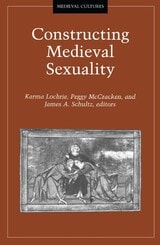
Constructing Medieval Sexuality
Karma Lochrie
University of Minnesota Press, 1997
A groundbreaking examination of sexuality in the Middle Ages.
This collection is the first to be devoted entirely to medieval sexuality informed by current theories of sexuality and gender. It brings together essays from various disciplinary perspectives-literary, theological, philosophical, medical, historical, and art historical-to consider how the Middle Ages defined, regulated, and represented sexual practices and desires.
Always considering sexuality in relation to gender, the body, and identity, the essays explore medieval sexuality as a historical construction produced by and embedded in the cultures and institutions of that period. Examining a range of medieval texts and images, the contributors explore the medieval understanding of sodomy, the historical construction of heterosexuality, the polymorphous erotics of female mysticism, and the intersections of sexuality with race, gender, and religion. This work not only offers new perspectives on the ways in which queer theory might inform our views of sexuality in medieval Europe, but also suggests that medieval constructions of sexuality may offer important contributions to both queer theory and the history of sexuality.These essays, situated in the context of current debates, linger over various definitions of medieval sexuality; they speak to each other in their differences and their similarities to further productive thinking about the sometimes conflicting and always fascinating ways in which the Middle Ages regarded sex and sexuality. Contributors: E. Jane Burns, U of North Carolina; Joan Cadden, U of California, Davis; Michael Camille, U of Chicago; Dyan Elliott, Indiana U; Louise O. Fradenburg, U of California, Santa Barbara; Mark D. Jordan, U of Notre Dame; Steven F. Kruger, CUNY.
Constructing Modern Chemistry
J. B. Dumas and the French AtomAlan J. Rocke
University of Chicago Press, 0
A history of chemical atomic theory that centers on France and Jean-Baptiste Dumas, yielding new perspectives on the origins of modern chemistry.
Constructing Modern Chemistry examines the early history of the chemical atomic theory, focusing on France. Rather than beginning with John Dalton and the theory of the atom, skipping right to the periodic system, and rushing headlong into the discovery of subatomic particles, Alan J. Rocke traces relevant ideas and practices from their origins in Britain shortly after 1800 to their early reception in France. Then he addresses their history, especially among French and Francophone chemists (including connections to Britain, Sweden, and the German-speaking lands), up until about 1860. The major figure in the book is the curiously understudied but extraordinarily influential Jean-Baptiste Dumas (1800–1884).
The atomic theory is to the history of chemistry what Copernican cosmology is to the history of astronomy, what Newtonian mechanics is to the history of physics, and what evolution is to the history of biology: each of these ideas structures the very nature of scientific thought within its field. Constructing Modern Chemistry explores the changing nature of chemical theory, and of scientific theory in general, during the nineteenth century. Rocke sets out to show that the early history of chemical atomism provides important insight into theoretical patterns that became characteristic of the modern science of chemistry.
But while Rocke’s work will appeal to philosophers and others who value his analysis of theory and its workings, he places equal emphasis on social context: personal backstories, interpersonal relations, cultural and scientific institutions, and contingent events. The history that emerges is rich with insight into the origins of chemistry and its practices as we know it.
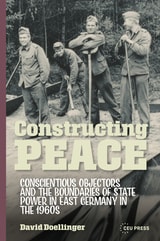
Constructing Peace
Conscientious Objectors and the Boundaries of State Power in East Germany in the 1960sDavid Doellinger
Central European University Press, 2026
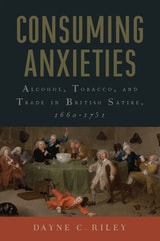
Consuming Anxieties
Alcohol, Tobacco, and Trade in British Satire, 1660-1751Dayne C. Riley
Bucknell University Press, 2024
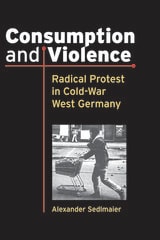
Consumption and Violence
Radical Protest in Cold-War West GermanyAlexander Sedlmaier
University of Michigan Press, 2014
Contemporary Europe in the Historical Imagination
Edited by Darcy Buerkle and Skye Doney
University of Wisconsin Press, 2023
George L. Mosse (1918–99) was one of the most influential cultural and intellectual historians of modern Europe. A refugee from Nazi Germany, he was an early leader in the study of fascism and the history of sexuality and masculinity, authoring more than two dozen books. In Contemporary Europe in the Historical Imagination, an international assembly of leading scholars explore Mosse’s enduring methodologies in German studies and modern European cultural history. Considering Mosse’s life and work historically and critically, the book begins with his intellectual biography and goes on to reread his writings in light of historical developments since his death, and to use, extend, and contend with Mosse’s legacy in new contexts he may not have addressed or even foreseen.
The volume wrestles with intertwined questions that continue to emerge from Mosse’s pioneering research, including: What role do sexual and racial stereotypes play in European political culture before and after 1945? How are gender and Nazi violence bound together? And what does commemoration reveal about national culture? Importantly, the contributors pose questions that are inspired by Mosse’s work but that he did not directly examine. For example, to what extent were Nazism and Italian Fascism colonial projects? How have popular radical right parties reinforced and reimagined ethnonationalism and nativism? And how did Nazi perpetrators construct a moral system that accommodated genocide? Much like Mosse’s own work, the chapters in this book inspire new interventions into the history of gender and sexuality, Jewish identity during the rise of the Third Reich, and the many reincarnations of fascist pageantry and mass politics.
Contributors: Adi Armon, Steven E. Aschheim, Aleida Assmann, Darcy Buerkle, Skye Doney, Arie M. Dubnov, Rebekka Grossmann, David Harrisville, Meike Hoffmann, Andreas Huyssen, Elissa Mailänder, Frank Mecklenburg, Mary Nolan, Stefanie Schüler-Springorum, Roger Strauch, Enzo Traverso, Marc Volovici, Elisabeth Wagner, Sarah Wobick-Segev, Robert Zwarg
Contemporary Portugal
The Revolution and Its AntecedentsEdited by Lawrence S. Graham and Harry M. Makler
University of Texas Press, 1979
Despite worldwide interest in the Portuguese Revolution of 1974, Portugal remained for most people a little known and poorly understood country, neglected for years by social scientists. Editors Graham and Makler brought together for the first time in one substantive volume most of the leading social science experts on Portugal.
The contributors' highly original research represents the best work generated by the International Conference Group on Modern Portugal at its two major conferences held in 1973 and 1976. The result is a comprehensive collection of essays discussing in detail the events leading up to the revolution, the causes of the military coup, and the movement of a society on the brink of revolutionary upheaval toward open, democratic parliamentary elections.
As the first interdisciplinary study to span fifty years of Portuguese history from the Estado Novo of 1926 to the eventual social democratic republic, this book stands alone in its field. The specialist as well as the general reader will find insights into the dynamics of Portugal's people, politics, and economics.
Contested Canonizations
The Last Medieval Saints, 1482-1523Ronald C. Finucane
Catholic University of America Press, 2011
Contested Citizenship
Immigration and Cultural Diversity in EuropeRuud Koopmans
University of Minnesota Press, 2005
Revealing striking cross-national differences in how immigration and diversity are contended by different national governments, these authors find that how citizenship is constructed is the key variable defining the experience of Europe’s immigrant populations. Contested Citizenship provides nuanced policy recommendations and challenges the truism that multiculturalism is always good for immigrants. Even in an age of European integration and globalization, the state remains a critical actor in determining what points of view are sensible and realistic—and legitimate—in society.
Ruud Koopmans is professor of sociology at Free University, Amsterdam. Paul Statham is reader in political communications at the University of Leeds. Marco Giugni is a researcher and teacher of political science at the University of Geneva. Florence Passy is assistant professor of political science at the University of Lausanne, Switzerland.
Contested City
Municipal Politics and the Rise of Nazism in Altona, 1917-1937Anthony McElligott
University of Michigan Press, 1998
Contested Memories
Poles and Jews during the Holocaust and Its AftermathZimmerman, Joshua D.
Rutgers University Press, 2003
This collection of essays, representing three generations of Polish and Jewish scholars, is the first attempt since the fall of Communism to reassess the existing historiography of Polish-Jewish relations just before, during, and after the Second World War. In the spirit of detached scholarly inquiry, these essays fearlessly challenge commonly held views on both sides of the debates. The authors are committed to analyzing issues fairly and to reaching a mutual understanding. Contributors cover six topics:
1. The prewar legacy
2. The deterioration of Polish-Jewish relations during the first years of the war
3. Institutional Polish responses to the Nazi Final Solution
4. Poles and the Polish nation through Jewish eyes
5. The destruction of European Jewry and Polish popular opinion
6. Polish-Jewish relations since 1945
Contesting Copyright
A History of Intellectual Property in East Central Europe and the BalkansAugusta Dimou
Central European University Press, 2026
Contesting Sacrifice
Religion, Nationalism, and Social Thought in FranceIvan Strenski
University of Chicago Press, 2002
Strenski suggests that the annihilating spirituality rooted in the Catholic model of Eucharistic sacrifice persuaded the judges in the Dreyfus Case to overlook or play down his possible innocence because a scapegoat was needed to expiate the sins of France and save its army from disgrace. Strenski also suggests that the French army's strategy in World War I, French fascism, and debates over public education and civic morals during the Third Republic all owe much to Catholic theology of sacrifice and Protestant reinterpretations of it. Pointing out that every major theorist of sacrifice is French, including Bataille, Durkheim, Girard, Hubert, and Mauss, Strenski argues that we cannot fully understand their work without first taking into account the deep roots of sacrificial thought in French history.

Continental England
Form, Translation, and Chaucer in the Hundred Years’ WarElizaveta Strakhov
The Ohio State University Press, 2022
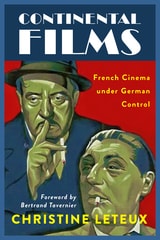
Continental Films
French Cinema under German ControlChristine Leteux
University of Wisconsin Press, 2022
Using recently opened archival documents, including reams of testimony from the épuration (purification) hearings conducted shortly after the war, Christine Leteux has produced the most authoritative and complete history of the company and its impact on the French film industry—both during the war and after. She captures the wide range of responses to the firm from those who were eager to work for a company whose ideology matched their own, to others who reluctantly accepted contracts out of necessity, to those who abhorred the company but felt compelled to participate in order to protect family members from Nazi reprisals. She examines not only the formation and management of Continental Films but also the personalities involved, the fraught and often deadly political circumstances of the period, the critical reception of the films, and many of the more notorious and controversial events.
As Bertrand Tavernier explains in his foreword, Leteux overturns many of the preconceptions and clichés that have come to be associated with Continental Films. Published to rave reviews in French and translated by the author into English, this work shatters expectations and will reinvigorate study of a lesser-known but significant period of French film history.

Control of the Imaginary
Reason and Imagination in Modern TimesLuiz Costa LimaTranslated by Ronald W. SousaIntroduction by Ronald W. SousaAfterword by Jochen Schulte-Sasse
University of Minnesota Press, 1989
Control of the Imaginary was first published in 1989. Minnesota Archive Editions uses digital technology to make long-unavailable books once again accessible, and are published unaltered from the original University of Minnesota Press editions.
In Control of the Imaginary Luiz Costa Lima explains how the distinction between truth and fiction emerged at the beginning of modern times and why, upon its emergence, fiction fell under suspicion. Costa Lima not only describes the continuous relationship between Western notions of reason and subjectivity over a broad time-frame—the Renaissance to the first decade of the twentieth century—but he uses this occasion to reexamine the literary traditions of France, Italy, Spain, Portugal, England, and Germany. The book reconstructs the dominant frames in the European tradition between the Middle Ages and the nineteenth century from the perspective of a Latin American who sees the culture of his native Brazil haunted by unresolved questions from the Northern Hemisphere. Costa Lima manages to synthesize positions from philosophy, anthropology, sociology, psychology, linguistics, and history without separating the theoretical discussion from his historical reconstructions.
The first chapter situates the problem and grounds the emergent distinction between truth and fiction in a very close analysis of one of the first European historians, Fernao Lopes, who sets the tone for the condemnation of fiction in the name of the truth of history and the potential for individual interpretation. Costa Lima pursues these notions through the aesthetic debates of the seventeenth and eighteenth centuries to the writings of the French historian Michelet. He also devotes an illuminating chapter to the invention of the strictures imposed on fiction.

Controlling East-West Trade and Technology Transfer
Power, Politics, and PoliciesGary K. Bertsch, ed.
Duke University Press, 1988

Conventional Arms Control and East-West Security
Robert D. Blackwill and F. Stephen Larrabee, eds.
Duke University Press, 1989
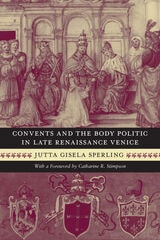
Convents and the Body Politic in Late Renaissance Venice
Jutta Gisela Sperling
University of Chicago Press, 2000
Sperling explains how women were not allowed to marry beneath their social status while men could, especially if their brides were wealthy. Faced with a shortage of suitable partners, patrician women were forced to offer themselves as "a gift not only to God, but to their fatherland," as Patriarch Giovanni Tiepolo told the Senate of Venice in 1619. Noting the declining birth rate among patrician women, Sperling explores the paradox of a marriage system that preserved the nobility at the price of its physical extinction. And on a more individual level, she tells the fascinating stories of these women. Some became scholars or advocates of women's rights, some took lovers, and others escaped only to survive as servants, prostitutes, or thieves.
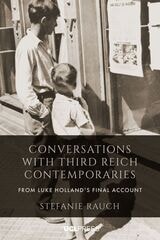
Conversations with Third Reich Contemporaries
From Luke Holland’s Final AccountStefanie Rauch
University College London, 2025
Conversations with Third Reich Contemporaries presents excerpts from filmed interviews conducted by British documentary filmmaker Luke Holland across a span of over a decade. These interviews were compiled into the German-language documentary film Final Account (2020), completed shortly before Holland’s death. Most interviewees were young adults when the war ended; some had benefited from Nazism, and others had directly enacted persecution or state violence. In addition to making this vital interview collection more widely accessible, the sourcebook raises critical awareness of issues around representation, authenticity, memory, and the co-production of narratives, reshaping discussions around the role of “ordinary” citizens under the Third Reich. It is the first sourcebook to engage directly with issues of representation and identity after 1945.
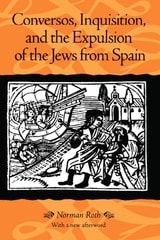
Conversos, Inquisition, and the Expulsion of the Jews from Spain
Norman Roth
University of Wisconsin Press, 2002
The Jewish community of medieval Spain was the largest and most important in the West for more than a thousand years, participating fully in cultural and political affairs with Muslim and Christian neighbors. This stable situation began to change in the 1390s, and through the next century hundreds of thousands of Jews converted to Christianity. Norman Roth argues here with detailed documentation that, contrary to popular myth, the conversos were sincere converts who hated (and were hated by) the remaining Jewish community. Roth examines in depth the reasons for the Inquisition against the conversos, and the eventual expulsion of all Jews from Spain.
“With scrupulous scholarship based on a profound knowledge of the Hebrew, Latin, and Spanish sources, Roth sets out to shatter all existing preconceptions about late medieval society in Spain.”—Henry Kamen, Journal of Ecclesiastical History
“Scholarly, detailed, researched, and innovative. . . . As the result of Roth’s writing, we shall need to rethink our knowledge and understanding of this period.”—Murray Levine, Jewish Spectator
“The fruit of many years of study, investigation, and reflection, guaranteed by the solid intellectual trajectory of its author, an expert in Jewish studies. . . . A contribution that will be particularly valuable for the study of Spanish medievalism.”—Miguel Angel Motis Dolader, Annuario de Estudios Medievales
Conveying the Renaissance
A Tribute to Charles S. RossAngelica Duran
University of Delaware Press, 2027
Conveying the Renaissance: A Tribute to Charles S. Ross provides answers to at once timely and enduring questions: How did literary works convey new, distinctive ideas and dynamics in the Renaissance era? How have Renaissance literary works, in turn, been conveyed into various media through today? By what authorial and authorizing agents and forces—authors and artists, international politics, performers, readers, technologies, and translators—have these works and the ideas and dynamics of the Renaissance era been conveyed? And for what kinds of audiences, imagined and actual? The answers show the vitality of Ludovico Ariosto, Matteo Maria Boiardo, Claudio Monteverdi, Cervantes, Milton, Shakespeare, Tasso, and other Renaissance authors in their immediate contexts and through the centuries in cinema, landscaping, modernist lyric, music, puppetry, TV, and visual art. The eight main chapters are case studies drawing out cultural dynamics, topics, and media that deserve renewed attention or that have received no attention despite their significance.

Copenhagen Chic
A Locational History of Copenhagen FashionEdited by Katrina Sark
Intellect Books, 2023
Copenhagen has long been celebrated for its unique fashion, design, innovation, and sustainability practices, yet there has never been a comprehensive history of Copenhagen fashion and its current innovation and sustainability drive. This book fills that gap, assembling a multidisciplinary roster of contributors to examine all aspects of Copenhagen fashion and culture. Grounded in a broad context of Danish culture, industry, media, technology, sustainability, and innovation practices within the wider cultural and economic fields of fashion, the book helps us understand what makes Copenhagen unique.
Copying Machines
Taking Notes for the AutomatonCatherine Liu
University of Minnesota Press, 2000
Explores literary theory’s fear of and fascination with the mechanical.
Anxieties about fixing the absolute difference between the human being and the mechanical replica, the automaton, are as old as the first appearance of the machine itself. Exploring these anxieties and the efforts they prompted, this book opens a window on one of the most significant, if subtle, ideological battles waged on behalf of the human against the machine since the Enlightenment—one that continues in the wake of technological and conceptual progress today.
A sustained examination of the automaton as early modern machine and as a curious ancestor of the twentieth-century robot, Copying Machines offers extended readings of mechanistic images in the eighteenth century through the prism of twentieth-century commentary. In readings of texts by Lafayette, Molière, Laclos, and La Bruyère—and in a chapter on the eighteenth-century inventor of automatons, Jacques Vaucanson—Catherine Liu provides a fascinating account of ways in which the automaton and the preindustrial machine haunt the imagination of ancien régime France and structure key moments of the canonical literature and criticism of the period.
Cordially Yours, Brother Cadfael
Edited by Anne K. Kaler
University of Wisconsin Press, 1998
Why, essays ask, is a cloistered monk solving murders? How can an author combine a valid detective and an effective healer?
Core Europe and Greater Eurasia
A Roadmap for the FutureEdited by Peter W. Schulze
Campus Verlag, 2017
Cosmas of Prague
Lisa Wolverton
Catholic University of America Press, 2014
Cosmas of Prague
The Chronicle of the CzechsPetra Mutlová
Central European University Press, 2020
The Latin-English bilingual volume presents the text of The Chronicle of the Czechs by Cosmas of Prague. Cosmas was born around 1045, educated in Liège, upon his return to Bohemia, he got married as well as became a priest. In 1086 he was appointed prebendary, a senior member of clergy in Prague. He completed the first book of the Chronicle in 1119, starting with the creation of the world and the earliest deeds of the Czechs up to Saint Adalbert. In the second and third books Cosmas presents the preceding century in the history of Bohemia, and succeeds in reporting about events up to 1125, the year when he died.
The English translation was done by Petra Mutlova and Martyn Rady with the cooperation of Libor Švanda. The introduction and the explanatory notes were written by Jan Hasil with the cooperation of Irene van Rensvoude.T
Cosmopolis
The Hidden Agenda of ModernityStephen Toulmin
University of Chicago Press, 1992
In the seventeenth century, a vision arose which was to captivate the Western imagination for the next three hundred years: the vision of Cosmopolis, a society as rationally ordered as the Newtonian view of nature. While fueling extraordinary advances in all fields of human endeavor, this vision perpetuated a hidden yet persistent agenda: the delusion that human nature and society could be fitted into precise and manageable rational categories. Stephen Toulmin confronts that agenda—its illusions and its consequences for our present and future world.
Cosmopolitanisms and the Jews
Cathy S. Gelbin and Sander L. Gilman
University of Michigan Press, 2017
Counterinsurgency and Collusion in Northern Ireland
Mark McGovern
Pluto Press, 2019
Here Mark McGovern turns back the clock to the late 1980s and early ‘90s—the ‘endgame’ of the Troubles and a period defined by a rash of state-sanctioned paramilitary killings. Drawing on previously unpublished evidence, and original testimony of victims’ families and eyewitnesses, McGovern examines several dozen killings of republicans and their families and communities that took place in the Mid-Ulster area. Placing these accounts within a wider critical analysis of the nature of British counterinsurgency and the state use of agents and informers, McGovern paints a damning picture of covert, deniable, and unlawful violence.
Court, Cloister, and City
The Art and Culture of Central Europe, 1450-1800Thomas DaCosta Kaufmann
University of Chicago Press, 1995
"Kaufmann throws considerable light on one of the more neglected and least understood periods in art history."—Philadelphia Inquirer
"A wonderful book which does justice both to a formal analysis of the art and to an explanation of broader political and economic forces at work."—Virginia Quarterly Review
"Important and stimulating, Kaufmann's study examines the cultural legacy of a region too little known and understood."—Choice
"Peaks of the creative heritage which [Kaufmann] describes reserve their message—and their surprises—for those who visit them in situ. But invest in Kaufmann's volume before you go."—R. J. W. Evans, New York Review of Books
Courtly Love, the Love of Courtliness, and the History of Sexuality
James A. Schultz
University of Chicago Press, 2006
Courtly love, Schultz finds, was provoked not by the biological and intrinsic factors that play such a large role in our contemporary thinking about sexuality—sex difference or desire—but by extrinsic signs of class: bodies that were visibly noble and behaviors that represented exemplary courtliness. Individuals became “subjects” of courtly love only to the extent that their love took the shape of certain courtly roles such as singer, lady, or knight. They hoped not only for physical union but also for the social distinction that comes from realizing these roles to perfection. To an extraordinary extent, courtly love represented the love of courtliness—the eroticization of noble status and the courtly culture that celebrated noble power and refinement
Courts, Jurisdictions, and Law in John Milton and His Contemporaries
Alison A. Chapman
University of Chicago Press, 2020
Surveying Milton’s early pamphlets, divorce tracts, late political tracts, and major prose works in comparison with the writings and cases of some of Milton’s contemporaries—including George Herbert, John Donne, Ben Jonson, and John Bunyan—Chapman reveals the variety and nuance in Milton’s juridical toolkit and his subtle use of competing legal traditions in pursuit of justice.
Covert Gestures
Crypto-Islamic Literature as Cultural Practice in Early Modern SpainVincent Barletta
University of Minnesota Press, 2005
Creating Spaniards
Culture and National Identity in Republican SpainSandie Holguin
University of Wisconsin Press, 2002
Creating Spaniards is a cultural and intellectual history that explains the intersection of politics and culture, and the formation of a national identity, during Spain’s Second Republic and Civil War. It counters recent scholarship claiming that leaders of the Second Republic had no programs for "inventing traditions" to encourage a Spanish national identity.
Focusing on the Second Republic, 1931–1936, Sandie Holguín illustrates how various intellectuals and politicians of the Republican–Socialist coalition used theater, literature, and film to aid the construction of a unified Spanish culture and history. She uses memoirs, journals, newspapers, parliamentary debates, and archival sources in her examination of the impact that cultural reforms had on the transformation of one of Europe’s oldest states.

Creative Dissent
Alternative Cultures during SocialismKatalin Cseh-Varga
Central European University Press, 2027
Creative Dissent argues that the region was teeming with alternative cultures: emerging practices and expressions that actively challenged the dominant social code and reshaped the reality of the people’s democracies.
The book explores how ordinary people, intellectuals, and cultural players across socialist Europe responded to state repression and comprehensive control with ingenuity and defiance. By examining how these dissenting voices circumvented or even penetrated official spaces, this collection illuminates the complex heterogeneity of life behind the Iron Curtain.
Structured around four key areas—communities, markets, media, and spaces—this work offers a necessary, nuanced understanding of cultural resistance and the limits of authoritarian control.
Credit, Fashion, Sex
Economies of Regard in Old Regime FranceClare Haru Crowston
Duke University Press, 2013
Credit economies constituted "economies of regard" in which reputation depended on embodied performances of credibility. Crowston explores the role of fashionable appearances and sexual desire in leveraging credit and reconstructs women's vigorous participation in its gray markets. The scandalous relationship between Queen Marie Antoinette and fashion merchant Rose Bertin epitomizes the vertical loyalties and deep social divides of the credit regime and its increasingly urgent political stakes.
Crip Authority
Disability and the Art of Consolation in the RenaissanceElizabeth B. Bearden
University of Michigan Press, 2025
Disabled authors include Francesco Petrarca, Teresa de Cartagena, Giovani Paolo Lomazzo, Miguel de Cervantes Saavedra, Robert Burton, and John Milton. They all explore their experiences of disability, but their work has rarely or never been considered from a disability studies perspective. Bearden thus brings today’s models of disability studies and crip theory together with early modern articulations of disability based on ancient and Renaissance models of military, political, biblical, and literary authority. In sum, Crip Authority makes a significant contribution to the growing field of early modern disability studies and invites us to rethink the extent of crip history and the endurance of disability gain.

Critical Heritage Studies and the Futures of Europe
Edited by Rodney Harrison, Nélia Dias, and Kristian Kristiansen
University College London, 2023
Cultural and natural heritage are central to ideas of what Europe and “the European project’” are. Heritage studies were prevalent in the emergence of nation-states in the eighteenth and nineteenth centuries, where they were used to justify differences over which border conflicts were fought. Later, the idea of a “common European heritage” provided a rationale for the development of the European Union. Now, the emergence of “new” populist nationalisms shows how the imagined past continues to play a role in cultural and social governance, while a series of interlinked social and ecological crises are changing the ways that heritage operates, with new discourses and ontologies emerging to reconfigure heritage for the circumstances of the present and the uncertainties of the future.
Crossing Borders
Hebrew Manuscripts as a Meeting-place of CulturesEdited by Piet van Boxel and Sabine Arndt
Bodleian Library Publishing, 2010
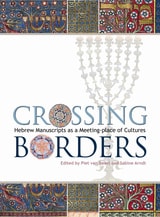
Crossing Borders tells the intriguing but largely unfamiliar story of the exchange of culture and knowledge between Jews and non-Jews in the Muslim and Christian worlds during the late Middle Ages as part of the preparation of Hebrew manuscripts. The book is composed of ten narratives, each of which brings to light a different aspect of Jewish life in a non-Jewish medieval society—highlighting the practical cooperation, social interaction, and religious toleration that was surprisingly common between the groups involved in the early enterprise of book production.
Alongside the narratives, Crossing Borders is beautifully illustrated with images from the Hebrew holdings at the Bodleian Library—one of the largest and most important collections of Hebrew manuscripts worldwide. The art includes Christian codex fragments from the third century, a copy of Moses Maimonides’ Mishneh Torah signed by Maimonides himself, a thirteenth century German Jewish prayer book, and lavishly illuminated Spanish Bible manuscripts from the fifteenth century. This exquisitely illustrated book takes a fascinating look at the often-ignored role of Jews in the written transmission of culture and science throughout medieval Europe.
Crossing Cultures
Essays in the Displacement of Western CivilizationDaniel Segal
University of Arizona Press, 1992
Crossing the Rapido
A Tragedy of World War IIDuane Schultz
Westholme Publishing, 2010
The True Story of an Impossible Mission During the Liberation of Italy
"World War II history writing at its best.” —Dallas Morning News
“Schultz convey stories of individual courage and fear. He presents the Rapido crossing as part of an experience that changed lives utterly.” —Publishers Weekly
“Well written, superbly documented and containing many helpful illustrations and maps, this fine book will appeal to military history enthusiasts of all ages.” —Read@MPL (Milwaukee Public Library)
“Duane Schultz has written another powerful account of the Second World War.” —Daily News, Iron Mountain, Michigan
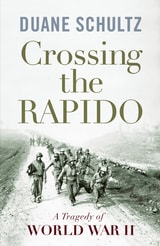
“A fast-paced, dramatic account of World War II combat.”—Global War StudiesThe Rapido River was the last natural barrier between General Mark W. Clark’s Fifth U.S. Army and Rome. Ignoring intelligence reports that the Germans had significant forces protecting the opposite side of the river, Clark ordered the 36th Division to make a nighttime crossing on January 20, 1944. The division, already coming through some of the heaviest fighting in Italy, knew they could not succeed: they had to cross a fast-flowing river at night in bitter cold and face one of the strongest, most formidable German defensive lines in Europe, full of minefields, veteran troops, and withering artillery and mortar fire. Once in the water, men in full field gear were borne away by the current or vanished in massive explosions. The few who managed to reach the other side found themselves pinned down unable to move. Soldiers died by the hundreds, yet the stunned survivors who fell back to the launch site were ordered to attack again, this time in daylight. Of the 4,000 men who attempted the crossing, more than half did not return. General Clark never accepted blame for ordering the assault despite the numerous warnings he received from both British and American commanders. Although they were decimated, the division went on to lead a key surprise attack that opened Rome to Allied forces, and ultimately fought in France, where they had the distinction of capturing Hermann Goering and Field Marshal Gerd von Rundstedt.
In Crossing the Rapido: A Tragedy of World War II, Duane Schultz follows the action at the ground level using survivors’ interviews and army documents to tell the story of one division’s sacrifice in war. In doing so, he demonstrates that the American soldier will face the greatest odds without protest, but expects those in command to share any failure or success.“Those of us who were present will always remember the men of the 36th, climbing silently in the night behind the enemy, armed with little but their American competence and a personal faith in their quiet, retiring general who had never let them down. If Generals Alexander and Clark received the key to the city of Rome, it was General Walker who turned the key and handed it to them.” —Eric Sevareid, reporting from Italy during World War II
“I have never seen so many dead as on that day.” —John Huston, Academy Award winning director during his wartime filming of The Battle of San Pietro
Cruelty and Laughter
Forgotten Comic Literature and the Unsentimental Eighteenth CenturySimon Dickie
University of Chicago Press, 2011
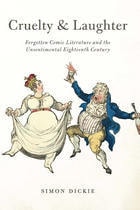
Eighteenth-century British culture is often seen as polite and sentimental—the creation of an emerging middle class. Simon Dickie disputes these assumptions in Cruelty and Laughter, a wildly enjoyable but shocking plunge into the forgotten comic literature of the age. Beneath the surface of Enlightenment civility, Dickie uncovers a rich vein of cruel humor that forces us to recognize just how slowly ordinary human sufferings became worthy of sympathy.
Delving into an enormous archive of comic novels, jestbooks, farces, variety shows, and cartoons, Dickie finds a vast repository of jokes about cripples, blind men, rape, and wife-beating. Epigrams about syphilis and scurvy sit alongside one-act comedies about hunchbacks in love. He shows us that everyone—rich and poor, women as well as men—laughed along. In the process, Dickie also expands our understanding of many of the century’s major authors, including Samuel Richardson, Lady Mary Wortley Montagu, Tobias Smollett, Frances Burney, and Jane Austen. He devotes particular attention to Henry Fielding’s Joseph Andrews, a novel that reflects repeatedly on the limits of compassion and the ethical problems of laughter. Cruelty and Laughter is an engaging, far-reaching study of the other side of culture in eighteenth-century Britain.
Crying Hands
Eugenics and Deaf People in Nazi GermanyHorst Biesold
Gallaudet University Press, 2003
When the Nazis assumed power in Germany in 1933, they wasted no time in implementing their radical policies, first by securing passage of the Law for the Prevention of Offspring with Hereditary Diseases. Among those designated by this law as “congenitally disabled” were deaf people. Horst Biesold’s newly translated book examines this neglected aspect of Nazi “racial hygiene” through interviews with more than 1,000 deaf survivors of this brutal law that authorized forced sterilizations, abortions, and eventually murder.
Crying Hands meticulously delineates the antecedents of Nazi eugenics, beginning with Social Darwinism (postulated in the mid-nineteenth century) and tracing the various sterilization laws later initiated throughout the world, including many passed and practiced in the United States. This exceptional scholarship is movingly paralleled by the human faces fixed to the numbing statistics, as in story after story those affected recount their irretrievable loss, pain, and misplaced shame imposed upon them by the Nazi regime. Through their stories, told to Biesold in German Sign Language, they have given voice to the countless others who died from the specious science practiced by the Third Reich. And now their own trials have finally been acknowledged.
Cul de Sac
Patrimony, Capitalism, and Slavery in French Saint-DominguePaul Cheney
University of Chicago Press, 2017
Focusing on correspondence between the Ferronnayses and their plantation managers, Cul de Sac proposes that the Caribbean plantation system, with its reliance on factory-like production processes and highly integrated markets, was a particularly modern expression of eighteenth-century capitalism. But it rested on a foundation of economic and political traditionalism that stymied growth and adaptation. The result was a system heading toward collapse as planters, facing a series of larger crises in the French empire, vainly attempted to rein in the inherent violence and instability of the slave society they had built. In recovering the lost world of the French Antillean plantation, Cul de Sac ultimately reveals how the capitalism of the plantation complex persisted not as a dynamic source of progress, but from the inertia of a degenerate system headed down an economic and ideological dead end.
Cultural Aesthetics
Renaissance Literature and the Practice of Social OrnamentPatricia Fumerton
University of Chicago Press, 1991
Cultural Marxism in Postwar Britain
History, the New Left, and the Origins of Cultural StudiesDennis Dworkin
Duke University Press, 1997
Limited to neither a single discipline nor a particular intellectual figure, this book comprehensively views British cultural Marxism in terms of the dialogue between historians and the originators of cultural studies and in its relationship to the new left and feminist movements. From the contributions of Eric Hobsbawm, Christopher Hill, Rodney Hilton, Sheila Rowbotham, Catherine Hall, and E. P. Thompson to those of Perry Anderson, Barbara Taylor, Raymond Williams, Dick Hebdige, and Stuart Hall, Dworkin examines the debates over issues of culture and society, structure and agency, experience and ideology, and theory and practice. The rise, demise, and reorganization of journals such as The Reasoner, The New Reasoner, Universities and Left Review, New Left Review, Past and Present, are also part of the history told in this volume. In every instance, the focus of Dworkin’s attention is the intellectual work seen in its political context. Cultural Marxism in Postwar Britain captures the excitement and commitment that more than one generation of historians, literary critics, art historians, philosophers, and cultural theorists have felt about an unorthodox and critical tradition of Marxist theory.
Cultural Revolution in Berlin
Jews in the Age of EnlightenmentShmuel Feiner and Natalie Naimark-Goldberg
Bodleian Library Publishing, 2011