Results by title
8128 books match the query 'Literary Criticism' and 523 start with c
Contesting Childhood
Autobiography, Trauma, and MemoryDouglas, Kate
Rutgers University Press, 2010
Drawing on trauma and memory studies and theories of authorship and readership, Contesting Childhood offers commentary on the triumphs, trials, and tribulations that have shaped this genre. Douglas examines the content of the narratives and the limits of their representations, as well as some of the ways in which autobiographies of youth have become politically important and influential. This study enables readers to discover how stories configure childhood within cultural memory and the public sphere.
Contesting Cultural Rhetorics
Public Discourse and Education, 1890-1900Margaret J. Marshall
University of Michigan Press, 1995
Contesting the Past, Reconstructing the Nation
American Literature and Culture in the Gilded Age, 1876-1893Benjamin A. Railton
University of Alabama Press, 2007
In this study of Gilded Age literature and culture, Ben Railton proposes that in the years after Reconstruction, America’s identity was often contested through distinct and competing conceptions of the nation’s history. He argues that the United States moved toward unifying and univocal historical narratives in the years between the Centennial and Columbian Expositions, that ongoing social conflict provided sites for complications of those narratives, and that works of historical literature offer some of the most revealing glimpses into the nature of those competing visions.
Gilded Age scholarship often connects the period to the 20th-century American future, but Railton argues that it is just as crucial to see how the era relates to the American past. He closely analyzes the 1876 and 1893 Expositions, finding that many of the period’s central trends, from technology to imperialism, were intimately connected to particular visions of the nation’s history. Railton’s concern is with four key social questions: race, Native Americans, women, and the South. He provides close readings of a number of texts for the ways they highlight these issues. He examines established classics (The Adventures of Huck Finn and The Bostonians); newer additions to the canon (The Conjure Woman, Life Among the Piutes, The Story of Avis); largely forgotten best-sellers (Uncle Remus, The Grandissimes); unrecovered gems (Ploughed Under, Where the Battle Was Fought); and autobiographical works by Douglass and Truth, poems by Harper and Piatt, and short stories by Woolson and Cook.
These readings, while illuminating the authors themselves, contribute to ongoing conversations over historical literature’s definition and value, and a greater understanding of not only American society in the Gilded Age, but also debates on our shared but contested history that remain very much alive in the present.
Context in Literary and Cultural Studies
Edited by Jakob Ladegaard and Jakob Gaardbo Nielsen
University College London, 2019
Introducing readers to new developments in literary and cultural theory, Context in Literary and Cultural Studies connects all disciplines related to these areas to provide an interdisciplinary overview of the challenges different scholarly fields today meet in their studies of artworks in context. Spanning a number of countries and covering subjects from nineteenth-century novels to rave culture, the chapters together constitute an informed, diverse and wide-ranging discussion. The volume is written for scholarly readers at all levels in the fields of literary studies, comparative literature, cultural studies, art history, film, theater studies, and digital humanities.
Continental Divides
Remapping the Cultures of North AmericaRachel Adams
University of Chicago Press, 2009
North America is more a political and an economic invention than a place people call home. Nonetheless, the region shared by the United States and its closest neighbors, North America, is an intriguing frame for comparative American studies. Continental Divides is the first book to study the patterns of contact, exchange, conflict, and disavowal among cultures that span the borders of Canada, the United States, and Mexico.
Rachel Adams considers a broad range of literary, filmic, and visual texts that exemplify cultural traffic across North American borders. She investigates how our understanding of key themes, genres, and periods within U.S. cultural study is deepened, and in some cases transformed, when Canada and Mexico enter the picture. How, for example, does the work of the iconic American writer Jack Kerouac read differently when his Franco-American origins and Mexican travels are taken into account? Or how would our conception of American modernism be altered if Mexico were positioned as a center of artistic and political activity? In this engaging analysis, Adams charts the lengthy and often unrecognized traditions of neighborly exchange, both hostile and amicable, that have left an imprint on North America’s varied cultures.
Continental Drift
From National Characters to Virtual SubjectsEmily Apter
University of Chicago Press, 1999
Among the many topics Apter explores are the fate of national literatures in an increasingly transnational literary climate; the volatile stakes of Albert Camus's life and reputation against the backdrop of Algerian civil strife; the use of literary and theatrical productions to "script" national character for the colonies; belly-dancing and aesthetic theory; and the impact of new media on colonial and postcolonial representation, from tourist photography to the videos of Digital Diaspora.
Continental Drift advances debates not just in postcolonial studies, but also in gender, identity, and cultural studies; ethnography; psychoanalysis; and performance studies.
Continental England
Form, Translation, and Chaucer in the Hundred Years’ WarElizaveta Strakhov
The Ohio State University Press, 2022
Contingency Blues
The Search For Foundations In American CriticismPaul Jay
University of Wisconsin Press, 1997
From Emerson to Rorty, American criticism has grappled in one way or another with the problem of modernity—specifically, how to determine critical and cultural standards in a world where every position seems the product of an interpretation. Part intellectual history, part cultural critique, this provocative book is an effort to shake American thought out of the grip of the nineteenth century—and out of its contingency blues.
Paul Jay focuses his analysis on two strands of American criticism. The first, which includes Richard Poirier and Giles Gunn, has attempted to revive what Jay insists is an anachronistic pragmatism derived from Emerson, James, and Dewey. The second, represented most forcefully by Richard Rorty, tends to reduce American criticism to a metadiscourse about the contingent grounds of knowledge. In chapters on Emerson, Whitman, Santayana, Van Wyck Brooks, Dewey, and Kenneth Burke, Jay examines the historical roots of these two positions, which he argues are marked by recurrent attempts to reconcile transcendentalism and pragmatism. A forceful rejection of both kinds of revisionism, Contingency Blues locates an alternative in the work of the “border studies” critics, those who give our interest in contingency a new, more concrete form by taking a more historical, cultural, and anthropological approach to the invention of literature, subjectivity, community, and culture in a pan-American context.
Contingent Figure
Chronic Pain and Queer EmbodimentMichael D. Snediker
University of Minnesota Press, 2021
A masterful synthesis of literary readings and poetic reflections, making profound contributions to our understanding of chronic pain
At the intersection of queer theory and disability studies, acclaimed theorist Michael D. Snediker locates something unexpected: chronic pain. Starting from this paradigm-shifting insight, Snediker elaborates a bracing examination of the phenomenological peculiarity of disability, articulating a complex idiom of figuration as the lived substance of pain’s quotidian. This lexicon helps us differently inhabit both the theoretical and phenomenal dimensions of chronic pain and suffering by illuminating where these modes are least distinguishable.
Suffused with fastidious close readings, and girded by a remarkably complex understanding of phenomenal experience, Contingent Figure resides in the overlap between literary theory and lyric experiment. Snediker grounds his exploration of disability and chronic pain in dazzling close readings of Herman Melville, Emily Dickinson, Henry James, and many others. Its juxtaposition of these readings with candid autobiographical accounts makes Contingent Figure an exemplary instance of literary theory as a practice of lyric attention.
Thoroughly rigorous and anything but predictable, this stirring inquiry leaves the reader with a rich critical vocabulary indebted to the likes of Maurice Blanchot, Gilles Deleuze, D. O. Winnicott, and Eve Kosofsky Sedgwick. A master class in close reading’s inseparability from the urgency of lived experience, this book is essential for students and scholars of disability studies, queer theory, formalism, aesthetics, and the radical challenge of Emersonian poetics across the long American nineteenth century.
Continuing Bonds with the Dead
Parental Grief and Nineteenth-Century American AuthorsHarold K. Bush
University of Alabama Press, 2016
Grief transformed into legacy—how loss shaped the soul of American literature.
Harold K. Bush's Continuing Bonds with the Dead examines the profound transfiguration that the death of a child wrought on the literary work of nineteenth-century American writers. Taking as his subjects Harriet Beecher Stowe, Abraham Lincoln, William Dean Howells, Mark Twain, and W. E. B. Du Bois, Bush demonstrates how the death of a child became the defining "before-and-after moment" in their lives as adults and as artists. In narrating their struggles, Bush maps the intense field of creative energy induced by reverberating waves of parental grief and the larger nineteenth-century culture of mortality and grieving.
Bush explores in detail how each of these five writers grappled with and were altered by the loss of a child. He writes, for example, with moving insights about how the famed author of Adventures of Huckleberry Finn found himself adrift on a river of grief when meningitis struck down his daughter, Susy. In his deeply learned exploration of Twain's subsequent work, Bush illuminates how Twain wrote to cope with Susy's death, to make sense of her persistent presence in his life, and possibly to redeem her loss. Passionate and personal, Bush's insightful prose traces the paths of personal transformation each of these emblematic American writers took in order to survive the spiritual trauma of loss.
The savage Civil War was America's shared "before and after moment," the pivot upon which the nation's future swung. Bush's account of these five writers' grief amplifies our understanding of America's evolving, national relationship to mourning from then to the present.
Continuous Pasts
Frictions of Memory in Postcolonial AfricaSakiru Adebayo
University of Michigan Press, 2023
Finalist: Memory Studies Association 2025 First Book Award Shortlist | April 7, 2025
In Continuous Pasts, author Sakiru Adebayo claims that the post-conflict fiction of memory in Africa depicts the intricate ways in which the past is etched on bodies and topographies, resonant in silences and memorials, and continuous even in experiences as well as structures of migration. Adebayo argues that the post-conflict fiction of memory in Africa invites critical deliberations on the continuity of the past within the realm of positionality and the domain of subjectivity—that is to say, the past is not merely present; instead, it survives, lives on, and is mediated through the subject positions of victims, perpetrators, as well as secondary and transgenerational witnesses. The book also argues that post-conflict fiction of memory in Africa shows the unfinished business of the past produces fragile regimes of peace and asynchronous temporalities that challenge progressive historicism. It contends that, in most cases in Africa, the post-conflict present is beset with a tight political economy wherein the scramble for survival trumps the ability to imagine a just future among survivors—and that it is precisely this despairing disposition toward the future that some writers of post-conflict fiction attempt to confront in their works. On the whole, Continuous Pasts shows how post-conflict fictions of memory in Africa recalibrate discourses of futurity, solidarity, responsibility, justice, survival, and reconciliation. It also contends that post-conflict fictions of memory in Africa provide the tools for imagining and theorizing a collective African memory. Each text analyzed in the book provides, in very interesting ways, an imaginative possibility and template for how post-independence African countries can ‘remember together’ using what the author describes as an African transnational memory framework.
Contours of the Theatrical Avant-Garde
Performance and TextualityJames M. Harding, Editor
University of Michigan Press, 2000
Contradictory Characters
An Interpretation of the Modern TheatreAlbert Bermel
Northwestern University Press, 1996
Playwright and critic Albert Bermel examines thirteen modern plays to assess the underpinnings of dramatic conflict. Contradictory Characters inspects the three well-known types of dramatic conflict-between characters, between character and environment, and within the protagonist himself-and argues that the "character-against-himself" is not only a type of conflict, but is indeed the prototypical conflict underlying the others.
Contradictory Indianness
Indenture, Creolization, and Literary ImaginaryAtreyee Phukan
Rutgers University Press, 2022
Convent Paradise
Arcangela Tarabotti
Iter Press, 2020
The Other Voice in Early Modern Europe - The Toronto Series volume 73
Conversations in Exile
Russian Writers AbroadJohn Glad, ed.
Duke University Press, 1993
Glad's introduction situates the three distinct waves of westward emigration in their historical and political framework. Organized by genre, the book begins with discussions with the older generation of writers and then moves on to more recent arrivals: the makers of fantasy and humor, the aesthetes, the moralists, and the realists. Each voice is compelling for its invaluable testimony--some reveal startling insights into the persecution of dissidents under Soviet rule while others address the relationship between creativity, writing, and conditions of exile. Taken together these interviews reveal the range of modern Russian writing and document the personalities and positions that have made Russian writers in emigration so diverse, experimental, and controversial.
The Writers: Vasily Aksyonov, Joseph Brodsky, Igor Chinnov, Natalya Goranevskaya, Frifrikh Gorensetin, Roman Goul, Yury Ivask, Boris Khazanov, Edward Liminov, Vladimir Makisimov, Andrei Siniavsky and Maria Rozanova, Sasha Sokolov, Vladimir Voinovich, Aleksandr Zinoviev
Excerpt
John Glad: You're a Russian poet but an American essayist. Does that bring on any measure of split personality? Do you think you are becoming less and less Russian?
Joseph Brodsky (recipient of 1987 Nobel Prize for Literature): That's not for me to say. As far as I'm concerned, in my inner self, inside, it feels quite natural. I think being a Russian poet and an American essayist is an ideal situation. It's all a matter of whether you have (a) the heart and (b) the brains to be able to do both. Sometimes I think I do. Sometimes I think I don't. Sometimes I think that one interferes with the other.
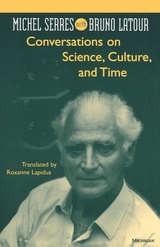
Conversations on Science, Culture, and Time
Michel Serres with Bruno LatourMichel Serres
University of Michigan Press, 1995
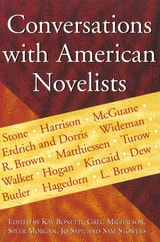
Conversations with American Novelists
Edited by Kay Bonetti, Greg Michalson, Speer Morgan, Jo Sapp, & Sam Stowers
University of Missouri Press, 1997
Readers of fine novels cherish the opportunity to hear their favorite novelists speak directly, without commentary or interpretation, about how their lives and concerns drive their fiction writing. For twenty years The Missouri Review has brought these readers some of the most compelling and thought- provoking literary interviews in print. In this collection of fifteen in-depth interviews with contemporary novelists, the authors discuss the style and themes of their work, their writing habits, their cultural and social backgrounds, and larger aesthetic issues with refreshing insight about themselves and their art.
Originally conducted for the American Audio Prose Library, the interviews were then edited for publication in The Missouri Review. Here they are reproduced with an introduction and with a brief biographical and bibliographical headnote for each writer. These candid interviews with some of our favorite novelists are sure to delight all readers.
Authors Interviewed in This Volume:Robert Stone
Jamaica Kincaid
Jim Harrison
Tom McGuane
Louise Erdrich and Michael Dorris
John Edgar Wideman
Robb Forman Dew
Rosellen Brown
Peter Matthiessen
Scott Turow
Margaret Walker
Linda Hogan
Robert Olen Butler
Jessica Hagedorn
Larry Brown

Conversations with Isabel Allende
Revised EditionEdited by John Rodden
University of Texas Press, 2004
This revised edition has been updated to cover Allende's three newest books—City of the Beasts, Portrait in Sepia: A Novel, and Daughter of Fortune. It includes four new interviews in which Allende discusses completing her trilogy of novels that began with House of the Spirits, as well as her ongoing spiritual adventure and political interests.

Conversations with Nelson Algren
H. E. F. Donohue and Nelson Algren
University of Chicago Press, 2001
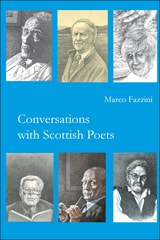
Conversations with Scottish Poets
Marco Fazzini
Aberdeen University Press, 2015
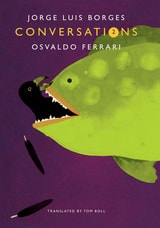
Conversations
Volume 2Jorge Luis Borges and Osvaldo Ferrari
Seagull Books, 2015
In Conversations: Volume 2, Borges and Ferrari engage in a dialogue that is both improvisational and frequently humorous as they touch on subjects as diverse as epic poetry, detective fiction, Buddhism, and the moon landing. With his signature wit, Borges offers insight into the philosophical basis of his stories and poems, his fascination with religious mysticism, and the idea of life as a dream. He also dwells on more personal themes, including the influence of his mother and father on his intellectual development, his friendships, and living with blindness. These recollections are alive to the passage of history, whether in the changing landscape of Buenos Aires or a succession of political conflicts, leading Borges to contemplate what he describes as his “South American destiny.”
The recurrent theme of these conversations, however, is a life lived through books. Borges draws on the resources of a mental library that embraces world literature—ancient and modern. He recalls the works that were a constant presence in his memory and maps his changing attitudes to a highly personal canon. In the prologue to the volume, Borges celebrates dialogue and the transmission of culture across time and place. These conversations are a testimony to the supple ways that Borges explored his own relation to numerous traditions.
Conversations
Volume 3Jorge Luis Borges and Osvaldo Ferrari
Seagull Books, 2017
In Conversations: Volume 3, Borges and Ferrari discuss subjects as diverse as film criticism, fantastic literature, science fiction, the Argentinian literary tradition, and the works of writers such as Bunyan, Wilde, Joyce, and Yeats, among others. With his signature wit, Borges converses on the philosophical basis of his writing, his travels, and his fascination with religious mysticism. He also ruminates on more personal themes, including the influence of his family on his intellectual development, his friendships, and living with blindness.
The recurrent theme of these conversations, however, is a life lived through books. Borges draws on the resources of a mental library that embraces world literature, both ancient and modern. He recalls the works that were a constant presence in his memory and maps his changing attitudes to a highly personal canon. These conversations are a testimony to the supple ways that Borges explored his own relation to numerous traditions—the conjunction of his life, his lucidity, and his imagination.
Conveying the Renaissance
A Tribute to Charles S. RossAngelica Duran
University of Delaware Press, 2027
Conveying the Renaissance: A Tribute to Charles S. Ross provides answers to at once timely and enduring questions: How did literary works convey new, distinctive ideas and dynamics in the Renaissance era? How have Renaissance literary works, in turn, been conveyed into various media through today? By what authorial and authorizing agents and forces—authors and artists, international politics, performers, readers, technologies, and translators—have these works and the ideas and dynamics of the Renaissance era been conveyed? And for what kinds of audiences, imagined and actual? The answers show the vitality of Ludovico Ariosto, Matteo Maria Boiardo, Claudio Monteverdi, Cervantes, Milton, Shakespeare, Tasso, and other Renaissance authors in their immediate contexts and through the centuries in cinema, landscaping, modernist lyric, music, puppetry, TV, and visual art. The eight main chapters are case studies drawing out cultural dynamics, topics, and media that deserve renewed attention or that have received no attention despite their significance.
Cooking by the Book
Food in Literature and CultureEdited by Mary Anne Schofield
University of Wisconsin Press, 1989
The second part of Cooking by the Book turns to the more diverse food rhetorics of the marketplace. What, for example, is the fast food rhetoric? Why are there so many eating disorders in our society? Is it possible to teach philosophy through cookery? How long has vegetarianism been popular?

Cool Memories II, 1987-1990
Jean Baudrillard
Duke University Press, 1996
In this wide-ranging discussion of events and ideas, Baudrillard moves between poetry and waterfalls, strikes and stealth bombers, Freud and La Cicciolina, shadows and simulacra, deconstruction and the zodiac, Reagan’s smile and Kennedy’s death, the “curse” on South America and the future of the West, the last tango of French intellectual life and the exemplary disappearing act of Italian politics. Writing at the site where the philosophic and the poetic merge, he once again offers us commentary in the form of the riveting insight, the short distillation of reality that establishes its truth with the force of recognition.
Cool Memories II, Baudrillard’s latest commentary on the technopresent and future, an installment of his reflections on the reality of contemporary western culture, will entice all readers concerned with postmodernism and the current state of theory.

Coordinates
Placing Science Fiction and FantasyGeorge E Slusser
Southern Illinois University Press, 1983
These thirteen original essays were written specifically for the Third J. Lloyd Eaton Conference on Science Fiction and Fantasy Literature, held February 21–22, 1981, at the University of California, Riverside.
Leslie Fiedler sets the tone of this volume by fixing a basic set of coordinates—that of “elitist” and “popular” standards.
Those replying to his charge are: Eric S. Rabkin, Professor of English at the University of Michigan and author of The Fantasticin Literature, “The Descent of Fantasy”; Gerald Prince, Professor of French at the University of Pennsylvania, “How New is New?”; Mark Rose, Professor of English at the University of California at Santa Barbara, author of Alien Encounters, “Jules Verne: Journey to the Center of Science Fiction”; Joseph Lenz, who teaches English Literature at the University of Michigan, “Manifest Destiny: Science Fiction Epic and Classical Forms”; Michelle Massé, of the English Department at the George Mason University, “‘All you have to do is know what you want’: Individual Expectations in Triton”;Gary K. Wolfe, who teaches English at Roosevelt University, author of The Known and the Unknown, “Autoplastic and Alloplastic Adaptations in Science Fiction: ‘Waldo’ and ‘Desertion’”; Robert Hunt, an editor with Glencoe Press, “Science Fiction for the Age of Inflation: Reading Atlas Shrugged in the 1980s”; George R. Guffey, Professor of English at UCLA, “Fahrenheit 451and the ‘Cubby-Hole Editors’ of Ballantine Books”; H. Bruce Franklin, Professor of English and American Literature at Rutgers University at Newark, “America as Science Fiction: 1939”; Sandra M. Gilbert, Professor of English at the University of California at Davis, and coauthor with Susan Gubar of Madwoman in the Attic, “Rider Haggard’s Heart of Darkness”; the aforementioned Susan Gubar, Professor of English at Indiana University, “She in Her/and: Feminism as Fantasy”; and George R. Slusser, Curator of the Eaton Collection, “Death and the Mirror: Existential Fantasy.”

Cops and Constables
American and British Fictional PolicemenEdited by Earl F. Bargainnier and George N. Dove
University of Wisconsin Press, 1986
Cordially Yours, Brother Cadfael
Edited by Anne K. Kaler
University of Wisconsin Press, 1998
Why, essays ask, is a cloistered monk solving murders? How can an author combine a valid detective and an effective healer?
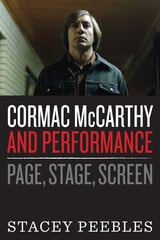
Cormac McCarthy and Performance
Page, Stage, ScreenBy Stacey Peebles
University of Texas Press, 2017
Cormac McCarthy is renowned as the author of popular and acclaimed novels such as Blood Meridian, All the Pretty Horses, and The Road. Throughout his career, however, McCarthy has also invested deeply in writing for film and theater, an engagement with other forms of storytelling that is often overlooked. He is the author of five screenplays and two plays, and he has been significantly involved with three of the seven film adaptations of his work. In this book, Stacey Peebles offers the first extensive overview of this relatively unknown aspect of McCarthy’s writing life, including the ways in which other artists have interpreted his work for the stage and screen.
Drawing on many primary sources in McCarthy’s recently opened archive, as well as interviews, Peebles covers the 1977 televised film The Gardener’s Son; McCarthy’s unpublished screenplays from the 1980s that became the foundation for his Border Trilogy novels and No Country for Old Men; various successful and unsuccessful productions of his two plays; and all seven film adaptations of his work, including John Hillcoat’s The Road (2009) and the Coen brothers’ Oscar-winning No Country for Old Men (2007). Emerging from this narrative is the central importance of tragedy—the rich and varied portrayals of violence and suffering and the human responses to them—in all of McCarthy’s work, but especially his writing for theater and film.
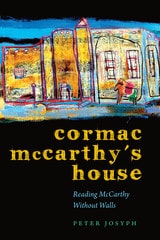
Cormac McCarthy's House
Reading McCarthy Without WallsBy Peter Josyph
University of Texas Press, 2013
Novelist Cormac McCarthy’s brilliant and challenging work demands deep engagement from his readers. In Cormac McCarthy’s House, author, painter, photographer, and actor-director Peter Josyph draws on a wide range of experience to pose provocative, unexpected questions about McCarthy’s work, how it is achieved, and how it is interpreted.
As a visual artist, Josyph wrestles with the challenge of rendering McCarthy’s former home in El Paso as a symbol of a great writer’s workshop. As an actor and filmmaker, he analyzes the high art of Tommy Lee Jones in The Sunset Limited and No Country for Old Men. Invoking the recent suicide of a troubled friend, he grapples with the issue of “our brother’s keeper” in The Crossing and The Sunset Limited. But for Josyph, reading the finest prose-poet of our day is a project into which he invites many voices, and his investigations include a talk with Mark Morrow about photographing McCarthy while he was writing Blood Meridian; an in-depth conversation with director Tom Cornford on the challenges of staging The Sunset Limited and The Stonemason; a walk through the streets, waterfronts, and hidden haunts of Suttree with McCarthy scholar and Knoxville resident Wesley Morgan; insights from the cast of The Gardener’s Son about a controversial scene in that film; actress Miriam Colon’s perspective on portraying the Dueña Alfonsa opposite Matt Damon in All the Pretty Horses; and a harsh critique of Josyph’s views on The Crossing by McCarthy scholar Marty Priola, which leads to a sometimes heated debate. Illustrated with thirty-one photographs, Josyph’s unconventional journeys into the genius of Cormac McCarthy form a new, highly personal way of appreciating literary greatness.
Cormac McCarthy's Western Novels
Barcley Owens
University of Arizona Press, 2000
In the continuing redefinition of the American West, few recent writers have left a mark as indelible as Cormac McCarthy. A favorite subject of critics and fans alike despite—or perhaps because of—his avoidance of public appearances, the man is known solely through his writing. Thanks to his early work, he is most often associated with a bleak vision of humanity grounded in a belief in man's primordial aggressiveness.
McCarthy scholar Barcley Owens has written the first book to concentrate exclusively on McCarthy's acclaimed western novels: Blood Meridian, National Book Award winner All the Pretty Horses, The Crossing, and Cities of the Plain. In a thought-provoking analysis, he explores the differences between Blood Meridian and the Border Trilogy novels and shows how those differences reflect changing conditions in contemporary American culture.
Owens captures both Blood Meridian's wanton violence and the Border Trilogy's fond remembrance of the Old West. He shows how this dramatic shift from atavistic brutality to nostalgic Americana suggests that McCarthy has finally given his readers what they most want—the stuff of their mythic dreams.
Owens's study is both an incisive look at one of our most important and demanding authors and a penetrating analysis of violence and myth in American culture. Fans of McCarthy's work will find much to consider for ongoing discussions of this influential body of work.
Cormac McCarthy
An American ApocalypseMarkus Wierschem
Michigan State University Press, 2024
Corporeal Words
Mikhail Bakhtins Theology DiscourseAlexandar Mihailovic
Northwestern University Press, 1997
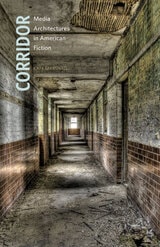
Corridor
Media Architectures in American FictionKate Marshall
University of Minnesota Press, 2013
Corridor offers a series of conceptually provocative readings that illuminate a hidden and surprising relationship between architectural space and modern American fiction. By paying close attention to fictional descriptions of some of modernity’s least remarkable structures, such as plumbing, ductwork, and airshafts, Kate Marshall discovers a rich network of connections between corridors and novels, one that also sheds new light on the nature of modern media.
The corridor is the dominant organizational structure in modern architecture, yet its various functions are taken for granted, and it tends to disappear from view. But, as Marshall shows, even the most banal structures become strangely visible in the noisy communication systems of American fiction. By examining the link between modernist novels and corridors, Marshall demonstrates the ways architectural elements act as media. In a fresh look at the late naturalist fiction of the 1920s, ’30s, and ’40s, she leads the reader through the fetus-clogged sewers of Manhattan Transfer to the corpse-choked furnaces of Native Son and reveals how these invisible spaces have a fascinating history in organizing the structure of modern persons.
Portraying media as not only objects but processes, Marshall develops a new idiom for Americanist literary criticism, one that explains how media studies can inform our understanding of modernist literature.
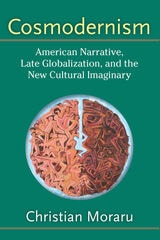
Cosmodernism
American Narrative, Late Globalization, and the New Cultural ImaginaryChristian Moraru
University of Michigan Press, 2010
"Christian Moraru is an especially dynamic and brilliant scholar who works at a high level of critical and theoretical sophistication. I've never seen anything quite so exhaustive, so magisterial. Readers of Cosmodernism will think of the Keats line about an astronomer's exhilaration when a new planet swims into his ken."
---David Cowart, University of South Carolina
"Cosmodernism has the potential to become foundational for the study of a whole period. Christian Moraru undertakes here to establish a new basis for thinking about the era of cultural history in which we have found ourselves, in the United States but also around the world, since the end of the Cold War. The strength of Moraru's work lies in its intellectual ambition and scope; its polymathic range and breadth of learning; its confident mastery of a variety of disciplinary discourses; its fresh and thoughtful selection of texts for discussion; the sharpness and insight of its textual analyses; and, animating everything, its fervent commitment to a new and better way of understanding our relationship to others and the world at large."
---Brian McHale, The Ohio State University
A sweeping inquiry into post–Cold War American literature and theory, Cosmodernism argues, cautiously but persuasively, for the rise of a new cultural paradigm against the backdrop of accelerating globalization. Moraru calls this paradigm "cosmodern." He uses the term to account for what seems to be gradually challenging the postmodern over the last twenty-odd years. Not so much a well-structured movement yet, cosmodernism is chiefly a critical construct enabling Moraru to articulate representative literary-theoretical interventions of the past two decades into a reasonably coherent model. The coherence inheres, he shows, in a certain "relational" imaginary, which the critic canvasses by placing a wide range of authors and works in, across, and against the material-conceptual networks of globalization, cosmopolitanism, modernism, postmodernism, postcolonialism, multiculturalism, and other areas of contemporary U.S. intellectual history.
Christian Moraru is Professor of English at the University of North Carolina, Greensboro. His latest books include Rewriting: Postmodern Narrative and Cultural Critique in the Age of Cloning (2001), Memorious Discourse: Reprise and Representation in Postmodernism (2005), and the edited collection Postcommunism, Postmodernism, and the Global Imagination (2009).
Cover art: Earth, oil and acrylic on canvas, 48" × 36", 2008. Painting courtesy of Rebecca Darlington.
Cosmopolitan Desires
Global Modernity and World Literature in Latin AmericaMariano Siskind
Northwestern University Press, 2014
Mariano Siskind’s groundbreaking debut book redefines the scope of world literature, particularly regarding the place of Latin America in its imaginaries and mappings. In Siskind’s formulation, world literature is a modernizing discursive strategy, a way in which cultures negotiate their aspirations to participate in global networks of cultural exchange, and an original tool to reorganize literary history. Working with novels, poems, essays, travel narratives, and historical documents, Siskind reads the way Latin American literary modernity was produced as a global relation, from the rise of planetary novels in the 1870s and the cosmopolitan imaginaries of modernism at the turn of the twentieth century, to the global spread of magical realism. With its unusual breadth of reference and firm but unobtrusive grounding in philosophy, literary theory, and psychoanalysis, Cosmopolitan Desires will have a major impact in the fields of Latin American studies and comparative literature.
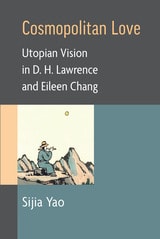
Cosmopolitan Love
Utopian Vision in D. H. Lawrence and Eileen ChangSijia Yao
University of Michigan Press, 2023
Finalist: 2024 Southern Atlantic Modern Language Association (SAMLA) Book Award Finalist | 05/21/2024
Love, and the different manifestations of it, is a common theme in literature around the world. In Cosmopolitan Love, Sijia Yao examines the writings of D. H. Lawrence, a British writer whose literature focused primarily on interpersonal relationships in domestic settings, and Eileen Chang, a Chinese writer who migrated to the United States and explored Chinese heterosexual love in her writing. While comparing the writings of a Chinese writer and an English one, Yao avoids a direct comparison between East and West that could further enforce binaries. Instead, she uses the comparison to develop an idea of cosmopolitanism that shows how the writers are in conversation with their own culture and with each other. Both D. H. Lawrence and Eileen Chang wrote stories that are influenced by—but sometimes stand in opposition to—their own cultures. They offer alternative understandings of societies dealing with modernism and cultural globalization. Their stories deal with emotional pain caused by the restrictions of local politics and economics and address common themes of incestuous love, sexual love, adulterous love, and utopian love. By analyzing their writing, Yao demonstrates that the concept of love as a social and political force can cross cultural boundaries and traditions to become a basis for human meaning, the key to a cosmopolitan vision.
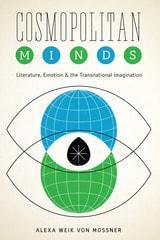
Cosmopolitan Minds
Literature, Emotion, and the Transnational ImaginationBy Alexa Weik von Mossner
University of Texas Press, 2014
During World War II and the early Cold War period, factors such as race, gender, sexual orientation, or class made a number of American writers feel marginalized in U.S. society. Cosmopolitan Minds focuses on a core of transnational writers—Kay Boyle, Pearl S. Buck, William Gardner Smith, Richard Wright, and Paul Bowles—who found themselves prompted to seek experiences outside of their home country, experiences that profoundly changed their self-understanding and creative imagination as they encountered alternative points of views and cultural practices in Europe, Asia, and Africa.
Alexa Weik von Mossner offers a new perspective on the affective underpinnings of critical and reflexive cosmopolitanism by drawing on theories of emotion and literary imagination from cognitive psychology, philosophy, and cognitive literary studies. She analyzes how physical dislocation, and the sometimes violent shifts in understanding that result from our affective encounters with others, led Boyle, Buck, Smith, Wright, and Bowles to develop new, cosmopolitan solidarities across national, ethnic, and religious boundaries. She also shows how, in their literary texts, these writers employed strategic empathy to provoke strong emotions such as love, sympathy, compassion, fear, anger, guilt, shame, and disgust in their readers in order to challenge their parochial worldviews and practices. Reading these texts as emotionally powerful indictments of institutionalized racism and national violence inside and outside of the United States, Weik von Mossner demonstrates that our emotional engagements with others—real and imagined—are crucially important for the development of transnational and cosmopolitan imaginations.
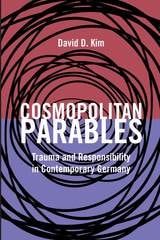
Cosmopolitan Parables
Trauma and Responsibility in Contemporary GermanyDavid D. Kim
Northwestern University Press, 2017
To exemplify this global challenge, Kim examines three internationally acclaimed writers of German origin—Hans Christoph Buch, Michael Krüger, and W. G. Sebald—joined by their own harrowing experiences and stunning entanglements with Holocaust memory, postcolonial responsibility, and communist legacy. This bold new study is the first of its kind, interrogating transnational memories of trauma alongside globally shared responsibilities for justice. More important, it addresses the question of remembrance—whether the colonial past or the postwar legacy serves as a proper foundation upon which cosmopolitanism is to be pursued in today's era of globalization.
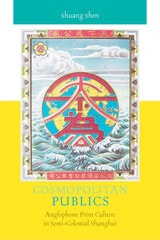
Cosmopolitan Publics
Anglophone Print Culture in Semi-Colonial ShanghaiShen, Shuang
Rutgers University Press, 2009
Cosmopolitan Publics focuses on China's "cosmopolitans," Western-educated intellectuals who returned to Shanghai in the late 1920s to publish in English and who, ultimately, became both cultural translators and citizens of the wider world. Shuang Shen highlights their work in publications such as The China Critic and T'ien Hsia, providing readers with a broader understanding of the role and function of cultural mixing, translation, and multilingualism in China's cultural modernity.
Decades later, as nationalist biases and political restrictions emerged within China, the influence of the cosmopolitans was neglected and the significance of cosmopolitan practice was underplayed. Shen's encompassing study revisits and presents the experience of Chinese modernity as far more heterogeneous, emergent, and transnational than it has been characterized until now.
Cosmopolitan Twain
Edited by Ann M. Ryan and Joseph B. McCullough
University of Missouri Press, 2008
Cosmopolitical Claims
Turkish-German Literatures from Nadolny to PamukB. Venkat Mani
University of Iowa Press, 2007
Moving deftly from the theoretical literature to the texts themselves, Mani’s groundbreaking study explores these conflicts and dialogues and the resulting cultural hybridization as they are expressed in four novels that document the complexity of Turkish-German cultural interactions in the late twentieth and early twenty-first centuries. His innovative readings will engage students of contemporary German literature as well as illuminate the discussion of minority literature in a multicultural setting.
As Salman Rushdie said in the 2002 Tanner Lecture at Yale, “The frontier is an elusive line, visible and invisible, physical and metaphorical, amoral and moral. . . . To cross a frontier is to be transformed.” It is in this vein that Mani’s dynamic and subtle work posits a still evolving discourse between Turkish and German writers.
Counter-cartographies
Neurodivergence and the Errancies of PerformanceLeon J. Hilton
University of Minnesota Press, 2025
How to remake the world with neurodivergence at its heart
What if we embraced neurodivergent ways of being not as deviations to be corrected but as vital ways of inhabiting the world? What new realities might emerge? Bringing a much-needed humanistic perspective to the study of autism and other forms of neurodivergence, Counter-cartographies offers a bold reimagining of neurological difference, moving beyond rigid diagnostic frameworks to uncover more expansive, generative modes of existence.
Engaging the work of Fernand Deligny to trace how modern taxonomies of neurodivergence have hardened over time, Leon J. Hilton questions how these categories might instead serve as tools for remapping the world with neurodivergence at its center. At the heart of Counter-cartographies is an exploration of performance and performativity that reveals how the norm of neurotypical reality is continually reinforced through acts of doing, redoing, and undoing.
Charting the historical shift away from “mind” and toward “brain” and moving fluidly across disciplines—from digital art and documentary cinema to cybernetics and radical mental health movements—Hilton illuminates the deep interconnections between performance, perception, and the historical construction of the “neurotypical.” Through close readings of works by William Pope.L, Mel Baggs, Wu Tsang, and others, Hilton also examines how neurodivergence has been represented, embodied, and materialized in contemporary art and media. Restless, engrossing, and persistently attuned to moments of rupture when the neurotypical order falters, Counter-cartographies charts a path toward a more capacious, imaginative world.
Retail e-book files for this title are screen-reader friendly with images accompanied by short alt text and/or extended descriptions.
Countering the Counterculture
Rereading Postwar American Dissent from Jack Kerouac to Tomás RiveraManuel Luis Martinez
University of Wisconsin Press, 2003
Rebelling against bourgeois vacuity and taking their countercultural critique on the road, the Beat writers and artists have long symbolized a spirit of freedom and radical democracy. Manuel Martinez offers an eye-opening challenge to this characterization of the Beats, juxtaposing them against Chicano nationalists like Raul Salinas, Jose Montoya, Luis Valdez, and Oscar Acosta and Mexican migrant writers in the United States, like Tomas Rivera and Ernesto Galarza.
In an innovative rereading of American radical politics and culture of the 1950s and 1960s, Martinez uncovers reactionary, neoromantic, and sometimes racist strains in the Beats’ vision of freedom, and he brings to the fore the complex stances of Latinos on participant democracy and progressive culture. He analyzes the ways that Beats, Chicanos, and migrant writers conceived of and articulated social and political perspectives. He contends that both the Beats’ extreme individualism and the Chicano nationalists’ narrow vision of citizenship are betrayals of the democratic ideal, but that the migrant writers presented a distinctly radical and inclusive vision of democracy that was truly countercultural.
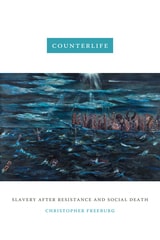
Counterlife
Slavery after Resistance and Social DeathChristopher Freeburg
Duke University Press, 2021
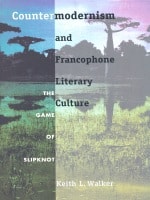
Countermodernism and Francophone Literary Culture
The Game of SlipknotKeith L. Walker
Duke University Press, 1999
Martinique, French Guyana, Senegal, Morocco, and Haiti serve as the stage for the struggle these writers have faced with French language and culture, a struggle influenced by the legacy of Aimé Césaire. In his stand against the modernist principles of Charles Baudelaire, Walker argues, Césaire has become the preeminent francophone countermodernist. A further examination of the relationships between Césaire and the writers Léon Gontron Damas, Mariama Bâ, Tahar Ben Jelloun, Ken Bugul, and Gérard Étienne forms the core of the book and leads to Walker’s characterization of francophone literature as having “slipped the knot,” or escaped the snares of the familiar binary oppositions of modernism. Instead, he discovers in these writers a shared consciousness rooted in an effort to counter and denounce modernist humanist discourse and pointing toward a new subjectivity formed through the negotiation of an alternative modernity.
Countermodernism and Francophone Literary Culture will engage readers interested in French literature and in postcolonial, Caribbean, African, American, and francophone studies.
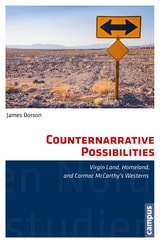
Counternarrative Possibilities
Virgin Land, Homeland, and Cormac McCarthy's WesternsJames Dorson
Campus Verlag, 2016

Court and Culture in Renaissance Scotland
Sir David Lindsay of the MountEdington, Carol
University of Massachusetts Press, 1995
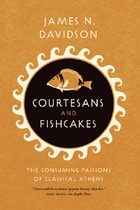
Courtesans and Fishcakes
The Consuming Passions of Classical AthensJames N. Davidson
University of Chicago Press, 2011
As any reader of the Symposium knows, the ancient Greek philosopher Socrates conversed over lavish banquets, kept watch on who was eating too much fish, and imbibed liberally without ever getting drunk. In other words, James Davidson writes, he reflected the culture of ancient Greece in which he lived, a culture of passions and pleasures, of food, drink, and sex before—and in concert with—politics and principles. Athenians, the richest and most powerful of the Greeks, were as skilled at consuming as their playwrights were at devising tragedies. Weaving together Greek texts, critical theory, and witty anecdotes, this compelling and accessible study teaches the reader a great deal, not only about the banquets and temptations of ancient Athens, but also about how to read Greek comedy and history.