Results by title
1201 books match the query 'Race relations' and 43 start with d

Dammed
The Politics of Loss and Survival in Anishinaabe TerritoryBrittany Luby
University of Manitoba Press, 2020
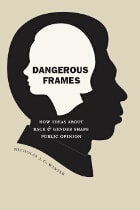
Dangerous Frames
How Ideas about Race and Gender Shape Public OpinionNicholas J. G. Winter
University of Chicago Press, 2008
Dangerous Liaisons
Gender, Nation, and Postcolonial PerspectivesAnne Mcclintock
University of Minnesota Press, 1997
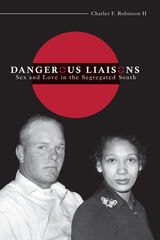
Dangerous Liaisons
Sex and Love in the Segregated SouthCharles F. Robinson II
University of Arkansas Press, 2003
In the tumultuous decades after the Civil War, as the southern white elite reclaimed power, “racial mixing” was the central concern of segregationists who strove to maintain “racial purity.” Segregation—and race itself—was based on the idea that interracial sex posed a biological threat to the white race. In this groundbreaking study, Charles Robinson examines how white southerners enforced anti-miscegenation laws. His findings challenge conventional wisdom, documenting a pattern of selective prosecution under which interracial domestic relationships were punished even more harshly than transient sexual encounters. Robinson shows that the real crime was to suggest that black and white individuals might be equals, a notion which undermined the legitimacy of the economic, political, and social structure of white male supremacy.
Robinson examines legal cases from across the South, considering both criminal prosecutions brought by states and civil disputes over marital and family assets. He also looks at U.S. Supreme Court decisions, debates in state legislatures, comments in the U.S. Congressional Record, and newspaper editorials. He not only shows the hardening of racial categories but assesses the attitudes of African Americans about anti-miscegenation laws and intermarriage. The epilogue concerns “The Demise of Anti-miscegenation Law” including the case of Richard and Mildred Loving.
Dangerous Liaisons vividly documents the regulation of intimacy and its fundamental role in the construction of race.
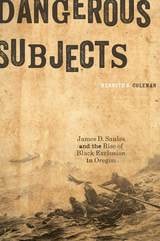
Dangerous Subjects
James D. Saules and the Rise of Black Exclusion in OregonKenneth R. Coleman
Oregon State University Press, 2017
In Oregon, Saules encountered a multiethnic population already transformed by colonialism—in particular, the fur industry and Protestant missionaries. Once the Oregon Trail emigrants began arriving in large numbers, in 1843, Saules had to adapt to a new reality in which Anglo-American settlers persistently sought to marginalize and exclude black residents from the region. Unlike Saules, who adapted and thrived in Oregon’s multiethnic milieu, the settler colonists sought to remake Oregon as a white man’s country. They used race as shorthand to determine which previous inhabitants would be included and which would be excluded. Saules inspired and later had to contend with a web of black exclusion laws designed to deny black people citizenship, mobility, and land.
In Dangerous Subjects, Kenneth Coleman sheds light on a neglected chapter in Oregon’s history. His book will be welcomed by scholars in the fields of western history and ethnic studies, as well as general readers interested in early Oregon and its history of racial exclusion.
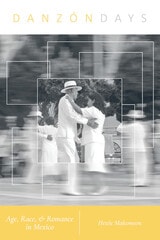
Danzón Days
Age, Race, and Romance in MexicoHettie Malcomson
University of Illinois Press, 2023
Winner of the 2024 BFE Book Prize (British Forum for Ethnomusicology)
Older people negotiating dance routines, intimacy, and racialized differences provide a focal point for an ethnography of danzón in Veracruz, the Mexican city closely associated with the music-dance genre. Hettie Malcomson draws upon on-site research with semi-professional musicians and amateur dancers to reveal how danzón connects, and does not connect, to blackness, joyousness, nostalgia, ageing, and romance. Challenging pervasive utopian views of danzón, Malcomson uses the idea of ambivalence to explore the frictions and opportunities created by seemingly contrary sentiments, ideas, sensations, and impulses. Interspersed with experimental ethnographic vignettes, her account takes readers into black and mestizo elements of local identity in Veracruz, nostalgic and newer styles of music and dance, and the friendships, romances, and rivalries at the heart of regular danzón performance and its complex social world.
Fine-grained and evocative, Danzón Days journeys to one of the genre’s essential cities to provide new perspectives on aging and romance and new explorations of nostalgia and ambivalence.
Dark Continent Of Our Bodies
Black Feminism & Politics Of RespectabilityE. Frances White
Temple University Press, 2001
White's powerful introduction draws on oral narratives from her own family history to illuminate the nature of narrative, both what is said and what is left unsaid. She then sets the historical stage with a helpful history of the inception and development of black feminism and a critique of major black feminist writings. In the three chapters that follow, she addresses the obstacles black feminism has already surmounted and must continue to traverse. Confronting what White calls "the politics of respectability," these chapters move the reader from simplistic views of race and gender in the nineteenth century through black nationalism and the radical movements of the sixties, and their relationship to feminist thought, to the linkages between race, gender, and sexuality in the works of such giants as Toni Morrison and James Baldwin. No one who finishes Dark Continent of Our Bodies will look at race and gender in the same way again.
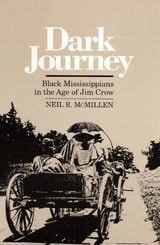
Dark Journey
Black Mississippians in the Age of Jim CrowNeil R. McMillen
University of Illinois Press, 1989
"Dark Journey is a superb piece of scholarship, a book that all students of southern and African-American history will find valuable and informative."--David J. Garrow, Georgia Historical Quarterly
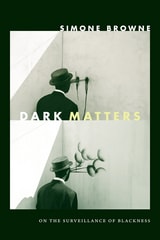
Dark Matters
On the Surveillance of BlacknessSimone Browne
Duke University Press, 2015
Dark Mirror
African Americans and the Federal Writers' ProjectJ. J. Butts
The Ohio State University Press, 2021
Dark Side of the Light
Slavery and the French EnlightenmentLouis Sala-Molins
University of Minnesota Press, 2006
Translated into English for the first time, Dark Side of the Light scrutinizes Condorcet’s Reflections on NegroSlavery and the works of Montesquieu, Rousseau, and Diderot side by side with the Code Noir (the royal document that codified the rules of French Caribbean slavery) in order to uncover attempts to uphold the humanist project of the Enlightenment while simultaneously justifying slavery. Wielding the pen of both the ironist and the moralist, Sala-Molins demonstrates the flawed nature of these attempts and the reasons given for this denial of rights, from the imperatives of public order to the incomplete humanity of the slave (and thus the need for his progressive humanization through slavery), to the economic prosperity that depended on his labor. At the same time, Sala-Molins uses the techniques of literature to give equal weight to the perspective of the “barefooted, the starving, and the slaves” through expository prose and scenes between slave and philosopher, giving moral agency and flesh-and-blood dimensions to issues most often treated as abstractions.
Both an urgent critique and a measured analysis, Dark Side of the Light reveals the moral paradoxes of Enlightenment philosophies and their world-changing consequences.
Louis Sala-Molins is a moral and political philosopher and emeritus professor at the University of Toulouse. He is the author of many books, including Le Code Noir, ou Le calvaire de Canaan and L’Afrique aux Amériques.
John Conteh-Morgan is associate professor of French and Francophone, African-American, and African studies at Ohio State University. He is the author of Theatre and Drama in Francophone Africa: A Critical Introduction.
Dark Voices
W. E. B. Du Bois and American Thought, 1888-1903Shamoon Zamir
University of Chicago Press, 1995
Bringing to light materials from the Du Bois archives that have not been discussed before, Shamoon Zamir explores Du Bois's deep engagement with American and European philosophy and social science. He examines the impact on Du Bois of his studies at Harvard with William James and George Santayana, and shows how the experience of post-Reconstruction racism moved Du Bois from metaphysical speculation to the more instrumentalist knowledge of history and the new discipline of sociology, as well as toward the very different kind of understanding embodied in the literary imagination. Providing a new and detailed reading of The Souls of Black Folk in comparison with Hegel's Phenomenology of Mind, Zamir challenges accounts that place Du Bois alongside Emerson and James, or characterize him as a Hegelian idealist. This reading also explores Du Bois's relationship to African American folk culture, and shows how Du Bois was able to dramatize the collapse of many of his hopes for racial justice and liberation.
The first book to place The Souls of Black Folk in its intellectual context, Dark Voices is a case study of African American literary development in relation to the broader currents of European and American thought.

Darkroom
A Memoir in Black and WhiteLila Quintero Weaver
University of Alabama Press, 2012
A Latina girl’s journey through the shadows of the civil rights era.
Darkroom is a deeply moving graphic memoir that chronicles Lila Quintero Weaver’s experience growing up as an Argentine immigrant in 1960s Alabama during the height of the civil rights movement. Through striking black-and-white illustrations and heartfelt narrative, Weaver explores the complexities of race, identity, and belonging in a society divided by segregation. Neither Black nor White, her family occupies a unique position that offers a powerful lens on the struggles for justice and equality. This coming-of-age story blends personal history with pivotal social change, inviting readers to reflect on themes of immigration, cultural assimilation, and moral courage. Darkroom is both an intimate portrait and a universal tale of resilience, making it an essential read for those interested in civil rights, memoirs, and graphic storytelling.
Daughter of the Revolution
The Major Nonfiction Works of Pauline HopkinsDworkin, Ira
Rutgers University Press, 2007
Pauline E. Hopkins (1859–1930) came to prominence in the early years of the twentieth century as an outspoken writer, editor, and critic. Frequently recognized for her first novel, Contending Forces, she is currently one of the most widely read and studied African American novelists from that period.
While nearly all of Hopkins’s fiction remains in print, there is very little of her nonfiction available. This reader brings together dozens of her hard-to-find essays, including longer nonfiction works such as Famous Men of the Negro Race and The Dark Races of the Twentieth Century, some of which are published here for the first time in their entirety.
Through these works, along with two juvenile essays from the 1870s, a personal letter, and two speeches, readers encounter a voice that is committed to constructing an international discourse on race, recovering the militant abolitionist tradition to combat Jim Crow, celebrating black political participation during and after the Reconstruction era, articulating the connections between race and labor, and insisting on equal rights for women. Hopkins’s writing will challenge contemporary scholars to rethink their understanding of black activism and modernity in the early twentieth century.
David Duke and the Politics of Race in the South
John C. Kuzenski
Vanderbilt University Press, 1995
Deadliest Enemies
Law and Race Relations on and off Rosebud ReservationThomas Biolsi
University of Minnesota Press, 2007
Many people living far away from Indian reservations express sympathy for the poverty and misery experienced by Native Americans, yet, Thomas Biolsi argues, the problems faced by Native Americans are the results of white privilege.
In Deadliest Enemies, Biolsi connects the origins of racial tension between Indians and non-Indians on the Rosebud Reservation in South Dakota to federal laws, showing how the courts have created opposing political interests along race lines. Biolsi demonstrates that the court’s definitions of legal rights—both constitutional and treaty rights—make solutions to racial tensions intractable.
This powerful work sheds much-needed light on racial conflicts in South Dakota and in the rest of the United States, and holds white people accountable for the benefits of their racial privilege that come at the expense of Native Americans.
Thomas Biolsi is professor of Native American studies at the University of California at Berkeley.

Dear Denise
Letters to the Sister I Never KnewLisa McNair
University of Alabama Press, 2022
Poignant, honest, and heartfelt letters to a sister who perished in the 16th Street Baptist Church bombing.
Lisa McNair was born in 1964, one year after her older sister, Denise, was murdered in the bombing of the 16th Street Baptist Church in Birmingham, Alabama. Dear Denise is a collection of forty letters from Lisa addressed to the sister she never knew, but in whose shadow of sacrifice and lost youth she was raised. These letters offer an intimate look into the life of a family touched by one of the most heinous tragedies of the Civil Rights Movement.
Written in a genuine, accessible, familiar, and easy-to-read voice, Lisa’s letters apprise her late sister of all that has come to pass in the years since her death. Lisa considers her own challenges and accomplishments as a student in remarkably different—and very racially complex—schools; the birth of their baby sister, Kim; their father’s election to the Alabama legislature; her evolving sense of faith and place, and sometimes lack thereof, within the Black church; her college experiences; and her own sense of self as she’s matured into adulthood. She reveals some of the family’s difficulties and health challenges, and shares some of their joys and celebrations.
The letters are accompanied by 29 black-and-white photographs, most of them from the McNair family collection, many of them taken by her father, a professional photographer who documented the Civil Rights Movement in Alabama both before and after Denise’s murder. An unswervingly candid, gentle, and nuanced book, Dear Denise is a testament to one singular life lived bravely and truthfully (if sometimes confusedly or awkwardly), during decades of bewildering social change and in the shadow of one life never fully lived.
Death at Cross Plains
An Alabama Reconstruction TragedyGene L. Howard with a foreword by Gary B. Mills
University of Alabama Press, 1984
Reconstruction in the South is a much studied and yet little understood period in the region’s history. In many areas it was marked by such violence as to have been guerrilla warfare in all but name. Death at Cross Plains is the gripping story of one local incident that illuminates the aftermath of the Civil War throughout the region.

Deep in the Piney Woods
Southeastern Alabama from Statehood to the Civil War, 1800–1865Tommy Craig Brown
University of Alabama Press, 2018
Beyond the backwoods—uncovering the Civil War legacy of Alabama’s forgotten frontier.
Much of Alabama’s written history concentrates on the Tennessee Valley, the hill counties, and the Black Belt, while the piney woods of south central and southeastern Alabama, commonly known as the wiregrass region today, is one of the most understudied areas in Alabama history. Deep in the Piney Woods: Southeastern Alabama from Statehood to the Civil War, 1800–1865 offers a comprehensive and long overdue account of a historically rich region of the state, challenging many commonly held assumptions about the area’s formation and settlement, economy, politics, race relations, and its role in both the secession of the state and the Civil War.
Historians routinely depict this part of the state as an isolated, economically backward wilderness filled with poor whites who showed little interest in supporting the Confederacy once civil war erupted in 1861. Tommy Craig Brown challenges those traditional interpretations, arguing instead that many white Alabamians in this territory participated in the market economy, supported slavery, favored secession, and supported the Confederate war effort for the bulk of the conflict, sending thousands of soldiers to fight in some of the bloodiest campaigns of the war.
This thorough and expansive account of southeastern Alabama’s role in the Civil War also discusses its advocacy for state secession in January 1861; the effects of Confederate conscription on the home front; the economic devastation wrought on the area; and the participation of local military companies in key campaigns in both the eastern and western theaters, including Shiloh, the Peninsula Campaign, the Overland Campaign, Atlanta, and Franklin-Nashville. Brown argues that the lasting effects of the war on the region’s politics, identity, economy, and culture define it in ways that are still evident today.
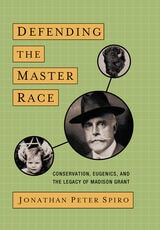
Defending the Master Race
Conservation, Eugenics, and the Legacy of Madison GrantJonathan Spiro
University Press of New England, 2008
Degrees of Mixture, Degrees of Freedom
Genomics, Multiculturalism, and Race in Latin AmericaPeter Wade
Duke University Press, 2017
Democracy, Dialogue, and Community Action
Truth and Reconciliation in GreensboroSpoma Jovanovic
University of Arkansas Press, 2012
Demonic Grounds
Black Women And The Cartographies Of StruggleKatherine McKittrick
University of Minnesota Press, 2006
Demonic Grounds moves between past and present, archives and fiction, theory and everyday, to focus on places negotiated by black women during and after the transatlantic slave trade. Specifically, the author addresses the geographic implications of slave auction blocks, Harriet Jacobs’s attic, black Canada and New France, as well as the conceptual spaces of feminism and Sylvia Wynter’s philosophies.
Central to McKittrick’s argument are the ways in which black women are not passive recipients of their surroundings and how a sense of place relates to the struggle against domination. Ultimately, McKittrick argues, these complex black geographies are alterable and may provide the opportunity for social and cultural change.
Katherine McKittrick is assistant professor of women’s studies at Queen’s University.
Destination Detroit
Discourses on the Refugee in a Post-Industrial CityRashmi Luthra
University of Michigan Press, 2024
Few U.S. locations provide a more vivid case study of this fight than Metro Detroit, where competing interest groups are waging war over the meaning of the figure of the refugee. This book dives deeply into the discourse on refugees occurring among various institutions in Metro Detroit. The way in which local institutions talk about refugees gives us vital clues as to how they are negotiating competing pressures and how the city overall is negotiating competing imperatives. Indeed, this local discourse gives us a crucial glimpse into how U.S. cities are defining and redefining themselves today. The figure of the refugee becomes a slate on which groups with varied interests write their stories, aspirations, and fears. Consequently, we can figure out from local refugee discourses the ongoing question of what it means to be a Metro Detroiter—and by extension, what it means to be a revitalizing U.S. city in this age.
Detroit Divided
Reynolds Farley
Russell Sage Foundation, 2000
Detroit
Race Riots, Racial Conflicts, and Efforts to Bridge the Racial DivideJoe T. Darden and Richard Thomas
Michigan State University Press, 2013
Detroit
Race and Uneven DevelopmentJoe T. Darden, Richard Child Hill, June Thomas and Richard Thomas
Temple University Press, 1990
Hub of the American auto industry and site of the celebrated Riverfront Renaissance, Detroit is also a city of extraordinary poverty, unemployment, and racial segregation. This duality in one of the mightiest industrial metropolises of twentieth-century North America is the focus of this study. Viewing the Motor City in light of sociology, geography, history, and planning, the authors examine the genesis of modern Detroit. They argue that the current situation of metropolitan Detroit—economic decentralization, chronic racial and class segregation, regional political fragmentation—is a logical result of trends that have gradually escalated throughout the post-World War II era. Examining its recent redevelopment policies and the ensuing political conflicts, Darden, Hill, Thomas, and Thomas, discuss where Detroit has been and where it is going.
In the series Comparative American Cities, edited by Joe T. Darden.

Discourse and Destruction
The City of Philadelphia versus MOVERobin Wagner-Pacifici
University of Chicago Press, 1993
How did this struggle between the city and MOVE go from memos and meetings to tear gas and bombs? And how does the mandate to defend public order become a destructive force? Sifting through the hearings that followed the deadly encounter, Robin Wagner-Pacifici reconstructs the conflict between MOVE and the city of Philadelphia. Against this richly nuanced account, in which the participants—from the mayor and the police officers to members of MOVE and their neighbors—offer opposing versions of their aims, assumptions, and strategies, Wagner-Pacifici develops a compelling analysis of the relation between definition and action, between language and violence.
Was MOVE simply a radical, black separatist group with an alternative way of life? Or was it a terrorist cult that held a neighborhood and politicians hostage to its offensive language and bizarre behavior? Wagner-Pacifici shows how competing definitions of MOVE led to different strategies for managing the conflict. In light of the shockingly similar, and even more deadly, 1993 Branch Davidian disaster in Waco, Texas, such an analysis becomes imperative. Indeed, for those who hope to understand—and, finally, to forestall—the moment when language and violence are inexorably drawn together, this book demands attention.
Dissent in Wichita
The Civil Rights Movement in the Midwest, 1954-72Gretchen Cassel Eick
University of Illinois Press, 2001
Winner of the Richard L. Wentworth Prize in American History, Byron Caldwell Smith Book Prize, and the William Rockhill Nelson Award
On a hot summer evening in 1958, a group of African American students in Wichita, Kansas, quietly entered Dockum's Drug Store and sat down at the whites-only lunch counter. This was the beginning of the first sustained, successful student sit-in of the modern civil rights movement, instigated in violation of the national NAACP's instructions.
Dissent in Wichita traces the contours of race relations and black activism in this unexpected locus of the civil rights movement. Based on interviews with more than eighty participants in and observers of Wichita's civil rights struggles, this powerful study hones in on the work of black and white local activists, setting their efforts in the context of anticommunism, FBI operations against black nationalists, and the civil rights policies of administrations from Eisenhower through Nixon.
Through her close study of events in Wichita, Eick reveals the civil rights movement as a national, not a southern, phenomenon. She focuses particularly on Chester I. Lewis, Jr., a key figure in the local as well as the national NAACP. Lewis initiated one of the earliest investigations of de facto school desegregation by the Department of Health, Education, and Welfare and successfully challenged employment discrimination in the nation's largest aircraft industries.
Dissent in Wichita offers a moving account of the efforts of Lewis, Vivian Parks, Anna Jane Michener, and other courageous individuals to fight segregation and discrimination in employment, public accommodations, housing, and schools. This volume also offers the first extended examination of the Young Turks, a radical movement to democratize and broaden the agenda of the NAACP for which Lewis provided critical leadership.
Through a close study of personalities and local politics in Wichita over two decades, Eick demonstrates how the tenor of black activism and white response changed as economic disparities increased and divisions within the black community intensified. Her analysis, enriched by the words and experiences of men and women who were there, offers new insights into the civil rights movement as a whole and into the complex interplay between local and national events.
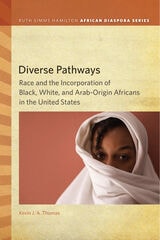
Diverse Pathways
Race and the Incorporation of Black, White, and Arab-Origin Africans in the United StatesKevin J. A. Thomas
Michigan State University Press, 2014
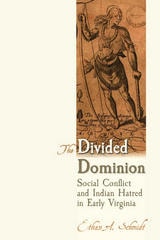
Divided Dominion
Social Conflict and Indian Hatred in Early VirginiaEthan A. Schmidt
University Press of Colorado, 2014
Myriad internal and external factors drove Virginians to interpret their disputes with one another increasingly along class lines. The decades-long tripartite struggle among elite whites, non-elite whites, and Native Americans resulted in the development of mutually beneficial economic and political relationships between elites and Native Americans. When these relationships culminated in the granting of rights—equal to those of non-elite white colonists—to Native Americans, the elites crossed a line and non-elite anger boiled over. A call for the annihilation of all Indians in Virginia united different non-elite white factions and molded them in widespread social rebellion.
The Divided Dominion places Indian policy at the heart of Bacon's Rebellion, revealing the complex mix of social, cultural, and racial forces that collided in Virginia in 1676. This new analysis will interest students and scholars of colonial and Native American history.
Divided by Color
Racial Politics and Democratic IdealsDonald R. Kinder and Lynn M. Sanders
University of Chicago Press, 1996
Divided by Color supplies the reasons for this division, asserting that racial resentment continues to exist. Despite a parade of recent books optimistically touting the demise of racial hostility in the United States, the authors marshal a wealth of the most current and comprehensive evidence available to prove their case. Kinder and Sanders reveal that racial resentment remains the most powerful determinant of white opinion on such racially charged issues as welfare, affirmative action, school desegregation, and the plight of the inner city.
But more than a comprehensive description of American views on race, Divided by Color seeks to explain just why black and white Americans believe what they do. Kinder and Sanders analyze the critical factors that shape people's opinion on race-related issues, uncovering the relative importance of self-interest, group identity, ideological principles, as well as racial animosity. Finally, the authors explore how the racial divide has insinuated itself into the presidential election process and examine the role of political elites in framing racial issues for ordinary citizens.
The most accurate and thorough analysis of American attitudes toward race and racial policies undertaken in decades, Divided by Color is destined to become a landmark work on race in America.
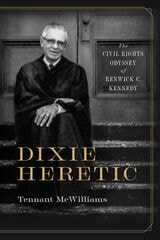
Dixie Heretic
The Civil Rights Odyssey of Renwick C. KennedyTennant McWilliams
University of Alabama Press, 2023
A life-and-times biography of the minister and social reformer Renwick C. Kennedy
Drawn from some 5,000 letters, six decades of daily-diary writings, and extensive interviews, Dixie Heretic: The Civil Rights Odyssey of Renwick C. Kennedy offers a life-and-times biography of the Alabama Black Belt minister, Renwick C. Kennedy (1900–1985). Here, Tennant McWilliams gives an unvarnished account of Kennedy’s tortuous efforts to make his congregants and other southern whites “better Christians.”
Kennedy came from “upcountry” South Carolina, a place rife with Scotch-Irish Associate Reformed Presbyterians—people of biblical infallibility and individual piety and salvation. In 1927, after a life-changing theology education at Princeton, he moved to Camden, Alabama, county seat of Wilcox County. There, he came to believe that God had a mandate for him: to change the “Half Christian” conservative, and the often violent, racial behaviors around him. As a neo-orthodox Protestant, Kennedy never rejected literal approaches to the Bible. Still, out of the “Full Christian” Social Gospel, he urged changed racial behavior. Ultimately this led him to publish confrontational short stories and essays in Christian Century and New Republic—most set in fictitious “Yaupon County.”
In World War II, Kennedy served as a chaplain with the famed 102nd Evacuation Hospital. He came home hoping the Allied victory would spur Americans to fight racial segregation just as they had fought racial fascism in Europe. The 1948 Dixiecrat movement dashed these hopes, turning much of his neo-orthodox optimism to cynicism. His hope found fleeting resurgence in the civil rights movement, and saw Kennedy quietly leading desegregation of Troy University, where he was an administrator. But the era’s assassinations, combined with George Wallace and the rise of southern white Republicans, regularly returned him to the frustrated hopes of 1948 and fostered a pessimism about truly changed hearts that he took to his grave in 1985.
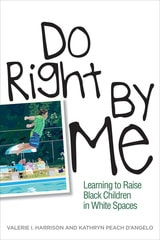
Do Right by Me
Learning to Raise Black Children in White SpacesValerie I. Harrison and Kathryn Peach D'Angelo
Temple University Press, 2021
For decades, Katie D’Angelo and Valerie Harrison engaged in conversations about race and racism. However, when Katie and her husband, who are white, adopted Gabriel, a biracial child, Katie’s conversations with Val, who is black, were no longer theoretical and academic. The stakes grew from the two friends trying to understand each other’s perspectives to a mother navigating, with input from her friend, how to equip a child with the tools that will best serve him as he grows up in a white family.
Through lively and intimate back-and-forth exchanges, the authors share information, research, and resources that orient parents and other community members to the ways race and racism will affect a black child’s life—and despite that, how to raise and nurture healthy and happy children. These friendly dialogues about guarding a child’s confidence and nurturing positive racial identity form the basis for Do Right by Me. Harrison and D’Angelo share information on transracial adoption, understanding racism, developing a child’s positive racial identity, racial disparities in healthcare and education, and the violence of racism.
Do Right by Me also is a story about friendship and kindness, and how both can be effective in the fight for a more just and equitable society.
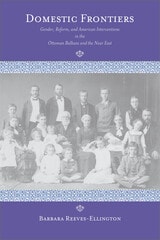
Domestic Frontiers
Gender, Reform, and American Interventions in the Ottoman Balkans and the Near EastBarbara Reeves-Ellington
University of Massachusetts Press, 2013
During the nineteenth and early twentieth centuries, American Protestant missionaries attempted to export their religious beliefs and cultural ideals to the Ottoman Empire. Seeking to attract Orthodox Christians and even Muslims to their faith, they promoted the paradigm of the “Christian home” as the foundation of national progress. Yet the missionaries' efforts not only failed to win many converts but also produced some unexpected results.
Drawing on a broad range of sources—Ottoman, Bulgarian, Russian, French, and English—Barbara Reeves-Ellington tracks the transnational history of this little-known episode of American cultural expansion. She shows how issues of gender and race influenced the missionaries' efforts as well as the complex responses of Ottoman subjects to American intrusions into their everyday lives. Women missionaries—married and single—employed the language of Christian domesticity and female moral authority to challenge the male-dominated hierarchy of missionary society and to forge bonds of feminist internationalism. At the same time, Orthodox Christians adapted the missionaries' ideology to their own purposes in developing a new strain of nationalism that undermined Ottoman efforts to stem growing sectarianism within their empire. By the beginning of the twentieth century, as some missionaries began to promote international understanding rather than Protestantism, they also paved the way for future expansion of American political and commercial interests.
Domesticating Brown
Movements of Racial ImaginationChristopher B. Patterson
Duke University Press, 2026

Double Cross
Japanese Americans In Black And White ChicagoJacalyn D. Harden
University of Minnesota Press, 2003
Examines relations between peoples of color to offer a compelling new approach to understanding race in America
Since the Great Migration of the early twentieth century, Chicago has been a cauldron of race relations, symbolizing the tenacity of discrimination and segregation. But as in other cities with significant populations of Latinos and Asians, Arabs and Jews, this image belies complex racial dynamics. In Double Cross, Jacalyn D. Harden provides an essential rethinking of the ways we understand and talk about race, using an examination of the Japanese American community of Chicago’s Far North Side to form an innovative new framework for looking at race, identity, and political change.
The Japanese American community in Chicago rapidly expanded between 1940 and 1950 in the aftermath of wartime internment and government relocation programs. Harden tells their story through archival research and interviews with some of the first Japanese Americans who were relocated to Chicago in the 1940s, incorporating her own experiences as an African American scholar who has lived in Japan. The result is a compelling and surprising account of racial interactions, one that clarifies the complex interweaving between black and Asian lives and reclaims a lost history of solidarity between the two groups.Moving from the Great Migration to the “great relocation” to gentrification, Harden explores the shared history of civil rights struggles that firmly links Japanese and African Americans, most importantly the issue of reparations (for internment during World War II and slavery, respectively). She describes the efforts of Japanese Americans to “double-cross the color line” by building coalitions across race, age, and class boundaries, and their vexed position as sometimes “colored,” sometimes white (for example, the Japanese American soldier who was instructed to use the white washrooms at boot camp in Alabama during World War II, while thousands were being relocated to internment camps).Double Cross is a major contribution to our thought about race relations, challenging orthodoxy and shedding new light on the complex identities, conflicting interests, and external forces that have defined the concept of race in the United States.
Down on the Killing Floor
Black and White Workers in Chicago's Packinghouses, 1904-54Rick Halpern
University of Illinois Press, 1997

Downed by Friendly Fire
Black Girls, White Girls, and Suburban SchoolingSignithia Fordham
University of Minnesota Press, 2016
Most Americans would never willingly revisit their high school experiences; the nation’s school systems reflect the broader society’s hierarchical emphasis on race, class, and gender. While schools purport to provide equal opportunities for all students, this rarely happens in actuality—particularly for girls.
In Downed by Friendly Fire, Signithia Fordham unmasks and examines female-centered bullying in schools, arguing that it is essential to unmask female aggression, bullying, and competition, all of which directly relate to the structural violence embedded in the racialized and gendered social order. For two and a half years, Fordham conducted field research at “Underground Railroad High School,” a suburban high school in upstate New York. Through a series of composite student profiles, she examines the girls’ relationships to academic achievement, social competition, and aggression toward one another. Fordham argues that girls academically “compete to lose,” which only perpetuates their subordination through the misrecognition of their own competitive behaviors. She goes further to expand the meaning of violence to include what is seen as normal, including suffering, humiliation, and social and economic abuse.
Using the concept “symbolic violence,” Fordham theorizes the psychological and social damage suffered especially by black girls in schools. The five narratives in Downed by Friendly Fire ultimately highlight the pain and suffering this violence produces as well as the ways in which it promotes inequality, exclusion, and marginalization among girls.
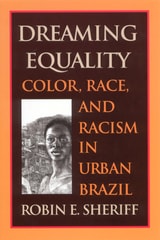
Dreaming Equality
Color, Race, and Racism in Urban BrazilSheriff, Robin E.
Rutgers University Press, 2001
This myth contrasts starkly with the realities of a pernicious racial inequality that permeates every aspect of Brazilian life. To study the grip of this myth on African Brazilians’ views of themselves and their nation, Robin E. Sheriff spent twenty months in a primarily black shantytown in Rio de Janeiro, studying the inhabitants’s views of race and racism. How, she asks, do poor African Brazilians experience and interpret racism in a country where its very existence tends to be publicly denied? How is racism talked about privately in the family and publicly in the community—or is it talked about at all?
Sheriff’s analysis is particularly important because most Brazilians live in urban settings, and her examination of their views of race and racism sheds light on common but underarticulated racial attitudes. This book is the first to demonstrate that urban African Brazilians do not subscribe to the racial democracy myth and recognize racism as a central factor shaping their lives.

Duress
Imperial Durabilities in Our TimesAnn Laura Stoler
Duke University Press, 2016
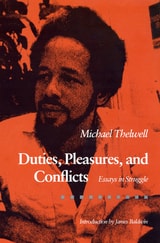
Duties, Pleasures, and Conflicts
Essays in StruggleMichael M. Thelwell
University of Massachusetts Press, 1987
This powerful collection of essays and short stories provides a unique perspective on the black civil rights movement over the past twenty-five years. A long-time activist, Michael Thelwell was a member of the Student Non-Violent Coordinating Committee (SNCC) and the Mississippi Freedom Democratic Party in the early 1960s, a founder of the W.E.B. Du Bois Department of Afro-American Studies at the University of Massachusetts in 1970, author of the widely praised novel The Harder They Come published in 1980, and an organizer for Jesse Jackson's presidential campaign in 1984. Thelwell is a writer of rare grace, integrity, and strong political convictions.
The collection begins with three stories. Set in the Mississippi Delta in the 1960s, the stories explore how individuals manage to preserve their dignity in a world of racism and violence. The next six essays, also written in the 1960s, are historical and journalistic. They discuss the March on Washington for Jobs and Freedom, the situation in the South as seen by SNCC workers, the political challenges in Mississippi, the articulation of the Black Power movement, the causes of the black student revolt at Cornell, and the need for Black Studies as the intellectual offensive in the struggle for black liberation.
The section that follows is composed of literary pieces: two appreciative essays on James Baldwin, two critical reviews of William Styron and his treatment of Nat Turner, an excoriating assessment of V. S. Naipaul, a profile of Amos Tutuola, and a thoughtful analysis of the social responsibility of the black writer.
The final essay examines the history of Jesse Jackson's presidential campaign and comments on the political climate of the 1980s.
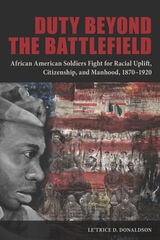
Duty beyond the Battlefield
African American Soldiers Fight for Racial Uplift, Citizenship, and Manhood, 1870–1920Le'Trice D. Donaldson
Southern Illinois University Press, 2020
Through extensive research, Donaldson not only illuminates this evolution but also interrogates the association between masculinity and citizenship and the ways in which performing manhood through military service influenced how these men struggled for racial uplift. Following the Buffalo soldier units and two regular army infantry units from the frontier and the Mexican border to Mexico, Cuba, and the Philippines, Donaldson investigates how these locations and the wars therein provide windows into how the soldiers’ struggles influenced black life and status within the United States.
Continuing to probe the idea of what it meant to be a military race man—a man concerned with the uplift of the black race who followed the philosophy of progress—Donaldson contrasts the histories of officers Henry Flipper and Charles Young, two soldiers who saw their roles and responsibilities as black military officers very differently.
Duty beyond the Battlefield demonstrates that from the 1870s to 1920s military race men laid the foundation for the “New Negro” movement and the rise of Black Nationalism that influenced the future leaders of the twentieth century Civil Rights movement.