Results by title
5448 books match the query 'History and criticism' and 158 start with e
Epic and Exile
Novels of the German Popular Front, 1933-1945Hunter Bivens
Northwestern University Press, 2015
Epic of the Dispossessed
Derek Walcott's OmerosRobert D. Hamner
University of Missouri Press, 1997
In Epic of the Dispossessed, Robert D. Hamner offers an insightful, well-researched analysis of Omeros, the masterful epic poem by 1992 Nobel Laureate Derek Walcott. Rich and various, Omeros is an innovative extension of the epic tradition. Despite Walcott's insistence that he violates the formulaþhe notes his autobiographical presence in the poem and the absence of classical heroic figures and epic battlesþthe poem incorporates fragments of all the definitive characteristics of the genre. Hamner establishes that through its self-reflexive textuality, Omeros complements the time-honored tradition of the epic by giving voice to the marginalized peoples of the New World.
Hamner briefly explains his perception of the epic tradition and its viability in contemporary literature. He examines Walcott's writing career and traces his development of devices, themes, techniques, and a narrative style essential to epic poetry. Although Walcott could not have fully anticipated Omeros, a retrospective view of his writing reveals the consistent accumulation of the skills and broad scope required for such an undertaking. Hamner attempts also to show that Walcott has incorporated into his personal style not only the more obvious aspects of his formal education but also uniquely West Indian cultural material and forms of expression.
Hamner describes Omeros as an epic of the dispossessed because each of its protagonists is a castaway in one sense or another. Regardless of whether their ancestry is traced to the classical Mediterranean, Europe, Africa, or confined to the Americas, they are transplanted individuals whose separate quests all center on the fundamental human need to strike roots in a place where one belongs.
Walcott's vivid, lyrical verse is visually compelling and aurally appealing. He is, however, a richly complex, allusive writer dealing with a wide range of profound human problems. Given the exciting climate of postcolonial and postmodern criticism, Walcott offers students and scholars unparalleled opportunities for challenging, creatively interpretive insights. Epic of the Dispossessed will be a valuable companion to the work that may prove to be Walcott's crowning achievement. The fresh and original Omeros stands on its own merits; nevertheless, it deserves to be examined in light of both Western tradition and its Caribbean context.
Epideictic Rhetoric
Questioning the Stakes of Ancient PraiseBy Laurent Pernot
University of Texas Press, 2015
Speeches of praise and blame constituted a form of oratory put to brilliant and creative use in the classical Greek period (fifth to fourth century BC) and the Roman imperial period (first to fourth century AD), and they have influenced public speakers through all the succeeding ages. Yet unlike the other classical genres of rhetoric, epideictic rhetoric remains something of a mystery. It was the least important genre at the start of Greek oratory, but its role grew exponentially in subsequent periods, even though epideictic orations were not meant to elicit any action on the part of the listener, as judicial and deliberative speeches attempted to do. So why did the ancients value the oratory of praise so highly?
In Epideictic Rhetoric, Laurent Pernot offers an authoritative overview of the genre that surveys its history in ancient Greece and Rome, its technical aspects, and its social function. He begins by defining epideictic rhetoric and tracing its evolution from its first realizations in classical Greece to its eloquent triumph in the Greco-Roman world. No longer were speeches limited to tribunals, assemblies, and courts—they now involved ceremonies as well, which changed the political and social implications of public speaking. Pernot analyzes the techniques of praise, both as stipulated by theoreticians and as practiced by orators. He describes how epideictic rhetoric functioned to give shape to the representations and common beliefs of a group, render explicit and justify accepted values, and offer lessons on new values. Finally, Pernot incorporates current research about rhetoric into the analysis of praise.
Epidemic Empire
Colonialism, Contagion, and Terror, 1817–2020Anjuli Fatima Raza Kolb
University of Chicago Press, 2021
Terrorism is a cancer, an infection, an epidemic, a plague. For more than a century, this metaphor has figured insurgent violence as contagion in order to contain its political energies. In Epidemic Empire, Anjuli Fatima Raza Kolb shows that this trope began in responses to the Indian Mutiny of 1857 and tracks its tenacious hold through 9/11 and beyond. The result is the first book-length study to approach the global War on Terror from a postcolonial literary perspective.
Raza Kolb assembles a diverse archive from colonial India, imperial Britain, French and independent Algeria, the postcolonial Islamic diaspora, and the neoimperial United States. Anchoring her book are studies of four major writers in the colonial-postcolonial canon: Rudyard Kipling, Bram Stoker, Albert Camus, and Salman Rushdie. Across these sources, she reveals the tendency to imagine anticolonial rebellion, and Muslim insurgency specifically, as a virulent form of social contagion. Exposing the long history of this broken but persistent narrative, Epidemic Empire is a major contribution to the rhetorical history of our present moment.
Epistolary Responses
The Letter in Twentieth-Century American Fiction and CriticismAnne Bower
University of Alabama Press, 1996
Epistolary Responses explores the transformative nature of epistolary fiction and criticism in letter form from a largely feminist perspective. While most scholarly work to date has focused on 17th- and 18th-century manifestations of this genre, Bower's study concentrates on epistolary fiction by contemporary American writers published between 1912 and 1988. The novels discussed, all featuring women letter writers, include: Lee Smith's Fair and Tender Ladies, John Barth's LETTERS, Alice Walker's The Color Purple, John Updike's S., Jean Webster's Daddy-Long-Legs, Upton Sinclair's Another Pamela, and Ana Castillo's The Mixquiahuala Letters.
Bower explores the influence letters have on the act of writing and writing as act, their encoded desire for reply, their incompleteness as units of narrative information, their play on ideas of absence and presence, their apparently personal and private nature, and their foregrounding of the writer's agency and authority, all of which make letters a most useful genre both for novelists and for scholars. Several of the book's "fiction" chapters include a letter from the author of the text (sometimes a critic) that complements and supplements Bower's analysis. The final part of the book explores how seven scholars--men and women--have applied letters to their own critical writing, finding that this formal move allows them to question issues of public and private discourse, the authority of signature, and the "feminine" location.
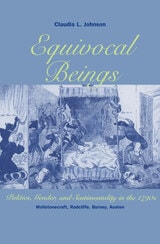
Equivocal Beings
Politics, Gender, and Sentimentality in the 1790s--Wollstonecraft, Radcliffe, Burney, AustenClaudia L. Johnson
University of Chicago Press, 1995
Demonstrating the interrelationships among politics, gender, and feeling in the fiction of this period, Johnson provides detailed readings of Wollstonecraft, Radcliffe, and Burney, and treats the qualities that were once thought to mar their work—grotesqueness, strain, and excess—as indices of ideological conflict and as strategies of representation during a period of profound political conflict. She maintains that the reactionary reassertion of male sentimentality as a political duty displaced customary gender roles, rendering women, in Wollstonecraft's words, "equivocal beings."
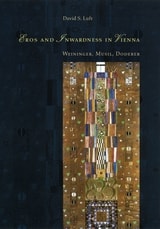
Eros and Inwardness in Vienna
Weininger, Musil, DodererDavid S. Luft
University of Chicago Press, 2003
According to Luft, Otto Weininger viewed human beings as bisexual and applied this theme to issues of creativity and morality. Robert Musil developed a creative ethics that was closely related to his open, flexible view of sexuality and gender. And Heimito von Doderer portrayed his own sexual obsessions as a way of understanding the power of total ideologies, including his own attraction to National Socialism. For Luft, the significance of these three writers lies in their understandings of eros and inwardness and in the roles that both play in ethical experience and the formation of meaningful relations to the world-a process that continues to engage artists, writers, and thinkers today.
Eros and Inwardness in Vienna will profoundly reshape our understanding of Vienna's intellectual history. It will be important for anyone interested in Austrian or German history, literature, or philosophy.
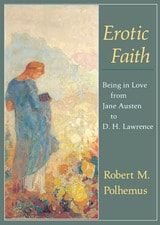
Erotic Faith
Being in Love from Jane Austen to D. H. LawrenceRobert M. Polhemus
University of Chicago Press, 1990
Drawing on a wide range of disciplines, Polhemus shows the reciprocity of love as subject, the novel as form, and faith as motive in important works by Jane Austen, Walter Scott, the Brontës, Dickens, George Eliot, Trollope, Thomas Hardy, Joyce, D. H. Lawrence, Virginia Woolf, and Samuel Beckett. Throughout, Polhemus relates the novelists' representation of love to that of such artists as Botticelli, Vermeer, Claude Lorrain, Redon, and Klimt. Juxtaposing their paintings with nineteenth- and twentieth-century texts both reveals the ways in which novels develop and individualize common erotic and religious themes and illustrates how the novel has influenced our perception of all art.
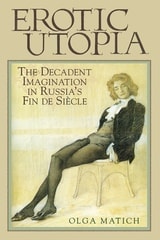
Erotic Utopia
The Decadent Imagination in Russia's Fin de SiecleOlga Matich
University of Wisconsin Press, 2007
The first generation of Russian modernists experienced a profound sense of anxiety resulting from the belief that they were living in an age of decline. What made them unique was their utopian prescription for overcoming the inevitability of decline and death both by metaphysical and physical means. They intertwined their mystical erotic discourse with European degeneration theory and its obsession with the destabilization of gender. In Erotic Utopia, Olga Matich suggests that same-sex desire underlay their most radical utopian proposal of abolishing the traditional procreative family in favor of erotically induced abstinence.
“Offers a fresh perspective and a wealth of new information on early Russian modernism. . . . It is required reading for anyone interested in fin-de-siècle Russia and in the history of sexuality in general.”—Bernice Glatzer Rosenthal, Slavic and East European Journal
“Thoroughly entertaining.”—Avril Pyman, Slavic Review
Erotics of Sovereignty
Queer Native Writing in the Era of Self-DeterminationMark Rifkin
University of Minnesota Press, 2012
In 1970 the Nixon administration inaugurated a new era in federal Indian policy. No more would the U.S. government seek to deny and displace Native peoples or dismantle Native governments; from now on federal policy would promote “the Indian’s sense of autonomy without threatening his sense of community.”
In The Erotics of Sovereignty, Mark Rifkin offers a telling perspective on what such a policy of self-determination has meant and looks at how contemporary queer Native writers use representations of sensation to challenge official U.S. accounts of Native identity. Rifkin focuses on four Native writers—Qwo-Li Driskill (Cherokee), Deborah Miranda (Esselen), Greg Sarris (Graton Rachería), and Chrystos (Menominee)—approaching their fiction and poetry as forms of political theory.
Rifkin shows how the work of these queer or two-spirit Native writers affirms the significance of the erotic as an exercise of individual and community sovereignty. In this way, we come to see how their work contests the homophobic, sexist, and exclusivist policies and attitudes of tribal communities as well as those of the nation-state.
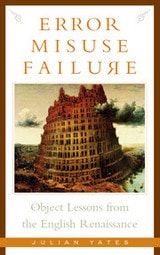
Error, Misuse, Failure
Object Lessons From The English RenaissanceJulian Yates
University of Minnesota Press, 2002
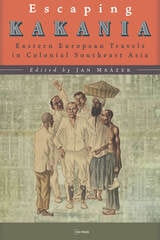
Escaping Kakania
Eastern European Travels in Colonial Southeast AsiaJan Mrázek
Central European University Press, 2024
Escaping Kakania is about fascinating characters—soldiers, doctors, scientists, writers, painters—who traveled from their eastern European homelands to colonial Southeast Asia. Their stories are told by experts on different countries in the two regions, who bring diverse approaches into a conversation that crosses disciplinary and national borders.
The 14 chapters deal with the diverse encounters of eastern Europeans with the many faces of colonial southeast Asia. Some essays directly engage with post-colonial studies, contributing to an ongoing critical re-evaluation of eastern European “semi-peripheral” (non-)involvement in colonialism. Other chapters disclose a range of perspectives and narratives that illuminate the plurality of the travelers’ positions while reflecting on the specificity of the eastern European experience.
The travellers moved—as do the chapter authors—between two regions that are off-centre, in-between, shiftingly “Eastern,” and disorientingly heterogeneous, thus complicating colonial and postcolonial notions of “Europe,” “East,” and East-West distinctions. Both at home and overseas, they navigated among a multiplicity of peoples, “races,” and empires, Occidents and Orients, fantasies of the Self and the Other, adopting/adapting/mimicking/rejecting colonialist identities and ideologies. They saw both eastern Europe and southeast Asia in a distinctive light, as if through each other—and so will the readers of Escaping Kakania.

Eschatological Subjects
Divine and Literary Judgment in Fourteenth-Century French PoetryJ. M. Moreau
The Ohio State University Press, 2014
But Eschatological Subjects goes even further to demonstrate the largely unrecognized duality of this judge figure: not just God, the judge is also the imperious and imperfect human reader. The simultaneous divine and human judgments in (and of) French poetry reveal much about the ethical stakes of writing vernacular poetry in the later Middle Ages and, most importantly, about the relationships between authors and audiences.
Focusing on Guillaume de Deguileville, Guillaume de Machaut, and Jean Froissart (each of whom composed scenes in which they appear on trial before God), Moreau contributes important new insights on the complex “trial process” of later medieval literature, in which poetic authority and fame depended on the poet’s ability to defend himself before a fearful court of reader opinion.

Essay on the Origin of Languages and Writings Related to Music
Jean Jacques Rousseau
Dartmouth College Press, 2009
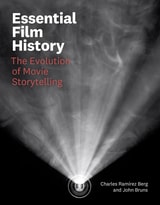
Essential Film History
The Evolution of Movie StorytellingCharles Ramírez Berg and John Bruns
University of Texas Press, 2026
A guide to the fundamentals of understanding film history, filmmaking, and film appreciation.
Film is not just a medium; it is also a language—and a global one at that. Essential Film History describes how this language emerged and how it has matured over the course of more than 125 years. Beginning with the experiments of the late nineteenth century, and tracking the development of cinematic storytelling, commercial distribution, and audience reception into the era of digital recording, Charles Ramírez Berg and John Bruns offer a comprehensive course in both the history and artistry of film.
Essential Film History breaks cinematic language into three core components: image, sound, and narrative. Between the 1890s and 1940s, this audiovisual language both consolidated and spread, becoming comprehensible worldwide. Since then, filmmakers have adapted and extended the language of cinema to suit an ever-growing range of aesthetic and narrative projects, from documentaries and full-length animation to avant-garde and made-for-TV movies. Covering major figures, studios, and events as well as key technological and sociopolitical developments, Essential Film History is an indispensable guide to the evolution of cinematic style.
Essentials of the Theory of Fiction
Michael J. Hoffman and Patrick D. Murphy, eds.
Duke University Press, 2005
Contributors. M. M. Bakhtin, John Barth, Roland Barthes, Wayne Booth, John Brenkman, Peter Brooks, Catherine Burgass, Seymour Chatman, J. Yellowlees Douglas, Rachel Blau DuPlessis, Wendy B. Faris, Barbara Foley, E. M. Forster, Joseph Frank, Joanne S. Frye, William H. Gass, Henry Louis Gates Jr., Gérard Genette, Ursula K. Heise, Michael J. Hoffman, Linda Hutcheon, Henry James, Susan S. Lanser, Helen Lock, Georg Lukács, Patrick D. Murphy, Ruth Ronen, Joseph Tabbi, Jon Thiem, Tzvetan Todorov, Virginia Woolf

Essentials of the Theory of Fiction, 2nd ed.
Michael J. Hoffman and Patrick D. Murphy, eds.
Duke University Press, 1996
Selections from: M. M. Bakhtin, John Barth, Roland Barthes, Wayne Booth, Peter Brooks, Seymour Chatman, Rachel Blau DuPlessis, Suzanne C. Ferguson, Barbara Foley, E. M. Forster, Joseph Frank, William Freedman, Norman Friedman, Joanne S. Frye, William H. Gass, Henry Louis Gates Jr., Gérard Genette, J. Arthur Honeywell, Linda Hutcheon, Henry James, Susan S. Lanser, Mitchell A. Leaska, George Levine, David Lodge, Georg Lukács, Gerald Prince, Patrocinio P. Schweickart, Tzvetan Todorov, Lionel Trilling, and Virginia Woolf
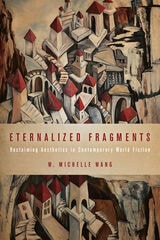
Eternalized Fragments
Reclaiming Aesthetics in Contemporary World FictionW. Michelle Wang
The Ohio State University Press, 2020
Since postmodern and contemporary fiction tend to be dominated by disjunctures, paradoxes, and incongruities, this book offers an account of how and why readers choose to engage regardless, articulating the cognitive rewards such difficulties offer. By putting narrative and philosophical approaches in conversation with evolutionary psychology and contemporary neuroscience, W. Michelle Wang examines the value of attending to aesthetic experiences when we read literature and effectively demonstrates that despite the aesthetic’s stumble in time, our ongoing love affair with fiction is grounded in our cognitive engagements with the text’s aesthetic dimensions.
Drawing on a diverse range of works by Gabriel García Márquez, Kazuo Ishiguro, Arundhati Roy,Cormac McCarthy, Jeanette Winterson, Jennifer Egan, Italo Calvino, Flann O’Brien, and Alasdair Gray, Eternalized Fragments lucidly renders the aesthetic energies at work in the novels’ rich potentialities of play, the sublime’s invitation to affective renegotiations, and beauty’s polysemy in shaping readerly capacities for nuance.
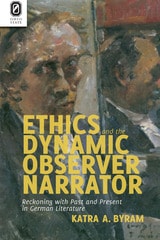
Ethics and the Dynamic Observer Narrator
Reckoning with Past and Present in German LiteratureKatra A. Byram
The Ohio State University Press, 2015
Ethics and the Dynamic Observer Narrator contributes to scholarship on both narrative theory and the historical and cultural context of German and Austrian literary studies. Narrative theory, according to Byram, should understand this form to register complex interactions between history and narrative form. Byram also juxtaposes new readings of works by Textor, Storm, and Raabe from the nineteenth century with analyses of twentieth-century works by Grass, Handke, and Sebald, ultimately reframing our understanding of literary Vergangenheitsbewältigung, or the struggle to come to terms with the past. Overall, Byram shows that neither the problem of reckoning with the past nor the dynamic observer form is unique to Germany’s post-WWII era. Both are products of the dynamics of modern identity, surfacing whenever critical change separates what was from what is.
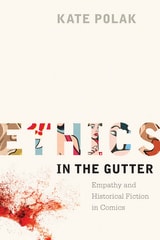
Ethics in the Gutter
Empathy and Historical Fiction in ComicsKate Polak
The Ohio State University Press, 2017
This book’s most important questions surround how we receive and interpret representations of history, considering the ways in which what we think we know about historical atrocities can be at odds with the convoluted circumstances surrounding violence. Beginning with a new look at Watchmen, and including examinations of such popular series as Scalped and Hellblazer as well as Bayou and Deogratias, the book questions how graphic narratives create an alternative route by which to understand large-scale violence. Ethics in the Gutter explores how graphic narrative representations of violence can teach readers about the possibilities and limitations of empathy and ethics.
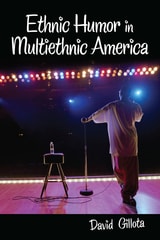
Ethnic Humor in Multiethnic America
Gillota, David
Rutgers University Press, 2013
Gillota investigates the manner in which various humorists respond to multiculturalism and the increasing diversity of the American population. Rather than looking at one or two ethnic groups at a time—as is common scholarly practice—the book focuses on the interplay between humorists from different ethnic communities. While some comic texts project a fantasy world in which diverse ethnic characters coexist in a rarely disputed harmony, others genuinely engage with the complexities and contradictions of multiethnic America.
The first chapter focuses on African American comedy with a discussion of such humorists as Paul Mooney and Chris Rock, who tend to reinforce a black/white vision of American race relations. This approach is contrasted to the comedy of Dave Chappelle, who looks beyond black and white and uses his humor to place blackness within a much wider multiethnic context.
Chapter 2 concentrates primarily on the Jewish humorists Sarah Silverman, Larry David, and Sacha Baron Cohen—three artists who use their personas to explore the peculiar position of contemporary Jews who exist in a middle space between white and other.
In chapter 3, Gillota discusses different humorous constructions of whiteness, from a detailed analysis of South Park to “Blue Collar Comedy” and the blog Stuff White People Like.
Chapter 4 is focused on the manner in which animated children’s film and the network situation comedy often project simplified and harmonious visions of diversity. In contrast, chapter 5 considers how many recent works, such as Harold and Kumar Go to White Castle and the Showtime series Weeds, engage with diversity in more complex and productive ways.
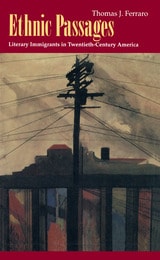
Ethnic Passages
Literary Immigrants in Twentieth-Century AmericaThomas J. Ferraro
University of Chicago Press, 1993
Ferraro engages the literature of immigration and mobility by asking what motivates its authors and what their work actually accomplishes. He concentrates on five diverse examples of the "up-from-the-ghetto" narrative: Mario Puzo's The Godfather, Anzia Yezierska's Bread Givers, Henry Roth's Call It Sleep, Henry Miller's "The Tailor Shop," and Maxine Hong Kingston's The Woman Warrior. To Ferraro the unsuspected value of these works is that they recast the conventions of ethnic representation, illustrating the power of ethnic writing to capture and redirect the national literary imagination.
Ferraro's sharply observed reading of these five works shows how such reenactments of immigrant mobility test the ideology of assimilation against the writer's experience. Ethnic Passages will refocus discussion of how literature addresses the American conflict between ethnic heritage and the greater opportunities of "mainstream" society.
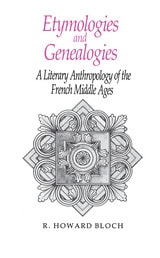
Etymologies and Genealogies
A Literary Anthropology of the French Middle AgesR. Howard Bloch
University of Chicago Press, 1983
"Bloch's Study is a genuinely interdisciplinary one, bringing together elements of history, ethnology, philology, philosophy, economics and literature, with the undoubted ambition of generating a new synthesis which will enable us to read the Middle Ages in a different light.
Stated simply, and in terms which do justice neither to the density nor the subtlety of his argument, Bloch's thesis is this: that medieval society perceived itself in terms of a vertical mode of descent from origins. This model is articulated etymologically in medieval theories of grammar and language, and is consequently reflected in historical and theological writings; it is also latent in the genealogical structure of the aristocratic family as it began to be organized in France in the twelfth century, and is made manifest in such systems of signs as heraldry and the adoption of patronymns. . . .
It is an ingenious and compelling synthesis which no medievalist, even on this side of the Atlantic, can afford to ignore." –Nicholas Mann, Times Literary Supplement
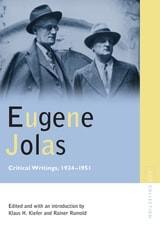
Eugene Jolas
Critical Writings, 1924-1951Eugene Jolas
Northwestern University Press, 2009
Dividing his youth between the United States and the bilingual Alsace-Lorraine, Eugene Jolas (1894–1952) flourished in three languages. As an editor and poet, he came to know the major writers and artists of his time and enjoyed a pivotal position between the Anglo-American and Continental avant-garde. His editorship of transition, the leading avant-garde journal of Paris in the twenties and early thirties, provided a major impetus to writers from James Joyce (whose Finnegans Wake was serialized in transition) to Gertrude Stein, and Samuel Beckett, with first translations of André Breton, and Franz Kafka, among others. Jolas’s critical work, collected in this volume, includes introductions to anthologies, manifestoes like the famous Vertical, essays, some published here for the first time, on writers as various as Novalis, Trakl, the major Surrealists, Heidegger, and other philosophers. An acute observer of the literary scene as well as of the roiling politics of the time, Jolas emerges here in his role at the very center of avant-garde activity between the wars. Accordingly, this book is of signal importance to anyone with an interest in modernism, avant-garde, multilingualism, and the culture of Western Europe in the first half of the twentieth century.
Euripides and the Instruction of the Athenians
Justina Gregory
University of Michigan Press, 1997
Evenings with the Orchestra
Hector Berlioz
University of Chicago Press, 1999
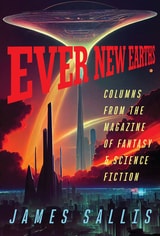
Ever New Earths
Columns from the Magazine of Fantasy & Science FictionSallis, James
University of Iowa Press, 2026
Ever New Earths gathers twenty-five years of book columns written by legendary writer James Sallis and published in The Magazine of Fantasy & Science Fiction to offer an exceptional overview of developments in contemporary science fiction, fully appreciating the genre’s traditions while recognizing its reach, its potential. This is a rare view of the genre from the inside, written toward outsiders with reason to learn and understand more: critics, historians, writers, editors.
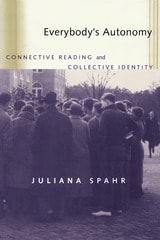
Everybody's Autonomy
Connective Reading and Collective IdentityJuliana Spahr
University of Alabama Press, 2001
Contemporary avant garde writing has often been overlooked by those who study literature and identity. Such writing has been perceived as unrelated, as disrespectful of subjectivity. But Everybody's Autonomy instead locates within avant garde literature models of identity that are communal, connective, and racially concerned. Everybody's Autonomy, as it tackles literary criticism's central question of what sort of selves do works create, looks at works that encourage connection, works that present and engage with large, public worlds that are in turn shared with readers. With this intent, it aligns the iconoclastic work of Gertrude Stein with foreign, immigrant Englishes and their accompanying subjectivities. It examines the critique of white individualism and privilege in the work of language writers Lyn Hejinian and Bruce Andrews. It looks at how Harryette Mullen mixes language writing's open text with the distinctivesness of African-American culture to propose a communal, yet still racially conscious identity. And it examines Theresa Hak Kyung Cha's use of broken English and French to unsettle readers' fluencies and assimilating comprehensions, to decolonize reading. Such works, the book argues, well represent and expand changing notions of the public, of everybody.

Everybody’s Family Romance
Reading Incest in Neoliberal AmericaGillian Harkins
University of Minnesota Press, 2009
In the 1990s, a boom in autobiographical novels and memoirs about incest emerged, making incest one of the hottest topics to connect daytime TV talk shows, the self-help industry, and the literary publishing circuit. In Everybody's Family Romance, Gillian Harkins places this proliferation of incest literature at the center of transformations in the political and economic climate of the late twentieth century.
Harkins's interdisciplinary approach reveals how women's narratives about incest were co-opted by-and yet retained resistant strains against-the cultural logics of the neoliberal state. Across chapters examining legal cases on recovered memory, popular journalism, and novels and memoirs by Dorothy Allison, Carolivia Herron, Kathryn Harrison, and Sapphire, Harkins demonstrates that incest narratives look backward into the past. In these accounts, images of incest forge links between U.S. chattel slavery and the distributive impasses of the welfare state and between decades-distant childhoods and emergent memories of the present.
In contrast to recent claims that incest narratives eclipse broader frameworks of political and economic power, Harkins argues that their emergence exposes changing structural relations between the family and the nation and, in doing so, transforms the analyses of American familial sexual violence.
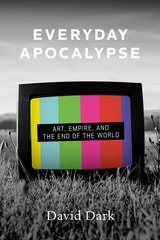
Everyday Apocalypse
Art, Empire, and the End of the WorldDavid Dark
Vanderbilt University Press, 2025
This revised edition of the book includes a foreword by Hanif Abdurraqib, an extensive afterword, updates in light of the passage of time since its publication, and new insights from the author, whose outspokenness has placed him outside of circles in which he was once supported and celebrated.
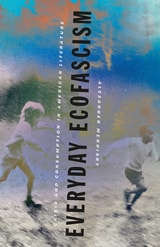
Everyday Ecofascism
Crisis and Consumption in American LiteratureAlexander Menrisky
University of Minnesota Press, 2025
A timely look into how fascist ideas permeate contemporary culture well beyond the far right
As challenges posed by climate change have intensified in the twenty-first century, right-wing figures in the United States and abroad have increasingly framed anti-immigrant, anti-Indigenous, and white-supremacist sentiments in terms of environmental survival. Everyday Ecofascism explores the insidious nature of this tendency, revealing how permutations of these perspectives in fact resonate across the political spectrum. Drawing on comparative studies of fascism writ large, Alexander Menrisky demonstrates that ecofascism is best understood not as a uniquely right-wing ideology but as a political genre that reinforces white supremacy and other forms of domination.
Presenting a view of fascism as a complex power network that plays out on scales both large and small, Menrisky shows how extremist sentiments have crept into everyday language, stories, and ideas. Through a literary and cultural studies lens, he illuminates ecofascism’s narrative patterns and their easy permeation of environmentalist discourses, from back-to-the-land movements to the resurgence of psychedelic drugs, food localism, and pandemic politics. Opposite his analysis of ecofascism in action, Menrisky sheds important light on narrative resistances to dominant conceptions of race, nation, and territory by Native, queer, and women-of-color writers who have countered ethnonationalism for generations.
Bridging past and present, Menrisky powerfully nails down the emergent concept of ecofascism and forms a basis for understanding phenomena like Covid-19, ecological utopianism, and psychedelic environmentalism that detangles ecofascist tendencies from justice-oriented visions of place-based belonging.
Retail e-book files for this title are screen-reader friendly.
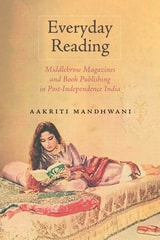
Everyday Reading
Middlebrow Magazines and Book Publishing in Post-Independence IndiaAakriti Mandhwani
University of Massachusetts Press, 2024
Finalist for the 2025 SHARP Book History Book Prize
During the two difficult decades immediately following the 1947 Indian Independence, a new, commercially successful print culture emerged that articulated alternatives to dominant national narratives. Through what Aakriti Mandhwani defines as middlebrow magazines—like Delhi Press’s Saritā—and the first paperbacks in Hindi—Hind Pocket Books—North Indian middle classes cultivated new reading practices that allowed them to reimagine what it meant to be a citizen. Rather than focusing on individual sacrifices and contributions to national growth, this new print culture promoted personal pleasure and other narratives that enabled readers to carve roles outside of official prescriptions of nationalism, austerity, and religion.
Utilizing a wealth of previously unexamined print culture materials, as well as paying careful attention to the production of commercial publishing companies and the reception of ordinary reading practices—particularly those of women—Everyday Reading offers fresh perspectives into book history, South Asian literary studies, and South Asian gender studies.
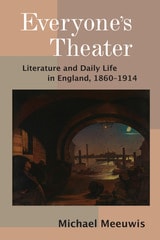
Everyone’s Theater
Literature and Daily Life in England, 1860–1914Michael Meeuwis
University of Michigan Press, 2019
Nearly all residents of England and its colonies between 1860 and 1914 were active theatergoers, and many participated in the amateur theatricals that defined late Victorian life. The Victorian theater was not an abstract figuration of the world as a stage, but a media system enmeshed in mass lived experience that fulfilled in actuality the concept of a theatergoing nation. Everyone’s Theater turns to local history, the words of everyday Victorians found in their diaries and production records, to recover this lost chapter of theater history in which amateur drama domesticates the stage. Professional actors and playwrights struggled to make their productions compatible with ideas and techniques that could be safely reproduced in the home—and in amateur performances from Canada to India. This became the first true English national theater: a society whose myriad classes found common ground in theatrical display. Everyone’s Theater provides new ways to extend Victorian literature into the dimension of voice, sound, and embodiment, and to appreciate the pleasures of Victorian theatricality.
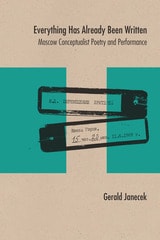
Everything Has Already Been Written
Moscow Conceptualist Poetry and PerformanceGerald Janecek
Northwestern University Press, 2019
Innovative poets such as Vsevolod Nekrasov, Lev Rubinstein, and Dmitry Prigov are among the most prominent literary figures of Russia in the 1980s and 1990s, yet they are virtually unknown outside Russia. The same is true of the numerous active Russian performance art groups, especially the pioneering Collective Actions group led by the brilliantly inventive Andrei Monastyrsky. Everything Has Already Been Written strives to make Moscow Conceptualism more accessible, to break the language barrier and to foster understanding among an international readership by thoroughly discussing a broad range of specific works and theories. Janecek’s study is the first comprehensive analysis of Moscow Conceptualist poetry and theory, vital for an understanding of Russian culture in the post‑Conceptualist era.
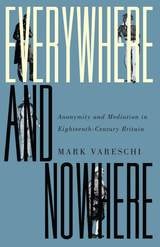
Everywhere and Nowhere
Anonymity and Mediation in Eighteenth-Century BritainMark Vareschi
University of Minnesota Press, 2018
A fascinating analysis of anonymous publication centuries before the digital age
Everywhere and Nowhere considers the ubiquity of anonymity and mediation in the publication and circulation of eighteenth-century British literature—before the Romantic creation of the “author”—and what this means for literary criticism. Anonymous authorship was typical of the time, yet literary scholars and historians have been generally unable to account for it as anything more than a footnote or curiosity.
Mark Vareschi shows the entangled relationship between mediation and anonymity, revealing the nonhuman agency of the printed text. Drawing richly on quantitative analysis and robust archival work, Vareschi brings together philosophy, literary theory, and media theory in a trenchant analysis, uncovering a history of textual engagement and interpretation that does not hinge on the known authorial subject.
In discussing anonymous poetry, drama, and the novel along with anonymously published writers such as Daniel Defoe, Frances Burney, and Walter Scott, he unveils a theory of mediation that renews broader questions about agency and intention. Vareschi argues that textual intentionality is a property of nonhuman, material media rather than human subjects alone, allowing the anonymous literature of the eighteenth century to speak to contemporary questions of meaning in the philosophy of language. Vareschi closes by exploring dubious claims about the death of anonymity and the reexplosion of anonymity with the coming of the digital. Ultimately, Everywhere and Nowhere reveals the long history of print anonymity so central to the risks and benefits of the digital culture.
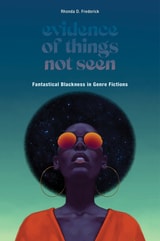
Evidence of Things Not Seen
Fantastical Blackness in Genre FictionsRhonda D. Frederick
Rutgers University Press, 2022
Evolutionary Rhetoric
Sex, Science, and Free Love in Nineteenth-Century FeminismWendy Hayden
Southern Illinois University Press, 2013
In Evolutionary Rhetoric, scholar Wendy Hayden provides a comprehensive examination of the relationship between scientific and feminist rhetorics in free-love feminism, studying the movement from its inception in the 1850s to its dark turn toward eugenics in the early 1900s. Hayden organizes her provocative study by scientific discipline—evolution, physiology, bacteriology, embryology, and heredity. Each chapter explores how free-love feminists adopted the evidence of that discipline in their arguments for increased sex education, women’s sexual rights, reproductive freedom, and the abolition of a marriage system that repressed the rights and the sexuality of women.
Hayden takes our conventional understanding of the relationship between nineteenth-century feminism and science and expands it. The author provides examples of the powerful words of free-love feminists to show exactly how these exceptional women used science as a rhetorical platform to promote feminist, and often radical, social reforms.
Considering why the free-love movement has not yet been studied, Hayden also discusses how the recovery of this movement may impact larger goals in the recovery of women’s rhetoric. This important and timely study of a long-forgotten movement adds to our understanding of the complexities of the history of feminism.
Exchange and the Maiden
Marriage in Sophoclean TragedyBy Kirk Ormand
University of Texas Press, 1999
Marriage is a central concern in five of the seven extant plays of the Greek tragedian Sophocles. In this pathfinding study, Kirk Ormand delves into the ways in which these plays represent and problematize marriage, thus offering insights into how Athenians thought about the institution of marriage.
Ormand takes a two-fold approach. He first explores the legal and economic underpinnings of Athenian marriage, an institution designed to guarantee the legitimate continuation of patrilineal households. He then shows how Sophocles' plays Trachiniae, Electra, Antigone, Ajax, and Oedipus Tyrannus both reinforce and critique this ideology by representing marriage as a homosocial exchange between men, in which women are objects who may attempt—but always fail—to become self-acting subjects.
These fresh readings provide the first systematic study of marriage in Sophocles. They draw important connections between drama and marriage as rituals concerned with controlling potentially disruptive female subjectivities.
Exile and Creativity
Signposts, Travelers, Outsiders, Backward GlancesSusan Rubin Suleiman, ed.
Duke University Press, 1998
In essays that range chronologically from the Renaissance to the 1990s, geographically from the Danube to the Andes, and historically from the Inquisition to the Holocaust, the complexities and tensions of exile and the diversity of its experiences are examined. Recognizing exile as an interior experience as much as a physical displacement, this collection discusses such varied topics as intellectual exile and seventeenth-century French literature; different versions of home and of the novel in the writings of Bakhtin and Lukács; the displacement of James Joyce and Clarice Lispector; a young journalist’s meeting with James Baldwin in the south of France; Jean Renoir’s Hollywood years; and reflections by the descendents of European emigrés. Strikingly, many of the essays are themselves the work of exiles, bearing out once more the power of the personal voice in scholarship.
With the exception of the contribution by Henry Louis Gates Jr., these essays were originally published in a special double issue of Poetics Today in 1996. Exile and Creativity will engage a range of readers from those whose specific interests include the problems of displacement and diaspora and the European Holocaust to those whose broad interests include art, literary and cultural studies, history, film, and the nature of human creativity.
Contributors. Zygmunt Bauman, Janet Bergstrom, Christine Brooke-Rose, Hélène Cixous, Tibor Dessewffy, Marianne Hirsch, Denis Hollier, Henry Louis Gates Jr., Linda Nochlin, Leo Spitzer, Susan Rubin Suleiman, Thomas Pavel, Doris Sommer, Nancy Huston, John Neubauer, Ernst van Alphen, Alicia Borinsky, Svetlana Boym, Jacqueline Chénieux-Gendron
Experiencing Fiction
Judgments, Progressions, and the Rhetorical Theory of NarrativeJames Phelan
The Ohio State University Press, 2007
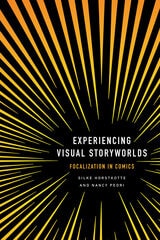
Experiencing Visual Storyworlds
Focalization in ComicsSilke Horstkotte and Nancy Pedri
The Ohio State University Press, 2022
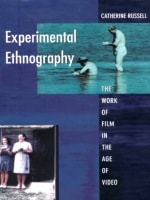
Experimental Ethnography
The Work of Film in the Age of VideoCatherine Russell
Duke University Press, 1999
Russell provides detailed analyses of more than thirty-five films and videos from the 1890s to the 1990s and discusses a wide range of film and videomakers, including Georges Méliès, Maya Deren, Peter Kubelka, Ray Birdwhistell, Jean Rouch, Su Friedrich, Bill Viola, Kidlat Tahimik, Margaret Mead, Tracey Moffatt, and Chantal Akerman. Arguing that video enables us to see film differently—not as a vanishing culture but as bodies inscripted in technology, Russell maps the slow fade from modernism to postmodern practices. Combining cultural critique with aesthetic analysis, she explores the dynamics of historical interruption, recovery, and reevaluation. As disciplinary boundaries dissolve, Russell contends, ethnography is a means of renewing the avant-gardism of “experimental” film, of mobilizing its play with language and form for historical ends. “Ethnography” likewise becomes an expansive term in which culture is represented from many different and fragmented perspectives.
Original in both its choice of subject and its theoretical and methodological
approaches, Experimental Ethnography will appeal to visual anthropologists, as well as film scholars interested in experimental and documentary practices.
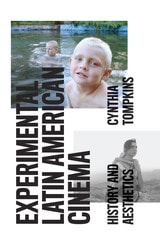
Experimental Latin American Cinema
History and AestheticsBy Cynthia Tompkins
University of Texas Press, 2013
While there are numerous film studies that focus on one particular grouping of films—by nationality, by era, or by technique—here is the first single volume that incorporates all of the above, offering a broad overview of experimental Latin American film produced over the last twenty years.
Analyzing seventeen recent films by eleven different filmmakers from Argentina, Brazil, Cuba, Mexico, Paraguay, and Peru, Cynthia Tompkins uses a comparative approach that finds commonalities among the disparate works in terms of their influences, aesthetics, and techniques. Tompkins introduces each film first in its sociohistorical context before summarizing it and then subverting its canonical interpretation. Pivotal to her close readings of the films and their convergences as a collective cinema is Tompkins’s application of Deleuzian film theory and the concept of the time-image as it pertains to the treatment of time and repetition. Tompkins also explores such topics as the theme of decolonization, the consistent use of montage, paratactically structured narratives, and the fusion of documentary conventions and neorealism with drama. An invaluable contribution to any dialogue on the avant-garde in general and to filmmaking both in and out of Latin America, Experimental Latin American Cinema is also a welcome and insightful addition to Latin American studies as a whole.
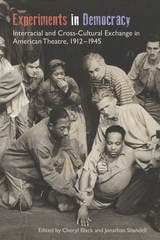
Experiments in Democracy
Interracial and Cross-Cultural Exchange in American Theatre, 1912-1945Edited by Cheryl Black and Jonathan Shandell
Southern Illinois University Press, 2016
In Experiments in Democracy, edited by Cheryl Black and Jonathan Shandell, theatre historians examine a wide range of performances—from Broadway, folk plays and dance productions to scripted political rallies and radio dramas. Contributors look at such diverse groups as the Theatre Union, La Unión Martí-Maceo, and the American Negro Theatre, as well as individual playwrights and their works, including Theodore Browne’s folk opera Natural Man, Josefina Niggli’s Soldadera, and playwright Lynn Riggs’s Cherokee Night and Green Grow the Lilacs (the basis for the musical Oklahoma!). Exploring the ways progressive artists sought to connect isolated racial and cultural groups in pursuit of a more just and democratic society, contributors take into account the blind spots, compromised methods, and unacknowledged biases at play in their practices and strategies. Essays demonstrate how the gap between the ideal of American democracy and its practice—mired in entrenched systems of white privilege, economic inequality, and social prejudice—complicated the work of these artists.
Focusing on questions of race, ethnicity, gender, and sexuality on the stage in the decades preceding the Civil Rights era, Experiments in Democracy fills an important gap in our understanding of the history of the American stage—and sheds light on these still-relevant questions in contemporary American society.
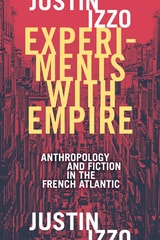
Experiments with Empire
Anthropology and Fiction in the French AtlanticJustin Izzo
Duke University Press, 2019
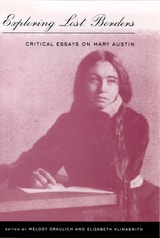
Exploring Lost Borders
Critical Essays On Mary AustinMelody Graulich
University of Nevada Press, 1999
Exporting Perilous Pauline
Pearl White and Serial Film CrazeEdited by Marina Dahlquist
University of Illinois Press, 2013
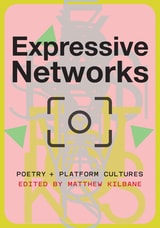
Expressive Networks
Poetry and Platform CulturesEdited by Matthew Kilbane
Amherst College Press, 2025
Though contributors write from a variety of methodological positions and address themselves to a range of archives, they share the primary conviction that the impact of Web 2.0 on literary practice is far-reaching, far from self-evident, and far more variegated and unpredictable than easy summations of social media’s influence suggest. Expressive Networks asks after poetry’s present and future by examining what poems themselves express about the social make-up of networked platforms.
Edited by Matthew Kilbane with contributions from Cameron Awkward-Rich, Micah Bateman, Andrew Campana, Sumita Chakraborty, Scott Challener, C.R. Grimmer, Tess McNulty, Michael Nardone, Seth Perlow, Anna Preus, Susanna Sacks, Carly Schnitzler, Melanie Walsh, and Samuel Caleb Wee.
Extended Play
Sounding Off from John Cage to Dr. FunkensteinJohn Corbett
Duke University Press, 1994
Using cultural critique and textual theory, Corbett addresses a broad spectrum of issues, such as the status of recorded music in postmodern culture, the politics of self-censorship, experimentation, and alternativism in the music industry, and the use of metaphors of space and madness in the work of African American musicians. He follows these more theoretically oriented essays with a series of extensive profiles and in-depth interviews that offer contrasting and complementary perspectives on some of the world’s most creative musicians and their work. Included here are more than twenty original photographs as well as a meticulously annotated discography. The result is one of the most thoughtful, and most entertaining, investigations of contemporary music available today.
Extinct Lands, Temporal Geographies
Chicana Literature and the Urgency of SpaceMary Pat Brady
Duke University Press, 2002
The history of the American Southwest in large part entails the transformation of lived, embodied space into zones of police surveillance, warehouse districts, highway interchanges, and shopping malls—a movement that Chicana writers have contested from its inception. Brady examines this long-standing engagement with space, first in the work of early newspaper essayists and fiction writers who opposed Anglo characterizations of Northern Sonora that were highly detrimental to Mexican Americans, and then in the work of authors who explore border crossing. Through the writing of Sandra Cisneros, Cherríe Moraga, Terri de la Peña, Norma Cantú, Monserrat Fontes, Gloria Anzaldúa, and others, Brady shows how categories such as race, gender, and sexuality are spatially enacted and created—and made to appear natural and unyielding. In a spatial critique of the war on drugs, she reveals how scale—the process by which space is divided, organized, and categorized—has become a crucial tool in the management and policing of the narcotics economy.