Results by title
8113 books match the query 'Literary Criticism' and 280 start with e

Eschatological Subjects
Divine and Literary Judgment in Fourteenth-Century French PoetryJ. M. Moreau
The Ohio State University Press, 2014
But Eschatological Subjects goes even further to demonstrate the largely unrecognized duality of this judge figure: not just God, the judge is also the imperious and imperfect human reader. The simultaneous divine and human judgments in (and of) French poetry reveal much about the ethical stakes of writing vernacular poetry in the later Middle Ages and, most importantly, about the relationships between authors and audiences.
Focusing on Guillaume de Deguileville, Guillaume de Machaut, and Jean Froissart (each of whom composed scenes in which they appear on trial before God), Moreau contributes important new insights on the complex “trial process” of later medieval literature, in which poetic authority and fame depended on the poet’s ability to defend himself before a fearful court of reader opinion.

Essay on the Origin of Languages and Writings Related to Music
Jean Jacques Rousseau
Dartmouth College Press, 2009

Essaying Shakespeare
Karen Newman
University of Minnesota Press, 2009
A pioneering scholar of Shakespeare and early modern letters provides an overview of work in the field
For more than twenty-five years, Karen Newman has brought her critical acumen to bear on early modern studies. In this collection of her essays on Shakespeare—some acknowledged classics and others never before published—Newman shows how changing theoretical trends have shaped Shakespeare studies, from new historicism and gender studies to critical race studies and globalization.
Central to Newman’s work is social exchange, or the circulation of people and objects. At least two of these essays have had a powerful and lasting impact on Shakespeare studies: “Renaissance Family Politics and Shakespeare’s The Taming of the Shrew” and “‘And wash the Ethiop White’: Femininity and the Monstrous in Othello.” Three essays appear in print for the first time: an examination of clothing of the poor and the portrayal of the king as a beggar in Richard II; a stinging review of Harold Bloom’s book Shakespeare: The Invention of the Human; and a rethinking of claims about the globalization of culture and cultural translation.Essaying Shakespeare chronicles Newman’s own critical development to provide a significant map of critical work on Shakespeare.
Essays and Studies in English and Comparative Literature
Members of the English Department of the University of Michigan
University of Michigan Press, 1935
Essays and Studies in English and Comparative Literature
Members of the English Department of the University of Michigan
University of Michigan Press, 1932
Essays on Ancient and Modern Judaism
Arnaldo Momigliano
University of Chicago Press, 1994
Momigliano acknowledged that his Judaism was the most fundamental inspiration for his scholarship, and the writings in this collection demonstrate how the ethical experience of the Hebraic tradition informed his other works. Part 1 is devoted entirely to writings on ancient and medieval Judaism. In these essays, Momigliano ranges over such subjects as the stages of rapport between Hellenism and Judaism, the figure of Flavius Josephus, and the salient moments of Maccabean history. Part 2 comprises Momigliano's writings on modern subjects. Here are profiles of Jewish scholars of the classical world (Bernays, Bickerman, and Finley) together with those of eminent representatives of contemporary Jewish thought (Strauss, Scholem, and Benjamin). These essays gain special significance alongside Momigliano's reflections on Italian Jewry and the Weberian interpretation of Judaism.
Silvia Berti's Introduction discusses Momigliano's religious and intellectual formation, the key events of his life, and the influence of Judaism on his mature scholarship. In his Preface, Momigliano offers a personal meditation on his own Judaism and that of his family.
By the time of his death, Momigliano had acquired an international following. This volume will at last give his admirers in the English-speaking world easy access to an important body of his work.
Essays on Gogol
Logos and the Russian WordSusanne Fusso and Priscilla Meyer
Northwestern University Press, 1994

Essays on Karolina Pavlova
Susanne Fusso and Alexander Lehrman
Northwestern University Press, 2001

Essential Essays (Two-volume set)
Foundations of Cultural Studies & Identity and DiasporaStuart Hall
Duke University Press, 2018
From his arrival in Britain in the 1950s and involvement in the New Left, to founding the field of cultural studies and examining race and identity in the 1990s and early 2000s, Stuart Hall has been central to shaping many of the cultural and political debates of our time. Essential Essays—a landmark two volume set—brings together Stuart Hall's most influential and foundational works. Spanning the whole of his career, these volumes reflect the breadth and depth of his intellectual and political projects while demonstrating their continued vitality and importance.
Volume 1: Foundations of Cultural Studies focuses on the first half of Hall's career, when he wrestled with questions of culture, class, representation, and politics. This volume's stand-out essays include his field-defining “Cultural Studies and Its Theoretical Legacies;” the prescient “The Great Moving Right Show,” which first identified the emergent mode of authoritarian populism in British politics; and “Encoding and Decoding in the Television Discourse,” one of his most influential pieces of media criticism. As a whole, Volume 1 provides a panoramic view of Hall's fundamental contributions to cultural studies.
Volume 2: Identity and Diaspora draws from Hall's later essays, in which he investigated questions of colonialism, empire, and race. It opens with “Gramsci's Relevance for the Study of Race and Ethnicity,” which frames the volume and finds Hall rethinking received notions of racial essentialism. In addition to essays on multiculturalism and globalization, black popular culture, and Western modernity's racial underpinnings, Volume 2 contains three interviews with Hall, in which he reflects on his life to theorize his identity as a colonial and diasporic subject.
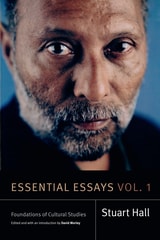
Essential Essays, Volume 1
Foundations of Cultural StudiesStuart Hall
Duke University Press, 2018
Volume 1: Foundations of Cultural Studies focuses on the first half of Hall's career, when he wrestled with questions of culture, class, representation, and politics. This volume's stand-out essays include his field-defining “Cultural Studies and Its Theoretical Legacies"; the prescient “The Great Moving Right Show,” which first identified the emergent mode of authoritarian populism in British politics; and “Encoding and Decoding in the Television Discourse,” one of his most influential pieces of media criticism. As a whole, Volume 1 provides a panoramic view of Hall's fundamental contributions to cultural studies.
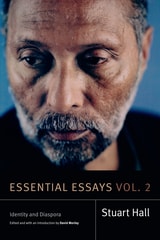
Essential Essays, Volume 2
Identity and DiasporaStuart Hall
Duke University Press, 2018
Volume 2: Identity and Diaspora draws from Hall's later essays, in which he investigated questions of colonialism, empire, and race. It opens with “Gramsci's Relevance for the Study of Race and Ethnicity,” which frames the volume and finds Hall rethinking received notions of racial essentialism. In addition to essays on multiculturalism and globalization, black popular culture, and Western modernity's racial underpinnings, Volume 2 contains three interviews with Hall, in which he reflects on his life to theorize his identity as a colonial and diasporic subject.
Essentials of the Theory of Fiction
Michael J. Hoffman and Patrick D. Murphy, eds.
Duke University Press, 2005
Contributors. M. M. Bakhtin, John Barth, Roland Barthes, Wayne Booth, John Brenkman, Peter Brooks, Catherine Burgass, Seymour Chatman, J. Yellowlees Douglas, Rachel Blau DuPlessis, Wendy B. Faris, Barbara Foley, E. M. Forster, Joseph Frank, Joanne S. Frye, William H. Gass, Henry Louis Gates Jr., Gérard Genette, Ursula K. Heise, Michael J. Hoffman, Linda Hutcheon, Henry James, Susan S. Lanser, Helen Lock, Georg Lukács, Patrick D. Murphy, Ruth Ronen, Joseph Tabbi, Jon Thiem, Tzvetan Todorov, Virginia Woolf

Essentials of the Theory of Fiction, 2nd ed.
Michael J. Hoffman and Patrick D. Murphy, eds.
Duke University Press, 1996
Selections from: M. M. Bakhtin, John Barth, Roland Barthes, Wayne Booth, Peter Brooks, Seymour Chatman, Rachel Blau DuPlessis, Suzanne C. Ferguson, Barbara Foley, E. M. Forster, Joseph Frank, William Freedman, Norman Friedman, Joanne S. Frye, William H. Gass, Henry Louis Gates Jr., Gérard Genette, J. Arthur Honeywell, Linda Hutcheon, Henry James, Susan S. Lanser, Mitchell A. Leaska, George Levine, David Lodge, Georg Lukács, Gerald Prince, Patrocinio P. Schweickart, Tzvetan Todorov, Lionel Trilling, and Virginia Woolf
Esteem Enlivened by Desire
The Couple from Homer to ShakespeareJean H. Hagstrum
University of Chicago Press, 1992
Hagstrum looks mainly at depictions of love in art and literature, works of the imagination that reflect social reality but also often transcend it to challenge restrictive codes and open up new possibilities for human nature. Among these possibilities, the association of esteem with sexual desire is one of the most invigorating that artists and thinkers have ever addressed. Tracing this motif through many different kinds of expression—from the Homeric epics, the Oresteia, Augustine's Confessions to the stories of Ovid, the Decameron, the plays and sonnets of Shakespeare—Hagstrum also illuminates a number of related themes, including other forms of relationship, from friendship to lust; marriage for political ends; liaisons with the same sex; and the presence of passion in religious commitment.
The culmination of Hagstrum's long career, Esteem Enlivened by Desire offers generous insight into the amorous heritage of the West—and honors one of its most important, enduring, and hard-won achievements.
Esther Regina
A Bakhtinian ReadingAndre LaCocque
Northwestern University Press, 2007
LaCocque finds in the book’s grotesque elements—from royal banquets that last a half-year to an improbable succession of coincidences and reversals of fortunes neutralizing a planned genocide—a natural fit with Bakhtin’s description of the “carnivalesque.”
Using key Bakhtinian tools such as the dialogic, the novelistic, the chronotopic, the polyphonic, and authoring-as-creating, LaCocque rereads Esther to show how the book’s comedic mood is paradoxically proportional to the catastrophic predicament of the Jews. Here, as biblical theocentrism shifts to Judeocentrism, we see how the carnivalesque becomes subversive of the Establishment and liberating. In Esther, the underlying conviction is that Jewish survival is providential—and that antisemitism is anti-God. This is, as LaCocque tells us with a nod to Aristotle, a worthy lesson disguised as a "low genre."
Eternalized Fragments
Reclaiming Aesthetics in Contemporary World FictionW. Michelle Wang
The Ohio State University Press, 2020
Since postmodern and contemporary fiction tend to be dominated by disjunctures, paradoxes, and incongruities, this book offers an account of how and why readers choose to engage regardless, articulating the cognitive rewards such difficulties offer. By putting narrative and philosophical approaches in conversation with evolutionary psychology and contemporary neuroscience, W. Michelle Wang examines the value of attending to aesthetic experiences when we read literature and effectively demonstrates that despite the aesthetic’s stumble in time, our ongoing love affair with fiction is grounded in our cognitive engagements with the text’s aesthetic dimensions.
Drawing on a diverse range of works by Gabriel García Márquez, Kazuo Ishiguro, Arundhati Roy,Cormac McCarthy, Jeanette Winterson, Jennifer Egan, Italo Calvino, Flann O’Brien, and Alasdair Gray, Eternalized Fragments lucidly renders the aesthetic energies at work in the novels’ rich potentialities of play, the sublime’s invitation to affective renegotiations, and beauty’s polysemy in shaping readerly capacities for nuance.
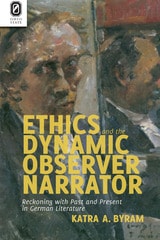
Ethics and the Dynamic Observer Narrator
Reckoning with Past and Present in German LiteratureKatra A. Byram
The Ohio State University Press, 2015
Ethics and the Dynamic Observer Narrator contributes to scholarship on both narrative theory and the historical and cultural context of German and Austrian literary studies. Narrative theory, according to Byram, should understand this form to register complex interactions between history and narrative form. Byram also juxtaposes new readings of works by Textor, Storm, and Raabe from the nineteenth century with analyses of twentieth-century works by Grass, Handke, and Sebald, ultimately reframing our understanding of literary Vergangenheitsbewältigung, or the struggle to come to terms with the past. Overall, Byram shows that neither the problem of reckoning with the past nor the dynamic observer form is unique to Germany’s post-WWII era. Both are products of the dynamics of modern identity, surfacing whenever critical change separates what was from what is.
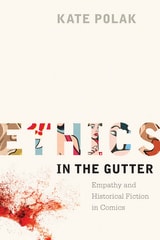
Ethics in the Gutter
Empathy and Historical Fiction in ComicsKate Polak
The Ohio State University Press, 2017
This book’s most important questions surround how we receive and interpret representations of history, considering the ways in which what we think we know about historical atrocities can be at odds with the convoluted circumstances surrounding violence. Beginning with a new look at Watchmen, and including examinations of such popular series as Scalped and Hellblazer as well as Bayou and Deogratias, the book questions how graphic narratives create an alternative route by which to understand large-scale violence. Ethics in the Gutter explores how graphic narrative representations of violence can teach readers about the possibilities and limitations of empathy and ethics.
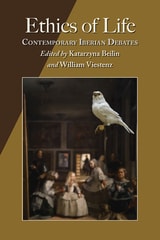
Ethics of Life
Contemporary Iberian DebatesKatarzyna Beilin
Vanderbilt University Press, 2016
• What are the different rhetorical strategies employed by writers, artists, filmmakers, and activists to react to the degradation of life and climate change?
• How are urban movements using environmental issues to resist corporate privatization of the commons?
• What is the shape of Spanish debates on reproductive rights and biotechnology?
• What is the symbolic significance of the bullfighting debate and other human/animal issues in today's political turmoil in Spain?
Hispanic Issues Series
Nicholas Spadaccini, Editor-in-Chief
Hispanic Issues Online
hispanicissues.umn.edu/online_main.html
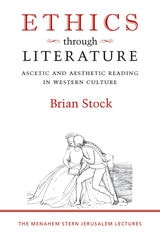
Ethics through Literature
Ascetic and Aesthetic Reading in Western CultureBrian Stock
Brandeis University Press, 2008
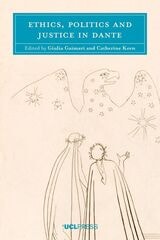
Ethics, Politics and Justice in Dante
Edited by Giulia Gaimari and Catherine Keen
University College London, 2019
Bringing together an international and interdisciplinary group of contributors, ranging across history, philology, classical studies, philosophy, and theology, Ethics, Politics and Justice in Dante presents new research on ethics, politics, and justice in the works of Dante Alighieri, including chapters on Dante’s conception of the afterlife. Contributors scrutinize the Divine Comedy and Dante’s other works in Italian and Latin, showing the evolution of his thought throughout his writing career, with chapters focusing especially on his early philosophical Convivio and on the two “Eclogues” of his final years. Other chapters tackle themes relating to judgment, justice, rhetoric, and literary ethics in the Divine Comedy, as well as the differing public reception and use of Dante’s work in Italy and Britain.
Ethiopia Unbound
A Critical EditionJ. E. Casely Hayford
Michigan State University Press, 2024
Ethnic Passages
Literary Immigrants in Twentieth-Century AmericaThomas J. Ferraro
University of Chicago Press, 1993
Ferraro engages the literature of immigration and mobility by asking what motivates its authors and what their work actually accomplishes. He concentrates on five diverse examples of the "up-from-the-ghetto" narrative: Mario Puzo's The Godfather, Anzia Yezierska's Bread Givers, Henry Roth's Call It Sleep, Henry Miller's "The Tailor Shop," and Maxine Hong Kingston's The Woman Warrior. To Ferraro the unsuspected value of these works is that they recast the conventions of ethnic representation, illustrating the power of ethnic writing to capture and redirect the national literary imagination.
Ferraro's sharply observed reading of these five works shows how such reenactments of immigrant mobility test the ideology of assimilation against the writer's experience. Ethnic Passages will refocus discussion of how literature addresses the American conflict between ethnic heritage and the greater opportunities of "mainstream" society.
Ethnicity on Parade
Inventing the Norwegian American through CelebrationApril R. Schultz
University of Massachusetts Press, 2009
These are some of the questions April R. Schultz addresses in this interdisciplinary study of the way in which ethnic identity has been shaped and expressed in American culture. Drawing on the work of historians, anthropologists, literary critics, and cultural theorists, Schultz analyzes one national celebration—the 1925 Norwegian-American Immigration Centennial—as a strategic site for the invention of ethnicity. She shows how Norwegian Americans used this ceremony to create a distinctive vision of their past and present—a social and cultural construction that both accommodated and resisted dominant Anglo-American conceptions of assimilation.
By taking a close look at the experiences of a white, middle-class, Protestant ethnic community, this book challenges many assumptions about the "Americanization" of immigrant groups and offers new insight into the uses of historical memory.
Etymologies and Genealogies
A Literary Anthropology of the French Middle AgesR. Howard Bloch
University of Chicago Press, 1983
"Bloch's Study is a genuinely interdisciplinary one, bringing together elements of history, ethnology, philology, philosophy, economics and literature, with the undoubted ambition of generating a new synthesis which will enable us to read the Middle Ages in a different light.
Stated simply, and in terms which do justice neither to the density nor the subtlety of his argument, Bloch's thesis is this: that medieval society perceived itself in terms of a vertical mode of descent from origins. This model is articulated etymologically in medieval theories of grammar and language, and is consequently reflected in historical and theological writings; it is also latent in the genealogical structure of the aristocratic family as it began to be organized in France in the twelfth century, and is made manifest in such systems of signs as heraldry and the adoption of patronymns. . . .
It is an ingenious and compelling synthesis which no medievalist, even on this side of the Atlantic, can afford to ignore." –Nicholas Mann, Times Literary Supplement
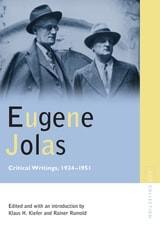
Eugene Jolas
Critical Writings, 1924-1951Eugene Jolas
Northwestern University Press, 2009
Dividing his youth between the United States and the bilingual Alsace-Lorraine, Eugene Jolas (1894–1952) flourished in three languages. As an editor and poet, he came to know the major writers and artists of his time and enjoyed a pivotal position between the Anglo-American and Continental avant-garde. His editorship of transition, the leading avant-garde journal of Paris in the twenties and early thirties, provided a major impetus to writers from James Joyce (whose Finnegans Wake was serialized in transition) to Gertrude Stein, and Samuel Beckett, with first translations of André Breton, and Franz Kafka, among others. Jolas’s critical work, collected in this volume, includes introductions to anthologies, manifestoes like the famous Vertical, essays, some published here for the first time, on writers as various as Novalis, Trakl, the major Surrealists, Heidegger, and other philosophers. An acute observer of the literary scene as well as of the roiling politics of the time, Jolas emerges here in his role at the very center of avant-garde activity between the wars. Accordingly, this book is of signal importance to anyone with an interest in modernism, avant-garde, multilingualism, and the culture of Western Europe in the first half of the twentieth century.
Eureka
Edgar Allan Poe
University of Illinois Press, 2004
This user-friendly edition puts Eureka in context, explaining Poe's excellent grasp of then-new developments in astronomy, his often-prescient projections from what was known to what might come next (Poe is especially good on space-time), and the close connections between Eureka and the thought and attitudes of his era.
Through extensive annotations this edition of Eureka demonstrates intimate connections with Poe's poetry, fiction, and criticism, with his career and aspirations, his humor and satire, and his love of grand literary effects.
It also presents a carefully edited text, including Poe's own emendations from several copies which he marked for the revised reprinting that he hoped would follow, and related documents
Euripides and the Tragic Tradition
Ann Norris Michelini
University of Wisconsin Press, 2006
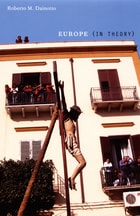
Europe (in Theory)
Roberto M. Dainotto
Duke University Press, 2007
Dainotto synthesizes a vast array of literary, philosophical, and historical works by authors from different parts of Europe. He scrutinizes theories that came to dominate thinking about the continent, including Montesquieu’s invention of Europe’s north-south divide, Hegel’s “two Europes,” and Madame de Staël’s idea of opposing European literatures: a modern one from the North, and a pre-modern one from the South. At the same time, Dainotto brings to light counter-narratives written from Europe’s margins, such as the Spanish Jesuit Juan Andrés’s suggestion that the origins of modern European culture were eastern rather than northern and the Italian Orientalist Michele Amari’s assertion that the South was the cradle of a social democracy brought to Europe via Islam.
European Others
Queering Ethnicity in Postnational EuropeFatima El-Tayeb
University of Minnesota Press, 2011
European Others offers an interrogation into the position of racialized communities in the European Union, arguing that the tension between a growing nonwhite, non-Christian population and insistent essentialist definitions of Europeanness produces new forms of identity and activism. Moving beyond disciplinary and national limits, Fatima El-Tayeb explores structures of resistance, tracing a Europeanization from below in which migrant and minority communities challenge the ideology of racelessness that places them firmly outside the community of citizens.
Using a notable variety of sources, from drag performances to feminist Muslim activism and Euro hip-hop, El-Tayeb draws on the largely ignored archive of vernacular culture central to resistance by minority youths to the exclusionary nationalism that casts them as threatening outcasts. At the same time, she reveals the continued effect of Europe’s suppressed colonial history on the representation of Muslim minorities as the illiberal Other of progressive Europe.
Presenting a sharp analysis of the challenges facing a united Europe seen by many as a model for twenty-first-century postnational societies, El-Tayeb combines theoretical influences from both sides of the Atlantic to lay bare how Europeans of color are integral to the continent’s past, present, and, inevitably, its future.

Evelyn Waugh's Oxford
Barbara Cooke
Bodleian Library Publishing, 2018
Following a brief overview of Waugh’s life and work, subsequent chapters examine the prose and graphic art Waugh produced as an undergraduate, together with his portrayal of Oxford in Brideshead Revisited and his memoir, A Little Learning. A specially commissioned, hand-drawn trail around Evelyn Waugh’s Oxford guides the reader around the city Waugh knew and loved through such iconic locations as the Botanic Garden, the Oxford Union, and the Chequers.
A unique literary biography, this book brings to life Waugh’s Oxford, exploring the lasting impression it made on one of the most accomplished literary craftsmen of the twentieth century.
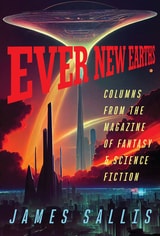
Ever New Earths
Columns from the Magazine of Fantasy & Science FictionSallis, James
University of Iowa Press, 2026
Ever New Earths gathers twenty-five years of book columns written by legendary writer James Sallis and published in The Magazine of Fantasy & Science Fiction to offer an exceptional overview of developments in contemporary science fiction, fully appreciating the genre’s traditions while recognizing its reach, its potential. This is a rare view of the genre from the inside, written toward outsiders with reason to learn and understand more: critics, historians, writers, editors.
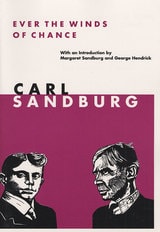
Ever the Winds of Chance
POEMSCarl Sandburg
University of Illinois Press, 1983
Ever the Winds of Chance opens in 1898 when the twenty-year-old Sandburg, recently returned from the Spanish-American war, enrolls at Lombard College in his native Galesburg, Illinois. Sandburg writes about his job at the fire station; his teachers, inspired or otherwise; his classmates and their camaraderie; his observations on great literary works and writers; and his own writings for the school newspaper, literary review, and yearbook and for the Galesburg Mail. But he also includes much about life between school years and after college, recounting his various brief careers as a fireman, salesman of stereoscopic views, advertising copywriter, vagabond, "jailbird," and budding poet and socialist. Together these reminiscences provide an intimate look at the formative years of a preeminent figure in American letters.
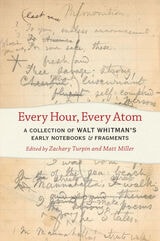
Every Hour, Every Atom
A Collection of Walt Whitman's Early Notebooks and FragmentsWalt Whitman, Zachary Turpin and Matt Miller
University of Iowa Press, 2020
Some of the dimmest years in Walt Whitman’s life precede the advent of Leaves of Grass in 1855, when he was working as a journalist and fiction writer. Starting around 1850, what he’d begun writing in his personal notebooks was far more enigmatic than anything he’d done before.
One of Whitman’s most secretive projects during this timeframe was a novel, Life and Adventures of Jack Engle; serialized anonymously in the spring of 1852, and rediscovered and properly published in 2017. The key to the novel’s later discovery were plot notes Whitman had made in one of his private notebooks.
Whitman’s invaluable notebooks have been virtually inaccessible to the public, until now. Maintaining the early notebooks’ wild, syncretic feel and sample illustrations of Whitman’s beautiful and unkempt pages, scholars Zachary Turpin and Matt Miller’s thorough transcriptions have made these notebooks available to all; sharing Whitman’s secret space for developing his poetry, his writing, his philosophy, and himself.
Every Intellectual's Big Brother
George Orwell's Literary SiblingsBy John Rodden
University of Texas Press, 2006
George Orwell has been embraced, adopted, and co-opted by everyone from the far left to the neoconservatives. Each succeeding generation of Anglo-American intellectuals has felt compelled to engage the life, work, and cultural afterlife of Orwell, who is considered by many to have been the foremost political writer of the twentieth century. Every Intellectual's Big Brother explores the ways in which numerous disparate groups, Orwell's intellectual "siblings," have adapted their views of Orwell to fit their own agendas and how in doing so they have changed our perceptions of Orwell himself. By examining the politics of literary reception as a dimension of cultural history, John Rodden gives us a better understanding of Orwell's unique and enduring role in Anglo-American intellectual life.
In Part One, Rodden opens the book with a section titled "Their Orwell, Left and Right," which focuses on Orwell's reception by several important literary circles of the latter half of the twentieth century. Beginning with Orwell's own contemporaries, Rodden addresses the ways various intellectual groups of the 1950s responded to Orwell. Rodden then moves on in Part Two to what he calls the "Orwell Confraternity Today," those contemporary intellectuals who have, in various ways, identified themselves with or reacted against Orwell. The author concludes by examining how Orwell's status as an object of admiration and detraction has complicated the way in which he has been perceived by readers since his death.
Everybody's Autonomy
Connective Reading and Collective IdentityJuliana Spahr
University of Alabama Press, 2001
Contemporary avant garde writing has often been overlooked by those who study literature and identity. Such writing has been perceived as unrelated, as disrespectful of subjectivity. But Everybody's Autonomy instead locates within avant garde literature models of identity that are communal, connective, and racially concerned. Everybody's Autonomy, as it tackles literary criticism's central question of what sort of selves do works create, looks at works that encourage connection, works that present and engage with large, public worlds that are in turn shared with readers. With this intent, it aligns the iconoclastic work of Gertrude Stein with foreign, immigrant Englishes and their accompanying subjectivities. It examines the critique of white individualism and privilege in the work of language writers Lyn Hejinian and Bruce Andrews. It looks at how Harryette Mullen mixes language writing's open text with the distinctivesness of African-American culture to propose a communal, yet still racially conscious identity. And it examines Theresa Hak Kyung Cha's use of broken English and French to unsettle readers' fluencies and assimilating comprehensions, to decolonize reading. Such works, the book argues, well represent and expand changing notions of the public, of everybody.
Everybody’s Family Romance
Reading Incest in Neoliberal AmericaGillian Harkins
University of Minnesota Press, 2009
In the 1990s, a boom in autobiographical novels and memoirs about incest emerged, making incest one of the hottest topics to connect daytime TV talk shows, the self-help industry, and the literary publishing circuit. In Everybody's Family Romance, Gillian Harkins places this proliferation of incest literature at the center of transformations in the political and economic climate of the late twentieth century.
Harkins's interdisciplinary approach reveals how women's narratives about incest were co-opted by-and yet retained resistant strains against-the cultural logics of the neoliberal state. Across chapters examining legal cases on recovered memory, popular journalism, and novels and memoirs by Dorothy Allison, Carolivia Herron, Kathryn Harrison, and Sapphire, Harkins demonstrates that incest narratives look backward into the past. In these accounts, images of incest forge links between U.S. chattel slavery and the distributive impasses of the welfare state and between decades-distant childhoods and emergent memories of the present.
In contrast to recent claims that incest narratives eclipse broader frameworks of political and economic power, Harkins argues that their emergence exposes changing structural relations between the family and the nation and, in doing so, transforms the analyses of American familial sexual violence.
Everyday Apocalypse
Art, Empire, and the End of the WorldDavid Dark
Vanderbilt University Press, 2025
This revised edition of the book includes a foreword by Hanif Abdurraqib, an extensive afterword, updates in light of the passage of time since its publication, and new insights from the author, whose outspokenness has placed him outside of circles in which he was once supported and celebrated.
Everyday Ecofascism
Crisis and Consumption in American LiteratureAlexander Menrisky
University of Minnesota Press, 2025
A timely look into how fascist ideas permeate contemporary culture well beyond the far right
As challenges posed by climate change have intensified in the twenty-first century, right-wing figures in the United States and abroad have increasingly framed anti-immigrant, anti-Indigenous, and white-supremacist sentiments in terms of environmental survival. Everyday Ecofascism explores the insidious nature of this tendency, revealing how permutations of these perspectives in fact resonate across the political spectrum. Drawing on comparative studies of fascism writ large, Alexander Menrisky demonstrates that ecofascism is best understood not as a uniquely right-wing ideology but as a political genre that reinforces white supremacy and other forms of domination.
Presenting a view of fascism as a complex power network that plays out on scales both large and small, Menrisky shows how extremist sentiments have crept into everyday language, stories, and ideas. Through a literary and cultural studies lens, he illuminates ecofascism’s narrative patterns and their easy permeation of environmentalist discourses, from back-to-the-land movements to the resurgence of psychedelic drugs, food localism, and pandemic politics. Opposite his analysis of ecofascism in action, Menrisky sheds important light on narrative resistances to dominant conceptions of race, nation, and territory by Native, queer, and women-of-color writers who have countered ethnonationalism for generations.
Bridging past and present, Menrisky powerfully nails down the emergent concept of ecofascism and forms a basis for understanding phenomena like Covid-19, ecological utopianism, and psychedelic environmentalism that detangles ecofascist tendencies from justice-oriented visions of place-based belonging.
Retail e-book files for this title are screen-reader friendly.
Everyday English 1500-1700
A ReaderBridget Cusack, Editor
University of Michigan Press, 1998
This unique source book of essential documents designed for courses on Early Modern English is designed as a teaching text with full guidance to each text, including glossary, explanatory and background notes, and suggested topics for linguistic evaluation. Everyday English takes an up-to-the-minute approach by focusing on language as it was used and spoken at the time.
This wide-ranging collection for the first time makes available to students a corpus of examples of the ordinary, nonstandard language of the man and woman in the street, coming from areas as diverse as England, Scotland, and America. The emphasis throughout is on providing as much assistance as possible to the reader to aid understanding and appreciation of both the linguistic features and the everyday lifestyles of the time.
"The only book a really conscientious teacher of the history and structure of Early Modern English would use for source texts." --Roger Lass, University of Cape Town
Bridget Cusack was lecturer in English Language, University of Edinburgh.
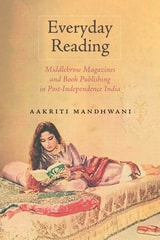
Everyday Reading
Middlebrow Magazines and Book Publishing in Post-Independence IndiaAakriti Mandhwani
University of Massachusetts Press, 2024
Finalist for the 2025 SHARP Book History Book Prize
During the two difficult decades immediately following the 1947 Indian Independence, a new, commercially successful print culture emerged that articulated alternatives to dominant national narratives. Through what Aakriti Mandhwani defines as middlebrow magazines—like Delhi Press’s Saritā—and the first paperbacks in Hindi—Hind Pocket Books—North Indian middle classes cultivated new reading practices that allowed them to reimagine what it meant to be a citizen. Rather than focusing on individual sacrifices and contributions to national growth, this new print culture promoted personal pleasure and other narratives that enabled readers to carve roles outside of official prescriptions of nationalism, austerity, and religion.
Utilizing a wealth of previously unexamined print culture materials, as well as paying careful attention to the production of commercial publishing companies and the reception of ordinary reading practices—particularly those of women—Everyday Reading offers fresh perspectives into book history, South Asian literary studies, and South Asian gender studies.
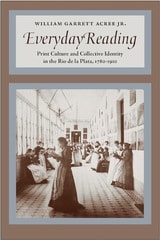
Everyday Reading
Print Culture and Collective Identity in the Rio de la Plata, 1780-1910William Garrett Acree
Vanderbilt University Press, 2011
Starting in the late nineteenth century, the region of South America known as the Rio de la Plata (containing modern-day Uruguay and Argentina) boasted the highest literacy rates in Latin America. In Everyday Reading, William Acree explores the history, events, and culture that gave rise to the region's remarkable progress. With a specific focus on its print culture, in the form of newspapers, political advertisements and documents, schoolbooks, and even stamps and currency, Acree creates a portrait of a literary culture that permeated every aspect of life.
Everyday Reading argues that the introduction of the printing press into the Rio de la Plata in the 1780s hastened the collapse of Spanish imperial control and played a major role in the transition to independence some thirty years later. After independence, print culture nurtured a new identity and helped sustain the region through the tumult of civil war in the mid-1800s. Acree concludes by examining the role of reading in formal education, which had grown exponentially by the early twentieth century as schoolchildren were taught to fulfill traditional roles in society.
Ultimately, Everyday Reading humanizes literary culture, demonstrating its unrecognized and unexpected influence in everyday lives.
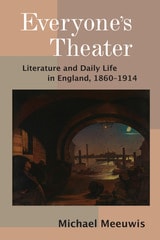
Everyone’s Theater
Literature and Daily Life in England, 1860–1914Michael Meeuwis
University of Michigan Press, 2019
Nearly all residents of England and its colonies between 1860 and 1914 were active theatergoers, and many participated in the amateur theatricals that defined late Victorian life. The Victorian theater was not an abstract figuration of the world as a stage, but a media system enmeshed in mass lived experience that fulfilled in actuality the concept of a theatergoing nation. Everyone’s Theater turns to local history, the words of everyday Victorians found in their diaries and production records, to recover this lost chapter of theater history in which amateur drama domesticates the stage. Professional actors and playwrights struggled to make their productions compatible with ideas and techniques that could be safely reproduced in the home—and in amateur performances from Canada to India. This became the first true English national theater: a society whose myriad classes found common ground in theatrical display. Everyone’s Theater provides new ways to extend Victorian literature into the dimension of voice, sound, and embodiment, and to appreciate the pleasures of Victorian theatricality.
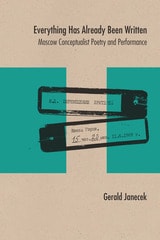
Everything Has Already Been Written
Moscow Conceptualist Poetry and PerformanceGerald Janecek
Northwestern University Press, 2019
Innovative poets such as Vsevolod Nekrasov, Lev Rubinstein, and Dmitry Prigov are among the most prominent literary figures of Russia in the 1980s and 1990s, yet they are virtually unknown outside Russia. The same is true of the numerous active Russian performance art groups, especially the pioneering Collective Actions group led by the brilliantly inventive Andrei Monastyrsky. Everything Has Already Been Written strives to make Moscow Conceptualism more accessible, to break the language barrier and to foster understanding among an international readership by thoroughly discussing a broad range of specific works and theories. Janecek’s study is the first comprehensive analysis of Moscow Conceptualist poetry and theory, vital for an understanding of Russian culture in the post‑Conceptualist era.
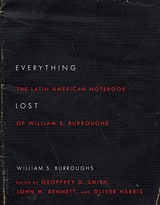
Everything Lost
The Latin American Notebook of William S. Burroughs, Revised EditionWilliam S. Burroughs, Edited by Geoffrey D. Smith, John M. Bennett, and Oliver Harris
The Ohio State University Press, 2017
In late summer 1953, as he returned to Mexico City after a seven-month expedition through the jungles of Ecuador, Colombia, and Peru, William Burroughs began a notebook of final reflections on his four years in Latin America. His first novel, Junkie, had just been published and he would soon be back in New York to meet Allen Ginsberg and together complete the manuscripts of what became The Yage Letters and Queer. Yet this notebook, the sole survivor from that period, reveals Burroughs not as a writer on the verge of success, but as a man staring down personal catastrophe and visions of looming cultural disaster.
Losses that will not let go of him haunt Burroughs throughout the notebook: “Bits of it keep floating back to me like memories of a daytime nightmare.” However, out of these dark reflections we see emerge vivid fragments of Burroughs’ fiction and, even more tellingly, unique, primary evidence for the remarkable ways in which his early manuscripts evolved. Assembled in facsimile and transcribed by Geoffrey D. Smith, John M. Bennett, and Burroughs scholar Oliver Harris, the notebook forces us to change the way we see both Burroughs and his writing at a turning point in his literary career.
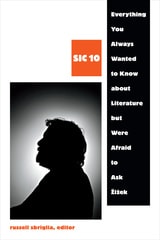
Everything You Always Wanted to Know about Literature but Were Afraid to Ask Žižek
SIC 10Russell Sbriglia, editor
Duke University Press, 2017
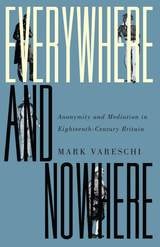
Everywhere and Nowhere
Anonymity and Mediation in Eighteenth-Century BritainMark Vareschi
University of Minnesota Press, 2018
A fascinating analysis of anonymous publication centuries before the digital age
Everywhere and Nowhere considers the ubiquity of anonymity and mediation in the publication and circulation of eighteenth-century British literature—before the Romantic creation of the “author”—and what this means for literary criticism. Anonymous authorship was typical of the time, yet literary scholars and historians have been generally unable to account for it as anything more than a footnote or curiosity.
Mark Vareschi shows the entangled relationship between mediation and anonymity, revealing the nonhuman agency of the printed text. Drawing richly on quantitative analysis and robust archival work, Vareschi brings together philosophy, literary theory, and media theory in a trenchant analysis, uncovering a history of textual engagement and interpretation that does not hinge on the known authorial subject.
In discussing anonymous poetry, drama, and the novel along with anonymously published writers such as Daniel Defoe, Frances Burney, and Walter Scott, he unveils a theory of mediation that renews broader questions about agency and intention. Vareschi argues that textual intentionality is a property of nonhuman, material media rather than human subjects alone, allowing the anonymous literature of the eighteenth century to speak to contemporary questions of meaning in the philosophy of language. Vareschi closes by exploring dubious claims about the death of anonymity and the reexplosion of anonymity with the coming of the digital. Ultimately, Everywhere and Nowhere reveals the long history of print anonymity so central to the risks and benefits of the digital culture.
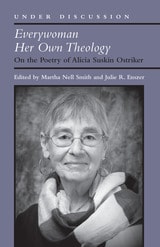
Everywoman Her Own Theology
On the Poetry of Alicia Suskin OstrikerMartha Nell Smith and Julie R. Enszer, Editors
University of Michigan Press, 2018
Everywoman Her Own Theology: On the Poetry of Alicia Suskin Ostriker engages Ostriker’s poetry from throughout her career, including her first volume Songs, her award-winning collection The Imaginary Lover, and her more recent work in the collections No Heaven, the volcano sequence, The Old Woman, the Tulip, and the Dog, and Waiting for the Light. Like her literary criticism and essays, Ostriker’s poetry explores themes of feminism, Jewish life, family, and social justice.
With insightful essays—some newly written for this collection—poets and literary critics including Toi Derricotte, Daisy Fried, Cynthia Hogue, Tony Hoagland, and Eleanor Wilner illuminate and open new pathways for critical engagement with Alicia Ostriker’s lifetime of poetic work.
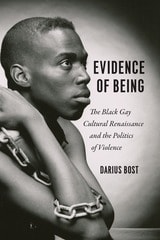
Evidence of Being
The Black Gay Cultural Renaissance and the Politics of ViolenceDarius Bost
University of Chicago Press, 2018
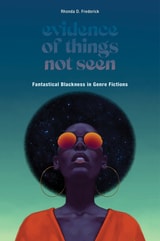
Evidence of Things Not Seen
Fantastical Blackness in Genre FictionsRhonda D. Frederick
Rutgers University Press, 2022