Results by title
1882 books match the query 'Criticism and interpretation' and 62 start with f
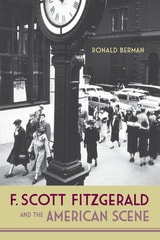
F. Scott Fitzgerald and the American Scene
Ronald Berman
University of Alabama Press, 2017
A study of the philosophical, intellectual, and political influences on the artistic creations of Fitzgerald and key early American modernist writers
F. Scott Fitzgerald and the American Scene continues Ronald Berman’s lifelong study of the philosophical, intellectual, and political influences on the artistic creations of key early American modernist writers. Each chapter in this volume elaborates on a crucial aspect of F. Scott Fitzgerald’s depiction of American society, specifically through the lens of the social sciences that most influenced his writing and thinking.
Berman addresses, among other subjects, Fitzgerald’s use of philosophy, cultural analyses, and sociology—all enriched by the insights of his own experience living an American life. He was especially interested in how life had changed from 1910 to 1920. Many Americans were unable to navigate between the 1920s and their own memories of a very different world before the Great War; especially Daisy Buchanan who evolves from girlhood (as typified in sentimental novels of the time) to wifehood (as actually experienced in the new decade). There is a profound similarity between what happens to Fitzgerald’s characters and what happened to the nation.
Berman revisits classics like The Great Gatsby but also looks carefully at Fitzgerald’s shorter fictions, analyzing a stimulating spectrum of scholars from more contemporary critics like Thomas Piketty to George Santayana, John Maynard Keynes, John Dewey, and Walter Lippmann. This fascinating addition to F. Scott Fitzgerald scholarship, although broad in its content, is accessible to a wide audience. Scholars and students of Fitzgerald and twentieth-century American literature, as well as dedicated Fitzgerald readers, will enjoy Berman’s take on a long-debated and celebrated author.
F. Scott Fitzgerald in the Twenty-First Century
Jackson R. Bryer
University of Alabama Press, 2003
This thought-provoking collection explores significant new facets of an American author of lasting international stature.
“Edited by three eminent Fitzgerald scholars, this fine book comprises nineteen incisive and provocative essays (most written for this collection) by . . . well-known Fitzgerald critics. The content is as varied as the international origins of its authors.” —Choice
As the author of some of the most compelling short stories ever written, two of the central novels in American literature, and some of the most beautiful prose ever penned, F. Scott Fitzgerald is read and studied all over the world. Sixty-two years after his death, his works—protean, provocative, multilayered, and rich—continue to elicit spirited responses. This collection grew out of the F. Scott Fitzgerald Conference that convened in Princeton at the centennial of this author's birth. Bringing together dozens of the world's leading scholars and commentators, the conference and the book celebrate the ever-growing legacy of Fitzgerald's art.
The subjects of these 19 essays reflect the contributors' wish to shine new light on less-frequently discussed aspects of Fitzgerald's work. Topics include Fitzgerald's Princeton influences and his expression of Catholic romanticism; his treatments of youth culture, the devil, and waste; parallels in the work of Mencken, Cather, and Murakami; and the ways gender, pastoral mode, humor, and the Civil War are variously presented in his work. One illustrated summary examines Fitzgerald's effect on popular culture through his appearance in the comics. Two broad overviews—one on Fitzgerald's career and another on the final developments in the author's style—round out the collection.
The international scope of the contributors to this volume reflects Fitzgerald's worldwide reputation and appeal. With extensive treatments of This Side of Paradise, The Beautiful and Damned, The Last Tycoon, and the Pat Hobby stories, this collection makes an unusual and significant contribution to the field of Fitzgerald studies.
F. Scott Fitzgerald
A Composite BiographyNiklas Salmose
University of Minnesota Press, 2023
A comprehensive study of the life of F. Scott Fitzgerald, related in two-year chapters by twenty-three leading writers on the Jazz Age author
“There never was a good biography of a novelist,” F. Scott Fitzgerald wrote in The Crack-Up. “There couldn’t be. He is too many people, if he’s any good.” Fitzgerald, a good novelist by any measure, has tested this challenge to the biographer’s art. A new star illuminating the literary scene; a chronicler of the Jazz Age in all its brilliance and tarnish; a romantic symbol of the American century; an acute observer of society’s best and worst, and of his own star-crossed career; a midlife burnout at forty-four, leaving an unfinished masterpiece in his wake—he was a man of many aspects, a writer whose complexity and multitudes this composite biography finally aptly portrays.
Bringing together twenty-three leading writers and scholars on Fitzgerald, each focusing on two years of his life, this volume takes its cue from Henry James’s remark, cited by preeminent Fitzgerald biographer Scott Donaldson: “The whole of anything is never told; you can only take what groups together.” F. Scott Fitzgerald: A Composite Biography presents a new way of “grouping together” biographical material and perspectives, considering from various angles the author's best-known works as well as understudied writings, including neglected stories and forays into autobiography such as “What I Think and Feel at 25” and “How to Live on $36,000 a Year.” The glamor and fame that made F. Scott and Zelda mythic figures of their time appear here alongside the personal experiences that he occasionally included in his writing: the beginnings as well as the poignant end; the literary relationships that informed and framed his work, set against solitary effort, fame, and failures. This remarkable study of F. Scott Fitzgerald reflects the multifaceted whole of a “life in many parts” in new and revelatory ways.
Contributors: Jade Broughton Adams; Ronald Berman; William Blazek, Liverpool Hope U; Elisabeth Bouzonviller, Jean Monnet U; Jackson Bryer, U of Maryland; Kirk Curnutt, Troy U; Catherine Delesalle-Nancey, U Jean Moulin Lyon 3; Scott Donaldson; Kayla Forrest; Marie-Agnès Gay, U Jean Moulin Lyon 3; Joel Kabot, U of Maryland, Baltimore; Sara Kosiba; Arne Lunde, U of California, Los Angeles; Bryant Mangum, Virginia Commonwealth U; Martina Mastandrea; Philip McGowan, Queen’s U Belfast; David Page; Walter Raubicheck, Pace U; Ross Tangedal, U of Wisconsin–Stevens Point; Helen Turner, Linnaeus U; James L. W. West III, Pennsylvania State U.
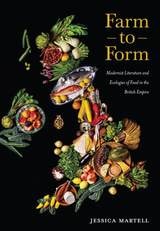
Farm to Form
Modernist Literature and Ecologies of Food in the British EmpireJessica Martell
University of Nevada Press, 2020
Deeply informed by Martell’s extensive knowledge of modern British, Irish, American, and World Literatures, this progressive work positions modernism as central to the study of narratives of resistance against social and environmental degradation. Analyzed works include those of Thomas Hardy, E. M. Forster, Virginia Woolf, Joseph Conrad, George Russell, and James Joyce.
In light of climate change, fossil fuel supremacy, nutritional dearth, and other pressing food issues, modernist texts bring to life an era of crisis and anxiety similar to our own. In doing so, Martell summons the past as a way to employ the modernist term of “defamiliarizing” the present so that entrenched perceptions can be challenged. Our current food regime is both new and constantly evolving with the first industrial food trades. Studying earlier cultural responses to them invites us to return to persistent problems with new insights and renewed passion.
Fassbinder
The Life And Work Of A Provocative GeniusChristian Braad Thomsen
University of Minnesota Press, 2004
The revealing biography of this highly productive and radical film director
Rainer Werner Fassbinder was the most innovative practitioner of New German Cinema. He worked at breakneck speed and in fourteen years made forty-four films, including Ali: Fear Eats the Soul (1973) and The Marriage of Maria Braun (1978). Fassbinder ruthlessly attacked both German bourgeois society and the larger limitations of humanity, and his films detail the desperate yearning for love and freedom and the many ways in which society defeats that desire.
In Fassbinder, Christian Thomsen, a close friend of the director, illuminates Fassbinder’s body of work while revealing his insider views of a man who, despite a furious temper, manic working habits, and rampant drug addiction, supported an extended family—including his mother, a string of male lovers, lovelorn women, and even a pair of frustrated wives—with his intoxicating and prolific imagination. This book, like Fassbinder’s often-used image of the mirror, brilliantly reflects the sexual, political, and overwhelmingly human contradictions inherent in the life of this intensely creative man and the remarkable films he directed.
Father and Son
Kingsley Amis, Martin Amis, and the British Novel since 1950Gavin Keulks
University of Wisconsin Press, 2004

Faulkner and Hemingway
Biography of a Literary RivalryJoseph Fruscione
The Ohio State University Press, 2012
Faulkner’s Marginal Couple
Invisible, Outlaw, and Unspeakable CommunitiesBy John N. Duvall
University of Texas Press, 1990
Is William Faulkner’s fiction built on a fundamental dichotomy of outcast individual versus the healthy agrarian community? The New Critics of the 1930s advanced this view, and it has shaped much Faulkner criticism. However, in Faulkner’s Marginal Couple, John Duvall posits the existence of another possibility, alternative communities formed by “deviant” couples. These couples, who violate “normal” gender roles and behaviors, challenge the either/or view of Faulkner’s world.
The study treats in detail the novels Light in August, The Wild Palms, Sanctuary, Pylon, and Absalom, Absalom!, as well as several of Faulkner’s short stories. In discussing each work, Duvall challenges the traditional view that Faulkner created active men who follow a code of honor and passive women who are close to nature. Instead, he charts the many instances of men who are nurturing and passive and women who are strong and sexually active. These alternative couples undermine a common view of Faulkner as an upholder of Southern patriarchal values, thus countering the argument that Faulkner’s fiction is essentially misogynist.
This new approach, drawing on semiotics, feminism, and Marxism, makes Faulkner more accessible to readers interested in ideological analysis. It also stresses the intertextual connections between Faulkner’s Yoknapatawpha and non-Yoknapatawpha fiction. Perhaps most importantly, it uncovers what the New Criticism concealed, namely, that Faulkner’s fiction traces the full androgynous spectrum of the human condition.
Federico Fellini as Auteur
Seven Aspects of His FilmsJohn C. Stubbs
Southern Illinois University Press, 2006
Federico Fellini as Auteur: Seven Aspects of His Films offers a comprehensive auteurist study of the renowned Italian director. Film scholar John C. Stubbs dispenses with a traditional film-career review of the man, focusing instead on the key elements of the filmmaker’s style, the influence of Carl Jung and dreams, the autobiographical depiction of childhood and adolescence, the portrait of the artist, the filmmaker’s working relationship with his wife, Fellini’s comic strategies, and his adaptation of works by others. Each of the aspects is fully contextualized. This examination of the critical elements in Fellini films offers a better understanding of the artistry that is uniquely Fellini.
Ferocious Reality
Documentary according to Werner HerzogEric Ames
University of Minnesota Press, 2012
Over the course of his career Werner Herzog, known for such visionary masterpieces as Aguirre: The Wrath of God (1972) and The Enigma of Kaspar Hauser (1974), has directed almost sixty films, roughly half of which are documentaries. And yet, in a statement delivered during a public appearance in 1999, the filmmaker declared: “There are deeper strata of truth in cinema, and there is such a thing as poetic, ecstatic truth. It is mysterious and elusive, and can be reached only through fabrication and imagination and stylization.” Ferocious Reality is the first book to ask how this conviction, so hostile to the traditional tenets of documentary, can inform the work of one of the world’s most provocative documentarians.
Herzog, whose Cave of Forgotten Dreams was perhaps the most celebrated documentary of 2010, may be the most influential filmmaker missing from major studies and histories of documentary. Examining such notable films as Lessons of Darkness (1992) and Grizzly Man (2005), Eric Ames shows how Herzog dismisses documentary as a mode of filmmaking in order to creatively intervene and participate in it. In close, contextualized analysis of more than twenty-five films spanning Herzog’s career, Ames makes a case for exploring documentary films in terms of performance and explains what it means to do so. Thus his book expands the field of cinema studies even as it offers an invaluable new perspective on a little studied but integral part of Werner Herzog’s extraordinary oeuvre.
Ferryman of Memories
The Films of Rithy PanhDeirdre Boyle
Rutgers University Press, 2023
Fetching the Old Southwest
Humorous Writing from Longstreet to TwainJames H. Justus
University of Missouri Press, 2004
Film's Ghosts
Tatsumi Hijikata's Butoh and the Transmutation of 1960s JapanStephen Barber
Diaphanes, 2019
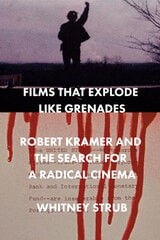
Films That Explode Like Grenades
Robert Kramer and the Search for a Radical CinemaWhitney Strub
University of Chicago Press, 2026
Robert Kramer (1939–99) was the emblematic filmmaker of the late-1960s New Left in the United States. Yet because most of his three dozen films have been out of circulation for decades, he has long been neglected by film historians and the Left. Kramer was the cofounder of the leftist documentary collective Newsreel and the director of underground films such as Ice (1970), Milestones (1975), and Route One/USA (1989). His films provide distinctive insights into how America’s political terrain has changed over time, capturing each era’s revolutionary ethos and its contradictions. Whitney Strub’s Films That Explode Like Grenades tracks the histories of leftist film and global revolutionary movements via Kramer’s life and travels. Moving among New York City, Chicago, North Vietnam, Paris, Portugal, Angola, and other crucial flashpoints, Kramer left a major and influential body of work in his wake that has fundamentally shaped the work of radical filmmakers across the globe.
For Strub, Kramer’s career is a key thread in an intimate history of the 1960s New Left, one that emphasizes the complexities of the movement’s internal tensions and its legacies. Drawing on visual analysis, extensive archival research across the United States and France, and myriad interviews with Kramer contemporaries, including Bernardine Dohrn, Tom Hayden, Jonas Mekas, and Kramer’s relatives, Strub transforms Kramer’s life story into a dynamic and engaging social history of 1960s radicalism and its generational legacies.
With detailed mapping of Robert Kramer’s many social and artistic contexts, Films That Explode Like Grenades restores him to a place of global importance in leftist cinema.
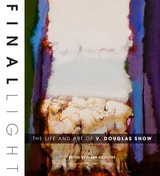
Final Light
The Life and Art of V. Douglas SnowFrank McEntire
University of Utah Press, 2013
A nationally recognized artist, Snow chose to stay in Utah where, when not teaching at the University of Utah, he roamed the southern Utah desert gaining inspiration from the red rock formations, especially the Cockscomb outside his studio near Capitol Reef National Park. Snow said, “Every artist probably wonders if he or she made the right decision to dig in to a certain place.” He dug into the landscape in and around Southern Utah and never regretted it. Just as “Tennessee Williams’s South, William Faulkner’s Mississippi, [or] John Steinbeck’s West Coast, formed their work,” the desert lands of the Colorado Plateau formed Snow’s. Their sense of place, “without provincialism,” said Snow “is what gives their art its enduring power.” Final Light will appeal to art historians and art lovers, especially those interested in abstract expressionism and the art of Utah, the West, and the Southwest.
Chosen by 15 Bytes, Utah's art magazine, as the most exceptional art book for 2014.
Finding People in Early Greece
Carol G. Thomas
University of Missouri Press, 2005
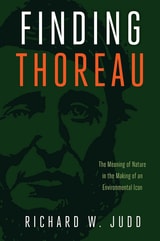
Finding Thoreau
The Meaning of Nature in the Making of an Environmental IconRichard W. Judd
University of Massachusetts Press, 2018
In his 1862 eulogy for Henry David Thoreau, Ralph Waldo Emerson reflected that his friend “dedicated his genius with such entire love to the fields, hills, and waters of his native town, that he made them known and interesting to all reading Americans, and to people over the sea.” Finding Thoreau traces the reception of Thoreau's work from the time of his death to his ascendancy as an environmental icon in the 1970s, revealing insights into American culture's conception of the environment.
Moving decade by decade through this period, Richard W. Judd unveils a cache of commentary from intellectuals, critics, and journalists to demonstrate the dynamism in the idea of nature, as Americans defined and redefined the organic world around them amidst shifting intellectual, creative, and political forces. This book tells the captivating story of one writer's rise from obscurity to fame through a cultural reappraisal of the work he left behind.
Finding the Middle Ground
Krestovskii, Tur, and the Power of Ambivalence in Nineteenth-Century Russian Women's ProseJehanne Gheith
Northwestern University Press, 2004
Finding the Weight of Things
Larry Eigner's EcrippoeticsGeorge Hart
University of Alabama Press, 2022
Where language, body, and form converge in the poetry of Larry Eigner.
Larry Eigner (1927–1996) wrote thousands of poems in his lifetime, despite profound physical limitations caused by cerebral palsy. Using only the thumb and index finger of his right hand, Eigner generated a torrent of urgent and rich language, participating in vital correspondences as well as publishing widely in literary magazines and poetry journals.
While Eigner wrote before the emergence of ecopoetics, his poetry reflected a serious engagement with scientific writing and media, including Rachel Carson’s seminal Silent Spring. Eigner was writing about environmental disasters and climate change long before such concerns took on a moral incumbency. Similarly, Eigner was ahead of his time in his exploration of disability. The field of disability studies has expanded rapidly in the new millennium. Eigner was not an overtly biographical poet, at least as far as his physical limitations were concerned, but his poetry spoke volumes on the idea of embodiment in all its forms.
Finding the Weight of Things: Larry Eigner’s Ecrippoetics is the first full-length study of Eigner’s poetry, covering his entire career from the beginning of his mature work in the 1950s to his last poems of the 1990s. George Hart charts where Eigner’s two central interests intersect, and how their interaction fueled his work as a poet-critic—one whose work has much to tell us about the ecology and embodiment of our futures. Hart sees Eigner’s overlapping concerns for disability, ecology, and poetic form as inextricable, and coins the phrase ecrippoetics here to describe Eigner’s prescient vision.
Fire and Desire
Mixed-Race Movies in the Silent EraJane M. Gaines
University of Chicago Press, 2001
Fire and Desire offers a penetrating look at the black independent film movement during the silent period. Gaines traces the profound influence that D. W. Griffith's racist epic The Birth of a Nation exerted on black filmmakers such as Oscar Micheaux, the director of the newly recovered Within Our Gates. Beginning with What Happened in the Tunnel, a movie that played with race and sex taboos by featuring the first interracial kiss in film, Gaines also explores the cinematic constitution of self and other through surprise encounters: James Baldwin sees himself in the face of Bette Davis, family resemblance is read in Richard S. Robert's portrait of an interracial family, and black film pioneer George P. Johnson looks back on Micheaux.
Given the impossibility of purity and the co-implication of white and black, Fire and Desire ultimately questions the category of "race movies" itself.

First Love
The Affections of Modern FictionMaria DiBattista
University of Chicago Press, 1991
DiBattista argues that modernity reinvented First Love as a myth of creative initiative, as its characteristic response to a pervasive sense of historical belatedness. Anxious that its own creations can never be more than diminished forms of mightier originals, modernity idolizes First Love as the beginning that can never be repeated. First Love hence epitomizes the dream of a new self-incarnation. From Turgenev's First Love to the formative works of Virginia Woolf, Gertrude Stein, E. M. Forster, and Vladimir Nabokov, First Love confirms the birth of an artistic vocation. For modern men and women intent on becoming the original authors of their own lives, First Love becomes paradigmatic of those life-altering moments that transform the undifferentiated sequence of days into a fateful narrative.
DiBattista focuses on the enunciation of First Love in the fiction of Thomas Hardy, D. H. Lawrence, James Joyce, and Samuel Beckett. In reading their works, DiBattista dramatically revises the accepted view of irony as the dominant tone of modernism. First Love constitutes, she shows, a new apprehension of the world characterized not by the frigid distances of irony but by a belief in the creative individual who may begin the world anew, as if for the first time.
Fitzgerald, Hemingway, and the Twenties
Ronald Berman
University of Alabama Press, 2002
A noted scholar offers fresh ways of looking at two legendary American authors.
Both F. Scott Fitzgerald and Ernest Hemingway came into their own in the 1920s and did some of their best writing during that decade. In a series of interrelated essays, Ronald Berman considers an array of novels and short stories by both authors within the context of the decade's popular culture, philosophy, and intellectual history. As Berman shows, the thought of Fitzgerald and Hemingway went considerably past the limits of such labels as the Jazz Age or the Lost Generation.
Both Fitzgerald and Hemingway were avid readers, alive to the intellectual currents of their day, especially the contradictions and clashes of ideas and ideologies. Both writers, for example, were very much concerned with the problem of untenable belief—and also with the need to believe. In this light, Berman offers fresh readings of such works as Fitzgerald's The Great Gatsby, "Bernice Bobs Her Hair," and "The Diamond as Big as the Ritz" and Hemingway's "The Killers," A Farewell to Arms, and The Sun Also Rises. Berman invokes the thinking of a wide range of writers in his considerations of these texts, including William James, Alfred North Whitehead, Walter Lippman, and Edmund Wilson.
Berman's essays are driven and connected by a focused line of inquiry into Fitzgerald's and Hemingway's concerns with dogma both religious and secular, with new and old ideas of selfhood,and, particularly in the case of Hemingway, with the way we understand, explain, and transmit experience.
Fitzgerald-Wilson-Hemingway
Language and ExperienceRonald Berman
University of Alabama Press, 2003
In this study, Ronald Berman examines the work of the critic/novelist Edmund Wilson and the art of F. Scott Fitzgerald and Ernest Hemingway as they wrestled with the problems of language, experience, perception and reality in the "age of jazz." By focusing specifically on aesthetics—the ways these writers translated everyday reality into language—Berman challenges and redefines many routinely accepted ideas concerning the legacy of these authors.
Fitzgerald is generally thought of as a romantic, but Berman shows that we need to expand the idea of Romanticism to include its philosophy. Hemingway, widely viewed as a stylist who captured experience by simplifying language, is revealed as consciously demonstrating reality's resistance to language. Between these two renowned writers stands Wilson, who is critically influenced by Alfred North Whitehead, as well as Dewey, James, Santayana, and Freud.
By patiently mapping the correctness of these philosophers, historians, literary critics and writers, Berman aims to open a gateway into the era. This work should be of interest to scholars of American literature, philosophy and aesthetics; to academic libraries; to students of intellectual history; and to general readers interested in Fitzgerald, Hemingway and Wilson.
Five Portraits
Modernity and the Imagination in Twentieth-Century German WritingMichael Bernstein
Northwestern University Press, 2000
Five Strands of Fictionality
The Institutional Construction of Contemporary American FictionDaniel Punday
The Ohio State University Press, 2010
Flannery O'Connor and Blaise Pascal
Recovering the Incarnation for the Modern MindAnn Hartle
Catholic University of America Press, 2025
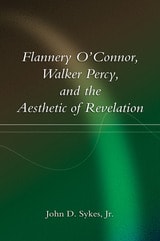
Flannery O'Connor, Walker Percy, and the Aesthetic of Revelation
John D. Sykes, Jr.
University of Missouri Press, 2007
With his mastery of modernist technique and his depictions of characters obsessed with the past, Nobel laureate William Faulkner raised the bar for southern fiction writers. But the work of two later authors shows that the aesthetic of memory is not enough: Confederate thunder fades as they turn to an explicitly religious source of meaning.
According to John Sykes, the fiction of Flannery O’Connor and Walker Percy provides occasions for divine revelation. He traces their work from its common roots in midcentury southern and Catholic intellectual life to show how the two adopted different theological emphases and rhetorical strategies—O’Connor building to climactic images, Percy striving for dialogue with the reader—as a means of uncovering the sacramental foundation of the created order.
Sykes sets O’Connor and Percy against the background of the Southern Renaissance from which they emerged, showing not only how they shared a distinctly Christian notion of art that led them to see fiction as revelatory but also how their methods of revelation took them in different directions. Yet, despite their differences in strategy and emphasis, he argues that the two are united in their conception of the artist as “God’s sharp-eyed witness,” and he connects them with the philosophers and critics, both Christian and non-Christian, who had a meaningful influence on their work.
Through sustained readings of key texts—particularly such O’Connor stories as “The Artificial Nigger” and “The Geranium” and Percy’s novels Love in the Ruins and The Second Coming—Sykes focuses on the intertwined themes of revelation, sacrament, and community. He views their work in relation to the theological difficulties that they were not able to overcome concerning community. For both writers, the question of community is further complicated by the changing nature of the South as the Lost Cause and segregation lose their holds and a new form of prosperity arises.
By disclosing how O’Connor and Percy made aesthetic choices based on their Catholicism and their belief that fiction by its very nature is revelatory, Sykes demonstrates that their work cannot be seen as merely a continuation of the historical aesthetic that dominated southern literature for so long. Flannery O’Connor, Walker Percy, and the Aesthetic of Revelation is theoretically sophisticated without being esoteric and is accessible to any reader with a serious interest in these writers, brimming with fresh insights about both that clarify their approaches to art and enrich our understanding of their work.
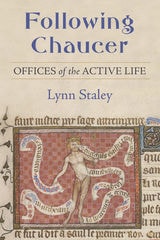
Following Chaucer
Offices of the Active LifeLynn Staley
University of Michigan Press, 2020
Following Chaucer: Offices of the Active Life explores three representative figures—the royal woman, the poet, and the merchant—in relation to the concept of “office,” which Cicero linked to the health of the republic, but Chaucer to that of the common good. Not usually conjoined to the term “office,” these three figures, situated in the active life, were not firmly mapped onto the body politic, which was used to figure a relational and ordered social body ruled by the king, the head. These figures are points of entry into a set of questions rooted in Chaucer’s understanding of his cultural and historical past and in his keen appraisal of the social dynamics of his own time that also reverberate in the centuries after Chaucer’s death.
Following Chaucer does not trace influence but uses Chaucer’s likely reading, circumstances, and literary and social affiliations as guides to understanding his poetry, within the context of late medieval English culture and the reshaping of the concept of these particular offices that suited the needs of a future whose dynamics he anticipated. His understanding of the importance of the Ciceronian concept of office within the active life, his profound cultural awareness, and his probing of the foundations of social change provide him with a keen sense of the persistent tensions and inconsistencies that are fundamental to his poetry.
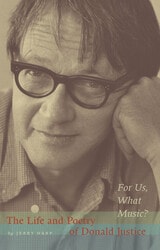
For Us, What Music?
The Life and Poetry of Donald JusticeJerry Harp
University of Iowa Press, 2010
When Donald Justice wrote in “On a Picture by Burchfield” that “art keeps long hours,” he might have been describing his own life. Although he early on struggled to find a balance between his life and art, the latter became a way of experiencing his life more deeply. He found meaning in human experience by applying traditional religious language to his artistic vocation. Central to his work was the translation of the language of devotion to a learned American vernacular. Art not only provided him with a wealth of intrinsically worthwhile experiences but also granted rich and nuanced ways of experiencing, understanding, and being in the world. For Donald Justice—recipient of some of poetry’s highest laurels, including the Pulitzer Prize, the Bollingen Prize, and the Lannan Literary Award for Poetry—art was a way of life.
Because Jerry Harp was Justice’s student, his personal knowledge of his subject—combined with his deep understanding of Justice’s oeuvre—works to remarkable advantage in For Us, What Music? Harp reads with keen intelligence, placing each poem within the precise historical moment it was written and locating it in the context of the literary tradition within which Justice worked. Throughout the text runs the narrative of Justice’s life, tying together the poems and informing Harp’s interpretation of them. For Us, What Music? grants readers a remarkable understanding of one of America’s greatest poets.
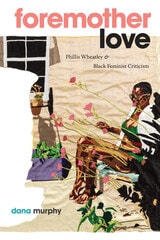
Foremother Love
Phillis Wheatley and Black Feminist CriticismDana Murphy
Duke University Press, 2025
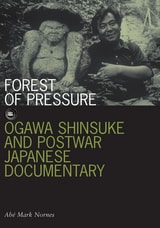
Forest of Pressure
Ogawa Shinsuke and Postwar Japanese DocumentaryAbe Mark Nornes
University of Minnesota Press, 2007
“Extraordinarily valuable, illuminating, and even entertaining, Forest of Pressure brims with the types of information that only a key insider can get his hands on.” —Mitsuhiro Yoshimoto, New York University
Ogawa Productions—known in Asia as Ogawa Pro—was an influential filmmaking collective that started in the 1960s under the direction of Ogawa Shinsuke (1936–1992). Between 1968 and the mid-1970s, Ogawa Pro electrified the Japanese student movement with its Sanrizuka documentary series—eight films chronicling the massive protests over the construction of the Narita airport—which has since become the standard against which documentaries are measured in Japan.
A critical biography of a collective, Forest of Pressure explores the emergence of socially committed documentary filmmaking in postwar Japan. Analyzing Ogawa Pro’s films and works by other Japanese filmmakers, Abé Mark Nornes addresses key issues in documentary theory and practice, including individual and collective cinema production modes and the relationship between subject and object. Benefiting from unprecedented access to Ogawa Pro’s archives and interviews with former members, Forest of Pressure is an innovative look at the fate of political filmmaking in the wake of the movement’s demise.
Abé Mark Nornes is associate professor of screen arts and cultures and Asian languages and cultures at the University of Michigan. He is a coordinator at the Yamagata International Documentary Film Festival and the author of Japanese Documentary Film: The Meiji Era through Hiroshima (Minnesota, 2003).
Form, Power, and Person in Robert Creeley’s Life and Work
Stephen Fredman
University of Iowa Press, 2010
By any measure—international reputation, influence upon fellow writers and later generations, number of books published, scholarly and critical attention—Robert Creeley (1926–2005) is a literary giant, an outstanding, irreplaceable poet. For many decades readers have remarked upon the almost harrowing emotional nakedness of Creeley’s writing. In the years since his death, it may be that the disappearance of the writer allows that nakedness to be observed more readily and without embarrassment.
Written by the foremost critics of his poetry, Form, Power, and Person in Robert Creeley’s Life and Work is the first book to treat Creeley’s career as a whole. Masterfully edited by Stephen Fredman and Steve McCaffery, the essays in this collection have been gathered into three parts. Those in “Form” consider a variety of characteristic formal qualities that differentiate Creeley from his contemporaries. In “Power,” writers reflect on the pressure exerted by emotions, gender issues, and politics in Creeley’s life and work. In “Person,” Creeley’s unique artistic and psychological project of constructing a person—reflected in his correspondence, teaching, interviews, collaborations, and meditations on the concept of experience—is excavated. While engaging these three major topics, the authors remain, as Creeley does, intent upon the ways such issues appear in language, for Creeley’s nakedness is most conspicuously displayed in his intimate relationship with words.
Contributors
Charles Altieri
Rachel Blau DuPlessis
Stephen Fredman
Benjamin Friedlander
Alan Golding
Michael Davidson
Steve McCaffery
Peter Middleton
Marjorie Perloff
Peter Quartermain
Libbie Rifkin
Fornes
Theater in the Present TenseDiane Lynn Moroff
University of Michigan Press, 1996
Diane Lynn Moroff focuses on Fornes's major plays, providing illuminating readings of her unique and irreverent body of work. The book traces the career of this influential playwright, director, and teacher, including the reception of her plays, the range of critical responses (particularly those of feminist critics), and an introduction to Fornes's theatrical philosophies. It looks at such critical issues in Fornes's work as the representation of female subjectivity, theater as metaphor and context, art as ritual, and the role of the spectator. In a final chapter, Fornes's plays including Abingdon Square and her most recent work, What of the Night? are examined in the context of the sexualization of character, an ongoing theme for Fornes.
Fornes: Theater in the Present Tense will appeal to scholars and students in theater studies and women's studies and to anyone interested or engaged in contemporary theater.
Diane Lynn Moroff is Assistant Professor of English, Oglethorpe University.
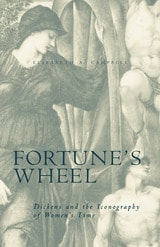
Fortune’s Wheel
Dickens and the Iconography of Women’s TimeElizabeth A. Campbell
Ohio University Press, 2003
In the first half of the nineteenth century, England became quite literally a world on wheels. The sweeping technological changes wrought by the railways, steam-powered factory engines, and progressively more sophisticated wheeled conveyances of all types produced a corresponding revolution in Victorian iconography: the image of the wheel emerged as a dominant trope for power, modernity, and progress.
In Fortune’s Wheel, an original and illuminating study, Elizabeth Campbell explores the ways in which Charles Dickens appropriated and made central to his novels the dominant symbol of his age. Between 1840 and 1860, a transformation took place in Dickens’ thinking about gender and time, and this revolution is recorded in iconographic representations of the goddess Fortune and wheel imagery that appear in his work.
Drawing on a rich history of both literary and visual representations of Fortune, Professor Campbell argues that Dickens’ contribution to both the iconographic and narrative traditions was to fuse the classical image of the wheel with the industrial one. As the wheel was increasingly identified as the official Victorian symbol for British industrial and economic progress, Dickens reacted by employing this icon to figure a more pessimistic historical vision—as the tragic symbol for human fate in the nineteenth century.
Fortune’s Wheel ably portrays the concept that, in both text and illustrations, images of fortune and the wheel in Dickens’ work record his abandonment of a linear, progressive, and arguably masculine view of history to embrace a cyclical model that has been identified with “women’s time.”

Four Shakespearean Period Pieces
Margreta de Grazia
University of Chicago Press, 2021
Yet recent theoretical work has called for their reappraisal. Anachronisms, previously condemned as errors in the order of time, are being hailed as alternatives to that order. Conversely chronology and periods, its mainstays, are now charged with having distorted the past they have been entrusted to represent, and secularization, once considered the driving force of the modern era, no longer holds sway over the past or the present.
In light of this reappraisal, can Shakespeare studies continue unshaken? This is the question Four Shakespearean Period Pieces takes up, devoting a chapter to each term: on the rise of anachronism, the chronologizing of the canon, the staging of plays “in period,” and the use of Shakespeare in modernity’s secularizing project.
To read these chapters is to come away newly alert to how these fraught concepts have served to regulate the canon’s afterlife. Margreta de Grazia does not entirely abandon them but deftly works around and against them to offer fresh insights on the reading, editing, and staging of the author at the heart of our literary canon.
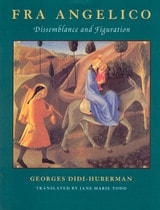
Fra Angelico
Dissemblance and FigurationGeorges Didi-Huberman
University of Chicago Press, 1995
A Florentine painter who took Dominican vows, Fra Angelico (1400-1455) approached his work as a largely theological project. For him, the problems of representing the unrepresentable, of portraying the divine and the spiritual, mitigated the more secular breakthroughs in imitative technique. Didi-Huberman explores Fra Angelico's solutions to these problems—his use of color to signal approaching visibility, of marble to recall Christ's tomb, of paint drippings to simulate (or stimulate) holy anointing. He shows how the painter employed emptiness, visual transformation, and displacement to give form to the mystery of faith.
In the work of Fra Angelico, an alternate strain of Renaissance painting emerges to challenge rather than reinforce verisimilitude. Didi-Huberman traces this disruptive impulse through theological writings and iconographic evidence and identifies a widespread tradition in Renaissance art that ranges from Giotto's break with Byzantine image-making well into the sixteenth century. He reveals how the techniques that served this ultimately religious impulse may have anticipated the more abstract characteristics of modern art, such as color fields, paint spatterings, and the absence of color.
Fragments and Assemblages
Forming Compilations of Medieval LondonArthur Bahr
University of Chicago Press, 2013
Fragonard
Art and EroticismMary D. Sheriff
University of Chicago Press, 1990
Sheriff begins her inquiry with an appraisal of Fragonard criticism, followed by an extensive and thoroughly original reading of selected works by Fragonard and of the eroticism encoded in them. Art and eroticism converge in a discussion of execution, in which Sheriff explores the changing conception of execution and elucidates its complex rhetorical and cultural underpinnings. Drawing on analytic methods from contemporary critical theory and an understanding of each work's cultural milieu, Sheriff pays particular attention throughout to the relation between beholder and work of art, which she views as manifest in the artist's preoccupation with the play between the real and the fictive. Scholars and students of art history, eighteenth-century culture and history, critical theory, literary criticism, and all those drawn to the work of this great French painter will find this work essential reading.
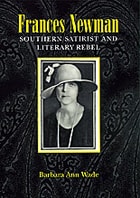
Frances Newman
Southern Satirist and Literary RebelBarbara Ann Wade
University of Alabama Press, 1998
This first biographical and literary assessment of Frances Newman highlights one of the most experimental writers of the Southern Renaissance
Frances Newman was born into a prominent Atlanta family and was educated at private schools in the South and the Northeast. Her first novel, The Hard-Boiled Virgin, was hailed by James Branch Cabell as “the most brilliant, the most candid, the most civilized, and the most profound yet written by any American woman.” Cabell and H. L. Mencken became Newman’s literary mentors and loyally supported her satire of southern culture, which revealed the racism, class prejudice, and religious intolerance that reinforced the idealized image of the white southern lady. Writing within a nearly forgotten feminist tradition of southern women’s fiction, Newman portrayed the widely acclaimed social change in the early part of the century in the South as superficial rather than substantial, with its continued restrictive roles for women in courtship and marriage and limited educational and career opportunities.
Barbara Wade explores Newman’s place in the feminist literary tradition by comparing her novels with those of her contemporaries Ellen Glasgow, Mary Johnston, and Isa Glenn. Wade draws from Newman’s personal correspondence and newspaper articles to reveal a vibrant, independent woman who simultaneously defied and was influenced by the traditional southern society she satirized in her writing.
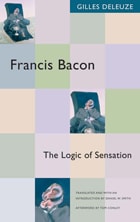
Francis Bacon
The Logic of SensationGilles Deleuze
University of Minnesota Press, 2005
Afterword by Tom Conley
Gilles Deleuze had several paintings by Francis Bacon hanging in his Paris apartment, and the painter’s method and style as well as his motifs of seriality, difference, and repetition influenced Deleuze’s work. This first English translation shows us one of the most original and important French philosophers of the twentieth century in intimate confrontation with one of that century’s most original and important painters.
In considering Bacon, Deleuze offers implicit and explicit insights into the origins and development of his own philosophical and aesthetic ideas, ideas that represent a turning point in his intellectual trajectory. First published in French in 1981, Francis Bacon has come to be recognized as one of Deleuze’s most significant texts in aesthetics. Anticipating his work on cinema, the baroque, and literary criticism, the book can be read not only as a study of Bacon’s paintings but also as a crucial text within Deleuze’s broader philosophy of art.
In it, Deleuze creates a series of philosophical concepts, each of which relates to a particular aspect of Bacon’s paintings but at the same time finds a place in the “general logic of sensation.” Illuminating Bacon’s paintings, the nonrational logic of sensation, and the act of painting itself, this work—presented in lucid and nuanced translation—also points beyond painting toward connections with other arts such as music, cinema, and literature. Francis Bacon is an indispensable entry point into the conceptual proliferation of Deleuze’s philosophy as a whole.
Gilles Deleuze (1925–1995) was professor of philosophy at the University of Paris, Vincennes–St. Denis. He coauthored Anti-Oedipus and A Thousand Plateaus with Félix Guattari. These works, as well as Cinema 1, Cinema 2, The Fold, Proust and Signs, and others, are published in English by Minnesota.
Daniel W. Smith teaches in the Department of Philosophy at Purdue University.
Francis Ford Coppola
Jeff Menne
University of Illinois Press, 2014
However, Jeff Menne argues that Coppola exemplifies the new breed of creative corporate person and sees the director's oeuvre as vital for reimagining the corporation in the transformation of Hollywood.
Reading auteur theory as the new American business theory, Menne reveals how Coppola's vision of a new kind of company has transformed the worker into a liberated and well-utilized artist, but has also commodified individual creativity at a level unprecedented in corporate history. Coppola negotiated the contradictory roles of shrewd businessman and creative artist by recognizing the two roles are fused in a postindustrial economy.
Analyzing films like The Godfather (1970) and the overlooked Tucker: The Man and His Dream (1988) through Coppola's use of opera, Menne illustrates how Coppola developed a defining musical aesthetic while making films that reflected the idea of a corporation as family--and how his studio American Zoetrope came to represent a new brand of auteurism and the model for post-Fordist Hollywood.
Francois Ozon
Thibaut Schilt
University of Illinois Press, 2011

Frank Capra
Authorship and the Studio SystemRobert Sklar
Temple University Press, 1998
This collection of nine essays by leading international film historians analyzes Capra's filmmaking during his most prolific period, from 1928 to 1939, taking a closer look at the more complex aspects of his work. They trace his struggles for autonomy against Columbia Pictures head Harry Cohn, his reputation as an amateur, and the ways in which working within studio modes of production my have enhanced the director's strengths.
The contributors also place their critiques within the context of the changing fortunes of the Hollywood studio system, the impact of the Depression, and Capra's working relationships with other studio staff and directors. The contributors' access to nineteen newly restored Capra films made at Columbia during this period fills this collection with some of the most comprehensive critiques available on the director's early body of work.
Frank Lloyd Wright and His Manner of Thought
Jerome Klinkowitz
University of Wisconsin Press, 2014
Klinkowitz presents a critical biography driven by the architect's own work and intellectual growth, focusing on the evolution of Wright's thinking and writings from his first public addresses in 1894 to his last essay in 1959. Did Wright reject all of Victorian thinking about the home, or do his attentions to a minister's sermon on "the house beautiful" deserve closer attention? Was Wright echoing the Transcendentalism of Ralph Waldo Emerson, or was he more in step with the philosophy of William James? Did he reject the Arts and Crafts movement, or repurpose its beliefs and practices for new times? And, what can be said of his deep dissatisfaction with architectural concepts of his own era, the dominant modernism that became the International Style? Even the strongest advocates of Frank Lloyd Wright have been puzzled by his objections to so much that characterized the twentieth century, from ideas for building to styles of living.
In Frank Lloyd Wright and His Manner of Thought, Klinkowitz, a widely published authority on twentieth-century literature, thought, and culture, examines the full extent of Wright's books, essays, and lectures to show how he emerged from the nineteenth century to anticipate the twenty-first.
Outstanding Book, selected by the American Association of School Librarians
Best Books for General Audiences, selected by the Public Library Reviewers
Frank Lloyd Wright's Forgotten House
How an Omission Transformed the Architect's LegacyNicholas D. Hayes
University of Wisconsin Press, 2021
When Nicholas and Angela Hayes became stewards of the unassuming Elizabeth Murphy House near Milwaukee, they began to unearth evidence that ultimately revealed a one-hundred-year-old fiasco fueled by competing ambitions and conflicting visions of America. The couple’s forensic pursuit of the truth untangled the ways Wright’s ASBH experiment led to the architect’s most productive, creative period. Frank Lloyd Wright’s Forgotten House includes a wealth of drawings and photographs, many of which have never been previously published. Historians, architecture buffs, and Wrightophiles alike will be fascinated by this untold history that fills a crucial gap in the architect’s oeuvre.
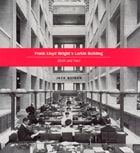
Frank Lloyd Wright's Larkin Building
Myth and FactJack Quinan
University of Chicago Press, 2006
Quinan’s history draws on engineering documents, personal accounts of the building, and other papers he acquired from the family of Darwin D. Martin, a Larkin executive who proposed commissioning Wright to design the company’s offices. With access to these rare sources, Quinan reveals how a young Wright landed the commission and traces the evolution of his cutting-edge plans. Quinan then takes Wright studies to a new level, examining the Larkin Building as a structure at the center of economic and personal relationships.
Illustrated with more than one hundred photographs, floor plans, maps, and diagrams, Frank Lloyd Wright’s Larkin Building provides a concise but complete record of how the building was conceived, built, evaluated, and finally demolished in what has been called a tragic loss for American architecture.
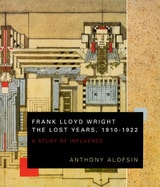
Frank Lloyd Wright--the Lost Years, 1910-1922
A Study of InfluenceAnthony Alofsin
University of Chicago Press, 1993
"Alofsin has set out to explain the impact of European culture on Wright by integrating its artistic influence with the tumultuous events in his private life. . . . [He] succeeds in this ambitious goal."—Kevin Nute, Architects' Journal
"A convincing and well-documented case that these were in fact crucial and fruitful years in Wright's development as an architect. . . . Absorbing."—Catherine Maclay, San Jose Mercury News
"One of the best."—Robert Fulford, Toronto Globe and Mail
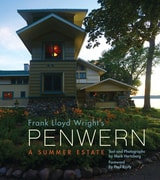
Frank Lloyd Wright’s Penwern
A Summer EstateMark Hertzberg
Wisconsin Historical Society Press, 2019
Frank Miller's Daredevil and the Ends of Heroism
Young, Paul
Rutgers University Press, 2016
In the late 1970s and early 1980s, writer-artist Frank Miller turned Daredevil from a tepid-selling comic into an industry-wide success story, doubling its sales within three years. Lawyer by day and costumed vigilante by night, the character of Daredevil was the perfect vehicle for the explorations of heroic ideals and violence that would come to define Miller’s work.
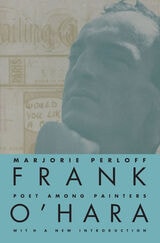
Frank O'Hara
Poet Among PaintersMarjorie Perloff
University of Chicago Press, 1997
"A groundbreaking study. [This book] is a genuine work of criticism. . . . Through Marjorie Perloff's book we see an O'Hara perhaps only his closer associates saw before: a poet fully aware of the traditions and techniques of his craft who, in a life tragically foreshortened, produced an adventurous if somewhat erratic body of American verse."—David Lenson, Chronicle of Higher Education
"Perloff is a reliable, well-informed, discreet, sensitive . . . guide. . . . She is impressive in the way she deals with O'Hara's relationship to painters and paintings, and she does give first-rate readings of four major poems."—Jonathan Cott, New York Times Book Review