Results by title
3576 books match the query 'American' and 135 start with f
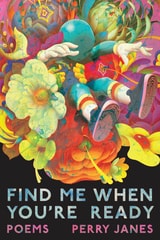
Find Me When You're Ready
PoemsPerry Janes
Northwestern University Press, 2024
A powerful debut and a lyric coming-of-age narrative that interrogates the myths we carry
In Find Me When You’re Ready, Perry Janes traces a sweeping journey from Detroit to Los Angeles. As he leaves home and forges toward California, the speaker in these poems considers how we learn and mislearn ideas about manhood, confronts the aftershocks of childhood sexual abuse, and questions the human need for belonging. By embracing the touchstones of youth—movies, lore, graphic novels—these poems assert the speaker’s defiant right to childhood even amid damage.
As the collection arcs toward adulthood, the speaker embodies a vision of healing that refuses easy binaries and embraces the joys of intimacy. Across each of its five acts, Perry Janes’s debut collection is driven by an interest troubling our creation myths, asking who built them, why we carry them, and how we might set them aside.

Finding Betty Crocker
The Secret Life of America’s First Lady of FoodSusan Marks
University of Minnesota Press, 2007
While Betty Crocker is often associated with 1950s happy homemaking, she originally belonged to a different generation. Created in 1921 as a “friend to homemakers” for the Washburn Crosby Company (a forerunner to General Mills) in Minneapolis, her purpose was to answer consumer mail. “She” was actually the women of the Home Service Department who signed Betty’s name. Eventually, Betty Crocker’s local radio show on WCCO expanded, and audiences around the nation tuned her in, tried her money-saving recipes, and wrote Betty nearly 5,000 fan letters per day. In Finding Betty Crocker, Susan Marks offers an utterly unique look at the culinary and marketing history of America’s First Lady of Food.
Susan Marks is a writer/producer/director with her own production company, Lazy Susan Productions.
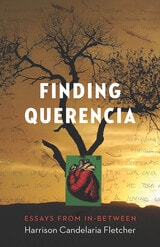
Finding Querencia
Essays from In-BetweenHarrison Candelaria Fletcher
The Ohio State University Press, 2022
With its roots in the Spanish verb querer—“to want, to love”—the term querencia has been called untranslatable but has come to mean a place of safety and belonging, that which we yearn for when we yearn for home. In this striking essay collection, Harrison Candelaria Fletcher shows that querencia is also a state of being: the peace that arises when we reconcile who we are. A New Mexican of mixed Latinx and white ethnicity, Candelaria Fletcher ventures into the fault lines of culture, landscape, and spirit to discover the source of his lifelong hauntings. Writing in the persona of coyote, New Mexican slang for “mixed,” he explores the hyphenated elements within himself, including his whiteness. Blending memory, imagination, form, and language, each essay spirals outward to investigate, accept, and embrace hybridity. Ultimately, Finding Querencia offers a new vocabulary of mixed-ness, a way to reconcile the crosscurrents of self and soul.
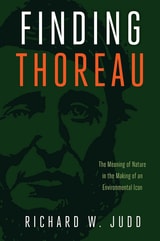
Finding Thoreau
The Meaning of Nature in the Making of an Environmental IconRichard W. Judd
University of Massachusetts Press, 2018
In his 1862 eulogy for Henry David Thoreau, Ralph Waldo Emerson reflected that his friend “dedicated his genius with such entire love to the fields, hills, and waters of his native town, that he made them known and interesting to all reading Americans, and to people over the sea.” Finding Thoreau traces the reception of Thoreau's work from the time of his death to his ascendancy as an environmental icon in the 1970s, revealing insights into American culture's conception of the environment.
Moving decade by decade through this period, Richard W. Judd unveils a cache of commentary from intellectuals, critics, and journalists to demonstrate the dynamism in the idea of nature, as Americans defined and redefined the organic world around them amidst shifting intellectual, creative, and political forces. This book tells the captivating story of one writer's rise from obscurity to fame through a cultural reappraisal of the work he left behind.
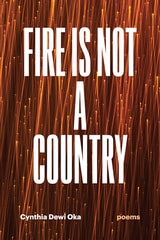
Fire Is Not a Country
PoemsCynthia Dewi Oka
Northwestern University Press, 2022
As she builds a lyric portrait of her own family, Oka interrogates how migration, economic exploitation, patriarchal violence, and a legacy of political repression shape the beauties and limitations of familial love and obligation. Woven throughout are speculative experiments that intervene in the popular apocalyptic narratives of our time with the wit of an unassimilable other.
Oka’s speakers mourn, labor, argue, digress, avenge, and fail, but they do not retreat. Born of conflicts public and private, this collection is for anyone interested in what it means to engage the multitudes within ourselves.
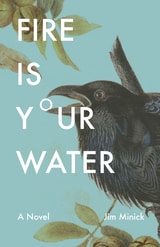
Fire Is Your Water
A NovelJim Minick
Ohio University Press, 2001
Sacred chants are Ada Franklin’s power and her medicine. By saying them, she can remove warts, stanch bleeding, and draw the fire from burns. At age twenty, her reputation as a faith healer defines her in her rural Pennsylvania community. But on the day in 1953 that her family’s barn is consumed by flame, her identity as a healer is upended. The heat, the roar of the blaze, and the bellows of the trapped cows change Ada. For the first time, she fears death and—for the first time—she doubts God. With her belief goes her power to heal. Then Ada meets an agnostic named Will Burk and his pet raven, Cicero.
Fire Is Your Water is acclaimed memoirist Jim Minick’s first novel. Built on magical realism and social observation in equal measure, it never gives way to sentimentality and provides an insider’s glimpse into the culture of Appalachia. A jealous raven, a Greek chorus of one, punctuates the story with its judgments on the characters and their actions, until a tragic accident brings Ada and Will together in a deeper connection.
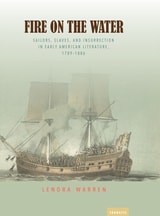
Fire on the Water
Sailors, Slaves, and Insurrection in Early American Literature, 1789-1886Warren, Lenora
Bucknell University Press, 2019
Published by Bucknell University Press. Distributed worldwide by Rutgers University Press.
First Books
The Printed Word and Cultural Formation in Early AlabamaPhilip D. Beidler
University of Alabama Press, 1999
Early 19th-century Alabama was a society still in the making. Now Philip Beidler tells how the first books written and published in the state influenced the formation of Alabama's literary and political culture. As Beidler shows, virtually overnight early Alabama found itself in possession of the social, political, and economic conditions required to jump start a traditional literary culture in the old Anglo-European model: property-based class relationships, large concentrations of personal wealth, and professional and merchant classes of similar social, political, educational, and literary views.
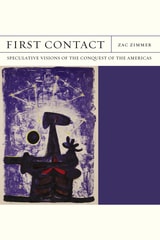
First Contact
Speculative Visions of the Conquest of the AmericasZac Zimmer
Northwestern University Press, 2025
Examining the power of speculative fiction to reimagine historical accounts of the conquest of the Americas
The historical conquest of the Americas resides at the core of all first-contact narratives, which stage colonization and resistance in the generic guise of speculative fiction. Starting from this axiom, First Contact: Speculative Visions of the Conquest of the Americas moves through a corpus of Mexican novels, Andean visual arts practices, and other cultural artifacts that have dramatized counterfactual narratives. Reimagining the early colonial period’s historiography from a south-to-north directionality while inventing parallel realities, these texts, which are concerned with limit cases, alterities, and alternative temporalities, refuse any reliance on the imperial ontologies of European expansion. Zac Zimmer examines these works to explore the slippage that exists between science fiction as the exemplary genre of the modern, colonial reality and literary speculation as an aesthetic tool that can be used to imagine other possible worlds. First Contact thus poses a foundational question: Can we understand the conquest as an originary world-historical event without eclipsing the other cosmologies that existed, and continue to exist, within the contact zone? Can we decolonize the speculative imagination itself?
First We Read, Then We Write
Emerson on the Creative ProcessRobert D. Richardson
University of Iowa Press, 2009
Writing was the central passion of Emerson’s life. While his thoughts on the craft are well developed in “The Poet,” “The American Scholar,” Nature, “Goethe,” and “Persian Poetry,” less well known are the many pages in his private journals devoted to the relationship between writing and reading. Here, for the first time, is the Concord Sage’s energetic, exuberant, and unconventional advice on the idea of writing, focused and distilled by the preeminent Emerson biographer at work today.
Emerson advised that “the way to write is to throw your body at the mark when your arrows are spent.” First We Read, Then We Write contains numerous such surprises—from “every word we speak is million-faced” to “talent alone cannot make a writer”—but it is no mere collection of aphorisms and exhortations. Instead, in Robert Richardson’s hands, the biographical and historical context in which Emerson worked becomes clear.
Emerson’s advice grew from his personal experience; in practically every moment of his adult life he was either preparing to write, trying to write, or writing. Richardson shows us an Emerson who is no granite bust but instead is a fully fleshed, creative person disarmingly willing to confront his own failures. Emerson urges his readers to try anything—strategies, tricks, makeshifts—speaking not only of the nuts and bolts of writing but also of the grain and sinew of his determination. Whether a writer by trade or a novice, every reader will find something to treasure in this volume. Fearlessly wrestling with “the birthing stage of art,” Emerson’s counsel on being a reader and writer will be read and reread for years to come.
Fitzgerald's Mentors
Edmund Wilson, H. L. Mencken, and Gerald MurphyRonald Berman
University of Alabama Press, 2012
Fitzgerald, Hemingway, and the Twenties
Ronald Berman
University of Alabama Press, 2002
A noted scholar offers fresh ways of looking at two legendary American authors.
Both F. Scott Fitzgerald and Ernest Hemingway came into their own in the 1920s and did some of their best writing during that decade. In a series of interrelated essays, Ronald Berman considers an array of novels and short stories by both authors within the context of the decade's popular culture, philosophy, and intellectual history. As Berman shows, the thought of Fitzgerald and Hemingway went considerably past the limits of such labels as the Jazz Age or the Lost Generation.
Both Fitzgerald and Hemingway were avid readers, alive to the intellectual currents of their day, especially the contradictions and clashes of ideas and ideologies. Both writers, for example, were very much concerned with the problem of untenable belief—and also with the need to believe. In this light, Berman offers fresh readings of such works as Fitzgerald's The Great Gatsby, "Bernice Bobs Her Hair," and "The Diamond as Big as the Ritz" and Hemingway's "The Killers," A Farewell to Arms, and The Sun Also Rises. Berman invokes the thinking of a wide range of writers in his considerations of these texts, including William James, Alfred North Whitehead, Walter Lippman, and Edmund Wilson.
Berman's essays are driven and connected by a focused line of inquiry into Fitzgerald's and Hemingway's concerns with dogma both religious and secular, with new and old ideas of selfhood,and, particularly in the case of Hemingway, with the way we understand, explain, and transmit experience.
Fitzgerald-Wilson-Hemingway
Language and ExperienceRonald Berman
University of Alabama Press, 2003
In this study, Ronald Berman examines the work of the critic/novelist Edmund Wilson and the art of F. Scott Fitzgerald and Ernest Hemingway as they wrestled with the problems of language, experience, perception and reality in the "age of jazz." By focusing specifically on aesthetics—the ways these writers translated everyday reality into language—Berman challenges and redefines many routinely accepted ideas concerning the legacy of these authors.
Fitzgerald is generally thought of as a romantic, but Berman shows that we need to expand the idea of Romanticism to include its philosophy. Hemingway, widely viewed as a stylist who captured experience by simplifying language, is revealed as consciously demonstrating reality's resistance to language. Between these two renowned writers stands Wilson, who is critically influenced by Alfred North Whitehead, as well as Dewey, James, Santayana, and Freud.
By patiently mapping the correctness of these philosophers, historians, literary critics and writers, Berman aims to open a gateway into the era. This work should be of interest to scholars of American literature, philosophy and aesthetics; to academic libraries; to students of intellectual history; and to general readers interested in Fitzgerald, Hemingway and Wilson.
Five Strands of Fictionality
The Institutional Construction of Contemporary American FictionDaniel Punday
The Ohio State University Press, 2010
Flannery O'Connor, Walker Percy, and the Aesthetic of Revelation
John D. Sykes, Jr.
University of Missouri Press, 2007
With his mastery of modernist technique and his depictions of characters obsessed with the past, Nobel laureate William Faulkner raised the bar for southern fiction writers. But the work of two later authors shows that the aesthetic of memory is not enough: Confederate thunder fades as they turn to an explicitly religious source of meaning.
According to John Sykes, the fiction of Flannery O’Connor and Walker Percy provides occasions for divine revelation. He traces their work from its common roots in midcentury southern and Catholic intellectual life to show how the two adopted different theological emphases and rhetorical strategies—O’Connor building to climactic images, Percy striving for dialogue with the reader—as a means of uncovering the sacramental foundation of the created order.
Sykes sets O’Connor and Percy against the background of the Southern Renaissance from which they emerged, showing not only how they shared a distinctly Christian notion of art that led them to see fiction as revelatory but also how their methods of revelation took them in different directions. Yet, despite their differences in strategy and emphasis, he argues that the two are united in their conception of the artist as “God’s sharp-eyed witness,” and he connects them with the philosophers and critics, both Christian and non-Christian, who had a meaningful influence on their work.
Through sustained readings of key texts—particularly such O’Connor stories as “The Artificial Nigger” and “The Geranium” and Percy’s novels Love in the Ruins and The Second Coming—Sykes focuses on the intertwined themes of revelation, sacrament, and community. He views their work in relation to the theological difficulties that they were not able to overcome concerning community. For both writers, the question of community is further complicated by the changing nature of the South as the Lost Cause and segregation lose their holds and a new form of prosperity arises.
By disclosing how O’Connor and Percy made aesthetic choices based on their Catholicism and their belief that fiction by its very nature is revelatory, Sykes demonstrates that their work cannot be seen as merely a continuation of the historical aesthetic that dominated southern literature for so long. Flannery O’Connor, Walker Percy, and the Aesthetic of Revelation is theoretically sophisticated without being esoteric and is accessible to any reader with a serious interest in these writers, brimming with fresh insights about both that clarify their approaches to art and enrich our understanding of their work.
Flawed Texts and Verbal Icons
Literary Authority and American FictionHershel Parker
Northwestern University Press, 1984
Fleet River
James Longenbach
University of Chicago Press, 2003
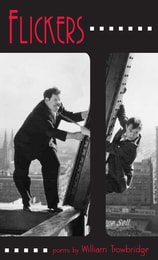
Flickers
PoemsWilliam Trowbridge
University of Arkansas Press, 2000
These poems are dark comedies that capture both the eerie and the ordinary. This balance is not easily achieved, but like a veteran comedian executing a pratfall, Trowbridge makes it all seem natural. His surreal family, the Glads, satirizes life in suburbia and reflects the often absurd margins of our urban lifestyle. By contrast, a group of poems revolving around a packing house in Kansas City (Trowbridge worked there as a young man), reminds us of those darker places in our lives that exist just “across the street from the ledgers and lapels.”
The variety of subjects Trowbridge works with is refreshing. Whether he is writing about Buster Keaton, Fred Astaire, June bugs, baseball, the holocaust, Cadillacs, or old dogs, his eye is always focused on the turn of phrase that will catch us off guard. His well-crafted lines are full of wit and humor. He approaches his subjects like Coyote approaches Fox—smiling, ready to expose his dear friend to the reality of his existence through sleight of hand. And, like Coyote, he teaches us to laugh at ourselves or perish under the weight of our everyday lives.
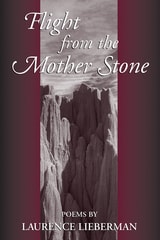
Flight from the Mother Stone
PoemsLaurence Lieberman
University of Arkansas Press, 2000
In his newest collection of poetry, Laurence Leiberman widens the scope of his previous Caribbean collections by drawing attention to the small enchanting islands of the Grenadines, a chain running between Grenada and St. Vincent. These outposts, often frequented by sailors, are mainly off the beaten tourist tracks. Lieberman’s poems bring to life all the overlooked people, hidden places, and indigenous but rarely seen animals which can be found on these islands.
These poems are as powerful as voodoo, full of energetic narratives in which Lieberman acts as observer while his characters—native “Caribs” and friends—guide us through the mystifying world of Guyana and the Caribbean: the planting of tree farms, local myths and religious sects, the daily crises of manual laborers working in the gold and diamond mines, and encounters with watras and harpy eagles.
Lieberman’s lines are rhythmic and strong; voices swirl in and out of his stanzas. From Lieberman’s own precise observations to his inclusion of Caribbean dialects, the language created here is deeply textured and unique. The majority of these poems are narratives, stories about a culture that is extremely attuned to the richness of its past. They remind their readers that no matter how diverse a society becomes, it remains irrevocably connected to the land it was born of and the plants and animals that struggle to survive in its midst.
Florida
Christine Schutt
Northwestern University Press, 2003
Florida is the portrait of the artist as a young woman, an orphan's story full of loss and wonder, a familiar tale told in original language. Alice Fivey, fatherless at age seven, is left in the care of her relatives at ten when her love-wearied mother loses custody of her and submits to the sanitarium and years of psychiatric care. A namesake daughter locked in the orphan's move-around life, she must hold still while the seamstress pins her into someone not her mother. But they share the same name, so she is her mother, isn't she?
Alice finds consolation in books and she herself is a storyteller who must build a home for herself word by right word. Florida is her story, recalled in brief scenes of spare beauty and strangeness as Alice moves from house to house, ever further from the desolation of her mother's actions, ever closer to the meaning of her experience. In this most elegiac and luminous novel, Schutt gives voice to the feast of memory, the mystery of the mad and missing, and above all, the life-giving power of language.
Flowers as Mind Control
poemsLaura Minor
BkMk Press, 2021
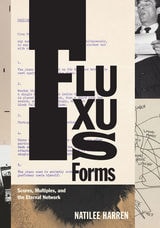
Fluxus Forms
Scores, Multiples, and the Eternal NetworkNatilee Harren
University of Chicago Press, 2020
While today the Fluxus collective is recognized for its radical neo-avant-garde works of performance, publishing, and relational art and its experimental, interdisciplinary approach, it was not taken seriously in its own time. With Fluxus Forms, Natilee Harren captures the magnetic energy of Fluxus activities and collaborations that emerged at the intersections of art, music, performance, and literature. The book offers insight into the nature of art in the 1960s as it traces the international development of the collective’s unique intermedia works—including event scores and Fluxbox multiples—that irreversibly expanded the boundaries of contemporary art.
Flying Over Sonny Liston
PoemsGary Short
University of Nevada Press, 1996
Flying through a Hole in the Storm
PoemsFleda Brown
Ohio University Press, 2021
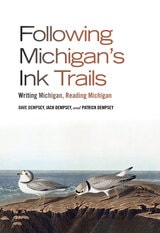
Following Michigan's Ink Trails
Writing Michigan, Reading MichiganDave Dempsey
Michigan State University Press, 2027
Michigan is renowned for its natural beauty and automotive history, yet its rich literary heritage often goes unrecognized. This engaging and extensively researched book aims to change that by providing vivid portraits of both well-known and overlooked authors. It also offers an enjoyable tour through the state’s libraries and bookstores. The book takes readers on a fascinating journey across the back roads and highways of Michigan writing, showcasing the remarkable diversity of authors who have called the state home as well as those who have found it inspirational. It is perfect for anyone interested in reading, Michigan’s literary heritage, and its culture.
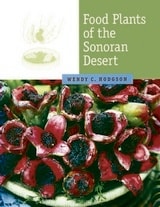
Food Plants of the Sonoran Desert
Wendy C. Hodgson
University of Arizona Press, 2001
The seemingly inhospitable Sonoran Desert has provided sustenance to indigenous peoples for centuries. Although it is to all appearances a land bereft of useful plants, fully one-fifth of the desert's flora are edible.
This volume presents information on nearly 540 edible plants used by people of more than fifty traditional cultures of the Sonoran Desert and peripheral areas. Drawing on thirty years of research, Wendy Hodgson has synthesized the widely scattered literature and added her own experiences to create an exhaustive catalog of desert plants and their many and varied uses.
Food Plants of the Sonoran Desert includes not only plants such as gourds and legumes but also unexpected food sources such as palms, lilies, and cattails, all of which provided nutrition to desert peoples. Each species entry lists recorded names and describes indigenous uses, which often include nonfood therapeutic and commodity applications. The agave, for example, is cited for its use as food and for alcoholic and nonalcoholic beverages, syrup, fiber, cordage, clothing, sandals, nets, blankets, lances, fire hearths, musical instruments, hedgerows, soap, and medicine, and for ceremonial purposes. The agave entry includes information on harvesting, roasting, and consumption—and on distinguishing between edible and inedible varieties.
No other source provides such a vast amount of information on traditional plant uses for this region. Written to be easily accessible to general readers, the book is an invaluable compendium for anyone interested in the desert's hidden bounty.
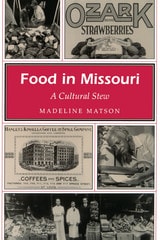
Food in Missouri
A Cultural StewMadeline Matson
University of Missouri Press, 1994
Corn, squash, and beans from the Native Americans; barbecue sauces from the Spanish; potatoes and sausages from the Germans: Missouri's foods include a bountiful variety of ingredients. In Food in Missouri: A Cultural Stew, Madeline Matson takes readers on an enticing journey through the history of this state's food, from the hunting and farming methods of the area's earliest inhabitants, through the contributions of the state's substantial African American population, to the fast-food purveyors of the microwave age.
Tracing the history of food preparation, preservation, and marketing, while highlighting the cultural traditions that engendered each change, Matson shows how advances in farming methods, the invention of the electric range, the development of cookbooks, and three waves of immigration have profoundly influenced what Missourians eat today. Along the way, she highlights some of the key people, places, and institutions in Missouri's food history: Irma S. Rombauer, author of Joy of Cooking; Stark Bro's Nurseries and Orchards in Louisiana, Missouri, the largest family-owned fruit-tree nursery in the world and the home of Delicious, Golden Delicious, and Gala apples; St. Louis's Soulard Market, established in 1779 and said to be the oldest public market west of the Mississippi; and Stone Hill Winery, a leader in Hermann's nationally recognized wine- making industry.
By bringing to life the traditions behind the foods we eat every day, Food in Missouri provides a unique perspective on the people who explored and settled the state, showing that Missouri's rich heritage truly is a cultural stew.
For Dust Thou Art
Timothy Liu
Southern Illinois University Press, 2005
Running the gamut from traditional to radical forms, Timothy Liu’s sixth collection of poems, For Dust Thou Art, continues the trajectory of his previous books but extends his lyrical range. The centerpiece of the volume’s tripartite structure is a meditation on the events surrounding 9/11 and its aftermath. In his poems, Liu explores what a twenty-first century American “poetry of witness” might look like and protests the charge that the poetic generation to which Liu belongs is stymied by a kind of jaded amorality. Whether taking on public spectacle or contemplating the fallout of a private life, these meditations move forward and backward through time, seeking spiritual consolation within a material world.
For This and Other Cruelties
Youna Kwak
University of Iowa Press, 2025
CALIBA’s 2025 Golden Poppy Book Award Winner, Poetry
The shadow of mothering has never been given a richer, fuller, more debased vision than in Youna Kwak’s For This and Other Cruelties. Kwak casts a cold eye on the splendid and cruel intransigence of maternal paradoxes in all their impossible double binds, monstrous pleasures, and profane mystifications. Shifting between lyric and prose poems, this collection throws slanted light on the ineffability of our deepest attachments, envisioning a world where mother is “a creature whose only enemy could be human.” Kwak brings us face to face with the irreconcilable facts of being mother, mothered, and alive.
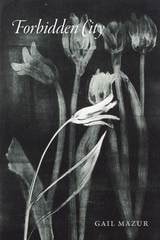
Forbidden City
Gail Mazur
University of Chicago Press, 2016
A draughtsman’s draughtsman, Hokusai at 70
thought he’d begun to grasp the structures
of birds and beasts, insects and fish, of the way
plants grow, hoped that by 90 he’d have
penetrated to their essential nature.
And more, by 100, I will have reached the stage
where every dot, every mark I make will be
alive. You always loved that resolve, you’d repeat
joyfully—Hokusai’s utterance of faith
in work’s possibilities, its reward, that,
at 130, he’d perhaps have learned to draw.
Gail Mazur’s poems in Forbidden City build an engaging meditative structure upon the elements of mortality and art, eloquently contemplating the relationship of art and life—and the dynamic possibilities of each in combination. At the collection’s heart is the poet’s long marriage to the artist Michael Mazur (1935–2009). A fascinating range of tone infuses the book—grieving, but clear-eyed rather than lugubrious, sometimes whimsical, even comical, and often exuberant. The note of pleasure, as in an old tradition enriched by transience, runs through the work, even in the final poem, “Grief,” where “our ravenous hold on the world” is a powerful central element.
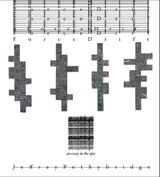
Force Drift
An Essay in the EpicJeffrey Pethybridge
Tupelo Press, 2025
The poems in Force Drift recall Gilles Deleuze’s insight that art “is not a matter of reproducing or inventing forms, but of capturing forces.” Through the formal range of this dynamic sequence, Pethybridge achieves something like a synthesis of Deleuze’s opposition whereby the invention of poetic form becomes the very means of capturing, registering forces: “a reckoning lyric.”
The task of reckoning renders visible the violence of the state that lies at the heart of the matter precisely because the state intends to conceal or justify its brutality through the invocation of emergency powers, as well as the state of exception, or how the state disappears persons in its network of black site prisons. As the political scientist Darius Rejali has demonstrated, it is in fact democracies that have refined “invisible tortures” such as sensory deprivation, stress-positions, and the waterboard.
Working at the intersection of documentary poetics and theories of the epic, Pethybridge recommits poetry to a responsibility for a description of history. As a poet-researcher, he asks: “what would be possible…if listening / were the leading-form of being.” Driven by argument, abstraction, and assemblage, the poems in Force Drift address themselves to the irreparable, the “traumaeffect,” within the war on terror’s record of atrocity. Force Drift is a cri de coeur, political critique, and essay in the epic.
Against the world-destroying violence of the US torture program, Force Drifts juxtaposes a catalog of energies, forms, and genres. It is abolitionist, citational, architectural, chromatic, and replete with visual poetries ranging from the arabasques of tzahibs to erasures to extreme measures of leading and kerning. Even when its language is reduced to the pure transcription of pain––”aiai aiai aiai”––Force Drift is committed to aliveness and embodiment as “final treaty of the person,” as conscience and counterworld to the history as catastrophe of US imperialism, “irrefutable as the sun to the eye.”
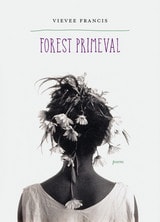
Forest Primeval
PoemsVievee Francis
Northwestern University Press, 2016
Winner, 2017 Kingsley Tufts Poetry Award
Winner, 2016 Hurston/Wright Legacy Award in the Poetry category
Finalist, 2015 Balcones Poetry Prize
Shortlist finalist, 2015 PEN Open Book Award for an exceptional book by an author of color
"Another Anti-Pastoral," the opening poem of Forest Primeval, confesses that sometimes "words fail." With a "bleat in [her] throat," the poet identifies with the voiceless and wild things in the composed, imposed peace of the Romantic poets with whom she is in dialogue. Vievee Francis’s poems engage many of the same concerns as her poetic predecessors—faith in a secular age, the city and nature, aging, and beauty. Words certainly do not fail as Francis sets off into the wild world promised in the title. The wild here is not chaotic but rather free and finely attuned to its surroundings. The reader who joins her will emerge sensitized and changed by the enduring power of her work.
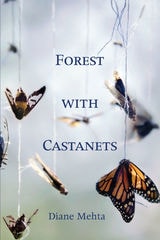
Forest with Castanets
Diane Mehta
Four Way Books, 2019
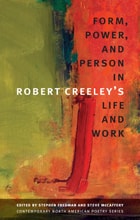
Form, Power, and Person in Robert Creeley’s Life and Work
Stephen Fredman
University of Iowa Press, 2010
By any measure—international reputation, influence upon fellow writers and later generations, number of books published, scholarly and critical attention—Robert Creeley (1926–2005) is a literary giant, an outstanding, irreplaceable poet. For many decades readers have remarked upon the almost harrowing emotional nakedness of Creeley’s writing. In the years since his death, it may be that the disappearance of the writer allows that nakedness to be observed more readily and without embarrassment.
Written by the foremost critics of his poetry, Form, Power, and Person in Robert Creeley’s Life and Work is the first book to treat Creeley’s career as a whole. Masterfully edited by Stephen Fredman and Steve McCaffery, the essays in this collection have been gathered into three parts. Those in “Form” consider a variety of characteristic formal qualities that differentiate Creeley from his contemporaries. In “Power,” writers reflect on the pressure exerted by emotions, gender issues, and politics in Creeley’s life and work. In “Person,” Creeley’s unique artistic and psychological project of constructing a person—reflected in his correspondence, teaching, interviews, collaborations, and meditations on the concept of experience—is excavated. While engaging these three major topics, the authors remain, as Creeley does, intent upon the ways such issues appear in language, for Creeley’s nakedness is most conspicuously displayed in his intimate relationship with words.
Contributors
Charles Altieri
Rachel Blau DuPlessis
Stephen Fredman
Benjamin Friedlander
Alan Golding
Michael Davidson
Steve McCaffery
Peter Middleton
Marjorie Perloff
Peter Quartermain
Libbie Rifkin
Fornes
Theater in the Present TenseDiane Lynn Moroff
University of Michigan Press, 1996
Diane Lynn Moroff focuses on Fornes's major plays, providing illuminating readings of her unique and irreverent body of work. The book traces the career of this influential playwright, director, and teacher, including the reception of her plays, the range of critical responses (particularly those of feminist critics), and an introduction to Fornes's theatrical philosophies. It looks at such critical issues in Fornes's work as the representation of female subjectivity, theater as metaphor and context, art as ritual, and the role of the spectator. In a final chapter, Fornes's plays including Abingdon Square and her most recent work, What of the Night? are examined in the context of the sexualization of character, an ongoing theme for Fornes.
Fornes: Theater in the Present Tense will appeal to scholars and students in theater studies and women's studies and to anyone interested or engaged in contemporary theater.
Diane Lynn Moroff is Assistant Professor of English, Oglethorpe University.
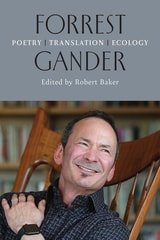
Forrest Gander
Poetry, Translation, EcologyEdited by Robert Baker
University of Michigan Press, 2026
Pulitzer Prize winner Forrest Gander is widely celebrated as a love poet, a meditative poet, and a poet of ecological awareness. He has always been a writer drawn to cross-cultural encounter, as active in translation as any poet of his generation. This collection of essays on his work brings together an international range of poets, novelists, critics, and translators, including Charles Altieri, Stephanie Burt, Julia Fiedorczuk, Jorie Graham, and Jeanette Winterson.
The collection features interviews as well as essays of different kinds—reviews, appreciations, and interpretations—and they address Gander’s poetry, fiction, and translations. They illuminate major concerns at the heart of all his work: eros, companionship, loss, renewal, an openness to the life all around us, and a rapt attention to the natural world.
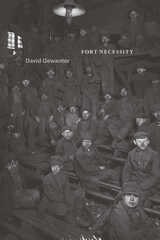
Fort Necessity
David Gewanter
University of Chicago Press, 2018
Haunted by his father’s autopsy of a workman he witnessed as a child, Gewanter forges intensely personal poems that explore the fate of our laboring bodies, from the Carnegie era’s industrial violence and convict labor to our present day of broken trust, profiteering, and the Koch brothers. Guided by a moral vision to document human experience, this unique collection takes raw historical materials—newspaper articles, autobiography and letters, court testimony, a convict ledger, and even a menu—and shapes them into sonnets, ballads, free verse, and prose poems. The title poem weaves a startling lyric sequence from direct testimony by steelworkers and coal-miners, strikers and members of prison chain-gangs, owners and anarchists, revealing an American empire that feeds not just on oil and metal, but also on human energy, impulse, and flesh. Alongside Gewanter’s family are hapless souls who dream of fortune, but cannot make their fates, confronting instead the dark outcomes of love, loyalty, fantasy, and betrayal.
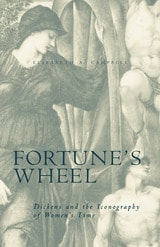
Fortune’s Wheel
Dickens and the Iconography of Women’s TimeElizabeth A. Campbell
Ohio University Press, 2003
In the first half of the nineteenth century, England became quite literally a world on wheels. The sweeping technological changes wrought by the railways, steam-powered factory engines, and progressively more sophisticated wheeled conveyances of all types produced a corresponding revolution in Victorian iconography: the image of the wheel emerged as a dominant trope for power, modernity, and progress.
In Fortune’s Wheel, an original and illuminating study, Elizabeth Campbell explores the ways in which Charles Dickens appropriated and made central to his novels the dominant symbol of his age. Between 1840 and 1860, a transformation took place in Dickens’ thinking about gender and time, and this revolution is recorded in iconographic representations of the goddess Fortune and wheel imagery that appear in his work.
Drawing on a rich history of both literary and visual representations of Fortune, Professor Campbell argues that Dickens’ contribution to both the iconographic and narrative traditions was to fuse the classical image of the wheel with the industrial one. As the wheel was increasingly identified as the official Victorian symbol for British industrial and economic progress, Dickens reacted by employing this icon to figure a more pessimistic historical vision—as the tragic symbol for human fate in the nineteenth century.
Fortune’s Wheel ably portrays the concept that, in both text and illustrations, images of fortune and the wheel in Dickens’ work record his abandonment of a linear, progressive, and arguably masculine view of history to embrace a cyclical model that has been identified with “women’s time.”
Forty Years of Texas Storytelling
Historical and Contemporary Tales from Diverse Writers and PoetsTed Parkhurst
Parkhurst Brothers, Inc., 2024
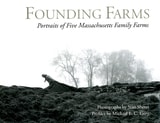
Founding Farms
Portraits of Five Massachusetts Family FarmsStanley E. Sherer
University of Massachusetts Press, 1993
With each passing year, the number of family farms in the United States diminishes. Fewer people have the persistence and ingenuity to wrest a livelihood from the land in an era of corporate ownership and mass production. Yet some family farms survive.
Through words and photographs, this book documents the long lives of five of the oldest farms in Massachusetts. Each has remained in the same family for more than two, sometimes three, centuries and each has a distinctive history. The devotion to the land and family heritage is palpable in the stories these five families tell.
Stan Sherer’s remarkable photographs depict the activities of the family members as they go about their daily labors, planting crops, feeding animals, applying new technologies to ancient tasks, and coping with the vagaries of weather and state regulations. Michael E. C. Gery’s narrative traces how the farms began, what has sustained them through the generations, and how the families who run them today feel about their past, present, and future. These stories are told largely through the words of the people themselves.
The result is a complex portrait that moves beyond traditional stereotypes to reveal the realities of family farm life in an increasingly urbanized society.
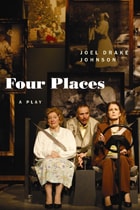
Four Places
A PlayJoel Drake Johnson
Northwestern University Press, 2009
Sketched together on a deceptively simple frame, this emotionally precise play uses its spare structure to devastating and darkly comic effect. A brother and sister have received word from their parents’ caretaker that their elderly parents may be a danger to each other. The brother breaks his routine to join his sister and mother on their weekly lunch date in hopes that together he and his sister can get a clearer picture of the situation. As the mother confronts the indignities of age and the children stare down a mounting list of losses and disappointments, an image of the family emerges that is true to life. Johnson gives readers an unwavering exploration of the ways that the love and knowledge family members have of one another creates both hurt and comfort.
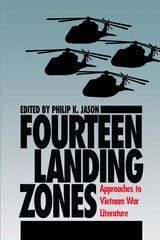
Fourteen Landing Zones
Approaches to Vietnam War LiteraturePhilip K. Jason
University of Iowa Press, 1991
It is in the spirit of the LZ that the essayists in Fourteen Landing Zones approach the writings of the Vietnam War. These fourteen diverse and powerful works by some of today's leading critics in Vietnam studies begin to answer the question of how we will filter the writings of the Vietnam War—including fiction, poetry, drama, and memoirs. What will survive the process of critical acclaim and societal affirmation—and why? Included is an incisive introduction by Jason that provides an overview of the burgeoning body of Vietnam War literature and its peculiar life in the literary and academic marketplace. This strong, often emotional volume will be of particular importance to all those interested in the literature of the Vietnam War, contemporary literature, and contemporary culture and history.
Fractures
Carlos Andrés Gómez
University of Wisconsin Press, 2020
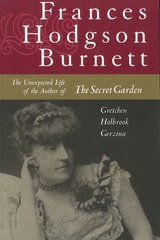
Frances Hodgson Burnett
The Unexpected Life of the Author of the Secret GardenGerzina, Gretchen H
Rutgers University Press, 2006
Hugely successful in her own time for adult novels and plays, Frances Hodgson Burnett (1849-1924) would be astounded to find out she is remembered for a handful of books for children, but most of all for the enormously popular Secret Garden. This fascinating biography-the first to have the full cooperation of Burnett's descendants and relatives-examines her life with lively intelligence, sensitivity, and fascinating new, never-before-published material.
Burnett's life was full of those reversals of fortune that mark her work. Following modest beginnings in mid-Victorian Manchester, she arrived in post-Civil War Tennessee at the age of fifteen with her widowed mother and two sisters. Burnett was the breadwinner of the family from the age of seventeen, eventually publishing a total of fifty-two books and writing and producing thirteen plays. She made and spent a fortune in her lifetime, was generous and profligate, yet anxious about money and obsessively hardworking.
Constantly restless and inventive, Burnett's personal life was as complex as her professional one. Her first marriage to a southern doctor disintegrated as a result of her notorious flirtations and a scandalous affair, and her subsequent marriage to an English doctor turned actor suffered a similar fate. She understood the intensity and loneliness of the thoughtful child, but was herself a largely absent mother of two sons-overwhelmed by guilt when tragedy struck one of them; the other one never got over being the model for Little Lord Fauntleroy.
A woman of contrasts and paradoxes, this quintessentially British writer was equally at home in the United States, which honored her with a memorial in Central Park. Frances Hodgson Burnett reinvented for herself and for generations to come in both countries the magic and the mystery of the childhood she never had.
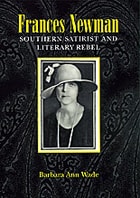
Frances Newman
Southern Satirist and Literary RebelBarbara Ann Wade
University of Alabama Press, 1998
This first biographical and literary assessment of Frances Newman highlights one of the most experimental writers of the Southern Renaissance
Frances Newman was born into a prominent Atlanta family and was educated at private schools in the South and the Northeast. Her first novel, The Hard-Boiled Virgin, was hailed by James Branch Cabell as “the most brilliant, the most candid, the most civilized, and the most profound yet written by any American woman.” Cabell and H. L. Mencken became Newman’s literary mentors and loyally supported her satire of southern culture, which revealed the racism, class prejudice, and religious intolerance that reinforced the idealized image of the white southern lady. Writing within a nearly forgotten feminist tradition of southern women’s fiction, Newman portrayed the widely acclaimed social change in the early part of the century in the South as superficial rather than substantial, with its continued restrictive roles for women in courtship and marriage and limited educational and career opportunities.
Barbara Wade explores Newman’s place in the feminist literary tradition by comparing her novels with those of her contemporaries Ellen Glasgow, Mary Johnston, and Isa Glenn. Wade draws from Newman’s personal correspondence and newspaper articles to reveal a vibrant, independent woman who simultaneously defied and was influenced by the traditional southern society she satirized in her writing.
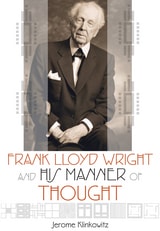
Frank Lloyd Wright and His Manner of Thought
Jerome Klinkowitz
University of Wisconsin Press, 2014
Klinkowitz presents a critical biography driven by the architect's own work and intellectual growth, focusing on the evolution of Wright's thinking and writings from his first public addresses in 1894 to his last essay in 1959. Did Wright reject all of Victorian thinking about the home, or do his attentions to a minister's sermon on "the house beautiful" deserve closer attention? Was Wright echoing the Transcendentalism of Ralph Waldo Emerson, or was he more in step with the philosophy of William James? Did he reject the Arts and Crafts movement, or repurpose its beliefs and practices for new times? And, what can be said of his deep dissatisfaction with architectural concepts of his own era, the dominant modernism that became the International Style? Even the strongest advocates of Frank Lloyd Wright have been puzzled by his objections to so much that characterized the twentieth century, from ideas for building to styles of living.
In Frank Lloyd Wright and His Manner of Thought, Klinkowitz, a widely published authority on twentieth-century literature, thought, and culture, examines the full extent of Wright's books, essays, and lectures to show how he emerged from the nineteenth century to anticipate the twenty-first.
Outstanding Book, selected by the American Association of School Librarians
Best Books for General Audiences, selected by the Public Library Reviewers
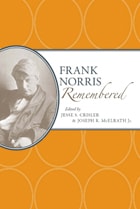
Frank Norris Remembered
Edited by Jesse S. Crisler and Joseph R. McElrath Jr.
University of Alabama Press, 2013
Frank Norris Remembered is a collection of reminiscences by Norris’s contemporaries, friends, and family that illuminate the life of a popular American novelist.
Considering his undergraduate education spent studying art at Académie Julian in Paris and creative writing at Harvard and his journalism career reporting from the far reaches of South Africa and Cuba, it is difficult to fathom how Frank Norris also found time to compose seven novels during the course of his brief life. But despite his adventures abroad, Norris turned out novels at a dizzying pace. He published Moran of the Lady Letty in 1898, McTeague early in 1899, Blix later that year, A Man’s Woman in February 1900, and The Octopus, the first in his ultimately unfinished “Epic of the Wheat” trilogy, in 1901. By informing his novels with his own experiences abroad, Norris composed works that were politically charged and culturally relevant and that made considerable contributions to the character of American literature in the twentieth century.
Frank Norris died at the age of thirty-two in 1902 from peritonitis resulting from a burst appendix, leaving behind a wife, a daughter, and an unfinished series of novels (two of which, The Pit and Vandover and the Brute, were published posthumously). The aim of Frank Norris Remembered, edited by Jesse S. Crisler and Joseph R. McElrath Jr., is to re-create the short, spectacular life of this American author through the eyes of those who knew him best. The fifty reminiscences included in this book feature the voices of Frank N. Doubleday; William Dean Howells; Hamlin Garland; Norris’s wife, Jeannette; and many others who were lucky enough to form a relationship with this vital twentieth-century American author, artist, and adventurer.
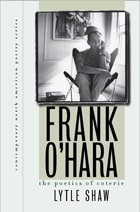
Frank O'Hara
The Poetics of CoterieLytle Shaw
University of Iowa Press, 2006
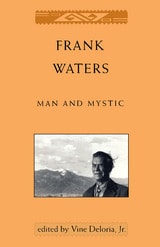
Frank Waters
Man and MysticVine Deloria Jr.
Ohio University Press, 1993
“In addition to his accomplishments as a talented novelist, a thorough historian, and an excellent essayist, Frank Waters is that rare breed of man who has merged heart and mind early in his life and moved forward to confront ultimate questions. This dilemma of faith and heritage, religion and identity, and commitment and comfort has never been resolved intellectually. Even with profound faith and rigorous discipline of self, mystics have found it difficult to resolve through action and prayer…I look at the life and writing of Frank Waters…and find…a remarkable journey of inquiry spanning nearly a century and illuminating questions which I did not think possible to formulate.”
—Vine Deloria, Jr., editor
Contributors to this volume are Alvin M. Josephy, Jr., Bobby Bridger, Steven Wall, Will Wright, William Eastlake, Larry Evers, David Jongeward, Max Evans, Win Blevins, Barbara Waters, Rudolfo Anaya, Thomas J. Lyon, Joe Gordon, Robert Kostka, Charles Adams, Father Peter J. Powell, Quay Grigg, Alexander Blackburn, and T. N. Luther.
Frankenstein
Penetrating the Secrets of NatureLederer, Susan E
Rutgers University Press, 2002
As science penetrates the secrets of nature, with each discovery generating new questions, Mary Shelley's Frankenstein will sound its note of warning. Many scientific developments have provoked references to Frankenstein, a story that, for nearly two centuries, has gripped our imaginations and haunted our nightmares. How can society balance the benefits of medical discoveries against the ethical or spiritual questions posed?
Frankenstein: Penetrating the Secrets of Nature accompanies a traveling exhibit of the same name. This lavishly illustrated volume begins by highlighting Shelley's novel and the context in which she conceived it. It next focuses on the redefinition of the Frankenstein myth in popular culture. Here, the fate of the monster becomes a moral lesson illustrating the punishment for ambitious scientists who seek to usurp the place of God by creating life. The final section examines the continuing power of the Frankenstein story to articulate present-day concerns raised by new developments in biomedicine such as cloning and xenografting (the use of animal organs in human bodies), and the role scientists and citizens play in determining acceptable limits of scientific and medical advances.