Results by title
1882 books match the query 'Criticism and interpretation' and 63 start with h
H. G. Adler
Life, Literature, LegacyEdited by Julia Creet, Sara R. Horowitz, and Amira Bojadzija-Dan
Northwestern University Press, 2016
H. G. Adler: Life, Literature, Legacy is the first collection of essays in English dedicated to the life and work of German-language author H. G. Adler. Among the international scholars of German, Jewish, and Holocaust literature and history who reveal the range of Adler’s legacy across genres are Adler’s son, Jeremy Adler, and Peter Filkins, translator of Adler’s trilogy, Panorama, (The Journey). Together, the essays examine Adler’s writing in relation to his life, especially his memory as a survivor of the Nazi death camps and his posthumous recognition for having produced a Gesamtkunstwerk, an aesthetic synthesis of the Shoah. The book carries the moral charge of Adler’s work, moving beyond testimony to a complex dialectic between fact and fiction, exploring Adler’s experiments with voice and the ethical work of literary engagement with the Shoah.
H.R.F. Keating
Post-Colonial Detection, A Critical StudyMeera Tamaya
University of Wisconsin Press, 1993
HARLAN ELLISON
THE EDGE OF FOREVERGary K. Wolfe and Ellen Weil
The Ohio State University Press, 2002
HAWTHORNE AND THE REAL
BICENTENNIAL ESSAYSMILLICENT BELL
The Ohio State University Press, 2005
Contributors:
- Millicent Bell
- Nina Baym
- Michael T. Gilmore
- Leland S. Person
- David Leverenz
- Larry J. Reynolds
- Lawrence Buell
- Rita K. Gollin
- John Carlos Row
- Brenda Wineapple
Hal Hartley
Mark L. Berrettini
University of Illinois Press, 2011

Hamlet Vocation Coleridge And Wordsworth
Martin Greenberg
University of Iowa Press, 1986
Handsomely Done
Aesthetics, Politics, and Media after MelvilleEdited by Daniel Hoffman-Schwartz
Northwestern University Press, 2019
The volume thus engages not only Melville reception across media (Jorge Luis Borges, John Huston, Jean-Luc Godard, Led Zeppelin, Claire Denis) but also the Melvillean resonances and echoes of various political events and movements, such as the Attica uprising, the Red Army Faction, Occupy Wall Street, and Black Lives Matter. This consideration of Melville’s afterlife opens onto theorizations of intermediality, un/translatability, and material intensity even as it also continually faces the most concrete and pressing questions of history and politics.
Hanif Kureishi
Postcolonial StorytellerBy Kenneth C. Kaleta
University of Texas Press, 1997
"Hanif Kureishi is a proper Englishman. Almost." So observes biographer Kenneth Kaleta. Well known for his films My Beautiful Laundrette and Sammy and Rosie Get Laid, the Anglo-Asian screenwriter, essayist, and novelist has become one of the leading portrayers of Britain's multicultural society. His work raises important questions of personal and national identity as it probes the experience of growing up in one culture with roots in another, very different one.
This book is the first critical biography of Hanif Kureishi. Kenneth Kaleta interviewed Kureishi over several years and enjoyed unlimited access to all of his working papers, journals, and personal files. From this rich cache of material, he opens a fascinating window onto Kureishi's creative process, tracing such works as My Beautiful Laundrette, Sammy and Rosie Get Laid, The Buddha of Suburbia, London Kills Me, The Black Album, and Love in a Blue Time from their genesis to their public reception. Writing for Kureishi fans as well as film and cultural studies scholars, Kaleta pieces together a vivid mosaic of the postcolonial, hybrid British culture that has nourished Kureishi and his work.
Hansberry's Drama
COMMITMENT AMID COMPLEXITYSteven R. Carter
University of Illinois Press, 1991
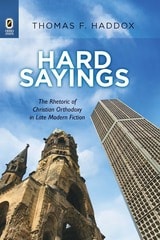
Hard Sayings
The Rhetoric of Christian Orthodoxy in Late Modern FictionThomas F. Haddox
The Ohio State University Press, 2013
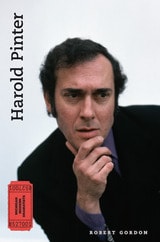
Harold Pinter
The Theatre of PowerRobert Gordon
University of Michigan Press, 2013
The latest volume in the Michigan Modern Dramatists series offers an authoritative but accessible look at Harold Pinter, one of the greatest and most influential postwar British playwrights and author of classic works such as The Birthday Party and The Homecoming. Pinter was awarded the Nobel Prize for Literature in 2005 for his remarkable body of work and plays that "uncover the precipice under everyday prattle and force entry into oppression's closed rooms."
Harold Pinter: The Theatre of Power focuses on the playwright's continuously innovative experiments in theatrical form while tracing the recurrence of a consistent set of ethical and epistemological concerns. Exploring important plays from across this prolific writer’s career, author Robert Gordon argues that the motivating force in almost all of Pinter's drama is the ceaseless desire for power, represented in his work as a compulsive drive to achieve or maintain dominance—whether it be the struggle to defend one's own territory from intruders, the father's battle with his sons to assert his patriarchal position in the family, the manipulation of erotic feelings in the gender warfare that motivates sexual relationships, the abuse of brute force by dictatorships and democracies, or simply the masculine obsession to dominate. Gordon demonstrates the adventurousness of Pinter's experimentation with form while at the same time exposing the ethical, epistemological, and aesthetic preoccupations that have persisted with remarkable consistency throughout his career.
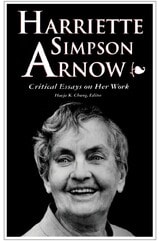
Harriette Simpson Arnow
Critical Essays on Her WorkHaeja K. Chung
Michigan State University Press, 1995
At her death in 1986, Harriette Simpson Arnow left a modest collection of published work: ten short stories, five novels, two non-fiction books, a short autobiography, and nineteen essays and book reviews. Although the sum is small, her writing has been examined from regionalist, Marxist, feminist, and other critical perspectives.
The 1970s saw the first serious attempts to revive interest in Arnow. In 1971, Tillie Olsen identified her as a writer whose "books of great worth suffer the death of being unknown, or at best, a peculiar eclipsing." Joyse Carol Oates wrote in The New York Times Book Review that Arnow's The Dollmaker is "our most unpretentious American masterpiece."
In the 1990s, it is appropriate to take stock of her earlier work and to prompt reexamination of this powerful yet poorly understood writer. This collection of critical essays examines traditional as well as new interpretations of Arnow and her work. It also suggests future directions for Arnow scholarship and includes studies of all of Arnow's writing, fiction and non-fiction, published and unpublished.
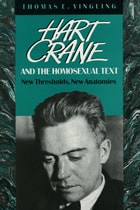
Hart Crane and the Homosexual Text
New Thresholds, New AnatomiesThomas E. Yingling
University of Chicago Press, 1990
"A brilliant critical model for understanding how textuality and sexuality can produce pervasive effects on each other in the writing of a figure like Crane."—Michael Moon, Duke University

Hart Crane
A Re-IntroductionWarner Berthoff
University of Minnesota Press, 1989
Hart Crane was first published in 1989. Minnesota Archive Editions uses digital technology to make long-unavailable books once again accessible, and are published unaltered from the original University of Minnesota Press editions.
More than half a century after his death, the work of Hart Crane (1899–1932) remains central to our understanding of twentieth-century American poetry. During his short life, Crane's contemporaries had difficulty seeing past the "roaring boy" who drank too much and hurled typewriters from windows; in recent years, he has come to be seen as a kind of "last poet" whose only theme is self-destruction, and who himself exemplifies the breakdown of poetry in the modern age. Taking as a point of departure Robert Lowell's 1961 valuation of Crane and his power to speak from "the center of things," Warner Berthoff in this book reappraises the essential character and force of Crane's still problematic achievement. Though he takes into account the substantial body of commentary on Crane's work, his primary intent is to look afresh at the poems themselves, and at the poet's clear-eyed (and brilliant) letters. This approach enables Berthoff, first, to track the emergence and development of Crane's lyric style—an art that recreates, in compact form, the turbulence of the modern city. He then explores the background and historical community that nourished Crane's creative imagination, and he evaluates Crane's conception of the ideal modern poetic: a poetry of ecstasy created with architectural craft. His final chapter is devoted to The Bridge, the ambitious lyric suite that proved to be the climax and terminus of Crane's work. Berthoff's emphasis throughout is on the beauty and power of individual poems, and on the sanity, shrewdness, and sense of purpose that informed Crane's working intelligence.
Hart Crane
After His LightsBrian M. Reed
University of Alabama Press, 2006
In Hart Crane: After His Lights, Brian Reed undertakes a study of Crane’s poetic output that takes into account, but also questions, the post-structural and theoretical developments in humanities scholarship of the last decade that have largely approached Crane in a piecemeal way, or pigeonholed him as represen-tative of his class, gender, or sexual orientation. Reed examines Crane’s career from his juvenilia to his posthumous critical reception and his impact on practicing poets following World War II. The first part of the study tests common rubrics of literary theory—nationality, sexuality, period—against Crane’s poetry, and finds that these labels, while enlightening, also obfuscate the origin and character of the poet’s work. The second part examines Crane’s poetry through the process of its composition, sources, and models, taking up questions of style, genealogy, and genre. The final section examines Crane’s influence on subsequent generations of American poets, especially by avant-garde literary circles like the New American poets, the Black Mountain School, the New York School, and the Beats.
The result is a study that complicates and enriches our understandings of Crane’s poetry and contributes to the ongoing reassessment of literary modernism’s origins, course, and legacy.
Harvester of Hearts
Motherhood under the Sign of FrankensteinRachel Feder
Northwestern University Press, 2018
In the period between 1815 and 1820, Mary Shelley wrote her most famous novel, Frankenstein; or, The Modern Prometheus, as well as its companion piece, Mathilda, a tragic incest narrative that was confiscated by her father, William Godwin, and left unpublished until 1959. She also gave birth to four—and lost three—children.
In this hybrid text, Rachel Feder interprets Frankenstein and Mathilda within a series of provocative frameworks including Shelley’s experiences of motherhood and maternal loss, twentieth-century feminists’ interests in and attachments to Mary Shelley, and the critic’s own experiences of pregnancy, childbirth, and motherhood. Harvester of Hearts explores how Mary Shelley’s exchanges with her children—in utero, in birth, in life, and in death—infuse her literary creations. Drawing on the archives of feminist scholarship, Feder theorizes “elective affinities,” a term she borrows from Goethe to interrogate how the personal attachments of literary critics shape our sense of literary history. Feder blurs the distinctions between intellectual, bodily, literary, and personal history, reanimating the classical feminist discourse on Frankenstein by stepping into the frame.
The result—at once an experimental book of literary criticism, a performative foray into feminist praxis, and a deeply personal lyric essay—not only locates Mary Shelley’s monsters within the folds of maternal identity but also illuminates the connections between the literary and the quotidian.
Haunted Man's Report
Reading Charles PortisRobert Cochran
University of Arkansas Press, 2024
Haunted Man’s Report, a deeply insightful literary exploration of Portis’s singular and underexamined oeuvre, celebrates this novelist’s great achievement and is certain to prove a valuable guide for readers new to Portis as well as aficionados.
Hawksmoor's London Churches
Architecture and TheologyPierre de la Ruffinière du Prey
University of Chicago Press, 2000
Haydn and the Performance of Rhetoric
Edited by Tom Beghin and Sander M. Goldberg
University of Chicago Press, 2007
In this volume, a distinguished group of contributors in fields from classics to literature to musicology restores the rhetorical model to prominence and shows what can be achieved by returning to the idea of music as a rhetorical process. An accompanying DVD, specially designed for this project, presents performances and illustrations keyed to its chapters, making musicological arguments accessible to nonspecialists and advancing additional arguments of its own through the medium of performance. The volume thus reaches beyond musicology to enrich and complicate the larger debate over rhetoric's role in eighteenth-century culture.
Hearts of Darkness
White Women Write RaceMarcus, Jane
Rutgers University Press, 2004
The centerpiece of the book is Marcus's dialogue with one of her best-known essays, "Britannia Rules The Waves." In that piece, she argues that The Waves makes a strong anti-imperialist statement. Although many already support that argument, she now goes further in order to question the moral value of such a buried critique on Woolf's part. In "A Very Fine Negress" she analyzes the painful subject of Virginia Woolf's racism in A Room of One's Own. Other chapters traverse the connected issues of modernism, race, and imperialism. In two of them, we follow Nancy Cunard through the making of the Negro anthology and her appearance in a popular novel of the freewheeling Jazz Age. Elsewhere, Marcus delivers a complex analysis of A Passage to India, in a reading that interrogates E. M. Forster's displacement of his fear of white Englishwomen struggling for the vote.
Marcus, as always, brings considerable gifts as both researcher and writer to this collection of new and reprinted essays, a combination resulting in a powerful interpretation of many of modernism's most cherished figures.
Heeding the Call
A Study of Denise Giardina's NovelsWilliam Jolliff
West Virginia University Press, 2020
In chapters devoted to each of Giardina’s novels, Jolliff attends to her uses of history, her formal techniques, and the central themes that make each work significant. What becomes clear is that while the author’s religious beliefs inform her fiction, she never offers easy answers. Her narratives consistently push her characters—and her readers—into more challenging and meaningful questions. Jolliff concludes by arguing that although Giardina’s initial fame has been tied to her significance as an Appalachian novelist, future studies must look beyond the regional to the deeply human questions her novels so persistently engage.
Hegel on Hamann
G. W. F. Hegel
Northwestern University Press, 2008
In 1828, G. W. F. Hegel published a critical review of Johann George Hamann, a retrospective of the life and works of one of Germany's most enigmatic and challenging thinkers and writers. While Hegel's review had enjoyed a central place in Hamann studies since its appearance, Hegel on Hamann is the first English translation of the important work. Philosophers, theologians, and literary critics welcome Anderson's stunning translation since Hamann is gaining renewed attention, not only as a key figure of German intellectual history, but also as an early forerunner of postmodern thought. Relationships between Enlightenment, Counter Enlightenment, and Idealism come to the fore as Hegel reflects on Hamann's critiques of his contemporaries Immanuel Kant, Moses Mendelssohn, J. G. Herder, and F. H. Jacobi. Hegel on Hamann also includes an introduction to Hegel's review, as well as an essay on the role of friendship in Hamann's life, in Hegel's thought, and in German intellectual culture more broadly. Rounding out the volume are its extensive annotations and bibliography, which facilitate further study of eighteenth- and nineteenth-century philosophy in English and German. This book is essential both for readers of Hegel or Hamann and for those interested in the history of German thought, the philosophy of religion, language and hermeneutics, or friendship as a philosophical category.
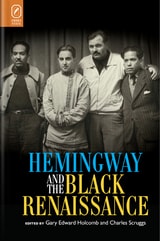
Hemingway and the Black Renaissance
Edited by Gary Edward Holcomb and Charles Scruggs
The Ohio State University Press, 2012
Hemingway and the Black Renaissance, edited by Gary Edward Holcomb and Charles Scruggs, explores a conspicuously overlooked topic: Hemingway’s wide-ranging influence on writers from the Harlem Renaissance to the present day. An observable who’s who of black writers—Ralph Ellison, James Baldwin, Langston Hughes, Claude McKay, Wallace Thurman, Chester Himes, Alex la Guma, Derek Walcott, Gayl Jones, and more—cite Hemingway as a vital influence. This inspiration extends from style, Hemingway’s minimalist art, to themes of isolation and loneliness, the dilemma of the expatriate, and the terrifying experience of living in a time of war. The relationship, nevertheless, was not unilateral, as in the case of Jean Toomer’s 1923 hybrid, short-story cycle Cane, which influenced Hemingway’s collage-like 1925 In Our Time.
Hemingway's Neglected Short Fiction
New PerspectivesSusan F. Beegel
University of Alabama Press, 1991
“This critical anthology is the result of a brilliant idea….A volume which not only will lead most readers to place more value on a number of stories previously passed over but that will likely extend the reader’s sense of Hemingway’s artistry.” —Studies in American Fiction
Hemingway’s Neglected Short Fiction is a groundbreaking exploration of Ernest Hemingway’s least‑examined stories, works long overshadowed by the towering fame of his novels. The collection reveals how many of Hemingway’s short stories have been cursorily summarized, misread, or simply ignored. Through twenty‑five original essays, leading scholars illuminate the breadth, experimentation, irony, and emotional range found in over thirty stories—tales that challenge the conventional “code hero” paradigm and expose a richer, more complex Hemingway. What emerges is a vivid portrait of an artist whose most overlooked pieces frequently contain his sharpest innovations and deepest moral provocations.
Structured with historical awareness and critical freshness, the volume ranges from Hemingway’s earliest apprentice fiction (“The Mercenaries,” “Up in Michigan,” “My Old Man”) to his experimental, metafictional, or posthumously published works (“A Natural History of the Dead,” “Get a Seeing‑Eyed Dog,” “A Man of the World”). Contributors draw from an impressive range of approaches—rhetorical theory, linguistics, psychoanalysis, semiotics, religious studies, Bakhtinian dialogism, and close textual analysis. Along the way, they revisit stories distorted by biography (“Out of Season,” “Mr. and Mrs. Elliot”), reconsider stories dismissed as trivial (“A Pursuit Race,” “A Day’s Wait”), and restore neglected gems such as “Wine of Wyoming,” “The Sea Change,” and “Homage to Switzerland.”
This book will captivate scholars of modernism, Hemingway specialists, teachers seeking fresh classroom material, and general readers who want to discover the Hemingway hidden between the lines. It is essential reading for anyone interested in the evolution of a major American writer and the vibrant life of the short story form.
Hemingway's Wars
Public and Private BattlesLinda Wagner-Martin
University of Missouri Press, 2017
Linda Wagner-Martin has written or edited more than sixty books including Ernest Hemingway, A Literary Life. She is Frank Borden Hanes Professor Emerita at the University of North Carolina-Chapel Hill and a winner of the Jay B. Hubbell Medal for Lifetime Achievement.
Henry James and the Queerness of Style
Kevin Ohi
University of Minnesota Press, 2010
For Ohi, there are many elements in the style that make James’s writing queer. But if there is a thematic marker, Ohi shows through his careful engagements with these texts, it is belatedness. The recurrent concern with belatedness, Ohi explains, should be understood not psychologically but stylistically, not as confessing the sad predicament of being out of sync with one’s life but as revealing the consequences of style’s refashioning of experience. Belatedness marks life’s encounter with style, and it describes an experience not of deprivation but of the rich potentiality of the literary work that James calls “freedom.” In Ohi’s reading, belatedness is the indicator not of sublimation or repression, nor of authorial self-sacrifice, but of the potentiality of the literary—and hence of the queerness of style.
Presenting original readings of a series of late Jamesian texts, the book also represents an exciting possibility for queer theory and literary studies in the future: a renewed attention to literary form and a new sounding—energized by literary questions of style and form—of the theoretical implications of queerness.
Henry Mancini
Reinventing Film MusicJohn Caps
University of Illinois Press, 2012
A volume in the series Music in American Life

Herbert Marcuse
An Aesthetics of LiberationMalcolm Miles
Pluto Press, 2012
When capitalism is clearly catastrophically out of control and its excesses cannot be sustained socially or ecologically, the ideas of Herbert Marcuse become as relevant as they were in the 1960s. This is the first English introduction to Marcuse to be published for decades, and deals specifically with his aesthetic theories and their relation to a critical theory of society.
Although Marcuse is best known as a critic of consumer society, epitomised in the classic One-Dimensional Man, Malcolm Miles provides an insight into how Marcuse's aesthetic theories evolved within his broader attitudes, from his anxiety at the rise of fascism in the 1930s through heady optimism of the 1960s, to acceptance in the 1970s that radical art becomes an invaluable progressive force when political change has become deadlocked.
Marcuse's aesthetics of liberation, in which art assumes a primary role in interrupting the operation of capitalism, made him a key figure for the student movement in the 1960s. As diverse forms of resistance rise once more, a new generation of students, scholars and activists will find Marcuse’s radical theory essential to their struggle.
Herman Melville
Among the MagazinesGraham Thompson
University of Massachusetts Press, 2018
What I feel most moved to write, that is banned,—it will not pay. Yet, altogether, write the other way I cannot. Herman Melville wrote these words as he struggled to survive as a failing novelist. Between 1853 and 1856, he did write “the other way,” working exclusively for magazines. He earned more money from his stories than from the combined sales of his most well known novels, Moby-Dick, Pierre, and The Confidence-Man.
In Herman Melville Graham Thompson examines the author's magazine work in its original publication context, including stories that became classics, such as “Bartelby, the Scrivener” and “Benito Cereno,” alongside lesser-known work. Using a concept he calls “embedded authorship,” Thompson explores what it meant to be a magazine writer in the 1850s and discovers a new Melville enmeshed with forgotten materials, editors, writers, and literary traditions. He reveals how Melville responded to the practical demands of magazine writing with dazzling displays of innovation that reinvented magazine traditions and helped create the modern short story.

Herman Melville
Modernity and the Material TextKatie McGettigan
University of New Hampshire Press, 2018
Combining archival research in print and publishing history with close reading, McGettigan situates Melville's works alongside advertising materials, magazine articles, trade manuals, and British and American commentary on the literary industry to demonstrate how Melville's literary practice relies on and aestheticizes the specific conditions of literary production in which he worked. For Melville, the book is a physical object produced by particular technological processes, as well as an entity that manifests social and economic values. His characters carry books, write on them, and even sleep on them; they also imagine, observe, and participate in the buying and selling of books. Melville employs the book's print, paper, and binding—and its market circulations—to construct literary figures, to shape textual form, and to create irony and ambiguity.
Exploring the printed book in Melville's writings brings neglected sections of his poetry and prose to the fore and invites new readings of familiar passages and images. These readings encourage a reassessment of Melville's career as shaped by his creative engagements with print, rather than his failures in the literary marketplace. McGettigan demonstrates that a sustained and deliberate imaginative dialogue with the material text is at the core of Melville's expressive practice and that, for Melville, the printed book served as a site for imagining the problems and possibilities of modernity.
Hardcover is un-jacketed.
Herodotus and the Question Why
By Christopher Pelling
University of Texas Press, 2019
In the 5th century BCE, Herodotus wrote the first known Western history to build on the tradition of Homeric storytelling, basing his text on empirical observations and arranging them systematically. Herodotus and the Question Why offers a comprehensive examination of the methods behind the Histories and the challenge of documenting human experiences, from the Persian Wars to cultural traditions.
In lively, accessible prose, Christopher Pelling explores such elements as reconstructing the mentalities of storyteller and audience alike; distinctions between the human and the divine; and the evolving concepts of freedom, democracy, and individualism. Pelling traces the similarities between Herodotus's approach to physical phenomena (Why does the Nile flood?) and to landmark events (Why did Xerxes invade Greece? And why did the Greeks win?), delivering a fascinating look at the explanatory process itself. The cultural forces that shaped Herodotus's thinking left a lasting legacy for us, making Herodotus and the Question Why especially relevant as we try to record and narrate the stories of our time and to fully understand them.
Hidden Hitchcock
D. A. Miller
University of Chicago Press, 2016
Focusing on three films—Strangers on a Train, Rope, and The Wrong Man—Miller shows how Hitchcock anticipates, even demands a “Too-Close Viewer.” Dwelling within us all and vigilant even when everything appears to be in good order, this Too-Close Viewer attempts to see more than the director points out, to expand the space of the film and the duration of the viewing experience. And, thanks to Hidden Hitchcock, that obsessive attention is rewarded. In Hitchcock’s visual puns, his so-called continuity errors, and his hidden appearances (not to be confused with his cameos), Miller finds wellsprings of enigma.
Hidden Hitchcock is a revelatory work that not only shows how little we know this best known of filmmakers, but also how near such too-close viewing comes to cinephilic madness.
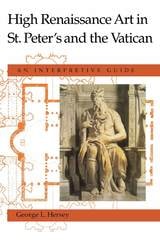
High Renaissance Art in St. Peter's and the Vatican
An Interpretive GuideGeorge L. Hersey
University of Chicago Press, 1993
Before starting the tour of individual works, Hersey describes how the treacherously shifting political and religious alliances of sixteenth-century Italy, France, and Spain played themselves out in the Eternal City. He offers vivid accounts of the lives and personalities of four popes, each a great patron of art and architecture: Julius II, Leo X, Clement VII, and Paul III. He also tells of the complicated rebuilding and expanding of St. Peter's, a project in which Bramante, Raphael, and Michelangelo all took part.
Having set the historical scene, Hersey then explores the Vatican's magnificent Renaissance art and architecture. In separate chapters, organized spatially, he leads the reader through the Cortile del Belvedere and Vatican Museums, with their impressive holdings of statuary and paintings; the richly decorated Stanze and Logge of Raphael; and Michelangelo's Last Judgment and newly cleaned Sistine Chapel ceiling. A fascinating final chapter entitled "The Tragedy of the Tomb" recounts the vicissitudes of Michelangelo's projected funeral monument to Julius II.
Hersey is never content to simply identify the subject of a painting or sculpture. He gives us the story behind the works, telling us what their particular themes signified at the time for the artist, the papacy, and the Church. He also indicates how the art was received by contemporaries and viewed by later generations.
Generously illustrated and complete with a useful chronology, High Renaissance Art in St. Peter's and the Vatican is a valuable reference for any traveler to Rome or lover of Italian art who has yearned for a single-volume work more informative and stimulating than ordinary guidebooks. At the same time, Hersey's many anecdotes and intriguing comparisons with works outside the Vatican will provide new insights even for specialists.
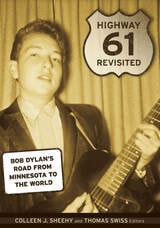
Highway 61 Revisited
Bob Dylan’s Road from Minnesota to the WorldColleen J. Sheehy
University of Minnesota Press, 2009
New essays consider Dylan’s latest work, his Minnesota roots, and his global reach
The young man from Hibbing released Highway 61 Revisited in 1965, and the rest, as they say, is history. Or is it? From his roots in Hibbing, to his rise as a cultural icon in New York, to his prominence on the worldwide stage, Colleen J. Sheehy and Thomas Swiss bring together the most eminent Dylan scholars at work today—as well as people from such far-reaching fields as labor history, African American studies, and Japanese studies—to assess Dylan’s career, influences, and his global impact on music and culture.
The Dylan effect has extended far beyond the United States in recent decades, and the essays here analyze his contribution to the people and cultures of the United Kingdom, Italy, and Japan. With a special focus on his Minnesota roots, including Greil Marcus’s spectacular tour of Dylan’s hometown, authors also take into account his most recent work and Martin Scorsese’s documentary No Direction Home.The first cultural and historical geography of his dramatic rise, storied career, and unmatched iconic status, Highway 61 Revisited maps the terrain of Bob Dylan’s music in the world.Contributors: John Barner, U of Georgia; Daphne Brooks, Princeton U; Court Carney, Stephen F. Austin State U; Alessandro Carrera, U of Houston; Michael Cherlin, U of Minnesota; Marilyn J. Chiat; Susan Clayton; Mick Cochrane, Canisius College; Thomas Crow, New York U; Kevin J. H. Dettmar, Pomona College, Carbondale; Sumanth Gopinath, U of Minnesota; Charles Hughes; C. P. Lee, U of Salford, Manchester, England; Alex Lubet, U of Minnesota; Greil Marcus, U of California, Berkeley; Aldon Lynn Nielsen, Pennsylvania State U; Roberto Polito, The New School; Robert Reginio, Frostburg State U; Heather Stur, U of Southern Mississippi; Mikiko Tachi, Chiba U, Japan; Gayle Wald, George Washington U; Anne Waldman, Naropa U; David Yaffe, Syracuse U.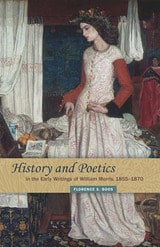
History and Poetics in the Early Writings of William Morris, 1855–1870
Florence S. Boos
The Ohio State University Press, 2015
Boos’s study is the first to utilize surviving original manuscripts, periodical publications, and poems unpublished during Morris’s lifetime. History and Poetics in the Early Writings of William Morris, 1855–1870traces Morris’s literary evolution through his juvenile poems; the essays, poems, and prose romances of the Oxford and CambridgeMagazine; the startlingly original verses of The Defence of Guenevere; and the ten years of experimentation that preceded his two best-known epics, The Life and Deathof Jason and The Earthly Paradise. This book explores the young poet’s successive efforts to find a balancing ethical framework through poetry—a framework that was at once a motivation for action and a template for authentic, shared popular art, one that reemerges forcefully in his later work.
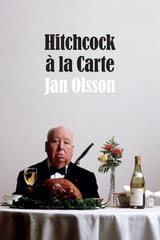
Hitchcock à la Carte
Jan Olsson
Duke University Press, 2015
Hitchcock's People, Places, and Things
John Bruns
Northwestern University Press, 2019
This book offers new readings of well-known Hitchcock films, including The Lodger, Shadow of a Doubt, Psycho, The Birds, and Marnie, as well as insights into lesser-discussed films such as I Confess and Family Plot. Additional close readings of the original theatrical trailer for Psycho and a Hitchcock-directed episode of Alfred Hitchcock Presents expand the Hitchcock landscape beyond conventional critical borders. In tracing the network of relations in Hitchcock’s work, Bruns brings new Hitchcockian tropes to light. For students, scholars, and serious fans, the author promises a thrilling critical navigation of the Hitchcock landscape, with frequent “mental shake-ups” that Hitchcock promised his audience.
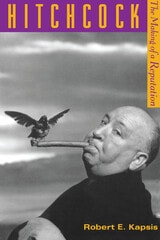
Hitchcock
The Making of a ReputationRobert E. Kapsis
University of Chicago Press, 1992
Through a close examination of Hitchcock's personal papers, scripts, production notes, publicity files, correspondence, and hundreds of British and American reviews, Robert Kapsis here traces Hitchcock's changing critical fortunes. Vertigo, for instance, was considered a flawed film when first released; today it is viewed by many as the signal achievement of a great director. According to Kapsis, this dramatic change occurred because the making of the Hitchcock legend was not solely dependent on the quality of his films. Rather, his elevation to artist was caused by a successful blending of self-promotion, sponsorship by prominent members of the film community, and, most important, changes in critical theory which for the first time allowed for the idea of director as auteur.
Kapsis also examines the careers of several other filmmakers who, like Hitchcock, have managed to cross the line that separates craftsman from artist, and shows how Hitchcock's legacy and reputation shed light on the way contemporary reputations are made. In a chapter about Brian De Palma, the most reknowned thriller director since Hitchcock, Kapsis explores how Hitchcock's legacy has affected contemporary work in—and criticism of—the thriller genre.
Filled with fascinating anecdotes and intriguing excerpts, and augmented by interviews with Hitchcock's associates, this thoroughly documented and engagingly written book will appeal to scholars and film enthusiasts alike.
"Required reading for Hitchcock scholars...scrupulously researched, invaluable material for those who continue to ask: what made the master tick?"—Anthony Perkins
Hitting A Straight Lick with a Crooked Stick
Race and Gender in the Work of Zora Neale HurstonSusan E Meisenhelder
University of Alabama Press, 2001
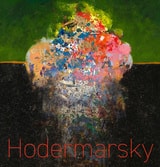
Hodermarsky
Daniel Hodermarsky
The Artist Book Foundation, 2024
Daniel Hodermarsky's work embraces both the representational and the abstract, reflecting the intricate spaces of both his psyche and shared human experience.
Daniel Hodermarsky was the son of Slovak immigrants who emigrated from Hačava to settle and work in the coal fields of Pennsylvania and later in the auto-manufacturing industries of Ohio. He served in World War II on the Western front and was awarded two presidential citations, two Croix de Guerre, and one combat star. He returned home with severe and persistent post-traumatic stress disorder that left an indelible mark on his life and art.
Throughout his career, Hodermarsky’s work embraced both the representational and the abstract. His early works experimented with new media (such as Dayglo paint) and new styles such as Op Art and performance. In the 1970s and beyond, he engaged landscape—rural, urban, and imaginary—wherein he explored the interplay of terrain (land or water, horizon, and sky). The human figure—Slovak farmers, wounded or dismembered soldiers, and mythical and historical figures—were among his favorite subjects. He was fascinated by how age, human nature, and personality combine to create the physical form. His eclectic themes mirror his own unique complexities and experiences. Later in his career, he focused on abstract works that reflect the intricate spaces of both his psyche and shared human experience.
A deeply spiritual man with a strong religious faith, Hodermarsky’s abstract paintings ask the existential questions that have challenged humankind across millennia. By showing us his own experience of these great mysteries, his art underscores life’s abiding beauty. Over his long career of interpreting the world in which he lived, Hodermarsky invites us to inhabit a realm filled with joy, reverence, and passion.
Hollywood Renegade
Elaine May, Mikey and Nicky, and the Making of a MasterpieceTodd Berliner
University of Texas Press, 2026
Examines the career and unorthodox filmmaking practices of director Elaine May, whose Mikey and Nicky, over a span of fifty years, transformed from a fiasco to a masterpiece of seventies cinema.
Elaine May’s Mikey and Nicky stands out in the history of Hollywood. After a troubled production, massive cost overruns, and lawsuits between May and the studio, the film received scathing reviews and failed at the box office. But the very qualities that initially alienated viewers and reviewers led later generations to regard the film as an overlooked masterpiece.
Written and directed by the period’s only female New Hollywood filmmaker, Mikey and Nicky has not received the attention given to other unconventional films of the 1970s. But May worked for years to give each moment of the movie multiple areas of interest. She made every character, even peripheral ones, nuanced and memorable. And she designed every scene, even minor ones, as a performance event. Her lead actors, Peter Falk and John Cassavetes, thrived under her unorthodox directing style, earning acclaim even from reviewers who hated the movie. Decades in the making—years of scriptwriting, a shoot that spanned ten months, and three years spent editing—Mikey and Nicky shows us what Hollywood cinema can accomplish when talented filmmakers challenge Hollywood’s limited notion of professionalism, rejecting the harsh time pressures of commercial filmmaking in order to get the most out of every scene.
Homer and the Dual Model of the Tragic
Yoav Rinon
University of Michigan Press, 2008
Homosexual Desire in Shakespeare's England
A Cultural PoeticsBruce R. Smith
University of Chicago Press, 1994
"The best single analysis of the homoerotic element in Renaissance English literature."—Keith Thomas, New York Review of Books
"Smith's lucid and subtle book offer[s] a poetics of homosexual desire. . . . Its scholarship, impressively broad and deftly deployed, aims to further a serious social purpose: the redemptive location of homosexual desire in history and the recuperation for our own time, through an understanding of its discursive embodiments, of that desire's changing imperatives and parameters."—Terence Hawkes, Times Literary Supplement
"The great strength of Bruce Smith's book is that it does not sidestep the complex challenge of engaging in the sexual politics of the present while attending to the resistant discourses and practices of Renaissance England. Homosexual Desire in Shakespeare's England demonstrates how a commitment to the present opens up our understanding of the past."—Peter Stallybrass, Shakespeare Quarterly
"A major contribution to the understanding of homosexuality in Renaissance England and by far the best and most comprehensive account yet offered of the homoeroticism that suffuses Renaissance literature."—Claude J. Summers, Journal of Homosexuality
Horace Vernet and the Thresholds of Nineteenth-Century Visual Culture
Edited by Daniel Harkett and Katie Hornstein
Dartmouth College Press, 2017
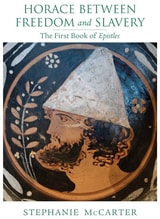
Horace between Freedom and Slavery
The First Book of <i>Epistles</i>Stephanie McCarter
University of Wisconsin Press, 2015
She argues that, although Horace commences the Epistles with an uncompromising insistence on freedom, he ultimately adopts a middle course. She shows how Horace explores in the poems the application of moderate freedom first to philosophy, then to friendship, poetry, and place. Rather than rejecting philosophical masters, Horace draws freely on them without swearing permanent allegiance to any—a model for compromise that allows him to enjoy poetic
renown and friendships with the city's elite while maintaining a private sphere of freedom. This moderation and adaptability, McCarter contends, become the chief ethical lessons that Horace learns for himself and teaches to others. She reads Horace's reconfiguration of freedom as a political response to the transformations of the new imperial age.
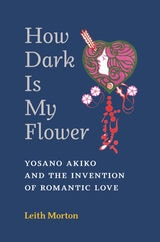
How Dark Is My Flower
Yosano Akiko and the Invention of Romantic LoveLeith Morton
University of Michigan Press, 2023
How Dark Is My Flower emphasizes the astonishing innovations in diction and style, not to mention content, in Akiko’s work that transformed the tanka genre from a hidebound and conservative mode of verse to something much more daring and modern. This book pays particular attention to poetry, particularly the tanka genre, in the evolution of modernism in Japanese literature and breaks new ground in the study of modern Japanese literature by examining the invention and evolution of the concept of romantic love.
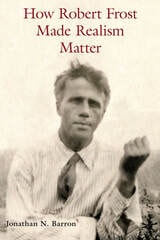
How Robert Frost Made Realism Matter
Jonathan N. Barron
University of Missouri Press, 2015
Robert Frost stood at the intersection of nineteenth-century romanticism and twentieth-century modernism and made both his own. Frost adapted the genteel values and techniques of nineteenth-century poetry, but Barron argues that it was his commitment to realism that gave him popular as well as scholarly appeal and created his enduring legacy. This highly researched consideration of Frost investigates early innovative poetry that was published in popular magazines from 1894 to 1915 and reveals a voice of dissent that anticipated “The New Poetry” – a voice that would come to dominate American poetry as few others have.
How Russia Learned to Write
Literature and the Imperial Table of RanksIrina Reyfman
University of Wisconsin Press, 2021
Irina Reyfman illuminates the surprisingly diverse effects of the Table of Ranks on writers, their work, and literary culture in Russia. From Sumarokov and Derzhavin in the eighteenth century through Pushkin, Gogol, Dostoevsky, and poets serving in the military in the nineteenth, state service affected the self-images of writers and the themes of their creative output. Reyfman also notes its effects on Russia’s atypical course in the professionalization and social status of literary work.
How Sondheim Found His Sound
Steve Swayne
University of Michigan Press, 2010
---Richard Crawford, author of America's Musical Life: A History
"Sondheim's career and music have never been so skillfully dissected, examined, and put in context. With its focus on his work as composer, this book is surprising and welcome."
---Theodore S. Chapin, President and Executive Director, The Rodgers & Hammerstein Organization
"What a fascinating book, full of insights large and small. An impressive analysis and summary of Sondheim's many sources of inspiration. All fans of the composer and lovers of Broadway in general will treasure and frequently refer to Swayne's work."
---Tom Riis, Joseph Negler Professor of Musicology and Director of the American Music Research Center, University of Colorado
Stephen Sondheim has made it clear that he considers himself a "playwright in song." How he arrived at this unique appellation is the subject of How Sondheim Found His Sound---an absorbing study of the multitudinous influences on Sondheim's work.
Taking Sondheim's own comments and music as a starting point, author Steve Swayne offers a biography of the artist's style, pulling aside the curtain on Sondheim's creative universe to reveal the many influences---from classical music to theater to film---that have established Sondheim as one of the greatest dramatic composers of the twentieth century.
Sondheim has spoken often and freely about the music, theater, and films he likes, and on occasion has made explicit references to how past works crop up in his own work. He has also freely acknowledged his eclecticism, seeing in it neither a curse nor a blessing but a fact of his creative life.
Among the many forces influencing his work, Sondheim has readily pointed to a wide field: classical music from 1850 to 1950; the songs of Tin Pan Alley, Broadway, and Hollywood; the theatrical innovations of Oscar Hammerstein II and his collaborators; the cinematic elements found in certain film schools; and the melodramatic style of particular plays and films. Ultimately, Sondheim found his sound by amalgamating these seemingly disparate components into his unique patois.
How Sondheim Found His Sound is the first book to provide an overview of his style and one of only a few to account for these various components, how they appear in Sondheim's work, and how they affect his musical and dramatic choices.
How We Became Human
Mimetic Theory and the Science of Evolutionary OriginsPierpaolo Antonello
Michigan State University Press, 2015