Results by title
1832 books match the query 'Essays' and 52 start with h
HUMANS AND OTHER ANIMALS
Edited by Arien Mack with a foreword by Marc Bekoff
The Ohio State University Press, 1999
In 1995 the New School for Social Research sponsored a landmark conference to explore human/animal interactions. Published as a special issue of the journal Social Research (under the title In the Company of Animals), this collection is now available for the first time in a book edition.
Habitations of Modernity
Essays in the Wake of Subaltern StudiesDipesh Chakrabarty
University of Chicago Press, 2002
Chakrabarty pursues these issues in a series of closely linked essays, ranging from a history of the influential Indian series Subaltern Studies to examinations of specific cultural practices in modern India, such as the use of khadi—Gandhian style of dress—by male politicians and the politics of civic consciousness in public spaces. He concludes with considerations of the ethical dilemmas that arise when one writes on behalf of social justice projects.
Hack
Stories from a Chicago CabDmitry Samarov
University of Chicago Press, 2011
An artist and painter trained at the School of the Art Institute of Chicago, Samarov began driving a cab in 1993 to make ends meet, and he’s been working as a taxi driver ever since. In Hack: Stories from a Chicago Cab, he recounts tales that will delight, surprise, and sometimes shock the most seasoned urbanite. We follow Samarov through the rhythms of a typical week, as he waits hours at the garage to pick up a shift, ferries comically drunken passengers between bars, delivers prostitutes to their johns, and inadvertently observes drug deals. There are long waits with other cabbies at O’Hare, vivid portraits of street corners and their regular denizens, amorous Cubs fans celebrating after a game at Wrigley Field, and customers who are pleasantly surprised that Samarov is white—and tell him so. Throughout, Samarov’s own drawings—of his fares, of the taxi garage, and of a variety of Chicago street scenes—accompany his stories. In the grand tradition of Nelson Algren, Saul Bellow, Mike Royko, and Studs Terkel, Dmitry Samarov has rendered an entertaining, poignant, and unforgettable vision of Chicago and its people.
Half Wild
People, Dogs, and Environmental PolicyDave Dempsey
Michigan State University Press, 2023

Hard Science Fiction
George E Slusser
Southern Illinois University Press, 1986
These 16 essays from the fifth annual J.Lloyd Eaton Conference at the University of California, Riverside, seek to come to grips with science fiction’s core, the core at which “science must ultimately seem to outweigh the fiction.”
Never before has hard SF been the topic of such extended discussion by such qualified people. The dialogue constitutes new (and potentially shocking to a traditional literary critic) modes of literary criticism, modes that take into account the impact of scientific speculation and method on our culture and on the ways our culture invents stories and myths.
Essayists include writer/scientist professors Robert L. Forward, David Brin, and Gregory Benford. Noted critics and writers with scientific backgrounds or interests include: James Gunn, Frank McConnell, George Guffey, John Huntington, Paul Carter, Patricia Warrick, Paul Alkon, Robert M. Philmus, David Clayton, Eric S. Rabkin, Herbert Sussman, Michael Collings, and George E. Slusser.
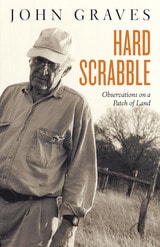
Hard Scrabble
Observations on a Patch of LandBy John Graves<br>Introduction by Rick Bass
University of Texas Press, 2016
“A kind of homemade book—imperfect like a handmade thing, a prize. It’s a galloping, spontaneous book, on occasion within whooping distance of that greatest and sweetest of country books, Ivan Turgenev’s A Sportsman’s Notebook.” —Edward Hoagland, New York Times Book Review
“His subjects are trees and brush, hired help, fences, soil, armadillos and other wildlife, flood and drought, local history, sheep and goats . . . and they come to us reshaped and reenlivened by his agreeably individual (and sometimes cranky) notions.” —New Yorker
“If Goodbye to a River was in some sense Graves’s Odyssey, this book is his [version of Hesiod’s] Works and Days. It is partly a book about work, partly a book about nature, but mostly a book about belonging. In the end John Graves has learned to belong to his patch of land so thoroughly that at moments he can sense in himself a unity with medieval peasants and Sumerian farmers, working with their fields by the Tigris.” —Larry McMurtry, Washington Post Book World
“Hard Scrabble is hard pastoral of the kind we have learned to recognize in Wordsworth, Frost, Hemingway, and Faulkner. It celebrates life in accommodation with a piece of the ‘given’ creation, a recalcitrant four hundred or so acres of Texas cedar brake, old field, and creek bottom, which will require of any genuine resident all the character he can muster.” —Southwest Review
Hard-to-Measure Goods and Services
Essays in Honor of Zvi GrilichesEdited by Ernst E. Berndt and Charles R. Hulten
University of Chicago Press, 2007
The celebrated economist Zvi Griliches’s entire career can be viewed as an attempt to advance the cause of accuracy in economic measurement. His interest in the causes and consequences of technical progress led to his pathbreaking work on price hedonics, now the principal analytical technique available to account for changes in product quality.
Hard-to-Measure Goods and Services, a collection of papers from an NBER conference held in Griliches’s honor, is a tribute to his many contributions to current economic thought. Here, leading scholars of economic measurement address issues in the areas of productivity, price hedonics, capital measurement, diffusion of new technologies, and output and price measurement in “hard-to-measure” sectors of the economy. Furthering Griliches’s vital work that changed the way economists think about the U.S. National Income and Product Accounts, this volume is essential for all those interested in the labor market, economic growth, production, and real output.
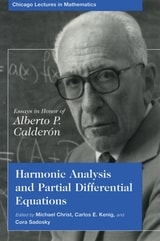
Harmonic Analysis and Partial Differential Equations
Essays in Honor of Alberto P. CalderonEdited by Michael Christ, Carlos E. Kenig, and Cora Sadosky
University of Chicago Press, 1999
In 1996, more than 300 mathematicians from around the world gathered in Chicago for a conference on harmonic analysis and partial differential equations held in Calderón's honor. This volume originated in papers given there and presents timely syntheses of several major fields of mathematics as well as original research articles contributed by some of the finest scholars working in these areas. An important addition to the literature, this book is essential reading for researchers in these and other related fields.
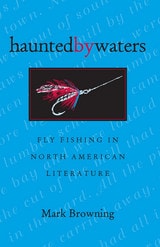
Haunted By Waters
Fly Fishing In North American LiteratureMark Browning
Ohio University Press, 1998
As his own story unfolds, Mark Browning analyzes angling literature from the Bible to Norman Maclean, always bringing his inquiry back to the same source: the enigma of this sport.
Haunted by Waters is an exploration of the apparent compulsion of those who fish not only to read about the sport, but to write about it as well. Mark Browning's personal account as a fly fisherman and his perspective as a critic make him uniquely qualified to navigate these waters.
He Heru. A Comb
An Ornament for the Most Sacred Part of the BodyWhiti Hereaka
Diaphanes, 2026
Drawing inspiration from a seemingly simple comb, or heru, this new text by Whiti Heraka comes in nine sections, “a part for each tooth, and a part for each space between them.” The parts tell stories of love, loss, and longing: tales of whales whose bones were used to make objects, of a carver creating a comb, of Maori gods and the power of women, of colonial whalers fishing their prey almost to extinction in the South Pacific, of a writer who cuts her hair and moves across worlds, weaving connections. Hereaka unfurls a stunning cosmology around the heru, combing with it through time and space to make “stories of ocean blue, blood red, bone white.”
Healing to All Their Flesh
Jewish and Christian Perspectives on Spirituality, Theology, and HealthJeff Levin
Templeton Press, 2012
The editors of this collection, Drs. Jeff Levin and Keith G. Meador, have gathered together the writings of leading Jewish and Christian theological, pastoral, ethical, and religious scholars to answer these important questions. Contributors include Richard Address, William Cutter, Elliot N. Dorff, Dayle A. Friedman, Stanley Hauerwas, Warren Kinghorn, M. Therese Lysaught, Stephen G. Post, John Swinton, and Simkha Y. Weintraub, with a foreword by Samuel E. Karff.
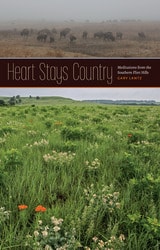
Heart Stays Country
Meditations from the Southern Flint HillsGary Lantz
University of Iowa Press, 2017
As proud grasslanders know, the prairie is biologically fulfilling, unique, and increasingly rare: biologists from the National Park Service and the Nature Conservancy agree that a healthy prairie remains one of the most ecologically diverse and dynamic ecosystems on this planet—as well as one of the rarest left on earth. This landscape that once inspired rapturous exclamations from travelers headed west on horseback now mostly exists in fragments exiled from each other by cropland, cities, and interstate highways.
Historically, tallgrass prairie stretched from Canada to Texas, from central Kansas to Indiana. Now the last major expanse of tallgrass occurs in the Flint Hills, a verdant landscape extending in a north-south strip across eastern Kansas and into northern Oklahoma’s Osage County. In these essays, Gary Lantz brings the beautiful diversity of the prairie home to all of us.
Henry van de Velde
Selected Essays, 1889–1914Henry van de Velde
J. Paul Getty Trust, The, 2022
Belgian artist, architect, designer, and theorist Henry van de Velde (1863–1957) was a highly original and influential figure in Europe beginning in the 1890s. A founding member of the Art Nouveau and Jugendstil movements, he also directed the Grand-Ducal Saxon School of Arts and Crafts in Weimar, Germany, which eventually became the Bauhaus under Walter Gropius.
This selection of twenty-six essays, translated from French and German, includes van de Velde’s writings on William Morris and the English Arts and Crafts movement, Neo-Impressionist painting, and relationships between ornament, line, and abstraction in German aesthetics. The texts trace the evolution of van de Velde’s thoughts during his most productive period as a theorist in the artistic debates in France, Germany, Belgium, and the Netherlands. Katherine M. Kuenzli expertly guides readers to see how van de Velde’s writings reconcile themes of aesthetics and function, and expression and reason, throughout the artistic periods and regions represented by these texts. With introductory discussions of each essay and full annotations, this is an essential volume for a broad range of scholars and students of the history of fine and applied arts and ideas.
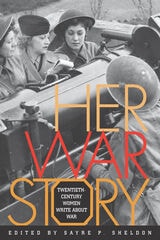
Her War Story
Twentieth-Century Women Write About WarEdited by Sayre P. Sheldon
Southern Illinois University Press, 1999
Sayre P. Sheldon chose the twentieth century for this collection of women's war writing because women's roles in war have changed dramatically in this century. The twentieth century has redefined the meaning of combat and expanded the territory of war to include women in larger numbers than ever before. When the technological advances of modern war began to target civilians, the home front became the front line. Women took an active part in war whether or not by choice, often by moving into occupations previously closed to them. Women covered wars for their newspapers, wrote war propaganda for their governments, published their wartime diaries, described fighting alongside men, and used wartime experience for their fiction and poetry.
Women writers also chose the right to imagine war, just as men for centuries had written about war without actually experiencing it. Women writers anthologized here include Anna Akhmatova, Vera Brittain, Gwendolyn Brooks, Willa Cather, Colette, Martha Gellhorn, H.D., Etty Hillesum, Käthe Kollwitz, Doris Lessing, Amy Lowell, Katherine Mansfield, Mary McCarthy, Toni Morrison, Dorothy Parker, Mary Lee Settle, Gertrude Stein, Huong Tram, Edith Wharton, Virginia Woolf, and Mitsuye Yamada.
Heracles' Bow
Essays On The Rhetoric & Poetics Of The LawJames B. White
University of Wisconsin Press, 1989
White’s essays, though bound by a common perspective, are thematically varied. Each of these pieces makes eloquent and insightful reading. Taken as a whole, they establish, by triangulation, a position from which they all proceed: a view of poetry, law, and rhetoric as essentially synonymous. Only when we perceive the links between these processes, White stresses, can we begin to unite the concerns of truth, beauty, and justice in a single field of action and expression.
Here is Where I Walk
Episodes From a Life in the ForestLeslie Carol Roberts
University of Nevada Press, 2019
In layered stories of her life and travels, Leslie turns her daily walks into revelations of deeper meaning. From Maryland to Iowa to Tasmania, we follow a fierce and keenly observant walker through places of exquisite beauty and complexity. Her daily walks inspire Leslie to accept the invitation of the beckoning trees where she finds herself colliding with the urban coyote, the peculiar banana slug, and the manzanita. She also notes both ridiculous and poignant aspects of human ecosystems in pursuit of what it means to live a life of creativity and creation from scientist-activists battling to save environments to the tragic realities of ordinary life.
In this finely crafted eco-memoir, each place provides Leslie with exactly the scaffolding needed to survive, with nature serving as the tonic. Here is Where I Walk provides a vivid answer to how we can find our place, not only in nature but within ourselves and the world we walk.
Here on Lake Hallie
In Praise of Barflies, Fix-It Guys, and Other Folks in Our HometownPatti See
Wisconsin Historical Society Press, 2022
Growing up in the 1970s and 1980s as the youngest of eight children, Patti never imagined she’d stay in Chippewa Falls as an adult. Now, living on rural Lake Hallie just five miles from her childhood home, she has a new appreciation for all that comes with country living, from ice fishing and eagle sightings to pontoon rides and tavern dice. These brief essays—many of which were originally published in the Sawdust Stories column of the Eau Claire Leader-Telegram—establish that, above all else, it’s friends, family, and other folks in our hometown who provide us with a sense of belonging.
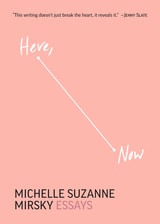
Here, Now
EssaysMichelle Suzanne Mirsky
Northwestern University Press, 2025
A deeply felt and humorous collection examining a year in the wake of extraordinary loss
In November 2010, on the morning after election day, Mirsky lost her three-year-old son, Lev. In the year that followed, she produced a profound and provocatively humorous body of work—tackling extreme loss as well as divorce, friendship, dating, sex, comedy, and art making, all while continuing her day job as a family liaison at the same children’s hospital where Lev died. Every November, the anniversary of Lev’s loss aligns with the churn of the election cycle.
A decade later, we find Mirsky in the heart of a different crisis: supervising COVID vaccine distribution in the polarized political climate of Austin, Texas. In “An Addendum,” she turns again to themes of grief and healing, this time on a societal scale, as she reckons with the tenth anniversary of Lev’s passing. Through her un-extraordinary story of extraordinary loss, Mirsky offers proof that there is an afterward to grief.
Hewing to Experience
Essays and Reviews on Recent American Poetry and Poetics, Nature and CultureSherman Paul
University of Iowa Press, 1989
Hieroglyphs of Another World
On Poetry, Swedenborg, and Other MattersIlya Kutik
Northwestern University Press, 2000
Higher Education and Democracy
Essays on Service-Learning and Civic EngagementEdited by John Saltmarsh and Edward Zlotkowski
Temple University Press, 2011
Higher Education and Democracy is a collection of essays written over the last ten years on how civic engagement in higher education works to achieve what authors John Saltmarsh and Edward Zlotkowsi consider to be the academic and civic purposes of higher education. These include creating new modes of teaching and learning, fostering participation in American democracy, the development and respect for community and civic institutions, and encouraging the constant renewal all of these dimensions of American life.
Organized chronologically, the twenty-two essays in this volume provide "signposts" along the road in the journey of fulfilling the civic purposes of higher education. For the authors, service-learning is positioned as centrally important to the primary academic systems and structures of higher education, departments, disciplines, curriculum, and programs that are central to the faculty domain. Progressing from the general and the contextual to specific practices embodied in ever larger academic units, the authors conclude with observations on the future of the civic engagement movement.
Hijacked Brains
The Experience and Science of Chronic AddictionHenrietta Robin Barnes
Dartmouth College Press, 2015
Historicity of Nature
Essays on Science and TheologyWolfhart Pannenberg
Templeton Press, 2008
Known as one of the most outstanding theologians of the twentieth century, Wolfhart Pannenberg is also considered a great interdisciplinary thinker. Now, essays and articles on science and theology that are central to understanding Pannenberg's theories have been collected into one volume.
Niels Henrik Gregersen, a former student of Pannenberg and now professor of systematic theology at Copenhagen University, has compiled the writings in four sections: Methodology, Creation and Nature's Historicity, Religion and Anthropology, and Meaning and Metaphysics. Included in this volume are:
•Translations of Pannenberg's principled argument for the consonance between science and religion, including contingency and laws of nature, field theories and space-time, and divine action•Translations of Pannenberg's theory of theology as a rational hypothetical science, including his discussions with leading British and American scholars such as A. N. Whitehead, John Cobb, and Langdon Gilkey
•Previously unpublished articles on the problems between science and theology in the course of modern history, explaining why chance may be more important for theology than design
•Translations of seminal articles that articulate Pannenberg's understanding of the role of religion in human nature
•One of the few theological articles on aggression as a psychological and social phenomenon
With this collection, the essays of this important contemporary theologian and his illuminating views are presented in one convenient volume.
History Is Embarrassing
Karen Chase
CavanKerry Press, 2024
Filled with profound reflections and snapshots from the past, Karen Chase’s History is Embarrassing weaves together threads from one single life—a girl suffering from polio, a poet, a Jewish woman, a writer, and a painter. Like Chase, the characters who populate these essays are outsiders—undercover cops, a gay couple in 1500s India, bear poachers, psychiatric patients, and even a president—each a meaningful part of history. Divided into three parts—histories, pleasures, and horrors—History is Embarrassing is an assortment of thought-provoking essays that are sure to resonate with many readers.

History and Philosophy of Modern Mathematics
Volume XIWilliam Aspray and Philip Kitcher, Editors
University of Minnesota Press, 1988
History and Philosophy of Modern Mathematics was first published in 1988. Minnesota Archive Editions uses digital technology to make long-unavailable books once again accessible, and are published unaltered from the original University of Minnesota Press editions.
The fourteen essays in this volume build on the pioneering effort of Garrett Birkhoff, professor of mathematics at Harvard University, who in 1974 organized a conference of mathematicians and historians of modern mathematics to examine how the two disciplines approach the history of mathematics. In History and Philosophy of Modern Mathematics, William Aspray and Philip Kitcher bring together distinguished scholars from mathematics, history, and philosophy to assess the current state of the field. Their essays, which grow out of a 1985 conference at the University of Minnesota, develop the basic premise that mathematical thought needs to be studied from an interdisciplinary perspective.
The opening essays study issues arising within logic and the foundations of mathematics, a traditional area of interest to historians and philosophers. The second section examines issues in the history of mathematics within the framework of established historical periods and questions. Next come case studies that illustrate the power of an interdisciplinary approach to the study of mathematics. The collection closes with a look at mathematics from a sociohistorical perspective, including the way institutions affect what constitutes mathematical knowledge.
History and the Social Web
A Collection of EssaysAugust C. Krey
University of Minnesota Press, 1955
History and the Social Web was first published in 1955. Minnesota Archive Editions uses digital technology to make long-unavailable books once again accessible, and are published unaltered from the original University of Minnesota Press editions.
In this volume of twelve essays a distinguished historian demonstrates that the roots and branches of history form a continuous social web, that the events and societies of pasts eras and modern times form a complex and interlocking pattern when seen as a whole, and that a knowledge of history has a profound application to the problems and pleasures of the present. The volume includes the well-known essay, "A City That Art Built," which has long been out of print. The first group of essays is devoted to aspects of medieval and renaissance history, and those in the second section point up the continuity of the thread of world history. The essays on law, education, and medicine which form a part of the first section will be of particular interest to members of these professions.
Holdfast
At Home in the Natural WorldKathleen Dean Moore
Oregon State University Press, 2013
Naturalist and philosopher Kathleen Dean Moore meditates on connection and separation in these twenty-one elegant, probing essays. Using the metaphor of holdfasts—the structures that attach seaweed to rocks with a grip strong enough to withstand winter gales—she examines our connections to our own bedrock.
“When people lock themselves in their houses at night and seal the windows shut to keep out storms, it is possible to forget, sometimes for years and years, that human beings are part of the natural world,” she writes. Holdfast passionately reclaims an awareness of the natural world, exploring the sense of belonging fostered by the communal howls of wolves; the inevitability of losing children to their own lives; the fear of bears and love of storms; the sublimity of life and longing in the creatures of the sea; her agonizing decision when facing her father’s bone-deep pain. As Moore travels philosophically and geographically—from Oregon’s shores to Alaska’s islands—she leaves no doubt of her virtuosity and range.
The new afterword is an important statement on the new responsibilities of nature writers as the world faces the consequences of climate change.
Hollywood Notebook
EssaysWendy C. Ortiz
Northwestern University Press, 2025
A daylight traipse through early-aughts Los Angeles, Hollywood Notebook encapsulates the powerful feelings and hopeful futures of twentysomething Wendy C. Ortiz. In this boundary-defying sister memoir to Bruja, Ortiz navigates internal maps as she traverses external palm-treed streets, moving through her youthful twenties and into the pensiveness of her thirties. Peering at what lies ahead while dipping her toes into the past, Ortiz shows us that there is no place like Hollywood to unearth the joys of success and the blows of mistakes—both realized and denied. An innovative and bold examination of the daytime roaming mind, Hollywood Notebook is a cartography of love, loss, and transformation in the face of a brilliant psyche in a vibrant city.
Homing Instincts
Dionisia Morales
Oregon State University Press, 2018
Although Morales migrated from one North American coast to another, the questions she raises are relevant to migrations of any scale and place, whether across town or around the world. What does it mean to be a newcomer? Who has the right to claim a sense of place? What is gained or lost when we try to fit in? In a world where people are migrating more than ever for social, economic, personal, and political reasons, these questions take on a new urgency.
A wife and mother as well as a professional writer and editor, Morales writes with grace and resolve about a broad range of topics, including pregnancy, people watching, rock climbing, and bee colony collapse. She channels a spirit of adventure and adaptability while acknowledging how certain habits and mindsets are indelibly ingrained and are—like it or not—forever part of where, what, and who we call home.
As issues of migration and social integration play out in national and international politics, Morales provides a personal lens through which readers can appreciate that at one time or another we have all been in the process of arriving. Homing Instincts is a remarkable debut from a gifted prose stylist. It will be warmly received by lovers of the essay form and anyone who has sought, or still seeks, a place to call home.
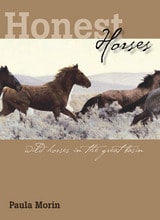
Honest Horses
Wild Horses In The Great BasinPaula Morin
University of Nevada Press, 2006
Horses have been part of the American West since the first Spanish explorers brought their European-bred steeds onto the new continent. Soon thereafter, some of these animals, lost or abandoned by their owners or captured by indigenous peoples, became the foundation of the great herds of mustangs (from the Spanish mesteño, stray) that still roam the West. These feral horses are inextricably intertwined with the culture, economy, and mythology of the West. The current situation of the mustangs as vigorous competitors for the scanty resources of the West’s drought-parched rangelands has put them at the center of passionate controversies about their purpose, place, and future on the open range. Photographer/oral historian Paula Morin has interviewed sixty-two people who know these horses best: ranchers, horse breeders and trainers, Native Americans, veterinarians, wild horse advocates, mustangers, range scientists, cowboy poets, western historians, wildlife experts, animal behaviorists, and agents of the federal Bureau of Land Management. The result is the most comprehensive, impartial examination yet of the history and impact of wild mustangs in the Great Basin. Morin elicits from her interviewees a range of expertise, insight, and candid opinion about the nature of horses, ranching, and the western environment. Honest Horses brings us the voices of authentic westerners, people who live intimately with horses and the land, who share their experiences and love of the mustangs, and who understand how precariously all life exists in Great Basin.
Hooked on Oregon
Tales of Life, Death, and FishingEben Pindyck
Oregon State University Press, 2027
Far from your average fishing book, Hooked on Oregon invites readers to visit unexpected places—behind prison walls, inside a bait factory, deep in a forbidden forest, up a mountain, and around a desert oasis—while introducing a troop of unforgettable fishing buddies. A German orphan adopted by an American war hero, a parolee busted for fishing without a license, and a Marine veteran, among others, help show what life looks like through the eyes of an inveterate angler.
Fishing stories in Oregon have never been greater than those told by Eben Pindyck. Whether casting a line on the Columbia River or visiting Herman the Sturgeon at the State Fair, there’s a real-life tale to capture the interest and fancy of anyone in search of a good story. These funny, honest, and elucidative essays take you to lakes, streams, and waterways throughout the state—and far beyond the anecdote about the one that got away.
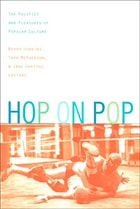
Hop on Pop
The Politics and Pleasures of Popular CultureHenry Jenkins, Tara McPherson and Jane Shattuc, eds.
Duke University Press, 2003
The essays cover a wide and colorful array of subjects including pro wrestling, the computer games Myst and Doom, soap operas, baseball card collecting, the Tour de France, karaoke, lesbian desire in the Wizard of Oz, Internet fandom for the series Babylon 5, and the stress-management industry. Broader themes examined include the origins of popular culture, the aesthetics and politics of performance, and the social and cultural processes by which objects and practices are deemed tasteful or tasteless. The commitment that binds the contributors is to an emergent perspective in cultural studies, one that engages with popular culture as the culture that "sticks to the skin," that becomes so much a part of us that it becomes increasingly difficult to examine it from a distance. By refusing to deny or rationalize their own often contradictory identifications with popular culture, the contributors ensure that the volume as a whole reflects the immediacy and vibrancy of its objects of study.
Hop on Pop will appeal to those engaged in the study of popular culture, American studies, cultural studies, cinema and visual studies, as well as to the general educated reader.
Contributors. John Bloom, Gerry Bloustein, Aniko Bodroghkozy, Diane Brooks, Peter Chvany, Elana Crane, Alexander Doty, Rob Drew, Stephen Duncombe, Nick Evans, Eric Freedman, Joy Fuqua, Tony Grajeda, Katherine Green, John Hartley, Heather Hendershot, Henry Jenkins, Eithne Johnson, Louis Kaplan, Maria Koundoura, Sharon Mazer, Anna McCarthy, Tara McPherson, Angela Ndalianis, Edward O’Neill, Catherine Palmer, Roberta Pearson, Elayne Rapping, Eric Schaefer, Jane Shattuc, Greg Smith, Ellen Strain, Matthew Tinkhom, William Uricchio, Amy Villarego, Robyn Warhol, Charles Weigl, Alan Wexelblat, Pamela Robertson Wojcik, Nabeel Zuberi
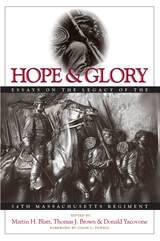
Hope and Glory
Essays on the Legacy of the 54th Massachusetts RegimentMartin H. Blatt
University of Massachusetts Press, 2009
The monument by Augustus Saint-Gaudens to Robert Gould Shaw and the 54th Massachusetts Regiment, located on Boston Common, stands at a symbolic crossroads of American history. A reminder of the nation's ongoing struggle over race, it captures the Civil War's higher purpose—the end of slavery—and memorializes those black soldiers and white officers who made common cause in the service of freedom. The monument and the saga of the 54 th Massachusetts remain powerful touchstones, inspiring enduring meditations such as Robert Lowell's poem “For the Union Dead” and the popular film Glory.
This volume brings together the best scholarship on the history of the 54th, the formation of collective memory and identity, and the ways Americans have responded to the story of the regiment and the Saint-Gaudens monument. Contributors use the historical record and popular remembrance of the 54th as a lens for examining race and community in the United States. The essays range in time from the mid-nineteenth century to the present and encompass history, literature, art, music, and popular culture.
In addition to the editors and Colin Powell, who writes about the memory and example of the 54th in his own career, contributors include Stephen Belyea, David W. Blight, Thomas Cripps, Kathryn Greenthal, James Oliver Horton, Edwin S. Redkey, Marilyn Richardson, Kirk Savage, James Smethurst, Cathy Stanton, Helen Vendler, Denise Von Glahn, and Joan Waugh.
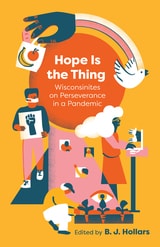
Hope is the Thing
Wisconsinites on Perseverance in a PandemicB. J. Hollars
Wisconsin Historical Society Press, 2021
As the one hundred essays and poems gathered here demonstrate, hope comes in many forms: a dad dance, a birth plan, an unblemished banana, a visit from a neighborhood dog, the revival of an old tradition, empathy. The contributors are racially, geographically, and culturally diverse, representing a rough cross section of Wisconsin voices, from truck driver to poet laureate, from middle school student to octogenarian, from small business owner to seasoned writer. The result is a book-length exploration of the depth and range of hope experienced in times of crisis, as well as an important record of what Wisconsinites were facing and feeling through these historic times.
Hope, Trust, and Forgiveness
Essays in FinitudeJohn T. Lysaker
University of Chicago Press, 2023
As ethical beings, we strive for lives that are meaningful and praiseworthy. But we are finite. We do not know, so we hope. We need, so we trust. We err, so we forgive. In this book, philosopher John T. Lysaker draws our attention to the ways in which these three capacities—hope, trust, and forgiveness—contend with human limits. Each experience is vital to human flourishing, yet each also poses significant personal and institutional challenges as well as opportunities for growth. Hope, Trust, and Forgiveness explores these challenges and opportunities and proposes ways to best meet them. In so doing, Lysaker experiments with the essay as a form and advances an improvisational perfectionism to deepen and expand our ethical horizons.
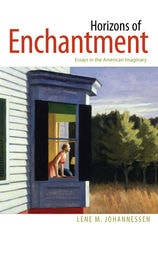
Horizons of Enchantment
Essays in the American ImaginaryLene M. Johannessen
Dartmouth College Press, 2011
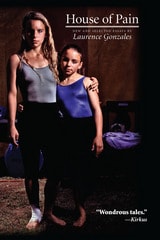
House of Pain
New and Selected EssaysLaurence Gonzales
University of Arkansas Press, 2013
Laurence Gonzales began his successful publishing career in 1989 with the publication of The Still Point and later The Hero’s Apprentice (1994), both with the University of Arkansas Press. From these collections of essays he went on to write for renowned magazines in addition to publishing several books, including the best selling Deep Survival. His journalism garnered two National Magazine Awards, and his latest nonfiction book, Surviving Survival, was named by Kirkus as one of the best books of 2012.
This new collection of essays shows us the sometimes hair-raising, sometimes heart-wrenching writing that Gonzales has become known for. This “compelling and trustworthy guide” (Booklist) takes us from a maximum-security prison to a cancer ward, from a mental institution to the World Trade Center. Among the essays included is “Marion Prison,” a National Magazine Award finalist, with its intimate view inside the most maximum security prison in America. “House of Pain” takes the reader into the life of a brain surgeon at Chicago’s Cook County Hospital, a grim world that few ever see. “Rites of Spring,” another National Magazine Award finalist, follows Gonzales and his wife on their journey through cancer, not once, but twice.
Other stories venture above the Arctic Circle, flying deep into the Alaskan wilderness among grizzly bears and trumpeter swans; explore aerobatics in high-performance aircraft; and eulogize Memphis and Miami as American cities that mourn their fates in uniquely different ways.
How I Married Michele
and Other Journeys, EssaysGary Gildner
BkMk Press, 2021
Essays from this collection have appeared in such venues as the New York Times Magazine, The Southern Review, and New Letters.
How Large Is God
The Voices of Scientists and TheologiansJohn Marks Templeton
Templeton Press, 1998
This new collection of essays reveals how very little we know about God and fundamental spiritual principles. In recent years, scientific research has revealed that the universe is staggering in size and intricacy, and some scientists are now suggesting that our definition of God is much too small. Nine distinguished scholars and scientists present their varied views on the dimensions of God.
Edited by philanthropist John Marks Templeton, this fascinating and challenging book continues the exploration of theological and philosophical implications of the momentous and accelerating scientific discoveries of our times.
How Long Have You Been With Us?
Essays on PoetryKhaled Mattawa
University of Michigan Press, 2016
A volume in the Poets on Poetry series, which collects critical works by contemporary poets, gathering together the articles, interviews, and book reviews by which they have articulated the poetics of a new generation.
“Like the myriad companions and comrades that he summons from their exile, Khaled Mattawa is himself a ‘poet-stranger.’ In the essays, ‘written in a poet’s prose,’ collected in How Long Have You Been With Us, Mattawa evokes a powerful amalgam of the personal intimacy of the solitary and the political challenge of solidarity.”
—Barbara Harlow, University of Texas at Austin
“If you’ve read about exile, you’ve read about Brodsky and Milosz—just as, if you’ve read about translation, you’ve read about Walter Benjamin and George Steiner. While Khaled Mattawa has mastered these masters, his essays about world literature serve as a tour of the rest of the world. He introduces you to the writers you haven’t heard of but should from contemporary Libya and colonial South Asia to Latin America and China. When Mattawa invokes Saadi Youssef or Rabinidrath Tagore, Mohja Kahf or Toru Dutt, the effect is to deprovincialize American literature.”
—Ken Chen, The Asian American Writers’ Workshop
Khaled Mattawa, an American poet of Libyan origin, explores various dynamic developments shaping American poetry as it is being practiced today. Arising from an incredibly diverse range personal backgrounds, lyric traditions, and even languages, American poetry is transforming into a truly international form. Mattawa, who also translates Arabic poetry into American English and American poetry into Arabic, explores the poetics and politics of cross-cultural exchange and literary translation that fostered such transformation. The essays in this collection also shed light on Mattawa’s development as a poet and provide numerous portraits of the poets who helped shaped his poetry.
How Many Exceptionalisms?
Explorations in Comparative MacroanalysisAristide R. Zolberg
Temple University Press, 2008
The essays in How Many Exceptionalisms? span the long history of the intellectual output of Aristide Zolberg, one of the most distinguished social scientists of our time. In this collection, Zolberg shows his originality, insights, and breadth of thought as he addresses subjects ranging from theories of immigration policy, the making of Belgium, and the origins of the modern world system.
Written over three decades, and featuring many essays that have not been in wide circulation, Zolberg here draws from political science, cultural anthropology, sociology, and history to provide a configurative analysis of and long-term approach to the cultural diversity in Africa, Europe, and the United States.
How Noise Matters to Finance
N. Adriana Knouf
University of Minnesota Press, 2016
As scores of crises over the past century have shown, the stock market is manipulable and manipulated. The market is composed of human-made machines, which are affected by a lack of predictability more fundamental than the human: the noise of the material world. N. Adriana Knouf draws on historical and contemporary documents to show how noise—sonic, informatic, or otherwise—affects the ways in which financial markets function. How Noise Matters to Finance draws on different forms of financial noise, paying attention to how materiality and the interference of humans and machines causes the meanings of noise to shift over space and time.
Forerunners is a thought-in-process series of breakthrough digital works. Written between fresh ideas and finished books, Forerunners draws on scholarly work initiated in notable blogs, social media, conference plenaries, journal articles, and the synergy of academic exchange. This is gray literature publishing: where intense thinking, change, and speculation take place in scholarship.
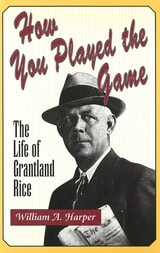
How You Played the Game
The Life of Grantland RiceWilliam Harper
University of Missouri Press, 1999
Centering around the life and times of the revered American sportswriter Grantland Rice (1880-1954), How You Played the Game takes us back to those magical days of sporting tales and mythic heroes. Through Rice's eyes we behold such sports as bicycle racing, boxing, golf, baseball, football, and tennis as they were played before 1950. We witness ups and downs in the careers of such legendary figures as Christy Mathewson, Jack Dempsey, Ty Cobb, Babe Ruth, Jim Thorpe, Red Grange, Bobby Jones, Bill Tilden, Notre Dame's Four Horsemen, Gene Tunney, and Babe Didrikson--all of whom Rice helped become household names.
Grantland Rice was a remarkably gifted and honorable sportswriter. From his early days in Nashville and Atlanta, to his famed years in New York, Rice was acknowledged by all for his uncanny grasp of the ins and outs of a dozen sports, as well as his personal friendship with hundreds of sportsmen and sportswomen. As a pioneer in American sportswriting, Rice helped establish and dignify the profession, sitting shoulder to shoulder in press boxes around the nation with the likes of Ring Lardner, Damon Runyon, Heywood Broun, and Red Smith.
Besides being a first-rate reporter, Rice was also a columnist, poet, magazine and book writer, film producer, family man, war veteran, fund-raiser, and skillful golfer. His personal accomplishments over a half century as an advocate for sports and good sportsmanship are astounding by any standard. What truly set Rice apart from so many of his peers, however, was the idea behind his sports reporting and writing. He believed that good sportsmanship was capable of lifting individuals, societies, and even nations to remarkable heights of moral and social action.
More than just a biography of Grantland Rice, How You Played the Game is about the rise of American sports and the early days of those who created the art and craft of sportswriting. Exploring the life of a man who perfectly blended journalism and sporting culture, this book is sure to appeal to all, sports lovers or not.
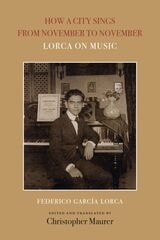
How a City Sings from November to November
Lorca on MusicFederico García Lorca
Swan Isle Press, 2026
“Yo ante todo, soy músico,” Federico García Lorca once remarked: “Before all else, I am a musician.” Whether seated at the piano, collecting folksongs on his travels through Spain, or composing music for his plays, few poets have lived music so deeply. For Lorca, songs were “living creatures.” How a City Sings from November to November: Lorca on Music brings together for the first time in English the poet’s writing on music and musicians. In these pages, through lectures, letters, and interviews, Lorca celebrates the musical seasons of Granada, “a city enclosed by mountains and made for music”; the sources of cante jondo (flamenco deep song); the haunting melodies of Spanish cradle songs; and the dance of La Argentina. He describes learning the guitar, staging Spanish ballads in Buenos Aires, and listening to spirituals in New York. In bed with a fever, he compares it to a “delicate tempo rubato of Chopin.” Based on recent archival research, edited and newly translated by noted Lorca scholar Christopher Maurer, this collection offers an intricate and enjoyable counterpoint to Lorca’s poetry and theater.
How the New Deal Was Run
Edited by Sarah E. Igo and Ganesh Sitaraman
University of Chicago Press, 2027
Notable historians delve into the brass tacks of launching and sustaining federal agencies.
Critics today complain that the United States government can’t do big things, can’t do them quickly, and certainly can’t do many of them at once. The New Deal offers a striking contrast. During the 1930s, the United States created a wealth of new agencies, departments, offices, and programs—all at once and in very short order—that enabled a stunning expansion of state capacity. The question is: how?
In this illuminating collection, leading American historians explore the nuts and bolts of New Deal implementation to offer answers. From the Civilian Conservation Corps to the Rural Electrification Administration to the Securities and Exchange Commission, they uncover exactly how the New Dealers did so much so quickly. They detail the choices before state builders who, operating under the pressure and immediacy of the era, made decisions that had momentous consequences in the longer term.
At a time when federal agencies are under stress as never before, the contributors suggest what future administrations can learn from the New Deal’s extraordinary achievements—and how they can build state capacity and deliver for Americans once again.
Features contributions by W. Tanner Allread, Mary Bridges, Brent Cebul, Sarah E. Igo, Meg Jacobs, Richard R. John, Neil M. Maher, Sharon Ann Musher, Sarah T. Phillips, Kathryn Olmsted and Eric Rauchway, Alex Platt, Jason Scott Smith, Ganesh Sitaraman, Abby Spinak, Chloe Thurston, and Mason B. Williams.
How to Draw a Circle
On Reading and WritingDan Beachy-Quick
University of Michigan Press, 2024
How to Educate an American
The Conservative Vision for Tomorrow's SchoolsMichael J. Petrilli
Templeton Press, 2020
Today, these gains are in retreat, ceding ground to progressive nostrums that do little to boost the skills and knowledge of young people. Far from being discouraged, however, conservatives should seize the moment to refresh their vision of quality K–12 education for today’s America. These essays by 20 leading conservative thinkers do just that.
Students, according to this vision, should complete high school with a thorough understanding of the country’s history, including gratitude for its sacrifices, respect for its achievements, and awareness of its shortcomings. They should also learn to be trustworthy stewards of a democratic republic, capable of exercising virtue and civic responsibility.
Beyond helping to form their character, schools ought to ready their pupils for careers that are productive, rewarding, and dignified. Excellent technical-training opportunities will await those not headed to a traditional college. Regardless of the paths and schools that they select, all students must come to understand that they can succeed in America if they are industrious, creative, and responsible.
Anchored in tradition yet looking towards tomorrow, How to Educate an American should be read by anyone concerned with teaching future generations to preserve the country’s heritage, embody its universal ethic, and pursue its founding ideals.

How to Live
A memoir-in-essaysKelle Groom
Tupelo Press, 2023
—Joan Wickersham
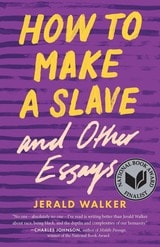
How to Make a Slave and Other Essays
Jerald Walker
The Ohio State University Press, 2020
Winner, 2021 Massachusetts Book Award, Nonfiction Category
A Book of the Year pick from Kirkus, BuzzFeed, and Literary Hub
“The essays in this collection are restless, brilliant and short. . . . The brevity suits not just Walker’s style but his worldview, too.…Keeping things quick gives him the freedom to move; he can alight on a truth without pinning it into place.” —Jennifer Szalai, the New York Times
For the black community, Jerald Walker asserts in How to Make a Slave, “anger is often a prelude to a joke, as there is broad understanding that the triumph over this destructive emotion lay in finding its punchline.” It is on the knife’s edge between fury and farce that the essays in this exquisite collection balance. Whether confronting the medical profession’s racial biases, considering the complicated legacy of Michael Jackson, paying homage to his writing mentor James Alan McPherson, or attempting to break free of personal and societal stereotypes, Walker elegantly blends personal revelation and cultural critique. The result is a bracing and often humorous examination by one of America’s most acclaimed essayists of what it is to grow, parent, write, and exist as a black American male. Walker refuses to lull his readers; instead his missives urge them to do better as they consider, through his eyes, how to be a good citizen, how to be a good father, how to live, and how to love.

How to Read Barthes' Image-Music-Text
Ed White
Pluto Press, 2012
Roland Barthes remains one of the most influential cultural theorists of the postwar period and Image-Music-Text collects his most influential essays. Ed White provides students with a clear guide to this essential but difficult text.
As students are increasingly expected to write across a range of media, Barthes' work can be understood as an early mapping of what we now call interdisciplinary or multidisciplinary study. The book's detailed section-by-section readings makes Barthes' most important writings accessible to undergraduate readers.
This book is a perfect companion for teaching and learning Barthes' ideas in cultural studies and literary theory.