Results by title
2335 books match the query 'Modern' and 88 start with h
HAWTHORNE AND THE REAL
BICENTENNIAL ESSAYSMILLICENT BELL
The Ohio State University Press, 2005
Contributors:
- Millicent Bell
- Nina Baym
- Michael T. Gilmore
- Leland S. Person
- David Leverenz
- Larry J. Reynolds
- Lawrence Buell
- Rita K. Gollin
- John Carlos Row
- Brenda Wineapple
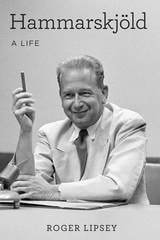
Hammarskjöld
A LifeRoger Lipsey
University of Michigan Press, 2015
After his mysterious death, Dag Hammarskjöld was described by John F. Kennedy as the "greatest statesman of our century." Second secretary-general of the United Nations (1953 - 61), he is the only person to have been awarded the Nobel Peace Prize posthumously. Through extensive research in little explored archives and personal correspondence, Roger Lipsey has produced the definitive biography of Dag Hammarskjöld. Hammarskjöld: A Life provides vivid new insights into the life and mind of a truly great individual. Hammarskjöld the statesman and Hammarskjöld the author of the classic spiritual journal Markings meet in this new biography - and the reader will meet them both in these pages. A towering mid-twentieth-century figure, Hammarskjöld speaks directly to our time.
Hannah Whitman Heyde
The Complete CorrespondenceMaire Mullins
Bucknell University Press, 2022
Hans Jonas
The Integrity of ThinkingDavid J. Levy
University of Missouri Press, 2002
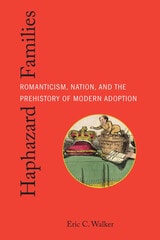
Haphazard Families
Romanticism, Nation, and the Prehistory of Modern AdoptionEric C. Walker
The Ohio State University Press, 2024
There are no provisions for adoption in English common law, and adoption wasn't legally formalized in England and Wales until 1926. But a century earlier, untimely adoptions navigated the new exceptionalism of childhood in Romanticism. In Haphazard Families, Eric C. Walker explores the history of the adopted child in Romantic-era England. Taking up the stories of both fictional and historical adoptees, he demonstrates how these children, diminished to nonpersons, shouldered the burden of social constructs of nation, family, gender, and class. Walker further demonstrates how Rousseau’s infamous failure to follow his own ideals of parenthood shaped British reactions in famous texts such as Frankenstein and Emma. Incorporating perspectives from Romantic scholarship and critical adoption studies and examining the stories of adopted children associated with Queen Caroline, Anna Letitia Barbauld, Jane Austen, the Wordsworth siblings, Mary Shelley, Charles and Mary Lamb, Letitia Landon, and others, Haphazard Families considers how Romantic constructions of childhood supply foundational structures of modern adoptee subjectivity.
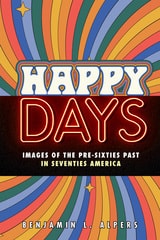
Happy Days
Images of the Pre-Sixties Past in Seventies AmericaBenjamin L. Alpers
Rutgers University Press, 2024
Happy Days investigates how 1970s popular culture was obsessed with America’s past but often offered radically different interpretations of the same historical events and icons. Even the figure of the greaser, once an icon of juvenile delinquency, was made family-friendly by Henry Winkler’s Fonzie at the same time that he was being appropriated in more threatening ways by punk and gay subcultures. The cultural historian Benjamin Alpers discovers similar levels of ambivalence toward the past in 1970s neo-noir films, representations of America’s founding, and neo-slave narratives by Alex Haley and Octavia Butler. By exploring how Americans used the 1970s to construct divergent representations of their shared history, he identifies it as a pivotal moment in the nation’s ideological fracturing.
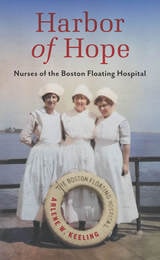
Harbor of Hope
Nurses of the Boston Floating HospitalArlene W. Keeling
University of Massachusetts Press, 2026
The untold story of Boston’s Floating Hospital and the nurses whose work redefined infant care
In late nineteenth-century Boston, nearly one in five babies did not survive infancy. Each summer, outbreaks of “summer complaint”—a deadly gastrointestinal illness caused by contaminated cow’s milk—swept through the city’s poorest neighborhoods. Infants born to immigrant families were especially vulnerable, trapped in stifling tenements with poor sanitation and little access to safe nutrition. Searching for a solution, reform-minded Bostonians looked to New York City’s hospital boats, which offered sick children relief from the heat. In the summer of 1894, Boston launched its own bold experiment: the Boston Floating Hospital.
What began as a modest charitable venture in Boston Harbor soon transformed pediatric care. While physicians have long received credit for the Floating Hospital’s success in reducing infant mortality, Harbor of Hope tells a deeper story. Historian Arlene W. Keeling reveals the essential and often overlooked role of nurses. It was nurses who translated medical theory into lifesaving practice: feeding and bathing fragile infants, administering treatments, calming anxious mothers, and carefully observing each child’s response. Serving as the vital link between doctors and families, they became the heart of the Floating Hospital’s mission.
Tracing the hospital’s story from its first voyage to its tragic destruction by fire in 1927, Harbor of Hope situates these nurses within a city undergoing dramatic change. Against the backdrop of rapid industrial growth, mass immigration, and emerging movements in public health and social reform, Keeling shows how skill, compassion, and persistence reshaped the fate of Boston’s most vulnerable children. Set afloat on Boston Harbor, this is a powerful story of caregiving, innovation, and the women who fought day after day to save babies’ lives.

Harvester of Hearts
Motherhood under the Sign of FrankensteinRachel Feder
Northwestern University Press, 2018
In the period between 1815 and 1820, Mary Shelley wrote her most famous novel, Frankenstein; or, The Modern Prometheus, as well as its companion piece, Mathilda, a tragic incest narrative that was confiscated by her father, William Godwin, and left unpublished until 1959. She also gave birth to four—and lost three—children.
In this hybrid text, Rachel Feder interprets Frankenstein and Mathilda within a series of provocative frameworks including Shelley’s experiences of motherhood and maternal loss, twentieth-century feminists’ interests in and attachments to Mary Shelley, and the critic’s own experiences of pregnancy, childbirth, and motherhood. Harvester of Hearts explores how Mary Shelley’s exchanges with her children—in utero, in birth, in life, and in death—infuse her literary creations. Drawing on the archives of feminist scholarship, Feder theorizes “elective affinities,” a term she borrows from Goethe to interrogate how the personal attachments of literary critics shape our sense of literary history. Feder blurs the distinctions between intellectual, bodily, literary, and personal history, reanimating the classical feminist discourse on Frankenstein by stepping into the frame.
The result—at once an experimental book of literary criticism, a performative foray into feminist praxis, and a deeply personal lyric essay—not only locates Mary Shelley’s monsters within the folds of maternal identity but also illuminates the connections between the literary and the quotidian.
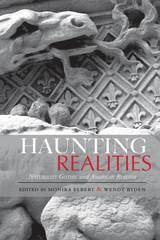
Haunting Realities
Naturalist Gothic and American RealismEdited by Monika Elbert and Wendy Ryden
University of Alabama Press, 2017
An innovative collection of essays examining the sometimes paradoxical alignment of Realism and Naturalism with the Gothic in American literature to highlight their shared qualities
Following the golden age of British Gothic in the late eighteenth century, the American Gothic’s pinnacle is often recognized as having taken place during the decades of American Romanticism. However, Haunting Realities explores the period of American Realism—the end of the nineteenth century—to discover evidence of fertile ground for another age of Gothic proliferation.
At first glance, “Naturalist Gothic” seems to be a contradiction in terms. While the Gothic is known for its sensational effects, with its emphasis on horror and the supernatural, the doctrines of late nineteenth-century Naturalism attempted to move away from the aesthetics of sentimentality and stressed sobering, mechanistic views of reality steeped in scientific thought and the determinism of market values and biology. Nonetheless, what binds Gothicism and Naturalism together is a vision of shared pessimism and the perception of a fearful, lingering presence that ominously haunts an impending modernity. Indeed, it seems that in many Naturalist works reality is so horrific that it can only be depicted through Gothic tropes that prefigure the alienation and despair of modernism.
In recent years, research on the Gothic has flourished, yet there has been no extensive study of the links between the Gothic and Naturalism, particularly those which stem from the early American Realist tradition. Haunting Realities is a timely volume that addresses this gap and is an important addition to scholarly work on both the Gothic and Naturalism in the American literary tradition.

Hawker Hunter
the story of a thoroughbredSreco Bradic
Amsterdam University Press, 2023
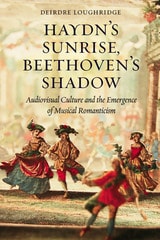
Haydn’s Sunrise, Beethoven’s Shadow
Audiovisual Culture and the Emergence of Musical RomanticismDeirdre Loughridge
University of Chicago Press, 2016
Deirdre Loughridge reveals that allusions in musical writings to optical technologies reflect their spread from fairgrounds and laboratories into public consciousness and a range of discourses, including that of music. She demonstrates how concrete points of intersection—composers’ treatments of telescopes and peepshows in opera, for instance, or a shadow-play performance of a ballad—could then fuel new modes of listening that aimed to extend the senses. An illuminating look at romantic musical practices and aesthetics, this book yields surprising relations between the past and present and offers insight into our own contemporary audiovisual culture.
Hayek and the Evolution of Capitalism
Naomi Beck
University of Chicago Press, 2018
Yet even among those who study his work in depth, few have looked closely at his use of ideas from evolutionary science to advance his vision of markets and society. With this book Naomi Beck offers the first full-length engagement with Hayek’s thought from this perspective. Hayek argued that the capitalism we see in advanced civilizations is an unintended consequence of group selection—groups that adopted free market behavior expanded more successfully than others. But this attempt at a scientific grounding for Hayek’s principles, Beck shows, fails to hold water, plagued by incoherencies, misinterpretations of the underlying science, and lack of evidence. As crises around the globe lead to reconsiderations of the place of capitalism, Beck’s excavation of this little-known strand of Hayek’s thought—and its failure—is timely and instructive.
Hayek on Mill
The Mill-Taylor Friendship and Related WritingsF. A. Hayek
University of Chicago Press, 2015
This latest addition to the University of Chicago Press’s Collected Works of F. A. Hayek series showcases the fascinating intersections between two of the most prominent thinkers from two successive centuries. Hayek situates Mill within the complex social and intellectual milieu of nineteenth-century Europe—as well as within twentieth-century debates on socialism and planning—and uncovers the influence of Taylor-Mill on Mill’s political economy. The volume features the Mill-Taylor correspondence and brings together for the first time Hayek’s related writings, which were widely credited with beginning a new era of Mill scholarship.
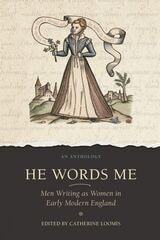
He Words Me
Men Writing as Women in Early Modern EnglandCatherine Loomis
Arizona Center for Medieval and Renaissance Studies, 2026
This anthology gives students and scholars access to a body of texts that provide a clearer understanding of what life was like for early modern women by presenting hundreds of little-known primary texts that contain details about early modern women’s work, relationships, emotional and intellectual development, friendships, and daily struggles. He Words Me brings together work from a variety of genres in which male authors adopt the voice of a female narrator and use that voice to provide intimate details about the lives of women.
These works introduce modern readers to less familiar genres, complement or contradict portrayals of women in canonical texts, and raise compelling questions about who speaks for women and when women can speak for themselves. Through these women’s voices, readers can encounter characters and experiences that will broaden their understanding of early modern English literature and culture, and of the history of women in the late sixteenth and early seventeenth centuries.
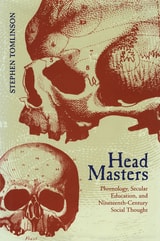
Head Masters
Phrenology, Secular Education, and Nineteenth-Century Social ThoughtStephen Tomlinson
University of Alabama Press, 2005
Head Masters challenges the assumption that phrenology—the study of the conformation of the skull as it relates to mental faculties and character—played only a minor and somewhat anecdotal role in the development of education. Stephen Tomlinson asserts instead that phrenology was a scientifically respectable theory of human nature, perhaps the first solid physiological psychology. He shows that the first phrenologists were among the most prominent scientists and intellectuals of their day, and that the concept was eagerly embraced by leading members of the New England medical community.
Following its progression from European theorists Franz-Joseph Gall, Johan Gasper Spurzheim, and George Combe to Americans Horace Mann and Samuel Gridley Howe, Tomlinson traces the origins of phrenological theory and examines how its basic principles of human classification, inheritance, and development provided a foundation for the progressive practices advocated by middle-class reformers such as Combe and Mann. He also elucidates the ways in which class, race, and gender stereotypes permeated 19th century thought and how popular views of nature, mind, and society supported a secular curriculum favoring the use of disciplinary practices based on physiology.
This study ultimately offers a reconsideration of the ideas and theories that motivated education reformers such as Mann and Howe, and a reassessment of Combe, who, though hardly known by contemporary scholars, emerges as one of the most important and influential educators of the 19th century.
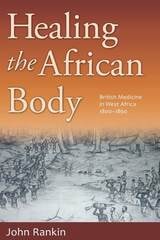
Healing the African Body
British Medicine in West Africa, 1800-1860John Rankin
University of Missouri Press, 2015
This timely book explores the troubled intertwining of religion, medicine, empire, and race relations in the early nineteenth century. John Rankin analyzes the British use of medicine in West Africa as a tool to usher in a “softer” form of imperialism, considers how British colonial officials, missionaries, and doctors regarded Africans, and explores the impact of race classification on colonial constructs.
Rankin goes beyond contemporary medical theory, examining the practice of medicine in colonial Africa as Britons dealt with the challenges of providing health care to their civilian employees, African soldiers, and the increasing numbers of freed slaves in the general population, even while the imperialists themselves were threatened by a lack of British doctors and western medicines. As Rankin writes, “The medical system sought to not only heal Africans but to ‘uplift’ them and make them more amenable to colonial control . . . Colonialism starts in the mind and can be pushed on the other solely through ideological pressure.”
Hearing Things
Voice and Method in the Writing of Stanley CavellTimothy Gould
University of Chicago Press, 1998
Gould argues that a tension between voice and method unites Cavell's broad and often perplexing range of interests. From Wittgenstein to Thoreau, from Shakespeare to the movies, and from opera to Freud, Gould reveals the connection between the voice within Cavell's writing and the voices Cavell appeals to through the methods of ordinary language philosophy. Within Cavell's extraordinary productivity lies a new sense of philosophical method based on elements of the act of reading. Hearing Things is both an important study of Cavell's work and a major contribution to the construction of American philosophy.
Hegel and the Freedom of Moderns
Domenico Losurdo
Duke University Press, 2004
Hegel and the Freedom of Moderns persuasively argues that the tug of war between “conservative” and “liberal” interpretations of Hegel has obscured and distorted the most important aspects of his political thought. Losurdo unravels this misleading dualism and provides an illuminating discussion of the relation between Hegel’s political philosophy and the thinking of Karl Marx and Friedrich Engels. He also discusses Hegel’s ideas in relation to the pertinent writings of other major figures of modern political philosophy such as Jean-Jacques Rousseau, John Locke, Edmund Burke, John Stuart Mill, Jeremy Bentham, Karl Popper, Norberto Bobbio, and Friedrich Hayek.
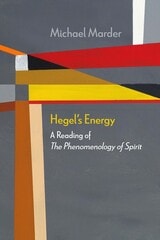
Hegel's Energy
A Reading of The Phenomenology of SpiritMichael Marder
Northwestern University Press, 2021
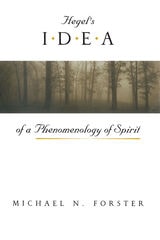
Hegel's Idea of a Phenomenology of Spirit
Michael N. Forster
University of Chicago Press, 1998
The Phenomenology of Spirit emerges as an extraordinarily coherent work with a rich array of important and original ideas. These include a diagnosis of the ills of modernity in terms of its commitment to a series of dualisms, and a project for overcoming them; a sweeping naturalism; a deep rethinking of and response to problems of skepticism; subtle arguments for social theories of meaning and truth; and ideas based on the insight that human thought changes in fundamental ways over the course of history. Forster's unique and compelling reading unlocks the mysteries of Hegel's seminal work.
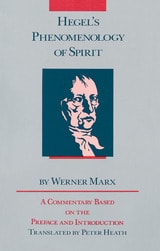
Hegel's Phenomenology of Spirit
A Commentary Based on the Preface and IntroductionWerner Marx
University of Chicago Press, 1988
The primary focus of Marx's book is on the account. Hegel gives of the phenomenological journey from natural consciousness to philosophical wisdom (or absolute knowledge, as Hegel calls it). In showing that Hegel's many statements concerning consciousness 'finding itself' or 'knowing itself' in its world can be understood as discovering the rationality of the conditioning world, Marx offers a solution to several sets of interrelated problems that have troubled students of Hegel. His book contains valuable analyses of the relation between Hegel's thought and that of Descartes and Kant as well as that of Karl Marx, and it also sheds considerable light on the question of the internal unity or coherence of the Phenomenology.
Hegel's Phenomenology, Part 1
Analysis and CommentaryHoward P. Kainz
Ohio University Press, 1976
Kainz provides an accessible entry into the complexities of Hegelian thought by asking a series of questions about such matters as the literary form of the Phenomenology, its "plot," its relation to the "system," its subject matter, the problem of objectivity, dialectical necessity, the concept of "experience," and the Hegelian concept of consciousness. Building of the work of previous commentators, and presenting the work of these commentators in a clear and unbiased manner, Kainz offers an analysis that will be helpful both to experienced Hegelian scholars and to those readers preparing to approach the large and bewildering territory of the Phenomenology for the first time.
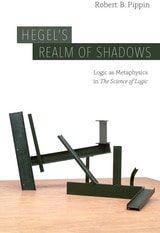
Hegel's Realm of Shadows
Logic as Metaphysics in “The Science of Logic”Robert B. Pippin
University of Chicago Press, 2018
Robert B. Pippin offers here a bold, original interpretation of Hegel’s claim that only now, after Kant’s critical breakthrough in philosophy, can we understand how logic can be a metaphysics. Pippin addresses Hegel’s deep, constant reliance on Aristotle’s conception of metaphysics, the difference between Hegel’s project and modern rationalist metaphysics, and the links between the “logic as metaphysics” claim and modern developments in the philosophy of logic. Pippin goes on to explore many other facets of Hegel’s thought, including the significance for a philosophical logic of the self-conscious character of thought, the dynamism of reason in Kant and Hegel, life as a logical category, and what Hegel might mean by the unity of the idea of the true and the idea of the good in the “Absolute Idea.” The culmination of Pippin’s work on Hegel and German idealism, this is a book that no Hegel scholar or historian of philosophy will want to miss.
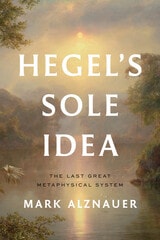
Hegel's Sole Idea
The Last Great Metaphysical SystemMark Alznauer
University of Chicago Press, 2026
An accessible reconstruction of Hegel’s attempt to derive all reality from a single concept.
In the early decades of the nineteenth century, G. W. F. Hegel came to believe that philosophy was finally in a position to achieve something it had striven for since ancient Greece: becoming an objective, demonstrative science. But to achieve this aim, he thought philosophical knowledge needed to be reconceived in a radically new way—as content contained in a single concept just as the oak tree is hidden in the acorn. In Hegel’s Sole Idea, Mark Alznauer reads Hegel’s mature philosophical system as the unprecedented attempt to comprehend the entire world as the full unfolding of that single concept, which he mysteriously calls “the absolute idea.”
Ever since Hegel set out this program in his Encyclopedia of the Philosophical Sciences in Outline, Hegel’s system has been regarded as the last best hope of philosophy as an autonomous, fully rational science. But while Hegel’s followers regarded the Encyclopedia as the successful realization of the traditional aims of philosophy, his most influential successors thought it instead showed the exhaustion and collapse of that project. Hegel’s Sole Idea offers a comprehensive interpretation of Hegelian philosophy that allows a fair confrontation with its most provocative and ambitious claims.

Hegel's Theory of Intelligibility
Rocío Zambrana
University of Chicago Press, 2015
Zambrana clarifies crucial features of Hegel’s theory of normativity previously thought to be absent from the argument of the Science of Logic—what she calls normative precariousness and normative ambivalence. She shows that Hegel’s theory of determinacy views intelligibility as both precarious, the result of practices and institutions that gain and lose authority throughout history, and ambivalent, accommodating opposite meanings and valences even when enjoying normative authority. In this way, Zambrana shows that the Science of Logic provides the philosophical justification for the necessary historicity of intelligibility. Intervening in several recent developments in the study of Kant, Hegel, and German Idealism more broadly, this book provides a productive new understanding of the value of Hegel’s systematic ambitions.
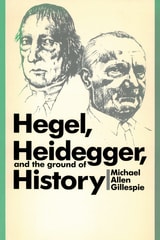
Hegel, Heidegger, and the Ground of History
Michael Allen Gillespie
University of Chicago Press, 1984
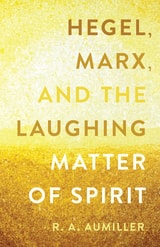
Hegel, Marx, and the Laughing Matter of Spirit
R. A. Aumiller
Northwestern University Press, 2026
What happens when those who have been denied political subjectivity fully play out their negative role in a historical drama that damned them from the beginning? Hegel, Marx, and the Laughing Matter of Spirit locates the eruption of revolutionary laughter in historical cracks across nineteenth- and twentieth-century Europe, where exiled philosophers, partisan fighters, and artists framed their political resistance as a historical comedy. Hegelian comedy fuels the Young Hegelian critique of Prussian censorship, Walter Benjamin’s staging of the anti-fascist resistance, and the Yugoslavian partisan attempt to begin again in fascism’s aftermath. Revolution erupts from a historical stage that can no longer look on its own contradictions with a straight face. Drawing on the defiant spirit of comedy, this Hegelian feminist manifesto defies political despair, overturning the perception that history tragically repeats itself. Invoking the phrase “Nothing changes” as a mantra, R. A. Aumiller turns a concession of defeat into a battle cry for political resistance.
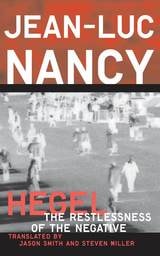
Hegel
The Restlessness Of The NegativeJean-Luc Nancy
University of Minnesota Press, 2002
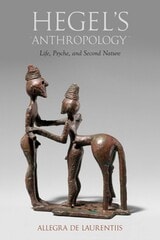
Hegel’s Anthropology
Life, Psyche, and Second NatureAllegra de Laurentiis
Northwestern University Press, 2021
A groundbreaking contribution to scholarship on Hegel and nineteenth-century philosophy, this book shows that the Anthropology is essential to understanding Hegel’s concept of spirit, not only in its connection with nature but also in its more sophisticated realizations as objective and absolute spirit. Future scholarship on this subject will recount—and build upon—de Laurentiis’s innovative study.
Hegel’s Theory of Normativity
The Systematic Foundations of the Philosophical Science of RightKevin Thompson
Northwestern University Press, 2019

Heidegger And The Jews
Jean-Francois Lyotard
University of Minnesota Press, 1990
Heidegger and the Myth of a Jewish World Conspiracy
Peter Trawny
University of Chicago Press, 2015
While Heidegger’s affiliation with National Socialism is well known, the anti-Semitic dimension of that engagement could not be fully told until now. Trawny traces Heidegger’s development of a grand “narrative” of the history of being, the “being-historical thinking” at the center of Heidegger’s work after Being and Time. Two of the protagonists of this narrative are well known to Heidegger’s readers: the Greeks and the Germans. The world-historical antagonist of this narrative, however, has remained hitherto undisclosed: the Jews, or, more specifically, “world Judaism.” As Trawny shows, world Judaism emerges as a racialized, destructive, and technological threat to the German homeland, indeed, to any homeland whatsoever. Trawny pinpoints recurrent, anti-Semitic themes in the Notebooks, including Heidegger’s adoption of crude cultural stereotypes, his assigning of racial reasons to philosophical decisions (even undermining his Jewish teacher, Edmund Husserl), his endorsement of a Jewish “world conspiracy,” and his first published remarks on the extermination camps and gas chambers (under the troubling aegis of a Jewish “self-annihilation”). Trawny concludes with a thoughtful meditation on how Heidegger’s achievements might still be valued despite these horrifying facets. Unflinching and systematic, this is one of the most important assessments of one of the most important philosophers in our history.
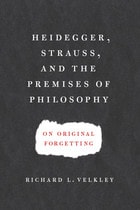
Heidegger, Strauss, and the Premises of Philosophy
On Original ForgettingRichard L. Velkley
University of Chicago Press, 2011
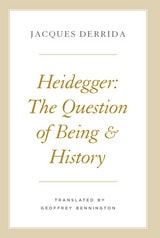
Heidegger
The Question of Being and HistoryJacques Derrida
University of Chicago Press, 2016
Derrida performs an almost surgical reading of the notoriously difficult text, marrying pedagogical clarity with patient rigor and acting as a lucid guide through the thickets of Heidegger’s prose. At this time in intellectual history, Heidegger was still somewhat unfamiliar to French readers, and Being and Time had only been partially translated into French. Here Derrida mostly uses his own translations, giving his own reading of Heidegger that directly challenges the French existential reception initiated earlier by Sartre. He focuses especially on Heidegger’s Destruktion (which Derrida would translate both into “solicitation” and “deconstruction”) of the history of ontology, and indeed of ontology as such, concentrating on passages that call for a rethinking of the place of history in the question of being, and developing a radical account of the place of metaphoricity in Heidegger’s thinking.
This is a rare window onto Derrida’s formative years, and in it we can already see the philosopher we’ve come to recognize—one characterized by a bravura of exegesis and an inventiveness of thought that are particularly and singularly his.
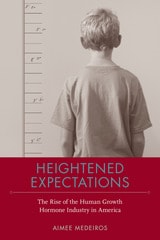
Heightened Expectations
The Rise of the Human Growth Hormone Industry in AmericaAimee Medeiros
University of Alabama Press, 2016
This book documents how the rise of modern capitalism and efforts to protect those most vulnerable to its harmful effects contributed to the social stigmatization of short statured children. Short boys bore the brunt of this discrimination by the mid-twentieth century, as cultural notions of masculinity deemed smallness a troubling trait in need of remedy. These boys became targets of growth hormone treatment, a trend accelerated by the development of effective HGH therapy in the late 1950s.
With a revisionist twist, Medeiros argues that HGH therapy was not plagued by a limited number of sources of the hormone but rather a difficult-to-access supply during the 1960s and 1970s. The advent of synthetic HGH remedied this situation. Therapy was available, however, only to those who could afford it. Very few could, which made short stature once again a mark of the underprivileged class.
Today, small boys with dreams of being taller remain the key customer base of the legitimate arm of the HGH industry. As gender and economic class disparities in treatment continue, some medical experts have alluded to patients’ parents as culprits of this trend. This book sheds light on how medicine’s attempt to make up for perceived physical shortcomings has deep roots in American culture.
Of interest to historians and scholars of medicine, gender studies, and disability studies, Heightened Expectations also offers much to policy makers and those curious about where standards and therapies originate.
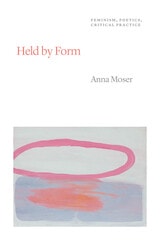
Held by Form
Feminism, Poetics, Critical PracticeAnna Moser
University of Chicago Press, 2026
How contemporary poetry illuminates the workings—and struggles—of commitment in feminism.
In this lucid and vigorous defense of poetics for feminism, Anna Moser situates the practice of contemporary poetry in an exploratory dialogue with the work of philosophical, critical, and historical thinkers—placing Denise Riley in conversation with Judith Butler, Lyn Hejinian with Hannah Arendt, m. nourbeSe philip with Saidiya Hartman, and Susan Howe with Emily Dickinson.
Moser’s central theme is these poets’ questioning, agonistic commitment to feminism. What, the book asks, does it mean to be committed? How does such a commitment materialize? What are its consequences? What does it mean not to take for granted an affiliation like “feminist” (or even “woman”), but rather to involve one’s art in probing its historical formations, present conditions, and future trajectories? Moser explores both the risks and possibilities of making art in this equivocal condition. She reveals that the poetry of certain contemporary writers not only unfolds within this space of agonistic commitment, but that, in doing so, it offers an important contribution to feminist thinking. Moser’s book also shows that while form is a constraint that limits these poets’ freedom, it also holds them in a more sustaining sense, allowing something belatedly and imperfectly to be said.
In dialogue with feminist political theory, philosophy, historiography, and aesthetics, Held by Form reveals poetics as a unique mode of critical practice: one that models relations of care and collectivity, refigures inherited forms in ways that contest their hierarchies of value, and responds with generosity and openness to the complexities of living in gender.
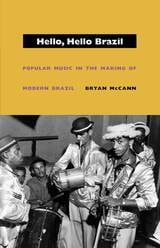
Hello, Hello Brazil
Popular Music in the Making of Modern BrazilBryan McCann
Duke University Press, 2004
McCann explores the links between the growth of the culture industry, rapid industrialization, and the rise and fall of Getúlio Vargas’s Estado Novo dictatorship. He argues that these processes opened a window of opportunity for the creation of enduring cultural patterns and demonstrates that the understandings of popular music cemented in the mid–twentieth century continue to structure Brazilian cultural life in the early twenty-first.
Hemingway's Neglected Short Fiction
New PerspectivesSusan F. Beegel
University of Alabama Press, 1991
“This critical anthology is the result of a brilliant idea….A volume which not only will lead most readers to place more value on a number of stories previously passed over but that will likely extend the reader’s sense of Hemingway’s artistry.” —Studies in American Fiction
Hemingway’s Neglected Short Fiction is a groundbreaking exploration of Ernest Hemingway’s least‑examined stories, works long overshadowed by the towering fame of his novels. The collection reveals how many of Hemingway’s short stories have been cursorily summarized, misread, or simply ignored. Through twenty‑five original essays, leading scholars illuminate the breadth, experimentation, irony, and emotional range found in over thirty stories—tales that challenge the conventional “code hero” paradigm and expose a richer, more complex Hemingway. What emerges is a vivid portrait of an artist whose most overlooked pieces frequently contain his sharpest innovations and deepest moral provocations.
Structured with historical awareness and critical freshness, the volume ranges from Hemingway’s earliest apprentice fiction (“The Mercenaries,” “Up in Michigan,” “My Old Man”) to his experimental, metafictional, or posthumously published works (“A Natural History of the Dead,” “Get a Seeing‑Eyed Dog,” “A Man of the World”). Contributors draw from an impressive range of approaches—rhetorical theory, linguistics, psychoanalysis, semiotics, religious studies, Bakhtinian dialogism, and close textual analysis. Along the way, they revisit stories distorted by biography (“Out of Season,” “Mr. and Mrs. Elliot”), reconsider stories dismissed as trivial (“A Pursuit Race,” “A Day’s Wait”), and restore neglected gems such as “Wine of Wyoming,” “The Sea Change,” and “Homage to Switzerland.”
This book will captivate scholars of modernism, Hemingway specialists, teachers seeking fresh classroom material, and general readers who want to discover the Hemingway hidden between the lines. It is essential reading for anyone interested in the evolution of a major American writer and the vibrant life of the short story form.
Hemispheres and Stratospheres
The Idea and Experience of Distance in the International EnlightenmentKevin L. Cope
Bucknell University Press, 2021
Published by Bucknell University Press. Distributed worldwide by Rutgers University Press.
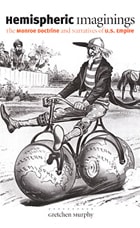
Hemispheric Imaginings
The Monroe Doctrine and Narratives of U.S. EmpireGretchen Murphy
Duke University Press, 2005
Murphy juxtaposes close readings of novels with analyses of nonfiction texts. From uncovering the literary inspirations for the Monroe Doctrine itself to tracing visions of hemispheric unity and transatlantic separation in novels by Lydia Maria Child, Nathaniel Hawthorne, María Amparo Ruiz de Burton, Lew Wallace, and Richard Harding Davis, she reveals the Doctrine’s forgotten cultural history. In making a vital contribution to the effort to move American Studies beyond its limited focus on the United States, Murphy questions recent proposals to reframe the discipline in hemispheric terms. She warns that to do so risks replicating the Monroe Doctrine’s proprietary claim to isolate the Americas from the rest of the world.
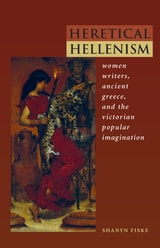
Heretical Hellenism
Women Writers, Ancient Greece, and the Victorian Popular ImaginationShanyn Fiske
Ohio University Press, 2008
The prevailing assumption regarding the Victorians’ relationship to ancient Greece is that Greek knowledge constituted an exclusive discourse within elite male domains. Heretical Hellenism: Women Writers, Ancient Greece, and the Victorian Popular Imagination challenges that theory and argues that while the information women received from popular sources was fragmentary and often fostered intellectual insecurities, it was precisely the ineffability of the Greek world refracted through popular sources and reconceived through new fields of study that appealed to women writers’ imaginations.
Examining underconsidered sources such as theater history and popular journals, Shanyn Fiske uncovers the many ways that women acquired knowledge of Greek literature, history, and philosophy without formal classical training. Through discussions of women writers such as Charlotte Brontë, George Eliot, and Jane Harrison, Heretical Hellenism demonstrates that women established the foundations of a heretical challenge to traditional humanist assumptions about the uniformity of classical knowledge and about women’s place in literary history.
Heretical Hellenism provides a historical rationale for a more expansive definition of classical knowledge and offers an interdisciplinary method for understanding the place of classics both in the nineteenth century and in our own time.

Heterology and the Postmodern
Bataille, Baudrillard, and LyotardJulian Pefanis
Duke University Press, 1991
Beginning with the introduction of Hegel in French postmodernist thought—largely but not exclusively through the thought of Georges Bataille—Pefanis argues that the core problematics of postmodern aesthetics—history, exchange, representation, and writing—are related to Bataille’s reconceptualization of the Hegelian framework. Pefanis explores how Bataille was influenced by Hegel, Marcel Mauss, Freud, and Nietzsche, and traces the effects of this influence on the analyses and critiques of later postmodernists, most notably Lyotard and Baudrillard. Finally, employing these postmodernists along with Freud and Jacques Lacan, Pefanis discusses discourse on postmodernism and its relation to Freud’s concept of the death drive.
This intellectual history makes valuable contributions to the debates over what the “postmodern” may mean for intellectual and political activity.

Heterosexual Africa?
The History of an Idea from the Age of Exploration to the Age of AIDSMarc Epprecht
Ohio University Press, 2008
Heterosexual Africa? The History of an Idea from the Age of Exploration to the Age of AIDS builds from Marc Epprecht’s previous book, Hungochani (which focuses explicitly on same-sex desire in southern Africa), to explore the historical processes by which a singular, heterosexual identity for Africa was constructed—by anthropologists, ethnopsychologists, colonial officials, African elites, and most recently, health care workers seeking to address the HIV/AIDS pandemic. This is an eloquently written, accessible book, based on a rich and diverse range of sources, that will find enthusiastic audiences in classrooms and in the general public.
Epprecht argues that Africans, just like people all over the world, have always had a range of sexualities and sexual identities. Over the course of the last two centuries, however, African societies south of the Sahara have come to be viewed as singularly heterosexual. Epprecht carefully traces the many routes by which this singularity, this heteronormativity, became a dominant culture. In telling a fascinating story that will surely generate lively debate, Epprecht makes his project speak to a range of literatures—queer theory, the new imperial history, African social history, queer and women’s studies, and biomedical literature on the HIV/AIDS pandemic. He does this with a light enough hand that his story is not bogged down by endless references to particular debates.
Heterosexual Africa? aims to understand an enduring stereotype about Africa and Africans. It asks how Africa came to be defined as a “homosexual-free zone” during the colonial era, and how this idea not only survived the transition to independence but flourished under conditions of globalization and early panicky responses to HIV/AIDS.
Hey Presto!
Swift and the QuacksHugh Ormsby-Lennon
University of Delaware Press, 2011
Published by University of Delaware Press. Distributed worldwide by Rutgers University Press.

Hidden Transfers
How Rural Women’s Reproductive Work Paid for Industrialization in Mao’s ChinaJacob Eyferth
University of Chicago Press, 0
Provides a striking, new interpretation of the importance of rural women’s cloth production in collective-era China.
Based on extensive archival research, fieldwork across multiple villages, and hundreds of interviews, Hidden Transfers offers a material history of the working lives of rural women in communist China from 1949 to 1983.
Focusing on cotton cultivation and manual textile production in rural households, historian Jacob Eyferth examines the relationship between domestic labor and socialist development by recovering the story of the millions of women who spent countless hours spinning yarn, weaving cloth, and making clothes for their families. He shows how the “hidden transfers” from the domestic economy to fund accumulation rested, as with capitalist economies, on women’s unpaid domestic work. But state socialism went even further, celebrating the future-making work of production while disparaging work that reproduced life at home. Through careful research, Eyferth tracks how the Chinese state’s project of primitive accumulation, in turn, created the conditions for the spectacular growth experienced in the post-Mao years.

Hidden
A Sister and Brother in Nazi PolandFay Walker
University of Wisconsin Press, 2002
Of the Rosenbluth family, only the older children, Faiga and Luzer, had gone into hiding before the SS rounded up the Jews of Kanczuga, Poland. Hidden is Faiga and Luzer’s story, a memoir whose intimate and quiet particularity makes the incomprehensible enormity of the Holocaust immediate, human, and devastatingly real.
In alternating first-person narratives, Faiga (Fay) and Luzer (Leo) take readers into their very different but inextricably linked experiences in Nazi-occupied Poland. Faiga, the once-dignified young lady from a good home with servants and a seat by the eastern wall of the synagogue, spends two years wandering the perilous countryside, hoping to be taken for a peasant. Mere miles away, knowing nothing of his sister’s fate, Luzer, the leather wholesaler’s only son, lies silent all day in the stifling dark corner of a barn, where the smell of the cows’ warm hides are a piquant reminder of his lost world. Hidden deftly summons that world, as the familiar comforts and squabbles of life in a well-to-do, religious Jewish family are slowly overwhelmed by the grim news coming out of Germany. We follow Faiga and Luzer through the early forebodings and deprivations of the war, into hiding among righteous Poles and erstwhile neighbors-turned-betrayers, and finally, at war’s end, back once more into the world—but not necessarily into safety. Told in a confident, clear, and unsentimental prose, this is a story of heroism and tragedy writ large and small, of two young people coming of age in a world in chaos and then trying to return to "normal" after experiences as unimaginable as they are unforgettable.
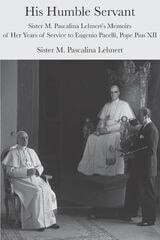
His Humble Servant
Sister M. Pascalina Lehnert's Memoirs of Her Years of Service to Eugenio Pacelli, Pope Pius XIIM. Pascalina Lehnert
St. Augustine's Press, 2012
This is a personal and insightful portrait of Pope Pius XII, the memories of Sister M. Pascalina Lehnert, who served as his housekeeper for forty years. Her book, most of it written just a few months after the Pope’s death, shares insights into the person, the life, and the thinking of Pius XII, from his time as Nuncio in Munich until his death. Much of Sister’s motivation in writing this work was to correct the many distortions of fact and interpretation regarding this great pope.
This book was a best seller in the original German, as well as in the Italian and French translations. This is the first edition in English.
These reminiscences were written down at the instructions of Sister’s Superior General, but were not made known to the public until 1982, when it was published in German at the express wishes of Pope John Paul II to publish the work without any changes. So the work remained a lively, flowing account of memories and anecdotes in a simple, spontaneous style. It is a powerful and insightful account of Pius’s daily life, his treatment of those around him, and his concern for the upholding of the traditional teaching of the Church in the face of his awesome burden to lead the Church during World War II.

Historiae Britannicae Defensio / A Defence of the British History
John Prise
Bodleian Library Publishing, 2015
Historical Distance and the Holocaust
Interactions Between Historians and Middle-Class Western Europeans in Memory EducationThomas Van de Putte
Central European University Press, 2026
A detailed interactional analysis and thick ethnographic description demonstrate how the temporal, moral and emotional distancing practices reenforce the lay moralities and political subjectivities of the white middle-class. This comes with (mostly unintended) consequences. Distanced approaches to the Holocaust in non-academic environments reduce empathy for victims and survivors, normalize violence, disconnect the meaning of the Holocaust from contemporary conflict, and re-activate stereotypes about groups who employ more ‘close’ approaches to the Holocaust.
Historicizing the Enlightenment, Volume 2
Literature, the Arts, and the Aesthetic in BritainMichael McKeon
Bucknell University Press, 2023
Published by Bucknell University Press. Distributed worldwide by Rutgers University Press.