Results by title
28164 books match the query 'History' and 165 start with k

K-Pop Fandom
Performing Deokhu from the 1990s to TodayAreum Jeong
University of Michigan Press, 2026
Through an autoethnography of becoming a K-pop deokhu, Jeong connects their experiences to generations of K-pop fans, showing simultaneously how fandom practices have shifted over time and the intricacies of fan labor participation. This personal connection paved the way for participant-observation and co-performer witnessing methodologies in the study, which crucially allowed for collaborating with fans whose communal pursuits have been stigmatized by dominant discourses that denigrate their activities as solely addictive, uncritical, and wasteful. Jeong’s genre-spanning corpus of fan activities and analyzing its contexts and contents represents an important contribution to the making of a fan archive that is also an archive of affective labor.
KOTEX, KLEENEX, HUGGIES
KIMBERLY-CLARK AND THE CONSUMER REVOLUTION IN AMERICAN BUSINESSThomas Heinrich and Bob Batchelor
The Ohio State University Press, 2004
Kabbalistic Revolution
Reimagining Judaism in Medieval SpainLachter, Hartley
Rutgers University Press, 2014
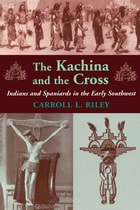
Kachina and the Cross
Carroll L Riley
University of Utah Press, 1999
In The Kachina and the Cross, Carroll Riley weaves elements of archaeology, anthropology, and history to tell a dramatic story of conflict between the Pueblo Indians and Franciscan missionaries in the seventeenth-century Spanish colony of New Mexico.
Until now, histories of the early Southwest have tended to concentrate on the Spanish presence, with little mention of Indian resistance or the decade-long war that eventually erupted. In The Kachina and the Cross Riley completes the picture by utilizing archaeological and anthropological research from the past forty years, fleshing out the story of the first century of sustained Spanish-Pueblo relations.
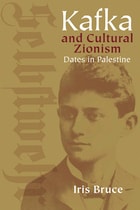
Kafka and Cultural Zionism
Dates in PalestineIris Bruce
University of Wisconsin Press, 2007

Kakungulu and the Creation of Uganda, 1868–1928
1868-1928Michael Twaddle
Ohio University Press, 1993
This is a history of the early days of Uganda. The account has an African focus because it shows the British takeover through the experiences of an extraordinary leader.
“At this spot in the year 1901 the British flag was first hoisted by Semei Kakanguru, emissary and loyal servant of His Majesty the King. He built here a boma which was for a short time the headquarters of the district. From this beginning came the establishment of peace and the development of orderly progress in this part of Uganda.”
Michael Twaddle was shown this plaque in 1963 by a local government official who said “That man created the Uganda we Ugandans are fighting for today.” And yet the local people had had the plaque removed to a bicycle shed.
How do people regard an African who had an active role in the creation of the imperial state? Was this man “a hero,” “a collaborator,” “a warlord”? The reaction of colonial officials was mixed. One considered him “…in point of general intelligence, progressive ideas and charm of manner…far above all other natives in the Protectorate…” Another dismissed him, along with his companions, as “no better than Masai or Nandi cattle lifters.” And yet another viewed him as “undoubtedly…a partial religious maniac.”
The story of this man is an example of the dilemma for a whole generation of East Africans at the turn of the last century. This book has been compared in its importance to Shepperson’s and Price’s Independent African.
Kaleidoscope
Redrawing an American Family TreeMargaret Jones Bolsterli
University of Arkansas Press, 2015
Kaleidoscope is the story of this discovery, and it is the story, too, of the rise and fall of the Chavis fortunes in Mississippi, from the family’s first appearance on a frontier farm in 1829 to ownership of over a thousand acres and the slaves to work them by 1860. Bolsterli learns that in the 1850s, when all free colored people were ordered to leave Mississippi or be enslaved, Jordan Chavis’s white neighbors successfully petitioned the legislature to allow him to remain, unmolested, even as three of his sons and a daughter moved to Arkansas and Illinois. She learns about the agility with which the old man balanced on a tightrope over chaos to survive the war and then take advantage of the opportunities of newly awarded citizenship during Reconstruction. The story ends with the family’s loss of everything in the 1870s, after one of the exiled sons returns to Mississippi to serve in the Reconstruction legislature and a grandson attempts unsuccessfully to retain possession of the land. In Kaleidoscope, long-silenced truths are revealed, inviting questions about how attitudes toward race might have been different in the family and in America if the truth about this situation and thousands of others like it could have been told before.
Kaleidoscopic Ethnicity
International Migration and the Reconstruction of Community Identities in IndiaKurien, Prema A
Rutgers University Press, 2002
Co-Winner of the 2003 American Sociological Association's Asia/Asian American book award.
Based on ethnographic research in three communities (Ezhava Hindu, Mappila Muslim, and Syrian Christian) in Kerala, India, which sent large numbers of workers to the Middle East for temporary jobs, Kaleidoscopic Ethnicity explores the factors responsible for the striking differences in the groups’ patterns of migration and migration-induced social change. Most broadly, Prema Kurien seeks to understand what ethnicity is and how it affects people’s activities and decisions. She argues that, in each case, a community-specific nexus of religion, gender, and status shaped migration, and was, in turn, transformed by it.
The religious background of the three groups determined their social location within colonial and postcolonial Kerala. This social location in turn affected their occupational profiles, family structures, and social networks, as well as their conceptions of gender and honor, and thus was fundamental in shaping migration patterns. The rapid enrichment brought about by international migration resulted in a reinterpretation of religious identity and practice which was manifested by changes in patterns of gendered behavior and status in each of the three communities. What makes this book unique is its focus on the sociocultural patterns of short-term international migration and its comparative ethnographic approach.
Kali's Child
The Mystical and the Erotic in the Life and Teachings of RamakrishnaJeffrey J. Kripal
University of Chicago Press, 1998
In a substantial new preface to this second edition, Kripal answers his critics, addresses the controversy the book has generated in India, and traces the genealogy of his work in the history of psychoanalytic discourse on mysticism, Hinduism, and Ramakrishna himself. Kali's Child has already proven to be provocative, groundbreaking, and immensely enjoyable.
"Only a few books make such a major contribution to their field that from the moment of publication things are never quite the same again. Kali's Child is such a book."—John Stratton Hawley, History of Religions
Winner of the American Academy of Religion's History of Religions Prize for the Best First Book of 1995
Kallimachos
The Alexandrian Library and the Origins of BibliographyRudolf Blum
University of Wisconsin Press, 1991
The famous library of Alexandria, founded around 295 BCE by Ptolemaios I, housed the greatest collection of texts in the ancient world and was a fertile site of Hellenistic scholarship. Rudolf Blum’s landmark study, originally published in German in 1977, argues that Kallimachos of Kyrene was not only the second director of the Alexandrian library but also the inventor of two essential scholarly tools still in use to this day: the library catalog and the “biobibliographical” reference work. Kallimachos expanded the library’s inventory lists into volumes called the Pinakes, which extensively described and categorized each work and became in effect a Greek national bibliography and the source and paradigm for most later bibliographic lists of Greek literature. Though the Pinakes have not survived, Blum attempts a detailed reconstruction of Kallimachos’s inventories and catalogs based on a careful analysis of surviving sources, which are presented here in full translation.
Kalmykia in Russia's Past and Present National Policies and Administrative System
Konstantin N. Maksimov
Central European University Press, 2008

Kamikaze Diaries
Reflections of Japanese Student SoldiersEmiko Ohnuki-Tierney
University of Chicago Press, 2006
This moving history presents diaries and correspondence left by members of the tokkotai and other Japanese student soldiers who perished during the war. Outside of Japan, these kamikaze pilots were considered unbridled fanatics and chauvinists who willingly sacrificed their lives for the emperor. But the writings explored here by Emiko Ohnuki-Tierney clearly and eloquently speak otherwise. A significant number of the kamikaze were university students who were drafted and forced to volunteer for this desperate military operation. Such young men were the intellectual elite of modern Japan: steeped in the classics and major works of philosophy, they took Descartes’ “I think, therefore I am” as their motto. And in their diaries and correspondence, as Ohnuki-Tierney shows, these student soldiers wrote long and often heartbreaking soliloquies in which they poured out their anguish and fear, expressed profound ambivalence toward the war, and articulated thoughtful opposition to their nation’s imperialism.
A salutary correction to the many caricatures of the kamikaze, this poignant work will be essential to anyone interested in the history of Japan and World War II.

Kamikaze, Cherry Blossoms, and Nationalisms
The Militarization of Aesthetics in Japanese HistoryEmiko Ohnuki-Tierney
University of Chicago Press, 2002
Drawing on diaries never before published in English, Ohnuki-Tierney describes these young men's agonies and even defiance against the imperial ideology. Passionately devoted to cosmopolitan intellectual traditions, the pilots saw the cherry blossom not in militaristic terms, but as a symbol of the painful beauty and unresolved ambiguities of their tragically brief lives. Using Japan as an example, the author breaks new ground in the understanding of symbolic communication, nationalism, and totalitarian ideologies and their execution.
Kammie on First
Baseball’s Dottie KamenshekMichelle Houts
Ohio University Press, 2014
Dorothy Mary Kamenshek was born to immigrant parents in Norwood, Ohio. As a young girl, she played pickup games of sandlot baseball with neighborhood children; no one, however, would have suspected that at the age of seventeen she would become a star athlete at the national level.
The outbreak of World War II and the ensuing draft of able-bodied young men severely depleted the ranks of professional baseball players. In 1943, Philip K. Wrigley, owner of the Chicago Cubs, led the initiative to establish a new league—a women’s league—to fill the ballparks while the war ground on in Europe and the Pacific. Kamenshek was selected and assigned to the Rockford Peaches in their inaugural season and played first base for a total of ten years, becoming a seven-time All-Star and holder of two league batting titles. When injuries finally put an end to her playing days, she went on to a successful and much quieter career in physical therapy. Fame came again in 1992, when Geena Davis portrayed a player loosely based on Kamenshek in the hit movie A League of Their Own.
Kammie on First is a real-life tale that will entertain and inspire young readers, both girls and boys. It is the first book in a new series, Biographies for Young Readers, from Ohio University Press.
Kandik Map
Linda Johnson
University of Alaska Press, 2009
Kannani and Document of Flames
Two Japanese Colonial NovelsKatsuei Yuasa
Duke University Press, 2005
In his introduction, Mark Driscoll provides a nuanced and engaging discussion of Yuasa’s life and work and of the cultural politics of Japanese colonialism. He describes Yuasa’s sharp turn, in the years following the publication of Kannani and Document of Flames, toward support for Japanese nationalism and the assimilation of Koreans into Japanese culture. This abrupt ideological reversal has made Yuasa’s early writing—initially censored for its anticolonialism—all the more controversial. In a masterful concluding essay, Driscoll connects these novels to larger theoretical issues, demonstrating how a deep understanding of Japanese imperialism challenges prevailing accounts of postcolonialism.

Kansas City vs. Oakland
The Bitter Sports Rivalry That Defined an EraMatthew C. Ehrlich
University of Illinois Press, 2019
Kansas in the Great Depression
Work Relief, the Dole, and RehabilitationPeter Fearon
University of Missouri Press, 2007
No part of the United States escaped the ravages of the Great Depression, but some coped with it better than others. This book examines New Deal relief programs in Kansas throughout the Depression, focusing on the relationship between the state and the federal government to show how their successful operation depended on the effectiveness of that partnership.
Ranging widely over all of Kansas’s 105 counties, Peter Fearon provides a detailed analysis of the key relief programs for both urban and rural areas and shows that the state’s Republican administration—led by FDR’s later presidential opponent Governor Alf Landon—effectively ran New Deal welfare policies. As early as 1933, federal officials reported the Kansas central relief administration to be one of the most efficient in the country, and funding for farm policies was generous enough to keep many Kansas farm families off the relief rolls. Indeed, historically high levels of social spending ensured that New Deal initiatives were radical for their day, but Fearon shows that, especially in Kansas, fears of the debilitating effects of the dole and the insistence on means testing and work relief served as conservative balances to the threat of a dependency culture.
Drawing on extensive research at the county level, Fearon examines relief problems from the perspective of recipients, social workers, and poor commissioners, all of whom had to cope with inadequate and fluctuating funding. He plumbs the sometimes volatile relationships between social workers and their clients to illustrate the formidable difficulties faced by the former and explain reasons for—and effects of—strikes and riots by the latter. He also investigates the operation of work relief, considers the treatment of women and blacks in the distribution of welfare resources, and assesses the effects of the WPA on employment—showing that the majority of those eligible were unable to secure positions and were forced to fall back on county relief.
Kansas in the Great Depression is an insightful look at how federal, state, and local authorities worked together to deal with a national emergency, revealing the complexities of policy initiatives not generally brought to light in studies at the national level while establishing important links between pre-Roosevelt policies and the New Deal. It reaffirms the virtues of government programs run by dedicated public officials as it opens a new window on Americans helping Americans in their darkest hours.
Kansas’s War
The Civil War in DocumentsPearl T. Ponce
Ohio University Press, 2011
When the Civil War broke out in April 1861, Kansas was in a unique position. It had been a state for mere weeks, and already its residents were intimately acquainted with civil strife. Since its organization as a territory in 1854, Kansas had been the focus of a national debate over the place of slavery in the Republic. By 1856, the ideological conflict developed into actual violence, earning the territory the sobriquet “Bleeding Kansas.” Because of this steady escalation in violence, the state’s transition from peace to war was not as abrupt as that of other states.
Kansas’s War illuminates the new state’s main preoccupations: the internal struggle for control of policy and patronage; border security; and issues of race—especially efforts to come to terms with the burgeoning African American population and Native Americans’ coninuing claims to nearly one-fifth of the state’s land. These documents demonstrate how politicians, soldiers, and ordinary Kansans were transformed by the war.

Kant on the Human Animal
Anthropology, Ethics, RaceDavid Baumeister
Northwestern University Press, 2022
David Baumeister tracks four decades of Kant’s intellectual development, surveying works published in Kant’s lifetime along with posthumously published notes and student lecture transcripts. They show the crucial role that animality plays in many previously unconnected areas of Kant’s thought, such as his account of the human’s originally quadrupedal posture, his theory of early childhood development, and his conception of the process of human racial differentiation. Beginning with a delineation of Kant’s understanding of the commonalities and differences between humans and other animals, Baumeister focuses on the contribution of animality to Kant’s views of ethics, anthropology, human nature, and race.
Placing divergent features of Kant’s thought within a unified interpretive framework, Kant on the Human Animal reveals how, for Kant, becoming human requires that animality not be eclipsed and overcome but rather disciplined and developed. What emerges is a new appreciation of Kant’s human being as the human animal it is.
Kant's Conception of Pedagogy
Toward Education for FreedomG. Felicitas Munzel
Northwestern University Press, 2012
Although Kant was involved in the education debates of his time, it is widely held that in his mature philosophical writings he remained silent on the subject. In her groundbreaking Kant’s Conception of Pedagogy, G. Felicitas Munzel finds extant in Kant’s writings the so-called missing critical treatise on education. It appears in the Doctrines of Method with which he concludes each of his major works.
In it, Kant identifies the fundamental principles for the cultivation of reason’s judgment when it comes to cognition, beauty, nature, and the exercise of morality while subject to the passions and inclinations that characterize the human experience.
From her analysis, Munzel extrapolates principles for a cosmopolitan education that parallels the structure of Kant’s republican constitution for perpetual peace. With the formal principles in place, the argument concludes with a query of the material principles that would fulfill the formal conditions required for an education for freedom.
Kant's Organicism
Epigenesis and the Development of Critical PhilosophyJennifer Mensch
University of Chicago Press, 2013

Kant, Herder, and the Birth of Anthropology
John H. Zammito
University of Chicago Press, 2001
Relying on previously unexamined sources, Zammito traces Kant's friendship with Herder as well as the personal tensions that destroyed their relationship. From this he shows how two very different philosophers emerged from the same beginnings and how, because of Herder's reformulation of Kant, anthropology was born out of philosophy.
Shedding light on an overlooked period of philosophical development, this book is a major contribution to the history of philosophy and the social sciences, and especially to the history of anthropology.
Kaqchikel Chronicles
The Definitive EditionWith translation and exegesis by Judith M. Maxwell and Robert M. Hill II
University of Texas Press, 2006
The collection of documents known as the Kaqchikel Chronicles consists of rare highland Maya texts, which trace Kaqchikel Maya history from their legendary departure from Tollan/Tula through their migrations, wars, the Spanish invasion, and the first century of Spanish colonial rule. The texts represent a variety of genres, including formal narrative, continuous year-count annals, contribution records, genealogies, and land disputes.
While the Kaqchikel Chronicles have been known to scholars for many years, this volume is the first and only translation of the texts in their entirety. The book includes two collections of documents, one known as the Annals of the Kaqchikels and the other as the Xpantzay Cartulary. The translation has been prepared by leading Mesoamericanists in collaboration with Kaqchikel-speaking linguistic scholars. It features interlinear glossing, which allows readers to follow the translators in the process of rendering colonial Kaqchikel into modern English. Extensive footnoting within the text restores the depth and texture of cultural context to the Chronicles. To put the translations in context, Judith Maxwell and Robert Hill have written a full scholarly introduction that provides the first modern linguistic discussion of the phonological, morphological, syntactic, and pragmatic structure of sixteenth-century Kaqchikel. The translators also tell a lively story of how these texts, which derive from pre-contact indigenous pictographic and cartographic histories, came to be converted into their present form.

Karamzin's Memoir on Ancient and Modern Russia
A Translation and AnalysisRichard Pipes
University of Michigan Press, 2005
Russian history was typically studied through liberal or socialist lenses until Richard Pipes first published his translation of Karamzin's Memoir. Almost fifty years later, it is still the only English-language edition of this classic work. Still fresh and readable today, the Memoir-in which Alexander I's state historian elaborates his arguments for a strong Russian state-remains the most accessible introduction to the conservatism of Russia's ancien regime. This annotated translation is a "faithful rendition of the letter and spirit of the original," which not only introduces readers to the sweep of Karamzin's ideas, but also weaves together a fascinating version of Russia's rich history. With a new foreword by Richard Pipes, Karamzin's Memoir on Ancient and Modern Russia is a touchstone for anyone interested in Russia's fascinating and turbulent past.
Richard Pipes is Baird Professor of History at Harvard University.
Nikolai M. Karamzin (1766-1826) was a Russian historian, poet, and journalist. He was appointed court historian by Tsar Alexander I.

Karim Khan Zand
A History of Iran, 1747-1779John R. Perry
University of Chicago Press, 1979
Karl Marx in America
Andrew Hartman
University of Chicago Press, 2025
To read Karl Marx is to contemplate a world created by capitalism. People have long viewed the United States as the quintessential anti-Marxist nation, but Marx’s ideas have inspired a wide range of people to formulate a more precise sense of the stakes of the American project. Historians have highlighted the imprint made on the United States by Enlightenment thinkers such as Adam Smith, John Locke, and Thomas Paine, but Marx is rarely considered alongside these figures. Yet his ideas are the most relevant today because of capitalism’s centrality to American life.
In Karl Marx in America, historian Andrew Hartman argues that even though Karl Marx never visited America, the country has been infused, shaped, and transformed by him. Since the beginning of the Civil War, Marx has been a specter in the American machine. During the Gilded Age, socialists read Marx as an antidote to the unchecked power of corporations. In the Great Depression, communists turned to Marx in hopes of transcending the destructive capitalist economy. The young activists of the 1960s were inspired by Marx as they gathered to protest an overseas war. Marx’s influence today is evident, too, as Americans have become increasingly attuned to issues of inequality, labor, and power.
After decades of being pushed to the far-left corner of intellectual thought, Marx’s ideologies have crossed over into the mainstream and are more alive than ever. Working-class consciousness is on the rise, and, as Marx argued, the future of a capitalist society rests in the hands of the people who work at the point of production. A valuable resource for anyone interested in Marx’s influence on American political discourse, Karl Marx in America is a thought-provoking account of the past, present, and future of his philosophies in American society.
Karl Renner
AustriaJamie Bulloch
Haus Publishing, 2009
Karolyi & Bethlen
HungaryBryan Cartledge
Haus Publishing, 2009
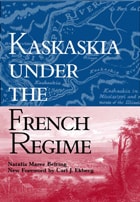
Kaskaskia Under the French Regime
Natalia Maree Belting. Foreword by Carl J. Ekberg
Southern Illinois University Press, 2003
“The Illinois Habitant,” writes Natalia Maree Belting, “was a gay soul; he seemed shockingly carefree to later, self-righteous puritans from the American colonies. He danced on Sunday after mass, was passionately attached to faro and half a dozen other card games, and played billiards at all hours. He gossiped long over a friendly pipe and congenial mug of brandy in the half-dusk of his porch or in the noisy tavern.”
First published in 1948, Kaskaskia under the French Regime is a social and economic history of French Kaskaskia from 1703 to 1765. Using a readable, journalistic style, Belting brings to life the prairie terrain, the Kaskaskia mission, early architecture, building methods and materials, the beginnings of government, domestic tools and utensils, commerce, and the social customs of the pioneer.
In 1703, Kaskaskia was little more than a mission station in Illinois territory inhabited by a few French traders, their Indian wives, and a priest. Later in the century, the settlement became a flourishing French village filled with rows of low one-story French-style houses lining the streets. But the unique native and French bonds began when the explorers Louis Joliet and Pierre Marquette discovered a peaceful tribe, the Kaskaskia, while journeying along the Illinois River.
This historic friendship grew into a unique colonial culture, the remnants which can be seen through numerous primary source documents. Belting draws on and translates from eighteenth century French the Kaskaskia Manuscripts, in which French notaries recorded parish marriage contracts, property transactions (including slave sales), and estate inventories. She also examines the papers of the Marquis de Vaudreuil, among them the most complete census ever conducted in French Illinois, which provides a household-by-household enumeration of the population. What results is a comprehensive depiction of the lives and livelihood of French settlers in colonial Illinois.
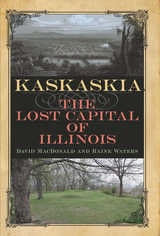
Kaskaskia
The Lost Capital of IllinoisDavid MacDonald and Raine Waters
Southern Illinois University Press, 2019
At the outset the Kaskaskia tribe, along with Jesuit missionaries and French traders, settled near the confluence of the Kaskaskia and Mississippi rivers, about sixty miles south of modern-day St. Louis. The town quickly became the largest French town and most prosperous settlement in the Illinois Country. After French control ended, Kaskaskia suffered under corrupt British and then inept American rule. In the 1790s the town revived and became the territorial capital, and in 1818 it became the first state capital. Along the way Kaskaskia was beset by disasters: crop failures, earthquakes, tornadoes, floods, epidemics, and the loss of the capital-city title to Vandalia. Likewise, human activity and industry eroded the river’s banks, causing the river to change course and eventually wash away the settlement. All that remains of the state’s first capital today is a village several miles from the original site.
MacDonald and Waters focus on the town’s growth, struggles, prosperity, decline, and obliteration, providing an overview of its domestic architecture to reveal how its residents lived. Debunking the notion of a folklore tradition about a curse on the town, the authors instead trace those stories to late nineteenth-century journalistic inventions. The result is a vibrant, heavily illustrated, and highly readable history of Kaskaskia that sheds light on the entire early history of Illinois.

Katherine Mansfield's Fiction
Patrick D. Morrow
University of Wisconsin Press, 1993
This book attempts to analyze a major part of Mansfield's fiction, concentrating on an analysis of the various textures, themes, and issues, plus the point of view virtuosity that she accomplished in her short lifetime (34 years). Many of her most famous works, such as "Prelude" and "Bliss," are explicated, along with many of her less famous and unfinished stories.
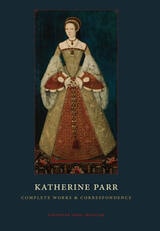
Katherine Parr
Complete Works and CorrespondenceKatherine Parr
University of Chicago Press, 2011
To the extent that she is popularly known, Katherine Parr (1512–48) is the woman who survived King Henry VIII as his sixth and last wife. She merits far greater recognition, however, on several other fronts. Fluent in French, Italian, and Latin, Parr also began, out of necessity, to learn Spanish when she ascended to the throne in 1543. As Henry’s wife and queen of England, she was a noted patron of the arts and music and took a personal interest in the education of her stepchildren, Princesses Mary and Elizabeth and Prince Edward. Above all, Parr commands interest for her literary labors: she was the first woman to publish under her own name in English in England.
For this new edition, Janel Mueller has assembled the four publications attributed to Parr—Psalms or Prayers, Prayers or Meditations, The Lamentation of a Sinner, and a compilation of prayers and Biblical excerpts written in her hand—as well as her extensive correspondence, which is collected here for the first time. Mueller brings to this volume a wealth of knowledge of sixteenth-century English culture. She marshals the impeccable skills of a textual scholar in rendering Parr’s sixteenth-century English for modern readers and provides useful background on the circumstances of and references in Parr’s letters and compositions. Given its scope and ambition, Katherine Parr: Complete Works and Correspondence will be an event for the English publishing world and will make an immediate contribution to the fields of sixteenth-century literature, reformation studies, women’s writing, and Tudor politics.
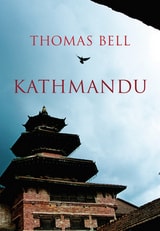
Kathmandu
Thomas Bell
Haus Publishing, 2016
Closed to the outside world until 1951 and trapped in a medieval time warp, Kathmandu is, as Bell argues, a jewel of the art world, a carnival of sexual license, a hotbed of communist revolution, a paradigm of failed democracy, a case study in bungled western intervention, and an environmental catastrophe. The layered development of the city can be seen in the successive generations of its gods and goddesses; its comfort in the caste system and ethos of aristocracy and kingship; and the recent destabilizing effects of consumerist approaches and the push for egalitarianism and democracy. In important ways, Kathmandu’s rapid modernization can be seen as an extreme version of what is happening in other traditional societies. Bell also discusses the ramifications of the recent Nepal earthquake.
A comprehensive look at a top global destination, Kathmandu is an entertaining and accessible chronicle for anyone eager to learn more about this fascinating city.
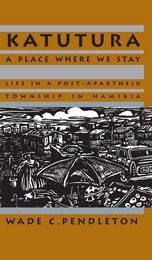
Katutura
A Place Where We Stay: Life in a Post-Apartheid Township in NamibiaWade C. Pendleton
Ohio University Press, 1995

Kayanerenkó
wa: The Great Law of PeaceKayanesenh Paul Williams
University of Manitoba Press, 2018
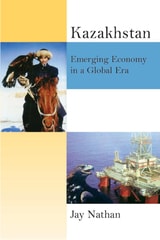
Kazakhstan's New Economy
Post-Soviet, Central Asian Industries in a Global EraJay Nathan
University of Scranton Press, 2013
“An excellent resource on major industries in Kazakhstan.”—Byrganym Aitimova, Minister of Education and Science, the Republic of Kazakhstan

Kazimir Malevich
The Climax of DisclosureRainer Crone and David Moos
University of Chicago Press, 1991
Against the historical background of distinctly Russian progressive cultural and scientific movements, the authors define affinities between Malevich's work and other nonpolitical revolutions: relativity and quantum theory in physics; the work of Roman Jakobson and the "Prague School" in linguistics; and the exploration of language in the writings of the poet Velimir Khlebnikov. They situate the artist within the fundamental epistemological shift from nineteenth-century objectivity to an all-pervasive modernist subjectivity, relying upon Malevich's contribution to illustrate the ways cultural production is mediated through various modes of transmission.

Kearney's Own
The History of the First New Jersey Brigade in the Civil WarGottfried, Bradley M
Rutgers University Press, 2005
From the first battle at Bull Run to the surrender of Lee's army at Appomattox four years later, only one federal infantry brigade experienced the entire Civil War as a cohesive unit. While most units were composed of regiments from different states that were disbanded after three years, the First New Jersey Brigade was the enduring exception.
Despite the group's remarkable coherency, it started as many military units did during the early stages of the war-a disorganized ragtag outfit that was poorly trained and ill-prepared for battle. This quickly changed, however, with the appointment of General Philip Kearny in the fall of 1861. Kearny transformed the troops, making them among the most disciplined and effective commands in the Army of the Potomac. A series of notable victories earned the soldiers an impressive reputation and, with it, thousands of others voluntarily came forward to enlist. Even when they suffered heavy losses, the New Jersey regiments fought exceptionally well and served key roles in dozens of battles, including the Peninsula, Seven Days, Second Bull Run, Antietam, Chancellorsville, Wilderness, Spotsylvania, Cold Harbor, Early's Valley, and the Petersburg Campaigns.
In Kearny's Own, Bradley M. Gottfried weaves together compelling accounts of battles fought with a wealth of letters and diaries to tell the story of this famous brigade from a uniquely personal perspective. The hopes, fears, and sorrows of the men come through vividly as accounts reveal how civilians were physically and emotionally transformed into soldiers. Primary sources also provide insight to what the war meant to the men who fought for the Union.
Fourteen maps illustrate the battles and marches, while detailed appendices include statistical breakdowns of losses and outline the fates of the men whose letters and diaries are used as sources. In this first book published on the subject, Gottfried not only provides a long-overdue history of the First New Jersey Brigade, he offers a human window into the turbulent and trying experiences of war.
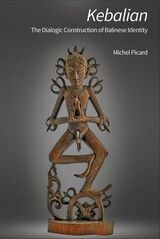
Kebalian
The Dialogic Construction of Balinese IdentityMichel Picard
National University of Singapore Press, 2024
Over the past one hundred years, the Balinese have been challenged by colonial occupation, political turbulence, and, most recently, tourism. In response, they have come to rely on the idea of “Kebalian,” or Balinese-ness. Kebalian is likened to a tree whose roots are religion (agama), the trunk is tradition (adat), and the fruits, Balinese culture (budaya). To understand how this sense of Balinese-ness came to be, Michel Picard examines the dialogues that the Balinese have engaged in both among themselves and with outsiders by conducting over a hundred interviews with Balinese opinion leaders, officials, and religious reformers. A key throughline in the construction of Kebalian is what Picard identifies as a twofold process of “religionization” and “Hinduization.” This process began with the first years of the incorporation of Bali into the Dutch East Indies and became more urgent with Indonesia’s independence. Kebalian today encompasses the tension between those Balinese eager to defend their customary ritual practices and advocates of Hinduism who deny that such local traditions qualify as agama. Kebalian presents a fascinating picture of religious change, identities in motion, and culture. Scholars of religion, cultural change, and Southeast Asian area studies will find this to be a fascinating and important book.

Keenie Meenie
The British Mercenaries Who Got Away with War CrimesPhil Miller
Pluto Press, 2020
Like its mysterious name, Keenie Meenie Services escaped definition and to this day has evaded sanctions. Now explosive new evidence - only recently declassified - exposes the extent of these war crimes, and the British government's tacit support for the company's operations. Including testimonies from SAS veterans, spy chiefs and diplomats, we hear from key figures battle-hardened by the Troubles in Northern Ireland and the Iranian Embassy siege. Investigative journalist Phil Miller asks, who were these mercenaries: heroes, terrorists, freedom fighters or war criminals?
This book presents the first ever comprehensive case against Keenie Meenie Services, providing long overdue evidence on the crimes of the people who make a killing from killing.

Keep On Fighting
The Life and Civil Rights Legacy of Marian A. SpencerDorothy H. Christenson
Ohio University Press, 2015
Marian Alexander Spencer was born in 1920 in the Ohio River town of Gallipolis, Ohio, one year after the “Red Summer” of 1919 that saw an upsurge in race riots and lynchings. Following the example of her grandfather, an ex-slave and community leader, Marian joined the NAACP at thirteen and grew up to achieve not only a number of civic leadership firsts in her adopted home city of Cincinnati, but a legacy of lasting civil rights victories.
Of these, the best known is the desegregation of Cincinnati’s Coney Island amusement park. She also fought to desegregate Cincinnati schools and to stop the introduction of observers in black voting precincts in Ohio. Her campaign to raise awareness of industrial toxic-waste practices in minority neighborhoods was later adapted into national Superfund legislation.
In 2012, Marian’s friend and colleague Dot Christenson sat down with her to record her memories. The resulting biography not only gives us the life story of remarkable leader but encapsulates many of the twentieth century’s greatest struggles and advances. Spencer’s story will prove inspirational and instructive to citizens and students alike.

Keep Your Airspeed Up
The Story of a Tuskegee AirmanHarold H. Brown and Marsha S. Bordner
University of Alabama Press, 2017
Inspiring memoir of Colonel Harold H. Brown, one of the 930 original Tuskegee pilots, whose dramatic wartime exploits and postwar professional successes contribute to this extraordinary account.
Keep Your Airspeed Up: The Story of a Tuskegee Airman is the memoir of an African American man who, through dedication to his goals and vision, overcame the despair of racial segregation to great heights, not only as a military aviator, but also as an educator and as an American citizen.
Unlike other historical and autobiographical portrayals of Tuskegee airmen, Harold H. Brown’s memoir is told from its beginnings: not on the first day of combat, not on the first day of training, but at the very moment Brown realized he was meant to be a pilot. He revisits his childhood in Minneapolis where his fascination with planes pushed him to save up enough of his own money to take flying lessons. Brown also details his first trip to the South, where he was met with a level of segregation he had never before experienced and had never imagined possible.
During the 1930s and 1940s, longstanding policies of racial discrimination were called into question as it became clear that America would likely be drawn into World War II. The military reluctantly allowed for the development of a flight-training program for a limited number of African Americans on a segregated base in Tuskegee, Alabama. The Tuskegee Airmen, as well as other African Americans in the armed forces, had the unique experience of fighting two wars at once: one against Hitler’s fascist regime overseas and one against racial segregation at home.
Colonel Brown fought as a combat pilot with the 332nd Fighter Group during World War II, and was captured and imprisoned in Stalag VII A in Moosburg, Germany, where he was liberated by General George S. Patton on April 29, 1945. Upon returning home, Brown noted with acute disappointment that race relations in the United States hadn’t changed. It wasn’t until 1948 that the military desegregated, which many scholars argue would not have been possible without the exemplary performance of the Tuskegee Airmen.
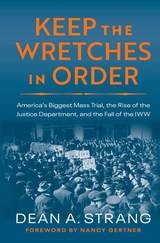
Keep the Wretches in Order
America's Biggest Mass Trial, the Rise of the Justice Department, and the Fall of the IWWDean A. Strang
University of Wisconsin Press, 2020
In the first legal history of this federal trial, Dean Strang shows how the case laid the groundwork for a fundamentally different strategy to stifle radical threats, and had a major role in shaping the modern Justice Department. As the trial unfolded, it became an exercise of raw force, raising serious questions about its legitimacy and revealing the fragility of a criminal justice system under great external pressure.

Keepers of the Flame
NFL Films and the Rise of Sports MediaTravis Vogan
University of Illinois Press, 2014
Drawing on research at the NFL Films Archive and the Pro Football Hall of Fame and interviews with media pioneer Steve Sabol and others, Travis Vogan shows how NFL Films has constructed a consistent, romanticized, and remarkably visible mythology for the National Football League. The company packages football as a visceral and dramatic sequence of violent, beautiful, graceful, and heroic gridiron battles. Historically proven formulas for presentation--such as the dramatic voiceovers once provided by John Facenda's baritone, the soaring scores of Sam Spence's rousing background music, and the epic poetry found in Steve Sabol's scripts--are still used today.
From the Vincent Price-narrated Strange but True Football Stories to the currently running series Hard Knocks, NFL Films distinguishes the NFL from other sports organizations and from other media and entertainment. Vogan tells the larger story of the company's relationship with and vast influence on our culture's representations of sport, the expansion of sports television beyond live game broadcasts, and the emergence of cable television and Internet sports media.
Keepers of the Flame: NFL Films and the Rise of Sports Media presents sports media as an integral facet of American popular culture and NFL Films as key to the transformation of professional football into the national obsession commonly known as America's Game.
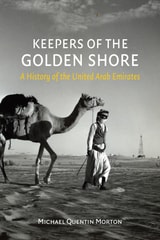
Keepers of the Golden Shore
A History of the United Arab EmiratesMichael Quentin Morton
Reaktion Books, 2016
As Michael Quentin Morton recounts, the region now known as the UAE likely began as a trading post between Mesopotamia and Oman, and since that time has been the stage of important economic and cultural exchanges. It has seen the rise and fall of a thriving pearl industry, piracy, invasions and wars, and the arrival of the oil age that would make it one of the richest countries on earth. Since the early 1970s, when seven sheikhs agreed to enter into a union, it has been a sovereign nation, carrying on the resourceful spirit—with resplendent fervor—that the brutally inhospitable landscape has long demanded of the people. Ultimately, Morton shows that the country is not only rich in oil and money but in an extraordinarily deep history and culture.

Keepin' It Real
Essays on Race in Contemporary AmericaElwood David Watson
Intellect Books, 2019
America’s racial problems aren’t going away any time soon. Keepin’ It Real will serve as a marker of the arguments we’re having right now, and an argument for the changes we need to make to become the better nation we’ve long imagined ourselves to be.
Keeping An Open Door
Passages in a University PresidencyKeith Brodie and Leslie Banner
Duke University Press, 1996
In Keeping an Open Door, Duke chancellor (1982-1985) and president (1985-1993) Keith Brodie and coauthor Leslie Banner recount what it was like to lead Duke during an era of change for research universities across the country: how Brodie reached some of his most controversial decisions, including the “Black Faculty Initiative”; his strategy for precluding abuse in Division I athletics at Duke; how his training as a psychiatrist shaped his leadership style and influenced how he dealt with trustees, deans, faculty, and students; and the avenues of power still open to today’s university presidents. The history and feeling of life on the Duke campus during the Brodie era are vividly evoked in photographs and key speeches introduced by the former president’s personal recollections.
Keeping an Open Door provides an insider’s view of issues critical to modern research universities and will interest anyone concerned with the history and future of higher education.
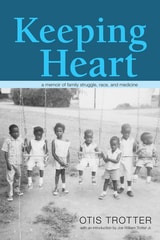
Keeping Heart
A Memoir of Family Struggle, Race, and MedicineOtis Trotter
Ohio University Press, 2015
“After saying our good-byes to friends and neighbors, we all got in the cars and headed up the hill and down the road toward a future in Ohio that we hoped would be brighter,” Otis Trotter writes in his affecting memoir, Keeping Heart: A Memoir of Family Struggle, Race, and Medicine.
Organized around the life histories, medical struggles, and recollections of Trotter and his thirteen siblings, the story begins in 1914 with his parents, Joe William Trotter Sr. and Thelma Odell Foster Trotter, in rural Alabama. By telling his story alongside the experiences of his parents as well as his siblings, Otis reveals cohesion and tensions in twentieth-century African American family and community life in Alabama, West Virginia, and Ohio.
This engaging chronicle illuminates the journeys not only of a black man born with heart disease in the southern Appalachian coalfields, but of his family and community. It fills an important gap in the literature on an underexamined aspect of American experience: the lives of blacks in rural Appalachia and in the nonurban endpoints of the Great Migration. Its emotional power is a testament to the importance of ordinary lives.
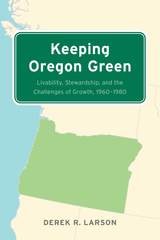
Keeping Oregon Green
Livability, Stewardship, and the Challenges of Growth, 1960–1980Derek R. Larson
Oregon State University Press, 2016
Keeping Oregon Green is a new history of the signature accomplishments of Oregon’s environmental era: the revitalization of the polluted Willamette River, the Beach Bill that preserved public access to the entire coastline, the Bottle Bill that set the national standard for reducing roadside litter, and the nation’s first comprehensive land use zoning law, colloquially known as LDCD. To these case studies is added the largely forgotten tale of what would have been Oregon’s second National Park, intended to preserve the Oregon Dunes as one of the country’s first National Seashores.
Through the detailed study of the historical, political, and cultural contexts of these environmental conflicts the author uncovers new dimensions in familiar stories linked to the concepts of “livability” and environmental stewardship. Linking events in Oregon to the national environmental awakening of the 1960s-1970s, the innovative environmental policies that carried Oregon to a position of national leadership are shown to be products of place and culture as much as politics. While political leaders played critical roles in framing new laws, the advocacy of ordinary citizens-- farmers, students, business leaders, and factory workers --drove a movement that crossed partisan, geographic, and class lines to make Oregon the nation’s environmental showplace of the 1970s.
Drawing on extensive archival research, source materials ranging from poetry to congressional hearings, and firmly rooted in the cultural, economic, and political history of the Pacific Northwest, Keeping Oregon Green argues that the state’s environmental legacy is not just the product of visionary leadership, but rather a complex confluence of events, trends, and personalities that could only have happened when and where it did. The linked concepts of livability and stewardship behind Oregon’s success were not transferrable to other places or times, dooming efforts to repeat the state’s signature achievements elsewhere to failure.