Results by title
1993 books match the query 'Latin America' and 97 start with l
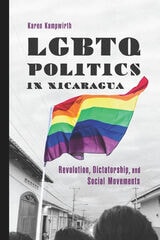
LGBTQ Politics in Nicaragua
Revolution, Dictatorship, and Social MovementsKaren Kampwirth
University of Arizona Press, 2022
Karen Kampwirth is a renowned scholar of the Nicaraguan Revolution, who has been writing at the intersection of gender and politics for decades. In this chronological telling of the last fifty years of political history in Nicaragua, Kampwirth deploys a critical new lens: understanding politics from the perspective of the country’s LGBTQ community. Kampwirth details the gay and lesbian guerrillas in the 1960s and 1970s, Nicaragua’s first openly gay television wizard in the 1980s, and the attempts by LGBTQ revolutionaries to create a civil rights movement and the subsequent squashing of that movement by the ruling Sandinista party. She analyzes the shifting political alliances, the rise of strong feminist and LGBTQ movements in Nicaragua, and the attempts by the administration of Daniel Ortega to co-opt and control these movements.
Ultimately, this is a story of struggle and defeat, progress and joy. This timely book provides a well-documented review of LGBTQ politics in modern Nicaragua, helping us to see the Sandinista Revolution and its ongoing aftermath in a new light.
La Florida del Inca and the Struggle for Social Equality in Colonial Spanish America
Jonathan D. Steigman
University of Alabama Press, 2005
A cross-disciplinary view of an important De Soto chronicle.
Among the early Spanish chroniclers who contributed to popular images of the New World was the Amerindian-Spanish (mestizo) historian and literary writer, El Inca Garcilaso de la Vega (1539-1616). He authored several works, of which La Florida del Inca (1605) stands out as the best because of its unique Amerindian and European perspectives on the De Soto expedition (1539-1543). As the child of an Indian mother and a Spanish father, Garcilaso lived in both worlds--and saw value in each. Hailed throughout Europe for his excellent contemporary Renaissance writing style, his work was characterized as literary art. Garcilaso revealed the emotions, struggles, and conflicts experienced by those who participated in the historic and grandiose adventure in La Florida. Although criticized for some lapses in accuracy in his attempts to paint both the Spaniards and the Amerindians as noble participants in a world-changing event, his work remains the most accessible of all the chronicles.
In this volume, Jonathan Steigman explores El Inca’s rationale and motivations in writing his chronicle. He suggests that El Inca was trying to influence events by influencing discourse; that he sought to create a discourse of tolerance and agrarianism, rather than the dominant European discourse of intolerance, persecution, and lust for wealth. Although El Inca's purposes went well beyond detailing the facts of De Soto’s entrada, his skill as a writer and his dual understanding of the backgrounds of the participants enabled him to paint a more complete picture than most--putting a sympathetic human face on explorers and natives alike.
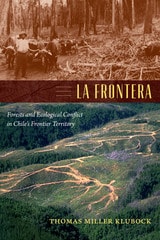
La Frontera
Forests and Ecological Conflict in Chile's Frontier TerritoryThomas Miller Klubock
Duke University Press, 2014
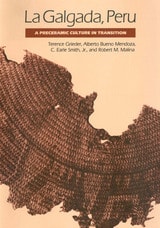
La Galgada, Peru
A Preceramic Culture in TransitionBy Terence E. Grieder, Alberto Bueno Mendoza, C. Earle Smith, Jr., and Robert M. Malina
University of Texas Press, 1988
Excavations over many years in the Peruvian Andes and coastal regions have revealed that the village settlements on the west coast of South America were one of the early centers of world civilization. One of these settlements, La Galgada, flourished from 3000 B.C. to 1700 B.C. Its extraordinarily complete cultural remains help to reconstruct a picture of human life, health, activities, and trade relations as they were 4,000 years ago and allow us to enter the mental and artistic life of this early civilization.
The location of La Galgada on Peru’s Tablachaca River midway between the highlands and the coast caused it to be influenced by the culture of both those regions. The remains found at La Galgada tie together important textile collections from the coastal region with important architectural remains from the Andean highland to give a picture of a complete preceramic culture in ancient Peru. Numerous illustrations provide an exciting visual catalog of the finds at La Galgada. What also makes La Galgada such a significant site are the changes in art and architecture that can be documented in considerable detail from about 2500 B.C. to about 1700 B.C. During that period, La Galgada and the other preceramic communities in northern Peru were transformed with a rapidity that must have seemed shocking and revolutionary to their inhabitants. These changes record the first appearance of the powerful and intimidating Chavín culture that was to dominate the region for the next thousand years. They also allow us to watch a people change and adapt as they try to cope with the powerful pressure of technical and social development in their region.
La Patria del Criollo
An Interpretation of Colonial GuatemalaSevero Martínez Peláez
Duke University Press, 2009
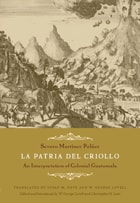
Martínez Peláez asserts that “the coffee dictatorships were the full and radical realization of criollo notions of the patria.” This patria, or homeland, was one that criollos had wrested from Spaniards in the name of independence and taken control of based on claims of liberal reform. He contends that since labor is needed to make land productive, the exploitation of labor, particularly Indian labor, was a necessary complement to criollo appropriation. His depiction of colonial reality is bleak, and his portrayal of Spanish and criollo behavior toward Indians unrelenting in its emphasis on cruelty and oppression. Martínez Peláez felt that the grim past he documented surfaces each day in an equally grim present, and that confronting the past is a necessary step in any effort to improve Guatemala’s woes. An extensive introduction situates La Patria del Criollo in historical context and relates it to contemporary issues and debates.
La Raza Cosmética
Beauty, Identity, and Settler Colonialism in Postrevolutionary MexicoNatasha Varner
University of Arizona Press, 2020
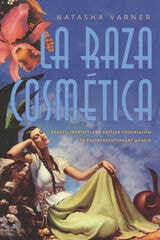
Critically examining beauty pageants, cinema, tourism propaganda, photography, murals, and more, Natasha Varner shows how postrevolutionary understandings of mexicanidad were fundamentally structured by legacies of colonialism, as well as shifting ideas about race, place, and gender. This interdisciplinary study smartly weaves together cultural history, Indigenous and settler colonial studies, film and popular culture analysis, and environmental and urban history. It also traces a range of Indigenous interventions in order to disrupt top-down understandings of national identity construction and to “people” this history with voices that have all too often been entirely ignored.
La Revolución
Mexico's Great Revolution as Memory, Myth, and HistoryBy Thomas Benjamin
University of Texas Press, 2000
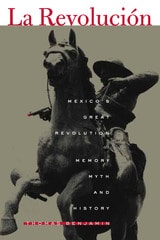
The 1910 Revolution is still tangibly present in Mexico in the festivals that celebrate its victories, on the monuments to its heroes, and, most important, in the stories and memories of the Mexican people. Yet there has never been general agreement on what the revolution meant, what its objectives were, and whether they have been accomplished.
This pathfinding book shows how Mexicans from 1910 through the 1950s interpreted the revolution, tried to make sense of it, and, through collective memory, myth-making, and history writing, invented an idea called "la Revolución." In part one, Thomas Benjamin follows the historical development of different and often opposing revolutionary traditions and the state's efforts to forge them into one unified and unifying narrative. In part two, he examines ways of remembering the past and making it relevant to the present through fiestas, monuments, and official history. This research clarifies how the revolution has served to authorize and legitimize political factions and particular regimes to the present day. Beyond the Mexican case, it demonstrates how history is used to serve the needs of the present.
La Verdad
An International Dialogue on Hip Hop LatinidadesEdited by Melissa Castillo-Garsow and Jason Nichols
The Ohio State University Press, 2016
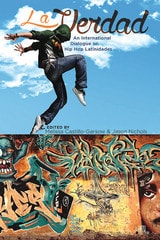
A truly international effort, La Verdad: An International Dialogue on Hip Hop Latinidades brings together exciting new work about Latino/a hip hop across more than a dozen countries, from scholars and practitioners in the United States and in Latin America, highlighting in new ways the participation of women, indigenous peoples, and Afro-descendants in a reimagined global, hip hop nation. From graffitera crews in Costa Rica and Nicaragua to Mexican hip hop in New York, from Aymara rap in Bolivia to Chicano rap in Taiwan, this volume explodes stereotypes of who and how hip hop is consumed, lived, and performed. Examining hip hop movements in Spanish, English, Portuguese, Aymara, and Creole, La Verdad demonstrates that Latino hip hop is a multilingual expression of gender, indigeneity, activism, and social justice.
La proyección del neoliberalismo
Las transformaciones del cine mexicano (1988–2012)Ignacio M. Sánchez Prado
Vanderbilt University Press, 2019
Labor Justice across the Americas
Leon Fink, Juan Palacio
University of Illinois Press, 2018
Labors Appropriate to Their Sex
Gender, Labor, and Politics in Urban Chile, 1900–1930Elizabeth Quay Hutchison
Duke University Press, 2001
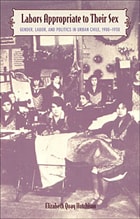
In addition to population and industrial censuses, Hutchison culls published and archival sources to illuminate such misconceptions and to reveal how women’s paid labor became a locus of anxiety for a society confronting social problems—both real and imagined—that were linked to industrialization and modernization. The limited options of working women were viewed by politicians, elite women, industrialists, and labor organizers as indicative of a society in crisis, she claims, yet their struggles were also viewed as the potential springboard for reform. Labors Appropriate to Their Sex thus demonstrates how changing norms concerning gender and work were central factors in conditioning the behavior of both male and female workers, relations between capital and labor, and political change and reform in Chile.
Land of Necessity
Consumer Culture in the United States–Mexico BorderlandsAlexis McCrossen, ed.
Duke University Press, 2009
In Land of Necessity, historians and anthropologists unravel the interplay of the national and transnational and of scarcity and abundance in the region split by the 1,969-mile boundary line dividing Mexico and the United States. This richly illustrated volume, with more than 100 images including maps, photographs, and advertisements, explores the convergence of broad demographic, economic, political, cultural, and transnational developments resulting in various forms of consumer culture in the borderlands. Though its importance is uncontestable, the role of necessity in consumer culture has rarely been explored. Indeed, it has been argued that where necessity reigns, consumer culture is anemic. This volume demonstrates otherwise. In doing so, it sheds new light on the history of the U.S.-Mexico borderlands, while also opening up similar terrain for scholarly inquiry into consumer culture.
The volume opens with two chapters that detail the historical trajectories of consumer culture and the borderlands. In the subsequent chapters, contributors take up subjects including smuggling, tourist districts and resorts, purchasing power, and living standards. Others address home décor, housing, urban development, and commercial real estate, while still others consider the circulation of cinematic images, contraband, used cars, and clothing. Several contributors discuss the movement of people across borders, within cities, and in retail spaces. In the two afterwords, scholars reflect on the U.S.-Mexico borderlands as a particular site of trade in labor, land, leisure, and commodities, while also musing about consumer culture as a place of complex political and economic negotiations. Through its focus on the borderlands, this volume provides valuable insight into the historical and contemporary aspects of the big “isms” shaping modern life: capitalism, nationalism, transnationalism, globalism, and, without a doubt, consumerism.
Contributors. Josef Barton, Peter S. Cahn, Howard Campbell, Lawrence Culver, Amy S. Greenberg, Josiah McC. Heyman, Sarah Hill, Alexis McCrossen, Robert Perez, Laura Isabel Serna, Rachel St. John, Mauricio Tenorio-Trillo, Evan R. Ward
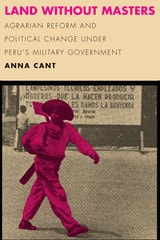
Land without Masters
Agrarian Reform and Political Change under Peru's Military GovernmentBy Anna Cant
University of Texas Press, 2021
In 1969, Juan Velasco Alvarado’s military government began an ambitious land reform program in Peru, transferring holdings from large estates to peasant cooperatives. Fifty years later this reform remains controversial: critics claim it unjustly expropriated land and ruined the Peruvian economy, while supporters emphasize its success in addressing rural inequality and exploitation.
Moving beyond agricultural policy to offer a fresh perspective on the agrarian reform, Land without Masters shows how ideological assumptions and state interventions surrounding the reform transformed Peru’s political culture and social fabric. Drawing on fieldwork in three different regions, Anna Cant shows how the government adapted its discourse and interventions to the local context while using the reform as a platform for nation-building. This comparative approach reveals how local actors shaped the regional impact of the agrarian reform and highlights the new forms of agency that emerged, including that of marginalized peasants who helped forge a new social, cultural, and political landscape.
Making novel use of both visual and cultural sources, this book is a fascinating look at how the agrarian reform process permanently altered the relationship between rural citizens and the national government—and how it continues to resonate in Peruvian politics today.
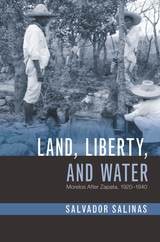
Land, Liberty, and Water
Morelos After Zapata, 1920–1940Salvador Salinas
University of Arizona Press, 2018
Salvador Salinas takes readers inside the diverse pueblos of the former Zapatistas during the 1920s and 1930s and recounts the first statewide land reform carried out in postrevolutionary Mexico. Based on extensive archival research, he reveals how an alliance with the national government that began in 1920 stimulated the revival of rural communities after ten years of warfare and helped once-landless villagers reclaim Morelos’s valley soils, forested mountains, and abundant irrigation waters.
During the presidency of Plutarco Elías Calles (1924–1928), pueblos forged closer ties to the centralized government in Mexico City through a plethora of new national institutions, such as ejidos, forestry cooperatives, water juntas, credit societies, and primary schools. At the same time, the expansion of charcoal production in the Sierra de Ajusco and rice cultivation in the lowland valleys accelerated deforestation and intensified water conflicts.
Salinas recounts how the federal reforms embraced by the countryside aided the revival of the pueblos, and in return, villagers repeatedly came to the defense of an embattled national regime. Salinas gives readers interested in modern Mexico, the Zapatista revolution, and environmental history a deeply researched analysis of the outcomes of the nation’s most famous revolutionary insurgency.
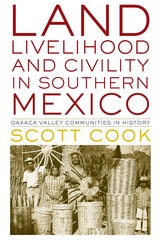
Land, Livelihood, and Civility in Southern Mexico
Oaxaca Valley Communities in HistoryBy Scott Cook
University of Texas Press, 2014
In the Valley of Oaxaca in Mexico’s Southern Highland region, three facets of sociocultural life have been interconnected and interactive from colonial times to the present: first, community land as a space to live and work; second, a civil-religious system managed by reciprocity and market activity wherein obligations of citizenship, office, and festive sponsorships are met by expenditures of labor-time and money; and third, livelihood. In this book, noted Oaxacan scholar Scott Cook draws on thirty-five years of fieldwork (1965–1990) in the region to present a masterful ethnographic historical account of how nine communities in the Oaxaca Valley have striven to maintain land, livelihood, and civility in the face of transformational and cumulative change across five centuries.
Drawing on an extensive database that he accumulated through participant observation, household surveys, interviews, case studies, and archival work in more than twenty Oaxacan communities, Cook documents and explains how peasant-artisan villagers in the Oaxaca Valley have endeavored over centuries to secure and/or defend land, worked and negotiated to subsist and earn a living, and striven to meet expectations and obligations of local citizenship. His findings identify elements and processes that operate across communities or distinguish some from others. They also underscore the fact that landholding is crucial for the sociocultural life of the valley. Without land for agriculture and resource extraction, occupational options are restricted, livelihood is precarious and contingent, and civility is jeopardized.
Landowners in Colonial Peru
By Keith A. Davies
University of Texas Press, 1984
In 1540 a small number of Spaniards founded the city of Arequipa in southwestern Peru. These colonists, later immigrants, and their descendants devoted considerable energy to exploiting the surrounding area. At first, like many other Spaniards in the Americas, they relied primarily on Indian producers; by the late 1500s they had acquired land and established small farms and estates. This, the first study to examine the agrarian history of a region in South America from the mid-sixteenth through late-seventeenth century, demonstrates that colonials exploited the countryside as capitalists. They ran their rural enterprises as efficiently as possible, expanded their sources of credit and labor, tapped widespread markets, and lobbied strenuously to influence the royal government. The reasons for such behavior have seldom been explored beyond the colonists’ evident need to sustain themselves and their dependents.
Arequipa’s case suggests another fundamental cause of capitalist behavior in colonial South America: rural wealth was inextricably tied to the colonists’ desire to reinforce and improve their stature. Arequipa’s Spanish families of the upper and middle social levels consistently employed land and its proceeds to attract prominent spouses, to acquire prestigious political and military posts, and to enhance their standing by becoming benefactors of the Church. They rarely lost sight of the crucial role that wealth played in their lives. Thus, when the region’s economy flourished, as it did during the late 1500s, they expanded and improved their holdings. When it faltered at the beginning of the next century, they made every effort to retain properties, even fragmenting land to accommodate family members and new spouses. Unlike patterns sometimes suggested for Spanish America, many Arequipan colonial families possessed land and retained it over many generations. Neither the increasingly rich Church nor a few powerful persons managed to build up extensive estates.
Landowners in Colonial Peru explains how and why rural property became so important. It emphasizes both the capitalist bent of Hispanics and the manner in which wealth served social aspirations. The approach makes clear that many of the economic and social characteristics so often attributed to eighteenth- and nineteenth-century Latin Americans were present from the early Colonial period.
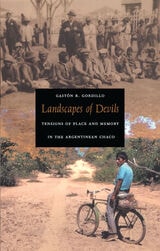
Landscapes of Devils
Tensions of Place and Memory in the Argentinean ChacoGastón R. Gordillo
Duke University Press, 2004
As Gordillo explains, the bush is the result of social, cultural, and political processes that intertwine this place with other geographies. Labor exploitation, state violence, encroachment by settlers, and the demands of Anglican missionaries all transformed this land. The Toba’s lives have been torn between alienating work in sugar plantations and relative freedom in the bush, between moments of domination and autonomy, abundance and poverty, terror and healing. Part of this contradictory experience is culturally expressed in devils, evil spirits that acquire different features in different places. The devils are sources of death and disease in the plantations, but in the bush they are entities that connect with humans as providers of bush food and healing power. Enacted through memory, the experiences of the Toba have produced a tense and shifting geography. Combining extensive fieldwork conducted over a decade, historical research, and critical theory, Gordillo offers a nuanced analysis of the Toba’s social memory and a powerful argument that geographic places are not only objective entities but also the subjective outcome of historical forces.
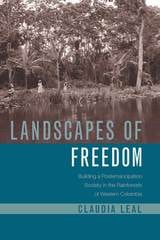
Landscapes of Freedom
Building a Postemancipation Society in the Rainforests of Western ColombiaClaudia Leal
University of Arizona Press, 2018
After emancipation in 1851, the African descendants living in the extra-humid rainforests of the Pacific coast of Colombia attained levels of autonomy hardly equaled anywhere else in the Americas. This autonomy rested on their access to a diverse environment—including small strips of fertile soils, mines, forests, rivers, and wetlands—that contributed to their subsistence and allowed them to procure gold, platinum, rubber, and vegetable ivory for export.
Afro-Colombian slave labor had produced the largest share of gold in the colony of New Granada. After the abolishment of slavery, some free people left the mining areas and settled elsewhere along the coast, making this the largest area of Latin America in which black people predominate into the present day. However, this economy and society, which lived off the extraction of natural resources, was presided over by a very small white commercial elite living in the region’s ports, where they sought to create an urban environment that would shelter them from the jungle.
Landscapes of Freedom reconstructs a nonplantation postemancipation trajectory that sheds light on how environmental conditions and management influenced the experience of freedom. It also points at the problematic associations between autonomy and marginality that have shaped the history of Afro-America. By focusing on racialized landscapes, Leal offers a nuanced and important approach to understanding the history of Latin America.
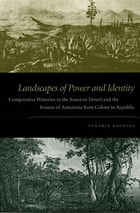
Landscapes of Power and Identity
Comparative Histories in the Sonoran Desert and the Forests of Amazonia from Colony to RepublicCynthia Radding
Duke University Press, 2005
Radding’s comparative approach illuminates what happened when similar institutions of imperial governance, commerce, and religion were planted in different physical and cultural environments. She draws on archival documents, published reports by missionaries and travelers, and previous histories as well as ecological studies and ethnographies. She also considers cultural artifacts, including archaeological remains, architecture, liturgical music, and religious dances. Radding demonstrates how colonial encounters were conditioned by both the local landscape and cultural expectations; how the colonizers and colonized understood notions of territory and property; how religion formed the cultural practices and historical memories of the Sonoran and Chiquitano peoples; and how the conflict between the indigenous communities and the surrounding creole societies developed in new directions well into the nineteenth century.
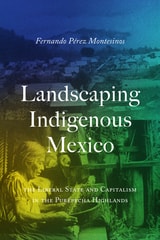
Landscaping Indigenous Mexico
The Liberal State and Capitalism in the Purépecha HighlandsFernando Pérez Montesinos
University of Texas Press, 2025
2026 Bolton-Johnson Prize, Conference on Latin American History
2026 María Elena Martínez Prize in Mexican History, Conference on Latin American History
2026 Honorable Mention, Environment Section of the Latin American Studies Association
A history of the Purépecha people's survival amid environmental and political changes.
Landscapes are more than geological formations; they are living records of human struggles. Landscaping Indigenous Mexico unearths the history of Juátarhu, an Indigenous landscape shaped and nurtured by the Purépecha—a formidable Mesoamerican people whose power once rivaled that of the Aztecs. Although cataclysmic changes came with European contact and colonization, Juátarhu’s enduring agroecology continued to sustain local life through centuries of challenges.
Contesting essentialist narratives of Indigenous penury, Pérez Montesinos shows how Purépechas thrived after Mexican independence in 1821, using Juátarhu’s diverse agroecology to negotiate continued autonomy amid waves of national economic and political upheaval. After 1870, however, autonomy waned under the pressure of land privatization policies, state intervention, and industrial logging. On the eve of the Mexican Revolution in 1910, Purépechas stood at a critical juncture: Would the Indigenous landscape endure or succumb? Offering a fresh perspective on a seemingly well-worn subject, Pérez Montesinos argues that Michoacán, long considered a peripheral revolutionary region, saw one of the era’s most radical events: the destruction of the liberal order and the timber capitalism of Juátarhu.

Las Raras
Feminine Style, Intellectual Networks, and Women Writers during Spanish-American ModernismoSarah Moody
Vanderbilt University Press, 2024
Premio al Mejor Libro en Humanidades, Latin American Studies Association–Nineteenth-Century Section, 2025
Premio Victoria Urbano de Monografía Crítica, Association of Gender and Sexuality Studies, 2025 (co-winner)
Segundo Premio, Adela Zamudio Prize, Feministas Unidas, 2025
Las Raras proposes that the Modernistas’ advocacy for a writing style they considered feminine helps us to understand why so few (and perhaps no) women were accepted as active participants in Modernismo. Author Sarah Moody studies how particular writers contributed to the idea of a feminine aesthetic and tracks the intellectual networks of Modernismo through periodicals and personal papers, such as albums and correspondence. Buenos Aires, Paris, and Montevideo figure prominently in this transatlantic study, which reexamines some of the most important period writers in Spanish, including Rubén Darío, Amado Nervo, and Enrique Gómez Carrillo.
This book also considers the critiques launched by women writers, such as Aurora Cáceres, Clorinda Matto de Turner, and María Eugenia Vaz Ferreira, who experienced Modernista exclusion firsthand, deconstructed the Modernista discourse of a modern, “feminine” style, and built literary success in alternative terms. These writers reoriented the discussion about women in modernity to address women’s education, professionalization, and advocacy for social and civic improvements. In this study, Modernismo emerges as both a literary style and an intellectual network, in which style and sociability are mutually determining and combine to form a system of prestige and validation that excluded women writers.
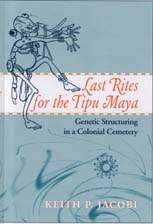
Last Rites for the Tipu Maya
Genetic Structuring in a Colonial CemeteryKeith Jacobi
University of Alabama Press, 2000
Jacobi's groundbreaking osteology study uncovers the history of the Tipu Maya of Belize and their subsequent contact with the Spanish conquistadores and missionaries.
Two cultures collided at Tipu, Belize, in the 1600s: that of the native Maya and that of the Spanish missionaries, who arrived with an agenda of religious subjugation and, ultimately, political control. Combining historical documentation with the results of an archaeological exploration of a Tipu cemetery, Keith Jacobi provides an account of the meshing of these two cultures and the assimilation of Catholic practices by the Tipu.
In particular, Jacobi focuses on the dental remains recovered at this site. A tooth may be the last tangible evidence of a living creature, so teeth can reveal information about an individual's health, diet, cosmetic alteration, trauma, and genetic structure. From the genetic structure the researcher can learn information about an individual's relationship to others in a particular population and between populations.
Jacobi's research reveals how these European and Spanish Catholic practices were assimilated by the Tipu Maya and enables the first description of the prevalent attitudes toward death and burial customs. Through this study of Tipu Maya dentition changes through time, Jacobi sheds light on Spanish intermarriage, Maya familial relationships, and the Tipu genetic affinity with other prehistoric, historic, and modern Maya.
Late Intermediate Occupation at Cerro Azul, Perú, A Preliminary Report
Joyce Marcus
University of Michigan Press, 1987
Latent Memory
Human Rights and Jewish Identity in ChileMaxine Lowy
University of Wisconsin Press, 2022
Maxine Lowy draws upon hundreds of first-person testimonials and archival resources to explore Chilean Jewish identity in the wake of Pinochet's coup, exposing the complex and sometimes contradictory development of collective traumatic memory and political sensibilities in an oppressive new context. Latent Memory points to processes of community gestures of moral reparation and signals the pathways to justice and healing associated with Shoah and the Jewish experience. Lowy asks how individuals and institutions may overcome fear, indifference, and convenience to take a stand even under intense political duress, posing questions applicable to any nation emerging from state repression.
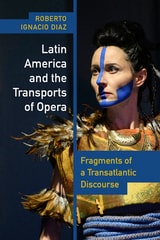
Latin America and the Transports of Opera
Fragments of a Transatlantic DiscourseRoberto Ignacio Díaz
Vanderbilt University Press, 2023
Latin America and the Transports of Opera studies a series of episodes in the historical and textual convergence of a hallowed art form and a part of the world often regarded as peripheral. Perhaps unexpectedly, the archives of opera generate new arguments about several issues at the heart of the established discussion about Latin America: the allure of European cultural models; the ambivalence of exoticism; the claims of nationalism and cosmopolitanism; and, ultimately, the place of the region in the global circulation of the arts. Opera’s transports concern literal and imagined journeys as well as the emotions that its stories and sounds trigger as they travel back and forth between Europe—the United States, too—and Latin America.
Focusing mostly on librettos and other literary forms, this book analyzes Calderón de la Barca’s baroque play on the myth of Venus and Adonis, set to music by a Spanish composer at Lima’s viceregal court; Alejo Carpentier’s neobaroque novella on Vivaldi’s opera about Moctezuma; the entanglements of opera with class, gender, and ethnicity throughout Cuban history; music dramas about enslaved persons by Carlos Gomes and Hans Werner Henze, staged in Rio de Janeiro and Copenhagen; the uses of Latin American poetry and magical realism in works by John Adams and Daniel Catán; and a novel by Manuel Mujica Lainez set in Buenos Aires’s Teatro Colón, plus a chamber opera about Victoria Ocampo with a libretto by Beatriz Sarlo. Close readings of these texts underscore the import and meanings of opera in Latin American cultural history.
This book is the recipient of the 2024 Norman L. and Roselea J. Goldberg Prize from Vanderbilt University Press for the best book in the area of art or medicine.
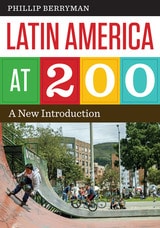
Latin America at 200
A New IntroductionBy Phillip Berryman
University of Texas Press, 2016
Between 2010 and 2025, most of the countries of Latin America will commemorate two centuries of independence, and Latin Americans have much to celebrate at this milestone. Most countries have enjoyed periods of sustained growth, while inequality is showing modest declines and the middle class is expanding. Dictatorships have been left behind, and all major political actors seem to have accepted the democratic process and the rule of law. Latin Americans have entered the digital world, routinely using the Internet and social media.
These new realities in Latin America call for a new introduction to its history and culture, which Latin America at 200 amply provides. Taking a reader-friendly approach that focuses on the big picture and uses concrete examples, Phillip Berryman highlights what Latin Americans are doing to overcome extreme poverty and underdevelopment. He starts with issues facing cities, then considers agriculture and farming, business, the environment, inequality and class, race and ethnicity, gender, and religion. His survey of Latin American history leads into current issues in economics, politics and governance, and globalization. Berryman also acknowledges the ongoing challenges facing Latin Americans, especially crime and corruption, and the efforts being made to combat them. Based on decades of experience, research, and travel, as well as recent studies from the World Bank and other agencies, Latin America at 200 will be essential both as a classroom text and as an introduction for general readers.
Latin America in Caricature
By John J. Johnson
University of Texas Press, 1993
“Not many readers will thank the author as he deserves, for he has told us more about ourselves than we perhaps wish to know,” predicted Latin America in Books of Latin America in Caricature—an exploration of more than one hundred years of hemispheric relations through political cartoons collected from leading U.S. periodicals from the 1860s through 1980.
The cartoons are grouped according to recurring themes in diplomacy and complementing visual imagery. Each one is accompanied by a lengthy explanation of the incident portrayed, relating the drawing to public opinion of the day. Johnson’s thoughtful introduction and the comments that precede the individual chapters provide essential background for understanding U.S. attitudes and policies toward Latin America.
Latin America in Debate
Indigeneity, Development, Dependency, PopulismMaristella Svampa
Duke University Press, 2025
Latin America in the 21st Century
Challenges and SolutionsEdited by Gregory Knapp
University of Texas Press, 2002
This book showcases the achievements of geographers in helping understand and solve major problems facing Latin America. Chapters cover a variety of topics from conservation to transportation to gender. Each chapter is written by an expert in the geography of Latin America. The chapters include case studies of recent problems or issues in Latin America and provide examples of geographic research that has helped illuminate or solve these problems.
Latin America
The Allure and Power of an IdeaMauricio Tenorio-Trillo
University of Chicago Press, 2017
Tenorio-Trillo builds the book on three interlocking steps: first, an intellectual history of the concept of Latin America in its natural historical habitat—mid-nineteenth-century redefinitions of empire and the cultural, political, and economic intellectualism; second, a serious and uncompromising critique of the current “Latin Americanism”—which circulates in United States–based humanities and social sciences; and, third, accepting that we might actually be stuck with “Latin America,” Tenorio-Trillo charts a path forward for the writing and teaching of Latin American history. Accessible and forceful, rich in historical research and specificity, the book offers a distinctive, conceptual history of Latin America and its many connections and intersections of political and intellectual significance. Tenorio-Trillo’s book is a masterpiece of interdisciplinary scholarship.

Latin American Comics in the Twenty-First Century
Transgressing the FrameJames Scorer
University of Texas Press, 2024
2025 Katherine Singer Kovacs Prize, Modern Language Association
2025 Comics Studies Society Charles Hatfield Book Prize, Honorable Mention
How twenty-first-century Latin American comics transgress social, political, and cultural frontiers.
Given comics’ ability to cross borders, Latin American creators have used the form to transgress the political, social, spatial, and cultural borders that shape the region. A groundbreaking and comprehensive study of twenty-first-century Latin American comics, Latin American Comics in the Twenty-First Century documents how these works move beyond national boundaries and explores new aspects of the form, its subjects, and its creators.
Latin American comics production is arguably more interconnected and more networked across national borders than ever before. Analyzing works from Argentina, Chile, Colombia, Mexico, Peru, and Uruguay, James Scorer organizes his study around forms of “transgression,” such as transnationalism, border crossings, transfeminisms, punk bodies, and encounters in the neoliberal city. Scorer examines the feminist comics collective Chicks on Comics; the DIY comics zine world; nonfiction and journalistic comics; contagion and zombie narratives; and more. Drawing from archives across the United States, Europe, and Latin America, Latin American Comics in the Twenty-First Century posits that these comics produce micronarratives of everyday life that speak to sites of social struggle shared across nation states.
Latin American Documentary Filmmaking
Major WorksDavid William Foster
University of Arizona Press, 2013
Foster provides a series of detailed examinations of major texts of Latin American filmmaking, discussing their textual production and processes of meaning. His analysis delves deeply into the world of Latin American film and brings forth a discourse of structure that has previously been absent from the fields of filmmaking and Latin American studies. This volume provides perspective on diverse and methodological approaches, pulling from a wide scope of cinematic traditions. Using his own critical readings and research, Foster presents his findings in terms that are accessible to non-Spanish speakers and Latin American film enthusiasts.
A much-needed contribution to the field of Latin American documentary film, Foster’s research and perspective will be a valuable source for those interested in film studies, gender studies, and culture.
Latin American Elections
Choice and ChangeRichard Nadeau, Éric Bélanger, Michael S. Lewis-Beck, Mathieu Turgeon, and François Gélineau
University of Michigan Press, 2017
Latin American History
A Teaching AtlasCathryn L. Lombardi
University of Wisconsin Press, 1983
Latin American Identity and Constructions of Difference
Amaryll Chanady
University of Minnesota Press, 1993
Latin American Indigenous Warfare and Ritual Violence
Edited by Richard J. Chacon and Rubén G. Mendoza
University of Arizona Press, 2007
All of the chapters advance our knowledge of the causes, extent, and consequences of indigenous violence—including ritualized violence—in Latin America. Each major historical/cultural group in Latin America is addressed by at least one contributor. Incorporating the results of dozens of years of research, this volume documents evidence of warfare, violent conflict, and human sacrifice from the fifteenth century to the twentieth, including incidents that occurred before European contact. Together the chapters present a convincing argument that warfare and ritual violence have been woven into the fabric of life in Latin America since remote antiquity.
For the first time, expert subject-area work on indigenous violence—archaeological, osteological, ethnographic, historical, and forensic—has been assembled in one volume. Much of this work has heretofore been dispersed across various countries and languages. With its collection into one English-language volume, all future writers—regardless of their discipline or point of view—will have a source to consult for further research.
CONTENTS
Acknowledgments
Introduction
Richard J. Chacon and Rubén G. Mendoza
1. Status Rivalry and Warfare in the Development and Collapse of Classic Maya Civilization
Matt O’Mansky and Arthur A. Demarest
2. Aztec Militarism and Blood Sacrifice: The Archaeology and Ideology of Ritual Violence
Rubén G. Mendoza
3. Territorial Expansion and Primary State Formation in Oaxaca, Mexico
Charles S. Spencer
4. Images of Violence in Mesoamerican Mural Art
Donald McVicker
5. Circum-Caribbean Chiefly Warfare
Elsa M. Redmond
6. Conflict and Conquest in Pre-Hispanic Andean South America: Archaeological Evidence from Northern Coastal Peru
John W. Verano
7. The Inti Raymi Festival among the Cotacachi and Otavalo of Highland Ecuador: Blood for the Earth
Richard J. Chacon, Yamilette Chacon, and Angel Guandinango
8. Upper Amazonian Warfare
Stephen Beckerman and James Yost
9. Complexity and Causality in Tupinambá Warfare
William Balée
10. Hunter-Gatherers’ Aboriginal Warfare in Western Chaco
Marcela Mendoza
11. The Struggle for Social Life in Fuego-Patagonia
Alfredo Prieto and Rodrigo Cárdenas
12. Ethical Considerations and Conclusions Regarding Indigenous Warfare and Ritual Violence in Latin America
Richard J. Chacon and Rubén G. Mendoza
References
About the Contributors
Index
Latin American Jewish Cultural Production
David William Foster
Vanderbilt University Press, 2008
Latin American Law
A History of Private Law and Institutions in Spanish AmericaBy M. C. Mirow
University of Texas Press, 2004
Private law touches every aspect of people's daily lives—landholding, inheritance, private property, marriage and family relations, contracts, employment, and business dealings—and the court records and legal documents produced under private law are a rich source of information for anyone researching social, political, economic, or environmental history. But to utilize these records fully, researchers need a fundamental understanding of how private law and legal institutions functioned in the place and time period under study.
This book offers the first comprehensive introduction in either English or Spanish to private law in Spanish Latin America from the colonial period to the present. M. C. Mirow organizes the book into three substantial sections that describe private law and legal institutions in the colonial period, the independence era and nineteenth century, and the twentieth century. Each section begins with an introduction to the nature and function of private law during the period and discusses such topics as legal education and lawyers, legal sources, courts, land, inheritance, commercial law, family law, and personal status. Each section also presents themes of special interest during its respective time period, including slavery, Indian status, codification, land reform, and development and globalization.
Latin American Literature at the Millennium
Local Lives, Global SpacesCecily Raynor
Bucknell University Press, 2021
Latin American Macroeconomic Reforms
The Second StageEdited by José Antonio González, Vittorio Corbo, Anne O. Krueger, and Aaron Tornell
University of Chicago Press, 2003
Contributors also work to identify future concerns and erect clear signposts for future reforms. For instance, now that inflation rates have been stabilized, one suggested "second stage" monetary reform would be to focus on reducing rates from high to low single digits. Financial sector reforms, it is suggested, should center on improving regulation and supervision. And, contributors argue, since fiscal stability has already been achieved in most countries, new fiscal reforms need to concentrate on institutionalizing fiscal discipline, improving the efficiency and equity of tax collection, and modifying institutional arrangements to deal with increasingly decentralized federal systems.
The analysis and commentary in this volume-authored not only by academic observers but by key Latin American policymakers with decades of firsthand experience-will prove important to anyone with an interest in the future of Latin American's continuing economic development and reform.
Contributors to this volume:
José Antonio González, Stanford University
Anne O. Krueger, International Monetary Fund
Vittorio Corbo, Pontifical Catholic University, Chile
Klaus Schmidt-Hebbel, Central Bank of Chile
Alejandro Werner, Bank of Mexico
Márcio G. P. Garcia, Pontifical Catholic University, Rio
Tatiana Didier, World Bank
Gustavo H. B. Franco, former president, Central Bank of Brazil
Francisco Gil Díaz, Minister of the Treasury, Mexico
Roberto Zahler, former governor, Central Bank of Chile
Ricardo J. Caballero, Massachusetts Institute of Technology
Philip L. Brock, University of Washington
Stephen Haber, Stanford University
Pablo E. Guidotti, Universidad Torcuato Di Tella, Buenos Aires
Vito Tanzi, International Monetary Fund
Enrique Dávila, Ministry of Finance, Mexico
Santiago Levy, Mexican Social Security Institute
Ricardo Fenochietto, private consultant, Buenos Aires
Rogério L. F. Werneck, Pontifical Catholic University, Rio
Carola Pessino, Universidad Torcuato di Tella, Buenos Aires
Michael Michaely, Hebrew University of Jerusalem

Latin American Melodrama
Passion, Pathos, and EntertainmentEdited and with an Introduction by Darlene J. Sadlier
University of Illinois Press, 2008
Like their Hollywood counterparts, Latin American film and TV melodramas have always been popular and highly profitable. The first of its kind, this anthology engages in a serious study of the aesthetics and cultural implications of Latin American melodramas. Written by some of the major figures in Latin American film scholarship, the studies range across seventy years of movies and television within a transnational context, focusing specifically on the period known as the "Golden Age" of melodrama, the impact of classic melodrama on later forms, and more contemporary forms of melodrama. An introductory essay examines current critical and theoretical debates on melodrama and places the essays within the context of Latin American film and media scholarship.
Contributors are Luisela Alvaray, Mariana Baltar, Catherine L. Benamou, Marvin D’Lugo, Paula Félix-Didier, Andrés Levinson, Gilberto Perez, Darlene J. Sadlier, Cid Vasconcelos, and Ismail Xavier.
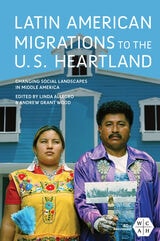
Latin American Migrations to the U.S. Heartland
Changing Social Landscapes in Middle AmericaEdited by Linda Allegro and Andrew Grant Wood
University of Illinois Press, 2019
Filled with varied and eye-opening perspectives, Latin American Migrations to the U.S. Heartland reveals how identities, economies, and geographies are changing as Latin Americans adjust to their new homes, jobs, and communities.
Contributors: Linda Allegro, Tisa M. Anders, Scott Carter, Caitlin Didier, Miranda Cady Hallett, Edmund Hamann, Albert Iaroi, Errol D. Jones, Jane Juffer, László J. Kulcsár, Janelle Reeves, Jennifer F. Reynolds, Sandi Smith-Nonini, and Andrew Grant Wood.
Latin American Neostructuralism
The Contradictions of Post-Neoliberal DevelopmentFernando Ignacio Leiva
University of Minnesota Press, 2008
Interrogates this ascending political and economic paradigm
This landmark work is the first sustained critique of Latin American neostructuralism, the prevailing narrative that has sought to replace “market fundamentalism” and humanize the “savage capitalism” imposed by neoliberal dogmatism. Fernando Leiva analyzes neostructuralism and questions its credibility as the answer to the region’s economic, political, and social woes.
Recent electoral victories by progressive governments in Latin America promising economic growth, social equity, and political democracy raise a number of urgent questions, including: What are the key strengths and weaknesses of the emerging paradigm? What kinds of transformations can this movement enact? Leiva addresses these issues and argues that the power relations embedded in local institutions, culture, and populations must be recognized when building alternatives to the present order. Considering the governments in countries such as Chile, Argentina, and Brazil, Leiva examines neostructuralism’s impact on global politics and challenges whether this paradigm constitutes a genuine alternative to neoliberalism or is, rather, a more sophisticated form of consolidating existing systems.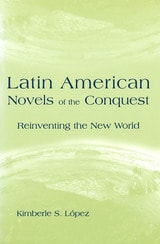
Latin American Novels of the Conquest
Reinventing the New WorldKimberle S. López
University of Missouri Press, 2002
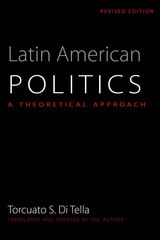
Latin American Politics
A Theoretical ApproachBy Torcuato S. Di Tella
University of Texas Press, 2001
First published in English in 1990 as Latin American Politics: A Theoretical Framework, a translation of Torcuato S. Di Tella's original Sociología de los procesos políticos, this new edition also focuses on the prerequisites for democracy in any society and on the role of the popular classes in social change. Di Tella draws on the work of Montesquieu, Burke, Tocqueville, Marx, Weber, and Durkheim in formulating his explanatory theories. These theories are then tested against crucial events in Latin American history—from the rebellions of the eighteenth century to the caudillos of the nineteenth century and the militarism of the twentieth century.
This edition is more attuned to an English-speaking audience, with a new chapter addressing the historical process in Argentina from the 1930s to 2000. Latin American Politics is written in a style easily accessible to the general reader or student, while its emphasis on the growth of democracy in Latin America makes it particularly timely.
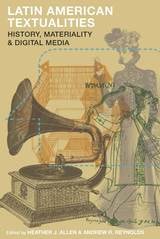
Latin American Textualities
History, Materiality, and Digital MediaEdited by Heather J. Allen and Andrew R. Reynolds
University of Arizona Press, 2018
Latin American Textualities is a wide-ranging, interdisciplinary look at textual history, textual artifacts, and digital textualities across Latin America from the colonial era to the present. Editors Heather J. Allen and Andrew R. Reynolds gather a wide range of scholars to investigate the region’s textual scholarship. Contributors offer engaging examples of not just artifacts but also the contexts in which the texts are used. Topics include Guamán Poma’s library, the effect of sound recordings on writing in Argentina, Sudamericana Publishing House’s contribution to the Latin American literary boom, and Argentine science fiction. Latin American Textualities provides new paths to reading Latin American history, culture, and literatures.
Contributors:
Heather J. Allen
Catalina Andrango-Walker
Sam Carter
Sara Castro-Klarén
Edward King
Rebecca Kosick
Silvia Kurlat Ares
Walther Maradiegue
Clayton McCarl
José Enrique Navarro
Andrew R. Reynolds
George Antony Thomas
Zac Zimmer
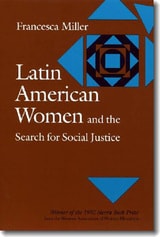
Latin American Women and the Search for Social Justice
Francesca Miller
University Press of New England, 1991

Latin American and Caribbean Library Resources in the British Isles
A DirectoryAlan Biggins and Valerie Cooper
University of London Press, 2001
Latin Politics, Global Media
Edited by Elizabeth Fox and Silvio Waisbord
University of Texas Press, 2002
The globalization of media industries that began during the 1980s and 1990s occurred at the same time as the establishment of or return to democratic forms of government in many Latin American countries. In this volume of specially commissioned essays, thirteen well-known media experts examine how the intersection of globalization and democratization has transformed media systems and policies throughout Latin America.
Following an extensive overview by editors Elizabeth Fox and Silvio Waisbord, the contributors investigate the interaction of local politics and global media in individual Latin American countries. Some of the issues they discuss include the privatization and liberalization of the media, the rise of media conglomerates, the impact of trade agreements on media industries, the role of the state, the mediazation of politics, the state of public television, and the role of domestic and global forces. The contributors address these topics with a variety of theoretical approaches, combining institutional, historical, economic, and legal perspectives.
Latinamericanism after 9/11
John Beverley
Duke University Press, 2011