Results by title
775 books match the query 'Germany' and 43 start with m

Making Jet Engines in World War II
Britain, Germany, and the United StatesHermione Giffard
University of Chicago Press, 2016
Giffard compares the approaches of Britain, Germany, and the United States. Each approached jet engines in different ways because of its own war aims and industrial expertise. Germany, which produced more jet engines than the others, did so largely as replacements for more expensive piston engines. Britain, on the other hand, produced relatively few engines—but, by shifting emphasis to design rather than production, found itself at war's end holding an unrivaled range of designs. The US emphasis on development, meanwhile, built an institutional basis for postwar production. Taken together, Giffard's work makes a powerful case for a more nuanced understanding of technological innovation, one that takes into account the influence of the many organizational factors that play a part in the journey from idea to finished product.

Making Security Social
Disability, Insurance, and the Birth of the Social Entitlement State in GermanyGreg Eghigian
University of Michigan Press, 2000
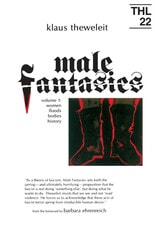
Male Fantasies
Volume 1: Women Floods Bodies HistoryKlaus Theweleit
University of Minnesota Press, 1987
This first volume of Male Fantasies centers on the fantasies that preoccupied a group of men who played a crucial role in the rise of Nazism. These men were officers in the Freikorps--private, volunteer armies that roamed Germany, serving the cause of domestic repression in the aftermath of World War I. Klaus Theweleit draws upon the novels, letters, and autobiographies of these proto-fascists and their contemporaries, as well as cartoons, advertisements, engravings, and posters. He explores these sources, not to discover what their creators thought about fighting or the fatherland, but to seek out and reconstruct their images of women. He shows that the Freikorps male identity was shaped by the dread and revulsion that characterized their relations with women (real or imagined) and that this dread was, in turn, linked to the aggressive racism and anticommunism at the heart of most fascist movements.
Theweleit’s second volume, Male Bodies: Psychoanalyzing the White Terror, carries Male Fantasies from the female image to the self-image of manhood and its ritualized forms of mass behavior, culminating in warfare. It also is available from the University of Minnesota Press.
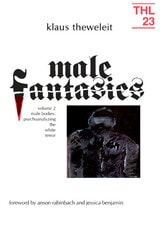
Male Fantasies
Volume 2: Male Bodies: Psychoanalyzing the White TerrorKlaus Theweleit
University of Minnesota Press, 1989
Theweleit’s project in Male Fantasies is to discover the emotional core of fascism as it was revealed in the novels and memoirs of the Freikorps, mercenary bands that fought Germany’s border disputes and put down worker revolts in the aftermath of World War I. His excavation of Freikorps literary remains (and the writings of some of their protofascist contemporaries) enabled Theweleit to reconstruct the mythical content of the fascist imagination. An integral part of Male Fantasies is Theweleit’s choice of illustrations--cartoons, advertisements, engravings, posters--that serve as an ironic commentary on the text and extend its meaning in time and space.
In this second volume of the two-volume work Theweleit discovers how the repudiation of one’s own body--and of femininity--became a psychic compulsion associating masculinity with hardness, self-denial, and destruction. We are shown how the body becomes a mechanism for eluding the dreaded liquid--the “Red Flood,” lava, mud--and the “feminine” emotions associated with it. Armored, organized by mental and physical procedures like the military drill, the male body is transformed into a “man of steel.” As Theweleit shows, only in war does this body find redemption from constraint.
The first volume of Male Fantasies, also available from the University of Minnesota Press, deals primarily with the image of women in the collective unconscious of the fascist warrior that threatens to engulf the male ego.

Markets and Medicine
The Politics of Health Care Reform in Britain, Germany, and the United StatesSusan Giaimo
University of Michigan Press, 2002
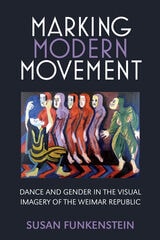
Marking Modern Movement
Dance and Gender in the Visual Imagery of the Weimar RepublicSusan Funkenstein
University of Michigan Press, 2020
Yet behind the razzle dazzle of these depictions and experiences was one far more complex involving issues of gender and the body during a tumultuous period in history, Germany’s first democracy (1918-1933). Rather than mere titillation, the images copiously illustrated and analyzed in Marking Modern Movement illuminate how visual artists and dancers befriended one another and collaborated together. In many ways because of these bonds, artists and dancers forged a new path in which images revealed artists’ deep understanding of dance, their dynamic engagement with popular culture, and out of that, a possibility of representing women dancers as cultural authorities to be respected. Through six case studies, Marking Modern Movement explores how and why these complex dynamics occurred in ways specific to their historical moment.
Extensively illustrated and with color plates, Marking Modern Movement is a clearly written book accessible to general readers and undergraduates. Coming at a time of a growing number of major art museums showcasing large-scale exhibitions on images of dance, the audience exists for a substantial general-public interest in this topic. Conversing across German studies, art history, dance studies, gender studies, and popular culture studies, Marking Modern Movement is intended to engage readers coming from a wide range of perspectives and interests.

Marlene Dietrich, Rita Hayworth, & My Mother
Rita Maria Magdaleno
University of Arizona Press, 2003
Rita Magdaleno was born near Dachau shortly after World War II to a German mother and a Mexican American GI. Her family moved to Arizona in 1947, and Rita was raised with her father's traditions—but she remains at heart a child of two cultures.
This poetic memoir, recalling Magdaleno's return to the land of her birth, is an intertwining of personal and public history, bridging continents and cultures in search of family secrets. Her poems recall a mother "Marlene Dietrich pretty, / her smoky voice / & those wide Aryan / eyes that promised / never to lie," a war bride who named her child after a Hollywood movie star even before casting eyes on America. They also offer a new, intimate view of the war—and of today's reunified Germany—and show that the consequences of events played out half a century ago continue to resonate with the children of that era.
Magdaleno navigates currents of emotion that would drown less capable poets. With patience, courage, and abiding love, she draws on memories of mother and motherland to show us that healing can come in many forms.

Marlene Dietrich
Life and LegendSteven Bach
University of Minnesota Press, 2011
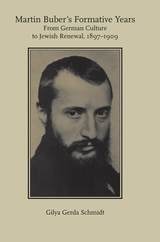
Martin Buber's Formative Years
From German Culture to Jewish Renewal, 1897–1909Gilya Gerda Schmidt
University of Alabama Press, 1995
Martin Buber (1878–1965) has had a tremendous impact on the development of Jewish thought as a highly influential figure in 20th-century philosophy and theology. However, most of his key publications appeared during the last forty years of his life and little is known of the formative period in which he was searching for, and finding, the answers to crucial dilemmas affecting Jews and Germans alike. Now available in paperback, Martin Buber’s Formative Years illuminates this critical period in which the seeds were planted for all of his subsequent work.
During the period from 1897 to 1909, Buber's keen sense of the crisis of humanity, his intimate knowledge of German culture and Jewish sources, and his fearlessness in the face of possible ridicule challenged him to behave in a manner so outrageous and so contrary to German-Jewish tradition that he actually achieved a transformation of himself and those close to him. Calling on spiritual giants of great historical periods in German, Christian, and Jewish history—such as Nicolas of Cusa, Jakob Boehme, Israel Baal Shem Tov, Rabbi Nachman of Brazlav, Johann Wolfgang von Goethe, and Friedrich Nietzsche—Buber proceeded to subvert the existing order by turning his upside-down world of slave morality right side up once more.
By examining the multitude of disparate sources that Buber turned to for inspiration, Gilya Gerda Schmidt elucidates Buber's creative genius and his contribution to turn-of-the-century Jewish renewal. This comprehensive study concludes that Buber was successful in creating the German-Jewish symbiosis that emancipation was to have created for the two peoples but that this synthesis was tragic because it came too late for practical application by Jews in Germany.
Martin Monath
A Jewish Resistance Fighter Amongst Nazi SoldiersNathaniel Flakin
Pluto Press, 2019
Masses and Man
Nationalist and Fascist Perceptions of RealityGeorge L. Mosse
University of Wisconsin Press, 2024
Masses and Man comprises three parts. The first lays out a cultural history of nationalism, essentially the first of its kind, emphasizing the importance of sacred expressions like myths, symbols, and rituals as appropriated in a political context. The second zeroes in on fascism’s most dramatic irruptions in European history in the rise of Italian Fascism and the Nazi Party in Germany, elucidating these as not just political movements but also cultural and even aesthetic ones. The third part considers nationalism and fascism from the particular standpoint of German Jews.
Taken in full, the volume offers an eloquent summation of Mosse’s groundbreaking insights into European nationalism, fascism, and Jewish history in the twentieth century. A new critical introduction by Enzo Traverso helpfully situates Mosse’s work in context and exposes the many ways in which Masses and Man, first published in 1980, remains relevant today.
Max Reinhardt
From Bourgeois Theater to Metropolitan CulturePeter W. Marx, translated from the German by Robert E. Goodwin
Northwestern University Press, 2024
At the same time, Reinhardt soon longed for an international range: guest performances throughout Europe and to the US soon made him into a global star – and even a brand. He represents a metropolitan culture that roots in the late nineteenth century but comes to an end when Fasicsm in Europe ended any hopes for an international culture. As a Jew, Reinhardt himself had to flee the Nazis but when he eventually arrived in the US, he could not follow up with his earlier successes. Marx provides a broad panorama of Reinhardt's work, portraying not only his work method and some of his best known productions, but also the cultural conditions of his visionary enterprise.

Max Weber and German Politics, 1890-1920
Wolfgang J. Mommsen
University of Chicago Press, 1990
First published in German in 1959, Max Weber and German Politics appeared in a revised edition in 1974 and became available in an English translation only in 1984. In writing this work, Mommsen drew extensively on Weber's published and unpublished essays, newspaper articles, memoranda, and correspondence.
Max Weber's Comparative-Historical Sociology
Stephen Kalberg
University of Chicago Press, 1994
Max Weber
An Introduction to His Life and WorkDirk Käsler
University of Chicago Press, 1988
Käsler offers a comprehensive account of Weber's views, giving attention both to the context in which Weber produced his most significant contributions to social science, and to the changes involved in his work over the course of his career. This volume also serves as an introduction to the controversies that Weber's writings have stimulated, from the time of their first appearance to the present day.
This book will be of vital interest to anyone concerned with Max Weber and will undoubtedly become the leading student text on Weber in the English-speaking world.

Mediating Culture in the Seventeenth-Century German Novel
Eberhard Werner Happel, 1647-1690Gerhild Scholz Williams
University of Michigan Press, 2014
Happel primarily lived and worked in the vigorous port city of Hamburg, which was a “media center” in terms of the access it offered to a wide library of books in public and private collections. Hamburg’s port status meant it buzzed with news and information, and Happel drew on this flow of data in his novels. His books deal with many topics of current interest—national identity formation, gender and sexualities, Western European encounters with neighbors to the East, confrontations with non-European and non-Western powers and cultures—and they feature multiple media, including news reports, news collections, and travel writings. As a result, Happel’s use of contemporary source material in his novels feeds our current interest in the impact of the production of knowledge on seventeenth-century narrative. Mediating Culture in the Seventeenth-Century German Novel explores the narrative wealth and multiversity of Happel’s work, examines Happel’s novels as illustrative of seventeenth-century novel writing in Germany, and investigates the synergistic relationship in Happel’s writings between the booming print media industry and the evolution of the German novel.

Medical Misinformation in Early Modern Germany
Christopher Hutchinson
University of Delaware Press, 2026
Medical Misinformation in Early Modern Germany examines how doctors, writers, and printers in sixteenth-century Germany responded to the rapid expansion of print and its implications for medical knowledge. The spread of printed texts generated widespread suspicion about print’s reliability as a conduit of information and led writers to reflect on questions of audience, vernacularity, and medical authority in their responses to disease. The book investigates literary texts alongside popular vernacular medical pamphlets on the major epidemic diseases of the period––plague, syphilis, and the English sweating sickness––to reveal a widespread concern with the impact of printed texts on public health. During the 1529 outbreak of the English sweating sickness, this concern culminated in writers’ use of a “rhetoric of virality,” explicitly comparing the circulation of texts to the spread of disease, as they confronted the parallel contagions of disease and information.

Memoirs (1630-1680)
Sophia of Hanover
Iter Press, 2013
Memory Passages
Holocaust Memorials in the United States and GermanyNatasha Goldman
Temple University Press, 2020
For decades, artists and architects have struggled to relate to the Holocaust in visual form, resulting in memorials that feature a diversity of aesthetic strategies. In Memory Passages, Natasha Goldman analyzes both previously-overlooked and internationally-recognized Holocaust memorials in the United States and Germany from the postwar period to the present, drawing on many historical documents for the first time. From the perspectives of visual culture and art history, the book examines changing attitudes toward the Holocaust and the artistic choices that respond to it.
The book introduces lesser-known sculptures, such as Nathan Rapoport’s Monument to the Six Million Jewish Martyrs in Philadelphia, as well as internationally-acclaimed works, such as Peter Eisenman’s Memorial to the Murdered Jews of Europe in Berlin. Other artists examined include Will Lammert, Richard Serra, Joel Shapiro, Gerson Fehrenbach, Margit Kahl, and Andy Goldsworthy.Archival documents and interviews with commissioners, survivors, and artists reveal the conversations and decisions that have shaped Holocaust memorials.
Memory Passages suggests that memorial designers challenge visitors to navigate and activate spaces to engage with history and memory by virtue of walking or meandering. This book will be valuable for anyone teaching—or seeking to better understand—the Holocaust.
Metropolitan Governance
Different Paths in Contrasting Contexts: Germany and IsraelEdited by Hubert Heinelt, Eran Razin, and Karsten Zimmermann
Campus Verlag, 2011
As urban areas have grown and sprawl has spread in recent decades, metropolitan governments around the world have begun to look beyond city borders, establishing regional partnerships to help them deal with issues of transit, resource use, and more. Metropolitan Governance examines this trend through a close comparative study of seven metropolitan areas in Israel and Germany. While not neglecting the reasons behind these changes in governance, the authors pay particular attention to their effects on—and diminishing of—democratic participation and accountability.
Michael Polanyi and His Generation
Origins of the Social Construction of ScienceMary Jo Nye
University of Chicago Press, 2011

Mies van der Rohe
A Critical BiographyFranz Schulze
University of Chicago Press, 1985
“Franz Schulze’s 1985 biography of Ludwig Mies van der Rohe has always been acknowledged as the most comprehensive and thoughtful biography of one of the key figures in twentieth-century architecture. This revised edition with significant new scholarship by its two authors will undoubtedly come to occupy the same position.”—Dietrich Neumann, Brown University

Mies van der Rohe
A Critical Biography, New and Revised EditionFranz Schulze and Edward Windhorst
University of Chicago Press, 2012
Migrants and City-Making
Dispossession, Displacement, and Urban RegenerationAyse Caglar and Nina Glick Schiller
Duke University Press, 2018

Mission on the Rhine
"Reeducation" and Denazification in American-Occupied GermanyJames F. Tent
University of Chicago Press, 1982
For this meticulously researched study, James F. Tent has drawn on a wealth of recently declassified documents and on numerous personal interviews with veterans of the Occupation. He brings to life not only the dilemmas American officials faced in balancing the need for a political purge against the need to rehabilitate a disrupted society but also the paradoxes involved in a democracy's attempt to impose its ideals on another people. His book chronicles the dedicated work of many Americans; it also illuminates America's Occupation experience as a whole.
Mobility and Modernity
Migration in Germany, 1820-1989Steve Hochstadt
University of Michigan Press, 1999
Mobilizing Black Germany
Afro-German Women and the Making of a Transnational MovementTiffany N. Florvil
University of Illinois Press, 2020
Tiffany N. Florvil examines the role of queer and straight women in shaping the contours of the modern Black German movement as part of the Black internationalist opposition to racial and gender oppression. Florvil shows the multifaceted contributions of women to movement making, including Audre Lorde’s role in influencing their activism; the activists who inspired Afro-German women to curate their own identities and histories; and the evolution of the activist groups Initiative of Black Germans and Afro-German Women. These practices and strategies became a rallying point for isolated and marginalized women (and men) and shaped the roots of contemporary Black German activism.
Richly researched and multidimensional in scope, Mobilizing Black Germany offers a rare in-depth look at the emergence of the modern Black German movement and Black feminists’ politics, intellectualism, and internationalism.
Moderate Modernity
The Newspaper Tempo and the Transformation of Weimar DemocracyJochen Hung
University of Michigan Press, 2023
The newspaper’s idea of a modern, democratic Germany was undermined by the political and economic crises that hit Germany at the beginning of the 1930s. The way the newspaper described German democracy changed under these pressures. Flappers, American fridges, and modern music—the things that Tempo had once marshalled as representatives of a German future—were now rejected by the newspaper as emblems of a bygone age. The changes in Tempo’s vision of Germany’s future show that descriptions of Weimar politics as a standoff between upright democrats and rabid extremists do not do justice to the historical complexity of the period. Rather, we need to accept the Nazis as a lethal product of a German democracy itself. The history of Tempo teaches us how liberal democracies can create and nurture their own worst enemies.

Modern Nature
The Rise of the Biological Perspective in GermanyLynn K. Nyhart
University of Chicago Press, 2009
In Modern Nature,Lynn K. Nyhart traces the emergence of a “biological perspective” in late nineteenth-century Germany that emphasized the dynamic relationships among organisms, and between organisms and their environment. Examining this approach to nature in light of Germany’s fraught urbanization and industrialization, as well the opportunities presented by new and reforming institutions, she argues that rapid social change drew attention to the role of social relationships and physical environments in rendering a society—and nature—whole, functional, and healthy.
This quintessentially modern view of nature, Nyhart shows, stood in stark contrast to the standard naturalist’s orientation toward classification. While this new biological perspective would eventually grow into the academic discipline of ecology, Modern Nature locates its roots outside the universities, in a vibrant realm of populist natural history inhabited by taxidermists and zookeepers, schoolteachers and museum reformers, amateur enthusiasts and nature protectionists.
Probing the populist beginnings of animal ecology in Germany, Nyhart unites the history of popular natural history with that of elite science in a new way. In doing so, she brings to light a major orientation in late nineteenth-century biology that has long been eclipsed by Darwinism.
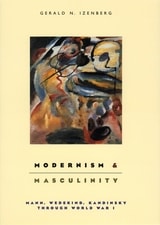
Modernism and Masculinity
Mann, Wedekind, Kandinsky through World War IGerald Izenberg
University of Chicago Press, 2000
But their critique of masculinity created enormous challenges: How could they appropriate a feminine aesthetic while retaining their own masculine idenitites? How did appropiating the feminine affect their personal relationships or their political views? Modernism and Masculinity seeks to answer these questions. In this absorbing combination of biography and formal critique, Izenberg reconsiders the works of Mann, Wedekind, Kandinsky and semonstrates how the cirses of masculinity they endure are found not just within the images and forms of their art, but in the distinct and very personal impulses that inspired it.
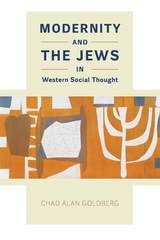
Modernity and the Jews in Western Social Thought
Chad Alan Goldberg
University of Chicago Press, 2017
In Modernity and the Jews in Western Social Thought, Chad Alan Goldberg brings us a major new study of Western social thought through the lens of Jews and Judaism. In France, where antisemites decried the French Revolution as the “Jewish Revolution,” Émile Durkheim challenged depictions of Jews as agents of revolutionary subversion or counterrevolutionary reaction. When German thinkers such as Karl Marx, Georg Simmel, Werner Sombart, and Max Weber debated the relationship of the Jews to modern industrial capitalism, they reproduced, in secularized form, cultural assumptions derived from Christian theology. In the United States, William Thomas, Robert Park, and their students conceived the modern city and its new modes of social organization in part by reference to the Jewish immigrants concentrating there. In all three countries, social thinkers invoked real or purported differences between Jews and gentiles to elucidate key dualisms of modern social thought. The Jews thus became an intermediary through which social thinkers discerned in a roundabout fashion the nature, problems, and trajectory of their own wider societies. Goldberg rounds out his fascinating study by proposing a novel explanation for why Jews were such an important cultural reference point. He suggests a rethinking of previous scholarship on Orientalism, Occidentalism, and European perceptions of America, arguing that history extends into the present, with the Jews—and now the Jewish state—continuing to serve as an intermediary for self-reflection in the twenty-first century.

Moral Entanglements
Conserving Birds in Britain and GermanyStefan Bargheer
University of Chicago Press, 2018
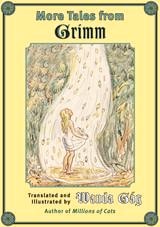
More Tales from Grimm
Wanda Gág
University of Minnesota Press, 2006
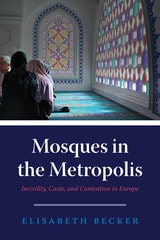
Mosques in the Metropolis
Incivility, Caste, and Contention in EuropeElisabeth Becker
University of Chicago Press, 2021

Mothers on the Move
Reproducing Belonging between Africa and EuropePamela Feldman-Savelsberg
University of Chicago Press, 2016
Feldman-Savelsberg introduces readers to several Cameroonian mothers, each with her own unique history, concerns, and voice. Through scenes of their lives—at a hometown association’s year-end party, a celebration for a new baby, a visit to the Foreigners’ Office, and many others—as well as the stories they tell one another, Feldman-Savelsberg enlivens our thinking about migrants’ lives and the networks and repertoires that they draw on to find stability and, ultimately, belonging. Placing women’s individual voices within international social contexts, this book unveils new, intimate links between the geographical and the generational as they intersect in the dreams, frustrations, uncertainties, and resolve of strong women holding families together across continents.

Murder Scenes
Normality, Deviance, and Criminal Violence in Weimar BerlinSace Elder
University of Michigan Press, 2010
---Kenneth Ledford, Case Western Reserve University
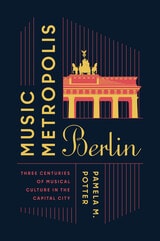
Music Metropolis Berlin
Three Centuries of Musical Culture in the Capital CityPamela M. Potter
University of Chicago Press, 0
Tracing the development of Berlin as a center of music from the eighteenth century to the present, examining how its music survived despite its turbulent history.
Berlin is a music-lover’s paradise, offering up everything from operas to raves. Yet unlike Vienna, Leipzig, or even Nashville, Berlin does not immediately come to mind as a city of music. Instead, its turbulent history evokes images of industry, commerce, militarism, destruction, division, and resurrection. Over the past three centuries, Berlin was the capital of a kingdom, an empire, a republic, and a dictatorship; it was ravaged by war and occupied by foreign powers; and its division and reunification made it a powerful symbol of the Cold War. Through all these highs and lows, the music played on. Music Metropolis Berlin is the first full-length exploration of how Berlin became a city of music against all odds.
Unlike the other European music centers that stake their reputations on the fame of composers like Bach or Beethoven, Berlin is known for its ensembles, artists, theaters, organizers, intellectuals, and media stars. This is because Berlin took a very different, and almost accidental, route to becoming a city of music. Hampered for centuries by rulers who were more focused on military and industrial expansion than on cultural prestige, Berlin’s musical life prospered thanks to the ambitions of entrepreneurs and politicians who saw the value in serving the ever-changing music public in an expanding urban landscape. By focusing on Berlin as a rapidly developing global capital, Music Metropolis Berlin looks beyond the music, its creators, and its institutions to reveal how political, economic, and social forces fueled the creation of the Berlin metropolis and continue to nurture a vibrant and diverse musical life.

Music and German National Identity
Celia Applegate and Pamela Potter
University of Chicago Press, 2002
This book explores the questions of how music came to be associated with German identity, when and how Germans came to be regarded as the "people of music," and how music came to be designated as "the most German art." Drawing on the expertise of leading scholars in German history, musicology, and German literature, the essays assembled here examine philosophy, literature, politics, and social currents, as well as the creation and performance of folk music, art music, church music, jazz, and pop to explore the ways in which music has continued to play a central role in the German national imagination and in shaping German identity.
Music in German Philosophy
An IntroductionEdited by Stefan Lorenz Sorgner and Oliver Fürbeth
University of Chicago Press, 2011
Though many well-known German philosophers have devoted considerable attention to music and its aesthetics, surprisingly few of their writings on the subject have been translated into English. Stefan Lorenz Sorgner, a philosopher, and Oliver Fürbeth, a musicologist, here fill this important gap for musical scholars and students alike with this compelling guide to the musical discourse of ten of the most important German philosophers, from Kant to Adorno.
Music in German Philosophy includes contributions from a renowned group of ten scholars, including some of today’s most prominent German thinkers, all of whom are specialists in the writers they treat. Each chapter consists of a short biographical sketch of the philosopher concerned, a summary of his writings on aesthetics, and finally a detailed exploration of his thoughts on music. The book is prefaced by the editors’ original introduction, presenting music philosophy in Germany before and after Kant, as well as a new introduction and foreword to this English-language addition, which places contemplations on music by these German philosophers within a broader intellectual climate.
Muslims of Metropolis
The Stories of Three Immigrant Families in the WestRajagopalan, Kavitha
Rutgers University Press, 2008
The Muslim population globally is comprised of hundreds of ethnic, linguistic, and religious sub-communities. Yet, more often than not, the public conflates these diverse and unrelated communities, branding Muslim immigrants as a single, suspicious, and culturally antagonistic group of people. Generalizations like these have compromised many Muslim immigrants' sense of belonging and acceptance in places where they have lived, in some cases, for three or four generations.
In Muslims of Metropolis, Kavitha Rajagopalan takes a much needed step in personalizing and humanizing our understanding of the Muslim diaspora. Tracing the stories of three very different families-a Palestinian family moving to London, a Kurdish family moving to Berlin, and a Bangladeshi family moving to New York-she reveals a level of complexity and nuance that is seldom considered. Through their voices and in their words, Rajagopalan describes what prompted these families to leave home, what challenges they faced in adjusting to their new lives, and how they came to view their place in society. Interviews with community leaders, social justice organizations, and with academics and political experts in each of the countries add additional layers of insight to how broad political issues, like nationalist conflict, immigration reform, and antiterrorism strategies affect the lives of Muslims who have migrated in search of economic stability and personal happiness.
Although recent thinking about immigration policy in the United States and Europe emphasizes the importance of long-term integration, a global attitude that continues to sensationalize divisions between Muslim and other communities thwarts this possibility. Integration cannot occur with policy solutions alone-people must feel that they belong to a larger society. Whether read as simple stories or broader narratives, the voices in this revealing book are among the many speaking against generalization, prejudice, and fear that has so far surrounded Muslims living in the West.
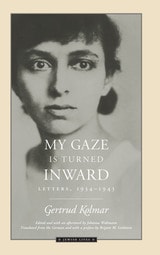
My Gaze Is Turned Inward
Letters 1938-1943Gertrud Kolmar
Northwestern University Press, 2004
So a picture of Gertrud Kolmar, a gifted Jewish writer struggling to sustain her art and family, emerges from these eloquent and allusive letters. Written in the stolen moments before her day as a forced laborer in a munitions factory began, the letters tell of Kolmar's move from the family home in Finkenkrug to a three-room flat in Berlin, which she and her father must soon share with other displaced Jews. They describe her factory work as a learning experience and assert, in the face of ever worsening conditions, that true art, never dependent on comfort or peace, is "capable of triumphing over . . . time and place."
These letters are a triumph of art, proclaiming the freedom of the human will amidst oppression. Though prevented by Nazi censorship from saying too much too directly, Kolmar still conveys the intensity and determination of her inner world, as well as the relentlessness of the outer world bent on crushing her. For its insight into the mind and soul of a poet submitting to and denying fate, and for its interior vision of one of history's darkest moments, My Gaze Is Turned Inward is a unique document of literary, historical, and spiritual power.

My Germany
A Jewish Writer Returns to the World His Parents EscapedLev Raphael
University of Wisconsin Press, 2009
Haunted by his parents’ horrific suffering and traumatic losses under Nazi rule, Lev Raphael grew up loathing everything German. Those feelings shaped his Jewish identity, his life, and his career. While researching his mother’s war years after her death, he discovers a distant relative living in the very city where she had worked in a slave labor camp, found freedom, and met his father. Soon after, Raphael is launched on book tours in Germany and, in the process, redefines himself as someone unafraid to face the past and let it go.
Bookmarks, “Top Ten Nonfiction Titles of 2009”
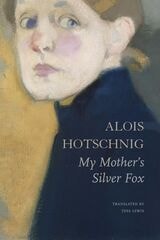
My Mother's Silver Fox
Alois Hotschnig
Seagull Books, 2025
Heinz Fitz has only one tangible clue to his past: a worn piece of paper from the SS-Lebensborn program, a Nazi initiative designed to promote so-called racial purity. His mother, a Norwegian woman, fell in love with the wrong man—an Austrian soldier—during the German occupation. Betrayed and abandoned, she fled to Austria, only to be turned away by his family. Branded a collaborator in her homeland and a pariah in a foreign land, she was left to survive as best she could. Now, years later, her son is determined to piece together the fragments of his origins.
But every answer leads to more questions, and as he unearths painful truths, an alternative story—one of resilience, love, and survival—emerges from the darkness. Inspired by real events, Alois Hotschnig’s novel is both a fierce reckoning with history and a poignant tribute to a mother’s strength. A masterful meditation on memory and storytelling, My Mother’s Silver Fox asks whether the past can ever truly be understood—or if it will always slip through our grasp, like snow through our fingers.