Results by title
1228 books match the query 'Library & Information Science' and 68 start with m

MARC 21 for Everyone
A Practical GuideRichard J. Fritz
American Library Association, 2003
Magic Search
Rebecca S. American Library Association
American Library Association, 2009
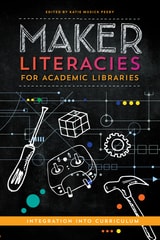
Maker Literacies for Academic Libraries
Integration into CurriculumEdited by Katie Musick Peery
American Library Association, 2020
Melding universities’ strategic goals with libraries’ teaching and learning mission, the academic library makerspace can be a powerful catalyst for information literacy, offering faculty partners a place for interdisciplinary, experiential learning. If you’re pondering what it takes to get your makerspace into the curriculum, this volume’s relatable, first-hand accounts from librarians, makerspace staff, and faculty partners will give you the confidence to make the leap. Contributors, drawn from the IMLS-funded Maker Literacies project, describe pilots and assessment for a variety of demographics, course subjects, and makerspace equipment. Guided by their experiences, you’ll be ready to fully partner with faculty through the course integration and assessment process. Inside, you’ll learn
- why academic librarians are uniquely situated to be leaders in the realm of makerspaces and makerspace literacy;
- how the ACRL Framework informs maker competencies;
- methods for using competencies and assessment in designing course assignments;
- 5 steps for guiding faculty in creating assignments for makerspaces;
- advice on developing a new staffing and service model to handle course-wide use of the makerspace;
- steps for taking students through concept, design, prototype, and final product in a project management course;
- how an ethical perspective engaged a women’s history course toward the “In Her Shoes” project;
- pedagogical strategies for integrating the makerspace into fine arts classes; and
- ways to showcase makerspace outputs to generate excitement around campus.
Makerspaces
Caitlin A. Bagley
American Library Association, 2014
Making Libraries Accessible
Char Booth
American Library Association, 2010
Making Sense of Business Reference
A Guide for Librarians and Research ProfessionalsCelia Ross
American Library Association, 2020
“It reads as if you have an expert coach in business reference helping you each step of the way." That’s how Academic BRASS summarized the first edition of this unique, unparalleled resource authored by Ross, a past winner of the Gale Cengage Learning Award for Excellence in Business Librarianship. Now she’s revised and updated it to tackle even more “bizref” headscratchers related to investment and finance, consumer behavior and statistics, company, and industry research. In addition to general reference strategies in each chapter that give you the lay of the land, inside you’ll find
- overviews of more than fifty databases for articles, company and industry, directories, consumer, international, or raw data;
- 33 real-life "Stumper" questions, all new for this edition, drawn from librarians in the field;
- why asking “who cares about this kind of question” reveals potential sources;
- techniques for applying reference interview techniques to business questions;
- advice on where to find the numbers for answering finance questions;
- expanded coverage of venture capital research and business information literacy;
- “Start Making Sense” suggestions for further skill-building; and
- questions to consider when building a bizref collection.
This is the guide to keep at your side when serving business students, job-seekers, investors, or entrepreneurs in your library.
Making Sense of Business Reference
A Guide for Librarians and Research ProfessionalsCelia Ross
American Library Association, 2013
Making Values-Based Decisions in the Academic Library
Amanda Koziura
Assoc of College & Research Libraries, 2025
Making Values-Based Decisions in the Academic Library explores the decision-making process of librarians in both formal and informal leadership roles. Rather than trying to identify a singular “correct” answer, authors offer an exploration of their own processes and the tools they used to arrive at conclusions that fit their contexts and institutions. Their examples show how values can be central considerations in assessment, inform collection development, shape our spaces and services, influence policy, and be foundational for seeking a better way forward.
We have more power than we think to create change, and our values can be a touchstone for the decisions we make at every level. The strategies in Making Values-Based Decisions in the Academic Library can help you holistically consider available options and make choices that consider your personal, institutional, and professional values amid challenging and changing circumstances.

Making in School and Public Libraries
Edited by Kristin Fontichiaro, Caroline Wack, Tori Culler, and Nicole Sype
Michigan Publishing Services, 2020
Readers will gain practical insights about how to
- Define goals and target audiences
- Customize programs to meet community needs
- Equip a makerspace
- Document activities
- Assess achievements and areas for growth
- Engage makers in a variety of technology and hands-on activities, including robots, 3D printing, sewing, cardboard challenges, knitting and crochet, design thinking, and zines
The authors’ experiences include co-creating one of the nation’s first school library makerspaces; establishing after-school maker programs with elementary and middle school learners; co-designing one-off and ongoing maker events for community-building in diverse public libraries; engaging with senior citizens in a low-income Senior Summer Camp pilot; and state, national, and international workshops for teachers, librarians, and youth mentors.
Making the Most of Your Library Career
Lois Stickell
American Library Association, 2014
Management Basics for Information Professionals
G. Edward Evans
American Library Association, 2020
The recipient of rave reviews from far and wide (Journal of Hospital Librarianship deemed it “a librarian’s dream … very forward-thinking”), since its initial publication this text has served as an essential resource for both LIS students and practitioners. The new fourth edition offers an updated, comprehensive examination of the myriad of basic skills effective library managers must exercise throughout their careers. Throughout, Evans and new co-author Greenwell pay close attention to management in "new normal" straitened economic conditions and the pervasive impact of technology on a library manager’s role. This book’s coverage includes
- a new focus on how being in the public/nonprofit sector influences the application of management basics such as planning, accountability, trust and delegation, decision making, principles of effective organizational communication, fostering change and innovation, quality control, and marketing;
- the managerial environment, organizational skill sets, the importance of a people-friendly organization, and legal issues;
- key points on leadership, team-building, and human resource management;
- budget, resource, and technology management;
- management ethics, with a lengthy discussion of why ethics matter; and
- tips for planning a library career, with a look at the work/life debate.
This book, to quote Australian Library Journal, is “a recommended text for library science students, but is also an excellent source of information for career librarians wanting to refresh their knowledge of library management in a fast-moving information services environment.”
Management Basics for Information Professionals
G. Edward Evans
American Library Association, 2013
Managing Budgets and Finances
A How-To-Do-It Manual for Librarians and Information ProfessionalsAmerican Library Association, 2005
Managing Creativity
The Innovative Research LibraryRonald Jantz
American Library Association, 2016
Managing Crises in the Academic Library
Past, Present, and FutureDoris Van Kampen-Breit
Assoc of College & Research Libraries, 2023
In 29 chapters from authors in all institution types and sizes, Managing Crises in the Academic Library can help library workers learn from the crises of the past and prepare for the next unexpected event. Chapters cover lessons from the COVID-19 pandemic, perpetual budget uncertainty, dealing with downsizing, merging departments, mold mitigation, and mental health issues, but also offer strategies applicable during any crisis, including:
- Responsive decision-making in academic library collections
- Managing stakeholder expectations
- Effective communication strategies
- Continuity of operations planning
- Utilizing library storage facilities
- Documentation and cross-training
- Mediating student technology needs
- Setting boundaries
Libraries and library workers are deeply sustaining lifelines for many students and faculty. Managing Crises in the Academic Library collects stories that demonstrate the tenacity, creativity, and ingenuity of academic library workers as they maintain this vital community lifeline and offers actionable ideas and approaches for planning for and sustaining the resources, services, and people in the library during difficult times.
Managing Data for Patron Privacy
Comprehensive Strategies for LibrariesKristin Briney and Becky Yoose
American Library Association, 2022
- succinct summaries of major U.S. laws and other regulations and standards governing patron data management;
- information security practices to protect patrons and libraries from common threats;
- how to navigate barriers in organizational culture when implementing data privacy measures;
- sources for publicly available, customizable privacy training material for library workers;
- the data life cycle from planning and collecting to disposal;
- how to conduct a data inventory;
- understanding the associated privacy risks of different types of library data;
- why the current popular model of library assessment can become a huge privacy invasion;
- addressing key topics while keeping your privacy policy clear and understandable to patrons; and
- data privacy and security provisions to look for in vendor contracts.
Managing Electronic Government Information in Libraries
American Library Association, 2008
Managing Electronic Records
American Library Association, 2009
Managing Electronic Resources
Ryan Weir
American Library Association, 2012
Managing Facilities for Results
Optimizing Space for ServicesCheryl Bryan
American Library Association, 2007
Managing Grey Literature
Technical Services PerspectivesMichelle Leonard
American Library Association, 2021
An important resource for scholarly research, grey literature is relevant to every discipline. It’s also often more current than commercial publications. Unfortunately, though it provides a richness of content, this type of scholarly resource is often overlooked when conducting research. This book aims to change that, describing the importance of grey literature and offering a holistic approach to successfully integrating it into library collections. Readers will learn
- an overview of grey literature that discusses its importance to researchers, scholars, and students;
- collections policies for selection and deselection, complete with a suggested workflow;
- information about vendors, OA, and other aspects of acquisitions;
- guidance on cataloging, such as collection categories in the public-facing catalog, and preservation; and
- methods for promoting grey literature in library collections, including institutional repositories; and
- tips for marketing, branding, outreach, and best communication practices for colleagues, administrators, and patrons.
Managing Library Volunteers
Preston Driggers
American Library Association, 2011
Managing Your Library Construction Project
A Step-by-Step GuideRichard C. McCarthy
American Library Association, 2007
Managing in the Middle
Robert Farrell
American Library Association, 2012
Managing the Successful School Library
Strategic Planning and Reflective PracticeLesley S. J. Farmer
American Library Association, 2016
Managing with Data
Using ACRLMetrics and PLAmetricsPeter Hernon
American Library Association, 2015
Marketing Today's Academic Library
A Bold New Approach to Communicating with StudentsBrian Mathews
American Library Association, 2009
Marketing Your Library's Electronic Resources
Marie R. Kennedy
American Library Association, 2018
Marketing with Social Media
A LITA GuideBeth Thomsett-Scott
American Library Association, 2020
This all-new edition gathers a range of contributors to explore real-world uses of library marketing technology, perfect for novices ready to dive in as well as practitioners on the lookout for ways to improve existing efforts. Inside, librarians share insights on how they use their favorite social media tools to promote their library and build community. Applicable to all types of institutions, this guide
- covers popular tools such as Snapchat, Tumblr, Instagram, Facebook, and Twitter;
- shares four easy-to-use tools for creating memes, tips for creating short videos, and ways to integrate blogs into social media;
- demonstrates how to use reaction GIFs and tagging to boost your Tumblr posts;
- shows how to tailor messages to communicate effectively with different generations and audiences; and
- includes screen shots, illustrations, sample social media policies to help you navigate controversies, and free online training resources.
Matchmaking in the Archive
19 Conversations with the Dead and 3 Encounters with GhostsE.G. Crichton
Rutgers University Press, 2023
Working with the archives of the Gay Lesbian Bisexual Transgender Historical Society, artist E.G. Crichton decided to do something to bridge this generation gap. She selected 19 innovative LGBTQ artists, writers, and musicians, then paired each of them with a deceased person whose personal artifacts are part of the archive.
Including 25 pages of vivid images, Matchmaking in the Archive documents this monumental creative project and adds essays by Jonathan D. Katz, Michelle Tea, and Chris Vargas, who describe their own unique encounters with the ghosts of LGBTQ history. Together, they make the archive come alive in remarkably intimate ways.
Maximizing School Librarian Leadership
Building Connections for Learning and AdvocacyJudi Moreillon
American Library Association, 2018
Maxwell's Handbook for AACR2
Explaining and Illustrating the Anglo-American Cataloguing Rules through the 2003 UpdateRobert L. Maxwell
American Library Association, 2004
Maxwell's Handbook for RDA
Explaining and Illustrating RDARobert L. Maxwell
American Library Association, 2013
Winner of several prestigious honors, including the 2014 ABC-CLIO Greenwood Award for the Best Book in Library Literature, the first edition of this clear and comprehensive handbook has become an essential resource for catalogers, LIS students, and cataloging instructors. Now, in this second edition, Maxwell explains the changes to RDA: Resource Description and Access brought about by 3R, and brings his handbook fully in line with all the new developments. Designed to interpret and explain RDA, this resource illustrates the cataloging standard for every type of information format. From books to electronic materials to music and beyond, Maxwell
- explains the alignment of the new RDA with the IFLA’s Library Reference Model (LRM), offering value to library and cultural heritage communities;
- incorporates the changes made to the RDA Toolkit after the completion of the 3R Project that allow for greater personalization and accessibility;
- addresses the new structural changes to RDA that allow for greater flexibility and reuse;
- explores the new emphasis on relationships between entities and what it means for RDA users; and
- provides abundant sample records to illustrate RDA principles.

Meaningful Metrics
A 21St Century Librarian's Guide ToRobin Chin Roemer
Assoc of College & Research Libraries, 2015
Meaningful Metrics
A 21St Century Librarian's Guide to Bibliometrics, Altmetrics, and Research ImpactRobin Chin Roemer
Assoc of College & Research Libraries, 2015
Meeting the Challenge of Teaching Information Literacy
Michelle Reale
American Library Association, 2020
While the profession has generated many books on information literacy, none to date have validated exactly why it is so difficult to teach. In her new book, Reale posits that examining and reflecting on the reality of those factors is what will enable practitioners to meet the challenge of their important mandate. Using the same warm and conversational tone as in her previous works, she
- uses personal anecdotes to lay out the key reasons that teaching information literacy is so challenging, from the limited amount of time given to instructors and lack of collaboration with faculty to one’s own anxieties about the work;
- examines how these factors are related and where librarians fit in;
- validates readers’ struggles and frustrations through an honest discussion of the emotional labor of librarianship, including “imposter syndrome,” stress, and burnout;
- offers a variety of approaches, strategies, and topics of focus that will assist readers in their daily practice;
- looks at how a vibrant community of practice can foster positive change both personally and institutionally; and
- presents “Points to Ponder” at the end of each chapter that encourage readers to self-reflect and then transform personal insights into action.
Mentoring A-Z
Julie Todaro
American Library Association, 2015
Mentoring and Managing Students in the Academic Library
Michelle Reale
American Library Association, 2013
Mentoring in the Library
Building for the FutureMarta K. American Library Association
American Library Association, 2011
Metadata
Jian Qin
American Library Association, 2022
This benchmark text is back in a new edition thoroughly updated to incorporate developments and changes in metadata and related domains. Zeng and Qin provide a solid grounding in the variety and interrelationships among different metadata types, offering a comprehensive look at the metadata schemas that exist in the world of library and information science and beyond. Readers will gain knowledge and an understanding of key topics such as
- the fundamentals of metadata, including principles of metadata, structures of metadata vocabularies, and metadata descriptions;
- metadata building blocks, from modeling to defining properties, from designing application profiles to implementing value vocabularies, and from specification generating to schema encoding, illustrated with new examples;
- best practices for metadata as linked data, the new functionality brought by implementing the linked data principles, and the importance of knowledge organization systems;
- resource metadata services, quality measurement, and interoperability approaches;
- research data management concepts like the FAIR principles, metadata publishing on the web and the recommendations by the W3C in 2017, related Open Science metadata standards such as Data Catalog Vocabulary (DCAT) version 2, and metadata-enabled reproducibility and replicability of research data;
- standards used in libraries, archives, museums, and other information institutions, plus existing metadata standards’ new versions, such as the EAD 3, LIDO 1.1, MODS 3.7, DC Terms 2020 release coordinating its ISO 15396-2:2019, and Schema.org’s update in responding to the pandemic; and
- newer, trending forces that are impacting the metadata domain, including entity management, semantic enrichment for the existing metadata, mashup culture such as enhanced Wikimedia contents, knowledge graphs and related processes, semantic annotations and analysis for unstructured data, and supporting digital humanities (DH) through smart data.
A supplementary website provides additional resources, including examples, exercises, main takeaways, and editable files for educators and trainers.
Metadata
Marcia Lei Zeng
American Library Association, 2016
Metadata
Marcia Lei Zeng
American Library Association, 2008
Metadata Fundamentals for All Librarians
Priscilla Caplan
American Library Association, 2003
Metadata Fundamentals for All Librarians
Priscilla Caplan
American Library Association, 2003
Metadata for Digital Collections
Steven Jack Miller
American Library Association, 2022
Since it was first published, LIS students and professionals everywhere have relied on Miller’s authoritative manual for clear instruction on the real-world practice of metadata design and creation. Now the author has given his text a top to bottom overhaul to bring it fully up to date, making it even easier for readers to acquire the knowledge and skills they need, whether they use the book on the job or in a classroom. By following this book’s guidance, with its inclusion of numerous practical examples that clarify common application issues and challenges, readers will
- learn about the concept of metadata and its functions for digital collections, why it’s essential to approach metadata specifically as data for machine processing, and how metadata can work in the rapidly developing Linked Data environment;
- know how to create high-quality resource descriptions using widely shared metadata standards, vocabularies, and elements commonly needed for digital collections;
- become thoroughly familiarized with Dublin Core (DC) through exploration of DCMI Metadata Terms, CONTENTdm best practices, and DC as Linked Data;
- discover what Linked Data is, how it is expressed in the Resource Description Framework (RDF), and how it works in relation to specific semantic models (typically called “ontologies”) such as BIBFRAME, comprised of properties and classes with “domain” and “range” specifications;
- get to know the MODS and VRA Core metadata schemes, along with recent developments related to their use in a Linked Data setting;
- understand the nuts and bolts of designing and documenting a metadata scheme; and
- gain knowledge of vital metadata interoperability and quality issues, including how to identify and clean inconsistent, missing, and messy metadata using innovative tools such as OpenRefine.
Metadata for Digital Collections
A How-To-Do-It ManualSteven Jack Miller
American Library Association, 2011
Metadata in Practice
American Library Association, 2004
Metaliteracy in Practice
Trudi E. Jacobson
American Library Association, 2015
Metaliteracy
Reinventing Information Literacy to Empower LearnersThomas P. Mackey
American Library Association, 2014
Metaliterate Learning for the Post-Truth World
Thomas P. Mackey
American Library Association, 2018