Results by title
4917 books match the query 'Philosophy' and 215 start with m
Machado de Assis and Narrative Theory
Language, Imitation, Art, and Verisimilitude in the Last Six NovelsEarl E. Fitz
Bucknell University Press, 2019
Published by Bucknell University Press. Distributed worldwide by Rutgers University Press.
Machado de Assis
Toward a Poetics of EmulationJoão Cezar de Castro Rocha
Michigan State University Press, 2015
At the center of this alternative explanation, Castro Rocha situates the fallout from the success enjoyed by Eça de Queirós with the publication of Cousin Basílio and Machado’s two long texts condemning the author and his work. Literary and aesthetic rivalries come to the fore, allowing for a new theoretical framework based on a literary appropriation of “thick description,” the method proposed by anthropologist Clifford Geertz. From this method, Castro Rocha derives his key hypothesis: an unforeseen consequence of Machado’s reaction to Eça’s novel was a return to the classical notion of aemulatio, which led Machado to develop a “poetics of emulation.”
Machiavelli in the Making
Claude Lefort; Translated from the French by Michael B. Smith
Northwestern University Press, 2011
Machiavelli in the Making is both a novel interpretation of the Florentine’s work and a critical document for understanding influential French scholar and public intellectual Claude Lefort’s later writings on democracy and totalitarianism. Lefort extricates Machiavelli’s thought from the dominant interpretations of him as the founder of “objective” political science, which, having liberated itself from the religious and moralizing tendencies of medieval political reflection, attempts to arrive at a realistic discourse on the operations of raw power. Lefort ultimately finds that Machiavelli’s discourse opens the “place of the political” which had previously been occupied by theology and morality.
Machiavelli on Liberty and Conflict
Edited by David Johnston, Nadia Urbinati, and Camila Vergara
University of Chicago Press, 2017
With Machiavelli on Liberty and Conflict, David Johnston, Nadia Urbinati, and Camila Vergara have brought together the most recent research on The Prince, with contributions from many of the leading scholars of Machiavelli, including Quentin Skinner, Harvey Mansfield, Erica Benner, John McCormick, and Giovanni Giorgini. Organized into four sections, the book focuses first on Machiavelli’s place in the history of political thought: Is he the last of the ancients or the creator of a new, distinctly modern conception of politics? And what might the answer to this question reveal about the impact of these disparate traditions on the founding of modern political philosophy? The second section contrasts current understandings of Machiavelli’s view of virtues in The Prince. The relationship between political leaders, popular power, and liberty is another perennial problem in studies of Machiavelli, and the third section develops several claims about that relationship. Finally, the fourth section explores the legacy of Machiavelli within the republican tradition of political thought and his relevance to enduring political issues.
Machiavelli's New Modes and Orders
A Study of the Discourses on LivyHarvey C. Mansfield
University of Chicago Press, 2001
Mansfield's aim is to discern Machiavelli's intention in writing the book: he argues that Machiavelli wanted to introduce new modes and orders in political philosophy in order to make himself the founder of modern politics. Mansfield maintains that Machiavelli deliberately concealed part of his intentions so that only the most perceptive reader could see beneath the surface of the text and understand the whole of his book. Previously out of print, Mansfield's penetrating study brings to light the hidden thoughts lurking in the details of the Discourses on Livy to inform and challenge its readers at every step along the way.
Machiavelli's Politics
Catherine H. Zuckert
University of Chicago Press, 2017
Starting with Machiavelli’s two major political works, Zuckert persuasively shows that the moral revolution Machiavelli sets out in The Prince lays the foundation for the new form of democratic republic he proposes in the Discourses. Distrusting ambitious politicians to serve the public interest of their own accord, Machiavelli sought to persuade them in The Prince that the best way to achieve their own ambitions was to secure the desires and ambitions of their subjects and fellow citizens. In the Discourses, he then describes the types of laws and institutions that would balance the conflict between the two in a way that would secure the liberty of most, if not all. In the second half of her book, Zuckert places selected later works—La Mandragola, The Art of War, The Life of Castruccio Castracani, Clizia, and Florentine Histories—under scrutiny, showing how Machiavelli further developed certain aspects of his thought in these works. In The Art of War, for example, he explains more concretely how and to what extent the principles of organization he advanced in The Prince and the Discourses ought to be applied in modern circumstances. Because human beings act primarily on passions, Machiavelli attempts to show readers what those passions are and how they can be guided to have productive rather than destructive results.
A stunning and ambitious analysis, Machiavelli’s Politics brilliantly shows how many conflicting perspectives do inform Machiavelli’s teachings, but that one needs to consider all of his works in order to understand how they cohere into a unified political view. This is a magisterial work that cannot be ignored if a comprehensive understanding of the philosopher is to be obtained.
Machiavelli's Virtue
Harvey C. Mansfield
University of Chicago Press, 1996
"The book brings together essays that have mapped [Mansfield's] paths of reflection over the past thirty years. . . . The ground, one would think, is ancient and familiar, but Mansfield manages to draw out some understandings, or recognitions, jarringly new."—Hadley Arkes, New Criterion
"Mansfield's book more than rewards the close reading it demands."—Colin Walters, Washington Times
"[A] masterly new book on the Renaissance courtier, statesman and political philosopher. . . . Mansfield seeks to rescue Machiavelli from liberalism's anodyne rehabilitation."—Roger Kimball, The Wall Street Journal
Machine
Thomas Pringle
University of Minnesota Press, 2018
On the social consequences of machines
Automation, animation, and ecosystems are terms of central media-philosophical concern in today’s society of humans and machines. This volume describes the social consequences of machines as a mediating concept for the animation of life and automation of technology. Bernard Stiegler’s automatic society illustrates how digital media networks establish a new proletariat of knowledge workers. Gertrud Koch offers the animation of the technical to account for the pathological relations that arise between people and their devices. And Thomas Pringle synthesizes how automation and animation explain the history of intellectual exchanges that led to the hybrid concept of the ecosystem, a term that blends computer and natural science. All three contributions analyse how categories of life and technology become mixed in governmental policies, economic exploitation and pathologies of everyday life thereby both curiously and critically advancing the term that underlies those new developments: ‘machine.’
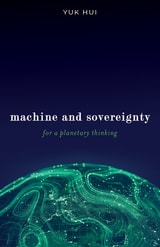
Machine and Sovereignty
For a Planetary Thinkingyuk
University of Minnesota Press, 2024
Developing a new political thought to address today’s planetary crises
What is “planetary thinking” today? Arguing that a new approach is urgently needed, Yuk Hui develops a future-oriented mode of political thought that encompasses the unprecedented global challenges we are confronting: the rise of artificial intelligence, the ecological crisis, and intensifying geopolitical conflicts.
Machine and Sovereignty starts with three premises. The first affirms the necessity of developing a new language of coexistence that surpasses the limits of nation-states and their variations; the second recognizes that political forms, including the polis, empire, and the state, are technological phenomena, which Lewis Mumford terms “megamachines.” The third suggests that a particular political form is legitimated and rationalized by a corresponding political epistemology. The planetary thinking that this book sketches departs from the opposition between mechanism and organism, which characterized modern thought, to understand the epistemological foundations of Hegel’s political state and Schmitt’s Großraum and their particular ways of conceiving the question of sovereignty. Through this reconstruction, Hui exposes the limits of the state and reflects on a new theoretical matrix based on the interrelated concepts of biodiversity, noodiversity, and technodiversity.
Arguing that we are facing the limit of modernity, of the eschatological view of history, of globalization, and of the human, Hui conceives necessary new epistemological and technological frameworks for understanding and rising to the crises of our present and our future.
Retail e-book files for this title are screen-reader friendly.
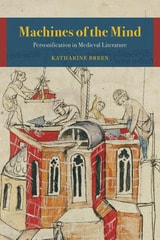
Machines of the Mind
Personification in Medieval LiteratureKatharine Breen
University of Chicago Press, 2021
In Machines of the Mind, Katharine Breen proposes that medieval personifications should be understood neither as failed novelistic characters nor as instruments of heavy-handed didacticism. She argues that personifications are instead powerful tools for thought that help us to remember and manipulate complex ideas, testing them against existing moral and political paradigms. Specifically, different types of medieval personification should be seen as corresponding to positions in the rich and nuanced medieval debate over universals. Breen identifies three different types of personification—Platonic, Aristotelian, and Prudentian—that gave medieval writers a surprisingly varied spectrum with which to paint their characters.
Through a series of new readings of major authors and works, from Plato to Piers Plowman, Breen illuminates how medieval personifications embody the full range of positions between philosophical realism and nominalism, varying according to the convictions of individual authors and the purposes of individual works. Recalling Gregory the Great’s reference to machinae mentis (machines of the mind), Breen demonstrates that medieval writers applied personification with utility and subtlety, employing methods of personification as tools that serve different functions. Machines of the Mind offers insight for medievalists working at the crossroads of religion, philosophy, and literature, as well as for scholars interested in literary character-building and gendered relationships among characters, readers, and texts beyond the Middle Ages.
Machinic Eros
Writings on JapanFélix Guattari
University of Minnesota Press, 2015
The French philosopher Félix Guattari frequently visited Japan during the 1980s and organized exchanges between French and Japanese artists and intellectuals. His immersion into the “machinic eros” of Japanese culture put him into contact with media theorists such as Tetsuo Kogawa and activists within the mini-FM community (Radio Home Run), documentary filmmakers (Mitsuo Sato), photographers (Keiichi Tahara), novelists (Kobo Abe), internationally recognized architects (Shin Takamatsu), and dancers (Min Tanaka). From pachinko parlors to high-rise highways, alongside corporate suits and among alt-culture comrades, Guattari put himself into the thick of Japanese becomings during a period in which the bubble economy continued to mutate. This collection of essays, interviews, and longer meditations shows a radical thinker exploring the architectural environment of Japan’s “machinic eros.”
Mad Like Artaud
Sylvère Lotringer
University of Minnesota Press, 2015
Those who are mad like Antonin Artaud, are they just as mad as he was? Madness, like the plague, is contagious, and everyone, from his psychiatrists to his disciples, family, and critics, everyone who gets close to Artaud, seems to participate in his delirium. Sylvère Lotringer explores various embodiments of this shared delirium through what Artaud called “mental dramas”—a series of confrontations with his witnesses or “persecutors” where we uncover the raw delirium at work, even in Lotringer himself. Mad Like Artaud does not intend to add one more layer of commentary to the bitter controversies that have been surrounding the cursed poet’s work since his death in 1948, nor does it take sides among the different camps who are still haggling over his corpse. This book speaks of the site where “madness” itself is simmering.
Madness, Language, Literature
Michel Foucault
University of Chicago Press, 2023
Perceiving an enigmatic relationship between madness, language, and literature, French philosopher Michel Foucault developed ideas during the 1960s that are less explicit in his later, more well-known writings. Collected here, these previously unpublished texts reveal a Foucault who undertakes an analysis of language and experience detached from their historical constraints. Three issues predominate: the experience of madness across societies; madness and language in Artaud, Roussel, and Baroque theater; and structuralist literary criticism. Not only do these texts pursue concepts unique to this period such as the “extra-linguistic,” but they also reveal a far more complex relationship between structuralism and Foucault than has typically been acknowledged.
Magical Nominalism
The Historical Event, Aesthetic Reenchantment, and the PhotographMartin Jay
University of Chicago Press, 2025
In this magisterial new book, intellectual historian Martin Jay traces the long-standing competition between two versions of nominalism—the “conventional” and the “magical.” Since at least William of Ockham, according to Jay, the conventional form of nominalism has contributed to the disenchantment of the world, by viewing general terms as nothing more than mere names we use to group particular objects together, rejecting the idea that they refer to a further, “higher” reality. Magical nominalism, instead, performs a reenchanting function, by investing proper names, disruptive events, and singular objects with an auratic power of their own. Drawing in part on Jewish theology, it challenges the elevation of the constitutive subject resulting from Ockham’s reliance on divine will in his critique of real universals.
Starting with the fourteenth-century revolution of nominalism against Scholastic realism, Jay unpacks various “counterrevolutions” against nominalism itself, including a magical alternative to its conventional form. Focusing on fundamental debates over the relationship between language, thought, and reality, Jay illuminates connections across thinkers, disciplines, and vast realms of human experience. Ranging from theology and philosophy of history to aesthetics and political theory, this book engages with a range of artists and thinkers, including Adorno, Ankersmit, Badiou, Barthes, Bataille, Benjamin, Blumenberg, Derrida, Duchamp, Foucault, Kracauer, Kripke, and Lyotard. Ultimately, Magical Nominalism offers a strikingly original way to understand humanity’s intellectual path to modernity.
Maimonides and Spinoza
Their Conflicting Views of Human NatureJoshua Parens
University of Chicago Press, 2012
Until the last century, it was generally agreed that Maimonides was a great defender of Judaism, and Spinoza—as an Enlightenment advocate for secularization—among its key opponents. However, a new scholarly consensus has recently emerged that the teachings of the two philosophers were in fact much closer than was previously thought. In his perceptive new book, Joshua Parens sets out to challenge the now predominant view of Maimonides as a protomodern forerunner to Spinoza—and to show that a chief reason to read Maimonides is in fact to gain distance from our progressively secularized worldview.
Maimonides' "Guide of the Perplexed"
A Philosophical GuideAlfred L. Ivry
University of Chicago Press, 2016
Drawing on a lifetime of study, Alfred L. Ivry has written the definitive guide to the Guide—one that makes it comprehensible and exciting to even those relatively unacquainted with Maimonides’ thought, while also offering an original and provocative interpretation that will command the interest of scholars. Ivry offers a chapter-by-chapter exposition of the widely accepted Shlomo Pines translation of the text along with a clear paraphrase that clarifies the key terms and concepts. Corresponding analyses take readers more deeply into the text, exploring the philosophical issues it raises, many dealing with metaphysics in both its ontological and epistemic aspects.

Maimonides' Ethics
The Encounter of Philosophic and Religious MoralityRaymond L. Weiss
University of Chicago Press, 1991
The gulf between classical philosophy and the Torah made the task of Maimonides extraordinarily difficult. Weiss shows that Maimonides subtly preserves the tension between those traditions while producing a practical accommodation between them. To explain how Maimonides was able to accomplish this twofold goal, Weiss takes seriously the multilevel character of Maimonides' works. Weiss interprets Maimonides as a heterodox thinker who, with utter integrity, faces the Law's encounter with philosophy and gives both the Torah and philosophy their due.

Maimonides' "Guide of the Perplexed" in Translation
A History from the Thirteenth Century to the TwentiethEdited by Josef Stern, James T. Robinson, and Yonatan Shemesh
University of Chicago Press, 2019
A collection of essays by scholars from a range of disciplines, the book unfolds in two parts. The first traces the history of the translations of the Guide, from medieval to modern renditions. The second surveys its influence in translation on Latin scholastic, early modern, and contemporary Anglo-American philosophy, as well as its impact in translation on current scholarship. Interdisciplinary in approach, this book will be essential reading for philosophers, historians, and religious studies scholars alike.
Making Grateful Kids
The Science of Building CharacterJeffrey Froh
Templeton Press, 2014
If there was a new wonder drug on the market that got kids to behave better, improve their grades, feel happier, and avoid risky behaviors, many parents around the world would be willing to empty their bank accounts to acquire it. Amazingly, such a product actually does exist. It’s not regulated by the FDA, it has no ill side-effects, and it’s absolutely free and available to anyone at any time. This miracle cure is gratitude.
Over the past decade, science has shown that gratitude is one of the most valuable and important emotions we possess, and it is a virtue that anyone can cultivate. In fact, researchers have developed many different methods people can use to foster an attitude of gratitude, and the science shows that many of them really work.
In Making Grateful Kids, two of the leading authorities on gratitude among young people, Jeffrey J. Froh and Giacomo Bono, introduce their latest and most compelling research, announce groundbreaking findings, and share real-life stories from adults and youth to show parents, teachers, mentors, and kids themselves how to achieve greater life satisfaction through gratitude. Most importantly perhaps, they expand on this groundbreaking research to offer practical and effective common-sense plans that can be used in day-to-day interactions between kids and adults to enhance success and wellbeing.
Their unique, scientifically-based approach for producing grateful youth works whether these kids are very young elementary school students or troubled teenagers. Not only does the purposeful practice of gratitude increase their happiness, but the research indicates that grateful kids also report more self-discipline, fulfilling relationships, and engagement with their schools and communities when compared to their less grateful counterparts. After reading Making Grateful Kids, parents, teachers, and anyone who works with youth will be able to connect more meaningfully with kids so that all parties can focus on the things that matter most and, in turn, create a more cooperative and thriving society.
Making History Matter
Robert Dawidoff
Temple University Press, 2000
As a scholar of intellectual and cultural history, Dawidoff takes the stance that historians ought to take an active role in our democratic culture, informing and participating in public discourse. He argues for a broad reach when it comes to cultural expression, resisting the polarization of formal intellectual history and folk or commercial popular culture. In his view, Ralph Waldo Emerson and Katherine Hepburn are equally worthy topics for a historian's consideration, provided that they are treated with equal seriousness of purpose and analytic rigor. In "The Gay Nineties" section that closes the book, he traces key events in the continual struggle for gay and lesbian civil rights and takes on such unresolved issues as safer sex, needle exchange programs to control HIV transmission, and the public controversy around the portrayal of gay and lesbian television characters.
Divided into sections that deal with the patriarchs of American political and intellectual culture, expressive culture, and a historian's public voice, this book is a model of engaged and engaging writing. Accessible and witty, Making History Matter will appeal to general and academic readers interested in American history as well as gay and lesbian political and cultural issues.
Making History Move
Five Principles of the Historical FilmKim Nelson
Rutgers University Press, 2024
Making Morality
Pragmatist Reconstruction in Ethical TheoryTodd Lekan
Vanderbilt University Press, 2003
Building on classical American philosophy to address current philosophical concerns, Lekan's theory revises our basic understanding of moral life and the place of theorizing within that life. Making Morality will prove of great interest to ethical theorists, as it enjoins them to measure theoretical inquiries by how well they produce intellectual tools for problem-solving in dynamic, complex communities.
Making Sense in Common
A Reading of Whitehead in Times of CollapseIsabelle Stengers
University of Minnesota Press, 2023
A leading philosopher seeks to recover “common sense” as a meeting place to reconcile science and philosophy
With her previous books on Alfred North Whitehead, Isabelle Stengers not only secured a reputation as one of the premier philosophers of our times but also inspired a rethinking of critical theory, political thought, and radical philosophy across a range of disciplines. Here, Stengers unveils what might well be seen as her definitive reading of Whitehead.
Making Sense in Common will be greeted eagerly by the growing group of scholars who use Stengers’s work on Whitehead as a model for how to think with conceptual precision through diverse domains of inquiry: environmentalism and ecology, animal studies, media and technology studies, the history and philosophy of science, feminism, and capitalism. On the other hand, the significance of this new book extends beyond Whitehead. Instead, it lies in Stengers’s recovery of the idea of “common sense” as a meeting place—a commons—where opposed ideas of science and humanistic inquiry can engage one another and help to move society forward. Her reconciliation of science and philosophy is especially urgent today—when climate disaster looms all around us, when the values of what we thought of as civilization and modernity are discredited, and when expertise of any kind is under attack.
Making Sense in Life and Literature
Hans Ulrich Gumbrecht
University of Minnesota Press, 1992
“The translation of these essays by Gumbrecht on literary theory and history marks the appearance in English of one of Europe’s most learned, productive, and inventive scholars. Their range is extraordinary. They show that Gumbrecht is not only a sophisticated theorist and historian of literature, but a master practitioner of cultural studies.” --Hayden White, University of California, Santa Cruz

Making Sense of Nietzsche
REFLECTIONS TIMELY AND UNTIMELYRichard Schacht
University of Illinois Press, 1995
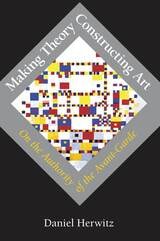
Making Theory/Constructing Art
On the Authority of the Avant-GardeDaniel Herwitz
University of Chicago Press, 1993
Spurred by the theoretical claims of Arthur Danto, a leader in the philosophy of the avant-garde, Herwitz reexamines the art and theory of major figures in the avant-garde movement including John Cage, Jean-François Lyotard, Jean Baudrillard, and Andy Warhol.
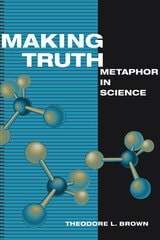
Making Truth
Metaphor in ScienceTheodore L. Brown
University of Illinois Press, 2002
To illustrate the roles of metaphor in science, Brown presents a series of studies of scientific systems. These range from the atom, historically one of the most important ideas in science, through models in chemistry and biology, including current “hot” topics such as protein folding, chaperone proteins, and global warming. The case studies in Making Truth illustrate the deeply metaphorical nature of scientific reasoning and communication. They provide the basis for far-reaching conclusions about science as an intellectual and social practice and about the nature of scientific truth.
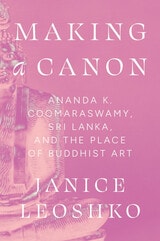
Making a Canon
Ananda K. Coomaraswamy, Sri Lanka, and the Place of Buddhist ArtJanice Leoshko
University of Chicago Press, 2024
An early interpreter of Buddhist art to the West, Ananda Kentish Coomaraswamy laid the foundation of what would become the South Asian visual canon, particularly through his efforts to understand how Buddhist art emerged and developed. In Making a Canon, Janice Leoshko examines how Coomaraswamy’s experience as the director of a mineralogical survey in Sri Lanka shaped his understanding of South Asian art and religion. Along the way, she reveals how Coomaraswamy’s distinctive repetition of Sri Lankan visual images in his work influenced the direction of South Asia’s canon formation and left a lasting impression on our understanding of Buddhist art.
Making the American Team
Sport, Culture, and the Olympic ExperienceMark Dyreson
University of Illinois Press, 1998
Sport dominates television and the mass media. Politics and business are a-bustle with sports metaphors. Endorsements by athletes sell us products. "Home run," "slam dunk," and the rest of the vocabulary of sport color daily conversation. Even in times of crisis and emergency, the media reports the scores and highlights.
Marky Dyreson delves into how our obsession with sport came into being with a close look at coverage of the Olympic Games between 1896 and 1912. How people reported and consumed information on the Olympics offers insight into how sport entered the heart of American culture as part of an impetus for social reform. Political leaders came to believe in the power of sport to revitalize the "republican experiment." Sport could instill a new sense of national identity that would forge a new sense of community and a healthy political order while at the same time linking America's intellectual and power elite with the experiences of the masses.

Maladies of Modernity
Scientism and the Deformation of Political OrderDavid N. Whitney
St. Augustine's Press, 2014
“Chief among the spiritually blighting tendencies of the age is materialist reductionism parading as scientific orthodoxy. David Whitney powerfully explores this movement and habit of mind as it takes its rise in the form of scientism, especially from Sir Francis Bacon’s NEW ATLANTIS in the 17th century and finds full fruition in the positivist teachings of August Comte in the 19th century—a preamble to the behavioralist dogmas of our own time. The openness to the facts of experience characteristic of all science as a search for the truth of reality in all its dimensions and diversity is thereby effectively abandoned in favor of an unrelenting insistence on a restrictive methodology ostensibly grounded in phenomenal reality that is perversely made the touchstone of all valid inquiry. The consequences are philosophically as well as politically disastrous, as Whitney brilliantly demonstrates in this path-breaking study.”
– Ellis Sandoz, Founder of the Eric Voegelin Institute for American Renaissance Studies
"David Whitney’s excellent critique of what he calls scientism, a dogmatic application of the methods of natural science to social science, provides a high-brow diagnosis of the modern maladies that result from the “rhetorical power of science.”
–– Scott Robinson, voegelinview
Man Made God
The Meaning of LifeLuc Ferry
University of Chicago Press, 2002
Luc Ferry argues that modernity and the emergence of secular humanism in Europe since the eighteenth century have not killed the search for meaning and the sacred, or even the idea of God, but rather have transformed both through a dual process: the humanization of the divine and the divinization of the human. Ferry sees evidence for the first of these in the Catholic Church's attempts to counter the growing rejection of dogmatism and to translate the religious tradition into contemporary language. The second he traces to the birth of modern love and humanitarianism, both of which demand a concern for others and even self-sacrifice in defense of values that transcend life itself. Ferry concludes with a powerful statement in favor of what he calls "transcendental humanism"—a concept that for the first time in human history gives us access to a genuine spirituality rooted in human beings instead of the divine.
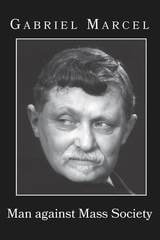
Man against Mass Society
Gabriel Marcel
St. Augustine's Press, 2008
The central theme of this important book is that we are paying the price of an arrogance that refuses to recognize mystery. The author invites the reader to enter into the argument that he holds with himself on a great number of problems. Written in the early 1950s, Marcel’s discussion of these topics are remarkably contemporary, e.g.:
* Our crisis is a metaphysical, not merely social, one.
* What a man is depends partly on what he thinks he is, and a materialistic philosophy turns men into things.
* Can a man be free except in a free country?
* Stoicism is no longer a workable philosophy because today pressure can be put on the mind as well as on the body.
* Technical progress is not evil in itself, but a technique is a means that, regarded as an end, can become either an idol or an excuse for self-idolatry. State control of scientific research, leading to a concentration on new means of destruction, is a calamity.
* Fanaticism is an opinion that refuses to argue, and so the fanatic is an enemy of truth.
* The kind of unification that science is bringing about today is really an ironing out of differences, but the only valuable kind of unity is one that implies a respect for differences.
* We must beware of thinking in terms of great numbers and so blinding ourselves to the reality of individual suffering. Our philosophical approach to being is made possible only by our practical approach to our neighbor.
* We must encourage the spirit of fraternity and distrust the kind of egalitarianism that is based on envy and resentment.
* No man however humble should feel that he cannot spread the light among his friends. No easy solution is offered, but the author conveys his own faith that ultimately love and intelligence will triumph.

Manifesto Now!
Instructions for Performance, Philosophy, PoliticsEdited by Laura Cull and Will Daddario
Intellect Books, 2013
Manifesto of a Passionate Moderate
Unfashionable EssaysSusan Haack
University of Chicago Press, 1998
"The virtue of Haack's book, and I mean virtue in the ethical sense, is that it embodies the attitude that it exalts. . . Haack's voice is urbane, sensible, passionate—the voice of philosophy that matters. How good to hear it again."—Jonathan Rauch, Reason
"A tough mind, confident of its power, making an art of logic . . . a cool mastery."—Paul R. Gross, Wilson Quarterly
"Few people are better able to defend the notion of truth, and in strong, clear prose, than Susan Haack . . . a philosopher of great distinction."—Hugh Lloyd-Jones, National Review
"If you relish acute observation and straight talk, this is a book to read."—Key Reporter (Phi Beta Kappa)
"Everywhere in this book there is the refreshing breeze of common sense, patiently but inexorably blowing."—Roger Kimball, Times Literary Supplement
"A refreshing alternative to the extremism that characterizes so much rhetoric today."—Kirkus Reviews

Man’s Soul
An Introductory Essay in Philosophical PsychologyS.L. Frank
Ohio University Press, 1993
“Seymon Lyudvigovich Frank, the author of the volume here made available for the first time in English translation, was one of the leading Russian philosophers of this century; some authorities consider him the most outstanding Russian philosopher of any age….
”Man’s Soul is a book which perfectly exemplifies the generous conception of the mission and competence of philosophy characteristic of Frank and the other members of the Russian metaphysical movement. Frank’s stated aim in the treatise is to reclaim for philosophy a field of investigation which, from the time of Plato and Aristotle to that of the Russian Idealists, philosophers had viewed as properly theirs, but which, since the mid-nineteenth century, they had allowed to fall into almost complete neglect: the study of the nature of the human soul (or psyche)….
“The moral message of Man’s Soul is well summed up by its epigraph, quoted from St. Augustine: ‘Let man first of all return to his own self, so that once he has, as it were, stepped therein, he may rise from thence and be elevated to God.’”
—from the foreword by Philip J. Swoboda
Mapping Michel Serres
Niran Abbas, Editor
University of Michigan Press, 2005
---Robert Harrison, Stanford University [blurb from review pending permission]
The work of Michel Serres---including the books Hermes, The Parasite, The Natural Contract, Genesis, The Troubadour of Knowledge, and Conversations on Science, Culture, and Time---has stimulated readers for years, as it challenges the boundaries of science, literature, culture, language, and epistemology. The essays in Mapping Michel Serres, written by the leading interpreters of his work, offer perspectives from a range of disciplinary positions, including literature, language studies, and cultural theory. Contributors include Maria Assad, Hanjo Berressem, Stephen Clucas, Steven Connor, Andrew Gibson, René Girard, Paul Harris, Marcel Hénaff, William Johnsen, William Paulson, Marjorie Perloff, Philipp Schweighauser, Isabella Winkler, and Julian Yates.
Maps and Mirrors
Topologies of Art and PoliticsSteve Martinot
Northwestern University Press, 2001

Margaret Fuller and Her Circles
Brigitte Bailey
University of New Hampshire Press, 2013

Margins in the Classroom
Teaching LiteratureKostas Myrsiades and Linda S. Myrsiades, Editors
University of Minnesota Press, 1994
Margins in the Classroom was first published in 1994. Minnesota Archive Editions uses digital technology to make long-unavailable books once again accessible, and are published unaltered from the original University of Minnesota Press editions.
For today's teacher of literature, facing a minefield of politics and theory, this book arrives as a much needed guide through the multiplying cultural anxieties of the college classroom. Margins in the Classroom brings together established scholars and emerging voices from diverse backgrounds to show how politics and theory can and do affect the most pressing problems confronting the contemporary teacher of literature. The essays in this volume go beyond questioning and examining existing practices to suggest fresh approaches to teaching the expanding literary canon within the context of the politics of the educational institution.
Grounded in literary criticism, psychoanalysis, feminist theory, political economy, sociology, and philosophy, these essays apply new theoretical models to the traditional canon, identify new bodies of literature, and show how theory can be used to analyze these new literatures. Focusing on the politics of teaching and theory in the classroom, the authors explore the present practice and future implications of changing textual analysis, literary theory, and pedagogy. Their essays address the politics of literature as it affects the classroom, the design of courses, and the creation of new courses. They mold theory to the variety of classroom populations and materials the teacher of literature encounters today. The resulting volume bridges the differences between the languages of the classroom instructor and the contemporary theorist. Margins in the Classroom is unique in both the breadth and the depth of its concern over the disturbing, if electric, impact of changes in criticism, theory, and pedagogy in college literature classes as we approach the next century of academic instruction.Kostas Myrsiades is professor of comparative literature, and Linda S. Myrsiades is professor of English, both at West Chester University. Kostas Myrsiades is editor of College Literature, where Linda S. Myrsiades is an associate editor.
Margins of Philosophy
Jacques Derrida
University of Chicago Press, 1982

Marsilio Ficino, Three Books on Life
A Critical Edition and TranslationCarol V. Kaske
Arizona Center for Medieval and Renaissance Studies, 2019

Martin Buber's Ontology
An Analysis of I and ThouRobert Wood
Northwestern University Press, 1969
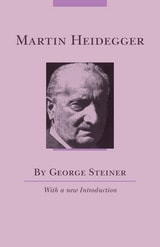
Martin Heidegger
George Steiner
University of Chicago Press, 1987
Acquaintance with the work of Martin Heidegger is indispensable to an understanding of contemporary thought and culture. His work has had a profound influence on a number of disciplines, including theology, Sartrean existentialism, linguistics, Hellenic studies, the structuralist and hermeneutic schools of textual interpretation, literary theory, and literature itself. With characterisitc lucidity and style, George Steiner makes this philosopher’s immensely difficult body of work accessible to the general reader. The breadth of Steiner’s learning and interests also allows him to place Heidegger in a broader Continental literary-cultural context. In a new Introduction, Steiner addresses language and philosophy and the rise of Nazism

Martin Heidegger Saved My Life
Grant Farred
University of Minnesota Press, 2015
In Martin Heidegger Saved My Life, Grant Farred combines autobiography with philosophical rumination to offer this unusual meditation on American racism. In the fall of 2013 while raking leaves outside his home, Farred experienced a racist encounter: a white woman stopped to ask him, “Would you like another job?” Farred responded, “Only if you can match my Cornell faculty salary.” The moment, however, stuck with him. The black man had gravitated to, of all people, Martin Heidegger, specifically Heidegger’s pronouncement, “Only when man speaks, does he think—and not the other way around,” in order to unpack this encounter.
In this essay, Farred grapples with why it is that Heidegger—well known as a Nazi—resonates so deeply with him during this encounter instead of other, more predictable figures such as Malcolm X, W. E. B. DuBois, or Frantz Fanon.
Forerunners is a thought-in-process series of breakthrough digital works. Written between fresh ideas and finished books, Forerunners draws on scholarly work initiated in notable blogs, social media, conference plenaries, journal articles, and the synergy of academic exchange. This is gray literature publishing: where intense thinking, change, and speculation take place in scholarship.
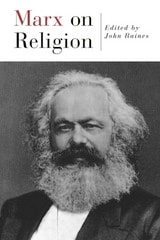
Marx On Religion
John Raines
Temple University Press, 2002
Marx at the Margins
On Nationalism, Ethnicity, and Non-Western SocietiesKevin B. Anderson
University of Chicago Press, 2010
In Marx at the Margins, Kevin Anderson uncovers a variety of extensive but neglected texts by the well-known political economist which cast what we thought we knew about his work in a startlingly different light. Analyzing a variety of Marx’s writings, including journalistic work written for the New York Tribune, Anderson presents us with a Marx quite at odds with our conventional interpretations. Rather than providing us with an account of Marx as an exclusively class-based thinker, Anderson here offers a portrait of Marx for the twenty-first century: a global theorist whose social critique was sensitive to the varieties of human social and historical development, including not just class, but nationalism, race, and ethnicity, as well.
Marx at the Margins ultimately argues that alongside his overarching critique of capital, Marx created a theory of history that was multi-layered and not easily reduced to a single model of development or revolution. Through highly-informed readings on work ranging from Marx’s unpublished 1879–82 notebooks to his passionate writings about the antislavery cause in the United States, this volume delivers a groundbreaking and canon-changing vision of Karl Marx that is sure to provoke lively debate in Marxist scholarship and beyond.
Marx for Cats
A Radical BestiaryLeigh Claire La Berge
Duke University Press, 2023

Marx on Suicide
Karl Marx
Northwestern University Press, 1999
Marx's Dream
From Capitalism to CommunismTom Rockmore
University of Chicago Press, 2018
With Marx’s Dream, Tom Rockmore offers a much-needed alternative view, distinguishing rigorously between Marx and Marxism. Rockmore breaks with the Marxist view of Marx in three key ways. First, he shows that the concern with the relation of theory to practice—reflected in Marx’s famous claim that philosophers only interpret the world, while the point is to change it—arose as early as Socrates, and has been central to philosophy in its best moments. Second, he seeks to free Marx from his unsolicited Marxist embrace in order to consider his theory on its own merits. And, crucially, Rockmore relies on the normal standards of philosophical debate, without the special pleading to which Marxist accounts too often resort. Marx’s failures as a thinker, Rockmore shows, lie less in his diagnosis of industrial capitalism’s problems than in the suggested remedies, which are often unsound.
Only a philosopher of Rockmore’s stature could tackle a project this substantial, and the results are remarkable: a fresh Marx, unencumbered by doctrine and full of insights that remain salient today.
Marxism and the Interpretation of Culture
Edited by Cary Nelson and Lawrence Grossberg
University of Illinois Press, 1988