Results by title
28167 books match the query 'History' and 1583 start with m
Made from Bone
Trickster Myths, Music, and History from the AmazonJonathan D. Hill
University of Illinois Press, 2008
Made-from-Bone is the first work to provide a complete set of English translations of narratives about the mythic past and its transformations from the indigenous Arawak-speaking people of South America. Among the Arawak-speaking Wakuénai of southernmost Venezuela, storytellers refer to these narratives as "words from the primordial times," and they are set in an unfinished space-time before there were any clear distinctions between humans and animals, men and women, day and night, old and young, and powerful and powerless. The central character throughout these primordial times and the ensuing developments that open up the world of distinct peoples, species, and places is a trickster-creator, Made-from-Bone, who survives a prolonged series of life-threatening attacks and ultimately defeats all his adversaries.
Carefully recorded and transcribed by Jonathan D. Hill, these narratives offer scholars of South America and other areas the only ethnographically generated cosmogony of contemporary or ancient native peoples of South America. Hill includes translations of key mythic narratives along with interpretive and ethnographic discussion that expands on the myths surrounding this fascinating and enigmatic character with broad appeal throughout various folkloric traditions.
Made in America
A Social History of American Culture and CharacterClaude S. Fischer
University of Chicago Press, 2010
Our nation began with the simple phrase, “We the People.” But who were and are “We”? Who were we in 1776, in 1865, or 1968, and is there any continuity in character between the we of those years and the nearly 300 million people living in the radically different America of today?
With Made in America, Claude S. Fischer draws on decades of historical, psychological, and social research to answer that question by tracking the evolution of American character and culture over three centuries. He explodes myths—such as that contemporary Americans are more mobile and less religious than their ancestors, or that they are more focused on money and consumption—and reveals instead how greater security and wealth have only reinforced the independence, egalitarianism, and commitment to community that characterized our people from the earliest years. Skillfully drawing on personal stories of representative Americans, Fischer shows that affluence and social progress have allowed more people to participate fully in cultural and political life, thus broadening the category of “American” —yet at the same time what it means to be an American has retained surprising continuity with much earlier notions of American character.
Firmly in the vein of such classics as The Lonely Crowd and Habits of the Heart—yet challenging many of their conclusions—Made in America takes readers beyond the simplicity of headlines and the actions of elites to show us the lives, aspirations, and emotions of ordinary Americans, from the settling of the colonies to the settling of the suburbs.

Made in Chicago
Stories Behind 30 Great Hometown BitesMonica Eng and David Hammond
University of Illinois Press, 2023
A BookRiot Most Anticipated Travel Book of 2023
Italian beef and hot dogs get the headlines. Cutting-edge cuisine and big-name chefs get the Michelin stars. But Chicago food shows its true depth in classic dishes conceived in the kitchens of immigrant innovators, neighborhood entrepreneurs, and mom-and-pop visionaries.
Monica Eng and David Hammond draw on decades of exploring the city’s food landscape to serve up thirty can’t-miss eats found in all corners of Chicago. From Mild Sauce to the Jibarito and from Taffy Grapes to Steak and Lemonade, Eng and Hammond present stories of the people and places behind each dish while illuminating how these local favorites reflect the multifaceted history of the city and the people who live there. Each entry provides all the information you need to track down whatever sounds good and selected recipes even let you prepare your own Flaming Saganaki or Akutagawa.
Generously illustrated with full-color photos, Made in Chicago provides locals and visitors alike with loving profiles of a great food city’s defining dishes.
Made in Newark
Cultivating Industrial Arts and Civic Identity in the Progressive EraShales, Ezra
Rutgers University Press, 2010
This is the story of experimental exhibitions in the library and the founding of the Newark Museum Associationùa project in which cultural literacy was intertwined with civics and consumption. Local artisans demonstrated crafts, connecting the cultural institution to the department store, school, and factory, all of which invoked the ideal of municipal patriotism. Today, as cultural institutions reappraise their relevance, Made in Newark explores precedents for contemporary debates over the ways the library and museum engage communities, define heritage in a multicultural era, and add value to the economy.
Made to Be Seen
Perspectives on the History of Visual AnthropologyEdited by Marcus Banks and Jay Ruby
University of Chicago Press, 2011
Made to be Seen brings together leading scholars of visual anthropology to examine the historical development of this multifaceted and growing field. Expanding the definition of visual anthropology beyond more limited notions, the contributors to Made to be Seen reflect on the role of the visual in all areas of life. Different essays critically examine a range of topics: art, dress and body adornment, photography, the built environment, digital forms of visual anthropology, indigenous media, the body as a cultural phenomenon, the relationship between experimental and ethnographic film, and more.
The first attempt to present a comprehensive overview of the many aspects of an anthropological approach to the study of visual and pictorial culture, Made to be Seen will be the standard reference on the subject for years to come. Students and scholars in anthropology, sociology, visual studies, and cultural studies will greatly benefit from this pioneering look at the way the visual is inextricably threaded through most, if not all, areas of human activity.
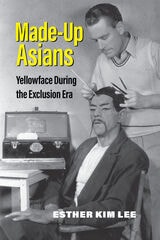
Made-Up Asians
Yellowface During the Exclusion EraEsther Kim Lee
University of Michigan Press, 2022
Madeline Island & the Chequamegon Region
John O. Holzhueter
Wisconsin Historical Society Press, 1974
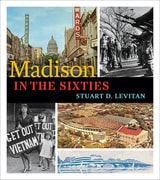
Madison in the Sixties
Stuart D. Levitan
Wisconsin Historical Society Press, 2018
Landmark civil rights laws were passed. Pivotal campus protests were waged. A spring block party turned into a three-night riot. Factor in urban renewal troubles, a bitter battle over efforts to build Frank Lloyd Wright’s Monona Terrace, and the expanding influence of the University of Wisconsin, and the decade assumes legendary status.
In this first-ever comprehensive narrative of these issues—plus accounts of everything from politics to public schools, construction to crime, and more—Madison historian Stuart D. Levitan chronicles the birth of modern Madison with style and well-researched substance. This heavily illustrated book also features annotated photographs that document the dramatic changes occurring downtown, on campus, and to the Greenbush neighborhood throughout the decade. Madison in the Sixties is an absorbing account of ten years that changed the city forever.
Madison's Nightmare
How Executive Power Threatens American DemocracyPeter M. Shane
University of Chicago Press, 2009
The George W. Bush administration’s ambitious—even breathtaking—claims of unilateral executive authority raised deep concerns among constitutional scholars, civil libertarians, and ordinary citizens alike. But Bush’s attempts to assert his power are only the culmination of a near-thirty-year assault on the basic checks and balances of the U.S. government—a battle waged by presidents of both parties, and one that, as Peter M. Shane warns in Madison’s Nightmare, threatens to utterly subvert the founders’ vision of representative government.
Tracing this tendency back to the first Reagan administration, Shane shows how this era of "aggressive presidentialism" has seen presidents exerting ever more control over nearly every arena of policy, from military affairs and national security to domestic programs. Driven by political ambition and a growing culture of entitlement in the executive branch—and abetted by a complaisant Congress, riven by partisanship—this presidential aggrandizement has too often undermined wise policy making and led to shallow, ideological, and sometimes outright lawless decisions. The solution, Shane argues, will require a multipronged program of reform, including both specific changes in government practice and broader institutional changes aimed at supporting a renewed culture of government accountability.
From the war on science to the mismanaged war on terror, Madison’s Nightmare outlines the disastrous consequences of the unchecked executive—and issues a stern wake-up call to all who care about the fate of our long democratic experiment.

Madison
Portraits of Our NeighborsLaura Jo Amaral and Stacie Huckeba; Foreword by Carlene Carter
Vanderbilt University Press, 2025
Madison: Portraits of Our Neighbors, a photography book and living historical document of a unique Tennessee community, is the result of an artistic partnership between internationally recognized photographer Stacie Huckeba and Madison, Tennessee, community volunteer Laura Jo Amaral. This book captures the heart of the people who contribute to the Madison community as it is today, through portraits of a range of its citizens—a world-class bass player, a nonagenarian cattle farmer, a TikTok celebrity, a singer-songwriter, a mariachi band, the personal photographer for Johnny Cash, a beloved gymnastics coach, model airplane enthusiasts, educators, a fashion designer, a puppet enthusiast, a pastor and outreach worker, and an array of artists, small business owners, farmers, and local legends. Beyond a collection of portraits, it is a testament to an enduring urban community, a celebration of the shared human experience, and a reminder to see our neighbors in their best light. Madison: Portraits of Our Neighbors invites readers to celebrate the tapestry of humanity that weaves through this distinctive neighborhood.
This book is the recipient of the 2026 Norman L. and Roselea J. Goldberg Prize from Vanderbilt University Press for the best book in the area of art or medicine.

Madison
The Illustrated History, 1932–1979Stuart D. Levitan
University of Wisconsin Press, 2026
This second volume in the acclaimed illustrated civic history of Madison, Wisconsin, tells the story of this iconic midwestern city in the middle years of the twentieth century. Like the rest of America in this period, Madison was buffeted by a boom-and-bust economy, hot and cold wars abroad, and social and cultural changes on the homefront. Stuart D. Levitan, a mainstay of Madison media and government since 1975, offers a decade-by-decade visual and narrative account of the city’s transformation—as well as that of its major public university. Featuring hundreds of illustrations, this volume also highlights the local legends and luminaries who shaped the city, from bootleggers to world-famous architects to radicals and revolutionaries.
Madison
The Illustrated History, Volume 1, 1856–1931Stuart D. Levitan
University of Wisconsin Press, 2006
This engaging illustrated history, full of photographs, maps, and bird’s-eye views, captures Madison’s early history from its first days as a city to the Great Depression. Biographical vignettes tell the stories of early movers and shakers in the city. The volume includes many archival images of Madison that have never been published or have not been seen for a century or more.
Madness Is Civilization
When the Diagnosis Was Social, 1948-1980Michael E. Staub
University of Chicago Press, 2011
In the 1960s and 1970s, a popular diagnosis for America’s problems was that society was becoming a madhouse. In this intellectual and cultural history, Michael E. Staub examines a time when many believed insanity was a sane reaction to obscene social conditions, psychiatrists were agents of repression, asylums were gulags for society’s undesirables, and mental illness was a concept with no medical basis.
The first study to describe how social diagnostic thinking emerged, Madness Is Civilization casts new light on the politics of the postwar era.
Madness and Enterprise
Psychiatry, Economic Reason, and the Emergence of Pathological ValueNima Bassiri
University of Chicago Press, 2024
Madness and Enterprise reveals the economic norms embedded within psychiatric thinking about mental illness in the North Atlantic world. Over the course of the nineteenth century, various forms of madness were subjected to a style of psychiatric reasoning that was preoccupied with money. Psychiatrists across Western Europe and the United States attributed financial and even moral value to an array of pathological conditions, such that some mental disorders were seen as financial assets and others as economic liabilities. By turning to economic conduct and asking whether potential patients appeared capable of managing their financial affairs or even generating wealth, psychiatrists could often bypass diagnostic uncertainties about a person’s mental state.
Through an exploration of the intertwined histories of psychiatry and economic thought, Nima Bassiri shows how this relationship transformed the very idea of value in the modern North Atlantic, as the most common forms of social valuation—moral value, medical value, and economic value—were rendered equivalent and interchangeable. If what was good and what was healthy were increasingly conflated with what was remunerative (and vice versa), then a conceptual space opened through which madness itself could be converted into an economic form and subsequently redeemed—and even revered.

Madness and Enterprise
Psychiatry, Economic Reason, and the Emergence of Pathological ValueNima Bassiri
University of Chicago Press, 2024
This is an auto-narrated audiobook version of this book.
Uncovers a powerful relationship between pathology and money: beginning in the nineteenth century, the severity of mental illness was measured against a patient’s economic productivity.
Madness and Enterprise reveals the economic norms embedded within psychiatric thinking about mental illness in the North Atlantic world. Over the course of the nineteenth century, various forms of madness were subjected to a style of psychiatric reasoning that was preoccupied with money. Psychiatrists across Western Europe and the United States attributed financial and even moral value to an array of pathological conditions, such that some mental disorders were seen as financial assets and others as economic liabilities. By turning to economic conduct and asking whether potential patients appeared capable of managing their financial affairs or even generating wealth, psychiatrists could often bypass diagnostic uncertainties about a person’s mental state.
Through an exploration of the intertwined histories of psychiatry and economic thought, Nima Bassiri shows how this relationship transformed the very idea of value in the modern North Atlantic, as the most common forms of social valuation—moral value, medical value, and economic value—were rendered equivalent and interchangeable. If what was good and what was healthy were increasingly conflated with what was remunerative (and vice versa), then a conceptual space opened through which madness itself could be converted into an economic form and subsequently redeemed—and even revered.
Madrid Codex
New Approaches to Understanding an Ancient Maya ManuscriptGabrielle Vail
University Press of Colorado, 2004
Contributors include: Harvey M. Bricker, Victoria R. Bricker, John F. Chuchiak IV, Christine L. Hernández, Bryan R. Just, Merideth Paxton, and John Pohl. Additional support for this publication was generously provided by the Eugene M. Kayden Fund at the University of Colorado.
Madumo, a Man Bewitched
Adam Ashforth
University of Chicago Press, 2000
So begins this true story of witchcraft and friendship set against the turbulent backdrop of contemporary Soweto. Adam Ashforth, an Australian who has spent many years in the black township, finds his longtime friend Madumo in dire circumstances: his family has accused him of using witchcraft to kill his mother and has thrown him out on the street. Convinced that his life is cursed, Madumo seeks help among Soweto's bewildering array of healers and prophets. An inyanga, or traditional healer, confirms that he has indeed been bewitched. With Ashforth by his side, skeptical yet supportive, Madumo embarks upon a physically grueling treatment regimen that he follows religiously-almost to the point of death-despite his suspicion that it may be better to "Westernize my mind and not think about witchcraft."
Ashforth's beautifully written, at times poignant account of Madumo's struggle shows that the problem of witchcraft is not simply superstition, but a complex response to spiritual insecurity in a troubling time of political and economic upheaval. Post-apartheid Soweto, he discovers, is suffering from a deluge of witchcraft. Through Madumo's story, Ashforth opens up a world that few have seen, a deeply unsettling place where the question "Do you believe in witchcraft?" is not a simple one at all. The insights that emerge as Ashforth accompanies his friend on an odyssey through Soweto's supernatural perils have profound implications even for those of us who live in worlds without witches.

Mafalda
A Social and Political History of Latin America's Global ComicIsabella Cosse
Duke University Press, 2019
Mafeking Diary
A Black Man’s View of a White Man’s WarSol T. Plaatje
Ohio University Press, 1990
“Sol Plaatje’s Mafeking Diary is a document of enduring importance and fascination. The product of a young black South African court interpreter, just turned 23 years old when he started writing, it opens an entirely new vista on the famous Siege of Mafeking. By shedding light on the part played by the African population of the town, Plaatje explodes the myth, maintained by belligerents, and long perpetuated by both historians and the popular imagination, this this was a white man’s affair. One of the great epics of British imperial history, and perhaps the best remembered episode of the Anglo-Boer war of 1899–1902, is presented from a wholly novel perspective.
“At the same time, the diary provides an intriguing insight into the character of a young man who was to play a key role in South African political and literary history during the first three decades of this century. It reveals much of the perceptions and motives that shaped his own attitudes and intellectual development and, indeed, those of an early generation of African leaders who sought to build a society which did not determine the place of its citizens by the colour of their skin. The diary therefore illuminates the origins of a struggle which continues to this day.”
— John L. Comaroff (ed.) in his preface
Magic Flutes and Enchanted Forests
The Supernatural in Eighteenth-Century Musical TheaterDavid J. Buch
University of Chicago Press, 2008
David J. Buch reveals that despite—and perhaps even because of—their fundamental irrationality, fantastic and exotic themes acquired extraordinary force and popularity during the period, pervading theatrical works with music in the French, German, and Italian mainstream. Considering prominent compositions by Gluck, Rameau, and Haydn, as well as many seminal contributions by lesser-known artists, Buch locates the origins of these magical elements in such historical sources as ancient mythology, European fairy tales, the Arabian Nights, and the occult. He concludes with a brilliant excavation of the supernatural roots of Mozart’s The Magic Flute and Don Giovanni, building a new foundation for our understanding of the magical themes that proliferated in Mozart’s wake.
Magic's Reason
An Anthropology of AnalogyGraham M. Jones
University of Chicago Press, 2017
Using French magicians’ engagements with North African ritual performers as a case study, Jones shows how magic became enshrined in anthropological reasoning. Acknowledging the residue of magic’s colonial origins doesn’t require us to dispense with it. Rather, through this radical reassessment of classic anthropological ideas, Magic’s Reason develops a new perspective on the promise and peril of cross-cultural comparison.
Magical Criticism
The Recourse of Savage PhilosophyChristopher Bracken
University of Chicago Press, 2007
Christopher Bracken’s Magical Criticism brings the unacknowledged history of this racialization to light and shows how, even as we have rejected ethnocentric notions of “the savage,” they remain active today in everything from attacks on postmodernism to Native American land disputes. Here Bracken reveals that many of the most influential Western thinkers dabbled in savage philosophy, from Marx, Nietzsche, and Proust, to Freud, C. S. Peirce, and Walter Benjamin. For Bracken, this recourse to savage philosophy presents an opportunity to reclaim a magical criticism that can explain the very real effects created by the discourse of historians, anthropologists, philosophers, the media, and governments.
Magical Realism and the History of the Emotions in Latin America
Jerónimo Arellano
Bucknell University Press, 2026
Published by Bucknell University Press. Distributed worldwide by Rutgers University Press.
Magical Tales
Myth, Legend, and Enchantment in Children's BooksEdited by Carolyne Larrington and Diane Purkiss
Bodleian Library Publishing, 2013
Magical Tales traces the origin of the genre back through Norse mythology, Arthurian legend, and medieval literature. Drawing on manuscripts and rare books in the renowned collection of the Bodleian Library, the essays turn the spotlight on spell books; grimoires, or magical textbooks; and books of legend and myth whose themes writers like J. R. R. Tolkien and C. S. Lewis incorporated into their work, inspiring generations of writers that extend to the present day. In serving as a source of inspiration for later literary works, the contributors show, myths and legends have themselves been altered in interesting ways.
Richly illustrated, Magical Tales offers an enchanting take on the development of this wildly popular genre.
Magic’s Translations
Reality Politics in Colonial IndonesiaMargaret J. Wiener
Duke University Press, 2025

Magna Carta
Its Role in the Making of the English Constitution, 1300-1629Faith Thompson
University of Minnesota Press, 1948
Magna Carta
Origins and LegacyNicholas Vincent
Bodleian Library Publishing, 2015
This book tells the story of the birth and development of Magna Carta from its origins to the modern day. It also reproduces and describes, for the very first time, every surviving copy of the Great Charter, as well as related charters of the period, including various new discoveries. It addresses the previously unanswered question of how the charter was published and disseminated to the shires of England and includes a chapter on the charter's scribes and sealing, supplying a truly unique insight into both the creation and afterlife of the most fundamental legal document in British history.

Magna Carta
history, context and influence: Papers delivered at Peking University on the 800th anniversary of Magna CartaEdited by Lawrence Goldman
University of London Press, 2018
Magnificent Méliès
The Authorized BiographyMadeleine Malthête-Méliès, translated by Kel Pero, edited by Matthew Solomon
University of Michigan Press, 2022

Magnus Felix Ennodius
A Gentleman of the ChurchS. A. H. Kennell
University of Michigan Press, 2000
S. A. H. Kennell is Adjunct Professor of Classics, Memorial University of Newfoundland.

Maguey Journey
Discovering Textiles in GuatemalaKathryn Rousso
University of Arizona Press, 2010
In this fascinating book, Kathryn Rousso, an accomplished textile artist, takes a detailed look at the state of maguey culture, use, and trade in Guatemala. She has spent years traveling in Guatemala, highlighting maguey workers’ interactions in many locations and blending historical and current facts to describe their environments. Along the way, Rousso has learned the process of turning a raw leaf into beautiful and useful textile products and how globalization and modernization are transforming the maguey trade in Guatemala.
Featuring a section of full-color illustrations that follow the process from plant to weaving to product, Maguey Journey presents the story of this fiber over recent decades through the travels of an impassioned artist. Useful to cultural anthropologists, ethnobotanists, fiber artists, and interested travelers alike, this book offers a snapshot of how the industry stands now and seeks to honor those who keep the art alive in Guatemala.
Maguey Utilization in Highland Central Mexico
An Archaeological EthnographyJeffrey R. Parsons and Mary H. Parsons
University of Michigan Press, 1990
Mahan and Baekje
The Complex Origins of Korean KingdomsRory Walsh
Michigan Publishing Services, 2020
Mahan and Baekje is a pioneering study of the Korean past from the perspective of everyday objects: ceramics made, used, and left behind by ancient Koreans themselves. Focusing on the third to fifth centuries CE in southwestern Korea, this book reexamines the social, political, and economic construction of the interconnected societies known as Mahan and the kingdom of Baekje. Pottery, which played central roles in Mahan’s and Baekje’s culinary practices, community gatherings, trade, and ritual, now sheds new light on the origins of Korean civilization.
Using advanced archaeological and geochemical techniques, this book traces the production, exchange, and use of pottery from Mahan and Baekje. The patterns reveal the shared underpinnings of Mahan and Baekje political economy, showing that the Baekje kingdom developed locally and not as the result of outside forces. Long-distance trade in Mahan and Baekje suggest a cosmopolitan ethos with roots in the deep past, while smaller scale exchanges hint at the complex web of social interactions that typified early Korean societies. Mahan and Baekje provides exciting new details of life at an epochal moment in ancient Korea.
Maharajah of Bikaner
IndiaHugh Purcell
Haus Publishing, 2010

Mai Ya's Long Journey
Sheila Cohen
Wisconsin Historical Society Press, 2005
The story of Mai Ya Xiong and her family and their journey from the Ban Vinai refugee camp in Thailand to a new life in Madison, Wisconsin, is extraordinary. Yet it is typical of the stories of the 200,000 Hmong people who now live in the United States and who struggle to adjust to American society while maintaining their own culture as a free people.
Mai Ya's Long Journey follows Mai Ya Xiong, a young Hmong woman, from her childhood in Thailand's Ban Vinai Refugee Camp to her current home in Wisconsin. Mai Ya's parents fled Laos during the Vietnam War and were refugees in Thailand for several years before reaching the United States. But the story does not end there. Students will read the challenges Mai Ya faces in balancing her Hmong heritage and her adopted American culture as she grows into adulthood.
Maid as Muse
How Servants Changed Emily Dickinson’s Life and LanguageAífe Murray
University of New Hampshire Press, 2010
Mail and Female
Epistolary Narrative and Desire in Ovid's HeroidesSara H. Lindheim
University of Wisconsin Press, 2003
Using feminist and psychoanalytic approaches to examine the "female voice" in the Heroides, Sara H. Lindheim closely reads these fictive letters in which the women seemingly tell their own stories. She points out that in Ovid’s verse epistles all the women represent themselves in a strikingly similar and disjointed fashion. Lindheim turns to Lacanian theory of desire to explain these curious and hauntingly repetitive representations of the heroines in the "female voice." Lindheim’s approach illuminates what these poems reveal about both masculine and feminine constructions of the feminine

Maimonides' Empire of Light
Popular Enlightenment in an Age of BeliefRalph Lerner
University of Chicago Press, 2000
Lerner describes the brilliant and sometimes wily ways in which Maimonides sought to break through the despair and superstition that gripped the Jewish people's minds, without sacrificing the dignity and core of his message. These writings—presented here in uncommonly accurate, mostly new translations—also reveal that Maimonides was willing to risk the scorn of his contemporaries to enlighten both his own and future generations. By addressing the writings of Maimonides' disciples, including Shem Tov ben Joseph Ibn Falaquera in the mid-thirteenth century and Joseph Albo in the fifteenth century, Lerner shows how this technique was passed on.
In striking contrast to the Enlightenment of the eighteenth century, Maimonides' enlightenment is premised on the inequality of understandings and other differences between the elite and the common people. Instead of scorning the past, Lerner shows, Maimonides' enlightenment invests it with a new and ennobling dignity. A valuable reference for students of political philosophy and Jewish studies, Lerner's elegantly written book also brings to life the richness and relevance of medieval Jewish thought for all those interested in the Jewish tradition.
Maimonides' Ethics
The Encounter of Philosophic and Religious MoralityRaymond L. Weiss
University of Chicago Press, 1991
The gulf between classical philosophy and the Torah made the task of Maimonides extraordinarily difficult. Weiss shows that Maimonides subtly preserves the tension between those traditions while producing a practical accommodation between them. To explain how Maimonides was able to accomplish this twofold goal, Weiss takes seriously the multilevel character of Maimonides' works. Weiss interprets Maimonides as a heterodox thinker who, with utter integrity, faces the Law's encounter with philosophy and gives both the Torah and philosophy their due.
Maimonides' "Guide of the Perplexed" in Translation
A History from the Thirteenth Century to the TwentiethEdited by Josef Stern, James T. Robinson, and Yonatan Shemesh
University of Chicago Press, 2019
A collection of essays by scholars from a range of disciplines, the book unfolds in two parts. The first traces the history of the translations of the Guide, from medieval to modern renditions. The second surveys its influence in translation on Latin scholastic, early modern, and contemporary Anglo-American philosophy, as well as its impact in translation on current scholarship. Interdisciplinary in approach, this book will be essential reading for philosophers, historians, and religious studies scholars alike.

Main Street Public Library
Community Places and Reading Spaces in the Rural Heartland, 1876-956Wayne A. Wiegand
University of Iowa Press, 2011

Main Street Ready-Made
Arnold Alanen
Wisconsin Historical Society Press, 1987
Main Street Ready-Made
The New Deal Community of Greendale, WisconsinArnold R. Alanen
Wisconsin Historical Society Press, 2012
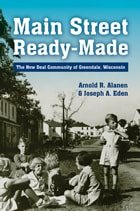
The dream of the suburb is an old one in America. For more than a century, city dwellers have sought to escape the crowding and pollution of industrial centers for the quiet streets and green spaces on their fringes. In the 1930s, that dream inspired the largest migration of Americans in the twentieth century and led to the creation of Greendale, Wisconsin, one of three planned communities initially begun to resettle the rural poor hit hard by the Great Depression. This idea, though, quickly developed into a plan to revitalize cities and stabilize farming communities around the nation. The result was three “greenbelt towns” built from scratch, expressly for working-class families and within easy commuting distance of urban employment. Greendale, completed in 1938, was consciously designed as a midwestern town in both its physical character and social organization, where ordinary citizens could live in a safe, attractive, economical community that was in harmony with the surrounding farmland.
“Main Street Ready-Made” examines Greendale as an outgrowth of public policy, an experiment in social engineering, and an organic community that eventually evolved to embrace a huge shopping mall, condominiums, and expensive homes while still preserving much of the architecture and ambiance of the original village. A snapshot of 1930s idealism and ingenuity, “Main Street Ready-Made” makes a significant contribution to the history of cities, suburbs, and social planning in mid-century America.
Main Street Revisited
Time, Space, and Image Building in Small-Town AmericaRichard V. Francaviglia
University of Iowa Press, 1996
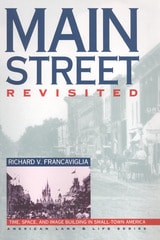
As an archetype for an entire class of places, Main Street has become one of America's most popular and idealized images. In Main Street Revisited, the first book to place the design of small downtowns in spatial and chronological context, Richard Francaviglia finds the sources of romanticized images of this archetype, including Walt Disney's Main Street USA, in towns as diverse as Marceline, Missouri, and Fort Collins, Colorado.
Francaviglia interprets Main Street both as a real place and as an expression of collective assumptions, designs, and myths; his Main Streets are treasure troves of historic patterns. Using many historical and contemporary photographs and maps for his extensive fieldwork and research, he reveals a rich regional pattern of small-town development that serves as the basis for American community design. He underscores the significance of time in the development of Main Street's distinctive personality, focuses on the importance of space in the creation of place, and concentrates on popular images that have enshrined Main Street in the collective American consciousness.
Maine’s Lithographic Landscapes
Town and City Views, 1830-1870Earle G. Shettleworth Jr.
Brandeis University Press, 2020
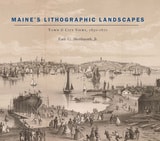
During the nineteenth century, Americans celebrated their towns and cities through printed landscapes. In Maine, lithographs were commissioned from such leading artists as Fitz Henry Lane and talented, lesser known local artists, such as Esteria Butler. This book reproduces many of these works and provides insights into how these growing centers of commerce and industry viewed themselves and wished to be viewed by others.
It’s the perfect book for those who love Maine, both full-time residents and those who make it a beloved summer destination.
Published in association with the Bowdoin College Museum of Art on the occasion of the bicentennial of Maine statehood.
Mainsprings of Indian and Pakistani Foreign Policies
S.M. Burke
University of Minnesota Press, 1974
Mainsprings of Indian and Pakistani Foreign Policies was first published in 1974. Minnesota Archive Editions uses digital technology to make long-unavailable books once again accessible, and are published unaltered from the original University of Minnesota Press editions.
This study by a South Asian specialist illuminates a vast and complex field. For the first time Indian and Pakistani foreign policies have been paralleled within the covers of a single volume. Also for the first time the author has not chosen as his starting point the year 1947, when these ancient lands reemerged as sovereign states, but has adopted it as the middle point, devoting equal attention to the pre-independence period.
Part I provides a cogent answer to the query, often raised but seldom answered to the satisfaction of outsiders, why the Hindus and the Muslims, nourished by the same soil for hundreds of years, were unable to form a single united and strong nation after releasing themselves from foreign domination. And it highlights the surprising extent to which the foreign policies of India and Pakistan have been motivated by impulses inherited from their long past.
Part II evaluates the actual performance of independent India and Pakistan on the world stage; reviews the rivalry between the United States, the Soviet Union, and China to gain influence in South Asia; and probes the vital question why India and Pakistan have belied the original expectation that they would rapidly become prosperous and powerful members of the international community. Domestic pressures bearing on the foreign policies of both countries, including circumstances culminating in the emergence of Bangladesh, are explained.

Mainstream Maverick
John Hughes and New Hollywood CinemaBy Holly Chard
University of Texas Press, 2020
Winner, Best First Monograph, British Association of Film, Television and Screen Studies
The first scholarly book on John Hughes examines Hollywood's complex relationship with genre, the role of the auteur in commercial cinema, and the legacy of favorites such as Sixteen Candles and Ferris Bueller's Day Off.
In the 1980s and 1990s, John Hughes was one of Hollywood's most reliable hitmakers, churning out beloved teen comedies and family films such as The Breakfast Club and Home Alone, respectively. But was he an artist? Hughes, an adamantly commercial filmmaker who was dismissed by critics, might have laughed at the question. Since his death in 2009, though, he has been memorialized on Oscar night as a key voice of his time. Now the critics lionize him as a stylistic original.
Holly Chard traces Hughes's evolution from entertainer to auteur. Studios recognized Hughes's distinctiveness and responded by nurturing his brand. He is therefore a case study in Hollywood's production not only of movies but also of genre and of authorship itself. The films of John Hughes, Chard shows, also owed their success to the marketers who sold them and the audiences who watched. Careful readings of Hughes's cinema reveal both the sources of his iconic status and the imprint on his films of the social, political, economic, and media contexts in which he operated.
The first serious treatment of Hughes, Mainstream Maverick elucidates the priorities of the American movie industry in the New Hollywood era and explores how artists not only create but are themselves created.
Mainstreaming Palestine
Cinematic Activism and Solidarity Politics in the United StatesUmayyah Cable
University of Minnesota Press, 2025
A history of cinema’s role in popularizing the politics of Palestinian liberation
For decades, Arab American activists and allies have used film, video, and multimedia to mobilize support for the Palestinian cause in the United States. In this detailed history of cinema’s role within the broader solidarity movement, Umayyah Cable analyzes the various strands of cinematic activism that have helped move Palestinian liberation politics from the periphery and into the mainstream.
Cable charts the shifting discourse around Palestine as it has been shaped by grassroots film production and alternative media distribution networks as well as more conventional outlets. Ranging from the circulation of educational filmstrips by the Association of Arab American University Graduates in the 1970s to the treatment of Palestinian solidarity at contemporary Hollywood awards ceremonies and film festivals, Mainstreaming Palestine tells the story of how cinema has promoted Palestinian liberation and solidarity politics. While highlighting various public controversies and struggles against censorship, Cable also acknowledges the drawbacks of the Palestinian cause being subsumed by the mainstream, discussing how activism risks becoming fashionable, undermining the radical potential of the very tools that helped bring it there.
Combining archival research, ethnographic observation and interviews, text analysis, and visual analysis of film, video, and multimedia, Mainstreaming Palestine encourages readers to critically assess the relationship between the politics of liberation and the all-consuming engine of contemporary capitalism. By underscoring the impact of visual media on the evolution of the Palestinian solidarity discourse, this book offers both a treatise on the practical power of cinema and a necessary historicization of an urgent issue in American politics.
Retail e-book files for this title are screen-reader friendly with images accompanied by short alt text and/or extended descriptions.

Major Robert Farmar of Mobile
Robert R. Rea
University of Alabama Press, 1990
"An engaging biography [and] a colorful tale. . . . Robert Farmar, a son of New Jersey, used his position among that colony's elite to secure a commission as a captain in the British Army during the War of Jenkins' Ear and King George's War, serving in the unsuccessful assaults at Cartegena, Cuba, and Panama and then in the disaster at Fontenoy in Flanders and in the reversals at Rocoux and Laffeldt. . . . During the Seven Years' War he participated in the capture of Havana.
Major Women Writers of Seventeenth-Century England
James Fitzmaurice, Josephine A. Roberts, Carol L. Barash, Eugene R. Cunnar, and Nancy A. Gutierrez, Editors
University of Michigan Press, 1997