Results by title
2916 books match the query 'Politics and government' and 139 start with m

Maya Political Science
Time, Astronomy, and the CosmosBy Prudence M. Rice
University of Texas Press, 2004
How did the ancient Maya rule their world? Despite more than a century of archaeological investigation and glyphic decipherment, the nature of Maya political organization and political geography has remained an open question. Many debates have raged over models of centralization versus decentralization, superordinate and subordinate status—with far-flung analogies to emerging states in Europe, Asia, and Africa. But Prudence Rice asserts that neither the model of two giant "superpowers" nor that which postulates scores of small, weakly independent polities fits the accumulating body of material and cultural evidence.
In this groundbreaking book, Rice builds a new model of Classic lowland Maya (AD 179-948) political organization and political geography. Using the method of direct historical analogy, she integrates ethnohistoric and ethnographic knowledge of the Colonial-period and modern Maya with archaeological, epigraphic, and iconographic data from the ancient Maya. On this basis of cultural continuity, she constructs a convincing case that the fundamental ordering principles of Classic Maya geopolitical organization were the calendar (specifically a 256-year cycle of time known as the may) and the concept of quadripartition, or the division of the cosmos into four cardinal directions. Rice also examines this new model of geopolitical organization in the Preclassic and Postclassic periods and demonstrates that it offers fresh insights into the nature of rulership, ballgame ritual, and warfare among the Classic lowland Maya.
Maya after War
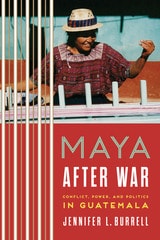
Conflict, Power, and Politics in GuatemalaBy Jennifer L. Burrell
University of Texas Press, 2013
Guatemala’s thirty-six-year civil war culminated in peace accords in 1996, but the postwar transition has been marked by continued violence, including lynchings and the rise of gangs, as well as massive wage-labor exodus to the United States. For the Mam Maya municipality of Todos Santos Cuchumatán, inhabited by a predominantly indigenous peasant population, the aftermath of war and genocide resonates with a long-standing tension between state techniques of governance and ancient community-level power structures that incorporated concepts of kinship, gender, and generation. Showing the ways in which these complex histories are interlinked with wartime and enduring family/class conflicts, Maya after War provides a nuanced account of a unique transitional postwar situation, including the complex influence of neoliberal intervention.
Drawing on ethnographic field research over a twenty-year period, Jennifer L. Burrell explores the after-war period in a locale where community struggles span culture, identity, and history. Investigating a range of tensions from the local to the international, Burrell employs unique methodologies, including mapmaking, history workshops, and an informal translation of a historic ethnography, to analyze the role of conflict in animating what matters to Todosanteros in their everyday lives and how the residents negotiate power. Examining the community-based divisions alongside national postwar contexts, Maya after War considers the aura of hope that surrounded the signing of the peace accords, and the subsequent doubt and waiting that have fueled unrest, encompassing generational conflicts. This study is a rich analysis of the multifaceted forces at work in the quest for peace, in Guatemala and beyond.
Mayas in Postwar Guatemala
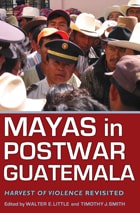
Harvest of Violence RevisitedEdited by Walter E. Little and Timothy J. Smith
University of Alabama Press, 2009
Mayor Harold Washington
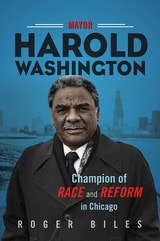
Champion of Race and Reform in ChicagoRoger Biles
University of Illinois Press, 2020

Me, Governor?
My Life in the Rough-and-Tumble World of New Jersey PoliticsRichard J. Codey
Rutgers University Press, 2011

Meddling in Middle Europe
Britain and the 'Lands Between' 1919-1925Miklos Lojkó
Central European University Press, 2006
Media Power in Central America
Rick Rockwell and Noreene Janus
University of Illinois Press, 2003
Rick Rockwell and Noreene Janus examine the region country by country and deal with the specific conditions of government-sponsored media repression, economic censorship, corruption, and consumer trends that shape the political landscape. Challenging the notion of the media as a democratizing force, Media Power in Central America shows how governments use the media to block democratic reforms and outlines the difficulties of playing watchdog to rulers who use the media as a tool of power.

Media and Dependency in South Africa
A Case Study of the Press and the Ciskei “Homeland”Les Switzer
Ohio University Press, 1985

Medicine, Law, and the State in Imperial Russia
Elisa M. Becker
Central European University Press, 2011
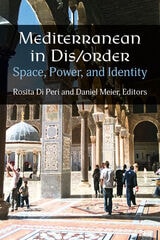
Mediterranean in Dis/order
Space, Power, and IdentityRosita Di Peri and Daniel Meier, Editors
University of Michigan Press, 2023
Mediterranean in Dis/order reveals the connection between space and politics by examining the role that space has played in insurgencies, conflicts, uprisings, and mobilities in the Mediterranean region. With this approach, the authors are able to challenge well-established beliefs about the power structure of the state across different disciplines (including political science, history, sociology, geography, and anthropology), and its impact on the conception, production, and imagination of space in the broader Mediterranean. Further, they contribute to particular areas of studies, such as migration, political Islam, mobilization, and transition to democracy, among others. The book, infusing critical theory, unveils original and revelatory case studies in Tunisia, Libya, Lebanon, Turkey, Syria, Morocco, and the EU Mediterranean policy, through a various set of actors and practices—from refugees and migrations policies, to Islamist or students’ movements, architectural sites, or movies. This multidisciplinary perspective on space and power provides a valuable resource for practitioners interested in how space, context, and time interact to produce institutions, political subjectivities, and asymmetries of power, particularly since the turning point of the Arab uprisings. The book also helps readers understand the conditions under which the uprisings develop, giving a clearer picture about various national, regional, and international dynamics.
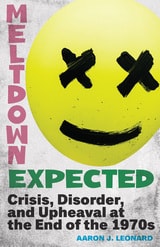
Meltdown Expected
Crisis, Disorder, and Upheaval at the end of the 1970sAaron J. Leonard
Rutgers University Press, 2024
Meltdown Expected tells the story of the power shifts from late 1978 through 1979 whose repercussions are still being felt. Iran’s revolution led to a hostage crisis while neighbouring Afghanistan became the site of a proxy war between the USSR and the US, who supplied aid to Islamic mujahideen fighters that would later form the Taliban. Meanwhile, as tragedies like the Jonestown mass suicide and the assassination of Harvey Milk captured the nation’s attention, the government quietly reasserted and expanded the FBI’s intelligence powers. Drawing from recently declassified government documents and covering everything from Three Mile Island to the rise of punk rock, Aaron J. Leonard paints a vivid portrait of a tumultuous yet pivotal time in American history.

Memoirs (1630-1680)
Sophia of Hanover
Iter Press, 2013

Memoirs Of A Cold War Son
Post, Gaines, Jr.
University of Iowa Press, 2000
In 1951 Gaines Post was a gangly, bespectacled, introspective teenager preparing to spend a year in Paris with his professorial father and older brother; his mother, who suffered from extreme depression, had been absent from the family for some time. Ten years later, now less gangly but no less introspective, he was finishing a two-year stint in the army in West Germany and heading toward Oxford on a Rhodes scholarship, having narrowly escaped combat in the Berlin crisis of 1961. His quietly intense coming-of-age story is both self-revealing and reflective of an entire generation of young men who came to adulthood before the Cuban Missile Crisis and the Vietnam War.
Post's experiences in high school in Madison, Wisconsin, and Paris, his Camus-influenced undergraduate years at Cornell University, and his army service in Germany are set very effectively against the events of the Cold War. McCarthyism and American crackdowns on dissidents, American foreign and military policy in Western Europe in the nuclear age, French and German life and culture, crises in Paris and Berlin that nearly bring the West to war and the Post family to dissolution—these are the larger scenes and subjects of his self-disclosure as a contemplative, conflicted "Cold War agnostic."
His intelligent, talented mother and her fragile health hover over Post's narrative, informing his hesitant relationships with women and his acutely questioning sense of self-worth. His story is strongly academic and historical as well as political and military; his perceptions and judgments lean toward no ideological extreme but remain true to the heroic ideals of his boyhood during the Second World War.

Memories Of Underdevelopment
Chanan, Michael
Rutgers University Press, 1990
This double volume includes the complete continuity script of Memories, as well as the complete novel, Inconsolable Memories, upon which the film is based. An interview with Alea is reproduced here, as well as documentation of the political controversy that surrounded the film in this country. Michael Chanan's introduction places the film in the context of Cuban political and cultural history. The volume also includes a biographical sketch of Alea, a chronology of the Cuban Revolution, reviews, commentary, a filmography, and a bibliography.Michael Chanan lives in England, where he teaches and writes on film. He is the author of The Cuban Image: Cinema and Cultural Politics in Cuba.
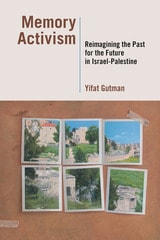
Memory Activism
Reimagining the Past for the Future in Israel-PalestineYifat Gutman
Vanderbilt University Press, 2017
Set in Israel in the first decade of the twenty-first century and based on long-term fieldwork, this rich ethnographic study offers an innovative analysis of the Israeli-Palestinian conflict. It explores practices of "memory activism" by three groups of Jewish-Israeli and Arab-Palestinian citizens--Zochrot, Autobiography of a City, and Baladna--showing how they appropriated the global model of truth and reconciliation while utilizing local cultural practices such as tours and testimonies.
These activist efforts gave visibility to a silenced Palestinian history in order to come to terms with the conflict's origins and envision a new resolution for the future. This unique focus on memory as a weapon of the weak reveals a surprising shift in awareness of Palestinian suffering among the Jewish majority of Israeli society in a decade of escalating violence and polarization--albeit not without a backlash.
Contested memories saturate this society. The 1948 war is remembered as both Independence Day by Israelis and al-Nakba ("the catastrophe") by Palestinians. The walking tour and survivor testimonies originally deployed by the state for national Zionist education that marginalized Palestinian citizens are now being appropriated by activists for tours of pre-state Palestinian villages and testimonies by refugees.
Memory Construction and the Politics of Time in Neoliberal South Korea
Namhee Lee
Duke University Press, 2022
Memory Crash
Politics of History in and around Ukraine, 1980s–2010sGeorgiy Kasianov
Central European University Press, 2022
This account of historical politics in Ukraine, framed in a broader European context, shows how social, political, and cultural groups have used and misused the past from the final years of the Soviet Union to 2020. Georgiy Kasianov details practices relating to history and memory by a variety of actors, including state institutions, non-governmental organizations, political parties, historians, and local governments. He identifies the main political purposes of these practices in the construction of nation and identity, struggles for power, warfare, and international relations.
Kasianov considers the Ukrainian case in the context of a global increase in the politics of history and memory, with particular emphasis on a distinctive East-European variety. He pays special attention to the use and abuse of history in relations between Ukraine, Russia, and Poland.
Men Own The Fields, Women Own The Crops
Gender And Power In The Cameroon GrassfieldsMiriam Goheen
University of Wisconsin Press, 1996
Based on a decade of fieldwork, this work tracks the negotiations between chiefs and subchiefs and women and men over ritual power, economic power, and administrative power. Though Nso men obviously dominate their society at both the local level and nationally, women have had power of their own by virtue of their status as women. Men may own the land, for example, but women control the crops through their labor . Goheen explains clearly the place of gender in very complex historical processes, such as land tenure systems, title societies, chieftancy, marriage systems, changing ideas of symbolic capital, and internal and external politics.
In examining women’s resistance to traditional patterns of marriage, Goheen raises the question of whether such actions truly change the balance of power between the sexes, or whether resistance to marriage is instead fostering the formation of a new elite class, since it is only the better-educated women of wealthier families who can change the dynamic of power and labor within the household.
The issues raised in this book are not unique to Nso but apply throughout the African subcontinent. Written in a straightforward way with much of the theoretical argument in footnotes, Men Own the Fields, Women Own the Crops marshals important arguments of wide relevance in present-day Africa.
Men at the Center
Redemptive Governance under Louis IXWilliam Chester Jordan
Central European University Press, 2012
Taking Professor Natalie Zemon Davis’ fascinating biographical studies of three Women on the Margins in the seventeenth century as an inspiration, the author of this book offers three portraits of men who were at the very center of governance in thirteenth-century France, men who strove in the shadow of King Louis IX (Saint Louis) to impose a redemptive regime on the realm. Professor Jordan treats them as individuals, but in a sense they are also types: Robert of Sorbon, a churchman; Etienne Boileau, a bourgeois; and Simon de Nesle, an aristocrat. Robert was the founder of the Sorbonne; Boileau was the prévôt or royal administrator of Paris; and Simon was twice co-regent of the kingdom. Thinking about them and their relations with Louis IX opens up a new and altogether sobering vista for exploring the nature of the king’s rule and the impact of his rule on his subjects.
Mencken’s America
H. L. MenckenS. T. Joshi
Ohio University Press, 2004
Long famous as a political, social, and cultural gadfly, journalist and essayist H. L. Mencken was unafraid to speak his mind on controversial topics and to express his views in a deliberately provocative manner.
Mencken was prolific; much of his best work lies buried in the newspapers and magazines in which it originally appeared. Mencken’s America is a sampling of this uncollected work, arranged to present the wide-ranging treatise on American culture that Mencken himself never wrote.
The core of the book is a series of six articles on “The American” published in the Smart Set in 1913-14. Never before reprinted, they embody the essence of Mencken’s views on the deficiencies of his countrymen.
What was the problem with America? For Mencken, it could be summed up in one word: Puritanism. Puritanism accounted for much that was wrong with American culture: the prevalence of “militant morality” represented by Prohibition, by campaigns against prostitution, and by religious fundamentalism. American hostility toward the fine arts led to furious attempts to suppress any work of art that was thought to contravene conventional morality-attempts that Mencken chronicles with impressive scholarship in the essay “Puritanism as a Literary Force.”
Mencken reserved his greatest scorn for American political institutions. Opposed to the very principle of democracy and universal suffrage, he maintained that, in the absence of an educated electorate, all politicians are compelled to become demagogues.
Bracing, infuriating, and pungent, H. L. Mencken’s writings retain their relevance even after the passage of nearly a hundred years, cogently discussing issues with which Americans of the twenty-first century are still wrestling. Sagaciously edited by S. T. Joshi, one of the country’s foremost Mencken scholars, Mencken’s America is a superb example of America’s turning the looking glass on itself.
Metamorphosis
Studies in Social and Political Change in MyanmarEdited by Renaud Egreteau and François Robinne
National University of Singapore Press, 2015
But underlying recent political transitions are other wrenching social changes and shocks, a set of transformations less clearly mapped out. Relations between ethnic and religious groups, in the context of Burma’s political model of a state composed of ethnic groups, are a particularly important “unsolved equation”.
The editors use the notion of metamorphosis to look at Myanmar today and tomorrow—a term that accommodates linear change, stubborn persistence and the possibility of dramatic transformation. Divided into four sections, on politics, identity and ethnic relations, social change in fields like education and medicine, and the evolutions of religious institutions, the volume takes a broad view, combining an anthropological approach with views from political scientists and historians. This volume is an essential guide to the political and social challenges ahead for Myanmar.
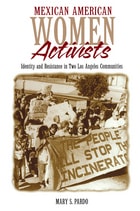
Mexican American Women Activists
Mary Pardo
Temple University Press, 1998
By focusing on women in two contiguous but very different communities -- the working-class, inner-city neighborhood of Boyle Heights in Eastside Los Angeles and the racially mixed middle-class suburb of Monterey Park -- Pardo is able to bring class as ell as gender and ethnic concerns to bear on her analysis in ways that shed light on the complexity of mobilizing for urban change.
Unlike many studies, the stories told here focus on women's strengths rather than on their problems. We follow the process by which these women empowered themselves by using their own definitions of social justice and their own convictions about the importance of traditional roles. Rather than becoming political participants in spite of their family responsibilities, women in both neighborhoods seem to have been more powerful because they had responsibilities, social networks, and daily routines separate from the men in their communities.
Pardo asserts that the decline of real wages and the growing income gap means that unforunately most women will no longer be able to focus their energies on unpaid community work. She reflects on the consequences of this change for women's political involvement, as well as on the politics of writing about women and politics.

Mexican Americans and Health
¡Sana! ¡Sana!Adela de la Torre and Antonia Estrada
University of Arizona Press, 2001
- how values such as machismo, familismo, and marianismo influence care-seeking decisions and treatment of illness;
- how factors such as cultural values, socioeconomic status, peer pressure, and family concerns can contribute to substance abuse;
- how cultural attitudes toward sex can heighten the risk of AIDS—and how approaches to AIDS prevention and education need to reflect core cultural values such as familismo, respeto, and confianza. The book also addresses concerns of Mexican Americans regarding the health care system. These include not only access to care and to health insurance but also the shortage of bilingual and bicultural health care professionals. This coverage stresses not only the importance of linguistic competency but also the need to understand folklore illnesses, herbal remedies, and spiritual practices that can delay the treatment of illness and either complement or compromise treatment. Of all the issues that face the contemporary Mexican American community, none is as important to its very survival as health and health care. This timely book gives readers a broad understanding of these complex issues and points the way toward a healthier future for all people of Mexican origin. Mexican Americans and Health and Chicano Popular Culture are the first volumes in the series The Mexican American Experience, a cluster of modular texts designed to provide greater flexibility in undergraduate education. Each book deals with a single topic concerning the Mexican American population. Instructors can create a semester-length course from any combination of volumes, or may choose to use one or two volumes to complement other texts.

Mexican Americans and the Environment
Tierra y VidaDevon G. Peña
University of Arizona Press, 2005

Mexican Americans and the Politics of Diversity
¡Querer es poder!Lisa Magaña
University of Arizona Press, 2005
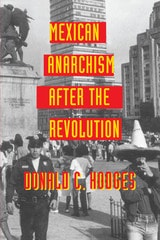
Mexican Anarchism after the Revolution
By Donald C. Hodges
University of Texas Press, 1995
Formal anarchist organizations disappeared in Mexico after the 1910 Revolution, but anarchist principles survive in the popular resistance movements against the post-revolutionary governments. In this book, Donald Hodges offers the first comprehensive treatment of the intellectual foundations, history, politics, and strategy of Mexican anarchism since the Revolution.
Hodges interviewed leading Mexican anarchists, including Mónico Rodríguez Gómez, and gained access to documents of numerous guerrilla organizations, such as the previously missing "Plan de Cerro Prieto." Using both original and published sources, he shows how the political heirs of Ricardo Flores Magón, Mexico's foremost anarchist, agitated for workers' self-management and agrarian reform under the cover of the Mexican Communist party, how they played an important role in the student rebellion, and how, in the face of a labor movement that has come under government control, anarchism is currently experiencing a rebirth under another name.
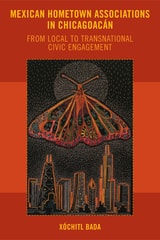
Mexican Hometown Associations in Chicagoacán
From Local to Transnational Civic EngagementBada, Xóchitl
Rutgers University Press, 0
Hometown associations (HTAs) consist of immigrants from the same town in Mexico and often begin quite informally, as soccer clubs or prayer groups. As Bada’s work shows, however, HTAs have become a powerful force for change, advocating for Mexican immigrants in the United States while also working to improve living conditions in their communities of origin. Focusing on a group of HTAs founded by immigrants from the state of Michoacán, the book shows how their activism has bridged public and private spheres, mobilizing social reforms in both inner-city Chicago and rural Mexico.
Bringing together ethnography, political theory, and archival research, Bada excavates the surprisingly long history of Chicago’s HTAs, dating back to the 1920s, then traces the emergence of new models of community activism in the twenty-first century. Filled with vivid observations and original interviews, Mexican Hometown Associations in Chicagoacán gives voice to an underrepresented community and sheds light on an underexplored form of global activism.

Mexicanos in Oregon
Their Stories, Their LivesErlinda Gonzales-Berry
Oregon State University Press, 2010

Mexicans in Wisconsin
Sergio González
Wisconsin Historical Society Press, 2017
From agricultural and factory workers to renowned writers and musicians, the Mexican immigrants who have made their homes in Wisconsin over the past century have become a significant and diverse part of this state’s cultural and economic history. Coming from a variety of educational and professional backgrounds, the earliest Mexican immigrants traveled north in search of better economic opportunities and relief from the violence and economic turmoil of the Mexican Revolution. They found work in tanneries and foundries, and on beet farms where they replaced earlier European immigrant workers who had moved on to family farms. As Mexican immigration has grown to the present day, these families have become integral members of Wisconsin communities, building businesses, support systems, and religious institutions. But their experience has also been riddled with challenges, as they have fought for adequate working conditions, access to education, and acceptance amid widespread prejudice. In this concise history, learn the fascinating stories of this vibrant and resilient immigrant population: from the Tejano migrant workers who traveled north seasonally to work in the state’s cucumber fields, to the determined labor movement led by Jesus Salas, to the young activists of the Chicano Movement, and beyond.
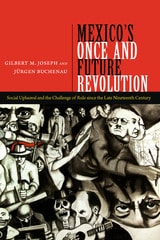
Mexico's Once and Future Revolution
Social Upheaval and the Challenge of Rule since the Late Nineteenth CenturyGilbert M. Joseph and Jürgen Buchenau
Duke University Press, 2013

Michigan Government, Politics, and Policy
John S. Klemanski and David A. Dulio, editors
University of Michigan Press, 2017
As the state continues to deal with many of these challenges, Michiganders more than ever need a clear picture of how their state’s political institutions, actors, and processes work. To that end, this book provides a comprehensive analysis of Michigan’s politics and government that will help readers better understand the state’s history and its future prospects. Chapters elucidate the foundational aspects of the state’s government (the Michigan Constitution and intergovernmental relations); its political institutions (the state legislature, governor, and court system); its politics (political parties and elections); and its public policy (education, economic development, and budget and fiscal policy). The book’s four themes—historical context, decline, responses to challenges, and state-local government relations—run throughout and are buttressed by coverage of recent events. Moreover, they are brought together in a compelling chapter with a particular focus on the Flint water crisis.
An ideal fit for courses on state and local government, this thorough, well-written text will also appeal to readers simply interested in learning more about the inner workings of government in the Great Lakes State.
Michigan's Con-Con 11
Women and State Constitution-making in 1961Lynn Liberato
Michigan State University Press, 2025
Militant Nationalism
Between Movement and Party in Ireland and the Basque CountryCynthia Irvin
University of Minnesota Press, 1999
A comparative analysis of two militant nationalist groups.
Why do some militant nationalists turn to electoral politics while others resist-and even seek to destroy-that arena? Cynthia L. Irvin examines two cases of electoral interventions by nationalist organizations engaged in violent political competition: in Northern Ireland and in the Basque provinces of Spain. Based on her findings, she offers insights into the circumstances that lead such groups to abandon violence in favor of institutional political struggle.
Using fieldwork done in Northern Ireland and the Basque Country, Irvin develops a model linking the internal dynamics of Sinn Fein and Herri Batasuna (the electoral arm of the militant Basque separatists) to changes in their external environments. In this unusual comparative analysis, she draws on interviews with more than 100 Sinn Fein and Herri Batasuna activists and on a unique survey of 140 Herri Batasuna activists. This approach moves Irvin’s work beyond previous analyses, which have relied on either descriptive and historical accounts or formal models of insurgent violence. This detailed account has broad implications for the study of social movements and ethnic identity, providing a valuable new perspective into the strategic interactions and often conflict-ridden relationship between social movements and political parties. ISBN 0-8166-3114-X Cloth £00.00 $49.95xxISBN 0-8166-3115-8 Paper £00.00 $19.95x304 Pages 26 Tables 5 7/8 x 9 MaySocial Movements, Protest, and Contention Series, volume 9Translation inquiries: University of Minnesota Press
Militant Zionism in America
The Rise and Impact of the Jabotinsky Movement in the United States, 1926-1948Rafael Medoff
University of Alabama Press, 2006
This in-depth look at a controversial faction of American Zionism fills
a void in the story of American Zionism--and in the story of American Judaism.
This book recounts the fascinating and little-known story
of the militant American Zionists who lobbied Congress, rallied American
public opinion, and influenced British-American relations in their campaign
for Jewish statehood in the 1930s and 1940s. Although these activists have
been dismissed as fanatics who fragmented the American Zionist movement,
Rafael Medoff reveals that the faction--which included an Academy Award-winning
screenwriter and several future members of the Israeli parliament--was
more influential than has been previously acknowledged.
These militants stirred America's conscience by placing
controversial newspaper ads, lobbying conservative as well as liberal members
of Congress, and staging dramatic protest rallies. Through these tactics,
Medoff shows, they attracted a wave of support from an extraordinary cross-section
of leading Americans, including comedians Harpo Marx and Carl Reiner, actors
Vincent Price, Marlon Brando, and Jane Wyatt, musician Leonard Bernstein,
and rising young politicians Jacob Javits and Hubert Humphrey. Medoff also
describes the shadowy underground division that smuggled weapons to the
Holy Land in caskets, naming and interviewing for the first time members
of this gunrunning network.
Based on years of archival research and interviews and
written in a compelling style, Militant Zionism in America documents
events that reshaped the American Jewish community, influenced American
foreign policy, and contributed to one of the most extraordinary events
of modern history: the creation of the State of Israel.
Rafael Medoff is a Visiting Scholar at the State University of New York -- Purchase College.
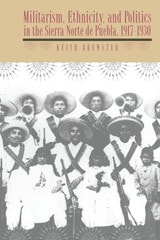
Militarism, Ethnicity, and Politics in the Sierra Norte de Puebla, 1917-1930
Keith Brewster
University of Arizona Press, 2003
Gabriel Barrios Cabrera, leader of the Brigada Serrana, rose from rural obscurity in the tiny village of Cuacuila to a position of unprecedented military strength during the Revolution, and throughout the 1920s he and his brother Demetrio came to enjoy the confidence of the nation's presidents. This work provides an in-depth look at how a local political boss held on to power. Keith Brewster reveals how the story of the Sierra is inextricably linked to that of the Barrios Cabrera family, and he investigates the ways in which this interconnection developed.
Brewster argues that Barrios owed his long prominence to his sensitivity to the region's culture, but also shows that the extent of his power was exaggerated by both contemporaries and historians. Barrios was able to develop a working relationship with the federal government by endorsing its objectives and convincing them of his own indispensability, but his authority depended on the weakness of the federal government and on infighting within the Puebla state government; once both governments stabilized, Barrios quickly lost his grip on power.
Masterfully blending archival sources and oral history, Brewster captures life in the Sierra during the 1920s and examines the decision-making processes that determined how communities responded to new pressures, such as requests for soldiers or support for development projects. He shows that subaltern groups were able to shape and even resist state reforms, mustering evidence that the Sierra's indigenous communities drove hard bargains over issues affecting their everyday lives. Although many communities used Barrios as an intermediary, Brewster reveals that they did not universally accept his legitimacy but simply used his connections to pursue their own local agendas.
Brewster depicts the Sierra de Puebla of the 1920s as a scene of shifting balances of power where political, economic, social, and ethnic factors combined to produce the temporary ascendancy of different interest groups beyond and within the region. His study forces us to question assumptions about how power was exercised at the local and regional levels in postrevolutionary Mexico and will be of lasting interest to all concerned with the dynamics of caciquismo and the evolution of the Mexican political system.

Militarized Currents
Toward a Decolonized Future in Asia and the PacificSetsu Shigematsu
University of Minnesota Press, 2010
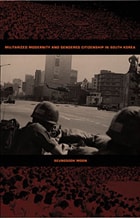
Militarized Modernity and Gendered Citizenship in South Korea
Seungsook Moon
Duke University Press, 2005
Moon situates militarized modernity in the historical context of colonialism and nationalism in the twentieth century. She follows the course of militarized modernity in South Korea from its development in the early 1960s through its peak in the 1970s and its decline after rule by military dictatorship ceased in 1987. She highlights the crucial role of the Cold War in South Korea’s militarization and the continuities in the disciplinary tactics used by the Japanese colonial rulers and the postcolonial military regimes. Moon reveals how, in the years since 1987, various social movements—particularly the women’s and labor movements—began the still-ongoing process of revitalizing South Korean civil society and forging citizenship as a new form of membership in the democratizing nation.
Military Ascendancy and Political Culture
A Study of Indonesia's GolkarLeo Suryadinata
Ohio University Press, 1989
Leo Suryadinata traces the birth, struggle, and emergence of this party so closely identified with Indonesia’s President Suharto. Yet, to claim that Suharto and the military dominate the party is to view Golkar superficially, for the party is also composed of factions of civil servants and the Minister of Security and Defense, as well as several other governmental agencies. A complex and well-detailed cultural history of Indonesia’s most powerful political party, this case study should have wider implications for the study of military behavior in the Third World.
Military Institutions and Coercion in the Developing Nations
The Military in the Political Development of New NationsMorris Janowitz
University of Chicago Press, 1988
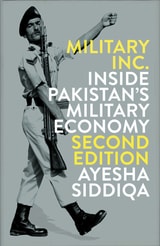
Military, Inc.
Inside Pakistan's Military EconomyAyesha Siddiqa
Pluto Press, 2016
This book offers a close look at what the rise of the military has meant for Pakistani society. Ayesha Siddiqa shows how entrenched the military has become, not just in day-to-day governance, but in the Pakistani corporate sector as well. What are the consequences of this unprecedented merging of the military and corporate sectors? What does it mean for Pakistan’s economic development—let alone for hopes of an eventual return to democracy and de-militarization? This new edition brings Siddiqa’s account fully up to date with a new preface and conclusion that emphasize the changing role of the media.
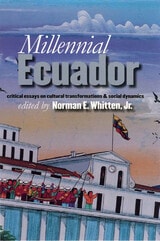
Millennial Ecuador
Critical Essays Cultural TransformationsNorman E Whitten
University of Iowa Press, 2003

Millennial Makeover
MySpace, YouTube, and the Future of American PoliticsWinograd, Morley
Rutgers University Press, 2008
A 2008 New York Times Notable Book of the Year
It happens in America every four decades and it is about to happen again. America’s demand for change in the 2008 election will cause another of our country’s periodic political makeovers. This realignment, like all others before it, will result from the coming of age of a new generation of young Americans—the Millennial Generation—and the full emergence of the Internet-based communications technology that this generation uses so well. Beginning in 2008, almost everything about American politics and government will transform—voting patterns, the fortunes of the two political parties, the issues that engage the nation, and our government and its public policy.
Building on the seminal work of previous generational theorists,Morley Winograd and Michael D. Hais demonstrate and describe, for the first time, the two types of realignments—“idealist” and “civic”—that have alternated with one another throughout the nation’s history. Based on these patterns, Winograd and Hais predict that the next realignment will be very different from the last one that occurred in 1968. “Idealist” realignments, like the one put into motion forty years ago by the Baby Boomer Generation, produce, among other things, a political emphasis on divisive social issues and governmental gridlock. “Civic” realignments, like the one that is coming, and the one produced by the famous GI or “Greatest” Generation in the 1930s, by contrast, tend to produce societal unity, increased attention to and successful resolution of basic economic and foreign policy issues, and institution-building.
The authors detail the contours and causes of the country’s five previous political makeovers, before delving deeply into the generational and technological trends that will shape the next. The book’s final section forecasts the impact of the Millennial Makeover on the elections, issues, and public policies that will characterize America’s politics in the decades ahead.
For additional information go to:
Millennial Makeover website.
Millennial Momentum
How a New Generation Is Remaking AmericaWinograd, Morley
Rutgers University Press, 2011
About every eight decades, coincident with the most stressful and perilous events in U.S. history—the Revolutionary and Civil Wars and the Great Depression and World War II—a new, positive, accomplished, and group-oriented “civic generation” emerges to change the course of history and remake America. The Millennial Generation (born 1982–2003) is America’s newest civic generation.
In their 2008 book, Millennial Makeover, Morley Winograd and Michael D. Hais made a prescient argument that the Millennial Generation would change American politics for good. Later that year, a huge surge of participation from young voters helped to launch Barack Obama into the White House.
Now, in Millennial Momentum, Winograd and Hais investigate how the beliefs and practices of the Millennials are transforming other areas of American culture, from education to entertainment, from the workplace to the home, and from business to politics and government. The Millennials’ cooperative ethic and can-do spirit have only just begun to make their mark, and are likely to continue to reshape American values for decades to come.
Drawing from an impressive array of demographic data, popular texts, and personal interviews, the authors show how the ethnically diverse, socially tolerant, and technologically fluent Millennials can help guide the United States to retain its leadership of the world community and the global marketplace. They also illustrate why this generation’s unique blend of civic idealism and savvy pragmatism will enable us to overcome the internal culture wars and institutional malaise currently plaguing the country. Millennial Momentum offers a message of hope for a deeply divided nation.
Minorities and Law in Czechoslovakia
Jan Kuklík and René Petráš
Karolinum Press, 2017
Minority Parties in U.S. Legislatures
Conditions of InfluenceJennifer Hayes Clark
University of Michigan Press, 2015
Challenging conventional assumptions that the majority party dominates the legislature, Jennifer Hayes Clark investigates precisely the ways in which—and under what conditions—members of the minority party successfully pursue their interests. For this study, Clark collects fine-grained data from both the U.S. Congress and state legislatures to get a close look at three key points in the legislative process: committee assignments, bill cosponsorship, and roll-call votes. She finds that minority party members are not systematically excluded throughout the policymaking process. Indeed, their capacity to shape legislative decision-making is enhanced when party polarization is low, when institutional prerogatives are broadly dispersed rather than centralized, and when staff resources are limited. Under these conditions, bipartisanship bill cosponsorship and voting coalitions are also more prevalent.
With the sharp increase of partisan polarization in state legislatures and in Congress, it is essential to understand how and when a minority party can effectively represent constituents.
Minority Report
Evaluating Political Equality in AmericaJohn D. Griffin and Brian Newman
University of Chicago Press, 2008

Miracle of '48
Edited by Steve Neal. Foreword by Robert V. Remini
Southern Illinois University Press, 2003
Miracle of ’48: Harry Truman’s Major Campaign Speeches and Selected Whistle-stopsis the first published collection of the public addresses Harry Truman made as he crisscrossed the United States from New York City to Los Angeles to Independence, Missouri in 1948. Edited by veteran political journalist Steve Neal, and complemented by a foreword from presidential historian Robert V. Remini, this volume captures the infectious spirit and determination of Truman’s message to the American people.
In an era when policy issues were paramount and televised debates were a thing of the future, Truman boldly stated his case directly to the American people, and they responded. “Senator Barkley and I will win this election and make these Republicans like it,” he declared in his acceptance speech at the Democratic National Convention in Philadelphia. “Don’t you forget that. We will do that because they are wrong and we are right.”
From the start of his “non-political” western tour in Crestline, Ohio, through his victory celebration in his hometown of Independence, the plainspoken Truman waged the good fight against all odds, never mixing his words or apologizing for his aggressively honest tactics. In blaming the GOP for a decline in farm prices, he alleged that the 80th Congress had “stuck a pitchfork in the farmer’s backs.” Truman is now regarded as among our greatest presidents and the populist message of his ’48 campaign is still as compelling and relevant today as it was over half a century ago.
“The political history of the United States reveals many unusual developments,” General Dwight D. Eisenhower wrote Truman after the 1948 election, “but certainly at no point does it record a greater accomplishment than yours, that can be traced so clearly to the stark courage and fighting heart of one man.”
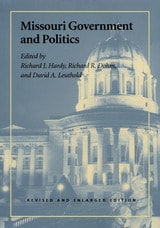
Missouri Government and Politics
Revised and Enlarged EditionEdited by Richard J. Hardy, Richard R. Dohm, & David A. Leuthold
University of Missouri Press, 1995
Since the publication of the first edition in 1985, Missouri Government and Politics has been widely acclaimed as an outstanding text. This revised and enlarged edition updates all of the chapters to reflect the changes that have occurred in the state's government during the last decade. Five new chapters have been added on topics previously unaddressed: economic development, energy, and the environment; state policy making in higher education; funding for education in the 1990s; the statewide elected executive officials; and the types of law in Missouri.
The twenty-six chapters are grouped into four main categories: "The Context of Missouri Politics," "State Governmental Framework," "Policies and Policy Making in Missouri," and "Local Government and Politics in Missouri." Helpful additions to the basic text include more than fifty tables and figures, a glossary giving clear definitions of many governmental terms, and a bibliography on Missouri politics and government.
The authors have become experts about Missouri by serving as teachers and researchers in Missouri colleges and universities, as candidates and workers in Missouri political campaigns, and as officeholders and public administrators in Missouri state government. Their collective experience in Missouri politics ensures that this new edition provides the most thorough and comprehensive overview of the structure and inner workings of Missouri's political system.

Missouri Law and the American Conscience
Historical Rights and WrongsEdited by Kenneth H. Winn
University of Missouri Press, 2016
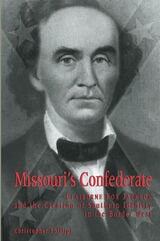
Missouri's Confederate
Claiborne Fox Jackson and the Creation of Southern Identity in the Border WestChristopher Phillips
University of Missouri Press, 2000
Claiborne Fox Jackson (1806-1862) remains one of Missouri's most controversial historical figures. Elected Missouri's governor in 1860 after serving as a state legislator and Democratic party chief, Jackson was the force behind a movement for the neutral state's secession before a federal sortie exiled him from office. Although Jackson's administration was replaced by a temporary government that maintained allegiance to the Union, he led a rump assembly that drafted an ordinance of secession in October 1861 and spearheaded its acceptance by the Confederate Congress. Despite the fact that the majority of the state's populace refused to recognize the act, the Confederacy named Missouri its twelfth state the following month. A year later Jackson died in exile in Arkansas, an apparent footnote to the war that engulfed his region and that consumed him.
In this first full-length study of Claiborne Fox Jackson, Christopher Phillips offers much more than a traditional biography. His extensive analysis of Jackson's rise to power through the tangle that was Missouri's antebellum politics and of Jackson's complex actions in pursuit of his state's secession complete the deeper and broader story of regional identity--one that began with a growing defense of the institution of slavery and which crystallized during and after the bitter, internecine struggle in the neutral border state during the American Civil War. Placing slavery within the realm of western democratic expansion rather than of plantation agriculture in border slave states such as Missouri, Philips argues that southern identity in the region was not born, but created. While most rural Missourians were proslavery, their "southernization" transcended such boundaries, with southern identity becoming a means by which residents sought to reestablish local jurisdiction in defiance of federal authority during and after the war. This identification, intrinsically political and thus ideological, centered—and still centers—upon the events surrounding the Civil War, whether in Missouri or elsewhere. By positioning personal and political struggles and triumphs within Missourians' shifting identity and the redefinition of their collective memory, Phillips reveals the complex process by which these once Missouri westerners became and remain Missouri southerners.
Missouri's Confederate not only provides a fascinating depiction of Jackson and his world but also offers the most complete scholarly analysis of Missouri's maturing antebellum identity. Anyone with an interest in the Civil War, the American West, or the American South will find this important new biography a powerful contribution to our understanding of nineteenth-century America and the origins—as well as the legacy—of the Civil War.