Results by title
3576 books match the query 'American' and 179 start with m
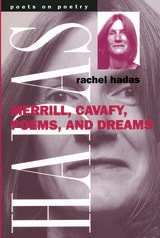
Merrill, Cavafy, Poems, and Dreams
Rachel Hadas
University of Michigan Press, 2000
The second half of the book combines explorations of various corners and horizons of the poetry scene, including neglected American poets and Hadas's thoughts on her own poetics and career. "Two Letters from New York" and "Tangled Web Sites" take bemused looks at literary or cultural landscapes. Hadas also looks inward: to dreams and dreamwork, to her dead mother's address book, to the emblematic drilling of a well in a country house. The range of selections includes essays, interviews, memoir, criticism, and a few of Hadas's own poems.
Rachel Hadas is the author of eleven books of poetry, essays, and translations. Her most recent book is Halfway Down the Hall: New and Selected Poems. She has received a Guggenheim Fellowship in Poetry and an American Academy-Institute of Arts and Letters Award in Literature, and is a member of the American Academy of Arts and Sciences. She is Professor of English at the Newark campus of Rutgers University.
Mesmerizingly Sadly Beautiful
Matthew Lippman
Four Way Books, 2020
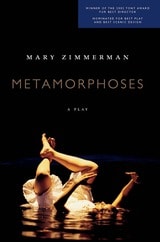
Metamorphoses
A PlayMary Zimmerman
Northwestern University Press, 2002
A beautiful and deeply humane reanimation of Ovid's myths
Called by Time the "theater event of the year," Mary Zimmerman's Metamorphoses brings Ovid's tales to stunning visual life. Set in and around a large pool of water onstage, Metamorphoses juxtaposes the ancient and the contemporary in both language and image to reflect the variety and persistence of narrative in the face of inevitable change. Nominated for three 2002 Tony Awards, including "Best Play," Metamorphoses earned Zimmerman a Tony for "Best Direction of a Play."
Mezcal
By Charles Bowden
University of Texas Press, 1988
Praise for Mezcal:
"Mezcal is also a lyrical meditation upon the ultimate strength of the land, specifically the desert Southwest, and how that land prevails and endures despite every effort of modern industry and development to rape and savage it in the name of progress. Mezcal lingers in the mind as only the very best books manage to do."—Harry Crews
"The author . . . excavates his own tormented life—and its relation to the land he loves—in a series of powerful, imagistic autobiographical essays. Like the desert he cherishes, this memoir is harsh yet lovely, full of sour self-truth. . . . A potent presentation of the wounds of one man's life, packed with indelible impressions; but there's little healing here, making this a bitter if beautiful read."—Kirkus Review
"In Mezcal . . . Bowden drops the journalistic veil, exploring the ecology of his interior landscape at least as thoroughly as the changing scenery that surrounds him. . . . Others—Aldo Leopold, Edward Abbey—have already staked inviolate claims on the Southwestern deserts. But Bowden owns the complex terrain where, like a mezcal-inspired mirage, the Sonoran sun-belt overlaps the gray convolutions of the American mind."—Los Angeles Times

Michigan Herb Cookbook
Suzanne Breckenridge and Marjorie Snyder
University of Michigan Press, 2001
If you're interested in cooking with herbs and want to use the best of Michigan and the Midwest's seasonal foods, then this is the cookbook for you.
The recipe section is written for both the novice and the more experienced cook. Each recipe has helpful information about serving suggestions and menu ideas. Scattered throughout the book are handy tips related to foods, herbs, and cooking. In addition, Michigan Herb Cookbook includes a section on herb growing and designing in which planting, growing, freezing, drying, and storage tips for over thirty herbs are explained in detail.
You will find over 150 recipes in the book's seven chapters. More than half are low-fat, and there are many vegetarian favorites. Also, a chapter devoted to condiments and "little extras" contains various herb blend, vinegar, chutney, pesto, and sauce recipes, such as Sun-Dried-Tomato Pesto and Roasted Red Pepper Sage Sauce.
Suzanne Breckenridge, formerly a ceramics and cooking instructor, is now a food stylist and caterer. Marjorie Snyder is a freelance food writer, a cooking teacher at a junior college, and cofounder and president of the Madison Wisconsin Herb Society.
Michigan Quarterly Review
Vol. 57, No. 1Khaled Mattawa
Michigan Publishing Services, 2018
Michigan Quarterly Review
Vol. 57, No. 3Khaled Mattawa
Michigan Publishing Services, 2018
Michigan Quarterly Review
Vol. 58, No. 2Khaled Mattawa
Michigan Publishing Services, 2019
Michigan Quarterly Review
Volume 58, Issue 3: Summer 2019Khaled Mattawa
Michigan Publishing Services, 2019

Michigan Salvage
The Fiction of Bonnie Jo CampbellLisa DuRose
Michigan State University Press, 2023

Micrographia
Emily Wilson
University of Iowa Press, 2009
Eight years after her revelatory first book, Emily Wilson deepens her focus and extends her vision in new poems of striking intelligence and originality. Venturing into landscapes both interior and exterior, Micrographia explores what Wilson calls “the complex rigged wildness” of geographical, emotional, and verbal states, a territory located “somewhere in that / enjambment within / a cave within the brain.” Following in the tradition of such poets as Dickinson, Bishop, and Ammons, Wilson’s work regards the mind as “enmeshed” with the natural world, always “at the hinge of going over.” Her way of speaking is as precisely calibrated and as restless as her way of seeing, and the terrain of Micrographia rises from a rich and unpredictable encounter with poetic language and form. At the same time, the voice of these poems is never less than urgent, “coming clear by the foment / moving through it.”
Wilson’s eye travels the troubled boundaries between visible and invisible worlds, ranging from coastal Nova Scotia to the Andean highlands to Brooklyn’s industrial Gowanus Canal to the poet’s own backyard. Steeped in tradition but spoken in tones that are utterly distinctive, these intricate poems enter into the microscopic, micrographic spaces between words and things, between thinking and being.
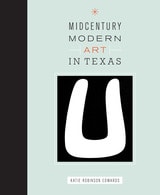
Midcentury Modern Art in Texas
By Katie Robinson Edwards
University of Texas Press, 2014
Winner, Award of Merit for Non-Fiction, The Philosophical Society of Texas, 2015
Before Abstract Expressionism of New York City was canonized as American postwar modernism, the United States was filled with localized manifestations of modern art. One such place where considerable modernist activity occurred was Texas, where artists absorbed and interpreted the latest, most radical formal lessons from Mexico, the East Coast, and Europe, while still responding to the state’s dramatic history and geography. This barely known chapter in the story of American art is the focus of Midcentury Modern Art in Texas.
Presenting new research and artwork that has never before been published, Katie Robinson Edwards examines the contributions of many modernist painters and sculptors in Texas, with an emphasis on the era’s most abstract and compelling artists. Edwards looks first at the Dallas Nine and the 1936 Texas Centennial, which offered local artists a chance to take stock of who they were and where they stood within the national artistic setting. She then traces the modernist impulse through various manifestations, including the foundations of early Texas modernism in Houston; early practitioners of abstraction and non-objectivity; the Fort Worth Circle; artists at the University of Texas at Austin; Houston artists in the 1950s; sculpture in and around an influential Fort Worth studio; and, to see how some Texas artists fared on a national scale, the Museum of Modern Art’s “Americans” exhibitions.
The first full-length treatment of abstract art in Texas during this vital and canon-defining period, Midcentury Modern Art in Texas gives these artists their due place in American art, while also valuing the quality of Texan-ness that subtly undergirds much of their production.
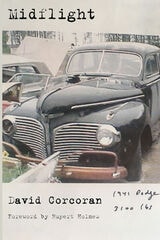
Midflight
David Corcoran
Four Way Books, 2022
A posthumous collection, Midflight collects the poems written by beloved science editor and journalist David Corcoran in the latter part of his life. Idling in a space between the pastoral and the ordinary, Corcoran’s lyrical world maps the sublime mundanity of nature while exploring memory, dreams, and consciousness itself. Corcoran’s lines abound with figures living and long deceased, with the dead walking onstage as if they never left. Describing the accident that killed his father when he was a toddler in “Here,” Corcoran writes, “the door [opens] in midflight / and [pitches] him out.” In “Last Questions,” he asks, “Are you my brother or / a mockingbird?” While these haunting, vivid poems have an aching prescience, imbued as they are with the awareness of human ephemerality, the gift they proffer, to the writer and the reader at once, is the sense of finding oneself midflight, in midair, betwixt sky and ground, in the free fall of being—going and going and never gone.
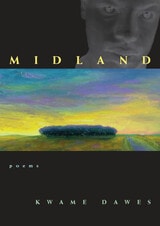
Midland
PoemsKwame Dawes
Ohio University Press, 2000
The winning manuscript of the fourth annual Hollis Summers Poetry Prize is also the exciting American debut by a poet who has already established himself as an important international poetic voice. Midland, the seventh collection by Kwame Dawes, draws deeply on the poet’s travels and experiences in Africa, the Caribbean, England, and the American South. Marked equally by a lushness of imagery, an urgency of tone, and a muscular rhythm, Midland, in the words of the final judge, Eavan Boland, is “a powerful testament of the complexity, pain, and enrichment of inheritance…It is a compelling meditation on what is given and taken away in the acts of generation and influence. Of a father’s example and his oppression. There are different places throughout the book. They come willfully in and out of the poems: Jamaica. London. Africa. America. But all the places become one place in the central theme and undersong here: which is displacement…The achievement of this book is a beautifully crafted voice which follows the painful and vivid theme of homelessness in and out of the mysteries of loss and belonging.”
Midland is the work of a keen and transcendent intellect, a collection of poems that speaks to the landscape from inside, from an emotional and experiential place of risk and commitment.
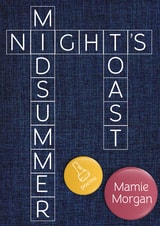
Midsummer Night's Toast
PoemsMamie Morgan
Ohio University Press, 2026
Midsummer Night’s Toast is a collection that answers to no one, a freedom we learn the speaker has finally afforded herself after a half-life spent under the glaring light of tradition, fear, of men, of institutions. She’s answered to her parents, to students, to academia, shame, to the workshop model, to various earlier versions of herself and is ready—in short—to have a good time. The invite list for this particular party belongs entirely to her: friends, street names, Kelly Ripa inside a crossword puzzle, bounced checks, hurricanes and Marilyn Hacker, frat boys and birds, bridal shops, Chaucer, the pictures her husband draws, King Arthur, Adrienne Rich. She’s sad for sure, and angry, but she’s also fierce as fire. At times these poems feel hurried, because they are. The landscape of this book feels like that penultimate moment in When Harry Met Sally when Billy Crystal says, “When you realize you want to spend the rest of your life with somebody, you want the rest of your life to start as soon as possible.” Mamie Morgan is reenacting a half-life of pain utilizing a kaleidoscope she’s crafted from discarded paper, felt, cheap gemstones, crayons worn to nubs, and mixtapes. Lots of mixtapes.
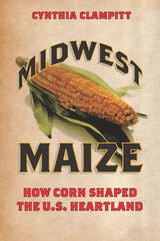
Midwest Maize
How Corn Shaped the U.S. HeartlandCynthia Clampitt
University of Illinois Press, 2015

Midwestern Food
A Chef’s Guide to the Surprising History of a Great American Cuisine, with More Than 100 Tasty RecipesPaul Fehribach
University of Chicago Press, 2023
Celebrated chef Paul Fehribach has made his name serving up some of the most thoughtful and authentic regional southern cooking—not in the South, but in Chicago at Big Jones. But over the last several years, he has been looking to his Indiana roots in the kitchen, while digging deep into the archives to document and record the history and changing foodways of the Midwest.
Fehribach is as painstaking with his historical research as he is with his culinary execution. In Midwestern Food, he focuses not only on the past and present of Midwestern foodways but on the diverse cultural migrations from the Ohio River Valley north- and westward that have informed them. Drawing on a range of little-explored sources, he traces the influence of several heritages, especially German, and debunks many culinary myths along the way.
The book is also full of Fehribach’s delicious recipes informed by history and family alike, such as his grandfather's favorite watermelon rind pickles; sorghum-pecan sticky rolls; Detroit-style coney sauce; Duck and manoomin hotdish; pawpaw chiffon pie; strawberry pretzel gelatin salad (!); and he breaks the code to the most famous Midwestern pizza and BBQ styles you can easily reproduce at home. But it is more than just a cookbook, weaving together historical analysis and personal memoir with profiles of the chefs, purveyors, and farmers who make up the food networks of the region.
The result is a mouth-watering and surprising Midwestern feast from farm to plate. Flyover this!
Midwhistle
Dante Di Stefano
University of Wisconsin Press, 2023
Di Stefano travels through a controlled stream of consciousness as he examines the weights of joy and grief. Bearing witness to the world, Midwhistle unfolds and refolds upon itself, touching on Hiroshima, Bergen-Belsen, Charlottesville, the sacoglossan sea slug, Darwin's Arch, and much more. Stylistically formal, the poem soars and dips, lightly and deftly finding the light in nighttime meditations, as the poet considers “our Unyet son, lemon-sized, / amniotic cosmonaut,” while imagining Heyen at his own age, “the thin black necktie of your / apprenticeship had not been / taken off yet.”
In these examinations we find the poet himself, faced always with a “blinking / cursor,” seeking in the words and lives of other poets what it really means to write poetry. Midwhistle, in its meandering self-reflection and loving expansiveness, is a celebration of the act of poetic creation itself.
your beloved.
—Excerpt from “xxiii. (interlude: prayer for Gaza)”

Migrant Psalms
PoemsDarrel Alejandro Holnes
Northwestern University Press, 2021
Migrant Psalms gives us a rare look inside a Panamanian experience of migration, describing the harsh realities of mothers, children, and teens who entered the United States—or tried to do so. Holnes’s poems find the universal through specificity; their exploration of expatriation, assimilation, and naturalization transcends the author’s personal experience to speak to what it means to be “other” anywhere.
The collection begins with “Kyrie,” a coming‑to‑America chronicle that spans three years in Texas, modeled after the liturgical Christian prayer Kyrie Eleison (Lord, have mercy). Other poems experiment with macaronic language and form to parallel shifts in the speaker’s status from immigrant to citizen, ending with “The 21st Century Poem,” which probes what’s “real” in today’s New York City. Through the speaker’s quest to become an American, this collection asks: Who are we becoming as individuals, as a society, as a nation, as a world? And is faith enough to enact change? Or is it just the first step?

Migrating Fictions
Gender, Race, and Citizenship in U.S. Internal DisplacementsAbigail G. H. Manzella
The Ohio State University Press, 2018
Winner, 2021 CCCC Outstanding Book Award
Migrating Fictions analyzes the role of race, gender, and citizenship in the major internal displacements of the 20th century in history and in narrative. Surveying the particular tactics employed by the United States during the Great Migration, the Dust Bowl, the Japanese American incarceration, and the migrant labor of the Southwest, Abigail G. H. Manzella reveals how the country’s past is imbued with governmentally (en)forced movements that diminished access to full citizenship rights for the laboring class, people of color, and women.
This work is the first book-length study to examine all of these movements together along with their literature, including Zora Neale Hurston’s Their Eyes Were Watching God, Sanora Babb’s Whose Names Are Unknown, Julie Otsuka’s When the Emperor Was Divine, Helena María Viramontes’s Under the Feet of Jesus, and Jesmyn Ward’s Salvage the Bones. Manzella shows how the United States’ history of spatial colonization within its own borders extends beyond isolated incidents into a pattern based on ideology about nation-building, citizenship, and labor. This book seeks to theorize a Thirdspace, an alternate location for social justice that acknowledges the precarity of the internally displaced person.
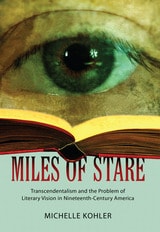
Miles of Stare
Transcendentalism and the Problem of Literary Vision in Nineteenth-Century AmericaMichelle Kohler
University of Alabama Press, 2014
The strangeness of nineteenth-century poetic vision is exemplified most famously by Emerson’s transparent eyeball. That disembodied, omniscient seer is able to shed its body and transcend sight paradoxically in order to see—not to create—poetic language “manifest” on the American landscape. In Miles of Stare, Michelle Kohler explores the question of why, given American transcendentalism’s anti-empiricism, the movement’s central trope becomes an eye purged of imagination. And why, furthermore, she asks, despite its insistent empiricism, is this notorious eye also so decidedly not an eye? What are the ethics of casting a boldly equivocal metaphor as the source of a national literature amidst a national landscape fraught with slavery, genocide, poverty, and war?
Miles of Stare explores these questions first by tracing the historical emergence of the metaphor of poetic vision as the transcendentalists assimilated European precedents and wrestled with America’s troubling rhetoric of manifest destiny and national identity. These questions are central to the work of many nineteenth-century authors writing in the wake of transcendentalism, and Kohler offers examples from the writings of Douglass, Hawthorne, Dickinson, Howells, and Jewett that form a cascade of new visual metaphors that address the irreconcilable contradictions within the transcendentalist metaphor and pursue their own efforts to produce an American literature. Douglass’s doomed witness to slavery, Hawthorne’s reluctantly omniscient narrator, and Dickinson’s empty “miles of Stare” variously skewer the authority of Emerson’s all-seeing poetic eyeball while attributing new authority to the limitations that mark their own literary gazes.
Tracing this metaphorical conflict across genres from the 1830s through the 1880s, Miles of Stare illuminates the divergent, contentious fates of American literary vision as nineteenth-century writers wrestle with the commanding conflation of vision and language that lies at the center of American transcendentalism—and at the core of American national identity.
Mill and Mansion
A Study of Architecture and Society in Lowell, Massachusetts, 1820-1865John Coolidge
University of Massachusetts Press, 1993
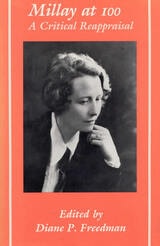
Millay At 100
A Critical ReappraisalDiane F. Freedman
Southern Illinois University Press, 1995
Though finding its occasion in the life of Millay— the centennial of the writer’ s birth— this volume refocuses attention on Millay’ s art by asking questions central to our present concerns: What in the varied body of Millay’ s work speaks to us most forcefully today? Which critical perspectives most illuminate her texts? How might those approaches be challenged, extended, or reoriented? In seeking the answers to such questions, the volume’ s contributors illuminate the means by which Millay’ s early success has been slighted and misunderstood and examine issues of personality, personae, critical stature, and formal experimentation in Millay’ s various genres: lyric poetry, the sonnet, verse drama, fiction, and the personal letter.
In 1920, following the publication of A Few Figs from Thistles, Millay was the "It girl" of American poetry. But by the late 1930s, her popularity waned as her critical reputation declined under the reign of high modernism and its critics. In fact, Millay, like others of her generation, had rejected modernist elitism in favor of public engagement, using her powerful public voice to plead for an end to the Sacco-Vanzetti trials as well as for U.S. entry into World War II. Condemned for both her politicizing and her political poetry, she was the first to admit that she and her poetry suffered in the service of public causes.
Grouped into four parts, these essays focus on Millay’ s relation to modernism, her revisionary perspectives on love, her treatment of time and of the female body, and her use of masquerade and impersonation in life and in art. Throughout, the essayists pose such questions as: Where is Millay’ s place in the literary histories of modern writing and in our hearts? How are we to value, interpret, and characterize the various forms and genres in which she wrote? What is the cultural work Millay achieves and reflects? How does she help us redefine modernism? What do Millay’ s great gifts enable us to see about genre, the social construction of gender, the definition of modernism, and the role of the poet?
Millay’ s considerable productivity, the range and virtues of her forms, and her experimentation clearly argue for a wide-ranging reappraisal of her work.
Millennial Teeth
Dan Albergotti
Southern Illinois University Press, 2014
Both bleak and bewildering, Millennial Teeth, the visceral new collection by poet Dan Albergotti, maps a contradictory journey filled with longing and dread, cynicism and hope. A heady mix of traditional forms and more experimental verse, Albergotti’s volume lures readers inexorably into the poet’s obsessions with mystery, doubt, ephemerality, and silence.
The poetry in Millennial Teeth will feel both refreshingly new and strangely familiar to Albergotti’s audience. Some poems pay direct tribute to such literary luminaries as Wallace Stevens and Philip Larkin, while others give nods to icons of pop culture, from Radiohead to Roman Polanski. The narrator muses on the resurrection of Christina the Astonishing, the works of Coleridge, and the mindless duties of minor players in Shakespeare’s Hamlet.
Yet these familiar faces are not our friends; they are juxtaposed with the heartbreaking apocalypses, both natural and man-made, that have plagued the world since the first plane flew into the World Trade Center. A reluctant witness to such events, the narrator of these poems attempts to navigate his own personal crises, including the mental illness and dementia of loved ones and the inability to connect with others, from the darkness of a personal orbit far from the sun. As he vehemently rejects the notions of religious succor, immortality, and the passive acceptance of fate, he simultaneously yearns to be proven wrong. Yet despite his trials, Albergotti’s narrator maintains a gallows humor and wry insight that balance his despair.
A riveting exploration of the all-too-human struggle between faith and doubt, skepticism and obsession, Millennial Teeth has both heart and bite in plenty.

Mimetic Disillusion
Eugene O'Neill, Tennessee Williams, and U.S. Dramatic RealismAnne Fleche
University of Alabama Press, 1997
Reimagining American dramatic realism through the lenses of mimesis, theory, and theatrical innovation.
This volume focuses on two major writers of the 1930s and 1940s—Eugene O'Neill and Tennessee Williams—one whose writing career was just ending and the other whose career was just beginning. In new readings of their major works from this period, Long Day's Journey into Night, The Iceman Cometh, The Glass Menagerie, and A Streetcar Named Desire, Fleche develops connections to the writings of Jacques Derrida, Paul de Man, and Michel Foucault, among others, and discusses poststructuralism in the light of modern writers such as Bertolt Brecht, Antonin Artaud, and Walter Benjamin. Fleche also extends this discussion to the work of two contemporary playwrights, Adrienne Kennedy and Tony Kushner. The aim of Mimetic Disillusion is not to reject "mimetic" and "realistic" readings but to explore the rich complexities of these two ideas and the fruit of their ongoing relevance to U.S. theatre.

Minding the Sun
Robert Pack
University of Chicago Press, 1996
The opening section marks a return for Pack to the musical sensuality of the lyric. These short lyrics are uniquely his: the sequence begins in Vermont and concludes in the Andromeda galaxy, providing an opportunity to hold in mind the nurturing sun of our solar system.
The poems of the collection's middle section, written in the flowing narrative and meditative mode familiar to Pack's many admirers, take up the themes of human sexuality and consciousness. And the final section, replete with puns and paradoxes, shows Pack at his most playful as he muses on art, technology, romantic and marital desire, and the stubborn longing for transcendence. The poet concludes the volume with a sobering plea, "The Trees Will Die," to heed the sun's example, to cherish and protect our planet and all its living things.
Mindprints
Thoreau's Material WorldsIvan Gaskell
University of Chicago Press, 2024
Though we may associate Henry David Thoreau with ascetic renunciation, he accumulated a variety of tools, art, and natural specimens throughout his life as a homebuilder, surveyor, and collector. In some of these objects, particularly Indigenous artifacts, Thoreau perceived the presence of their original makers, and he called such objects “mindprints.” Thoreau believed that these collections could teach him how his experience, his world, fit into the wider, more diverse (even incoherent) assemblage of other worlds created and re-created by other beings every day. In this book, Ivan Gaskell explores how a profound environmental aesthetics developed from this insight and shaped Thoreau’s broader thought.
Mirror of the Indies
A History of Dutch Colonial LiteratureRob Nieuwenhuys
University of Massachusetts Press, 1982
Misery Prefigured
J. Allyn Rosser
Southern Illinois University Press, 2001
In her second collection of poems, J. Allyn Rosser explores the human condition in all its gloriously valiant pathos. Misery Prefigured dwells on our continual reinventions of self and world and the restless dynamic that vibrates between them.Whether contemplating a failed marriage, a visit from God, or a pearl dropped into a bottle of Prell shampoo, Rosser's wry yet impassioned eye looks hard for a habitable and abiding truth. Alternating between deadpan and dead serious, these poems are often darkly funny, exposing the contradictions inherent in every desire. Misery Prefigured is fueled by a cocky, unsentimental determination to make some consolatory sense of what passes for reality.
Missouri's Silver Age
Silversmiths of the 1800sNorman Mack. Foreword by Anne Woodhouse
Southern Illinois University Press, 2005
The result of nearly two decades of intensive research by Norman Mack and his late wife, Beatrice Davidow Mack, Missouri’s Silver Age: Silversmiths of the 1800s is a comprehensive directory of nineteenth-century Missouri silversmiths, their works, and their identifying makers’ marks. Illustrated with over one hundred photographs, this exceptional reference for historians and silver collectors showcases the Macks’ three-hundred-piece collection of Missouri silver, which includes a representative sample by nearly every known Missouri silversmith and is housed at the Missouri Historical Society in St. Louis.
Featuring more than a hundred detailed biographies of the artisans and apprentices who created handmade silver in St. Louis and Missouri during the nineteenth century, Missouri’s Silver Age also contains extensive photographs of makers’ touchmarks and of the pieces themselves, which include bowls, dishes, spoons, and ladles, as well as other household utensils and decorative items. Arranged alphabetically, the biographies reveal all known details of the business activities and locations of the silversmiths. Collectively, the entries and the illustrations shed light on the growth of enterprise in Missouri, show the impact of the individual on the developing frontier economies of the Midwest, and reveal how the production, acquisition, and possession of material goods reflected the culture and values of Americans during the 1800s.
Mack provides a brief but thorough history of silversmithing in America for novice collectors and historians, detailing the various methods used in making silver and the range of styles that were popular, providing insight into the methods of training apprentices, and explaining the effects of mechanization on the trade. Augmenting this volume are an appendix by Jo Ann Griffin on how to care for old silver, a map of the silversmiths’ primary locations, and a helpful alphabetical appendix of the silversmiths that includes illustrations of their touchmarks.
Missy
A NovelRaghav Rao
Northwestern University Press, 2026
A remarkable young woman flees India to chase the dream of self-reinvention in America
The orphaned girls of St. Ursula’s convent are destined to be nuns or servants, but seventeen-year-old Savi dreams of escape. She is chosen to work as a governess for the wealthy Nandiyar family at their country estate in Tamil Nadu, where she falls for a lively and carefree apprentice sculptor. After the violent and horrific events of a single night, they are forced to flee, leaving their homeland forever in the rearview.
Decades later, Savi has become known to all as “Missy” and runs a successful driving school in Chicago. She is a pillar of the South Asian community and the mother of two brilliant, stubborn young women, Mansi and Shilpa. But when Varun, a charming doctor with mysterious connections to her past, enters their lives, a chain of events is set off that puts Missy’s carefully constructed world in jeopardy. Can Missy outrun her secrets? And, if she is forced to face them, what will become of those she loves?
Mixed Company
Alan Shapiro
University of Chicago Press, 1996
"What draws us into Alan Shapiro's Mixed Company is not a conspicuous felicity or any sort of bravura, but the quiet, undaunted way he goes after the truth of human feeling and motive. . . . The poems grope and conjecture, looking for understanding . . . but whatever may remain unsolved and insoluble, the poems are full of astonishing insights, a rare articulateness, and what another age called 'knowledge of the human heart.'" —Richard Wilbur
Mixed Realism
Videogames and the Violence of FictionTimothy J. Welsh
University of Minnesota Press, 2016
Mixed Realism is about how we interact with media. Timothy J. Welsh shows how videogames, like novels, both promise and trouble experiences of “immersion.” His innovative methodology offers a new understanding of the expanding role of virtuality in contemporary life.
Today’s wired culture is a mixed reality, conducted as exchanges between virtual and material contexts. We make balance transfers at an ATM, update Facebook timelines, and squeeze in sessions of Angry Birds on the subway. However, the “virtual” is still frequently figured as imaginary, as opposed to “real.” The vision of 1990s writers of a future that would pit virtual reality against actual reality has never materialized, yet it continues to haunt cultural criticism. Our ongoing anxiety about immersive media now surrounds videogames, especially “shooter games,” and manifests as a fear that gamers might not know the difference between the virtual world and the real world.
As Welsh notes, this is the paradox of real virtuality. We understand that the media-generated virtualities that fill our lives are not what they represent. But what are they if they are not real? Do they have presence, significance, or influence exceeding their material presence and the user processes that invoke them? What relationships do they establish through and beyond our interactions with them?
Mixed Realism brims with fresh analyses of literary works such as Truman Capote’s In Cold Blood and Mark Z. Danielewski’s House of Leaves, along with sustained readings of controversial videogames such as Super Columbine Massacre and Call of Duty: Modern Warfare 2. Continually connecting the dots between surprising groupings of texts and thinkers, from David Foster Wallace to the cult-classic videogame Eternal Darkness and from Cormac McCarthy to Grand Theft Auto, it offers a fresh perspective on both digital games and contemporary literature.
Mobility and Migration
East Anglian Founders of New England, 1629-1640Roger Thompson
University of Massachusetts Press, 1994
During the 1630s, more than 14,000 people sailed from Britain bound for New England, constituting what has come to be known as the Great Migration. This book offers the most extensive study of these emigrants ever undertaken. Focusing on 2,000 individuals who moved from the five counties of eastern England, it provides historians with important new findings on mobility, family life, kinship networks, and community cohesion.
Roger Thompson reveals the personal experiences and ancestral histories of the emigrants. He follows them across the Atlantic and investigates their lives and achievements in the New World. Distinguising between such groups as gentry, entrepreneurs, artisans, farmers, and servants, he explores whether the migration tended to be a solitary uprooting from a stable and predictable world of familiar neighborhoods or simply a longer move among many relocations.
Thompson also sheds light on the issue of motivation: Were these settlers pulled by the hope of eventual enrichment or of founding a purified society, or were they pushed by intolerance and persecution at home? Did they see New England as a haven of escape or an opportunity to exploit? Did New Englanders seek to replicate “English ways,” preserving traditional culture and society, or did they embrace change and innovation? Mobility and Migration provides a wealth of new evidence for historians of both early modern England and colonial America.
Modern American Grotesque
Literature and PhotographyJames Goodwin
The Ohio State University Press, 2009
Modern American Poetry, 1865-1950
Alan Shucard
University of Massachusetts Press, 1990
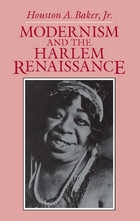
Modernism and the Harlem Renaissance
Houston A. Baker Jr.
University of Chicago Press, 1989

Modernity
Clarence Major
Tupelo Press, 2027
From the barbershop to the railroad track, from the museum to the waiting room, this collection invites us to see through the eyes of one of the greatest living American poets.
In Modernity, Clarence Major brings his painter's eye and poet's precision to the ordinary landscapes of contemporary life, transforming everyday encounters into moments of revelation. Moving effortlessly among museums, city streets, family memory, dreams, travel, and ritual, these quietly luminous poems discover beauty, humor, melancholy, and resilience in the fleeting textures of modern experience. Animated by keen observation and philosophical wit, Modernity reflects on art, aging, love, race, memory, and the passage of time without sacrificing the immediacy of lived perception. The result is a deeply humane collection from one of America's most distinguished literary voices, celebrating the extraordinary that persists within the ordinary.
Modernity and Progress
Fitzgerald, Hemingway, OrwellRonald Berman
University of Alabama Press, 2007
Breaks new critical ground by exploring philosophical and aesthetic issues germane to the writings of three major modern literary figures.
In the 1920s and ‘30s, understandings of time, place, and civilization were subjected to a barrage of new conceptions. Ronald Berman probes the work of three writers who wrestled with one or more of these issues in ways of lasting significance.
Hemingway, Fitzgerald, and Orwell all grappled with fluid notions of time: Hemingway’s absolute present, Fitzgerald’s obsession with what might be and what might have been, and Orwell’s concerns with progress. For these authors, progress is also tied to competing senses of place--for Fitzgerald, the North versus the South; for Hemingway, America versus Europe. At stake for each is an understanding of what constitutes true civilization in a post-war world. Berman discusses Hemingway’s deployment of language in tackling the problems of thinking and knowing. Berman follows this notion further in examining the indisputable impact upon Hemingway’s prose of Paul Cézanne’s painting and the nature of perception.
Finally, Berman considers the influence on Orwell of Aristotle and Freud’s ideas of civilization, translated by Orwell into the fabric of 1984 and other writings.
Ronald Berman is Professor of English at the University of California at San Diego and past chairman of the National Endowment for the Humanities. He is author of six books, including “The Great Gatsby” and Fitzgerald’s World of Ideas and Fitzgerald-Wilson-Hemingway: Language and Experience.
Modernizing Solitude
The Networked Individual in Nineteenth-Century American LiteratureYoshiaki Furui
University of Alabama Press, 2019
During the nineteenth century, the United States saw radical developments in media and communication that reshaped concepts of spatiality and temporality. As the telegraph, the postal system, and public transportation became commonplace, the country achieved a level of connectedness that was never possible before. At this level, physical isolation no longer equaled psychological separation from the exterior world, and as communication networks proliferated, being disconnected took on negative cultural connotations.
Though solitude, and the lack thereof, is a pressing concern in today’s culture of omnipresent digital connectivity, Yoshiaki Furui shows that solitude has been a significant preoccupation since the nineteenth century. The obsession over solitude is evidenced by many writers of the period, with consequences for many basic notions of creativity, art, and personal and spiritual fulfillment.
In Modernizing Solitude: The Networked Individual in Nineteenth-Century American Literature, Furui examines, among other works, Henry David Thoreau’s Walden, Harriet Jacobs’s Incidents in the Life of a Slave Girl, Herman Melville’s “Bartleby, the Scrivener,” Emily Dickinson’s poetry and letters, and telegraphic literature in the 1870s to identify the virtues and values these writers bestowed upon solitude in a time and place where it was being consistently threatened or devalued. Although each writer has a unique way of addressing the theme, they all aim to reclaim solitude as a positive, productive state of being that is essential to the writing process and personal identity. Employing a cross-disciplinary approach to understand modern solitude and the resulting literature, Furui seeks to historicize solitude by anchoring literary works in this revolutionary yet interim period of American communication history, while also applying theoretical insights into the literary analysis.
Money in the Air
Art Dealers and the Making of a Transatlantic Market, 1880–1930Gail Feigenbaum
J. Paul Getty Trust, The, 2024
“There was money in the air, ever so much money,” wrote Henry James in 1907, reflecting on the American appetite for art acquisitions. Indeed, collectors such as Henry Clay Frick and Andrew W. Mellon are credited with bringing noteworthy European art to the United States, with their collections forming the backbone of major American museums today. But what of the dealers, who possessed the expertise in art and recognized the potential of developing a new market model on both sides of the Atlantic?
Money in the Air investigates the often-overlooked role of these dealers in creating an international art world. Contributors examine the histories of well-known international firms like Duveen Brothers, M. Knoedler & Co., and Goupil & Cie and their relationships with American clients, as well as accounts of other remarkable dealers active in the transatlantic art market. Drawing on dealer archives, scholars reveal compelling findings, including previously unknown partnerships and systems of cooperation. This volume offers new perspectives on the development of art collections that formed the core of American art museums, such as the National Gallery of Art, the Metropolitan Museum of Art, and the Frick Collection.
Monster Mash
Susan Browne
Four Way Books, 2025
Monstrous Youth
Transgressing the Boundaries of Childhood in the United StatesSara Austin
The Ohio State University Press, 2022
Monumental Anxieties
Homoerotic Desire and Feminine Influence in 19-th Century U.S. LiteratureDerrick, Scott S
Rutgers University Press, 1997
Scott Derrick has written an original book that contributes significantly to current revisions of the nineteenth-century American literary tradition's representation of gender and sexuality. His interpretation of feminist, lesbian-feminist, and gay issues in nineteenth-century American literature as complementary enlarges our historical understanding and helps build the coalition politics needed in these areas."-John Carlos Rowe, University of California, Irvine
Recent gender-based scholarship on nineteenth-century American literature has established male authors' crucial awareness of the competition from popular women writers. And critical work in gay studies and queer theory has stressed the importance in canonical American literature of homoerotic relations between men, even before "homosexuality" became codified at the end of the century. Scott Derrick draws on these insights to explore the ways in which male authors struggle to refigure literature-historically devalued as feminine-as a masculine and heterosexual enterprise. Derrick focuses on scenes of compositional crisis that reveal how male identity itself is at risk in the perils and possibilities of being a male author in a feminized literary marketplace.
He suggests that traditionally valued texts by Hawthorne, Poe, James, Sinclair, and Crane have at their core combustible four-sided conflicts between feminine identifications and masculine distancings, homoerotic longings and homophobic dreads, conflicts which are largely determined by domestic ideals of male and female roles within the nineteenth-century family. The negotiation of such conflicts is controlled by the nature of fiction writing, which both frees the imagination to explore forbidden fantasies and harnesses the imagination to public understandings of the proper form and content of fiction. Thus Monumental Anxieties also contributes to recent debates about the social shaping of contemporary homosexuality and to the history of American masculinity.
Moods
Elbert, Sarah
Rutgers University Press, 1991
Moods, Louisa May Alcott's first novel was published in 1864, four years before the best-selling Little Women. The novel unconventionally presents a "little woman," a true-hearted abolitionist spinster, and a fallen Cuban beauty, their lives intersecting in Alcott's first major depiction of the "woman problem."
Sylvia Yule, the heroine of Moods, is a passionate tomboy who yearns for adventure. The novel opens as she embarks on a river camping trip with her brother and his two friends, both of whom fall in love with her. These rival suitors, close friends, are modeled on Ralph Waldo Emerson and Henry Daniel Thoreau. Aroused, but still "moody" and inexperienced, Sylvia marries the wrong man. In the rest of the novel, Alcott attempts to resolve the dilemma she has created and leave her readers asking whether, in fact, there is a place for a woman such as Sylvia in a man's world.
In 1882, eighteen years after the original publication, Alcott revised and republished the novel. Her own literary success and the changes she helped forge in women's lives now allowed her heroine to meet, as Alcott said, "a wiser if less romantic fate than in the former edition." This new volume contains the complete text of the 1864 Moods and Alcott's revisions for the 1882 version, along with explanatory notes by the editor. A critical introduction places Moods in the context of Alcott's own literary history and in the larger historical setting of nineteenth-century society and culture.
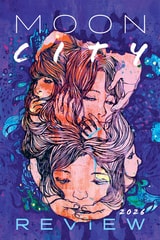
Moon City Review 2026
A Literary AnthologyMichael Czyzniejewski
Moon City Press, 2026
Moon City Press’ 2026 edition proudly boasts selections by established and up-and-coming writers, including poems, short stories, flash fiction, creative nonfiction, graphic narrative, and translation.
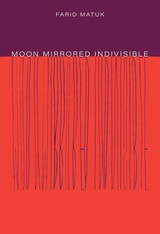
Moon Mirrored Indivisible
Farid Matuk
University of Chicago Press, 2025
An inheritor of lineages marked by colonial and gendered violence, Farid Matuk approaches the musical capacities of verse not as mere excitation or decoration, but as forms that reclaim pleasure and presence. Entering the sonic constellations of Moon Mirrored Indivisible, the reader finds relief from nesting layers of containment that systems of power impose on our bodies and imaginations. In this hall of historical mirrors, fictions of identity are refracted, reflected, and multiplied into a vast field of possibilities. Matuk’s meditations on place and power offer experiments in self-understanding, moving through expansive conversations between a lyric “I” and others, including poets, the speaker’s partner, ancestors, and the reader, and creating spaces for strange intimacy. Each of the book’s four sections of poems builds on the other to ask how we might form a collective—a people—not founded in orthodoxies of originality but in the mutual work of mirroring one another.

Moorings and Metaphors
Figures of Culture and Gender in Black Women's LiteratureKarla F. Holloway
Rutgers University Press, 1991
Proceeding from a consideration of the imaginative textual languages of contemporary African-American and West African writers, Holloway asserts the intertextuality of black women's literature across two continents. She argues the subtext of culture as the source of metaphor and language, analyzes narrative structures and linguistic processes, and develops a combined theoretical/critical apparatus and vocabulary for interpreting these writers' works. The cultural sources and spiritual considerations that inhere in these textual languages are discussed within the framework Holloway employs of patterns of revision, (re)membrance, and recursion--all of which are vehicles for expressive modes inscribed at the narrative level. Her critical reading of contemporary black women's writing in the United States and West Africa is unique, radical, and sure to be controversial.
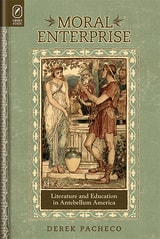
Moral Enterprise
Literature and Education in Antebellum AmericaDerek Pacheco
The Ohio State University Press, 2013
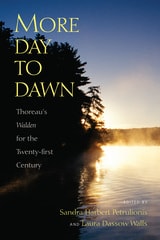
More Day to Dawn
Thoreau's Walden for the Twenty-first CenturySandra Harbert Petrulionis
University of Massachusetts Press, 2007
Thoreau asserted that the leaves of the earth's strata were not page upon page to be studied by geologists and antiquaries chiefly, "but living poetry like the leaves of a tree." The continuing vitality of Walden shows that it, too, is not a fossil but a living book, still putting out green leaves of insight.
Each decade since Walden was published in 1854 has seen the world grow more crowded and less "simple." What, in our consumerist, speed-of-light, hypermediated world would Thoreau have found worth pursuing? How would he structure his life so as to shut out the phones ringing, the cars honking, the litter trashing his beloved haunts? Readers still seek answers to such questions by picking up their dog-eared copy of Walden and immersing themselves yet again in its pages. Students convince us that this book still holds the power to change lives. These essays are written with the expectation that Thoreau in the new century can help us realize that there are more lives to live and more day to dawn—that "the sun is but a morning star."
Contributors include Nina Baym, Robert Cummings, Robert Oscar López, Lance Newman, H. Daniel Peck, Dana Phillips, Larry J. Reynolds, David M. Robinson, William Rossi, Robert Sattelmeyer, Sarah Ann Wider, and Michael G. Ziser.