Results by title
402 books match the query 'American poetry' and 39 start with p
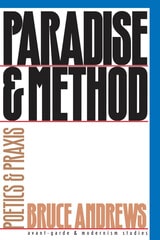
Paradise and Method
Poetry and PraxisBruce Andrews
Northwestern University Press, 1996
Addressing poetics from a poet's perspective, Andrews focuses on the ways in which meaning is produced and challenged. His essays aim "to map out opportunities for making sense (or making noise)--both in reading and writing contemporary literature. At the center has been a desire to explore language, as up close as possible, as a material and social medium for restagings of meaning and power." Andrews analyzes poetics and the production of meaning; alternative traditions and canons; and innovative contemporary poetry, particularly its break with many of the premises and constraints of even the most forward-looking modernisms.
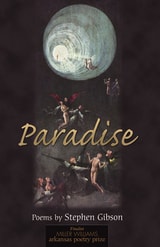
Paradise
PoemsStephen Gibson
University of Arkansas Press, 2011
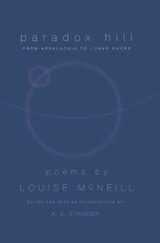
Paradox Hill
From Appalachia to Lunar Shore, Revised EditionPoems by Louise McNeill, Edited and with an Introduction by A. E. Stringer
West Virginia University Press, 2009
—a classic work from a West Virginia Poet Laureate!
With a new introduction by A.E. Stringer, this reprint of Louise McNeill's classic work remains as vivid as when it was first published. Containing poems from several decades of her career, Paradox Hill: From Appalachia to Lunar Shore is a must-have collection of a beloved poet's heartfelt exploration of her physical and cultural surroundings.
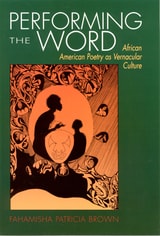
Performing The Word
African American Poetry As Vernacular CultureBrown, Fahamisha Patricia
Rutgers University Press, 1999
Fahamista Patricia Brown examines elements of African American expressive culture- its language practices, both fold and popular. Her book is an excellent introduction to a diverse group of poets and the common basis of their work in language practices and performativity, in the expressive culture of a people. Performing the Word is an important contribution to the understanding of African American culture and American poetry as a whole.
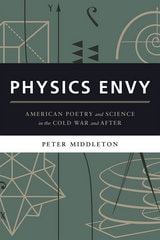
Physics Envy
American Poetry and Science in the Cold War and AfterPeter Middleton
University of Chicago Press, 2015
In Physics Envy, Peter Middleton examines the influence of science, particularly physics, on American poetry since World War II. He focuses on such diverse poets as Charles Olson, Muriel Rukeyser, Amiri Baraka, and Rae Armantrout, among others, revealing how the methods and language of contemporary natural and social sciences—and even the discourse of the leading popular science magazine Scientific American—shaped their work. The relationship, at times, extended in the other direction as well: leading physicists such as Robert Oppenheimer, Werner Heisenberg, and Erwin Schrödinger were interested in whether poetry might help them explain the strangeness of the new, quantum world. Physics Envy is a history of science and poetry that shows how ultimately each serves to illuminate the other in its quest for the true nature of things.
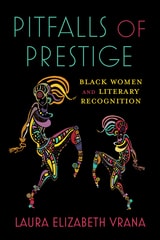
Pitfalls of Prestige
Black Women and Literary RecognitionLaura Elizabeth Vrana
The Ohio State University Press, 2024
Winner, 2025 College Language Association Book Award
From 1987, when Rita Dove won the Pulitzer Prize for Poetry, to 2021, when Amanda Gorman skyrocketed to celebrity status after performing during Biden’s inauguration and the Super Bowl, Black women have seemingly attained secure, stable positions at the forefront of American poetry. But this prominence comes at a price. As figures like Dove and Elizabeth Alexander have become well known, receiving endorsements and gaining visible platforms from major prizes, academic institutions, and publishing houses, the underlying terms of evaluation that greet Black women’s poetics often remain superficial, reflecting efforts to co-opt and contain rather than meaningfully consider new voices and styles. In Pitfalls of Prestige, Laura Elizabeth Vrana surveys how developments in American literary institutions since 1980 have shaped—and been shaped by—Black women poets. Grappling with the refulgent works of the most acclaimed contemporary figures alongside those of lesser-known poets, Vrana both elucidates how seeming gestures of inclusion can actually result in constraining Black women poets’ works and also celebrates how these writers draw on a rich lineage and forge alternative communities in order to craft continually innovative modes of transgressing such limits, on the page and in life.
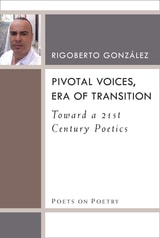
Pivotal Voices, Era of Transition
Toward a 21st Century PoeticsRigoberto González
University of Michigan Press, 2017
This book fills a glaring gap in existing poetry scholarship by focusing exclusively on writers of color, and particularly on Latino poetry. González makes important observations about the relevance, urgency, and exquisite craft of the work coming from writers who represent marginalized communities. His insightful connections between the Latino, African American, Asian American, and Native American literatures persuasively position them as a collective movement critiquing, challenging, and reorienting the direction of American poetry with their nuanced and politicized verse. González’s inclusive vision covers a wide landscape of writers, opening literary doors for sexual and ethnic minorities.
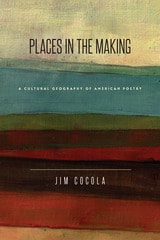
Places in the Making
A Cultural Geography of American PoetryJim Cocola
University of Iowa Press, 2016
Positing place as a pivotal axis of identification and heralding emplacement as a crucial model for cultural, intellectual, and political activity in a period marked and imperiled by a tendency toward dislocation, the critical vocabulary of this project centers upon the work of place-making. It attends to a poetics that extends beyond epic and lyric modes while relying simultaneously on auditory and visual effects and proceeding in the interests of environmental advocacy and social justice, often in contrast to the more orthodox concerns of literary modernism, global capitalism, and print culture. Focusing on poets of international reputation, such as Elizabeth Bishop, Pablo Neruda, Charles Olson, and William Carlos Williams, Places in the Making also considers work by more recent figures, including Kamau Brathwaite, Joy Harjo, Myung Mi Kim, and Craig Santos Perez. In its larger comparative, multiethnic, and transnational emphases, this book addresses questions of particular moment in American literary and cultural studies and aspires to serve as a catalyst for further interdisciplinary work connecting geography and the humanities.

Poems and Meditations
Anne Bradstreet
Iter Press, 2019
Poems of the American Empire
The Lyric Form in the Long Twentieth CenturyJen Hedler Phillis
University of Iowa Press, 2019
Poems of the American Empire argues that careful attention to a particular strain of twentieth-century lyric poetry yields a counter-history of American global power. The period that Phillis covers—from Ezra Pound’s A Draft of XXX Cantos in 1930 to Cathy Park Hong’s Engine Empire in 2012—roughly matches what some consider the ascent and decline of the American empire. The diverse poems that appear in this book are united by their use of epic forms in the lyric poem, a combination that violates a fundamental framework of both genres’ relationship to time.
This book makes a groundbreaking intervention by insisting that lyric time is key to understanding the genre. These poems demonstrate the lyric form’s ability to represent the totality of history, making American imperial power visible in its fullness. Neither strictly an empty celebration of American exceptionalism nor a catalog of atrocities, Poems of the American Empire allows us to see both.
Poetic Investigations
Singing the Holes in HistoryPaul Naylor
Northwestern University Press, 1999
Poetic License
Essays on Modernist and Postmodernist LyricMarjorie Perloff
Northwestern University Press, 1990
Poetic Obligation
Ethics in Experimental American Poetry after 1945Matthew G. Jenkins
University of Iowa Press, 2008
Since at least the time of Plato's Republic, the relationship between poetry and ethics has been troubled. Through the prism of what has been called the "new" ethical criticism, inspired by the work of Emmanuel Levinas, G. Matthew Jenkins considers the works of Objectivists, Black Mountain poets, and Language poets in light of their full potential to reshape this ancient relationship.
American experimental poetry is usually read in either political or moral terms. Poetic Obligation, by contrast, considers the poems of Louis Zukofsky, Charles Reznikoff, George Oppen, Edward Dorn, Robert Duncan, Susan Howe, and Lyn Hejinian in terms of the philosophical notion of ethical obligation to the Other in language. Jenkins's historical trajectory enables him to consider the full breadth of ethical topics that have driven theoretical debate since the end of World War II. This original approach establishes an ethical lineage in the works of twentieth-century experimental poets, creating a way to reconcile the breach between poetry and the issue of ethics in literature at large.
With implications for a host of social issues, including ethnicity and immigration, economic inequities, and human rights, Jenkins's imaginative reconciliation of poetry and ethics will provide stimulating reading for teachers and scholars of American literature as well as advocates and devotees of poetry in general. Poetic Obligation marshals ample evidence that poetry matters and continues to speak to the important issues of our day.
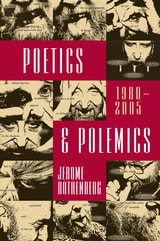
Poetics & Polemics
1980-2005Jerome Rothenberg
University of Alabama Press, 2008
Poetics & Polemics, 1980-2005 brings together in one volume a wide-ranging selection of essays and commentaries by one of the most significant poets, critics, and translators working with American and international poetry today.
Jerome Rothenberg’s work spans a period of over forty years and nearly one hundred books, and though perhaps best known as a poet, his critical and theoretical contributions to the fields of innovative, experimental poetry have become equally important facets of his work. Rothenberg’s earliest critical writings concerned themselves with ethnopoetics and the poetics of performance. In the last twenty years his critical thinking has evolved to encompass more explicitly issues of modernism, postmodernism, and the avant-garde, as well as meditations on the nature of the book and writing. This volume extends and elaborates all of those interests, allowing for the first time a comprehensive glimpse of the full trajectory of his thinking.
In the first section, “Poetics and Polemics,” Rothenberg’s essays address a range of issues with which he’s become closely associated, among them the anthology as a critical and polemical tool; the intersection of poetry with art, performance, and politics, in both contemporary and traditional practice; the poetics of Jewish mysticism as a traditional form of conceptual and language poetry; and the universality of poetic discourse, particularly as seen in tribal poetry or in poetic traditions long separated from the Western literary mainstream. In “A Gallery of Poets” is Rothenberg’s lively explorations of the work of other poets, as they relate to his own work, to avant-garde poetry in general, and to the poetic traditions that concern him the most. Finally, in “Dialogues and Interviews” are Rothenberg’s unbridled meditations and musings on what he calls “the life of poetry” outside the bounds of book and binding, class and category, a dynamic force at the center of all that we call human.
Poetics and Praxis 'After' Objectivism
W. Scott Howard and Broc Rossell
University of Iowa Press, 2018
Poetics and Praxis ‘After’ Objectivismexamines late twentieth-and early twenty-first-century poetics and praxis within and against the dynamic, disparate legacy of Objectivism and the Objectivists. This is the first volume in the field to investigate the continuing relevance of the Objectivist ethos to poetic praxis in our time. The book argues for a reconfiguration of Objectivism, adding contingency to its historical values of sincerity and objectification, within the context of the movement’s development and disjunctions from 1931 to the present.
Essays and conversations from emerging and established poets and scholars engage a network of communities in the U.S., Canada, and the U.K., shaped by contemporaneous oppositions as well as genealogical (albeit discontinuous) historicisms. This book articulates Objectivism as an inclusively local, international, and interdisciplinary ethos, and reclaims Objectivist poetics and praxis as modalities for contemporary writers concerned with radical integrations of aesthetics, lyric subjectivities, contingent disruption, historical materialism, and social activism. The chapter authors and roundtable contributors reexamine foundational notions about Objectivism—who the Objectivists were and are, what Objectivism has been, now is, and what it might become—delivering critiques of aesthetics and politics; of race, class, and gender; and of the literary and cultural history of the movement’s development and disjunctions from 1931 to the present.
Contributors: Rae Armantrout, Julie Carr, Amy De’Ath, Jeff Derksen, Rachel Blau DuPlessis, Graham Foust, Alan Golding, Jeanne Heuving, Ruth Jennison, David Lau, Steve McCaffery, Mark McMorris, Chris Nealon, Jenny Penberthy, Robert Sheppard
Poetics in a New Key
Interviews and EssaysMarjorie Perloff
University of Chicago Press, 2014
The fourteen interviews in Poetics in a New Key—conducted by scholars, poets, and critics from the United States, Denmark, Norway, France, and Poland, including Charles Bernstein, Hélène Aji, and Peter Nicholls—cover a broad spectrum of topics in the study of poetry: its nature as a literary genre, its current state, and its relationship to art, politics, language, theory, and technology. Also featured in the collection are three pieces by Perloff herself: an academic memoir, an exploration of poetry pedagogy, and an essay on twenty-first-century intellectuals. But across all the interviews and essays, Perloff’s distinctive personality and approach to reading and talking resound, making this new collection an inspiring resource for scholars both of poetry and writing.
Poetics of Emergence
Affect and History in Postwar Experimental PoetryBenjamin Lee
University of Iowa Press, 2020
Experimental poetry responded to historical change in the decades after World War II, with an attitude of such casual and reckless originality that its insights have often been overlooked. However, as Benjamin Lee argues, to ignore the scenes of self and the historical occasions captured by experimental poets during the 1950s and 1960s is to overlook a rich and instructive resource for our own complicated transition into the twenty-first century.
Frank O’Hara and fellow experimental poets like Amiri Baraka, Diane di Prima, and Allen Ginsberg offer us a set of perceptive responses to Cold War culture, lyric meditations on consequential changes in U.S. social life and politics, including the decline of the Old Left, the rise of white-collar workers, and the emergence of vernacular practices like hipsterism and camp. At the same time, they offer us opportunities to anatomize our own desire for historical significance and belonging, a desire we may well see reflected and reconfigured in the work of these poets.
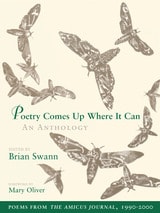
Poetry Comes Up Where It Can
Brian Swann
University of Utah Press, 2000
The poems in this anthology first appeared in The Amicus Journal, the quarterly publication of the Natural Resources Defense Council (NRDC). Selected by the journal’s poetry editor, Brian Swann, they represent a broad array of responses to the natural world—from warning to celebration—by some of the nation’s most distinguished poets. Included is work by American poets Wendell Berry, Michael Dorris, Denise Levertov, Mary Oliver, Pattiann Rogers, and William Stafford, as well as work from poets in Australia and Mexico. All grapple with issues of nature and the environment from the perspective of the final decade of the millennium.
These poems remind us that we can be dazzled both by nature and by the poetry that explores the natural world.
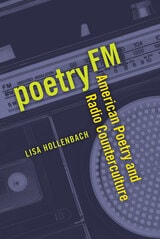
Poetry FM
American Poetry and Radio CountercultureLisa Hollenbach
University of Iowa Press, 2023
Lisa Hollenbach traces the history of Pacifica Radio—founded in 1946, the nation’s first listener-supported public radio network—through the 1970s: from the radical pacifists and poets who founded Pacifica after the war; to the San Francisco Renaissance, Beat, and New York poets who helped define the countercultural sound of Pacifica stations KPFA and WBAI in the 1950s and 1960s; to the feminist poets and activists who seized Pacifica’s frequencies in the 1970s. In the poems and recorded broadcasts of writers like Kenneth Rexroth, Jack Spicer, Allen Ginsberg, Amiri Baraka, Audre Lorde, Pat Parker, Bernadette Mayer, and Susan Howe, one finds a recurring ambivalence about the technics and poetics of reception. Through tropes of static noise, censorship, and inaudibility as well as voice, sound, and signal, these radiopoetic works suggest new ways of listening to the sounds and silences of Cold War American culture.
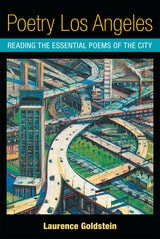
Poetry Los Angeles
Reading the Essential Poems of the CityLaurence Goldstein
University of Michigan Press, 2014
One chapter is devoted to Charles Bukowski, the celebrity face of the city’s poetry. Other chapters discuss the ways that poets explore “Interiors” and “Exteriors” throughout the cityscape. Goldstein also provides ample connections to the novels, films, art, and politics of Southern California. In clear prose, Poetry Los Angeles examines the strategies by which poets make significant places meaningful and memorable to readers of every region of the U.S. and elsewhere.
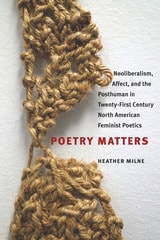
Poetry Matters
Neoliberalism, Affect, and the Posthuman in Twenty-First Century North American Feminist PoeticsHeather Milne
University of Iowa Press, 2018
Poetry Matters explores poetry written by women from the United States and Canada, which documents the social and political turmoil of the early twenty-first century and places this poetry in dialogue with recent currents of feminist theory including new materialism, affect theory, posthumanism, and feminist engagements with neoliberalism and capitalism. Central to this project is the conviction that a poetics that explores the political dimensions of affect; demonstrates an understanding of subjectivity as posthuman and transcorporeal; critically reflects on the impact of capitalism on queer, racialized, and female bodies; and develops an ethical vocabulary for reimagining the nation state and critically engaging with issues of democracy and citizenship is now more urgent than ever before.
Milne focuses on poetry published after 2001 by writers who mostly began writing after the feminist writing movements of the 1980s, but who have inherited and built upon their political and aesthetic legacies. The poets discussed in this book—including Jennifer Scappettone, Margaret Christakos, Larissa Lai, Rita Wong, Nikki Reimer, Rachel Zolf, Yedda Morrison, Marcella Durand, Evelyn Reilly, Juliana Spahr, Claudia Rankine, Dionne Brand, Jena Osman, and Jen Benka—bring a sense of political agency to poetry. These voices seek new vocabularies and dissenting critical and aesthetic frameworks for thinking across issues of gender, materiality, capitalism, the toxic convergences of nationalism and racism, and the decline of democratic institutions. This is poetry that matters—both in its political urgency and in its attentiveness to the world as “matter”—as a material entity under siege. It could not be more timely or more relevant.
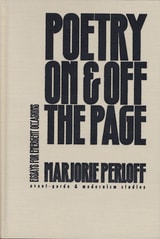
Poetry On and Off the Page
Essays for Emergent OccasionsMarjorie Perloff
Northwestern University Press, 1998
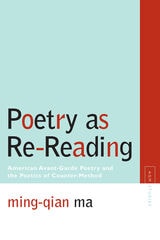
Poetry as Re-Reading
American Avant-Garde Poetry and the Poetics of Counter-MethodMing-Qian Ma
Northwestern University Press, 2008
Rereading and rewriting our understanding of the poetics of modernism and postmodernism, this truly revisionary work identifies a significant counter-tradition in twentieth-century poetry. Postmodernism, Ming-Qian Ma argues, does not so much follow from modernism as coexist with it, with postmodernists employing the anarchic poetics introduced by Gertrude Stein in countering the rationalist method of high modernists such as T. S. Eliot and Ezra Pound.
Grounded in a detailed and compelling account of the philosophy guiding such a project, Ma’s book traces a continuity of thought and practice through the very different poetic work of objectivists Louis Zukofsky, George Oppen, Carl Rakosi, and John Cage and language poets Susan Howe, Lyn Hejinian, Bruce Andrews, and Charles Bernstein. His deft individual readings provide an opening into this notoriously difficult work, even as his larger critique reveals a new and clarifying perspective on American modernist and post-modernist avant-garde poetics. Ma shows how we cannot understand these poets according to the usual way of reading but must see how they deliberately use redundancy, unpredictability, and irrationality to undermine the meaning-oriented foundations of American modernism--and to force a new and different kind of reading.
With its unusually clear explanation of the philosophy informing postmodern practice, and its unique insights into some of the more interesting and vexing poets of our time, this book points to a reading of an important strain of postmodern American poetry that is likely to develop well into the twenty-first century.
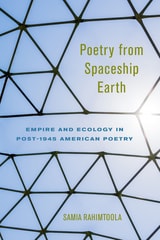
Poetry from Spaceship Earth
Empire and Ecology in Post-1945 American PoetrySamia Rahimtoola
University of Iowa Press, 2026
In the early decades of the postwar period, the planetary metaphor of “spaceship Earth” was everywhere in the West. It exerted its power on sites as various as Caribbean research stations, the shipping lanes of the U.S.-occupied Pacific, Palestinian refugee camps, and the internal colonies of segregated nations. At its heart was a new ideology and infrastructure of managing, administering, and rationalizing nature through which Western powers sought to maintain their grip on a decolonizing planet.
Poetry from Spaceship Earth retrieves a diverse array of postwar American poets—Robert Duncan, June Jordan, Joanne Kyger, Lorine Niedecker, and Charles Olson—who contested and cultivated alternatives to this emergent mode of environmentalism. By placing the major innovations of postwar poetry into conversation with environmental politics, Cold War science and technology studies, and postcolonial and Black studies, Samia Rahimtoola develops an original theoretical and historical account of the racial and colonial logics that underpin the supposedly neutral project of managing nature.
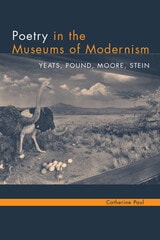
Poetry in the Museums of Modernism
Yeats, Pound, Moore, SteinCatherine Paul
University of Michigan Press, 2002
Although critics have attested to the importance of the visual arts to literary modernists and have begun to explore the relationships between literary production and social institutions, before now no one has examined the particular institutions in which modernist poets found the artworks, specimens, and other artifacts that inspired their literary innovations. Catherine Paul's book offers the reader a fresh encounter with modernism that will interest literary and art historians, literary theorists, critics, and scholars in cultural studies and museum studies.
Catherine Paul is Associate Professor of English, Clemson University.
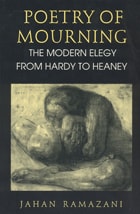
Poetry of Mourning
The Modern Elegy from Hardy to HeaneyJahan Ramazani
University of Chicago Press, 1994
Through subtle readings of elegies, self-elegies, war poems, and the blues, Ramazani greatly enriches our critical understanding of a wide range of poets, including Thomas Hardy, Wilfred Owen, Wallace Stevens, Langston Hughes, W. H. Auden, Sylvia Plath, and Seamus Heaney. He also interprets the signal contributions to the American family elegy of Robert Lowell, Allen Ginsberg, Anne Sexton, John Berryman, Adrienne Rich, Michael Harper, and Amy Clampitt. Finally, he suggests analogies between the elegy and other kinds of contemporary mourning art—in particular, the AIDS Memorial Quilt and the Vietnam Veterans Memorial.
Grounded in genre theory and in the psychoanalysis of mourning, Ramazani's readings also draw on various historical, formal, and feminist critical approaches. This book will be of interest to anyone concerned with the psychology of mourning or the history of modern poetry.
"Consists of full, intelligent and lucid exposition and close reading. . . . Poetry of Mourning is itself a welcome contribution to modern poetry's search for a 'resonant yet credible vocabulary of grief in our time."—Times Literary Supplement
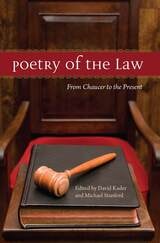
Poetry of the Law
From Chaucer to the PresentDavid Kader
University of Iowa Press, 2010
Since the time of Blackstone's "Farewell," poetry has been seen as celestial, pastoral, solitary, and mellifluous; law as venerable, social, urban, and cacophonous. This perception has persisted even to the present, with the bourgeoning field of law and literature focusing almost exclusively on fiction and drama. Poetry of the Law, however, reveals the richness of poetry about the law.
Poetry of the Law is the first serious anthology of law-related poetry ever published in the United States. As the editors make clear, though, serious need not imply solemn. Instead, David Kader and Michael Stanford have assembled a surprisingly capacious collection of 100 poems from the 1300s to the present.
Set in courtrooms, lawyers’ offices, law-school classrooms, and judges’ chambers; peopled with attorneys, the imprisoned (both innocent and guilty), judges, jurors, witnesses, and law-enforcement officers; based on real events (think “Scottsboro”) or exploring the complexity of abstract legal ideas; the poems celebrate justice or decry the lack of it, ranging in tone from witty to wry, sad to celebratory, funny to infuriating. Poetry of the Law is destined to become an authoritative source for years to come.
Contributors Include:
W. H. Auden
Robert Burns
Lewis Carroll
John Ciardi
Daniel Defoe
Emily Dickinson
John Donne
Rita Dove
Ralph Waldo Emerson
Martín Espada
Thomas Hardy
Seamus Heaney
A. E. Housman
Langston Hughes
Ben Jonson
X. J. Kennedy
Yusef Komunyakaa
Ted Kooser
D. H. Lawrence
Edgar Lee Masters
W. S. Merwin
Edna St. Vincent Millay
Sir Walter Raleigh
Muriel Rukeyser
Carl Sandburg
William Shakespeare
Jonathan Swift
Mona Van Duyn
Oscar Wilde
William Carlos Williams
from “The Hanging Judge” by Eavan Boland
Come to the country where justice is seen to be done,
Done daily. Come to the country where
Sentence is passed by word of mouth and raw
Boys split like infinitives. Look, here
We hanged our son, our only son
And hang him still and still we call it law.
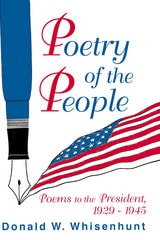
Poetry of the People
Poems to the President, 1929–1945Donald W. Whisenhunt
University of Wisconsin Press, 1996
The poets of the era voiced their opinions on virtually every subject. They wrote about New Deal agencies, they praised and condemned Hoover and Roosevelt. They expressed their views about the Supreme Court, the third term, and the approaching war in Europe. The resulting study, arranged topically rather than chronologically, provides a unique perspective on American popular culture and American politics.
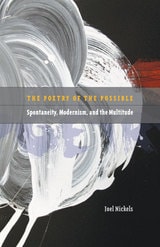
Poetry of the Possible
Spontaneity, Modernism, and the MultitudeJoel Nickels
University of Minnesota Press, 2012
The Poetry of the Possible challenges the conventional image of modernism as a socially phobic formation, arguing that modernism’s abstractions and difficulties are ways of imagining unrealized powers of collective self-organization. Establishing a conceptual continuum between modernism and contemporary theorists such as Paulo Virno, Michael Hardt, Antonio Negri, and Alain Badiou, Joel Nickels rediscovers modernism’s attempts to document the creative potenza of the multitude.
By examining scenes of collective life in works by William Carlos Williams, Wyndham Lewis, Laura Riding, and Wallace Stevens, Nickels resurrects modernism’s obsession with constituent power: the raw, indeterminate capacity for reciprocal counsel that continually constitutes and reconstitutes established political regimes. In doing so, he reminds us that our own attempts to imagine leaderless networks of collective initiative are not so much breaks with modernist forms of knowledge as restagings of some of modernism’s most radical moments of political speculation.
Setting modernism’s individual and collective models of spontaneity in dialogue with theorists of political spontaneity such as Antonio Gramsci, Herbert Marcuse, and Theodor Adorno, Nickels retells the story of modernism as the struggle to represent powers of collective self-organization that lie outside established regimes of political representation.
Poetry's Afterlife
Verse in the Digital AgeKevin Stein
University of Michigan Press, 2010
"The great pleasure of this book is the writing itself. Not only is it free of academic and ‘lit-crit' jargon, it is lively prose, often deliciously witty or humorous, and utterly contemporary. Poetry's Afterlife has terrific classroom potential, from elementary school teachers seeking to inspire creativity in their students, to graduate students in MFA programs, to working poets who struggle with the aesthetic dilemmas Stein elucidates, and to teachers of poetry on any level."
--- Beckian Fritz Goldberg, Arizona State University
"Kevin Stein is the most astute poet-critic of his generation, and this is a crucial book, confronting the most vexing issues which poetry faces in a new century."
---David Wojahn, Virginia Commonwealth University
At a time when most commentators fixate on American poetry's supposed "death," Kevin Stein's Poetry's Afterlife instead proposes the vitality of its aesthetic hereafter. The essays of Poetry's Afterlife blend memoir, scholarship, and personal essay to survey the current poetry scene, trace how we arrived here, and suggest where poetry is headed in our increasingly digital culture. The result is a book both fetchingly insightful and accessible. Poetry's spirited afterlife has come despite, or perhaps because of, two decades of commentary diagnosing American poetry as moribund if not already deceased. With his 2003 appointment as Illinois Poet Laureate and his forays into public libraries and schools, Stein has discovered that poetry has not given up its literary ghost. For a fated art supposedly pushing up aesthetic daisies, poetry these days is up and about in the streets, schools, and universities, and online in new and compelling digital forms. It flourishes among the people in a lively if curious underground existence largely overlooked by national media. It's this second life, or better, Poetry's Afterlife, that his book examines and celebrates.
Kevin Stein is Caterpillar Professor of English and Director of the Creative Writing Program at Bradley University and has served as Illinois Poet Laureate since 2003, having assumed the position formerly held by Gwendolyn Brooks and Carl Sandburg. He is the author of numerous books of poetry and criticism.
digitalculturebooksis an imprint of the University of Michigan Press and the Scholarly Publishing Office of the University of Michigan Library dedicated to publishing innovative and accessible work exploring new media and their impact on society, culture, and scholarly communication. Visit the website at www.digitalculture.org.
Poets Beyond the Barricade
Rhetoric, Citizenship, and Dissent after 1960Dale M. Smith
University of Alabama Press, 2012
Poets On Place
W. T. Pfefferle
Utah State University Press, 2005
Out to see America and satisfy his travel bug, W. T. Pfefferle resigned from his position as director of the writing program at Johns Hopkins University and hit the road to interview sixty-two poets about the significance of place in their work. The lively conversations that resulted may surprise with the potential meanings of a seemingly simple concept. This gathering of voices and ideas is illustrated with photo and word portraits from the road and represented with suitable poems.
The poets are James Harms, David Citino, Martha Collins, Linda Gregerson, Richard Tillinghast, Orlando Ricardo Menes, Mark Strand, Karen Volkman, Lisa Samuels, Marvin Bell, Michael Dennis Browne, David Allan Evans, David Romtvedt, Sandra Alcosser, Robert Wrigley, Nance Van Winckel, Christopher Howell, Mark Halperin, Jana Harris, Sam Hamill, Barbara Drake, Floyd Skloot, Ralph Angel, Carol Muske-Dukes, David St. John, Sharon Bryan, Donald Revell, Claudia Keelan, Alberto Rios, Richard Shelton, Jane Miller, William Wenthe, Naomi Shihab Nye, Peter Cooley, Miller Williams, Beth Ann Fennelly, Natasha Trethewey, Denise Duhamel, Campbell McGrath, Terrance Hayes, Alan Shapiro, Nikki Giovanni, Charles Wright, Rita Dove, Henry Taylor, Dave Smith, Nicole Cooley, David Lehman, Lucie Brock-Broido, Michael S. Harper, C. D. Wright, Mark Wunderlich, James Cummins, Frederick Smock, Mark Jarman, Carl Phillips, Scott Cairns, Elizabeth Dodd, Jonathan Holden, Bin Ramke, Kenneth Brewer, and Paisley Rekdal.
Postliterary America
From Bagel Shop Jazz to MicropoetriesMaria Damon
University of Iowa Press, 2011
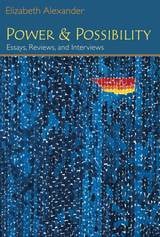
Power and Possibility
Essays, Reviews, and InterviewsElizabeth Alexander
University of Michigan Press, 2007
A volume in the Poets on Poetry series, which collects critical works by contemporary poets, gathering together the articles, interviews, and book reviews by which they have articulated the poetics of a new generation.
Elizabeth Alexander is considered one of the country's most gifted contemporary poets, and the publication of her essays in The Black Interior in 2004 established her as an astute critic and cultural commentator as well. Arnold Rampersad has called Alexander "one of the brightest stars in our literary sky . . . a superb, invaluable commentator on the American scene." In this new collection of her essays, reviews, and interviews, Alexander again focuses on African American artistic production, particularly poetry, and the cultural contexts in which it is created and experienced.
The book's first section, "Black Arts 101," takes up the poetry of Paul Laurence Dunbar, Sterling Brown, Lucille Clifton, Gwendolyn Brooks, and Rita Dove (among others); artist Romare Bearden; dancer Bill T. Jones; and dramatist August Wilson. A second section, "Black Feminist Thinking," provides engaging meditations ranging from "My Grandmother's Hair" and "A Very Short History of Black Women and Food" to essays on the legacies of Toni Cade, Audre Lorde, and June Jordan. The collection's final section, "Talking," includes interviews, a commencement address---"Black Graduation"---and the essay "Africa and the World."
Elizabeth Alexander received a B.A. from Yale University, an M.A. from Boston University, and a Ph.D. in English from the University of Pennsylvania. She has published four books of poems: The Venus Hottentot (1990); Body of Life (1996); Antebellum Dream Book (2001); and, most recently, American Sublime (2005), which was one of three finalists for the Pulitzer Prize. Her play, Diva Studies, was produced at the Yale School of Drama. She is presently Professor of American and African American Studies at Yale University.
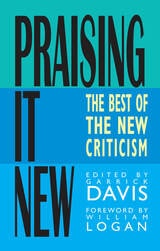
Praising It New
The Best of the New CriticismGarrick Davis
Ohio University Press, 2008
Praising It New is the first anthology of New Criticism to be printed in fifty years. It includes important essays by such influential poets and critics as T. S. Eliot, Ezra Pound, John Crowe Ransom, Allen Tate, Yvor Winters, Cleanth Brooks, R. P. Blackmur, W. K. Wimsatt, and Robert Penn Warren. Together, these authors ushered in the modernist age of poetry and criticism and transformed the teaching of literature in the schools. As the American poet and critic Randall Jarrell once noted: “I do not believe there has been another age in which so much extraordinarily good criticism of poetry has been written.”
This anthology now makes much of the best American poetry criticism available again, and includes short biographies and selected bibliographies of its chief figures. Praising It New is the perfect introduction for students to the best American poetry criticism of the twentieth century.
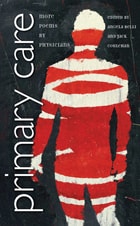
Primary Care
More Poems by PhysiciansAngela Belli
University of Iowa Press, 2006
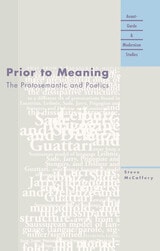
Prior to Meaning
The Protosemantic and PoeticsSteve McCaffery
Northwestern University Press, 2000
Purple Passages
Pound, Eliot, Zukofsky, Olson, Creeley, and the Ends of Patriarchal PoetryRachel Blau DuPlessis
University of Iowa Press, 2012
purplish
poetry anger publicsJosé Felipe Alvergue
University of Iowa Press, 2025
purplish challenges the idea of an objective or unbiased cultural rationale to purple regions in America by historicizing how anger has been systemically cleansed from the collective sentiments regarding nation-building throughout key moments of our national heritage.