Results by title
1095 books match the query 'Rhetoric' and 56 start with p
PARS in Charge
Resources and Strategies for Online Writing Program LeadersJessie Borgman
University Press of Colorado, 2023
Passions Pedagogies and 21st Century Technologies
edited by Gail E. Hawisher & Cynthia L. Selfe
Utah State University Press, 1999
Gail Hawisher and Cynthia Selfe created a volume that set the agenda in the field of computers and composition scholarship for a decade. The technology changes that scholars of composition studies faced as the new century opened couldn't have been more deserving of passionate study. While we have always used technologies (e.g., the pencil) to communicate with each other, the electronic technologies we now use have changed the world in ways that we have yet to identify or appreciate fully. Likewise, the study of language and literate exchange, even our understanding of terms like literacy, text, and visual, has changed beyond recognition, challenging even our capacity to articulate them.
As Hawisher, Selfe, and their contributors engage these challenges and explore their importance, they "find themselves engaged in the messy, contradictory, and fascinating work of understanding how to live in a new world and a new century." The result is a broad, deep, and rewarding anthology of work still among the standard works of computers and composition study.
Patient Sense
Rhetorical Body Work in the Age of TechnologyLillian Campbell
The Ohio State University Press, 2025
In Patient Sense, Lillian Campbell introduces a theory of rhetorical body work and applies it to three distinct healthcare contexts: clinical nursing simulations, physical therapy labs, and tele-observation in a virtual intensive care unit. Drawing on sociological frameworks, she defines rhetorical body work as paid physical, emotional, or discursive labor performed at the material or technological interface of worker–client bodies. Such work is devalued within social and institutional systems and often gendered and racialized. Campbell captures the value of providers’ intuitive patient sense in the face of increasingly technology-mediated healthcare and intervenes in conversations about the future of healthcare training. Ultimately, she demonstrates that we will always need responsive healthcare providers whose rhetorical body work and patient sense cannot be replaced by technicians or algorithms.
Paul Ricoeur
Tradition and Innovation in Rhetorical TheoryAndreea Deciu Ritivoi
Southern Illinois University Press, 2006
Peer Response in Second Language Writing Classrooms
Jun Liu and Jette G. Hansen
University of Michigan Press, 2002
Peer Response in Second Language Writing Classrooms, Second Edition
Jun Liu and Jette G. Hansen Edwards
University of Michigan Press, 2018
Now that classes are as likely to be online as held in physical classrooms and now that a new generation of digital natives can routinely read and respond to what others write via laptops, tablets, and phones, peer response as pedagogical practice is not just more easily implemented, but it is more likely to feel natural to L2 learners.
The Second Edition is a highly accessible guide to how the world is using peer response and serves as a motivator and facilitator for those who want to try it for the first time or want to increase the effectiveness of the activities—whether via CMC or not. The volume includes 11 forms useful in training students to provide good peer feedback, including a final checklist to ensure teachers have taken all the necessary steps to achieve a successful peer feedback activity.
Performing Antiracist Pedagogy in Rhetoric, Writing, and Communication
Frankie Condon
University Press of Colorado, 2017
In Performing Antiracist Pedagogy, Frankie Condon and Vershawn Ashanti Young seek to help create openings to address race and racism not only in course readings and class discussion in writing, rhetoric, and communication courses but also in wider public settings. The contributors to this collection, drawn from a wide range of disciplines, urge readers to renew their commitment to intelligently and publicly deliberate race and to counteract the effects of racism. The book is both theoretically rigorous and practical, providing readers with insightful analyses of race and racism and useful classroom suggestions and examples.
Contributors: Chiara Bacigalupa, Sophia Bell, Susan Leigh Brooks, Frankie Condon, Rasha Diab, John Dean, Thomas Ferrell, Beth Godbee, Dae-Joong Kim, Timothy Lensmire, Calvin M. Logue, Aja Y. Martinez, Rebecca Nathan, Bobbi Olson, Jessica Parker, Charise Pimentel, Octavio Pimentel, Mya Poe, Neil Simpkins, Nathan Snaza, Deatra Sullivan, Vershawn Ashanti Young
Peripheral Visions for Writing Centers
Jackie Grutsch McKinney
Utah State University Press, 2013
McKinney argues that this grand narrative neglects the extent to which writing center work is theoretically and pedagogically complex, with ever-changing work and conditions, and results in a straitjacket for writing center scholars, practitioners, students, and outsiders alike. Peripheral Visions for Writing Centers makes the case for a broader narrative of writing center work that recognizes and theorizes the various spaces of writing center labor, allows for professionalization of administrators, and sees tutoring as just one way to perform writing center work.
McKinney explores possibilities that lie outside the grand narrative, allowing scholars and practitioners to open the field to a fuller, richer, and more realistic representation of their material labor and intellectual work.
Personal Effects
edited by Deborah H. Holdstein & David Bleich
Utah State University Press, 2002
With this volume, then, these scholars move us to explore the intersections of the social with subjectivity, with voice, ideology, and culture, and to consider the roles of these in the work of academics who study writing and literature. Taken together, the essays in this collection carry forward the idea that the personal, the candidly subjective and intersubjective, must be part of the subject of study in humanities scholarship. They propose an understanding of the personal in scholarship that is more helpful because more clearly anchored in human experience.
Personally Speaking
Experience as Evidence in Academic DiscourseCandace Spigelman
Southern Illinois University Press, 2004
Responding to contemporary discussion about using personal accounts in academic writing, Personally Speaking: Experience as Evidence in Academic Discourse draws on classical and current rhetorical theory, feminist theory, and relevant examples from both published writers and first-year writing students to illustrate the advantages of blending experiential and academic perspectives.
Candace Spigelman examines how merging personal and scholarly worldviews produces useful contradictions and contributes to a more a complex understanding in academic writing. This rhetorical move allows for greater insights than the reading or writing of experiential or academic modes separately does. Personally Speaking foregrounds the semi-fictitious nature of personal stories and the rhetorical possibilities of evidence as Spigelman provides strategies for writing instructors who want to teach personal academic argument while supplying practical mechanisms for evaluating experiential claims.
The volume seeks to complicate and intensify disciplinary debates about how compositionists should write for publication and what kinds of writing should be taught to composition students. Spigelman not only supplies evidence as to why the personal can count as evidence but also relates how to use it effectively by including student samples that reflect particular features of personal writing. Finally, she lays the groundwork to move narrative from its current site as confessional writing to the domain of academic discourse.
Persons of the Market
Conservatism, Corporate Personhood, and Economic TheologyKevin Musgrave
Michigan State University Press, 2022
light on their seemingly odd marriage in contemporary American politics. Author Kevin Musgrave highlights the ways that theories of corporate and human personhood have long been and remain bound together by examining four case studies: the U.S. Supreme Court’s 1886 Santa Clara decision, the role of early twentieth-century advertisers in endowing corporations with souls, Justice Lewis Powell Jr.’s eponymous memo of 1971, and the arc of the conservative movement from Ronald Reagan to Donald Trump. Tracing this rhetorical history of the extension and attribution of personhood to the corporate form illustrates how the corporation has for many increasingly become a normative model or ideal to which human persons should aspire. In closing, the book offers preliminary ideas about how we might fashion a more democratic and humane understanding of what it means to be a person.
Philosophy as Agôn
A Study of Plato’s Gorgias and Related TextsRobert Metcalf
Northwestern University Press, 2018
In Philosophy as Agôn: A Study of Plato's Gorgias and Related Texts, Robert Metcalf offers a fresh interpretation of Plato's dialogues as dramatic texts whose philosophy is not so much a matter of doctrine as it is a dynamic, nondogmatic, and open-ended practice of engaging others in agonistic dialogue.
Metcalf challenges prevailing interpretations according to which the agôn (contest or struggle) between the interlocutors in the dialogues is inessential to Plato's philosophical purpose, or simply a reflection of the cultural background of ancient Greek life. Instead, he argues that Plato understands philosophy as essentially agonistic—involving the adversarial engagement of others in dialogue such that one's integrity is put to the test through this engagement, and where the agôn is structured so as to draw adversaries together in agreement about the matters at issue, though that agreement is always open to future contest.
Based on a careful reading of the Gorgias and related Socratic dialogues, such as Apology and Theaetetus, Metcalf contends that agôn is indispensable to the critique of prevailing opinions, to the transformation of the interlocutor through shame-inducing refutation, and to philosophy as a lifelong training (askêsis) of oneself in relation to others.
Philosophy, Rhetoric, Literary Criticism
(Inter)viewsGary A. Olson
Southern Illinois University Press, 1994
Susan Wells and Reed Way Dasenbrock provide distinctly divergent assessments of the application of Donald Davidson’ s language theory to rhetoric and composition, and especially to writing pedagogy. Patricia Bizzell and John Trimbur explore how Stanley Fish’ s neopragmatism might be useful both to composition theory and to literacy education. And Joyce Irene Middleton and Tom Fox discuss bell hooks’ s notions of how race and gender affect pedagogy. In two frank and sometimes angry responses, Patricia Harkin and Jasper Neel take J. Hillis Miller to task for seeming to support rhetoric and composition while continuing to maintain the political status quo. Similarly, Susan C. Jarratt and Elizabeth A. Flynn express skepticism about Jane Tompkins’ s vocal support of composition and of radical pedagogy particularly. And Arabella Lyon and C. Jan Swearingen analyze Stephen Toulmin’ s thoughts on argumentation and postmodernism.
Internationally respected anthropologist Clifford Geertz provides a foreword; literacy expert Patricia Bizzell contributes an introduction to the text; and noted reader-response critic David Bleich supplies critical commentary.
This book is a follow-up to the editor’ s (Inter)views: Cross-Disciplinary Perspectives on Rhetoric and Literacy, already a major work of scholarship in the field.

Pil 58,Center For Learning
Writing Centers & LibrariesJames Elmborg
Assoc of College & Research Libraries, 2011
Pivotal Strategies
Claiming Writing Studies as DisciplineLynn C. Lewis
Utah State University Press, 2024
Because undergraduate degrees in writing studies are relatively new, claiming the discipline has required reinvention and revision at personal and professional levels far different than any other discipline. Suspicions about the viability of the discipline linger in many departments and universities, as well as outside the academy, leading writing studies scholars to develop innovative strategies to deal with covertly hostile attitudes. Within the collection, contributors name explicit claiming strategies from the discipline’s beginnings to the contemporary moment, locating opportune spaces, negotiating identities and fostering resilience, and developing allegiances by foregrounding their embodiment as underrepresented members of academia through a commitment to social justice and equity.
Responding to current conversations on the worth of education with honest stories about the burdens and joys of becoming and being an academic, Pivotal Strategies features a spectrum of voices across racial, gender, class, and age categories. This collection not only makes the discipline more visible but also helps map the contemporary state of writing studies.
Places of Public Memory
The Rhetoric of Museums and MemorialsEdited by Greg Dickinson, Carole Blair, and Brian L. Ott
University of Alabama Press, 2010
A sustained and rigorous consideration of the intersections of memory, place, and rhetoric
Though we live in a time when memory seems to be losing its hold on communities, memory remains central to personal, communal, and national identities. And although popular and public discourses from speeches to films invite a shared sense of the past, official sites of memory such as memorials, museums, and battlefields embody unique rhetorical principles.
Places of Public Memory: The Rhetoric of Museums and Memorials is a sustained and rigorous consideration of the intersections of memory, place, and rhetoric. From the mnemonic systems inscribed upon ancient architecture to the roadside accident memorials that line America’s highways, memory and place have always been deeply interconnected. This book investigates the intersections of memory and place through nine original essays written by leading memory studies scholars from the fields of rhetoric, media studies, organizational communication, history, performance studies, and English. The essays address, among other subjects, the rhetorical strategies of those vying for competing visions of a 9/11 memorial at New York City’s Ground Zero; rhetorics of resistance embedded in the plans for an expansion of the National Civil Rights Museum; representations of nuclear energy—both as power source and weapon—in Cold War and post–Cold War museums; and tours and tourism as acts of performance.
By focusing on “official” places of memory, the collection causes readers to reflect on how nations and local communities remember history and on how some voices and views are legitimated and others are minimized or erased.

Planting the Anthropocene
Rhetorics of NaturecultureJennifer Clary-Lemon
Utah State University Press, 2019
Using the results of interviews with seasonal Canadian tree planters, Jennifer Clary-Lemon interrogates the complex and messy imbrication of nature-culture through the inadequate terminology used to describe the actual circumstances of the planters’ work and lives—and offers alternative ways to conceptualize them. Although silvicultural workers do engage with the limiting rhetoric of efficiency and humanism, they also make rhetorical choices that break down the nature-culture divide and orient them on a continuum that blurs the boundaries between the given and the constructed, the human and nonhuman. Tree-planting work is approached as a site of a deep-seated materiality—a continued re-creation of the land’s “disturbance”—rather than a simplistic form of doing good that further separates humans from landscapes.
Jennifer Clary-Lemon’s view of nature and the Anthropocene through the lens of material rhetorical studies is thoroughly original and will be of great interest to students and scholars of rhetoric and composition, especially those focused on the environment.
Plato, Derrida, and Writing
Jasper Neel
Southern Illinois University Press, 1988
Winner, Mina P. Shaughnessy Prize
Achieving the remarkable feat of linking composition theory, deconstruction, and classical rhetoric, this book has been admirably summarized by the theorist G. Douglas Atkins, who writes: "This lively and engaging, informed and informative book constitutes an important contribution. Though its ‘field’ is most obviously composition, composition theory, and pedagogy, part of its importance derives from the way it transcends disciplinary boundaries to bear on writing in general. . . I know of no book that so fully and well discusses, and evaluates, the implications of deconstruction for composition and pedagogy. That [it] goes ‘beyond deconstruction,’ rather than merely ‘applying’ it, increases its importance and signals a clear contribution to the understanding of writing."
Jasper Neel analyzes the emerging field of composition studies within the epistemological and ontological debate over writing precipitated by Plato, who would have us abandon writing entirely, and continued by Derrida, who argues that all human beings are written. This book offers a three-part exploration of that debate. In the first part, a deconstructive reading of Plato’s Phaedrus, Neel shows the elaborate sleight-of-hand that Plato must employ as he uses writing to engage in a semblance of spoken dialogue.
The second part describes Derrida’s theory of writing and presents his famous argument that "the history of truth, of the truth of truth, has always been. . .the debasement of writing, and its repression outside full speech." A lexicon of nine Derridean terms, the key to his theory of writing, is also included. At the end of this section, Neel turns deconstruction against itself, demonstrating that Derridean analysis collapses of its own weight.
The concluding section of the book juxtaposes the implications of Platonic and Derridean views of writing, warning that Derrida’s approach may lock writing inside philosophy. The conclusion suggests that writing may be liberated from philosophical judgment by turning to Derrida’s predecessors, the sophists, particularly Protagoras and Gorgias. Drawing on Protagoras’s idea of strong discourse, Neel shows that sophistry is the foundation of democracy: "Strong discourse is public discourse, which, though based on probability and not truth, remains persuasive over a long period of time to a great number of people. This publicly tested discourse exists only among competitors, never alone, but its ability to remain persuasive even when surrounded by other discourses enables the ideas of democracy to emerge and then keeps democracy alive."
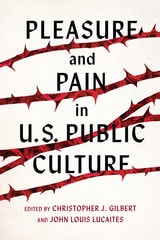
Pleasure and Pain in US Public Culture
edited by Christopher J. Gilbert and John Louis Lucaites
University of Alabama Press, 2025
A critical examination of how pleasure and pain are constructed, represented, and contested within American public culture.
Mainstream news and social media often highlight presentations of pain that invite a voyeuristic, pleasurable experience, whether the result of war, disasters, crime, accidents, or other catastrophes. This collection of essays explores pleasurable pains and painful pleasures, showing how they pervade contemporary western public culture.
Deploying methodologies drawn from psychoanalysis, rhetoric and communication, political theory, and visual culture, Pleasure and Pain in US Public Culture offers insightful criticisms and theories about how pleasure and pain function in public discourse, media, and everyday communication practices.
The contributors provide a sample of fascinating range of news reportage, television, film and cinema, stage drama, comic performances, street art, and other forms of popular culture. The media cited and analyzed include Spike Lee’s films, Afrofuturism, autoethnography, and the #MeToo movement.
The collection takes up engrossing topics such as the cathartic allure of pain, ethical dilemmas surrounding public displays of suffering, and the transformative power of narratives that confront trauma. The essays also draw connections between theory and real-world outcomes, explore the implications of enjoying traumatic comedy, and link the natural world to otherwise mundane instances of interspecies violence. Brett Kavanaugh's Supreme Court nomination hearings and what they suggest about witnessing trauma is also discussed.
Pleasure and Pain in US Public Culture will change how a reader sees the world. It imparts a startling vision of western culture permeated by pain and pleasure.
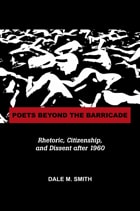
Poets Beyond the Barricade
Rhetoric, Citizenship, and Dissent after 1960Dale M. Smith
University of Alabama Press, 2012
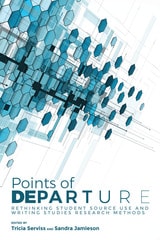
Points of Departure
Rethinking Student Source Use and Writing Studies Research MethodsTricia Serviss
Utah State University Press, 2017
The contributors offer methodologies, techniques, and suggestions for research that move beyond decontextualized guides to grapple with the messiness of research-in-process, as well as design, development, and expansion. Serviss and Jamieson’s model of RAD writing studies research is transcontextual and based on hybridized or mixed methods. Among these methods are citation context analysis, research-aloud protocols, textual and genre analysis, surveys, interviews, and focus groups, with an emphasis on process and knowledge as contingent. Chapters report on research projects at different stages and across institution types—from pilot to multi-site, from community college to research university—focusing on the methods and artifacts employed.
A rich mosaic of research about research, Points of Departure advances knowledge about student writing and serves as a guide for both new and experienced researchers in writing studies.
Contributors: Crystal Benedicks, Katt Blackwell-Starnes, Lee-Ann Kastman Breuch, Kristi Murray Costello, Anne Diekema, Rebecca Moore Howard, Sandra Jamieson, Elizabeth Kleinfeld, Brian N. Larson, Karen J. Lunsford, M. Whitney Olsen, Tricia Serviss, Janice R. Walker
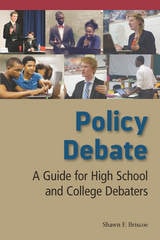
Policy Debate
A Guide for High School and College DebatersShawn F. Briscoe
Southern Illinois University Press, 2017
Briscoe addresses all aspects of policy debate, including stock issues, judging paradigms and effective engagement with judges, the responsibilities of both affirmative and negative teams, and the evaluation of policy proposals through the use of disadvantages, counterplans, and critical argumentation. In addition, Briscoe helps debaters better establish their credibility, improve their cross-examination skills, and understand the specialized notetaking method called flowing. The book models for readers how to effectively cross-examine an opposing team, features a transcript of a mock debate designed to help clarify the lessons taught in previous chapters, and includes a glossary of key terms. Briscoe also considers contemporary trends in the debate community, exploring the evolution of policy debate and the rise of performance-based approaches, while providing insight into how best to engage with performance teams.
Offering a unique approach presented by a seasoned debate coach, Policy Debate: A Guide for High School and College Debaters goes beyond the basics to explore how policy is an ever-evolving form of debate. This attention to the progression of policy styles will make readers better at adapting to opponents during a debate and will make them more adept at arguing against a wider range of cases.
Political Literacy in Composition and Rhetoric
Defending Academic Discourse against Postmodern PluralismDonald Lazere
Southern Illinois University Press, 2015
Political Perversion
Rhetorical Aberration in the Time of TrumpeteeringJoshua Gunn
University of Chicago Press, 2020
Drawing on insights from critical theory, media ecology, and psychoanalysis, Gunn argues that perverse rhetorics dominate not only the political sphere but also our daily interactions with others, in person and online. From sexting to campaign rhetoric, Gunn advances a new way to interpret our contemporary political context that explains why so many of us have difficulty deciphering the appeal of aberrant public figures. In this book, Trump is only the tip of a sinister, rapidly growing iceberg, one to which we ourselves unwittingly contribute on a daily basis.
Political Style
The Artistry of PowerRobert Hariman
University of Chicago Press, 1995
In critical studies of classic texts, Hariman identifies four dominant political styles. The realist style, as found in Machiavelli's The Prince, creates a world of sheer power, constant calculation, and emotional control; this style is the common sense of modern political science. The courtly style, depicted in Kapuscinski's The Emperor, is characterized by high decorousness, hierarchies, and fixation on the body of the sovereign; this style infuses mass media coverage of the American presidency. The republican style, reflected in Cicero's letters to Atticus, promotes the art of oratory, consensus, and civility; it informs our ideal of democratic conversation. The bureaucratic style, as captured in Kafka's The Castle, emphasizes institutional procedures, official character, and the priority of writing; this style structures everday life.
Hariman looks at effective political artistry in figures from antiquity to modern politicians such as Vaclav Havel, Ronald Reagan, and Bill Clinton. He discusses the crises to which each style is susceptible, as well as the social and moral consequences of each style's success.
Political Tone
How Leaders Talk and WhyRoderick P. Hart, Jay P. Childers, and Colene J. Lind
University of Chicago Press, 2013
Political Vocabularies
FDR, the Clergy Letters, and the Elements of Political ArgumentMary E. Stuckey
Michigan State University Press, 2018
Politics of Writing Studies
Reinventing Our Universities from BelowRobert Samuels
Utah State University Press, 2017
A friendly critique of the field, The Politics of Writing Studies examines a set of recent pivotal texts in composition to show how writing scholarship, in an effort to improve disciplinary prestige and garner institutional resources, inadvertently reproduces structures of inequality within American higher education. Not only does this enable the exploitation of contingent faculty, but it also puts writing studies—a field that inherently challenges many institutional hierarchies—in a debased institutional position and at odds with itself.
Instead of aligning with the dominant paradigm of research universities, where research is privileged over teaching, theory over practice, the sciences over the humanities, and graduate education over undergraduate, writing studies should conceive itself in terms more often associated with labor. By identifying more profoundly as workers, as a collective in solidarity with contingent faculty, writing professionals can achieve solutions to the material problems that the field, in its best moments, wants to address. Ultimately, the change compositionists want to see in the university will not come from high theory or the social science research agenda; it must come from below.
Offering new insight into a complex issue, The Politics of Writing Studies will be of great interest to writing studies professionals, university administrators, and anyone interested in the political economy of education and the reform of institutions of higher education in America.
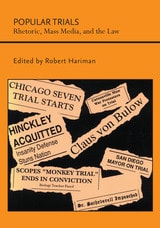
Popular Trials
Rhetoric, Mass Media, and the LawRobert Hariman
University of Alabama Press, 1993
Examining how landmark trials become public dramas that shape law, culture, and collective memory.
Contemporary scholarship illustrates the law’s increasingly powerful role in American life; legal education, in turn, has focused on the problems and techniques of communication. This book addresses these interests through critical study of eight popular trials: the 17th-century trial of Dr. Henry Sacheverell, and the 20th-century trials of Scopes, the Rosenbergs, the Chicago Seven, the Catonsville Nine, John Hinckley, Claus von Bulow, and San Diego Mayor Larry Hedgecock. Such trials spark major public debates, become symbols of public life, and legitimize particular beliefs and institutions. Despite high visibility and drama, however, the popular trial has not received sufficient study as persuasive event. Lying at the intersection of the institutional practices of law and the mass media, the popular trial has confounded study according to the conventional assumptions of scholarship in both law and communication studies.
This volume defines popular trials as a genre of public communication, a genre that includes trials unusually prominent within public discourse. Further, popular trials are often characterize by special media presentations through televised coverage of the trial itself and news analysis, intense audience identification with the principal actors, and political and social consequences independent of the legal action. The essays in this volume stress the rhetorical functions of popular trials. Contributors in addition to the editor include Lawrance M. Bernabo, Barry Brummett, Celeste Michelle Condit, Juliet Dee, Susan J. Drucker, J. Justin Gustainis, Janice Platt Hunold, William Lewis, John Louis Lucaites, and Larry A. Williamson.
Post-Digital Rhetoric and the New Aesthetic
Justin Hodgson
The Ohio State University Press, 2019
Post-Digital Rhetoric and the New Aesthetic takes stock of these reconfigurations and their implications for rhetorical studies by taking up the New Aesthetic—a movement introduced by artist/digital futurist James Bridle that was meant to capture something of a digital way of seeing by identifying aesthetic values that could not exist without computational and digital technologies. Bringing together work in rhetoric, art, and digital media studies, Hodgson treats the New Aesthetic as a rhetorical ecology rather than simply an aesthetic movement, allowing him to provide operative guides for the knowing, doing, and making of rhetoric in a post-digital culture.
Post-Process Theory
Beyond the Writing-Process ParadigmEdited by Thomas Kent
Southern Illinois University Press, 1999
Breaking with the still-dominant process tradition in composition studies, post-process theory—or at least the different incarnations of post-process theory discussed by the contributors represented in this collection of original essays—endorses the fundamental idea that no codifiable or generalizable writing process exists or could exist. Post-process theorists hold that the practice of writing cannot be captured by a generalized process or a "big" theory.
Most post-process theorists hold three assumptions about the act of writing: writing is public; writing is interpretive; and writing is situated. The first assumption is the commonsensical claim that writing constitutes a public interchange. By "interpretive act," post-process theorists generally mean something as broad as "making sense of" and not exclusively the ability to move from one code to another. To interpret means more than merely to paraphrase; it means to enter into a relationship of understanding with other language users. And finally, because writing is a public act that requires interpretive interaction with others, writers always write from some position or some place. Writers are never nowhere; they are "situated."
Leading theorists and widely published scholars in the field, contributors are Nancy Blyler, John Clifford, Barbara Couture, Nancy C. DeJoy, Sidney I. Dobrin, Elizabeth Ervin, Helen Ewald, David Foster, Debra Journet, Thomas Kent, Gary A. Olson, Joseph Petraglia, George Pullman, David Russell, and John Schilb.
Post-Realism
The Rhetorical Turn in International RelationsFrancis A. Beer
Michigan State University Press, 1996
These essays demonstrate how realism operates rhetorically and point the way toward a richer understanding of world politics.
Post-Truth Rhetoric and Composition
Bruce Mccomiskey
Utah State University Press, 2017
Post-Truth Rhetoric and Composition is a timely exploration of the increasingly widespread and disturbing effect of “post-truth” on public discourse in the United States. Bruce McComiskey analyzes the instances of bullshit, fake news, feigned ethos, hyperbole, and other forms of post-truth rhetoric employed in recent political discourse.
The book frames “post-truth” within rhetorical theory, referring to the classic triad of logos, ethos, and pathos. McComiskey shows that it is the loss of grounding in logos that exposes us to the dangers of post-truth. As logos is the realm of fact, logic, truth, and valid reasoning, Western society faces increased risks—including violence, unchecked libel, and tainted elections—when the value of reason is diminished and audiences allow themselves to be swayed by pathos and ethos. Evaluations of truth are deferred or avoided, and mendacity convincingly masquerades as a valid form of argument.
In a post-truth world, where neither truth nor falsehood has reliable meaning, language becomes purely strategic, without reference to anything other than itself. This scenario has serious consequences not only for our public discourse but also for the study of composition.
Postcomposition
Sidney I. Dobrin
Southern Illinois University Press, 2011
Dobrin evaluates the current state of composition studies, underscoring the difference between composition and writing and arguing that the field's focus on the administration of writing students and its historically imposed prohibition on theory greatly limit what can be understood about writing. Instead he envisions a more significant approach to writing, one that questions the field's conservative allegiance to subject and administration and reconsiders writing as spatial and ecological. Using concepts from ecocomposition, spatial theory, network theory, complexity theory, and systems theory, Postcomposition lays the groundwork for a networked theory of writing, and advocates the abandonment of administration as a useful part of the field. He also challenges the usefulness of rhetoric in writing studies, showing how writing exceeds rhetoric.
Postcomposition is a detailed consideration of how posthumanism affects the field's understanding of subjectivity. It also tears at the seams of the "contingent labor problem." As he articulates his own frustrations with the conservatism of composition studies and builds on previous critiques of the discipline, Dobrin stages a courageous-and inevitably polemical-intellectual challenge to the entrenched ideas and assumptions that have defined composition studies.
Postprocess Postmortem
M. Kristopher Lotier
University Press of Colorado, 2021
In Postprocess Postmortem, Kristopher M. Lotier surveys the postprocess era-that-never-was, its end, and its after-lives. Employing cutting-edge digital research tools to track the circulation of texts and shifting scales from the global to the local and back again, he offers a revisionist history of a largely unchronicled past. From one perspective, the history of postprocess might seem to be a history of failure: what could have become The Next Big Thing in composition and writing studies during the 1990s and early 2000s never quite ascended. Today, few writing studies scholars apply the term postprocess to their own research or self-identify with a postprocess movement. And yet, as Lotier demonstrates, numerous core postprocess tenets have attained disciplinary centrality. The result: whether they admit to doing so or not, many contemporary scholars employ a postprocess vocabulary, allowing the ideas underlying this important movement/theory/period/attitude to live on.
Practicing Digital Activisms
Nicole E. Allen
Utah State University Press, 2027
Practicing Digital Activisms reframes digital activism as embodied, situated work that extends across classrooms, communities, institutions, streets, and ecosystems. It develops frameworks for studying and practicing activism in an era shaped by social media, datafication, and artificial intelligence. At the heart of the collection is a rethinking of digital activism for the twenty-first century that traces activism through networks of people, platforms, infrastructures, and material practices.
Bringing together scholars in rhetoric, writing studies, technical communication, and community engagement, contributors show how activism now unfolds across interconnected media ecologies, through affective and material infrastructures, and at multiple tempos ranging from viral moments to the quieter practices of organizing, care, and persistence. Through case studies of food activism, environmental advocacy, reproductive health, social media movements, and emerging data practices, contributors demonstrate digital activism as a sustained practice of coalition building, circulation, documentation, and persistence. The chapters provide theoretical tools for making infrastructures visible, negotiating ethical responsibility, and designing interventions responsive to local needs and broader struggles for justice.
Attending to the risks that shape contemporary digital life—including surveillance, commodification, algorithmic bias, harassment, platform control, and unequal access—the collection offers language, methods, and examples for understanding how communities build power, sustain movements, and imagine just futures through digital practice. For scholars, teachers, students, organizers, and readers interested in digital rhetoric and social change, Practicing Digital Activisms invites attention to digital participation as a vital site where collective action is imagined, contested, and practiced.

Pragmatic Theory of Rhetoric
Walter H. Beale
Southern Illinois University Press, 1987
Walter H. Beale offersthe most coherent treatment of the aims and modes of discourse to be presented in more than a decade. His development of a semiotic “grammar of motives” that relates the problems of meaning in discourse both to linguistic structure and ways of constructing reality stands as a provocative new theory of rhetoric sharply focused on writing.
He includes a comprehensive treatment of rhetoric, its classes and varieties, modes, and strategies. In addition, he demonstrates the importance of the purpose, substance, and social context of discourse, at a time when scholarly attention has become preoccupied with process. He fortifies and extends the Aristotelian approach to rhetoric and discourse at a time when much theory and pedagogy have yielded to modernist assumptions and methods. And finally, he develops a theoretical framework that illuminates the relationship between rhetoric, the language arts, and the human sciences in general.
Praising Girls
The Rhetoric of Young Women, 1895-1930Henrietta Rix Wood
Southern Illinois University Press, 2016
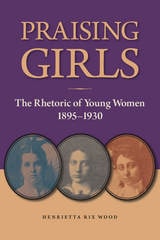
The site of the study—Kansas City, Missouri—reflects the diverse rhetorical experiences of girls in cities across the United States at the beginning of the last century. Four case studies examine the writing of privileged white girls at a college preparatory school, Native American girls at an off-reservation boarding school, African American girls at a segregated high school, and working- and middle-class girls at a large whites-only public high school. Wood’s analysis reveals a contemporary concept of epideictic rhetoric that accounts for issues of gender, race, class, and age.
Precarious Rhetorics
Edited by Wendy S. Hesford, Adela C. Licona, and Christa Teston
The Ohio State University Press, 2018
This collection features cross-disciplinary contributions from leading scholars, including the editors of the volume as well as James J. Brown Jr., Gale Coskan-Johnson, Ronald Greene, Lavinia Hirsu, Arabella Lyon, Louis Maraj, Sara McKinnon, Alexandra Schultheis Moore, Kimberlee Pérez, Margaret Price, Amy Shuman, Kristin Swenson, Becca Tarsa, and Belinda Walzer. Chapters emphasize a materialist-rhetorical approach while also drawing on feminist studies, women of color feminisms, affect studies, critical disability studies, critical race and ethnic studies, medical humanities, sexuality studies, queer migration studies, and human rights and humanitarian studies. While theoretically rich, this volume intentionally features chapters that explore precarious rhetorics as they operate in practice—whether in borderlands, politics, public policy, or the quotidian spaces of human activity, such as school, work, social media, and medicine.
President Johnson's War On Poverty
Rhetoric and HistoryDavid Zarefsky
University of Alabama Press, 1986
How words waged war—and shaped the fate of a nation’s boldest social crusade.
In January 1964, in his first State of the Union address, President Lyndon Johnson announced a declaration of “unconditional war” on poverty. By the end of the year the Economic Opportunity Act became law.
War on Poverty illustrates the interweaving of rhetorical and historical forces in shaping public policy. Zarefsky suggests that an important problem lay in its discourse. He assumes that language plays a central role in the formulation of social policy by shaping the context within which people view the social world. By terming the anti-poverty effort a war, President Johnson imparted significant symbolism to the effort: it called for total victory and gave confidence that the “war” was winnable. It influenced the definition of the enemy as an intergenerational cycle of poverty, rather than the shortcomings of the individual; and it led to the choice of community action, manpower programs, and prudent management as weapons and tactics. Each of these implications involves a choice of language and symbols, a decision about how to characterize and discuss the world. Zarefsky contends that each of these rhetorical choices was helpful to the Johnson administration in obtaining passage of the Economic Opportunity Ac of 1964, but that each choice invited redefinition or reinterpretation of a symbol in a way that threatened the program.
Presidents Creating the Presidency
Deeds Done in WordsKarlyn Kohrs Campbell and Kathleen Hall Jamieson
University of Chicago Press, 2008
Identifying the primary genres of presidential oratory, Campbell and Jamieson add new analyses of signing statements and national eulogies to their explorations of inaugural addresses, veto messages, and war rhetoric, among other types. They explain that in some of these genres, such as farewell addresses intended to leave an individual legacy, the president acts alone; in others, such as State of the Union speeches that urge a legislative agenda, the executive solicits reaction from the other branches. Updating their coverage through the current administration, the authors contend that many of these rhetorical acts extend over time: George W. Bush’s post-September 11 statements, for example, culminated in a speech at the National Cathedral and became a touchstone for his subsequent address to Congress.
For two centuries, presidential discourse has both succeeded brilliantly and failed miserably at satisfying the demands of audience, occasion, and institution—and in the process, it has increased and depleted political capital by enhancing presidential authority or ceding it to the other branches. Illuminating the reasons behind each outcome, Campbell and Jamieson draw an authoritative picture of how presidents have used rhetoric to shape the presidency—and how they continue to re-create it.
Presidents and Protestors
Political Rhetoric in the 1960sTheodore O. Windt
University of Alabama Press, 1990
The decade of the 1960s was a time of passionate politics and resounding rhetoric. The “resounding rhetoric,” from Kennedy’s celebrated inaugural address, to the outlandish antics of the Yippies, is the focus of this book. The importance of this volume is its consideration of both people in power (presidents) and people out of power (protesters), and its delineation of the different rhetorical bases that each had to work from in participating in the politics of the 1960s.
Presidents and Protesters places rhetorical acts within their specific political contexts, changing the direction of previous rhetorical studies from the sociological to the historical-political. Above all, this is an intellectual history of the 1960s as seen through the rhetoric of the participants, which ultimately shows that the major participants utilized every form of political discourse available and, consequently, exhausted not only themselves but the rhetorical forms as well.
Presumptions and Burdens of Proof
An Anthology of Argumentation and the LawEdited by Hans V. Hansen, Fred J. Kauffeld, James B. Freeman, and Lilian Bermejo-Luque
University of Alabama Press, 2019
An anthology of the most important historical sources, classical and modern, on the subjects of presumptions and burdens of proof
In the last fifty years, the study of argumentation has become one of the most exciting intellectual crossroads in the modern academy. Two of the most central concepts of argumentation theory are presumptions and burdens of proof. Their functions have been explicitly recognized in legal theory since the middle ages, but their pervasive presence in all forms of argumentation and in inquiries beyond the law—including politics, science, religion, philosophy, and interpersonal communication—have been the object of study since the nineteenth century.
However, the documents and essays central to any discussion of presumptions and burdens of proof as devices of argumentation are scattered across a variety of remote sources in rhetoric, law, and philosophy. Presumptions and Burdens of Proof: An Anthology of Argumentation and the Law brings together for the first time key texts relating to the history of the theory of presumptions along with contemporary studies that identify and give insight into the issues facing students and scholars today.
The collection’s first half contains historical sources and begins with excerpts from Aristotle’s Topics and goes on to include the locus classicus chapter from Bishop Whately’s crucial Elements of Rhetoric as well as later reactions to Whately’s views. The second half of the collection contains contemporary essays by contributors from the fields of law, philosophy, rhetoric, and argumentation and communication theory. These essays explore contemporary understandings of presumptions and burdens of proof and their role in numerous contexts today. This anthology is the definitive resource on the subject of these crucial rhetorical modes and will be a vital resource to all scholars of communication and rhetoric, as well as legal scholars and practicing jurists.
Privacy Matters
Conversations about Surveillance within and beyond the ClassroomEstee Beck
Utah State University Press, 2020
This collection offers practical analyses of surveillance and privacy as they occur within classrooms and communities. Organized by themes—surveillance and classrooms, surveillance and bodies, surveillance and culture—Privacy Matters provides writing, rhetoric, and communication scholars and teachers with specific approaches, methods, inquiries, and examinations into the impact tracking and monitoring has upon people’s habits, bodies, and lived experiences.
While each chapter contributes a new perspective in the discipline and beyond, Privacy Matters affirms that these analyses remain inconclusive. This collection is a call for scholars, researchers, activists, and educators within rhetoric and composition to continue the scholarly conversation because privacy matters to all of us.
Contributors: Christina Cedillo, Jenae Cohn, Dànielle Nicole DeVoss, Dustin Edwards, Norah Fahim, Ann Hill Duin, Gavin P. Johnson, John Peterson, Santos Ramos, Colleen A. Reilly, Jennifer Roth Miller, Jason Tham, Stephanie Vie
Private, the Public, and the Published
Reconciling Private Lives and Public Rhetoricedited by Barbara Couture & Thomas Kent
Utah State University Press, 2004
At the 2003 "Rock the Vote" debate, one of the questions posed by a student to the eight Democratic candidates for the presidential nomination was "have you ever used marijuana?" Amazingly, all but one of the candidates voluntarily answered the question. Add to this example the multiple ways in which we now see public intrusion into private lives (security cameras, electronic access to personal data, scanning and "wanding" at the airport) or private self-exposure in public forums (cell phones, web cams, confessional talk shows, voyeuristic "reality" TV). That matters so private could be treated as legitimate--in some cases even vital--for public discourse indicates how intertwined the realms of private and public have become in our era. Reverse examples exist as well. Around the world, public authorities look the other way while individual rights are abused--calling it a private matter--or officials appeal to sectarian morés to justify discrimination in public policies.
The authors of The Private, the Public, and the Published feel that scholarship needs to explore and understand this phenomenon, and needs to address it in the college classroom. There are consequences of conflating public and private, they argue--consequences that have implications especially for what is known as the public good. The changing distinctions between "private" and "public," and the various practices of private and public expression, are explored in these essays with an eye toward what they teach us about those consequences and implications.
Process This
Undergraduate Writing in Composition StudiesNancy C. DeJoy
Utah State University Press, 2004
In Process This, Nancy DeJoy argues that even recent revisions to composition studies, cultural studies, service learning, and social process movements--continue to repress the subjects and methodologies that should be central, especially at the level of classroom practice. Designed to move student discourses beyond the classroom, these approaches nonetheless continue to position composition students (and teachers) as mere consumers of the discipline. This means that the subjects, methodologies, and theory/practice relationships that define the field are often absent in composition classrooms.
Arguing that the world inside and outside of the academy cannot be any different if the profession stays the same, DeJoy creates a pedagogy and a plan for faculty development that revisions the prewrite/write/rewrite triad to open spaces for participation and contribution to all members of first-year writing classrooms.
Professional Academic Writing in the Humanities and Social Sciences
Susan Peck MacDonald
Southern Illinois University Press, 1994
In Professional Academic Writing in the Humanities and Social Sciences, Susan Peck MacDonald tackles important and often controversial contemporary questions regarding the rhetoric of inquiry, the social construction of knowledge, and the professionalization of the academy. MacDonald argues that the academy has devoted more effort to analyzing theory and method than to analyzing its own texts. Professional texts need further attention because they not only create but are also shaped by the knowledge that is special to each discipline. Her assumption is that knowledge-making is the distinctive activity of the academy at the professional level; for that reason, it is important to examine differences in the ways the professional texts of subdisciplinary communities focus on and consolidate knowledge within their fields.
Throughout the book, MacDonald stresses her conviction that academics need to do a better job of explaining their text-making axioms, clarifying their expectations of students at all levels, and monitoring their own professional practices. MacDonald’s proposals for both textual and sentence-level analysis will help academic professionals better understand how they might improve communication within their professional communities and with their students.
Professionalizing Multimodal Composition
Santosh Khadka
Utah State University Press, 2023
Academic leaders, scholars, and faculty who have successfully designed and launched academic programs or faculty development initiatives discuss the theoretical and logistical questions considered in their design, the outcomes they achieved, and how others can emulate them. This exchange of knowledge, insight, experiences, and lessons learned among community members is critical for enabling or inspiring other programs, departments, and institutions to conceive, design, and launch academic programs or faculty development initiatives for their own faculty.
The larger goal of professionalizing is to work with teaching faculty to increase their interactional expertise with multimodal composition, and this collection offers a set of models for how faculty can do that at their own institutions and in their own programs.
Promiscuous Knowledge
Information, Image, and Other Truth Games in HistoryKenneth Cmiel and John Durham Peters
University of Chicago Press, 2020
Propaganda and Rhetoric in Democracy
History, Theory, AnalysisEdited by Gae Lyn Henderson and M. J. Braun Foreword by Charles Bazerman
Southern Illinois University Press, 2016
Propaganda and Rhetoric in Democracy offers new perspectives on the history of propaganda, explores how it has evolved during the twentieth and twenty-first centuries, and advances a much more nuanced understanding of what it means to call discourse propaganda.