Results by title
28167 books match the query 'History' and 1297 start with p

Phylogenetic Ecology
A History, Critique, and RemodelingNathan G. Swenson
University of Chicago Press, 2019
In Phylogenetic Ecology, Nathan G. Swenson synthesizes this nascent field’s major conceptual, methodological, and empirical developments to provide students and practicing ecologists with a foundational overview. Along the way, he highlights those realms of phylogenetic ecology that will likely increase in relevance—such as the burgeoning subfield of phylogenomics—and shows how ecologists might lean on these new perspectives to inform their research programs.

Physician to the World
The Life of General William C. GorgasJohn M. Gibson
University of Alabama Press, 1989
The remarkable story of the physician whose public health victories changed the world.
Physician to the World by John M. Gibson is a study of the career of William Crawford Gorgas, focusing primarily on the 22 years from the Spanish-American War until his death at the age of 65. The book details the medical community’s gradual acceptance of the mosquito theory as the cause for yellow fever epidemics and follows Gorgas as his initial skepticism gave way to belief while he participated in Walter Reed’s massive cleanup of Havana. From this success Gorgas moved to the Panama Canal Zone and a bureaucratic quagmire as he attempted to apply sanitary principles there to control yellow fever and malaria. As canal construction proceeded, assorted red-tape and critics repeatedly thwarted Gorgas’s efforts. His particular nemesis was the imperious engineer George Goethals, who ruled the construction project with an iron hand. Gorgas’s dogged persistence to make Panama healthy for both Americans and natives eventually succeeded, enabling the project to be completed with minimum loss of life. During World War I Gorgas became U.S. Surgeon General, and finally his reputation equaled his accomplishments. He traveled widely in Europe, South Africa, and South America on behalf of public health improvements and was about to begin another such journey when he died of complications from a stroke in London in 1920.

Physicians for the People
Black Doctors and the Struggle for Health-Care Equality in Alabama, 1870–1970Jack D. Ellis with a foreword by Alan I Marcus
University of Alabama Press, 2025
WINNER OF THE JAMES F. SULZBY AWARD
Healing against the odds—Black doctors, bold resistance, and the fight for medical justice in Alabama.
Physicians for the People chronicles the remarkable stories of 241 Black doctors who practiced medicine in Alabama during the Jim Crow era. Historian Jack D. Ellis reveals the ingenuity and resilience of these trailblazing doctors who defied segregation by establishing hospitals and clinics and providing vital healthcare to underserved Black communities.
This meticulously researched work draws on archival sources, oral histories, and an unparalleled database to dismantle the myth of a monolithic medical system in the Jim Crow South. Jack D. Ellis argues that the post–Civil War lives of Black physicians, dentists, pharmacists, nurses, and midwives hold special significance, illuminating both the causes of health care disparities among African Americans and the reasons for their continued underrepresentation in the medical professions.
Offering much of interest to students and scholars of Black history, medical history, and the civil rights movement, Physicians for the People exposes the deliberate exclusion faced by Black doctors within the white medical establishment and their ongoing fight for racial equality in medicine.
Physicians, Peasants, and Modern Medicine
Imagining Rurality in Romania, 1860-1910Constantin Barbulescu
Central European University Press, 2019

Physics Envy
American Poetry and Science in the Cold War and AfterPeter Middleton
University of Chicago Press, 2015
In Physics Envy, Peter Middleton examines the influence of science, particularly physics, on American poetry since World War II. He focuses on such diverse poets as Charles Olson, Muriel Rukeyser, Amiri Baraka, and Rae Armantrout, among others, revealing how the methods and language of contemporary natural and social sciences—and even the discourse of the leading popular science magazine Scientific American—shaped their work. The relationship, at times, extended in the other direction as well: leading physicists such as Robert Oppenheimer, Werner Heisenberg, and Erwin Schrödinger were interested in whether poetry might help them explain the strangeness of the new, quantum world. Physics Envy is a history of science and poetry that shows how ultimately each serves to illuminate the other in its quest for the true nature of things.
Physics Or Natural Hearing
Glen Aristotle
St. Augustine's Press, 2005
Physics in the Nineteenth Century
Purrington, Robert
Rutgers University Press, 1997
Physics, the Human Adventure
From Copernicus to Einstein and BeyondBrush, Stephen G
Rutgers University Press, 2001
Winner of the 2001 Joseph Hazen Education Prize of the History of Science Society
Physics, the Human Adventure is the third edition of the classic text Introduction to Concepts and Theories in Physical Science. Authored by Gerald Holton, the text was a landmark in science education. It was the first modern textbook in physics (or in any other science) to make full and effective use of the history and philosophy of science in presenting for both the general and the science-oriented student an account of the nature of physical science. A second edition, prepared by Stephen G. Brush, brought the book up to date by increasing the coverage of topics in modern physics and by taking account of recent scholarly research in the history of science.
In the new book Physics, The Human Adventure, each of the chapters has been reworked to further clarify the physics concepts and to incorporate recent physical advances and research. The book shows the unifying power of science by bringing in connections to chemistry, astronomy, and geoscience. In short, the aid of the new edition is to teach good physics while presenting physical science as a human adventure that has become a major force in our civilization.
New chapters discuss theories of the origin of the solar system and the expanding universe; fission, fusion, and the Big Bang–Steady State Controversy; and thematic elements and styles in scientific thought. New topics include:
• Theories of vision: does the eye send out rays or receive them?
• Distances in the solar system
• The prediction of the return of Halley’s comet and analysis of deviations from Kepler’s laws
• Angular momentum conservation and Laplace’s nebular hypothesis
• Relation between symmetries and conservation laws: Emmy Noether’s theorem
• First estimates of atomic sizes
• Consequences of the indistinguishability of elementary particles of the same kind
• Applications of quantum mechanics to many-particle systems
• Dirac’s prediction of anti-matter
• The anthropic principle and other controversial issues on the frontiers of research
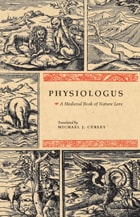
Physiologus
A Medieval Book of Nature LoreTranslated by Michael J. Curley
University of Chicago Press, 2009
One of the most popular and widely read books of the Middle Ages, Physiologus contains allegories of beasts, stones, and trees both real and imaginary, infused by their anonymous author with the spirit of Christian moral and mystical teaching. Accompanied by an introduction that explains the origins, history, and literary value of this curious text, this volume also reproduces twenty woodcuts from the 1587 version. Originally composed in the fourth century in Greek, and translated into dozens of versions through the centuries, Physiologus will delight readers with its ancient tales of ant-lions, centaurs, and hedgehogs—and their allegorical significance.
“An elegant little book . . . still diverting to look at today. . . . The woodcuts reproduced from the 1587 Rome edition are alone worth the price of the book.”—Raymond A. Sokolov, New York Times Book Review
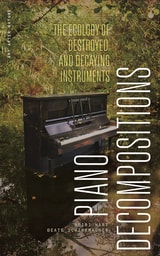
Piano Decompositions
The Ecology of Destroyed and Decaying InstrumentsHeidi Hart
University of Minnesota Press, 2026
Examining musical instrument destruction through an ecological and intermedial lens
Musical instruments are typically seen as objects both used and maintained with ritualistic care. But what happens when they’re tossed from homes in mudslides, burned during ecstatic parties, or waterlogged by pop stars in viral videos—and how do these elemental interactions transform the way we see and play instruments? Piano Decompositions asks what happens when we let go of controlling musical instruments. What kind of meanings start to sound when instruments are moved out of the protected cultural space and engage with their surrounding elements?
Heidi Hart and Beate Schirrmacher trace the history of destroyed and decaying pianos, both sorting them within the realm of artistic violence against instruments and following their return journeys into water, sand, and soil. They parse the artistic vision of Annea Lockwood, whose iconic burning, drowning, and decaying Piano Transplants presented a novel means of drawing attention to the increasing threats of climate change in the 1960s and ’70s. Turning to instruments made from found materials and others played collaboratively with wind and water, they demonstrate how human sound making is entangled in the more-than-human world.
Showing how the piano can transform conversations around the Anthropocene and environmental destruction, Hart and Schirrmacher find the instrument to be a potent creative and ecological force, a medium to connect with environments in an explorative, attentive way. Piano Decompositions unearths new ways to relate our concepts of curiosity, pleasure, and music to the natural world.
Retail e-book files for this title are screen-reader friendly with images accompanied by short alt text and/or extended descriptions.
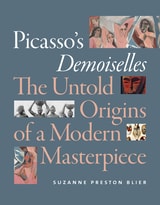
Picasso's Demoiselles
The Untold Origins of a Modern MasterpieceSuzanne Preston Blier
Duke University Press, 2019
Pickin’ Cotton on the Way to Church
The Life and Work of Father Boniface Hardin, OSBNancy Van Note Chism
Indiana Historical Society Press, 2019
Pictorial Victorians
The Inscription of Values in Word and ImageJulia Thomas
Ohio University Press, 2005
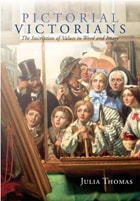
The Victorians were image obsessed. The middle decades of the nineteenth century saw an unprecedented growth in the picture industry. Technological advances enabled the Victorians to adorn with images the pages of their books and the walls of their homes. But this was not a wholly visual culture. Pictorial Victorians focuses on two of the most popular mid-nineteenth-century genres—illustration and narrative painting—that blurred the line between the visual and textual.
Illustration negotiated text and image on the printed page, while narrative painting juxtaposed the two media in its formulation of pictorial stories. Author Julia Thomas reassesses mid-nineteenth-century values in the light of this interplay. The dialogue between word and image generates meanings that are intimately related to the Victorians' image of themselves. Illustrations in Victorian publications and the narrative scenes that lined the walls of the Royal Academy reveal the Victorians' ideas about the world in which they lived and their notions of gender, class, and race.
Pictorial Victorians surveys a range of material, from representations of the crinoline, to the illustrations that accompanied Harriet Beecher Stowe’s novel Uncle Tom's Cabin and Tennyson's poetry, to paintings of adultery. It demonstrates that the space between text and image is one in which values are both constructed and questioned.
Picture Man
The Legacy of Southeast Alaska Photographer Shoki KayamoriMargaret Thomas
University of Alaska Press, 2015
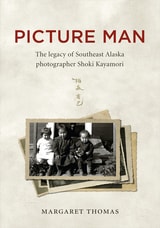
In Picture Man, Margaret Thomas views Kayamori’s life through multiple lenses. Using Kayamori’s original photos, she explores the economic and political realities that sent Kayamori and thousands like him out of Japan toward opportunity and adventure in the United States, especially the Pacific Northwest. She reveals the tensions around Asian immigrants on the West Coast and the racism that sent many young men north to work in the canneries of Alaska. And she illuminates the intersecting—and at times conflicting—lives of villagers and migrants in a time of enormous change. Part history, part biography, part photographic showcase, Picture Man offers a fascinating new view of Alaska history.
Picture Personalities
The Emergence of the Star System in AmericaRichard deCordova
University of Illinois Press, 1990
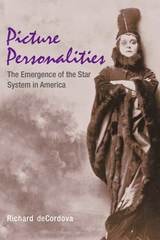
Conventional wisdom attributes the rise of the star system to the charisma of individual performers or to the public's desire to idolize an appealing star. In Picture Personalities, Richard deCordova argues that the fledgling movie industry and the press conspired to develop the star system, along with a system of discourse to support it.
How actors became stars and how they began to assume public identities distinct from their fictional roles was closely tied to the journalistic discourse of the period, produced by the trade press, newspapers, general periodicals, fan magazines, publicity stills, posters, and other material. DeCordova shows how the studios worked to fabricate moral images of the stars' marriages and personal lives and how a series of star scandals in the 1920s challenged those images and brought about changes in the conventions of representing stars. A new foreword by Corey K. Creekmur enhances this first paperback edition.
Picture Worlds
Storytelling on Greek, Moche, and Maya PotteryDavid Saunders
J. Paul Getty Trust, The, 2024
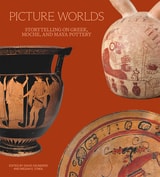
Satyrs and sphinxes, violent legumes, and a dancing maize deity figure in the stories painted on the pottery produced by the ancient Greek, Moche, and Maya cultures, respectively. Picture Worlds is the first book to examine the elaborately decorated terracotta vessels of these three distinct civilizations. Although the cultures were separated by space and time, they all employed pottery as a way to tell stories, explain the world, and illustrate core myths and beliefs. Each of these painted pots is a picture world. But why did these communities reach for pottery as a primary method of visual communication? How were the vessels produced and used? In this book, experts offer introductions to the civilizations, exploring these foundational questions and examining the painted imagery. Readers will be rewarded with a better understanding of each of these ancient societies, fascinating insights into their cultural commonalities and differences, and fresh perspectives on image making and storytelling, practices that remain vibrant to this day.
This volume is published to accompany an exhibition on view at the J. Paul Getty Museum at the Getty Villa from April 10 to July 29, 2024, and at the Michael C. Carlos Museum at Emory University from September 14 to December 15, 2024.
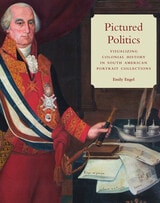
Pictured Politics
Visualizing Colonial History in South American Portrait CollectionsBy Emily Engel
University of Texas Press, 2020
The Spanish colonial period in South America saw artists develop the subgenre of official portraiture, or portraits of key individuals in the continent’s viceregal governments. Although these portraits appeared to illustrate a narrative of imperial splendor and absolutist governance, they instead became a visual record of the local history that emerged during the colonial occupation.
Using the official portrait collections accumulated between 1542 and 1830 in Lima, Buenos Aires, and Bogotá as a lens, Pictured Politics explores how official portraiture originated and evolved to become an essential component in the construction of Ibero-American political relationships. Through the surviving portraits and archival evidence—including political treatises, travel accounts, and early periodicals—Emily Engel demonstrates that these official portraits not only belie a singular interpretation as tools of imperial domination but also visualize the continent's multilayered history of colonial occupation. The first stand alone analysis of South American portraiture, Pictured Politics brings to light the historical relevance of political portraits in crafting the history of South American colonialism.
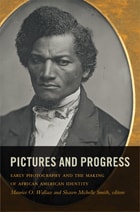
Pictures and Progress
Early Photography and the Making of African American IdentityMaurice O. Wallace and Shawn Michelle Smith, eds.
Duke University Press, 2012
Contributors. Michael A. Chaney, Cheryl Finley, P. Gabrielle Foreman, Ginger Hill, Leigh Raiford, Augusta Rohrbach, Ray Sapirstein, Suzanne N. Schneider, Shawn Michelle Smith, Laura Wexler, Maurice O. Wallace
Pictures and the Past
Media, Memory, and the Specter of Fascism in Postmodern ArtAlexander Bigman
University of Chicago Press, 2024
A fresh take on the group of artists known as the Pictures Generation, reinterpreting their work as haunted by the history of fascism, the threat of its return, and the effects of its recurring representation in postwar American culture.
The artists of the Pictures Generation, converging on New York City in the late 1970s, indelibly changed the shape of American art. Rebelling against abstraction, they borrowed liberally from the aesthetics of mass media and sometimes the work of other artists. It has long been thought that the group’s main contribution was to upend received conceptions of authorial originality. In Pictures and the Past, however, art critic and historian Alexander Bigman shows that there is more to this moment than just the advent of appropriation art. He presents us with a bold new interpretation of the Pictures group’s most significant work, in particular its recurring evocations of fascist iconography.
In the wake of the original Pictures show, curated by Douglas Crimp in 1977, artists such as Sarah Charlesworth, Jack Goldstein, Troy Brauntuch, Robert Longo, and Gretchen Bender raised pressing questions about what it means to perceive the world historically in a society saturated by images. Bigman argues that their references to past cataclysms—to the violence wrought by authoritarianism and totalitarianism—represent not only a coded form of political commentary about the 1980s but also a piercing reflection on the nature of collective memory. Throughout, Bigman situates their work within a larger cultural context including parallel trends in music, fashion, cinema, and literature. Pictures and the Past probes the shifting relationships between art, popular culture, memory, and politics in the 1970s and ’80s, examining how the specter of fascism loomed for artists then—and the ways it still looms for us today.
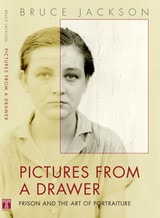
Pictures from a Drawer
Prison and the Art of PortraitureBruce Jackson
Temple University Press, 2009
Pictures in the Air
The Story of the National Theatre of the DeafStephen C. Baldwin
Gallaudet University Press, 1994
Picturing
Edited by Rachael Z. DeLue
Terra Foundation for American Art, 2016
The first volume in a new series on critical concerns in the history of American art, Picturing brings together essays by a distinguished international group of scholars who discuss the creation and consumption of images from the early modern period through the end of the twentieth century. Some of the contributions focus on art critical texts, like Gertrude Stein’s portrait of Cézanne, while others have as their point of departure particular artworks, from a portrait of Benjamin Franklin to Eadweard Muybridge’s nineteenth-century photographs of the California Coast. Works that addressed images and image making were not confined to the academy; they spilled out into poetry, literature, theater, and philosophy, and the essays’ considerations likewise range freely, from painting to natural history illustrations, travel narratives, and popular fiction. Together, the contributions demonstrate a rich deliberation that thoroughly debunks the notion that American art is merely derivative of a European tradition.
With a wealth of new research and full-color illustrations, Picturing significantly expands the terrain of scholarship on American art.
Picturing America
The Golden Age of Pictorial MapsStephen J. Hornsby
University of Chicago Press, 2017
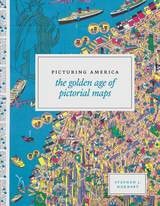
Picturing America is the first book to showcase this vivid and popular genre of maps. Geographer Stephen J. Hornsby gathers together 158 delightful pictorial jewels, most drawn from the extensive collections of the Library of Congress. In his informative introduction, Hornsby outlines the development of the cartographic form, identifies several representative artists, describes the process of creating a pictorial map, and considers the significance of the form in the history of Western cartography. Organized into six thematic sections, Picturing America covers a vast swath of the pictorial map tradition during its golden age, ranging from “Maps to Amuse” to “Maps for War.” Hornsby has unearthed the most fascinating and visually striking maps the United States has to offer: Disney cartoon maps, college campus maps, kooky state tourism ads, World War II promotional posters, and many more. This remarkable, charming volume’s glorious full-color pictorial maps will be irresistible to any map lover or armchair traveler.
Picturing American Modernity
Traffic, Technology, and the Silent CinemaKristen Whissel
Duke University Press, 2008
Whissel shows that by portraying key events, achievements, and anxieties, the cinema invited American audiences to participate in the rapidly changing world around them. Moving pictures provided astonishing visual dispatches from military camps prior to the outbreak of fighting in the Spanish-American War. They allowed audiences to delight in images of the Pan-American Exposition, and also to mourn the assassination of President McKinley there. One early film genre, the reenactment, presented spectators with renditions of bloody battles fought overseas during the Philippine-American War. Early features offered sensational dramatizations of the scandalous “white slave trade,” which was often linked to immigration and new forms of urban work and leisure. By bringing these frequently distant events and anxieties “near” to audiences in cities and towns across the country, the cinema helped construct an American national identity for the machine age.
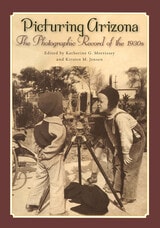
Picturing Arizona
The Photographic Record of the 1930sEdited by Katherine G. Morrissey and Kirsten Jensen
University of Arizona Press, 2005
This book places the work of local Arizonans alongside that of federal photographers both to illuminate the impact of the Depression on the state’s distinctive racial and natural landscapes and to show the influence of differing cultural agendas on the photographic record. The more than one hundred images—by well-known photographers such as Dorothea Lange and Laura Gilpin as well as by an array of less familiar photographers—represent a variety of purposes and perspectives, from public to personal, political to promotional. Six essays and three photo-essays bring together prominent authorities in history, the arts, and other fields who provide diverse perspectives on this period in Arizona and American history. Viewed together, the words and images capture a Depression-era Arizona bustling with activity as federally funded construction projects and seasonal agricultural jobs brought migrants and newcomers to the state. They convey the celebrations and the struggles of commercial photographers, archaeologists, city folks, farmers, tourists, native peoples and others in these hard times.
As the economic strains of the decade reverberated through the state, local photographers documented the lives of Arizona residents—including those frequently overlooked by historians. As this book persuasively shows, photographs can conceal as much as they reveal. A young Mexican American girl stands in front of a backdrop that hides the outhouse behind her, a deeply moving image for what it suggests about the efforts of her family to conceal their economic circumstances. Yet this image is a perfect metaphor for all the photographs in this book: stories remain hidden, but when viewers begin to question what they cannot see, pictures resonate more loudly than ever before.
This book is a history of Arizona written from the photographic record, offering a point of view that may differ from the written record. From the images and the insights of the authors, we can gain a new appreciation of how one state—and its indomitable people—weathered our nation’s toughest times.
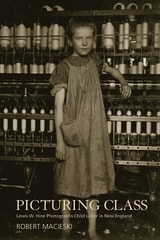
Picturing Class
Lewis W. Hine Photographs Child Labor in New EnglandRobert Macieski
University of Massachusetts Press, 2015
In this richly illustrated book, Robert Macieski examines Lewis W. Hine's art and advocacy on behalf of child laborers as part of the National Child Labor Committee (NCLC) between 1909 and 1917. A “social photographer”—as he called himself—Hine created images that documented children at work throughout New England, revealing their exploitation in the North as he had for rural working children in the South. Hine staged his images, highlighting particular types of labor in specific places: the “newsies” in Connecticut cities; sardine canners in Eastport, Maine; cranberry pickers in Cape Cod bogs; industrial homeworkers in Boston and Providence; and cotton textile workers throughout the region. His association with the NCLC connected him to a network of local and national reformers, social workers, and child welfare professionals, a broad coalition he supported in their fight to end this unethical labor practice. Macieski also chronicles Hine's efforts to mount major exhibitions that would help move public opinion against child labor.
In Picturing Class, Macieski explores the historical context of Hine's photographs and the social worlds of his subjects. He offers a detailed analysis of many of the images, unearthing the stories behind the creation of these photographs and the lives of their subjects. In telling the story of these photographs, their creation, and their reception, Macieski demonstrates how Hine worked to advance an unvarnished picture of a rapidly changing region and the young workers at the center of this important shift.

Picturing Empire
Photography and the Visualization of the British EmpireJames R. Ryan
University of Chicago Press, 1997
But as James R. Ryan argues in Picturing Empire, Victorian photographs reveal as much about the imaginative landscapes of imperial culture as they do about the "real" subjects captured within their frames. Ryan considers the role of photography in the exploration and domestication of foreign landscapes, in imperial warfare, in the survey and classification of "racial types," in "hunting with the camera," and in teaching imperial geography to British schoolchildren.
Ryan's careful exposure of the reciprocal relation between photographic image and imperial imagination will interest all those concerned with the cultural history of the British Empire.

Picturing Illinois
Twentieth-Century Postcard Art from Chicago to CairoJohn A. Jakle and Keith A. Sculle
University of Illinois Press, 2012

Picturing Indians
Photographic Encounters and Tourist Fantasies in H. H. Bennett's Wisconsin DellsSteven D. Hoelscher
University of Wisconsin Press, 2008
Winner, Book Award of Merit, Wisconsin Historical Society, Best Books for General Audiences, selected by the American Association of School Librarians, and Best Books for Regional Interests, selected by the Public Library Association
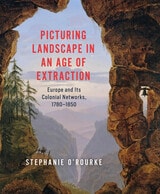
Picturing Landscape in an Age of Extraction
Europe and Its Colonial Networks, 1780–1850Stephanie O'Rourke
University of Chicago Press, 2025
In the late eighteenth and early nineteenth centuries, European artists confronted the emergence of a new way of thinking about and treating the Earth and its resources. Centered on extraction, this new paradigm was characterized by large-scale efforts to transform and monetize the physical environment across the globe. With this book, Stephanie O’Rourke considers such practices, looking at what was at stake in visual representations of the natural world during the first decades of Europe’s industrial revolutions.
O’Rourke argues that key developments in the European landscape painting tradition were profoundly shaped by industries including mining and timber harvesting, as well as by interlinked ideas about race, climate, and waste. Focusing on developments in Britain, France, Germany, and across Europe’s colonial networks, she explores how artworks and technical illustrations portrayed landscapes in ways that promoted—or pushed against—the logic of resource extraction.
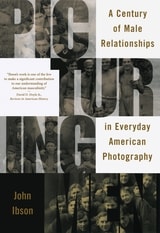
Picturing Men
A Century of Male Relationships in Everyday American PhotographyJohn Ibson
University of Chicago Press, 2006
Such is the time John Ibson evokes in Picturing Men, a striking visual record of changes in attitudes about relationships between gentlemen, soldiers, cowboys, students, lumberjacks, sailors, and practical jokers. Spanning from 1850 to 1950, the 142 everyday photographs that richly illustrate Picturing Men radiate playfulness, humor, and warmth. They portray a lost world for American men: a time when their relationships with each other were more intimate than they commonly are today, regardless of sexual orientation. Picturing Men starkly contrasts the calm affection displayed in earlier photographs with the absence of intimacy in photos from the mid-1950s on. In doing so, this lively, accessible book makes a significant contribution to American history and cultural studies, gender studies, and the history of photography.
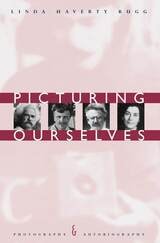
Picturing Ourselves
Photography and AutobiographyLinda Haverty Rugg
University of Chicago Press, 1997
Rugg tracks photography's impact on the formation of self-image through the study of four literary autobiographers concerned with the transformative power of photography. Obsessed with self-image, Mark Twain and August Strindberg both attempted (unsuccessfully) to integrate photographs into their autobiographies. While Twain encouraged photographers, he was wary of fakery and kept a fierce watch on the distribution of his photographic image. Strindberg, believing that photographs had occult power, preferred to photograph himself.
Because of their experiences under National Socialism, Walter Benjamin and Christa Wolf feared the dangerously objectifying power of photographs and omitted them from their autobiographical writings. Yet Benjamin used them in his photographic conception of history, which had its testing ground in his often-ignored Berliner Kindheit um 1900. And Christa Wolf's narrator in Patterns of Childhood attempts to reclaim her childhood from the Nazis by reconstructing mental images of lost family photographs.
Confronted with multiple and conflicting images of themselves, all four of these writers are torn between the knowledge that texts, photographs, and indeed selves are haunted by undecidability and the desire for the returned glance of a single self.
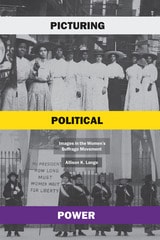
Picturing Political Power
Images in the Women’s Suffrage MovementAllison K. Lange
University of Chicago Press, 2020
For as long as women have battled for equitable political representation in America, those battles have been defined by images—whether illustrations, engravings, photographs, or colorful chromolithograph posters. Some of these pictures have been flattering, many have been condescending, and others downright incendiary. They have drawn upon prevailing cultural ideas of women’s perceived roles and abilities and often have been circulated with pointedly political objectives.
Picturing Political Power offers perhaps the most comprehensive analysis yet of the connection between images, gender, and power. In this examination of the fights that led to the ratification of the Nineteenth Amendment in 1920, Allison K. Lange explores how suffragists pioneered one of the first extensive visual campaigns in modern American history. She shows how pictures, from early engravings and photographs to colorful posters, proved central to suffragists’ efforts to change expectations for women, fighting back against the accepted norms of their times. In seeking to transform notions of womanhood and win the right to vote, white suffragists emphasized the compatibility of voting and motherhood, while Sojourner Truth and other leading suffragists of color employed pictures to secure respect and authority. Picturing Political Power demonstrates the centrality of visual politics to American women’s campaigns throughout the nineteenth and early twentieth centuries, revealing the power of images to change history.
Picturing Religious Experience
George Herbert, Calvin, and the ScripturesDaniel Doerksen
University of Delaware Press, 2012
Published by University of Delaware Press. Distributed worldwide by Rutgers University Press.
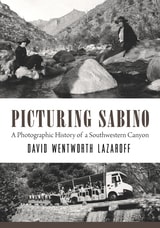
Picturing Sabino
A Photographic History of a Southwestern CanyonDavid Wentworth Lazaroff
University of Arizona Press, 2023
The story is vividly told through numerous historical photographs, lively anecdotes, and an engaging text, informed by decades of research by David Wentworth Lazaroff. Along the way the reader makes the acquaintance of ordinary picnickers as well as influential citizens who helped to reshape the canyon, while witnessing the canyon’s evolving relationship with its growing urban neighbor. The book will fascinate readers who are already familiar with Sabino Canyon, as well as anyone with an interest in local or regional history, or in historical photography.
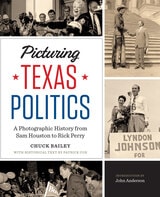
Picturing Texas Politics
A Photographic History from Sam Houston to Rick PerryBy Chuck Bailey; with historical text by Patrick Cox; introduction by John Anderson
University of Texas Press, 2015
With rare, previously unpublished photographs and iconic images of politicians from the state’s founders to Ann Richards, George W. Bush, and Rick Perry, here is the first-ever photographic album of Texas politicians and political campaigns.
The Republic of Texas was founded in 1839, around the time that photography was being invented. So while there were no photographers at the Alamo or San Jacinto, they arrived soon after to immortalize, on film, Sam Houston, David Burnett, Mirabeau Lamar, and many other founding fathers of the Lone Star State. Over the following nearly two centuries, Texas politics and politicians have provided reliable, often dramatic, and sometimes larger-than-life subjects for photographers to capture in the moment and add to the historical record.
Picturing Texas Politics presents the first photographic album of Texas politicians and political campaigns ever assembled. Chuck Bailey has searched archives, museums, libraries, and private collections to find photographs that have never been published, as well as iconic images, such as Russell Lee’s pictures of one of Ralph Yarborough’s campaigns. These photographs are arranged into four chronological sections, each one introduced by historian Patrick Cox, who also provides informative photo captions. The photographs display power and political savvy from the early Republic to Lyndon Johnson and Bob Bullock; unmatched dedication to Texas in the Hobby and Bush families; and the growing influence of women in politics, from Miriam “Ma” Ferguson to Barbara Jordan, Ann Richards, and Kay Bailey Hutchison. With Sam Houston’s jaguar vest, W. Lee “Pappy” O’Daniel’s hillbilly band, a famous governor with an ostrich, and prominent Texans eating watermelons, shooting guns, and riding horses, this is Texas politics at its liveliest and best.
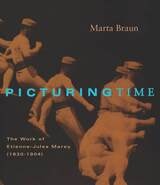
Picturing Time
The Work of Etienne-Jules Marey (1830-1904)Marta Braun
University of Chicago Press, 1992
Braun offers a fascinating look at how Marey's chronophotography was used to express the profound transformation in understanding and experiencing time that occurred in the late nineteenth century. Featuring 335 illustrations, Picturing Time includes many unpublished examples of Marey's chronophotographs and cinematic work. It also contains a complete bibliography of his writings and the first catalog of his films, photographic prints, and recently discovered negatives.

Picturing Utopia
Bertha Shambaugh and the Amana PhotographersAbigail Foerstner
University of Iowa Press, 2005
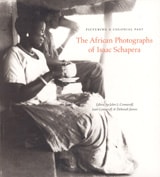
Picturing a Colonial Past
The African Photographs of Isaac SchaperaEdited by John L. Comaroff, Jean Comaroff, and Deborah James
University of Chicago Press, 2007

Picturing the Atmosphere
Photography and the Advancement of Atmospheric ScienceTerrence R. Nathan
American Meteorological Society, 2021
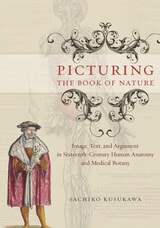
Picturing the Book of Nature
Image, Text, and Argument in Sixteenth-Century Human Anatomy and Medical BotanySachiko Kusukawa
University of Chicago Press, 2012
Because of their spectacular, naturalistic pictures of plants and the human body, Leonhart Fuchs’s De historia stirpium and Andreas Vesalius’s De humani corporis fabrica are landmark publications in the history of the printed book. But as Picturing the Book of Nature makes clear, they do more than bear witness to the development of book publishing during the Renaissance and to the prominence attained by the fields of medical botany and anatomy in European medicine. Sachiko Kusukawa examines these texts, as well as Conrad Gessner’s unpublished Historia plantarum, and demonstrates how their illustrations were integral to the emergence of a new type of argument during this period—a visual argument for the scientific study of nature.

Picturing the Cosmos
A Visual History of Early Soviet Space EndeavorIina Kohonen
Intellect Books, 2017
Kohonen ably examines each image, elucidating how visual media helped to anchor otherwise abstract political and intellectual concepts of the future and modernization within the Soviet Union. The USSR mapped and named the cosmos, using new media to stake a claim to this new territory and incorporating it into the daily lives of its citizens. Soviet cosmonauts, meanwhile, were depicted as prototypes of the perfect Communist man, representing modernity, good taste, and the aesthetics of the everyday. Across five heavily illustrated chapters, Picturing the Cosmos navigates and critically examines these utopian narratives, highlighting the rhetorical tension between propaganda, censorship, art, and politics.
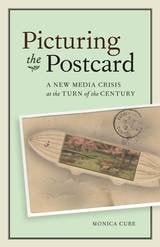
Picturing the Postcard
A New Media Crisis at the Turn of the CenturyMonica Cure
University of Minnesota Press, 2018
The first full-length study of a once revolutionary visual and linguistic medium
Literature has “died” many times—this book tells the story of its death by postcard. Picturing the Postcard looks to this unlikely source to shed light on our collective, modern-day obsession with new media. The postcard, almost unimaginably now, produced at the end of the nineteenth century the same anxieties and hopes that many people think are unique to twenty-first-century social media such as Facebook or Twitter. It promised a newly connected social world accessible to all and threatened the breakdown of authentic social relations and even of language.
Arguing that “new media” is as much a discursive object as a material one, and that it is always in dialogue with the media that came before it, Monica Cure reconstructs the postcard’s history through journals, legal documents, and sources from popular culture, analyzing the postcard’s representation in fiction by well-known writers such as E. M. Forster and Edith Wharton and by more obscure writers like Anne Sedgwick and Herbert Flowerdew. Writers deployed uproar over the new medium of the postcard by Anglo-American cultural critics to mirror anxieties about the changing nature of the literary marketplace, which included the new role of women in public life, the appeal of celebrity and the loss of privacy, an increasing dependence on new technologies, and the rise of mass media. Literature kept open the postcard’s possibilities and in the process reimagined what literature could be.
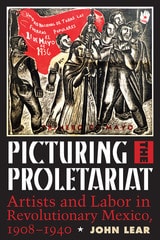
Picturing the Proletariat
Artists and Labor in Revolutionary Mexico, 1908–1940By John Lear
University of Texas Press, 2017
Thomas McGann Memorial Prize, Rocky Mountain Council on Latin American Studies, 2017
Runner-up, Humanities Book Prize, Mexico Section of the Latin American Studies Association, 2018
In the wake of Mexico’s revolution, artists played a fundamental role in constructing a national identity centered on working people and were hailed for their contributions to modern art. Picturing the Proletariat examines three aspects of this artistic legacy: the parallel paths of organized labor and artists’ collectives, the relations among these groups and the state, and visual narratives of the worker. Showcasing forgotten works and neglected media, John Lear explores how artists and labor unions participated in a cycle of revolutionary transformation from 1908 through the presidency of Lázaro Cárdenas (1934–1940). Lear shows how middle-class artists, radicalized by the revolution and the Communist Party, fortified the legacy of the prerevolutionary print artisan José Guadalupe Posada by incorporating modernist, avant-garde, and nationalist elements in ways that supported and challenged unions and the state. By 1940, the state undermined the autonomy of radical artists and unions, while preserving the image of both as partners of the “institutionalized revolution.”
This interdisciplinary book explores the gendered representations of workers; the interplay of prints, photographs, and murals in journals, in posters, and on walls; the role of labor leaders; and the discursive impact of the Spanish Civil War. It considers “los tres grandes”—Rivera, Siquieros, and Orozco—while featuring lesser-known artists and their collectives, including Saturnino Herrán, Leopoldo Méndez, Santos Balmori, and the League of Revolutionary Writers and Artists (LEAR). The result is a new perspective on the art and politics of the revolution.

Piecemeal Protest
Animal Rights in the Age of NonprofitsCorey Lee Wrenn
University of Michigan Press, 2019
Given their tendency to splinter over tactics and goals, social movements are rarely unified. Following the modern Western animal rights movement over thirty years, Corey Lee Wrennapplies the sociological theory of Bourdieu, Goffman, Weber, and contemporary social movement researchers to examine structural conditions in the animal rights movement, facilitating factionalism in today’s era of professionalized advocacy.
Modern social movements are dominated by bureaucratically oriented nonprofits, a special arrangement that creates tension between activists and movement elites who compete for success in a corporate political arena. Piecemeal Protest examines the impact of nonprofitization on factionalism and a movement’s ability to mobilize, resonate, and succeed. Wrenn’sexhaustive analysis of archival movement literature and exclusive interviews with movement leaders illustrate how entities with greater symbolic capital are positioned to monopolize claims-making, disempower competitors, and replicate hegemonic power, eroding democratic access to dialogue and decision-making essential for movement health.
Piecemeal Protest examines social movement behavior shaped by capitalist ideologies and state interests. As power concentrates to the disadvantage of marginalized factions in the modern social movement arena, Piecemeal Protest shines light on processes of factionalism and considers how, in the age of nonprofits, intra-movement inequality could stifle social progress.

Pieces of Sound
German Experimental RadioDaniel Gilfillan
University of Minnesota Press, 2009
A cultural history of German radio broadcasting from the 1920s to today
Since the rise of film and television, radio has continued to evolve, with satellite radio and podcasts as its latest incarnations. Any understanding of the development of radio, like its visual counterparts, depends on closely examining the artistic ventures that preceded commercial acceptance.
In Pieces of Sound, Daniel Gilfillan offers a cultural history that explores these major aspects of the medium by focusing on German radio broadcasting, providing a context that sees beyond programming to consider regulations, cultural politics, and social standardization. Gilfillan showcases the work of radio pioneers and artists over the past century, including Brecht’s work with the form, and how radio was employed before and after World War II. He traces how German radio broadcasters experimented with networked media not only to expand the artistic and communicative possibilities of radio, but also to inform perceptions about the advantages and direction of newer telecommunications media like Internet broadcasting and pirate radio, which artists are using today to engage with a medium that is increasingly under corporate control. Gilfillan astutely observes how claims made for the Internet today echo those made for radio in its infancy and puts forth a broad and incisive historical analysis of German cultural broadcasting.
Pierio Valeriano on the Ill Fortune of Learned Men
A Renaissance Humanist and His WorldJulia Haig Gaisser
University of Michigan Press, 1999
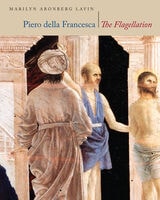
Piero Della Francesca
The FlagellationMarilyn Aronberg Lavin
University of Chicago Press, 1990
"[Lavin] leaves the picture more wondrous than before, a simultaneous triumph of the theological and biographical, as well as pictorial, imagination."—Rackstraw Downes, New York Times Book Review
Piers Plowan
The A Version, Revised EditionWilliam Langland
Catholic University of America Press, 2023
Piers Plowman
The A VersionWilliam Langland
Catholic University of America Press, 2020