Results by title
8113 books match the query 'Literary Criticism' and 405 start with p
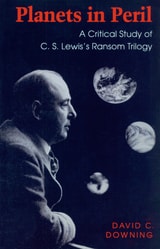
Planets in Peril
A Critical Study of C. S. Lewis's Ransom TrilogyDavid C. Downing
University of Massachusetts Press, 1992
A critical study of C.S. Lewis's “Ransom Trilogy” which analyses Lewis's methods and meanings, concentrating on this trilogy but also including relevant secondary work. Lewis's literary scholarship and display of Christian values are incorporated into this discussion.
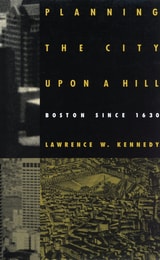
Planning the City upon a Hill
Boston since 1630Lawrence W. Kennedy
University of Massachusetts Press, 1992
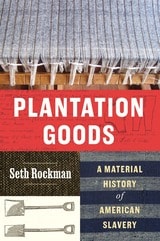
Plantation Goods
A Material History of American SlaverySeth Rockman
University of Chicago Press, 2024
The industrializing North and the agricultural South—that’s how we have been taught to think about the United States in the early nineteenth century. But in doing so, we overlook the economic ties that held the nation together before the Civil War. We miss slavery’s long reach into small New England communities, just as we fail to see the role of Northern manufacturing in shaping the terrain of human bondage in the South. Using plantation goods—the shirts, hats, hoes, shovels, shoes, axes, and whips made in the North for use in the South—historian Seth Rockman locates the biggest stories in American history in the everyday objects that stitched together the lives and livelihoods of Americans—white and Black, male and female, enslaved and free—across an expanding nation.
By following the stories of material objects, such as shoes made by Massachusetts farm women that found their way to the feet of a Mississippi slave, Rockman reveals a national economy organized by slavery—a slavery that outsourced the production of its supplies to the North, and a North that outsourced its slavery to the South. Melding business and labor history through powerful storytelling, Plantation Goods brings northern industrialists, southern slaveholders, enslaved field hands, and paid factory laborers into the same picture. In one part of the country, entrepreneurs envisioned fortunes to be made from “planter’s hoes” and rural women spent their days weaving “negro cloth” and assembling “slave brogans.” In another, enslaved people actively consumed textiles and tools imported from the North to contest their bondage. In between, merchants, marketers, storekeepers, and debt collectors laid claim to the profits of a thriving interregional trade.
Examining producers and consumers linked in economic and moral relationships across great geographic and political distances, Plantation Goods explores how people in the nineteenth century thought about complicity with slavery while showing how slavery structured life nationwide and established a modern world of entrepreneurship and exploitation. Rockman brings together lines of American history that have for too long been told separately, as slavery and capitalism converge in something as deceptively ordinary as a humble pair of shoes.
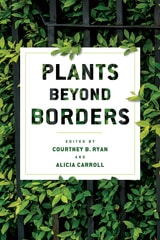
Plants Beyond Borders
Edited by Courtney B. Ryan and Alicia Carroll
The Ohio State University Press, 2026
Centers vegetal life as a force that disrupts the borders of race, gender, sexuality, and colonial power.
Although plants are the most abundant life form on earth, the environmental humanities have paid them scant attention until recently, even as new challenges, such as the COVID-19 pandemic, climate change, war, and the global rise of the right have piqued interest in plants as signs of life that challenge the Anthropocene and the logic of extraction. In Plants Beyond Borders, Courtney B. Ryan and Alicia Carroll have marshalled a range of innovative contributions that focus on vegetal borderlands—or spaces in which plant and human life overlap—where vegetal life exceeds and uproots human borders. Containing perspectives from English, landscape architecture, Native American studies, performing arts, and more, Plants Beyond Borders foregrounds Indigenous sovereignty and plant knowledge; explores the shared transmutability of plants and trans, queer, and pregnant bodies; and investigates phytographia, or plant writing, as plants thinking beyond borders. No matter the objective, the essays in this interdisciplinary collection center vegetal life, considering how agentic plants not only rupture myths of settler colonialism, gender, and sexuality but also inscribe themselves and us in the world.
Contributors:
Cinthya Ammerman Muñoz, Alicia Carroll, Gwendolyn Cohen, Isaac Cohen, Xinyue Fu, Patrícia de Nóbrega Gomes, Katie Hogan, Kaley Makino, Melissa Parrish, MacKenzie Patterson, Courtney B. Ryan, John Charles Ryan, Saghar Safaeyan, Jeannette Schollaert, Kathryn Van Wert, Christina Welch
Plato's World
Man's Place in the CosmosJoseph Cropsey
University of Chicago Press, 1995
Cropsey interprets seven of Plato's dialogues—Theaetetus, Euthyphro, Sophist, Statesman, Apology, Crito, and Phaedo—in light of their dramatic consecutiveness and thus as a conceptual and dramatic whole. The cosmos depicted by Plato in these dialogues, Cropsey argues, is often unreasonable, and populated by human beings unaided by gods and dealt with equivocally by nature. Masterfully leading the reader through the seven scenes of the drama, Cropsey shows how they are, to an astonishing degree, concerned with the resources available to help us survive in such a world.
This is a world—and a Plato—quite at odds with most other portraits. Much more than a summary of Plato's thinking, this book is an eloquent, sometimes amusing, often moving guide to the paradoxes and insights of Plato's philosophy.
Play in the Age of Goethe
Theories, Narratives, and Practices of Play around 1800Edgar Landgraf
Bucknell University Press, 2020
Published by Bucknell University Press. Distributed worldwide by Rutgers University Press.
Playing Dirty
Sexuality and Waste in Early Modern ComedyWill Stockton
University of Minnesota Press, 2010
Noting that psychoanalysis has traditionally operated in a paranoid framework that relentlessly produces evidence of the same “truths,” Stockton turns to a minority practice in psychoanalysis—associated with Jean Laplanche—to develop a more “playful” analytic for literary studies. This analytic brings together different discourses of sexuality and the body and allows individual writings to reform psychoanalytic wisdom about sexuality, waste, and comedy. Through original explorations of works by William Shakespeare, Ben Jonson, Sir John Harington, Thomas Nashe, and Geoffrey Chaucer, Stockton further encourages the reconciliation of psychoanalysis and queer historicism. He focuses in large part on the less-often-read texts of the early modern English canon, assessing the ways in which these books have been purged from the canon in the name of generic purity.
Playing Dirty builds on recent calls by Renaissance and medieval queer scholars for a method of literary analysis that is less constrained by the boundaries of periodicity and the supposed exigencies of historicism. To take Playing Dirty seriously is to accept its invitation to “play”—to queerly disrupt the modern divide in moving promiscuously between texts past and present.
Playing House in the American West
Western Women's Life Narratives, 1839–1987Cathryn Halverson
University of Alabama Press, 2013
How domestic life shaped identity, gender, and power in the American West
The controlling metaphor Cathryn Halverson uses in her engrossing study is “playing house.” From Caroline Kirkland and Laura Ingalls Wilder to Willa Cather and Marilynne Robinson, from the mid-nineteenth to the late-twentieth centuries, western authors have persistently embraced wayward or eccentric housekeeping to prove a woman’s difference from western neighbors and eastern readers alike.
The readings in Playing House investigate the surprising textual ends to which westerners turn the familiar terrain of the home: evaluating community; arguing for different conceptions of race and class; and perhaps most especially, resisting traditional gender roles. Western women writers, Halverson argues, render the home as a stage for autonomy, resistance, and imagination rather than as a site of sacrifice and obligation.
The western women examined in Playing House in the American West are promoted and read as representatives of a region, as insiders offering views of distant and intriguing ways of life, even as they conceive of themselves as outsiders. By playing with domestic conventions, they recast the region they describe, portraying the West as a place that fosters female agency, individuality, and subjectivity.
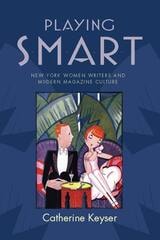
Playing Smart
New York Women Writers and Modern Magazine CultureKeyser, Catherine
Rutgers University Press, 2010
Through humor writing, this "smart set" expressed both sides of the story-promoting their urbanity and wit while using irony and caricature to challenge feminine stereotypes. Their fiction raised questions about what it meant to be a woman in the public eye, how gender roles would change because men and women were working together, and how the growth of the magazine industry would affect women's relationships to their bodies and minds. Keyser provides a refreshing and informative chronicle, saluting the value of being "smart" as incisive and innovative humor showed off the wit and talent of women writers and satirized the fantasy world created by magazines.
Playing at Narratology
Digital Media as Narrative TheoryDaniel Punday
The Ohio State University Press, 2019
Returning to terms such as narrator, setting, event, character, and world, Playing at Narratology reveals new ways of thinking about these basic narrative concepts—concepts that are not so basic when applied to games and web-based narratives. What are thought of as narrative innovations in these digital forms are a product of technological ability and tied to how we physically interact with a medium, creating new and complicated questions: Is the game designer the implied author or the narrator? Is the space on the screen simply the story’s setting? Playing at Narratology guides us through the evolution of narrative in new media without abandoning the field’s theoretical foundations.
Playing in the Shadows
Fictions of Race and Blackness in Postwar Japanese LiteratureWilliam Bridges
University of Michigan Press, 2020
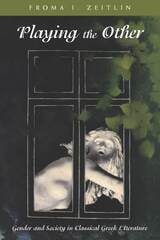
Playing the Other
Gender and Society in Classical Greek LiteratureFroma I. Zeitlin
University of Chicago Press, 1995
Zeitlin demonstrates the indispensable workings of gender as a major factor in Greek social, religious, and cultural practices and in more abstract ideas about nature and culture, public and private, citizen and outsider, self and other, and mortal and immortal. Focusing on the prominence of female figures in these male authored texts, she enlarges our perspective on critical components of political order and civic identity by including issues of sexuality, the body, modes of male and female maturation, and speculations about parentage, kinship, and reproductive strategies. Along with considerations of genre, poetics, and theatrical mimesis, she points to the powerful mythmaking capacities of Greek culture for creating memorable paradigms and dramatic scenarios that far exceed simple notions of male and female opposition and predictable enforcement of social norms. Consisting of both new and revised essays, Playing the Other is a wide-ranging account of a central category of Greek literature by a scholar who pioneered an approach to classics through the perspective of gender.
Plays by Early American Women, 1775-1850
Amelia Howe Kritzer, Editor
University of Michigan Press, 1995
Plays by French and Francophone Women
A Critical AnthologyChristiane P. Makward and Judith G. Miller, Editors
University of Michigan Press, 1994
Plays by French and Francophone Women presents eight recent plays by contemporary French and francophone women writers. The plays vary in style and form from the satirical to the poetic, from the comedic one-woman show to the potential multi-media esoteric production, and have been written by French, Qué becois, Acadian, and Caribbean francophone writers. The editors have provided informative headnotes to introduce each play, then faithful translations rendered with an ear toward production in English. A general introduction to the volume situates each work within the broader context of contemporary French-language theater by women. The volume also includes an annotated bibliography by Cynthia Running-Johnson of thirty-one additional plays by women in French.
Featured plays and playwrights are The Scent of Sulphur by S. Corinna Bille; When Fairies Thirst by Denise Boucher; Island Memories by Ina Césaire; Warmth: A Bloodsong by Chantal Chawaf; The Goddess Lar or Centuries of Women by Andrée Chedid; The Name of Oedipus: Song of the Forbidden Body by Hélène Cixous; The Table: Womenspeak by Michèle Foucher; and The Rabble by Antonine Maillet.
Pleasures in Socialism
Leisure and Luxury in the Eastern BlocDavid Crowley
Northwestern University Press, 2012
Much has been written about the workings of communist governments in the USSR and the Soviet bloc, yet there is still a great deal to explore regarding their relationship to the everyday lives of the citizens living under them. This third volume builds on the editors’ Style and Socialism and Socialist Spaces, showing how the rise of consumer culture took a unique form in these countries.
Essays from top scholars address topics ranging from fashion and game shows to smoking and camping. The authors of the essays in this collection investigate the ways in which pleasurable activities, like many other facets of daily life, were both a space in which these communist governments tried to insinuate themselves and thereby further expand the reach of their authority,
and also an opportunity for people to assert their individuality.
Plotting History
The Russian Historical Novel in the Imperial AgeDan Ungurianu
University of Wisconsin Press, 2007
Balanced precariously between fact and fiction, the historical novel is often viewed with suspicion. Some have attacked it as a mongrel form, a “bastard son” born of “history’s flagrant adultery with imagination.” Yet it includes some of the most celebrated achievements of Russian literature, with Alexander Pushkin, Nikolai Gogol, Leo Tolstoy, and scores of other writers contributing to this tradition.
Dan Ungurianu’s Plotting History traces the development of the Russian historical novel from its inception in the romantic era to the emergence of Modernism on the eve of the Revolution. Organized historically and thematically, the study is focused on the cultural paradigms that shaped the evolution of the genre and are reflected in masterpieces such as The Captain’s Daughter and War and Peace. Ungurianu examines the variety of approaches by which Russian writers combined fact with fiction and explores the range of subjects that inspired the Russian historical imagination.
Outstanding Academic Title, Choice Magazine
“Ungurianu has produced a most valuable work for literary scholars.”—Andrew M. Drozd, Slavic and East European Journal
“[Ungurianu’s] overwhelming knowledge, impeccable documentation, erudite notes, and valuable addenda make for a treasure house of information and keen analysis. . . . Essential.”—Choice
Pluralist Universalism
An Asian Americanist Critique of U.S. and Chinese MulticulturalismsWen Jin
The Ohio State University Press, 2012
Pluralist Universalism: An Asian Americanist Critique of U.S. and Chinese Multiculturalisms by Wen Jin is an extended comparison of U.S. and Chinese multiculturalisms during the post–Cold War era. Her book situates itself at the intersection of Asian American literary critique and the growing field of comparative multiculturalism. Through readings of fictional narratives that address the issue of racial and ethnic difference in both national contexts simultaneously, the author models a “double critique” framework for U.S.–Chinese comparative literary studies.
Poe Abroad
Influence Reputation AffinitiesLois Davis Vines
University of Iowa Press, 1999
In Poe Abroad, Lois Vines has brought together a collection of essays that document the American writer's influence on the diverse literatures—and writers—of the world. Over twenty scholars demonstrate how and why Poe has significantly influenced many of the major literary figures of the last 150 years.
Part One includes studies of Poe's popularity among general readers, his influence on literary movements, and his reputation as a poet, fiction writer, and literary critic. Part Two presents analyses of the role Poe played in the literary development of specific writers representing many different cultures.
Poe Abroad commemorates the 150th anniversary of Poe's death and celebrates his worldwide impact, beginning with the first literal translation of Poe into a foreign language, “The Gold-Bug”into French in 1845. Charles Baudelaire translated another Poe tale in 1848 and four years later wrote an essay that would make Poe a well-known author in Europe even before he achieved recognition in America.
Poe died knowing only that some of his stories had been translated into French. He probably never would have imagined that his work would be admired and imitated as far away as Japan, China, and India or would have a lasting influence on writers such as Baudelaire, August Strindberg, Franz Kafka, Jorge Luis Borges, Julio Cortázar, and Tanizaki Junichiro.
As we approach the sesquicentennial of his death, Poe Abroad brings together a timely one-volume assessment of Poe's influence throughout the world.
Poe's Critical Theory
THE MAJOR DOCUMENTSEdgar Allan Poe
University of Illinois Press, 2007
This edition shows that what is consistent in Poe is not any single theory. Rather, always present are wit, playfulness, concern for the strong effect, a bin of recyclable allusions, anecdotes and quotations, and a writer’s discipline. His writing on theory is of a piece with his fiction, poetry, and journalism. The Levines explain how these pieces also tie in tightly to the social, political, economic, and technological history of the world in which Poe lived.
Poe's Pym
Critical ExplorationsRichard Kopley, ed.
Duke University Press, 1992
The product of a decade of research and planning, Poe's "Pym" offers a factual basis for some of the most fantastic elements in the novel and uncovers surprising connections between Poe's text and exploration literature, nautical lore, Arthurian narrative, nineteenth-century journalism, Moby Dick, and other writings. Representing a rich cross-section of current modes of literary study—from source study to psychoanalytic criticism to new historicism—these sixteen essays probe issues such as literary influence, the limits of language, racism, the holocaust, prolonged mourning, and the structure of the human mind. Poe's "Pym" will be an invaluable resource for students of both contemporary criticism and nineteenth-century American culture.
Contributors. John Barth, Susan F. Beegel, J. Lasley Dameron, Grace Farrell, Alexander Hammond, David H. Hirsch, John T. Irwin, J. Gerald Kennedy, David Ketterer, Joan Tyler Mead, Joseph J. Moldenhauer, Carol Peirce, Burton R. Pollin, Alexander G. Rose III, John Carlos Rowe, G. R. Thompson, Bruce I. Weiner
Poe, Fuller, and the Mesmeric Arts
Transition States in the American RenaissanceBruce Mills
University of Missouri Press, 2005
Poem Containing History
Textual Studies in The CantosLawrence S. Rainey, Editor
University of Michigan Press, 1997

Poems from Captured Documents
A Bilingual EditionThanh T. Nguyen
University of Massachusetts Press, 1994
Written in journals and notebooks by ordinary soldiers who fought against American forces in Vietnam, the poems collected in this volume fill a longstanding void in the literature of that war. In addition to offering a revealing window into another culture – a culture that prizes poetry as an integral part of social life – the pieces provide a rare look at the conflict from the perspective of those who served in the National Liberation Front, the People’s Armed Forces, and the People’s Army of Vietnam.
The format of this edition is bilingual, to enable both Vietnamese and American readers to share and appreciate these poignant and deeply personal documents, which were often written under fire and always in the face of death.
Poems of the American Empire
The Lyric Form in the Long Twentieth CenturyJen Hedler Phillis
University of Iowa Press, 2019
Poems of the American Empire argues that careful attention to a particular strain of twentieth-century lyric poetry yields a counter-history of American global power. The period that Phillis covers—from Ezra Pound’s A Draft of XXX Cantos in 1930 to Cathy Park Hong’s Engine Empire in 2012—roughly matches what some consider the ascent and decline of the American empire. The diverse poems that appear in this book are united by their use of epic forms in the lyric poem, a combination that violates a fundamental framework of both genres’ relationship to time.
This book makes a groundbreaking intervention by insisting that lyric time is key to understanding the genre. These poems demonstrate the lyric form’s ability to represent the totality of history, making American imperial power visible in its fullness. Neither strictly an empty celebration of American exceptionalism nor a catalog of atrocities, Poems of the American Empire allows us to see both.
Poet's Work, Poet's Play
Essays on the Practice and the ArtEdited by Daniel Tobin and Pimone Triplett
University of Michigan Press, 2008
A follow-up to the highly praised Poets Teaching Poets, Daniel Tobin and Pimone Triplett's Poet's Work, Poet's Play gathers together essays by some of the most important voices in contemporary poetry: Carl Dennis, Stephen Dobyns, Tony Hoagland, Heather McHugh, Ellen Bryant Voigt, Eleanor Wilner, Dean Young, and the late Larry Levis and Agha Shahid Ali.
Lively, accessible, and erudite, the pieces range from discussions on syntax and the syllable to an exploration of the complexities of canon formation under the shadow of imperialism, race, and history. Exploring the work of John Donne, William Butler Yeats, Robert Frost, Philip Larkin, Charles Olsen, Ezra Pound, Anne Carson, Robert Herrick, Harryette Mullen, and many others, Poet's Work, Poet's Play---like its predecessor volume---will be an invaluable tool for teachers, students, and poets at every level.
"Much more than a set of essays on poetic craft or aesthetic understandings, this collection takes on two of the most prevalent anxieties about writing poetry in our time: the place of subjectivity in poetry, and how to make a significant shape in language while both affirming and interrogating the poetic I's authority. This is a book for anyone who wants to write better poems, who wants to read with greater passion, and who believes that poetry is an independent category of human consciousness that can be as capaciousness as the world, and as nuanced."
---Tom Sleigh, author of Space Walk and Far Side of the Earth
"Gathering together essays by unquestionably important poets, Poet's Work, Poet's Play has immense pedagogical value in the way it demonstrates how to discover in poetry resources of language and structure often overlooked in first, and ensuing, readings of complex texts."
---Laurence Goldstein, Professor of English, University of Michigan, and Editor, Michigan Quarterly Review
"A valuable document illuminating critical aspects of the contemporary American poetry scene."
---John Koethe, Distinguished Professor of Philosophy at the University of Wisconsin, Milwaukee, and author of Sally's Hair: Poems
Poetic Closure
A Study of How Poems EndBarbara Herrnstein Smith
University of Chicago Press, 1971
In Poetic Closure, distinguished literary scholar Barbara Herrnstein Smith explores the provocative question: How do poems end? To answer it, Smith examines numerous individual poems and examples of common poetic forms in order to reveal the relationship between closure and the overall structure and integrity of a poem. First published in 1968, Smith’s book remains essential reading in poetic theory.
“Ranging from Elizabethan lyric through free and syllabic verse and concrete poetry, Poetic Closure is a learned, witty, and richly illustrated study of the behavior of poems. . . . It can be read, enjoyed, studied by people who like reading poetry, including—I would suspect—poets.”—Richard M. Elman, New York Times Book Review

Poetic Creation
Inspiration or CraftCarl FehrmanTranslated by Karin Petherick
University of Minnesota Press, 1980
Poetic Creation was first published in 1980. Minnesota Archive Editions uses digital technology to make long-unavailable books once again accessible, and are published unaltered from the original University of Minnesota Press editions.
Myths of creativity have changed throughout Western literary history. The Romantic era cherished the idea of creativity as a spontaneous, unpremeditated act, closely related to improvisation. In the twentieth century the myth of the writer as a worker among workers has competed with the Surrealist myth of the spontaneous author who writes in a sort of trance. Yet there can be no doubt that the creative process as such crosses historical boundaries. Carl Fehrman devotes this book to the process of artistic creativity, focusing on the dichotomy between inspiration and effort and using texts and manuscripts from the period of early Romanticism to present.
Fehrman is primarily concerned with the creativity of poets and draws on authorial accounts of the process, the analysis of manuscripts in successive drafts, psychological and linguistic experiments in creativity, and accounts of creativity in other fields. At the heart of the book are case studies: on Coleridge's writings of "Kubla Khan," Poe's composition of "The Raven," And Valery's account of his prolonged work on "Le Cimetiere Marin." Fehrman also deals with literary works that have undergone genre transformation, Ibsen's Brand and Selma Lagerlof;s Gosta Berlings Saga. In closing chapters he draws upon his case studies and other materials to provide fascinating insights into both productivity and its converse, blocked creativity, and in this context discusses the general problem of periodicity in a creative life.
Fehrman works within a Swedish aesthetic tradition which has attracted philosophers, art historians, and literary scholars since the turn of the century, all of them intent on discovering the origins of the work of art. This translation brings his work to Englishspeaking literary scholars and will be of special interest to those concerned with comparative aesthetics and the creative process.
Poetic Culture
Contemporary American Poetry between Community and InstitutionChristopher Beach
Northwestern University Press, 1999
Poetic Investigations
Singing the Holes in HistoryPaul Naylor
Northwestern University Press, 1999
Poetic License
Essays on Modernist and Postmodernist LyricMarjorie Perloff
Northwestern University Press, 1990
Poetic Maneuvers
Hans Magnus Enzensberger and the Lyric GenreCharlotte Melin
Northwestern University Press, 2004
From the first, Enzensberger resisted the marginalization of literature–particularly poetry—by connecting it with ethical imperatives of the post-Holocaust era. Charlotte Ann Melin shows how Enzensberger has accomplished this by challenging prevailing aesthetic and social values. Departing from existing studies that focus on Enzensberger's political views or controversial texts, her book situates his full poetic program within contemporary discussions staged by various German writers, translators, and theorists, including Jürgen Habermas and Theodor Adorno. Melin proposes a framework for reading poetry by Enzensberger and his contemporaries—one that connects the radical evolution of poetic style with how questions about representation, identity, and ethical values developed under historical conditions unique to the second half of the twentieth century. Her account of postwar literary trends explores the fluidity of national literary boundaries and tastes after 1945, and reveals the relationship of such American poets as William Carlos Williams and Carolyn Forché to German verse. Essential to an understanding Enzensberger as an important literary figure, Poetic Maneuvers also offers invaluable insight into the status of recent postwar German literature and American-European literary relations.
Poetic Obligation
Ethics in Experimental American Poetry after 1945Matthew G. Jenkins
University of Iowa Press, 2008
Since at least the time of Plato's Republic, the relationship between poetry and ethics has been troubled. Through the prism of what has been called the "new" ethical criticism, inspired by the work of Emmanuel Levinas, G. Matthew Jenkins considers the works of Objectivists, Black Mountain poets, and Language poets in light of their full potential to reshape this ancient relationship.
American experimental poetry is usually read in either political or moral terms. Poetic Obligation, by contrast, considers the poems of Louis Zukofsky, Charles Reznikoff, George Oppen, Edward Dorn, Robert Duncan, Susan Howe, and Lyn Hejinian in terms of the philosophical notion of ethical obligation to the Other in language. Jenkins's historical trajectory enables him to consider the full breadth of ethical topics that have driven theoretical debate since the end of World War II. This original approach establishes an ethical lineage in the works of twentieth-century experimental poets, creating a way to reconcile the breach between poetry and the issue of ethics in literature at large.
With implications for a host of social issues, including ethnicity and immigration, economic inequities, and human rights, Jenkins's imaginative reconciliation of poetry and ethics will provide stimulating reading for teachers and scholars of American literature as well as advocates and devotees of poetry in general. Poetic Obligation marshals ample evidence that poetry matters and continues to speak to the important issues of our day.
Poetic Voices
Discourse Linguistics and the Poetic TextTimothy R. Austin
University of Alabama Press, 1994
Poems written in the first person, poems that contain passages of conversation or dialogue, and narrative poems all rely on their readers’ capacity to process discourse. Discourse features in the texts of those poems—features such as temporal and spatial reference, narrative “framing”, and the strategic use of direct speech—inevitably affect the way readers receive the central themes. Recent developments in linguistic theory, including developments that address discourse structure, thus offer literary scholars new tools for approaching a richer understanding of those poems.
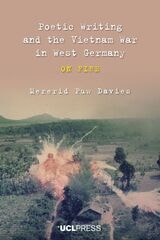
Poetic Writing and the Vietnam War in West Germany
On fireMererid Puw Davies
University College London, 2023
Though the Vietnam War did not directly involve West Germany, it was nonetheless a decisive catalyst for the era’s wider protest movements in that country, and it gave rise to an ardent anti-war discourse. Poetry and poetic writing were key to anti-war work. Hundreds of poems and related writings about Vietnam circulated in West Germany, yet they are almost entirely forgotten today. Poetic Writing and the Vietnam War in West Germany uncovers and explores some of that rich artistic production in order to present a new history of engaged poetic writing in West Germany in the 1960s and 1970s and to draw out distinctive characteristics of wider protest culture. In doing so, it makes the case for attending to marginal, non-canonical, or neglected literary and cultural forms, and for critical thinking about why they might, over time, have been obscured. The book also offers a case study for reflection on the representation of war, on ways in which German oppositional culture could imagine its others, and on the relationship of poetry to the historical world.
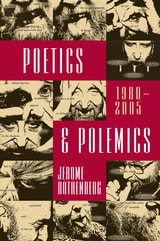
Poetics & Polemics
1980-2005Jerome Rothenberg
University of Alabama Press, 2008
Poetics & Polemics, 1980-2005 brings together in one volume a wide-ranging selection of essays and commentaries by one of the most significant poets, critics, and translators working with American and international poetry today.
Jerome Rothenberg’s work spans a period of over forty years and nearly one hundred books, and though perhaps best known as a poet, his critical and theoretical contributions to the fields of innovative, experimental poetry have become equally important facets of his work. Rothenberg’s earliest critical writings concerned themselves with ethnopoetics and the poetics of performance. In the last twenty years his critical thinking has evolved to encompass more explicitly issues of modernism, postmodernism, and the avant-garde, as well as meditations on the nature of the book and writing. This volume extends and elaborates all of those interests, allowing for the first time a comprehensive glimpse of the full trajectory of his thinking.
In the first section, “Poetics and Polemics,” Rothenberg’s essays address a range of issues with which he’s become closely associated, among them the anthology as a critical and polemical tool; the intersection of poetry with art, performance, and politics, in both contemporary and traditional practice; the poetics of Jewish mysticism as a traditional form of conceptual and language poetry; and the universality of poetic discourse, particularly as seen in tribal poetry or in poetic traditions long separated from the Western literary mainstream. In “A Gallery of Poets” is Rothenberg’s lively explorations of the work of other poets, as they relate to his own work, to avant-garde poetry in general, and to the poetic traditions that concern him the most. Finally, in “Dialogues and Interviews” are Rothenberg’s unbridled meditations and musings on what he calls “the life of poetry” outside the bounds of book and binding, class and category, a dynamic force at the center of all that we call human.
Poetics and Praxis 'After' Objectivism
W. Scott Howard and Broc Rossell
University of Iowa Press, 2018
Poetics and Praxis ‘After’ Objectivismexamines late twentieth-and early twenty-first-century poetics and praxis within and against the dynamic, disparate legacy of Objectivism and the Objectivists. This is the first volume in the field to investigate the continuing relevance of the Objectivist ethos to poetic praxis in our time. The book argues for a reconfiguration of Objectivism, adding contingency to its historical values of sincerity and objectification, within the context of the movement’s development and disjunctions from 1931 to the present.
Essays and conversations from emerging and established poets and scholars engage a network of communities in the U.S., Canada, and the U.K., shaped by contemporaneous oppositions as well as genealogical (albeit discontinuous) historicisms. This book articulates Objectivism as an inclusively local, international, and interdisciplinary ethos, and reclaims Objectivist poetics and praxis as modalities for contemporary writers concerned with radical integrations of aesthetics, lyric subjectivities, contingent disruption, historical materialism, and social activism. The chapter authors and roundtable contributors reexamine foundational notions about Objectivism—who the Objectivists were and are, what Objectivism has been, now is, and what it might become—delivering critiques of aesthetics and politics; of race, class, and gender; and of the literary and cultural history of the movement’s development and disjunctions from 1931 to the present.
Contributors: Rae Armantrout, Julie Carr, Amy De’Ath, Jeff Derksen, Rachel Blau DuPlessis, Graham Foust, Alan Golding, Jeanne Heuving, Ruth Jennison, David Lau, Steve McCaffery, Mark McMorris, Chris Nealon, Jenny Penberthy, Robert Sheppard
Poetics in a New Key
Interviews and EssaysMarjorie Perloff
University of Chicago Press, 2014
The fourteen interviews in Poetics in a New Key—conducted by scholars, poets, and critics from the United States, Denmark, Norway, France, and Poland, including Charles Bernstein, Hélène Aji, and Peter Nicholls—cover a broad spectrum of topics in the study of poetry: its nature as a literary genre, its current state, and its relationship to art, politics, language, theory, and technology. Also featured in the collection are three pieces by Perloff herself: an academic memoir, an exploration of poetry pedagogy, and an essay on twenty-first-century intellectuals. But across all the interviews and essays, Perloff’s distinctive personality and approach to reading and talking resound, making this new collection an inspiring resource for scholars both of poetry and writing.
Poetics of Change
The New Spanish-American NarrativeBy Julio Ortega
University of Texas Press, 1986
Too often literary criticism is academic exercise rather than creative act. For the multifaceted Julio Ortega—respected poet, dramatist, and novelist in his own right—the act of criticism becomes profoundly creative, his incisive readings of the text far transcending the pedantry that may falsely pass for imagination, intelligence, and rigor. Nearly every Spanish-American writer of consequence, from Paz to Fuentes, Cortázar to Lezama Lima, has extolled Ortega’s criticism as not merely a reflection but an essential part of the renaissance that took place in Spanish-American letters during the late twentieth century.
Poetics of Change brings together Ortega’s most penetrating and insightful analyses of the fiction of Borges, Fuentes, García Márquez, Carpentier, Rulfo, Cabrera Infante, and others responsible for great writing from Spanish America. Ortega concerns himself most with the semantic innovations of these masters of the modern narrative and their play with form, language, and the traditional boundaries of genre. Mapping their creative territory, he finds that the poetics of Spanish-American writing is that of a dynamically changing genre that has set exploration at its very heart.
Poetics of Cognition
Thinking through Experimental PoemsJessica Lewis Luck
University of Iowa Press, 2023
The cognitive research Luck draws upon suggests that the strangeness of experimental poetry can reshape the activity of the reader’s mind, creating new forms of attention, perception, and cognition. This book closes by shifting from theory to praxis, extracting forms of teaching from the forms of thinking that experimental poems instill in order to better enable their transformative effects in readers and to bring poetry pedagogy into the twenty-first century.
Poetics of Dislocation
Meena Alexander
University of Michigan Press, 2009
Poetics of Dislocation sets the work of contemporary American poetry within the streams of migration that have made the nation what it is in the twenty-first century. There are few poets better qualified to muse on that context than Meena Alexander, who spent her life studying at prestigious institutions around the globe before settling in the United States to work on her acclaimed body of poetry.
Part of the University of Michigan Press's award-winning Poets on Poetry series, Poetics of Dislocation studies not only the personal creative process Alexander uses, but also the work of other prominent writers. Alexander discusses what it means to come to America as an adult to write poetry, and her place---and that of others---in the collection of cultures that makes up this country. She outlines the dilemmas that face modern immigrant poets, including how to make a place for oneself in a new society and how to write poetry in a time of violence worldwide.
Poetics of Emergence
Affect and History in Postwar Experimental PoetryBenjamin Lee
University of Iowa Press, 2020
Experimental poetry responded to historical change in the decades after World War II, with an attitude of such casual and reckless originality that its insights have often been overlooked. However, as Benjamin Lee argues, to ignore the scenes of self and the historical occasions captured by experimental poets during the 1950s and 1960s is to overlook a rich and instructive resource for our own complicated transition into the twenty-first century.
Frank O’Hara and fellow experimental poets like Amiri Baraka, Diane di Prima, and Allen Ginsberg offer us a set of perceptive responses to Cold War culture, lyric meditations on consequential changes in U.S. social life and politics, including the decline of the Old Left, the rise of white-collar workers, and the emergence of vernacular practices like hipsterism and camp. At the same time, they offer us opportunities to anatomize our own desire for historical significance and belonging, a desire we may well see reflected and reconfigured in the work of these poets.
Poetics of Relation
Édouard Glissant
University of Michigan Press, 1997
In Poetics of Relation, Glissant turns the concrete particulars of Caribbean reality into a complex, energetic vision of a world in transformation. He sees the Antilles as enduring suffering imposed by history, yet as a place whose unique interactions will one day produce an emerging global consensus. Arguing that the writer alone can tap the unconscious of a people and apprehend its multiform culture to provide forms of memory capable of transcending "nonhistory," Glissant defines his "poetics of relation"--both aesthetic and political--as a transformative mode of history, capable of enunciating and making concrete a French-Caribbean reality with a self-defined past and future. Glissant's notions of identity as constructed in relation and not in isolation are germane not only to discussions of Caribbean creolization but also to our understanding of U.S. multiculturalism. In Glissant's view, we come to see that relation in all its senses--telling, listening, connecting, and the parallel consciousness of self and surroundings--is the key to transforming mentalities and reshaping societies.
This translation of Glissant's work preserves the resonating quality of his prose and makes the richness and ambiguities of his voice accessible to readers in English.
"The most important theoretician from the Caribbean writing today. . . . He is central not only to the burgeoning field of Caribbean studies, but also to the newly flourishing literary scene in the French West Indies." --Judith Graves Miller, University of Wisconsin, Madison
Édouard Glissant is Distinguished Professor of French at City University of New York, Graduate Center. Betsy Wing's recent translations include Lucie Aubrac's Outwitting the Gestapo (with Konrad Bieber), Didier Eribon's Michel Foucault and Hélêne Cixous's The Book of Promethea.
Poetics of Visibility in the Contemporary Arab American Novel
Mazen Naous
The Ohio State University Press, 2020
Naous’s book offers analyses of Diana Abu-Jaber’s Arabian Jazz and Crescent, Rabih Alameddine’s Koolaids: The Art of War, Laila Halaby’s Once in a Promised Land, and Mohja Kahf’s The Girl in the Tangerine Scarf as ways to answer this question. Naous explores how these novels negotiate queer desire, music, Western and Middle Eastern art, gender, and relationships between other minorities. These poetics enable readers to see the nuance and richness of Arab American experience. Naous ultimately argues that fiction creates crucial spaces for reimagining and redefining intercultural relationships.
Poetics of the Hive
Insect Metaphor in LiteratureCristopher Hollingsworth
University of Iowa Press, 2001
Poetics of the Hold
Variations on the Slave ShipFabienne Kanor
University of Chicago Press, 0
An essential reflection on the haunting legacy of the transatlantic slave trade from award-winning French filmmaker and writer Fabienne Kanor.
A century and a half after the passage of the last known slave ship, the hold—in which captives were imprisoned together under inhuman conditions—still haunts collective memory, particularly that of Afro-descendant artists, thinkers, and writers. With The Poetics of the Hold, scholar, writer, and filmmaker Fabienne Kanor offers a series of meditations on the transatlantic slave trade and on how the experience of the Middle Passage has been represented in modern culture of the United States, Francophone Africa, and the French West Indies.
In this important book, Kanor draws from a multitude of sources—history, literature, art, philosophy, the Négritude tradition, and Caribbean thinkers—to take readers on a journey from colonial archives to public spaces, museums, and other places of commemoration. Throughout, the image of the hold serves as a spectral monument, the traumatic reverberations of which can be felt in both the texts Kanor examines and in her own writing. While archives, logbooks, and sea reports provide information about slave ships, the stories of the slaves themselves too often remain shrouded in silence. This powerful and poetic book seeks to rectify that amnesia and to wrestle with these neglected histories and their afterlives.
Poetics of the Legal Sea in English Renaissance Literature
Hayley Cotter
University of Alabama Press, 2026
A vivid exploration of how early modern literature transformed the law of the sea into a rich imaginative realm of maritime space and poetic possibility
Poetics of the Legal Sea in English Renaissance Literature is a richly layered study that traces how early modern writers imagined the sea as both a legal landscape and a site of narrative possibility. Through an interdisciplinary lens, the book illuminates the ways literary forms conceptualized the maritime laws that governed the early modern world. Its narrative moves fluidly between legal frameworks and poetic language, revealing a dynamic exchange between artistic expression and the systems that regulated life at sea.
Hayley Cotter’s analysis charts a metaphorical voyage, guiding readers from the calm departure of genre and jurisdiction through turbulent encounters with piracy, shipwreck, and salvage. Plays and poems become vessels that carry ideas about authority, justice, and sovereignty, while rhetorical devices such as metaphor, synecdoche, and metonymy deepen the imaginative pull of maritime experience. This journey foregrounds the cognitive effects of literary language, showing how early modern authors engaged with legal culture in ways that often moved beneath the surface of conscious thought.
As the chapters progress, literary texts become active participants in shaping understandings of law and maritime space. Shakespearean drama, Elizabethan pirate tales, sonneteering traditions, and anonymous sea poems all contribute to a vibrant conversation about how societies negotiated law and commerce on the open water. Bringing together readers interested in early modern literature, maritime history, and interdisciplinary inquiry, Poetics of the Legal Sea in English Renaissance Literature offers a compelling exploration of how the ocean’s vast, shifting expanse inspired new ways of thinking about power and the stories that give shape to legal life.
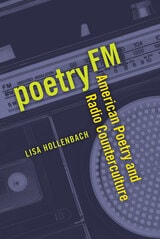
Poetry FM
American Poetry and Radio CountercultureLisa Hollenbach
University of Iowa Press, 2023
Lisa Hollenbach traces the history of Pacifica Radio—founded in 1946, the nation’s first listener-supported public radio network—through the 1970s: from the radical pacifists and poets who founded Pacifica after the war; to the San Francisco Renaissance, Beat, and New York poets who helped define the countercultural sound of Pacifica stations KPFA and WBAI in the 1950s and 1960s; to the feminist poets and activists who seized Pacifica’s frequencies in the 1970s. In the poems and recorded broadcasts of writers like Kenneth Rexroth, Jack Spicer, Allen Ginsberg, Amiri Baraka, Audre Lorde, Pat Parker, Bernadette Mayer, and Susan Howe, one finds a recurring ambivalence about the technics and poetics of reception. Through tropes of static noise, censorship, and inaudibility as well as voice, sound, and signal, these radiopoetic works suggest new ways of listening to the sounds and silences of Cold War American culture.
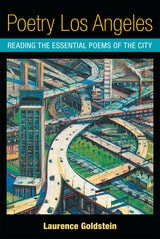
Poetry Los Angeles
Reading the Essential Poems of the CityLaurence Goldstein
University of Michigan Press, 2014
One chapter is devoted to Charles Bukowski, the celebrity face of the city’s poetry. Other chapters discuss the ways that poets explore “Interiors” and “Exteriors” throughout the cityscape. Goldstein also provides ample connections to the novels, films, art, and politics of Southern California. In clear prose, Poetry Los Angeles examines the strategies by which poets make significant places meaningful and memorable to readers of every region of the U.S. and elsewhere.
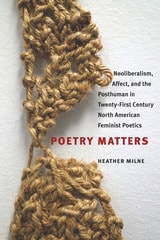
Poetry Matters
Neoliberalism, Affect, and the Posthuman in Twenty-First Century North American Feminist PoeticsHeather Milne
University of Iowa Press, 2018
Poetry Matters explores poetry written by women from the United States and Canada, which documents the social and political turmoil of the early twenty-first century and places this poetry in dialogue with recent currents of feminist theory including new materialism, affect theory, posthumanism, and feminist engagements with neoliberalism and capitalism. Central to this project is the conviction that a poetics that explores the political dimensions of affect; demonstrates an understanding of subjectivity as posthuman and transcorporeal; critically reflects on the impact of capitalism on queer, racialized, and female bodies; and develops an ethical vocabulary for reimagining the nation state and critically engaging with issues of democracy and citizenship is now more urgent than ever before.
Milne focuses on poetry published after 2001 by writers who mostly began writing after the feminist writing movements of the 1980s, but who have inherited and built upon their political and aesthetic legacies. The poets discussed in this book—including Jennifer Scappettone, Margaret Christakos, Larissa Lai, Rita Wong, Nikki Reimer, Rachel Zolf, Yedda Morrison, Marcella Durand, Evelyn Reilly, Juliana Spahr, Claudia Rankine, Dionne Brand, Jena Osman, and Jen Benka—bring a sense of political agency to poetry. These voices seek new vocabularies and dissenting critical and aesthetic frameworks for thinking across issues of gender, materiality, capitalism, the toxic convergences of nationalism and racism, and the decline of democratic institutions. This is poetry that matters—both in its political urgency and in its attentiveness to the world as “matter”—as a material entity under siege. It could not be more timely or more relevant.
Poetry On and Off the Page
Essays for Emergent OccasionsMarjorie Perloff
Northwestern University Press, 1998