Results by title
1116 books match the query 'Africa' and 80 start with s
Safari Nation
A Social History of the Kruger National ParkJacob S. T. Dlamini
Ohio University Press, 2020
Safe in a Midwife's Hands
Birthing Traditions from Africa to the American SouthLinda Janet Holmes
The Ohio State University Press, 2023
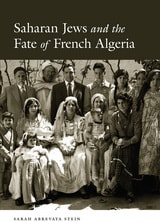
Saharan Jews and the Fate of French Algeria
Sarah Abrevaya Stein
University of Chicago Press, 2014
Drawing on materials from thirty archives across six countries, Stein tells the story of colonial imposition on a desert community that had lived and traveled in the Sahara for centuries. She paints an intriguing historical picture—of an ancient community, trans-Saharan commerce, desert labor camps during World War II, anthropologist spies, battles over oil, and the struggle for Algerian sovereignty. Writing colonialism and decolonization into Jewish history and Jews into the French Saharan one, Saharan Jews and the Fate of French Algeria is a fascinating exploration not of Jewish exceptionalism but of colonial power and its religious and cultural differentiations, which have indelibly shaped the modern world.

Saharan Winds
Energy Systems and Aeolian Imaginaries in Western SaharaAllan, Joanna
West Virginia University Press, 2024
Winner, ASLE-UKI Critical Book Prize, 2025
Finalist, Ecocritical Book Award, 2025, Association for the Study of Literature and Environment (ASLE)
Longlisted, Bread and Roses Award for Radical Publishing, 2025
Saharan Winds contributes to a fairer energy horizon by illuminating the role of imaginaries--how we understand energy sources such as wind and the meanings we attach to wind--in determining the wider politics, whether oppressive or just, associated with energy systems. This book turns to various cultures and communities across different time periods in one space, Western Sahara, to explore how wind imaginaries affect the development, management, and promotion of windfarms; the distribution of energy that windfarms produce; and, vitally, the type of politics mediated by all these elements combined. Highlighting the wind-fueled oppression of colonial energy systems, the book shows the potential offered by nomadic, Indigenous wind imaginaries for contributing to a fairer energy future.

Scream for Me, Africa!
Heavy Metal Identities in Post-Colonial AfricaEdward Banchs
Intellect Books, 2023
Scream for Me Africa! examines the hard rock and metal scenes in five African countries: Botswana, Togo, South Africa, Kenya, and Ghana. Edward Banchs interviewed musicians, producers, and fans in each country to create vivid pictures of each of these rarely discussed scenes. The book considers how the subculture of heavy metal is viewed in postcolonial Africa and examines how musicians on the continent have stepped forward to make this genre their own. It looks at Africa's blossoming scenes through various themes, including hybridity, othering, and political tensions.
Searching for a Different Future
The Rise of a Global Middle Class in MoroccoShana Cohen
Duke University Press, 2004
Cohen delves into the rupture that has occurred between the middle class, the individual, and the nation in Morocco and elsewhere around the world. Combining institutional economic analysis with cultural theory and ethnographic observation including interviews with seventy young adults in Casablanca and Rabat, she reveals how young, urban, educated Moroccans conceive of their material, social, and political conditions. She finds that, for the most part, they perceive improvement in their economic and social welfare apart from the types of civic participation commonly connected with nationalism and national identity. In answering classic sociological questions about how the evolution of capitalism influences identity, Cohen sheds new light on the measurable social and economic consequences of globalization and on its less tangible effects on individuals’ perception of their place in society and prospects in life.
Season of Rains
Africa in the WorldStephen Ellis
University of Chicago Press, 2012

Second Chances
Surviving AIDS in UgandaSusan Reynolds Whyte, editor
Duke University Press, 2014
Contributors. Phoebe Kajubi, David Kyaddondo, Lotte Meinert, Hanne O. Mogensen, Godfrey Etyang Siu, Jenipher Twebaze, Michael A. Whyte, Susan Reynolds Whyte
Secular Missionaries
Americans and African Development in the 1960sLarry Grubbs
University of Massachusetts Press, 2010
Secure the Base
Making Africa Visible in the GlobeNgugi wa Thiong’o
Seagull Books, 2016
Ngũgĩ's fiction has been met with wide acclaim, but his nonfiction work, while equally brilliant, is more difficult to find. Secure the Base changes this by bringing together for the first time essays spanning nearly three decades. Originating as disparate lectures and texts, this complete volume will remind readers anew of Ngũgĩ's power and importance. Written in a personal and accessible style, the book covers a range of issues, including the role of the intellectual, the place of Asia in Africa, labor and political struggles in an era of rampant capitalism, and the legacies of slavery and prospects for peace. At a time when Africa looms large in our discussions of globalization, Secure the Base is mandatory reading.
Seeing Like a Citizen
Decolonization, Development, and the Making of Kenya, 1945–1980Kara Moskowitz
Ohio University Press, 2019
In Seeing Like a Citizen, Kara Moskowitz approaches Kenya’s late colonial and early postcolonial eras as a single period of political, economic, and social transition. In focusing on rural Kenyans—the vast majority of the populace and the main targets of development interventions—as they actively sought access to aid, she offers new insights into the texture of political life in decolonizing Kenya and the early postcolonial world.
Using multisited archival sources and oral histories focused on the western Rift Valley, Seeing Like a Citizen makes three fundamental contributions to our understanding of African and Kenyan history. First, it challenges the widely accepted idea of the gatekeeper state, revealing that state control remained limited and that the postcolonial state was an internally varied and often dissonant institution. Second, it transforms our understanding of postcolonial citizenship, showing that its balance of rights and duties was neither claimed nor imposed, but negotiated and differentiated. Third, it reorients Kenyan historiography away from central Kenya and elite postcolonial politics. The result is a powerful investigation of experiences of independence, of the meaning and form of development, and of how global political practices were composed and recomposed on the ground in local settings.
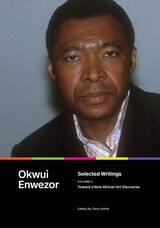
Selected Writings, Volume 1
Toward a New African Art DiscourseOkwui Enwezor. Edited by Terry Smith.
Duke University Press, 2025
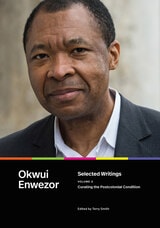
Selected Writings, Volume 2
Curating the Postcolonial Condition, Volume 2Okwui Enwezor. Edited by Terry Smith.
Duke University Press, 2025
Self-Devouring Growth
A Planetary Parable as Told from Southern AfricaJulie Livingston
Duke University Press, 2019

Sex, France, and Arab Men, 1962–1979
Todd Shepard
University of Chicago Press, 2017
Sex, France, and Arab Men is a history of how and why—from the upheavals of French Algeria in 1962 through the 1970s—highly sexualized claims about Arabs were omnipresent in important public French discussions, both those that dealt with sex and those that spoke of Arabs. Shepard explores how the so-called sexual revolution took shape in a France profoundly influenced by the ongoing effects of the Algerian revolution. Shepard’s analysis of both events alongside one another provides a frame that renders visible the ways that the fight for sexual liberation, usually explained as an American and European invention, developed out of the worldwide anticolonial movement of the mid-twentieth century.
Shadow of Things to Come
Kossi Efoui
Seagull Books, 2013
In an unnamed African nation, the people are subject to a state of perpetual warfare and to an Orwellian abuse of language that strips from language its meaning and renders life senseless. And in a bare room lit only by moonlight, a young man hides, waiting for the mysterious crocodile-men to come and help him escape from the violent tyranny of the state. While he waits, he tells his story.
This is Kossi Efoui’s catastrophic and carnivalesque dreamscape, the dark setting of The Shadow of Things to Come. Here, men and women are taken in the night, spirited away from their families, and sent to plantation penal colonies to be worked to the edge of madness. When they return, they are empty shells, their lost time referred to as the “Time of Annexation.” But though his parents were taken, our protagonist survived, first in the care of a quirky benefactress named Mama Maize, then under the wing of the state itself, as a student at one of its elite schools. When he meets a bookseller named Axis Kemal, however, he has found a surrogate father, an eccentric and wise man who can bring him out of the meaningless confusion and tell him the truth about the society he lives in.
Through his characters, Efoui speaks out against atrocity and the abuse of power, but more, he writes against political rhetoric and the destruction of meaning by government. This novel is a love letter to language and, in Chris Turner’s dazzling translation, it becomes a stunning introduction for English-language readers to an exciting new talent.
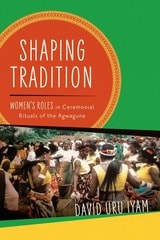
Shaping Tradition
Women's Roles in Ceremonial Rituals of the AgwaguneDavid Uru Iyam
University of Wisconsin Press, 2021
Using this community as a case study, David Uru Iyam asserts that these women are not stereotypically submissive, oppressed, or passive. Agwagune women participate in male ceremonies by pretending to be unaware of them, concealing their authority under a veneer of secrecy. Instead of focusing on obvious male political power, Iyam highlights the overlooked domestic and public contributions of women that uphold—and change—entire social systems.
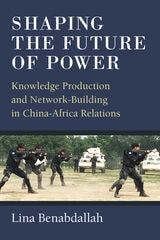
Shaping the Future of Power
Knowledge Production and Network-Building in China-Africa RelationsLina Benabdallah
University of Michigan Press, 2020

Short-Changed?
South Africa since ApartheidColin Bundy
Ohio University Press, 2015
What have been the most significant developments—political, social, economic—in South Africa since 1994? How much has changed since the demise of apartheid, and how much remains stubbornly the same? Should one celebrate a robust democracy now two decades old, or lament the corrosive effects of factionalism, greed, and corruption on political life? Colin Bundy tries to answer such questions, while avoiding simplistic or one-sided assessments of life under Mandela, Mbeki, and Zuma. He recognizes real advances under ANC rule but also identifies the limits and contradictions of such progress. Bundy demonstrates, too, how the country’s past permeates the present, complicating and constraining the politics of transition, so that genuine transformation has been short-changed.
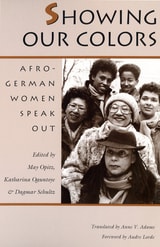
Showing Our Colors
Afro-German Women Speak OutMay Optiz
University of Massachusetts Press, 1992
Showing Our Colors: Afro-German Women Speak Out is an English translation of the German book Farbe bekennen, edited by author May Ayim, Katharina Oguntoye, and Dagmar Schultz. It is the first published book by Afro-Germans. It is the first written use of the term Afro-German.

Siaya
The Historical Anthropology of an African LandscapeDavid William Cohen
Ohio University Press, 1989
The authors of this highly original book set out to remove the persistent boundary between the authors and readers of ethnography on one hand and the subjects of ethnography on the other – those who observe and those who are observed.
The authors use stories to reveal Siaya, the Luo-speaking area of Western Kenya down near the Lake but still surprisingly vulnerable to drought. There are the stories of survival by a woman with her carpenter husband in Nairobi, there is the launching of a boat as bride into the Lake and there is the great Boro Christmas disco riot. The book finishes with an Afterword on the burial of the lawyer S. M. Otiono that divided its whole of Kenya.
It is both written about and for the Luo. It brings together Luo ideas and debates about their own past and present with findings, arguments and questions produced about this “other people;” by outside scholars writing in their own disciplines. Among the Luo, what constitutes culture, what is correct behavior, what is history, are questions that are heavily fought over.
This is one of those rare books that makes students and other interested individuals question their own cultural preconceptions and what are the genuine concerns of academic disciplines.
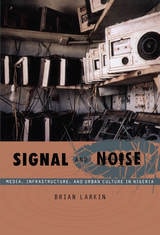
Signal and Noise
Media, Infrastructure, and Urban Culture in NigeriaBrian Larkin
Duke University Press, 2008
Media technologies were introduced to Nigeria by colonial regimes as part of an attempt to shape political subjects and create modern, urban Africans. Larkin considers the introduction of media along with electric plants and railroads as part of the wider infrastructural project of colonial and postcolonial urbanism. Focusing on radio networks, mobile cinema units, and the building of cinema theaters, he argues that what media come to be in Kano is the outcome of technology’s encounter with the social formations of northern Nigeria and with norms shaped by colonialism, postcolonial nationalism, and Islam. Larkin examines how media technologies produce the modes of leisure and cultural forms of urban Africa by analyzing the circulation of Hindi films to Muslim Nigeria, the leisure practices of Hausa cinemagoers in Kano, and the dynamic emergence of Nigerian video films. His analysis highlights the diverse, unexpected media forms and practices that thrive in urban Africa. Signal and Noise brings anthropology and media together in an original analysis of media’s place in urban life.
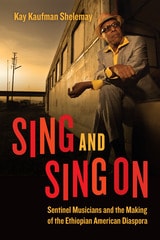
Sing and Sing On
Sentinel Musicians and the Making of the Ethiopian American DiasporaKay Kaufman Shelemay
University of Chicago Press, 2022
Sing and Sing On is the first study of the forced migration of musicians out of the Horn of Africa dating from the 1974 Ethiopian revolution, a political event that overthrew one of the world’s oldest monarchies and installed a brutal military regime. Musicians were among the first to depart the region, their lives shattered by revolutionary violence, curfews, and civil war. Reconstructing the memories of forced migration, Sing and Sing On traces the challenges musicians faced amidst revolutionary violence and the critical role they played in building communities abroad.
Drawing on the recollections of dozens of musicians, Sing and Sing On details personal, cultural, and economic hardships experienced by musicians who have resettled in new locales abroad. Kay Kaufman Shelemay highlights their many artistic and social initiatives and the ways they have offered inspiration and leadership within and beyond a rapidly growing Ethiopian American diaspora. While musicians held this role as sentinels in Ethiopian culture long before the revolution began, it has taken on new meanings and contours in the Ethiopian diaspora. The book details the ongoing creativity of these musicians while exploring the attraction of return to their Ethiopian homeland over the course of decades abroad. Ultimately, Shelemay shows that musicians are uniquely positioned to serve this sentinel role as both guardians and challengers of cultural heritage.
Sisters for Justice
Small Acts in the Transformation of Apartheid South AfricaCatherine Higgs
University of Wisconsin Press, 2025
Based on extensive oral history interviews with white and Black sisters as well as deep archival research, this groundbreaking book reveals a largely untold story, nested within the broader literature of women’s activism in South Africa. The result is a new perspective that expands and intensifies our understanding of a dramatic period during which individual actions, in the aggregate, contributed to social change.
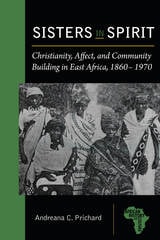
Sisters in Spirit
Christianity, Affect, and Community Building in East Africa, 1860–1970Andreana C. Prichard
Michigan State University Press, 2017
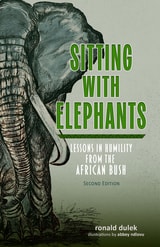
Sitting with Elephants
Lessons in Humility from the African Bush, Enhanced and Expanded Second EditionRonald Dulek, Illustrations by Abbey Ndlovu
University of Alabama Press, 2026
A professor of communication and strategy reveals deep lessons from life in the African bush.
Sitting with Elephants is a heartfelt memoir that follows a middle-aged American professor and his wife as they trade suburban life for a remote bush house in South Africa. What begins as a spontaneous decision becomes a life-changing experience—one shaped by lions at the backdoor, baboons in the rafters, and above all, a herd of elephants who frequent their yard like neighbors.
Told through a series of emails to their adult children and brought to life by vivid illustrations from Abbey Ndlovu, Ronald Dulek’s narrative explores the profound lessons nature teaches: patience, humility, and deep respect for the wild. As the couple learns to communicate with elephants and navigate the rhythms of bush life, they also reflect on the unexpected beauty of slowing down and embracing the unknown.
Blending lighthearted anecdotes with moments of quiet insight, Sitting with Elephants invites readers into a story of transformation—both personal and environmental. This second edition includes expanded content with new stories and reflections, offering a deeper look into the couple’s unforgettable time in the African bush.
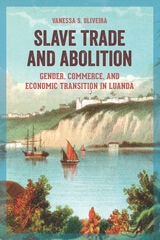
Slave Trade and Abolition
Gender, Commerce, and Economic Transition in LuandaVanessa S. Oliveira
University of Wisconsin Press, 2022
Vanessa S. Oliveira traces how existing commercial networks adapted to changes in the Atlantic slave trade during the first half of the nineteenth century. Slave Trade and Abolition reveals how women known as donas (a term adapted from the title granted to noble and royal women in the Iberian Peninsula) were often important cultural brokers. Acting as intermediaries between foreign and local people, they held high socioeconomic status and even competed with the male merchants who controlled the trade. Oliveira provides rich evidence to explore the many ways this Luso-African community influenced its society. In doing so, she reveals an unexpectedly nuanced economy with regard to the dynamics of gender and authority.
Slavery In Africa
Historical & Anthropological PerspectivesSuzanne Miers
University of Wisconsin Press, 1979
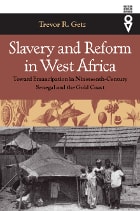
Slavery and Reform in West Africa
Toward Emancipation in Nineteenth-Century Senegal and the Gold CoastTrevor R. Getz
Ohio University Press, 2004
A series of transformations, reforms, and attempted abolitions of slavery form a core narrative of nineteenth-century coastal West Africa. As the region’s role in Atlantic commercial networks underwent a gradual transition from principally that of slave exporter to producer of “legitimate goods” and dependent markets, institutions of slavery became battlegrounds in which European abolitionism, pragmatic colonialism, and indigenous agency clashed.
In Slavery and Reform in West Africa, Trevor Getz demonstrates that it was largely on the anvil of this issue that French and British policy in West Africa was forged. With distant metropoles unable to intervene in daily affairs, local European administrators, striving to balance abolitionist pressures against the resistance of politically and economically powerful local slave owners, sought ways to satisfy the latter while placating or duping the former.
The result was an alliance between colonial officials, company agents, and slave-owning elites that effectively slowed, sidetracked, or undermined serious attempts to reform slave holding. Although slavery was outlawed in both regions, in only a few isolated instances did large-scale emancipations occur. Under the surface, however, slaves used the threat of self-liberation to reach accommodations that transformed the master-slave relationship.
By comparing the strategies of colonial administrators, slave-owners, and slaves across these two regions and throughout the nineteenth century, Slavery and Reform in West Africa reveals not only the causes of the astounding success of slave owners, but also the factors that could, and in some cases did, lead to slave liberations. These findings have serious implications for the wider study of slavery and emancipation and for the history of Africa generally.
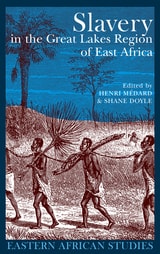
Slavery in the Great Lakes Region of East Africa
Henri Médard
Ohio University Press, 2007
Slavery in the Great Lakes Region of East Africa is a collection of ten studies by the most prominent historians of the region. Slavery was more important in the Great Lakes region of Eastern Africa than often has been assumed, and Africans from the interior played a more complex role than was previously recognized. The essays in this collection reveal the connections between the peoples of the region as well as their encounters with the conquering Europeans. The contributors challenge the assertion that domestic slavery increased in Africa as a result of the international trade. Slavery in this region was not a uniform phenomenon and the line between enslaved and non-slave labor was fine. Kinship ties could mark the difference between free and unfree labor. Social categories were not always clear-cut and the status of a slave could change within a lifetime.
Contents:
- Introduction by Henri Médard
- Language Evidence of Slavery to the Eighteenth Century by David Schoenbrun
- The Rise of Slavery & Social Change in Unyamwezi 1860–1900 by Jan-Georg Deutsch
- Slavery & Forced Labour in the Eastern Congo 1850–1910 by David Northrup
- Legacies of Slavery in North West Uganda ‘The One-Elevens’ by Mark Leopold
- Human Booty in Buganda: The Seizure of People in War, c.1700–c.1900 by Richard Reid
- Stolen People & Autonomous Chiefs in Nineteenth-Century Buganda by Holly Hanson
- Women’s Experiences of Slavery in Late Nineteenth- & Early Twentieth-Century Uganda by Michael W. Tuck
- Slavery & Social Oppression in Ankole 1890–1940 by Edward I. Steinhart
- The Slave Trade in Burundi & Rwanda at the Beginning of German Colonisation 1890–1906 by Jean-Pierre Chretien
- Bunyoro & the Demography of Slavery Debate by Shane Doyle
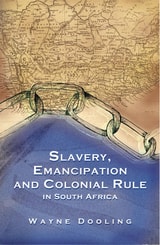
Slavery, Emancipation and Colonial Rule in South Africa
Wayne Dooling
Ohio University Press, 2008
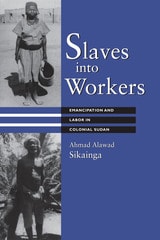
Slaves into Workers
Emancipation and Labor in Colonial SudanBy Ahmad Alawad Sikainga
University of Texas Press, 1996
Unlike African slavery in Europe and the Americas, slavery in the Sudan and other parts of Africa persisted well into the twentieth century. Sudanese slaves served Sudanese masters until the region was conquered by the Turks, who practiced slavery on a larger, institutional scale. When the British took over the Sudan in 1898, they officially emancipated the slaves, yet found it impossible to replace their labor in the country’s economy.
This pathfinding study explores the process of emancipation and the development of wage labor in the Sudan under British colonial rule. Ahmad Sikainga focuses on the fate of ex-slaves in Khartoum and on the efforts of the colonial government to transform them into wage laborers. He probes into what colonial rule and city life meant for slaves and ex-slaves and what the city and its people meant for colonial officials.
This investigation sheds new light on the legacy of slavery and the status of former slaves and their descendants. It also reveals how the legacy of slavery underlies the current ethnic and regional conflicts in the Sudan. It will be vital reading for students of race relations and slavery, colonialism and postcolonialism, urbanization, and labor history in Africa and the Middle East.
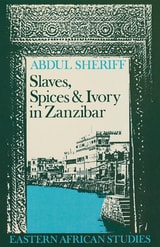
Slaves, Spices and Ivory in Zanzibar
Integration of an East African Commercial Empire into the World Economy, 1770–1873Abdul Sheriff
Ohio University Press, 1987
The rise of Zanzibar was based on two major economic transformations. Firstly slaves became used for producing cloves and grains for export. Previously the slaves themselves were exported.
Secondly, there was an increased international demand for luxuries such as ivory. At the same time the price of imported manufactured gods was falling. Zanzibar took advantage of its strategic position to trade as far as the Great Lakes.
However this very economic success increasingly subordinated Zanzibar to Britain, with its anti-slavery crusade and its control over the Indian merchant class.
Professor Sheriff analyses the early stages of the underdevelopment of East Africa and provides a corrective to the dominance of political and diplomatic factors in the history of the area.
Smugglers Secessionists & Loyal Citizens
On The Ghana-Togo FrontierPaul Nugent
Ohio University Press, 2002
Paul Nugent contends that whatever the origins of partition, border peoples quickly became knowing and active participants in the shaping of this international boundary. The study itself straddles the conventional divide between social and political history and offers a reconstruction of a long-range history of smuggling and a reappraisal of Ewe identity.
Addressing topics such as imperialism, cocoa, the Customs Preventive Service, Christianity, and Ewe unification, this study will be of interest to scholars and to others concerned with issues of criminality, identity, and the state.
Social History and African Environments
William Beinart
Ohio University Press, 2003
The explosion of interest in African environmental history has stimulated research and writing on a wide range of issues facing many African nations.
This collection represents some of the finest studies to date. The general topics include African environmental ideas and practices; colonial science, the state and African responses; and settlers and Africans' culture and nature. The contributors are Emmanuel Kreike, Karen Middleton, Innocent Pikirayi, Terence Ranger, JoAnn McGregor, Helen Tilley, Grace Garswell, John McCracken, Ingrid Yngstrom, David Bunn, Sandra Swart, Robert J. Gordon, and Jane Carruthers.
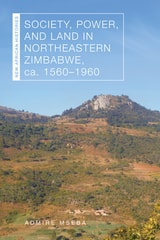
Society, Power, and Land in Northeastern Zimbabwe, ca. 1560–1960
Admire Mseba
Ohio University Press, 2024
This book refocuses attention on how regimes of power rooted in kinship, gender, generation, and status have, individually and in combination, informed access to land in precolonial northeastern Zimbabwe. It then examines how these regimes of power interacted with colonial policies to inform the African experience in colonial Zimbabwe. Further, the book places land and the ability to ensure its fecundity at the center of the making and moderation of precolonial political power and how this power was impacted by the imposition of colonial rule.
Tracing the dynamics of land and power from precolonial times, together with their entanglement with colonial policies, is important, for this relationship is almost always neglected by both scholars and policymakers drawn to the high drama of colonial and postcolonial politics of land. This oversight has real consequences on our understandings of landed inequalities and how they are addressed. When Zimbabwe’s postcolonial state focused on colonially induced racialized land inequalities, its land reform efforts left older forms of landed inequalities based on gender, generation, and ideas of belonging intact. The book, which details these inequalities, reminds Zimbabweans and others that if the quest for equity espoused in postcolonial land reforms is to be meaningful, it must be attentive to both colonially induced inequalities and those enduring disparities that predated, were deepened by, and outlived colonial rule. At the same time, Zimbabweans who now live with a postcolonial state that is increasingly centralizing power over land may well learn from past societies’ creative efforts to limit the authority of their leaders.
Soldier's Paradise
Militarism in Africa after EmpireSamuel Fury Childs Daly
Duke University Press, 2024
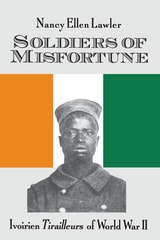
Soldiers Of Misfortune
lvoirien Tirailleurs of World War IINancy Ellen Lawler
Ohio University Press, 1992
This is a study of the African veterans of a European war. It is a story of men from the Cote d‘Ivoire, many of whom had seldom traveled more than a few miles from their villages, who served France as tirailleurs (riflemen) during World War II.
Thousands of them took part in the doomed attempt to hold back the armies of the Third Relch in 1940; many were to spend the rest of the war as prisoners in Germany or Occupied France.
Others more fortunate came under the authority of Vichy France, and were deployed in the Defense of the “Motherland” and its overseas possessions against the threat posed by the Allies. By 1943, the tirailleur regiments had passed into the service of de Gaulle’s free French and under Allied command, played a significant role in the liberation of Europe.
In describing these complex events, Dr. Lawler draws upon archives in both France and the Cote d’Ivoire. She also carried out an extensive series of interviews with Ivoirien veterans principally, but not exclusively, from the Korhogo region. The vividness of their testimony gives this study a special character. They talk freely not only of their wartime exploits, but also of their experiences after repatriation.
Lawler allows them to speak for themselves. They express their hatred of forced labor and military conscription, which were features of the colonial system, yet at the same time reveal a pride in having come to the defense of France. They describe their role in the nationalist struggle, as foot soldiers of Felix Houphouet-Boigny, but also convey their sense of having become a lost generation. They recognize that their experiences as French soldiers had become sadly irrelevant in a new nation in quest of its history.

Soldiers, Airmen, Spies, and Whisperers
The Gold Coast in World War IINancy Ellen Lawler
Ohio University Press, 2002
Somalis Abroad
Clan and Everyday Life in FinlandStephanie R. Bjork
University of Illinois Press, 2017

Somebody Else
Arthur Rimbaud in Africa 1880-91Charles Nicholl
University of Chicago Press, 1999
In this compelling biography, Charles Nicholl pieces together the shadowy story of Rimbaud's life as a trader, explorer, and gunrunner in Africa. Following his fascinating journey, Nicholl shows how Rimbaud lived out that mysterious pronouncement of his teenage years: "Je est un autre"—I is somebody else.
"Rimbaud's fear of stasis never left him. 'I should like to wander over the face of the whole world,' he told his sister, Isobelle, 'then perhaps I'd find a place that would please me a little.' The tragedy of Rimbaud's later life, superbly chronicled by Nicholl, is that he never really did."—London Guardian
"Nicholl has excavated a mosaic of semi-legendary anecdotes to show that they were an essential part of the poet's journey to become 'somebody else.' Not quite biography, not quite travel book, in the end Somebody Else transcends both genres."—Sara Wheeler, Daily Telegraph
"At the end of Somebody Else Rimbaud is more interesting and more various than before: he is not less mysterious, but he is more real."—Susannah Clapp, Observer Review
Song Walking
Women, Music, and Environmental Justice in an African BorderlandAngela Impey
University of Chicago Press, 2018
This book links ethnomusicological research to larger themes of international development, environmental conservation, gender, and local economic access to resources. By demonstrating that development processes are essentially cultural processes and revealing how music fits within this frame, Song Walking testifies to the affective, spatial, and economic dimensions of place, while contributing to a more inclusive and culturally apposite alignment between land and environmental policies and local needs and practices.

Song of the Cicadas
Anne Mong-Lan Pham
University of Massachusetts Press, 2001
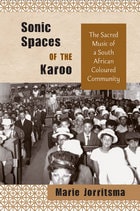
Sonic Spaces of the Karoo
The Sacred Music of a South African Coloured CommunityMarie Jorritsma
Temple University Press, 2011
Sonic Spaces of the Karoo is a pioneering study of the sacred music of three coloured (the apartheid designation for people "not white or native") people's church congregations in the rural town of Graaff-Reinet, South Africa. Jorritsma's fieldwork involves an investigation of the choruses, choir music, and hymns of the Karoo region to present a history of the people's traditional, religious, and cultural identity in song. This music is examined as part of a living archive preserved by the community in the face of a legacy of slavery and colonial as well as apartheid oppression.
Jorritsma's findings counteract a lingering stereotype that coloured music is inferior to European or African music and that coloured people should not or do not have a cultural identity. Sonic Spaces of the Karoo seeks to eradicate that bias and articulate a more legitimate place for these people in the contemporary landscape of South Africa.
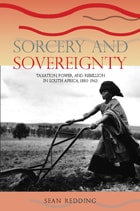
Sorcery and Sovereignty
Taxation, Power, and Rebellion in South Africa, 1880–1963Sean Redding
Ohio University Press, 2006
Rebellions broke out in many areas of South Africa shortly after the institution of white rule in the late nineteenth century and continued into the next century. However, distrust of the colonial regime reached a new peak in the mid-twentieth century, when revolts erupted across a wide area of rural South Africa. All these uprisings were rooted in grievances over taxes. Rebels frequently invoked supernatural powers for assistance and accused government officials of using witchcraft to enrich themselves and to harm ordinary people.
As Sean Redding observes in Sorcery and Sovereignty, beliefs in witchcraft and supernatural powers were part of the political rhetoric; the system of taxation—with all its prescribed interactions between ruler and ruled—was intimately connected to these supernatural beliefs.
In this fascinating study, Redding examines how black South Africans’ beliefs in supernatural powers, along with both economic and social change in the rural areas, resulted in specific rebellions and how gender relations in black South African rural families changed. Sorcery and Sovereignty explores the intersection of taxation, political attitudes, and supernatural beliefs among black South Africans, shedding light on some of the most significant issues in the history of colonized Africa.

Sorcery in the Black Atlantic
Edited by Luis Nicolau Parés and Roger Sansi
University of Chicago Press, 2011
Most scholarship on sorcery and witchcraft has narrowly focused on specific times and places, particularly early modern Europe and twentieth-century Africa. And much of that research interprets sorcery as merely a remnant of premodern traditions. Boldly challenging these views, Sorcery in the Black Atlantic takes a longer historical and broader geographical perspective, contending that sorcery is best understood as an Atlantic phenomenon that has significant connections to modernity and globalization.
A distinguished group of contributors here examine sorcery in Brazil, Cuba, South Africa, Cameroon, and Angola. Their insightful essays reveal the way practices and accusations of witchcraft spread throughout the Atlantic world from the age of discovery up to the present, creating an indelible link between sorcery and the rise of global capitalism. Shedding new light on a topic of perennial interest, Sorcery in the Black Atlantic will be provocative, compelling reading for historians and anthropologists working in this growing field.
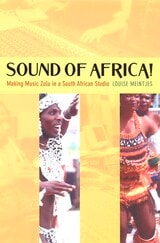
Sound of Africa!
Making Music Zulu in a South African StudioLouise Meintjes
Duke University Press, 2003
Focusing on the ways artists, producers, and sound engineers collaborate in the studio control room, Meintjes reveals not only how particular mbaqanga sounds are shaped technically, but also how egos and artistic sensibilities and race and ethnicity influence the mix. She analyzes how the turbulent identity politics surrounding Zulu ethnic nationalism impacted mbaqanga artists' decisions in and out of the studio. Conversely, she explores how the global consumption of Afropop and African images fed back into mbaqanga during the recording process. Meintjes is especially attentive to the ways the emotive qualities of timbre (sound quality or tone color) forge complex connections between aesthetic practices and political ideology. Vivid photos by the internationally renowned photographer TJ Lemon further dramatize Meintjes’ ethnography.
South Africa’s Struggle for Human Rights
Saul Dubow
Ohio University Press, 2012
The human rights movement in South Africa’s transition to a postapartheid democracy has been widely celebrated as a triumph for global human rights. It was a key aspect of the political transition, often referred to as a miracle, which brought majority rule and democracy to South Africa. The country’s new constitution, its Truth and Reconciliation Commission, and the moral authority of Nelson Mandela stand as exemplary proof of this achievement. Yet, less than a generation after the achievement of freedom, the status of human rights and constitutionalism in South Africa is uncertain. In government the ANC has displayed an inconsistent attitude to the protection, and advancement, of hard-won freedoms and rights, and it is not at all clear that a broader civic and political consciousness of the importance of rights is rooting itself more widely in popular culture.
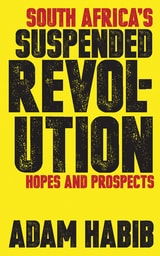
South Africa’s Suspended Revolution
Hopes and ProspectsAdam Habib
Ohio University Press, 2013
South Africa’s Suspended Revolution tells the story of South Africa’s democratic transition and the prospects for the country to develop a truly inclusive political system. Beginning with an account of the transition in the leadership of the African National Congress from Thabo Mbeki to Jacob Zuma, the book then broadens its lens to examine the relationship of South Africa’s political elite to its citizens. It also examines the evolution of economic and social policies through the democratic transition, as well as the development of a postapartheid business community and a foreign policy designed to re-engage South Africa with the world community.
Written by one of South Africa’s leading scholars and political commentators, the book combines historical and contemporary analysis with strategies for an alternative political agenda. Adam Habib connects the lessons of the South African experience with theories of democratic transition, social change, and conflict resolution. Political leaders, scholars, students, and activists will all find material here to deepen their understanding of the challenges and opportunities of contemporary South Africa.
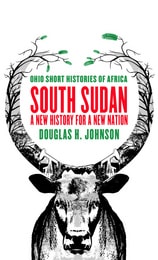
South Sudan
A New History for a New NationDouglas H. Johnson
Ohio University Press, 2016
Africa’s newest nation has a long history. Often considered remote and isolated from the rest of Africa, and usually associated with the violence of slavery and civil war, South Sudan has been an arena for a complex mixing of peoples, languages, and beliefs. The nation’s diversity is both its strength and a challenge as its people attempt to overcome the legacy of decades of war to build a new economic, political, and national future.
Most recent studies of South Sudan’s history have a foreshortened sense of the past, focusing on current political issues, the recently ended civil war, or the ongoing conflicts within the country and along its border with Sudan. This brief but substantial overview of South Sudan’s longue durée, by one of the world’s foremost experts on the region, answers the need for a current, accessible book on this important country.
Drawing on recent advances in the archaeology of the Nile Valley, new fieldwork as well as classic ethnography, and local and foreign archives, Johnson recovers South Sudan’s place in African history and challenges the stereotypes imposed on its peoples.