Results by title
4412 books match the query 'Anthropology' and 316 start with s
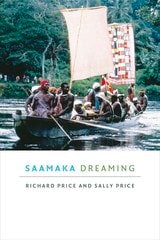
Saamaka Dreaming
Richard Price and Sally Price
Duke University Press, 2017

Sacred Modern
Faith, Activism, and Aesthetics in the Menil CollectionBy Pamela G. Smart
University of Texas Press, 2010
Renowned as one of the most significant museums built by private collectors, the Menil Collection in Houston, Texas, seeks to engage viewers in an acutely aesthetic, rather than pedagogical, experience of works of art. The Menil's emphasis on being moved by art, rather than being taught art history, comes from its founders' conviction that art offers a way to reintegrate the sacred and the secular worlds. Inspired by the French Catholic revivalism of the interwar years that recast Catholic tradition as the avant-garde, Dominique and John de Menil shared with other Catholic intellectuals a desire to reorder a world in crisis by imbuing modern cultural forms with religious faith, binding the sacred with the modern.
Sacred Modern explores how the Menil Collection gives expression to the religious and political convictions of its founders and how "the Menil way" is being both perpetuated and contested as the Museum makes the transition from operating under the personal direction of Dominique de Menil to the stewardship of career professionals. Taking an ethnographic approach, Pamela G. Smart analyzes the character of the Menil aesthetic, the processes by which it is produced, and the sensibilities that it is meant to generate in those who engage with the collection. She also offers insight into the extraordinary impact Dominique and John de Menil had on the emergence of Houston as a major cultural center.
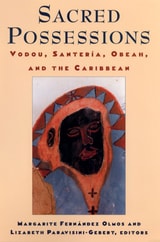
Sacred Possessions
Vodou, Santería, Obeah, and the CaribbeanOlmos, Margarite Fernândez
Rutgers University Press, 1997
Sacred Possessions is an unprecedented collection of thirteen comparative and interdisciplinary essays exploring the cross-cultural dynamics of African-based religious systems in the Caribbean. The contributors analyze the nature and liturgies of Vodou, Santeria, Obeah, Quimbois, and Gaga as they form one central cultural matrix in the region. They ask how these belief systems were affected by differing colonial histories and landscapes, and how they affected other cultural expressions (from the oral tradition to popular art and literature), and how they have been perceived and (mis)represented by the West.
The book is a unique contribution to the study of the Caribbean as a site of multiculturalism, demonstrating the linkages between anthropology, religion, literature, and popular culture. Also included are a stunning photoessay on Cuban Santeria, a glossary of terms, and an insightful introduction by the editors.
Sacred Possessions
Vodou, Santería, Obeah, and the CaribbeanOlmos, Margarite Fernândez
Rutgers University Press, 1997
Sacred Possessions is an unprecedented collection of thirteen comparative and interdisciplinary essays exploring the cross-cultural dynamics of African-based religious systems in the Caribbean. The contributors analyze the nature and liturgies of Vodou, Santeria, Obeah, Quimbois, and Gaga as they form one central cultural matrix in the region. They ask how these belief systems were affected by differing colonial histories and landscapes, and how they affected other cultural expressions (from the oral tradition to popular art and literature), and how they have been perceived and (mis)represented by the West.
The book is a unique contribution to the study of the Caribbean as a site of multiculturalism, demonstrating the linkages between anthropology, religion, literature, and popular culture. Also included are a stunning photoessay on Cuban Santeria, a glossary of terms, and an insightful introduction by the editors.
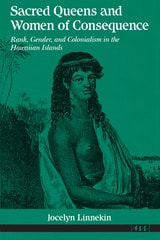
Sacred Queens and Women of Consequence
Rank, Gender, and Colonialism in the Hawaiian IslandsJocelyn Linnekin
University of Michigan Press, 1990
Sacred Queens and Women of Consequence is a pathbreaking examination of the contact encounter in Hawaii from the perspective of Hawaiian women. Jocelyn Linnekin offers a reconstruction of Hawaiian women's authority and status before contact with the West and examines changes in their cultural valuation and social position during the first century of Western contact. Through a detailed analysis of women's roles in exchange, production, kinship, and politics during the political and economic transformations of the nineteenth century, Linnekin challenges the view that Polynesian women were doomed to a peripheral status by the ritual logic of pollution. She demonstrates how Hawaiian women maintained their position as points of access to land and power, while frequently resisting the constraints of the tabu system as well as later Western-influenced attempts to abridge their authority.This book is a unique and important contribution to the scholarship on Hawaiian history as well as to the growing literature on women and colonialism and women and social stratification. It will appeal to scholars and students who work in the areas of gender studies, social stratification, cultural change, Oceania, and historical anthropology.
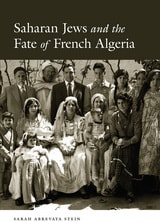
Saharan Jews and the Fate of French Algeria
Sarah Abrevaya Stein
University of Chicago Press, 2014
Drawing on materials from thirty archives across six countries, Stein tells the story of colonial imposition on a desert community that had lived and traveled in the Sahara for centuries. She paints an intriguing historical picture—of an ancient community, trans-Saharan commerce, desert labor camps during World War II, anthropologist spies, battles over oil, and the struggle for Algerian sovereignty. Writing colonialism and decolonization into Jewish history and Jews into the French Saharan one, Saharan Jews and the Fate of French Algeria is a fascinating exploration not of Jewish exceptionalism but of colonial power and its religious and cultural differentiations, which have indelibly shaped the modern world.
Sahel Visions
Planned Settlement and River Blindness Control in Burkina FasoDella E. McMillan
University of Arizona Press, 1994
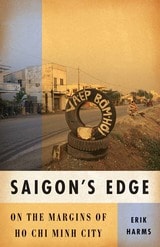
Saigon’s Edge
On the Margins of Ho Chi Minh CityErik Harms
University of Minnesota Press, 2010
Unlike the idealized Vietnamese model of urban space, Hóc Môn is between worlds, neither outside nor inside but always uncomfortably both. With particular attention to everyday social realities, Harms demonstrates how living on the margin can be both alienating and empowering, as forces that exclude its denizens from power and privilege in the inner city are used to thwart the status quo on the rural edges.
More than a local case study of urban change, Harms’s work also opens a window on Vietnam’s larger turn toward market socialism and the celebration of urbanization—transformations instructively linked to trends around the globe.

Sales and Celebrations
Retailing and Regional Identity in Western New York State, 1920–1940Sarah Elvins
Ohio University Press, 2004
Between the two world wars, the retail world experienced tremendous changes. New forms of competition, expanded networks of communication and transportation, and the proliferation of manufactured goods posed challenges to department store and small shopkeeper alike.
In western New York, and in Buffalo and Rochester in particular, retailers were a crucial part of urban life, acting as cultural brokers and civic leaders. They were also cultivators of area pride. Even as they adopted the latest merchandising techniques or stocked the newest items, merchants emphasized their local roots and their ability to put a local spin on national trends and innovations. Regional identity became a powerful selling tool not only during the prosperity of the 1920s but also through the economic crisis of the Great Depression.
Sales and Celebrations explains how local traditions and institutions affected the evolution of American consumer culture. It expands our understanding of American consumerism, demonstrating that local particularities and loyalties could often coexist with, and occasionally challenge, the spread of mass consumption. In her award-winning study, Professor Sarah Elvins provides new insight into the relationship between America’s largest metropolises and its smaller centers. Retailers in Buffalo and Rochester did not simply imitate the practices of their counterparts in Manhattan and Chicago; they highlighted their unique ability to serve the wants and needs of their particular markets.
By drawing attention to this persistent power of the local, Sales and Celebrations illuminates a neglected aspect of the story of American culture in the interwar period.
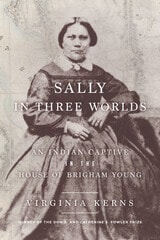
Sally in Three Worlds
An Indian Captive in the House of Brigham YoungVirginia Kerns
University of Utah Press, 2021
In this remarkable and deeply felt book, Virginia Kerns uncovers the singular and forgotten life of a young Indian woman who was captured in 1847 in what was then Mexican territory. Sold to a settler, a son-in-law of Brigham Young, the woman spent the next thirty years as a servant to Young’s family. Sally, as they called her, lived in the shadows, largely unseen. She was later remembered as a “wild” woman made “tame” who happily shed her past to enter a new and better life in civilization.
Drawing from a broad range of primary sources, Kerns retrieves Sally from obscurity and reconstructs her complex life before, during, and after captivity. This true story from the American past resonates deeply in the current moment, attentive as it is to killing epidemics and racial injustices. In telling Sally’s story, Kerns presents a new narrative of the American West.
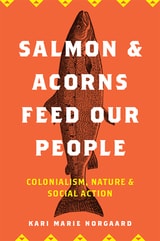
Salmon and Acorns Feed Our People
Colonialism, Nature, and Social ActionKari Marie Norgaard
Rutgers University Press, 2019
Since time before memory, large numbers of salmon have made their way up and down the Klamath River. Indigenous management enabled the ecological abundance that formed the basis of capitalist wealth across North America. These activities on the landscape continue today, although they are often the site of intense political struggle. Not only has the magnitude of Native American genocide been of remarkable little sociological focus, the fact that this genocide has been coupled with a reorganization of the natural world represents a substantial theoretical void. Whereas much attention has (rightfully) focused on the structuring of capitalism, racism and patriarchy, few sociologists have attended to the ongoing process of North American colonialism. Salmon and Acorns Feed Our People draws upon nearly two decades of examples and insight from Karuk experiences on the Klamath River to illustrate how the ecological dynamics of settler-colonialism are essential for theorizing gender, race and social power today.
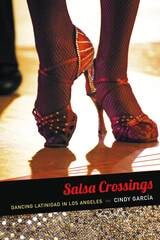
Salsa Crossings
Dancing Latinidad in Los AngelesCindy García
Duke University Press, 2013
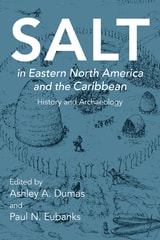
Salt in Eastern North America and the Caribbean
History and ArchaeologyEdited by Ashley A. Dumas and Paul N. Eubanks
University of Alabama Press, 2021
Case studies examining the archaeological record of an overlooked mineral
Salt, once a highly prized trade commodity essential for human survival, is often overlooked in research because it is invisible in the archaeological record. Salt in Eastern North America and the Caribbean: History and Archaeology brings salt back into archaeology, showing that it was valued as a dietary additive, had curative powers, and was a substance of political power and religious significance for Native Americans. Major salines were embedded in collective memories and oral traditions for thousands of years as places where physical and spiritual needs could be met. Ethnohistoric documents for many Indian cultures describe the uses of and taboos and other beliefs about salt.
The volume is organized into two parts: Salt Histories and Salt in Society. Case studies from prehistory to post-Contact and from New York to Jamaica address what techniques were used to make salt, who was responsible for producing it, how it was used, the impact it had on settlement patterns and sociopolitical complexity, and how economies of salt changed after European contact. Noted salt archaeologist Heather McKillop provides commentary to conclude the volume.
.
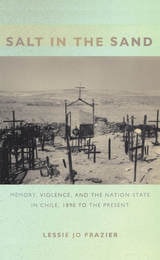
Salt in the Sand
Memory, Violence, and the Nation-State in Chile, 1890 to the PresentLessie Jo Frazier
Duke University Press, 2007
Analyzing multiple memories of state violence, Frazier innovatively shapes social and cultural theory to interpret a range of sources, including local and national government archives, personal papers, popular literature and music, interviews, architectural and ceremonial commemorations, and her ethnographic observations of civic associations, women's and environmental groups, and human rights organizations. A masterful integration of extensive empirical research with sophisticated theoretical analysis, Salt in the Sand is a significant contribution to interdisciplinary scholarship on human rights, democratization, state formation, and national trauma and reconciliation.
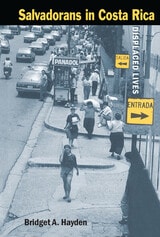
Salvadorans in Costa Rica
Displaced LivesBridget Hayden
University of Arizona Press, 2003
Salvadorans in Costa Rica: Displaced Lives introduces readers to people from a wide range of class and educational backgrounds who had come to Costa Rica from all over El Salvador. All shared the experience of having become refugees and having settled in a new country under the same circumstances, and when the war in their own country ended, they shared a concern about the issues involved in deciding whether to return there. Their diversity allows Hayden to examine the ways in which the language of national identity played out in different contexts and sometimes contradictory ways.
Drawing on contemporary theories of migration and space, Hayden identifies the discourses, narratives, and concepts that Salvadorans in Costa Rica had in common and then analyzes the ways in which their experiences and their uses of those discourses varied. She focuses on key spatial concepts that Salvadorans used in talking about displacement and re-emplacement in order to show how they constructed the experience of settlement and how such variables as gender and age influenced their experiences. Because "nationality" was an idiom they used to relate their experiences, she pays particular attention to the role of national belonging and national difference—in terms of both the ways in which the Salvadorans were received by Costa Ricans and their reactions to their new lives in Costa Rica. A concluding chapter compares them with Salvadorans who emigrated to other countries.
The story of these displaced Salvadorans, focusing on the lives of real people, can give us a new understanding of how individuals feel a sense of belonging to a sociocultural space. By exploring many meanings of the nation and national belonging for different people under varying conditions, Hayden's study provides fresh insights into the dynamics of migration, gender, and nationalism.
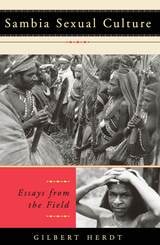
Sambia Sexual Culture
Essays from the FieldGilbert Herdt
University of Chicago Press, 1999
Over the course of 20 years, Herdt made 13 field trips to live with the Sambia in order to understand sexuality and ritual in the context of warfare and gender segregation. Herdt's essays examine Sambia fetish and fantasy, ritual nose-bleeding, the role of homoerotic insemination, the role of the father and mother in the process of identity formation, and the creation of a "third sex" in nature and culture. He also discusses the representation of homosexuality in cross-cultural literature on premodern societies, arguing that scholars have long viewed desires through the tropes of negative western models. Herdt asks us to reconsider the realities and subjective experiences of desires in their own context, and to rethink how the homoerotic is expressed in radically divergent sexual cultures.
SamulNori
Contemporary Korean Drumming and the Rebirth of Itinerant Performance CultureNathan Hesselink
University of Chicago Press, 2012

San Rock Art
J.D. Lewis-Williams
Ohio University Press, 2011
San rock paintings, scattered over the range of southern Africa, are considered by many to be the very earliest examples of representational art. There are as many as 15,000 known rock art sites, created over the course of thousands of years up until the nineteenth century. There are possibly just as many still awaiting discovery.
Taking as his starting point the magnificent Linton panel in the Iziko-South African Museum in Cape Town, J. D. Lewis-Williams examines the artistic and cultural significance of rock art and how this art sheds light on how San image-makers conceived their world. It also details the European encounter with rock art as well as the contentious European interaction with the artists’ descendants, the contemporary San people.
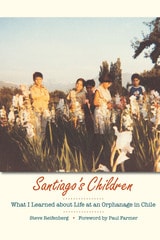
Santiago's Children
What I Learned about Life at an Orphanage in ChileBy Steve Reifenberg
University of Texas Press, 2008
Runner-up, Bronze Medal, Independent Publishers Book Awards: Memoir/Autobiography Category, 2009
Unclear about his future career path, Steve Reifenberg found himself in the early 1980s working at a small orphanage in a poor neighborhood in Santiago, Chile, where a determined single woman was trying to create a stable home for a dozen or so children who had been abandoned or abused. With little more than good intentions and very limited Spanish, the 23-year-old Reifenberg plunged into the life of the Hogar Domingo Savio, becoming a foster father to kids who stretched his capacities for compassion and understanding in ways he never could have imagined back in the United States.
In this beautifully written memoir, Reifenberg recalls his two years at the Hogar Domingo Savio. His vivid descriptions create indelible portraits of a dozen remarkable kids—mature-beyond-her-years Verónica; sullen, unresponsive Marcelo; and irrepressible toddler Andrés, among them. As Reifenberg learns more about the children's circumstances, he begins to see the bigger picture of life in Chile at a crucial moment in its history.
The early 1980s were a time of economic crisis and political uprising against the brutal military dictatorship of Augusto Pinochet. Reifenberg skillfully interweaves the story of the orphanage with the broader national and international forces that dramatically impact the lives of the kids. By the end of Santiago's Children, Reifenberg has told an engrossing story not only of his own coming-of-age, but also of the courage and resilience of the poorest and most vulnerable residents of Latin America.
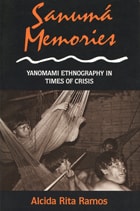
Sanuma Memories
Yanomami Ethnography in Times of CrisisAlcida Rita Ramos
University of Wisconsin Press, 1995
The Yanomami people of Brazil first attracted anthropological and popular attention in the 1960s, when they were portrayed as essentially primitive and violent in the widely read book Yanomamo: The Fierce People. To this image of the Yanomami another has recently been added: that of victims of the economic rapacity devouring the Amazon.
Sanumá Memories moves beyond these images to provide the first anthropologically sophisticated account of the Yanomami and their social organization, kinship, and marriage, capturing both individual experiences and the broader sociological trends that engulf them. A poignant personal story as well, it draws on Alcida Ramos's extensive fieldwork among the Sanumá (the northernmost Yanomami subgroup) from 1968 to 1992, as she reports on the brutal impact of many invasions—from road construction to the gold rush that brought the Yanomami social chaos, thousands of deaths, devastation of gardens and forest, and a disquietingly uncertain future.
At the cutting edge of anthropological description and analysis, Sanumá Memories ponders the importance of "otherness" to the Sanumá; describes Sanumá spaces, from the grandiosity of the rain forest to cozy family compartments; analyzes their notions of time, from the minute reckoning of routine village life to historical and metaphysical macro-time; shows how power and authority are generated and allocated in space and time; and examines the secrecy of personal names and the all-pervading consequences of disclosing them.
Sarajevo
A Bosnian KaleidoscopeFran Markowitz
University of Illinois Press, 2010
This fascinating urban anthropological analysis of Sarajevo and its cultural complexities examines contemporary issues of social divisiveness, pluralism, and intergroup dynamics in the context of national identity and state formation. Rather than seeing Bosnia-Herzegovina as a volatile postsocialist society, the book presents its capital city as a vibrant yet wounded center of multicultural diversity, where citizens live in mutual recognition of difference while asserting a lifestyle that transcends boundaries of ethnicity and religion. It further illuminates how Sarajevans negotiate group identity in the tumultuous context of history, authoritarian rule, and interactions with the built environment and one another.
As she navigates the city, Fran Markowitz shares narratives of local citizenry played out against the larger dramas of nation and state building. She shows how Sarajevans' national identities have been forged in the crucible of power, culture, language, and politics. Sarajevo: A Bosnian Kaleidoscope acknowledges this Central European city's dramatic survival from the ravages of civil war as it advances into the present-day global arena.

Sardonic Smile
Nonverbal Behavior in Homeric EpicDonald Lateiner
University of Michigan Press, 1998
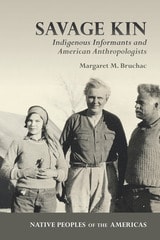
Savage Kin
Indigenous Informants and American AnthropologistsMargaret M. Bruchac
University of Arizona Press, 2018
This book reconceptualizes the intimate details of encounters with Native interlocutors who by turns inspired, facilitated, and resisted the anthropological enterprise. Like other texts focused on this era, Savage Kin features some of the elite white men credited with salvaging material that might otherwise have been lost. Unlike other texts, this book highlights the intellectual contributions and cultural strategies of unsung Indigenous informants without whom this research could never have taken place.
These bicultural partnerships transgressed social divides and blurred the roles of anthropologist/informant, relative/stranger, and collector/collected. Yet these stories were obscured by collecting practices that separated people from objects, objects from communities, and communities from stories. Bruchac’s decolonizing efforts include “reverse ethnography”—painstakingly tracking seemingly unidentifiable objects, misconstrued social relations, unpublished correspondence, and unattributed field notes—to recover this evidence. Those early encounters generated foundational knowledges that still affect Indigenous communities today.
Savage Kin also contains unexpected narratives of human and other-than-human encounters—brilliant discoveries, lessons from ancestral spirits, prophetic warnings, powerful gifts, and personal tragedies—that will move Native and non-Native readers alike.
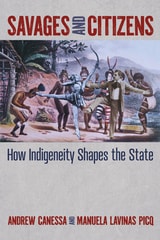
Savages and Citizens
How Indigeneity Shapes the StateAndrew Canessa and Manuela Lavinas Picq; Foreword by Jeff Ganohalidoh Corntassel
University of Arizona Press, 2024
Delving into European political philosophy, comparative politics, and contemporary international law, the book shows how the concept of indigeneity has shaped the development of the modern state. The exclusion of Indigenous people was not a collateral byproduct; it was a political project in its own right. The book argues that indigeneity is a political identity relational to modern nation-states and that Indigenous politics, although marking the boundary of the state, are co-constitutive of colonial processes of state-making. In showing how indigeneity is central to how the international system of states operates, the book forefronts Indigenous peoples as political actors to reject essentializing views that reduce them to cultural “survivors” rooted in the past.
With insights drawn from diverse global contexts and empirical research from Bolivia and Ecuador, this work advocates for the relevance of Indigenous studies within political science and argues for an ethnography of sovereignty in anthropology. Savages and Citizens makes a compelling case for the centrality of Indigenous perspectives to understand the modern state from political theory to international studies.
Savages, Romans, and Despots
Thinking about Others from Montaigne to HerderRobert Launay
University of Chicago Press, 2018
Beginning with Mandeville and Montaigne, and working through Montesquieu, Diderot, Gibbon, Herder, and others, Launay traces how Europeans both admired and disdained unfamiliar societies in their attempts to work through the inner conflicts of their own social worlds. Some of these writers drew caricatures of “savages,” “Oriental despots,” and “ancient” Greeks and Romans. Others earnestly attempted to understand them. But, throughout this history, comparative thinking opened a space for critical reflection. At its worst, such space could give rise to a sense of European superiority. At its best, however, it could prompt awareness of the value of other ways of being in the world. Launay’s masterful survey of some of the Western tradition’s finest minds offers a keen exploration of the genesis of the notion of “civilization,” as well as an engaging portrait of the promises and perils of cross-cultural comparison.

Savaging the Civilized
Verrier Elwin, His Tribals, and IndiaRamachandra Guha
University of Chicago Press, 1999
Described by his contemporaries as a cross between Albert Schweitzer and Paul Gauguin, Elwin was a man of contradictions, at times taking on the role of evangelist, social worker, political activist, poet, government worker, and more. He rubbed elbows with the elite of both Britain and India, yet found himself equally at home among the impoverished and destitute. Intensely political, the Oxford-trained scholar tirelessly defended the rights of the indigenous and, despite the deep religious influences of St. Francis and Mahatma Gandhi on his early career, staunchly opposed Hindu and Christian puritans in the debate over the future of India's tribals. Although he was ordained as an Anglican priest, Elwin was married twice to tribal women and enthusiastically (and publicly) extolled the tribals' practice of free sex. Later, as prime minister Nehru's friend and advisor in independent India, his compelling defense of tribal hedonism made him at once hugely influential, extremely controversial, and the polemical focal point of heated discussions on tribal policy and economic development.
Savaging the Civilized is both biography and history, an exploration through Elwin's life of some of the great debates of the twentieth century: the future of development, cultural assimilation versus cultural difference, the political practice of postcolonial as opposed to colonial governments, and the moral practice of writers and intellectuals.

Saving Animals
Multispecies Ecologies of Rescue and CareElan Abrell
University of Minnesota Press, 2021
A fascinating and unprecedented ethnography of animal sanctuaries in the United States
In the past three decades, animal rights advocates have established everything from elephant sanctuaries in Africa to shelters that rehabilitate animals used in medical testing, to homes for farmed animals, abandoned pets, and entertainment animals that have outlived their “usefulness.” Saving Animals is the first major ethnography to focus on the ethical issues animating the establishment of such places, where animals who have been mistreated or destined for slaughter are allowed to live out their lives simply being animals.
Based on fieldwork at animal rescue facilities across the United States, Elan Abrell asks what “saving,” “caring for,” and “sanctuary” actually mean. He considers sanctuaries as laboratories where caregivers conceive and implement new models of caring for and relating to animals. He explores the ethical decision making around sanctuary efforts to unmake property-based human–animal relations by creating spaces in which humans interact with animals as autonomous subjects. Saving Animals illustrates how caregivers and animals respond by cocreating new human–animal ecologies adapted to the material and social conditions of the Anthropocene.
Bridging anthropology with animal studies and political philosophy, Saving Animals asks us to imagine less harmful modes of existence in a troubled world where both animals and humans seek sanctuary.
Savu
History and Oral Tradition on an Island of IndonesiaGeneviève Duggan and Hans Hägerdal
National University of Singapore Press, 2018

Scammer's Yard
The Crime of Black Repair in JamaicaJovan Scott Lewis
University of Minnesota Press, 2020
Tells the story of Jamaican “scammers” who use crime to gain autonomy, opportunity, and repair
There is romance in stealing from the rich to give to the poor, but how does that change when those perceived rich are elderly white North Americans and the poor are young Black Jamaicans? In this innovative ethnography, Jovan Scott Lewis tells the story of Omar, Junior, and Dwayne. Young and poor, they strive to make a living in Montego Bay, where call centers and tourism are the two main industries in the struggling economy. Their experience of grinding poverty and drastically limited opportunity leads them to conclude that scamming is the best means of gaining wealth and advancement. Otherwise, they are doomed to live in “sufferation”—an inescapable poverty that breeds misery, frustration, and vexation.
In the Jamaican lottery scam run by these men, targets are told they have qualified for a large loan or award if they pay taxes or transfer fees. When the fees are paid, the award never arrives, netting the scammers tens of thousands of U.S. dollars. Through interviews, historical sources, song lyrics, and court testimonies, Lewis examines how these scammers justify their deceit, discovering an ethical narrative that reformulates ideas of crime and transgression and their relationship to race, justice, and debt.
Scammer’s Yard describes how these young men, seeking to overcome inequality and achieve autonomy, come to view crime as a form of liberation. Their logic raises unsettling questions about a world economy that relegates postcolonial populations to deprivation even while expecting them to follow the rules of capitalism that exacerbate their dispossession. In this groundbreaking account, Lewis asks whether true reparation for the legacy of colonialism is to be found only through radical—even criminal—means.

Scarlett's Women
Gone With the Wind and Its Female FansTaylor, Helen
Rutgers University Press, 1989

Scarlett's Women
Gone With the Wind and Its Female FansTaylor, Helen
Rutgers University Press, 1969

Scenes from the High Desert
JULIAN STEWARD'S LIFE AND THEORYVirginia Kerns
University of Illinois Press, 2002
Scenes from the Shadows
Afro-Argentine Life in the Twentieth CenturyRobert J. Cottrol and Lea Geler
Ohio University Press, 2027
Scenes from the Shadows challenges one of the most enduring myths of Argentine history: that Afro-Argentines had disappeared by the twentieth century. Bringing together leading scholars of race, culture, and history, the volume demonstrates that Afro-descendant communities remained a vital part of Argentine society even as official narratives, public institutions, and popular memory rendered them increasingly invisible. Drawing on oral histories, community newspapers, family archives, ethnography, and archival research, the contributors recover the lives, organizations, and cultural worlds that persisted beneath the surface of Argentina’s self-image as a White, European nation.
Focusing on Buenos Aires—home to the country’s largest Afro-descendant population and the epicenter of debates over race and national identity—the book situates Argentina within the broader history of the African diaspora in Latin America and examines how ideologies of Whitening (blanqueamiento), racial classification, urban development, and national identity obscured Afro-descendant presence throughout the twentieth century. The chapters explore Black celebrity and performance culture, tango, Afro-Porteño associational life, community journalism, public employment, migration, gender, and the formation of Afro-descendant social networks, revealing how Afro-Argentines negotiated exclusion while sustaining vibrant traditions of community, creativity, and belonging.
More than a recovery of forgotten histories, Scenes from the Shadows offers a new interpretation of modern Argentina itself. It shows how race continued to shape social life even in a society that denied its importance and how Afro-descendant communities endured despite powerful pressures toward erasure. A major contribution to Afro-Latin American studies, Argentine history, and diaspora scholarship, the volume restores Afro-Argentines to their place in the story of twentieth-century Argentina and provides a powerful framework for understanding the relationship between race, memory, and nationhood.
Contributors
Paulina L. Alberto
Judith M. Anderson
Laura Colabella
Robert J. Cottrol
Alejandra Egido
Alejandro Frigerio
Lea Geler
Lucas Glasman
Miriam Gomes
Chisu Teresa Ko
Eva Lamborghini
Marta Maffia
Carmen Yannone

Schneider on Schneider
The Conversion of the Jews and Other Anthropological StoriesDavid M. Schneider, as told to Richard Handler
Duke University Press, 1995
In this work, based on conversations with Richard Handler, Schneider tells the story of his days devoted to anthropology—as a student of Clyde Kluckhohn and Talcott Parsons and as a writer and teacher whose work on kinship and culture theory revolutionized the discipline. With a master’s sense of the telling anecdote, he describes his education at Cornell, Yale, and Harvard, his fieldwork on the Micronesian island of Yap and among the Mescalero Apache, and his years teaching at the London School of Economics, Berkeley, and the University of Chicago. Musing on the current state and the future of anthropology, Schneider’s cast of characters reads like a who’s who of postwar social science. His reflections on anthropological field research and academic politics address some of the most pressing ethical and epistemological issues facing scholars today, while yielding tales of unexpected amusement.
With its humor and irony, its wealth of information and searching questions about the state of anthropology, Schneider on Schneider not only provides an important resource for the history of twentieth-century social science, but also brings to life the entertaining voice of an engaging storyteller.

School for Cool
The Academic Jazz Program and the Paradox of Institutionalized CreativityEitan Y. Wilf
University of Chicago Press, 2014
Few art forms epitomize the anti-institutional image more than jazz, but it’s precisely at the academy where jazz is now flourishing. This shift has introduced numerous challenges and contradictions to the music’s practitioners. Solos are transcribed, technique is standardized, and the whole endeavor is plastered with the label “high art”—a far cry from its freewheeling days. Wilf shows how students, educators, and administrators have attempted to meet these challenges with an inventive spirit and a robust drive to preserve—and foster—what they consider to be jazz’s central attributes: its charisma and unexpectedness. He also highlights the unintended consequences of their efforts to do so. Ultimately, he argues, the gap between creative practice and institutionalized schooling, although real, is often the product of our efforts to close it.

Science Fiction Cinema
Between Fantasy and RealityCornea, Christine
Rutgers University Press, 2007
Offering a broad historical and theoretical reassessment of science fiction, Christine Cornea explores the development of this popular genre in cinema from its very beginnings to the present day. Each chapter offers analyses of particular films, situating them within a wider historical/cultural context while also highlighting a specific key thematic issue. Cornea provides vital and unique perspectives on the genre, including discussions of the relevance of psychedelic imagery, race, the “new woman of science,” generic performance, and the prevalence of “techno-orientalism” in recent films. Enriching the book are new interviews with some of the main practitioners in the field, such as Roland Emmerich, Paul Verhoeven, Ken Russell, Stan Winston, William Gibson, Brian Aldiss, Joe Morton, Dean Norris, and Billy Gray. While American films are Cornea’s main focus, she also engages with a range of examples from other countries and explains why science fiction lends itself well to transnational reception.
Among the many films discussed are The Day the Earth Stood Still, The Body Snatchers, Forbidden Planet, The Quatermass Experiment, 2001: A Space Odyssey, Demon Seed, Star Trek: The Motion Picture, Star Wars, Altered States, Alien, Blade Runner, The Brother from Another Planet, Back to the Future, The Terminator, Predator, The One, Dark City, The Matrix, Fifth Element, and eXistenZ.

Science in the Forest, Science in the Past
Edited by Geoffrey E. R. Lloyd and Aparecida Vilaça
HAU, 2020
Science in the Forest, Science in the Past is a pioneering interdisciplinary exploration that will challenge the way readers interested in sciences, mathematics, humanities, social research, computer sciences, and education think about deeply held notions of what constitutes reality, how it is apprehended, and how to investigate it.

Screening Social Justice
Brave New Films and Documentary ActivismSherry B. Ortner
Duke University Press, 2023
Scripted Affects, Branded Selves
Television, Subjectivity, and Capitalism in 1990s JapanGabriella Lukács
Duke University Press, 2010
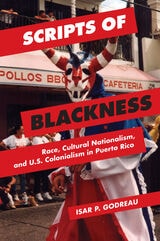
Scripts of Blackness
Race, Cultural Nationalism, and U.S. Colonialism in Puerto RicoIsar P. Godreau
University of Illinois Press, 2015
Based on an ethnographic study of the barrio of San Antón in the city of Ponce, Scripts of Blackness examines institutional and local representations of blackness as developing from a power-laden process that is inherently selective and political, not neutral or natural. Godreau traces the presumed benevolence or triviality of slavery in Puerto Rico, the favoring of a Spanish colonial whiteness (under a hispanophile discourse), and the insistence on a harmonious race mixture as discourses that thrive on a presumed contrast with the United States that also characterize Puerto Rico as morally superior. In so doing, she outlines the debates, social hierarchies, and colonial discourses that inform the racialization of San Antón and its residents as black.
Mining ethnographic materials and anthropological and historical research, Scripts of Blackness provides powerful insights into the critical political, economic, and historical context behind the strategic deployment of blackness, whiteness, and racial mixture.
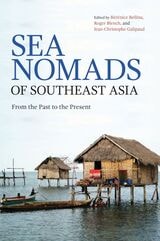
Sea Nomads of Southeast Asia
From the Past to the PresentEdited by Bérénice Bellina, Roger Blench, and Jean-Christophe Galipaud
National University of Singapore Press, 2020
For many years, the sea nomads were assumed to be without history, and even without archaeology. This has proven far from the case, and recent archaeological findings allow us to more closely describe sea nomadism from the Pleistocene through the early Holocene up to the present. Integrating these findings with the latest in historical research, linguistics, ethnography and historical genetics allows us to better understand sea-nomad ways of life over a scale of millennia and to appreciate the diversity and flexibility of this sea-nomad world. This in turn enriches our understanding of nomadism and mobility as ways of life more generally, and of the sea not only as a landscape of resources, but as a home and spiritual landscape.
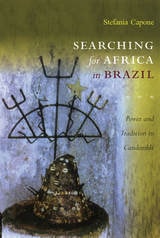
Searching for Africa in Brazil
Power and Tradition in CandombléStefania Capone
Duke University Press, 2010
Challenging the usual interpretations of Afro-Brazilian religions as fixed entities, completely independent of one another, Capone reveals these practices as parts of a unique religious continuum. She does so through an analysis of ritual variations as well as discursive practices. To illuminate the continuum of Afro-Brazilian religious practice and the tensions between exegetic discourses and ritual practices, Capone focuses on the figure of Exu, the sacred African trickster who allows communication between gods and men. Following Exu and his avatars, she discloses the centrality of notions of prestige and power—mystical and religious—in Afro-Brazilian religions. To explain how religious identity is constantly negotiated among social actors, Capone emphasizes the agency of practitioners and their political agendas in the “return to roots,” or re-Africanization, movement, an attempt to recover the original purity of a mythical and legitimizing Africa.
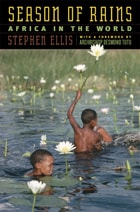
Season of Rains
Africa in the WorldStephen Ellis
University of Chicago Press, 2012

Second Chances
Surviving AIDS in UgandaSusan Reynolds Whyte, editor
Duke University Press, 2014
Contributors. Phoebe Kajubi, David Kyaddondo, Lotte Meinert, Hanne O. Mogensen, Godfrey Etyang Siu, Jenipher Twebaze, Michael A. Whyte, Susan Reynolds Whyte

Second Star to the Right
Peter Pan in the Popular ImaginationFriedman, Lester D
Rutgers University Press, 2008
Since 2003 the characters from this story have had a highly visible presence in nearly every genre of popular culture: two major films, a literary sequel to the original adventures, a graphic novel featuring a grown-up Wendy Darling, and an Argentinean novel about a children's book writer inspired by J. M. Barrie. Simultaneously, Barrie surfaced as the subject of two major biographies and a feature film. The engaging essays in Second Star to the Right approach Pan from literary, dramatic, film, television, and sociological perspectives and, in the process, analyze his emergence and preservation in the cultural imagination.
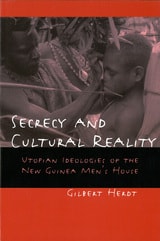
Secrecy and Cultural Reality
Utopian Ideologies of the New Guinea Men's HouseGilbert Herdt
University of Michigan Press, 2003
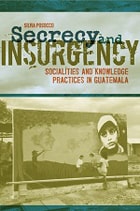
Secrecy and Insurgency
Socialities and Knowledge Practices in GuatemalaSilvia Posocco
University of Alabama Press, 2014
Drawing on a broad field of contemporary theory, Silvia Posocco’s Secrecy and Insurgency presents a vivid ethnographic account of secrecy as both sociality and a set of knowledge practices. Informed by multi-sited anthropological fieldwork among displaced communities with experiences of militancy in the guerrilla organization Fuerzas Armadas Rebeldes, the book traces the contours of dispersed and intermittent guerrilla social relations, unraveling the gendered dimensions of guerrilla socialities and subjectivities in a local context marked by violence and rapid social change.
The chapters chart shifting regimes of governance in the northern departamento of Petén; the inception of violence and insurgency; guerrilla practices of naming and secret relations; moral orders based on sameness and sharing; and forms of relatedness, embodiment, and subjectivity among the combatants. The volume develops new critical idioms for grappling with partiality, perspective, and incompleteness in ethnography and contributes to new thinking on the anthropology of Guatemala.
Secrecy and Insurgency will be of interest to social and cultural anthropologists, human geographers, and scholars in Latin American studies, human rights, women’s studies, and gender studies.
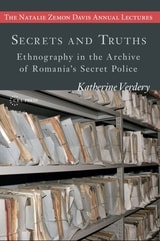
Secrets and Truths
Ethnography in the Archive of Romania's Secret PoliceKatherine Verdery
Central European University Press, 2014
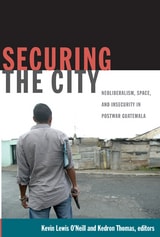
Securing the City
Neoliberalism, Space, and Insecurity in Postwar GuatemalaKevin Lewis O Neill and Kedron Thomas, eds.
Duke University Press, 2011
Contributors. Peter Benson, Manuela Camus, Avery Dickins de Girón, Edward F. Fischer, Deborah Levenson, Thomas Offit, Kevin Lewis O’Neill, Kedron Thomas, Rodrigo José Véliz

Security Disarmed
Critical Perspectives on Gender, Race, and MilitarizationMorgen, Sandra
Rutgers University Press, 2008
In Security Disarmed, scholars, policy planners, and activists come together to think critically about the human cost of violence and viable alternatives to armed conflict. Arranged in four parts--alternative paradigms of security, cross-national militarization, militarism in the United States, and pedagogical and cultural concerns--the book critically challenges militarization and voices an alternative encompassing vision of human security by analyzing the relationships among gender, race, and militarization. This collection of essays evaluates and resists the worldwide crisis of militarizationùincluding but going beyond American military engagements in the twenty-first century.