Results by title
808 books match the query 'Drama' and 81 start with s
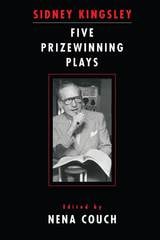
SIDNEY KINGSLEY
FIVE PRIZEWINNING PLAYSNena Couch
The Ohio State University Press, 1997
Sidney Kingsley was a playwright, but through his writing he played many other parts as well—a social and political activist, a health care reformer, an advocate for children, a patriot, a visionary. Of his nine professionaly produced plays, five garnered major awards. This collection of Kingsley’s award-winning plays fills a void in American dramatic publishing and provides the definitive edition of the plays, each with an introduction by the playwright. Although critical statements on Kingley’s work do appear in significant studies of American theatre, and though his plays continue to be produced, there has never been a standard edition of his major works.
Strong threads weave these plays inextricably into the fabric of twentieth-century American theatre—their meticulous, gut-wrenching, yet inspiring realism; their roles of great breadth for actors; their masterfully constructed scripts that in combination with outstanding design provide first-rate theatrical presentations; and perhaps most importantly, their unswerving attention to grave human issues.
At a time when abortion may again become illegal and the inadequacy of the health care system is a daily topic, when children facing hopelessness and poverty stare at us from the evening news, when police brutality cases are before the courts, and when issues of individual patriotism and the position of the United States as a democracy in a rapidly changing world arise—in a time, in fact, when all the human rights issues and social problems dealt with in these plays are still, or again, with us—Sidney Kingsley has proven to be a playwright whose work is timely as well as timeless.
Includes: Men in White, Dead End, The Patriots, Detective Story, and Darkness at Noon.
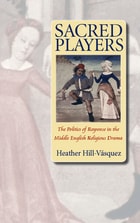
Sacred Players
The Politics of Response in the Middle English Religious DramaHeather Hill-Vásquez
Catholic University of America Press, 2007
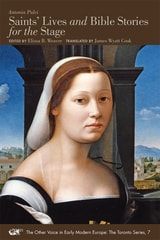
Saints' Lives and Bible Stories for the Stage
A Bilingual EditionAntonia Pulci
Iter Press, 2010
—Sharon Strocchia
Professor of History, Emory University

Save Yourself If You Can
Six PlaysThomas Bernhard
Seagull Books, 2023
Save Yourself if You Can is a collection of six plays that span the entirety of Thomas Bernhard’s career as a dramatist. The plays collected in this long-awaited addition to Bernhard’s oeuvre in English—The Ignoramus and the Madman, The Celebrities, Immanuel Kant, The Goal Attained, Simply Complicated, and Elizabeth II—traverse somber lyricism and misanthropy to biting satire and glorious slapstick. They explore themes that will be familiar to longtime readers of Bernhardt, but here they are presented in a subtly different register, attuned to the needs of the stage.
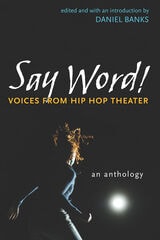
Say Word!
Voices from Hip Hop TheaterAn Anthology Edited and with an Introduction by Daniel Banks
University of Michigan Press, 2011
The phenomenon known as Hip Hop encompasses a global, multiethnic, grassroots culture committed to social justice and self-expression through performance. Hip Hop Theater emerged from that culture, mixing spoken-word performance with music and dance and marked by Hip Hop's strong sense of activism and resistance. Hip Hop Theater is engaged with questions of identity – culture, heritage, ethnicity, class, gender, sexuality, and difference—narrating the experiences of historically marginalized peoples and putting them in dialogue with other oppressed communities.
Say Word! Voices from Hip Hop Theater collects eight works by contemporary artists who confront today's compelling issues, ranging from racial profiling and police brutality to women's empowerment and from the commercial exploitation of Hip Hop to identity politics. Editor Daniel Banks has assembled work by Abiola Abrams, Zakiyyah Alexander, Chadwick Boseman, Kristoffer Diaz, Rha Goddess, Antoy Grant, Joe Hernandez-Kolski, Rickerby Hinds, and Ben Snyder, augmented with an extensive introduction and other informative commentary. The book also includes a roundtable moderated by Holly Bass and featuring Hip Hop pioneers Eisa Davis, Danny Hoch, Sarah Jones, and Will Power, a conversation that traces the roots of Hip Hop Theater and imagines its future directions.

Scenes from the Drama of European Literature
Erich AuerbachForeword by Paolo Valesio
University of Minnesota Press, 1984
Scenes from the Drama of European Literature was first published in 1984. Minnesota Archive Editions uses digital technology to make long-unavailable books once again accessible, and are published unaltered from the original University of Minnesota Press editions.
In his foreword to this reprint of Erich Auerbach's major essays, Paolo Valesio pays tribute to the author with an old saying that he feels is still the best metaphor for the genesis of a literary critic: the critic is born of the marriage of Mercury and Philology. The German-born Auerbach was a scholar who specialized in Romance philology, a tradition rooted in German historicism—the conviction that works of art must be judged as products of variable places and times, not from the eye of eternity, nor by a single unchanging aesthetic standard. The mercurial element in Auerbach's work is significant, for in a life of motion—of exile from Hitler's Germany—he came to believe that literary history was evolutionary, ever-changing—a view reflected in the title of his book, which suggests life and literature are historical drama.
Auerbach is best known for his magisterial study Mimesis: The Representation of Reality in Western Literature, written during the war, in Istanbul, when he was far from his own culture and from the books that he normally relied on. In 1957, just before his death, he arranged for the publication in English of his six most important essays, in a volume called Scenes from the Drama of European Literature.As in Mimesis,Auerbach's fresh insights bring to the disparate subjects of the essays a coherence that reflects the unity of Western, humanistic tradition, even while they hint at the deepening pessimism of his later years.
In the first essay, "Figura," Auerbach develops his concept of the figural interpretation of reality; applied here to Dante's Divine Comedy,it also served as groundwork for his treatment of realism in Mimesis. A second essay on Dante's examines the poet's depiction of St. Francis of Assisi. The next three essays deal with the paradoxical nature of Pascal's political thought; the merging of la cour and la ville—the king's entourage and the bourgeoisie—chiefly in relation to the seventeenth-century French theater; and Vico's formulation concepts by the German Romantics. In the final essay Auerbach confers upon Baudelaire's Fleurs du Mal the designation "aesthetic dignity" because, not in spite of, the hideous reality of the peoms.
"A major collection of important essays on European literature, almost all classics, and almost all required reading for their various centuries—thus the book is indispensable for the medieval period,the seventeenth and nineteenth centuries; in addition, the 'Figura' and the Vico essays are very significant theoretical statements. The book is lucid and far more accessible for undergraduates than, say, current high theory. Nor has Auerbach's own work aged . . . All of his varied strengths are evidence in this collection, which is a better way into his work than Mimesis." –Fredric Jameson, University of California, Santa Cruz.
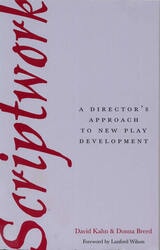
Scriptwork
A Director's Approach to New Play DevelopmentDavid Kahn and Donna Breed. Foreword by Lanford Wilson
Southern Illinois University Press, 1995
Despite the popular myth that plays arrive at the theater fully formed and ready for production, the truth is that for centuries, most scripts have been developed through a collaborative process in rehearsal and in concert with other theater artists. David Kahn and Donna Breed provide the first codified approach to this time-honored method of play development, with a flexible methodology that takes into account differing environments and various stages of formation.
Directors can use this unique guidebook for new play development from the beginning to the end of the process. Kahn and Breed explore ways of choosing new projects, talk about where to find new scripts, and explore the legal aspects of script development. They present a detailed system for theatrical analysis of the new script and show how to continue exploration and development of the script within the laboratory of the theater. Most importantly, they delineate the parameters of the relationship between the director and the playwright, offering proven methods to help the playwright and help facilitate the healthy development of the script.
Breed and Kahn offer suggestions on casting, incorporating rewrites, and script handling plus how and when to use audience response and how to decide what step to take next. They also include extended interviews with developmental directors, dramaturgs, and playwrights, who give credence to the new script development process.
In short, Kahn and Breed demystify a common, though often convoluted, theater process, providing a unique codification of ways to work on new plays.
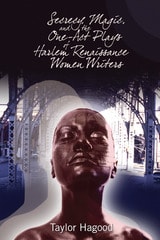
Secrecy, Magic, and the One-Act Plays of Harlem Renaissance Women Writers
Taylor Hagood
The Ohio State University Press, 2010
Exploring secrecy from the standpoints of poststructuralist language theory and game theory as well as dramatic performance, Taylor Hagood argues that the secret—a thing visible for its very invisibility—is a fundamental cog in the machinery of society, employed as a tool for both oppression and subversion. The many facets of secrecy have been particularly salient in African American culture, informing everything from the Underground Railroad to the subtle coding of Signifying. Most devastatingly, people on both sides of the color line are caught within a web of secrecy that is the result of centuries of distrust, doubt, and fear, a fact that is powerfully manifest not only in these one-act plays but in the reader’s/spectator’s interactions with them.

Secret Sharers in Italian Comedy
From Machiavelli to GoldoniJackson I. Cope
Duke University Press, 1996
Though outwardly similar to New Comedy with its characteristically harmonious closure, this essentially anti-Plautine form employs a secret—known by the audience but unequally shared among the players—to introduce a radical discrepancy between simultaneous stories unfolding in a single action doubly understood. The result is a plot that is misleading at the surface, contingent and unfinished at its end. The audience, in a position of enforced collusion with regard to the secret, becomes a formal ingredient in the production. The play, more cynical than carnivalesque, opens onto vistas of disruption and deception rather than closing on a note of renewed social harmony.
Cope’s close and original readings of both classic and lesser-known plays by Machiavelli, Ruzante, Cecchi, Grazzini, Fagiuoli, Maggi, and others follow this peculiarly Italian, anti-Plautine paradigm through variations across three centuries to its masterful and complex culmination in Carlo Goldoni’s villeggiatura trilogy. Establishing a new comedic canon that demands a revision of Italian dramatic history and the history of European dramatic theory, Secret Sharers in Italian Comedy makes an important contribution to Italian studies and will also attract readers among theater scholars in English, comparative literature, and drama.
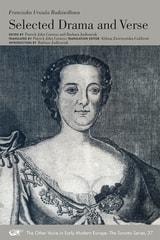
Selected Drama and Verse
Franciszka Urszula Radziwillowa
Iter Press, 2015
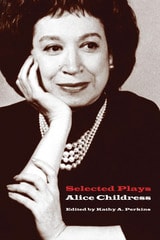
Selected Plays
Alice Childress
Northwestern University Press, 2011
Spanning the 1940s to the 1960s, the plays collected here are the ones Childress herself believed were her best, and offer a realistic portrait of the racial inequalities and social injustices that characterized these decades. Her plays often feature strong-willed female protagonists whose problems bring into harsh relief the restrictions faced by African American women. This is the first volume devoted exclusively to the work of a major playwright whose impact on the American theater was profound and lasting.

Selected Plays, Volume I
August Strindberg
University of Minnesota Press, 2012
August Strindberg is often considered the father of modern Swedish literature. His vast output of plays was innovative in style and form. Volume 1 of Selected Plays presents selections from the beginning of his career, before Strindberg’s period of psychotic attacks in the 1890s. Master Olof (1872) is a historical drama set in early Reformation Sweden, influenced by Ibsen and Shakespeare. Two of his most produced plays today, The Father (1887) and Miss Julie (1888), are examples of his naturalistic plays. Strindberg described Creditors (1888), a tragicomedy, as his “most mature work.” The Stronger (1889), a playlet, is a favorite in acting classes. Playing with Fire (1893) is one of his few comedies. These plays deal with Strindberg’s preoccupation with power struggles and sexual warfare.

Selected Plays, Volume II
August Strindberg
University of Minnesota Press, 2012
This second volume of the great Swedish writer August Strindberg’s plays begins with To Damascus I (1898), the first of a trilogy. It mirrors his own departure from the naturalism he had explored in several of his earlier works, as he set forth on a spiritual odyssey. Crimes and Crimes (1899), from the beginning of his symbolist mode, is a lighter take on the themes in To Damascus I. The first of a two-part play, Dance of Death I (1900) depicts a dysfunctional marriage. A Dream Play (1901), which is one of Strindberg’s most influential, shows reality converted into a dream; many critics consider it his greatest play. In 1907, Strindberg founded the Intimate Theater in Stockholm; The Ghost Sonata (1907) and The Pelican (1907), which were written for its opening, are two examples of a chamber play, a genre that Strindberg helped to originate.
Sender
A PlayIke Holter
Northwestern University Press, 2019
Ike Holter’s Sender thrives on the contrast between order and chaos and the tensions that emerge as we leave childhood and adolescence behind to contend with the demands of “adulting.” In this comedy, Holter presents us with four millennial friends wrestling with these issues. While each is at a different stage of “growing up,” one of the friends has disappeared and has been presumed dead. Yet, at the beginning of the play, he returns and completely upends the balance established in his absence. This witty, foul mouthed, and razor-sharp play asks: “What does growing up mean . . . and is it even desired in this day and age?”
Sender is one of seven plays in Holter’s Rightlynd Saga, all to be published by Northwestern University Press. Holter’s plays are set in Chicago’s fictional fifty-first ward. The other plays in the cycle are Exit Strategy, Lottery Day, Prowess, Red Rex, Rightlynd, and The Wolf at the End of the Block.
Seriously Mad
Mental Distress and the Broadway MusicalAleksei Grinenko
University of Michigan Press, 2023
Theatermakers in the United States have long been drawn to madness as a source of dramatic spectacle. During the Broadway musical’s golden age in the mid-twentieth century, creative teams used the currently in-vogue psychoanalytic ideas about mental life to construct troubled characters at odds with themselves and their worlds. As the clinical and cultural profile of madness transformed over the twentieth century, musicals continued to delve into the experience of those living with mental pain, trauma, and unhappiness.
Seriously Mad offers a dynamic account of stage musicals’ engagement with historically significant theories about mental distress, illness, disability, and human variance in the United States. By exploring who is considered mad and what constitutes madness at different moments in U.S. history, Aleksei Grinenko shows how, in attempts to bring the musicals closer to highbrow sophistication, theater dramatized serious medical conditions and social problems. Among the many Broadway productions discussed are Next to Normal, A Strange Loop, Sweeney Todd, Man of La Mancha, Gypsy, Oklahoma!, and Lady in the Dark.
Seven Black Plays
The Theodore Ward Prize for African American PlaywritingChuck Smith
Northwestern University Press, 2004
These seven plays, which span the Ward Prize's history, represent a wide range of talents, experience, and perspectives brought to bear on diverse themes, from a unique moment in the history of baseball's Negro League to a working-class couple contending with a neighborhood bully; from a child's memories of negotiating desegregation to coming of age amidst the ravages of racism, child abuse, and AIDS. By turns poetic and moving, brave and rousing, uproarious and unsettling, these works written by established and emerging playwrights allow actors, directors, theatergoers, and readers to sample the multifarious dramatic experience being limned by African American playwrights today.
Seven Contemporary Plays from the Korean Diaspora in the Americas
Esther Kim Lee, ed.
Duke University Press, 2012
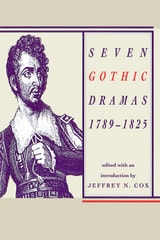
Seven Gothic Dramas, 1789–1825
1789-1825Jeffrey N. Cox
Ohio University Press, 1994
The Gothic drama came at a critical moment in the history of the theater, of British culture, and of European politics in the shadow of France’s revolution and the fall of Napoleon. It offered playwrights a medium to express the prevailing ideological tensions of romanticism and revolution, and also responded to a growing and changing theater audience.
In a wide-ranging introduction, Cox explores Gothic drama’s links with romanticism and its relation to other social and ideological shifts of the day. The texts are presented so as to reflect the dual life of dramatic works—on the stage and on the page. The plays are annotated and accompanied by biographic and bibliographic sketches.
Includes The Kentish Barons, by Francis North; Julia of Louvain; or, Monkish Cruelty, by J.C. Cross; The Castle Spectre, by Matthew G. Lewis; The Captive, by Matthew G. Lewis; De Monfort, by Joanna Baillie; Bertram; or, The Castle of St. Aldobrand, by C.R. Maturin; and Presumption; or, The Fate of Frankenstein, by R.B. Peake.
Seven Irish Plays, 1946-1964
Robert Hogan
University of Minnesota Press, 1967
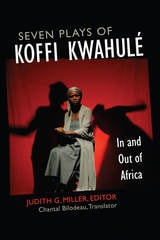
Seven Plays of Koffi Kwahulé
In and Out of AfricaJudith G. Miller, Editor, Chantal Bilodeau, Translator
University of Michigan Press, 2017
Kwahulé’s theater delves into both the horror of civil war in Africa and the diasporic experience of peoples of African origin living in Europe and the “New World.” From the split consciousness of the protagonist and rape victim in Jaz to the careless buffoonery of mercenaries in Brewery, Kwahulé’s characters speak in riffs and refrains that resonate with the improvisational pulse of jazz music. He confronts us with a violent world that represents the damage done to Africa and asks us, through exaggeration and surreal touches, to examine the reality of an ever-expanding network of global migrants. His plays speak to the contemporary state of humanity, suffering from exile, poverty, capitalist greed, collusion, and fear of “the other”—however that “other” gets defined.
Judith G. Miller’s introductory essay situates Kwahulé among his postcolonial contemporaries. Short introductory essays to each play, accompanied by production photos, contextualize possible approaches to Kwahulé’s often enigmatic work. Anglophone theater scholars and theater professionals eager to engage with contemporary theater beyond their borders, particularly in terms of what so-called minority theater artists from other countries are creating, will welcome this indispensable collection. Students and scholars of African studies and of global French studies will also find this work intriguing and challenging.

Sex in an Age of Technological Reproduction
<i>ICSI<i/> and <i>Taboos<i/>Carl Djerassi
University of Wisconsin Press, 2008
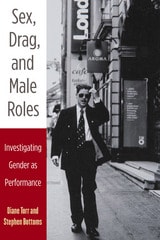
Sex, Drag, and Male Roles
Investigating Gender as PerformanceDiane Torr and Stephen Bottoms
University of Michigan Press, 2010
"Few books blend the critical and creative approaches to drag performance this provocatively and engagingly, and none provides both the historical and the personal perspectives so effectively. Torr and Bottoms fundamentally challenge many long-standing ideas about drag kings and the performance of masculinity."
---Sarah Bay-Cheng, University at Buffalo
"This book brings the reader inside an artist's creative imagination and intellect, showing us Diane Torr's work in a detailed, thoughtful, and engaging way. We discover how Torr uses different physical disciplines to explore how gender is constructed, interpreted, and expressed. Along the way---by taking us into various venues in which she performed---she evokes the lively, dynamic scene in New York in the '80s and '90s."
---Alisa Solomon, Columbia University
Why would women want to perform as men? Why is gender crossing so compelling, whether it happens onstage or in everyday life? What can drag performance teach, and what aesthetic, political, and personal questions does it raise?
Performance artist Diane Torr has been experimenting with the performance of gender for thirty years---exploring everything from feminist go-go dancing to masculine power play. One of the key pioneers of "drag king" performance, Torr has been celebrated internationally for her gender transformation workshops, in which she has taught hundreds of ordinary women how to pass as men on city streets around the world. This cultural subterfuge appeals to participants for many different reasons: personal confidence-building, sexual frisson, gender subversion, trans-curiosity, or simply the appeal of disguise and role play.
Sex, Drag, and Male Roles documents the evolution of Torr's work by blending first-person memoir and commentary from Torr with critical reflections and contextualization from leading performance critic Stephen J. Bottoms. The book includes a consideration of the long cultural history of female-to-male cross-dressing and concludes with Torr's "Do-It-Yourself" guide to becoming a "Man for a Day."
Diane Torr developed her cross-disciplinary art in the downtown New York art scene from 1976 to 2002. Now living in Scotland, Torr has earned an international reputation for her performances and gender transformation workshops (featured on HBO, BBC, and This American Life on NPR, among others). Her work is the focus of a feature film, Man for a Day.
Stephen J. Bottoms is Wole Soyinka Professor of Drama and Theatre Studies at the University of Leeds. His books include Playing Underground: A Critical History of the 1960s Off-Off-Broadway Movement and Small Acts of Repair: Performance, Ecology, and Goat Island.
Cover: Diane Torr walks the streets of London, 1995. Photo by Debbie Humphreys.
Shadowed Cocktails
The Plays of Philip Barry from Paris Bound to The Philadelphia StoryDonald R. Anderson
Southern Illinois University Press, 2010
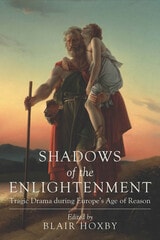
Shadows of the Enlightenment
Tragic Drama during Europe’s Age of ReasonEdited by Blair Hoxby
The Ohio State University Press, 2022
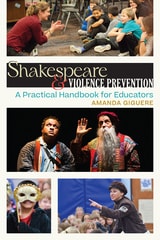
Shakespeare & Violence Prevention
A Practical Handbook for EducatorsAmanda Giguere
University of Wyoming Press, 2025
Framed by examples from Giguere’s work with the Shakespeare & Violence Prevention program, an interdisciplinary outreach project for K–12 schools developed at the University of Colorado Boulder, the text offers helpful entry points, digestible research, and practical exercises to align a violence-prevention curriculum with Shakespeare’s plays. It provides a condensed overview of key findings from violence prevention, clear synopses of the plays, and practicable strategies to implement the program. Guided by firsthand experience with a tried-and-true school program that reaches thousands of K–12 students annually, Giguere shares the Colorado Shakespeare Festival method, which focuses on “upstander” roleplays to practice violence-prevention strategies. Using a clear distillation of Shakespeare studies and violence-prevention research, she shows how the two fields naturally reinforce the concepts of teamwork, empathy, change, and hope.
Shakespeare and Violence Prevention is a new spin on these classic texts that empowers teachers and community leaders to use these tools to create research-guided university engagement programs, theatre company outreach programs, and K–12 student engagement with Shakespeare, even for those without expertise in violence prevention or Shakespeare.

Shakespeare Valued
Education Policy and Pedagogy 1989-2009Sarah Olive
Intellect Books, 2015
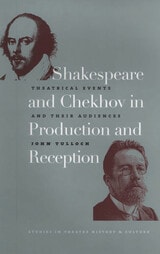
Shakespeare and Chekhov in Production and Reception
Theatrical Events and Their AudiencesTulloch, John
University of Iowa Press, 2005
With a focus on the canonical institutions of Shakespeare and Chekhov, John Tulloch brings together for the first time new concepts of “the theatrical event” with live audience analysis. Using mainstream theatre productions from across the globe that were highly successful according to both critics and audiences, this book of case studies—ethnographies of production and reception—offers a combined cultural and media studies approach to analyzing theatre history, production, and audience.
Tulloch positions these concepts and methodologies within a broader current theatrical debate between postmodernity and risk modernity. He also describes the continuing history of Shakespeare and Chekhov as a series of stories “currently and locally told” in the context of a blurring of academic genres that frames the two writers. Drawn from research conducted over nearly a decade in Australia, Britain, and the U.S., Shakespeare and Chekhov in Production and Reception will be of interest to students and scholars of theatre studies, media studies, and audience research.
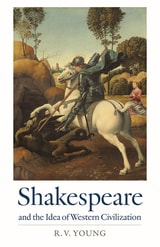
Shakespeare and the Idea of Western Civilization
R.V. Young
Catholic University of America Press, 2022

Shakespeare at the Cineplex
The Kenneth Branagh EraSamuel Crowl
Ohio University Press, 2005
Samuel Crowl’s Shakespeare at the Cineplex: The Kenneth Branagh Era is the first thorough exploration of the fifteen major Shakespeare films released since the surprising success of Kenneth Branagh’s Henry V (1989). Crowl presents the rich variety of these films in the “long decade: between the fall of the Berlin Wall and the terrorist attacks on September 11, 2001.” The productions range from Hollywood-saturated films such as Franco Zeffirelli’s Hamlet and Michael Hoffman’s A Midsummer Night’s Dream to more modest, experimental offerings, such as Christine Edzard’s As You Like It. Now available in paperback, Shakespeare at the Cineplex will be welcome reading for fans, students, and scholars of Shakespeare in performance.
Shakespeare from the Margins
Language, Culture, ContextPatricia Parker
University of Chicago Press, 1996
Combining feminist and historical approaches with attention to the "matter" of language as well as of race and gender, Parker's brilliant "edification from the margins" illuminates much that has been overlooked, both in Shakespeare and in early modern culture. This book, a reexamination of popular and less familiar texts, will be indispensable to all students of Shakespeare and the early modern period.

Shakespeare the Actor and the Purposes of Playing
Meredith Anne Skura
University of Chicago Press, 1993
Despite the obvious differences between our theater and Shakespeare's, sixteenth-century testimony suggests that the experience of acting has not changed much over the centuries. Beginning with a psychoanalytically informed account of acting today, Skura shows how this intense and ambivalent experience appears not only in literal references to acting in Shakespearean drama but also in recurring narrative concerns, details of language, and dramatic strategies used to engage the audience. Looking at the plays in the context of both public and private worlds outside the theater, Skura rereads the canon to identify new configurations in the plays and new ways of understanding theatrical self-consciousness in Renaissance England. Rich in theatrical, psychoanalytic, biographical, and historical insight, this book will be invaluable to students of Shakespeare and instructive to all readers interested in the dynamics of performance.
Shakespeare the Illusionist
Magic, Dreams, and the Supernatural on FilmNeil Forsyth
Ohio University Press, 2019
In Shakespeare the Illusionist, Neil Forsyth reviews the history of Shakespeare’s plays on film, using the basic distinction in film tradition between what is owed to Méliès and what to the Lumière brothers. He then tightens his focus on those plays that include some explicit magical or supernatural elements—Puck and the fairies, ghosts and witches, or Prospero’s island, for example—and sets out methodically, but with an easy touch, to review all the films that have adapted those comedies and dramas, into the present day.
Forsyth’s aim is not to offer yet another answer as to whether Shakespeare would have written for the screen if he were alive today, but rather to assess what various filmmakers and TV directors have in fact made of the spells, haunts, and apparitions in his plays. From analyzing early camera tricks to assessing contemporary handling of the supernatural, Forsyth reads Shakespeare films for how they use the techniques of moviemaking to address questions of illusion and dramatic influence. In doing so, he presents a bold step forward in Shakespeare and film studies, and his fresh take is presented in lively, accessible language that makes the book ideal for classroom use.
Shakespeare's Dramatic Transactions
Michael Mooney
Duke University Press, 1990
Michael Mooney draws on the work of East German critic Robert Weimann and his concept of figurenposition—the correlation between an actor’s stage location and the speech, action, and stylization associated with that position—to understand the actor/stage location relationship in Shakespeare’s plays. In his examination of the original staging of Shakespeare’s tragedies, Mooney looks at the traditional interplay between a downstage “place” and upstage “location” to describe the difference between non-illusionistic action (often staged near the audience) and the illusionistic, localized action that characterizes mimetic art.
The innovative and insightful approach of Shakespeare’s Dramatic Transactions brings together the techniques of performance criticism and the traditional literary study of Shakespearean tragedy. In showing how the distinctions of stage location illuminate the interaction among language, representation, Mooney’s compelling argument enhances our understanding of Shakespeare and the theater.
Shakespeare's Noise
Kenneth Gross
University of Chicago Press, 2001
Kenneth Gross explores Shakespeare's deep fascination with dangerous and disorderly forms of speaking—especially rumor, slander, insult, vituperation, and curse—and through them offers a vision of the work of words in his plays. Coriolanus's taunts or Lear's curses force us to think not just about how Shakespeare's characters speak, but also about how they hear, overhear, and mishear what is spoken, how rumor becomes tragic knowledge for Hamlet, or opens Othello to fantastic jealousies. Gross also shows how Shakespeare's preoccupation with "noisy" speech echoed and transformed a broader cultural obsession with the perils of rumor, slander, and libel in Renaissance England.
Elegantly written and passionately argued, Shakespeare's Noise will challenge and delight anyone who loves his plays, from scholars to general readers, actors, and directors.
Shakespeare's Once and Future Child
Speculations on SovereigntyJoseph Campana
University of Chicago Press, 2024
Politicians are fond of saying that “children are the future.” How did the child become a figure for our political hopes? Joseph Campana’s book locates the source of this idea in transformations of childhood and political sovereignty during the age of Shakespeare, changes spectacularly dramatized by the playwright himself. Shakespeare’s works feature far more child figures—and more politically entangled children—than other literary or theatrical works of the era. Campana delves into this rich corpus to show how children and childhood expose assumptions about the shape of an ideal polity, the nature of citizenship, the growing importance of population and demographics, and the question of what is or is not human. As our ability to imagine viable futures on our planet feels ever more limited, and as children take up legal proceedings to sue on behalf of the future, it behooves us to understand the way past child figures haunt our conversations about intergenerational justice. Shakespeare offers critical precedents for questions we still struggle to answer.
Shakespeare's Politics
Allan Bloom
University of Chicago Press, 1981
In essays looking at Julius Caesar, Othello, and The Merchant of Venice, Bloom shows how Shakespeare presents a picture of man that does not assume privileged access for only literary criticism. With this claim, he argues that political philosophy offers a comprehensive framework within which the problems of the Shakespearean heroes can be viewed. In short, he argues that Shakespeare was an eminently political author. Also included is an essay by Harry V. Jaffa on the limits of politics in King Lear.
"A very good book indeed . . . one which can be recommended to all who are interested in Shakespeare." —G. P. V. Akrigg
"This series of essays reminded me of the scope and depth of Shakespeare's original vision. One is left with the impression that Shakespeare really had figured out the answers to some important questions many of us no longer even know to ask."-Peter A. Thiel, CEO, PayPal, Wall Street Journal
Allan Bloom was the John U. Nef Distinguished Service Professor on the Committee on Social Thought and the co-director of the John M. Olin Center for Inquiry into the Theory and Practice of Democracy at the University of Chicago. Harry V. Jaffa is professor emeritus at Claremont McKenna College and Claremont Graduate School.
Shakespeare's Reparative Comedies
A Psychoanalytic View of the Middle AgesJoseph Westlund
University of Chicago Press, 1984
Shakespeare's Women
A Playscript for Performance and AnalysisLibby Appel and Michael Flachmann
Southern Illinois University Press, 1986
Serves both as a script for performance and as a text for high school and college theater and English classes.
This self-contained script brings together different scenes from Shakespeare’s plays to portray women “in all their infinite variety.” Two narrators, a man and a woman, introduce and comment on these scenes, weaving together the different characters and situations.
This book combines literary and theatrical techniques in examining Shakespeare’s women. Its promptbook format provides clear, helpful stage directions on pages facing each of the scenes. Also helpful are concise glosses and footnotes to define difficult words and phrases plus a commentary to explain each scene in its dramatic context.
Other features include sheet music for each song in the play, a bibliography on the topic of women in Shakespeare’s plays, and suggestions for directors who wish to stage the play.
Shakespearean Pragmatism
Market of His TimeLars Engle
University of Chicago Press, 1993
To Engle, the problems of worth, price, and value that appear so frequently in Shakespeare's works reveal a playwright dramatizing the negotiable nature of perception and belief—in short, the nature of his audience's purchase on reality. This innovative argument is the first to view Shakespeare in the context of contemporary pragmatism and to show that Shakespeare in many ways anticipated pragmatism as it has been developed in the thought of Richard Rorty, Barbara Herrnstein Smith, and others. With detailed reference to the sonnets and plays, Engle explores Shakespeare's tendency to treat knowledge, truth, and certainty as relatively stable goods within a theatrical economy of social interaction. He shows the playwright recasting kingship, aristocracy, and poetic immortality in pragmatic terms.
As attentive to history as it is to contemporary theory, this book mediates between current and traditional accounts of Shakespeare. In doing so, it offers a sweeping new account of Shakespeare's enterprise that will interest philosophers, literary theorists, and Shakespeare scholars alike.
Showing Off, Showing Up
Studies of Hype, Heightened Performance, and Cultural PowerLaurie Frederik, Kim Marra, and Catherine Schuler, Editors
University of Michigan Press, 2017
Sight Unseen
Beckett, Pinter, Stoppard, and Other Contemporary Dramatists on RadioElissa S. Guralnick
Ohio University Press, 1994
In Sight Unseen radio drama, a genre traditionally dismissed as popular culture, is celebrated as high art. The radio plays discussed here range from the conventional (John Arden’s Pearl) to the docudramatic (David Rudkin’s Cries from Casement), from the curtly conversational (Harold Pinter’s A Slight Ache) to the virtually operatic (Robert Ferguson’s Transfigured Night), testifying to radio drama’s variety and literary stature. Two of the plays included in this study pose aesthetic questions—the role of art in politics (Howard Barker’s Scenes from an Execution), and the nature of artistic excellence (Tom Stoppard’s Artist Descending a Staircase).
Guralnick contends that well-crafted radio plays tend to meld to their medium so naturally that they cannot be transferred to the theater or to film without being diminished. Each play is thus shown to exploit, to special effect, one of radio’s fundamental features: its invisible stage (Barker and Stoppard), its affinity to music (Ferguson and Beckett), its ability to imitate the mind’s subjectivity (Kopit and Pinter), its association with world events through features and the news (Rudkin). As for the question of radio’s relation to the theater, the issue is engaged in the work of John Arden, who dares to portray a theatrical stage on the airwaves, while intimating that the radio offers contemporary playwrights an incomparable boon: creative conditions roughly equivalent to those enjoyed by Shakespeare.
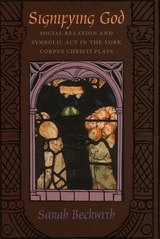
Signifying God
Social Relation and Symbolic Act in the York Corpus Christi PlaysSarah Beckwith
University of Chicago Press, 2001
Introducing a radical new understanding of these plays as "sacramental theater," Beckwith shows how organizing the plays served as a political mechanism for regulating labor, and how theater and sacrament combined in them to do important theological work. She argues, for instance, that the theology of Corpus Christi in the resurrection plays can only be understood as a theatrical exploration of eucharistic absence and presence. Beckwith frames her study with discussions of twentieth-century manifestations of sacramental theater in Barry Unsworth's novel Morality Play and Denys Arcand's film Jesus of Montreal, and the connections between contemporary revivals of the York Corpus Christi plays and England's heritage culture.
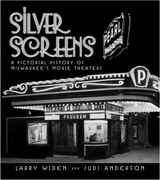
Silver Screens
A Pictorial History of Milwaukee's Movie TheatersLarry Widen
Wisconsin Historical Society Press, 2007
Silver Screens traces the rich history of Milwaukee's movie theaters, from 1890s nickelodeons to the grand palaces of the Roaring Twenties to the shopping mall outlets of today. And the story doesn't end there: in the past two decades, the revival of interest in preservation and restoration of theaters has confirmed that there's still life in these beloved old structures. With the publication of Silver Screens, authors Larry Widen and Judi Anderson help ensure that our old theaters, those being restored and those long since vanished, will remain forever embedded in our collective memory.
In this revised edition of their book Milwaukee Movie Palaces, the authors present new findings on film innovations, drive-in theaters, projection booths, movie promotions, noted theater personalities, recent restoration efforts, and much more. Illuminated with more than a hundred photographs, including many never before published, Silver Screens is a stunning tribute to the legacy of the movie theater.

Six Plays for Children
By Aurand Harris
University of Texas Press, 1977
Six Plays for Children by Aurand Harris brings together a variety of dramatic forms that have enormously enriched the literature of children's theatre in this country and around the world. These works by this respected children's theatre playwright show Harris's great versatility: in the commedia dell'arte of Androcles and the Lion; the musical melodrama Rags to Riches; the sober, absurd comedy Punch and Judy; the realistic historical drama Steal Away Home; the farce Peck's Bad Boy; and the musical review Yankee Doodle. Each of the six plays exhibits a vital theatricality which is sure to win a child's attention and response.
Editor Coleman A. Jennings traces Harris's development as a playwright in a biographical study based on interviews with Harris. This enlightening section treats Harris's philosophy and teaching methods, as well as his creative process.
Slapstick Modernism
Chaplin to Kerouac to Iggy PopWilliam Solomon
University of Illinois Press, 2018
William Solomon charts the origins and evolution of what he calls slapstick modernism--a merging of artistic experimentation with the socially disruptive lunacy made by the likes of Charlie Chaplin. Romping through texts, films, and theory, Solomon embarks on an intellectual odyssey from the high modernism of Dos Passos and Williams to the late modernism of the Beats and Burroughs before a head-on crash into the raw power of punk rock. Throughout, he shows the links between the experimental writers and silent screen performers of the early century, and explores the potent cultural undertaking that drew inspiration from anarchical comedy after World War II.
Slow Death
Contemporary Japanese Performance in Times of Suspended CrisesKyoko Iwaki, Jessica Nakamura, Corey Wakeling
Northwestern University Press, 2027
Bringing together performance studies, critical theory, and contemporary Japanese cultural studies to offer an unsettling glimpse into a global future of crisis already arriving
Slow Death examines contemporary artistic practice as a form of active engagement with the condition of “slow death”: the diffused feeling of decline with no end in sight. The theater and performance artists discussed here confront the realities of a state that is no longer tenable, rehearsing slow death’s modalities, probing its implications, and imagining possible endpoints through dramaturgy. As these artists show, the very notion of progress—whether framed as a march toward a hopeful future or a retreat into the comforts of a nostalgic past—carries an inescapable irony. Both trajectories seem equally unsustainable, rendering any prospect of radical transformation elusive. This sense of endless suspendedness emerges as a pervasive motif across the artworks discussed, such as the anticapitalist performance spaces created by Tanino Kurō and the queer feminist dramaturgy of Ichihara Satoko. Yet, as coauthors Kyoko Iwaki, Jessica Nakamura, and Corey Wakeling identify throughout, to enact slow death in performance is not to capitulate to despair but to expose its structure and, in doing so, uncover latent forms of everyday resistance.
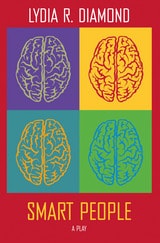
Smart People
A PlayLydia R. Diamond
Northwestern University Press, 2017

Socrates and Aristophanes
Leo Strauss
University of Chicago Press, 1996
"Strauss gives us an impressive addition to his life's work—the recovery of the Great Tradition in political philosophy. The problem the book proposes centers formally upon Socrates. As is typical of Strauss, he raises profound issues with great courage. . . . [He addresses] a problem that has been inherent in Western life ever since [Socrates'] execution: the tension between reason and religion. . . . Thus, we come to Aristophanes, the great comic poet, and his attack on Socrates in the play The Clouds. . . [Strauss] translates it into the basic problem of the relation between poetry and philosophy, and resolves this by an analysis of the function of comedy in the life of the city." —Stanley Parry, National Review
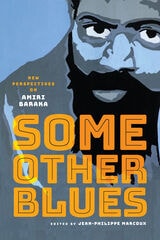
Some Other Blues
New Perspectives on Amiri BarakaEdited by Jean-Philippe Marcoux
The Ohio State University Press, 2021
(Include contributors if space allows) Contributors: Tony Bolden, Jeremy Glick, William J. Harris, Benjamin Lee, Aidan Levy, John Lowney, Jean-Philippe Marcoux, Kim McMillon, Fred Moten, Michael New, Aldon Lynn Nielsen, Amy Abugo Ongiri, Gregory Pierrot, Howard Rambsy II, Emily Ruth Rutter, Anthony Reed, Lauri Scheyer, Kathy Lou Schultz, Michael Simanga, James Smethurst, Laura Vrana, Tyrone Williams, Kalamu ya Salaam.
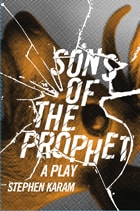
Sons of the Prophet
A PlayStephen Karam
Northwestern University Press, 2012
Finalist, 2012 Pulitzer Prize for Drama
Winner, 2012 New York Drama Critics Circle Award for Best Play
Winner, 2012 Lucille Lortel Award for Outstanding Play
A deeply humorous, unflinching portrait of grief and loss, Sons of the Prophet depicts a Lebanese-American family in rural Pennsylvania beset by an absurd string of tragedies. At the play’s center is Joseph Douaihy, a once-promising world-class runner now sidelined by injury. As Joseph confronts his deteriorating health, he is also forced to face the death of his father, an ailing Uncle, and a desperate boss beset by her own tragedies. Deftly keeping its various storylines in careful balance, Karam’s play confronts, with abundant intelligence and great sympathy for human frailty, the inevitability of loss and the equally inevitable comedy resulting from our attempts to cope with is consequences.