Results by title
436 books match the query 'Renaissance' and 113 start with t

Tanegashima
The Arrival of Europe in JapanOlof Lidin
National University of Singapore Press, 2002
Teaching Other Voices
Women and Religion in Early Modern EuropeEdited by Margaret L. King and Albert Rabil Jr.
University of Chicago Press, 2007
Teaching Race in the European Renaissance
A Classroom GuideEdited by Anna Wainwright and Matthieu Chapman
Arizona Center for Medieval and Renaissance Studies, 2023
Teaching Race in the European Renaissance: A Classroom Guide provides both educators and students the tools they need to discuss race in the European Renaissance both in its unique historical contexts and as part of a broader continuum with racial thinking today. The volume gathers scholars of the English, French, Italian, and Iberian Renaissances to provide exercises, lesson plans, methodologies, readings, and other resources designed to bring discussions of race into a broad spectrum of classes on the early modern period, from literature to art history to the history of science. This book is designed to help educators create more diverse and inclusive syllabi and curricula that engage and address a diverse, twenty-first-century student body composed of students from a growing variety of cultural, national, ethnic, and racial backgrounds. By providing clear, concise, and diverse methodologies and analytical focuses, Teaching Race in the European Renaissance: A Classroom Guide will help educators in all areas of Renaissance Studies overcome the anxiety and fear that can come with stepping outside of their expertise to engage with the topic of race, while also providing expert scholars of race in the Renaissance with new techniques and pedagogies to enhance the classroom experience of their students.
The Accommodated Animal
Cosmopolity in Shakespearean LocalesLaurie Shannon
University of Chicago Press, 2013
The Aesthetics of Service in Early Modern England
Elizabeth Rivlin
Northwestern University Press, 2011
In The Aesthetics of Service in Early Modern England, Elizabeth Rivlin explores the ways in which servant-master relationships reshaped literature. The early modern servant is enjoined to obey his or her master out of dutiful love, but the servant's duty actually amounts to standing in for the master, a move that opens the possibility of becoming master. Rivlin shows that service is fundamentally a representational practice, in which the servant who acts for a master merges with the servant who acts as a master.
Rivlin argues that in the early modern period, servants found new positions as subjects and authors found new forms of literature. Representations of servants and masters became a site of contact between pressing material concerns and evolving aesthetic ones. Offering readings of dramas by Shakespeare, Jonson, and Thomas Dekker and prose fictions by Thomas Deloney and Thomas Nashe, Rivlin suggests that these authors discovered their own exciting and unstable projects in the servants they created.
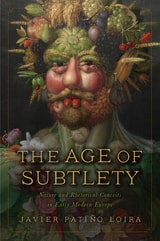
The Age of Subtlety
Nature and Rhetorical Conceits in Early Modern EuropeJavier Patiño Loira
University of Delaware Press, 2024
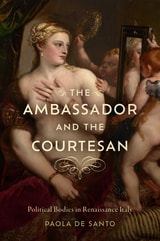
The Ambassador and the Courtesan
Political Bodies in Renaissance ItalyPaola De Santo
University of Delaware Press, 2026
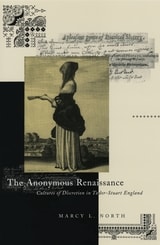
The Anonymous Renaissance
Cultures of Discretion in Tudor-Stuart EnglandMarcy L. North
University of Chicago Press, 2003
The Renaissance was in many ways the beginning of modern and self-conscious authorship, a time when individual genius was celebrated and an author's name could become a book trade commodity. Why, then, did anonymous authorship flourish during the Renaissance rather than disappear? In addressing this puzzle, Marcy L. North reveals the rich history and popularity of anonymity during this period.
The book trade, she argues, created many intriguing and paradoxical uses for anonymity, even as the authorial name became more marketable. Among ecclesiastical debaters, for instance, anonymity worked to conceal identity, but it could also be used to identify the moral character of the author being concealed. In court and coterie circles, meanwhile, authors turned name suppression into a tool for the preservation of social boundaries. Finally, in both print and manuscript, anonymity promised to liberate an authentic female voice, and yet made it impossible to authenticate the gender of an author. In sum, the writers and book producers who helped to create England's literary culture viewed anonymity as a meaningful and useful practice.
Written with clarity and grace, The Anonymous Renaissance will fill a prominent gap in the study of authorship and English literary history.
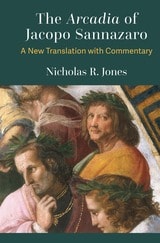
The Arcadia of Jacopo Sannazaro
A New Translation with CommentaryNicholas R. Jones
University of Michigan Press, 2025
Sannazaro’s Arcadia is widely recognized as a foundational text of pastoral poetry, humanism, and Italian literature. But the book itself has been largely inaccessible to English-language students and readers. This new translation uses contemporary American English to convey Arcadia’s youthful vigor, narrative energy, and poetic inventiveness. The extensive introduction and commentaries place Arcadia in the context of late fifteenth-century humanist thought and writing, as well as the complicated crisis of Naples in the years just before 1500. This translation is designed to facilitate the re-entry of Arcadia into scholarly discourse and general readership while outlining its lasting cultural influence on poetry, drama, art and music.
The Architecture of the Italian Renaissance
Jacob Burckhardt
University of Chicago Press, 1984
The Art of Conjecture
Nicholas of Cusa on KnowledgeClyde Lee Miller
Catholic University of America Press, 2021
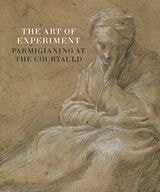
The Art of Experiment
Parmigianino at The CourtauldEdited by Ketty Gottardo and Guido Rebecchini
Paul Holberton Publishing, 2022
Accompanying an exhibition at London’s Courtauld Gallery, this stunning catalog presents works by the Renaissance artist Girolamo Francesco Maria Mazzola, better known as Parmigianino (1503–1540).
Fundamentally a draftsman at heart, Parmigianino drew relentlessly during his relatively short life, and around a thousand of his drawings have survived. The Courtauld’s collection comprises twenty-four sheets. In preparation for the catalog, new photography and technical examinations have been carried out on all the works, revealing two new drawings that were previously unknown, hidden underneath their historic mounts. They have also helped to better identify connections between some of the drawings and the finished paintings for which they were conceived. This stunning illustrated catalog presents the whole Courtauld collection and sheds light on an artist who approached every technique with unprecedented freedom and produced innovative works that are still admired by artists and collectors today.
The Art of the Network
Strategic Interaction and Patronage in Renaissance FlorencePaul D. McLean
Duke University Press, 2007
McLean scrutinized thousands of letters to and from Renaissance Florentines. He describes the social protocols the letters reveal, paying particular attention to the means by which Florentines crafted credible presentations of themselves. The letters, McLean contends, testify to the development not only of new forms of self-presentation but also of a new kind of self to be presented: an emergent, “modern” conception of self as an autonomous agent. They also bring to the fore the importance that their writers attached to concepts of honor, and the ways that they perceived themselves in relation to the Florentine state.
The Baker Who Pretended to Be King of Portugal
Ruth MacKay
University of Chicago Press, 2012
On August 4, 1578, in an ill-conceived attempt to wrest Morocco back from the hands of the infidel Moors, King Sebastian of Portugal led his troops to slaughter and was himself slain. Sixteen years later, King Sebastian rose again. In one of the most famous of European impostures, Gabriel de Espinosa, an ex-soldier and baker by trade—and most likely under the guidance of a distinguished Portuguese friar—appeared in a Spanish convent town passing himself off as the lost monarch. The principals, along with a large cast of nuns, monks, and servants, were confined and questioned for nearly a year as a crew of judges tried to unravel the story, but the culprits went to their deaths with many questions left unanswered.
The Bible in the Sixteenth Century
David C. Steinmetz
Duke University Press, 1990
Contributors. Irena Backus, Guy Bedouelle, Kalman P. Bland, Kenneth G. Hagen, Scott H. Hagen, Scott H. Hendrix, R. Gerald Hobbs, Jean-Claude Margolin, H. C. Erik Midelfort, Richard A. Muller, John B. Payne, David C. Steinmetz
The Birth of the Archive
A History of KnowledgeMarkus Friedrich, translated by John Noël Dillon
University of Michigan Press, 2018
Friedrich provides an essential background to the history of archives over the centuries and enriches the story of their evolution with chapters on key sociocultural aspects of European archival culture. He discusses their meaning and symbolism in European thought, early modern conceptions of the archive’s function, and questions of access and usability. Exploring the close, often vexed relationship between archives and political power, Friedrich illustrates the vulnerability of archives to political upheaval and war. He concludes with an introspective look at how historians used their knowledge of and work with archives to create distinct representations of themselves and their craft.
The Birth of the Archive engages with scholarship in political history, the history of mentalities, conceptions of space, historiography, and the history of everyday life in early modern Europe. It has much to offer for specialists and scholars, while the jargon-free prose of this translation is also accessible to the general reader.
The Body of Language
esperruquancluzelubelouzerireluGiorgio Agamben
Seagull Books, 2025
An erudite exploration of transgressive language from the Renaissance by one of Europe’s greatest living philosophers.
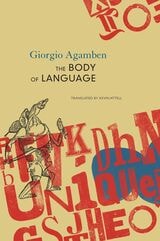
This book explores how early modern authors broke linguistic boundaries, creating new words and languages that challenged traditional grammar and lexicon, providing historical insight into today’s debates on the politics of language. Through a scholarly analysis by Giorgio Agamben, the text delves into the boundary-shifting language of the Renaissance, exemplified by giants like Pantagruel and Gargantua, whose outsized bodies mirror the vastness of their speech. The macaronic language invented by Teofilo Folengo, blending Latin and vernacular, embodies a linguistic rebellion that transforms language into a tangible, unruly force. Featuring illustrations from the Songes drolatiques de Pantagruel and Folengo’s Baldo, this volume offers a vivid portrayal of language as a physical, dynamic entity that defies grammatical norms.
The Boke of the Cyte of Ladyes
Brian Anslay's Translation of 1521 in Modernized EnglishChristine de Pizan
Iter Press, 2025
Christine de Pizan's defense of women against centuries of misogyny, Cité des dames, was the only work of literature translated into English by Brian Anslay, an administrator in the household of King Henry VII. While numerous manuscripts were held in royal and aristocratic libraries, Anslay’s printed translation enabled a broader range of readers to appreciate the arguments for female rule crucial to the reigns of Mary I and Elizabeth I. Anslay’s translation also played a key role in the late-nineteenth-century revival of interest in Christine. This modernization of Anslay’s Tudor English makes his translation accessible to contemporary readers while preserving the rhythms of early Tudor prose. It includes an extensive introduction and notes highlighting both the history of the language and the cultural references embodied in the text.
The Book of the Mutability of Fortune
Christine de Pizan
Iter Press, 2017
Christine de Pizan (ca. 1364–ca. 1431) has long been recognized as France’s first professional woman of letters, and interest in her voluminous and wide-ranging corpus has been steadily rising for decades. During the tumultuous later years of the Hundred Years’ War, Christine’s lone but strong feminine voice could be heard defending women, expounding the highest ideals for good governance, and lamenting France’s troubled times alongside her own personal trials. In The Mutability of Fortune, Christine fuses world history with autobiography to demonstrate mankind’s subjugation to the ceaselessly changing, and often cruel, whims of Fortune. Now, for the first time, this poem is accessible to an English-speaking audience, further expanding our appreciation of this ground-breaking woman author and her extraordinary body of work.
The Book of the Play
Playwrights, Stationers, and Readers in Early Modern EnglandMarta Straznicky
University of Massachusetts Press, 2006
The Book of the Play is a collection of essays that examines early modern drama in the context of book history. Focusing on the publication, marketing, and readership of plays opens fresh perspectives on the relationship between the cultures of print and performance and more broadly between drama and the public sphere. Marta Straznicky's introduction offers a survey of approaches to the history of play reading in this period, and the collection as a whole consolidates recent work in textual, bibliographic, and cultural studies of printed drama.
Individually, the essays advance our understanding of play reading as a practice with distinct material forms, discourses, social settings, and institutional affiliation. Part One, “Real and Imagined Communities,” includes four essays on play-reading communities and the terms in which they are distinguished from the reading public at large. Cyndia Clegg surveys the construction of readers in prefaces to published plays; Lucy Munro traces three separate readings of a single play, Edward Sharpham's The Fleer; Marta Straznicky studies women as readers of printed drama; and Elizabeth Sauer describes how play reading was mobilized for political purposes in the period of the Civil War.
In Part Two, “Play Reading and the Book Trade,” five essays consider the impact of play reading on the public sphere through the lens of publishing practices. Zachary Lesser offers a revisionist account of black-letter typeface and the extent to which it may be understood as an index of popular culture; Alan Farmer examines how the emerging news trade of the 1620s and 1630s affected the marketing of printed drama; Peter Berek traces the use of generic terms on title pages of plays to reveal their intersection with the broader culture of reading; Lauren Shohet demonstrates that the Stuart masque had a parallel existence in the culture of print; and Douglas Brooks traces the impact print had on eclipsing performance as the medium in which the dramatist could legitimately lay claim to having authored his text.
The individual essays focus on selected communities of readers, publication histories, and ideologies and practices of reading; the collection as a whole demonstrates the importance of textual production and reception to understanding the place of drama in the early modern public sphere.
The Brutus Revival
Parricide and Tyrranicide During the RenaissanceManfredi Piccolomini
Southern Illinois University Press, 1991
In a discussion of the Renaissance revival of classical culture, Piccolomini considers the period’s mythologizing of Brutus, Caesar’s assassin. He cites Dante as the initiator of an important literary, dramatic, political, and artistic theme and explains how the historical Brutus was changed by literature and theatre into a symbol of the just citizen rebelling against the unjust tyrant.
Piccolomini discusses several Renaissance political conspiracies modeled after Brutus’ act and explores how those conspiracies, in turn, formed the basis for the theme’s recurrence in Italian, French, and English theatre of the period.
The Church in the Republic
Gallicanism & Political Ideology in Renaissance FranceJotham Parsons
Catholic University of America Press, 2004
The Controversy of Renaissance Art
Alexander Nagel
University of Chicago Press, 2011
Many studies have shown that images—their presence in the daily lives of the faithful, the means used to control them, and their adaptation to secular uses—were at the heart of the Reformation crisis in northern Europe. But the question as it affects the art of Italy has been raised only in highly specialized studies.
In this book, Alexander Nagel provides the first truly synthetic study of the controversies over religious images that pervaded Italian life both before and parallel to the Reformation north of the Alps. Tracing the intertwined relationship of artistic innovation and archaism, as well as the new pressures placed on the artistic media in the midst of key developments in religious iconography, The Controversy of Renaissance Art offers an important and original history of humanist thought and artistic experimentation from one of our most acclaimed historians of art.
The Corporate Commonwealth
Pluralism and Political Fictions in England, 1516-1651Henry S. Turner
University of Chicago Press, 2016
Henry S. Turner uses the resources of economic and political history, literary analysis, and political philosophy to demonstrate how a number of English institutions with corporate associations—including universities, guilds, towns and cities, and religious groups—were gradually narrowed to the commercial, for-profit corporation we know today, and how the joint-stock corporation, in turn, became both a template for the modern state and a political force that the state could no longer contain. Through innovative readings of works by Thomas More, William Shakespeare, Francis Bacon, and Thomas Hobbes, among others, Turner tracks the corporation from the courts to the stage, from commonwealth to colony, and from the object of utopian fiction to the subject of tragic violence. A provocative look at the corporation’s peculiar character as both an institution and a person, The Corporate Commonwealth uses the past to suggest ways in which today’s corporations might be refashioned into a source of progressive and collective public action.
The Creature in the Map
A Journey to El DoradoCharles Nicholl
University of Chicago Press, 1997
"Walter Raleigh . . . was one of those Elizabethan all-rounders who still seem staggeringly larger than life. . . . Mr. Nicholl's cogent reconstruction of the journey uses Raleigh's own account, 'The Discoverie of Guiana'—part truth, part advertising, part rhapsody—and much well-found ancillary material."—Anthony Bailey, New York Times
"Like The Reckoning, his brilliant account of the murder of Christopher Marlowe, Nicholl's new book might be called an exercise in historical conjuring. The Creature in the Map is an effort not only to analyse but also to call into presence the lived experience of the voyage Raleigh undertook in 1595 to the Orinoco Delta in what is now Venezuela."—Stephen Greenblatt, Times Literary Supplement
"Charles Nicholl belongs to an elite company, that of historians who know how to make research into arcane matters and distant times as engrossing as In Cold Blood or All the President's Men."—Michael Dirda, Washington Post
The Culture of San Sepolcro during the Youth of Piero della Francesca
James R. Banker
University of Michigan Press, 2003
Piero della Francesca has remained an enigma because of the contradictions observed in his life and art. Banker's archival research has enabled him to clear away some of the obscurities. This book situates Piero in the earliest social and intellectual worlds within which he moved. Heretofore, writers on Piero have begun his putative formation in Florence in 1439. Banker demonstrates that the young painter's formation began prior to 1439, when he was surrounded by his family and the local artisans' community.
The Culture of San Sepolcro during the Youth of Piero della Francesca integrates social and art history in order to better understand the formation of a Renaissance artist. It will be vital to scholars and historians of the Italian Renaissance city states, as well as to art historians and those interested in the relationship of art and society.
James R. Banker is Professor of History, North Carolina State University.
The Darker Side of the Renaissance
Literacy, Territoriality, & Colonization, 2nd EditionWalter D. Mignolo
University of Michigan Press, 2003
Walter D. Mignolo is Professor in the Department of Romance Studies and the Program in Literature, Duke University.
The Darker Side of the Renaissance
Literacy, Territoriality, and ColonizationWalter D. Mignolo
University of Michigan Press, 1995
The Education of a Christian Woman
A Sixteenth-Century ManualJuan Luis Vives
University of Chicago Press, 2000
Praised by Erasmus and Thomas More, Vives advocated education for all women, regardless of social class and ability. From childhood through adolescence to marriage and widowhood, this manual offers practical advice as well as philosophical meditation and was recognized soon after publication in 1524 as the most authoritative pronouncement on the universal education of women. Arguing that women were intellectually equal if not superior to men, Vives stressed intellectual companionship in marriage over procreation, and moved beyond the private sphere to show how women's progress was essential for the good of society and state.
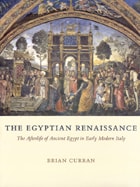
The Egyptian Renaissance
The Afterlife of Ancient Egypt in Early Modern ItalyBrian Curran
University of Chicago Press, 2007
Fascination with ancient Egypt is a recurring theme in Western culture, and here Brian Curran uncovers its deep roots in the Italian Renaissance, which embraced not only classical art and literature but also a variety of other cultures that modern readers don’t tend to associate with early modern Italy. Patrons, artists, and spectators of the period were particularly drawn, Curran shows, to Egyptian antiquity and its artifacts, many of which found their way to Italy in Roman times and exerted an influence every bit as powerful as that of their more familiar Greek and Roman counterparts.
Curran vividly recreates this first wave of European Egyptomania with insightful interpretations of the period’s artistic and literary works. In doing so, he paints a colorful picture of a time in which early moderns made the first efforts to decipher Egyptian hieroglyphs, and popes and princes erected pyramids and other Egyptianate marvels to commemorate their own authority. Demonstrating that the emergence of ancient Egypt as a distinct category of historical knowledge was one of Renaissance humanism’s great accomplishments, Curran’s peerless study will be required reading for Renaissance scholars and anyone interested in the treasures and legacy of ancient Egypt.
The Endless Periphery
Toward a Geopolitics of Art in Lorenzo Lotto's ItalyStephen J. Campbell
University of Chicago Press, 2019
The Enemy in Italian Renaissance Epic
Images of Hostility from Dante to TassoAndrea Moudarres
University of Delaware Press, 2019
Published by University of Delaware Press. Distributed worldwide by Rutgers University Press.
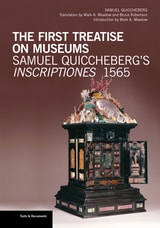
The First Treatise on Museums
Samuel Quiccheberg’s Inscriptiones, 1565Samuel Quiccheberg
J. Paul Getty Trust, The, 2014
Samuel Quiccheberg’s Inscriptiones, first published in Latin in 1565, is an ambitious effort to demonstrate the pragmatic value of curiosity cabinets, or Wunderkammern, to princely collectors in sixteenth-century Europe and, by so doing, inspire them to develop their own such collections. Quiccheberg shows how the assembly and display of physical objects offered nobles a powerful means to expand visual knowledge, allowing them to incorporate empirical and artisanal expertise into the realm of the written word. But in mapping out the collectability of the material world, Quiccheberg did far more than create a taxonomy. Rather, he demonstrated how organizing objects made their knowledge more accessible; how objects, when juxtaposed or grouped, could tell a story; and how such strategies could enhance the value of any single object.
Quiccheberg’s descriptions of early modern collections provide both a point of origin for today’s museums and an implicit critique of their aims, asserting the fundamental research and scholarly value of collections: collections are to be used, not merely viewed. The First Treatise on Museums makes Quiccheberg’s now rare publication available in an English translation. Complementing the translation are a critical introduction by Mark A. Meadow and a preface by Bruce Robertson.
The Future of Illusion
Political Theology and Early Modern TextsVictoria Kahn
University of Chicago Press, 2013
Kahn draws on theorists such as Carl Schmitt, Leo Strauss, Walter Benjamin, and Hannah Arendt and their readings of Shakespeare, Hobbes, Machiavelli, and Spinoza to illustrate that the dialogue between these modern and early modern figures can help us rethink the contemporary problem of political theology. Twentieth-century critics, she shows, saw the early modern period as a break from the older form of political theology that entailed the theological legitimization of the state. Rather, the period signaled a new emphasis on a secular notion of human agency and a new preoccupation with the ways art and fiction intersected the terrain of religion.
The Gift in Sixteenth-Century France
Natalie Zemon Davis
University of Wisconsin Press, 2000
Must a gift be given freely? How can we tell a gift from a bribe? Are gifts always a part of human relations—or do they lose their power and importance once the market takes hold and puts a price on every exchange? These questions are central to our sense of social relations past and present, and they are at the heart of this book by one of our most interesting and renowned historians.
In a wide-ranging look at gift giving in early modern France, Natalie Zemon Davis reveals the ways that gift exchange is crucial to understanding alliance and conflict in family life, economic relations, politics, and religion. Moving from the king’s bounty to the beggar’s alms, her book explores the modes and meanings of gift giving in every corner of sixteenth-century French society. In doing so, it arrives at a new way of considering gifts—what Davis calls "the gift register"—as a permanent feature of social relations over time. Gift giving, with its own justifications and forms in different periods, can create amity or lead to quarrels and trouble. It mixes the voluntary and the obligatory, with interested bribery at one extreme and inspired gratuitousness at the other.
Examining gifts both ethnographically (through archives, letters, and other texts) and culturally (through literary, ethical, and religious sources), Davis shows how coercive features in family life and politics, rather than competition from the market, disrupted the gift system. This intriguing book suggests that examining the significance of gifts can not only help us to understand social relations in the past, but teach us to deal graciously with each other in the present.
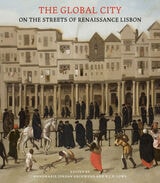
The Global City
On the Streets of Renaissance LisbonEdited by Annemarie Jordan Gschwend and K.J.P. Lowe
Paul Holberton Publishing, 2021
Winner, 2016 Admiral Teixeira da Mota Prize from the Academia de Marinha (Naval Academy), Lisbon
Recently identified by the editors as the Rua Nova dos Mercadores, the principal commercial and financial street in Renaissance Lisbon, two sixteenth-century paintings, acquired by Dante Gabriel Rossetti in 1866, form the starting point for this portrait of a global city in the early modern period. Focusing on unpublished objects, and incorporating newly discovered documents and inventories that allow novel interpretations of the Rua Nova and the goods for sale on it, these essays offer a compelling and original study of a metropolis whose reach once spanned four continents. The Rua Nova views painted by an anonymous Flemish artist portray an everyday scene on a recognizable street, with a diverse global population. This thoroughfare was the meeting point of all kinds of people, from rich to poor, slave to knight, indigenous Portuguese to Jews and diasporic black Africans.
The volume highlights the unique status of Lisbon as an entrepôt for curiosities, luxury goods and wild animals. As the Portuguese trading empire of the fifteenth and sixteenth century expanded sea-routes and networks from West Africa to India and the Far East, non-European cargoes were brought back to Renaissance Lisbon. Many rarities were earmarked for the Portuguese court, but simultaneously exclusive items were readily available for sale on the Rua Nova, the Lisbon equivalent of Bond Street or Fifth Avenue. Specialized shops offered West African and Ceylonese ivories, raffia and Asian textiles, rock crystals, Ming porcelain, Chinese and Ryukyuan lacquerware, jewelry, precious stones, naturalia and exotic animal byproducts. Lisbon was also a hub of distribution for overseas goods to other courts and cities in Europe. The cross-cultural and artistic influences between Lisbon and Portuguese Africa and Asia at this date are reassessed. Lisbon was imagined as the head of empire or caput mundi, while the River Tagus became the aquatic gateway to a globally connected world. Lisbon evolved into a dynamic Atlantic port city, excelling in shipbuilding, cartography and the manufacture of naval instruments. The historian Damião de Góis bragged of the "Tagus reigning over the world." Lisbon's fame depended on its river, an aquatic avenue that competed with the Rua Nova, providing a means of interaction, trade and communication along Lisbon’s coastline. Even for the cosmopolitan Góis, who traveled extensively for the Portuguese crown, Lisbon’s chaotic docks were worth describing. Of all the European cities he experienced, only Lisbon and her rival Seville could be "rightfully called Ladies and Queens of the Sea." Góis contended that they had opened up the early modern world through circumnavigation. Lisbon was destroyed in a devastating earthquake and tsunami in November 1755. These paintings are the only large-scale vistas of Rua Nova dos Mercadores to have survived, and together with the new objects and archival sources offer a fresh and original insight into Renaissance Lisbon and its material culture.
The Golden Age of Botanical Art
Martyn Rix
University of Chicago Press, 2012
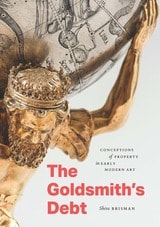
The Goldsmith's Debt
Conceptions of Property in Early Modern ArtShira Brisman
University of Chicago Press, 2026
In the sixteenth century, German goldsmiths played a unique role in articulating property claims and social values. These artisans shaped precious metals into visible expressions of domination, subordination, and obligation. The objects they crafted played a major role in the practices of exchange and inheritance that were reconfiguring a tumultuous economic landscape. Cities commissioned goldsmiths to transform revenue into goblets that could be given as diplomatic gifts or reconverted into currency in times of war, and courts used serving implements as promises of credit.
With The Goldsmith’s Debt, art historian Shira Brisman offers the first book-length study of the Nuremberg goldsmith Christoph Jamnitzer (1563–1618), who created elaborate gilded silver drinking cups that he crafted into unexpected forms, with designs ranging from racialized heads to mining scenes. Considering how works of art can shape a social order, Brisman explores what Jamnitzer’s etchings and goblets reveal about how goldsmiths shared ideas and how their patrons used commissioned works to legitimize their claims over land and the rights of others. Drawing on a range of textual and material evidence—including commentaries on Roman and customary laws, wills and civic statutes, printed designs, and firsthand study of lidded cups in dozens of major European institutions—this unprecedented study places the goldsmith at the heart of the era’s arguments about how people and lands should be subjugated. Brisman reveals the insidious side of these objects that were often used to advance socially conservative agendas, and she presents radical proposals for addressing inequity in the world of ornament prints.
The Historical Renaissance
New Essays on Tudor and Stuart Literature and CultureEdited by Heather Dubrow and Richard Strier
University of Chicago Press, 1988
The volume includes studies of mid-Tudor culture as well as of Elizabethan and Stuart periods.
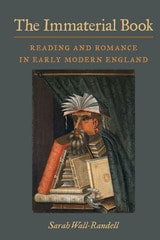
The Immaterial Book
Reading and Romance in Early Modern EnglandSarah Wall-Randell
University of Michigan Press, 2013
In romances—Renaissance England’s version of the fantasy novel—characters often discover books that turn out to be magical or prophetic, and to offer insights into their readers’ selves. The Immaterial Book examines scenes of reading in important romance texts across genres: Spenser’s Faerie Queene, Shakespeare’s Cymbeline and The Tempest, Wroth’s Urania, and Cervantes’ Don Quixote. It offers a response to “material book studies” by calling for a new focus on imaginary or “immaterial” books and argues that early modern romance authors, rather than replicating contemporary reading practices within their texts, are reviving ancient and medieval ideas of the book as a conceptual framework, which they use to investigate urgent, new ideas about the self and the self-conscious mind.
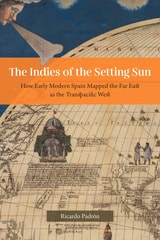
The Indies of the Setting Sun
How Early Modern Spain Mapped the Far East as the Transpacific WestRicardo Padrón
University of Chicago Press, 2020
Narratives of Europe’s westward expansion often tell of how the Americas came to be known as a distinct landmass, separate from Asia and uniquely positioned as new ground ripe for transatlantic colonialism. But this geographic vision of the Americas was not shared by all Europeans. While some imperialists imagined North and Central America as undiscovered land, the Spanish pushed to define the New World as part of a larger and eminently flexible geography that they called las Indias, and that by right, belonged to the Crown of Castile and León. Las Indias included all of the New World as well as East and Southeast Asia, although Spain’s understanding of the relationship between the two areas changed as the realities of the Pacific Rim came into sharper focus. At first, the Spanish insisted that North and Central America were an extension of the continent of Asia. Eventually, they came to understand East and Southeast Asia as a transpacific extension of their empire in America called las Indias del poniente, or the Indies of the Setting Sun.
The Indies of the Setting Sun charts the Spanish vision of a transpacific imperial expanse, beginning with Balboa’s discovery of the South Sea and ending almost a hundred years later with Spain’s final push for control of the Pacific. Padrón traces a series of attempts—both cartographic and discursive—to map the space from Mexico to Malacca, revealing the geopolitical imaginations at play in the quest for control of the New World and Asia.
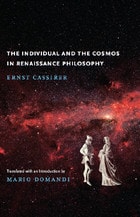
The Individual and the Cosmos in Renaissance Philosophy
Ernst Cassirer
University of Chicago Press, 2010
This provocative volume, one of the most important interpretive works on the philosophical thought of the Renaissance, has long been regarded as a classic in its field. Ernst Cassirer here examines the changes brewing in the early stages of the Renaissance, tracing the interdependence of philosophy, language, art, and science; the newfound recognition of individual consciousness; and the great thinkers of the period—from da Vinci and Galileo to Pico della Mirandola and Giordano Bruno. The Individual and the Cosmos in Renaissance Philosophy discusses the importance of fifteenth-century philosopher Nicholas Cusanus, the concepts of freedom and necessity, and the subject-object problem in Renaissance thought.
“This fluent translation of a scholarly and penetrating original leaves little impression of an attempt to show that a ‘spirit of the age’ or ‘spiritual essence of the time’ unifies and expresses itself in all aspects of society or culture.”—Philosophy
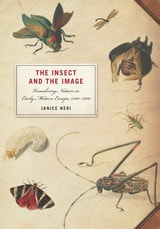
The Insect and the Image
Visualizing Nature in Early Modern Europe, 1500-1700Janice Neri
University of Minnesota Press, 2011
Once considered marginal members of the animal world (at best) or vile and offensive creatures (at worst), insects saw a remarkable uptick in their status during the early Renaissance. This quickened interest was primarily manifested in visual images—in illuminated manuscripts, still life paintings, the decorative arts, embroidery, textile design, and cabinets of curiosity. In The Insect and the Image, Janice Neri explores the ways in which such imagery defined the insect as a proper subject of study for Europeans of the early modern period.
It was not until the sixteenth century that insects began to appear as the sole focus of paintings and drawings—as isolated objects, or specimens, against a blank background. The artists and other image makers Neri discusses deployed this “specimen logic” and so associated themselves with a mode of picturing in which the ability to create a highly detailed image was a sign of artistic talent and a keenly observant eye. The Insect and the Image shows how specimen logic both reflected and advanced a particular understanding of the natural world—an understanding that, in turn, supported the commodification of nature that was central to global trade and commerce during the early modern era.
Revealing how sixteenth- and seventeenth-century artists and image makers shaped ideas of the natural world, Neri’s work enhances our knowledge of the convergence of art, science, and commerce today.
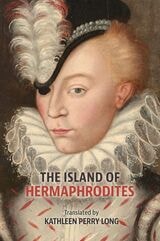
The Island of Hermaphrodites
Translated by Kathleen Perry Long
Arizona Center for Medieval and Renaissance Studies, 2025
A scandalous and subversive satire, Island of Hermaphrodites skewers the decadence and corruption of early seventeenth-century French society with razor-sharp wit. Published anonymously in 1605, this daring Menippean satire created an uproar for its irreverent portrayal of the French court, critique of absolute monarchy, and radical questioning of gender and power. A blend of political critique and biting humor, the novel follows an imagined land of aristocratic excess, where opulent feasts, elaborate fashion, and absurd rituals mask the deeper instability of a society built on privilege and deception.
Republished throughout the eighteenth century and connected to the intellectual ferment leading up to the French Revolution, Island of Hermaphrodites remains a strikingly modern indictment of unchecked power and economic exploitation. In its first full English translation, Kathleen P. Long offers new audiences a satirical romp through a world of absurdist power—one that feels politically salient today.
The Iuvenilia of Marc-Antoine Muret
With a translation, introduction, notes, and commentary by Kirk M. Summers
The Ohio State University Press, 2006
A growing interest in the contributions and perspectives of Renaissance authors who wrote in Latin has created an urgent need for accessible modern editions of their works. There is no hope of truly understanding the Renaissance, which, after all, was a revival of ancient learning integrated with an emerging modern world view, without taking into account the large body of work produced by neo-Latin authors. The Iuvenilia of Marc-Antoine Muret helps fill the need for critical editions that provide a general context and interpretation. A major neo-Latin poet, Muret was thoroughly versed in classical literature, mythology, rhetoric, and philosophy. He had inherited centuries of medieval learning and practices, both secular and religious. Muret incorporated the generic innovations of contemporary humanists while referring to current events and figures. In short, he summed up in his own person the body of human endeavor and thinking as it stood in his own time.
Given Muret’s importance, this lively translation by Kirk M. Summers, with an introduction, notes, and commentary, will appeal to classicists, including those interested in the classical tradition, as well as to scholars working on the French and European Renaissance.
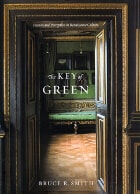
The Key of Green
Passion and Perception in Renaissance CultureBruce R. Smith
University of Chicago Press, 2008
Contending that color is a matter of both sensation and emotion, Bruce R. Smith examines Renaissance material culture—including tapestries, clothing, and stonework, among others—as well as music, theater, philosophy, and nature through the lens of sense perception and aesthetic pleasure. At the same time, Smith offers a highly sophisticated meditation on the nature of consciousness, perception, and emotion that will resonate with students and scholars of the early modern period and beyond. Like the key to a map, The Key of Green provides a guide for looking, listening, reading, and thinking that restores the aesthetic considerations to criticism that have been missing for too long.
The Kindness of Strangers
The Abandonment of Children in Western Europe from Late Antiquity to the RenaissanceJohn Boswell
University of Chicago Press, 1998
The Kinky Renaissance
Edited by Gillian Knoll and Joseph Gamble
Arizona Center for Medieval and Renaissance Studies, 2024
The Kinky Renaissance is a groundbreaking collection of essays that explore kink as a theoretical analytic, a historical formation, and an aesthetic mode. The essays in this work expand the sexual archive and its lexicon by introducing new vocabularies to familiar sexual scenes in early modern literature and culture and by bringing lesser-known scenes to bear on the study of sexuality in the period. Providing a capacious theory of sexuality and historical precedents for contemporary kinky practices, The Kinky Renaissance explores the erotic potential of early modern literature and pauses over various kinks nestled between and beside them. The collection boldly argues for a broader concept of a kinky Renaissance—one which reorients the terms of both the history of sexuality and queer theory more broadly.
The Legal Epic
"Paradise Lost" and the Early Modern LawAlison A. Chapman
University of Chicago Press, 2017
Alison A. Chapman argues that Milton’s Paradise Lost sits at the apex of the early modern period’s long fascination with law and judicial processes. Milton’s world saw law and religion as linked disciplines and thought therefore that in different ways, both law and religion should reflect the will of God. Throughout Paradise Lost, Milton invites his readers to judge actions using not only reason and conscience but also core principles of early modern jurisprudence. Law thus informs Milton’s attempt to “justify the ways of God to men” and points readers toward the types of legal justice that should prevail on earth.
Adding to the growing interest in the cultural history of law, The Legal Epic shows that England’s preeminent epic poem is also a sustained reflection on the role law plays in human society.
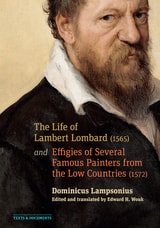
The Life of Lambert Lombard (1565); and Effigies of Several Famous Painters from the Low Countries (1572)
Dominicus Lampsonius
J. Paul Getty Trust, The, 2022
Dominicus Lampsonius’s The Life of Lambert Lombard (1565) is the earliest published biography of a Netherlandish artist. This neo-Latin account of the life of the painter, architect, and draftsman Lambert Lombard of Liège offers a theoretical exposition on the nature and ideal practice of Netherlandish art, emphasizing Lombard’s intellectual curiosity, interest in antiquity, attentive study of the human body, and exemplary generosity as a teacher.
This volume offers the first English edition of The Life of Lambert Lombard, complemented by a new translation of the inscriptions Lampsonius composed to accompany the Effigies of Several Famous Painters from the Low Countries (1572), a cycle of twenty-three engraved portraits of Netherlandish artists developed in collaboration with the print publisher Hieronymus Cock.
Together, The Life of Lambert Lombard and the Effigies established frameworks for a distinctly Netherlandish history of art. Responding to a growing sense of Netherlandish cultural and political identity on the eve of the Dutch Revolt, these texts proposed a critical alternative to Giorgio Vasari’s Lives of the Artists and its Italian model of art historical development, celebrating local ingenuity and skill. They remain the starting point for any history of the northern Renaissance.