Results by title
244 books match the query 'Study' and 54 start with t
Textual Sources for the Study of Hinduism
Edited by Wendy Doniger O'Flaherty
University of Chicago Press, 1990
Textual Sources for the Study of Islam
Edited by Andrew Rippin and Jan Knappert
University of Chicago Press, 1990
Textual Sources for the Study of Judaism
Edited and Translated by Philip S. Alexander
University of Chicago Press, 1990
"The texts . . . which are drawn from over two thousand years of history, are usefully divided, annotated and glossed. They enable students to explore the tradition in a new way [and] give a marvellous insight into the richness and liveliness of the Jewish religion and culture: we are given wit and pathos in addition to popular story and religious law."—Janet Trotter, Resource
Textual Sources for the Study of Sikhism
Edited by W.H. McLeod
University of Chicago Press, 1990
Textual Sources for the Study of Zoroastrianism
Edited by Mary Boyce
University of Chicago Press, 1990
"Wide-ranging. . . . An indispensable one-volume collection of primary materials."—William R. Darrow, Religious Studies Review
The Ait Ndhir of Morocco
A Study of the Social Transformation of a Berber TribeAmal Rassam Vinogradov
University of Michigan Press, 1974

The Alabama Folk Lyric
A Study in Origins and Media of DisseminationCollected and Edited with an Introduction and Notes by Ray B. Browne
University of Wisconsin Press, 1979
Alabamians have always been a singing people. The settlers who moved into the various sections of the state brought with them songs which reflected their national origins and geographical backgrounds, and as they spread into the hills and over the lowlands they created new songs out of the conditions under which they lived. Also, they absorbed songs from outside sources whenever these pieces could be adapted to their sentiments and ways of life. Thus, by a process of memory, composition and recreation they developed a rich body of folk songs. The following collection a part of the effort to discover and preserve these songs.
The Blues Detective
A Study of African American Detective FictionStephen Soitos
University of Massachusetts Press, 1996
This illuminating book makes the case for a tradition of African American detective fiction—novels written by black Americans about black detectives and incorporating distinctly African American tropes and themes. Beginning with Pauline Hopkins in 1901, black authors consciously altered and subverted the formulas of detective fiction in significant ways. Such writers as J. E. Bruce, Rudolph Fisher, Chester Himes, Ishmael Reed, and Clarence Major created a new genre that responded to the social and political concerns of the black community.
Examining the work of these authors, Stephen Soitos frames his analysis in terms of four uniquely African American tropes: altered detective personas, double-consciousness detection, black vernaculars, and hoodoo. He argues that black writers created sleuths who were in fact “blues detectives,” engaged not only in solving crimes, but also in exploring the mysteries of black life and culture.
Soitos grounds his study in African American literary theory, particularly the work of Houston Baker, Bernard Bell, and Henry Louis Gates, Jr. He offers both a new way of conceiving black detective fiction and a series of insightful readings of books in this genre.
The Boat People and Achievement in America
A Study of Family Life, Hard Work, and Cultural ValuesNathan Caplan, John K. Whitmore, and Marcella H. Choy
University of Michigan Press, 1989
The Brass Check
A STUDY OF AMERICAN JOURNALISMUpton Sinclair
University of Illinois Press, 2002
Fueled by mounting disdain for newspapers run by business tycoons and conservative editors, Sinclair self-published The Brass Check in the years after The Jungle had made him a household name. Despite Sinclair’s claim that this was his most important book, it was dismissed by critics and shunned by reviewers. Yet it sold over 150,000 copies and enjoyed numerous printings.
A substantial introduction to this paperback edition by Robert W. McChesney and Ben Scott asserts the book’s importance as a cornerstone critique of commercial journalism and a priceless resource for understanding the political turbulence of the Progressive Era.
The Chief Executive In Texas
A Study in Gubernatorial LeadershipBy Fred Gantt, Jr.
University of Texas Press, 1964
"A Texas governor has only two happy days: the day he is inaugurated and the day he retires."
So spoke Joseph D. Sayers at the beginning of the twentieth century. Now, in an analysis of the Texas governorship by Fred Gantt, Jr., the reader learns why Governor Sayers' remark remains true many years after it was uttered: the office has come to be so demanding that the reader may ask why anyone would want it. Price Daniel described a typical day: "The governor's job is a night-and-day job; I usually get up in the morning about seven and start answering the telephone, and then look over the mail that has come in late the day before. I sign mail before going over to the office and then have interviews most of the day. . . . In the evening at the Mansion I take calls and messages until late in the night."
The Chief Executive in Texas is much more than a book full of interesting facts: It is a discerning political commentary built on a broad historical foundation that places events and persons in a perspective perhaps not previously considered by the reader.
The office of chief executive in other states also is explored, as well as the decline and rise of executive power as it has been limited in various constitutions in Texas and as it has developed through custom. The account of the governor's relationship with the Legislature is historically valuable. Especially interesting to many readers will be the discussions of the political roles of individual Texas governors, whose ranks include "Ma" and "Pa" Ferguson and "Pappy" O'Daniel. These studies are personally revealing, and they attest that polities in Texas apparently can never be dull.

The Committee
A Study of Policy, Power, Politics and Obama's Historic Legislative Agenda on Capitol HillBryan W. Marshall and Bruce C. Wolpe
University of Michigan Press, 2018
The Committee
A Study of Policy, Power, Politics and Obama’s Historic Legislative Agenda on Capitol HillBryan W. Marshall and Bruce C. Wolpe
University of Michigan Press, 2021
For three years while serving as a senior adviser to Rep. Henry A. Waxman (D-CA), chairman of the House Committee on Energy and Commerce—one of the most powerful committees in Congress—Bruce C. Wolpe kept a diary, a senior staffer’s look at how committees develop and promote legislation. With its insider’s view of the rough-and-tumble politics of cap-and-trade, healthcare reform, tobacco, oversight, and the debt ceiling agreement, The Committee uniquely melds the art of politics and policymaking with the theory and literature of political science. The authors engage with the important questions that political science asks about committee power, partisanship, and the strategies used to build winning policy coalitions both in the Committee and on the floor of the House. In this new edition, the authors revisit the relationship between the executive and Congress in the wake of the sweeping changes wrought by the Trump administration, as well as thoughts about how that relationship will change again as President Biden faces a 117th Congress that is strikingly similar to Obama’s 111th. The insider politics and strategies about moving legislation in Congress, from internal and external coalition building to a chairman’s role in framing policy narratives, will captivate both novice and die-hard readers of politics.
The Consensus of the Church and Papal Infallibility
A Study in the Background of Vatican IRichard F. Costigan, S.J.
Catholic University of America Press, 2005
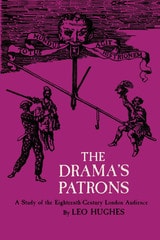
The Drama's Patrons
A Study of the Eighteenth-Century London AudienceBy Leo Hughes
University of Texas Press, 1971
The drama's laws,
the drama's patrons give,
For we that live to please,
must please to live.
—Samuel Johnson, 1747
Democratic ferment, responsible for political explosions in the seventeenth century and expanded power in the eighteenth, affected all phases of English life. The theatre reflected these forces in the content of the plays of the period and in an increased awareness among playgoers that the theatre "must please to live."
Drawing from a wealth of amusing and informative contemporary accounts, Leo Hughes presents abundant evidence that the theatre-going public proved zealous, and sometimes even unruly, in asserting its role and rights. He describes numerous species of individual pest—the box-lobby saunterers, the vizard masks (ladies of uncertain virtue), the catcallers, and the weeping sentimentalists. Protest demonstrations of various interest groups, such as footmen asserting their rights to sit in the upper gallery, reflect the behavior of the audience as a whole—an audience that Alexander Pope described as "the manyheaded monster of the pit."
Hughes analyzes the changes in the audience's taste through the long span from Dryden's day to Sheridan's. He illustrates the decline in taste from the sophisticated, if bawdy, comedy of the Restoration Period to the sentimentalism and empty show of later decades. He attributes the increased emphasis on sentiment and spectacle to audience influence and describes the effects of audience demands on managers, playwrights, and players. He describes in detail the mixed assembly that frequented the theatre during this period and the greatly enlarged theatres that were built to accommodate it.
Hughes concludes that it was the English people's basic love of liberty that allowed them to accept audience disruptions considered intolerable by foreign visitors and that the drama's patrons greatly influenced the quality of theatrical production during this long period.
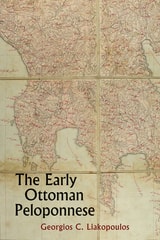
The Early Ottoman Peloponnese
A Study in the Light of an Annotated Editio Princeps of the TT10-1/14662 Ottoman Taxation Cadastre (ca. 1460–1463)Georgios C. Liakopoulos
Gingko, 2019
The book is divided into two parts, with part one covering a range of materials through an introduction and three chapters and part two consisting of a diplomatic edition of the transcribed Ottoman text. The introduction offers an orientation to the scope of the book, surveys previous scholarship conducted on the subject, and provides a historical examination of the late Byzantine Peloponnese and its conquest by the Ottomans. Accompanied by topographic and linguistic notes, Liakopoulos presents the historical geography of the Peloponnese, listing all the place-names mentioned in the sequence they appear in the TT10-1/14662 register. This is followed by a set of thirty-eight digital maps of the early Ottoman Peloponnese using GIS (Geographical Information Systems). This is followed by a discussion of the demography of the Peloponnese, including the settlement patterns, the density of population and its categorisation—urban and rural, sedentary and nomadic—concentrating on the influx and settlement of the second largest ethnic group in the peninsula: the Albanians. Liakopoulos explores the administrative and economic structures of the Peloponnese, and provides a detailed presentation their of agricultural production, fully illustrated with tables and charts.

The Family Meets the Depression
A Study of a Group of Highly Selected FamiliesWinona L. Morgan
University of Minnesota Press, 1939
The Family Meets the Depression was first published in 1939. Minnesota Archive Editions uses digital technology to make long-unavailable books once again accessible, and are published unaltered from the original University of Minnesota Press editions.
There have been very few studies of normal, happy family life. One such study, "The Family in the Present Social Order," by Ruth Lindquist, presented the circumstances of several hundred normal American families in 1927, one of the most prosperous years of our history.
The present investigation is a follow-up of Miss Lindquist's. Miss Morgan compares the circumstances of 331 of these families as they were in that year with those of the same families in 1933, which perhaps was the blackest year of the depression. The problems faced and the manner in which they were solved are carefully analyzed and presented in eminently readable form. Including as they do depleted incomes, lack of help in the household, dependent relatives, and health difficulties, these problems are in numerous ways typical of those faced by thousands of American families today.
The findings of this study should possess considerable significance not only for students of home economics but also for sociologists, parent educators, and psychologists concerned with problems of personal adjustment.

The Foundation Administrator
A Study of Those Who Manage America's FoundationsArnold John Zurcher
Russell Sage Foundation, 1972
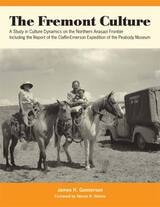
The Fremont Culture
A Study in Culture Dynamics on the Northern Anasazi Frontier, including the Report of the Claflin-Emerson Expedition of the Peabody MuseumJames H Gunnerson
University of Utah Press, 2009
Early expedition surveys and excavations conducted by Noel Morss would lead to a definition of the Fremont culture; later research would augment existing data on the Fremont by adding entirely new traits, disclosing new variations in architecture and basketry, and providing new information on the distribution of previously known traits.
In The Fremont Culture: A Study in Culture Dynamics on the Northern Anasazi Frontier, archaeologist James H. Gunnerson provides the results of his 1950s survey and excavation in the Utah area. He presents a functional synthesis of the Fremont culture and discusses the dynamics of its growth and decline.
Gunnerson’s report also uses the original field notes, maps, plans, photographs, sketches, and unpublished preliminary reports of the Claflin-Emerson expedition. Together, the reports of Morss and Gunnerson offer the most important and complete overview of the expedition available. They are fitting tributes to the men of that expedition, scientists who recognized the importance of an ancient people who once wrested a meager living from the rugged canyon country of the Green and Colorado Rivers.

The Gang
A Study of 1,313 Gangs in ChicagoFrederic Milton Thrasher
University of Chicago Press, 1963
While gangs and gang culture have been around for countless centuries, The Gang is one of the first academic studies of the phenomenon. Originally published in 1927, Frederic Milton Thrasher’s magnum opus offers a profound and careful analysis of hundreds of gangs in Chicago in the early part of the twentieth century. With rich prose and an eye for detail, Thrasher looked specifically at the way in which urban geography shaped gangs, and posited the thesis that neighborhoods in flux were more likely to produce gangs. Moreover, he traced gang culture back to feudal and medieval power systems and linked tribal ethos in other societies to codes of honor and glory found in American gangs. Thrasher approaches his subject with empathy and insightfulness, and creates a multifaceted and textured portrait that still has much to offer to readers today. With handsome images that evoke the era, this unabridged edition of The Gang not only explores an important moment in the history of Chicago, but also is itself a landmark in the history of sociology and subcultural theory.
The Great Eskimo Vocabulary Hoax and Other Irreverent Essays on the Study of Language
Geoffrey K. Pullum
University of Chicago Press, 1991
Geoffrey K. Pullum's writings began as columns in Natural Language and Linguistic Theory in 1983. For six years, in almost every issue, under the banner "TOPIC. . .COMMENT," he published a captivating mélange of commentary, criticism, satire, whimsy, and fiction. Those columns are reproduced here—almost exactly as his friends and colleagues originally warned him not to publish them—along with new material including a foreword by James D. McCawley, a prologue, and a new introduction to each of these clever pieces. Whether making a sneak attack on some sacred cow, delivering a tongue-in-cheek protest against current standards, or supplying a caustic review of some recent development, Pullum remains in touch with serious concerns about language and society. At the same time, he reminds the reader not to take linguistics too seriously all of the time.
Pullum will take you on an excursion into the wild and untamed fringes of linguistics. Among the unusual encounters in store are a conversation between Star Trek's Commander Spock and three real earth linguists, the strange tale of the author's imprisonment for embezzling funds from the Campaign for Typographical Freedom, a harrowing account of a day in the research life of four unhappy grammarians, and the true story of how a monograph on syntax was suppressed because the examples were judged to be libelous. You will also find a volley of humorous broadsides aimed at dishonest attributional practices, meddlesome copy editors, mathematical incompetence, and "cracker-barrel philosophy of science." These learned and witty pieces will delight anyone who is fascinated by the quirks of language and linguists.
The Hibernensis
Book 1: A Study and EditionRoy Flechner
Catholic University of America Press, 2019
Widely recognized as the single most important source for the history of the church in early medieval Ireland, the Hibernensis is also our best index for knowing what books were available in Ireland at the time of its compilation: it consists of excerpted material from the Bible, Church Fathers and doctors, hagiography, church histories, chronicles, wisdom texts, and insular normative material unattested elsewhere. This in addition to the staple sources of canonical collections, comprising the acta of church councils and papal letters. Altogether there are forty-two cited authors and 135 cited texts. But unlike previous canonical collections, the contents of the Hibernensis are not simply derivative: they have been modified and systematically organised, offering an important insight into the manner in which contemporary clerical scholars attempted to define, interpret, and codify law for the use of a growing Christian society.

The Individuality of Portugal
A Study in Historical-Political GeographyBy Dan Stanislawski
University of Texas Press, 1959
Many map users have wondered why Portugal, sharing with Spain the Iberian Peninsula, ever became a separate nation. That question is answered with remarkable clarity by Dan Stanislawski. This book also presents an analysis of the factors that produce separate nations and offers a study of the evolution of national cultures generally, especially as they apply to Portugal.
The Living Dead
A Study of the Vampire in Romantic LiteratureJames B. Twitchell
Duke University Press, 1981
The Makah Indians
A Study of an Indian Tribe in Modern American SocietyElizabeth Colson
University of Minnesota Press, 1953
The Makah Indians was first published in 1953. Minnesota Archive Editions uses digital technology to make long-unavailable books once again accessible, and are published unaltered from the original University of Minnesota Press editions.
Elizabeth Colson lived for a year among the Makah Indians at their reservation at Neah Bay, Washington, while engaged in the field work for this fascinating anthropological study. During that time she made friends with many of the tribe. She shared in their daily living and in their festivities. She listened with an understanding ear to their problems, to their rambling conversations, as well as to their replies in formal interviews.
The result is a richly detailed description of how an American Indian group lives in modern society and an acute analysis of their social problems and adjustments.
The author describes the land of the Makah, explains the origin of the tribe, and portrays their characteristic traits. In sections on the Makah and the Whites and the Makah and the Outer World, she analyzes group relationships. In another section, she describes the internal tribal rivalries that stem from the Makah tradition. Finally, she discusses the religious concepts and practices.
Anthropologists will find the study of primary importance. It is significant to social scientists in other fields as well and to all readers who are concerned about race relations and the special problems of the American Indian. In chronicling the effects of the U.S. Indian Service on one tribe, the book treats an important aspect of American social history.
The Making of a Sage
A Study in Rabbinic EthicsJonathan Wyn Schofer
University of Wisconsin Press, 2005
Jonathan Schofer offers the first theoretically framed examination of rabbinic ethics in several decades. Centering on one large and influential anthology, The Fathers According to Rabbi Nathan, Jonathan Schofer situates that text within a broader spectrum of rabbinic thought, while at the same time bringing rabbinic thought into dialogue with current scholarship on the self, ethics, theology, and the history of religions.
Notable Selection, Jordan Schnitzer Book Award for Philosophy and Jewish Thought, Association for Jewish Studies
The Mental Growth of Children From Two to Fourteen Years
A Study of the Predictive Value of the Minnesota Preschool ScalesFlorence Goodenough
University of Minnesota Press, 1942
The Mythmaker
A Study of Motif and Symbol in the Short Stories of Jorge Luis BorgesBy Carter Wheelock
University of Texas Press, 1969
Readers who are intrigued, though often mystified, by the intellectual fantasies of Jorge Luis Borges will find this book a revelation, a skeleton key to one of the most fundamental and baffling aspects of Borges’s fictions: the pattern of symbolism with an inner meaning. Carter Wheelock’s study reduces a number of literary and intellectual abstractions to concrete terms, enabling the reader to understand Borges’s fantasies in ways that show them to be not so fantastic after all. Indeed, they are amazingly consistent and minutely accurate in their symbolic depiction of the magic universe of the mind.
Wheelock also discusses the affinity between Borges’s philosophical idealism and his “esthetic of the intelligence,” the relationship between these and the esthetic ideas of French Symbolism, and the influence on his fictions of the Rubáiyát of Omar Khayyám.
Why is it that this “writer’s writer” from the Argentine—erudite, allusive, elusive—has attracted such international attention? In Wheelock’s opinion, it is because he has symbolized in his short stories the fundamental form of the human consciousness, the functioning of the imaginative (world-creating) mechanism, and the eternal battle between form and chaos. The Mythmaker is concerned with elucidating the particulars of Borges’s fictional works, but even as it does so it also reveals their universality.
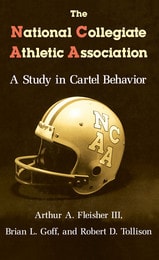
The National Collegiate Athletic Association
A Study in Cartel BehaviorArthur A. Fleisher III, Brian L. Goff, and Robert D. Tollison
University of Chicago Press, 1992
Probing the history and business practices of the most powerful sports organization of colleges and universities in the United States, the authors present a persuasive case that the NCAA is in fact a cartel, its members engaged in classically defined restrictive practices for the sole purpose of jointly maximizing their profits.
This fresh perspective on the NCAA's institutional structure helps to explain why illicit payments to athletes persist, why non-NCAA organizations have not flourished, and why members have readily agreed on certain suspect rules.
Offering a valuable case study for sports analysts and students of economics and cartel behavior, this book is a revealing glimpse inside the embattled NCAA program.

The Orwell Mystique
A Study in Male IdeologyDaphne Patai
University of Massachusetts Press, 1984
The Orwell Mystique: A Study in Male Ideology is a pioneering work of feminist literary criticism that subjects the life and writing of George Orwell (1903–1950) to a sustained and rigorous feminist analysis. Published in 1984—the same year as the famous date in Orwell's most celebrated dystopian novel—the book examines all of Orwell's major novels, essays, and journalism and argues that his widely celebrated reputation for moral authority and plain-speaking democratic decency is fundamentally undercut by a pervasive and condescending attitude toward women.
Author Daphne Patai contends that Orwell's work is saturated with a male ideology so deeply embedded as to be largely invisible to mainstream criticism, which had long treated Orwell as an exemplar of intellectual honesty and political courage while overlooking the gender assumptions that structure his writing. Drawing on feminist theory and close textual analysis, Patai systematically traces the ways in which Orwell's androcentrism—his tendency to place men and male experience at the center of human life—shapes not only his fiction but also his essays, autobiographical writings, and political commentary.
The book is organized around a series of thematic and textual investigations. An introductory chapter establishes what Patai calls “the Orwell myth”—the cultural phenomenon by which Orwell's personal authority as a moral and political guide has been constructed and sustained. Subsequent chapters examine specific dimensions of Orwell's work and biography, including his experience of empire and the masculine codes embedded in his writings about colonialism; his treatments of vagabondage, manual labor, and working-class masculinity (notably in works such as Down and Out in Paris and London and The Road to Wigan Pier); and the androcentrism running through Nineteen Eighty-Four, in which Patai argues that the novel's treatment of women, sexuality, and the body reflects deeply patriarchal assumptions. The book also addresses Orwell's essays and journalism, situating his gender ideology within the broader context of mid-twentieth-century British patriarchal culture.
At the time of its publication, The Orwell Mystique was one of the first book-length feminist examinations of Orwell, and it generated significant scholarly debate. It remains an important and frequently cited work in both Orwell studies and feminist literary criticism.
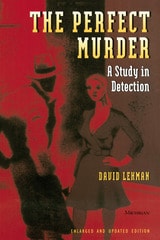
The Perfect Murder
A Study in DetectionDavid Lehman
University of Michigan Press, 2000
As Lehman shows, the detective story draws deeply from ancient storytelling traditions. The mystery's conventions--the locked room, the clue "hidden" in plain sight, the diabolical double, the villainous least likely subject--work on us as childhood fairy tales do; they prey upon our darkest fears, taking us to the brink of the unbearable before restoring a comforting sense of order. The myth of Oedipus, for example, contains the essential elements of a whodunit, with the twist that the murderer the detective pursues is himself.
With their wisecracking gumshoe heroes, Dashiell Hammett and Raymond Chandler fashioned an existential romance out of the detective novel. More recent writers such as Ross MacDonald, P. D. James, and Ruth Rendell have raised the genre to a new level of psychological sophistication. Yet the form evolves still, and Lehman guides us to the epistemological riddles of Jorge Luis Borges and Umberto Eco, who challenge the notion of a knowable truth. Originally published in 1989, this new edition features an additional chapter on the mystery novels of the 1990s.
"A lively study of the development and varieties of the detective story since Poe, its relations with other forms high and low, and the latter-day appropriation of its techniques by such writers as Borges and Eco. . . . A thoroughly intelligent and readable book." --Richard Wilbur, Pulitzer-Prize winning poet
David Lehman is the series editor of both the The Best American Poetry, published by Scribner, and the Poets on Poetry series published by the University of Michigan Press. He is a former Guggenheim Fellow in poetry, a vice president of the National Book Critics Circle, and the author of several books of criticism and collections of poems.

The Playwright as Thinker
A Study of Drama in Modern Times, Fourth EditionEric Bentley
University of Minnesota Press, 2010
The Puerto Rican Population
A Study in Human BiologyFrederick P. Thieme
University of Michigan Press, 1959
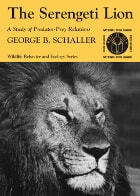
The Serengeti Lion
A Study of Predator-Prey RelationsGeorge B. Schaller
University of Chicago Press, 1976
Based on three years of study in the Serengeti National Park, George B. Schaller’s The Serengeti Lion describes the vast impact of the lion and other predators on the vast herds of wildebeest, zebra, and gazelle for which the area is famous. The most comprehensive book available on the lion, this classic work includes the author’s findings on all aspects of lion behavior, including its social system, population dynamics, hunting behavior, and predation patterns.
“If you have only enough time to read one book about field biology, this is the one I recommend.”—Edward O. Wilson, Science
“This book conveys not only the fascination of its particular study of lion behavior but the drama and wonder and beauty of the intimate interdependence of all living things.”—Saturday Review
“This is an important book, not just for its valuable information on lions, but for its broad, open, and intelligent approach to problems that cut across the fields of behavior, populations, ecology, wildlife management, evolution, anthropology, and comparative biology.”—Richard G. Van Gelder, Bioscience
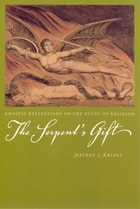
The Serpent's Gift
Gnostic Reflections on the Study of ReligionJeffrey J. Kripal
University of Chicago Press, 2006
“Because thou hast done this, thou art cursed above all cattle, and above every beast of the field.” With those words in Genesis, God condemns the serpent for tempting Adam and Eve, and the serpent has shouldered the blame ever since. But how would the study of religion change if we looked at the Fall from the snake’s point of view? Would he appear as a bringer of wisdom, more generous than the God who wishes to keep his creation ignorant?
Inspired by the early Gnostics who took that startling view, Jeffrey J. Kripal uses the serpent as a starting point for a groundbreaking reconsideration of religious studies and its methods. In a series of related essays, he moves beyond both rational and faith-based approaches to religion, exploring the erotics of the gospels and the sexualities of Jesus, John, and Mary Magdalene. He considers Feuerbach’s Gnosticism, the untapped mystical potential of comparative religion, and even the modern mythology of the X-Men.
Ultimately, The Serpent’s Gift is a provocative call for a complete reorientation of religious studies, aimed at a larger understanding of the world, the self, and the divine.
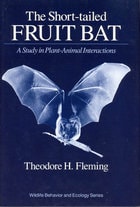
The Short-Tailed Fruit Bat
A Study in Plant-Animal InteractionsTheodore H. Fleming
University of Chicago Press, 1988
In The Short-tailed Fruit Bat, Theodore Fleming examines Carollia's role in the ecology of tropical forests. Based on more than ten years' research, this study provides the most detailed ecological and evolutionary account to date of the life history of a Neotropical mammal and includes striking photographs of the bats in flight.
The Sola Valley and the Monte Albán State
A Study of Zapotec Imperial ExpansionAndew K. Balkansky
University of Michigan Press, 2002
The Study of Ethnomusicology
Thirty-Three DiscussionsBruno Nettl
University of Illinois Press, 2015
A classroom perennial and a must-have for any scholar's bookshelf, the third edition of The Study of Ethnomusicology introduces Nettl's thought to a new generation.
The Study of Ethnomusicology
Thirty-one Issues and ConceptsBruno Nettl
University of Illinois Press, 2010
This book looks at the field of ethnomusicology--defined as the study of the world's musics from a comparative perspective, and the study of all music from an anthropological perspective--as a field of research. Nettl selects thirty-one concepts and issues that have been the subjects of continuing debate by ethnomusicologists, and he adds four entirely new chapters and thoroughly updates the text to reflect new developments and concerns in the field.
Each chapter looks at its subject historically and goes on to make its points with case studies, many taken from Nettl's own field experience. Drawing extensively on his field research in the Middle East, Western urban settings, and North American Indian societies, as well as on a critical survey of the available literature, Nettl advances our understanding of both the diversity and universality of the world's music. This revised edition's four new chapters deal with the doing and writing of musical ethnography, the scholarly study of instruments, aspects of women's music and women in music, and the ethnomusicologist's study of his or her own culture.

The Study of Population
An Inventory and AppraisalEdited by Philip M. Hauser and Otis Dudley Duncan
University of Chicago Press, 1959

The Study of Religion in an Age of Global Dialogue
Leonard Swidler
Temple University Press, 2000
What is religion? As this comprehensive work shows, religion is an explanation of the ultimate meaning of life and how to live accordingly, based on a notion of the Transcendent. Normally it contains the four "C's": Creed, Code, Cult, Community-structure.
This volume looks at the ways we humans have developed to study religion. It also examines the new age in human consciousness that is now drawing. It also examines the new age in human consciousness that is now dawning: The Age of Global Dialogue, a radically new consciousness that shifts the ways we understand everything in life, including religion. This global dialogical way of understanding life does not lead to one global religion, but it does lead toward a consciously acknowledged common set of ethical principles, a Global Ethic. The book looks at these two movements -- the Age of Global Dialogue and inchoative Global Ethic -- in order to help readers understand what is going on around them, so they may make informed, intelligent decisions about the meaning of life and how to live it.
The Study of Signed Languages
Essays in Honor of William C. StokoeDavid F. Armstrong
Gallaudet University Press, 2002
In 1999, many of today’s notable researchers assembled at a special conference in honor of William C. Stokoe to explore the remarkable research that grew out of his original insights on American Sign Language. The Study of Signed Languages presents the fascinating findings from that conference.
Part 1, Historical Perspectives, begins with a description of the decline of sign language studies in the 1800s. Past research on signed languages and its relationship to language origins theory follows, along with a consideration of modality and conflicting agendas for its study.
In Part 2, Language Origins, the first entry intrigues with the possibility that sign language could answer conundrums posed by Noam Chomsky’s linguistic theories. The next essay considers how to build a better language model by citing continuity, ethology, and Stokoe’s work as key elements. Stokoe’s own research on the gestural theory of language origins is examined in the section’s closing chapter.
Part 3, Diverse Populations, delineates the impact of sign language research on black deaf communities in America, on deaf education, on research into variation in sign language, and even on sign communication and the motor functioning of autistic children and others. In its wide-ranging, brilliant scholarship, The Study of Signed Languages serves as a fitting tribute to William C. Stokoe and his work.
The Sub
A Study in WitchcraftThomas M. Disch
University of Minnesota Press, 2010
The Taste for Nothingness
A Study of Virtus and Related Themes in Lucan's Bellum CivileR. Sklenar
University of Michigan Press, 2003
The Taste for Nothingness traces Lucan's own analytical method by showing how virtus and related concepts operate--or rather, fail to operate--in Lucan's appropriations and distortions of the traditional epic-battle narrative; in the philosophical commitment of Cato the Younger; and in the personalities of the two antagonists, Pompey and Caesar. Much recent scholarship has reached a consensus that Lucan's literary method is mimetic, that his belief in a chaotic cosmos produces a poetics of chaos. While accepting many of the recent findings about Lucan's view of language and the universe, The Taste for Nothingness also allows an even bolder Lucan to emerge: a committed aesthete who regards art as the only realm in which order is possible.
Robert Sklenár is Visiting Assistant Professor of Classical Studies, Tulane University.
The Tristan Legend
A Study in SourcesSigmund Eisner
Northwestern University Press, 1969
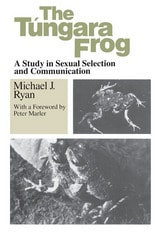
The Tungara Frog
A Study in Sexual Selection and CommunicationMichael J. Ryan
University of Chicago Press, 1985
In TheTúngara Frog, the most detailed and informative single study available of frogs and their reproductive behavior, Michael J. Ryan demonstrates the interplay of sexual and natural selection. Using techniques from ethology, behavioral ecology, sensory physiology, physiological ecology, and theoretical population genetics in his research, Ryan shows that large males with low-frequency calls mate most successfully. He examines in detail a number of explanations for the females' preferences, and he considers possible evolutionary forces leading to the males' success.
Though certain vocalizations allow males to obtain mates and thus should be favored by sexual selection, this study highlights two important costs of such sexual displays: the frogs expand considerable energy in their mating calls, and they advertise their whereabouts to predators. Ryan considers in detail how predators, especially the frige-lipped bat (Trachops cirrhosus), affect the evolution of the túngara frog's calls.
The Yomut Turkmen
A Study of Social Organization among a Central Asian Turkic-Speaking PopulationWilliam Irons
University of Michigan Press, 1975
The Young Child and His Parents
A Study of One-Hundred CasesJosephine Foster
University of Minnesota Press, 1929
These We Teach
A Study of General College StudentsCornelia T. Williams
University of Minnesota Press, 1943
These We Teach was first published in 1943. Minnesota Archive Editions uses digital technology to make long-unavailable books once again accessible, and are published unaltered from the original University of Minnesota Press editions.
They Went to College
A Study of 951 Former University StudentsC. Robert Pace
University of Minnesota Press, 1941
They Went to College was first published in 1941. Minnesota Archive Editions uses digital technology to make long-unavailable books once again accessible, and are published unaltered from the original University of Minnesota Press editions.