Results by title
2706 books match the query 'European' and 622 start with t
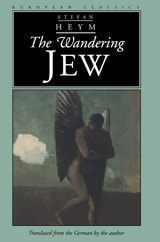
The Wandering Jew
Stefan Heym
Northwestern University Press, 1999
Heym introduces both Ahasverus and Lucifer as angels cast out of heaven for their opinions on God's order. Their respective oppositions continue throughout the rest of time: Ahasverus remains defiant through protest rooted in love and a faith in progress, while Lucifer is rebellious by means of his old, familiar methods. In a funny eternity of run-ins, debates, and meddling with characters such as Christ, a disciple of Luther, and a Marxist professor in East Germany, Ahasverus and Lucifer struggle on, awaiting the Second Coming.

The Wandering Life
Followed by "Another Era of Writing"Yves Bonnefoy
Seagull Books, 2023
The Wandering Life is a poetic culmination of Yves Bonnefoy’s wanderings and characterizes the final twenty-five years of his work. Bonnefoy was an ardent traveler throughout his life, and his journeys in foreign countries left a profound imprint on his work. The time he spent in Italy, translating Shakespeare’s work in England, in universities in the United States, in India with Octavio Paz, and more, affected his poetry in discernible ways and inspired The Wandering Life. Interweaving verse and prose—vignettes that range from a few lines in length to several pages—this volume is a fitting capstone to Bonnefoy’s oeuvre and appears in English translation for the first time to mark the centenary of Yves Bonnefoy’s birth.
The Wandering Scholars
Helen Waddell
University of Michigan Press, 1990
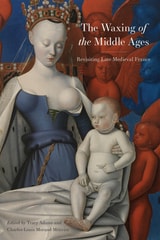
The Waxing of the Middle Ages
Revisiting Late Medieval FranceCharles-Louis Morand-Métivier
University of Delaware Press, 2023
The Waxing of the Middle Ages sets out to provide a rich, complex, and diverse study of these developments and to reassert that late medieval France is crucial in its own right. The collection argues for an approach that views the late medieval period not as an afterthought, or a blind spot, but as a period that is key in understanding the fluidity of time, traditions, culture, and history. Each essay explores some “cultural form,” to borrow Huizinga’s expression, to expose the false divide that has dominated modern scholarship.
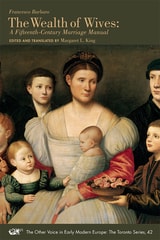
The Wealth of Wives
A Fifteenth-Century Marriage ManualFrancesco Barbaro
Iter Press, 2015
In 1415, Francesco Barbaro produced a marriage manual intended at once for his friend, a scion of the Florentine Medici family, and for the whole set of his peers, the young nobility of Venice. Countering the trends of the day toward dowry chasing and dowry inflation, Barbaro insisted that the real wealth of wives was their capacity to conceive, birth, and rear children worthy of their heritage. The success of the patriciate depended, ironically, on women: for they alone could ensure the biological, cultural, and spiritual reproduction of their marital lineage. The Wealth of Wives circulated in more than 100 manuscript versions, five Latin editions, and translations into German, Italian, French, and English, far outstripping in its influence Leon Battista Alberti’s On the Family (1434).
The Weight of a World of Feeling
Reviews and Essays by Elizabeth BowenElizabeth Bowen / Edited and with an introduction by Allan Hepburn
Northwestern University Press, 2017
This fascinating collection of reviews is filled with first impressions of novels, autobiographies, memoirs, illustrated books, biographies of politicians and artists, short story collections, and literary criticism. Books spark statements from Bowen about general principles of fictional technique; she articulates her understanding of the inner workings of fiction incidentally, while providing an opinion about the book at hand. In this volume, Hepburn draws together all the reviews that Bowen left uncollected in her non-fiction collections, as well as several more familiar essays that that she published in The Tatler, in order to make them accessible to a broader audience.
The Well at Morning
Selected Poems, 1925–1971Bohuslav Reynek
Karolinum Press, 2017
A chaffinch in a tree
of cherry sings merrily
spring’s introit.
Its blazing bobble dwells
in leaves, alive, and swells
in scarlet.
The flowers are flares of white.
The chaffinch has gone quiet
and turned sky-gazer.
My eyes close on the day:
an orb revolves in grey
and red and azure.
Poet and artist Bohuslav Reynek spent most of his life in the relative obscurity of the Czech-Moravian Highlands; although he suffered at the hands of the Communist regime, he cannot be numbered among the dissident poets of Eastern Europe who won acclaim for their political poetry in the second half of the twentieth century. Rather, Reynek belongs to an older pastoral-devotional tradition—a kindred spirit to the likes of English-language poets Gerard Manley Hopkins, William Wordsworth, Robert Frost, and Edward Thomas. The Well at Morning presents a selection of poems from across his life and is illustrated with twenty-five of his own color etchings. Also featuring three essays by leading scholars that place Reynek’s life and work alongside those of his better-known peers, this book presents a noted Czech artist to the wider world, reshaping and amplifying our understanding of modern European poetry.

The Well-Tun’d Word
Musical Interpretations of English Poetry, 1597-1651Elise Bickford Jorgens
University of Minnesota Press, 1982
The Well-Tun'd Word was first published in 1982. Minnesota Archive Editions uses digital technology to make long-unavailable books once again accessible, and are published unaltered from the original University of Minnesota Press editions.
The years 1957–1651 marked a period of high achievement in the history of song. In The Well-Tun'd Word Elise Bickford Jorgens studies changing musical conventions of English song in relation to new patterns in poetic taste from the late Elizabethan era through the Jacobean and Caroline years, basing her work on the premise that any musical setting of a poem is an interpretation of the poem itself. Thus by 1625, she contends, solo song in England had undergone a pronounced change in musical style, from the lute song of earlier decades to the monophonic continuo song. The appearance of John Donne and especially Ben Johnson and the Cavalier poets marked the demise of the Elizabethan lyrical mode that had inspired composers like John Downland, Thomas Campion, John Danyel, and Robert Jones.
Jorgen's opening chapters describe and illustrate elements of the craft of poetry and the musical conventions that can represent them. Her presentation is both clear and thorough, and will be especially helpful for students and scholars of English literature who are not necessarily musicians. She then discusses four major categories of song: Measured Music, Dance Songs and Tuneful Airs, English Monody, and Pathetic Airs, and notes that influence upon them of Continental music styles. But her major effort is to distinguish between them by pointing out their several characteristic attitudes towards the musical representation of poetic texts. All four groups show patterns of change during the first half of the seventeenth century.
Jorgens concludes that the celebrated union of the "sister arts" for which Elizabethan song was renowned was increasingly difficult to maintain after about 1610. Poets no longer favored those elements of poetic style that could in turn produce pleasing musical styles. Solo songs became, with continuo composers like Henry and William Lawes, Nicholas Lanier, and John Wilson, either notated recitations of poetry or simple pleasant trifles.
The Whole Book
Cultural Perspectives on the Medieval MiscellanyStephen G. Nichols and Siegfried Wenzel, Editors
University of Michigan Press, 1996
This group of papers, edited by two well-known scholars of the medieval world, offers both general and particular approaches to the issues surrounding manuscripts produced in the medieval habit of "miscellany," works of seemingly diverse natures bound together into one volume. Julia Boffey investigates how certain poetical miscellanies came to be assembled, for example, while Sylvia Huot suggests that the miscellany had many different sorts of function and significance. Siegfried Wenzel considers a taxonomy of such collections, and A. S. G. Edwards' paper considers Bodleian Selden B.24 as an example of how the notions of canon, authorship, and attribution might come into play. Ann Matter's final chapter offers the notion that what we call "miscellanies" are likely to have an internal logic that we have been trained to miss, but can come to understand. Other contributors are Ralph Hanna III, Georg Knauer, Stephen Nichols, James J. O'Donnell, and Barbara A. Shailor.
Because The Whole Book deals not only with the content of miscellanies but also with contemporary literary principles, this volume will be of interest to a wide circle of literary critics and historians, as well as to students of the survival of literature and of cultural values.
Stephen G. Nichols is James M. Beall Professor of French and Chair of the Department of French, The Johns Hopkins University. Siegfried Wenzel is Professor of English, University of Pennsylvania.
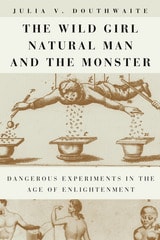
The Wild Girl, Natural Man, and the Monster
Dangerous Experiments in the Age of EnlightenmentJulia V. Douthwaite
University of Chicago Press, 2002
A variety of educational experiments failed to tame these feral children by the standards of the day. After telling their stories, Douthwaite turns to literature that reflects on similar experiments to perfect human subjects. Her examples range from utopian schemes for progressive childrearing to philosophical tales of animated statues, from revolutionary theories of regenerated men to Gothic tales of scientists run amok. Encompassing thinkers such as Rousseau, Sade, Defoe, and Mary Shelley, Douthwaite shows how the Enlightenment conceived of mankind as an infinitely malleable entity, first with optimism, then with apprehension. Exposing the darker side of eighteenth-century thought, she demonstrates how advances in science gave rise to troubling ethical concerns, as parents, scientists, and politicians tried to perfect mankind with disastrous results.
The Wine of Eternity
Short Stories from the LatvianKnuts Lesins
University of Minnesota Press, 1957
The Wine of Eternity was first published in 1957. Minnesota Archive Editions uses digital technology to make long-unavailable books once again accessible, and are published unaltered from the original University of Minnesota Press editions.
Ever since the small Baltic nation of Latvia became a part of the Soviet Union in 1940, its identity has been blurred to Western eyes. Many of its people have left their country in voluntary or forced exile. But, wherever they are today, the Latvians still cherish and preserve a rich national heritage of folklore and culture. Much of this is revealed in these stories, the work of an established Latvian writer who became a wartime refugee from his country.
This volume makes the work of Knuts Lesins available in English for the first time, although his writing has been published extensively in Europe in the original Latvian. In addition to the stories, the author provides a background sketch of the history and culture of Latvia. While much of the fascinating folklore of the country is interwoven in the stories, they are not primarily folk tales. They are perhaps best described as penetrating glimpses into human lives at moments of crisis or decision which reveal an individual's character and philosophy.
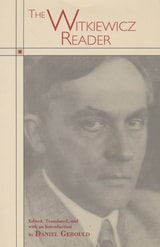
The Witkiewicz Reader
Stanislaw Ignacy Witkiewicz
Northwestern University Press, 1992
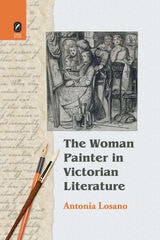
The Woman Painter in Victorian Literature
Antonia Losano
The Ohio State University Press, 2008
The nineteenth century saw a marked rise both in the sheer numbers of women active in visual art professions and in the discursive concern for the woman artist in fiction, the periodical press, art history, and politics. The Woman Painter in Victorian Literature argues that Victorian women writers used the controversial figure of the woman painter to intervene in the discourse of aesthetics. These writers were able to assert their own status as artistic producers through the representation of female visual artists.
Women painters posed a threat to the traditional heterosexual erotic art scenarios—a male artist and a male viewer admiring a woman or feminized art object. Antonia Losano traces an actual movement in history in which women writers struggled to rewrite the relations of gender and art to make a space for female artistic production. She examines as well the disruption female artists caused in the socioeconomic sphere. Losano offers close readings of a wide array of Victorian writers, particularly those works classified as noncanonical—by Anne Thackeray Ritchie, Margaret Oliphant, Anne Brontë, and Mrs. Humphrey Ward—and a new look at better-known novels such as Jane Eyre and Daniel Deronda, focusing on the pivotal social and aesthetic meanings of female artistic production in these texts. Each of the novels considered here is viewed as a contained, coherent, and complex aesthetic treatise that coalesces around the figure of the female painter.
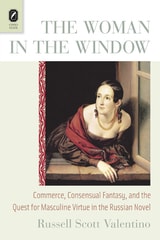
The Woman in the Window
Commerce, Consensual Fantasy, and the Quest for Masculine Virtue in the Russian NovelRussell Scott Valentino
The Ohio State University Press, 2014
With chapters on Gogol, Tolstoy, and Dostoevsky as well as Pasternak and Nabokov, The Woman in the Window argues that Russian authors worked through this question via their depictions of “mixed-up men.” Such characters, according to Valentino, reveal that in a world where social reality and personal identity depend on consensual fantasies, the old masculine figure loses its grounding and can easily drift away. Valentino charts a range of masculine character types thrown off stride by the new commercially inflected world: those who embrace blind confidence, those who are split with doubt or guilt, and those who look for an ideal of steadfastness and purity to keep afloat—a woman in a window.
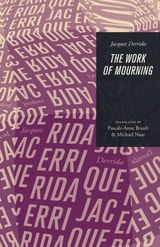
The Work of Mourning
Jacques Derrida
University of Chicago Press, 2001
Gathered here are texts—letters of condolence, memorial essays, eulogies, funeral orations—written after the deaths of well-known figures: Roland Barthes, Paul de Man, Michel Foucault, Louis Althusser, Edmond Jabès, Louis Marin, Sarah Kofman, Gilles Deleuze, Emmanuel Levinas, Jean-François Lyotard, Max Loreau, Jean-Marie Benoist, Joseph Riddel, and Michel Servière.
With his words, Derrida bears witness to the singularity of a friendship and to the absolute uniqueness of each relationship. In each case, he is acutely aware of the questions of tact, taste, and ethical responsibility involved in speaking of the dead—the risks of using the occasion for one's own purposes, political calculation, personal vendetta, and the expiation of guilt. More than a collection of memorial addresses, this volume sheds light not only on Derrida's relation to some of the most prominent French thinkers of the past quarter century but also on some of the most important themes of Derrida's entire oeuvre-mourning, the "gift of death," time, memory, and friendship itself.
"In his rapt attention to his subjects' work and their influence upon him, the book also offers a hesitant and tangential retelling of Derrida's own life in French philosophical history. There are illuminating and playful anecdotes—how Lyotard led Derrida to begin using a word-processor; how Paul de Man talked knowledgeably of jazz with Derrida's son. Anyone who still thinks that Derrida is a facetious punster will find such resentful prejudice unable to survive a reading of this beautiful work."—Steven Poole, Guardian
"Strikingly simpa meditations on friendship, on shared vocations and avocations and on philosophy and history."—Publishers Weekly
The Work of Mourning
Jacques Derrida
University of Chicago Press, 2003
Gathered here are texts—letters of condolence, memorial essays, eulogies, funeral orations—written after the deaths of well-known figures: Roland Barthes, Paul de Man, Michel Foucault, Louis Althusser, Edmond Jabès, Louis Marin, Sarah Kofman, Gilles Deleuze, Emmanuel Levinas, Jean-François Lyotard, Max Loreau, Jean-Marie Benoist, Joseph Riddel, and Michel Servière.
With his words, Derrida bears witness to the singularity of a friendship and to the absolute uniqueness of each relationship. In each case, he is acutely aware of the questions of tact, taste, and ethical responsibility involved in speaking of the dead—the risks of using the occasion for one's own purposes, political calculation, personal vendetta, and the expiation of guilt. More than a collection of memorial addresses, this volume sheds light not only on Derrida's relation to some of the most prominent French thinkers of the past quarter century but also on some of the most important themes of Derrida's entire oeuvre-mourning, the "gift of death," time, memory, and friendship itself.
"In his rapt attention to his subjects' work and their influence upon him, the book also offers a hesitant and tangential retelling of Derrida's own life in French philosophical history. There are illuminating and playful anecdotes—how Lyotard led Derrida to begin using a word-processor; how Paul de Man talked knowledgeably of jazz with Derrida's son. Anyone who still thinks that Derrida is a facetious punster will find such resentful prejudice unable to survive a reading of this beautiful work."—Steven Poole, Guardian
"Strikingly simpa meditations on friendship, on shared vocations and avocations and on philosophy and history."—Publishers Weekly
The World Saved by Kids
And Other EpicsElsa Morante
Seagull Books, 2016
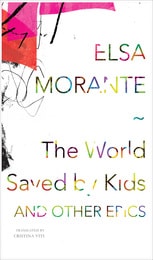
First published in Italian in 1968, The World Saved by Kids was written in the aftermath of deep personal change and in the context of what Elsa Morante called the “great youth movement exploding against the funereal machinations of the organized contemporary world.” Morante believed that it was only the youth who could truly hear her revolutionary call. With the fiftieth anniversary of the tumultuous events of 1968 approaching, there couldn’t be a more timely moment for this first English translation of Morante’s work to appear.
Greeted by Antonio Porta as one of the most important books of its decade, The World Saved by Kids showcases Morante’s true mastery of tone, rhythm, and imagery as she works elegy, parody, storytelling, song, and more into an act of linguistic magic through which Gramsci and Rimbaud, Christ and Antigone, Mozart and Simone Weil, and a host of other figures join the sassy, vulnerable neighborhood kids in a renewal of the word’s timeless, revolutionary power to explore and celebrate life’s insoluble paradox.
Morante gained international recognition and critical acclaim for her novels History, Arturo’s Island, and Aracoeli, and The World Saved By Kids may be her best book and the one that most closely represents her spirit.
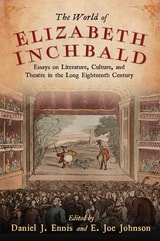
The World of Elizabeth Inchbald
Essays on Literature, Culture, and Theatre in the Long Eighteenth CenturyDaniel J. Ennis
University of Delaware Press, 2022
The Worldmakers
Global Imagining in Early Modern EuropeAyesha Ramachandran
University of Chicago Press, 2015
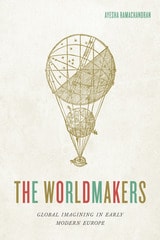
The Worldmakers moves beyond histories of globalization to explore how “the world” itself—variously understood as an object of inquiry, a comprehensive category, and a system of order—was self-consciously shaped by human agents. Gathering an international cast of characters, from Dutch cartographers and French philosophers to Portuguese and English poets, Ramachandran describes a history of firsts: the first world atlas, the first global epic, the first modern attempt to develop a systematic natural philosophy—all part of an effort by early modern thinkers to capture “the world” on the page.
The Worlds of Petrarch
Giuseppe Mazzotta
Duke University Press, 1993
Written in a clear and passionate style, The Worlds of Petrarch takes us into the politics of culture, the poetic imagination, into history and ethics, art and music, rhetoric and theology. With this encyclopedic strategy, Mazzotta is able to demonstrate that the self for Petrarch is not a unified whole but a unity of parts, and, at the same time, that culture emerges not from a consensus but from a conflict of ideas produced by opposition and dark passion. These conflicts, intrinsic to Petrarch's style of thought, lead Mazzotta to a powerful rethinking of the concepts of "fragments" and "unity" and, finally, to a new understanding of the relationship between them.
The Wretch, Otherwise Known as Guerrino
A Bilingual EditionTullia d'Aragona
Iter Press, 2024
This is an unabridged bilingual, fully annotated edition of Tullia d’Aragona’s epic poem The Wretch. This mid-century epic reflects the many historical and religious changes taking place in the first half of the sixteenth century in Europe and the burgeoning literary debates following the publication of another Italian epic poem, Ariosto’s Orlando Furioso. The Wretch recounts the adventures of Guerrino, a nobleman captured by pirates as an infant and sold into slavery. His famous quest in search of his parents and his identity involves abductions, same-sex seductions, and skirmishes with fantastical beasts as he travels through Europe, Turkey, Africa, India, Arabia, and the Purgatory of St. Patrick. The poem occupies an important position in the development of the prestigious epic genre, the highest step on the ladder to literary recognition and fame, and Tullia’s work paved the way for the epics of other women writers in subsequent decades.
The Writer in Petrograd and the House of Arts
Martha Weitzel Hickey
Northwestern University Press, 2009
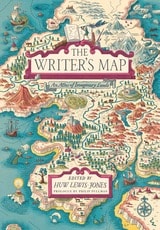
The Writer's Map
An Atlas of Imaginary LandsEdited by Huw Lewis-Jones
University of Chicago Press, 2018
Philip Pullman recounts the experience of drawing a map as he set out on one of his early novels, The Tin Princess. Miraphora Mina recalls the creative challenge of drawing up ”The Marauder’s Map” for the Harry Potter films. David Mitchell leads us to the Mappa Mundi by way of Cloud Atlas and his own sketch maps. Robert Macfarlane reflects on the cartophilia that has informed his evocative nature writing, which was set off by Robert Louis Stevenson and his map of Treasure Island. Joanne Harris tells of her fascination with Norse maps of the universe. Reif Larsen writes about our dependence on GPS and the impulse to map our experience. Daniel Reeve describes drawing maps and charts for The Hobbit film trilogy. This exquisitely crafted and illustrated atlas explores these and so many more of the maps writers create and are inspired by—some real, some imagined—in both words and images.
Amid a cornucopia of 167 full-color images, we find here maps of the world as envisaged in medieval times, as well as maps of adventure, sci-fi and fantasy, nursery rhymes, literary classics, and collectible comics. An enchanting visual and verbal journey, The Writer’s Map will be irresistible for lovers of maps, literature, and memories—and anyone prone to flights of the imagination.

The Writing of Melancholy
Modes of Opposition in Early French ModernismRoss Chambers
University of Chicago Press, 1993
After the failed revolution of 1848, the sense of disillusion that swept through France deeply affected the literature of the time. Chambers argues that literary melancholy and disorientation constituted a symptom of historical conditions rather than, as many other critics contend, a willful resistance to them.
Enriched by careful readings of works by Flaubert, Nerval, Baudelaire, Gautier, and Hugo, this book is a subtle meditation on the powers of writing and reading and a suggestive contribution to current debates over the historical status of literary texts. Originally published in French, the book has been revised and expanded to include a new chapter on Gérard de Nerval's "Sylvie."
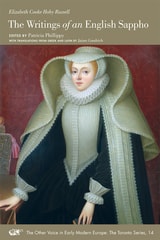
The Writings of an English Sappho
Elizabeth Cooke Hoby Russell
Iter Press, 2011
—Jane Donawerth
Professor of English and affiliate faculty in women’s studies
University of Maryland
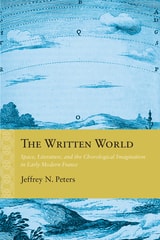
The Written World
Space, Literature, and the Chorological Imagination in Early Modern FranceJeffrey N. Peters
Northwestern University Press, 2018
In analyses of well-known authors such as Corneille, Molière, Racine, and Madame de Lafayette, Peters demonstrates that the apparent absence of physical space in seventeenth-century literary depiction indicates a subtle engagement with, rather than a rejection of, evolving principles of cosmological understanding. Space is not absent in these works so much as transformed in keeping with contemporaneous developments in early modern natural philosophy. The Written World will appeal to philosophers of literature and literary theorists as well as scholars of early modern Europe and historians of science and geography

The emergence of post-hybrid identities
a comparative analysis of national identity formations in Germany’s hip-hop cultureMarissa Munderloh
University of London Press, 2017
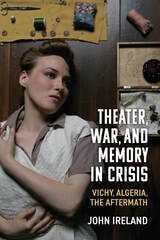
Theater, War, and Memory in Crisis
Vichy, Algeria, the AftermathJohn Ireland
University of Michigan Press, 2025
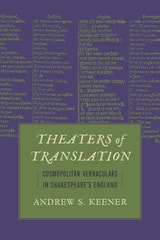
Theaters of Translation
Cosmopolitan Vernaculars in Shakespeare's EnglandAndrew S. Keener
University of Alabama Press, 2025
Explores the profound influence of multilingual dictionaries, dialogues, and grammars on English Renaissance playwrights
In Theaters of Translation, Andrew S. Keener offers a fascinating account of the ways that plays by Thomas Kyd, Mary Sidney Herbert, Ben Jonson, and their fellow English contemporaries were shaped by and part of a multilingual Europe where dictionaries, grammars, and language-learning materials circulated widely. He proposes a fresh, multilingual approach to English Renaissance drama that challenges the histories of early modern European languages as sites of national and linguistic cohesion.
Covering the period between 1570 and 1640, when England’s drama and the English language itself were evolving, Keener uses the term “cosmopolitan vernaculars” to examine how nonclassical European languages modeled transnational forms of belonging for playgoers, readers, and authors in Renaissance England. Combining recent contributions to cosmopolitan theory and transnational studies of early modern literature and culture, Keener highlights both the ways in which cosmopolitanism manifests through Europe’s vernacular languages—in print and performance—and the ways languages themselves can exhibit cosmopolitanism for those who encounter them on the page or on the stage.
Theaters of Translation opens up new transnational interpretations of English Renaissance plays and casts fresh light on historical anecdotes, such as Jonson inscribing a copy of Pietro Aretino’s scandalous Italian dialogues or Shakespeare’s First Folio being advertised for sale in Germany before its London publication. It offers much of interest to readers and scholars of Renaissance Europe, early modern drama, and the development of national European languages.
Theme of Farewell and After-Poems
A Bilingual EditionMilo de Angelis
University of Chicago Press, 2013
Theology and Literature in the Age of Johnson
Resisting SecularismMelvyn New
University of Delaware Press, 2012
Published by University of Delaware Press. Distributed worldwide by Rutgers University Press.
Theories of Africans
Francophone Literature and Anthropology in AfricaChristopher L. Miller
University of Chicago Press, 1990
". . . a superb cross-disciplinary analysis."—Y. Mudimbe
Theory as Event
Humanistic Knowledge Production in Germany Since 1968Matt Erlin, André Fischer
Northwestern University Press, 2027
Shedding new light on the actors, infrastructures, and events that shaped the development of literary and cultural theory
While theory aspires by its very nature to timeless validity, the ascendency of particular intellectual paradigms at specific historical moments depends on a complex assemblage of institutional, historical, political, material, and medial factors. Theory as Event: Humanistic Knowledge Production in Germany Since 1968 reconsiders the so-called age of theory as it took shape in the German-speaking world after 1968. In invoking the term “event,” this volume draws attention to the myriad incidents and accidents that enable the creation, diffusion, and canonization of humanistic knowledge, from public controversies and debates to the circulation of various forms of print media.
By conceptualizing theory as an event, the volume also sheds new light on the quotidian, praxeological forms of knowledge production—inconspicuous but no less important acts of research, teaching, and even administration that have shaped the intellectual landscape of the humanities, from visiting professorships and habilitation defenses to the founding of new working groups. In shifting attention from the explication of individual works to these seemingly paratextual phenomena, the contributors to this collection not only offer a fresh perspective on key moments in German intellectual history; they also model a new approach to the history of ideas.
Theory as Practice
A Critical Anthology of Early German Romantic WritingsJochen Schulte-Sasse, Haynes Horne, Elizabeth Mittman, Lisa C. Roetzel, Andreas Michel, Assenka Oksiloff, and Mary R. Strand, EditorsTranslated by Jochen Schulte-Sasse
University of Minnesota Press, 1997
Theory as Practice was first published in 1997. Minnesota Archive Editions uses digital technology to make long-unavailable books once again accessible, and are published unaltered from the original University of Minnesota Press editions.
In light of recent, dramatic revisions in criticism of European-particularly German-Romanticism, this anthology brings together key texts of the movement, especially those written in the last quarter of the eighteenth century by a small, influential circle centered at Jena.
In their introductory essays, the editors locate writings by Fichte, Schelling, Novalis, August Wilhelm Schlegel, and Friedrich Schlegel, among others, in this context. The selections include extensive excerpts from the correspondence of the Jena Romantics, their commentaries on each other's work, their most pertinent essays, fragments, and dialogues as well as diary entries and reviews. These works, together with the editors' articulation and elaboration of their significance, provide a new perspective on the provenance of postmodern thought and literary theory.
Jochen Schulte-Sasse is professor of German and comparative literature at the University of Minnesota and coeditor (with Wlad Godzich) of the Theory and History of Literature series at the University of Minnesota Press. Haynes Horne (University of Alabama), Andreas Michel (Indiana University), Assenka Oksiloff (New York University), Elizabeth Mittman (Michigan State University), Lisa C. Roetzel (University of Rochester), and Mary R. Strand each received a Ph.D. from the University of Minnesota.
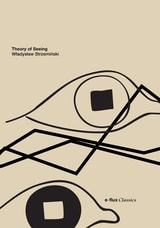
Theory of Seeing
Wladyslaw Strzeminski
University of Minnesota Press, 2025
The first English translation of a radical and influential theory of art by a leader of Poland’s avant-garde
After World War II, socialist realism became the official state doctrine of art in Poland, with abstract works deemed counterrevolutionary and forbidden from public view. Władysław Strzemiński, a leader of the Polish constructivist avant-garde, developed a treatise of visual consciousness as a foundation for progressive art, emphasizing art’s autonomy. His application of Marxist aesthetics to the physiology of seeing is expressed in Theory of Seeing, which was published posthumously in 1958 by his students from notes collected from his lectures.
Preceding the comparable perspectives developed by Jacques Rancière, David Hockney, and John Berger, and even the cinema of Jean-Luc Godard, Strzemiński’s Theory of Seeing introduces the radical and groundbreaking ideas of one of Poland’s most important artists to English-speaking audiences for the first time.

They Came to Japan
An Anthology of European Reports on Japan, 1543-1640Michael Cooper, Editor
University of Michigan Press, 1995
They Have All Been Healed
Reading Robert WalserJan Plug
Northwestern University Press, 2016
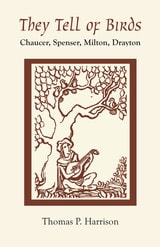
They Tell of Birds
Chaucer, Spenser, Milton, DraytonBy Thomas P. Harrison
University of Texas Press, 1956
Thomas P. Harrison here combines a lifelong interest in birds with a professional study of literature. This book, a study of birds as they are presented by four great English poets, inquires into the extent and sources of their knowledge of birds and analyzes the methods by which they adapted that knowledge for poetic purposes. The interrelationships of their poetry are also discussed, providing a new basis for comparison of four poets whose work is closely linked on other grounds remote from natural history.
The first chapter reviews representative figures and works of the centuries preceding the Renaissance and illustrates the medieval poetic conventions about birds that influenced the four poets. The remaining chapters treat each poet and his works in detail, comparing their use of this area of the natural world. The book concludes with an index of bird allusions in the works of the four poets, with occasional quotations illustrating the manner in which the traditional or observed habits of particular birds were put to poetic use. The book is illustrated with medieval and Renaissance illustrations of birds.
In this careful treatment of an important element of the poets’ works, Harrison has indicated the larger picture of their attitudes toward and use of the natural world about them. Accordingly, it might be said to constitute a chapter on the relationship of poetry and science at a crucial period in the history of thought.
For much of his material, Harrison journeyed to England, where, among other research activities, he visited museums of natural history and bird sanctuaries throughout the country.
Primarily intended for students of literature, They Tell of Birds will also be of interest to ornithologists in its presentation of the beliefs of antiquity and the Middle Ages about particular birds. For, as the distinguished ornithologist E. M. Nicholson has said: “We owe to poets a wealth of records of living wild birds long before scientific ornithology had started.”
Thick of It
Ulrike Almut Sandig
Seagull Books, 2018
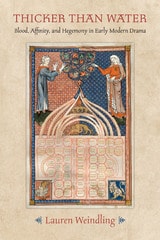
Thicker Than Water
Blood, Affinity, and Hegemony in Early Modern DramaLauren Weindling
University of Alabama Press, 2023
Examines the discourses around the role of bloodlines and kinship in the social hierarchies of early modern Europe
“Blood is thicker than water,” goes the old proverb. But do common bloodlines in fact demand special duties or prescribe affections? Thicker than Water examines the roots of this belief by studying the omnipresent discourse of bloodlines and kindred relations in the literature of early modern Europe.
Early modern discourses concerning kinship promoted the idea that similar bloodlines dictated greater love or affinity, stabilizing the boundaries of families and social classes, as well as the categories of ethnicity and race. Literary representations of romantic relationships were instrumental in such conceptions, and Lauren Weindling examines how drama from England, France, and Italy tests these assumptions about blood and love, exposing their underlying political function. Among the key texts that Weindling studies are Shakespeare’s Romeo and Juliet¸ Othello, and The Merchant of Venice, Pierre Corneille’s Le Cid, Giambattista della Porta’s La Sorella and its English analog, Thomas Middleton’s No Wit/Help Like a Woman’s, John Ford’s ’Tis Pity She’s a Whore, and Machiavelli’s La Mandragola.
Each of these plays offers an extreme limit case for early modern notions of belonging and exclusion, through plots of love, courtship, and marriage, including blood feuds and incest. Moreover, they feature the voices of marginalized groups, unprivileged by these metrics and ideologies, and thus offer significant counterpoints to this bloody worldview.
While most critical studies of blood onstage pertain to matters of guilt or violence, Thicker Than Water examines the work that blood does unseen in arbitrating social and emotional connections between persons, and thus underwriting our deepest forms of social organization.
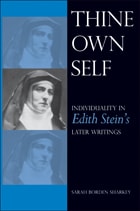
Thine Own Self
Individuality in Edith Stein's Later WritingsSarah Borden Sharkey
Catholic University of America Press, 2010
Thinking in Cases
Fiction, Law, and the Case HistoryPeter Brooks
University of Chicago Press, 2027
How the form of the case history became an important way of studying the individual as an exemplary case in medicine, psychoanalysis, law, and the novel.
What does it mean when we address ourselves to a specific problem and treat it as a “case” that needs resolution, a resolution that may in turn offer us more general lessons? The “case history” has become a central form of thought and analysis in our culture, but rarely has it been studied on its own. In Thinking in Cases, the distinguished critic Peter Brooks zeroes in on a kind of thinking that we all know—and often use—without understanding its dimensions and its history.
This book ponders what we do and mean when we think in cases—when we take up specific instances with a view to making them exemplary. Brooks brings to this study decades of reflection on the psychoanalytic case history, on the rhetoric of the legal case, and on novels that unfold as cases seeking solutions. Brooks focuses on the case-history’s emergence in the late nineteenth century: first, he examines how Henry James’s uses of narrative parallel case-study methods in law, medicine, and psychoanalysis. Elsewhere, he traces the case history from Hippocratic medicine through Sir Arthur Conan Doyle’s detective fiction to a startling legal case from Victorian England involving shipwreck and cannibalism. Other chapters discuss a tale of madness by Balzac and Freud’s most speculative works, especially Moses and Monotheism. A final chapter examines recent novels—Duras’s The Ravishing of Lol Stein, Coetzee’s Disgrace, Modiano’s Dora Bruder, and Erpenbeck’s Kairos—as case studies.
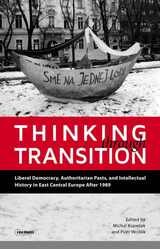
Thinking through Transition
Liberal Democracy, Authoritarian Pasts, and Intellectual History in East Central Europe After 1989Michal Kopecek
Central European University Press, 2015
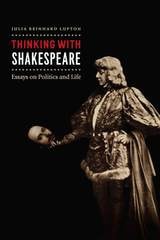
Thinking with Shakespeare
Essays on Politics and LifeJulia Reinhard Lupton
University of Chicago Press, 2011
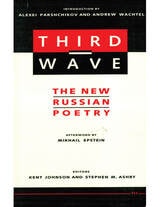
Third Wave
The New Russian PoetryKent Johnson and Stephen M. Ashby, Editors. Introduction by Alexei Parshchikov and Andrew Wachtel. Afterword by Mikhail Epstein
University of Michigan Press, 1992
This Is Enlightenment
Edited by Clifford Siskin and William Warner
University of Chicago Press, 2010
Debates about the nature of the Enlightenment date to the eighteenth century, when Imanual Kant himself addressed the question, “What is Enlightenment?” The contributors to this ambitious book offer a paradigm-shifting answer to that now-famous query: Enlightenment is an event in the history of mediation. Enlightenment, they argue, needs to be engaged within the newly broad sense of mediation introduced here—not only oral, visual, written, and printed media, but everything that intervenes, enables, supplements, or is simply in between.
With essays addressing infrastructure and genres, associational practices and protocols, this volume establishes mediation as the condition of possibility for enlightenment. In so doing, it not only answers Kant’s query; it also poses its own broader question: how would foregrounding mediation change the kinds and areas of inquiry in our own epoch? This Is Enlightenment is a landmark volumewith the polemical force and archival depth to start a conversation that extends across the disciplines that the Enlightenment itself first configured.
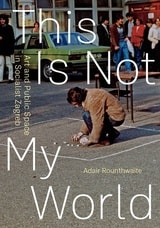
This Is Not My World
Art and Public Space in Socialist ZagrebAdair Rounthwaite
University of Minnesota Press, 2024
A close-up history of the Yugoslav artists who broke down the boundaries between public and private
In the decades leading up to the dissolution of socialist Yugoslavia, a collective of young artists based in Zagreb took to using the city’s public spaces as a platform for radical individual expression. This Is Not My World presents a detailed account of the Group of Six Authors and their circle in the prolific and experimental period from 1975 to 1985, highlighting the friction between public and private that underlied their innovative practices.
Looking to circumvent the rigid bureaucracy of official art institutions, this freewheeling group of conceptual artists and their peers brought artistic activities directly to an unwitting public by staging provocative performances, exhibiting artworks, and interacting with passersby on the streets. Exploring artworks such as Vlasta Delimar’s act of tying herself to a tree in a busy pedestrian area, Željko Jerman’s production of a giant banner declaring “Intimate Inscription” in the city’s central square, and Vlado Martek’s creation of an artwork on a seaside beach using women’s underwear, Adair Rounthwaite examines the work of these artists as a site of tension between the intimacy of artistic expression and the political structure of the public sphere under state socialism.
Whereas many histories of modern and contemporary art in formerly socialist countries tend to be dominated by discussions of ideology and resistance, This Is Not My World focuses its attention on the affective aspects of the group’s activities, using artist interviews and extensive documentation to bring the reader closer to the felt experience of their public interventions. Situating the group’s work within the context of broader developments in conceptualism and theories of the avant-garde, Rounthwaite provides a fresh consideration and newly detailed account of this marginalized episode in global art history.

This Machine Breeds Fascists / Mašina Koja Hrani Fašiste
Thompson—the Rock Star, the Collapse of Political Will, and the Resistance to Radicalization in Croatia / Thompson, Poraz Politike i Otpor Radikalizaciji HrvatskeBarbara Matejcic and Hrvoje Šimicevic, with an introduction by Matea Gnjec and Brian Willems
Disobedience Press, 2027
In this pair of essays, award-winning journalists Hrvoje Šimičević and Barbara Matejčić expose the turn in Croatia’s political trends, showing how “moderate” pro-European governments have opened the floodgates for far-right radicalism and fascism to transition from the societal fringes into the mainstream. Šimičević weaves these histories around a chilling turning point: a Thompson concert in which hundreds of thousands chanted the Ustaše salute. Matejčić then reveals the civic response and defiant resistance to the politics of fear and escalating attacks against Serbians and other minorities. At the heart of these texts is a struggle over the meaning of Croatia itself: will it belong to the loudest voices or to all who live there?
U ova dva eseja, nagrađivani novinari Hrvoje Šimičević i Barbara Matejčić opisuju političke promjene u Hrvatskoj, pokazujući kako su samozvane umjerene proeuropske vlade imale ključnu ulogu u pomicanju fašizma i krajnje desnog radikalizma s društvenih rubova u političku srednju struju. Šimičević plete povijest te pojave oko jezive prekretnice: Thompsonovog koncerta na kojem su stotine tisuća posjetitelja izvikivale ustaški pozdrav. Matejčić zatim prikazuje odgovor građana i prkosan otpor politici straha i eskalaciji napada na Srbe i druge manjine. U srži ovih tekstova leži borba za značenje Hrvatske: hoće li zemlja pripadati onima koji najglasnije viču ili svima koji u njoj žive?
Thomas De Quincey
British Rhetoric's Romantic TurnLois Peters Agnew
Southern Illinois University Press, 2012
This wide-ranging volume gives proper attention to the views on rhetoric and style set forth by British literary figure Thomas De Quincey (1785–1859), whose contributions to the history of rhetoric are often overlooked. Lois Peters Agnew presents an overview of this theorist’s life and provides cultural context for his time and place, with particular emphasis on the significance of his rhetoric as both an alternative strain of rhetorical history and a previously unrealized example of rhetoric’s transformation in nineteenth-century Britain.
Agnew presents an extensive discussion of De Quincey’s ideas on rhetoric, his theory and practice of conversation, his theory of style and its role in achieving rhetoric’s dialogic potential, and his strategic use of humor and irony in such works as Confessions of an English Opium Eater. Synthesizing previous treatments of De Quincey’s rhetoric and connecting his unusual perspectives on language to the biographical details of his life, Agnew helps readers understand his intellectual development while bringing to light the cultural contexts that prompted radical changes in the ways nineteenth-century British intellectuals conceived of the role of language and the imagination in public and private discourse.
Agnew presents an alternative vision of rhetoric that departs from many common assumptions about rhetoric’s civic purpose and offers insights into the topic of rhetoric and technological change. The result is an accessible and thorough explanation of De Quincey’s complex ideas on rhetoric and the first work to fully show the reach of his ideas across multiple texts written during his lifetime.
Thomas Hardy from Serial to Novel
Mary Chase
University of Minnesota Press, 1927