Results by title
4917 books match the query 'Philosophy' and 1267 start with t
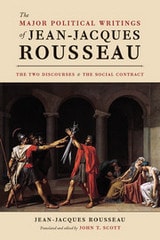
The Major Political Writings of Jean-Jacques Rousseau
The Two "Discourses" and the "Social Contract"Jean-Jacques Rousseau
University of Chicago Press, 2012
Individualist and communitarian. Anarchist and totalitarian. Classicist and romanticist. Progressive and reactionary. Since the eighteenth century, Jean-Jacques Rousseau has been said to be all of these things. Few philosophers have been the subject of as much or as intense debate, yet almost everyone agrees that Rousseau is among the most important and influential thinkers in the history of political philosophy. This new edition of his major political writings, published in the year of the three-hundredth anniversary of his birth, renews attention to the perennial importance of Rousseau’s work.
The Making of the Modern University
Intellectual Transformation and the Marginalization of MoralityJulie A. Reuben
University of Chicago Press, 1996
Based on extensive research at eight universities—Harvard, Yale, Columbia, Johns Hopkins, Chicago, Stanford, Michigan, and California at Berkeley—Reuben examines the aims of university reformers in the context of nineteenth-century ideas about truth. She argues that these educators tried to apply new scientific standards to moral education, but that their modernization efforts ultimately failed. By exploring the complex interaction between institutional and intellectual change, Reuben enhances our understanding of the modern university, the secularization of intellectual life, and the association of scientific objectivity with value-neutrality.
The Mana of Mass Society
William Mazzarella
University of Chicago Press, 2017
We often invoke the “magic” of mass media to describe seductive advertising or charismatic politicians. In The Mana of Mass Society, William Mazzarella asks what happens to social theory if we take that idea seriously. How would it change our understanding of publicity, propaganda, love, and power?
Mazzarella reconsiders the concept of “mana,” which served in early anthropology as a troubled bridge between “primitive” ritual and the fascination of mass media. Thinking about mana, Mazzarella shows, means rethinking some of our most fundamental questions: What powers authority? What in us responds to it? Is the mana that animates an Aboriginal ritual the same as the mana that energizes a revolutionary crowd, a consumer public, or an art encounter? At the intersection of anthropology and critical theory, The Mana of Mass Society brings recent conversations around affect, sovereignty, and emergence into creative contact with classic debates on religion, charisma, ideology, and aesthetics.

The Mangle in Practice
Science, Society, and BecomingAndrew Pickering and Keith Guzik, eds.
Duke University Press, 2008
The Mangle in Practice opens with a fresh introduction to the mangle by Pickering. Several contributors then present empirical studies that demonstrate the mangle’s applicability to topics as diverse as pig farming, Chinese medicine, economic theory, and domestic-violence policing. Other contributors offer examples of the mangle in action: real-world practices that implement a self-consciously “mangle-ish” stance in environmental management and software development. Further essays discuss the mangle as philosophy and social theory. As Pickering argues in the preface, the mangle points to a shift in interpretive sensibilities that makes visible a world of de-centered becoming. This volume demonstrates the viability, coherence, and promise of such a shift, not only in science and technology studies, but in the social sciences and humanities more generally.
Contributors: Lisa Asplen, Dawn Coppin, Adrian Franklin, Keith Guzik, Casper Bruun Jensen,Yiannis Koutalos, Brian Marick, Randi Markussen, Andrew Pickering, Volker Scheid, Esther-Mirjam Sent, Carol Steiner, Maxim Waldstein
The Mangle of Practice
Time, Agency, and ScienceAndrew Pickering
University of Chicago Press, 1995
Andrew Pickering offers a new approach to the unpredictable nature of change in science, taking into account the extraordinary number of factors—social, technological, conceptual, and natural—that interact to affect the creation of scientific knowledge. In his view, machines, instruments, facts, theories, conceptual and mathematical structures, disciplined practices, and human beings are in constantly shifting relationships with one another—"mangled" together in unforeseeable ways that are shaped by the contingencies of culture, time, and place.
Situating material as well as human agency in their larger cultural context, Pickering uses case studies to show how this picture of the open, changeable nature of science advances a richer understanding of scientific work both past and present. Pickering examines in detail the building of the bubble chamber in particle physics, the search for the quark, the construction of the quarternion system in mathematics, and the introduction of computer-controlled machine tools in industry. He uses these examples to address the most basic elements of scientific practice—the development of experimental apparatus, the production of facts, the development of theory, and the interrelation of machines and social organization.
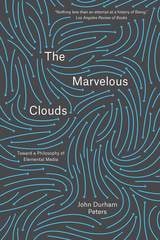
The Marvelous Clouds
Toward a Philosophy of Elemental MediaJohn Durham Peters
University of Chicago Press, 2015
When we speak of clouds these days, it is as likely that we mean data clouds or network clouds as cumulus or stratus. In their sharing of the term, both kinds of clouds reveal an essential truth: that the natural world and the technological world are not so distinct. In The Marvelous Clouds, John Durham Peters argues that though we often think of media as environments, the reverse is just as true—environments are media.
Peters defines media expansively as elements that compose the human world. Drawing from ideas implicit in media philosophy, Peters argues that media are more than carriers of messages: they are the very infrastructures combining nature and culture that allow human life to thrive. Through an encyclopedic array of examples from the oceans to the skies, The Marvelous Clouds reveals the long prehistory of so-called new media. Digital media, Peters argues, are an extension of early practices tied to the establishment of civilization such as mastering fire, building calendars, reading the stars, creating language, and establishing religions. New media do not take us into uncharted waters, but rather confront us with the deepest and oldest questions of society and ecology: how to manage the relations people have with themselves, others, and the natural world.
A wide-ranging meditation on the many means we have employed to cope with the struggles of existence—from navigation to farming, meteorology to Google—The Marvelous Clouds shows how media lie at the very heart of our interactions with the world around us. Peters’s book will not only change how we think about media but provide a new appreciation for the day-to-day foundations of life on earth that we so often take for granted.
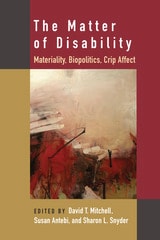
The Matter of Disability
Materiality, Biopolitics, Crip AffectDavid T. Mitchell, Susan Antebi, and Sharon L. Snyder, Editors
University of Michigan Press, 2019
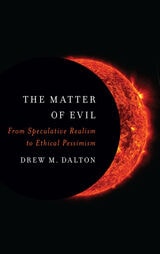
The Matter of Evil
From Speculative Realism to Ethical PessimismDrew M. Dalton
Northwestern University Press, 2024
In this radical reconsideration of ethical reasoning in contemporary European philosophy, Drew M. Dalton makes the case for an absolutely grounded account of ethical normativity developed from a scientifically informed and purely materialistic metaphysics. Expanding on speculative realist arguments, Dalton argues that the limits placed on the nature of ethical judgments by Kant’s critique can be overcome through a moral evaluation of the laws of nature—specifically, the entropic principle that undergirds the laws of physics, chemistry, and biology. In order to extract a moral meaning from this simple material fact, Dalton scrutinizes the presumptions of classical accounts and traditional understandings of good and evil within the history of Western philosophy and ultimately asserts that ethical normativity can be reestablished absolutely without reverting to dogmatism.
By overturning our assumptions about the nature and value of reality, The Matter of Evil: From Speculative Realism to Ethical Pessimism presents a provocative new model of ethical responsibility that is both logically justifiable and scientifically sound. Dalton argues for “ethical pessimism,” a position previously marginalized in the West, as a means to cultivate an account of ethical responsibility and political activism that takes seriously the unbecoming of being and the moral horror of existence.
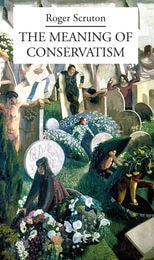
The Meaning of Conservatism
Roger Scruton
St. Augustine's Press, 2014
Rather, conservatism regards the individual not as the premise but the conclusion of politics, a politics that is fundamentally opposed to the ethic of social justice, to equality of station, income, and achievement, or to the attempt to bring major institutions of society (such as schools and universities) under government control.
The conservative outlook, says Scruton, is neither outmoded nor irrational. On the contrary, it is the most reasonable of political alternatives. The evils of socialism, he maintains, lie precisely where its supporters find its strengths, and the conditions for the credibility of socialism have long since disappeared. Neither socialism nor liberalism can come to terms with the real complexity of human society, and both appear plausible only because they direct attention away from what is actual, toward what is merely ideal.
From earlier editions of The Meaning of Conservatism:
“The book provides exactly that swift kick on the intellectual bottom which every undergraduate student of political science needs, most of them more urgently than ever before.” – T. E. Utley, (London) Daily Telegraph
“If the text is full of surprises, the manner is no less striking than the matter. Scruton is a great stylist, and one is continually arrested by beautifully crafted phrases which beg for quotation. . . . [He] is a cultured and critical guide through the traditional landscape of conservatism; his book provokes thought and it is a pleasure to read.”
– Bram Gieben, Political Quarterly
“. . . remarkable work. . . . The highest praise which one can bestow on The Meaning of Conservatism is to say that it reminds one at every page of Thomas Hobbes, the greatest master of the English language ever to write a work of political theory.” – Jonathan Sumption, Sunday Telegraph
“. . . clearly too ghastly to be taken seriously.” – Andrew Belsey, Radical Philosophy
The Meaning of Liberalism - East and West
Zdenek Suda
Central European University Press, 1999
The Meaning of Liberalism provides a new perspective on the continuing debate about how liberalism should be defined and what it means in countries with an established parliamentary system, particularly in the new democracies of Central and Eastern Europe.
The key question this book addresses is: will the specific experience of communism and its aftermath give birth to a new distinct current of liberal thought, or will it simply enlarge the scope of the Western liberal debate? The authors argue that liberalism cannot be reduced merely to private property and market prices, but needs a very complex set of institutions and corresponding law.
Contributors come from both sides of the former Iron Curtain and they highlight the richness and diversity of liberalism and discuss different perceptions of liberal thinking in the East and West in the post-modern world.
The Meaning of the Body
Aesthetics of Human UnderstandingMark Johnson
University of Chicago Press, 2007
In The Meaning of the Body, Mark Johnson continues his pioneering work on the exciting connections between cognitive science, language, and meaning first begun in the classic Metaphors We Live By. Johnson uses recent research into infant psychology to show how the body generates meaning even before self-consciousness has fully developed. From there he turns to cognitive neuroscience to further explore the bodily origins of meaning, thought, and language and examines the many dimensions of meaning—including images, qualities, emotions, and metaphors—that are all rooted in the body’s physical encounters with the world. Drawing on the psychology of art and pragmatist philosophy, Johnson argues that all of these aspects of meaning-making are fundamentally aesthetic. He concludes that the arts are the culmination of human attempts to find meaning and that studying the aesthetic dimensions of our experience is crucial to unlocking meaning's bodily sources.
The Memory of Place
A Phenomenology of the UncannyDylan Trigg
Ohio University Press, 2011
From the frozen landscapes of the Antarctic to the haunted houses of childhood, the memory of places we experience is fundamental to a sense of self. Drawing on influences as diverse as Merleau-Ponty, Freud, and J. G. Ballard, The Memory of Place charts the memorial landscape that is written into the body and its experience of the world.
Dylan Trigg’s The Memory of Place offers a lively and original intervention into contemporary debates within “place studies,” an interdisciplinary field at the intersection of philosophy, geography, architecture, urban design, and environmental studies. Through a series of provocative investigations, Trigg analyzes monuments in the representation of public memory; “transitional” contexts, such as airports and highway rest stops; and the “ruins” of both memory and place in sites such as Auschwitz. While developing these original analyses, Trigg engages in thoughtful and innovative ways with the philosophical and literary tradition, from Gaston Bachelard to Pierre Nora, H. P. Lovecraft to Martin Heidegger. Breathing a strange new life into phenomenology, The Memory of Place argues that the eerie disquiet of the uncanny is at the core of the remembering body, and thus of ourselves. The result is a compelling and novel rethinking of memory and place that should spark new conversations across the field of place studies.
Edward S. Casey, Distinguished Professor of Philosophy at Stony Brook University and widely recognized as the leading scholar on phenomenology of place, calls The Memory of Place “genuinely unique and a signal addition to phenomenological literature. It fills a significant gap, and it does so with eloquence and force.” He predicts that Trigg’s book will be “immediately recognized as a major original work in phenomenology.”
The Memory of the World
Deep Time, Animality, and EschatologyTed Toadvine
University of Minnesota Press, 2024
Advancing a phenomenological approach to deep time
Our imagination today is dominated by the end of the world, from sci-fi and climate fiction to actual predictions of biodiversity collapse, climate disruption, and the emergence of the Anthropocene. This obsession with the world’s precarity, The Memory of the World contends, relies on a flawed understanding of time that neglects the past and present with the goal of managing the future. Not only does this mislead sustainability efforts, it diminishes our encounters with the world and with human and nonhuman others.
Here, Ted Toadvine takes a phenomenological approach to deep time to show how our apocalyptic imagination forgets the sublime and uncanny dimensions of the geological past and far future. Guided by original readings of Maurice Merleau-Ponty, Emmanuel Levinas, Jacques Derrida, Jean-Luc Nancy, and others, he suggests that reconciling our embodied lives with the memory of the earth transforms our relationship with materiality, other forms of life, and the unprecedented future.
Integrating insights from phenomenology, deconstruction, critical animal studies, and new materialism, The Memory of the World argues for a new philosophy of time that takes seriously the multiple, pleated, and entangled temporal events spanning cosmic, geological, evolutionary, and human durations.
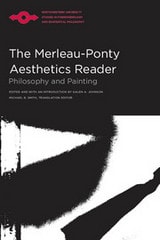
The Merleau-Ponty Aesthetics Reader
Philosophy and PaintingEdited and with an Introduction by Galen A. Johnson; Michael B. Smith, Translation Editor
Northwestern University Press, 1993
The Merleau-Ponty Reader
Leonard Lawlor and Ted Toadvine
Northwestern University Press, 2007
Arranged chronologically, the essays are grouped in three sections corresponding to the major periods of Merleau-Ponty’s work: First, the years prior to his appointment to the Sorbonne in 1949, the early, existentialist period during which he wrote important works on the phenomenology of perception and the primacy of perception; second, the years of his work as professor of child psychology and pedagogy at the Sorbonne, a period especially concerned with language; and finally, his years as chair of modern philosophy at the Collège de France, a time devoted to the articulation of a new ontology and philosophy of nature. The editors, who provide an interpretive introduction, also include previously unpublished working notes found in Merleau-Ponty’s papers after his death. Translations of all selections have been updated and several appear here in English for the first time.
By contextualizing Merleau-Ponty’s writings on the philosophy of art and politics within the overall development of his thought, this volume allows readers to see both the breadth of his contribution to twentieth-century philosophy and the convergence of the various strands of his reflection.
The Metamorphoses of the City of God
Etienne Gilson
Catholic University of America Press, 2021
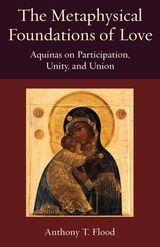
The Metaphysical Foundations of Love
Aquinas on Participation, Unity, and UnionAnthony T. Flood
Catholic University of America Press, 2018
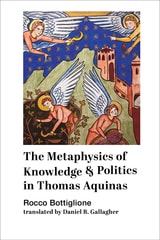
The Metaphysics of Knowledge and Politics in Thomas Aquinas
Rocco Buttiglione
St. Augustine's Press, 2020
In addition to its primary audience of philosophers, theologians, and political theorists, the book surprisingly enjoyed a wide general readership in Italy at the time of its publication. It represented an exciting attempt to harmonize medieval philosophy and the insights of personalism that had already had a deep impact on European intellectual life. Buttiglione was able to describe this attempt in a way accessible to a general readership, and in a way that confronted the political challenges Italy had been confronting for the last forty years.
Now, thirty-five years after the book’s initial publication, the conclusions Buttiglione draws from reading Thomas Aquinas’s commentary on Aristotle’s Politics––and the connections he makes between philosophy, theology, and political theory––are more relevant than ever. He argues that the traditional definition of “person” as rationalis naturae individua substantia––an individual substance or substrate (hypokeimenon) of a rational nature––“lacks that certain element that makes Augustine’s approach to personhood so appealing.” Hence Aquinas’s definition “is left wanting since it fails to elaborate on the crucial aspect of interpersonal relationship.”
The ingenuous way in which Buttiglione enlivens Thomistic political thinking with personalist philosophy helps to explain not only why free societies are more stable, tolerant, and respectful of human rights than totalitarian states, but theocratic ones as well. Only by raising the interpersonal aspects of political society to an ontological level—indeed, only by affirming and esteeming the self-transcendence of the human person as evidenced through ontological analysis—do the personal relationships that root and enliven the human person also lead to a realistic, dynamic, and convincing vision of the person’s real existence.
Buttiglione was startlingly prescient of the problems we confront at the beginning of the third millennium. This book will spark new discussions as it explains the importance of both the medieval tradition and twentieth-century personalism. The book also draws on a wide range of secondary sources unavailable to English readers that I and will have the unique ability to introduce readers to the “Italian” way of relating speculative and political philosophy in a relatively slim volume.
The Metaphysics of Media
Toward an End of Postmodern Cynicism and the Construction of a Virtuous RealityPeter K. Fallon
University of Scranton Press, 2009
In The Metaphysics of Media, award-winning media critic Peter K. Fallon tackles the complicated question of how a succession of dominant forms of media have supported—and even to some extent created—different conceptions of reality. To do so, he starts with the basics: a critical discussion of the very idea of objective reality and the various postmodern responses that have tended to dominate recent philosophical approaches to the subject. From there, he embarks on a survey of the evolution of communication through four major eras: orality; literacy; print; and electricity.
Within each era, Fallon argues, the dominant form of media supported particular ways of understanding the world, from the ascendance of reason that followed the development of alphabets to the obliteration of space and time that we associate with electronic communications. Fallon concludes with a hard look at the mass ignorance that prevails today despite (or perhaps because of) the sea of information with which contemporary life is surrounded.
A stirring, philosophically rich investigation, The Metaphysics of Media offers not only a clear picture of where our society has been but also a road map to a more engaged, informed, and fully human future.
The Metaphysics of Sound in Wallace Stevens
Anca Rosu
University of Alabama Press, 1995
Where sound speaks louder than meaning—Stevens’s poetry as a metaphysical echo.
Wallace Stevens dedicated his poetry to challenging traditional notions about reality, truth, knowledge, and the role of language as a means of representation. Rosu demonstrates that Stevens's experimentation with sound is not only essential to his poetics but also profoundly linked to the pragmatist ideas that informed his way of thinking about language. Her readings of Stevens's poems focus on revealing the dynamic through which meaning emerges in language patterns—a dynamic she calls "images of sound."
Rosu argues that the formal aspects of poetry are deeply ingrained in cultural realities and are, in fact, generated by their context. The sound pattern pervading Stevens's poems at once addresses and violates the reader's assumptions about the functioning of language and, along with them, ideas about reality, knowledge, and subjectivity. Sound is thus the starting point of an argument concerned with Stevens's epistemology and poetics—the way his poems insist on a movement past or through a normal poetic representation of the world to gesture toward a reality that lies outside or beyond systems of representation.
The relationship between sound and meaning isolated and analyzed in The Metaphysics of Sound in Wallace Stevens is firmly situated among critical debates concerning the poet's aesthetic and philosophical convictions. Rosu claims that Stevens's poetry is not ultimately about the powerlessness of language, nor is it a deconstructive enterprise of destabilizing culturally consecrated truths; rather it achieves meaning most frequently through patterns of sound. Sound helps Stevens make a deeply philosophical point in a language unavailable to philosophers.

The Method of Metaphor
Stanley Raffel
Intellect Books, 2013
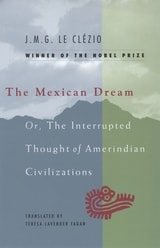
The Mexican Dream
Or, The Interrupted Thought of Amerindian CivilizationsJ. M. G. Le Clézio
University of Chicago Press, 1993
Winner of the 2008 Nobel Prize for Literature, J. M. G. Le Clézio here conjures the consciousness of Mexico, powerfully evoking the dreams that made and unmade an ancient culture. Le Clézio’s haunting book takes us into the dream that was the religion of the Aztecs, a religion whose own apocalyptic visions anticipated the coming of the Spanish conquerors. Here the dream of the conquistadores rises before us, too, the glimmering idea of gold drawing Europe into the Mexican dream. Against the religion and thought of the Aztecs and the Tarascans and the Europeans in Mexico, Le Clézio also shows us those of the “barbarians” of the north, the nomadic Indians beyond the pale of the Aztec frontier.
Finally, Le Clézio’s book is a dream of the present, a meditation on what in Amerindian civilizations—in their language, in their way of telling tales, of wanting to survive their own destruction—moved the poet, playwright, and actor Antonin Artaud and motivates Le Clézio in this book. His own deep identification with pre-Columbian cultures, whose faith told them the wheel of time would bring their gods and their beliefs back to them, finds fitting expression in this extraordinary book, which brings the dream around.
“We are lucky to have in Le Clézio a writer of great quality who brings his particular sensibility and talent here to remind us of the very nature of the rituals and myths of the civilizations of ancient Mexico; he provides us with descriptions as precise as they are mysterious.”—Le Figaro
The Michel Henry Reader
Edited by Scott Davidson and Frédéric Seyler
Northwestern University Press, 2019
The Michel Henry Reader is an indispensable resource for those who are approaching Henry for the first time as well as for those who are already familiar with his work. It provides broad coverage of the major themes in his philosophy and new translations of Henry’s most important essays. Sixteen chapters are divided into four parts that demonstrate the profound implications of Henry’s philosophy of life: for phenomenology; for subjectivity; for politics, art, and language; and for ethics and religion.
The Microbial State
Global Thriving and the Body PoliticStefanie R. Fishel
University of Minnesota Press, 2017
For three centuries, concepts of the state have been animated by one of the most powerful metaphors in politics: the body politic, a claustrophobic and bounded image of sovereignty. Climate change, neoliberalism, mass migration, and other aspects of the late Anthropocene have increasingly revealed the limitations of this metaphor. Just as the human body is not whole and separate from other bodies—comprising microbes, bacteria, water, and radioactive isotopes—Stefanie R. Fishel argues that the body politic of the state exists in dense entanglement with other communities and forms of life.
Drawing on insights from continental philosophy, science and technology studies, and international relations theory, this path-breaking book critiques the concept of the body politic on the grounds of its very materiality. Fishel both redefines and extends the metaphor of the body politic and its role in understanding an increasingly posthuman, globalized world politics. By conceiving of bodies and states as lively vessels, living harmoniously with multiplicity and the biosphere, she argues that a radical shift in metaphors can challenge a politics based on fear to open new forms of global political practice and community.
Reframing the concept of the body politic to accommodate greater levels of complexity, Fishel suggests, will result in new configurations for the political and social organization necessary to build a world in which the planet’s inhabitants do not merely live but actively thrive.
The Middle Included
Logos in AristotleAygün, Ömer
Northwestern University Press, 2016
The Middle Included also explores human language in Aristotelian philosophy. After an account of acoustic phenomena and animal communication, Aygün argues that human language for Aristotle is the ability to understand and relay both first-hand experiences and non-first-hand experiences. This definition is key to understanding many core human experiences such as science, history, news media, education, sophistry, and indeed philosophy itself. Logos is thus never associated with any other animal nor with anything divine—it remains strictly and rigorously secular, humane, and yet full of the wonder.
The Middle Works of John Dewey, Volume 1, 1899 - 1924
Journal Articles, Book Reviews, and Miscellany Published in the 1899-1901 Period, and The School and Society, and The Educational SituationJohn Dewey. Edited by Jo Ann Boydston
Southern Illinois University Press, 2008
Includes the complete text of The School and Society and The Educational Situation.
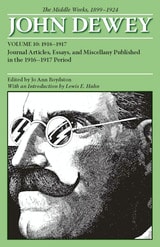
The Middle Works of John Dewey, Volume 10, 1899 - 1924
Journal Articles, Essays, and Miscellany Published in the 1916-1917 PeriodJohn Dewey. Edited by Jo Ann Boydston
Southern Illinois University Press, 2008
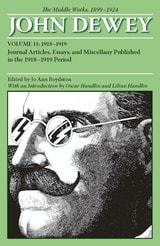
The Middle Works of John Dewey, Volume 11, 1899 - 1924
Journal Articles, Essays, and Miscellany Published in the 1918-1919 PeriodJohn Dewey. Edited by Jo Ann Boydston
Southern Illinois University Press, 2008
Volume 11 brings together all of Dewey’s writings for 1918 and 1919. A Modern Language Association Committee on Scholarly Editions textual edition.
Dewey’s dominant theme in these pages is war and its aftermath. In the Introduction, Oscar and Lilian Handlin discuss his philosophy within the historical context: “The First World War slowly ground to its costly conclusion; and the immensely more difficult task of making peace got painfully under way. The armistice that some expected would permit a return to normalcy opened instead upon a period of turbulence that agitated further a society already unsettled by preparations for battle and by debilitating conflict overseas.”
After spending the first half of 1918–19 on sabbatical from Columbia at the University of California, Dewey traveled to Japan and China, where he lectured, toured, and assessed in his essays the relationship between the two nations. From Peking he reported the student revolt known as the May Fourth Movement. The forty items in this volume also include an analysis of Thomas Hobbe’s philosophy; an affectionate commemorative tribute to Theodore Roosevelt, “our Teddy”; the syllabus for Dewey’s lectures at the Imperial University in Tokyo, which were later revised and published as Reconstruction in Philosophy; an exchange with former disciple Randolph Bourne about F. Matthias Alexander’s Man’sSupreme Inheritance; and, central to Dewey’s creed, “Philosophy and Democracy.” His involvement in a study of the Polish-American community in Philadelphia—resulting in an article, two memoranda, and a lengthy report—is discussed in detail in the Introduction and in the Note on the “Confidential Report of Conditions among the Poles in the United States.”
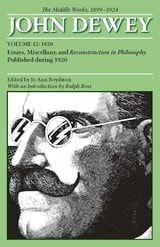
The Middle Works of John Dewey, Volume 12, 1899 - 1924
Essays, Miscellany, and Reconstruction in Philosophy Published during 1920John Dewey. Edited by Jo Ann Boydston
Southern Illinois University Press, 2008
A collection of all of Dewey’s writings for 1920 with the exception of Letters from China and Japan. A Modern Language Association Committee on Scholarly Editions textual edition.
The nineteen items collected here, including his major work, Reconstruction in Philosophy, evolved in the main from Dewey’s travel, touring, lecturing, and teaching in Japan and China. Ralph Ross notes in his Introduction to this volume that Reconstruction in Philosophy is “a radical book . . . a pugnacious book by a gentle man.” It is in this book that Dewey summarizes his version of pragmatism, then called Instrumentalism. For Dewey, the pragmatist, it was people acting on the strength of intelligence modeled on science who could find true ideas, ones “we can assimilate, validate, corroborate, and verify.” Optimism pervades Reconstruction of Philosophy; in keeping with Dewey’s world of open possibilities, the book recognizes that the observation and thought of human striving can make the difference between despair and affirmation of life.
The seven essays on Chinese politics and social tradition that Dewey sent back from the Orient exhibit both the liveliness and the sensitive power of an insightful mind. Set against a backdrop of Japanese hegemony in China, the last days of Manchu imperialism, Europe’s carving of China into concessions, and China’s subsequent refusal to accept the terms of the Treaty of Versailles, the essays were startlingly relevant in this time of Eastern turbulence and change.
At the National University of Peking, Dewey delivered a series of lectures on “Three Contemporary Philosophers: William James, Henri Bergson, and Bertrand Russell.” The James and Bergson lectures are published for the first time in this volume. Dewey chose these philosophers, according to Ralph Ross, because he was trying to show “his oriental audience what he believed and hoped about man and society and was talking about those fellow philosophers who shared the same beliefs and hopes.”
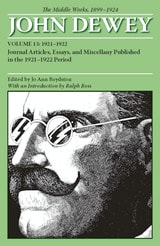
The Middle Works of John Dewey, Volume 13, 1899 - 1924
Journal Articles, Essays, and Miscellany Published in the 1921-1922 PeriodJohn Dewey. Edited by Jo Ann Boydston
Southern Illinois University Press, 2008
Volume 13 in The Middle Works of John Dewey, 1899–1924, series brings together Dewey’s writings for 1921 and 1922,with the exception of Human Nature and Conduct. A Modern Language Association Committee on Scholarly Editions textual edition.
Ralph Ross notes in his Introduction that the 53 items constituting this volume “defend Dewey’s beliefs at 63 and look forward to what he was yet to write.” The essays to which Dewey responded, as well as abstracts of articles that have been published only in Japanese, appear as appendixes.
The article “Valuation and Experimental Knowledge” treats a favorite Dewey theme: “Most of the important crises of life are cases where tastes are the only things worth discussing, and where, if the life of reason is to exist and prevail, judgment must be performed with regard for its logical implications.” The philosophical articles stress Dewey’s view that, as Ross remarks, “philosophies are not timeless and universal, but speak to times, places and conditions.”
The Middle Works of John Dewey, Volume 14, 1899 - 1924
Human Nature and Conduct, 1922John Dewey. Edited by Jo Ann Boydston
Southern Illinois University Press, 2008
Volume 14 of The Middle Works of John Dewey, 1899–1924, series provides an authoritative edition of Dewey’s Human Nature and Conduct. A Modern Language Association Committee on Scholarly Editions textual edition.
Human Nature and Conduct evolved from the West Memorial Foundation lectures at Stanford University. The lectures were extensively rewritten and expanded into one of Dewey’s best-known works. As Murray G. Murphey says in his Introduction, “It was a work in which Dewey sought to make explicit the social character of his psychology and philosophy—something which had long been evident but never so clearly spelled out.”
Subtitled “An Introduction to Social Psychology,” Human Nature and Conduct sets forth Dewey’s view that habits are social functions, and that social phenomena, such as habit and custom and scientific methods of inquiry are moral and natural. Dewey concludes, “Within the flickering inconsequential acts of separate selves dwells a sense of the whole which claims and dignifies them. In its presence we put off mortality and live in the universal.”
The Middle Works of John Dewey, Volume 15, 1899 - 1924
Journal Articles, Essays, and Miscellany Published in the 1923-1924 PeriodJohn Dewey. Edited by Jo Ann Boydston
Southern Illinois University Press, 2008
Volume 15 in The Middle Works of John Dewey, 1899–1924, series brings together Dewey’s writings for the period 1923–1924. A Modern Language Association Committee on Scholarly Editions textual edition.
Volume 15 completes the republication of Dewey’s extensive writings for the 25-year period included in the Middle Works series. Many facets of Dewey’s interests—politics, philosophy, education, and social concerns—are illuminated by the 40 items from 1923 and 1924.
Inspired by his own convictions and those of his friend Salmon O. Levinson, founder of the American Committee for the Outlawry of War, Dewey’s articles became the keystone of the committee’s campaign to outlaw war. His essay, “Logical Method and Law,” is perhaps the most enduring of Dewey’s writings in this volume. Dewey’s philosophical discussions with Daniel Sommer Robinson, David Wight Prall, Arthur Oncken Lovejoy, and Sterling Power Lamprecht are represented here, as is Dewey’s assessment of the Turkish educational system.
The Middle Works of John Dewey, Volume 2, 1899 - 1924
Journal Articles, Book Reviews, and Miscellany in the 1902-1903 Period, and Studies in Logical Theory and The Child and the CurriculumJohn Dewey
Southern Illinois University Press, 2008
Includes the complete text of Dewey’s Studies in Logical Theory and The Child and the Curriculum.
The Middle Works of John Dewey, Volume 3, 1899 - 1924
Journal Articles, Book Reviews, and Miscellany in the 1903-1906 PeriodJohn Dewey. Edited by Jo Ann Boydston
Southern Illinois University Press, 2008
The Middle Works of John Dewey, Volume 4, 1899 - 1924
Journal Articles and Book Reviews in the 1907-1909 Period, and The Pragmatic Movement of Contemporary Thought and Moral Principles in EducationJohn Dewey. Edited by Jo Ann Boydston
Southern Illinois University Press, 2008
The Middle Works of John Dewey, Volume 5, 1899-1924
Ethics, 1908John Dewey. Edited by Jo Ann Boydston
Southern Illinois University Press, 2008
Thisfifth volume of the Middle Works contains Ethics by John Dewey and his former colleague at the University of Michigan, James H. Tufts, which appeared as one of the last in the Holt American Science series of textbooks. Within some six months after publication, Ethics was adopted as a textbook by thirty colleges. The book continued to be extremely popular and widely used, and was reprinted twenty-five times before both authors completely revised their respective parts for the new 1932edition.
Up to the time Ethics was published, Dewey’s approach to ethics was known primarily from two short publications that were developed for use by his classes at the University of Michigan: Outlines of a Critical Theory of Ethics (1891)and The Study of Ethics: A Syllabus (1894). Charles Stevenson notes in his Introduction to the present edition that Ethics afforded Dewey an opportunity to preserve and enrich the content of those earlier works and at the same time to expound his position in a more systematic manner.
The Middle Works of John Dewey, Volume 6
Journal Articles, Book Reviews, Miscellany in the 1910-1911 Period, and How We ThinkJohn Dewey. Edited by Jo Ann Boydston
Southern Illinois University Press, 2008
William James, remarking in 1909 on the differences among the three leading spokesmen for pragmatism—himself, F. C. S. Schiller, and John Dewey—said that Schiller’s views were essentially “psychological,” his own, “epistemological,” whereas Dewey’s “panorama is the widest of the three.”
The two main subjects of Dewey’s essays at this time are also two of the most fundamental and persistent philosophical questions: the nature of knowledge and the meaning of truth. Dewey’s distinctive analysis is concentrated chiefly in seven essays, in a long, significant, and previously almost unknown work entitled “The Problem of Truth,” and in his book How We Think. As a whole, the 1910–11 writings illustrate especially well that which the Thayers identify in their Introduction as Dewey’s “deepening concentration on questions of logic and epistemology as contrasted with the more pronounced psychological and pedagogical treatment in earlier writings.”
The Middle Works of John Dewey, Volume 7, 1899 - 1924
Essays, Books Reviews, Encyclopedia Articles in the 1912-1914 Period, and Interest and Effort in EducationJohn Dewey. Edited by Jo Ann Boydston
Southern Illinois University Press, 2008
During the three years embraced by Volume 7, Dewey published twenty articles and reviews, one of the articles of monograph-length, “The Psychology of Social Behavior,” one small book, Interest and Effort in Education, and seventy encyclopedia articles.
A salient and arresting feature of the essays is the continuing polemic between Dewey and some of his critics. Ralph Ross, whose perceptive Introduction to the volume provides a broad perspective of the various philosophical controversies in which Dewey was engaged, comments that “when Dewey was pitting himself against important adversaries, his talents as a critic were fully evident.”
The Middle Works of John Dewey, Volume 8, 1899 - 1924
Essays and Miscellany in the 1915 Period and German Philosophy and Politics and Schools of To-MorrowJohn Dewey. Edited by Jo Ann Boydston
Southern Illinois University Press, 2008
Volume 8 comprises all Dewey’s published writings for the year 1915—and only for 1915, a year of typically elevated productivity, which saw publication of fifteen articles and miscellaneous pieces and three books, two of which are reprinted here: German Philosophy and Politics and Schools of Tomorrow.
Professor Hook says that the publications in this volume reveal John Dewey at the height of his philosophical powers. Even though his greatest works were still to come—Democracy and Education, Experience and Nature, The Quest for Certainty, and Logic: The Theory of Inquiry—“the themes elaborated therein were already sounded and developed with incisive brevity in the articles and books of this banner year.”
The Middle Works of John Dewey, Volume 9, 1899-1924
Democracy and Education, 1916John Dewey. Edited by Jo Ann Boydston
Southern Illinois University Press, 2008

The Midnight Meal and Other Essays About Doctors, Patients, and Medicine
Jerome Lowenstein
University of Michigan Press, 2005
In this expanded edition, an accomplished physician and teacher of medicine discusses the importance of being a caring doctor, especially now that the focus of medicine is increasingly on technological innovation and health care costs.
With wisdom and compassion, Dr. Jerome Lowenstein tells stories about relationships between medical students and their teachers, physicians and their patients. He reflects on what doctors learn from treating chronic illness; how they respond to patients' needs for reassurance; how they bear the burden of treating patients with life-threatening or degenerative disease; whether the distinction between traditional and "alternative" medical treatment is ultimately beneficial or destructive; and many other issues. Dr. Lowenstein's ruminations on humanistic approaches to learning and practicing medicine will be treasured by physicians, medical students, and patients alike.
The Mind That Is Catholic
Philosophical and Political EssaysJames V. Schall
Catholic University of America Press, 2008
The Mind of the Middle Ages
An Historical SurveyFrederick B. Artz
University of Chicago Press, 1980
The Minor Gesture
Erin Manning
Duke University Press, 2016
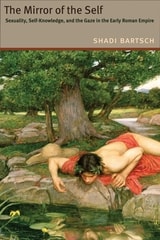
The Mirror of the Self
Sexuality, Self-Knowledge, and the Gaze in the Early Roman EmpireShadi Bartsch
University of Chicago Press, 2006
Weaving together literary theory, philosophy, and social history, Bartsch traces this complex notion of self from Plato’s Greece to Seneca’s Rome. She starts by showing how ancient authors envisioned the mirror as both a tool for ethical self-improvement and, paradoxically, a sign of erotic self-indulgence. Her reading of the Phaedrus, for example, demonstrates that the mirroring gaze in Plato, because of its sexual possibilities, could not be adopted by Roman philosophers and their students. Bartsch goes on to examine the Roman treatment of the ethical and sexual gaze, and she traces how self-knowledge, the philosopher’s body, and the performance of virtue all played a role in shaping the Roman understanding of the nature of selfhood. Culminating in a profoundly original reading of Medea, The Mirror of the Self illustrates how Seneca, in his Stoic quest for self-knowledge, embodies the Roman view, marking a new point in human thought about self-perception.
Bartsch leads readers on a journey that unveils divided selves, moral hypocrisy, and lustful Stoics—and offers fresh insights about seminal works. At once sexy and philosophical, The Mirror of the Self will be required reading for classicists, philosophers, and anthropologists alike.
The Misinterpellated Subject
James R. Martel
Duke University Press, 2017
The Mode of Information
Poststructuralism and Social ContextMark Poster
University of Chicago Press, 1990
The difference, Mark Poster argues, is the profound effect electronic mediation exerts on the very way we perceive ourselves and reality. To help decode the linguistic dimensions of our multiple forms of social interaction, he plays upon Marx's theory of the mode of production—the shift to late capitalism has a parallel in the shift from the mode of production to that of information.
Enlisting poststructuralist theory, he links four modes of communication with four poststructuralists: TV ads with Baudrillard, data bases with Foucault, electronic writing with Derrida, and computer science with Lyotard. Mode of Information points the way to a poststructuralist strategy for writing history, a framework well suited to unearthing structures of domination and the means to their disruption.
"An informed, insightful, provocative account of phenomena that have transformed virtually every area of public and private life on our time."—Robert Anchor, American Historical Review
"The importance of Poster's book is unmistakable for he skillfully negotiates between and juxtaposes two wide theoretical domains—electronically mediated communications and poststructuralist theory—about which much has been written, but hardly with the acumen that he brings to bear in a long-awaited critical rapprochement."—Charles J. Stivale, Criticism
The Modern Age
James V. Schall
St. Augustine's Press, 2011
The Modern Invention of Information
Discourse, History, and PowerRonald E. Day
Southern Illinois University Press, 2008
In The Modern Invention of Information: Discourse, History, and Power, Ronald E. Day provides a historically informed critical analysis of the concept and politics of information. Analyzing texts in Europe and the United States, his critical reading method goes beyond traditional historiographical readings of communication and information by engaging specific historical texts in terms of their attempts to construct and reshape history.
After laying the groundwork and justifying his method of close reading for this study, Day examines the texts of two pre–World War II documentalists, Paul Otlet and Suzanne Briet. Through the work of Otlet and Briet, Day shows how documentation and information were associated with concepts of cultural progress. Day also discusses the social expansion of the conduit metaphor in the works of Warren Weaver and Norbert Wiener. He then shows how the work of contemporary French multimedia theorist Pierre Lévy refracts the earlier philosophical writings of Gilles Deleuze and Félix Guattari through the prism of the capitalist understanding of the “virtual society.”
Turning back to the pre–World War II period, Day examines two critics of the information society: Martin Heidegger and Walter Benjamin. He explains Heidegger’s philosophical critique of the information culture’s model of language and truth as well as Benjamin’s aesthetic and historical critique of mass information and communication. Day concludes by contemplating the relation of critical theory and information, particularly in regard to the information culture’s transformation of history, historiography, and historicity into positive categories of assumed and represented knowledge.
The Modern Turn
Michael Rohlf
Catholic University of America Press, 2017
This volume approaches the modern turn not as an event that occurred all at once, but rather as a series of shifts in different areas of philosophy at different times. The essays are arranged broadly in chronological order of the topics they treat. Among the themes that recur most often in these essays are, first, that modern philosophy is characteristically preoccupied with questions about foundations and, second, that it ultimately prioritizes practice over theory. But the virtues of this text is in presenting a wide range or perspectives on modern philosophy – what constitutes it as modern, when it arose, and what its shortcomings may be.