Results by title
3576 books match the query 'American' and 770 start with t
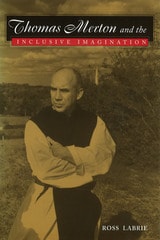
Thomas Merton and the Inclusive Imagination
Ross Labrie
University of Missouri Press, 2001
Thomas Merton (1915-1968) was a Roman Catholic priest, a Trappist monk, a social activist, and a poet. Author of the celebrated autobiography The Seven Storey Mountain, Merton has been described as the most important American religious writer of the past hundred years. One of the notable characteristics of Merton's writing, both in poetry and in prose, was his seamless intermingling of religious and Romantic elements, an intermingling that, because of his gifts as a writer and because of his enormous influence, has had the effect of making widespread a distinctive form of religious thought and expression. In Thomas Merton and the Inclusive Imagination, Ross Labrie reveals the breadth of Merton's intellectual reach by taking an original and systematic look at Merton's thought, which is generally regarded as eclectic and unsystematic.
What captured Merton's attention about Romanticism and mysticism and what held his attention virtually all his life was his consciousness of the ontological significance of unity and wholeness. Even though he was far from being a systematic thinker, Merton's writings form a coherent whole when considered from the point of view of his emphasis on unity and wholeness. Labrie skillfully examines Merton's letters, journals, and individual works to show the full expanse of his contribution. By using insights from the Romantic literary tradition and from the mystical tradition, the author is able to make sense of Merton's writings from all periods of his life. Although Labrie covers such sweeping topics as consciousness, self, being, nature, time, myth, culture, and individuation, remaining focused on Merton's specific, unique contributions in each area.
This thought-provoking work, which takes into account material from the recent full publication of Merton's journals and from his Columbia University notebooks on Romanticism, not only shows Merton's intellectual growth but provides a look at his expansive interests as well. Thomas Merton and the Inclusive Imagination will make a significant contribution to Merton studies.
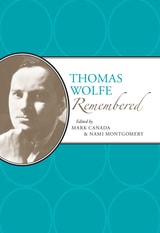
Thomas Wolfe Remembered
Edited by Mark Canada and Nami Montgomery
University of Alabama Press, 2018
A collection of reminiscences captures the private life of a great American writer.
Thomas Wolfe’s life may seem to be an open book. A life that, after all, was the source for his best-known works, including the novels Look Homeward, Angel and Of Time and the River, as well as his numerous short stories and dramas. Since his death in 1938, scholars and admirers of Wolfe have relied largely on these texts to understand the man himself.
Thomas Wolfe Remembered provides something new: a rich, multifaceted portrait painted by those who knew him (casually or intimately), loved him (or didn’t), and saw, heard, and experienced the literary (and literal) giant. This volume gathers in one place for the first time dozens of reminiscences by friends, family members, colleagues, and casual acquaintances, adding color and fine details to the self-portrait the author created in his novels.
Wolfe found plenty to challenge and frustrate him throughout his life, from his boyhood in Asheville, North Carolina, to his education at the University of North Carolina and Harvard University, through his time in New York and Europe, his travels through the American West, and his death in Baltimore. He experienced two distracted parents in a loveless marriage, the premature death of a beloved brother, a minor stutter, and the difficulties of controlling a mercurial temper. Yet Wolfe’s exuberance, perceptiveness, memory, and compulsion to record virtually all that he experienced made for an extravagance of material that sometimes angered the people whose lives he used as source material.
Editors Mark Canada and Nami Montgomery have collected dozens of remembrances, many unpublished or long forgotten, including pieces from Julia Wolfe, Margaret Roberts, Frederick Koch, Maxwell Perkins, Elizabeth Nowell, Edward Aswell, and Martha Dodd. Some are endearing, others are disturbing, and many are comical. All provide glimpses into the vibrant, haunted, boyish, paranoid, disheveled, courteous, captivating, infuriating, and altogether fascinating giant who was Thomas Wolfe.
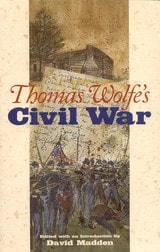
Thomas Wolfe's Civil War
Thomas Wolfe
University of Alabama Press, 2004
An anthology of Thomas Wolfe’s short stories, novel excerpts, and plays illuminating the Civil War
This collection of Thomas Wolfe’s writings demonstrates the centrality of the Civil War to Wolfe’s literary concerns and identity. From Look Homeward, Angel to The Hill Beyond and The Web and the Rock, Wolfe perpetually returned to the themes of loss, dissolution, sorrow, and romance engendered in the minds of many southerners by the Civil War and its lingering aftermath. His characters reflect time and again on Civil War heroes and dwell on ghostlike memories handed down by their mothers, fathers, and grandfathers. Wolfe and his protagonists compare their contemporary southern landscape to visions they have conjured of its appearance before and during the war, thereby merging the past with the present in an intense way. Ultimately, Wolfe’s prose style—incantatory and rhapsodic—is designed to evoke the national tragedy on an emotional level.
Selections of Wolfe’s writings in this collection include short stories ("Chickamauga," "Four Lost Men," "The Plumed Knight"), excerpts from his novels (O Lost, the restored version of Look Homeward, Angel, The Hills Beyond, and Of Time and the River) and a play, Mannerhouse, edited and introduced by David Madden. Madden, who makes the provocative claim that everything a southern writer writes derives from the Civil War experience, also highlights many issues essential to understanding Wolfe’s absorption with the Civil War.
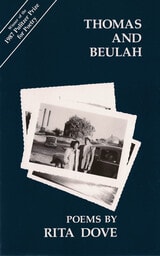
Thomas and Beulah
Rita Dove
Carnegie Mellon University Press, 1986
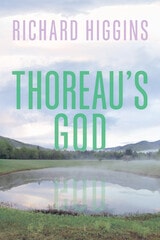
Thoreau's God
Richard Higgins
University of Chicago Press, 2024
Henry David Thoreau’s spiritual life is a riddle. Thoreau’s passionate critique of formal religion is matched only by his rapturous descriptions of encounters with the divine in nature. He fled the church only to pursue a deeper communion with a presence he felt at the heart of the universe. He called this illimitable presence many names, but he often called it God.
In Thoreau’s God, Richard Higgins invites seekers—religious or otherwise—to walk with the great Transcendentalist through a series of meditations on his spiritual life. Thoreau offers us no creed, but his writings encourage reflection on how to live, what to notice, and what to love. Though his quest was deeply personal, Thoreau devoted his life to communicating his experience of an infinite, wild, life-giving God. By recovering this vital thread in Thoreau’s life and work, Thoreau’s God opens the door to a new understanding of an original voice in American religion that speaks to spiritual seekers today.
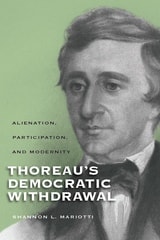
Thoreau’s Democratic Withdrawal
Alienation, Participation, and ModernityShannon L. Mariotti
University of Wisconsin Press, 2009
Separated by time, space, and context, Thoreau and Adorno share a common belief that critical inquiry is essential to democracy but threatened by modern society. While walking, huckleberrying, and picking wild apples, Thoreau tries to recover the capacities for independent perception and thought that are blunted by “Main Street,” conventional society, and the rapidly industrializing world that surrounded him. Adorno’s thoughts on particularity and the microscopic gaze he employs to work against the alienated experience of modernity help us better understand the value of Thoreau’s excursions into nature. Reading Thoreau with Adorno, we see how periodic withdrawals from public spaces are not necessarily apolitical or apathetic but can revitalize our capacity for the critical thought that truly defines democracy.
In graceful, readable prose, Mariotti reintroduces us to a celebrated American thinker, offers new insights on Adorno, and highlights the striking common ground they share. Their provocative and challenging ideas, she shows, still hold lessons on how we can be responsible citizens in a society that often discourages original, critical analysis of public issues.
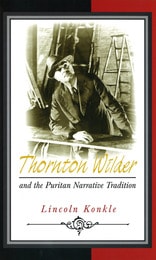
Thornton Wilder and the Puritan Narrative Tradition
Lincoln Konkle
University of Missouri Press, 2005

Thornton Wilder
New PerspectivesLincoln Konkle
Northwestern University Press, 2013
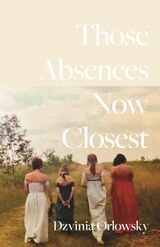
Those Absences Now Closest
Dzvinia Orlowsky
Carnegie Mellon University Press, 2024
In her newest collection, Ukrainian American poet Dzvinia Orlowsky is a witness, never a bystander, ready to stare down the demons, to “cut yourself with a dull razor.” She sets up house among the nightmares of intergenerational trauma and, as far as anyone can, humanizes them. Through her work, Orlowsky prompts us to enter our own histories instead of just watching.
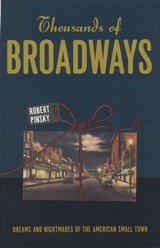
Thousands of Broadways
Dreams and Nightmares of the American Small TownRobert Pinsky
University of Chicago Press, 2009
Broadway, the main street that runs through Robert Pinsky’s home town of Long Branch, New Jersey, was once like thousands of other main streets in small towns across the country. But for Pinsky, one of America’s most admired poets and its former Poet Laureate, this Broadway is the point of departure for a lively journey through the small towns of the American imagination. Thousands of Broadways explores the dreams and nightmares of such small towns—their welcoming yet suffocating, warm yet prejudicial character during their heyday, from the early nineteenth century through World War II.
The citizens of quintessential small towns know one another extensively and even intimately, but fail to recognize the geniuses and criminal minds in their midst. Bringing the works of such figures as Mark Twain, William Faulkner, Alfred Hitchcock, Thornton Wilder, Willa Cather, and Preston Sturges to bear on this paradox, as well as reflections on his own time growing up in a small town, Pinsky explores how such imperfect knowledge shields communities from the anonymity and alienation of modern life. Along the way, he also considers how small towns can be small minded—in some cases viciously judgmental and oppressively provincial. Ultimately, Pinsky examines the uneasy regard that creative talents like him often have toward the small towns that either nurtured or thwarted their artistic impulses.
Of living in a small town, Sherwood Anderson once wrote that "the sensation is one never to be forgotten. On all sides are ghosts, not of the dead, but of living people." Passionate, lyrical, and intensely moving, Thousands of Broadways is a rich exploration of this crucial theme in American literature by one of its most distinguished figures.
Threat Come Close
Aaron Coleman
Four Way Books, 2018
Three Plays
Dividing the Estate, The Trip to Bountiful, and The Young Man from AtlantaHorton Foote
Northwestern University Press, 2008
Three Spiritualist Novels
Elizabeth Stuart Phelps
University of Illinois Press, 2000
Articulating an alternative to conservative church doctrine, Phelps assured her readers--many of them women bereft of their loved ones by the Civil War--that Spiritualist ideas about the afterlife were not fundamentally at odds with Scripture. Like the protagonist of The Gates Ajar, these readers wanted to believe "something actual, something pleasant" about the world to come, not "glittering generalities" about a "dreadful Heaven" where their loved ones were too busy singing and worshiping to have any thought of those left behind.
All three of the novels collected here--The Gates Ajar (1868), Beyond the Gates (1883), and The Gates Between (1887)--describe heaven as a perfected version of earthly life and the afterlife as a chance to make up for opportunities squandered on Earth. A grieving sister finds consolation in the Spiritualist idea of a continued connection with her beloved brother; a dying woman finds her soulmate in the afterlife; an erring husband makes amends across the line between the living and the dead.
Tremendously popular in Phelps's lifetime, these novels offer a way of reconciling human beings to earthly loss and sorrow, assuring readers of an afterlife both restorative and compensatory. They also provide an intriguing look at a phenomenon that preoccupied nineteenth-century America and continues to fascinate us in the twenty-first century.
Three Trios
PoemsJ II
Northwestern University Press, 2007
Thresherphobe
Mark Halliday
University of Chicago Press, 2013
Threshold
James Longenbach
University of Chicago Press, 1998
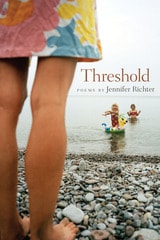
Threshold
Jennifer Richter
Southern Illinois University Press, 2010
Jennifer Richter presents a series of poems that explore the many facets of the term "threshold." Throughout the collection, the narrator experiences several acts of threshing, or separating—from birth and the small yet profound distances that part a mother and child, to the separation caused by illness and its toll on relationships. At the same time, she is progressively gathering, piecing together the remnants of her life, collecting her children into her arms, and welcoming a future without pain. Pain is often present in these poems, as the narrator frequently confronts her own threshold for enduring a ravaging illness. Her harrowing struggle through recovery is chronicled by a poem at the end of each section, tracing her powerful journey from deep suffering to a fragile yet steadfast sense of hope.
These gripping lyric and prose poems explore duality in its many forms: the private, contemplative world versus a world of action; the mirror sides of health and sickness; the warmth of a June sun and the deep, long nights of winter; mother and child; collecting and letting go. From the comfort of a morning bed at home to the desperate streets of Hanoi, Threshold is a searing portrait of healing, the courage it takes to bridge the gulfs that divide, and the wonder of the ties that bind.
What Is My Body Without You?
My son’s pajamas unsnapped
on the floor: small husk
of his body relaxing on its back,
legs and sleeves still filled
with his rush. This part of him
hasn’t outgrown my arms
and sometimes lets me lift
him up our steep stairs,
carry him to bed and pull
his shade against the gray
thin winter sky like milk
my daughter wakes up wanting.
In the last days of lifting her
to my breast, I fill her less
than the air already gone
from my son’s flat shape.
Twice like that I have lain back,
the doctor opening me
along the same clean seam.
Each time I was watching:
with a few tugs the child
was out, naked and heading
toward other hands, each child
cut loose before I knew it.
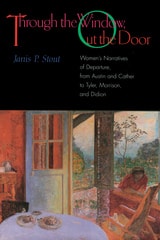
Through the Window, Out the Door
Women's Narratives of Departure, from Austin and Cather to Tyler, Morrison, and DidionJanis P. Stout
University of Alabama Press, 1998
This informative and provocative study focuses on the centrality of departure in the texts of five major American women novelists.
An important moment in many novels and poems by American women writers occurs when a central character looks out a window or walks out the door of a house. These acts of departure serve to convey such values as the rejection of constraining social patterns, the search for individual fulfillment, and the entry into the political.
Janis Stout examines such moments and related patterns of venture and travel in the fiction of five major American novelists of the 20th century: Mary Austin, Willa Cather, Anne Tyler, Toni Morrison, and Joan Didion. Stout views these five writers within a spectrum of narrative engagements with issues of home and departure—a spectrum anchored at one end by Sarah Orne Jewett and at the other by Marilynne Robinson, whose Housekeeping posits a vision of female transience.
Through the Window, Out the Door ranges over an expansive territory. Moving between texts as well as between texts and contexts, Stout shows how women writers have envisioned the walls of physical and social structures (including genres) as permeable boundaries, drawing on both a rhetoric of liberation and a rhetoric of domesticity to construct narrative arguments for women's right to move freely between the two. Stout concludes with a personal essay on the dilemmas of domesticity and the ambivalence of departure.
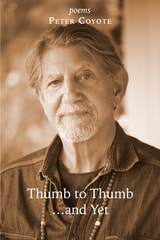
Thumb to Thumb… and Yet
Peter Coyote
Four Way Books, 2026
If Emmy Award-winner Peter Coyote’s debut collection represents the culmination of a half-century’s devotion to writing poetry, his second functions as a true encore: triumphant and raw. Thumb to Thumb… and Yet presents eighty-plus years of living — the countercultural adventures, the journey from Zen Buddhist discipleship to priesthood, marriage and divorce, a public career in entertainment, and the private work and rewards of parenthood — not as a retrospective but as a perpetual process of becoming. Coyote captures often-elusive wisdom and infuses these pages with the fullness of human experience: weariness that labor never ceases, that we cannot outgrow suffering, that we’re like “Manteaux ducks, immobilized so the fat / of everything can be forced down our gullets,” the glut of gavage neverending and “no option to stop swallowing”; frustration that ambition and ego persist despite the “pre-dawn Zendo chill” and over five decades spent “thumb-to-thumb sitting” in devoted practice; the satisfaction of pleasure, “smiling in the ruined sheets”; gratitude for life consummated and life ongoing and life that will continue long after us, for the opportunity of existence, for the work itself, for the “single nuthatch [that] bows / upside down on the grand oak” and its reminder during meditation that “everything presents itself as a partner.” The titular qualification of that “and yet” is an argument against and a celebration of conclusion; in a masterful encapsulation of the lyrical moment itself, these poems find Coyote returning to the stage only to perform another finale, every end recycled toward beginning. One song cedes to another, and yet the music flows on.

Thunderclouds in the Forecast
A NovelClarence Major
Northwestern University Press, 2021
When Ray’s train is delayed in Lorena, a Gold Rush outpost turned college town, he meets Alice. Together they embark on a romance that tempts him to stay. By the time Ray arrives in San Francisco, Scotty has abandoned his bartending job, his rented room, and his scant belongings and skipped town with a married woman from Lorena. Now Ray has more than one reason to return.
A preeminent American writer who thrives on reinvention, Major returns with an unforgettable exploration of life on the brink of sweeping change. With spare prose and subtle poignancy, Thunderclouds in the Forecast probes love, loyalty, and belonging. As Toni Morrison wrote, “Clarence Major has a remarkable mind and the talent to match.”
Thunderhead
Emily Rose Cole
University of Wisconsin Press, 2022
In this striking and nostalgic collection, Emily Rose Cole unearths the fragility and resilience of daughterhood through indelible imagery that evokes new senses of the body: swallowing keys, rain lashing eyelids, unzipping of flesh. Grieving self-portraits of historical and mythological women are woven with stirring recollections of struggling bodies and evocative spells to overcome them. Undulating with memories and magic, illness and death, these poems reveal how a single chance at life and loving can be both too much and not enough.
The wolf will live with the lamb, what did you mean?
Some days, cancer is the wolf. Some days, the wolf is Mama.
—excerpt from “Still Life with Lines from Isaiah”
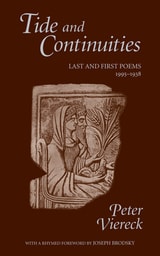
Tide and Continuities
Last and First Poems, 1995-1938Peter Viereck
University of Arkansas Press, 1995
Peter Viereck’s career in poetry is an ongoing experiment in the symbiosis of poetry and history. In Tide and Continuities that experiment has yielded its finest results. Included are many new poems, never before published, and stunning revisions from work as recent as his 1987 epic, Archer in the Marrow: The Applewood Cycles, and as early as his 1948 Pulitzer Prize-winning collection, Terror and Decorum.
This collection is the revelation of a great American poet. The Nobel laureate Joseph Brodsky calls Viereck “possibly the greatest rhymer of / the modern period.” This is Viereck’s most lyrical, most passionate book; hence Brodsky rhymes “lyric” with “Viereck.”
Tide and Continuities marks Viereck’s complete evolution as a poet, and brilliantly describes the arc of more than a half century’s work.
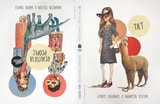
Tilt / Beautiful People
Denise Duhamel, Maureen Seaton, and Aaron Smith
Bridwell Press, 2024
In Tilt, Denise Duhamel and Maureen Seaton (1947-2023) write through climate change, Maureen’s illness, and the pandemic with their signature wit and poignancy. Their feminist curiosity leads them to poems about gender identity, marriage equality, and the complexities of national politics. Assembled shortly before Maureen’s death, the poems in Tilt tell the story of a friendship rooted in collaborative artistic play. The title of the book gives a nod to the earth’s tilt, which gives us seasons, but also hints that the poems were written at full tilt, these poets hyperaware they only had so much time left to write with one another.
Beautiful People was written back and forth over the course of several months by poets Maureen Seaton and Aaron Smith. Bold and inventive, it moves from sonnets and sestinas to prose poems and so much more. While its center is a love for poetry and art and laughter, the poets also grapple with mortality, sadness, and what it means to be alive on a broken but beautiful planet. Through their literary friendship, they put a mirror to all our lovely faces.
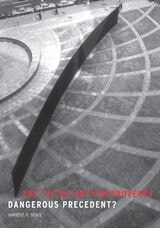
Tilted Arc Controversy
Dangerous PrecedentHarriet F. Senie
University of Minnesota Press, 2001
A comprehensive look at a controversy that continues to fuel debates about the role of public art in America.
Since its installation at and subsequent removal from New York City’s Federal Plaza, noted sculptor Richard Serra’s Tilted Arc has been a touchstone for debates over the role of public art. Installed in 1981, the 10-foot-high, 120-foot-long curved wall of Cor-Ten self-rusting steel instantly became a magnet for criticism. Art critics in the New York Times and the Village Voice labeled it the city’s worst public sculpture, and many denounced it as an example of the elitism associated with art and as an obstacle to the use and enjoyment of the plaza.
Harriet F. Senie explores the history of Tilted Arc, including its 1979 commission and the heated public hearings that eventually led to its removal in 1989 (it was dismantled and is currently stored in a government warehouse in Maryland). Analyzing the archive of popular opinion, Senie shows how the sculpture was caught in an avalanche of shifting local and national discussions about public funding for the arts. She examines the tactics of those opposed to the sculpture and the media’s superficial and sensational coverage of the controversy, reframing the dialogue in terms of public art, public space, and public policy instead of the question of whether the removal of Tilted Arc was poetic justice or a dangerous precedent. Senie provides an enlightening history and analysis of a controversy that will continue to inform our discussions about public art for years to come.
To Be in This Number
Alane Rollings
Northwestern University Press, 2005
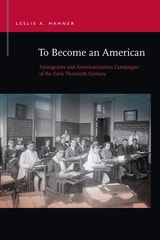
To Become an American
Immigrants and Americanization Campaigns of the Early Twentieth CenturyLeslie A. Hahner
Michigan State University Press, 2017
To Fight Aloud Is Very Brave
American Poetry and the Civil WarFaith Barrett
University of Massachusetts Press, 2012
Focusing on literary and popular poets, as well as work by women, African Americans, and soldiers, this book considers how writers used poetry to articulate their relationships to family, community, and nation during the Civil War. Faith Barrett suggests that the nationalist “we” and the personal “I” are not opposed in this era; rather they are related positions on a continuous spectrum of potential stances. For example, while Julia Ward Howe became famous for her “Battle Hymn of the Republic,” in an earlier poem titled “The Lyric I” she struggles to negotiate her relationship to domestic, aesthetic, and political stances.
Barrett makes the case that Americans on both sides of the struggle believed that poetry had an important role to play in defining national identity. She considers how poets created a platform from which they could speak both to their own families and local communities and to the nations of the Confederacy, the Union, and the United States. She argues that the Civil War changed the way American poets addressed their audiences and that Civil War poetry changed the way Americans understood their relationship to the nation.
To Forget Venice
Peg Boyers
University of Chicago Press, 2014
To Go Into the Words
Norman Finkelstein
University of Michigan Press, 2023
To Go Into the Words is the latest book of critical prose from renowned poet and scholar of Jewish literature Norman Finkelstein. Through a rigorous examination of poets such as William Bronk, Helen Adam, and Nathaniel Mackey, the book engages the contemporary poetic fascination with transcendence through the radical delight with language. By opening up a given poem, Finkelstein seeks the “gnosis” or insight of what it contains so that other readers can understand and appreciate the works even more.
Pulling from Finkelstein’s experience of writing thirteen books of poetry and six books of literary criticism, To Go Into the Words consistently rewards the reader with insights as transformative as they are well-considered and deftly mapped out. This volume opens the world of poetry to poets, scholars, and readers by showcasing “the gnosis that is to be found in modern poetry.”
To Make a Prairie
Essays on Poets, Poetry, and Country LivingMaxine Kumin
University of Michigan Press, 1980
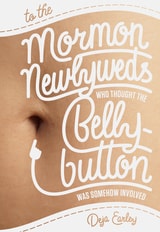
To the Mormon Newlyweds Who Thought the Bellybutton Was Somehow Involved
Deja Earley
Signature Books, 2018
In navigating her life as a free-spirited Mormon, each of Earley’s poems expresses the tension she feels in adhering to and expanding the confines of her faith. From awkward first kisses shared on a church couch to refusing to talk to men who are not Mormon “lest I fall from grace, on my ass,” her poems remain funny, wry, thoughtful. Despite the promise not to talk to non-Mormon men, her final poems detail her marriage to a Catholic husband who offers Hail Mary prayers after a lost pregnancy while she struggles to find comfort from an elusive Mother in Heaven. Despite their differences and moments of heartache, they thrive, allowing themselves to “imagine we’re floating in bright bubbles of light.” It is an emotional roadmap for anyone else facing such tensions, joys, and accommodations.
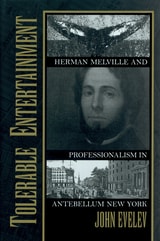
Tolerable Entertainment
Herman Melville and Professionalism in Antebellum New YorkJohn Evelev
University of Massachusetts Press, 2006
Perhaps more than any other nineteenth-century writer, Melville has been read and understood in the context of his career, embodied in a narrative of the trajectory from immature emergence, through brilliant ascendance, to collapse into neglect. Moving beyond these stereotypes, John Evelev uses Melville's writings to place the concept of "career" within a historical framework, as part of the ideological project of a new middle-class professionalism. He describes a meritocratic ethos of competitive specialization and expertise that distanced itself from both the deskilling of industrialized labor and the older professional arrangement of elite patronage. By exploring the intersections of class and culture in antebellum America, Evelev offers a new perspective on Melville's literary career.
Tolerable Entertainment reads Melville's life and work in relation to such cultural developments as the famous "high/low" theater riots at Astor Place and the rise of the lyceum circuit, a forum for celebrity lecturers to reach the new urban "middlebrow" audience. The book also considers such transformations in antebellum social attitudes as urban workers' protests against industrialization and the growth of the "self-culture" of the new urban middle class, with the emergence of vocational associations and professional specialization.
Evelev's readings run against the grain of modern Melville scholarship by emphasizing not the values of individualism and democracy that have led critics to construe Melville's writings as central to the American canon, but rather the ambivalent cultural and vocational distinctions of the developing middle class to which Melville belonged.
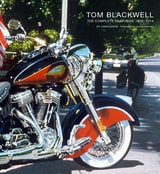
Tom Blackwell
The Complete Paintings, 1970–2014Tom Blackwell
The Artist Book Foundation, 2018
Tom Blackwell (1938–2020) is primarily known for his work in Photorealism, a stylistic movement noted for its ardent embrace of photographic source material. In 1969, he began a series of brashly beautiful motorcycle paintings that established him as one of the founders and foremost artists of the movement. The myriad painterly possibilities of urban store windows became another abiding interest. In his store-window paintings, Blackwell captures the counterpoint between the idealized reality within the store display and the bustling urban life reflected in the glass. As author Linda Chase remarks, "The magic of these paintings resides in the artist's ability to transform the arbitrary photographic information into dynamic and complex artistic compositions, revealing and clarifying the image while preserving its mystery."
In conjunction with his Photorealist paintings, Blackwell has produced a related body of work that is allegorical in its perpective. Combining photo-derived images, he addresses themes such as the passage of time, the fragility of nature, and the continuity that weaves through human history. The paintings, rich in symbolism and interpretive possibilities, fascinate and impress viewers with the breadth of Blackwell's abilities. "As a painter, I have been interested in dealing with the formal issues involved in juxtaposed and overlapping images," he explains. "In my Photorealism work, my goal is to reveal something about the actual world and to explore our photo-mediated perceptions of it."
Blackwell, born in Chicago in 1938, has deftly captured the vibrancy and visual excitement of urban street life for the past four decades and has had solo exhibitions across the United States and abroad. Tom Blackwell: The Complete Paintings, 1970–2014 is a comprehensive study of the artist's work as well as his artistic development and process, and includes a compilation of his early paintings through to his most recent works.

Tom Slaughter (Blue)
Tom Slaughter
The Artist Book Foundation, 2019
Of Tom Slaughter, Henry Geldzahler, the first curator of twentieth-century art at The Metropolitan Museum of Art, commented: "The quality of freshness, the familiar world re-seen, from the water towers of New York City to the rural pleasures of boating, is the most immediately arresting aspect of Tom Slaughter's art... Bold bright colors swiftly laid down echo with resonances: Léger and Stuart Davis, Raoul Dufy and Roy Lichtenstein." His work, with its seemingly effortless whimsy rendered with a strong sense of line, color, and rhythm, has also been compared to Matisse.
Slaughter's Pop-inflected drawings, prints, paintings, and illustrations convey his love of life as he relentlessly explored the complexities of the urban scene or the simple pleasures of boating. The Artist Book Foundation is pleased to publish Tom Slaughter, an extensive monograph of the artist's enormous body of work that celebrates his enduring optimism, personal and artistic honesty, and charming brashness in a landscape of pure joy.
Glenn Lowry, director of the Museum of Modern Art, reveals Slaughter as a treasured friend whose artistry was fueled by endless curiosity about life's simple pleasures, a man who made his innumerable friends and acquaintances part of his personal community. Slaughter's lifelong friend, actor and writer David Marshall Grant, remembers the artist's delight when, in a high school art class, he was introduced to the mysteries of negative space and the enigmatic power it brings to an artwork. Artist, art critic, and independent curator Andy Fabo describes his friend's vibrant art as all about pleasure. Even in the most turbulent of times, he took a celebratory approach to his art, offering his viewers a sensual and visual delight. For Jon Robin Baitz, playwright and screenwriter, the "sweetness" of Slaughter's images was insistent, a compulsive scrutinizing of the visual world of small domesticities. Marthe Jocelyn, the artist's former wife and a children's book author and illustrator, reflects on the couple's acclaimed collaboration on a series of books for the very youngest readers. Jim Kempner, gallery owner, recalls Slaughter as a man of charm and enormous artistic talent who always managed to retain a childlike innocence. Artist George Negroponte remembers Slaughter as focusing on the life around him, especially his daughters, in a unique mixture of everyday images, abstracted yet conveying popular culture. And in an interview both informative and poignant, Slaughter's friends, artists Stephen Hannock,
Tom Slaughter (Red)
Tom Slaughter
The Artist Book Foundation, 2019
Of Tom Slaughter, Henry Geldzahler, the first curator of twentieth-century art at The Metropolitan Museum of Art, commented: "The quality of freshness, the familiar world re-seen, from the water towers of New York City to the rural pleasures of boating, is the most immediately arresting aspect of Tom Slaughter's art... Bold bright colors swiftly laid down echo with resonances: Léger and Stuart Davis, Raoul Dufy and Roy Lichtenstein." His work, with its seemingly effortless whimsy rendered with a strong sense of line, color, and rhythm, has also been compared to Matisse.
Slaughter's Pop-inflected drawings, prints, paintings, and illustrations convey his love of life as he relentlessly explored the complexities of the urban scene or the simple pleasures of boating. The Artist Book Foundation is pleased to publish Tom Slaughter, an extensive monograph of the artist's enormous body of work that celebrates his enduring optimism, personal and artistic honesty, and charming brashness in a landscape of pure joy.
Glenn Lowry, director of the Museum of Modern Art, reveals Slaughter as a treasured friend whose artistry was fueled by endless curiosity about life's simple pleasures, a man who made his innumerable friends and acquaintances part of his personal community. Slaughter's lifelong friend, actor and writer David Marshall Grant, remembers the artist's delight when, in a high school art class, he was introduced to the mysteries of negative space and the enigmatic power it brings to an artwork. Artist, art critic, and independent curator Andy Fabo describes his friend's vibrant art as all about pleasure. Even in the most turbulent of times, he took a celebratory approach to his art, offering his viewers a sensual and visual delight. For Jon Robin Baitz, playwright and screenwriter, the "sweetness" of Slaughter's images was insistent, a compulsive scrutinizing of the visual world of small domesticities. Marthe Jocelyn, the artist's former wife and a children's book author and illustrator, reflects on the couple's acclaimed collaboration on a series of books for the very youngest readers. Jim Kempner, gallery owner, recalls Slaughter as a man of charm and enormous artistic talent who always managed to retain a childlike innocence. Artist George Negroponte remembers Slaughter as focusing on the life around him, especially his daughters, in a unique mixture of everyday images, abstracted yet conveying popular culture. And in an interview both informative and poignant, Slaughter's friends, artists Stephen Hannock,
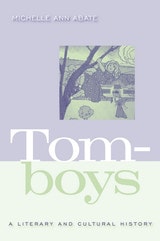
Tomboys
A Literary and Cultural HistoryMichelle Ann Abate
Temple University Press, 2008
Starting with the figure of the bold, boisterous girl in the mid-19th century and ending with the “girl power” movement of the 1990’s, Tomboys is the first full-length critical study of this gender-bending code of female conduct. Michelle Abate uncovers the origins, charts the trajectory, and traces the literary and cultural transformations that the concept of “tomboy” has undergone in the United States.
Abate focuses on literature including Louisa May Alcott's Little Women and Carson McCullers's The Member of the Wedding and films such as Peter Bogdanovich's Paper Moon and Jon Avnet's Fried Green Tomatoes. She also draws onlesser-known texts like E.D.E.N. Southworth's once wildly popular 1859 novel The Hidden Hand, Cold War lesbian pulp fiction, and New Queer Cinema from the 1990s.
Tomboys also explores the gender and sexual dynamics of tomboyism, and offers intriguing discussions of race and ethnicity's role in the construction of the enduring cultural archetype. Abate’s insightful analysis provides useful, thought-provoking connections between different literary works and eras. The result demystifies this cultural phenomenon and challenges readers to consider tomboys in a whole new light.
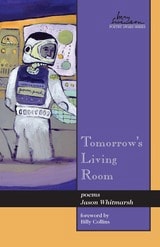
Tomorrow's Living Room
Jason Whitmarsh
Utah State University Press, 2009
Volume 13 in the Swenson Award Series, Tomorrow's Living Room offers a pleasantly disorienting verbal territory. The collection is alternately wry and dark, hopeful and bleak, full of unexpected light and laugh-out-loud incongruities. We begin to see that the shape and the furniture of Jason Whitmarsh's world reflect our own (they may in fact be universal), but we're considering them through completely new terms of engagement.
Selected by, and with a foreword by, Billy Collins.
The annual Swenson competition, named for May Swenson, honors her as one of America’s most provocative and vital writers. In John Hollander’s words, she was "one of our few unquestionably major poets."
Tomorrowing
Terry Bisson
Duke University Press, 2024
Tongue & Groove
Stephen Cramer
University of Illinois Press, 2007
Tongue Lyre
Tyler Mills
Southern Illinois University Press, 2013
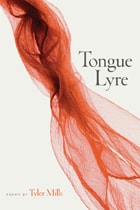
In Tongue Lyre, Tyler Mills weaves together fragments of myth and memory, summoning the works of Ovid, Homer, and James Joyce to spin a story of violence and the female body. Introducing the recurring lyre figure in the collection—a voice to counter the violence—is Ovid’s Philomena, who, while cruelly rendered speechless, nonetheless sets the reader on an eloquent voyage to discover the body through music, art, and language. Other legendary figures making appearances within—Telemachos, Nestor, Cyclops, Circe, and others—are held up as mirrors to reflect the human form as home. In this dynamic collection, the female body and its relationship to the psyche traverse mythic yet hauntingly familiar contemporary settings as each presents not a single narrative but a progressive exploration of our universal emotional experience.
Tongue of a Crow
Peter Coyote
Four Way Books, 2021
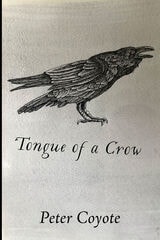
Peter Coyote’s first collection of poetry takes us on a whirlwind tour of an eclectic and exciting life as an actor and Zen Buddhist priest, meandering from love affairs to marriage to divorce to the Sixties to psychedelic spirituality and beyond. Written over several decades, these poems read as a collage, each piece distinct and contributing to a cohesive lyric narrative.
Tongue of a Crow
Peter Coyote
Four Way Books, 2021
Peter Coyote’s first collection of poetry takes us on a whirlwind tour of an eclectic and exciting life as an actor and Zen Buddhist priest, meandering from love affairs to marriage to divorce to the Sixties to psychedelic spirituality and beyond. Written over several decades, these poems read as a collage, each piece distinct and contributing to a cohesive lyric narrative.
Toni Morrison
PLAYING WITH DIFFERENCELucille P. Fultz
University of Illinois Press, 2003
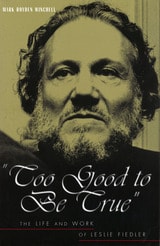
Too Good to Be True
The Life and Work of Leslie FiedlerMark Royden Winchell
University of Missouri Press, 2002

Too Many Thumbs
A Three-Act PlayRobert Hivnor
University of Minnesota Press, 1949
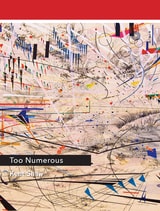
Too Numerous
Kent Shaw
University of Massachusetts Press, 2019
What does it really mean when people are viewed as bytes of data? And is there beauty or an imaginative potential to information culture and the databases cataloging it? As Too Numerous reveals, the raw material of bytes and data points can be reshaped and repurposed for ridiculous, melancholic, and even aesthetic purposes.
Grappling with an information culture that is both intimidating and daunting, Kent Shaw considers the impersonality represented by the continuing accumulation of personal information and the felicities—and barriers—that result: “The us that was inside us was magnificent structures. And they weren't going to grow any larger.”
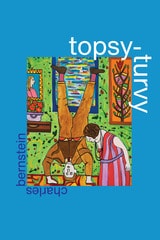
Topsy-Turvy
Charles Bernstein
University of Chicago Press, 2021
Though Bernstein’s poems play with form, they incorporate a melancholy, even tragic, sensibility. This “cognitive dissidence,” as Bernstein calls it, is reflected in a lyrically explosive mix of pathos, comedy, and wit, though the reader is kept guessing which is which at almost every turn. Topsy-Turvy includes an ode to the New York City subway and a memorial for Harpers Ferry hero Shields Green, along with collaborations with artists Amy Sillman and Richard Tuttle. This collection is also full of other voices: Pessoa, Geeshie Wiley, Friedrich Rückert, and Rimbaud; Carlos Drummond, Virgil, and Brian Ferneyhough; and even Caudio Amberian, an imaginary first-century aphorist.
Bernstein didn’t set out to write a book about the pandemic, but these poems, performances, and translations are oddly prescient, marking a path through dark times with a politically engaged form of aesthetic resistance: We must “Continue / on, as / before, as / after.”
The audio version of Topsy-Turvy is performed by the author.
Topsy-Turvy
Charles Bernstein
University of Chicago Press, 2021
Though Bernstein’s poems play with form, they incorporate a melancholy, even tragic, sensibility. This “cognitive dissidence,” as Bernstein calls it, is reflected in a lyrically explosive mix of pathos, comedy, and wit, though the reader is kept guessing which is which at almost every turn. Topsy-Turvy includes an ode to the New York City subway and a memorial for Harpers Ferry hero Shields Green, along with collaborations with artists Amy Sillman and Richard Tuttle. This collection is also full of other voices: Pessoa, Geeshie Wiley, Friedrich Rückert, and Rimbaud; Carlos Drummond, Virgil, and Brian Ferneyhough; and even Caudio Amberian, an imaginary first-century aphorist.
Bernstein didn’t set out to write a book about the pandemic, but these poems, performances, and translations are oddly prescient, marking a path through dark times with a politically engaged form of aesthetic resistance: We must “Continue / on, as / before, as / after.”
The audio version of Topsy-Turvy is performed by the author.
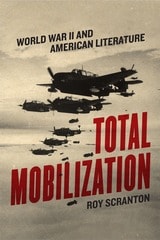
Total Mobilization
World War II and American LiteratureRoy Scranton
University of Chicago Press, 2019
Since World War II, the story of the trauma hero—the noble white man psychologically wounded by his encounter with violence—has become omnipresent in America’s narratives of war, an imaginary solution to the contradictions of American political hegemony. In Total Mobilization, Roy Scranton cuts through the fog of trauma that obscures World War II, uncovering a lost history and reframing the way we talk about war today.
Considering often overlooked works by James Jones, Wallace Stevens, Martha Gellhorn, and others, alongside cartoons and films, Scranton investigates the role of the hero in industrial wartime, showing how such writers struggled to make sense of problems that continue to plague us today: the limits of American power, the dangers of political polarization, and the conflicts between nationalism and liberalism. By turning our attention to the ways we make war meaningful—and by excavating the politics implicit within the myth of the traumatized hero—Total Mobilization revises the way we understand not only World War II, but all of postwar American culture.