Results by title
3785 books match the query 'Poetry' and 833 start with t
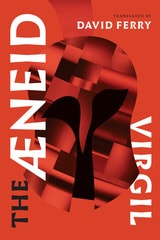
The Aeneid
Virgil
University of Chicago Press, 2017
The paperback and e-book editions include a new introduction by Richard F. Thomas, along with a new glossary of names that makes the book even more accessible for students and for general readers coming to the Aeneid for the first time who may need help acclimating to Virgil’s world.
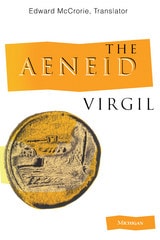
The Aeneid of Virgil
Virgil
University of Michigan Press, 1995
In this new translation Edward McCrorie has performed the difficult task of rendering Virgil's compact, dense Latin into fine, readable, modern English verse. The sometimes complex text is made clear and comprehensible even for first-time readers, and a glossary of names helps identify characters and place-names in the poem. The translation is well suited for students at all levels, and readers already familiar with Virgil will find many fresh images and ideas.
"A brilliant effort."--Robert Bly
"I admire the ambition of the project, and the generosity of many of the lines."--Robert Fagles
Edward McCrorie is Professor of English, Providence College. His poetry and translations of Latin verse have been widely published.
The Aesthetic Astronaut
sonnets by Roger ArmbrustRoger Armbrust
Parkhurst Brothers, Inc., 2009
One hundred twenty-two sonnets that touch on contemporary American popular culture, social trends, and personalities. Poet Roger Armbrust is described by some as a mystic, by others as a spiritualist, and by yet others as a guy who toys with really big thoughts, making them objects both of serious study and of humor. His sonnets will push you to laughter and meditation: a satisfying literary ride.
In The Aesthetic Astronaut, Roger Armbrust escorts readers on an insightful journey throughout Earth and beyond. We experience the loneliness and instpiration of "the Aesthetic Astronaut"; cold-blooded calculations of "The Armchair Assassin"; passion and sense of the romantic lover; reflective memories of a gentle heart growing older; ironic vision of an observer to history, and subtle--and sometimes not so subtle--humor of a fellow human involved in our day-to-day challenge of living a worthwhile life. The poet's imagery and attitude. . . may fascinate, thrill, sadden, anger, or push you to laughter or meditation. But you'll find the trip a fascinating literary ride.
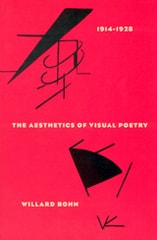
The Aesthetics of Visual Poetry, 1914-1928
Willard Bohn
University of Chicago Press, 1993
"An important contribution. Highly sophisticated, the study tends to raise its reader's impression of visual poetry in the twentieth century from trivial pastime to serious preoccupation."—Eric Sellin, Journal of Modern Literature
"With his definitive analyses full of quotable observations and sharp critical insights, Bohn has provided a model, pioneering study, one from which current and future studies of visual poetry will most certainly benefit."—Gerald J. Janacek, Romance Quarterly
"Bohn substantiates his thesis with thoughtful and often ingenious explications of texts both well known and hard to find. . . . Aesthetics of Visual Poetry is a thoroughly researched, beautifully written and fascinating introduction to an infinitely intriguing genre."—Mechthild Cranston, French Review
The Afterlife of Objects
Dan Chiasson
University of Chicago Press, 2002
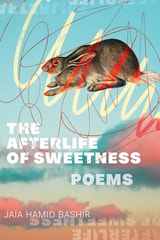
The Afterlife of Sweetness
PoemsJaia Hamid Bashir
The Ohio State University Press, 2026
The Aftermath of War
Jean-Paul Sartre
Seagull Books, 2008

The Age of Discovery
Alan Michael Parker
Tupelo Press, 2020
The Air in the Air Behind It
Brandon Rushton
Tupelo Press, 2022
—Donna Stonecipher
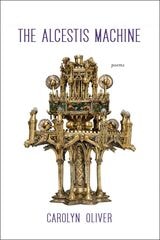
The Alcestis Machine
PoemsCarolyn Oliver
Acre Books, 2024
Inspired by the Greek myth of Alcestis, this poetry collection brings to life myriad voices who venture beyond the known world and exist between realities.
In Greek mythology, Alcestis descends to the mysterious kingdom of death in her beloved’s place. In The Alcestis Machine, Carolyn Oliver’s second poetry collection, loss and queer desire echo across the multiverse. “In another life, I’m a . . .” sea witch or swineherd, vampire or troubadour, florist or fossil or museum guard, Oliver writes. These parallel personas inhabit space stations and medieval villages, excavate the Devonian seabed, and plumb a subterranean Anthropocene. In possible futures and imagined pasts, they might encounter “all wrong turns and broken signs” or carry “a suitcase full of stars.”
Oliver’s poems are animated by lush, unsettling verse and forms both traditional and experimental. The Alcestis Machine demonstrates how very present absence can be and how desire knows no boundaries. In neighborhood subdivisions or the vast reaches of space, it’s impossible to know “whose time is slipping / again.” Anyone “could come loose / from gravity’s shine.”
The Alliterative Morte Arthure
The Owl and the Nightingale and Five Other Middle English PoemsJohn Gardner
Southern Illinois University Press, 1973
Poets of every age deal with roughly the same human emotions, and for the experienced reader poetry is interesting or not depending upon the moment-by-moment intensity of its appeal. This skillful rendering by John Gardner of seven Middle English poems into sparklingly modern verse translation—most of them for the first time—represents a selection of poems that, generally, have real artistic value but are so difficult to read in the original that they are not as well known as they deserve to be. The seven poems are: The Alliterative Morte Arthure, Winner and Waster, The Parliament of the Three Ages, Summer Sunday, The Debate of Body and Soul, The Thrush and the Nightingale,and The Owl and the Nightingale.
The first four poems represent high points in the alliterative renaissance of the fourteenth century. Morte Arthure,here translated for the first time in its entirety into modern verse, is the only heroic romance in Middle English—a work roughly in the same genre as the French Song of Roland. The other three poems have been included in the anthology as further poetic examples.
With his employment of extensive comments and notes on the poems, Gardner provides a wealth of aids to appreciation and understanding of his outstanding translations. The anthology will be of interest to general readers as well as to students.
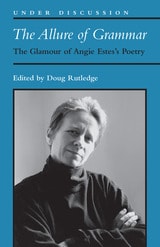
The Allure of Grammar
The Glamour of Angie Estes's PoetryDoug Rutledge, Editor
University of Michigan Press, 2019
In addition to presenting an overview of critical reactions to Estes’s oeuvre, reviews by Langdon Hammer, Julianne Buchsbaum, and Christopher Spaide also provide a helpful context for approaching a poet who claims to distrust narrative. Original essays consider the craft of Estes’s poetry and offer literary analysis. Ahren Warner uses line breaks to explore a postmodern analysis of Estes’s work. Mark Irwin looks at her poetic structure. Lee Upton employs a feminist perspective to explore Estes’s use of italics, and B. K. Fischer looks at the way she uses dance as a poetic image. Doug Rutledge considers her relationship to Dante and to the literary tradition through her use of ekphrasis. An interview with Estes herself, in which she speaks of a poem as an “arranged place . . . where experience happens,” adds her perspective to the mix, at turns resonating with and challenging her critics.
The Allure of Grammar will be useful for teachers and students of creative writing interested in the craft of non-narrative poetry. Readers of contemporary poetry who already admire Estes will find this collection insightful, while those not yet familiar with her work will come away from these essays eager to seek out her books.
The Almanac
PoemsSteve Straight
Northwestern University Press, 2012
While the poems in Steve Straight’'s new collection lead the reader "into the dark forest of memory / or onto the carnival ride of hypothesis, / or even right off the cliff of surprise," they maintain a sure course through the din and distraction of modern life. Bits of news from the natural sciences, chance encounters, and even convicted felon and crafting queen Martha Stewart all fall under Straight’s observant eye. The result is a collection of conversational poems that lend a sense of wonder to the commonplace.
The Ambiguity of Taste
Freedom and Food in European RomanticismJocelyne Kolb
University of Michigan Press, 1995
In The Ambiguity of Taste, Jocelyne Kolb attempts to define changes in genre and metaphorical usage by undertaking close readings of six authors. She looks first at Molière and Fielding, whose culinary allusions herald poetic revolution but whose works do not themselves escape the limits of a neoclassical aesthetic. Byron and Heine, known as renegades, are treated in separate chapters and in the greatest detail. The penultimate chapter joins Goethe and Hugo as champions of poetic freedom, and in the final chapter Kolb briefly considers Thomas Mann and Proust, whose works display the gains of poetic revolution.
This book will be savored by students of comparative literature and European Romanticism. Its accessible style will tempt nonspecialists and food enthusiasts as well.
Jocelyne Kolb is Professor of German Studies, Smith College. This book was the winner of the 1995 American Conference on Romanticism Book Prize.
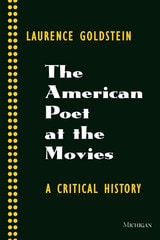
The American Poet at the Movies
A Critical HistoryLaurence Goldstein
University of Michigan Press, 1995
As an increasingly popular genre of modern poetry, and one that permits a unique view of this century's dominant art form, the movie poem has needed an explanatory book like this one. As cinema and television continue to wield extraordinary influence over the lives of all Americans, the efforts of poets to understand the visual culture will come to be appreciated as central to the task of modern and postmodern literature. This critical history is an important and timely contribution to the study of American literature and American institutions.
"One of the impressive things about the book is that while pursuing the seemingly narrow category of poems-about-movies, Goldstein is able to raise and illuminate virtually all the key issues surrounding the poetry of the period." - Roger Gilbert, Cornell University
". . . a discerning book, combining criticism and social history. It satisfies scholarly standards while appealing to general readers." - Philip French, coeditor of the Faber Book of Movie Verse
"In this work, [Goldstein] provides a new way of looking at American poets, both familiar and neglected. The approach is chronological and thematic, and films are seen from black, gay, Jewish, and feminist as well as middle-class white perspectives." Library Journal
Laurence Goldstein is editor of the Michigan Quarterly Review and Professor of English, University of Michigan.
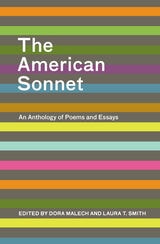
The American Sonnet
An Anthology of Poems and EssaysDora Malech
University of Iowa Press, 2023
Contributor List: Essayists
Abdul Ali, Baltimore, MD
Anna Lena Phillips Bell, University of North Carolina, Wilmington
Jodie Childers, Queens, New York
Benjamin Crawford, University of Alabama
Meg Day, Franklin and Marshall College
Donna Denizé, St. Albans School
Michael Dumanis, Bennington College
Jordan Finkin, Hebrew Union College
Rebecca Morgan Frank, Northwestern University
Anna Maria Hong, Mount Holyoke College
Gillian Huang-Tiller, University of Virginia, Wise
Walt Hunter, Clemson University
John James, University of California, Berkeley
Matthew Kilbane, University of Notre Dame
Diana Leca, University of Oxford
Ariel Martino, Colgate University
Nate Mickelson, New York University
Lisa L. Moore, University of Texas at Austin
Timo Müller, University of Konstanz, Germany
Carl Phillips, Washington University in St. Louis
Zoë Pollak, Columbia University
Jonathan F.S. Post, UCLA
Stephen Regan, Durham University, UK
Jahan Ramazani, University of Virginia
Hollis Robbins, University of Utah
Nathan Spoon, Joelton, TN
Marlo Starr, Wittenberg University
Yuki Tanaka, Hosei University, Japan
Tess Taylor, Ashland University
Michael Theune, Illinois Wesleyan University
Eleanor Wakefield, University of Oregon
Lesley Wheeler, Washington and Lee University
Jon Woodson, Howard University emeritus
Contributors List: Poets
Elizabeth Alexander, Agha Shahid Ali, Julia Alvarez, Maggie Anderson, Tacey Atsitty, Charles Bernstein, Ted Berrigan, Jen Bervin, Elizabeth Bishop, Louise Bogan, Ruth Muskrat Bronson, Gwendolyn Brooks, Jericho Brown, Lucille Clifton, Henri Cole, Wanda Coleman, Countee Cullen, William Cullen Bryant, E.E. Cummings, Meg Day, Natalie Diaz, Paul Laurence Dunbar, Alice Moore Dunbar-Nelson, Ralph Waldo Emerson, Rhina Espaillat, Tarfia Faizullah, Robert Frost, torrin a. greathouse, Marilyn Hacker, Robert Hayden, Terrance Hayes, Anthony Hecht, Lynn Hejinian, Leslie Pinckney Hill, Anna Maria Hong, Langston Hughes, David Humphreys, Helen Hunt Jackson, Tyehimba Jess, Helene Johnson, James Weldon Johnson, June Jordan, Douglas Kearney, Richard Kenney, Joan Larkin, Emma Lazarus, Mani Levb, Amy Lowell, Robert Lowell, Nate Marshall, Bernadette Mayer, George Marion McClellan, Brandy Nalani McDougall, Claude McKay, Joyelle McSweeney, Lo Kwa Mei-en, James Merrill, Phillip Metres, Edna St. Vincent Millay, Simone Muench, Marilyn Nelson, Craig Santos Perez, Carl Phillips, Sylvia Plath, Alexander Posey, Lizette Woodworth Reese, Adrienne Rich, Lola Ridge, Muriel Rukeyeser, Kay Ryan, Diane Seuss, Fradel Shtok, Aaron Shurin, giovanni singleton, Patricia Smith, Mary Ellen Solt, Nathan Spoon, Gertrude Stein, Adrienne Su, Lorenzo Thomas, Dunstan Thompson, Natasha Tretheway, Fredrick Goddard Tuckerman, Mona Van Duyn, Ellen Bryant Voight, Margaret Walker, Lucian B. Watkins, Phillis Wheatley, John Wheelwright, Jackie K. White, Walt Whitman, James Wright, Elinor Wylie
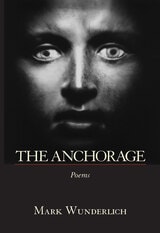
The Anchorage
PoemsMark Wunderlich
University of Massachusetts Press, 1999
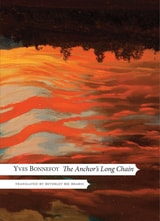
The Anchor’s Long Chain
Yves Bonnefoy
Seagull Books, 2015
Yves Bonnefoy has wowed the literary world for decades with his diffuse volumes. First published in France in 2008, The Anchor’s Long Chain is an indispensable addition to his oeuvre. Enriching Bonnefoy’s earlier work, the volume, translated by Beverley Bie Brahic, also innovates, including an unprecedented sequence of nineteen sonnets. These sonnets combine the strictness of the form with the freedom to vary line length and create evocative fragments. Compressed, emotionally powerful, and allusive, the poems are also autobiographical—but only in glimpses. Throughout, Bonnefoy conjures up life’s eternal questions with each new poem.
Longer, discursive pieces, including the title poem’s meditation on a prehistoric stone circle and a legend about a ship, are also part of this volume, as are a number of poetic prose pieces in which Bonnefoy, like several of his great French predecessors, excels. Long-time fans will find much to praise here, while newer readers will quickly find themselves under the spell of Bonnefoy’s powerful, discursive poetry.

The Andrew Wyeth Chronicles
Janée Baugher
Tupelo Press, 2026
The Andrew Wyeth Chronicles presents an imaginative narrative of the painter’s creative life, rife with both losses and pleasures. Janée J. Baugher employs the footnote form to write a book-length narrative of ekphrastic poetry in which the character of Andrew Wyeth chronicles his internal musings. The sixty-three Wyeth paintings that influenced these poems (dated 1938 through 2008) are the ones in which Baugher delighted in how the quotidian is made tender, like a white sheet drying outside on the line or sunflowers’ shadows against a house.
Studying the work of this particular artist was a decades-long meditative practice of deep looking, a method by which the author detaches from her ego. Wyeth’s paintings, drawings, and watercolors became portals through which she could imagine worlds beyond her immediate awareness and in which she could explore linguistic possibilities.
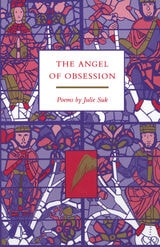
The Angel of Obsession
Julie Suk
University of Arkansas Press, 1992
Winner of the 1991 Arkansas Poetry Award, 1992 Roanoke-Chowan Poetry Award, and 1993 Bess Hokin Prize
Others may lament the uncertainties and disappointments of life, but Julie Suk, winner of the second annual Arkansas Poetry Award, embraces its tumult. Turning from the unsullied angels and the paradises captured by generations of artists, these poems focus instead on those who have abandoned heaven for the world of such mundane matters as family, loneliness, love, and loss. Rousing us to the passion and wonder that define our essential humanity, The Angel of Obsession celebrates the full, ragged canvas of living.
Suk’s poetry has previously appeared in The Georgia Review, The Midwest Quarterly, Southern Humanities Review, Poetry, and other important literary magazines. The Angel of Obsession was selected for publication from a field of more than five hundred entries by the poet John Stone.
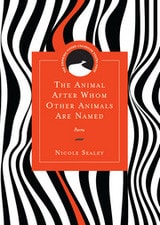
The Animal After Whom Other Animals Are Named
PoemsNicole Sealey
Northwestern University Press, 2016
The Poetry and Poetics Colloquium, in conjunction with Northwestern University Press, is delighted to announce that Nicole Sealey is the winner of the fourth annual Drinking Gourd Chapbook Poetry Prize. The Animal After Whom Other Animals Are Named will be published by Northwestern University Press with a planned launch party at the Poetry Foundation in Chicago in January 2016.
At turns humorous and heartbreaking, The Animal After Whom Other Animals Are Named explores in both formal and free verse what it means to die, which is to say, also, what it means to live. In this collection, Sealey displays an exquisite sense of the lyric, as well as an acute political awareness. Never heavy-handed or dogmatic, the poems included in this slim volume excavate the shadows of both personal and collective memory and are, at all points, relentless. To quote the poet herself, here is a debut as luminous and unforgiving "as the unsparing light at tunnel’s end."
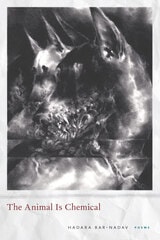
The Animal Is Chemical
Hadara Bar-Nadav
Four Way Books, 2024
Lyrically enacting the cognitive dissonance and embodied contradictions of our contemporary age, Hadara Bar-Nadav’s The Animal Is Chemical collects innovative poems that straddle the frontiers of language and scientific knowledge. She brilliantly draws on her own experience as a medical editor and her family’s history of Holocaust survival to write into the hybrid legacy of Western medicine: part clinical empiricism, part human fallibility and moral bankruptcy. Displaying a robust formal range, these poems move from feverish elegies to drug-pamphlet erasures, tangible articulations of Bar-Nadav’s epigenetic, cultural, and memorial inheritance as a writer navigating chronic illness and pain. In these pages, Nazi medical experiments, pharmaceutical literature, and manifestations of intergenerational trauma collide in the lyrical archive of Bar-Nadav’s latest collection, winner of the 2022 Four Way Books Levis Prize in Poetry. Just as she illuminates the paradox of time — that we may think of the past as something gone and yet always present in context and legacy — Bar-Nadav proves the enduring ambivalence of pharmakon, that antidote which poisons us, the medicine that kills. This febrile, fierce book casts spells and confronts illusions, ignites grief and awe, and challenges our assumptions about what it means to heal our bodies, our families, and our shared histories. Perhaps this work fulfills the specious salvation it describes in its opening pages, performing an exorcism of truth-telling that harnesses the heat of a “myth in which a god sets us / on fire and then sets us free.”
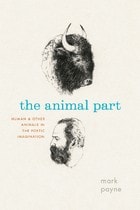
The Animal Part
Human and Other Animals in the Poetic ImaginationMark Payne
University of Chicago Press, 2010
How can literary imagination help us engage with the lives of other animals? The question represents one of the liveliest areas of inquiry in the humanities, and Mark Payne seeks to answer it by exploring the relationship between human beings and other animals in writings from antiquity to the present. Ranging from ancient Greek poets to modernists like Ezra Pound and William Carlos Williams, Payne considers how writers have used verse to communicate the experience of animal suffering, created analogies between human and animal societies, and imagined the kind of knowledge that would be possible if human beings could see themselves as animals see them.
The Animal Part also makes substantial contributions to the emerging discourse of the posthumanities. Payne offers detailed accounts of the tenuousness of the idea of the human in ancient literature and philosophy and then goes on to argue that close reading must remain a central practice of literary study if posthumanism is to articulate its own prehistory. For it is only through fine-grained literary interpretation that we can recover the poetic thinking about animals that has always existed alongside philosophical constructions of the human. In sum, The Animal Part marks a breakthrough in animal studies and offers a significant contribution to comparative poetics.
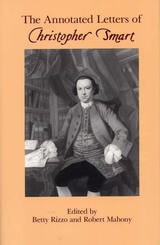
The Annotated Letters of Christopher Smart
Edited by Betty Rizzo and Robert Mahony
Southern Illinois University Press, 1991
The only collection of all known letters of Christopher Smart provides the best psychological explanation to date of that complex and elusive eighteenth-century poet.
The significant characteristics that distinguish Smart’s prose letters from his poetry, Betty Rizzo and Robert Mahony note, are that his letters were requests for assistance while his verses were bequests, gifts in which he set great store. Indeed, it was Smart’s lifelong conviction that he was a poet of major importance.
As Smart biographer Karina Williamson notes, "The splendidly informative and vivaciously written accounts of the circumstances surrounding each letter, or group of letters, add up to what is in effect a miniature biography."
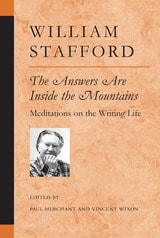
The Answers Are Inside the Mountains
Meditations on the Writing LifeWilliam Stafford, Edited by Paul Merchant & Vincent Wixon
University of Michigan Press, 2003
In this fourth collection of reflections on writing and the writing life, the late William Stafford's lifelong refusal to separate his work from the task of living responsibly -- "What a person is shows up in what a person does" -- rings clear.
The Answers Are Inside the Mountains collects unpublished interviews, poems, articles, aphorisms, and writing exercises from this great American man of letters and hugely prolific author, who kept a journal for nearly half a century and produced over 20,000 poems -- a staggering output by any standard.
The book begins with the words "To overwhelm by rightness," a phrase evoking the two demands Stafford made on himself: to write daily, and to live uprightly. The Answers Are Inside the Mountains lives up to those deceptively simple ethics, and confirms William Stafford's enduringly important voice for our uncertain age.
William Stafford (1914-93) authored more than thirty-five books of poetry and prose, including the highly acclaimed Writing the Australian Crawl, You Must Revise Your Life, Crossing Unmarked Snow: Further Views on the Writer's Vocation, and Traveling Through the Dark, winner of the National Book Award for Poetry.
The Apollonia Poems
Judith Vollmer
University of Wisconsin Press, 2017
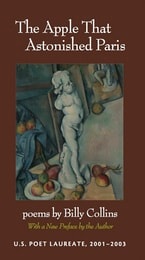
The Apple That Astonished Paris
PoemsBilly Collins
University of Arkansas Press, 2006
Bruce Weber in the New York Times called Billy Collins “the most popular poet in America.” He is the author of many books of poetry, including, most recently, The Rain in Portugal: Poems.
In 1988 the University of Arkansas Press published Billy Collins’s The Apple That Astonished Paris, his “first real book of poems,” as he describes it in a new, delightful preface written expressly for this new printing to help celebrate both the Press’s twenty-fifth anniversary and this book, one of the Press’s all-time best sellers. In his usual witty and dry style, Collins writes, “I gathered together what I considered my best poems and threw them in the mail.” After “what seemed like a very long time” Press director Miller Williams, a poet as well, returned the poems to him in the “familiar self-addressed, stamped envelope.” He told Collins that there was good work here but that there was work to be done before he’d have a real collection he and the Press could be proud of: “Williams’s words were more encouragement than I had ever gotten before and more than enough to inspire me to begin taking my writing more seriously than I had before.”
This collection includes some of Collins’s most anthologized poems, including “Introduction to Poetry,” “Another Reason Why I Don’t Keep a Gun in the House,” and “Advice to Writers.” Its success over the years is testament to Collins’s talent as one of our best poets, and as he writes in the preface, “this new edition . . . is a credit to the sustained vibrancy of the University of Arkansas Press and, I suspect, to the abiding spirit of its former director, my first editorial father.”
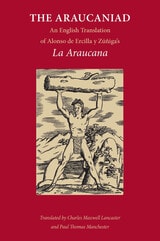
The Araucaniad
Alonso de Ercilla y Zuniga
Vanderbilt University Press, 1945
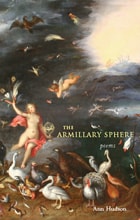
The Armillary Sphere
PoemsAnn Hudson
Ohio University Press, 2006
Taking the warp of dream, sometimes nightmare, and weaving it with the ordinary world, the poems of The Armillary Sphere, Ann Hudson’s award-winning debut collection, do not simplify the mystery but deepen it. Just as the interlocking rings of the armillary sphere of the title represent the great circles of the heavens, so do the poems herein demonstrate out of the beautiful, the extraordinary, and the cast off, a fresh scaffolding, a new way to see out from the center of our selves, a new measure of our relationship to the things of this world and the next.
Chosen from hundreds of manuscripts as this year’s winner of the Hollis Summers Poetry Prize, Ann Hudson’s The Armillary Sphere possesses, in the words of final judge Mary Kinzie,
“… a brightness of spirit and quickness of thought that are conveyed with extraordinary care as she frames moments of experience. Her style is unobtrusive—no fireworks of phrasing obscure the thing felt and seen. So simple a device as taking an intransitive verb transitively can shed strong light on the moment: “A fine sheen /of sweat glistens the cocktail glasses,”—and Hudson studies emotions with a brave restraint that resists cliché, while deftly joining together intuitions that bring contradictory or opposing charge.… Both circular and digressive, Hudson’s portrayal of beings of all ages poised on their varying thresholds brings a novelist’s sense of details unfolding into their future under the control of a fine poet’s pure and condensed language of likeness.”Insomnia
If you were awake too, I’d tell you
the whole story, how I dreamt
we never saw the child, how easily
we forgot. Instead I shuffle
to the porch to watch
traffic pass the house
and an occasional bat dive
under the streetlamps, ruthless
after its dark targets.

The Army of Truth
Selected PoemsHenrik Wergeland
University of Wisconsin Press, 2003
One of Norway’s most celebrated literary figures of the nineteenth century, Henrik Wergeland worked tirelessly for the civil rights of Jews in Norway. He used the words and structure of his poetry to enliven the ideals of truth, freedom, and equality. This translated volume, containing several of Wergeland’s most prominent poems, beautifully encapsulates the compelling force of his message, allowing its enduring influence to benefit a wider contemporary audience.
The Arrival
Daniel Simko
Four Way Books, 2009
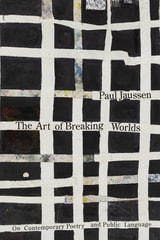
The Art of Breaking Worlds
On Contemporary Poetry and Public LanguagePaul Jaussen
Northwestern University Press, 2027
Showing how poetics provides a path for building new imagined possibilities
Drawing together a robust corpus of contemporary USAmerican poetry, The Art of Breaking Worlds explores social and political breaks: disasters, failures, and disruptions that simultaneously constitute and fracture the world. These breaks range from unsuccessful political movements and acts of resistance to mass incarceration and biopolitical violence, from anti-Black racism to the infrastructural catastrophes of climate collapse. Paul Jaussen shows how poetry responds to such disasters by incorporating public-facing genres and discourses into its literary practice, thereby rewriting into aesthetic form the public languages used to perpetuate or contain that rupture. This poetic integration of public language thus generates a third space, located between the rhetorical and the aesthetic, a literary practice of both world-breaking and world-making that transforms existing genres while also creating newly imagined modes of collectivity. Grounded in contemporary theory and close readings of works by poets such as Claudia Rankine, Juliana Spahr, and Ilya Kaminsky, this book proposes that these dynamics require a distinctive critical poetics, one simultaneously attuned to discourses of struggle and discourses of art, modeling a fresh approach to the relationship between politics and literature.
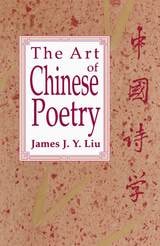
The Art of Chinese Poetry
James J. Y. Liu
University of Chicago Press, 1966
"[This] books should be read by all those interested in Chinese poetry."—Achilles Fang, Poetry
"[This is] a significant contribution to the understanding and appreciation of Chinese poetry, lucidly presented in a way that will attract a wide audience, and offering an original synthesis of Chinese and Western views that will stimulate and inspire students of poetry everywhere."—Hans H. Frankel, Harvard Journal of Asiatic Studies
"This is a book which can be recommended without reservation to anyone who wants to explore the world of Chinese poetry in translation."—James R. Hightower, Journal of Asian Studies
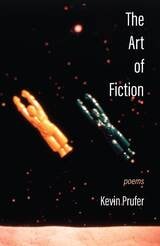
The Art of Fiction
Kevin Prufer
Four Way Books, 2021
In this his eighth collection of poetry (and fifth with Four Way Books), Prufer’s career-spanning talent for estranging the familiar—and also for recording the unthinkable with eerie directness—recurs, enhanced and transformed by the collection’s meta-level attention to the role of fiction in our civic lives. Prufer describes, often through personae, a near future, tracing there the political gambit of Fake News and the role of the imagination in our self-understanding (whether it’s cogent or delusional). Via both satire and direct address (to the point of reader-squeamishness), Prufer aims to understand the ugly-casual atmosphere of our often racialized, pervasive distrust. The Art of Fiction fundamentally understands that fictions are deployed to divide us, and they work: they get under our skin. Prufer powerfully explores the roles of imagination and art in how we explain ourselves to ourselves.
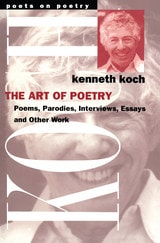
The Art of Poetry
Kenneth Koch
University of Michigan Press, 1996
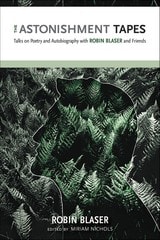
The Astonishment Tapes
Talks on Poetry and Autobiography with Robin Blaser and FriendsRobin Blaser
University of Alabama Press, 2015
Robin Blaser moved from his native Idaho to attend the University of California, Berkeley, in 1944. While there, he developed as a poet, explored his homosexuality, engaged in a lively arts community, and met fellow travelers and poets Robert Duncan and Jack Spicer. The three men became the founding members of the Berkeley core of what is now known as the San Francisco Renaissance in New American Poetry.
In the company of a small group of friends and writers in 1974, Blaser was asked to narrate his personal story and to comment on the Berkeley poetry scene. In twenty autobiographical audiotapes, Blaser talks about his childhood in Idaho, his time in Berkeley, and his participation in the making of a new kind of poetry. The Astonishment Tapes is the expertly edited transcript of these recordings by Miriam Nichols, Blaser’s editor and biographer.
In The Astonishment Tapes Blaser comments extensively on the poetic principles that he, Duncan, and Spicer worked through, as well as the differences and dissonances between the three of them. Nichols has edited the transcripts only minimally, allowing readers to make their own interpretations of Blaser’s intentions.
Sometimes gossipy, sometimes profound, Blaser offers his version on the inside story of one of the most significant moments in mid-twentieth century American poetry. The Astonishment Tapes is of considerable value and interest, not only to readers of Blaser, Duncan, and Spicer, but also to scholars of the early postmodern and twentieth-century American poetry.
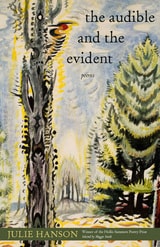
The Audible and the Evident
PoemsJulie Hanson
Ohio University Press, 2020
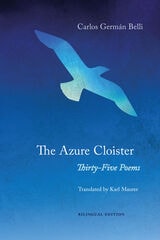
The Azure Cloister
Thirty-Five PoemsCarlos Germán Belli
Swan Isle Press, 2021
This selection of poems by internationally renowned Peruvian poet Carlos Germán Belli tempers a dark, ironic vision of worldly injustice with the “red midnight sun” of hope. Belli’s contemplative verses express faith in language, in bodily joy, and in artistic form. These thirty-five poems explore public and domestic spaces of confinement and freedom, from paralysis to the ease of a bird in its “azure cloister.”
Translations by Karl Maurer retain Belli’s original meter, follow his complex syntax, and meet the challenges of his poetic language, which ranges from colloquial Peruvian slang to the ironic use of seventeenth-century Spanish. This bilingual edition also includes notes and reflections on Belli and on the art of translation. Beyond introducing American readers to a major presence in world poetry, The Azure Cloister offers a fresh approach to the translation of contemporary verse in Spanish.
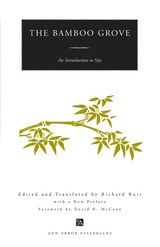
The Bamboo Grove
An Introduction to SijoRichard Rutt
University of Michigan Press, 1998
The popularity of the sijo in Korea--writers range from royalty to common citizens--is always a challenge for the translator, who must often inhabit widely differing backgrounds to completely understand a poem's subtle nuances. Richard Rutt's translations, considered to be some of the best available in English, remain true to the unique structure of the original Korean lyric.
The Bamboo Grove will interest not only poets and students of poetry, but scholars of Korean culture curious to view history through this important and significant form of verse.
The white snow has left the valleys where the clouds are lowering,
Is it true that somewhere the plum trees have happily blossomed?
I stand here alone in the dusk and do not know where to go.
YI SAEK (1328-1396)
Richard Rutt is also the editor and translator of the book Virtuous Women: Three Classic Korean Novels and, most recently, The Zhou Yi: A New Translation with Commentary of the Book of Changes. David R. McCann is Korea Foundation Professor of Korean Literature and Professor of East Asian Languages and Civilizations, Harvard University.
The Basque Poetic Tradition
Gorka Aulestia
University of Nevada Press, 2000
The Battlefield Where the Moon Says I Love You
Frank Stanford
University of Arkansas Press, 2026
Frank Stanford’s The Battlefield Where the Moon Says I Love You is a truly original Southern epic with immense cultural and creative range. Revered by a devoted cult following since it was first published posthumously in 1978, the poem unfolds over more than fifteen thousand lines without stanza breaks or punctuation, creating an unstoppable linguistic flow that mirrors the chaos and beauty it depicts. In this third edition, meticulously edited by James McWilliams and A. P. Walton, Stanford’s sprawling vision is revived not as a lost relic but as a towering work fiercely alive in its ethical and aesthetic extremes.
Beginning with poetry composed in his teens, Stanford worked feverishly in his early twenties to transform and expand fragments into this colossal, labyrinthine poem that captures the terrains of Tennessee, Mississippi, and Arkansas circa 1960. A few years later, he helped prepare the poem for its initial publication before ending his brief life at twenty-nine. The Battlefield blends vernacular speech and dream logic, creating a mythic landscape inhabited by Francis, the epic’s twelve-year-old hero—orphan, seer, street hustler—who navigates racial injustice, cinematic visions, and historical collisions with unflinching poetic force, wandering through myth and memory and armed with a bard’s ear and a trickster’s tongue.
A one-of-a-kind outlaw epic, The Battlefield has hidden in the literary shadows for half a century as a mystical artifact. Now, in this first scholarly edition, Stanford’s visionary masterpiece returns, fortified by the editorial precision and contextual care it deserves.

The Beautiful Agonies
Adrie Kusserow
Duke University Press, 2027
The Beautiful Immunity
Karen An-hwei Lee
Tupelo Press, 2024
The Beautiful Immunity asks how we create good in an imperfect world of fallible souls. Spare and formally daring, these poems were refined through the catastrophes of wildfires, recession, and a major public health crisis through the hope of a beautiful immunity—an everlasting salve for the lost. This slender volume reads as the culmination of more than a decade’s worth of labor, documenting large-scale social, cultural, and political upheavals, as well as the moment when the word “anthropause” floated indelibly into the world’s vocabulary.

The Best of Rilke
72 Form-True Verse Translations with Facing Originals, Commentary, and Compact BiographyRainer Maria Rilke
Dartmouth College Press, 1991
The Big Question
David Lehman
University of Michigan Press, 1995
The Big Question leads off with a major essay explaining and exploring the concept of postmodernism. The next sections include pieces about poetry and fiction, lives and letters, and criticism and controversy.
Other "big questions" addressed include political correctness, the genre of literary biography, academic life and deconstruction. There is a humorous piece on poetry "slams" and the whole "downtown" poetry scene, a feisty op-ed column (on the deconstruction of the Gettysburg Address), a pair of wickedly satirical poems, as well as a group of exceptional book reviews.
The subjects covered range from Philip Larkin to Philip Roth- from the greatest poetry hoax of the twentieth century (which took place in Australia during World War II) to Charles Dickens's unfinished last novel- and from nineteenthth-century American poetry to the political career of Martin Heidegger.
David Lehman is a poet and author of Signs of the Times: Deconstruction and the Fall of Paul de Man. He is series editor of the celebrated Best American Poetry anthology.
The Bilingual Muse
Self-Translation among Russian PoetsAdrian Wanner
Northwestern University Press, 2020
The Bilingual Muse analyzes the work of seven Russian poets who translated their own poems into English, French, German, or Italian. Investigating the parallel versions of self-translated poetic texts by Vladimir Nabokov, Joseph Brodsky, Andrey Gritsman, Katia Kapovich, Marina Tsvetaeva, Wassily Kandinsky, and Elizaveta Kul’man, Adrian Wanner considers how verbal creativity functions in different languages, the conundrum of translation, and the vagaries of bilingual identities.
Wanner argues that the perceived marginality of self-translation stems from a romantic privileging of the mother tongue and the original text. The unprecedented recent dispersion of Russian speakers over three continents has led to the emergence of a new generation of diasporic Russians who provide a more receptive milieu for multilingual creativity.
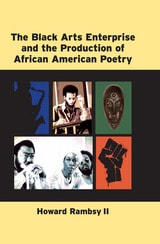
The Black Arts Enterprise and the Production of African American Poetry
Howard Rambsy II
University of Michigan Press, 2013
The outpouring of creative expression known as the Black Arts Movement of the 1960s and 1970s spawned a burgeoning number of black-owned cultural outlets, including publishing houses, performance spaces, and galleries. Central to the movement were its poets, who in concert with editors, visual artists, critics, and fellow writers published a wide range of black verse and advanced new theories and critical approaches for understanding African American literary art.
The Black Arts Enterprise and the Production of African American Poetry offers a close examination of the literary culture in which BAM's poets (including Amiri Baraka, Nikki Giovanni, Sonia Sanchez, Larry Neal, Haki Madhubuti, Carolyn Rodgers, and others) operated and of the small presses and literary anthologies that first published the movement's authors. The book also describes the role of the Black Arts Movement in reintroducing readers to poets such as Langston Hughes, Robert Hayden, Margaret Walker, and Phillis Wheatley.
Focusing on the material production of Black Arts poetry, the book combines genetic criticism with cultural history to shed new light on the period, its publishing culture, and the writing and editing practices of its participants. Howard Rambsy II demonstrates how significant circulation and format of black poetic texts—not simply their content—were to the formation of an artistic movement. The book goes on to examine other significant influences on the formation of Black Arts discourse, including such factors as an emerging nationalist ideology and figures such as John Coltrane and Malcolm X.
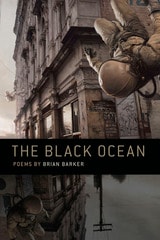
The Black Ocean
Brian Barker
Southern Illinois University Press, 2011
In The Black Ocean, poet Brian Barker attempts to make sense of some of the darkest chapters in history while peering forward to what lies ahead as the world totters in the wake of human complacence. Unveiled here are ruminations on human torture, the Chernobyl disaster, the aftermath of Hurricane Katrina, and genocide against Native Americans. The ghosts of Lincoln, Poe, and Billie Holiday manifest from pages laden with grim prophecies and catastrophes both real and imagined. These hauntingly intense documentary poems reflect on the past in an attempt to approach it with more clarity and understanding, while offering blistering insight into the state of the world today. Barker touches upon the power of manipulation and class oppression; the depths of fear and the struggle for social justice; and reveals how failure to act—on the parts of both politicians and everyday citizens—can have the most devastating effects of all.
Throughout the volume looms the specter of the black ocean itself, a powerful metaphor for all our collective longings and despair, as we turn to face a menacing and uncertain future.
Lullaby for the Last Night on Earth
When at last we whisper, so long, so lonesome,
and watch our house on the horizon
go down like a gasping zeppelin of bricks,
we’ll turn, holding hands,
and walk the train tracks to the sea . . .
So sing me that song where a mountain falls
in love with an octopus, and one thousand fireflies
ricochet around their heads,
and I’ll dream we’re dancing in the kitchen one last time,
swaying, the window a waystation
of flaming leaves, the dogs shimmying
about our legs,
dragging their golden capes of rain . . .
O my critter, my thistle, gal-o-my-dreams,
lift your voice like an oar into the darkness,
for all the sad birds are falling down—
Nothing in this night is ours.
The Black Outside
Joy Priest
Duke University Press, 2027
The Blue Clerk
Ars Poetica in 59 VersosDionne Brand
Duke University Press, 2018