Results by title
22279 books match the query 'Social Science' and 4007 start with t
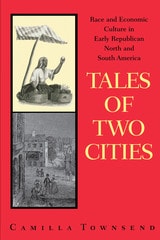
Tales of Two Cities
Race and Economic Culture in Early Republican North and South AmericaBy Camilla Townsend
University of Texas Press, 2000
With a common heritage as former colonies of Europe, why did the United States so outstrip Latin America in terms of economic development in the nineteenth century? In this innovative study, Camilla Townsend challenges the traditional view that North Americans succeeded because of better attitudes toward work—the Protestant work ethic—and argues instead that they prospered because of differences in attitudes towards workers that evolved in the colonial era.
Townsend builds her study around workers' lives in two very similar port cities in the 1820s and 1830s. Through the eyes of the young Frederick Douglass in Baltimore, Maryland, and an Indian woman named Ana Yagual in Guayaquil, Ecuador, she shows how differing attitudes towards race and class in North and South America affected local ways of doing business. This empirical research significantly clarifies the relationship between economic culture and racial identity and its long-term effects.

Tales of Wayward Girls and Immoral Women
Case Records and the Professionalization of Social WorkKaren W. Tice
University of Illinois Press, 1998
"An original and important study, this is the first major work I know of to carry out a contextual analysis of case records and to discuss the role case records have played in the development of social work." -- Leslie Leighninger, author of Social Work, Social Welfare, and American Society

Tales of the Field
On Writing EthnographyJohn Van Maanen
University of Chicago Press, 1988
For more than twenty years, John Van Maanen’s Tales of the Field has been a definitive reference and guide for students, scholars, and practitioners of ethnography and beyond. Originally published in 1988, it was the one of the first works to detail and critically analyze the various styles and narrative conventions associated with written representations of culture. This is a book about the deskwork of fieldwork and the various ways culture is put forth in print. The core of the work is an extended discussion and illustration of three forms or genres of cultural representation—realist tales, confessional tales, and impressionist tales. The novel issues raised in Tales concern authorial voice, style, truth, objectivity, and point-of-view. Over the years, the work has both reflected and shaped changes in the field of ethnography.
In this second edition, Van Maanen’s substantial new Epilogue charts and illuminates changes in the field since the book’s first publication. Refreshingly humorous and accessible, Tales of the Field remains an invaluable introduction to novices learning the trade of fieldwork and a cornerstone of reference for veteran ethnographers.
Tales of the Field
On Writing Ethnography, Second EditionJohn Van Maanen
University of Chicago Press, 2011
For more than twenty years, John Van Maanen’s Tales of the Field has been a definitive reference and guide for students, scholars, and practitioners of ethnography and beyond. Originally published in 1988, it was the one of the first works to detail and critically analyze the various styles and narrative conventions associated with written representations of culture. This is a book about the deskwork of fieldwork and the various ways culture is put forth in print. The core of the work is an extended discussion and illustration of three forms or genres of cultural representation—realist tales, confessional tales, and impressionist tales. The novel issues raised in Tales concern authorial voice, style, truth, objectivity, and point-of-view. Over the years, the work has both reflected and shaped changes in the field of ethnography.
In this second edition, Van Maanen’s substantial new Epilogue charts and illuminates changes in the field since the book’s first publication. Refreshingly humorous and accessible, Tales of the Field remains an invaluable introduction to novices learning the trade of fieldwork and a cornerstone of reference for veteran ethnographers.
Tales of the Metric System
A NovelImraan Coovadia
Ohio University Press, 2016

Talk about Sex
How Sex Ed Battles Helped Ignite the RightJanice M. Irvine
Temple University Press, 2023
“Must reading for scholars, sexuality researchers, activists, and public policy and public health planners engaged in efforts to promote education on sex, sexually transmitted diseases, and HIV infection prevention for adolescents in schools.”—JAMA
Talk about Sex is a rich social history about the political transformations, cultural dynamics, and emotional rhetorical strategies that helped the right wing manufacture controversies on the local and national levels in the United States. Although the emergence of a politicized Christian Right is commonly dated at the mid-seventies, with the founding of groups like the Moral Majority, Talk about Sex tells the story of a powerful right-wing Christian presence in politics a full decade earlier. These activists used inflammatory sexual rhetoric—oftentimes deceptive and provocative—to capture the terms of public debate, galvanize voters, and reshape the culture according to their own vision.
This 20th Anniversary Edition includes a new preface and epilogue by the author that examines current controversies over public education on sexuality, gender, and race.
Demonstrating how the right wing draws on the cultural power of sexual shame and fear to build a political movement, Talk about Sex explores the complex entanglements of sexual knowledge, politics, and discourses.

Talk of Love
How Culture MattersAnn Swidler
University of Chicago Press, 2001
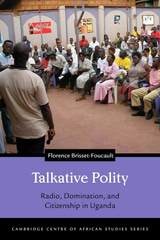
Talkative Polity
Radio, Domination, and Citizenship in UgandaFlorence Brisset-Foucault
Ohio University Press, 2019
For the first decade of the twenty-first century, every weekend, people throughout Uganda converged to participate in ebimeeza, open debates that invited common citizens to share their political and social views. These debates, also called “People’s Parliaments,” were broadcast live on private radio stations until the government banned them in 2009. In Talkative Polity, Florence Brisset-Foucault offers the first major study of ebimeeza, which complicate our understandings of political speech in restrictive contexts and force us to move away from the simplistic binary of an authoritarian state and a liberal civil society.
Brisset-Foucault conducted fieldwork from 2005 to 2013, primarily in Kampala, interviewing some 150 orators, spectators, politicians, state officials, journalists, and NGO staff. The resulting ethnography invigorates the study of political domination and documents a short-lived but highly original sphere of political expression. Brisset-Foucault thus does justice to the richness and depth of Uganda’s complex political and radio culture as well as to the story of ambitious young people who didn’t want to behave the way the state expected them to. Positioned at the intersection of media studies and political science, Talkative Polity will help us all rethink the way in which public life works.
Talkin' Up to the White Woman
Indigenous Women and FeminismAileen Moreton-Robinson
University of Minnesota Press, 2021
A twentieth-anniversary edition of this tour de force in feminism and Indigenous studies, now with a new preface
The twentieth anniversary of the original publication of this influential and prescient work is commemorated with a new edition of Talkin’ Up to the White Woman by Aileen Moreton-Robinson. In this bold book, of its time and ahead of its time, whiteness is made visible in power relations, presenting a dialogic of how white feminists represent Indigenous women in discourse and how Indigenous women self-present.
Moreton-Robinson argues that white feminists benefit from colonization: they are overwhelmingly represented and disproportionately predominant, play the key roles, and constitute the norm, the ordinary, and the standard of womanhood. They do not self-present as white but rather represent themselves as variously classed, sexualized, aged, and abled. The disjuncture between representation and self-presentation of Indigenous women and white feminists illuminates different epistemologies and an incommensurability in the social construction of gender.
Not so much a study of white womanhood, Talkin’ Up to the White Woman instead reveals an invisible racialized subject position represented and deployed in power relations with Indigenous women. The subject position occupied by middle-class white women is embedded in material and discursive conditions that shape the nature of power relations between white feminists and Indigenous women—and the unjust structural relationship between white society and Indigenous society.

Talkin' With Your Mouth Full
Conversations with the Videos of Steve FaginSteve Fagin, ed.
Duke University Press, 1998
Combining elements of criticism with various modes of artistic expression, these responses take the form of reviews, letters, interviews, and in one case an imaginary TV programming schedule. Interspersed with—and sometimes literally interrupting—the video scripts, these contributions interact with one another on multiple levels and complement Fagin’s scripts. Historical, political, and theoretical issues dovetail, ricochet, and interplay in this book, revealing a multiplicity of voices, concerns, and cultural revelations.
Unique in its structure and intellectual approach, Talkin’ with Your Mouth Full will appeal equally to those who have seen Fagin’s videos and those who have not. Students of art history and cultural critique, and anyone interested in the ongoing dialogue between artists and theorists, will find particular value in this book.
Contributors. Gregg Bordowitz, Constance DeJong, Leslie Dick, Steve Fagin, Barry Gifford, Victoria Gill, Bill Horrigan, Bertha Jottar, Ivone Margulies, Patricia Mellencamp, Margaret Morse, Constance Penley, Vicente L. Rafael, Mark Rappaport, Andrew Ross, Vivian Sobchack, Trinh T. Minh-ha, John Welchman, Peter Wollen
Talking #browntv
Latinas and Latinos on the ScreenFrederick Luis Aldama and William Anthony Nericcio
The Ohio State University Press, 2019
From the subversive critiques embedded in well-loved children’s characters like Speedy Gonzalez to the perpetuation of racial stereotypes in modern-era pornography, from Eva Longoria as ethnic mannequin to J-Lo flipping the sexy Latina music video on its head in “I Luh Ya Papi,” and with more than 150 full-color images, Aldama and Nericcio seek to expose the underlying causes as to why Latina/os constitute only 2 percent of mainstream cultural production when they’re the majority minority in the US. In a moment when anti-Mexican and anti-immigrant rhetoric oozes from TV sets and medias platform, Talking #browntv emerges as a bold antidote, an eloquent rejoinder, and a thoughtful meditation on Latina/os on the American screen and in America today.
Talking Art
The Culture of Practice and the Practice of Culture in MFA EducationGary Alan Fine
University of Chicago Press, 2018
Talking Back to the West
How Turkey Uses Counter-Hegemony to Reshape the Global Communication OrderBilge Yesil
University of Illinois Press, 2024
Insightfully exploring the crossroads of communications and authoritarianism, Talking Back to the West illuminates how the Erdogan government and its media allies use history, religion, and identity to pursue complementary agendas and tighten the AKP’s grip on power.
Talking Back
Images of Jewish Women in American Popular CultureEdited by Joyce Antler
Brandeis University Press, 1998
Talking Indian
Identity and Language Revitalization in the Chickasaw RenaissanceJenny L. Davis
University of Arizona Press, 2018
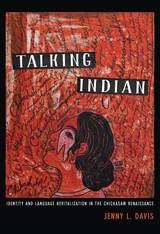
In south-central Oklahoma and much of “Indian Country,” using an Indigenous language is colloquially referred to as “talking Indian.” Among older Chickasaw community members, the phrase is used more often than the name of the specific language, Chikashshanompa’ or Chickasaw. As author Jenny L. Davis explains, this colloquialism reflects the strong connections between languages and both individual and communal identities when talking as an Indian is intimately tied up with the heritage language(s) of the community, even as the number of speakers declines.
Today a tribe of more than sixty thousand members, the Chickasaw Nation was one of the Native nations removed from their homelands to Oklahoma between 1837 and 1838. According to Davis, the Chickasaw’s dispersion from their lands contributed to their disconnection from their language over time: by 2010 the number of Chickasaw speakers had radically declined to fewer than seventy-five speakers.
In Talking Indian, Davis—a member of the Chickasaw Nation—offers the first book-length ethnography of language revitalization in a U.S. tribe removed from its homelands. She shows how in the case of the Chickasaw Nation, language programs are intertwined with economic growth that dramatically reshape the social realities within the tribe. She explains how this economic expansion allows the tribe to fund various language-learning forums, with the additional benefit of creating well-paid and socially significant roles for Chickasaw speakers. Davis also illustrates how language revitalization efforts are impacted by the growing trend of tribal citizens relocating back to the Nation.
Talking Leadership
Conversations with Powerful WomenHartman, Mary
Rutgers University Press, 1999
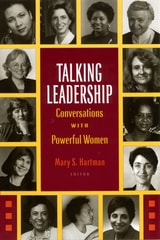
Talking Leadership presents a though-provoking look at differences and commonalities in the lives and leadership approaches of some of today's outstanding women in areas ranging from philanthropy to politics, and from business to academia. Regardless of their backgrounds and areas of expertise, these women are committed to social change--change that includes improving women's lives and options.
Well beyond personal details and entertaining anecdotes, these conversations capture a variety of fascinating experiences and insights reflecting what it is like to be a woman and a major leader in America at the close of the twentieth century. Many of these women hold positions in which womanhood sets them apart--not infrequently in uncomfortable ways. Talking Leadership gives testimony not only to how far women have come, but also how far they still have to go to claim their places as leaders.
Talking Leadership
Conversations with Powerful WomenHartman, Mary
Rutgers University Press, 1999
Whether we love it, hate it, or use it just to pass the time, most adults in the United States are watching more television than ever, up to four hours a day by some estimates. Our devotion to commercial television gives it unprecedented power in our lives.
Advertisers and television executives want us to spend as much time as we can in front of our sets, for it is access to our brains that they buy and sell. Yet the most important effect of television may be one that no one intends-accelerated destruction of the natural environment.
Consuming Environments explores how, with its portrayal of a world of simulated abundance, television has nurtured a culture of consumerism and overconsumption. The average person in the US consumers more than twice the grain and ten times the oil of a citizen of Brazil or Indonesia. And people in less industrialized countries suffer while their resources while their resources are commandeered to support comfortable lifestyles in richer nations.
Using detailed examples illustrated with images from actual commercials, news broadcasts, and television shows, and authors demonstrate how ads and programs are put together in complex way s to manipulate viewers, and they offer specific ways to counteract the effects of TV and overconsumption's assault on the environment.
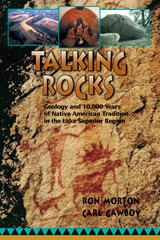
Talking Rocks
Geology and 10,000 Years of Native American Tradition in the Lake Superior RegionRon Morton
University of Minnesota Press, 2003
Join the conversation as an earth scientist and a Native American elder—wise men from two cultures—explore the natural history of the Lake Superior region, examining both the science and the spirit of the land.
As the geologist carefully presents a modern scientific perspective, the storyteller eloquently recounts a traditional Native American understanding, passed on through tales, myths, and symbols that illustrate how intimately his people have known and honored the earth and its history for over a hundred centuries.
Talking Rocks is not only a story of geological history told from two perspectives, it is also a chronicle of two people from very different cultural and scientific heritages learning to understand and appreciate each other’s distinct yet complementary ways of viewing the land we share.
Talking Stone
Rock Art of the CososPaul Goldsmith
University of Utah Press, 2017
Hidden away in the canyons of a highly restricted military base on the edge of the Mojave Desert is the largest concentration of rock art in North America, possibly in the world. Images of animals, shamans, and puzzling abstract forms were pecked and painted on stone over thousands of years by a now long-gone culture. Talking Stone: Rock Art of the Cosos is a multivocal investigation of this art.
Acclaimed cinematographer Paul Goldsmith takes the reader on a visual journey through this limited access area with more than 160 stunning color photographs. The book is structured around Goldsmith’s treks into the remote desert canyons and his meetings with archaeologists, Native Americans, a psychologist, an artist, bow hunters, and the commanding officer in charge of the military base. The result is a visually striking book that gives the viewer a personal and visceral experience of this enigmatic art.
Includes 160 color photographs.
Talking Taino
Caribbean Natural History from a Native PerspectiveWilliam F. Keegan and Lisabeth A. Carlson
University of Alabama Press, 2008
Keegan and Carlson, combined, have spent over 45 years conducting archaeological research in the Caribbean, directing projects in Trinidad, Grenada, St. Lucia, Puerto Rico, the Dominican Republic, Haiti, Cuba, Jamaica, Grand Cayman, the Turks & Caicos Islands, and throughout the Bahamas. Walking hundreds of miles of beaches, working without shade in the Caribbean sun, diving in refreshing and pristine waters, and studying the people and natural environment around them has given them insights into the lifeways of the people who lived in the Caribbean before the arrival of Christopher Columbus. Sadly, harsh treatment extinguished the culture that we today call Taíno or Arawak.
In an effort to repay their debt to the past and the present, the authors have focused on the relationship between the Taínos of the past (revealed through archaeological investigations) and the present natural history of the islands. Bringing the past to life and highlighting commonalities between past and present, they emphasize Taíno words and beliefs about their worldview and culture.
Talking Together
Public Deliberation and Political Participation in AmericaLawrence R. Jacobs, Fay Lomax Cook, and Michael X. Delli Carpini
University of Chicago Press, 2009
Challenging the conventional wisdom that Americans are less engaged than ever in national life and the democratic process, Talking Together paints the most comprehensive portrait available of public deliberation in the United States and explains why it is important to America’s future.
The authors’ original and extensive research reveals how, when, and why citizens talk to each other about the issues of the day. They find that—in settings ranging from one-on-one conversations to e-mail exchanges to larger and more formal gatherings—a surprising two-thirds of Americans regularly participate in public discussions about such pressing issues as the Iraq War, economic development, and race relations. Pinpointing the real benefits of public discourse while considering arguments that question its importance, Talking Together presents an authoritative and clear-eyed assessment of deliberation’s function in American governance. In the process, it offers concrete recommendations for increasing the power of talk to foster political action.
Talking Union
Judith Stepan-Norris and Maurice Zeitlin
University of Illinois Press, 1996
and cultural oral history of the struggle to unionize the River Rouge
Plant near Detroit during the 1930s and 40s, this book affords us a rare
insight into the difficulties of organizing a union in the face of the
then anti-union Ford Motor Company. Against a backdrop of the depression
and entrenched racism, history was made by courageous individuals whose
rich, eloquent stories illuminate the character and views of others like
them across the nation, from all backgrounds: left, right, and center;
black and white; native and foreign born, Jew and gentile.
Talking about Race
Community Dialogues and the Politics of DifferenceKatherine Cramer Walsh
University of Chicago Press, 2007
It is a perennial question: how should Americans deal with racial and ethnic diversity? More than 400 communities across the country have attempted to answer it by organizing discussions among diverse volunteers in an attempt to improve race relations. In Talking about Race, Katherine Cramer Walsh takes an eye-opening look at this strategy to reveal the reasons behind the method and the effects it has in the cities and towns that undertake it.
With extensive observations of community dialogues, interviews with the discussants, and sophisticated analysis of national data, Walsh shows that while meeting organizers usually aim to establish common ground, participants tend to leave their discussions with a heightened awareness of differences in perspective and experience. Drawing readers into these intense conversations between ordinary Americans working to deal with diversity and figure out the meaning of citizenship in our society, she challenges many preconceptions about intergroup relations and organized public talk. Finally disputing the conventional wisdom that unity is the only way forward, Walsh prescribes a practical politics of difference that compels us to reassess the place of face-to-face discussion in civic life and the critical role of conflict in deliberative democracy.
Talking to the Dead
Religion, Music, and Lived Memory among Gullah/Geechee WomenLeRhonda S. Manigault-Bryant
Duke University Press, 2014
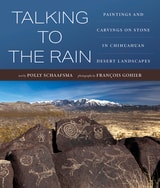
Talking to the Rain
Paintings and Carvings on Stone in Chihuahuan Desert LandscapesPolly Schaafsma, photographs by François Gohier
University of Utah Press, 2025
In this visually stunning volume, Polly Schaafsma, leading authority on pre-Hispanic Indian rock imagery and kiva murals of the greater American Southwest, provides an insightful journey into the petroglyphs and rock paintings of the Jornada Mogollon farmers in southern New Mexico's lower Chihuahuan Desert.
Talking to the Rain defines the Rio Grande Tradition, emphasizing the foundational Jornada Style as exemplified by its Mimbres-like imagery as well as its diverse and complex rain-making symbolism. By examining visual metaphors of cosmology and place-making, the book reveals an ancient dialogue between farmers and the cosmos that places rain for crops as its central concern. Exceptional color photographs by François Gohier invite readers to experience the landscapes and locations selected for creating these images. Both scholarly and accessible, Talking to the Rain offers a fresh perspective on cultural landscapes and the profound connections between people, art, and environment, making it essential for understanding Southwest cultural history.
Talking with the Children of God
Prophecy and Transformation in a Radical Religious GroupGordon Shepherd and Gary Shepherd
University of Illinois Press, 2010
Grounded in direct, systematic observation by neutral observers, Talking with the Children of God is a unique study of the radical religious movement now known as The Family International. The book draws on extraordinarily candid interviews with the group's leaders and administrative staff. In revealing new information about the organization's history, beliefs, and use of prophecy, Gordon Shepherd and Gary Shepherd offer a highly detailed case study that is both an antidote to sensationalized coverage of the group and a means for understanding the transformational practices of new religious movements in general.
One of the most controversial groups emerging from the Jesus People movement of the 1960s, the Family originally was known as The Children of God. Under leader David Berg, members proclaimed an apocalyptic "Endtime," shunned secular occupations, lived communally, and adopted unusual sexual practices that led to abuse scandals in the 1970s and 1980s. Following Berg's death in 1994, the organization began to dramatically alter its evangelization efforts and decision-making processes.
Talking with the Children of God builds a picture of a complex organization with ten thousand core members worldwide, including details on the lives, careers, and responsibilities of the second generation and their efforts to defend their faith. The authors summarize the Family's history and beliefs as well as its controversial past. In particular, they analyze the organization's use of prophecy--or channeled revelations from Jesus and other spiritual beings--for making decisions and setting policy, revealing how this essentially democratic process works and how it shapes Family life and culture.
These remarkable insights are the result of sixteen years of surveys and field observations conducted in Family member homes in sixteen countries, plus four days of face-to-face interviews with Family leaders and organizational staff. The volume also includes condensed transcripts of the interviews with analysis by Shepherd and Shepherd.
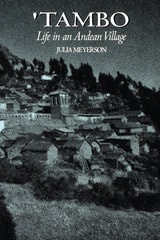
Tambo
Life in an Andean VillageBy Julia Meyerson
University of Texas Press, 1990
Perhaps the best way to sharpen one's power's of observation is to be a stranger in a strange land. Julia Meyerson was one such stranger during a year in the village of 'Tambo, Peru, where her husband was conducting anthropological fieldwork. Though sometimes overwhelmed by the differences between Quechua and North American culture, she still sought eagerly to understand the lifeways of 'Tambo and to find her place in the village. Her vivid observations, recorded in this field journal, admirably follow Henry James's advice: "Try to be one of the people upon whom nothing is lost."
With an artist's eye, Meyerson records the daily life of 'Tambo—the cycles of planting and harvest, the round of religious and cultural festivals, her tentative beginnings of friendship and understanding with the Tambinos. The journal charts her progress from tolerated outsider to accepted friend as she and her husband learn and earn, the roles of daughter and son in their adopted family.
With its wealth of ethnographic detail, especially concerning the lives of Andean women, 'Tambo will have great value for students of Latin American anthropology. In addition, scholars preparing to do fieldwork anywhere will find it a realistic account of both the hardships and the rewards of such study.
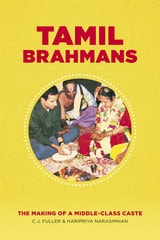
Tamil Brahmans
The Making of a Middle-Class CasteC. J. Fuller and Haripriya Narasimhan
University of Chicago Press, 2014
Fuller and Narasimhan offer one of the most comprehensive looks at Tamil Brahmans around the world to date. They examine Brahman migration from rural to urban areas, more recent transnational migration, and how the Brahman way of life has translated to both Indian cities and American suburbs. They look at modern education and the new employment opportunities afforded by engineering and IT. They examine how Sanskritic Hinduism and traditional music and dance have shaped Tamil Brahmans’ particular middle-class sensibilities and how middle-class status is related to the changing position of women. Above all, they explore the complex relationship between class and caste systems and the ways in which hierarchy has persisted in modernized India.
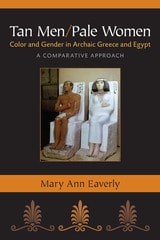
Tan Men/Pale Women
Color and Gender in Archaic Greece and Egypt, a Comparative ApproachMary Ann Eaverly
University of Michigan Press, 2013
One of the most obvious stylistic features of Athenian black-figure vase painting is the use of color to differentiate women from men. By comparing ancient art in Egypt and Greece, Tan Men/Pale Women uncovers the complex history behind the use of color to distinguish between genders, without focusing on race. Author Mary Ann Eaverly considers the significance of this overlooked aspect of ancient art as an indicator of underlying societal ideals about the role and status of women. Such a commonplace method of gender differentiation proved to be a complex and multivalent method for expressing ideas about the relationship between men and women, a method flexible enough to encompass differing worldviews of Pharaonic Egypt and Archaic Greece. Does the standard indoor/outdoor explanation—women are light because they stay indoors—hold true everywhere, or even, in fact, in Greece? How “natural” is color-based gender differentiation, and, more critically, what relationship does color-based gender differentiation have to views about women and the construction of gender identity in the ancient societies that use it?
The depiction of dark men and light women can, as in Egypt, symbolize reconcilable opposites and, as in Greece, seemingly irreconcilable opposites where women are regarded as a distinct species from men. Eaverly challenges traditional ideas about color and gender in ancient Greek painting, reveals an important strategy used by Egyptian artists to support pharaonic ideology and the role of women as complementary opposites to men, and demonstrates that rather than representing an actual difference, skin color marks a society’s ideological view of the varied roles of male and female.

Tanegashima
The Arrival of Europe in JapanOlof Lidin
National University of Singapore Press, 2002

Tangled Goods
The Practical Life of Pro Bono AdvertisingIddo Tavory, Sonia Prelat and Shelly Ronen
University of Chicago Press, 2022
The advertising industry may seem like one of the most craven manifestations of capitalism, turning consumption into a virtue. In Tangled Goods, authors Iddo Tavory, Sonia Prelat, and Shelly Ronen consider an important dimension of the advertising industry that appears to depart from the industry’s consumerist foundations: pro bono ad campaigns. Why is an industry known for biting cynicism and cutthroat competition also an industry in which people dedicate time and effort to “doing good”?
Interviewing over seventy advertising professionals and managers, the authors trace the complicated meanings of the good in these pro bono projects. Doing something altruistic, they show, often helps employees feel more at ease working for big pharma or corporate banks. Often these projects afford them greater creative leeway than they normally have, as well as the potential for greater recognition. While the authors uncover different motivations behind pro bono work, they are more interested in considering how various notions of the good shift, with different motivations and benefits rising to the surface at different moments. This book sheds new light on how goodness and prestige interact with personal and altruistic motivations to produce value for individuals and institutions and produces a novel theory of the relationship among goods: one of the most fraught questions in sociological theory.
Tangled Loyalties
Conflict of Interest in Legal PracticeSusan P. Shapiro
University of Michigan Press, 2002
This unique, empirical study examines the actual attitudes and perceptions of legal practitioners. The author discusses the realities of the profession--what lawyers face day to day, how they deal with conflicts of interest, and how those experiences vary from LaSalle Street to Wall Street to Main Street, from megafirms to solo practices. In describing how conflicts arise in their daily work, Shapiro sheds light on the nature of legal work--on clients, colleagues, law firm power and politics, economics, markets, malpractice insurance, careers, ethics, values, business judgments, and lawyers' most anguishing moments. In short, we learn what it means to be a lawyer at the end of the twentieth century.
Tangled Loyalties also looks at how these conflicts in law affect other fiduciaries--accountants, doctors, psychotherapists, journalists, and academics--and the way in which they respond to competing interests and the honoring of those interests.
Tangled Loyalties will appeal to readers interested in the legal and other professions, social institutions and relations, and issues of trust, ethics, social control and regulation.
Susan P. Shapiro is Senior Research Fellow, American Bar Foundation.
Tangled Roots
The Emergence of Israeli CultureIsrael Bartal
SBL Press, 2020
A new interpretation of the roots of Israeli culture
In Tangled Roots: The Emergence of Israeli Culture, Israel Bartal traces the history of modern Hebrew culture prior to the emergence of political Zionism. Bartal examines how traditional and modernist ideals and Western and non-European Jewish cultures merged in an unprecedented encounter between an ancient land (Israel) and a multigenerational people (the Jews). Premodern Jewish traditionalists, Palestinian locals, foreign imperial forces, and Jewish intellectuals, writers, journalists, and party functionaries each affected the Israeli culture that emerged. As this new Hebrew culture was taking shape, the memory of the recent European past played a highly influential role in shaping the image of the New Hebrew, that mythological hero who was meant to supplant the East European exilic Jew.
Features
- A critical revision of most contemporary politicized histories of Jewish nationalism
- An examination of the history of modern Hebrew culture prior to political Zionism
Tangweera
Life and Adventures among Gentle SavagesBy C. Napier Bell
University of Texas Press, 1989
In the 1980s, conflicts between the Miskito people of Nicaragua's eastern coast and the Sandinistas drew international attention. Indeed, the Miskitos' struggle to defend their cultural autonomy and land rights points out a curious historical anomaly. This native group has long had closer ties to British and American culture than to Hispanic Nicaraguan culture. C. Napier Bell, son of a British trader, grew up on the Miskito Coast in the nineteenth century and spoke the Miskito language fluently.
Tangweera, first published in 1899, is Bell's autobiographical account of his boyhood experiences. Rich in ethnographic detail, the book records an idyllic life of hunting, fishing, and trading. Bell describes the social customs and beliefs of the various Indian peoples he knew, as well as the relations among the coastal Miskito, the black creole population, and the tribes of the interior—the latter a subject of continuing importance. Although Bell shared common nineteenth-century ideas about the inferiority of “savage” races, his affection for the Miskito people and his love of their land fill Tangweera. Anthropologists, historians, naturalists, and travelers in the region will find this fascinating reading.
The introduction by Philip A. Dennis, Professor of Anthropology at Texas Tech University, provides a modern observer's view of Miskito culture and discusses important changes and continuities since Bell's time.

Tania León's Stride
A Polyrhythmic LifeAlejandro L. Madrid
University of Illinois Press, 2021
Nuanced and multifaceted, Tania León's Stride looks at the life, legacy, and milieu that created and sustained one of the most important figures in American classical music.
Taoist Meditation and Longevity Techniques
Edited by Livia Kohn, in cooperation with Yoshinobu Sakade
University of Michigan Press, 1989

Tapestries of Life
Women's Work, Women's Consciousness, and the Meaning of Daily ExperienceBettina Aptheker
University of Massachusetts Press, 1989
Tarahumara
Where Night is the Day of the MoonBernard L. Fontana; Photographs by John P. Schaefer
University of Arizona Press, 1997
The subtitle of the book derives from the Tarahumara's belief that the soul works at night while the body sleeps and that during this "day of the moon" both the spirits of the dead and the souls of the living move about in their mysterious ways.
As the authors observe, the fact that "so many men, women, and children persist in distinctive, centuries-old cultural traditions in spite of their nearness to all the complexities and attractions of modern industrial society is an importatn part of the story." Their book tells that story and brings readers closer to understanding the Tarahumara world and way of life.

Taste of Control
Food and the Filipino Colonial Mentality under American RuleR. Alexander D. Orquiza, Jr.
Rutgers University Press, 2020
Winner of the 2021 Gourmand Awards, Asian Section & Culinary History Section
Filipino cuisine is a delicious fusion of foreign influences, adopted and transformed into its own unique flavor. But to the Americans who came to colonize the islands in the 1890s, it was considered inferior and lacking in nutrition. Changing the food of the Philippines was part of a war on culture led by Americans as they attempted to shape the islands into a reflection of their home country.
Taste of Control tells what happened when American colonizers began to influence what Filipinos ate, how they cooked, and how they perceived their national cuisine. Food historian René Alexander D. Orquiza, Jr. turns to a variety of rare archival sources to track these changing attitudes, including the letters written by American soldiers, the cosmopolitan menus prepared by Manila restaurants, and the textbooks used in local home economics classes. He also uncovers pockets of resistance to the colonial project, as Filipino cookbooks provided a defense of the nation’s traditional cuisine and culture.
Through the topic of food, Taste of Control explores how, despite lasting less than fifty years, the American colonial occupation of the Philippines left psychological scars that have not yet completely healed, leading many Filipinos to believe that their traditional cooking practices, crops, and tastes were inferior. We are what we eat, and this book reveals how food culture served as a battleground over Filipino identity.
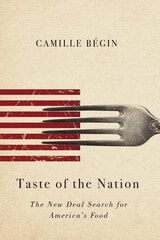
Taste of the Nation
The New Deal Search for America's FoodCamille Bégin
University of Illinois Press, 2016
Camille Begin shapes a cultural and sensory history of New Deal-era eating from the FWP archives. From "ravioli, the diminutive derbies of pastries, the crowns stuffed with a well-seasoned paste" to barbeque seasoning that integrated "salt, black pepper, dried red chili powder, garlic, oregano, cumin seed, and cayenne pepper" while "tomatoes, green chili peppers, onions, and olive oil made up the sauce", Begin describes in mouth-watering detail how Americans tasted their food. They did so in ways that varied, and varied widely, depending on race, ethnicity, class, and region. Begin explores how likes and dislikes, cravings and disgust operated within local sensory economies that she culls from the FWP’s vivid descriptions, visual cues, culinary expectations, recipes and accounts of restaurant meals. She illustrates how nostalgia, prescriptive gender ideals, and racial stereotypes shaped how the FWP was able to frame regional food cultures as "American."

Tattered Kimonos in Japan
Remaking Lives from Memories of World War IIRobert Rand
University of Alabama Press, 2024
Examines Japan’s war generation—Japanese men and women who survived World War Two and rebuilt their lives from memories of that conflict.
Since John Hersey’s Hiroshima—the classic account, published in 1946, of the aftermath of the atomic bombing of that city—very few books have examined the meaning and impact of World War II through the eyes of Japanese men and women who survived that conflict. Tattered Kimonos in Japan does just that: It is an intimate journey into contemporary Japan from the perspective of the generation of Japanese soldiers and civilians who survived World War II, by a writer whose American father and Japanese father-in-law fought on opposite sides of the conflict.
The author, a former NPR senior editor, is Jewish, and he approaches the subject with the sensibilities of having grown up in a community of Holocaust survivors. Mindful of the power of victimhood, memory, and shared suffering, he travels across Japan, including Hiroshima and Nagasaki, meeting a compelling group of men and women whose lives, even now, are defined by the trauma of war, and by lingering questions of responsibility and repentance for Japan’s wartime aggression.
The image of a tattered kimono from Hiroshima is the thread that drives the narrative arc of this emotional story about a writer’s encounter with history, inside the Japan of his father’s generation, on the other side of his father’s war. This is a book about history with elements of family memoir. It offers a fresh and truly unique perspective for readers interested in World War II, Japan, or Judaica; readers seeking cross-cultural journeys; and readers intrigued by Japanese culture, particularly the kimono.
Tattoo
Bodies, Art, and Exchange in the Pacific and the WestNicholas Thomas, Anna Cole, and Bronwen Douglas, eds.
Duke University Press, 2005
The contributors examine the contexts in which Pacific tattoos were “discovered” by Europeans, track the history of the tattooing of Europeans visiting the region, and look at how Pacific tattooing was absorbed, revalued, and often suppressed by agents of European colonization. They consider how European art has incorporated tattooing, and they explore contemporary manifestations of Pacific tattoo art, paying particular attention to the different trajectories of Samoan, Tahitian, and Maori tattooing and to the meaning of present-day appropriations of tribal tattoos. New research has uncovered a fascinating visual archive of centuries-old tattoo images, and this richly illustrated volume includes a number of those—many published here for the first time—alongside images of contemporary tattooing in Polynesia and Europe. Tattoo offers a tantalizing glimpse into the plethora of stories and cross-cultural encounters that lie between the blood on a sailor’s backside in the eighteenth century and the hammering of a Samoan tattoo tool in the twenty-first.
Contributors. Peter Brunt, Anna Cole, Anne D’Alleva, Bronwen Douglas, Elena Govor, Makiko Kuwahara, Sean Mallon, Linda Waimarie Nikora, Mohi Rua, Cyril Siorat, Ngahuia Te Awekotuku, Nicholas Thomas, Joanna White
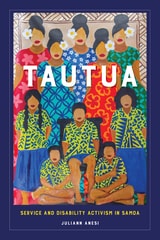
Tautua
Service and Disability Activism in SamoaJuliann Anesi
Temple University Press, 2026
The Sāmoan concept of tautua is the cultural practice of service—to family, village, church, and nation. For Juliann Anesi, tautua includes an ethical responsibility that extends to caring for people living with disabilities. Anesi learned this value from her aunty Sina, who was instrumental in founding two schools for youths in the mid-1970s—Aoga Fiamalamalama and Loto Taumafailike. These schools were designed for students like Sina’s son Gele, students excluded from private and public education because of intellectual or physical disabilities.
Tautua recounts how the Indigenous community organized and resisted ableist paradigms in colonial institutions by changing the education system to a more inclusive environment. Anesi explains how funding was arranged for the schools through NGOs. She also uses oral histories, personal narratives, archival documents, and newspapers to offer insights about how students experienced oppression and erasure as well as shame and sexism in their communities.
Highlighting advocacy and belonging, Tautua argues that these schools for students with disabilities centered Sāmoan concepts of service, advocacy, and self-determination in an attempt to decolonize elementary education. In doing so, Anesi shows what disability activism in Sāmoa can teach us about educability, school inclusion, and collective care.
In the series Dis/color
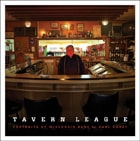
Tavern League
Portraits of Wisconsin BarsCarl Corey
Wisconsin Historical Society Press, 2011
In Tavern League, photographer Carl Corey documents a unique and important segment of the Wisconsin community. Our bars are unique micro-communities, offering patrons a sense of belonging. Many of these bars are the only public gathering place in the rural communities they serve. These simple taverns offer the individual the valuable opportunity for face to face conversation and camaraderie, particularly as people become more physically isolated through the accelerated use of the internet’s social networking, mobile texting, gaming, and the rapid-fire of email.
This collection of 60 pictures captures the Wisconsin tavern as it is today. Carl Corey’s view is both familiar and undeniably unique, his pictures resonant with anyone who has set foot in a Wisconsin tavern. As the Milwaukee Journal Sentinel’s Mary Louise Schumacher has written, “Carl Corey’s photographs . . . document iconic American places that are taken for granted. . . . They are comforting images, places we know, but also eerie and remote, presented with a sense of romance and nostalgia that suggests they are already past.”
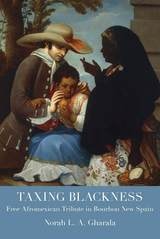
Taxing Blackness
Free Afromexican Tribute in Bourbon New SpainNorah L. A. Gharala
University of Alabama Press, 2019
A definitive analysis of the most successful tribute system in the Americas as applied to Afromexicans
During the eighteenth century, hundreds of thousands of free descendants of Africans in Mexico faced a highly specific obligation to the Spanish crown, a tax based on their genealogy and status. This royal tribute symbolized imperial loyalties and social hierarchies. As the number of free people of color soared, this tax became a reliable source of revenue for the crown as well as a signal that colonial officials and ordinary people referenced to define and debate the nature of blackness.
Taxing Blackness: Free Afromexican Tribute in Bourbon New Spain examines the experiences of Afromexicans and this tribute to explore the meanings of race, political loyalty, and legal privileges within the Spanish colonial regime. Norah L. A. Gharala focuses on both the mechanisms officials used to define the status of free people of African descent and the responses of free Afromexicans to these categories and strategies. This study spans the eighteenth century and focuses on a single institution to offer readers a closer look at the place of Afromexican individuals in Bourbon New Spain, which was the most profitable and populous colony of the Spanish Atlantic.
As taxable subjects, many Afromexicans were deeply connected to the colonial regime and ongoing debates about how taxpayers should be defined, whether in terms of reputation or physical appearance. Gharala shows the profound ambivalence, and often hostility, that free people of African descent faced as they navigated a regime that simultaneously labeled them sources of tax revenue and dangerous vagabonds. Some free Afromexicans paid tribute to affirm their belonging and community ties. Others contested what they saw as a shameful imposition that could harm their families for generations. The microhistory includes numerous anecdotes from specific cases and people, bringing their history alive, resulting in a wealth of rural and urban, gender, and family insight.

Taxing Women
Edward J. McCaffery
University of Chicago Press, 1997
"Taxing Women is a must-have primer for any woman who wants to understand how our current tax system affects her family's economic condition. In plain English, McCaffery explains how the tax code stacks the deck against women and why it's in women's economic interest to lead the next great tax rebellion."—Patricia Schroeder
"McCaffery is an expert on the interplay between taxes and social policy. . . . Devastating in his analysis. . . . Intriguing."—Harris Collingwood, Working Women
"A wake-up call regarding the inequalities of an archaic system that actually penalizes women for working."—Publishers Weekly
Taylor Swift as Storyteller
Identity, Power, and Digital CultureEdited by Alison Halsall
The Ohio State University Press, 2027
Taylor Swift as Storyteller examines one of the most influential cultural figures of the twenty-first century as both artist and “star text,” arguing that Swift’s global impact is shaped through the dynamic interplay of music, media, fandom, and branding. Bringing together literary scholars, ethnographers, and musicologists, this collection positions Swift as not just a pop figure but a transmedial construct.
Contributors explore how Swift’s carefully curated personae—from girl-next-door to feminist icon to “tortured poet”—generate powerful affective connections with audiences while also functioning as strategic marketing tools. At the same time, contributors retheorize authorship and control in the digital age. By foregrounding the roles of management, branding, and platform circulation, and by interrogating the participatory roles of Swifties as cocreators of meaning, Taylor Swift as Storyteller complicates the idea of singular authorship. Attending to questions of feminism, authorship, nostalgia, and literary adaptation, this collection ultimately reveals how Swift’s enterprise both reflects and reshapes contemporary media culture, illuminating the complex relationship between narrative, identity, and power in the digital age.
Contributors:
Natalie Abbott, Alexander Carpenter, Zixiao Chen, Katie E. Cline, Jennifer Duggan, Rachel M. Friars, Andrea LeMahieu Glaws, Wendy J. Glenn, Alison Halsall, Roxanne Harde, Juliette Holder, Erika Kvistad, Zhimou Li, Sarah E. Maier, Catherine McCarthy, Elly McCausland, Laura Carman McClintock, Adrianna Mirabal, Linh S. Nguy?n, Hazel O’Brien, Anah-Jayne Samuelson, L. M. Schmidt, Katlin Marisol Sweeney-Romero
Taylored Lives
Narrative Productions in the Age of Taylor, Veblen, and FordMartha Banta
University of Chicago Press, 1993
Teacher Education across Minority-Serving Institutions
Programs, Policies, and Social JusticePetchauer, Emery
Rutgers University Press, 2017
The first of its kind, Teacher Education across Minority-Serving Institutions brings together innovative work from the family of institutions known as minority-serving institutions: Historically Black Colleges and Universities, Tribal Colleges and Universities, Hispanic Serving Institutions, and Asian American and Native American Pacific Islander Serving Institutions. The book moves beyond a singular focus on teacher racial diversity that has characterized scholarship and policy work in this area. Instead, it pushes for scholars to consider that racial diversity in teacher education is not simply an end in itself but is, a means to accomplish other goals, such as developing justice-oriented and asset-based pedagogies.
Teacher's Manual for Elementary Latin
The Basic Structuresby Grace A. Crawford and Clara W. Ashley, Jane M. Infield, Frederick F. Kempner
University of Michigan Press, 1965