Results by title
702 books match the query 'America' and 147 start with t

The Puritan Tradition in America, 1620–1730
Edited by Alden T. Vaughan
University Press of New England, 1997
The Reckless Decade
America in the 1890sH.W. Brands
University of Chicago Press, 2002
Just as we do today, Americans of the 1890s faced changes in economics, politics, society, and technology that led to wrenching and sometimes violent tensions between rich and poor, capital and labor, white and black, East and West. In The Reckless Decade, H. W. Brands demonstrates that we can learn a lot about the contradictions that lie at the heart of America today by looking at them through the lens of the 1890s.
The 1890s saw the closing of the American frontier and a shift toward imperialist ambitions. Populists and muckrakers grappled with robber barons and gold-bugs. Americans addressed the unfinished business of Reconstruction by separating blacks and whites. Booker T. Washington, W. E. B. Du Bois, and other black leaders clashed over the proper response to continuing racial inequality. Those on top of the economic heap—Rockefeller, Carnegie, and Morgan—created vast empires of wealth, while those at the bottom worked for dimes a day. Brands brings all this to life in a vivid narrative filled with larger-than-life characters facing momentous challenges as they worked toward an uncertain future.
The Return of the Native
Indians and Myth-Making in Spanish America, 1810–1930Rebecca Earle
Duke University Press, 2007
Starting with the anti-Spanish wars of independence in the early nineteenth century, Earle charts the changing importance elite nationalists ascribed to the pre-Columbian past through an analysis of a wide range of sources, including historical writings, poems and novels, postage stamps, constitutions, and public sculpture. This eclectic archive illuminates the nationalist vision of creole elites throughout Spanish America, who in different ways sought to construct meaningful national myths and histories. Traces of these efforts are scattered across nineteenth-century culture; Earle maps the significance of those traces. She also underlines the similarities in the development of nineteenth-century elite nationalism across Spanish America. By offering a comparative study focused on Mexico, Guatemala, Colombia, Peru, Chile, and Ecuador, The Return of the Native illustrates both the common features of elite nation-building and some of the significant variations. The book ends with a consideration of the pro-indigenous indigenista movements that developed in various parts of Spanish America in the early twentieth century.
The Right Kind of Suffering
Gender, Sexuality, and Arab Asylum Seekers in AmericaRhoda Kanaaneh
University of Texas Press, 2023
2024 Evelyn Shakir Non-Fiction Academic Award, The Arab American National Museum
An examination of Arab asylum seekers who feel compelled to package their tales of disenfranchisement and suffering to satisfy a deeply reluctant immigration system.
From the overloaded courts with their constantly changing dates and appointments to the need to prove oneself the “right” kind of victim, the asylum system in the United States is an exacting and drawn-out immigration process that itself results in suffering. When anthropologist Rhoda Kanaaneh became a volunteer interpreter for Arab asylum seekers, she learned how applicants were pushed to craft specific narratives to satisfy the system’s requirements.
Kanaaneh tells the stories of four Arab asylum seekers who sought protection in the United States on the basis of their gender or sexuality: Saud, who relived painful memories of her circumcision and police harassment in Sudan and then learned to number and sequence these recollections; Fatima, who visited doctors and therapists in order to document years of spousal abuse without over-emphasizing her resulting mental illness; Fadi, who highlighted the homophobic motivations that provoked his arrest and torture in Jordan, all the while sidelining connected issues of class and racism; and Marwa, who showcased her private hardships as a lesbian in a Shiite family in Lebanon and downplayed her environmental activism. The Right Kind of Suffering is a compelling portrait of Arab asylum seekers whose success stories stand in contrast with those whom the system failed.

The Royal Treasuries of the Spanish Empire in America
Vol. 1: PeruJohn J. Tepaske and Herbert S. Klein, editors
Duke University Press, 1982

The Royal Treasuries of the Spanish Empire in America
Vol. 2: Upper Peru (Bolivia)John J. Tepaske and Herbert S. Klein, editors
Duke University Press, 1982

The Royal Treasuries of the Spanish Empire in America
Vol. 3: Chile and Rio de la PlataJohn J. Tepaske and Herbert S. Klein, editors
Duke University Press, 1982

The Royal Treasuries of the Spanish Empire in America
Vol. 4, Eighteenth-Century EcuadorAlvaro Jara and John Jay TePaske, eds.
Duke University Press, 0
The Science of Deception
Psychology and Commerce in AmericaMichael Pettit
University of Chicago Press, 2012

The Scientific Enterprise in America
Readings from IsisEdited by Ronald L. Numbers and Charles E. Rosenberg
University of Chicago Press, 1996
Contributions include Sally Gregory Kohlstedt, "Parlors, Primers, and Public Schooling: Education for Science in Nineteenth-Century America;" Margaret Rossiter, "'Women's Work' in Science, 1880-1910;" Philip J. Pauly, "The Development of High School Biology: New York City, 1900-1925;" Susan E. Lederer, "Political Animals: The Shaping of Biomedical Research Literature in Twentieth-Century America;" Stanley Goldberg, "Inventing a Climate of Opinion: Vannevar Bush and the Decision to Build the Bomb;" Daniel J. Kevles, "The National Science Foundation and the Debate over Postwar Research Policy, 1942-1945: A Political Interpretation of Science: The Endless Frontier;" David A. Hollinger, "Science as a Weapon in Kulturkämpfe in the United States During and After World War II;" and others.
These essays originally were published in Isis, a publication of the History of Science Society.
The Shock of Colonialism in New England
Fragments from a FrontierMeghan C. L. Howey
University of Alabama Press, 2025
Explores the untold impacts of colonialism in New England through diverse colonist lives, Indigenous encounters, and environmental legacies.
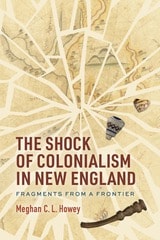
In The Shock of Colonialism in New England, archaeologist Meghan C. L. Howey uses excavations in the seventeenth-century colonial frontier of the Great Bay Estuary/P8bagok in today’s New Hampshire to trace the connection between European global colonialism and the planetary climate crises. Howey shows how this landscape holds forgotten stories of what it meant to live through the shock of colonialism.
These stories reveal an unexpected diversity and dynamism among English colonists, multifaceted encounters with Indigenous peoples, and lasting environmental damage from labor-intensive industries. Early Euro-American maps and stunning archaeological finds, such as a broken pickaxe embedded in a hearth, and a historical marker for the Oyster River “Massacre” of 1694 complicate our limited views of a shared past.
The reality of English colonialism in the dispossession of Indigenous lands and its wake is not commemorated. Howey’s work is a powerful corrective that traces the rise of intergenerational colonial wealth made possible by land commodified as property, the increased labor required to work newly opened land, the importation of indentured Scots and enslaved Africans to provide that labor, and the resulting degradation of the natural environment. Through Howey’s insights into the stories they tell, these fragments from a frontier can help contemporary readers better understand the past as they seek a more just and sustainable future.
The Social Life of Reading
Race, Book Clubs, and Post-Digital Readership in AmericaTamara Bhalla
University of Massachusetts Press, 2027
Showing how what we read, and with whom, reveals how power works in America
In an interview about his novel The Emperor of Gladness being selected for Oprah’s Book Club, Ocean Vuong recalled the women in his mother’s nail salon—working-class immigrants, mostly single mothers—who would buy whatever book Oprah had chosen. What she gave them, Vuong reflected, was “access… a ticket into the discourse.” Books, he said, “can change the posture of somebody’s mother.” It’s a small observation, but it points to something Tamara Bhalla takes seriously in The Social Life of Reading: that how we read, what we read, and with whom we read is rarely just a matter of personal taste.
Bhalla reveals how social reading practices, from celebrity book selections to Goodreads reviews, are crucial arenas where power circulates, gets contested, and gets remade in contemporary American culture. Drawing on sociology of literature, ethnic studies, and feminist cultural analysis, she shows that reading, often framed as apolitical and personal, is fundamentally a political practice. Using the term “post-digital” to capture how 21st-century reading blends digital platforms with in-person gatherings and print, Bhalla traces two distinct reading cultures: mainstream communities, including celebrity book clubs, Goodreads, and Moms for Liberty, that center white, heteronormative values through affective, particularly maternal, responses to literature; and reading communities informed by digital Black feminism and traditions of self-definition, conscious consumption, and political engagement to imagine alternative literary futures.
The result is a striking portrait of contemporary reading culture as simultaneously structured by whiteness and shaped by the emergence of racially conscious alternatives. Bhalla demonstrates that what we read, with whom we read, and what we value in literature is not a matter of individual taste—it is a powerful cultural force shaping who gets represented, whose voices matter, and what stories get told.
The Star-Entangled Banner
One Hundred Years of America in the PhilippinesDelmendo, Sharon
Rutgers University Press, 2004
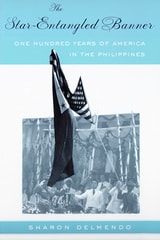
During a ceremony held in 1996 to commemorate the fiftieth anniversary of formal Philippine independence, the U.S. flag was being lowered while the Philippine flag was being raised, and the two became entangled. In The Star-Entangled Banner, Sharon Delmendo demonstrates that this incident is indicative of the longstanding problematic relationship between the two countries. When faced with a national crisis or a compelling need to reestablish its autonomy, each nation paradoxically turns to its history with the other to define its place in the world.
Each chapter of the book deals with a separate issue in this linked history: the influence of Buffalo Bill’s show on the proto-nationalism of José Rizal, who is often described as the “First Filipino”; the portrayal of the Philippines in American children’s books; Back to Bataan, a World War II movie starring John Wayne; the post-independence fiction of F. Sionil José; and the refusal of the U..S military to return the Balangiga Bells, which were taken as war booty during the Philippine-American War. Ultimately, Delmendo demonstrates how the effects of U.S. imperialism in the Philippines continue to resonate in U.S. foreign policy in the post cold war era and the war on terrorism.
The State Park Movement in America
A Critical ReviewNey C. Landrum
University of Missouri Press, 2013

The Taste of America
John L. Hess and Karen Hess
University of Illinois Press, 1972
The Taste of America provoked the cooking experts of the 1970s into spitting rage by pointing out in embarrassing detail that most of them lacked an essential ingredient: expertise. Now "Kool-Aid like Mother used to make" has become "Kool-Aid like Grandmother used to make," and a new generation has been weaned on synthetic food, pathetic snobbery, neurotic health advice, and reconstituted history.
This much-needed new edition chars Julia Child ("She's not a cook, but she plays one on TV"), chides food maven Ruth Reichl, and marvels at a convention of food technologists (whose program bore the slogan "Eat your heart out, Mother Nature"). Delectable reading for consumers, reformers, and scholars, this twenty-fifth anniversary reissue of The Taste of America will serve well into the new millennium.

The Tented Field
A History of Cricket in AmericaTom Melville
University of Wisconsin Press, 1998
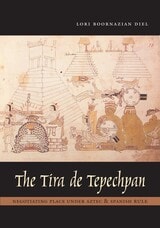
The Tira de Tepechpan
Negotiating Place under Aztec and Spanish RuleBy Lori Boornazian Diel
University of Texas Press, 2008
Created in Tepechpan, a relatively minor Aztec city in Central Mexico, the Tira de Tepechpan records important events in the city's history from 1298 through 1596. Most of the history is presented pictographically. A line of indigenous year signs runs the length of the Tira, with images above the line depicting events in Tepechpan and images below the line recording events at Tenochtitlan, capital of the Aztec empire and later the seat of Spanish rule. Written annotations amplify some of the images.
In this volume, which includes color plates of the entire Tira, Lori Boornazian Diel investigates the motives behind the creation and modification of the Tira in the second half of the sixteenth century. She identifies the Tira's different contributors and reconciles their various histories by asking why these painters and annotators, working at different times, recorded the events that they did. Comparing the Tira to other painted histories from Central Mexico, Diel demonstrates that the main goal of the Tira was to establish the antiquity, autonomy, and prestige of Tepechpan among the Central Mexican city-states that vied for power and status in the preconquest and colonial worlds. Offering the unique point of view of a minor city with grand ambitions, this study of the Tira reveals imperial strategy from the grassroots up, showing how a subject city negotiated its position under Aztec and Spanish control.
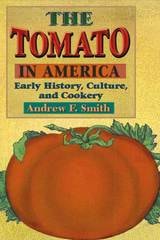
The Tomato in America
Early History, Culture, and CookeryAndrew F. Smith
University of Illinois Press, 1994
In this first concerted study of the tomato in America, Andrew F. Smith separates myth from historical fact, beginning with the Salem, New Jersey, man who, in 1820, allegedly attracted spectators from hundreds of miles to watch him eat a tomato on the courthouse steps (the legend says they expected to see him die a painful death). Later, hucksters such as Dr. John Cook Bennett and the Amazing Archibald Miles peddled the tomato's purported medicinal benefits. The competition was so fierce that the Tomato Pill War broke out in 1838.
The Tomato in America traces the early cultivation of the tomato, its infiltration of American cooking practices, the early manufacture of preserved tomatoes and ketchup (soon hailed as "the national condiment of the United States"), and the "great tomato mania" of the 1820s and 1830s. The book also includes tomato recipes from the pre-Civil War period, covering everything from sauces, soups, and main dishes to desserts and sweets.
Now available for the first time in paperback, The Tomato in America provides a piquant and entertaining look at a versatile and storied figure in culinary history.
The Transformation of Authorship in America
Grantland S. Rice
University of Chicago Press, 1997
Rice shows that the rigorous censorship practiced by Puritan authorities conferred an implicit prestige on texts as civic interventions, helping to foster a vigorous and indigenous tradition of sociopolitical criticism. With special attention to the sudden emergence of the novel in post-revolutionary America, Rice reveals how the emergence of economic liberalism undermined the earlier tradition of political writing by transforming American authorship from an expression of individual civic conscience to a market-oriented profession.
Includes discussions of the writings of Benjamin Franklin, Michel-Guillaume-Jean de Crèvecoeur, and Hugh Henry Brackenridge.
The Tree That Bends
Discourse, Power, and the Survival of Maskoki PeoplePatricia Riles Wickman
University of Alabama Press, 1999
In her compelling and controversial arguments, Wickman rejects the myths that erase Native Americans from Florida through the agency of Spaniards and diseases and make the area an empty frontier awaiting American expansion. Through research on both sides of the Atlantic and extensive oral history interviews among the Seminoles of Florida and Oklahoma, Wickman shatters current theories about the origins of the people encountered by the Spaniards and presents, for the first time ever, the Native American perspective. She describes the genesis of the groups known today as Creek, Seminole, and Miccosukee—the Maskoki peoples—and traces their common Mississippian heritage, affirming their claims to continuous habitation of the Southeast and Florida. Her work exposes the rhetoric of conquest and replaces it with the rhetoric of survival.
An important cross-disciplinary work, The Tree That Bends reveals the flexibility of the Maskoki people and the sociocultural mechanisms that allowed them to survive the pressures introduced at contact. Their world was capable of incorporating the New without destroying the Old, and their descendants not only survive today but also succeed as a discrete culture as a result.
The Truth About Health Care
Why Reform is Not Working in AmericaMechanic, David
Rutgers University Press, 2006
In The Truth about Health Care, David Mechanic explains how health care in America has evolved in ways that favor a myriad of economic, professional, and political interests over those of patients. While money has always had a place in medical care, "big money" and the quest for profits has become dominant, making meaningful reforms difficult to achieve. Mechanic acknowledges that railing against these influences, which are here to stay, can achieve only so much. Instead, he asks whether it is possible to convert what is best about health care in America into a well functioning system that better serves the entire population.
Bringing decades of experience as an active health policy participant, researcher, teacher, and consultant to the public and private sectors, Mechanic examines the strengths and weaknesses of our system and how it has evolved. He pays special attention to areas often neglected in policy discussions, such as the loss of public trust in medicine, the tragic state of long-term care, and the relationship of mental health to health care.
For anyone who has been frustrated by uncoordinated health networks, insurance denials, and other obstacles to obtaining appropriate care, this book will provide a refreshing and frank look at the system's current and future dilemmas. Mechanic's thoughtful roadmap describes how health plans, healthcare professionals, policymakers, and consumer groups can work together to improve access, quality, fairness, and health outcomes in America.
The Turk in America
The Creation of an Enduring PrejudiceJustin McCarthy
University of Utah Press, 2010
Utah Series in Middle East Studies
In The Turk in America, historian Justin McCarthy seeks to explain the historical basis for American prejudice towards Turks in the nineteenth and early twentieth centuries. The volume focuses on fraudulent characterizations of Turks, mostly stemming from an antipathy in Europe and America toward non-Christians, and especially Muslims. Spanning one hundred and fifty years, this history explores the misinformation largely responsible for the negative stereotypes of Turks during this period.
The Tyranny of Change
America in the Progressive Era, 1890-1920Chambers, John Whiteclay II
Rutgers University Press, 2000
Between 1890 and 1920, the forces accompanying industrialization sent the familiar nineteenth-century world plummeting toward extinction. The traditional countryside with its villages and family farms was eclipsed by giant corporations and sprawling cities. America appeared headed into an unknown future.
In lively, accessible prose, John Chambers incorporates the latest scholarship about the social, cultural, political, and economic changes which produced modern America. He illuminates the experiences of blacks, Asians, Latinos, as well as other working men and women in the cities and countryside as they struggled to improve their lives in a transformed economy. He explores the dimensions of the new consumer society and the new information and entertainment industries: newspapers, magazines, the movies. Striding these pages are many of the prominent individuals who shaped the attitudes and institutions of modern America: J. P. Morgan and corporate reorganization; Jane Addams and the origin of modern social work; Mary Pickford and the new star-oriented motion picture industry; and the radical labor challenge of “Big Bill” Haywood and the “Wobblies.”
While recognizing a “progressive ethos”—a mixture of idealistic vision and pragmatic reforms—which dominated the mainstream reforms that characterized the period, Chambers elaborates the role of civic volunteerism as well as the state in achieving directed social change. He also emphasizes the importance of radical and conservative political forces in shaping the so-called “Progressive Era.”
The revised edition in this classic work has an updated bibliography and a new preface, both of which incorporate particularly the new social and cultural research of the past decade.

The Unfulfilled Promise
Public Subsidy of the Arts in AmericaEdward Arian
Temple University Press, 1993
The Unsteady March
The Rise and Decline of Racial Equality in AmericaPhilip A. Klinkner and Rogers M. Smith
University of Chicago Press, 1999
"[An] unflinching portrait of the leviathan of American race relations. . . . This important book should be read by all who aspire to create a more perfect union."—Publishers Weekly, starred review
"Could it be that our unswerving belief in the power of our core values to produce racial equality is nothing but a comforting myth? That is the main argument put forth by Philip Klinkner and Rogers Smith . . . The Unsteady March is disturbing because it calls into question our cherished national belief and does so convincingly. . . . [It] is beautifully written, and the social history it provides is illuminating and penetrating."—Aldon Morris, American Journal of Sociology
Winner of the Horace Mann Bond Award of the W.E.B. Du Bois Institute for Afro-American Research at Harvard University.

The Village Enlightenment in America
Popular Religion and Science in the Nineteenth CenturyCraig James Hazen
University of Illinois Press, 2000
A theologian, writer, and apologist for the nascent Mormon movement, as well as an amateur scientist, Orson Pratt wrote Key to the Universe, or a New Theory of Its Mechanism, to establish a scientific base for the Church of Jesus Christ of Latter-day Saints. Robert Hare, an inventor and ardent convert to spiritualism, used his scientific expertise to lend credence to the spiritualist movement. Phineas Parkhurst Quimby, generally considered the initiator of the American mind-cure movement, developed an overtly religious concept of science and used it to justify his system of theology.
Pratt, Hare, and Quimby all employed a potent combination of popular science and Baconianism to legitimate their new religious ideas. Using the same terms--matter, ether, magnetic force--to account for the behavior of particles, planetary rotation, and the influence of the Holy Ghost, these agents of the Enlightenment constructed complex systems intended to demonstrate a fundamental harmony between the physical and the metaphysical.
Through the lives and work of these three influential men, The Village Enlightenment in America opens a window to a time when science and religion, instead of seeming fundamentally at odds with each other, appeared entirely reconcilable.

The Welsh in America
Letters From the ImmigrantsAlan Conway, Editor
University of Minnesota Press, 1961
The Welsh in America was first published in 1961. Minnesota Archive Editions uses digital technology to make long-unavailable books once again accessible, and are published unaltered from the original University of Minnesota Press editions.
The Welsh formed a small but significant part of the great migration from Europe to the United States during the nineteenth century. In this volume they tell their own story in letters they wrote from America to their families and friends back home. The letters are highly readable, written, for the most part, in vivid and entertaining style which reveals the Welsh as an unusually literate people.
The 197 letters are arranged chronologically and geographically, starting with letters that tell of the voyage across the Atlantic. Once in America, the immigrants described their experiences in the farming country of New York, Pennsylvania, Ohio, and some of the other midwestern states. Later, as the frontier moved west, they wrote of their efforts to establish exclusive Welsh settlements on the Great Plains. From the industrial centers there are letters from coal miners and iron and steel workers. The fortune seekers who went to California in the gold rush or to the mines in Colorado are also represented. Still others tell of their search for salvation in the Mormon Zion of Utah.
For each chapter or group of letters Mr. Conway has written an introduction giving the general background of the region or period and relating it to the Welsh settlers. Thus the events chronicled and the views expressed in the letters become significant in the history of the times. The majority of the letters were written in Welsh and they appear here in translation. Some were obtained from the files of old newspapers or denominational magazines; others came from the collections of the National Library of Wales or from individuals.
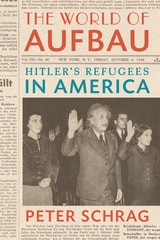
The World of Aufbau
Hitler's Refugees in AmericaPeter Schrag
University of Wisconsin Press, 2019
The book examines the columns and advertisements that chronicled the social and cultural life of that generation and maintained a detailed account of German-speaking cultures in exile. Peter Schrag is the first to present a definitive account of the influential publication that brought postwar refugees together and into the American mainstream.
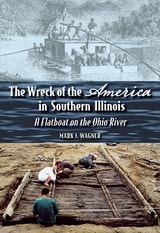
The Wreck of the "America" in Southern Illinois
A Flatboat on the Ohio RiverMark J. Wagner
Southern Illinois University Press, 2015
Winner, Illinois State Historical Society Superior Achievement, 2016
Flatboats were the most prolific type of vessel on the Ohio and Mississippi Rivers during the early 1800s. Thousands of these boats descended the two rivers each year, carrying not only valuable cargo to New Orleans but also western-bound emigrants to newly opened territories. By the late 1800s, flatboats had completely disappeared, and no intact examples were known to exist. Our knowledge of these historic vessels had been limited to illustrations, memoirs, and traveler accounts.
That changed in 2000 after local residents found a wreck on the Ohio River shoreline in Illinois. Archaeologist Mark J. Wagner and his colleagues from Southern Illinois University Carbondale investigated extensively and established that the wreck was a pre–Civil War flatboat, which they named America, after a nearby town.
In The Wreck of the America in Southern Illinois: A Flatboat on the Ohio River, Wagner provides a brief description and general history of flatboats and the various reasons they wrecked—such as poor workmanship and encounters with pirates, storms, rocks, and floating trees. Wagner describes the remains of the America, how it was constructed, the artifacts found nearby and inside—including pewter spoons, utensils with bone handles, metal buttons, and an iron felling axe—and the probable cause of its sinking. Wagner concludes with a history of the America since its discovery in 2000 and a plea that the boat be removed from the riverbank and preserved before the Ohio washes it away.
The Yale Critics
Deconstruction in AmericaJonathan Arac, Wlad Godzich, and Wallace Martin, Editors
University of Minnesota Press, 1983
The Yale Critics was first published in 1983. Minnesota Archive Editions uses digital technology to make long-unavailable books once again accessible, and are published unaltered from the original University of Minnesota Press editions.
A heated debate has been raging in North America in recent years over the form and function of literature. At the center of the fray is a group of critics teaching at Yale University—Harold Bloom, Geoffrey Hartman, Paul de Man, and J. Hillis Miller—whose work can be described in relation to the deconstructive philosophy practiced by French philosopher Jacques Derrida. For over a decade the Yale Critics have aroused controversy; most often they are considered as a group, to be applauded or attacked, rather than as individuals whose ideas merit critical scrutiny. Here a new generation of scholars attempts for the first time a serious, broad assessment of the Yale group. These essays appraise the Yale Critics by exploring their roots, their individual careers, and the issues they introduce.
Wallace Martin's introduction offers a brilliant, compact account of the Yale Critics and of their relation to deconstruction and the deconstruction to two characteristically Anglo-American enterprises; Paul Bove explores the new criticism and Wlad Godzich the reception of Derrida in America. Next come essays giving individual attention to each of the critics: Michael Sprinker on Hartman, Donald Pease on Miller, Stanley Corngold on de Man, and Daniel O'Hara on Bloom. Two essays then illuminate "deconstruction in America" through a return to modern continental philosophy: Donald Marshall on Maurice Blanchot, and Rodolphe Gasche on Martin Heidegger. Finally, Jonathan Arac's afterword brings the volume together and projects a future beyond the Yale Critics.
Throughout, the contributors aim to provide a balanced view of a subject that has most often been treated polemically. While useful as an introduction, The Yale Critics also engages in a serious critical reflection on the uses of the humanities in American today.
Theater Enough
American Culture and the Metaphor of the World Stage, 1607–1789Jeffrey H. Richards
Duke University Press, 1991
The rhetoric, or discourse, of early American theater emerged out of the figures of speech that permeated the colonists’ lives and literary productions. Jeffrey H. Richards examines a variety of texts—histories, diaries, letters, journals, poems, sermons, political tracts, trial transcripts, orations, and plays—and looks at the writings of such authors as John Winthrop and Mercy Otis Warren. Richards places the American usage of theatrum mundi—the world depicted as a stage—in the context of classical and Renaissance traditions, but shows how the trope functions in American rhetoric as a register for religious, political, and historical attitudes.
Their Sisters' Keepers
Women's Prison Reform in America, 1830-1930Estelle B. Freedman
University of Michigan Press, 1984
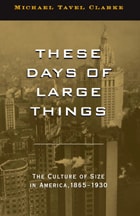
These Days of Large Things
The Culture of Size in America, 1865-1930Michael Tavel Clarke
University of Michigan Press, 2009
The United States at the turn of the twentieth century cultivated a passion for big. It witnessed the emergence of large-scale corporate capitalism; the beginnings of American imperialism on a global stage; record-level immigration; a rapid expansion of cities; and colossal events and structures like world's fairs, amusement parks, department stores, and skyscrapers. Size began to play a key role in American identity. During this period, bigness signaled American progress.
These Days of Large Things explores the centrality of size to American culture and national identity and the preoccupation with physical stature that pervaded American thought. Clarke examines the role that body size played in racial theory and the ways in which economic changes in the nation generated conflicting attitudes toward growth and bigness. Finally, Clarke investigates the relationship between stature and gender.
These Days of Large Things brings together a remarkable range of cultural material including scientific studies, photographs, novels, cartoons, architecture, and film. As a general cultural and intellectual history of the period, this work will be of interest to students and scholars in American studies, U.S. history, American literature, and gender studies.
Michael Tavel Clarke is Assistant Professor of English at the University of Calgary.
Cover photograph: "New York from Its Pinnacles," Alvin Langdon Coburn (1912). Courtesy of the George Eastman House.
"A fascinating study of the American preoccupation with physical size, this book charts new paths in the history of science, culture, and the body. A must-read for anyone puzzling over why Americans today love hulking SUVs, Mcmansions, and outsized masculine bodies."
---Lois Banner, University of Southern California
"From the Gilded Age through the Twenties, Clarke shows a nation-state obsessed with sheer size, ranging from the mammoth labor union to the 'Giant Incorporated Body' of the monopoly trust. These Days of Large Things links the towering Gibson Girl with the skyscraper, the pediatric regimen with stereotypes of the Jew. Spanning anthropology, medicine, architecture, business, and labor history, Clarke provides the full anatomy of imperial America and offers a model of cultural studies at its very best."
---Cecelia Tichi, Vanderbilt University
Think Tanks in America
Thomas Medvetz
University of Chicago Press, 2012
Thirteen Loops
Race, Violence, and the Last Lynching in AmericaB. J. Hollars
University of Alabama Press, 2011
The death of Vaudine Maddox—and the lynchings that followed—serves as a cautionary tale about the violence that occurred in the same region nearly fifty-years later, highlighting the cowardice, ignorance, and happenstance that sustained a culture of racial intolerance far into the future.Nearly half a century later, after a black bank robber was acquitted for the murder of police Sergeant Gene Ballard, two Klansmen took it upon themselves to exact revenge on an innocent victim--nineteen-year-old African American Michael Donald. Donald's murder--deemed the last lynching in America--reignited the race debate in America and culminated in a courtroom drama in which the United Klans of America were at long last put on trial.
While tracing the relationships among these murders, B. J. Hollars's research led him deep into the heart of Alabama’s racial, political, and legal landscapes. A work of literary journalism, Thirteen Loops draws upon rarely examined primary sources, court documents, newspaper reports, and first-hand accounts in an effort to unravel the twisted tale of a pair of interconnected murders that forever altered United States' race relations.

This Land Is Your Land
The Story of Field Biology in AmericaMichael J. Lannoo
University of Chicago Press, 2018
Lannoo illuminates characters such as John Wesley Powell, William Temple Hornaday, and Olaus and Adolph Murie—homegrown midwestern field biologists who either headed east to populate major research centers or went west to conduct their fieldwork along the frontier. From the pioneering work of Victor Shelford, Henry Chandler Cowles, and Aldo Leopold to contemporary insights from biologists such as Jim Furnish and historians such as William Cronon, Lannoo’s unearthing of American—and particularly midwestern—field biologists reveals how these scientists influenced American ecology, conservation biology, and restoration ecology, and in turn drove global conservation efforts through environmental legislation and land set-asides. This Land Is Your Land reveals the little-known legacy of midwestern field biologists, whose ethos and discoveries have enabled us to preserve and understand not just their land, but all lands.

Through Japanese Eyes
Thirty Years of Studying Aging in AmericaYohko Tsuji
Rutgers University Press, 2021
Through Japanese Eyes offers an ethnography of aging in America from a cross-cultural perspective based on a lengthy period of research. It illustrates how older Americans cope with the gap between the ideal (e.g., independence) and the real (e.g., needing assistance) of growing older, and the changes the author observed over thirty years of research.
Ticket to Minto
Stories of India and AmericaHomi Sohrab Fracis
University of Iowa Press, 2001
Ticket to Minto, Sohrab Homi Fracis's premier fiction collection, offers readers a passage to an unfamiliar destination-a world suspended between East and West, India and America, home and away.
With piercing insight, Fracis expertly reveals the underlying differences between immersion in India's culture-Hindu, Muslim, or Parsi-and life as an Indian in America. Alternating between East and West, the stories in Ticket to Minto serve as companion pieces, interrelated across continents in both theme and content. A middle-aged man's search for love in Bombay is contrasted with an Indian American family's hopes for the marriage of their westernized daughter. A university student rushes to save the life of a servant in his homeland only to find his own life threatened while attending graduate school in America.
Poignant and daring, Ticket to Minto underlines the harsh realization that the immigrant never truly arrives but is in constant limbo between two worlds. As one character relates, "There's a part of me that's American and a part that's Indian. I'm clear about that and comfortable with it, except that sometimes people want me to be just the one or the other."

To Live and Die in America
Class, Power, Health and HealthcareRobert Chernomas and Ian Hudson
Pluto Press, 2013
To Live and Die in America details how the United States has among the worst indicators of health in the industrialised world and at the same time spends significantly more on its health care system than any other industrial nation.
Robert Chernomas and Ian Hudson explain this contradictory phenomenon as the product of the unique brand of capitalism that has developed in the US. It is this particular form of capitalism that created both the social and economic conditions that largely influence health outcomes and the inefficient, unpopular and inaccessible health care system that is incapable of dealing with them.
The authors argue that improving health in America requires a change in the conditions in which people live and work as well as a restructured health care system.
Touching Home
Baseball and the Liberal-Republican Tradition in AmericaMary Craig
University of Missouri Press, 2025
2026 Society for American Baseball Research Seymour Medal finalist
Baseball’s relationship to American ideals has long been an object of study across disciplines. In Touching Home, Mary Craig contributes to this ongoing study by relating issues of class, race, and gender to America’s theoretical tradition of liberalism and republicanism established during the nation’s founding era. Specifically, Touching Home traces theories of individualism and civic virtue from the founding era through baseball’s place in American society at the end of the twentieth century.
The work also examines the mythologizing of baseball’s pastoralism, racial equality, and inculcation of manliness as a civic virtue. These myths became ingrained in baseball in significant ways, including, for example, the Supreme Court’s granting of an antitrust exemption to Major League Baseball; MLB’s promotion of Jackie Robinson’s career as proof of its leadership in and commitment to desegregation; and the short-lived All-American Girls Professional Baseball League (1943-1954) and subsequent relegation of women to softball.
Through the exploration of these and other societal issues, Craig’s work highlights baseball’s development from accessible hobby to multi-billion-dollar corporation, exploring the ways in which the sport has helped shape how individual Americans engage with politics. Indeed, in the pages of Touching Home readers will find a demythologizing of baseball that helps them better understand the results of their efforts to form community through engaging with teams at both the local and national levels. Scholars of American politics, particularly American political thought, will be intrigued to find baseball used as a case study of the effectiveness of the founders’ project of crafting a jointly liberal-republican framework capable of directing Americans toward responsible citizenship.
In all of these ways, Touching Home upholds the value of studying popular culture, presenting baseball as a unique and highly interesting lens through which to help us appreciate how individual Americans relate to politics and parties in their respective communities and nationally.
Tracing the Relational
The Archaeology of Worlds, Spirits, and TemporalitiesMeghan E. Buchanan and B. Jacob Skousen
University of Utah Press, 2015
Trading Spaces
The Colonial Marketplace and the Foundations of American CapitalismEmma Hart
University of Chicago Press, 2019
When we talk about the economy, “the market” is often just an abstraction. While the exchange of goods was historically tied to a particular place, capitalism has gradually eroded this connection to create our current global trading systems. In Trading Spaces, Emma Hart argues that Britain’s colonization of North America was a key moment in the market’s shift from place to idea, with major consequences for the character of the American economy.
Hart’s book takes in the shops, auction sites, wharves, taverns, fairs, and homes of seventeenth- and eighteenth-century America—places where new mechanisms and conventions of trade arose as Europeans re-created or adapted continental methods to new surroundings. Since those earlier conventions tended to rely on regulation more than their colonial offspring did, what emerged in early America was a less-fettered brand of capitalism. By the nineteenth century, this had evolved into a market economy that would not look too foreign to contemporary Americans. To tell this complex transnational story of how our markets came to be, Hart looks back farther than most historians of US capitalism, rooting these markets in the norms of seventeenth- and eighteenth-century Britain. Perhaps most important, this is not a story of specific commodity markets over time but rather is a history of the trading spaces themselves: the physical sites in which the grubby work of commerce occurred and where the market itself was born.
Trans-Americanity
Subaltern Modernities, Global Coloniality, and the Cultures of Greater MexicoJosé David Saldívar
Duke University Press, 2012
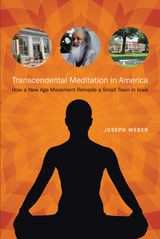
Transcendental Meditation in America
How a New Age Movement Remade a Small Town in IowaJoseph Weber
University of Iowa Press, 2014
The Indian spiritual entrepreneur Maharishi Mahesh Yogi took the West by storm in the 1960s and ’70s, charming Baby Boomers fed up with war and social upheaval with his message of meditation and peace. Heeding his call, two thousand followers moved to tiny Fairfield, Iowa, to set up their own university on the campus of a failed denominational college. Soon, they started a school for prekindergarten through high school, allowing followers to immerse themselves in Transcendental Meditation from toddlerhood through PhDs.
Although Fairfield’s longtime residents were relieved to see that their new neighbors were clean-cut and respectably dressed—not the wild-haired, drug-using hippies they had feared—the newcomers nevertheless quickly began to remake the town. Stores selling exotic goods popped up, TM followers built odd-looking homes that modeled the guru’s rules for peace-inspiring architecture, and the new university knocked down a historic chapel, even as it erected massive golden-domed buildings for meditators. Some newcomers got elected—and others were defeated—when they ran for local and statewide offices. At times, thousands from across the globe visited the small town.
Yet Transcendental Meditation did not always achieve its aims of personal and social tranquility. Suicides and a murder unsettled the meditating community over the years, and some followers were fleeced by con men from their own ranks. Some battled a local farmer over land use and one another over doctrine. Notably, the world has not gotten more peaceful.
Today the guru is dead. His followers are graying, and few of their children are moving into leadership roles. The movement seems rudderless, its financial muscle withering, despite the efforts of high-profile supporters such as filmmaker David Lynch and media magnate Oprah Winfrey. Can TM reinvent itself? And what will be the future of Fairfield itself? By looking closely at the transformation of this small Iowa town, author Joseph Weber assesses the movement’s surprisingly potent effect on Western culture, sketches out its peculiar past, and explores its possible future.
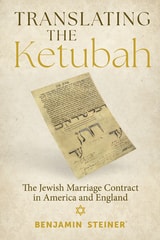
Translating the Ketubah
The Jewish Marriage Contract in America and EnglandBenjamin Steiner
University of Alabama Press, 2025
A groundbreaking exploration of the Jewish marriage contract and its evolution in English translation
Translating the Ketubah offers a fresh perspective on the ketubah, the Jewish marriage contract. Traditionally composed in Aramaic, ketubot have been examined in other books within the frameworks of Jewish law and Jewish art. Here, however, Benjamin Steiner shows how translations of the ketubah into English helped Jews adapt to changing social and economic circumstances across more than two centuries.
Steiner uses ketubot to trace the intricate relationship between religious law and secular law, the changing status of women within and outside Judaism, and the complex desire of Jews to be both authentically Jewish and fully acculturated. Steiner further shows how ketubah translation aided Jews to achieve different cultural goals. It has been used to uphold rabbinic law in communities where religious affiliation was voluntary to ensure women's economic security. It has also facilitated socialization with non-Jews and addressed perceived crises within the Jewish family.
Through a nuanced analysis of ketubah translations from England and various regions of the United States from the late eighteenth century to the present, Steiner offers a detailed look at how Jews have adapted ancient tradition to meet the challenges and opportunities of different historical contexts. His work sheds new light on the rich history of American and British Jewry.
Translation and Epistemicide
Racialization of Languages in the AmericasJoshua M. Price
University of Arizona Press, 2023
The book gives an account of translation-as-epistemicide in the Americas, drawing on a range of examples from the early colonial period to the War on Terror. The first chapters demonstrate four distinct operations of epistemicide: the commensuration of worlds, the epistemic marginalization of subaltern translators and the knowledge they produce, the criminalization of translators and interpreters, and translation as piracy or extractivism. The second part of the book outlines decolonial translation strategies, including an epistemic posture the author calls “bewilderment.”
Translation and Epistemicide tracks how through the centuries translation practices have enabled colonialism and resulted in epistemicide, or the destruction of Indigenous and subaltern knowledge.
Traveling without Moving
Essays from a Black Woman Trying to Survive in AmericaTaiyon J. Coleman
University of Minnesota Press, 2024
A stunning lyrical commentary on the constructions of race, gender, and class in the fraught nexus of a Black woman’s personal experience and cultural history
The Fair Housing Act passed in 1968, and more than fifty years later, yours seems to be the only Black family on your block in Minneapolis. You and your Black African husband, both college graduates, make less money than some White people with a felony record and no high school diploma. You’re the only Black student in your graduate program. You just aren’t working hard enough. You’re too sensitive. Sandra Bland? George Floyd? Don't take everything so personally. Amid the White smiles of Minnesota Nice and the Minnesota Paradox—the insidious racism of an ostensibly inclusive place to live—what do you do? If you’re Taiyon J. Coleman, you write.
In Traveling without Moving, Coleman shares intimate essays from her life: her childhood in Chicago—growing up in poverty with four siblings and a single mother—and the empowering decision to leave her first marriage. She writes about being the only Black student in a prestigious and predominantly White creative writing program, about institutional racism and implicit bias in writing instruction, about the violent legacies of racism in the U.S. housing market, about the maternal health disparities seen across the country and their implication in her own miscarriage. She explores what it means to write her story and that of her family—an act at once a responsibility and a privilege—bringing forth the inherent contradictions between American ideals and Black reality.
Using a powerful blend of perspectives that move between a first-person lens of lived experience and a wider-ranging critique of U.S. culture, policy, and academia, Coleman’s writing evinces how a Black woman in America is always on the run, always Harriet Tubman, traveling with her babies in tow, seeking safety, desperate to survive, thrive, and finally find freedom.
Retail e-book files for this title are screen-reader friendly.