Results by title
884 books match the query 'Historical' and 243 start with t
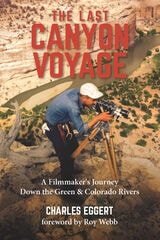
The Last Canyon Voyage
A Filmmaker's Journey Down the Green and Colorado RiversCharles Eggert Foreword by Roy Webb
University of Utah Press, 2020
This book finally brings Eggert’s writings out of the archives and into the public eye. With his keen photographer’s vision and colloquial voice, Eggert describes canyons and towns now deep under water as he tells the story of friendships forged upon the rapids and currents of the rivers. Roy Webb’s foreword provides historical context; river historian Alfred E. Holland Jr. introduces Eggert, the man who transformed into an environmentalist after visiting the West; and Sarah Holcombe’s afterword looks at what transpired in the lives of all eight crew members after the journey. Color and black-and-white illustrations further enliven the text. An engaging read, this is an important piece of river history that also shines light on Eggert’s tremendous influence as a conservation cinematographer.
The Last Century in the History of Judah
The Seventh Century BCE in Archaeological, Historical, and Biblical PerspectivesFilip Čapek
SBL Press, 2019
An incomparable interdisciplinary study of the history of Judah
Experts from a variety of disciplines examine the history of Judah during the seventh century BCE, the last century of the kingdom’s existence. This important era is well defined historically and archaeologically beginning with the destruction layers left behind by Sennacherib’s Assyrian campaign (701 BCE) and ending with levels of destruction resulting from Nebuchadnezzar’s Babylonian campaign (588-586 BCE). Eleven essays develop the current ongoing discussion about Judah during this period and extend the debate to include further important insights in the fields of archaeology, history, cult, and the interpretation of Old Testament texts.
Features
- A new chronological frame for the Iron Age IIB-IIC
- Close examinations of archaeology, texts, and traditions related to the reigns of Hezekiah, Manasseh, and Josiah
- An evaluation of the religious, cultic, and political landscape < /UL>
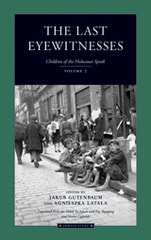
The Last Eyewitnesses, Volume 2
The Children of the Holocaust SpeakJakub Gutenbaum and Agnieszka Latala
Northwestern University Press, 2005
This book serves as a memorial to loved ones who do not even have a grave, as well as a tribute to those who risked their lives and families to save a Jewish child. A wide variety of experiences during the Nazi occupation of Poland are related with wrenching simplicity and candor, experiences that illustrate horrors and deprivation, but also present examples of courage and compassion.
These recollections-whether of hiding in forests or camouflaged bunkers, fighting with groups of partisans, enduring the horrors of concentration camps, or living in fear under disguised identities-serve as eloquent testimony to the depth, diversity, and richness of humanity under siege and offer a powerful lesson for future generations. Written by people who remained in Poland after the war, these accounts convey a great immediacy; the authors are not removed from the environment in which these experiences took place. The psychological impact on these child survivors and the difficulties they encountered even after the war are very poignant. The passing years have brought urgency to the publication of these stories, as those who wrote them are the last surviving eyewitnesses of these tumultuous events.
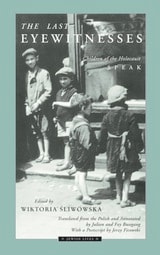
The Last Eyewitnesses
Children of the Holocaust SpeakWiktoria Sliwowska
Northwestern University Press, 1998
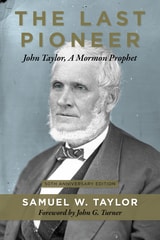
The Last Pioneer
John Taylor, A Mormon ProphetTaylor, Samuel W.
Signature Books, 2026
Mormon prophet John Taylor’s life is usually recounted as a series of anecdotes: singing hymns in Carthage Jail before a mob assassinated Joseph and Hyrum Smith, Taylor’s life spared when, according to myth, his pocketwatch stopped a bullet; his practice of polygamy, including taking a wife fifty years his junior while on the run as a fugitive from federal marshals; and his 1886 revelation that said God would not revoke the law of plural marriage, “for it is everlasting,” a revelation whose authenticity was questioned by the Church of Jesus Christ of Latter-day Saints for over a century but became the foundational text for breakaway sects continuing the practice of polygamy. Yet there was more to Taylor than his role in the martyrdom, his plural wives, his clashes with the federal government, and the legacy of fundamentalist Mormonism.
Taylor spent his first two decades in his home country of England before immigrating to Canada. His first wife, Leonora, was initially more interested when missionaries knocked on their door. But once he committed to the church, John Taylor was unflappable in his faith and zealous in his dedication. The Taylors moved from Toronto to Ohio, then to Missouri, and finally to Illinois as they followed their faith and their prophet Joseph Smith. John became an apostle in 1838 and a publisher thereafter, printing church newspapers. He followed Brigham Young to the Salt Lake Valley, where he became a prominent church and political leader for decades before finally ascending to the head of the faith in 1880.
In this timeless biography, Samuel W. Taylor weaves the threads of his grandfather’s life into a rich tapestry. Drawing on letters, speeches, diaries, and reminiscences, a well-rounded and riveting portrait of the third Mormon prophet comes into focus. A professional writer by trade, Samuel Taylor was uniquely suited to tell this story—and what a story it is.
The Last Thing
Leopold Lahola
Karolinum Press, 2025
Slovak Jewish writer Leopold Lahola was able to escape deportation to a concentration camp and fight in the resistance only to find himself forced into exile by the postwar communist regime. He emerged from obscurity during the brief thaw of the Prague Spring, when he was able to return to his homeland and thrive as a playwright and film director. It was also in 1968 that his short story collection The Last Thing appeared in Slovakia. The collection’s title proved sadly prophetic with the author suffering a fatal heart attack in January 1968, just before his 50th birthday and as his short stories finally appeared in book form.
The nine stories which make up The Last Thing range from the prewar rise of fascism and its dangers for the Jewish community through the concentration camps and the partisan fight against the Germans, concluding in the devastating awareness of all that had been lost and destroyed in the war. Lahola is a master of writing outside of conventional tropes, exploring moral ambivalences where others work within the comforts of good versus evil. He punctures the standard historical image of the partisan fighters by depicting their heroism along with their cruelty and pettiness while also showing how often bravery and madness, kindness and stupidity can coexist. Lahola has written a World War II story collection whose translation will offer not only a compelling read but starkly new perspectives on the tragedy and grandeur of that momentous time in history.
The Lean Lands
By Agustin Yáñez
University of Texas Press, 1968
What was it that flew over with such a terrifying roar? Was it, as many said, the devil, or was it that thing a few had heard of, a flying machine? And those electric lights at Jacob Gallo’s farm, were they witchcraft or were they science?
The theme of this harshly powerful novel is the impact of modern technology and ideas on a few isolated, tradition-bound hamlets in the aftermath of the Mexican Revolution of 1910. The old ways are represented by Epifanio Trujillo, the cacique of the region, now ailing and losing his grip on things; by ancient Madre Matiana, the region’s midwife, healer, counselor, and oracle; by penniless Rómulo and his wife Merced. “Progress” is represented by Don Epifanio’s bastard son Jacob, who acquired money and influence elsewhere during the Revolution and who now, against his father’s will, brings electricity, irrigation, fertilizers, and other modernities to the lean lands—together with armed henchmen. The conflict between the old and the new builds slowly and inexorably to a violent climax that will long remain in the reader’s memory.
The author has given psychological and historical depth to his story by alternating the passages of narrative and dialogue with others in which several of the major characters brood on the past, the present, and the future. For instance, Matiana, now in her eighties, touchingly remembers how she was married and widowed before she had reached her seventeenth birthday. This dual technique is superbly handled, so that people and events have both a vivid actuality and an inner richness of meaning. The impact of the narrative is intensified by the twenty-one striking illustrations by Alberto Beltrán.
The Lieutenant of Kouta
Massa Makan Diabaté
Michigan State University Press, 2017
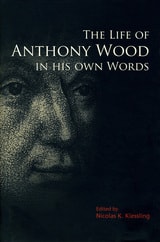
The Life of Anthony Wood in His Own Words
Edited by Nicolas K. Kiessling
Bodleian Library Publishing, 2009
Anthony Wood (1632–95) was an English historian and antiquary best known for his books on the history and antiquities of the University of Oxford as well as Athenae Oxonienses: an Exact History of all the Writers and Bishops who have had their Education in the University of Oxford from 1500 to 1690. Some of the revelations in Athenae Oxonienses were considered scandalous at the time, and a copy of the manuscript was famously burned in protest in front of the Bodleian Library in 1693. Wood’s autobiography reflects his life-long devotion to historiography, and consequently it paints a lively picture of many well known figures in seventeenth century England.
Wood made more contributions to biography, bibliography, and the history of the University and city of Oxford than any other writer before that time. As a result, The Autobiography of Anthony Wood is brimming with information of all kinds, from famous people—including Christopher Wren, John Locke, the physician John Lower, the defiant Catholic Ralph Sheldon, the mathematician John Wallis, and a host of Oxford heads of colleges, vice-chancellors and chancellors—to descriptions of significant events—such as skirmishes between parliamentarian and royalist forces in the 1640s, the atmosphere of Oxford during the parliamentarian occupation, the return of King Charles II in 1660, and the anti-Catholic movement of the 1670s. Based directly upon original sources, this critical edition of Wood’s autobiography offers an entertaining and revealing look at one of the most interesting and turbulent periods in Oxford’s past.
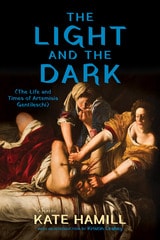
The Light and the Dark
(The Life and Times of Artemisia Gentileschi)Kate Hamill, Kristin Leahey
Northwestern University Press, 2026
A play from the inimitable Kate Hamill, based on the true story of the groundbreaking Italian painter Artemisia Gentileschi
During the seventeenth century, Italian artists strove to reshape the very image of humanity. Artemisia Gentileschi—the daughter of a painter—dreams of making her mark at a time when a woman is not thought capable of being an artist, let alone one of the greats. Just as her career begins to gain unexpected momentum, a series of devastating betrayals crack the foundation of her work—and her life. In electrifying verse and gorgeous artwork, The Light and The Dark depicts the deeply moving true story of a young woman who changed the very image of women in society . . . weaving a magnetic and empowering tapestry of ambition, rage, and resilience across the ages.
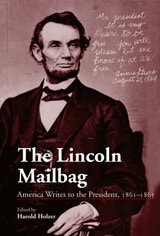
The Lincoln Mailbag
America Writes to the President, 1861-1865Edited by Harold Holzer
Southern Illinois University Press, 2006
As president, Abraham Lincoln received between two hundred and five hundred letters a day—correspondence from public officials, political allies, and military leaders, as well as letters from ordinary Americans of all races who wanted to share their views with him. Here, and in his critically acclaimed volume Dear Mr. Lincoln, editor Harold Holzer has rescued these voices—sometimes eloquent, occasionally angry, at times poetic—from the obscurity of the archives of the Civil War. The Lincoln Mailbag includes letters written by African Americans, which Lincoln never saw, revealing to readers a more accurate representation of the nation’s mood than even the president knew. This first paperback edition of The Lincoln Mailbag includes a new index and fourteen illustrations, and Holzer’s introduction and annotations provide historical context for the events described and the people who wrote so passionately to their president in Lincoln's America.
The Linguistic Dimension of Kant's Thought
Historical and Critical EssaysEdited by Frank Schalow and Richard Velkley
Northwestern University Press, 2014
Among modern philosophers, Immanuel Kant (1724–1804) has few rivals for his influence over the development of contemporary philosophy as a whole. While the issue of language has become a key fulcrum of continental philosophy since the twentieth century, Kant has been overlooked as a thinker whose breadth of insight has helped to spearhead this advance.
The Linguistic Dimension of Kant’s Thought remedies this historical gap by gathering new essays by distinguished Kant scholars. The chapters examine the many ways that Kant’s philosophy addresses the nature of language. Although language as a formal structure of thought and expression has always been part of the philosophical tradition, the “linguistic dimension” of these essays speaks to language more broadly as a practice including communication, exchange, and dialogue.
The Lisle Letters
Edited by Muriel St. Clare Byrne
University of Chicago Press, 1981

The Little Man with the Long Shadow
George S. Mills
University of Iowa Press, 1988
Frederick M. Hubbell, railroad financier and builder, real estate investor, public utilities magnate, leading lawyer, and founder of Iowa’s first life insurance company, the Equitable, was at one time the wealthiest Iowan in the state’s history. Based on his diaries from 1855 to 1927, The Little Man with the Long Shadow tells the story of this industrious and imaginative entrepreneur.
The Lives and Times of Bonnie & Clyde
E. R. Milner
Southern Illinois University Press, 2003
Although the mythology surrounding Bonnie and Clyde is charged with drama and fascination, Milner reveals the truth behind the bloody legend, carefully gleaning materials from obscure locally published accounts, previously untapped court records, and archived but unpublished oral history accounts from some sixty victims, neighbors, relatives, and police who were involved in the exploits of the infamous duo. And the truth proves to be sufficiently exciting. Romance aside, the Barrow gang carved a grisly swath through Texas, Arkansas, Oklahoma, and Missouri. The string of deaths was long— and real: Akota, Oklahoma, sheriff severely wounded, deputy killed; Sherman, Texas, grocery clerk killed; Temple, Texas, man killed as gang attempts to steal his car; Joplin, Missouri, two officers killed; Alma, Arkansas, police officer killed; Crockette, Texas, prison guard killed; Miami, Oklahoma, police officer killed.
Milner traces this violent path until 23 May 1934, when Bonnie and Clyde die in an ambush. Even dead, they draw crowds and are buried in a circus-like atmosphere. In death they continue to intrigue us in ways few criminals had before or have since.
The Lives of Cato the Younger from Ancient Rome to Modern America
Thomas E. Strunk
University of Michigan Press, 2026
The Lockmaster
Christoph Ransmayr
Seagull Books, 2024
A longboat plummets over the Great Falls, drowning the five passengers on board. The Lockmaster, the heir to an ancient title and responsible for guiding river traffic safely around this natural barrier on the White River, ought to have prevented this tragedy. His son is convinced that it was not an accident. Is his irascible father a murderer? A hydraulic engineer all too familiar with the brute force of rivers, he sets out to discover the truth and find his missing father.
The Lockmaster is a dramatic tale set in a world where water has become a precious commodity and Europe has fractured into warring ethno-nationalist entities desperate to uphold the traditions and insignia of a so-called glorious bygone era. Christoph Ransmayr recounts this story in his trademark style, its epic force shot through with visions of future technology and reactionary politics amid a climate breakdown. At heart, though, this novel is the story of a father–son relationship straddling the fault lines between past and present, and an exploration of timeless questions of guilt and forgiveness.
The Long Affair
Thomas Jefferson and the French Revolution, 1785-1800Conor Cruise O'Brien
University of Chicago Press, 1996
"The book is an attack on America's long affair with Jeffersonian ideology of radical individualism: an ideology that, by confusing Jefferson with a secular prophet, will destroy the United States from within."—David C. Ward, Boston Book Review
"With his background as a politician and a diplomat, O'Brien brings a broad perspective to his effort to define Jefferson's beliefs through the prism of his attitudes toward France. . . . This is an important work that makes an essential contribution to the overall picture of Jefferson."—Booklist
"O'Brien traces the roots of Jefferson's admiration for the revolution in France but notes that Jefferson's enthusiasm for France cooled in the 1790s, when French egalitarian ideals came to threaten the slave-based Southern economy that Jefferson supported."—Library Journal
"In O'Brien's opinion, it's time that Americans face the fact that Jefferson, long seen as a champion of the 'wronged masses,' was a racist who should not be placed on a pedestal in an increasingly multicultural United States."—Boston Phoenix
"O'Brien makes a well-argued revisionist contribution to the literature on Jefferson."—Kirkus Reviews
"O'Brien is right on target . . . determined not to let the evasions and cover-ups continue."—Forrest McDonald, National Review
"The Long Affair should be read by anyone interested in Jefferson—or in a good fight."—Richard Brookhiser, New York Times Book Review
The Long March of Basic Trust
Chronicle of Emotions; Notebook 2Alexander Kluge
Seagull Books, 2025
A kaleidoscopic journey through history and the vast landscape of human emotion, The Long March of Basic Trust presents Alexander Kluge at his most expansive and incisive. Moving seamlessly across time and space, Kluge weaves a tapestry of lived and imagined experience, interrogating the forces that shape our resilience in the face of catastrophe. From the wreckage of World War II to the deep time of geology, his singular prose dissolves boundaries between the real and the speculative.
Blurring the lines between fiction and philosophy, Kluge builds an intricate world enriched by hybrid images and his latest experiment: the “virtual camera,” a cinematic eye that captures the interplay of memory and invention. Now in his tenth decade, Kluge continues his lifelong pursuit of uncovering the patterns that connect us and the basic trust that allows us to go on. Both intellectually provocative and deeply humane, this latest installment in his Chronicle of Emotions is a testament to his unmatched ability to fuse thought and feeling into an electrifying literary form.
The Long Night
Andrew Lytle
University of Alabama Press, 1988
A first-rate novel that provides vivid descriptions of Alabama during an important period in the state’s history, The Long Night is set in the vicinity of Montgomery, Alabama, between 1850 and 1865. Originally published in 1936, the book is based on a true story related to Lytle by one of his close friends and colleagues at Vanderbilt University, Frank L. Owsley, who later became the chairman of The University of Alabama Department of History. In fact, the novel opens with a letter to Professor Owsley from the author, and Owsley’s son has written the introduction to this edition.
As described by George B. Tindall, The Long Night is “the episodic story of a young Alabamian beset by the moral dilemma of desire for revenge against the persecutors of his father and his larger duty in the war, a story that rose to its climax in the Battle of Shiloh.” The work is rich in its description of the land and people of Black-Belt Alabama during the mid-19th century.
The Lost Book of Alexander the Great
Andrew Young
Westholme Publishing, 2022
Alexander the Great is well known as one of the first great empire builders of the ancient world. Among those fellow Macedonian officers who accompanied Alexander in his epic conquests from Greece to India was Ptolemy Lagides. Ptolemy served alongside Alexander from the Persian defeat at the Battle of Issus in modern-day Turkey and the journey to find the oracle that proclaimed Alexander to be Zeus incarnate, to the Battle of the Hydaspes River in 326 BC that opened India to the West. Following Alexander’s death, Ptolemy gained control of Egypt where he founded the dynasty in his name, created the great library of Alexandria, and was patron of the mathematician Euclid. Sometime during his rule in Egypt, Ptolemy wrote a history of Alexander’s conquests. Although it is probable that Ptolemy enhanced his own importance, sources indicate that it was regarded as an accurate and even-handed account of the campaigns of Alexander. However, Ptolemy’s book was lost—perhaps with the destruction of the library he founded—and not even an original fragment has survived. His book, however, was acknowledged as a primary source of information for later Roman historians.
In The Lost Book of Alexander the Great, Andrew Young explores the world of ancient writings about the Macedonian leader in order to determine whether any of Ptolemy’s writings can be recovered. Inspired by Stephen Greenblatt’s distinguished biography of Shakespeare, Will in the World, and written for the general reader, the author uses literary forensics to suggest which parts of later books about Alexander the Great, most notably the account by Arrian of Nicomedia, might be the words of Ptolemy. In addition to separating later Roman sensibilities from the original Greek of Ptolemy, the author re-creates the famous library of Alexandria, and takes the reader along on Alexander’s conquests as closely as we can to how Ptolemy may have recounted them.
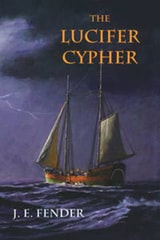
The Lucifer Cypher
J. E. Fender
University Press of New England, 2012
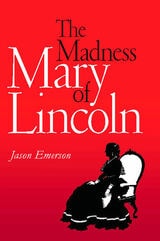
The Madness of Mary Lincoln
Jason Emerson
Southern Illinois University Press, 2007
WINNER, Russell P. Strange Memorial Book of the Year Award from the Illinois State Historical Society, 2007!
University Press Books for Public and Secondary Schools 2013 edition
In 2005, historian Jason Emerson discovered a steamer trunk formerly owned by Robert Todd Lincoln's lawyer and stowed in an attic for forty years. The trunk contained a rare find: twenty-five letters pertaining to Mary Todd Lincoln's life and insanity case, letters assumed long destroyed by the Lincoln family. Mary wrote twenty of the letters herself, more than half from the insane asylum to which her son Robert had her committed, and many in the months and years after.
The Madness of Mary Lincoln is the first examination of Mary Lincoln’s mental illness based on the lost letters, and the first new interpretation of the insanity case in twenty years. This compelling story of the purported insanity of one of America’s most tragic first ladies provides new and previously unpublished materials, including the psychiatric diagnosis of Mary’s mental illness and her lost will.
Emerson charts Mary Lincoln’s mental illness throughout her life and describes how a predisposition to psychiatric illness and a life of mental and emotional trauma led to her commitment to the asylum. The first to state unequivocally that Mary Lincoln suffered from bipolar disorder, Emerson offers a psychiatric perspective on the insanity case based on consultations with psychiatrist experts.
This book reveals Abraham Lincoln’s understanding of his wife’s mental illness and the degree to which he helped keep her stable. It also traces Mary’s life after her husband’s assassination, including her severe depression and physical ailments, the harsh public criticism she endured, the Old Clothes Scandal, and the death of her son Tad.
The Madness of Mary Lincoln is the story not only of Mary, but also of Robert. It details how he dealt with his mother’s increasing irrationality and why it embarrassed his Victorian sensibilities; it explains the reasons he had his mother committed, his response to her suicide attempt, and her plot to murder him. It also shows why and how he ultimately agreed to her release from the asylum eight months early, and what their relationship was like until Mary’s death.
This historical page-turner provides readers for the first time with the lost letters that historians had been in search of for eighty years.
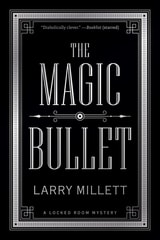
The Magic Bullet
A Locked Room MysteryLarry Millett
University of Minnesota Press, 2020
Enter Shadwell Rafferty: Irishman, St. Paul saloonkeeper, sometime detective, and old friend of the celebrated sleuth Sherlock Holmes. Summoned by Louis B. Hill—son of railroad magnate James J. Hill—to investigate, Rafferty descends into a world dominated by greedy tycoons and awash in political intrigue and wartime fearmongering. Suspects lurk in every corner of the city—including Dodge’s beautiful young widow, his slippery assistant, and a shadowy anarchist—and Rafferty pursues them from the streets of Ramsey Hill and the rooms of the Ryan Hotel to the labyrinthine caves under the Schmidt brewery. Matching wits with his foes at the police department and his unsavory rival, the St. Paul detective Mordecai Jones, Rafferty knows that in order to bring a killer to justice he must first unravel the riddle of a single bullet fired in a locked room, three hundred feet above the streets of St. Paul.
Set during a bitter streetcar strike and amid the clandestine activities of a ruthless commission charged with enforcing wartime patriotism, Larry Millett has created a classic and perfectly executed locked-room mystery in the great tradition of John Dickson Carr. From locked rooms and civil unrest to murder and wartime paranoia, The Magic Bullet presents Rafferty’s most challenging case, and its gripping conclusion—with a timely assist from Sherlock Holmes—finds both Rafferty and Millett at the top of their games.
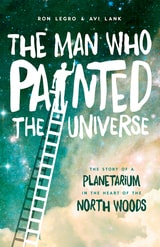
The Man Who Painted the Universe
The Story of a Planetarium in the Heart of the North WoodsRon Legro
Wisconsin Historical Society Press, 2015
The Man Who Painted the Universe: The Story of a Planetarium in the Heart of the North Woods introduces readers to the mild-mannered astronomy enthusiast whose creativity, ingenuity, fervor, and endurance realized a dream of galactic proportions. The story of this stargazer from Wisconsin’s North Woods so inspired two newspapermen, authors Ron Legro and Avi Lank, that they sought to document the story of the Kovac Planetarium for a new generation of stargazers and dreamers.
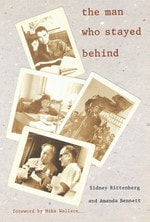
The Man Who Stayed Behind
Sidney Rittenberg and Amanda Bennett
Duke University Press, 2001
Both a memoir and a documentary history of the Chinese revolution from 1949 through the Cultural Revolution, The Man Who Stayed Behind provides a human perspective on China’s efforts to build a new society. Critical of both his own mistakes and those of the Communist leadership, Rittenberg nevertheless gives an even-handed account of a country that is now free of internal war for the first time in a hundred years.
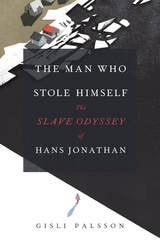
The Man Who Stole Himself
The Slave Odyssey of Hans JonathanGisli Palsson
University of Chicago Press, 2016
The island nation of Iceland is known for many things—majestic landscapes, volcanic eruptions, distinctive seafood—but racial diversity is not one of them. So the little-known story of Hans Jonathan, a free Black man who lived and raised a family in early nineteenth-century Iceland, is improbable and compelling, the stuff of novels.
In The Man Who Stole Himself, Gisli Palsson lays out the story of Hans Jonathan (also known as Hans Jónatan) in stunning detail. Born into slavery in St. Croix in 1784, Hans was taken as a slave to Denmark, where he eventually enlisted in the navy and fought on behalf of the country in the 1801 Battle of Copenhagen. After the war, he declared himself a free man, believing that he was due freedom not only because of his patriotic service, but because while slavery remained legal in the colonies, it was outlawed in Denmark itself. He thus became the subject of one of the most notorious slavery cases in European history, which he lost. Then Hans ran away—never to be heard from in Denmark again, his fate unknown for more than two hundred years. It’s now known that Hans fled to Iceland, where he became a merchant and peasant farmer, married, and raised two children. Today, he has become something of an Icelandic icon, claimed as a proud and daring ancestor both there and among his descendants in America.
The Man Who Stole Himself brilliantly intertwines Hans Jonathan’s adventurous travels with a portrait of the Danish slave trade, legal arguments over slavery, and the state of nineteenth-century race relations in the Northern Atlantic world. Throughout the book, Palsson traces themes of imperial dreams, colonialism, human rights, and globalization, which all come together in the life of a single, remarkable man. Hans literally led a life like no other. His is the story of a man who had the temerity—the courage—to steal himself.
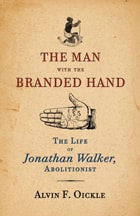
The Man with the Branded Hand
The Life of Jonathan Walker, AbolitionistAlvin F. Oickle
Westholme Publishing, 2011
Captured While Attempting to Smuggle Slaves to Freedom in 1844, the Only Man Branded in a Courtroom by a United States Marshal
Sailing around the Florida Keys in 1844, forty-five-year-old Jonathan Walker had a price on his head. On board the small boat he had built that winter in Alabama were seven fugitives from slavery. The Cape Cod sailor and abolitionist was wanted in Pensacola, Florida, for his crime: stealing slaves. The slaves’ owners had posted $100 each as reward money for their property and $1,000 for Walker’s apprehension. Only a day’s sail from their goal of freedom in British-controlled Bahamas, Walker and the slaves were stopped and seized by bounty hunters and taken to a Key West court. Ordered back to Pensacola for trial, Walker ended up spending a year in jail. He was fined and sentenced to stand in the pillory; in addition, he was to suffer a unique punishment in American history: while a packed courtroom watched, a United States marshal was ordered to use a hot branding iron to burn the letters SS, for “slave stealer,” into Walker’s right hand.
Walker survived his ordeal, spending much of his incarceration in isolation. Once released, he remained active in the antislavery movement even while he and his devoted wife Jane raised their nine children. His attempt to help form a new colony in Mexico for runaway American slaves also led to punishing experiences for Walker and one of his sons. Living later with his family in Plymouth, Massachusetts, in the years before the Civil War, Walker made room in his crowded house to shelter runaway slaves along the Underground Railroad. He participated in abolitionist lecture tours across the North where he would be urged to reveal his branded hand—made famous by John Greenleaf Whittier’s poem “The Branded Hand”—to astonished audiences. Too old to enlist in the Civil War, Walker instead headed to Virginia in the war’s final year to help educate African Americans fleeing Confederate forces. In The Man With the Branded Hand: The Life of Jonathan Walker, Abolitionist, distinguished journalist Alvin F. Oickle relates this entire remarkable story of a life devoted to the supposition that “all men are created equal.”
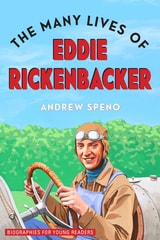
The Many Lives of Eddie Rickenbacker
Andrew Speno
Ohio University Press, 2020
The life story of a daredevil who became a war hero will fascinate adventurous young readers with its tales of survival.
At age thirteen, following the death of his father, young Eddie dropped out of school and joined the workforce. Through a combination of smarts, hard work, and perseverance, Rickenbacker would grow up to become an automobile mechanic, a race car driver, a fighter pilot, an entrepreneur, a war hero, a business executive, and a staunch advocate for hard work and personal responsibility.
Along the way he lived on the line between recklessness and courage. He survived dozens of accidents, coming close to death more than once. During the earliest years of American automobile racing, Rickenbacker was “the most daring and withal the most cautious driver” on the circuit. How could he have been both daring and cautious? This book invites young readers to decide for themselves as they follow Rickenbacker on his many hair-raising adventures.
The Many Lives of a Jesuit, Freemason, and Philanthropist
The Story of Töhötöm NagyÉva Petrás
Central European University Press, 2024
The life of Töhötöm Nagy (1908–1979), Jesuit, Mason, and secret service agent, offers fascinating insights into interwar Hungary, the Catholic Church and Vatican diplomacy, Freemasonry, and the activities of communist state security service.
As a young Jesuit Nagy was one of the leaders of a successful Catholic youth movement in interwar Hungary. After World War II he played an important role acting as an intermediary between the Vatican, the Red Army, and the Hungarian Catholic Church. After being sent to South America, he was attracted by liberation theology, but left the Society of Jesus, joined the Freemasons, and did social and philanthropic work in the slums of Buenos Aires. However, in the late 1960s he agreed to work for the Hungarian state security service in return for his repatriation. This latter period is reconstructed from the files of the Historical Archives of State Security in Budapest. Éva Petrás writes with empathy but with a sense of distance of the courage and restless energy of her subject. Her discussion of the limits of free choice and Nagy’s intense struggle to live a meaningful life make this biography breathtaking.
The Master
Patrick Rambaud
Seagull Books, 2023
“It was twenty-five centuries ago in the land of Song, between the Yellow River and the River Huai: Zhuang Zhou was born without a cry with his eyes wide open.”
Welcome to China in the fifth century BCE, a colorful, violent, unstable world into which Zhuang is born. Here royals raise huge armies, constantly waging wars against one another. They have slaves, concubines. Gold is everywhere. And so is hunger. Born rich and entitled, Zhuang learns to refuse any official function. His travels bring him closer to ordinary people, from whom he learns how to live a simple and useful life. This is how he will become one of the greatest Chinese philosophers who gave his name to his legendary book, the Zhuangzi, one of the two foundational texts of Taoism—a magnificent procession of lively stories in which we meet dwarfs, virtuous bandits, butchers, powerful lords in their castles, turtles, charming concubines, and false sages. In this remarkable bildungsroman, award-winning French novelist Patrick Rambaud spins out the extraordinary life of Zhuang Zhou—a poetic, cruel, and often humorous tale, halfway between fable and philosophy.

The Maverick and the Machine
Governor Dan Walker Tells His StoryDan Walker
Southern Illinois University Press, 2007
Best Memoir of 2008, San Diego Book Awards
Illinois State Historical Society Certificate of Excellence, 2008
The Measure of the World
A NovelDenis Guedj
University of Chicago Press, 2001
The Measure of the World by Denis Guedj tells the story of this strange and wonderful effort. Not a traditional history of science, the book is a novelistic account of the measurement project that relies heavily on archival sources. A more "traditional" history could not possibly describe how a sober scientific enterprise could turn into a journey filled with adventures and experiences so bizarre as to be hardly credible. In the tumultuous days of revolutionary and postrevolutionary France, Méchain and Delambre were objects of suspicion as they traveled through the provinces, climbing steeples and deploying strange instrumentsthey were detained as spies, taken for charlatans or fleeing royalists, and arrested for debt. Their perilous labors lasted until 1799, when the meter was formally established.
Arthur Goldhammer's crisp translation of this wonderful novel retains the flavor of the original, and an appendix explaining Guedj's use of historical materials is included. A vivid re-creation of a fascinating and troubling period in history juxtaposed with the achievement of a complicated scientific undertaking, The Measure of the World is a marvelous book-not science fiction, but fiction about science.
Denis Guedj is the author of La évolution des savants and L'Empire des nombres, among other books. La Mesure du monde was awarded the Prix d'Institut in 1989. Arthur Goldhammer is an award-winning translator who has translated works by Emmanuel Le Roy Ladurie, Jacques Le Goff, and Jean Starobinski.
The Memory of Elephants
A NovelBoman Desai
University of Chicago Press, 2001
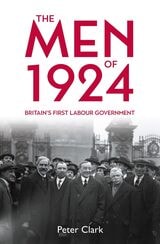
The Men of 1924
Britain’s First Labour GovernmentPeter Clark
Haus Publishing, 2023
In January of 1924, the cabinet of the first Labour government consisted of twenty white, middle-aged men, as it had for generations. But the election also represented a radical departure from government by the ruling class. Most members of the administration had left school by the age of fifteen. Five of them had started work by the time they were twelve years old. Three were working down the mines before they entered their teens. Two were illegitimate, one was abandoned at birth, and three were of Irish immigrant descent. For the first time in Britain’s history, the cabinet could truly be said to represent all of Britain’s social classes. This unheralded revolution in representation is the subject of Peter Clark’s fascinating new book, The Men of 1924. Who were these men? Clark’s vivid portrayal is full of evocative portraits of a new breed of politician, the forerunners of all those who, later in the last century and this one, overcame a system from which they had been excluded for too long.
The Men of Cajamarca
A Social and Biographical Study of the First Conquerors of PeruBy James Lockhart
University of Texas Press, 1972
In November 1532, a group of 168 Spaniards seized the Inca emperor Atahuallpa in the town of Cajamarca, in the northern Peruvian highlands. Their act, quickly taken as a symbol of the conquest of a vast empire, brought them unprecedented rewards in gold and silver; it made them celebrities, gave them first choice of positions of honor and power in the new Peru of the Spaniards, and opened up the possibility of a splendid life at home in Spain, if they so desired. Thus they became men of consequence, at the epicenter of a swift and irrevocable transformation of the Andean region. Yet before that memorable day in Cajamarca they had been quite unexceptional, a reasonable sampling of Spaniards on expeditions all over the Indies at the time of the great conquests.
The Men of Cajamarca is perhaps the fullest treatment yet published of any group of early Spaniards in America. Part I examines general types, characteristics, and processes visible in the group as representative Spanish immigrants, central to the establishment of a Spanish presence in the New World’s richest land. The intention is to contribute to a changing image of the Spanish conqueror, a man motivated more by pragmatic self-interest than by any love of adventure, capable and versatile as often as illiterate and rough. Aiming at permanence more than new landfalls, these men created the governmental units and settlement distribution of much of Spanish America and set lasting patterns for a new society.
Part II contains the men’s individual biographies, ranging from a few lines for the most obscure to many pages of analysis for the best-documented figures. The author traces the lives of the men to their beginnings in Spain and follows their careers after the episode in Cajamarca.
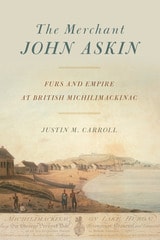
The Merchant John Askin
Furs and Empire at British MichilimackinacJustin M. Carroll
Michigan State University Press, 2017
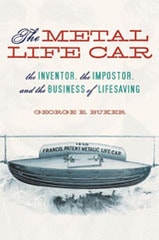
The Metal Life Car
The Inventor, the Impostor, and the Business of LifesavingGeorge E. Buker
University of Alabama Press, 2008
Engineering the battlefield—one armored advance at a time.
For centuries sailing vessels crept along the coastline, ready to flee ashore in case of danger or trouble; this worked well until weather or poor sailing drove these ships against an unforgiving coast. Saviors and salvors (often the same people) struggled to rescue both humans and cargo, often with results as tragic for them as for the sailors and passengers.
Joseph Francis (b. Boston, Massachusetts, 1801) was an inventor who also had the ability to organize a business to produce his inventions and the salesmanship to sell his products. His metal lifeboats, first used in survey expeditions in Asia Minor and Central America, came into demand among the world’s merchant marine, the U.S. Navy, and the U.S. Revenue Service. His corrugated “life car” was the keystone to development of the U.S. Life-Saving Service. Francis’s metal bateaux and lifeboats played an important role in the Third Seminole War in Florida. His metal pontoon army wagons served in the trans-Mississippi campaigns against the Indians.
In Europe, he was acclaimed as a genius and sold patent rights to shipyards in Liverpool and the Woolwich Arsenal in England, Le Havre seaport in France, in the free city of Hamburg, and in the Russian Empire. But while Francis was busy in Europe, Captain Douglass Ottinger, U.S. Revenue Marine Service, claimed to be the inventor of Francis’s life car and obtained support in the U.S. Congress and the Patent Office for his claim. Francis had to battle for decades to prove his rights, and Americans remained generally unfamiliar with his devices, thereby condemning Civil War armies to inferior copies while Europe was using, and acclaiming, his inventions.
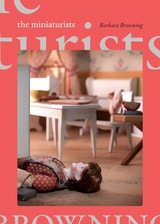
The Miniaturists
Barbara Browning
Duke University Press, 2022
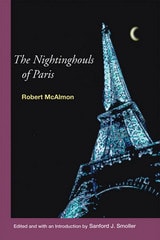
The Nightinghouls of Paris
Robert McAlmon. Edited and with an Introduction by Sanford J. Smoller
University of Illinois Press, 2006
The Nightinghouls of Paris is a thinly fictionalized memoir of the darker side of expatriate life in Paris. Beginning in 1928, the story follows the changes undergone by Canadian youths John Glassco and his friend Graeme Taylor during their (mis)adventures in Paris while trying to become writers. There they meet Robert McAlmon, who guides them through the city’s cafes, bistros, and nightclubs, where they find writers and artists including Kay Boyle (with whom Glassco has a fling), Bill Bird, Djuna Barnes, Claude McKay, Hilaire Hiler, Peggy Guggenheim, and Ernest Hemingway.
Fleeing France in late 1940, Robert McAlmon lost his notebook manuscripts and draftedThe Nightinghouls of Paris from memory. Till now, it has existed solely as a typescript held by Yale University. Unlike most memoirs of American expatriates in the ‘20s, The Nightinghouls of Paris centers not only on writers, but also encompasses the racial, national, and social mélange they encountered in everyday life.
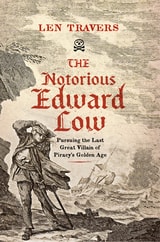
The Notorious Edward Low
Pursuing the Last Great Villain of Piracy's Golden AgeLen Travers
Westholme Publishing, 2025
In The Notorious Edward Low: Pursuing the Last Great Villain of Piracy’s Golden Age, historian Len Travers reexamines this critical period through the career of Low, a complicated pirate leader, and his nemesis, Peter Solgard, captain of the Royal Navy warship HMS Greyhound. By the time Solgard, aboard Greyhound, was tracking Low in 1723, the era’s other notable pirates were gone—dead, captured, or disappeared. Drawing on previously unpublished Admiralty records and consulting both contemporary and modern chroniclers, Travers directs readers to much powerful testimony minimized in or excluded from histories of piracy’s “Golden Age,” leveling a critical eye at familiar sources too long accepted at face value. Travers demonstrates that, feared as they certainly were, pirates were largely ordinary seamen trapped in desperate circumstances who, in the end, had little to show for their efforts. Contrary to popular portrayals, for pirates the second decade of the eighteenth century was a time of radically diminishing returns, scant treasure, buried or otherwise, and increasingly successful suppression by state authorities. One by one, safe havens shut out the sea-rovers, who with their depredations in America quickly squandered the sympathy and support they had once enjoyed among common folk. The Notorious Edward Low puts individual actors, from colonial governors to captains to common seamen, at center stage, and reveals how British authorities used new anti-piracy laws to reclaim a measure of authority over their fractious North American colonies—a compelling and meaningful story with its own brand of true-life swashbuckling on the high seas.
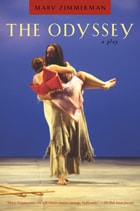
The Odyssey
A PlayMary Zimmerman
Northwestern University Press, 2006
With her trademark irreverent and witty twist on classic works, Zimmerman brings to life the story of Odysseus's ten-year journey
This dramatic adaptation of Homer's myth begins with a modern young woman who is struggling to understand Robert Fitzgerald's translation of The Odyssey. A classical muse appears, and the young woman becomes the goddess Athena--a tireless advocate for Odysseus in his struggle to get home. Zimmerman's adaptation depicts his encounters with characters such as Circe, the Cyclops, Poseidon, Calypso, the Sirens, and others in new and exciting ways.
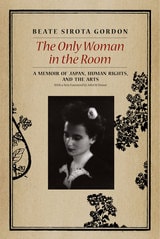
The Only Woman in the Room
A Memoir of Japan, Human Rights, and the ArtsBeate Sirota Gordon
University of Chicago Press, 2014
Sirota was born in Vienna, but in 1929 her family moved to Japan so that her father, a noted pianist, could teach, and she grew up speaking German, English, and Japanese. Russian, French, Italian, Latin, and Hebrew followed, and at fifteen Sirota was sent to complete her education at Mills College in California. The formal declaration of World War II cut Gordon off from her parents, and she supported herself by working for a CBS listening post in San Francisco that would eventually become part of the FCC. Translating was one of Sirota’s many talents, and when the war ended, she was sent to Japan as a language expert to help the American occupation forces. When General MacArthur suddenly created a team that included Sirota to draft the new Japanese Constitution, he gave them just eight days to accomplish the task. Colonel Roest said to Beate Sirota, “You’re a woman, why don’t you write the women’s rights section?”; and she seized the opportunity to write into law guarantees of equality unparalleled in the US Constitution to this day.
But this was only one episode in an extraordinary life, and when Gordon died in December 2012, words of grief and praise poured from artists, humanitarians, and thinkers the world over. Illustrated with forty-seven photographs, The Only Woman in the Room captures two cultures at a critical moment in history and recounts, after a fifty-year silence, a life lived with purpose and courage. This edition contains a new afterword by Nicole A. Gordon and an elegy by Geoffrey Paul Gordon.
The Osage Rose
Tom Holm
University of Arizona Press, 2008
Life is looking easy for J. D. Daugherty, a crusty ex-cop who has set up his own PI firm in Tulsa, Oklahoma, just after World War I. J. D. expects to make a straightforward living off the intrigues of the city’s wealthy socialites, but then Rose Chichester, a privileged young white woman, runs off with Tommy Ruffle, a young Indian who is heir to Osage oil. Hired by Rose’s father to track down the young pair, J. D. and his associate, a Cherokee named Hoolie Smith, find themselves caught in the cross fire of a deadly scheme. When Tommy turns up murdered and with Rose still missing, J. D. and Hoolie must navigate a twisting maze of deception, race riots, and gun battles in their unrelenting search for the truth—a search that ultimately leads to an intimate secret no one suspected.
Tom Holm writes a true private-eye mystery, yet he entwines the story’s layers of conspiracy and deceit with the realities of prejudice and hatred that existed during the early years of Oklahoma statehood. Rooted firmly in its time, Holm’s well-researched novel tells a complex and compelling story of individuals struggling to find justice at any cost in a world still caught between modernity and its Wild West legacy.
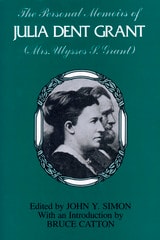
The Personal Memoirs of Julia Dent Grant
(Mrs. Ulysses S. Grant)Edited by John Y. Simon
Southern Illinois University Press, 1975
Written in the early twentieth century for her children and grandchildren and first published in 1975, these eloquent memoirs detail the life of General Ulysses S. Grant’s wife. First Lady Julia Dent Grant wrote her reminiscences with the vivacity and charm she exhibited throughout her life, telling her story in the easy flow of an afternoon conversation with a close friend. She writes fondly of White Haven, a plantation in St. Louis County, Missouri, where she had an idyllic girlhood and later met Ulysses.
In addition to relating the joys she experienced, Grant tells about the difficult and sorrowful times. Her anecdotes give fascinating glimpses into the years of the American Civil War. One recounts the night President Abraham Lincoln was assassinated. Grant insisted she and her husband turn down an invitation to the theater. Her decision saved her husband’s life: like Lincoln, he too had been marked for assassination.
Throughout these memoirs, which she ends with her husband’s death, Grant seeks to introduce her descendants to both her and the man she loved. She also strives to correct misconceptions that were circulated about him. She wanted posterity to share her pride in this man, whom she saw as one of America’s greatest heroes. Her book is a testament to their devoted marriage.
This forty-fifth-anniversary edition includes a new foreword by John F. Marszalek and Frank J. Williams, a new preface by Pamela K. Sanfilippo, the original foreword by Bruce Catton, the original introduction by editor John Y. Simon, recommendations for further reading, and more than twenty photographs of the Grants, their children, and their friends.
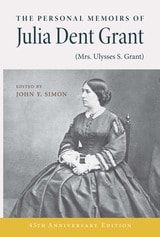
The Personal Memoirs of Julia Dent Grant
(Mrs. Ulysses S. Grant)Edited by John Y. Simon
Southern Illinois University Press, 1975
Written in the early twentieth century for her children and grandchildren and first published in 1975, these eloquent memoirs detail the life of General Ulysses S. Grant’s wife. First Lady Julia Dent Grant wrote her reminiscences with the vivacity and charm she exhibited throughout her life, telling her story in the easy flow of an afternoon conversation with a close friend. She writes fondly of White Haven, a plantation in St. Louis County, Missouri, where she had an idyllic girlhood and later met Ulysses.
In addition to relating the joys she experienced, Grant tells about the difficult and sorrowful times. Her anecdotes give fascinating glimpses into the years of the American Civil War. One recounts the night President Abraham Lincoln was assassinated. Grant insisted she and her husband turn down an invitation to the theater. Her decision saved her husband’s life: like Lincoln, he too had been marked for assassination.
Throughout these memoirs, which she ends with her husband’s death, Grant seeks to introduce her descendants to both her and the man she loved. She also strives to correct misconceptions that were circulated about him. She wanted posterity to share her pride in this man, whom she saw as one of America’s greatest heroes. Her book is a testament to their devoted marriage.
This forty-fifth-anniversary edition includes a new foreword by John F. Marszalek and Frank J. Williams, a new preface by Pamela K. Sanfilippo, the original foreword by Bruce Catton, the original introduction by editor John Y. Simon, recommendations for further reading, and more than twenty photographs of the Grants, their children, and their friends.
The Pistol
James Jones
University of Chicago Press, 2003
The Play of Allusion in the Historia Augusta
David Rohrbacher
University of Wisconsin Press, 2015
The Play of Allusion in the Historia Augusta
David Rohrbacher
University of Wisconsin Press, 2020
The Plea
The True Story of Young Wesley Elkins and His Struggle for RedemptionPatricia L. Bryan
University of Iowa Press, 2022
On a moonlit night in 1889, Iowa farmer John Elkins and his young wife, Hattie, were brutally murdered in their bed. Eight days later, their son, eleven-year-old Wesley Elkins, was arrested and charged with murder. The community reeled with shock by both the gruesome details of the homicides and the knowledge of the accused perpetrator—a small, quiet boy weighing just 75 pounds.
Accessible and fast-moving, The Plea delivers a complete, complex, and nuanced narrative of this horrific crime, while shedding light on the legal, social, and political environment of Iowa and the country in the late 1800s and early 1900s.