Results by title
1787 books match the query 'Literary Collections' and 471 start with t

The Complete Works of Robert Browning, Volume II
With Variant Readings And AnnotationsRobert Browning
Ohio University Press, 1971
In seventeen volumes, copublished with Baylor University, this acclaimed series features annotated texts of all of Robert Browning’s known writing. The series encompasses autobiography as well as influences bearing on Browning’s life and career and aspects of Victorian thought and culture.
Volume II contains Browning’s play, Strafford: An Historical Tragedy (1837), and the long poem, Sordello (1840). Strafford was Browning’s first play, based on the tragic life of Thomas Wentworth, Earl of Strafford. The editors note that the play had only four performances, “undoubtedly due… to its esoteric subject and bad acting.” Sordello is a fictionalized version of the life of Sordello da Goito, a 13th century Italian troubadour. The poem itself was famously known for being “difficult.”
As always in this acclaimed series, a complete record of textual variants is provided, as well as extensive explanatory notes.
The Complete Works of Robert Browning, Volume III
With Variant Readings And AnnotationsRobert Browning
Ohio University Press, 1972
In seventeen volumes, copublished with Baylor University, this acclaimed series features annotated texts of all of Robert Browning’s known writing. The series encompasses autobiography as well as influences bearing on Browning’s life and career and aspects of Victorian thought and culture.
Volume III contains Browning’s dramatic piece, Pippa Passes (1841), which Arthur Symons said was “Browning’s most perfect work”; another play King Victor and King Charles; A Tragedy, which Browning described as “the first artistic consequence of what Voltaire termed ‘a terrible event without consequences‘“; the “Essay on Chatterton,” which appeared anonymously in the Foreign Quarterly Review in July, 1842; the play The Return of the Druses: A Tragedy (1843); and the short pieces of Dramatic Lyrics, which contain some of Browning’s finest and most popular works such as “My Last Duchess,” “The Soliloquy of the Spanish Cloister,” and “The Pied Piper of Hamelin.”
As always in this acclaimed series, a complete record of textual variants is provided, as well as extensive explanatory notes.
The Complete Works of Robert Browning, Volume IX
With Variant Readings and AnnotationsRobert Browning
Ohio University Press, 1990
The Complete Works of Robert Browning, Volume V
With Variant Readings and AnnotationsRoma A. King Jr.
Ohio University Press, 1981
The Complete Works of Robert Browning, Volume VI
With Variant Readings and AnnotationsRobert Browning
Ohio University Press, 1996
In seventeen volumes, copublished with Baylor University, this acclaimed series features annotated texts of all of Robert Browning’s known writing. The series encompasses autobiography as well as influences bearing on Browning’s life and career and aspects of Victorian thought and culture.
The sixth in the projected seventeen-volume work, this volume covers the second half of Men and Women (1855), perhaps Browning’s most famous collection, and the entirety of Dramatis Personae (1864), the first book Browning produced after the death of Elizabeth Barrett Browning in 1861.
Men and Women II contains several great dramatic poems on which Browning’s reputation still depends, including “Andrea del Sarto,” “Saul,” and “Cleon.” It also includes the more intimate and personal works “The Guardian Angel” and “One Word More,” as well as the mysterious “Women and Roses.” The Brownings‘ shared interests in Renaissance art and nineteenth-century Italian politics inform the challenging “Old Pictures in Florence.”
The publication of Dramatis Personae was a key event in the rapid rise of Browning’s fame in the 1860s, though the collection is marked by a welter of conflicting impulses that arose after the poet left Italy and his married life behind. The classic monologues “Rabbi Ben Ezra” and “Abt Vogler” are here, but beside them Browning placed the nearly surreal “Caliban upon Setebos” and the achingly self-regarding “James Lee’s Wife,” one of the volume’s handful of dramatic lyrics about betrayed or failed relationships. Also included are “A Death in the Desert,” which contributed to the intense Victorian debate about scriptural validity and religious authority; and “Mr Sludge, ’The Medium,‘” Browning’s ferocious, pyrotechnic exposé of a spiritualist fraud.
As always in this acclaimed series, a complete record of textual variants is provided, as well as extensive explanatory notes.
The Complete Works of Robert Browning, Volume VII
With Variant Readings and AnnotationsRobert Browning
Ohio University Press, 1985
The first complete edition of the works of Robert Browning with variant readings and annotations contains: 1. The entire contents of the first editions of Browning’s work; 2. All prefaces and dedications which Browning wrote for his own works and for those of Elizabeth Barrett Browning and others; 3. The two prose essays: The Essay on Chatterton and The Essay on Shelley; 4. The front matter and tables of contents of each of the collected editions (1849, 1863, 1865, 1868, 1888–1889) which Browning himself saw through the press; 5 Poems by Browning published during his lifetime but not collected by him; 9. Poems not published during Browning’s lifetime which have come to light since his death; 7. John Forster’s Thomas Wentworth, Earl of Strafford to which Browning contributed significantly, though to what precise extent has not been determined.
The edition provides a full apparatus, including variant readings and annotations.
The Complete Works of Robert Browning, Volume X
With Variant Readings and AnnotationsRobert Browning
Ohio University Press, 1999
Browning began a poem on Louis Napoleon in 1860, but not until after the fall of the Second Empire in 1870 did he attempt a full-scale portrait of the French emperor. As an exercise in self-justification, Prince Hohenstiel-Schwangau falls into a familiar sub-genre of Browning's dramatic monologues. The most intriguing aspect of the poem lies in its biographical importance: the character and career of Napoleon III was a topic of sustained, sharp disagreement between Robert and Elizabeth Browning.
As always in this acclaimed series, a complete record of textual variants is provided, as well as extensive explanatory notes.
The Complete Works of Robert Browning, Volume XI
With Variant Readings and AnnotationsRobert Browning
Ohio University Press, 2008
In seventeen volumes, copublished with Baylor University, this acclaimed series features annotated texts of all of Robert Browning’s known writing. The series encompasses autobiography as well as influences bearing on Browning’s life and career and aspects of Victorian thought and culture.
Volume XI of The Complete Works of Robert Browning contains two strikingly disparate long poems from the 1870s, Fifine at the Fair and Red Cotton Night-Cap Country. In Fifine at the Fair, Browning creates an idiosyncratic version of the Don Juan figure, a distinctly post-Romantic and intellectual Don Juan who derives little from any literary predecessor. The legendary character is realized in a modern French setting, the village of Pornic, a favorite vacation spot for Browning. The poem is a sustained exercise in self-justification and casuistry, with Don Juan persuading himself that he can reconcile his love of his wife with his carnal love for a gipsy girl.
Though Red Cotton Night-Cap Country is similarly concerned with a struggle between spirit and flesh, the poem is entirely based in contemporary events. Using newspaper accounts and legal documents, Browning tells the strange and shocking tale of a rich and devout Frenchman who throws himself from the roof of his chateau, convinced that heaven will deliver him from death. Upon the question of his sanity hinges the disposition of his considerable estate, and the poet traces the claims and counterclaims to their settlement in court only a few months before he wrote the poem.
As always in this series of critical editions, a complete record of textual variants is provided, as well as extensive explanatory notes.
The Complete Works of Robert Browning, Volume XIII
With Variant Readings and AnnotationsRobert Browning
Ohio University Press, 1995
The Complete Works of Robert Browning, Volume XIV
With Variant Readings and AnnotationsRobert Browning
Ohio University Press, 2003
In seventeen volumes, copublished with Baylor University, this acclaimed series features annotated texts of all of Robert Browning’s known writing. The series encompasses autobiography as well as influences bearing on Browning’s life and career and aspects of Victorian thought and culture.
Volume XIV of The Complete Works of Robert Browning records a transition in the poet’s career. With The Agamemnon of Aeschylus (1877), Browning ended his experiments with classical sources, creating his “transcript” — not quite a translation — of the Greek original and providing an intriguing explanation for his approach. La Saisiaz, the deeply personal expression of Browning’s shock at the sudden death of a dear friend, was published in 1878 with The Two Poets of Croisic, an extended ironic meditation on literary fame. Browning’s collection of six poems under the title Dramatic Idyls (1879) marks the poet’s return to the dramatic forms he perfected in Men and Women and Dramatis Personae, and a revival of his interest in the psychology of motives.
As always in this acclaimed series, a complete record of textual variants is provided, as well as extensive explanatory notes.
The Complete Works of Robert Browning, Volume XV
With Variant Readings and AnnotationsRobert Browning
Ohio University Press, 2007
The Complete Works of Robert Browning, Volume XVI
With Variant Readings and AnnotationsRobert Browning
Ohio University Press, 1998
In seventeen volumes, copublished with Baylor University, this acclaimed series features annotated texts of all of Robert Browning’s known writing. The series encompasses autobiography as well as influences bearing on Browning’s life and career and aspects of Victorian thought and culture.
Robert Browning wrote Parleyings with Certain People of Importance in Their Day in his seventy-third year. The work is a capstone to the poet’s long career, encompassing autobiography as well as influences bearing on the poet’s life and career and on Victorian thought and culture in general. One of Browning’s most complex works, Parleyings is also a work essential to understanding his genius and career as a whole. The Ohio/Baylor Browning edition offers keys to the complexity and interest of Parleyings through a definitive, emended text, full annotations for allusions both explicit and implicit in the text, and variant readings for the manuscript and all editions revised by Browning during his lifetime.
In form and structure, Parleyings is a series of seven poems written in Browning’s own voice and addressed to figures influential in his development. The series is framed by a prologue and an epilogue, the whole amounting to some 3,500 lines. The poems are a formal contrast and a pendant to the great series of linked dramatic monologues in The Ring and the Book. They demonstrate the zest for innovation possessed by the master of the dramatic monologue in his ripe maturity. Interested readers as well as students and scholars of Browning will find a rich field of poetry and a critical mass of resources in Volume XVI of the Ohio/Baylor Browning edition.
As always in this acclaimed series, a complete record of textual variants is provided, as well as extensive explanatory notes.
The Complete Writings and Selected Correspondence of John Dickinson
Volume 1Jane E. Calvert
University of Delaware Press, 2011
The Complete Writings and Selected Correspondence of John Dickinson
Volume 2Jane E. Calvert
University of Delaware Press, 2021
Dickinson’s hard work on behalf of his clients brought him success in other areas of his public life. In October 1759, he was elected to his first public position as a representative for Kent County, Del., the following year he was elevated to the position of speaker, and in 1762, he became a representative for Philadelphia County, Pa. As a legislator in two colonies, learning his craft as a global war unfolded, he contributed to bills on military and defense, Indian relations, infrastructure improvements and city management, and served on various committees. The death of George II occasioned debates over laws and judges, in which Dickinson participated. This era concludes with Dickinson playing a central role in managing the unfolding Paxton Riots, in which frontiersmen massacred peaceful Indians and threatened the Quaker leadership of Pennsylvania.
In private, Dickinson lost the two most prominent male figures in his life in 1760, his father, Samuel, and soon thereafter, his mentor, colleague, and friend, John Moland. In honor of Moland, Dickinson published a poem and became a proxy head to Moland’s large family. Though his extant correspondence during this period is small, he exchanged letters with Mary Cadwalader Dickinson, Israel Pemberton, William Allason, George Read, Thomas McKean, and others. Perhaps most significant, he wrote a lengthy, unpublished essay on the flag-of-truce trade and also maintained commonplace books as he considered his place within the British Empire, opening up the next phase in Dickinson’s life as a leader of the resistance against Britain.
Published by the University of Delaware Press. Distributed worldwide by Rutgers University Press.
The Complete Writings and Selected Correspondence of John Dickinson
Volume 3Jane E. Calvert
University of Delaware Press, 2024
The Complete Writings and Selected Correspondence of John Dickinson
Volume 4, 1767-1769John Dickinson
University of Delaware Press, 0
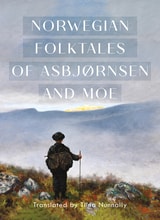
The Complete and Original Norwegian Folktales of Asbjørnsen and Moe
Peter Christen Asbjørnsen
University of Minnesota Press, 2019
The definitive English translation of the celebrated story collection regarded as a landmark of Norwegian literature and culture—now in paperback
The extraordinary folktales collected by Peter Christen Asbjørnsen and Jørgen Moe began appearing in Norway in 1841. Over the next two decades the publication of subsequent editions under the title Norske folkeeventyr made the names Asbjørnsen and Moe synonymous with Norwegian storytelling traditions. Tiina Nunnally’s vivid translation of their monumental collection is the first new English translation in more than 150 years—and the first ever to include all sixty original tales.
Magic and myth inhabit these pages in figures both familiar and strange. Giant trolls and talking animals are everywhere. The winds take human form. A one-eyed old woman might seem reminiscent of the Norse god Odin. We meet sly aunts, resourceful princesses, and devious robbers. The clever and fearless boy Ash Lad often takes center stage as he ingeniously breaks spells and defeats enemies to win half the kingdom. These stories, set in Norway’s majestic landscape of towering mountains and dense forests, are filled with humor, mischief, and sometimes surprisingly cruel twists of fate. All are rendered in the deceptively simple narrative style perfected by Asbjørnsen and Moe—now translated into an English that is as finely tuned to the modern ear as it is true to the original Norwegian.
Included here—for the very first time in English—are Asbjørnsen and Moe’s Forewords and Introductions to the early Norwegian editions of the tales. Asbjørnsen gives us an intriguing glimpse into the actual collection process and describes how the stories were initially received, both in Norway and abroad. Equally fascinating are Moe’s views on how central characters might be interpreted and his notes on the regions where each story was originally collected. Nunnally’s informative Translator’s Note places the tales in a biographical, historical, and literary context for the twenty-first century.
The Norwegian folktales of Asbjørnsen and Moe are timeless stories that will entertain, startle, and enthrall readers of all ages.
The Conscript
A Novel of Libya’s Anticolonial WarGebreyesus Hailu
Ohio University Press, 2013
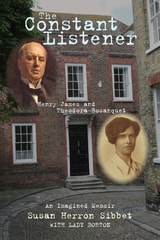
The Constant Listener
Henry James and Theodora Bosanquet—An Imagined MemoirSusan Herron Sibbet
Ohio University Press, 2017
In 1907, in a quiet English village, Theodora Bosanquet answered Henry James’s call for someone to transcribe his edits and additions to his formidable body of work. The aging James had agreed to revise his novels and tales into the twenty-four-volume New York Edition. Enter Bosanquet, a budding writer who would record the dictated revisions and the prefaces that would become a lynchpin of his legacy.
Embracing the role of amanuensis and creative counterpoint cautiously at first, Bosanquet kept a daily diary over the nine years that she worked with James, as their extraordinary partnership evolved. Bosanquet became the first audience for James’s compositions and his closest literary associate—and their relationship ultimately resulted in James’s famed “deathbed dictations.” At the same time, the homosexuality of each was an unspoken but important influence on their mutual support and companionship.
Susan Herron Sibbet’s posthumous novel gifts us with the voice of a young woman writer drawn into the intimate circle of an aging master, and is a moving addition to previous literary treatments of James and Bosanquet, even as it hews closer to fact than other works do. The Constant Listener is itself the work of an accomplished poet, and will speak to fans of James, historical fiction, and themes of art, love, sexuality, and identity.

The Continental Model
Selected French Critical Essays of the Seventeenth Century in English TranslationScott Elledge and Donald Schier, Editors
University of Minnesota Press, 1960
The Continental Model was first published in 1960. Minnesota Archive Editions uses digital technology to make long-unavailable books once again accessible, and are published unaltered from the original University of Minnesota Press editions.
The pervasive influence of seventeenth-century French criticism upon eighteenth-century English criticism makes it important for students of English and comparative literature to be familiar with the most important of the French works. Professors Elledge and Schier bring together here, in translation, some of the best examples of the French essays. They have chosen particularly works that are not otherwise available in translation.
Some of the translations are by contemporaries of the period. These are of works by d'Aubignac, Saint-Evremond, Huet, Rapin, Le Bossu, Bouhours, La Bruyere, and Fontenelle. Other selections have been translated by Professor Schier, and these include works of Chapelain, Sarasin, Scudery, Corneille, Bouhours, and Fontenelle.
The editors provide brief and pertinent comment on each writer and his place in literary history. They have also annotated the essays in order to save time for the reader who encounters references to other literatures not immediately clear to him. The volume as a whole provides a comprehensive and balanced selection of critical texts which were known to, used by, and significant in their influence upon writers such as Dryden, Dennis, Addison, Swift, Pope, and others.
The Converse of the Pen
Acts of Intimacy in the Eighteenth-Century Familiar LetterBruce Redford
University of Chicago Press, 1987
Redford examines six masters of the "talking letter": Lady Mary Wortley Montagu, William Cowper, Thomas Gray, Horace Walpole, James Boswell, and Samuel Johnson. All seek the paradoxical goal of artful spontaneity. Each exploits the distinctive resources of the eighteenth-century letter writer: a flexible conversational manner, a repertoire of literary and social allusion, a flair for dramatic impersonation. The voices of these letter writers "make distance, presence," in Samuel Richardson's phrase, by devising substitutes for gesture, vocal inflection, and physical context, turning each letter into a performance—an act. The resulting verbal constructs create a mysterious tension between the claims of fact and the possibilities of art. Redford recovers a neglected literary form and makes possible a deeper understanding of major eighteenth-century writers who devoted much of their talent and time to "the converse of the pen."
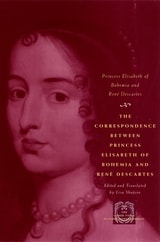
The Correspondence between Princess Elisabeth of Bohemia and René Descartes
Princess Elisabeth of Bohemia and René Descartes
University of Chicago Press, 2007
Between the years 1643 and 1649, Princess Elisabeth of Bohemia (1618–80) and René Descartes (1596–1650) exchanged fifty-eight letters—thirty-two from Descartes and twenty-six from Elisabeth. Their correspondence contains the only known extant philosophical writings by Elisabeth, revealing her mastery of metaphysics, analytic geometry, and moral philosophy, as well as her keen interest in natural philosophy. The letters are essential reading for anyone interested in Descartes’s philosophy, in particular his account of the human being as a union of mind and body, as well as his ethics. They also provide a unique insight into the character of their authors and the way ideas develop through intellectual collaboration.
Philosophers have long been familiar with Descartes’s side of the correspondence. Now Elisabeth’s letters—never before available in translation in their entirety—emerge this volume, adding much-needed context and depth both to Descartes’s ideas and the legacy of the princess. Lisa Shapiro’s annotated edition—which also includes Elisabeth’s correspondence with the Quakers William Penn and Robert Barclay—will be heralded by students of philosophy, feminist theorists, and historians of the early modern period.
The Correspondence of Jeremy Bentham, Volume 14
Supplementary LettersEdited by Philip Schofield, Tim Causer, and Chris Riley
University College London, 2026
Over 250 letters and other materials by the philosopher and reformer Jeremy Bentham, published in full and in authoritative form for the first time.
This volume is a supplement to the chronological series The Correspondence of Jeremy Bentham. It contains over 250 letters offering new biographical information and deepens our knowledge of Bentham’s relationship with his family, with the panopticon penitentiary scheme, and with notable “disciples” such as Étienne Dumont, Henry Bickersteth, and Leicester Stanhope. Additionally, this volume deepens our understanding of Bentham’s relationship with his younger brother, Samuel Bentham, and provides a detailed account of Samuel's journey to and sojourn in the Russian Empire.
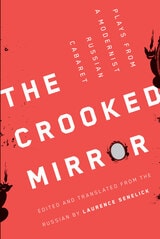
The Crooked Mirror
Plays from a Modernist Russian CabaretEdited and translated from the Russian by Laurence Senelick
Northwestern University Press, 2023
“Don’t blame the mirror if your mug is crooked!”
Parody dominated early twentieth-century Russian cabaret, but the Crooked Mirror extended its lampooning to theatrical practice itself. Eclectic in its targets, the Saint Petersburg theater mocked not only naturalism but also symbolism, futurism, and “Meyerholditis.” Its shows parodied both the stale conventions of melodrama and opera and the stylized trends in staging, wielding satire to provoke artistic and social reform. Though the theater was liquidated in 1931, many of its innovations would become standard techniques in cabaret repertoires and improv revues.
As a cultural phenomenon of the Silver Age, the Crooked Mirror deserves critical attention, yet it has received only fleeting mention in histories of Russian theater and biographies of its major figures. This anthology fills a critical gap in our understanding of that heady era by bringing together key plays—most appearing in English here for the first time—together with short biographies of their authors and robust commentary and annotations. Laurence Senelick guides readers through the artistic and ideological evolution of the Crooked Mirror and provides performers with the material to bring its innovations back to the stage.
The Culture of Neural Networks
Synthetic Literature and Art in (Not Only) the Czech and Slovak ContextZuzana Husárová and Karel Piorecký
Karolinum Press, 2024
The possibilities of generated cultural production have undergone fundamental changes in recent years, leading to a rethinking of existing approaches to the text and the artwork as such. To grasp this process, Zuzana Husárová and Karel Piorecký propose the term “neural network culture,” which captures a wide range of generative practices and reception mechanisms. The Culture of Neural Networks contextualizes the phenomenon of literary texts and other artifacts generated using the latest technological techniques. The generation of literary texts using neural networks is part of a broader cultural process, to which this publication formulates a position through the lens of literary science, media theory, and art theory.
The scholarly debate over this topic has been inconsistent—on the one hand, it underestimates the diachronic connections between generated texts and the tradition of experimental and conceptual literature; on the other hand, it does not sufficiently clarify the new-generation procedures and the contribution of human and technological actors in them. Therefore, Husárová and Piorecký propose the notion of synthetic textual art, which reflects the specific roles of the different actors involved in generative practice and its intermedial nature. In doing so, they approach the topic from both historical and theoretical perspectives, analyzing the current state of generative practice in all three basic literary types and in the intermedial space using selected foreign and Czech-Slovak projects. This state of affairs is often distorted in media discourse and even mythicized in terms of the capabilities of “artificial intelligence”; therefore, a critical analysis of this media discourse is essential. Finally, the authors summarize the implications of this stage in the development of generative practice on creativity theory and literary theory.
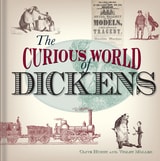
The Curious World of Dickens
Clive Hurst and Violet Moller
Bodleian Library Publishing, 2012
Published to celebrate the twohundredth anniversary of Dickens’s birth, this book brings together quotations from Dickens’s novels and letters with photographs of their original covers and Victorian-era images—among them, prints, posters, and newspaper pieces—that shed light on the topics about which Dickens writes. Ordered by theme, the book covers such topics as schools in Victorian England, domestic entertainment, the introduction of the railroad, and the poor conditions in prisons and workhouses, which loom large in Dickens’s novels—and, indeed, his own childhood. Dickens was also an avid theater enthusiast who arranged productions and public readings of many of his works, and this book explores his role throughout his later years in adroitly adapting his novels for the stage.
The Curious World of Dickens breathes new life on this momentous occasion into the vibrant world inhabited by Dickens and his characters.
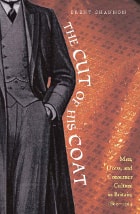
The Cut of His Coat
Men, Dress, and Consumer Culture in Britain, 1860–1914Brent Shannon
Ohio University Press, 2006
The English middle class in the late nineteenth century enjoyed an increase in the availability and variety of material goods. With that, the visual markers of class membership and manly behavior underwent a radical change. In The Cut of His Coat: Men, Dress, and Consumer Culture in Britain, 1860–1914, Brent Shannon examines familiar novels by authors such as George Eliot, Anthony Trollope, Thomas Hughes, and H. G. Wells, as well as previously unexamined etiquette manuals, period advertisements, and fashion monthlies, to trace how new ideologies emerged as mass-produced clothes, sartorial markers, and consumer culture began to change.
While Victorian literature traditionally portrayed women as having sole control of class representations through dress and manners, Shannon argues that middle-class men participated vigorously in fashion. Public displays of their newly acquired mannerisms, hairstyles, clothing, and consumer goods redefined masculinity and class status for the Victorian era and beyond.
The Cut of His Coat probes the Victorian disavowal of men’s interest in fashion and shopping to recover men’s significant role in the representation of class through self-presentation and consumer practices.
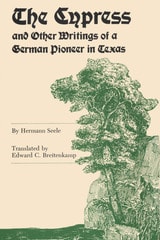
The Cypress and Other Writings of a German Pioneer in Texas
By Hermann Seele
University of Texas Press, 1979
When Hermann Seele anived in New Braunfels in 1845, the raw colony was plagued by poverty, disease, lack of food, and hostile Indians. This personal record of the Germans in Texas shows their evolution from struggling colonists to prosperous citizens.
From his viewpoint of a hardworking yet imaginative pioneer, Seele presents first a history of German immigration and settlement in Texas during the nineteenth century. Next, his autobiographical writings range from a "sentimental recollection" of his first Christmas Eve in Texas to his first day of teaching in New Braunfels, from accounts of the popular singing society to murder and justice along the Comal River. In addition, Seele's romantic novel, The Cypress, is a delightful though improbable tale of a traveling botanist, a chieftain's daughter, and a savage Indian cult.
Hermann Seele—farmer, lawyer, teacher, lay preacher, mayor, state representative, Civil War major, and editor—epitomizes the best of the German immigrants who established their communities as models of respectability and prosperity.
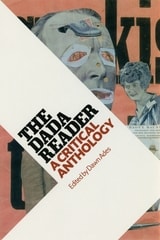
The DADA Reader
A Critical AnthologyEdited by Dawn Ades
University of Chicago Press, 2006
Bringing together key Dada texts, many of them translated into English for the first time, this volume immerses readers in some of the most famous (and infamous) periodicals of the time, from Hugo Ball’s Cabaret Voltaire and Francis Picabia’s 391 to Marcel Duchamp’s The Blind Man and Kurt Schwitters’s Merz. Published in Europe and the United States between 1916 and 1932, these journals constituted the movement’s lifeblood, communicating the desires and aspirations of the artists involved. In addition to providing the first representative selection of these texts, The Dada Reader also includes excerpts from many lesser-known American and Eastern European journals.
Compiled with both students and general readers in mind, this volume is necessary reading for anyone interested in one of the most dynamic and influential movements of the twentieth century.
The Daily Charles Dickens
A Year of QuotesCharles Dickens
University of Chicago Press, 2018
A bedside companion to dip into year round, this book introduces each month with a longer seasonal quote, while concise bits of wisdom and whimsy mark each day. Hopping gleefully from Esther Summerson’s abandonment by her mother in Bleak House to a meditation on the difficult posture of letter-writing in The Pickwick Papers, this anthology displays the wide range of Dickens’s stylistic virtuosity—his humor and his deep tragic sense, his ear for repetition, and his genius at all sorts of voices. Even the devotee will find between these pages a mix of old friends and strangers—from Oliver Twist and Ebenezer Scrooge to the likes of Lord Coodle, Sir Thomas Doodle, Mrs. Todgers, and Edwin Drood—as well as a delightful assortment of the some of the novelist’s most famous, peculiar, witty, and incisive passages, tailored to fit the season. To give one particularly apt example: David Copperfield blunders, in a letter of apology to Agnes Wickfield, “I began one note, in a six-syllable line, ‘Oh, do not remember’—but that associated itself with the fifth of November, and became an absurdity.”
Never Pecksniffian or Gradgrindish, this daily dose of Dickens crystallizes the novelist’s agile humor and his reformist zeal alike. This is a book to accompany you through the best of times and the worst of times.
The Daily Henry David Thoreau
A Year of Quotes from the Man Who Lived in SeasonHenry David Thoreau
University of Chicago Press, 2020
Modernity rules our lives by clock and calendar, dividing the stream of time into units and coordinating every passing moment with the universal globe. Henry David Thoreau subverted both clock and calendar, using them not to regulate time’s passing but to open up and explore its presence. This little volume thus embodies, in small compass, Thoreau’s own ambition to “live in season”—to turn with the living sundial of the world, and, by attuning ourselves to nature, to heal our modern sense of discontinuity with our surroundings.
Ralph Waldo Emerson noted with awe that from flowers alone, Thoreau could tell the calendar date within two days; children remembered long into adulthood how Thoreau showed them white waterlilies awakening not by the face of a clock but at the first touch of the sun. As Thoreau wrote in Walden, “Time is but the stream I go a-fishing in. I drink at it; but while I drink I see the sandy bottom and detect how shallow it is.”
Drawn from the full range of Thoreau’s journals and published writings, and arranged according to season, The Daily Henry David Thoreau allows us to discover the endless variation and surprise to be found in the repetitions of mundane cycles. Thoreau saw in the kernel of each day an earth enchanted, one he honed into sentences tuned with an artist’s eye and a musician’s ear. Thoreau’s world lives on in his writing so that we, too, may discover, even in a fallen world, a beauty worth defending.
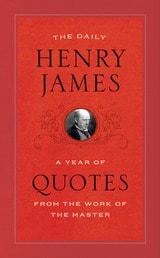
The Daily Henry James
A Year of Quotes from the Work of the MasterHenry James
University of Chicago Press, 2016
From the deepest longings of Isabel Archer to James’s insights in The Art of Fiction, longer seasonal quotes introduce each month, while concise bits of wisdom and whimsy mark each day. To take but one example: Isabel, in a quote from The Portrait of a Lady for September 30, muses, “She gave an envious thought to the happier lot of men, who are always free to plunge into the healing waters of action.” Featuring a new foreword by James biographer Michael Gorra as well as the original introductions by James and his good friend William Dean Howells, this long-forgotten perennial calendar will be an essential bibelot for James’s most ardent devotees and newest converts alike, a treasure to be cherished daily, across all seasons, for years, for ages to come.
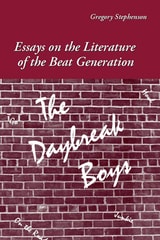
The Daybreak Boys
Essays on the Literature of the Beat GenerationGregory Stephenson
Southern Illinois University Press, 1990
In these critical essays Gregory Stephenson takes the reader on a journey through the literature of the Beat Generation: a journey encompassing that common ethos of Beat literature—the passage from darkness to light, from fragmented being toward wholeness, from Beat to Beatific. He travels through Jack Kerouac’s Duluoz Legend,following Kerouac’s quests for identity, community, and spiritual knowledge. He examines Allen Ginsberg’s use of transcendence in “Howl,” discovers the Gnostic vision in William S. Burroughs’s fiction, and studies the mythic, visionary power of Lawrence Ferlinghetti’s poetry. Stephenson also provides detailed examinations of the writing of lesser-known Beat authors: John Clellon Holmes, Gregory Corso, Richard Fariña, and Michael McClure. He explores the myth and the mystery of the literary legend of Neal Cassady. The book concludes with a look at the common traits of the Beat writers—their use of primitivism, shamanism, myth and magic, spontaneity, and improvisation, all of which led them to a new idiom of consciousness and to the expansion of the parameters of American literature.
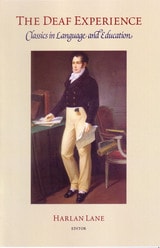
The Deaf Experience
Classics in Language and EducationHarlan Lane
Gallaudet University Press, 2006
The fifth volume in the Gallaudet Classics in Deaf Studies series features works written from 1764 up to1840. Pierre Desloges offers a stirring paean to sign language in an excerpt from his book, the first ever published by a deaf person. Saboureux de Fontenay and Jean Massieu, two prominent leaders, relate their respective experiences in autobiographical accounts. In separate essays, Charles-Michel de l’Epée and Roch-Ambroise Sicard describe systems for teaching manual French, followed by a critique of these methods by Roch-Ambroise Bébian, a well-known hearing friend of Deaf people during that era. Ferdinand Berthier, a renowned Deaf teacher and writer in the 19th century, concludes with a history of Deaf people up to that time.
The Deaf Experience shows clearly how this extraordinary era of French deaf education influenced the adoption of the manual method by the first schools for deaf students in America, in sharp contrast to the oral movement that repressed sign-language-centered education for nearly a century afterward. Deaf studies scholars and students alike will welcome the return of this invaluable resource.
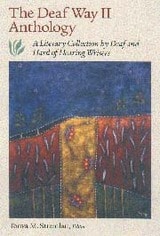
The Deaf Way II Anthology
A Literary Collection by Deaf and Hard of Hearing WritersTonya M. Stremlau
Gallaudet University Press, 2002
In July 2002, the second Deaf Way Conference and Festival took place at Gallaudet University in Washington, D.C., attracting more than 5,000 people worldwide. Researchers, artists, performers, and others converged to create a singular blend of scholarship and social interaction, which inspired The Deaf Way II Anthology.
The Deaf Way II Anthology brings together stellar contributions by 16 international writers who are deaf or hard of hearing. This remarkable collection features poetry, essays, short stories, and one play, all of which offer thought-provoking perspectives on elements from the personal universes of these gifted authors. Many are American writers well-known for their past publications, such as Douglas Bullard, Willy Conley, Christopher Heuer, and Raymond Luczak, while the outstanding work of John Lee Clark, volume editor Tonya Stremlau, Melissa Whalen, and several others have been collected for the first time in this volume. The international contributions further distinguish this anthology, ranging from poetry by Romanian Carmen Cristiu, verse by Sibylle Gurtner May from Switzerland, to a play by Nigerian Sotonwa Opeoluwa.
All of the writers showcased in The Deaf Way II Anthology portray the Deaf experience with unmatched authenticity, presenting a perfect introduction to the Deaf world. Simultaneously, their work demonstrates that deaf and hard of hearing people can write at the highest aesthetic level and offer invaluable insights on the complete human spectrum.
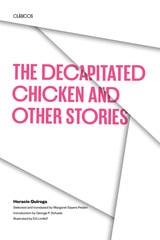
The Decapitated Chicken and Other Stories
By Horacio Quiroga
University of Texas Press, 1976
Tales of horror, madness, and death, tales of fantasy and morality: these are the works of South American master storyteller Horacio Quiroga. Author of some 200 pieces of fiction that have been compared to the works of Poe, Kipling, and Jack London, Quiroga experienced a life that surpassed in morbidity and horror many of the inventions of his fevered mind. As a young man, he suffered his father's accidental death and the suicide of his beloved stepfather. As a teenager, he shot and accidentally killed one of his closest friends. Seemingly cursed in love, he lost his first wife to suicide by poison. In the end, Quiroga himself downed cyanide to end his own life when he learned he was suffering from an incurable cancer.
In life Quiroga was obsessed with death, a legacy of the violence he had experienced. His stories are infused with death, too, but they span a wide range of short fiction genres: jungle tale, Gothic horror story, morality tale, psychological study. Many of his stories are set in the steaming jungle of the Misiones district of northern Argentina, where he spent much of his life, but his tales possess a universality that elevates them far above the work of a regional writer.
The first representative collection of his work in English, The Decapitated Chicken and Other Stories provides a valuable overview of the scope of Quiroga's fiction and the versatility and skill that have made him a classic Latin American writer.
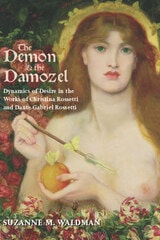
The Demon and the Damozel
Dynamics of Desire in the Works of Christina Rossetti and Dante Gabriel RossettiSuzanne M. Waldman
Ohio University Press, 2008
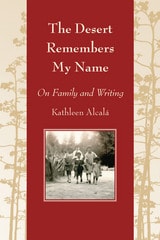
The Desert Remembers My Name
On Family and WritingKathleen Alcalá
University of Arizona Press, 2007
Thus begins a lyrical and entirely absorbing collection of personal essays by esteemed Chicana writer and gifted storyteller Kathleen Alcalá. Loosely linked by an exploration of the many meanings of “family,” these essays move in a broad arc from the stories and experiences of those close to her to those whom she wonders about, like Andrea Yates, a mother who drowned her children. In the process of digging and sifting, she is frequently surprised by what she unearths. Her family, she discovers, were Jewish refugees from the Spanish Inquisition who took on the trappings of Catholicism in order to survive.
Although the essays are in many ways personal, they are also universal. When she examines her family history, she is encouraging us to inspect our own families, too. When she investigates a family secret, she is supporting our own search for meaning. And when she writes that being separated from our indigenous culture is “a form of illiteracy,” we know exactly what she means.
After reading these essays, we find that we have discovered not only why Kathleen Alcalá is a writer but also why we appreciate her so much. She helps us to find ourselves.
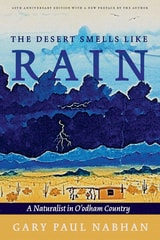
The Desert Smells Like Rain
A Naturalist in O'odham CountryGary Paul Nabhan
University of Arizona Press, 1982
In this work, Gary Paul Nabhan brings O’odham voices to the page at every turn. He writes elegantly of how they husband scant water supplies, grow crops, and utilize edible wild foods. Woven through his account are coyote tales, O’odham children’s impressions of the desert, and observations of the political problems that come with living on both sides of an international border. Nabhan conveys the everyday life and extraordinary perseverance of these desert people.
This edition includes a new preface written by the author, in which he reflects on his gratitude for the O’odham people who shared their knowledge with him. He writes about his own heritage and connections to the desert, climate change, and the border. He shares his awe and gratitude for O’odham writers and storytellers who have been generous enough to share stories with those of us from other cultural traditions so that we may also respect and appreciate the smell of the desert after a rain.
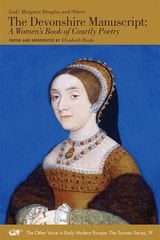
The Devonshire Manuscript
A Women's Book of Courtly PoetryLady Margaret Douglas and Others
Iter Press, 2012
—Jennifer Summit
Professor of English, Stanford University
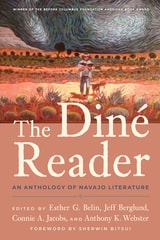
The Diné Reader
An Anthology of Navajo LiteratureEdited by Esther G. Belin, Jeff Berglund, Connie A. Jacobs, and Anthony K. Webster; Foreword by Sherwin Bitsui
University of Arizona Press, 2021
The Diné Reader: An Anthology of Navajo Literature is unprecedented. It showcases the breadth, depth, and diversity of Diné creative artists and their poetry, fiction, and nonfiction prose.This wide-ranging anthology brings together writers who offer perspectives that span generations and perspectives on life and Diné history. The collected works display a rich variety of and creativity in themes: home and history; contemporary concerns about identity, historical trauma, and loss of language; and economic and environmental inequalities.
The Diné Reader developed as a way to demonstrate both the power of Diné literary artistry and the persistence of the Navajo people. The volume opens with a foreword by poet Sherwin Bitsui, who offers insight into the importance of writing to the Navajo people. The editors then introduce the volume by detailing the literary history of the Diné people, establishing the context for the tremendous diversity of the works that follow, which includes free verse, sestinas, limericks, haiku, prose poems, creative nonfiction, mixed genres, and oral traditions reshaped into the written word.
This volume combines an array of literature with illuminating interviews, biographies, and photographs of the featured Diné writers and artists. A valuable resource to educators, literature enthusiasts, and beyond, this anthology is a much-needed showcase of Diné writers and their compelling work. The volume also includes a chronology of important dates in Diné history by Jennifer Nez Denetdale, as well as resources for teachers, students, and general readers by Michael Thompson. The Diné Reader is an exciting convergence of Navajo writers and artists with scholars and educators.
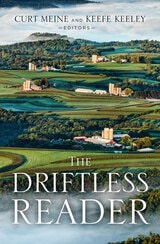
The Driftless Reader
Edited by Curt Meine and Keefe Keeley
University of Wisconsin Press, 2017
The Driftless Reader gathers writings that highlight the unique natural and cultural history, landscape, and literature of this region that encompasses southwestern Wisconsin and adjacent Minnesota, Iowa, and Illinois. The more than eighty selected texts include writings by Black Hawk, Mark Twain, Laura Ingalls Wilder, Frank Lloyd Wright, Aldo Leopold, David Rhodes, and many other Native people, explorers, scientists, historians, farmers, songwriters, journalists, and poets. Paintings, photographs, maps, and other images complement the texts, providing a deeper appreciation of this region's layered natural and human history.
Highlights include excerpts and art from:
Carol Ryrie Brink
William Cronon
John T. Curtis
August Derleth
Richard Eberhart
Fabu
Hamlin Garland
Pedro Guerrero
Hoowaneka (Little Elk)
Juliet Kinzie
Patty Loew
Ben Logan
Truman Lowe
Jacques Marquette
Ken McCullough
Edna Meudt
Mountain Wolf Woman
Zebulon Pike
Henry Schoolcraft
Clifford D. Simak
Wallace Stegner
Pearl Swiggum
Frank Utpatel
Mark Wunderlich
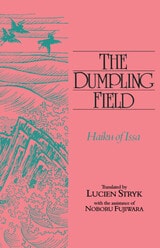
The Dumpling Field
Haiku of IssaKobayashi Issa
Ohio University Press, 1991
Kobayashi Issa (1763–1827), long considered among Japan’s four greatest haiku poets (along with Basho, Buson, and Shiki) is probably the best loved. This collection of more than 360 haiku, arranged seasonally and many rendered into English for the first time, attempts to reveal the full range of the poet’s extraordinary life as if it were concentrated within a year. Issa’s haiku are traditionally structured, of seventeen syllables in the original, tonally unified and highly suggestive, yet they differ from those of fellow haikuists in a few important respects. Given his character, they had to. The poet never tries to hide his feelings, and again and again we find him grieving over the lot of the unfortunate – of any and all species.
No poet, of any time or culture, feels greater compassion for his life of creatures. No Buddhist—Issa was to become a monk—acts out the credos of his faith more genuinely. The poet, a devoted follower of Basho, traveled throughout the country, often doing the most menial work, seeking spiritual companionship and inspiration for the thousands of haiku he was to write. Yet his emotional and creative life was centered in his native place, Kashiwabara in the province of Shinano (now Nagano Prefecture), and his severest pain was the result of being denied a place in his dead father’s house by his stepmother and half brother.
By the time he was able to share the house of his beloved father, Issa had experienced more than most the grief of living, and much more was to follow with the death of his wife and their four children. In the face of all he continued to write, celebrating passionately the lives of all that shared the world with him, all creatures, all humans. Small wonder that Issa is so greatly loved by his fellow poets throughout the world, and by poetry lovers of all ages.
The Early Mubarak Years 1982–1988
The Non-Fiction Writing of Naguib Mahfouz, Volume IIINaguib Mahfouz
Gingko, 2020
The Eclipse I Call Father
Essays on AbsenceDavid Axelrod
Oregon State University Press, 2019
The essays in this collection grew from a ten-year period when the author found himself periodically living and working abroad, wondering why foreign landscapes haunted him more than the familiar landscapes of the inland Pacific Northwest he called home. Each place had a long history of habitation, but at home he was blind, unable to see past the surfaces of things. Axelrod examines many aspects of that phenomenon in these pages, framing surface realities and imagining the scale and scope of that surface, but also trying to sense what is absent or changed, and how, despite its absence, the unseen accretes to ever-greater densities and persists as something uncanny.
Curious, alert, and keenly observant, these essays probe the boundaries between what is here and what is gone, what is present and what is past, in elegant prose. Readers familiar with Axelrod’s poetry will find a new facet of his lyrical gifts, while those encountering his work for the first time will be richly rewarded by the discovery of this Northwest literary talent.
The Ecuador Reader
History, Culture, PoliticsCarlos de la Torre and Steve Striffler, eds.
Duke University Press, 2008
The voices and creations of Ecuadorian politicians, writers, artists, scholars, activists, and journalists fill the Reader, from José María Velasco Ibarra, the nation’s ultimate populist and five-time president, to Pancho Jaime, a political satirist; from Julio Jaramillo, a popular twentieth-century singer, to anonymous indigenous women artists who produced ceramics in the 1500s; and from the poems of Afro-Ecuadorians, to the fiction of the vanguardist Pablo Palacio, to a recipe for traditional Quiteño-style shrimp. The Reader includes an interview with Nina Pacari, the first indigenous woman elected to Ecuador’s national assembly, and a reflection on how to balance tourism with the protection of the Galápagos Islands’ magnificent ecosystem. Complementing selections by Ecuadorians, many never published in English, are samples of some of the best writing on Ecuador by outsiders, including an account of how an indigenous group with non-Inca origins came to see themselves as definitively Incan, an exploration of the fascination with the Andes from the 1700s to the present, chronicles of the less-than-exemplary behavior of U.S. corporations in Ecuador, an examination of Ecuadorians’ overseas migration, and a look at the controversy surrounding the selection of the first black Miss Ecuador.
The Edda
A Collection of EssaysR.J. Glendinning
University of Manitoba Press, 1983
The Emerson Effect
Individualism and Submission in AmericaChristopher Newfield
University of Chicago Press, 1995
Christopher Newfield analyzes the interplay of liberal and authoritarian impulses in Emerson's work in various domains: domestic life, the changing New England economy, theories of poetic language, homoerotic friendship, and racial hierarchy. Focusing on neglected later writings, Newfield shows how Emerson explored the tensions between autonomy and community—and consistently resolved these tensions by "abandoning crucial elements of both" and redefining autonomy as a kind of liberating subjection. He argues that in Emersonian individualism, self-determination is accompanied by submission to authority, and examines the influence of this submissive individualism on the history of American liberalism. In a provocative reading of Emerson's early and neglected later works, Newfield analyzes Emerson's emphasis on collective, or "corporate", world-building, rather than private possession. Tracing the development of this corporate individualism, he illuminates contradictions in Emerson's political outlook, and the conjunctions of liberal and authoritarian ideology they produced.
The End of Chiraq
A Literary MixtapeEdited by Javon Johnson and Kevin Coval
Northwestern University Press, 2018
"Chiraq" has come to connote the violence—interpersonal and structural—that many Chicago youth regularly experience. But the contributors to The End of Chiraq show that Chicago is much more than Chiraq. Instead, they demonstrate how young people are thinking and mobilizing, engaged in a process of creating a new and safer world for themselves, their communities, and their city.
In true mixtape fashion, the book is an exercise in "low end theory" that does not just include so-called underground and marginal voices, but foregrounds them. Edited by award-winning poets, writers, and teachers Javon Johnson and Kevin Coval, The End of Chiraq addresses head-on the troublesome relationship between Chicago and Chiraq and envisions a future in which both might be transformed.
The Environmental Unconscious
Ecological Poetics from Spenser to MiltonSteven Swarbrick
University of Minnesota Press, 2023
Bringing psychoanalysis to bear on the diagnosis of ecological crisis
Why has psychoanalysis long been kept at the margins of environmental criticism despite the many theories of eco-Marxism, queer ecology, and eco-deconstruction available today? What is unique, possibly even traumatic, about eco-psychoanalysis? The Environmental Unconscious addresses these questions as it provides an innovative and theoretical account of environmental loss focused on the counterintuitive forms of enjoyment that early modern poetry and psychoanalysis jointly theorize.
Steven Swarbrick urges literary critics and environmental scholars fluent in the new materialism to rethink notions of entanglement, animacy, and consciousness raising. He introduces concepts from psychoanalysis as keys to understanding the force of early modern ecopoetics. Through close readings of Edmund Spenser, Walter Ralegh, Andrew Marvell, and John Milton, he reveals a world of matter that is not merely hyperconnected, as in the new materialism, but porous and off-kilter. And yet the loss these poets reveal is central to the enjoyment their works offer—and that nature offers.
As insightful as it is engaging, The Environmental Unconscious offers a provocative challenge to ecocriticism that, under the current regime of fossil capitalism in which everything solid interconnects, a new theory of disconnection is desperately needed. Tracing the propulsive force of the environmental unconscious from the early modern period to Freudian and post-Freudian theories of desire, Swarbrick not only puts nature on the couch in this book but also renews the psychoanalytic toolkit in light of environmental collapse.