Results by title
1066 books match the query 'Political' and 230 start with t
The Labour of Spirit
Massimo Cacciari
Seagull Books, 2025
Between 1917 and 1919, Max Weber delivered two lectures titled Die geistige Arbeit als Beruf, which we might translate as The Labour of Spirit as Vocation. This weighty formula represented the hope that animated the world of bourgeois culture from the likes of Kant, Goethe, Schiller, Fichte, and Hegel and would later form the earliest threads of revolutionary thought from Feuerbach and Marx. The “labor of spirit” is creative, autonomous labor—human labor understood in its fully effectual power. To press for its realization is to liberate all activity from the condition of commanded or alienated work. But the dissolution of the labor of spirit into the capitalist form of production, into the universal machinism that swallows up that science which remains the true engine of development, also ends up delegitimating political authority, whose own foundation lies in the “promise of liberation.”
Massimo Cacciari takes up old questions and confronts them anew: Is the “iron cage” fated to imprison that “labor of spirit” that is political praxis? Will the spirit of capitalism end up completely undermining the space of the political? Or are relations between science and politics still thinkable that might free us from our “debt” as we proceed without means or ends within the techno-economic system?
The Last Days of El Comandante
By Alberto Barrera Tyszka; translated by Rosalind Harvey and Jessie Mendez Sayer
University of Texas Press, 2020
2021 — Honorable Mention, Best Fiction Book Translation – International Latino Book Awards, Latino Literacy Now
Winner of the Tusquets Prize in 2015 and previously translated into French, German, Dutch, Polish, and Portuguese, Alberto Barrera Tyszka’s Patria o muerte is now available in English.
President Hugo Chávez’s cancer looms large over Venezuela in 2012, casting a shadow of uncertainty and creating an atmosphere of secrets, lies, and upheaval across the country. This literary thriller follows the connected lives of several Caracas neighbors consumed by the turmoil surrounding the Venezuelan president’s impending death.
Retired oncologist Miguel Sanabria, seeing the increasingly combustible world around him, feels on constant edge. He finds himself at odds with his wife, an extreme anti-Chavista, and his radical Chavista brother. These feelings grow when his nephew asks him to undertake the perilous task of hiding cell-phone footage of Chávez in Cuba. Fredy Lecuna, an unemployed journalist, takes a job writing a book about Chávez’s condition, which requires him to leave for Cuba while his landlord attempts to kick his wife and son out of their apartment. Nine-year-old María, long confined to an apartment with a neurotic mother intensely fearful of the city’s violence, finds her only contact with the outside world through a boy she messages online.
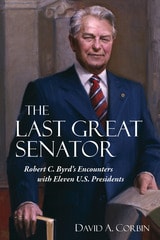
The Last Great Senator
Robert C. Byrd's Encounters with Eleven U.S. PresidentsDavid Corbin
West Virginia University Press, 2015
No person involved in so much history received so little attention as the late Robert C. Byrd, the longest-serving U.S. senator. In The Last Great Senator, David A. Corbin examines Byrd’s complex and fascinating relationships with eleven presidents of the United States, from Eisenhower to Obama. Furthermore, Byrd had an impact on nearly every significant event of the last half century, including the Cold War, the civil rights movement, the Vietnam War, Kennedy’s New Frontier, the Watergate scandal, the Reagan Revolution, the impeachment of President Clinton, and the Iraq War. Holding several Senate records, Byrd also cast more votes than any other U.S. senator.
In his sweeping portrait of this eloquent and persuasive man’s epic life and career, Corbin describes Senator Byrd’s humble background in the coalfields of southern West Virginia (including his brief membership in the Ku Klux Klan). He covers Byrd’s encounters and personal relationship with each president and his effect on events during their administrations. Additionally, the book discusses Byrd’s interactions with other notable senators, including Lyndon B. Johnson, Richard Russell, Mike Mansfield, and especially Robert and Edward Kennedy. Going beyond the boundaries of West Virginia and Capitol Hill, The Last Great Senator presents Byrd in a larger historical context, where he rose to the height of power in America.
The Last Hurrah
A NovelEdwin O'Connor
University of Chicago Press, 2016
Not quite a roman á clef of notorious Boston mayor James Michael Curley, The Last Hurrah tells the story of Skeffington’s final campaign as witnessed through the eyes of his nephew, who learns a great deal about politics as he follows his uncle to fundraisers, wakes, and into smoke-filled rooms, ultimately coming—almost against his will—to admire the man. Adapted into a 1958 film starring Spencer Tracy and directed by John Ford (and which Curley tried to keep from being made), Edwin O’Connor’s opus reveals politics as it really is, and big cities as they really were. An expansive, humorous novel offering deep insight into the Irish-American experience and the ever-changing nature of the political machine, The Last Hurrah reveals political truths still true today: what the cameras capture is just the smiling face of the sometimes sordid business of giving the people what they want.
The Lesson of Carl Schmitt
Four Chapters on the Distinction between Political Theology and Political PhilosophyHeinrich Meier
University of Chicago Press, 1998
Relating this religious dimension to Schmitt's support for National Socialism and his continuing anti-Semitism, Meier compels the reader to come to terms with the irreconcilable differences between political theology and political philosophy. His book will give pause to those who have tended to gloss over the troubling aspects of some of Schmitt's ideas.
With editions in German, French, Italian, and now English, Meier's two books on Schmitt have dramatically reoriented the international debate about Carl Schmitt and his significance for twentieth-century political thought.
"Standing far above the rest . . . is Heinrich Meier's new study, Die Lehre Carl Schmitts, which covers all of Schmitt's writings. . . . Meier's work has forced everyone to take a second look at the assumptions underlying Schmitt's better-known writings and reconsider some that have been ignored."—Mark Lilla, reviewing the German edition in The New York Review of Books
The Lesson of Carl Schmitt
Four Chapters on the Distinction between Political Theology and Political Philosophy, Expanded EditionHeinrich Meier
University of Chicago Press, 2011
The Leviathan in the State Theory of Thomas Hobbes
Meaning and Failure of a Political SymbolCarl Schmitt
University of Chicago Press, 2008
“Carl Schmitt is surely the most controversial German political and legal philosopher of this century. . . . We deal with Schmitt, against all odds, because history stubbornly persists in proving many of his tenets right.”—Perspectives on Political Science
“[A] significant contribution. . . . The relation between Hobbes and Schmitt is one of the most important questions surrounding Schmitt: it includes a distinct, though occasionally vacillating, personal identification as well as an association of ideas.”—Telos
The Liberalism of Care
Community, Philosophy, and EthicsShawn C. Fraistat
University of Chicago Press, 2021
To recover that language, Fraistat turns to three prominent philosophers—Plato, Jean-Jacques Rousseau, and William Godwin—who illuminate the varied ways caring language and caring values have structured core debates in the history of Western political thought about the proper role of government, as well as the rights and responsibilities of citizens. The Liberalism of Care presents a distinctive vision for our liberal politics where political communities and citizens can utilize the ethic and practices of care to face practical challenges.
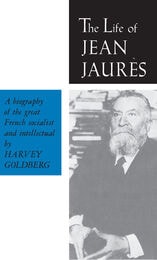
The Life of Jean Jaures
Harvey Goldberg
University of Wisconsin Press, 1962
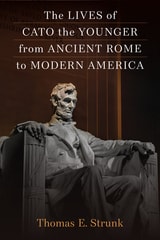
The Lives of Cato the Younger from Ancient Rome to Modern America
Thomas E. Strunk
University of Michigan Press, 2026
The Loss and Recovery of Truth
Selected Writings of Gerhart NiemeyerGerhart Niemeyer
St. Augustine's Press, 2013
The Lost Art of Declaring War
Brien Hallett
University of Illinois Press, 1998
Historically, it has been assumed that war is violence and declarations of war are simply public announcements that serve to initiate combat. Brien Hallett denies both assumptions and claims that war is policy, not violence.
The Lost Art of Declaring War analyzes the crucial differences between combat and war and convincingly argues that the power to "declare" war is in actuality the power to compose a text, draft a document, write a denunciation. Once written, the declaration then serves three functions: to articulate the political purposes of the war, to guide and direct military operations, and to establish the boundary between justified combat and unjustified devastation.
Hallett sounds a clarion call urging the people and their representatives to take up the challenge and write fully reasoned declarations of war. Then, and only then, can a civilized nation like the United States lay claim to being fully democratic, not only in peacetime, but in wartime as well.
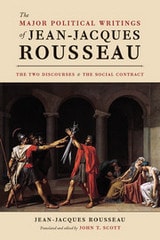
The Major Political Writings of Jean-Jacques Rousseau
The Two "Discourses" and the "Social Contract"Jean-Jacques Rousseau
University of Chicago Press, 2012
Individualist and communitarian. Anarchist and totalitarian. Classicist and romanticist. Progressive and reactionary. Since the eighteenth century, Jean-Jacques Rousseau has been said to be all of these things. Few philosophers have been the subject of as much or as intense debate, yet almost everyone agrees that Rousseau is among the most important and influential thinkers in the history of political philosophy. This new edition of his major political writings, published in the year of the three-hundredth anniversary of his birth, renews attention to the perennial importance of Rousseau’s work.
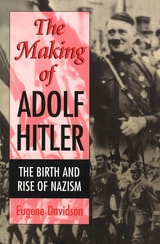
The Making of Adolf Hitler
The Birth and Rise of NazismEugene Davidson
University of Missouri Press, 1997
The harsh Armistice terms of 1918, the short-lived Weimar Republic, Hindenburg's senile vacillations, and behind-the-scene power plays form the backbone of this excellent study covering German history during the first three-and-a-half decades of the century.
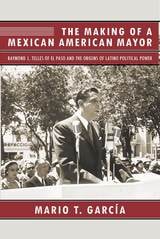
The Making of a Mexican American Mayor
Raymond L. Telles of El Paso and the Origins of Latino Political PowerMario T. García
University of Arizona Press, 2018
In the border metropolis of El Paso, more than half the population is Mexican American, yet this group had been denied effective political representation. Mexican Americans broke this barrier and achieved the “politics of status” through Telles’s stunning 1957 victory. This book captures the excitement of that long-awaited election.
The Making of a Mexican American Mayor also examines Telles’s story as a microcosm of the history of Mexican Americans before and after World War II—the Mexican American Generation. As mayor and ambassador, Telles symbolized this generation’s striving for political participation, and his legacy is evident in the growing number of Latinas/os holding office today.
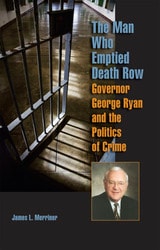
The Man Who Emptied Death Row
Governor George Ryan and the Politics of CrimeJames L. Merriner
Southern Illinois University Press, 2008
George H. Ryan, Illinois governor from 1999 to 2003, became nationally known for two significant and very different reasons. The first governor in the United States to clear out his state’s death row and put a moratorium on the death penalty, he was also convicted and sent to prison on corruption charges. The Man Who Emptied Death Row: Governor George Ryan and the Politics of Crime details the career of a man who both enhanced and tarnished the image of the highest office in Illinois and examines the political history and culture that shaped him.
Author James L. Merriner explores the two very different stories of George Ryan: the brave crusader against the death penalty and the petty crook. An extensive analysis of the official record, exclusive interviews, and previously undisclosed incidents in Ryan’s career expose why the governor pardoned or commuted the sentences of all 171 prisoners on Illinois’s death row before leaving office and how he later was convicted of eighteen counts of official corruption.
This biography traces Ryan’s family history and the Illinois political climate that influenced his development as a politician. Although Ryan championed “good-government” initiatives—organ donations, tougher drunken-driving and lobbyist disclosure laws—he never overcame a reputation as a wheeler-dealer, notes Merriner.
Merriner goes beyond Ryan’s life and career to explore the politics of crime, highlighting the successes and failures of the criminal justice system and suggesting how both white-collar fraud and violent crime shape politics. A fascinating story that reveals much about the way Illinois politics works, The Man Who Emptied Death Row will help determine how history will judge Illinois governor George Ryan.
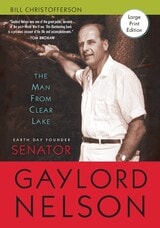
The Man from Clear Lake
Earth Day Founder Senator Gaylord NelsonBill Christofferson
University of Wisconsin Press, 2009
On Earth Day 1970 twenty million Americans displayed their commitment to a clean environment. It was called the largest demonstration in human history, and it permanently changed the nation’s political agenda. By Earth Day 2000 participation had exploded to 500 million people in 167 countries.
The seemingly simple idea—a day set aside to focus on protecting our natural environment—was the brainchild of U.S. Senator Gaylord Nelson of Wisconsin. It accomplished, far beyond his expectations, his lifelong goal of putting the environment onto the nation’s and the world’s political agendas.
A remarkable man, Nelson ranks as one of history’s leading environmentalists. He also played a major role as an early, outspoken opponent of the Vietnam War, and as a senate insider was a key player in civil rights, poverty, civil liberties and consumer protection issues.
The life of Nelson, a small town boy who learned his values and progressive political principles at an early age, is woven through the political history of the twentieth century. Nelson’s story intersects at times with Fighting Bob La Follette, Joe McCarthy, and Bill Proxmire in Wisconsin, and with George McGovern, Lyndon Johnson, Hubert Humphrey, Russell Long, Walter Mondale, John F. Kennedy, and others on the national scene.
Winner, Elizabeth A. Steinberg Prize, University of Wisconsin Press
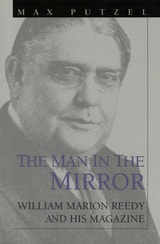
The Man in the Mirror
William Marion Reedy and His MagazineMax Putzel
University of Missouri Press, 1998
A flamboyant and controversial figure, William Marion Reedy was one of the most successful literary entrepreneurs of his day. Editor of the Mirror, a St. Louis weekly, from 1891 to 1920, Reedy played a large role in breaking down the genteel literary tradition, developing a native poetry, and helping to form some fifty significant poets. Emily Dickinson, Stephen Crane, Ezra Pound, Edwin Arlington Robinson, Amy Lowell, Sara Teasdale, Carl Sandburg, and Vachel Lindsay are just a few of the writers whose works Reedy featured in his magazine.
The Man in the Mirror offers a colorful description of Reedy's boyhood in St. Louis during the turbulent period following the Civil War. This well-documented biography follows Reedy throughout his years as a reporter in the early days of the St. Louis Post-Dispatch and Globe-Democrat and as editor of the St. Louis Star. Only seven years after Reedy founded the Mirror as a national journal of opinion--a potpourri of political comment, social gossip, and literary miscellany—the magazine's circulation far surpassed that of the Dial, Atlantic Monthly, or Nation.
Max Putzel truly conveys the spirit and personality of Reedy by carefully examining his life within the context of the literary world he influenced so significantly. Full chapters are devoted to his relationships with Theodore Dreiser, Ezra Pound, Vachel Lindsay, Amy Lowell, and others. Edgar Lee Masters, whose Spoon River Anthology first appeared in the Mirror, called Reedy both the "Literary Boss of the Middle West" and his best friend. In fact, Reedy had quite a range of friends, from librarians to politicians, St. Louis locals to Teddy Roosevelt. His personal effect on people, writers and readers alike, is what has made him such an important historical figure.
It is a tribute to Reedy's critical judgment that the reputations he helped to build would later overshadow his own. The Man in the Mirror, lauded as "the first substantial study of Reedy's work" by American Literature, reveals Reedy's notable contribution to the literary world.
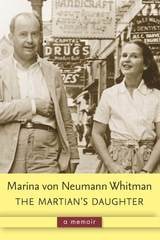
The Martian's Daughter
A MemoirMarina von Neumann Whitman
University of Michigan Press, 2013
One of the five Hungarian scientific geniuses dubbed "the Martians" by their colleagues, John von Neumann is often hailed as the greatest mathematician of the twentieth century and even as the greatest scientist after Einstein. He was a key figure in the Manhattan Project; the inventor of game theory; the pioneer developer of the modern stored-program electronic computer; and an adviser to the top echelons of the American military establishment. In The Martian's Daughter, Marina von Neumann Whitman reveals intimate details about the famed scientist and explores how the cosmopolitan environment in which she was immersed, the demanding expectations of her parents, and her own struggles to emerge from the shadow of a larger-than-life parent shaped her life and work.
Unfortunately, von Neumann did not live to see his daughter rise to become the first or highest-ranking woman in a variety of arenas. Whitman became a noted academic during the 1960s and '70s, casting her teaching and writing in the framework of globalization before the word had been invented; became the first woman ever to serve on the President's Council of Economic Advisers and participated actively in U.S. efforts to reshape the international monetary and financial system during the early 1970s; pioneered the role of women on the boards of leading multinational corporations; and became the highest-ranking female executive in the American auto industry in the 1980s. In her memoir, Whitman quotes from personal letters from her father and describes her interactions with such figures as Roger Smith of GM and President Nixon. She also details the difficulties she encountered as an early entrant into a world dominated by men and how she overcame the obstacles to, in her words, "have it all."
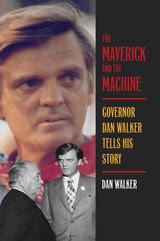
The Maverick and the Machine
Governor Dan Walker Tells His StoryDan Walker
Southern Illinois University Press, 2007
Best Memoir of 2008, San Diego Book Awards
Illinois State Historical Society Certificate of Excellence, 2008
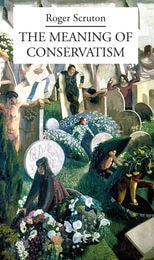
The Meaning of Conservatism
Roger Scruton
St. Augustine's Press, 2014
Rather, conservatism regards the individual not as the premise but the conclusion of politics, a politics that is fundamentally opposed to the ethic of social justice, to equality of station, income, and achievement, or to the attempt to bring major institutions of society (such as schools and universities) under government control.
The conservative outlook, says Scruton, is neither outmoded nor irrational. On the contrary, it is the most reasonable of political alternatives. The evils of socialism, he maintains, lie precisely where its supporters find its strengths, and the conditions for the credibility of socialism have long since disappeared. Neither socialism nor liberalism can come to terms with the real complexity of human society, and both appear plausible only because they direct attention away from what is actual, toward what is merely ideal.
From earlier editions of The Meaning of Conservatism:
“The book provides exactly that swift kick on the intellectual bottom which every undergraduate student of political science needs, most of them more urgently than ever before.” – T. E. Utley, (London) Daily Telegraph
“If the text is full of surprises, the manner is no less striking than the matter. Scruton is a great stylist, and one is continually arrested by beautifully crafted phrases which beg for quotation. . . . [He] is a cultured and critical guide through the traditional landscape of conservatism; his book provokes thought and it is a pleasure to read.”
– Bram Gieben, Political Quarterly
“. . . remarkable work. . . . The highest praise which one can bestow on The Meaning of Conservatism is to say that it reminds one at every page of Thomas Hobbes, the greatest master of the English language ever to write a work of political theory.” – Jonathan Sumption, Sunday Telegraph
“. . . clearly too ghastly to be taken seriously.” – Andrew Belsey, Radical Philosophy
The Meaning of Liberalism - East and West
Zdenek Suda
Central European University Press, 1999
The Meaning of Liberalism provides a new perspective on the continuing debate about how liberalism should be defined and what it means in countries with an established parliamentary system, particularly in the new democracies of Central and Eastern Europe.
The key question this book addresses is: will the specific experience of communism and its aftermath give birth to a new distinct current of liberal thought, or will it simply enlarge the scope of the Western liberal debate? The authors argue that liberalism cannot be reduced merely to private property and market prices, but needs a very complex set of institutions and corresponding law.
Contributors come from both sides of the former Iron Curtain and they highlight the richness and diversity of liberalism and discuss different perceptions of liberal thinking in the East and West in the post-modern world.
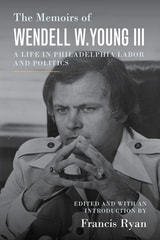
The Memoirs of Wendell W. Young III
A Life in Philadelphia Labor and PoliticsFrancis Ryan
Temple University Press, 2019
Philadelphia native Wendell W. Young III was one of the most important American labor leaders in the last half of the twentieth century. An Acme Markets clerk in the 1950s and ’60s, he was elected top officer of the Retail Clerks Union when he was twenty-four. His social justice unionism sought to advance wages while moving beyond collective bargaining to improve the conditions of the working-class majority, whether in a union or not. Young quickly gained a reputation for his independence, daring at times to publicly criticize the policies of the city’s powerful AFL-CIO leadership and tangle with the city’s political machine.
Editor Francis Ryan, whose introduction provides historical context, interviewed Young about his experiences working in the region’s retail and food industry, measuring the changes over time and the tangible impact that union membership had on workers. Young also describes the impact of Philadelphia’s deindustrialization in the 1970s and ’80s and recounts his activism for civil rights and the anti-war movements as well as on John F. Kennedy’s presidential campaign.
The Memoirs of Wendell W. YoungIII provides the most extensive labor history of late twentieth-century Philadelphia yet written.
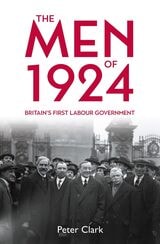
The Men of 1924
Britain’s First Labour GovernmentPeter Clark
Haus Publishing, 2023
In January of 1924, the cabinet of the first Labour government consisted of twenty white, middle-aged men, as it had for generations. But the election also represented a radical departure from government by the ruling class. Most members of the administration had left school by the age of fifteen. Five of them had started work by the time they were twelve years old. Three were working down the mines before they entered their teens. Two were illegitimate, one was abandoned at birth, and three were of Irish immigrant descent. For the first time in Britain’s history, the cabinet could truly be said to represent all of Britain’s social classes. This unheralded revolution in representation is the subject of Peter Clark’s fascinating new book, The Men of 1924. Who were these men? Clark’s vivid portrayal is full of evocative portraits of a new breed of politician, the forerunners of all those who, later in the last century and this one, overcame a system from which they had been excluded for too long.
The Metamorphoses of the City of God
Etienne Gilson
Catholic University of America Press, 2021
The Metaphysics of Knowledge and Politics in Thomas Aquinas
Rocco Buttiglione
St. Augustine's Press, 2020
In addition to its primary audience of philosophers, theologians, and political theorists, the book surprisingly enjoyed a wide general readership in Italy at the time of its publication. It represented an exciting attempt to harmonize medieval philosophy and the insights of personalism that had already had a deep impact on European intellectual life. Buttiglione was able to describe this attempt in a way accessible to a general readership, and in a way that confronted the political challenges Italy had been confronting for the last forty years.
Now, thirty-five years after the book’s initial publication, the conclusions Buttiglione draws from reading Thomas Aquinas’s commentary on Aristotle’s Politics––and the connections he makes between philosophy, theology, and political theory––are more relevant than ever. He argues that the traditional definition of “person” as rationalis naturae individua substantia––an individual substance or substrate (hypokeimenon) of a rational nature––“lacks that certain element that makes Augustine’s approach to personhood so appealing.” Hence Aquinas’s definition “is left wanting since it fails to elaborate on the crucial aspect of interpersonal relationship.”
The ingenuous way in which Buttiglione enlivens Thomistic political thinking with personalist philosophy helps to explain not only why free societies are more stable, tolerant, and respectful of human rights than totalitarian states, but theocratic ones as well. Only by raising the interpersonal aspects of political society to an ontological level—indeed, only by affirming and esteeming the self-transcendence of the human person as evidenced through ontological analysis—do the personal relationships that root and enliven the human person also lead to a realistic, dynamic, and convincing vision of the person’s real existence.
Buttiglione was startlingly prescient of the problems we confront at the beginning of the third millennium. This book will spark new discussions as it explains the importance of both the medieval tradition and twentieth-century personalism. The book also draws on a wide range of secondary sources unavailable to English readers that I and will have the unique ability to introduce readers to the “Italian” way of relating speculative and political philosophy in a relatively slim volume.
The Microbial State
Global Thriving and the Body PoliticStefanie R. Fishel
University of Minnesota Press, 2017
For three centuries, concepts of the state have been animated by one of the most powerful metaphors in politics: the body politic, a claustrophobic and bounded image of sovereignty. Climate change, neoliberalism, mass migration, and other aspects of the late Anthropocene have increasingly revealed the limitations of this metaphor. Just as the human body is not whole and separate from other bodies—comprising microbes, bacteria, water, and radioactive isotopes—Stefanie R. Fishel argues that the body politic of the state exists in dense entanglement with other communities and forms of life.
Drawing on insights from continental philosophy, science and technology studies, and international relations theory, this path-breaking book critiques the concept of the body politic on the grounds of its very materiality. Fishel both redefines and extends the metaphor of the body politic and its role in understanding an increasingly posthuman, globalized world politics. By conceiving of bodies and states as lively vessels, living harmoniously with multiplicity and the biosphere, she argues that a radical shift in metaphors can challenge a politics based on fear to open new forms of global political practice and community.
Reframing the concept of the body politic to accommodate greater levels of complexity, Fishel suggests, will result in new configurations for the political and social organization necessary to build a world in which the planet’s inhabitants do not merely live but actively thrive.
The Misinterpellated Subject
James R. Martel
Duke University Press, 2017
The Monarchia Controversy
An Historical Study with Accompanying Translations of Dante Alighieri's Monarchia, Guido Vernani's Refutation of the "Monarchia" Composed by Dante, and Pope John XXII's Bull Si fratrumAnthony K. Cassell
Catholic University of America Press, 2004
The Mystery of Fascism
David Ramsay Steele's Greatest HitsDavid Ramsay Steele
St. Augustine's Press, 2019
David Ramsay Steele, PhD, is a libertarian writer with a powerful underground reputation for producing caustic, entertaining, knowledgeable, and surprising arguments, often violently at odds with conventional thinking. For the first time, some of Dr. Steele’s “greatest hits” have been brought together in an anthology of provocative essays on a wide range of topics. The essays are divided into two parts, “More Popular than Scholarly” and “More Scholarly than Popular.”
“Scott Adams and the Pinocchio Fallacy,” Steele’s 2018 refutation of the popular claim that we might be living in a “simulated reality,” has been hailed as a totally irresistible debunking of that fallacy as promoted by The Matrix movie and by Scott Adams (among many pundits).
“What Follows from the Non-Existence of Mental Illness?” (2017) preserves the crucial insights of “psychiatric abolitionist” Thomas Szasz, while exposing Szasz’s major misconceptions.
In “The Bigotry of the New Atheism” (2014), Steele, himself an atheist, brings out the intolerant quality of the “New Atheists.” Steele powerfully argues that while “enthusiastic belief systems” may give rise to enormous atrocities, the historical evidence goes against the theory (promoted by Harris, Dawkins, and Hitchens) that these appalling outcomes are more likely when those belief systems include belief in God.
“Taking the JFK Assassination Conspiracy Seriously” (2003) has been reprinted many times, continues to be viewed online many thousands of times, and like many of Steele’s writings, keeps making converts. It is acknowledged to be the most persuasive brief popular statement of the Lone Nut theory.
“The Mystery of Fascism” (2001), which gives this collection its title, is still continually viewed and cited, for its demonstration that fascism arose directly out of far-left revolutionary Marxism and revolutionary syndicalism. Conventional ideologues of both right and left have been provoked by this highly readable piece to start thinking outside the box.
The earliest piece in this collection, “Alice in Wonderland” (1987) is a devastating critique of the Ayn Rand belief system and the Ayn Rand cult.
“Gambling Is Productive and Rational” (1997), mercilessly strips away the loose thinking which favors intolerance and prohibition of gambling. Steele argues that gambling adds to human well-being and ought to be completely legalized everywhere.
Other topics include the recovered memory witch hunt of the 1990s, the benefits of replacing democratic voting with selection of political positions by lottery, the unexpected results of research into the causes of human happiness, the reasons why Dexter (a TV show sympathetic to a psychotic serial killer) was politically “safe,” why economic growth can go on for ever, why the most popular moral argument against eating meat just doesn’t work, how Hillary Clinton could have won the presidency in 2016, why Friedrich Hayek is wrong about social evolution, the inevitable disappearance of market socialism, Robert Nozick’s muddled thinking about economics, and the proper way to view anti-consensus theories such as the Atkins Diet.
The Myth of Liberalism
John P. Safranek
Catholic University of America Press, 2015
The Nature of Political Philosophy
And Other Studies and CommentariesJames V. Schall
Catholic University of America Press, 2022
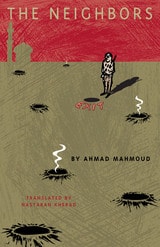
The Neighbors
By Ahmad Mahmoud
University of Texas Press, 2013
Ahmad Mahmoud sets The Neighbors against the backdrop of the oil nationalization crisis that gripped Iran in the early 1950s. His protagonist, Khaled, a young man from a rundown neighborhood in Ahvaz, a city in southern Iran, becomes involved in the struggle to wrest Iran’s oil industry from the British and, as the result of his political activities, comes to realize that there is more to life than the drudgery and poverty his parents and neighbors have experienced.
The Neighbors, published in 1974, cemented Mahmoud’s reputation as a novelist and captured the ethos of a generation—the generation that laid the groundwork for those who continue to struggle for democracy in Iran today. Though the novel received considerable praise and was read widely, its political nature earned the ire of Mohammad Reza Shah’s regime, and the Islamic Republic has objected to its sexually explicit content. This is the first time one of Ahmad Mahmoud’s novels has appeared in English translation.
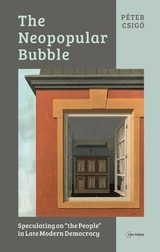
The Neopopular Bubble
Speculating on "the People" in Late Modern DemocracyPéter Csigó
Central European University Press, 2017
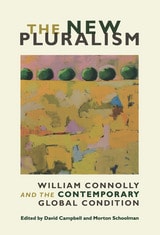
The New Pluralism
William Connolly and the Contemporary Global ConditionDavid Campbell and Morton Schoolman, eds.
Duke University Press, 2008
The contributors show how Connolly has continually revised his ideas about pluralism to take into account radical changes in global politics, incorporate new theories of cognition, and reflect on the centrality of religion in political conflict. They engage his arguments for an agonistic democracy in which all fundamentalisms become the objects of politicization, so that differences are not just tolerated but are productive of debate and the creative source of a politics of becoming. They also explore the implications of his work, often challenging his views to widen the reach of even his most recently developed theories. Connolly’s new pluralism will provoke all citizens who refuse to subordinate their thinking to the regimes in which they reside, to religious authorities tied to the state, or to corporate interests tied to either. The New Pluralism concludes with an interview with Connolly in which he reflects on the evolution of his ideas and expands on his current work.
Contributors: Roland Bleiker, Wendy Brown, David Campbell, William Connolly, James Der Derian, Thomas L. Dumm, Kathy E. Ferguson, Bonnie Honig, George Kateb, Morton Schoolman
Michael J. Shapiro, Stephen K. White
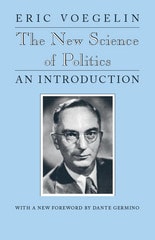
The New Science of Politics
An IntroductionEric Voegelin
University of Chicago Press, 1987
What Eric Voegelin attempts in The New Science of Politics is nothing less ambitious than a complete theory of humanity, society, and history. To build his theory, Voegelin draws on a breathtaking range of subjects from throughout history, including the Mongol Orders of Submission, the Behistun Inscription, and a controversy over an alter to the goddess Victoria in the Roman Forum. Addressing the access to truth afforded by myth, revelation, and philosophy, Voegelin then carefully contrasts each with gnosticism. The resulting book is a heady exploration of the development of European politics through the Western tradition and the ongoing importance of the inner quest for transcendent reality. =
The New Science of Politics
An IntroductionEric Voegelin
University of Chicago Press, 1987
"Thirty-five years ago few could have predicted that The New Science of Politics would be a best-seller by political theory standards. Compressed within the Draconian economy of the six Walgreen lectures is a complete theory of man, society, and history, presented at the most profound and intellectual level. . . . Voegelin's [work] stands out in bold relief from much of what has passed under the name of political science in recent decades. . . . The New Science is aptly titled, for Voegelin makes clear at the outset that a 'return to the specific content' of premodern political theory is out of the question. . . . The subtitle of the book, An Introduction, clearly indicates that The New Science of Politics is an invitation to join the search for the recovery of our full humanity."—From the new Foreword by Dante Germino
"This book must be considered one of the most enlightening essays on the character of European politics that has appeared in half a century. . . . This is a book powerful and vivid enough to make agreement or disagreement with even its main thesis relatively unimportant."—Times Literary Supplement
"Voegelin . . . is one of the most distinguished interpreters to Americans of the non-liberal streams of European thought. . . . He brings a remarkable breadth of knowledge, and a historical imagination that ranges frequently into brilliant insights and generalizations."—Francis G. Wilson, American Political Science Review
"This book is beautifully constructed . . . his erudition constantly brings a startling illumination."—Martin Wright, International Affairs
"A ledestar to thinking men who seek a restoration of political science on the classic and Christian basis . . . a significant accomplishment in the retheorization of our age."—Anthony Harrigan, Christian Century
The Next Social Contract
Animals, the Anthropocene, and BiopoliticsWayne Gabardi
Temple University Press, 2017
In his provocative book The Next Social Contract, Wayne Gabardi rigorously considers the fate of animals in the twenty-first century. He claims that if we are to address the challenges raised by the Anthropocene—the period where nonhuman beings tend to be mere extras, often subsumed under the umbrella notion of “nature”—we need to radically rethink our basic ethical outlook and develop a new, “more-than-human” social contract.
Gabardi’s wide-ranging and multidisciplinary analysis focuses on four principal battlegrounds of animal biopolitics in the twenty first century: the extinction of wild animals, the crisis of oceanic animals, industrialized farm animals and the future of industrial agribusiness, and the situation of contact-zone animals moving into human-occupied habitats.
In his recasting of the social contract, Gabardi envisions a culture shift in human-animal relations toward posthumanism that features the ethical and political prioritization of animal life so it is on par with that of human well-being.
The Ninth
A NovelFerenc Barnas
Northwestern University Press, 2009
Set in a sleepy village north of Budapest in 1968, this touching, unsettling novel paints a richly wrought portrait of mid-twentieth-century Hungary. The narrator is the ninth child of a family distinguished by its size, poverty, faith, and abundance of physical and psychological disabilities. His confusion is exacerbated by the strict, secretive Catholic household his parents keep in the face of a Communist system. These dual oppressions propel him toward an inevitable realization of his guilt and desire that speaks to his struggle with a fateful, seamless beauty.
The Nixon Memo
Political Respectability, Russia, and the PressMarvin Kalb
University of Chicago Press, 1994
The story begins on March 10, 1992. Nixon had written a private memo critical of president George Bush's policy toward Russia. The memo leaked and exploded on the front page of The New York Times. Why would Nixon attack Bush, a fellow party member fighting for re-election? Why on an issue of foreign affairs, which was Bush's strength? The questions are as intriguing as the answers, and distinguished journalist and scholar Marvin Kalb offers a suspenseful, eye-opening account of how our conventional wisdom on United States foreign policy is shaped by the insider's game of press/politics.
This story of Nixon's Machiavellian efforts to pressure the White House, by way of the press, into helping Boris Yeltsin and Russia sheds new light on the inner workings of the world inside the government of the United States. Marvin Kalb read the documents behind the Nixon memo and interviewed scores of journalists, scholars, and officials in and from Washington and Moscow. Drawing on his years of experience as a diplomatic correspondent, he identifies and illuminates the intersection of press and politics in the fashioning of public policy.
"An absorbing and often compelling argument that Richard Nixon directed his own political rehabilitation on the world stage, using presidents, lesser politicians, and the press as his supporting cast. This is a first-class job of unraveling a complex and usually unseen tapestry."—Ted Koppel
"With Marvin Kalb's captivating account, Richard Nixon continues to fascinate us even in death."—Al Hunt
The One Thomas More
Travis Curtright
Catholic University of America Press, 2012
The Only Woman in the Room
The Norma Paulus StoryNorma Paulus
Oregon State University Press, 2017
Paulus came from a family of Roosevelt Democrats, but when a friend campaigned for a Republican seat in the state legislature, she switched parties. As she put it, “The Republicans were in politics for all the right reasons.” Amid the nationwide political upheavals of the late 1960s, Oregon’s Republicans, led by popular governor Tom McCall, seemed to be her kind of people—principled, pragmatic, and committed to education, the environment, and equality for all citizens under the law.
Paulus’s appointment by Governor McCall to the Marion-Polk Boundary Commission in 1969, a precursor to Oregon’s urban growth boundaries, helped launched her on a long and distinguished career of public service. She ran successfully for the Oregon House of Representatives in 1970, the first women to do so in the district. After three terms in the House, where she championed environmental causes, women’s rights and government transparency, she was elected Oregon’s Secretary of State in 1976—the first woman to hold that office and be elected to a statewide office in Oregon. She was the Republican candidate for governor in 1986, served a stint on the Northwest Power and Conservation Council, went on to become Oregon’s superintendent of public instruction, and headed the Oregon Historical Society.
During her years of public service, spanning the 1970s through the early 2000s, Norma Paulus occupied a distinctive niche in Oregon’s progressive political ecosystem. Her vivid personality and strong convictions endeared her to a broad swath of citizens. Beautiful and opinionated, charming and forceful, Paulus was widely covered in statewide and national newspapers and television during her eventful, sometimes controversial career. Now, The Only Woman in the Room sums up her life and work in a lively, anecdotal history that will appeal to historians, political scientists, newshounds, and ordinary citizens alike.

The Other Side of the Digital
The Sacrificial Economy of New MediaAndrea Righi
University of Minnesota Press, 2021
A necessary, rich new examination of how the wired world affects our humanity
Our tech-fueled economy is often touted as a boon for the development of our fullest human potential. But as our interactions are increasingly turned into mountains of data sifted by algorithms, what impact does this infinite accumulation and circulation of information really have on us? What are the hidden mechanisms that drive our continuous engagement with the digital?
In The Other Side of the Digital, Andrea Righi argues that the Other of the digital acts as a new secular God, exerting its power through endless accountability that forces us to sacrifice ourselves for the digital. Righi deconstructs the contradictions inherent in our digital world, examining how ideas of knowledge, desire, writing, temporality, and the woman are being reconfigured by our sacrificial economy. His analyses include how both our self-image and our perception of reality are skewed by technologies like fitness bands, matchmaking apps, and search engines, among others.
The Other Side of the Digital provides a necessary, in-depth cultural analysis of how the political theology of the new media functions under neoliberalism. Drawing on the work of well-known thinkers like Jacques Derrida, Jacques Lacan, and Ludwig Wittgenstein, as well as Carla Lonzi, Luisa Muraro, and Luciano Parinetto, Righi creates novel appraisals of popular digital tools that we now use routinely to process life experiences. Asking why we must sign up for this sort of regime, The Other Side of the Digital is an important wake-up call to a world deeply entangled with the digital.
The Other Solzhenitsyn
Telling the Truth about a Misunderstood Writer and ThinkerDaniel J. Mahoney
St. Augustine's Press, 2014
This book above all explores philosophical, political, and moral themes in Solzhenitsyn’s two masterworks, The Gulag Archipelago and The Red Wheel, as well as in his great European novel In the First Circle. We see Solzhenitsyn as analyst of revolution, defender of the moral law, phenomenologist of ideological despotism, and advocate of “resisting evil with force.” Other chapters carefully explore Solzhenitsyn’s conception of patriotism, his dissection of ideological mendacity, and his controversial, but thoughtful and humane discussion of the “Jewish Question” in the Russian – and Soviet twentieth century. Some of Solzhenitsyn’s later writings, such as the “binary tales” that he wrote in the 1990s, are subject to critically appreciative analysis. And a long final chapter comments on Solzhenitsyn’s July 2007 Der Spiegel interview, his last word to Russia and the West. He is revealed to be a man of faith and freedom, a patriot but not a nationalist, and a principled advocate of self-government for Russia and the West.
A final Appendix reproduces the beautiful Introduction (“The Gift of Incarnation”) that the author’s widow, Natalia Solzhenitsyn, wrote to the 2009 Russian abridgment of The Gulag Archipelago, a work that is now taught in Russian high schools.
The People's Choice
Congressman Jim Jontz of IndianaRay Boomhower
Indiana Historical Society Press, 2012
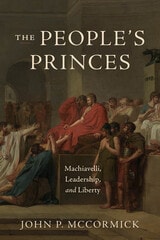
The People's Princes
Machiavelli, Leadership, and LibertyJohn P. McCormick
University of Chicago Press, 2025
A new window into Machiavelli’s idea of virtuous leadership and the appropriate relationship among leaders, common citizens, and elites.
For more than a decade, John P. McCormick has been at the forefront of a new wave of scholarship that reveals the anti-elitist and democratic commitments at the center of Niccolo Machiavelli’s political thought. In The People’s Princes, McCormick turns his attention to Machiavelli’s conception of virtuous leadership and Machiavelli’s views on the appropriate relationships among individual leaders, common citizens, and elites.
While most people think of Machiavelli as a cynical advisor of tyrants—a man who counseled leaders to aggrandize themselves, by any means necessary, at the expense of their subjects and citizens—The People’s Princes fundamentally challenges this understanding. Drawing from Machiavelli’s major political works a normative standard for leadership that emphasizes the mutually reinforcing relationship of civic leadership and popular government, McCormick delineates Machiavelli’s method of “political exemplarity” by analyzing in detail the Florentine’s case studies of leaders and their interactions with populaces throughout ancient and modern history.
McCormick argues that Machiavelli suggests that civic leaders should enhance their reputations by providing for their own eventual obsolescence; specifically, they should establish institutional means through which common citizens rule themselves more directly and substantively. The People’s Princes invites readers to consider Machiavelli anew, and also reflect on insights that remain relevant in the twenty-first century amidst growing concerns that political leaders are not accountable or responsive to popular majorities.
The Personality of Power
A Theory of Fascism for Anti-fascist LifeBrian Massumi
Duke University Press, 2025

The Philosophy of Antonio Negri, Volume One
Resistance in PracticeEdited by Timothy S. Murphy
Pluto Press, 2005
The Philosophy of Claude Lefort
Interpreting the PoliticalBernard Flynn
Northwestern University Press, 2005
Much of what passes for political philosophy in our day is merely politicized philosophical concepts, a distinction author Bernard Flynn underscores as he describes the development of Lefort's truly political philosophy—its ideas formed in response to his own political experience and to the work of certain major figures within the tradition of political thought. Beginning with Lefort's most important single work, his book on Machiavelli, Flynn presents the philosopher's conceptions of politics, modernity, and interpretation in the context within which they took shape. He then draws on a wide variety of Lefort's works to explicate his notions of premodern and modern democracy in which totalitarianism, in Lefort's singular and highly influential theory, is identified as a permanent problem of modernity.
A valuable exposition of one of the most important Continental philosophers of the post-World War II period, Flynn's book is itself a noteworthy work of interpretive philosophy, pursuing the ideas and issues addressed by Lefort to a point of unparalleled clarity and depth.
The Poetics of Political Thinking
Davide Panagia
Duke University Press, 2006
Panagia not only illuminates the structure of much contemporary political theory but also shows why understanding the poetics of political thinking is vital to contemporary society. Drawing on Gilles Deleuze’s critique of negation and his privileging of paradox as the source of political thought, Panagia suggests that a non-teleological concept of difference might generate insight into pressing questions about foreignness and citizenship. Turning to the liberal/poststructural debate that dominates contemporary political theory, he compares John Rawls’s concept of justice to Rancière’s ideas about political disagreement in order to demonstrate how, despite their differences, both thinkers comprehend aesthetic and moral reasoning as part and parcel of political writing. Considering the writings of William Hazlitt and Jürgen Habermas, he describes how the essay has become the exemplary genre of what is considered rational political argument. The Poetics of Political Thinking is a compelling reappraisal of the role of representation within political thought.