Results by title
2194 books match the query 'Women's Studies' and 323 start with t
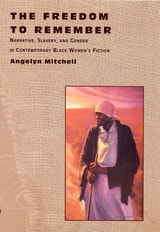
The Freedom to Remember
Narrative, Slavery, and Gender in Contemporary Black Women's FictionMitchell, Angelyn
Rutgers University Press, 2002
The Freedom to Remember examines contemporary literary revisions of slavery in the United States by black women writers. The narratives at the center of this book include: Octavia E. Butler’s Kindred, Sherley Anne Williams’s Dessa Rose, Toni Morrison’s Beloved, J. California Cooper’s Family, and Lorene Cary’s The Price of a Child.
Recent studies have investigated these works only from the standpoint of victimization. Angelyn Mitchell changes the conceptualization of these narratives, focusing on the theme of freedom, not slavery, defining these works as “liberatory narratives.” These works create a space to problematize the slavery/freedom dichotomy from which contemporary black women writers have the “safe” vantage point to reveal aspects of enslavement that their ancestors could not examine. The nineteenth-century female emancipatory narrative, by contrast, was written to aid the cause of abolition by revealing the unspeakable realitiesof slavery. Mitchell shows how the liberatory narrative functions to emancipate its readers from the legacies of slavery in American society: by facilitating a deeper discussion of the issues and by making them new through illumination and interrogation.
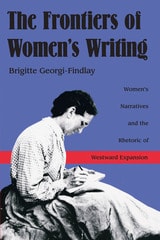
The Frontiers of Women's Writing
Women's Narratives and the Rhetoric of Westward ExpansionBrigitte Georgi-Findlay
University of Arizona Press, 1996
Brigitte Georgi-Findlay presents a range of writings that reflects the diversity of the western experience. Beginning with the narratives of Caroline Kirkland and other women of the early frontier, she reviews the diaries of the overland trails; letters and journals of the wives of army officers during the Indian wars; professional writings, focusing largely on travel, by women such as Caroline Leighton from the regional publishing cultures that emerged in the Far West during the last quarter of the century; and late-nineteenth- and early-twentieth-century accounts of missionaries and teachers on Indian reservations. Most of the writers were white, literate women who asserted their own kind of cultural authority over the lands and people they encountered. Their accounts are not only set in relation to a masculine frontier myth but also investigated for clues about their own involvement with territorial expansion. By exploring the various ways in which women writers actively contributed to and at times rejected the development of a national narrative of territorial expansion based on empire building and colonization, the author shows how their accounts are implicated in expansionist processes at the same time that they formulate positions of innocence and detachment.
Georgi-Findlay has drawn on American studies scholarship, feminist criticism, and studies of colonial discourse to examine the strategies of women's representation in writing about the West in ways that most theorists have not. She critiques generally accepted stereotypes and assumptions--both about women's writing and its difference of view in particular, and about frontier discourse and the rhetoric of westward expansion in general--as she offers a significant contribution to literary studies of the West that will challenge scholars across a wide range of disciplines.
The Gender Knot
Unraveling Our Patriarchal LegacyAllan Johnson
Temple University Press, 2014
The Gender Knot, Allan Johnson's response to the pain and confusion that men and women experience by living with gender inequality, explains what patriarchy is and isn't, how it works, and what gets in the way of understanding and doing something about it. Johnson's simple yet powerful approach avoids the paralyzing trap of guilt, blame, anger, and defensive denial that often results from conversations about gender.
This edition features:
• Updated references, data, resources, and examples, especially in relation to issues of sexual orientation and gender identity (e.g., gay marriage, transgender/cisgender)
• A glossary of terms
• A new chapter, "What Changes and What Does Not: Manhood and Violence," that provides an extended analysis of the causes of men's violence as a patriarchal phenomenon
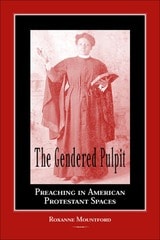
The Gendered Pulpit
Preaching in American Protestant SpacesRoxanne Mountford
Southern Illinois University Press, 2005
In this feminist investigation into the art of preaching—one of the oldest and least studied rhetorical traditions—Roxanne Mountford explores the relationship between bodies, space, race, and gender in rhetorical performance and American Protestant culture. Refiguring delivery and physicality as significant components of the rhetorical situation, The Gendered Pulpit: Preaching in American Protestant Spaces examines the strategies of three contemporary women preachers who have transgressed traditions, rearranged rhetorical space, and conquered gender bias to establish greater intimacy with their congregations.
Mountford’s examinations of the rhetoric inherent in preaching manuals from 1850 to the present provide insight into how “manliness” has remained a central concept in American preaching since the mid-nineteenth century. The manuals illustrate that the character, style, method of delivery, and theological purpose of preachers focused on white men and their cultural standing, leaving contemporary women preachers searching for ways to accommodate themselves to the physicality of preaching.
Three case studies of women preachers who have succeeded or failed in rearranging rhetorical space provide the foundation for the volume. These contemporary examples have important implications for feminist theology and also reveal the importance of gender, space, and bodies to studies of rhetoric in general. Mountford explores the geographies of St. John’s Lutheran Church and the preaching of Rev. Patricia O’Connor who reformed rhetorical space through the delivery of her sermons. At Eastside United Church of Christ, Mountford shows, Rev. Barbara Hill employed narrative style and prophetic utterance in the tradition of black preaching to address gender bias and institute change in her congregation. The final case study details the experiences of Pastor Janet Moore and her struggles at Victory Hills United Methodist Church, where the fractured congregation could not be united even with Pastor Moore’s focus on theological purpose and invention strategies.
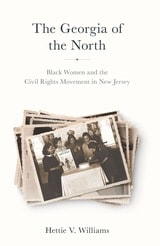
The Georgia of the North
Black Women and the Civil Rights Movement in New JerseyHettie V. Williams
Rutgers University Press, 2024

The Girl in the Yellow Poncho
A MemoirKristal Brent Zook
Duke University Press, 2023
The Girl in the Yellow Poncho is Zook’s coming-of-age tale about what it means to be biracial in America. Throughout, she grapples with in-betweenness while also facing childhood sexual assault, economic insecurity, and multigenerational alcoholism and substance abuse on both the Black and white sides of her family. Her story is one of strong Black women—herself, her cousin, her mother, and her grandmother—and the generational cycles of oppression and survival that seemingly defined their lives.
Setting out on an inner journey that takes her across oceans and continents, Zook tells the story of a little girl who never gives up on love, even long after it seems to have been destroyed. In the end she triumphs, reconciling with her father and mother to create the family of her dreams through forgiveness and sheer force of will. A testament to the power of settling into one’s authentic identity, this book tells a story of a daughter’s lifelong yearning, a mother’s rediscovery of lost love, and the profound power of atonement and faith to heal a broken family.
The Girls' History and Culture Reader
The Nineteenth CenturyEdited by Miriam Forman-Brunell and Leslie Paris
University of Illinois Press, 2011
The Girls' History and Culture Reader
The Twentieth CenturyEdited by Miriam Forman-Brunell and Leslie Paris
University of Illinois Press, 2011
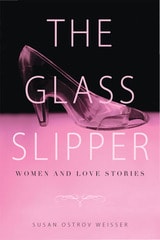
The Glass Slipper
Women and Love StoriesSusan Ostrov Weisser
Rutgers University Press, 2013
Why is the story of romance in books, magazines, and films still aimed at women rather than at men? Even after decades of feminism, traditional ideas and messages about romantic love still hold sway and, in our “postfeminist” age, are more popular than ever. Increasingly, we have become a culture of romance: stories of all kinds shape the terms of love. Women, in particular, love a love story.
The Glass Slipper is about the persistence of a familiar Anglo-American love story into the digital age. Comparing influential classics to their current counterparts, Susan Ostrov Weisser relates in highly amusing prose how these stories are shaped and defined by and for women, the main consumers of romantic texts. Following a trajectory that begins with Jane Austen and concludes with Internet dating sites, Weisser shows the many ways in which nineteenth-century views of women’s nature and the Victorian idea of romance have survived the feminist critique of the 1970s and continue in new and more ambiguous forms in today’s media, with profound implications for women.
More than a book about romance in fiction and media, The Glass Slipper illustrates how traditional stories about women’s sexuality, femininity, and romantic love have survived as seemingly protective elements in a more modern, feminist, sexually open society, confusing the picture for women themselves. Weisser compares diverse narratives—historical and contemporary from high literature and “low” genres—discussing novels by Jane Austen and Charlotte Brontë, Victorian women’s magazines, and D. H. Lawrence’s Lady Chatterley’s Lover; Disney movies; popular Harlequin romance novels; masochistic love in films; pornography and its relationship to romance; and reality TV and Internet ads as romantic stories.
Ultimately, Weisser shows that the narrative versions of the Glass Slipper should be taken as seriously as the Glass Ceiling as we see how these representations of romantic love are meant to inform women’s beliefs and goals. In this book, Weisser’s goal is not to shatter the Glass Slipper, but to see through it.

The Gloria Anzaldúa Reader
Gloria E. Anzaldúa
Duke University Press, 2009
This reader—which provides a representative sample of the poetry, prose, fiction, and experimental autobiographical writing that Anzaldúa produced during her thirty-year career—demonstrates the breadth and philosophical depth of her work. While the reader contains much of Anzaldúa’s published writing (including several pieces now out of print), more than half the material has never before been published. This newly available work offers fresh insights into crucial aspects of Anzaldúa’s life and career, including her upbringing, education, teaching experiences, writing practice and aesthetics, lifelong health struggles, and interest in visual art, as well as her theories of disability, multiculturalism, pedagogy, and spiritual activism. The pieces are arranged chronologically; each one is preceded by a brief introduction. The collection includes a glossary of Anzaldúa’s key terms and concepts, a timeline of her life, primary and secondary bibliographies, and a detailed index.
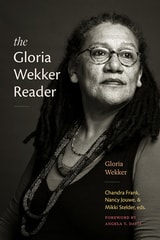
The Gloria Wekker Reader
Gloria Wekker. Chandra Frank, Nancy Jouwe, and Mikki Stelder, editors. Foreword by Angela Y. Davis.
Duke University Press, 2026
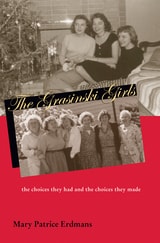
The Grasinski Girls
The Choices They Had and the Choices They MadeMary Patrice Erdmans
Ohio University Press, 2004
The Grasinski Girls were working-class Americans of Polish descent, born in the 1920s and 1930s, who created lives typical of women in their day. They went to high school, married, and had children. For the most part, they stayed home to raise their children. And they were happy doing that. They took care of their appearance and their husbands, who took care of them. Like most women of their generation, they did not join the women’s movement, and today they either reject or shy away from feminism.
Basing her account on interviews with her mother and aunts, Mary Erdmans explores the private lives of these white, Christian women in the post-World War II generation. She compares them, at times, to her own postfeminist generation. Situating these women within the religious routines that shaped their lives, Professor Erdmans explores how gender, class, ethnicity, and religion shaped the choices the Grasinski sisters were given as well as the choices they made. These women are both acted upon and actors; they are privileged and disadvantaged; they resist and surrender; they petition the Lord and accept His will.
The Grasinski Girls examines the complexity of ordinary lives, exposing privileges taken for granted as well as nuances of oppression often overlooked. Erdmans brings rigorous scholarship and familial insight to bear on the realities of twentieth-century working-class white women in America.
The Great Upheaval
Women and Nation in Postwar NigeriaJudith A. Byfield
Ohio University Press, 2021
The Great Woman Singer
Gender and Voice in Puerto Rican MusicLicia Fiol-Matta
Duke University Press, 2017
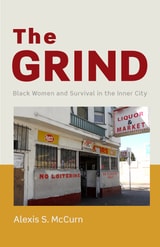
The Grind
Black Women and Survival in the Inner CityMcCurn, Alexis S
Rutgers University Press, 2018
Alexis S. McCurn draws on nearly two years of naturalistic field research among adolescents and adults in Oakland, California to provide an ethnographic account of how black women accomplish the routine tasks necessary for basic survival in poor inner-city neighborhoods and how the intersections of race, gender, and class shape how black women interact with others in public. This book makes the case that the daily consequences of racialized poverty in the lives of African Americans cannot be fully understood without accounting for the personal and collective experiences of poor black women.
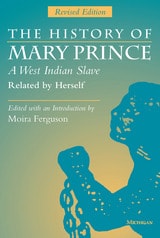
The History of Mary Prince, A West Indian Slave, Related by Herself
Revised EditionMoira Ferguson, Editor
University of Michigan Press, 1997
First published in London and Edinburgh in 1831, and well into its third edition that year, The History of Mary Prince inflamed public opinion and created political havoc. Never before had the sufferings and indignities of enslavement been seen through the eyes of a woman--a woman struggling for freedom in the face of great odds.
Moira Ferguson's edition of the book added an introduction, annotations, and appendices. The book has found popularity both in the classroom and with the general public. Recently, an adaptation of the memoirs of Mary Prince appeared as one segment of "A Skirt Through History," a six-part feature film series produced by the BBC. Mary Prince's story has also been the centerpiece of BBC radio broadcasts.
In this revised and expanded edition of The History of Mary Prince, Ferguson has added new material, based on her extensive research in Bermuda and London. The book includes new details of Mary Prince's experiences as a freewoman in England, the transcripts of several libel cases brought against her, and the reactions of British society, as seen in prominent periodicals of the day, against the original publication of The History of Mary Prince. This new material brings greater depth and detail and serves to more fully illustrate and contextualize the life of this remarkable woman.
Moira Ferguson is James E. Ryan Professor of English and Women's Literature, University of Nebraska.
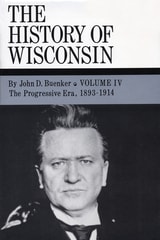
The History of Wisconsin, Volume IV
The Progressive Era, 1893-1914John D. Buenker
Wisconsin Historical Society Press, 1998
Published in Wisconsin's Sesquicentennial year, this fourth volume in The History of Wisconsin series covers the twenty tumultuous years between the World's Columbian Exposition and the First World War when Wisconsin essentially reinvented itself, becoming the nation's "laboratory of democracy."
The period known as the Progressive Era began to emerge in the mid-1890s. A sense of crisis and a widespread clamor for reform arose in reaction to rapid changes in population, technology, work, and society. Wisconsinites responded with action: their advocacy of women's suffrage, labor rights and protections, educational reform, increased social services, and more responsive government led to a veritable flood of reform legislation that established Wisconsin as the most progressive state in the union.
As governor and U.S. Senator from Wisconsin, Robert M. La Follette, Sr., was the most celebrated of the Progressives, but he was surrounded by a host of pragmatic idealists from politics, government, and the state university. Although the Progressives frequently disagreed over priorities and tactics, their values and core beliefs coalesced around broad-based participatory democracy, the application of scientific expertise to governance, and an active concern for the welfare of all members of society-what came to be known as "the Wisconsin Idea."
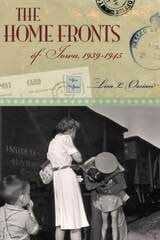
The Home Fronts of Iowa, 1939-1945
Lisa L. Ossian
University of Missouri Press, 2018
The Home Plot
Women, Writing, and Domestic RitualAnn Romines
University of Massachusetts Press, 1992
By reading domestic ritual as a gendered language, Romines seeks to reclaim one of the oldest female traditions--housekeeping--from trivialization and devaluation. In the process, she brings fresh insight to the work of five important American novelists.
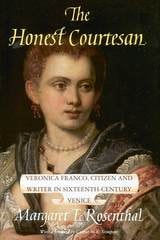
The Honest Courtesan
Veronica Franco, Citizen and Writer in Sixteenth-Century VeniceMargaret F. Rosenthal
University of Chicago Press, 1992
Margaret F. Rosenthal draws a compelling portrait of Veronica Franco in her cultural social, and economic world. Rosenthal reveals in Franco's writing a passionate support of defenseless women, strong convictions about inequality, and, in the eroticized language of her epistolary verses, the seductive political nature of all poetic contests. It is Veronica Franco's insight into the power conflicts between men and women—and her awareness of the threat she posed to her male contemporaries—that makes her literary works and her dealings with Venetian intellectuals so pertinent today.
Combining the resources of biography, history, literary theory, and cultural criticism, this sophisticated interdisciplinary work presents an eloquent and often moving account of one woman's life as an act of self-creation and as a complex response to social forces and cultural conditions.
"A book . . . pleasurably redolent of Venice in the 16th-century. Rosenthal gives a vivid sense of a world of salons and coteries, of intricate networks of family and patronage, and of literary exchanges both intellectual and erotic."—Helen Hackett, Times Higher Education Supplement
The Honest Courtesan is the basis for the film Dangerous Beauty (1998) directed by Marshall Herskovitz. (The film was re-titled The Honest Courtesan for release in the UK and Europe in 1999.)
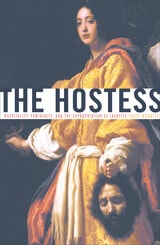
The Hostess
Hospitality, Femininity, and the Expropriation of IdentityTracy McNulty
University of Minnesota Press, 2006
The meaning of hospitality in Western thought—from the Bible to Derrida
The evolution of the idea of hospitality can be traced alongside the development of Western civilization. Etymologically, the host is the “master,” but this identity is established through expropriation and loss—the best host is the one who gives the most, ultimately relinquishing what defines him as master.
In The Hostess, Tracy McNulty asks, What are the implications for personhood of sharing a person—a wife or daughter—as an act of hospitality? In many traditions, the hostess is viewed not as a subject but as the master’s property. A foreign presence that both sustains and undercuts him, the hostess embodies the interplay of self and other within the host’s own identity.
Here McNulty combines critical readings of the Bible and Pierre Klossowski’s trilogy The Laws of Hospitality with analyses of exogamous marital exchange, theological works from the Talmud to Aquinas, the writings of Kant and Nietzsche, and the theory of femininity in the work of Freud and Lacan. Ultimately, she contends, hospitality involves the boundary between the proper and the improper, affecting the subject as well as interpersonal relations.
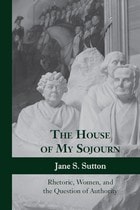
The House of My Sojourn
Rhetoric, Women, and the Question of AuthorityJane S. Sutton
University of Alabama Press, 2010
Employing the trope of architecture, Jane Sutton envisions the relationship between women and rhetoric as a house: a structure erected in ancient Greece by men that, historically, has made room for women but has also denied them the authority and agency to speak from within. Sutton’s central argument is that all attempts to include women in rhetoric exclude them from meaningful authority in due course, and this exclusion has been built into the foundations of rhetoric.
Drawing on personal experience, the spatial tropes of ancient Greek architecture, and the study of women who attained significant places in the house of rhetoric, Sutton highlights a number of decisive turns where women were able to increase their rhetorical access but were not able to achieve full authority, among them the work of Frances Wright, Lucy Stone, and suffragists Mott, Anthony, and Stanton; a visit to the 1893 World’s Columbian Exposition in Chicago, where the busts that became the Portrait Monument were displayed in the Woman’s Building (a sideshow, in essence); and a study of working-class women employed as telephone operators in New York in 1919.
With all the undeniable successes—socially, politically, and financially— of modern women, it appears that women are now populating the house of rhetoric as never before. But getting in the house and having public authority once inside are not the same thing. Sutton argues that women “can only act as far as the house permits.” Sojourn calls for a fundamental change in the very foundations of rhetoric.
The Hysteric's Revenge
French Women Writers at the Fin de SiecleRachel Mesch
Vanderbilt University Press, 2006
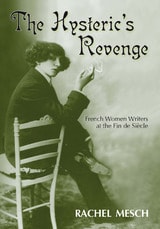
This book argues, however, that the fear of sexual abandon--though real--veiled an even more insidious fear: that women might be capable of intellectual equality with men and thus pose a threat to the most basic structures of French patriarchal society. In demonstrating the pervasiveness of this anxiety through analysis of nineteenth-century medical texts, literary criticism, and fiction, The Hysteric's Revenge brings into relief a critical relationship between the female mind and body that is essential to understanding the discursive position of the turn-of-the-century woman writer.
The novels presented here confront this mind/body problem through a wide variety of styles and genres that challenge conventional fin-de-siecle notions of femininity. From the compelling autobiography of Liane de Pougy--one of Paris's most renowned courtesans--to Colette's frank discussions of female pleasure in one of her early novels, to the violent creativity of Rachilde's androgynous heroine, Mesch demonstrates how both canonical and non-canonical writers promoted women's intellectual authority through the development of a sexual counter-discourse. In engaging the relationship between women's minds and bodies, these novels challenge the conclusions of a century of doctors who sought to prove a physiological basis for female intellectual inferiority. At the same time, they point the way towards later French feminists who sought to subvert patriarchal structures through literary explorations of sexuality.
The Intimate Life of Computers
Digitizing Domesticity in the 1980sReem Hilu
University of Minnesota Press, 2024
A feminist perspective on the early history of personal computing, revealing how computers were integrated into the most intimate aspects of family life
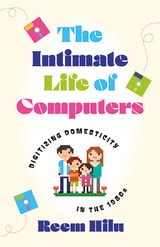
The Intimate Life of Computers shows how the widespread introduction of home computers in the 1980s was purposefully geared toward helping sustain heteronormative middle-class families by shaping relationships between users. Moving beyond the story of male-dominated computer culture, this book emphasizes the neglected history of the influence of women’s culture and feminist critique on the development of personal computing despite women’s underrepresentation in the industry.
Proposing the notion of “companionate computing,” Reem Hilu reimagines the spread of computers into American homes as the history of an interpersonal, romantic, and familial medium. She details the integration of computing into family relationships—from helping couples have better sex and offering thoughtful simulations of masculine seduction to animating cute robot companions and giving voice to dolls that could talk to lonely children—underscoring how these computer applications directly responded to the companionate needs of their users as a way to ease growing pressures on home life.
The Intimate Life of Computers is a vital contribution to feminist media history, highlighting how the emergence of personal computing dovetailed with changing gender roles and other social and cultural shifts. Eschewing the emphasis on technologies and institutions typically foregrounded in personal-computer histories, Hilu uncovers the surprising ways that domesticity and family life guided the earlier stages of our all-pervasive digital culture.

The Jacqueline Rose Reader
Jacqueline Rose
Duke University Press, 2011
The Japanese 'New Woman'
Images of Gender and ModernityLowy, Dina
Rutgers University Press, 2007
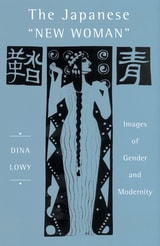
The dawn of the twentieth century in Japan witnessed the rise of a peculiar problem: the “Woman Problem.” This, at least, was the term used in an ongoing debate among the government and various intellectuals over how to define gender roles. While the government worked hard to promote the “good wife, wise mother” paradigm, certain female members of society had other notions about how to engage with their world.
In The Japanese “New Woman,” Dina Lowy focuses on this new female image as it was revealed, discussed, and debated in popular newspapers and magazines in the 1910s, as well as on the lives of a specific group of women—members of the feminist literary organization known as the Seitosha. These women drew on a variety of sources, including Zen training, Western writings and ideas, and Japanese morals and arts as they tried to open up new spaces for female activity beyond the confines of the home. Lowy shows how the Seitosha set a precedent that would be emulated in the decades to follow as Japanese women continued to question the patriarchal order, experiment with alternative visions, and pursue their rights in a variety of forms. This work also provides a context for comparative studies of New Women, gender debates, and the modernizing process.
The Jewish Women of Ravensbrück Concentration Camp
Rochelle G. Saidel
University of Wisconsin Press, 2006
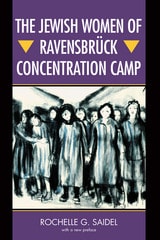
While this camp was designed to hold 5,000 women, the actual figure was six times this number. Between 1939 and 1945, 132,000 women from twenty-three countries were imprisoned in Ravensbrück, including political prisoners, Jehovah's Witnesses, "asocials" (including Gypsies, prostitutes, and lesbians), criminals, and Jewish women (who made up about 20 percent of the population). Only 15,000 survived.
Drawing upon more than sixty narratives and interviews of survivors in the United States, Israel, and Europe as well as unpublished testimonies, documents, and photographs from private archives, Rochelle Saidel provides a vivid collective and individual portrait of Ravensbrück’s Jewish women prisoners. She worked for over twenty years to track down these women whose poignant testimonies deserve to be shared with a wider audience and future generations. Their memoirs provide new perspectives and information about satellite camps (there were about 70 slave labor sub-camps). Here is the story of real daily camp life with the women’s thoughts about food, friendships, fear of rape and sexual abuse, hygiene issues, punishment, work, and resistance. Saidel includes accounts of the women's treatment, their daily struggles to survive, their hopes and fears, their friendships, their survival strategies, and the aftermath.
On April 30, 1945, the Soviet Army liberated Ravensbrück. They found only 3,000 extremely ill women in the camp, because the Nazis had sent other remaining women on a death march. The Jewish Women of Ravensbrück Concentration Camp reclaims the lost voices of the victims and restores the personal accounts of the survivors.
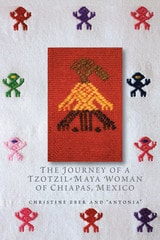
The Journey of a Tzotzil-Maya Woman of Chiapas, Mexico
Pass Well over the EarthBy Christine Eber and “Antonia”
University of Texas Press, 2011
Most recent books about Chiapas, Mexico, focus on political conflicts and the indigenous movement for human rights at the macro level. None has explored those conflicts and struggles in-depth through an individual woman's life story. The Journey of a Tzotzil-Maya Woman of Chiapas, Mexico now offers that perspective in one woman's own words. Anthropologist Christine Eber met "Antonia" in 1986 and has followed her life's journey ever since. In this book, they recount Antonia's life story and also reflect on challenges and rewards they have experienced in working together, offering insight into the role of friendship in anthropological research, as well as into the transnational movement of solidarity with the indigenous people of Chiapas that began with the Zapatista uprising.
Antonia was born in 1962 in San Pedro Chenalhó, a Tzotzil-Maya township in highland Chiapas. Her story begins with memories of childhood and progresses to young adulthood, when Antonia began working with women in her community to form weaving cooperatives while also becoming involved in the Word of God, the progressive Catholic movement known elsewhere as Liberation Theology. In 1994, as a wife and mother of six children, she joined a support base for the Zapatista Army of National Liberation. Recounting her experiences in these three interwoven movements, Antonia offers a vivid and nuanced picture of working for social justice while trying to remain true to her people's traditions.
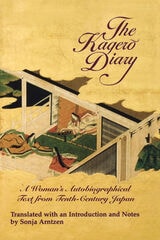
The Kagero Diary
A Woman’s Autobiographical Text from Tenth-Century JapanTranslated with an Introduction and Notes by Sonja Arntzen
University of Michigan Press, 1997
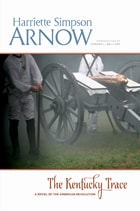
The Kentucky Trace
A Novel of the American RevolutionHarriette Simpson Arnow
Michigan State University Press, 2012
A gripping portrait of life in the hard-bitten wilderness of Revolutionary Kentucky, Harriette Simpson Arnow’s The Kentucky Trace follows surveyor William David Leslie Collins as he struggles to survive. Collins finds his fellow settlers to be almost as inscrutable as the weather—at times, they are allies, and at others, they are adversaries. Collins battles nature, bad luck, and the quickly shifting political tides to make his way in a changing world. Showcasing Arnow’s ear for dialogue and offering a wealth of historical detail, The Kentucky Trace is a masterful work of fiction by a preeminent Appalachian writer.
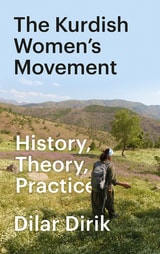
The Kurdish Women’s Movement
History, Theory, PracticeDilar Dirik
Pluto Press, 2021
'One the foremost writers and participants in the Kurdish women's movement' - Harsha Walia
The Kurdish women's movement is at the heart of the most exciting revolutionary experiment in the world today: Rojava. Forged over decades of struggle, most recently in the fight against ISIS, Rojava embodies a radical commitment to ecology, democracy and gender equality. But while striking images of Kurdish women in desert fatigues proliferate, a true understanding of the women's movement remains elusive.
Taking apart the superficial and Orientalist frameworks that dominate, Dilar Dirik offers instead an empirically rich account of the women's movement in Kurdistan. Drawing on original research and ethnographic fieldwork, she surveys the movement's historical origins, ideological evolution, and political practice over the past forty years. Going beyond abstract ideas, Dirik locates the movement's culture and ideology in its concrete work for women's liberation and radical democracy.
Taking the reader from the guerrilla camps in the mountains to radical women's academies and self-organized refugee camps, the book invites readers around the world to engage with the revolution in Kurdistan, both theoretically and practically, as a vital touchstone in the wider struggle for a militant anti-fascist, anti-capitalist feminist internationalism.
The Labor of Care
Filipina Migrants and Transnational Families in the Digital AgeValerie Francisco-Menchavez
University of Illinois Press, 2018
The Labor of Faith
Gender and Power in Black Apostolic PentecostalismJudith Casselberry
Duke University Press, 2017
The Lady and the Virgin
Image, Attitude, and Experience in Twelfth-Century FrancePenny Schine Gold
University of Chicago Press, 1985
Vividly recreating the rich texture of medieval life, Gold effectively and eloquently goes beyond a simple equation of social context and representation. In the process. she challenges equally simple judgments of historical periods as being either "good" or "bad" for women.
"[The Lady and the Virgin] presents its findings in a form that should attract students as well as their instructors. The careful and controlled use of so many different kinds of sources . . . offers us a valuable medieval case study in the inner-relationship between the segments of society and its ethos or value system."—Joel T. Rosenthal, The History Teacher
"Something of a tour de force in an interdisciplinary approach to history."—Jo Ann McNamara, Speculum
"[A] well-written, extremely well-researched book. . . . The Lady and the Virgin is useful, readable, and well informed."—R. Howard Bloch, Modern Philology

The Life and Death of Texas German
Eileen Boris, ed.
Duke University Press, 0
By comparing and contrasting present-day data with data from the German dialects brought to Texas since the 1840s, the volume offers an in-depth analysis of mutual interaction between the German-speaking community and English-speaking Texans, long-term accommodation of Texas German speakers in this new community, and language hybridization on the Texas frontier. The volume also analyzes a number of phonological, syntactic, and morphological changes in Texas German over the past century and examines sociolinguistic aspects of the Texas German community from its foundation to today, providing insight into the dynamics underlying new-dialect formation, diglossia, language shift, language maintenance, and language death. Finally, the volume investigates the rapid disappearance of languages, which has global social and cultural implications for areas beyond linguistics.
The Life and Times of Grandfather Alonso
Culture and History in the Upper AmazonMuratorio, Blanca
Rutgers University Press, 1991
In Blanca Muratorio's book, we are introduced to Rucuyaya Alonso, an elderly Quichua Indian of the Upper Ecuadorean Amazon. Alonso is a hunter, but like most Quichuas, he has done other work as well, bearing loads, panning gold, tapping rubber trees, and working for Shell Oil. He tells of his work, his hunting, his marriage, his fights, his fears, and his dreams. His story covers about a century because he incorporates the oral tradition of his father and grandfather along with his own memories. Through his life story, we learn about the social and economic life of that region.
Chapters of Alonso's life history and oral tradition alternate with chapters detailing the history of the world around him--the domination of missionaries, the white settlers' expropriation of land, the debt system workers were subjected to, the rubber boom, the world-wide crisis of the 1930s, and the booms and busts of the international oil market. Muratorio explains the larger social, economic, and ideological bases of white domination over native peoples in Amazonia. She shows how through everyday actions and thoughts, the Quichua Indians resisted attacks against their social identity, their ethnic dignity, and their symbolic systems. They were far from submissive, as they have often been portrayed.
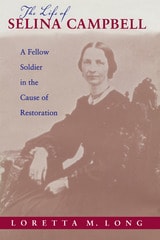
The Life of Selina Campbell
A Fellow Soldier in the Cause of RestorationLoretta M. Long Hunnicutt
University of Alabama Press, 2001
This first biography of Selina Campbell opens a window onto the experience of women in one of the most dynamic religious groups of 19th-century America
Loretta M. Long examines the life and influence of Selina Campbell, one of the most visible women in the 19th-century Disciples of Christ movement. Best known as the wife of Alexander Campbell, founder of the Disciples, Selina Campbell both shaped and exemplified the role of women in this dynamic religious group (also known as the Stone-Campbell movement). Her story demonstrates the importance of faith in the lives of many women during this era and adds a new dimension to the concept of the “separate spheres” of men and women, which women like Campbell interpreted in the context of their religious beliefs.
A household manager, mother, writer, and friend, Campbell held sway primarily in the domestic sphere, but she was not held captive by it. Her relationship with her husband was founded on a deep sense of partnership conditioned by their strong faith in an all-powerful God. Each of them took on complementary roles according to the perceived natural abilities of their genders: Alexander depended on Selina to manage his property and raise the children while he traveled the country preaching. Campbell outlived her husband by 30 years, and during that time published several newspaper articles and supported new causes, such as women in missions.
In the end, as Long amply demonstrates, Selina Campbell was neither her husband’s shadow nor solely a domestic worker. She was, in her husband’s eyes, a full partner and a “fellow soldier” in the cause of Restoration.
The Limits to Union
Same-Sex Marriage and the Politics of Civil RightsJonathan Goldberg-Hiller
University of Michigan Press, 2004
"The Limits to Union is a superb book about the complexities of recent political struggles over same-sex marriage. Goldberg-Hiller offers a sophisticated account of egalitarian rights advocacy and the reaction it has generated from established majorities animated by a 'new common sense' of exclusionary sovereign authority. The author's analysis is multidimensional and nuanced, but the core argument is bold, important, and well-supported. I recommend it very highly to everyone interested in understanding the character, possibilities, and constraints of civil rights amid our contemporary culture wars."
-Michael McCann, author of Rights at Work: Pay Equity Reform and the Politics of Legal Mobilization
"In this excellent book, Goldberg-Hiller uses Hawaii's experience to examine the interaction between courts and the political system. . . . Relying on briefs, legislative statements, and interviews with activists from both sides of the question, he views this familiar debate . . . through the unfamiliar prism of gay marriage, which allows him to gauge the viability and the pliability of the American civil rights ideal, and how gay and lesbian issues fit (or don't fit) within that ideal."
-Willian Heinzen, New York Law Journal
"Goldberg-Hiller presents the history of the same-sex marriage question since it first sparked debate in Hawaii. He follows the shifting debate through court cases, state propositions, and state and federal legislatures, considering questions about the constitutionality of the Defense of Marriage Act and the concept of equal protection under the law for gays and lesbians. This detailed treatment of the legal issues surrounding same-sex marriages is highly recommended."
-R. L. Abbott, University of Evansville
"[A] valuable contribution to the field, situating the gay marriage debate in broader contexts of theory, law and practice. [S]ame-sex marriage is an important issue...that finds itself caught in the friction points of much larger debates over the nature of rights, the limits of sovereignty and the proper role of courts and law in a democratic society. The Limits to Union should therefore be of interest even to those who do not think of themselves as interested in gay and lesbian rights issues."
-Evan Gerstmann, Loyola Marymount University, Law and Politics Book Review

The Limits to Union
Same-Sex Marriage and the Politics of Civil RightsJonathan Goldberg-Hiller
University of Michigan Press, 2002
"The Limits to Union is a superb book about the complexities of recent political struggles over same-sex marriage. Goldberg-Hiller offers a sophisticated account of egalitarian rights advocacy and the reaction it has generated from established majorities animated by a 'new common sense' of exclusionary sovereign authority. The author's analysis is multidimensional and nuanced, but the core argument is bold, important, and well-supported. I recommend it very highly to everyone interested in understanding the character, possibilities, and constraints of civil rights amid our contemporary culture wars."
-Michael McCann, author of Rights at Work: Pay Equity Reform and the Politics of Legal Mobilization
"In this excellent book, Goldberg-Hiller uses Hawaii's experience to examine the interaction between courts and the political system. . . . Relying on briefs, legislative statements, and interviews with activists from both sides of the question, he views this familiar debate . . . through the unfamiliar prism of gay marriage, which allows him to gauge the viability and the pliability of the American civil rights ideal, and how gay and lesbian issues fit (or don't fit) within that ideal."
-Willian Heinzen, New York Law Journal
"Goldberg-Hiller presents the history of the same-sex marriage question since it first sparked debate in Hawaii. He follows the shifting debate through court cases, state propositions, and state and federal legislatures, considering questions about the constitutionality of the Defense of Marriage Act and the concept of equal protection under the law for gays and lesbians. This detailed treatment of the legal issues surrounding same-sex marriages is highly recommended."
-R. L. Abbott, University of Evansville
"[A] valuable contribution to the field, situating the gay marriage debate in broader contexts of theory, law and practice. [S]ame-sex marriage is an important issue...that finds itself caught in the friction points of much larger debates over the nature of rights, the limits of sovereignty and the proper role of courts and law in a democratic society. The Limits to Union should therefore be of interest even to those who do not think of themselves as interested in gay and lesbian rights issues."
-Evan Gerstmann, Loyola Marymount University, Law and Politics Book Review
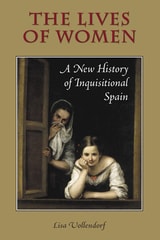
The Lives of Women
A New History of Inquisitional SpainLisa Vollendorf
Vanderbilt University Press, 2007
During this period, more women wrote for the public book market and participated in literary culture than ever before. In addition, the rise in convents and female education contributed to a marked increase in texts produced by and about women in religious orders. Vollendorf argues that, in conjunction with Inquisition and legal documents, this wealth of writing offers unprecedented access to women's perspectives on life in early modern Spain, and that those perspectives encompass diverse ethnic backgrounds and class differences. Many of the documents touch on issues of sex and intimacy; others provide new ways of understanding religious practice in the period. Perhaps most important, these writings give a richly textured view of how women reacted to the dominant culture's attempts to define, limit, and contain femininity. Vollendorf shows that the texts reflect a shared preoccupation with redefining gender and creating legitimate spaces for women.
As The Lives of Women vividly illustrates, hundreds, if not thousands, of women's stories await rediscovery in archives. The book provides a roadmap for understanding the experiences and concerns of wives, widows, sisters, and daughters who lived in a key moment in the development of the Spanish nation and the Hispanic world. At its core, The Lives of Women argues for a reconceptualization of history, one that will rely on the experiences of women and minorities as much as on the words and actions of kings and conquistadors.

The Long Road of Woman's Memory
Jane Addams
University of Illinois Press, 2001
These women, usually rather withdrawn from the community, seemed to spring to life in response to this apocryphal story--and to be inspired to tell stories of their own. The tales they shared with Addams in the wake of the Devil Baby were more personal and revealing than any they had previously told her: stories of abusive mates, lost or neglectful children, and endless, ill-paid menial labor endured on behalf of loved ones. In response to these sometimes wrenching conversations, Addams wrote The Long Road of Woman's Memory, an extended musing on the role of memory and myth in women's lives.
As Addams records the difficult recollections of these women she ponders the transformation of their experiences--so debilitating and full of anguish--into memories devoid of rancor and pain. She explores the catalytic function of cautionary tales in reviving older women's sense of agency. Through moving conversations with women who had lost sons on the battlefield, she emphasizes the importance of voicing a female perspective on war. The women's stories, graphically depicting the conditions in which they lived and labored and the purposefulness that sustained them, are gracefully woven together with Addams's insights on the functioning and purpose of memory.
Seen in the context of Addams's personal connection with these diverse women and their stories, her larger efforts to bring about equity and social justice appear all the more courageous and vital. Charlene Haddock Seigfried's new introduction sets Addams's observations in the context of pragmatist and feminist traditions.

The Love Surgeon
A Story of Trust, Harm, and the Limits of Medical RegulationSarah B. Rodriguez
Rutgers University Press, 2020
It would be easy to dismiss Dr. Burt as a monstrous aberration, a modern-day Dr. Frankenstein. Yet as medical historian Sarah Rodriguez reveals, that’s not the whole story. The Love Surgeon asks tough questions about Burt’s heinous acts and what they reveal about the failures of the medical establishment: How was he able to perform an untested surgical procedure? Why wasn’t he obliged to get informed consent from his patients? And why did it take his peers so long to take action?
The Love Surgeon is both a medical horror story and a cautionary tale about the limits of professional self-regulation.
The Making of Our Bodies, Ourselves
How Feminism Travels across BordersKathy Davis
Duke University Press, 2007
Kathy Davis tells the story of this remarkable book’s global circulation. Based on interviews with members of the Boston Women’s Health Book Collective, the group of women who created Our Bodies, Ourselves, as well as responses to the book from readers, and discussions with translators from Latin America, Egypt, Thailand, China, Eastern Europe, Francophone Africa, and many other countries and regions, Davis shows why Our Bodies, Ourselves could never have been so influential if it had been just a popular manual on women’s health. It was precisely the book’s distinctive epistemology, inviting women to use their own experiences as resources for producing situated, critical knowledge about their bodies and health, that allowed the book to speak to so many women within and outside the United States. Davis provides a grounded analysis of how feminist knowledge and political practice actually travel, and she shows how the process of transforming Our Bodies, Ourselves offers a glimpse of a truly transnational feminism, one that joins the acknowledgment of difference and diversity among women in different locations with critical reflexivity and political empowerment.
The Margins of the Text
D. C. Greetham, Editor
University of Michigan Press, 1997
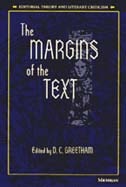
The Margins of the Text is the first attempt to collect a body of essays concerned with specific aspects of the marginal as they relate to text. The volume is divided into two sections. The first part assembles essays concerned with the margins of textual discourse and explores the function of discourses not previously recognized as significant to scholarly editing, such as those of class, race, gender, and sexual orientation. The second section attends to the textual margins in the bibliographical sense--the margins of the book, in which there has been so much recent interest. The two parts of the collection are clearly interrelated, since both study the effects of margins as a form of cultural discourse.
As a whole, the collection spans several periods (medieval, Renaissance, eighteenth-century to modern), several disciplines (drama, literature, art history, politics, and philosophy), and offers a wide-ranging consideration of a single topic as it is manifested in various genres, formats, and media. The contributors are among the most respected textual/critical theorists in their fields.
The Margins of the Text will become a standard reference in the field, and will be read profitably by culture critics and social historians as well as textual critics and editors.
D. C. Greetham is Professor of English and Medieval Studies, City University of New York Graduate School.

The Memory Sessions
Suzanne Farrell Smith
Bucknell University Press, 2019
Published by Bucknell University Press. Distributed worldwide by Rutgers University Press.

The Merchant of Prato's Wife
Margherita Datini and Her World, 1360-1423Ann Crabb
University of Michigan Press, 2015
The Merits of Women
Wherein Is Revealed Their Nobility and Their Superiority to MenModerata Fonte
University of Chicago Press, 2018
Without help from their wives, men are just like unlit lamps . . .
Just think of them as an unreliable clock that tells you it’s ten o’clock when it’s in fact barely two . . .
A man without a woman is like a fly without a head . . .
These are but a small selection of the quips bandied about at this lively gathering of women. The broad topic at hand is the relative pros and cons of men, and the cases in point range from pick-up artists to locker-room talk, and from double standards to fragile masculinity.
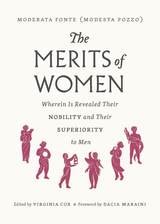
Yet this dialogue unfolds not among ironically misandrist millenials venting at their local dive bar, but rather among sixteenth-century women—variously married, widowed, single, and betrothed—attending a respectable Venice garden party. Written in the early 1590s by Moderata Fonte, pseudonym of the Renaissance poet and writer Modesta Pozzo, this literary dialogue interrogates men and men’s treatment of women, and explores by contrast the virtues of singledom and female friendship. As the women diverge from their theme—discussing everything from astrology to the curative powers of plants and minerals—a remarkable group portrait of wisdom, wit, and erudition emerges.
A new introduction by translator Virginia Cox and foreword by Dacia Maraini situate The Merits of Women in its historical context, written as it was on the cusp of Shakespeare’s heyday, and straddling the centuries between the feminist works of Christine de Pizan and Mary Wollstonecraft. Elegantly presented for a general audience, this is a must-read for baby feminists and “nasty women” alike, not to mention the perfect subtle gift for any mansplaining friend who needs a refresher on the merits of women . . . and their superiority to men.

The Mirage of a Space between Nature and Nurture
Evelyn Fox Keller
Duke University Press, 2010
The Modern Girl Around the World
Consumption, Modernity, and GlobalizationThe Modern Girl Around the World Research Group
Duke University Press, 2008
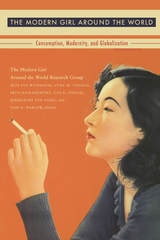
Scholars of history, women’s studies, literature, and cultural studies follow the Modern Girl around the world, analyzing her manifestations in Germany, Australia, China, Japan, France, India, the United States, Russia, South Africa, and Zimbabwe. Along the way, they demonstrate how the economic structures and cultural flows that shaped a particular form of modern femininity crossed national and imperial boundaries. In so doing, they highlight the gendered dynamics of interwar processes of racial formation, showing how images and ideas of the Modern Girl were used to shore up or critique nationalist and imperial agendas. A mix of collaborative and individually authored chapters, the volume concludes with commentaries by Kathy Peiss, Miriam Silverberg, and Timothy Burke.
Contributors: Davarian L. Baldwin, Tani E. Barlow, Timothy Burke, Liz Conor, Madeleine Yue Dong, Anne E. Gorsuch, Ruri Ito, Kathy Peiss, Uta G. Poiger, Priti Ramamurthy, Mary Louise Roberts, Barbara Sato, Miriam Silverberg, Lynn M. Thomas, Alys Eve Weinbaum
The Modern Woman Revisited
Paris Between the WarsChadwick, Whitney
Rutgers University Press, 2003
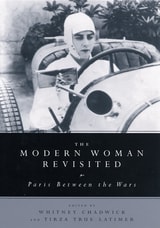
The contributions of female artists to the development of literary and artistic modernism in early twentieth century France remain poorly understood. It was during this period that a so-called “modern woman” began occupying urban spaces associated with the development of modern art and modernism’s struggles to define subjectivities and sexualities. Whereas most studies of modernism’s formal innovations and its encouragement of artistic autonomy neglect or omit necessary discussions of gender, race, class, and sexual orientation, the contributors of The Modern Woman Revisited inject these perspectives into the discussion.
Between the two World Wars, Paris served as the setting for unparalleled freedom for expatriate as well as native-born French women, who enjoyed unprecedented access to education and opportunities to participate in public artistic and intellectual life. Many of these women made lasting contributions in art and literature. Some of the artists discussed include Colette, Tamara de Lempicka, Sonia Delaunay, Djuna Barnes, Augusta Savage, and Lee Miller.
Inthis book, an internationally recognized roster of art historians, literary critics, and other scholars offers a nuanced portrait of what it meant to be a modern woman during this decisive period of modernism’s development. Individual essays explore the challenges faced by women in the early decades of the twentieth century, as well as the strategies these women deployed to create their art and to build meaningful lives and careers. The introduction underscores the importance of the contributors’ efforts to engender larger questions about modernity, sexuality, race, and class.