Results by title
836 books match the query 'France' and 213 start with t
The Premodern Condition
Medievalism and the Making of TheoryBruce Holsinger
University of Chicago Press, 2005
Holsinger shows that the preoccupation with medieval cultures and practices among Bataille, Derrida, Lacan, Barthes, Bourdieu, and their cohorts was so wide ranging that it merits recognition as one of the most significant epiphenomena of postwar French thought. Not simply an object of nostalgic longing or an occasional source of literary exempla, the medieval epoch was continually mined by these thinkers for specific philosophical vocabularies, social formations, and systems of thought.
To supplement its master thesis, The Premodern Condition also contains original essays by Bataille and Bourdieu—translated here for the first time into English—that testify in various ways to the strange persistence of medievalisms in French postwar avant-garde writings. What results is an important and original work that will be a touchstone for specialists in medieval studies and critical theory alike.
The Privilege of Being Banal
Art, Secularism, and Catholicism in ParisElayne Oliphant
University of Chicago Press, 2021
Exploring the violent histories and alternate trajectories effaced through this banal backgrounding of a crucial aspect of French history and culture, this richly textured ethnography lays bare the profound nostalgia that undergirds Catholicism’s circulation in nonreligious sites such as museums, corporate spaces, and political debates. Oliphant’s aim is to unravel the contradictions of religion and secularism and, in the process, show how aesthetics and politics come together in contemporary France to foster the kind of banality that Hannah Arendt warned against: the incapacity to take on another person’s experience of the world. A creative meditation on the power of the taken-for-granted, The Privilege of Being Banal is a landmark study of religion, aesthetics, and public space.
The Reception of Pragmatism in France and the Rise of Roman Catholic Modernism, 1890-1914
David G. Schultenover
Catholic University of America Press, 2009
The Reinvention of Obscenity
Sex, Lies, and Tabloids in Early Modern FranceJoan DeJean
University of Chicago Press, 2002
The Reinvention of Obscenity casts a fresh light on the mythical link between sexual impropriety and things French. Exploring the complicity between censorship, print culture, and obscenity, DeJean argues that mass market printing and the first modern censorial machinery came into being at the very moment that obscenity was being reinvented—that is, transformed from a minor literary phenomenon into a threat to society. DeJean's principal case in this study is the career of Moliére, who cannily exploited the new link between indecency and female genitalia to found his career as a print author; the enormous scandal which followed his play L'école des femmes made him the first modern writer to have his sex life dissected in the press.
Keenly alert to parallels with the currency of obscenity in contemporary America, The Reinvention of Obscenity will concern not only scholars of French history, but anyone interested in the intertwined histories of sex, publishing, and censorship.

The Republic Estranged
Christians, Muslims, and Jews between Algeria and France, 1870-1919Yuval Tal
University of Chicago Press, 0
Examines how the modern French Republic came into being through state efforts to assimilate Christians, Muslims, and Jews across France and colonial Algeria.
In The Republic Estranged, Yuval Tal studies three religious communities—Christians, Muslims, and Jews—and their interactions with French settlers in colonial Algeria. While each of these groups wanted to “become French” without abandoning their communal identities, the French system had its own ideas about what kind of assimilation was possible or desirable. It welcomed Christians, excluded Muslims, and enfranchised Jews while insisting that Jews could never become as naturally French as Christians could. The result, Tal shows, was a “republican ethnic common sense” that continues to shape French politics today.
Tal argues we must understand France’s deeply entrenched anti-Muslim rhetoric as part of a larger strategy that selectively privileges Christians over and against Muslim and Jewish minorities. He focuses on a period between 1870 and 1919, in which we see how France’s supposedly universalist project of national assimilation was predicated on the notion that some ethnically and religiously defined communities were more capable of “becoming French” than others. Working with sources in Arabic, French, Spanish, and Italian, including literary, political, and legal texts, this book speaks to readers across French studies, Jewish studies, and Middle East and North African studies, showing the ongoing relevance of this important period in French history.
The Republic Unsettled
Muslim French and the Contradictions of SecularismMayanthi L. Fernando
Duke University Press, 2014
The Returns of Fetishism
Charles de Brosses and the Afterlives of an IdeaCharles de Brosses, Rosalind C. Morris, and Daniel H. Leonard
University of Chicago Press, 2017
The product of de Brosses’s autodidactic curiosity and idiosyncratic theories of language, On the Worship of Fetish Gods is an enigmatic text that is often difficult for contemporary audiences to assess. In a thorough introduction to the text, Leonard situates de Brosses’s work within the cultural and intellectual milieu of its time. Then, Morris traces the concept of fetishism through its extraordinary permutations as it was picked up and transformed by the fields of philosophy, comparative religion, political economy, psychoanalysis, and anthropology. Ultimately, she breaks new ground, moving into and beyond recent studies by thinkers such as William Pietz, Hartmut Böhme, and Alfonso Iacono through illuminating new discussions on topics ranging from translation issues to Africanity and the new materialisms.
The Revolutionary Career of Maximilien Robespierre
David P. Jordan
University of Chicago Press, 1989
The Right to Difference
French Universalism and the JewsMaurice Samuels
University of Chicago Press, 2016
Samuels demonstrates that Jewish difference has always been essential to the elaboration of French universalism, whether as its foil or as proof of its reach. He traces the development of this discourse through key moments in French history, from debates over granting Jews civil rights during the Revolution, through the Dreyfus Affair and Vichy, and up to the rise of a “new antisemitism” in recent years. By recovering the forgotten history of a more open, pluralistic form of French universalism, Samuels points toward new ways of moving beyond current ethnic and religious dilemmas and argues for a more inclusive view of what constitutes political discourse in France.
The Rise and Fall of the French Revolution
Edited by T. C. W. Blanning
University of Chicago Press, 1996
The Rise and Fall of the French Revolution is a collection of seventeen pathbreaking articles which originally appeared in the Journal of Modern History. Contributors include Keith Michael Baker, Suzanne Desan, Bill Edmonds, François Furet, Vivian R. Gruder, Paul Hanson, James N. Hood, Lynn Hunt, David Lansky, Colin Lucas, John Markoff, Mona Ozouf, Alison Patrick, Jeremy D. Popkin, William H. Sewell, Jr., Theda Skocpol, Timothy Tackett, and Dale Van Kley. In addition, a substantial introduction by the editor discusses the evolution of the history of the period and how the individual contributors have shaped the debate.
This volume not only chronicles the rise and fall of the French Revolution but also introduces the reader to the different approaches being employed by the most eminent historians working in the field. The result is a volume on the French Revolution that offers a compelling combination of information and opinion, narrative and interpretation.
The Rise of the Masses
Spontaneous Mobilization and Contentious PoliticsBenjamin Abrams
University of Chicago Press, 2023
Between 15 and 26 million Americans participated in protests surrounding the murders of George Floyd, Ahmaud Arbery, Breonna Taylor, and others as part of the Black Lives Matter protests in 2020, which is only one of the most recent examples of an immense mobilization of citizens around a cause. In The Rise of the Masses, sociologist Benjamin Abrams addresses why and how people spontaneously protest, riot, and revolt en masse. While most uprisings of such a scale require tremendous resources and organizing, this book focuses on cases where people with no connection to organized movements take to the streets, largely of their own accord. Looking to the Arab Spring, Occupy Wall Street, and the Black Lives Uprising, as well as the historical case of the French Revolution, Abrams lays out a theory of how and why massive mobilizations arise without the large-scale planning that usually goes into staging protests.
Analyzing a breadth of historical and regional cases that provide insight into mass collective behavior, Abrams draws on first-person interviews and archival sources to argue that people organically mobilize when a movement speaks to their pre-existing dispositions and when structural and social conditions make it easier to get involved—what Abrams terms affinity-convergence theory. Shedding a light on the drivers behind large spontaneous protests, The Rise of the Masses offers a significant theory that could help predict movements to come.

The Romantic Machine
Utopian Science and Technology after NapoleonJohn Tresch
University of Chicago Press, 2012
In the years immediately following Napoleon’s defeat, French thinkers in all fields set their minds to the problem of how to recover from the long upheavals that had been set into motion by the French Revolution. Many challenged the Enlightenment’s emphasis on mechanics and questioned the rising power of machines, seeking a return to the organic unity of an earlier age and triggering the artistic and philosophical movement of romanticism. Previous scholars have viewed romanticism and industrialization in opposition, but in this groundbreaking volume John Tresch reveals how thoroughly entwined science and the arts were in early nineteenth-century France and how they worked together to unite a fractured society.
Focusing on a set of celebrated technologies, including steam engines, electromagnetic and geophysical instruments, early photography, and mass-scale printing, Tresch looks at how new conceptions of energy, instrumentality, and association fueled such diverse developments as fantastic literature, popular astronomy, grand opera, positivism, utopian socialism, and the Revolution of 1848. He shows that those who attempted to fuse organicism and mechanism in various ways, including Alexander von Humboldt and Auguste Comte, charted a road not taken that resonates today.
Essential reading for historians of science, intellectual and cultural historians of Europe, and literary and art historians, The Romantic Machine is poised to profoundly alter our understanding of the scientific and cultural landscape of the early nineteenth century.
The Roots of Radicalism
Tradition, the Public Sphere, and Early Nineteenth-Century Social MovementsCraig Calhoun
University of Chicago Press, 2012
The School for Lies
A Play Adapted from Molière's The MisanthropeDavid Ives
Northwestern University Press, 2012
The Seduction of Space
Cruising French CinemaJules O'Dwyer
University of Minnesota Press, 2025
A bold and far-reaching new study of French queer cinema reimagines the relationship between sexuality and space
Spatiality has long been a crucial and potent lens for understanding French culture and aesthetics. While canonical greats of French cinema such as Jean-Luc Godard, Agnès Varda, and Louis Malle invoked the notion of flânerie to explore ideas of modernism, spatial exploration, and urban sociality, Jules O’Dwyer demonstrates how a more recent generation of French queer filmmakers continues to engage with—and contest—this legacy by focusing attention on the cognate practice of cruising.
Through the work of Jacques Nolot, Sébastien Lifshitz, Christophe Honoré, Vincent Dieutre, Alain Guiraudie, and others, The Seduction of Space draws film theory, queer studies, and spatial inquiry into close proximity to examine the politics of cruising and the gendering of space. Making the case that cinema not only documents the queer spaces of the past but continues to produce them, O’Dwyer maps the relationships between sex and spatiality as he takes up such varied topics as public sex in the porn theater, racial eroticization in the banlieue, and the ecocritical valences of rural cruising.
Foregrounding the crucial role that spatiality plays in shaping the parameters of France’s visual cultures and political imaginary, The Seduction of Space is both an urgent queer reconceptualization of this tradition and a clarion call for film scholars to tarry with the politics of sexuality in all its messiness.
Retail e-book files for this title are screen-reader friendly with images accompanied by short alt text and/or extended descriptions.
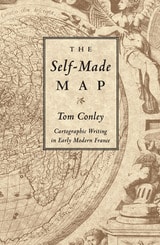
The Self-Made Map
Cartographic Writing in Early Modern FranceTom Conley
University of Minnesota Press, 2011
Conley traces the explosion of interest in mapmaking that occurred with the discovery of the New World, and discusses the commensurate rise of what he defines as cartographic writing-writing that "holds, penetrates, delineates, and explores space." Considering the works of such writers as Rabelais, Montaigne, and Descartes, Conley provides a "navigation" through the printed page, revealing the emerging values of Renaissance France. In his examination of the placing of words, letters, and graphic elements in books, he exposes the playful and sometimes enigmatic relation between spatial organization and text.
Conley also exposes the ideological exercise inherent in mapmaking, arguing that Renaissance cartography is inseparably bound up with the politics of the era. He undertakes close readings of maps and illustrations, discussing the necessity of viewing Renaissance maps in the context of their typographic layout, graphic reproduction, and literary and ideological import.
Richly illustrated throughout, The Self-Made Map combines studies of art, geography, history, literature, and printing to show a clear historical transformation, along the way linking geographical discoveries, printing processes, and political awareness. Conley's provocative analysis discloses how early modern printed literature and cartography worked together to crystallize broader issues engaging the then emergent status of cultural identity, nation, and individuality.

The Sephardic Jews of Bordeaux
Assimilation and Emancipation in Revolutionary and Napoleonic FranceFrances Malino
University of Alabama Press, 1978
This book focuses on a small community of French Jews, the first in Europe to encounter the requirements of an emerging nation-state and to be recognized by that state as full and equal citizens. The Sephardim of Bordeaux were typical of neither the majority of the Jews of France nor those of Western Europe. They had entered France as Catholics; only after more than a century of public adherence to Catholicism was their community officially recognized as Jewish. Nevertheless, their assimilation and conformity to the standards of French society as well as their commitment to a Judaism fashioned as much by contemporary political and economic concerns as by tradition reveal a legacy bequeathed to French Jewry and an important model for the development of the modern Jew.
Describing the tensions that existed between the Sephardic community of Bordeaux and the Ashkenazic Jews of France, the author also depicts their role in the relation of the Jews with Napoleon and the forming of the Grand Sanhedrin.
The Ship of Virtuous Ladies
Symphorien Champier
Iter Press, 2018
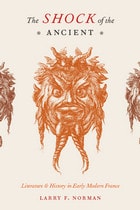
The Shock of the Ancient
Literature and History in Early Modern FranceLarry F. Norman
University of Chicago Press, 2011
The cultural battle known as the Quarrel of the Ancients and Moderns served as a sly cover for more deeply opposed views about the value of literature and the arts. One of the most public controversies of early modern Europe, the Quarrel has most often been depicted as pitting antiquarian conservatives against the insurgent critics of established authority. The Shock of the Ancient turns the canonical vision of those events on its head by demonstrating how the defenders of Greek literature—rather than clinging to an outmoded tradition—celebrated the radically different practices of the ancient world.
At a time when the constraints of decorum and the politics of French absolutism quashed the expression of cultural differences, the ancient world presented a disturbing face of otherness. Larry F. Norman explores how the authoritative status of ancient Greek texts allowed them to justify literary depictions of the scandalous. The Shock of the Ancient surveys the diverse array of aesthetic models presented in these ancient works and considers how they both helped to undermine the rigid codes of neoclassicism and paved the way for the innovative philosophies of the Enlightenment. Broadly appealing to students of European literature, art history, and philosophy, this book is an important contribution to early modern literary and cultural debates.
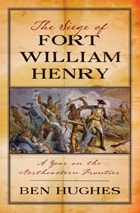
The Siege of Fort William Henry
A Year on the Northeastern FrontierBen Hughes
Westholme Publishing, 2012
Immortalized in The Last of the Mohicans, the True Story of a Pivotal Battle in the British and French War for the North American Continent
The opening years of the French and Indian War were disastrous for the British. In 1755 General Braddock’s troops were routed at the Battle of Monongahela and by the middle of 1756 Fort Oswego on Lake Ontario had fallen. Hindered by quarrelsome provincial councils, incompetent generals, and the redcoats’ inability to adapt to wilderness warfare, Britain was losing the war. In 1757 the 35th Regiment of Foot stepped into the breach. A poorly trained assortment of conscripts, old soldiers, and convicted criminals led by Lieutenant Colonel George Monro, the regiment was destined to take center stage in the most controversial event of the war. Fort William Henry on the southern shore of New York’s Lake George was a key fortification supporting British interests along the frontier with French America. Monro and his regiment occupied the fort in the spring of 1757 while Britain planned its attack on the key French fortress at Louisbourg, Nova Scotia. Learning that most of Britain’s military resources were allocated to Louisbourg, the French launched a campaign along the weakened frontier. French Commander Louis-Joseph de Montcalm and his American Indian allies laid siege to Fort William Henry; Monro could not hold out and was forced to surrender. As part of the terms, the British regiment, colonial militia, and their camp followers would be allowed safe passage to nearby Fort Edward. The French watched in horror, however, as their Indian allies attacked the British column after it left the fort, an episode that sparked outrage and changed the tactics of the war.
Seen through the eyes of participants such as Louis Antoine de Bougainville, a scholarly young aide-de-camp, Jabez Fitch, an amiable Connecticut sergeant, and Kisensik, a proud Nipissing chief whose father once met Louis XIV in the marbled halls of Versailles, The Siege of Fort William Henry: A Year on the Northeastern Frontier uses contemporary newspaper reports, official documents, private letters, and published memoirs to bring the narrative to life. From Indian councils on the banks of the Saint Lawrence River and bustling military camps in northern New York to the narrative’s bloody denouement on the shores of Lake George, the reader is immersed in the colorful, yet brutal world of eighteenth-century northeastern America.
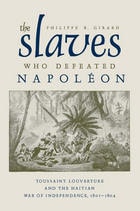
The Slaves Who Defeated Napoléon
Toussaint Louverture and the Haitian War of Independence, 1801–1804Philippe R. Girard
University of Alabama Press, 2011
A deeply researched and definitive account of the climactic battle at the end of the Haitian Revolution
Among the many rebellions against European colonial empires, the Haitian Revolution against France is among the most dramatic and complex. Having begun in 1791 as France was in the throes of its own young revolution, the conflict reached its dramatic climax when Napoleon dispatched a heavily armed expeditionary force led by his brother-in-law Charles Leclerc to re-establish slavery and the sugar economy that had so enriched France. Philippe Girard’s Slaves Who Defeated Napoleon is a deeply researched and engrossing account of this invasion and its spectacular defeat.
For this ambitious account, Philippe Girard has studied not only primary records in Haiti itself but also rare documents from nineteen public and private archives and research libraries in French, U.S., British, and Spanish collections. His more inclusive approach provides a fuller, more accurate and detailed narrative. He reveals not only key military movements, but also less-known aspects like the activities of U.S. merchants, in-fighting within Napoleon’s government, and communication between both sides and other European powers. Girard fills the work with unforgettable stories of those who led or were caught up in the war, people like poorly armed Black soldiers who ambushed Bonaparte’s columns, French child drummers, Jewish bankers in Kingston, weapon smugglers from Quaker Philadelphia, Polish artillerists, and mixed-raced people struggling to preserve their freedom against both Black and white opponents.
Transcending pat ideological and racial categories, the book brings into focus an Atlantic society at the crossroads of African and European influences, where Haitian rebels fought France while embracing its ideals.
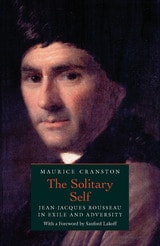
The Solitary Self
Jean-Jacques Rousseau in Exile and AdversityMaurice Cranston
University of Chicago Press, 1997
"The Solitary Self is a fitting coda to a magisterial work. Cranston . . . is a compelling stylist who narrates Rousseau's tribulations with a mixture of compassion and dry humor."—Thomas Pavel, Wall Street Journal
"Cranston not only recreates for his readers a rounded view of Rousseau himself, he sets it firmly in the social and political context of Europe's ancien regime. . . . An engrossing work of history."—John Gray, New Statesman
"Cranston's painstaking archival research and lucid style yield the most detailed and thoroughly documented biography of Rousseau written in English. His epilogue masterfully sums up Rousseau's importance as political philosopher and initiator of romantic sensibilities."—Choice
"Anyone curious about the paradoxes of a most paradoxical man will not go wrong by starting with this invaluable biography."—James Miller, Washington Post Book World
"As absorbing as a picaresque novel."—Naomi Bliven, New Yorker
"A monument of scholarship. . . . This amazing biography, like Boswell's account of Johnson, recreates the daily life of Rousseau: what he did, who he saw, what he said, what he wrote. . . . We may be quite confident that we hold in our hands the authoritative account of this life. The definitive Rousseau."—Isaac Kramnick, New Republic
Maurice Cranston (1920-1993), a distinguished scholar and recipient of the James Tait Black Memorial Prize for his biography of John Locke, was professor of political science at the London School of Economics. His numerous books include The Romantic Movement and Philosophers and Pamphleteers, and translations of Rousseau's The Social Contract and Discourse on the Origins of Inequality.
The Spell of Language
Poststructuralism and SpeculationThomas G. Pavel
University of Chicago Press, 2001
In this spirited book, Pavel shows that structuralism's flawed use of linguistic theory has rendered hollow the philosophical core of a whole generation of work in the human sciences.

The Streets of Europe
The Sights, Sounds, and Smells That Shaped Its Great CitiesBrian Ladd
University of Chicago Press, 2020
Merchants’ shouts, jostling strangers, aromas of fresh fish and flowers, plodding horses, and friendly chatter long filled the narrow, crowded streets of the European city. As they developed over many centuries, these spaces of commerce, communion, and commuting framed daily life. At its heyday in the 1800s, the European street was the place where social worlds connected and collided.
Brian Ladd recounts a rich social and cultural history of the European city street, tracing its transformation from a lively scene of trade and crowds into a thoroughfare for high-speed transportation. Looking closely at four major cities—London, Paris, Berlin, and Vienna—Ladd uncovers both the joys and the struggles of a past world. The story takes us up to the twentieth century, when the life of the street was transformed as wealthier citizens withdrew from the crowds to seek refuge in suburbs and automobiles. As demographics and technologies changed, so did the structure of cities and the design of streets, significantly shifting our relationships to them. In today’s world of high-speed transportation and impersonal marketplaces, Ladd leads us to consider how we might draw on our history to once again build streets that encourage us to linger.
By unearthing the vivid descriptions recorded by amused and outraged contemporaries, Ladd reveals the changing nature of city life, showing why streets matter and how they can contribute to public life.
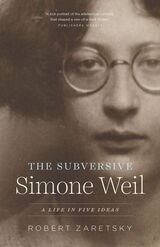
The Subversive Simone Weil
A Life in Five IdeasRobert Zaretsky
University of Chicago Press, 2021
Though Weil published little during her life, after her death, thanks largely to the efforts of Albert Camus, hundreds of pages of her manuscripts were published to critical and popular acclaim. While many seekers have been attracted to Weil’s religious thought, Robert Zaretsky gives us a different Weil, exploring her insights into politics and ethics, and showing us a new side of Weil that balances her contradictions—the rigorous rationalist who also had her own brand of Catholic mysticism; the revolutionary with a soft spot for anarchism yet who believed in the hierarchy of labor; and the humanitarian who emphasized human needs and obligations over human rights. Reflecting on the relationship between thought and action in Weil’s life, The Subversive Simone Weil honors the complexity of Weil’s thought and speaks to why it matters and continues to fascinate readers today.
The Suicide Archive
Reading Resistance in the Wake of French EmpireDoyle D. Calhoun
Duke University Press, 2024
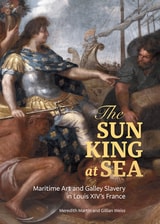
The Sun King at Sea
Maritime Art and Galley Slavery in Louis XIV's FranceMeredith Martin
J. Paul Getty Trust, The, 2022
Winner of the 2023 Leo Gershoy Award
2023 Winner of The David H. Pinkney Prize
Honorable Mention for The Mediterranean Seminar Best Book Prize 2023
Winner of the 2022 Kenshur Prize
Shortlisted for Apollo Magazine's 2022 Book of the Year
This richly illustrated volume, the first devoted to maritime art and galley slavery in early modern France, shows how royal propagandists used the image and labor of enslaved Muslims to glorify Louis XIV.
Mediterranean maritime art and the forced labor on which it depended were fundamental to the politics and propaganda of France’s King Louis XIV (r. 1643–1715). Yet most studies of French art in this period focus on Paris and Versailles, overlooking the presence or portrayal of galley slaves on the kingdom’s coasts. By examining a wide range of artistic productions—ship design, artillery sculpture, medals, paintings, and prints—Meredith Martin and Gillian Weiss uncover a vital aspect of royal representation and unsettle a standard picture of art and power in early modern France.
With an abundant selection of startling images, many never before published, The Sun King at Sea emphasizes the role of esclaves turcs (enslaved Turks)—rowers who were captured or purchased from Islamic lands—in building and decorating ships and other art objects that circulated on land and by sea to glorify the Crown. Challenging the notion that human bondage vanished from continental France, this cross-disciplinary volume invites a reassessment of servitude as a visible condition, mode of representation, and symbol of sovereignty during Louis XIV’s reign.

The Tears
Pascal Quignard
Seagull Books, 2023
The Tears is, at one level, a novel about the turbulent lives of twins, the sons of Charlemagne’s daughter Bertha. The studious and scholarly Nithard succeeds his father Angilbert as lay abbot of the Abbey of Saint Riquier in Normandy and accompanies his cousin the emperor Charles the Bald on his military campaigns. His twin brother Hartnid strikes out boldly for more exotic parts—including, eventually, Baghdad—in a seemingly deranged quest to track down the elusive female face that haunts his dreams. Yet this novel of intersecting historical threads and patches of poetic reimagining is crisscrossed by a host of other themes: the enigmatic joys afforded by nature, the intimate relation between living creatures which literature has since earliest times depicted, and the mysterious power of contingent events that have shaped entire cultures—including the birth of the French language itself. This heady brew of medieval chronicle, miraculous folktale, and speculative reconstruction of history further strengthens Pascal Quignard’s status as one of France’s most imaginative contemporary writers.
The Temptation of Saint Redon
Biography, Ideology, and Style in the Noirs of Odilon RedonStephen F. Eisenman
University of Chicago Press, 1992
Indeed, local tales and legends of witches, ghosts, one-eyed monsters, evil eyes, and wood fairies figure prominently in Redon's graphic works, which he called his noirs, or "blacks." After formal training at Bordeaux and Paris in the 1850s and 1860s, Redon began to chart his independent artistic course. Eisenman shows how, rejecting both naturalism and classicism, Redon, a prototypical Symbolist, found in grotesque and epic genres the expression of organic communities and precapitalist societies. He places Redon's desire for this imagined world of superstitious simplicity a desire manifest in his entire mature artistic practice in the context of contemporary avant-garde movements.
Redon's great noirs of the 1870s and 1880s, dreamlike configurations of seemingly irreconcilable elements from portraits, still lifes, and landscapes, show an increasingly subtle control of connotation and a complex indebtedness to caricature, allegory, and puns. Many of the noirs also visually interpret works by like-minded authors, including Baudelaire, Flaubert, Poe, and Mallarmé, one of Redon's close friends. Eisenman's analysis of the noirs underscores Redon's interest in creating an imaginative, even fantastic art, that could act directly on the human spirit. In addition to deepening our understanding of Redon and his art, The Temptation of Saint Redon exposes a link between place, politics, personal history, and the artistic imagination.

The Terror of Natural Right
Republicanism, the Cult of Nature, and the French RevolutionDan Edelstein
University of Chicago Press, 2009
Natural right—the idea that there is a collection of laws and rights based not on custom or belief but that are “natural” in origin—is typically associated with liberal politics and freedom. In The Terror of Natural Right, Dan Edelstein argues that the revolutionaries used the natural right concept of the “enemy of the human race”—an individual who has transgressed the laws of nature and must be executed without judicial formalities—to authorize three-quarters of the deaths during the Terror. Edelstein further contends that the Jacobins shared a political philosophy that he calls “natural republicanism,” which assumed that the natural state of society was a republic and that natural right provided its only acceptable laws. Ultimately, he proves that what we call the Terror was in fact only one facet of the republican theory that prevailed from Louis’s trial until the fall of Robespierre.
A highly original work of historical analysis, political theory, literary criticism, and intellectual history, The Terror of Natural Right challenges prevailing assumptions of the Terror to offer a new perspective on the Revolutionary period.
The Three Orders
Feudal Society ImaginedGeorges Duby
University of Chicago Press, 1980

The Transmutations of Chymistry
Wilhelm Homberg and the Académie Royale des SciencesLawrence M. Principe
University of Chicago Press, 2020
Principe, the leading authority on the subject, recounts how Homberg’s radical vision promoted chymistry as the most powerful and reliable means of understanding the natural world. Homberg’s work at the Académie and in collaboration with the future regent, Philippe II d’Orléans, as revealed by a wealth of newly uncovered documents, provides surprising new insights into the broader changes chymistry underwent during, and immediately after, Homberg. A human, disciplinary, and institutional biography, The Transmutations of Chymistry significantly revises what was previously known about the contours of chymistry and scientific institutions in the early eighteenth century.
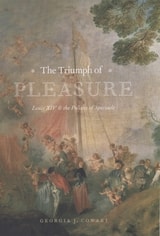
The Triumph of Pleasure
Louis XIV and the Politics of SpectacleGeorgia J. Cowart
University of Chicago Press, 2008
With bold revisionist strokes, Cowart traces this strain of artistic dissent through the comedy-ballets of Jean-Baptiste Lully and Molière, the late operatic works of Lully and the operas of his sons, the opera-ballets of André Campra and his contemporaries, and the related imagery of Antoine Watteau’s well-known painting The Pilgrimage to Cythera. She contends that through a variety of means, including the parody of old-fashioned court entertainments, these works reclaimed traditional allegories for new ideological aims, setting the tone for the Enlightenment. Exploring these arts from the perspective of spectacle as it emerged from the court into the Parisian public sphere, Cowart ultimately situates the ballet and related genres as the missing link between an imagery of propaganda and an imagery of political protest.
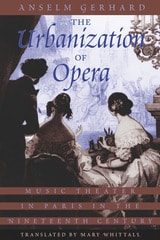
The Urbanization of Opera
Music Theater in Paris in the Nineteenth CenturyAnselm Gerhard
University of Chicago Press, 1998
"An invaluable look at this fascinating genre."—George W. Loomis, Opera News
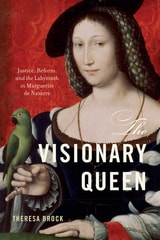
The Visionary Queen
Justice, Reform, and the Labyrinth in Marguerite de NavarreTheresa Brock
University of Delaware Press, 2024

The Visions of Tondal
From the Library of Margaret of YorkThomas Kren
J. Paul Getty Trust, The, 1990

The Visual Afterlife of Abdelkader Bennahar
Robert Desjarlais
Duke University Press, 2025
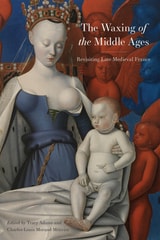
The Waxing of the Middle Ages
Revisiting Late Medieval FranceCharles-Louis Morand-Métivier
University of Delaware Press, 2023
The Waxing of the Middle Ages sets out to provide a rich, complex, and diverse study of these developments and to reassert that late medieval France is crucial in its own right. The collection argues for an approach that views the late medieval period not as an afterthought, or a blind spot, but as a period that is key in understanding the fluidity of time, traditions, culture, and history. Each essay explores some “cultural form,” to borrow Huizinga’s expression, to expose the false divide that has dominated modern scholarship.

The Wife of Martin Guerre
Janet Lewis
Ohio University Press, 2013
In this new edition of Janet Lewis’s classic short novel, The Wife of Martin Guerre, Swallow Press executive editor Kevin Haworth writes that Lewis’s story is “a short novel of astonishing depth and resonance, a sharply drawn historical tale that asks contemporary questions about identity and belonging, about men and women, and about an individual’s capacity to act within an inflexible system.” Originally published in 1941, The Wife of Martin Guerre has earned the respect and admiration of critics and readers for over sixty years.
Based on a notorious trial in sixteenth-century France, this story of Bertrande de Rols is the first of three novels making up Lewis’s Cases of Circumstantial Evidence suite (the other two are The Trial of Sören Qvist and The Ghost of Monsieur Scarron).
Swallow Press is delighted and honored to offer readers beautiful new editions of all three Cases of Circumstantial Evidence novels, each featuring a new introduction by Kevin Haworth.

The Wild Girl, Natural Man, and the Monster
Dangerous Experiments in the Age of EnlightenmentJulia V. Douthwaite
University of Chicago Press, 2002
A variety of educational experiments failed to tame these feral children by the standards of the day. After telling their stories, Douthwaite turns to literature that reflects on similar experiments to perfect human subjects. Her examples range from utopian schemes for progressive childrearing to philosophical tales of animated statues, from revolutionary theories of regenerated men to Gothic tales of scientists run amok. Encompassing thinkers such as Rousseau, Sade, Defoe, and Mary Shelley, Douthwaite shows how the Enlightenment conceived of mankind as an infinitely malleable entity, first with optimism, then with apprehension. Exposing the darker side of eighteenth-century thought, she demonstrates how advances in science gave rise to troubling ethical concerns, as parents, scientists, and politicians tried to perfect mankind with disastrous results.

The Woman Who Was Poor
A NovelLeon Bloy
St. Augustine's Press, 2014
It is the story of a woman who is abysmally poor, brutally treated and exploited by her parents, living in the gutters of Paris, yet she retains the spiritual outlook and purity of a saint. We are spared no brutality, yet there are scenes of the most tender beauty.
The woman, Clotilde, becomes an artist's model, meeting all the great French writers, among them the gloomy and magnificent Marchenoir, who is Bloy himself. They are all impressed by the depth of her thoughts and feelings; she finally marries one of them. They are pitifully poor, and the pages that cover the birth and death of their child shock with horror while moving the reader in their tragic beauty and tenderness––for this is Bloy, always hovering between death and ecstasy. Left a widow, Clotilda finds her true vocation, a vocation of poverty. She is the woman who is poor, no other words describe her more accurately. The novel ends with those famous words of extraordinary optimism: "There is only one misery…not to be saints."
The Wombs of Women
Race, Capital, FeminismFrançoise Vergès
Duke University Press, 2020

The World of René Girard
InterviewsNadine Dormoy
Michigan State University Press, 2024
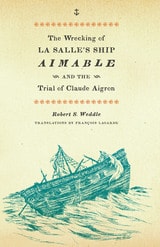
The Wrecking of La Salle's Ship Aimable and the Trial of Claude Aigron
By Robert S. Weddle
University of Texas Press, 2009
When Robert Cavelier, sieur de La Salle, landed on the Texas coast in 1685, bent on founding a French colony, his enterprise was doomed to failure. Not only was he hundreds of miles from his intended landfall—the mouth of the Mississippi—but his supply ship, Aimable, was wrecked at the mouth of Matagorda Bay, leaving the colonists with scant provisions and little protection against local Indian tribes. In anger and disgust, he struck out at the ship's captain, Claude Aigron, accusing him of wrecking the vessel purposely and maliciously.
Captain Aigron and his crew escaped the doomed colony by returning to France on the warship that had escorted the expedition on its ocean crossing. Soon after reaching France, Aigron found himself defendant in a civil suit filed by two of his officers seeking recompense for lost salary and personal effects, and then imprisoned on order of King Louis XIV while La Salle's more serious accusations were being investigated.
In this book, Robert Weddle meticulously recounts, through court documents, the known history of Aigron and the Aimable, and finds that despite La Salle's fervent accusations, the facts of the case offer no clear indictment. The court documents, deftly translated by François Lagarde, reveal Captain Aigron's successful defense and illuminate the circumstances of the wreck with Aigron's testimony. Much is also revealed about the French legal system and how the sea laws of the period were applied through the French government's L'Ordonnance de la Marine.
The Writing of Melancholy
Modes of Opposition in Early French ModernismRoss Chambers
University of Chicago Press, 1993
After the failed revolution of 1848, the sense of disillusion that swept through France deeply affected the literature of the time. Chambers argues that literary melancholy and disorientation constituted a symptom of historical conditions rather than, as many other critics contend, a willful resistance to them.
Enriched by careful readings of works by Flaubert, Nerval, Baudelaire, Gautier, and Hugo, this book is a subtle meditation on the powers of writing and reading and a suggestive contribution to current debates over the historical status of literary texts. Originally published in French, the book has been revised and expanded to include a new chapter on Gérard de Nerval's "Sylvie."
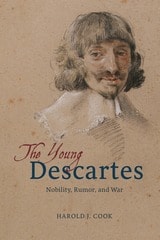
The Young Descartes
Nobility, Rumor, and WarHarold J. Cook
University of Chicago Press, 2018
In The Young Descartes, Harold J. Cook tells the story of a man who did not set out to become an author or philosopher—Descartes began publishing only after the age of forty. Rather, for years he traveled throughout Europe in diplomacy and at war. He was present at the opening events of the Thirty Years' War in Central Europe and Northern Italy, and was also later involved in struggles within France. Enduring exile, scandals, and courtly intrigue, on his journeys Descartes associated with many of the most innovative free thinkers and poets of his day, as well as great noblemen, noblewomen, and charismatic religious reformers. In his personal life, he expressed love for men as well as women and was accused of libertinism by his adversaries.
These early years on the move, in touch with powerful people and great events, and his experiences with military engineering and philosophical materialism all shaped the thinker and philosopher Descartes became in exile, where he would begin to write and publish, with purpose. But though it is these writings that made ultimately made him famous, The Young Descartes shows that this story of his early life and the tumultuous times that molded him is sure to spark a reappraisal of his philosophy and legacy.

Theater, War, and Memory in Crisis
Vichy, Algeria, the AftermathJohn Ireland
University of Michigan Press, 2025
Theory and Practice in Eighteenth-Century Dance
The German-French ConnectionTilden Russell
University of Delaware Press, 2017
This book is about the intersection of two evolving dance-historical realms—theory and practice—during the first two decades of the eighteenth century. France was the source of works on notation, choreography, and repertoire that dominated European dance practice until the 1780s. While these French inventions were welcomed and used in Germany, German dance writers responded by producing an important body of work on dance theory. This book examines consequences in Germany of this asymmetrical confrontation of dance perspectives.
Between 1703 and 1717 in Germany, a coherent theory of dance was postulated that called itself dance theory, comprehended why it was a theory, and clearly, rationally distinguished itself from practice. This flowering of dance-theoretical writing was contemporaneous with the appearance of Beauchamps-Feuillet notation in the Chorégraphie of Raoul Auger Feuillet (Paris, 1700, 1701). Beauchamps-Feuillet notation was the ideal written representation of the dance style known as la belle danse and practiced in both the ballroom and the theater. Its publication enabled the spread of belle danse to the French provinces and internationally. This spread encouraged the publication of new practical works (manuals, choreographies, recueils) on how to make steps and how to dance current dances, as well as of new dance treatises, in different languages.
The Rechtschaffener Tantzmeister, by Gottfried Taubert (Leipzig, 1717), includes a translated edition of Feuillet’s Chorégraphie. Theory and Practice in Eighteenth-Century Dance addresses how Taubert and his contemporary German authors of dance treatises (Samuel Rudolph Behr, Johann Pasch, Louis Bonin) became familiar with Beauchamps-Feuillet notation and acknowledged the Chorégraphie in their own work, and how Taubert’s translation of the Chorégraphie spread its influence northward and eastward in Europe. This book also examines the personal and literary interrelationships between the German writers on dance between 1703 and 1717 and their invention of a theoria of dance as a counterbalance to dance praxis, comparing their dance-theoretical ideas with those of John Weaver in England, and assimilating them all in a cohesive and inclusive description of dance theory in Europe by 1721.
Published by University of Delaware Press. Distributed worldwide by Rutgers University Press.

They Called Them Soldier Boys
A Texas Infantry Regiment in World War IGregory W. Ball
University of North Texas Press, 2013

Thinking With—Jean-Luc Nancy
Edited by Susanna Lindberg, Artemy Magun, and Marita Tatari
Diaphanes, 2023
This book continues passionate conversation that Jean-Luc Nancy (1940–2021) was engaged in throughout his life with philosophers and artists from all over the world. The contributors take up Nancy’s philosophical question of truth as a praxis of a “with”—understanding truth without any given measure or comparison as an articulation of a with. It is a thinking responsible for the world from within the world, a language that seeks to respond to the ongoing mutation of our civilization. Contributors include Jean-Christophe Bailly, Rodolphe Burger, Marcia Sá Calvacante Schuback, Marcus Coelen, Alexander García Düttmann, Juan-Manuel Garrido, Martta Heikkilä, Erich Hörl, Valentin Husson, Sandrine Israel-Jost, Ian James, Apostolos Lampropoulos, Nidesh Lawtoo, Jérôme Lèbre, Susanna Lindberg, Michael Marder, Artemy Magun, Boyan Manchev, Dieter Mersch, Hélène Nancy, Jean-Luc Nancy, Aïcha Liviana Messina, Ginette Michaud, Helen Petrovsky, Jacob Rogozinski, Philipp Stoellger, Peter Szendy, Georgios Tsagdis, Marita Tatari, Gert-Jan van der Heiden, and Aukje van Rooden.