Results by title
18284 books match the query 'United States' and 3764 start with t
The New American Small Town
Lessons for Sustainable Urban FuturesJennifer Mapes
West Virginia University Press, 2025
2026 Winner of John Brinckerhoff Jackson Prize awarded by the Association of American Geographers (AAG)
What makes a sustainable city? When planners and politicians talk about making cities more sustainable, they often describe changes to large urban centers like New York City or Los Angeles. Yet when they suggest solutions for sustainable living, they talk about walkable neighborhoods, traditional architecture, and diverse land uses; they talk about small towns. Planners and developers are now working to introduce a “small-town feel” into our large cities and suburbs in hopes that it will provide a sense of community and reduce the use of automobiles.
So, what of small towns themselves? We don’t talk about these places as much. They are often assumed to be utopias of the past or crumbling ghost towns of the present day rather than places with potential for sustainable living. This book critically examines narratives of American small towns, contrasting them with lived experiences in these places, and considers both the myth and reality in the context of current urban challenges. Interweaving stories from and about U.S. small towns, it offers lessons in sustainable urbanism that can be applied both in the towns themselves and to the larger cities and suburbs where most Americans now live.

The New American Sport History
Recent Approaches and PerspectivesEdited by S. W. Pope
University of Illinois Press, 1996
In this collection, sixteen scholars explore topics as diverse as the historical debate over black athletic superiority, the selling of sport in society, the eroticism of athletic activity, sexual fears of women athletes, and the marketing of the marathon.
In line with the changing nature of sport history as a field of study, the essays focus less on traditional topics and more on themes of class, gender, race, ethnicity, and national identity, which also define the larger parameters of social and cultural history. It is the first anthology to situation sport history within the broader fields of social history and cultural studies.
Contributors are Melvin L. Adelman, William J. Baker, Pamela L. Cooper, Mark Dyreson, Gerald R. Gems, Elliott J. Gorn, Allen Guttmann, Stephen H. Hardy, Peter Levine, Donald J. Mrozek, Michael Oriard, S. W. Pope, Benjamin G. Rader, Steven A. Riess, Nancy L. Struna, and David K. Wiggins.

The New American War Film
Robert Burgoyne
University of Minnesota Press, 2023
A look at how post-9/11 cinema captures the new face of war in the twenty-first century
While the war film has carved out a prominent space within the history of cinema, the twenty-first century has seen a significant shift in the characteristics that define it. Serving as a roadmap to the genre’s contemporary modes of expression, The New American War Film explores how, in the wake of 9/11, both the nature of military conflict and the symbolic frameworks that surround it have been dramatically reshaped.
Featuring in-depth analyses of contemporary films like The Hurt Locker, Zero Dark Thirty, Eye in the Sky, American Sniper, and others, The New American War Film details the genre’s turn away from previously foundational themes of heroic sacrifice and national glory, instead emphasizing the procedural violence of advanced military technologies and the haptic damage inflicted on individual bodies. Unfolding amid an atmosphere of profound anxiety and disillusionment, the new American war film demonstrates a breakdown of the prevailing cultural narratives that had come to characterize conflict in the previous century.
With each chapter highlighting a different facet of war’s cinematic representation, The New American War Film charts society’s shifting attitudes toward violent conflict and what is broadly considered to be its acceptable repercussions. Drawing attention to changes in gender dynamics and the focus on war’s lasting psychological effects within these recent films, Robert Burgoyne analyzes how cinema both reflects and reveals the makeup of the national imaginary.
The New Black Middle Class in the Twenty-First Century
Landry, Bart
Rutgers University Press, 2018
The New Bostonians
How Immigrants Have Transformed the Metro Area since the 1960sMarilynn S. Johnson
University of Massachusetts Press, 2015
How immigrants helped rebuild a city—and redefined what it means to be American
Among the most consequential pieces of Great Society legislation, the Immigration Act of 1965 opened the nation's doors to large-scale immigration from Africa, Asia, and Latin America. A half century later, the impact of the "new immigration" is evident in the transformation of the country's demographics, economy, politics, and culture, particularly in urban America.
In The New Bostonians, Marilynn S. Johnson examines the historical confluence of recent immigration and urban transformation in greater Boston, a region that underwent dramatic decline after World War II. Since the 1980s, the Boston area has experienced an astounding renaissance—a development, she argues, to which immigrants have contributed in numerous ways. From 1970 to 2010, the percentage of foreign-born residents of the city more than doubled, representing far more diversity than earlier waves of immigration. Like the older Irish, Italian, and other European immigrant groups whose labor once powered the region's industrial economy, these newer migrants have been crucial in re-building the population, labor force, and metropolitan landscape of the New Boston, although the fruits of the new prosperity have not been equally shared.

The New Censors
Movies and the Culture WarsCharles Lyons
Temple University Press, 1997
The New Censors, the first study of the complex ways movies have been shaped in the years since the demise of the Code, covers a wide range of movies, protests, and government actions. From feminists against "Dressed to Kill," to religious campaigns against "The Last Temptation of Christ," to homosexuals ire over "Basic Instinct," Lyons links a study of public outrage against movies to the broader culture wars over "family values," pornography, and various lifestyle issues.
This book provides a contemporary history of controversial movies and a timely discussion of how cultural politics continues to affect the movie industry.
The New Chicago
A Social and Cultural Analysisedited by John P. Koval, Larry Bennett, Michael I. J. Bennett, Fassil Demissie, Roberta Garner and Kiljoong Kim
Temple University Press, 2006
The New Chinese America
Class, Economy, and Social HierarchyZhao, Xiaojian
Rutgers University Press, 2010
In this detailed and comprehensive study of contemporary Chinese America, Xiaojian Zhao uses class analysis to illuminate the difficulties of everyday survival for poor and undocumented immigrants and analyzes the process through which social mobility occurs. Through ethnic ties, Chinese Americans have built an economy of their own in which entrepreneurs can maintain a competitive edge given their access to low-cost labor; workers who are shut out of the mainstream job market can find work and make a living; and consumers can enjoy high quality services at a great bargain. While the growth of the ethnic economy enhances ethnic bonds by increasing mutual dependencies among different groups of Chinese Americans, it also determines the limits of possibility for various individuals depending on their socioeconomic and immigration status.
The New Chosen People
Immigrants in the United StatesGuillermina Jasso
Russell Sage Foundation, 1990
The New Civil Rights Movement Reader
Resistance, Resilience, and JusticeEdited by Traci Parker and Marcia Walker-McWilliams
University of Massachusetts Press, 2023
In the United States, the fight to secure full civil rights for African American people has endured for centuries. The movement has included many voices, among them, working people, charismatic activists, musicians and artists, the LGBTQIA community, veterans, suburbanites, and elected officials. Moving from the labor struggles of the 1930s to the sit-ins and boycotts of midcentury, and the Black Lives Matter protests of today, this expansive volume brings together first-person accounts, political documents and speeches, and historical photographs from each region of the country.
Designed for use in courses and engaging for general readers, this new compilation is the most diverse, most inclusive, and most comprehensive resource available for teaching and learning about the civil rights movement. With chronological and geographical depth, The New Civil Rights Movement Reader addresses a range of key topics, including youth activism, regional and local freedom struggles, voting rights, economic inequality, gender, sexuality, and culture, and the movement’s global reach.
The New Crusades, the New Holy Land
Conflict in the Southern Baptist Convention, 1969-1991David T. Morgan
University of Alabama Press, 1996
Examines the conflict between modern-day Southern Baptists and “liberal” Southern Baptists over control of the Southern Baptist Convention
David Morgan captures the essence of the conflict between some modern-day Southern Baptists, who saw themselves as crusaders for truth, as they sought to redeem a new holy land--the Southern Baptist Convention-- from the control of other Southern Baptists they viewed as "liberals." To the so-called liberals, the crusaders were "fundamentalists" on a mission, not to reclaim the SBC in the name of theological truth but to gain control and redirect its activities according to their narrow political, social, and theological perspectives. The New Crusades provides a comprehensive history of the conflict, taking the reader through the bitter and divisive struggles of the late 1980s, that culminated in the 1991 emergence of a moderate faction within the SBC. The fundamentalists had won.
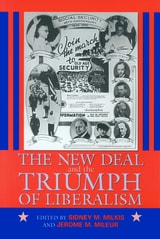
The New Deal and the Triumph of Liberalism
Sidney M. Milkis
University of Massachusetts Press, 2002
For scholars who have studied it, as for many Americans who experienced it firsthand, Franklin Roosevelt's New Deal has long represented a turning point in the modern history of the United States. More than simply a bold program of political change, it marked a critical departure in the governing principles, institutional arrangements, and policies that shape American life.
In this collection of original essays, a distinguished group of political scientists and historians reevaluate the legacy of the New Deal, showing how Roosevelt and his allies forged an enduring public philosophy—modern liberalism—that redefined the relationship of government and governed. Adapting broad principles from the past to the unprecedented circumstances of a worldwide depression, the New Dealers shifted American politics away from its traditional emphasis on self-reliance, private property, and decentralized power. In its place they advocated a new “economic constitutional order”—in effect, a new social contract—in which the government guaranteed protection to individuals against the uncertainties of the marketplace.
Although the contributors differ in their assessment of the successes and failures of New Deal liberalism, all agree that its implications for American political life were profound and far-reaching—in the realm of foreign as well as domestic affairs, for the theory as well as the practice of government. Taken together, the essays offer a fresh look at the many ways the New Deal, in Harry Hopkins's phrase, “made America over.”
In addition to the editors, contributors are William E. Leuchtenburg, Marc Landy, Nelson Lichtenstein, Donald R. Brand, Jyette Klausen, Suzanne Mettler, Ronald Story, Seyom Brown, and Morton Keller.
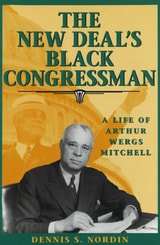
The New Deal's Black Congressman
A Life of Arthur Wergs MitchellDennis S. Nordin
University of Missouri Press, 1997
In this fascinating biography, Dennis S. Nordin chronicles the life of Arthur Wergs Mitchell, the first black Democrat to be elected to Congress. Although he is now one of history's forgotten figures, Mitchell was once almost as well known among black college students as Jesse Owens and Joe Louis. Nordin, however, shows that Mitchell's achievements and thus his fame were the direct result of his dishonorable deeds.
Mitchell's life began humbly in rural Alabama in 1883. After a memorable boyhood, he studied briefly at Tuskegee Institute, which had a major effect on Mitchell's outlook. He went on to study law in Washington, D.C., and thereafter became involved in politics when the Republicans sent him to Chicago in 1928 to campaign for Herbert Hoover. Impressed by Chicago's ward system and patronage politics, he returned to the city and made a bid for a congressional seat, changing political parties in an effort to oust black Republican Congressman Oscar DePriest. To accomplish this, Mitchell resorted to "Uncle Tomming," ingratiating himself with the white bosses of the Chicago Machine.
Within five years a Machine nomination was in hand, and Mitchell found himself owing his political success and thus his loyalty to the Chicago Machine. Because he was under strict orders from Chicago Mayor Ed Kelly not to cause problems or be confrontational, Mitchell rarely, if ever, supported the interests of his constituents.
It was only in the later years of his political career that Mitchell began to show opposition to his Machine backing. He had been an opponent of the NAACP in his first years in Congress, but later became a strong supporter of an NAACP antilynching bill. In 1937, Mitchell sued three railroad companies for not offering equal treatment and accommodations for all passengers. The case went to the Supreme Court, which gave Mitchell a favorable ruling. As a result of these "confrontational" acts, the Chicago Machine quickly decided not to endorse Mitchell in the elections of 1942.
In his research, Nordin relies on such primary sources as manuscripts, newspapers, and court records, as well as information from interviews with Mitchell's friends, neighbors, colleagues, political rivals, and widow. Woven tightly together, these sources form a narrative that reveals a most complex and intriguing individual, a man whose political and moral views and acts were strongly linked to the goals of the great Chicago political Machine.
The New Decentralists
The Back-to-the-Land Movement and the Politics of Localism in Appalachia, 1968-2000Jinny A Turman
West Virginia University Press, 2026
How some “back-to-the-landers” fled alienating urban, bureaucratic places for rural Appalachia in pursuit of self-reliance, liberation, and community, only to later find themselves vulnerable to a rising tide of national conservatism that minted new political elites on the state and local level at odds with their progressive social ideas and environmental values.
The New Dollars and Dreams
American Incomes in the Late 1990sFrank Levy
Russell Sage Foundation, 1998
The New Electoral Politics of Race
Matthew Justin Streb
University of Alabama Press, 2002
Historically, race has always been at the heart of American politics, and southern politics more specifically. Southern elections revolved almost entirely around racial issues during the 1950s and 1960s as debates raged over integration of schools, voting rights, and busing patterns. The election of George Wallace as governor of Alabama in 1962 underscored the electoral power of ruthless racial rhetoric, not only in Alabama, but throughout the South and the entire country. Almost 40 years later, segregation is no longer legal, tensions between blacks and whites have lessened, and the influx of large numbers of African Americans into the electorate has forced politicians to court black voters.
Matthew Streb finds, however, that although extreme racial rhetoric has disappeared from the modern campaign trail, voters are still polarized along racial lines. By comparing gubernatorial campaigns in four southern and three northern states-Alabama, Georgia, Arkansas, Virginia, Ohio, Iowa, and Massachusetts-the author examines how candidates use, or fail to use, race in their campaign strategies. He demonstrates that race indeed remains a significant factor in American elections, couched in alternative issues, such as affirmative action, profiling, and social welfare.
Streb's analysis of the appeal by politicians for the elite vote and the public vote reveals that class has replaced race as a definitive issue in American politics. This book will, therefore, be important not only to academic libraries and students and scholars of political science, southern history, and civil rights, but also to pollsters, campaign strategists, and state political party officials.
The New Female Antihero
The Disruptive Women of Twenty-First-Century US TelevisionSarah Hagelin and Gillian Silverman
University of Chicago Press, 2022
The last ten years have seen a shift in television storytelling toward increasingly complex storylines and characters. In this study, Sarah Hagelin and Gillian Silverman zoom in on a key figure in this transformation: the archetype of the female antihero. Far from the sunny, sincere, plucky persona once demanded of female characters, the new female antihero is often selfish and deeply unlikeable.
In this entertaining and insightful study, Hagelin and Silverman explore the meanings of this profound change in the role of women characters. In the dramas of the new millennium, they show, the female antihero is ambitious, conniving, even murderous; in comedies, she is self-centered, self-sabotaging, and anti-aspirational. Across genres, these female protagonists eschew the part of good girl or role model. In their rejection of social responsibility, female antiheroes thus represent a more profound threat to the status quo than do their male counterparts. From the devious schemers of Game of Thrones, The Americans, Scandal, and Homeland, to the joyful failures of Girls, Broad City, Insecure, and SMILF, female antiheroes register a deep ambivalence about the promises of liberal feminism. They push back against the myth of the modern-day super-woman—she who “has it all”—and in so doing, they give us new ways of imagining women’s lives in contemporary America.
The New Feminist Movement
Marion Lockwood Carden
Russell Sage Foundation, 1974
The New Freedom and the Radicals
Woodrow Wilson, Progressive Views of Radicalism, and the Origins of Repressive ToleranceJacob Kramer
Temple University Press, 2017
In The New Freedom and the Radicals, Jacob Kramer deftly examines how progressivism emerged at a time of critical transformation in American life. Using original archival sources, Kramer presents a study of Wilsonian-era politics to convey an understanding of the progressives’ views on radical America.
The New Freedom and the Radicals shows how the reactions of progressives to radicals accelerated the pace of reform in the United States, but how the movement was at times predisposed to repressing the radical elements to its left. In addition, Kramer asks to what extent progressives were responding to and influenced by those who opposed the state, capitalism, and the class structure altogether, as well as how progressives’ views of them changed in relation to events.
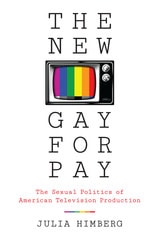
The New Gay for Pay
The Sexual Politics of American Television ProductionBy Julia Himberg
University of Texas Press, 2017
Television conveys powerful messages about sexual identities, and popular shows such as Will & Grace, Ellen, Glee, Modern Family, and The Fosters are often credited with building support for gay rights, including marriage equality. At the same time, however, many dismiss TV’s portrayal of LGBT characters and issues as “gay for pay”—that is, apolitical and exploitative programming created simply for profit. In The New Gay for Pay, Julia Himberg moves beyond both of these positions to investigate the complex and multifaceted ways that television production participates in constructing sexuality, sexual identities and communities, and sexual politics.
Himberg examines the production stories behind explicitly LGBT narratives and characters, studying how industry workers themselves negotiate processes of TV development, production, marketing, and distribution. She interviews workers whose views are rarely heard, including market researchers, public relations experts, media advocacy workers, political campaigners designing strategies for TV messaging, and corporate social responsibility department officers, as well as network executives and producers. Thoroughly analyzing their comments in the light of four key issues—visibility, advocacy, diversity, and equality—Himberg reveals how the practices and belief systems of industry workers generate the conceptions of LGBT sexuality and political change that are portrayed on television. This original approach complicates and broadens our notions about who makes media; how those practitioners operate within media conglomerates; and, perhaps most important, how they contribute to commonsense ideas about sexuality.
The New History in an Old Museum
Creating the Past at Colonial WilliamsburgRichard Handler and Eric Gable
Duke University Press, 1997
During much of its existence, the "living museum" at Williamsburg has been considered a patriotic shrine, celebrating the upscale lifestyles of Virginia’s colonial-era elite. But in recent decades a new generation of social historians has injected a more populist and critical slant to the site’s narrative of nationhood. For example, in interactions with museum visitors, employees now relate stories about the experiences of African Americans and women, stories that several years ago did not enter into descriptions of life in Colonial Williamsburg. Handler and Gable focus on the way this public history is managed, as historians and administrators define historiographical policy and middle-level managers train and direct front-line staff to deliver this "product" to the public. They explore how visitors consume or modify what they hear and see, and reveal how interpreters and craftspeople resist or acquiesce in being managed. By deploying the voices of these various actors in a richly textured narrative, The New History in an Old Museum highlights the elements of cultural consensus that emerge from this cacophony of conflict and negotiation.
The New Imperial Presidency
Renewing Presidential Power after WatergateAndrew Rudalevige
University of Michigan Press, 2006
"Well written and, while indispensable for college courses, should appeal beyond academic audiences to anyone interested in how well we govern ourselves. . . . I cannot help regarding it as a grand sequel for my own The Imperial Presidency."
---Arthur Schlesinger, Jr.
Has the imperial presidency returned? This question has been on the minds of many contemporary political observers, as recent American administrations have aimed to consolidate power.
In The New Imperial Presidency, Andrew Rudalevige suggests that the congressional framework meant to advise and constrain presidential conduct since Watergate has slowly eroded. Rudalevige describes the evolution of executive power in our separated system of governance. He discusses the abuse of power that prompted what he calls the "resurgence regime" against the imperial presidency and inquires as to how and why---over the three decades that followed Watergate---presidents have regained their standing.
Chief executives have always sought to interpret constitutional powers broadly. The ambitious president can choose from an array of strategies for pushing against congressional authority; finding scant resistance, he will attempt to expand executive control. Rudalevige's important and timely work reminds us that the freedoms secured by our system of checks and balances do not proceed automatically but depend on the exertions of public servants and the citizens they serve. His story confirms the importance of the "living Constitution," a tradition of historical experiences overlaying the text of the Constitution itself.
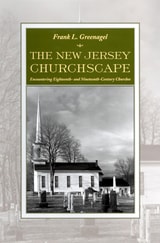
The New Jersey Churchscape
Encountering Eighteenth- and Nineteenth-Century ChurchesFrank L. Greenagel
Rutgers University Press, 2001
Although best known as the Garden State, New Jersey could also be called the Church State. The state boasts thousands of houses of worship, with more than one thousand still standing that were built in the eighteenth and nineteenth centuries. Frank L. Greenagel has photographed more than six hundred. He has selected two hundred of these historic landmarks for an examination of why they are sited where they are and why they look the way they do.
Greenagel has sought out and included images of not only mainstream Christian churches, but also Jewish synagogues as well as the places of worship of religious groups such as the Moravians, the Church of the Brethren, and the Seventh Day Baptists. The photographs are arranged chronologically within sections on three major early settlement regions of the state ¾ the Hudson River, the Delaware River, and the Raritan Valley. For each building, Greenagel details the date of construction, the cultural, historic, and religious influences that shaped it, the architectural details that distinguish it, and what purpose it currently serves.
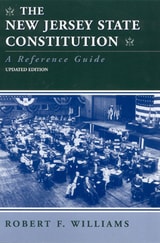
The New Jersey State Constitution
A Reference GuideWilliams, Robert F
Rutgers University Press, 1997
The year 1997 marks the fiftieth anniversary of New Jerseys wellregarded state constitution. State constitutions, although the highest source of law within a state, are not well understood by citizens, government officials, historians, political scientists, lawyers, or even judges.
This book is the first single volume to combine a detailed review of New Jersey's constitutional history and analysis of each section of the current constitution. It is the standard work on New Jersey constitutional development and law. Divided into two parts, the book first covers the historical development of the constitutions of 1776, 1844, the Constitutional Commission of 1873, and the current constitution written in 1947. It then traces the origins and major judicial interpretations of each section of the present-day constitution. It concludes with an exhaustive bibliographical essay which organizes the most complete listing of primary and secondary sources to date.
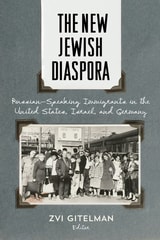
The New Jewish Diaspora
Russian-Speaking Immigrants in the United States, Israel, and GermanyGitelman, Zvi
Rutgers University Press, 2016
The New Jewish Leaders
Reshaping the American Jewish LandscapeEdited by Jack Wertheimer
Brandeis University Press, 2011
The New Left and Labor in 1960s
Peter B. Levy
University of Illinois Press, 1994
It is a powerful story: the relationship between the 1960s New Left and organized labor was summed up by hardhats confronting students and others over US involvement in Vietnam. But the real story goes beyond the "Love It or Leave It" signs and melees involving blue-collar types attacking protesters.
Peter B. Levy challenges these images by exploring the complex relationship between the two groups. Early in the 1960s, the New Left and labor had cooperated to fight for civil rights and anti-poverty programs. But diverging opinions on the Vietnam War created a schism that divided these one-time allies. Levy shows how the war, combined with the emergence of the black power movement and the blossoming of the counterculture, drove a permanent wedge between the two sides and produced the polarization that remains to this day.
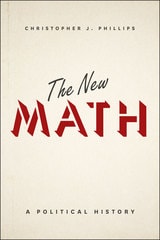
The New Math
A Political HistoryChristopher J. Phillips
University of Chicago Press, 2014
In this history, Christopher J. Phillips examines the rise and fall of the new math as a marker of the period’s political and social ferment. Neither the new math curriculum designers nor its diverse legions of supporters concentrated on whether the new math would improve students’ calculation ability. Rather, they felt the new math would train children to think in the right way, instilling in students a set of mental habits that might better prepare them to be citizens of modern society—a world of complex challenges, rapid technological change, and unforeseeable futures. While Phillips grounds his argument in shifting perceptions of intellectual discipline and the underlying nature of mathematical knowledge, he also touches on long-standing debates over the place and relevance of mathematics in liberal education. And in so doing, he explores the essence of what it means to be an intelligent American—by the numbers.
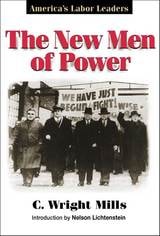
The New Men of Power
America's Labor LeadersC. Wright Mills
University of Illinois Press, 1948
thought labor leaders a new strategic elite and the unions a set of vanguard organizations that were crucial to "stopping the main drift towards war and slump." Today, as the unions once again seek to play a decisive role in American life, Mills' remarkable probe into the structure and ideology of mid-twentieth-century trade unionism remains essential reading. A new introduction by historian Nelson Lichtenstein offers insight into the Millsian political world at the time he wrote The New Men of Power.
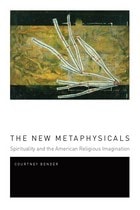
The New Metaphysicals
Spirituality and the American Religious ImaginationCourtney Bender
University of Chicago Press, 2010

The New Metropolis
Power, Place, and Inequality in Twenty-First-Century AmericaMargaret Weir
University of Chicago Press, 2027
A path-breaking investigation of changing patterns of inequality and contestation in America’s metropolises.
Since 1990, a new political geography of winners and losers has emerged in metros across America. This new metropolis looks nothing like the old. In many exurbs, suburban mansions abut declining towns and distressed communities. In historic central cities, African American communities reel from institutional stripping, even as gentrification and immigration revitalize once forgotten neighborhoods. The New Metropolis considers why, despite all the changes over the past four decades, we have recreated a metropolis that makes it harder for low-income Americans—especially low-income Americans of color—to thrive and why some efforts to promote equitable opportunity succeed against the odds.
With a focus on Chicago, Atlanta, and Houston, The New Metropolis shows how multi-level political actors and translocal networks build power across political boundaries to determine the pool of local public resources and the scope of local powers. Weir demonstrates how the timing of urbanization set up distinct conflicts over the public sector in Frostbelt versus Sunbelt metropolises, explaining how partisan divisions now supercharge these conflicts.
The New Metropolis shows why the battle over the metropolis sits at the center of American politics. It determines the shape of the public arenas where we make decisions and, ultimately, the kinds of connections Americans have with one another.
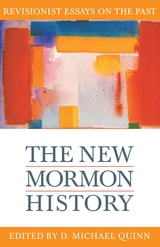
The New Mormon History
Revisionist Essays on the PastD. Michael Quinn
Signature Books, 1992
In this collection, D. Michael Quinn has selected fifteen essays which demonstrate the methods of this new history. Contributors include Thomas G. Alexander, James B. Allen, Leonard J. Arrington, Maureen Ursenbach Beecher, Eugene E. Campbell, Kenneth L. Cannon II, Mario S. DePillis, Robert B. Flanders, Klaus J. Hansen, William G. Hartley, Stanley S. Ivins, Dean L. May, Linda King Newell, B. H. Roberts, Jan Shipps, and Ronald W. Walker. Participants offer new ideas and give readers the opportunity to determine for themselves the relative success of these approaches by presenting examples. The collection demonstrates areas of interpretation that may be considered revisionist as well.
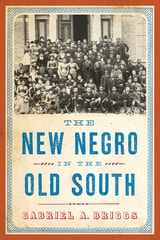
The New Negro in the Old South
Briggs, Gabriel A
Rutgers University Press, 2015
In this groundbreaking historical study, Gabriel A. Briggs makes the compelling case that the New Negro first emerged long before the Great Migration to the North. The New Negro in the Old South reconstructs the vibrant black community that developed in Nashville after the Civil War, demonstrating how it played a pivotal role in shaping the economic, intellectual, social, and political lives of African Americans in subsequent decades. Drawing from extensive archival research, Briggs investigates what made Nashville so unique and reveals how it served as a formative environment for major black intellectuals like Sutton Griggs and W.E.B. Du Bois.
The New Negro in the Old South makes the past come alive as it vividly recounts little-remembered episodes in black history, from the migration of Colored Infantry veterans in the late 1860s to the Fisk University protests of 1925. Along the way, it gives readers a new appreciation for the sophistication, determination, and bravery of African Americans in the decades between the Civil War and the Harlem Renaissance.

The New Neighborhood Senior Center
Redefining Social and Service Roles for the Baby Boom GenerationWeil, Joyce
Rutgers University Press, 2014
The New Politics of Indian Gaming
The Rise of Reservation Interest GroupsKenneth N. Hansen
University of Nevada Press, 2015
The New Politics of Pornography
Donald Alexander Downs
University of Chicago Press, 1989
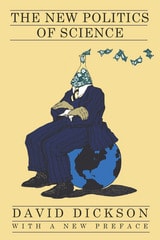
The New Politics of Science
David Dickson
University of Chicago Press, 1988
In The New Politics of Science, David Dickson points out that "the scientific community has its own internal power structures, its elites, its hierarchies, its ideologies, its sanctioned norms of social behavior, and its dissenting groups. And the more that science, as a social practice, forms an integral part of the economic structures of the society in which it is imbedded, the more the boundaries and differences between the two dissolve. Groups inside the scientific community, for example, will use groups outside the community—and vice versa—to achieve their own political ends." In this edition, Dickson has included a new preface commenting on the continuing and increasing influence of industrial and defense interests on American scientific research in the 1980s.
The New Praetorians
American Veterans, Society, and Service from Vietnam to the Forever WarMichael D. Gambone
University of Massachusetts Press, 2021
In an engrossing narrative that considers the military, economic, political, and social developments affecting military service after Vietnam, Michael D. Gambone investigates how successive generations have intentionally shaped their identity as veterans. The New Praetorians also highlights the impact of their homecoming, the range of educational opportunities open to veterans, the health care challenges they face, and the unique experiences of minority and women veterans. This groundbreaking study illustrates an important and often neglected group that is key to our understanding of American social history and civil-military affairs.
The New Presidential Elite
Men and Women in National PoliticsJeane J. Kirkpatrick
Russell Sage Foundation, 1976
The New Race Question
How the Census Counts Multiracial IndividualsJoel Perlmann
Russell Sage Foundation, 2002
The New Religious Image of Urban America, Second Edition
The Shopping Mall as Ceremonial CenterIra G. Zepp, Jr.
University Press of Colorado, 1997
The New Second Generation
Alejandro Portes
Russell Sage Foundation, 1996
The New South Faces the World
Foreign Affairs and the Southern Sense of Self,1877-1950Tennant S. McWilliams
University of Alabama Press, 2007
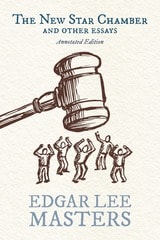
The New Star Chamber and Other Essays
Annotated EditionEdgar Lee Masters; edited by Jason Stacy
Southern Illinois University Press, 2023
Coedited by noted Masters scholar, Jason Stacy, and his class, “Editing History,” this annotated edition of Edgar Lee Masters’s The New Star Chamber and Other Essays reappears at a perilous time in US history, when large corporations and overseas conflicts once again threaten the integrity of American rights and liberties, and the United States still finds itself beholden to corporate power and the legacy of imperial hubris. In speaking to his times, Masters also speaks to ours.
These thirteen essays lay bare the political ideology that informed Spoon River Anthology. Masters argues that the dangerous imperialism championed by then-President Theodore Roosevelt was rooted in the Constitution itself. By debating the ethics of the Philippine-American War, criticizing Hamiltonian centralization of government, and extolling the virtues of Jeffersonian individualism, Masters elucidates the ways in which America had strayed from its constitutional morals and from democracy itself. The result is a compelling critique of corporate capitalism and burgeoning American imperialism, as well as an exemplary source for understanding its complicated author in the midst of his transformation from urban lawyer to poet of rural America.
In print again for the first time since 1904, this edition includes an introduction and historical annotations throughout. Edited and annotated by students at Southern Illinois University Edwardsville, and designed and illustrated by students at Southern Illinois University Carbondale, this volume traces economic and political pathologies to the origins of the American republic. The New Star Chamber and Other Essays is as vital now as it was over 100 years ago.
The New Suburban History
Edited by Kevin M. Kruse and Thomas J. Sugrue
University of Chicago Press, 2006
Kruse and Sugrue here collect ten essays—augmented by their provocative introduction—that challenge our understanding of suburbia. Drawing from original research on suburbs across the country, the contributors recast important political and social issues in the context of suburbanization. Their essays reveal the role suburbs have played in the transformation of American liberalism and conservatism; the contentious politics of race, class, and ethnicity; and debates about the environment, land use, and taxation. The contributors move the history of African Americans, Latinos, Asians, and blue-collar workers from the margins to the mainstream of suburban history.
From this broad perspective, these innovative historians explore the way suburbs affect—and are affected by—central cities, competing suburbs, and entire regions. The results, they show, are far-reaching: the emergence of a suburban America has reshaped national politics, fostered new social movements, and remade the American landscape. The New Suburban History offers nothing less than a new American history—one that claims the nation cannot be fully understood without a history of American suburbs at its very center.
The New Welfare Bureaucrats
Entanglements of Race, Class, and Policy ReformCeleste Watkins-Hayes
University of Chicago Press, 2009
As the recession worsens, more and more Americans must turn to welfare to make ends meet. Once inside the agency, the newly jobless will face a bureaucracy that has undergone massive change since the advent of welfare reform in 1996. A behind-the-scenes look at bureaucracy’s human face, The New Welfare Bureaucrats is a compelling study of welfare officers and how they navigate the increasingly tangled political and emotional terrain of their jobs.
Celeste Watkins-Hayes here reveals how welfare reform engendered a shift in focus for caseworkers from simply providing monetary aid to the much more complex process of helping recipients find work. Now both more intimately involved in their clients’ lives and wielding greater power over their well-being, welfare officers’ racial, class, and professional identities have become increasingly important factors in their work. Based on the author’s extensive fieldwork in two very different communities in the northeast, The New Welfare Bureaucrats is a boon to anyone looking to understand the impact of the institutional and policy changes wrought by welfare reform as well as the subtle social dynamics that shape the way welfare is meted out at the individual level.
The New Western History
The Territory AheadForrest G. Robinson
University of Arizona Press, 1998
Introduction / Jerome Frisk and Forrest G. Robinson
The Theoretical (Re)Positions of the New Western History / Jerome Frisk
Clio Bereft of Calliope: Literature and the New Western History / Forrest G. Robinson
Literature, Gender Studies, and the New Western History / Krista Comer
Haunting Presences and the New Western History: Reading Repetition, Negotiating Trauma / Carl Gutiérrez Jones
The Problem of the "Popular" in the New Western History / Stephen Tatum
The New Western History: An Essay from the Woods (and Rangelands) / Sally K. Fairfax and Lynn Huntsinger
The New Winter Soldiers
GI and Veteran Dissent During the Vietnam EraMoser, Richard
Rutgers University Press, 1996
Richard Moser uses interviews and personal stories of Vietnam veterans to offer a fundamentally new interpretation of the Vietnam War and the antiwar movement. Although the Vietnam War was the most important conflict of recent American history, its decisive battle was not fought in the jungles of Vietnam, or even in the streets of the United States, but rather in the hearts and minds of American soldiers. To a degree unprecedented in American history, soldiers and veterans acted to oppose the very war they waged. Tens of thousands of soldiers and veterans engaged in desperate conflicts with their superiors and opposed the war through peaceful protest, creating a mass movement of dissident organizations and underground newspapers.
Moser shows how the antiwar soldiers lived out the long tradition of the citizen soldier first created in the American Revolution and Civil War. Unlike those great upheavals of the past, the Vietnam War offered no way to fulfill the citizen-soldier's struggle for freedom and justice. Rather than abandoning such ideals, however, tens of thousands abandoned the war effort and instead fulfilled their heroic expectations in the movements for peace and justice. According to Moser, this transformation of warriors into peacemakers is the most important recent development of our military culture.
The struggle for peace took these new winter soldiers into America rather than away from it. Collectively these men and women discovered the continuing potential of American culture to advance the values of freedom, equality, and justice on which the nation was founded.
The New Woman in Alabama
Social Reforms and Suffrage, 1890–1920Mary Martha Thomas
University of Alabama Press, 1992
How Alabama women reshaped public life during the Progressive Era.
Between 1890 and 1920, middle-class white and black Alabama women created many clubs and organizations that took them out of the home and provided them with roles in the public sphere. Beginning with the Alabama Woman’s Christian Temperance Union in the 1880s and followed by the Alabama Federation of Women’s Clubs and the Alabama Federation of Colored Women’s Clubs in the 1890s, women spearheaded the drive to eliminate child labor, worked to improve the educational system, upgraded the jails and prisons, and created reform schools for both boys and girls.
Suffrage was also an item on the Progressive agenda. After a brief surge of activity during the 1890s, the suffrage drive lay dormant until 1912, when women created the Alabama Equal Suffrage Association. During their campaigns in the 1915 and 1919 to persuade the legislature to enfranchise women, the leaders learned the art of politics—how to educate, organize, lobby, and count votes. Women seeking validation for their roles as homemakers and mother demanded a hearing in the political arena for issues that affected them and their families. In the process they began to erase the line between the public world of men and the private world of women. These were the New Women who tackled the problems created by the industrialization and urbanization of the New South. By 1920 Alabama women had created new public spaces for themselves in these voluntary associations. As a consequence of their involvement in reform crusades, the women’s club movement, and the campaign for woman suffrage, women were no longer passive and dependent. They were willing and able to be rightful participants.
Thomas’s book is the first of its kind to focus on the reform activities of women during the Progressive Era, and the first to consider the southern woman and all the organizations of middle-class black and white women in the South and particularly in Alabama. It is also the first to explore the drive of Alabama women to obtain the vote. The development of political power among southern women progressed slowly. Demolishing as it did the myth of the “Southern Lady.” Traditionally confined to the domestic sphere, southern women had no experience in public decision making and were discouraged from attaining the skills necessary for participation in public debate. The division of women by race and class further impeded their political education. But through their participation in so-called women’s issues—child labor laws, temperance, and educational reform—women gained experience in influencing political leaders. Black and white women’s clubs provided the framework for state-wide lobbying.
Only in the wake of their success with domestic issues tackled through club organizations and temperance unions did women dare seek the right to vote. They learned how to wield political power through acceptable “ladylike” avenues, and it was this experience that led to their long but eventually successful drive for woman suffrage. The New Woman eventually found a way to replace the Southern Lady.
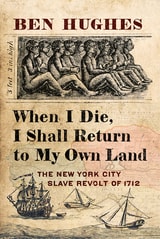
The New York City Slave Revolt of 1712
The First Enslaved Insurrection in British North AmericaBen Huges
Westholme Publishing, 2024
At 2 a.m. on April 7, 1712, a fire broke out in New York City’s North Ward. Unbeknown to the residents who roused themselves to combat the flames, the blaze had been started with murderous intent. A group of at least twenty-four enslaved West African men and women, mostly Akan from modern-day Ghana, had long plotted this moment. Armed with guns, daggers, swords, axes, and clubs, they fell upon their enslavers. In the next few frantic moments, eight Europeans were killed and seven were wounded. The perpetrators were rounded up, jailed, and put on public trial. Twenty enslaved men and one woman were executed or transported for carrying out the plot. As the first event of its kind to take place in the North American colonies, this revolt was the progenitor of those that followed—it inspired, the Stono Rebellion of 1739, the New York Conspiracy of 1741, and Nat Turner’s 1831 insurrection.
When I Die, I Shall Return to My Own Land: The 1712 New York City Slave Revolt is the first comprehensive investigation into this major event in the history of slavery in North America. Consulting court records, correspondence, and the minutes of the various colonial councils, as well as a wide range of sources related to eighteenth-century slavery, historian Ben Hughes vividly recreates early colonial New York, the lives of its enslaved inhabitants, the factionalism among the city’s Dutch and English elites, and their precarious hold on Manhattan Island in the face of French and Native American threats. Hughes traces the origins of the New York rebels, details how they came to be enslaved, and recreates the shadowy dealings that took place between African polities, European and American slavers, and New York merchants. The forerunners of a movement which continues to this day, the deeds of these original African American rebels have now been all but forgotten. Here, Hughes attempts to redress this imbalance by recovering their story.