Results by title
1832 books match the query 'Essays' and 450 start with t
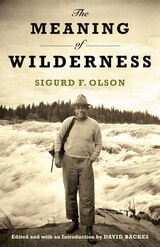
The Meaning of Wilderness
Sigurd F. Olson
University of Minnesota Press, 2015
Sigurd F. Olson (1899-1982) was one of the greatest environmentalists of the twentieth century. A conservation activist and popular writer, Olson introduced a generation of readers to the importance of wilderness. He served as president of the Wilderness Society and the National Parks Association and as a consultant to the federal government on wilderness preservation and ecological problems. He earned many honors, including the highest possible from the Sierra Club, National Wildlife Federation, and Izaak Walton League.
Olson is perhaps best known, though, for his many books that express the wonder, awe, and peace he found in the wilderness, including the nature classics The Singing Wilderness, Listening Point, and Reflections from the North Country. While these books have greatly influenced subsequent environmentalist movements and writers such as Annie Dillard and Barry Lopez, a major portion of Olson’s wilderness writing-much of it originating as speeches-has been relatively inaccessible, scattered in a number of magazines and obscure books over a period of more than fifty years, or never published at all.
The Meaning of Wilderness gathers together the most important of Sigurd Olson’s articles and speeches, making them available for the first time. The book also contains an introduction and chapter-by-chapter commentary by Olson’s authorized biographer, David Backes, that help the reader discover the various facets of Olson’s wilderness philosophy and their development over time. A lively look at the evolution of one of environmentalism’s greatest figures, The Meaning of Wilderness will be essential reading for Olson fans, historians, and outdoors people around the country.
The Memoir and the Memoirist
Reading and Writing Personal NarrativeThomas Larson
Ohio University Press, 2007
The memoir is the most popular and expressive literary form of our time. Writers embrace the memoir and readers devour it, propelling many memoirs by relative unknowns to the top of the best-seller list. Writing programs challenge authors to disclose themselves in personal narrative. Memoir and personal narrative urge writers to face the intimacies of the self and ask what is true.
In The Memoir and the Memoirist, critic and memoirist Thomas Larson explores the craft and purpose of writing this new form. Larson guides the reader from the autobiography and the personal essay to the memoir—a genre focused on a particularly emotional relationship in the author’s past, an intimate story concerned more with who is remembering, and why, than with what is remembered.
The Memoir and the Memoirist touches on the nuances of memory, of finding and telling the truth, and of disclosing one’s deepest self. It explores the craft and purpose of personal narrative by looking in detail at more than a dozen examples by writers such as Mary Karr, Frank McCourt, Dave Eggers, Elizabeth Wurtzel, Mark Doty, Nuala O’Faolain, Rick Bragg, and Joseph Lelyveld to show what they reveal about themselves. Larson also opens up his own writing and that of his students to demonstrate the hidden mechanics of the writing process.
For both the interested reader of memoir and the writer wrestling with the craft, The Memoir and the Memoirist provides guidance and insight into the many facets of this provocative and popular art form.
The Memory Eaters
Elizabeth Kadetsky
University of Massachusetts Press, 2020
As her mother loses her grasp on their shared history, Elizabeth Kadetsky sifts through boxes of the snapshots, newspaper clippings, pamphlets, and notebooks that remain, hoping to uncover the memories that her mother is actively losing as her dementia progresses. These remnants offer the false yet beguiling suggestion that the past is easy to reconstruct—easy to hold.
At turns lyrical, poignant, and alluring, The Memory Eaters tells the story of a family's cyclical and intergenerational incidents of trauma, secret-keeping, and forgetting in the context of 1970s and 1980s New York City. Moving from her parents' divorce to her mother's career as a Seventh Avenue fashion model and from her sister's addiction and homelessness to her own experiences with therapy for post-traumatic stress disorder, Kadetsky takes readers on a spiraling trip through memory, consciousness fractured by addiction and dementia, and a compulsion for the past salved by nostalgia.
The Middle Works of John Dewey, Volume 1, 1899 - 1924
Journal Articles, Book Reviews, and Miscellany Published in the 1899-1901 Period, and The School and Society, and The Educational SituationJohn Dewey. Edited by Jo Ann Boydston
Southern Illinois University Press, 2008
Includes the complete text of The School and Society and The Educational Situation.
The Middle Works of John Dewey, Volume 10, 1899 - 1924
Journal Articles, Essays, and Miscellany Published in the 1916-1917 PeriodJohn Dewey. Edited by Jo Ann Boydston
Southern Illinois University Press, 2008
The Middle Works of John Dewey, Volume 11, 1899 - 1924
Journal Articles, Essays, and Miscellany Published in the 1918-1919 PeriodJohn Dewey. Edited by Jo Ann Boydston
Southern Illinois University Press, 2008
Volume 11 brings together all of Dewey’s writings for 1918 and 1919. A Modern Language Association Committee on Scholarly Editions textual edition.
Dewey’s dominant theme in these pages is war and its aftermath. In the Introduction, Oscar and Lilian Handlin discuss his philosophy within the historical context: “The First World War slowly ground to its costly conclusion; and the immensely more difficult task of making peace got painfully under way. The armistice that some expected would permit a return to normalcy opened instead upon a period of turbulence that agitated further a society already unsettled by preparations for battle and by debilitating conflict overseas.”
After spending the first half of 1918–19 on sabbatical from Columbia at the University of California, Dewey traveled to Japan and China, where he lectured, toured, and assessed in his essays the relationship between the two nations. From Peking he reported the student revolt known as the May Fourth Movement. The forty items in this volume also include an analysis of Thomas Hobbe’s philosophy; an affectionate commemorative tribute to Theodore Roosevelt, “our Teddy”; the syllabus for Dewey’s lectures at the Imperial University in Tokyo, which were later revised and published as Reconstruction in Philosophy; an exchange with former disciple Randolph Bourne about F. Matthias Alexander’s Man’sSupreme Inheritance; and, central to Dewey’s creed, “Philosophy and Democracy.” His involvement in a study of the Polish-American community in Philadelphia—resulting in an article, two memoranda, and a lengthy report—is discussed in detail in the Introduction and in the Note on the “Confidential Report of Conditions among the Poles in the United States.”
The Middle Works of John Dewey, Volume 12, 1899 - 1924
Essays, Miscellany, and Reconstruction in Philosophy Published during 1920John Dewey. Edited by Jo Ann Boydston
Southern Illinois University Press, 2008
A collection of all of Dewey’s writings for 1920 with the exception of Letters from China and Japan. A Modern Language Association Committee on Scholarly Editions textual edition.
The nineteen items collected here, including his major work, Reconstruction in Philosophy, evolved in the main from Dewey’s travel, touring, lecturing, and teaching in Japan and China. Ralph Ross notes in his Introduction to this volume that Reconstruction in Philosophy is “a radical book . . . a pugnacious book by a gentle man.” It is in this book that Dewey summarizes his version of pragmatism, then called Instrumentalism. For Dewey, the pragmatist, it was people acting on the strength of intelligence modeled on science who could find true ideas, ones “we can assimilate, validate, corroborate, and verify.” Optimism pervades Reconstruction of Philosophy; in keeping with Dewey’s world of open possibilities, the book recognizes that the observation and thought of human striving can make the difference between despair and affirmation of life.
The seven essays on Chinese politics and social tradition that Dewey sent back from the Orient exhibit both the liveliness and the sensitive power of an insightful mind. Set against a backdrop of Japanese hegemony in China, the last days of Manchu imperialism, Europe’s carving of China into concessions, and China’s subsequent refusal to accept the terms of the Treaty of Versailles, the essays were startlingly relevant in this time of Eastern turbulence and change.
At the National University of Peking, Dewey delivered a series of lectures on “Three Contemporary Philosophers: William James, Henri Bergson, and Bertrand Russell.” The James and Bergson lectures are published for the first time in this volume. Dewey chose these philosophers, according to Ralph Ross, because he was trying to show “his oriental audience what he believed and hoped about man and society and was talking about those fellow philosophers who shared the same beliefs and hopes.”
The Middle Works of John Dewey, Volume 15, 1899 - 1924
Journal Articles, Essays, and Miscellany Published in the 1923-1924 PeriodJohn Dewey. Edited by Jo Ann Boydston
Southern Illinois University Press, 2008
Volume 15 in The Middle Works of John Dewey, 1899–1924, series brings together Dewey’s writings for the period 1923–1924. A Modern Language Association Committee on Scholarly Editions textual edition.
Volume 15 completes the republication of Dewey’s extensive writings for the 25-year period included in the Middle Works series. Many facets of Dewey’s interests—politics, philosophy, education, and social concerns—are illuminated by the 40 items from 1923 and 1924.
Inspired by his own convictions and those of his friend Salmon O. Levinson, founder of the American Committee for the Outlawry of War, Dewey’s articles became the keystone of the committee’s campaign to outlaw war. His essay, “Logical Method and Law,” is perhaps the most enduring of Dewey’s writings in this volume. Dewey’s philosophical discussions with Daniel Sommer Robinson, David Wight Prall, Arthur Oncken Lovejoy, and Sterling Power Lamprecht are represented here, as is Dewey’s assessment of the Turkish educational system.
The Middle Works of John Dewey, Volume 2, 1899 - 1924
Journal Articles, Book Reviews, and Miscellany in the 1902-1903 Period, and Studies in Logical Theory and The Child and the CurriculumJohn Dewey
Southern Illinois University Press, 2008
Includes the complete text of Dewey’s Studies in Logical Theory and The Child and the Curriculum.
The Middle Works of John Dewey, Volume 3, 1899 - 1924
Journal Articles, Book Reviews, and Miscellany in the 1903-1906 PeriodJohn Dewey. Edited by Jo Ann Boydston
Southern Illinois University Press, 2008
The Middle Works of John Dewey, Volume 6
Journal Articles, Book Reviews, Miscellany in the 1910-1911 Period, and How We ThinkJohn Dewey. Edited by Jo Ann Boydston
Southern Illinois University Press, 2008
William James, remarking in 1909 on the differences among the three leading spokesmen for pragmatism—himself, F. C. S. Schiller, and John Dewey—said that Schiller’s views were essentially “psychological,” his own, “epistemological,” whereas Dewey’s “panorama is the widest of the three.”
The two main subjects of Dewey’s essays at this time are also two of the most fundamental and persistent philosophical questions: the nature of knowledge and the meaning of truth. Dewey’s distinctive analysis is concentrated chiefly in seven essays, in a long, significant, and previously almost unknown work entitled “The Problem of Truth,” and in his book How We Think. As a whole, the 1910–11 writings illustrate especially well that which the Thayers identify in their Introduction as Dewey’s “deepening concentration on questions of logic and epistemology as contrasted with the more pronounced psychological and pedagogical treatment in earlier writings.”
The Middle Works of John Dewey, Volume 7, 1899 - 1924
Essays, Books Reviews, Encyclopedia Articles in the 1912-1914 Period, and Interest and Effort in EducationJohn Dewey. Edited by Jo Ann Boydston
Southern Illinois University Press, 2008
During the three years embraced by Volume 7, Dewey published twenty articles and reviews, one of the articles of monograph-length, “The Psychology of Social Behavior,” one small book, Interest and Effort in Education, and seventy encyclopedia articles.
A salient and arresting feature of the essays is the continuing polemic between Dewey and some of his critics. Ralph Ross, whose perceptive Introduction to the volume provides a broad perspective of the various philosophical controversies in which Dewey was engaged, comments that “when Dewey was pitting himself against important adversaries, his talents as a critic were fully evident.”
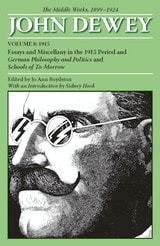
The Middle Works of John Dewey, Volume 8, 1899 - 1924
Essays and Miscellany in the 1915 Period and German Philosophy and Politics and Schools of To-MorrowJohn Dewey. Edited by Jo Ann Boydston
Southern Illinois University Press, 2008
Volume 8 comprises all Dewey’s published writings for the year 1915—and only for 1915, a year of typically elevated productivity, which saw publication of fifteen articles and miscellaneous pieces and three books, two of which are reprinted here: German Philosophy and Politics and Schools of Tomorrow.
Professor Hook says that the publications in this volume reveal John Dewey at the height of his philosophical powers. Even though his greatest works were still to come—Democracy and Education, Experience and Nature, The Quest for Certainty, and Logic: The Theory of Inquiry—“the themes elaborated therein were already sounded and developed with incisive brevity in the articles and books of this banner year.”
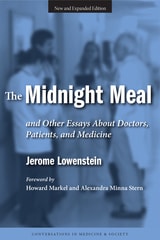
The Midnight Meal and Other Essays About Doctors, Patients, and Medicine
Jerome Lowenstein
University of Michigan Press, 2005
In this expanded edition, an accomplished physician and teacher of medicine discusses the importance of being a caring doctor, especially now that the focus of medicine is increasingly on technological innovation and health care costs.
With wisdom and compassion, Dr. Jerome Lowenstein tells stories about relationships between medical students and their teachers, physicians and their patients. He reflects on what doctors learn from treating chronic illness; how they respond to patients' needs for reassurance; how they bear the burden of treating patients with life-threatening or degenerative disease; whether the distinction between traditional and "alternative" medical treatment is ultimately beneficial or destructive; and many other issues. Dr. Lowenstein's ruminations on humanistic approaches to learning and practicing medicine will be treasured by physicians, medical students, and patients alike.
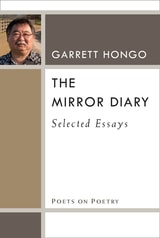
The Mirror Diary
Selected EssaysGarrett Hongo
University of Michigan Press, 2017
The Mirror Diary tracks the emergence of an original poetic voice and a learned consciousness amid multiple and sometimes competing influences of complex literary traditions and regional and ethnic histories. Beginning with a literary inquiry into the history of Japanese Americans in Hawai`i and California, Garrett Hongo draws on his own history to consider the mosaic of American identities—personal, cultural, and poetic—in the context of a postmodern diaspora.
Hongo’s essays attest to the breadth of what he considers his cultural inheritance and literary antecedents, ranging from the poets of China’s T’ang Dynasty to American poets such as Walt Whitman and Charles Olson. He explains free-verse prosody by way of John Coltrane’s jazz; praises his contemporaries, poets David Mura, Edward Hirsch, and Mark Jarman; and acknowledges his mentors, Bert Meyers and Charles Wright. In other pieces he engages with controversies and contestations in contemporary Asian American literature, confronts the politics of race and the legacy of Japanese American internment during World War II, offers paeans to the Hawaiian landscape, and addresses immigrants newly arrived in America with a warm welcome. The Mirror Diary is the work of a poet fully engaged with contemporary politics and poetics and committed to the study and celebration of diverse traditions.
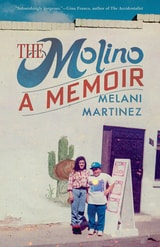
The Molino
A MemoirMelani Martinez
University of Arizona Press, 2024
Set in one of Tucson’s first tamal and tortilla factories, The Molino is a hybrid memoir that reckons with one family’s loss of home, food, and faith.
Weaving together history, culture, and Mexican food traditions, Melani Martinez shares the story of her family’s life and work in the heart of their downtown eatery, El Rapido. Opened by Martinez’s great-grandfather, Aurelio Perez, in 1933, El Rapido served tamales and burritos to residents and visitors to Tucson’s historic Barrio Presidio for nearly seventy years. For the family, the factory that bound them together was known for the giant corn grinder churning behind the scenes—the molino. With clear eyes and warm humor, Martinez documents the work required to prepare food for others, and explores the heartbreaking aftermath of gentrification that forces the multigenerational family business to close its doors.
The Molino is also Martinez’s personal story—that of a young Tucsonense coming of age in the 1980s and ’90s. As a young woman she rejects the work in her father’s popular kitchen, but when the business closes, her world shifts and the family disbands. When she finds her way back home, the tortillería’s iconic mural provides a gateway into history and ruin, ancestry and sacrifice, industrial myth and artistic incarnation—revealing a sacred presence still alive in Tucson.
A must-read for foodies, history lovers, and anyone searching for spiritual truth in the desert, this is a story of belonging and transformation in the borderlands.
The Monster I Am Today
Leontyne Price and a Life in VerseKevin Simmonds
Northwestern University Press, 2021
Structured operatically into overture, acts, and postlude, The Monster I Am Today guides the reader through associative shifts from arias like “weather events” and Price’s forty-two-minute final ovation to memories of Simmonds’s coming of age in New Orleans. As he melds lyric forms with the biography of one of classical music’s greatest virtuosos, Simmonds composes a duet that spotlights Price’s profound influence on him as a person and an artist: “That’s how I hear: Her.”

The Moral Imagination
Essays On Literature EthicsChristopher Clausen
University of Iowa Press, 1986
The Moral Obligation to Be Intelligent
Selected EssaysLionel Trilling
Northwestern University Press, 2009
Bringing together the thoughts of one of American literature’s sharpest cultural critics, this compendium will open the eyes of a whole new audience to the work of Lionel Trilling. Trilling was a strenuous thinker who was proud to think “too much.” As an intellectual he did not spare his own kind, and though he did not consider himself a rationalist, he was grounded in the world.
This collection features 32 of Trilling’s essays on a range of topics, from Jane Austen to George Orwell and from the Kinsey Report to Lolita. Also included are Trilling’s seminal essays “Art and Neurosis” and “Manners, Morals, and the Novel.” Many of the pieces made their initial appearances in periodicals such as The Partisan Review and Commentary; most were later reprinted in essay collections. This new gathering of his writings demonstrates again Trilling’s patient, thorough style. Considering “the problems of life”—in art, literature, culture, and intellectual life—was, to him, a vital occupation, even if he did not expect to get anything as simple or encouraging as “answers.” The intellectual journey was the true goal.
No matter the subject, Trilling’s arguments come together easily, as if constructing complicated defenses and attacks were singularly simple for his well-honed mind. The more he wrote on a subject and the more intricate his reasoning, the more clear that subject became; his elaboration is all function and no filler. Wrestling with Trilling’s challenging work still yields rewards today, his ideas speaking to issues that transcend decades and even centuries.
The Mountains Next Door
Janice Emily Bowers
University of Arizona Press, 1991
"I watched the seasons march through the canyons," writes Bowers, "followed the wildflower parade from February through November, and throughout it all realized that I could travel in the Rincon Mountains forever and never learn all they contained." It is also a book of meditations, as Bowers reflects upon the meaning of nature, the similarities between the scientific and creative processes, the value of wilderness in the face of urban encroachment, and other ideas. Participating in the long tradition of reflective natural history writing, she has produced a memorable book that depicts the delights and dilemmas of field botany as it explores the perennial struggle between science and mysticism that tugs at every naturalist's heart.
The Mountains of Paris
How Awe and Wonder Rewrote My LifeDavid Oates
Oregon State University Press, 2019
The present tense of the book takes place during the seasons he spends in Paris, sharing an artist’s residency. It is a rare opportunity to consider what it means to be human, through time-stopping moments with music, art, and deep history. The past tense of the book offers memories that intrude into the bustle of Paris life: a Billy Graham crusade at age thirteen, a mountain pass, a love, a loss.
In long years of mountaineering Oates fought the self-loathing which had infused him as the gay kid in the Baptist pew. In The Mountains of Paris, he ascends to a place of wonder through intense, personal narrative encounter with the strangeness of being alive. In his searching, luminous, and inimitable prose, Oates invites readers to share the sense of awe awakened by a Vermeer painting, or the night sky, or the echoing strains of music fading down a Paris street, lifting the curtain on a cosmos filled with a terrifying yet beautiful rightness.
The Mythologizing of Mark Twain
Sara Davis
University of Alabama Press, 1984
How Samuel Clemens became Mark Twain—and Mark Twain became a myth.
The Mythologizing of Mark Twain explores the enduring fascination with one of America's most celebrated literary figures and examines how Samuel Langhorne Clemens became the cultural icon known around the world as Mark Twain. Bringing together a distinguished group of scholars, this thought-provoking collection investigates Twain not simply as an author, but as a powerful symbol whose life, works, and public persona have become inseparable from larger ideas about American identity, humor, democracy, individualism, and national character.
Readers and critics have long recognized Twain's literary genius, yet explaining the origins and significance of that genius remains an ongoing challenge. The essays in this volume address that challenge by exploring the many ways Twain has been interpreted, celebrated, debated, and transformed into a mythic figure. They examine how his writings helped define an American literary tradition while simultaneously contributing to the creation of a broader cultural mythology that continues to shape public perceptions of the United States and its history.
Rather than seeking a single interpretation of Twain, the contributors employ a range of critical approaches to illuminate the complexity of both the man and the legend. Their analyses reveal how the boundaries between Samuel Clemens, Mark Twain, and the popular image of "America's author" have often blurred, generating new layers of meaning for successive generations of readers and scholars.
The Mythologizing of Mark Twain is an essential resource for students and scholars of American literature, cultural history, and literary criticism. By examining the evolution of Twain's reputation and influence, the collection offers a deeper understanding of how literary figures become cultural myths and why Mark Twain remains one of the most enduring voices in the American imagination.

The Nail in the Tree
Essays on Art, Violence, and ChildhoodCarol Ann Davis
Tupelo Press, 2020
The Natural Heritage of Illinois
Essays on Its Lands, Waters, Flora, and FaunaJohn E. Schwegman
Southern Illinois University Press, 2016
Author John E. Schwegman looks at the state’s early natural history, including its prehistoric vegetation and wildlife. He describes surviving remnants of formerly widespread species, such as biting horseflies so abundant they could kill a horse and flights of passenger pigeons dense enough to block the sun. The book addresses issues of species decline, the ways animals adapt to climate change and dwindling habitats, and the problem of invasive exotic species. Ecosystem preservation is discussed, and readers will witness prescribed burning techniques and volunteers aiding in natural land management.
Animal and plant conservation in Illinois is illustrated by essays that examine the efforts to save our dwindling Prairie Chicken population and to reintroduce river otters, the return of nesting bald eagles and cormorants to the state, the discovery of armadillos in southern Illinois, the pros and cons of feeding birds, and the biological significance of frog calls. Essays on Illinois’ native plants cover a wide range of topics, from defensive strategies to poisonous and edible species, prairie’s dependence on fire, how to recognize our wild roses, orchids, prairie grasses, and more. Full of fascinating information and expert knowledge, this book will prove invaluable to scholars, students, teachers, and casual nature lovers.
The Nature of Desert Nature
Edited by Gary Paul Nabhan
University of Arizona Press, 2020
Nabhan invites a prism of voices—friends, colleagues, and advisors from his more than four decades of study of deserts—to bring their own perspectives. Scientists, artists, desert contemplatives, poets, and writers bring the desert into view and investigate why these places compel us to walk through their sands and beneath their cacti and acacia. We observe the spines and spears, stings and songs of the desert anew. Unexpected. Surprising. Enchanting. Like the desert itself, each essay offers renewed vocabulary and thoughtful perceptions.
The desert inspires wonder. Attending to history, culture, science, and spirit, The Nature of Desert Nature celebrates the bounty and the significance of desert places.
Contributors
Thomas M. Antonio
Homero Aridjis
James Aronson
Tessa Bielecki
Alberto Búrquez Montijo
Francisco Cantú
Douglas Christie
Paul Dayton
Alison Hawthorne Deming
Father David Denny
Exequiel Ezcurra
Thomas Lowe Fleischner
Jack Loeffler
Ellen McMahon
Rubén Martínez
Curt Meine
Alberto Mellado Moreno
Paul Mirocha
Gary Paul Nabhan
Ray Perotti
Larry Stevens
Stephen Trimble
Octaviana V. Trujillo
Benjamin T. Wilder
Andy Wilkinson
Ofelia Zepeda
The Nature of Home
Taking Root in a PlaceGreta Gaard
University of Arizona Press, 2007
Gaard journeys through the deserts of southern California, through the High Sierras, the Wind River Mountains, and the Northern Cascades, through the wildlands and waterways of Washington and Minnesota, through snow season, rain season, mud season, and lilac season, yet her essays transcend mere description of natural beauty to investigate the interplay between place and identity. Gaard examines the earliest environments of childhood and the relocations of adulthood, expanding the feminist insight that identity is formed through relationships to include relationships to place. “Home” becomes not a static noun, but an active verb: the process of cultivating the connections with place and people that shape who we become.
Striving to create a sense of home, Gaard involves herself socially, culturally, and ecologically within her communities, discovering that as she works to change her environment, her environment changes her. As Gaard investigates environmental concerns such as water quality, oil spills, or logging, she touches on their parallels to community issues such as racism, classism, and sexism, uncovering the dynamic interaction by which “humans, like other life on earth, both shape and are shaped by our environments.”
While maintaining an understanding of the complex systems and structures that govern communities and environments, Gaard’s writing delves deeper to reveal the experiences and realities we displace through euphemisms or stereotypes, presenting issues such as homelessness or hunger with compelling honesty and sensitivity. Gaard’s essays form a quest narrative, expressing the process of letting go that is an inherent part of an impermanent life. And when a person is broken, in the aftermath of that letting go, it is a place that holds the pieces together.
As long as we are forced to move—by economics, by war, by colonialism—the strategies we possess to make and redefine home are imperative to our survival, and vital in the shaping of our very identities.
The Nearest Thing to Life
James Wood
Brandeis University Press, 2015
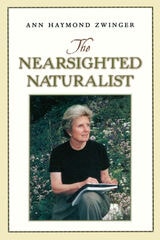
The Nearsighted Naturalist
Ann Haymond Zwinger
University of Arizona Press, 1998
The New Mormon History
Revisionist Essays on the PastD. Michael Quinn
Signature Books, 1992
In this collection, D. Michael Quinn has selected fifteen essays which demonstrate the methods of this new history. Contributors include Thomas G. Alexander, James B. Allen, Leonard J. Arrington, Maureen Ursenbach Beecher, Eugene E. Campbell, Kenneth L. Cannon II, Mario S. DePillis, Robert B. Flanders, Klaus J. Hansen, William G. Hartley, Stanley S. Ivins, Dean L. May, Linda King Newell, B. H. Roberts, Jan Shipps, and Ronald W. Walker. Participants offer new ideas and give readers the opportunity to determine for themselves the relative success of these approaches by presenting examples. The collection demonstrates areas of interpretation that may be considered revisionist as well.
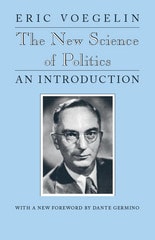
The New Science of Politics
An IntroductionEric Voegelin
University of Chicago Press, 1987
What Eric Voegelin attempts in The New Science of Politics is nothing less ambitious than a complete theory of humanity, society, and history. To build his theory, Voegelin draws on a breathtaking range of subjects from throughout history, including the Mongol Orders of Submission, the Behistun Inscription, and a controversy over an alter to the goddess Victoria in the Roman Forum. Addressing the access to truth afforded by myth, revelation, and philosophy, Voegelin then carefully contrasts each with gnosticism. The resulting book is a heady exploration of the development of European politics through the Western tradition and the ongoing importance of the inner quest for transcendent reality. =
The New Science of Politics
An IntroductionEric Voegelin
University of Chicago Press, 1987
"Thirty-five years ago few could have predicted that The New Science of Politics would be a best-seller by political theory standards. Compressed within the Draconian economy of the six Walgreen lectures is a complete theory of man, society, and history, presented at the most profound and intellectual level. . . . Voegelin's [work] stands out in bold relief from much of what has passed under the name of political science in recent decades. . . . The New Science is aptly titled, for Voegelin makes clear at the outset that a 'return to the specific content' of premodern political theory is out of the question. . . . The subtitle of the book, An Introduction, clearly indicates that The New Science of Politics is an invitation to join the search for the recovery of our full humanity."—From the new Foreword by Dante Germino
"This book must be considered one of the most enlightening essays on the character of European politics that has appeared in half a century. . . . This is a book powerful and vivid enough to make agreement or disagreement with even its main thesis relatively unimportant."—Times Literary Supplement
"Voegelin . . . is one of the most distinguished interpreters to Americans of the non-liberal streams of European thought. . . . He brings a remarkable breadth of knowledge, and a historical imagination that ranges frequently into brilliant insights and generalizations."—Francis G. Wilson, American Political Science Review
"This book is beautifully constructed . . . his erudition constantly brings a startling illumination."—Martin Wright, International Affairs
"A ledestar to thinking men who seek a restoration of political science on the classic and Christian basis . . . a significant accomplishment in the retheorization of our age."—Anthony Harrigan, Christian Century

The New Short Story Theories
Charles E. May
Ohio University Press, 1994
The first edition of May’s Short Story Theories (1976) opened with an essay entitled “The Short Story: An Underrated Art.” Almost two decades later, the short story suffers no such slight. Publishers and critics have become increasingly interested in the form, which has enjoyed a renaissance led by such writers as Raymond Carver, Tobias Wolff, Ann Beattie, Bobbie Ann Mason, and Mary Robison. An important part of this revival of interest, Short Story Theories has continued to attract a strong and loyal audience among students and teachers.
The New Short Story Theories includes a few basic pieces from the earlier volume—Poe’s Hawthorne review, Brander Matthew’s extension and formalization of Poe’s theories, and essays by Randall Jarrell, Elizabeth Bowen, and Nadine Gordimer—but most of the essays are new to the collection.
Addressing problems of definition, historical considerations, issues of technique, and cognitive approaches, essays include:
“The Tale as Genre in Short Story Fiction,” by W. S. Penn
“O. Henry and the Theory of the Short Story,” by Suzanne C. Ferguson
“On Writing,” by Raymond Carver
“From Tale to Short Story,” by Robert F. Marler
“A Cognitive Approach to Storyness,” by Susan Lohafer
May’s new collection will continue to highlight the short story, to provoke debate, and to enrich our experience of a demanding and rewarding literary form.
The News from Poems
Essays on the 21st-Century American Poetry of EngagementJeffrey Gray and Ann Keniston
University of Michigan Press, 2016
The News from Poems brings together newly commissioned essays by eminent poets and scholars of poetry and serves as a companion volume to an earlier anthology of engaged poetry compiled by the editors. Essays by Bob Perelman, Steven Gould Axelrod, Tony Hoagland, Eleanor Wilner, and others reveal how recent poetry has redefined our ideas of politics, authorship, identity, and poetics.
The volume showcases the diversity of contemporary American poetry, discussing mainstream and experimental poets, including some whose work has sparked significant controversy. These and other poets of our time, the volume suggests, are engaged not only with public events and topics but also with new ways of imagining subjectivity, otherness, and poetry itself.
The Northwest Ordinance
Essays on its Formulation, Provisions, and LegacyFrederick D. Williams
Michigan State University Press, 1989
Adoption of the Northwest Ordinance in 1787 ended a long and sometimes acrimonious debate over the question of how to organize and govern the western territories of the United States. Many eastern leaders viewed the Northwest Territory as a colonial possession, while freedom-loving settlers demanded local self- government. These essays address the ambiguities of the Ordinance, balance of power politics in North America, missionary activity in the territory, slavery, and higher education in the Old Northwest.
The Objectivist Nexus
Essays in Cultural PoeticsPeter Quartermain
University of Alabama Press, 1999
Outstanding poets and critics present cultural readings of the Objectivist poets, a group whose works have been largely unexamined.
"Objectivist" writers, conjoined through a variety of personal, ideological, and literary-historical links, have, from the late 1920s to the present, attracted emulation and suspicion. Representing a nonsymbolist, postimagist poetics and characterized by a historical, realist, antimythological worldview, Objectivists have retained their outsider status. Despite such status, however, the formal, intellectual, ideological, and ethical concerns of the Objectivist nexus have increasingly influenced poetry and poetics in the United States.
Thus, argue editors Rachel Blau DuPlessis and Peter Quartermain, the time has come for an anthology that unites essential works on Objectivist practices and presents Objectivist writing as an enlargement of the possibilities of poetry rather than as a determinable and definable literary movement. The authors' collective aim is to bring attention to this group of poets and to exemplify and specify cultural readings for poetic texts--readings alert to the material world, politics, society, and history, and readings concerned with the production, dissemination, and reception of poetic texts.
The contributors consider Basil Bunting, Lorine Niedecker, George Oppen, Carl Rakosi, Charles Reznikoff, and Louis Zukofsky within both their historical milieu and our own. The essays insist on poetry as a mode of thought; analyze and evaluate Objectivist politics; focus on the ethical, spiritual, and religious issues raised by certain Objectivist affiliations with Judaism; and explore the dissemination of poetic texts and the vagaries of Objectivist reception. Running throughout the book are two related threads: Objectivist writing as generally a practice aware of its own historical and social contingency and Objectivist writing as a site of complexity, contestation, interrogation, and disagreement.
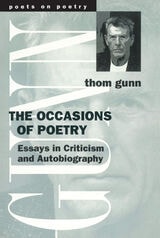
The Occasions of Poetry
Essays in Criticism and AutobiographyThom Gunn
University of Michigan Press, 1999
Thom Gunn is well-known as a poet, and increasingly as a literary critic. The Occasions of Poetry includes insightful critical pieces on writers ranging from William Carlos Williams and Gary Snyder to Thomas Hardy and Robert Duncan. "The occasion in all cases," writes Gunn, "is the starting point, only, of a poem, but it should be a starting point to which the poet must in some sense stay true." The first loyalty of a writer who is "true to his occasions," he writes, must be to the facts of experience.
The book includes five autobiographical essays, which combine to form an engaging account of the author's development as a poet and to chronicle some of the most significant literary currents of recent decades, both in England and America.
Thom Gunn, born in England in 1929, has lived in America since 1954. His books include Shelf Life: Essays, Memoirs, and an Interview; The Man with Night Sweats; Collected Poems; and The Passages of Joy. The Occasions of Poetry was originally published by Faber and Faber.
The Old Country and the New
Essays on Swedes and AmericaH. Arnold Barton
Southern Illinois University Press, 2006
Documenting a rich Scandinavian American culture and ethnic perspective
This notable collection of seventeen essays and six editorials by renowned Swedish American historian H. Arnold Barton was compiled from writings published between 1974 and 2005. The result of three decades of extensive research in the United States and Sweden, The Old Country and the New: Essays on Swedes and America, covers Swedish emigration to North America as well as the history and culture of Swedes in their new country.
In this rich mosaic of American ethnicity and cultural history, Barton analyzes the multifaceted Swedish emigration/immigration story. Essays include a survey of the historiography of emigration from the Scandinavian countries and the Scandinavian immigration to North America, Swedish emigration before 1846, and the Eric-Janssonist religious sect and its colony at Bishop Hill, Illinois.
Because Swedish immigrants were highly literate people, they wrote numerous letters describing their experiences to relatives and friends at home. What these letters related—or omitted—is the subject of another essay. Barton discusses Swedish immigrants who returned permanently to their homeland, affecting both the old country and the new. He also traces relations between the United States and Sweden, post—World War II Swedish immigration, and genealogy as history.
Offering a broad Scandinavian American ethnic perspective, The Old Country and the New appeals to both scholars and lay readers. Sixteen illustrations and a complete bibliography of Barton’s publications on Swedish American history and culture enhance the volume.
The Open Studio
Essays on Art and AestheticsSusan Stewart
University of Chicago Press, 2004
Gathering most of Stewart's writing on contemporary art—long and short pieces first published in small magazines, museum and gallery publications, and edited collections—The Open Studio illuminates work ranging from the installation art of Ann Hamilton to the sculptures and watercolors of Thomas Schütte, the prints and animations of William Kentridge to the films of Tacita Dean. Stewart's essays are often the record of studio conversations with living artists and curators, and of the afterlife of those experiences in the solitude of her own study. Considering a wide variety of art forms, Stewart finds pathbreaking ways to explore them. Whether she is following central traditions of painting, drawing, sculpture, film, photography, and printmaking or exploring the less well-known realms of portrait miniatures, collecting practices, doll-making, music boxes, and gardening, Stewart speaks to the creative process in general and to the relation between art and ethics.
The Open Studio will be read eagerly by scholars of art, poetry, and visual theory; by historians interested in the links between contemporary and classic literature and art; and by teachers, students, and practitioners of the visual arts.

The Optics of Ibn al-Haytham Books IV–V
On Reflection and Images Seen by ReflectionAbdelhamid I. Sabra
University of London Press, 2023
Ibn al-Haytham was perhaps the greatest mathematician and physicist of the medieval Arabic/Islamic world. The most famous book in which he applied his scientific method is his Optics, through which he dealt with both the mathematics of rays of light and the physical aspects of the eye in seven comprehensive books. His rethinking of the entire science of optics set the scene for the whole of the subsequent development of the subject, influencing figures such as William of Ockham, Kepler, Descartes, and Christaan Huygens. The immense work of editing, translating into English, and commenting on this work was undertaken by Abdelhamid I. Sabra. This English translation of Books IV–V was completed by Sabra just before his death in 2013 with an introduction and critical analysis. It has been extensively revised by Jan Hogendijk.
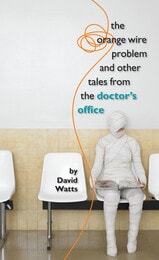
The Orange Wire Problem and Other Tales from the Doctor’s Office
David Watts
University of Iowa Press, 2009
With disarming candor and the audacity to admit that practicing medicine can be a crazy thing, Watts fills each page with riveting details, moving accounts, or belly-laughs. As the stories in this work unfold, we are witness to the moral dilemmas and personal rewards of ministering to the sick. Whether the subject is the potential benefits of therapeutic deception or telling a child about death, Watts’s ear for the right word, the right tone, and the right detail never fails him.
From The Orange Wire Problem and Other Tales from the Doctor’s Office:
We were lingering in the outer office. He mentioned again, no biopsy. I knew that. And I knew there would be no chemotherapy.
Maybe it's like that Orange Wire Problem, I said.
Yes exactly, he said, and four years from now when we're all sitting around the campfire we'll remember the Orange Wire Problem. . .
And I thought to myself, my brother did that. Spoke of the time ahead as he was dying of lung cancer. Six months from now he had said, we'll be glad we did all those drug therapies—as if to speak of the future laid claim to the future.
The Origins of Modern Environmental Thought
J. Edward de Steiguer
University of Arizona Press, 2006
Among others, de Steiguer examines works by Barry Commoner, Paul Ehrlich, Kenneth Boulding, Garrett Hardin, Herman Daly, and Arne Naess. He describes the growth of the environmental movement from 1962 to 1973 and explains a number of factors that led to a decline in environmental interest during the mid-1970s. He then reveals changes in environmental awareness in the 1980s and concludes with commentary on the movement through 2004. Updated and revised from The Age of Environmentalism, this expanded edition includes three new chapters on Stewart Udall, Roderick Nash, and E. F. Schumacher, as well as a new concluding chapter, bibliography, and updated material throughout. This primer on the history and development of environmental consciousness and the many modern scholars who have shaped the movement will be useful to students in all branches of environmental studies and philosophy, as well as biology, economics, and physics.
The Other Latin@
Writing Against a Singular IdentityEdited by Blas Falconer and Lorraine M. López
University of Arizona Press, 2011
The sheer number of different ethnic groups and cultures in the United States makes it tempting to classify them according to broad stereotypes, ignoring their unique and changing identities. Because of their growing diversity within the United States, Latinas and Latinos face this problem in their everyday lives. With cultural roots in Mexico, Puerto Rico, Cuba, the Dominican Republic, or a variety of other locales, Hispanic-origin people in the United States are too often consigned to a single category. With this book Blas Falconer and Lorraine M. López set out to change this.
The Other Latin@ is a diverse collection of essays written by some of the best emerging and established contemporary writers of Latin origin to help answer the question: How can we treat U.S. Latina and Latino literature as a definable whole while acknowledging the many shifting identities within their cultures? By telling their own stories, these authors illuminate the richness of their cultural backgrounds while adding a unique perspective to Latina and Latino literature.
This book sheds light on the dangers of abandoning identity by accepting cultural stereotypes and ignoring diversity within diversity. These contributors caution against judging literature based on the race of the author and lament the use of the term Hispanic to erase individuality. Honestly addressing difficult issues, this book will greatly contribute to a better understanding of Latina and Latino literature and identity.
The Painted Desert
Land of Wind and StoneText by Scott Thybony; Photographs by David Edwards
University of Arizona Press, 2006
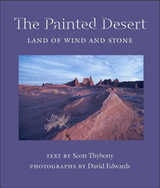
But this remote pocket of the Arizona desert, sandwiched between the Little Colorado River on one side and bold escarpments on the other, is much more than most tourists ever experience. An ethereal landscape of sculpted rock, wind-fluted cliffs, and elegantly drifting sand, the Painted Desert is a rich storehouse of natural beauty, colorful history, and scientific wonders. Here the strongest winds in Arizona blow across extensive dunefields, where less than ten inches of rain falls each year and only a few desert-savvy Navajo are able to live.
Now, for the first time award-winning writer Scott Thybony and freelance photographer David Edwards offer an intimate look at a place that remains inhospitable and inaccessible to so many. They share insights about the geology, paleontology, anthropology, and human history of the region as well as personal stories that dispel the misconceptions and mysteries that surround this delicate and difficult landscape.
With fifteen stunning photographs gracing the text, this book offers a vibrant portrait of one of the Southwest’s most barren, and most colorful landscapes.
The Paleobiological Revolution
Essays on the Growth of Modern PaleontologyEdited by David Sepkoski and Michael Ruse
University of Chicago Press, 2009
The Paradoxes of Unintended Consequences
István Rév
Central European University Press, 2000
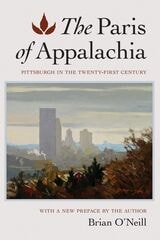
The Paris of Appalachia
Pittsburgh in the Twenty-First CenturyBrian O'Neill
Carnegie Mellon University Press, 2026
Maybe you never wondered if any metro area nearly straddles the borders of three major regions of the country, but The Paris of Appalachia: Pittsburgh in the Twenty-First Century tells us why this city is a place apart. It’s not East Coast, Midwest, or Southern, but the rest of America can fret about how to label Pittsburgh. It’s just fine being a walkable town that plays a big city on TV. Brian O'Neill, who walked its streets for more than three decades as a newspaper columnist, fell in love with the place from the moment he arrived. And when you read what he found, odds are better than even that you will, too. This reissue of the book includes a new introduction.
The Passionate Spectator
Essays on Art and PoetryJohn Yau
University of Michigan Press, 2006
Yau’s diverse critical sensibilities permeate The Passionate Spectator as he moves seamlessly between the visual and literary arts. Highlights of this collection include an essay on the poet as art critic, a study of the relationship between Kevin Young’s poetry and the paintings of Jean-Michel Basquiat, and an imaginative piece in which Yau speculates about what Jorge Luis Borges would have created had he been a visual artist. In the title essay, Yau lays out the duty of the spectator—a duty shared by viewer, reader, critic, and artist: “it is up to us to experience art, to engage and believe in its power.”
The Past's Threshold
Essays on PhotographySiegfried Kracauer
Diaphanes, 2014
This volume brings together for the first time all of Kracauer’s essays on photography that he wrote between 1927 and 1933 as a journalist for the Frankfurter Zeitung, as well as an essay that appeared in the Magazine of Art after his exile in America, where he would spend the last twenty-five years of his life. The texts show Kracauer as a pioneering thinker of the photographic medium in addition to the important historian, and theorist, of film that he is acknowledged to have been. His writings here build a cohesive theory on the affinities between photography, memory and history.
With a foreword by Philippe Despoix offering insights into Kracauer’s theories and the historical context, and a Curriculum vitae in pictures, photographs from the Kracauer estate annotated by Maria Zinfert.
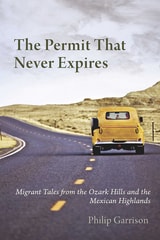
The Permit that Never Expires
Migrant Tales from the Ozark Hills and the Mexican HighlandsBy Philip Garrison
University of Arizona Press, 2010
There is a river, Garrison writes, that runs from Oaxaca to British Columbia. El flujo migratorio, he calls it. The migratory flow. But it isn’t a conventional sort of river. “It is made of neither rock nor water nor wind but only of motion, of momentum. And yet . . . it is the most compelling feature in the entire U.S. West,” he claims. Garrison has his feet planted firmly in the middle of this river of humanity, wondering why America is trying to build a wall along an actual river, the Rio Grande, to keep us separated from the mexicanos. All borders, he writes, exist mostly in the imagination—a point he proves decisively in this delightful book.
Garrison is an award-winning writer and this book shows why. Warm, witty, self-deprecating, and charming (the list could go on), this collection illuminates the lives of these migrants, whether at the local food bank in Ellensburg, Washington, in the streets of Michoacán, or everywhere in between.
The Perspective of the Acting Person
Essays in the Renewal of Thomistic Moral PhilosophyMartin Rhonheimer
Catholic University of America Press, 2008