Results by title
968 books match the query 'Movements' and 273 start with t
The Society of the Selfie
Social Media and the Crisis of Liberal DemocracyJeremiah Morelock and Felipe Ziotti Narita
University of Westminster Press, 2021
The Spectacle 2.0
Reading Debord in the Context of Digital CapitalismMarco Briziarelli and Emiliana Armano
University of Westminster Press, 2017
“Necessary reading for scholars interested in theorising the spectacle's relation to the labour theory of value, commodity fetishism and subjectivity under post-Fordism.” - https://www.triple-c.at/index.php/tripleC/article/view/1015/1176
Spectacle 2.0 recasts Debord's theory of spectacle within the frame of 21st century digital capitalism. It offers a reassessment of Debord’s original notion of Spectacle from the late 1960s, of its posterior revisitation in the 1990s, and it presents a reinterpretation of the concept within the scenario of contemporary informational capitalism and more specifically of digital and media labour. It is argued that the Spectacle 2.0 form operates as the interactive network that links through one singular (but contradictory) language and various imaginaries, uniting diverse productive contexts such as logistics, finance, new media and urbanism. Spectacle 2.0 thus colonizes most spheres of social life by processes of commodification, exploitation and reification. Diverse contributors consider the topic within the book’s two main sections: Part I conceptualizes and historicizes the Spectacle in the context of informational capitalism; contributions in Part II offer empirical cases that historicise the Spectacle in relation to the present (and recent past) showing how a Spectacle 2.0 approach can illuminate and deconstruct specific aspects of contemporary social reality. All contributions included in this book rework the category of the Spectacle to present a stimulating compendium of theoretical critical literature in the fields of media and labour studies. In the era of the gig-economy, highly mediated content and President Trump, Debord’s concept is arguably more relevant than ever.
The Specter of Relativism
Truth, Dialogue, and Phronesis in Philosophical HermeneuticsLawrence Schmidt
Northwestern University Press, 1995
The Spell of Language
Poststructuralism and SpeculationThomas G. Pavel
University of Chicago Press, 2001
In this spirited book, Pavel shows that structuralism's flawed use of linguistic theory has rendered hollow the philosophical core of a whole generation of work in the human sciences.
The Structures of the Life World
Alfred Schutz and Thomas Luckmann
Northwestern University Press, 1989
The Structures of the Life World
Alfred Schutz and Thomas Luckmann
Northwestern University Press, 1973
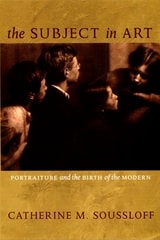
The Subject in Art
Portraiture and the Birth of the ModernCatherine M. Soussloff
Duke University Press, 2006
Soussloff combines a historically grounded examination of art and art historical thinking in Vienna with subsequent theories of portraiture and a careful historiography of philosophical and psychoanalytic approaches to human consciousness from Hegel to Sartre and from Freud to Lacan. She chronicles the emergence of a social theory of art among the art historians of the Vienna School, demonstrates how the Expressionist painter Oskar Kokoschka depicted the Jewish subject, and explores the development of pictorialist photography. Reflecting on the implications of the visualized, modern subject for textual and linguistic analyses of subjectivity, Soussloff concludes that the Viennese art historians, photographers, and painters will henceforth have to be recognized as precursors to such better-known theorists of the subject as Sartre, Foucault, and Lacan.
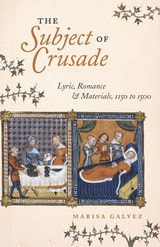
The Subject of Crusade
Lyric, Romance, and Materials, 1150 to 1500Marisa Galvez
University of Chicago Press, 2020
In The Subject of Crusade, Marisa Galvez offers a nuanced view of holy war and crusade poetry, reading these lyric works within a wider conversation with religion and culture. Arguing for an interdisciplinary treatment of crusade lyric, she shows how such poems are crucial for understanding the crusades as a complex cultural and historical phenomenon. Placing them in conversation with chronicles, knightly handbooks, artworks, and confessional and pastoral texts, she identifies a particular “crusade idiom” that emerged out of the conflict between pious and earthly duties. Galvez fashions an expanded understanding of the creative works made by crusaders to reveal their experiences, desires, ideologies, and reasons for taking up the cross.
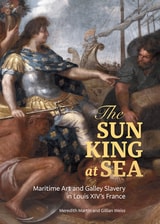
The Sun King at Sea
Maritime Art and Galley Slavery in Louis XIV's FranceMeredith Martin
J. Paul Getty Trust, The, 2022
Winner of the 2023 Leo Gershoy Award
2023 Winner of The David H. Pinkney Prize
Honorable Mention for The Mediterranean Seminar Best Book Prize 2023
Winner of the 2022 Kenshur Prize
Shortlisted for Apollo Magazine's 2022 Book of the Year
This richly illustrated volume, the first devoted to maritime art and galley slavery in early modern France, shows how royal propagandists used the image and labor of enslaved Muslims to glorify Louis XIV.
Mediterranean maritime art and the forced labor on which it depended were fundamental to the politics and propaganda of France’s King Louis XIV (r. 1643–1715). Yet most studies of French art in this period focus on Paris and Versailles, overlooking the presence or portrayal of galley slaves on the kingdom’s coasts. By examining a wide range of artistic productions—ship design, artillery sculpture, medals, paintings, and prints—Meredith Martin and Gillian Weiss uncover a vital aspect of royal representation and unsettle a standard picture of art and power in early modern France.
With an abundant selection of startling images, many never before published, The Sun King at Sea emphasizes the role of esclaves turcs (enslaved Turks)—rowers who were captured or purchased from Islamic lands—in building and decorating ships and other art objects that circulated on land and by sea to glorify the Crown. Challenging the notion that human bondage vanished from continental France, this cross-disciplinary volume invites a reassessment of servitude as a visible condition, mode of representation, and symbol of sovereignty during Louis XIV’s reign.
The Superhumanities
Historical Precedents, Moral Objections, New RealitiesJeffrey J. Kripal
University of Chicago Press, 2022
What would happen if we reimagined the humanities as the superhumanities? If we acknowledged and celebrated the undercurrent of the fantastic within our humanistic disciplines, entirely new cultural worlds and meanings would become possible. That is Jeffrey J. Kripal’s vision for the future—to revive the suppressed dimension of the superhumanities, which consists of rare but real altered states of knowledge that have driven the creative processes of many of our most revered authors, artists, and activists. In Kripal’s telling, the history of the humanities is filled with precognitive dreams, evolving superhumans, and doubled selves. The basic idea of the superhuman, for Kripal, is at the core of who and what the human species has tried to become over millennia and around the planet.
After diagnosing the basic malaise of the humanities—that the truth must be depressing—Kripal shows how it can all be done differently. He argues that we have to decolonize reality itself if we are going to take human diversity seriously. Toward this pluralist end, he engages psychoanalytic, Black critical, feminist, postcolonial, queer, and ecocritical theory. He works through objections to the superhumanities while also recognizing the new realities represented by the contemporary sciences. In doing so, he tries to move beyond naysaying practices of critique toward a future that can embrace those critiques within a more holistic view—a view that recognizes the human being as both a social-political animal as well as an evolved cosmic species that understands and experiences itself as something super.
The Surrealism Reader
An Anthology of IdeasEdited by Dawn Ades, Michael Richardson, and Krzysztof Fijalkowski
University of Chicago Press, 2016
Including essays by leading surrealists and other major writers on the movement, the volume addresses the key themes of identity, otherness, freedom and morality, and poetry. The texts uncover, among other things, the significance of surrealism for the antifascist and anticolonialist movements and the various manifestations of surrealism in the years after World War II. Giving space to the many different voices that made up the movement, and placing them for the first time within a clear and coherent historical framework, The Surrealism Reader radically revises the popular understanding of what, and when, surrealism was—making this book an essential reference for students, scholars, and all those interested in the central place of surrealism within twentieth-century thought and culture.
The Tacit Dimension
Michael Polanyi
University of Chicago Press, 2009
A classic work in the philosophy of science that changed how we think about knowledge itself
“I shall reconsider human knowledge by starting from the fact that we can know more than we can tell,” writes Michael Polanyi, whose work paved the way for the likes of Thomas Kuhn and Karl Popper. The Tacit Dimension argues that tacit knowledge—tradition, inherited practices, implied values, and prejudgments—is a crucial part of scientific knowledge. As relevant today as it was when it was first published, this volume challenges the assumption that skepticism, rather than established belief, lies at the heart of scientific discovery.
"The reissuing of this remarkable book give us a new opportunity to see how far-reaching—and foundational—Michael Polanyi's ideas are, on some of the age-old questions in philosophy."—Amartya Sen, from the Foreword
The Tenets of Cognitive Existentialism
Dimitri Ginev
Ohio University Press, 2011
In The Tenets of Cognitive Existentialism, Dimitri Ginev draws on developments in hermeneutic phenomenology and other programs in hermeneutic philosophy to inform an interpretative approach to scientific practices. At stake is the question of whether it is possible to integrate forms of reflection upon the ontological difference in the cognitive structure of scientific research. A positive answer would have implied a proof that (pace Heidegger) “science is able to think.” This book is an extended version of such a proof. Against those who claim that modern science is doomed to be exclusively committed to the nexus of objectivism and instrumental rationality, the interpretative theory of scientific practices reveals science’s potentiality of hermeneutic self-reflection. Scientific research that takes into consideration the ontological difference has resources to enter into a dialogue with Nature.
Ginev offers a critique of postmodern tendencies in the philosophy of science, and sets out arguments for a feminist hermeneutics of scientific research.
The Thinking of the Sensible
Merleau-Ponty's A-PhilosophyMauro Carbone
Northwestern University Press, 2004
An original and innovative interpretation of the ontology of Merleau-Ponty--and themselves a significant contribution to the field of Continental thought--these essays constitute a sustained exploration of what Merleau-Ponty detected, and greeted, as a "mutation within the relations of man and Being," which would provide him with the basis for a new idea of philosophy or "a-philosophy." In lucid, often elegant terms, Carbone analyzes key elements of Merleau-Ponty's thought in relation to Proust's Recherche, Hegel's Phenomenology of Spirit, the new biology of Von Uexküll, Rimbaud's Lettre du voyant, and Heidegger's conception of "letting-be." His work clearly demonstrates the vitality of Merleau-Ponty's late revolutionary philosophy by following its most salient, previously unexplored paths. This is essential reading for any scholar with an interest in Merleau-Ponty, in the questions of embodiment, temporality and Nature, or in the possibility of philosophy today.
The Thought of Becoming
Gilles Deleuze’s Poetics of LifeKathrin Thiele
Diaphanes, 2008
While this formula might estrange at first, the author, by approaching it through the conceptual figure of becoming, not only manages to carefully develop the Deleuzian thought-universe via its coordinates Spinoza, Bergson, and Nietzsche, but shows in her argument as well that the substitution of becoming for Being is no insignificant matter but rather the preparation for a new thought of ontology as an ontology of becoming and – as such – for a new thought of ethics as a poetics of life.
›Indirection‹ is the movement of becoming into this world, brought forth here as the most compelling dimension of Deleuze’s thought. Such a position dares to conceive of thought as practice without collapsing the gap that always persists between thinking and acting.
The Thought of Death and the Memory of War
Marc Crépon
University of Minnesota Press, 2013
War lays bare death and our relation to it. And in the wars—or more precisely the memories of war—of the twentieth century, images of the deaths of countless faceless or nameless others eclipse the singularity of each victim’s death as well as the end of the world as such that each death signifies.
Marc Crépon’s The Thought of Death and the Memory of War is a call to resist such images in which death is no longer actual death since it happens to anonymous others, and to seek instead a world in which mourning the other whose mortality we always already share points us toward a cosmopolitics. Crépon pursues this path toward a cosmopolitics of mourning through readings of works by Freud, Heidegger, Sartre, Patocka, Levinas, Derrida, and Ricœur, and others. The movement among these writers, Crépon shows, marks a way through—and against—twentieth-century interpretation to argue that no war, genocide, or neglect of people is possible without suspending how one relates to the death of another human being.
A history of a critical strain in contemporary thought, this book is, as Rodolphe Gasché says in the Foreword, “a profound meditation on what constitutes evil and a rigorous and illuminating reflection on death, community, and world.”
The translation of this work received financial support from the French Ministry of Foreign Affairs.
The Timeliness of George Herbert Mead
Edited by Hans Joas and Daniel R. Huebner
University of Chicago Press, 2016
Edited by well-respected Mead scholars Hans Joas and Daniel R. Huebner, the volume as a whole makes a coherent statement that places Mead in dialogue with current research, pushing these domains of scholarship forward while also revitalizing the growing literature on an author who has an ongoing and major influence on sociology, psychology, and philosophy.
The Transformation of the Avant-Garde
The New York Art World, 1940-1985Diana Crane
University of Chicago Press, 1989
Crane's account is built around discussions of seven styles: Abstract Expressionism in the forties; Pop art and Minimalism in the sixties; Figurative painting, Photorealism, and Pattern painting in the early seventies; and Neo-Expressionism in the early eighties. Demonstrating that the New York art world moved toward increasing acceptance of dominant American cultural trends, Crane offers a fascinating look not only at the intricacies of New York's artistic inner circle but also at the sociology of work and professions, the economics of culture markets such as "dealing art," and the sociology of culture.
The Treadmill Affect
Marxism, Subjectivity, and the PresentBenjamin Lee
Prickly Paradigm Press, 2025
The Treadmill Affect draws upon the work of three University of Chicago professors, each a former program director at the Center for Transcultural Studies: literary and cultural critic Lauren Berlant, historian and social theorist Moishe Postone, and linguist Michael Silverstein. Through this intellectual synthesis, Benjamin Lee demonstrates the critical possibilities of uniting a revived linguistic turn with Marxist accounts of affect and subjectivity, adding new dimensions to the "treadmill" affective structure of cruel optimism.
The Truth in Painting
Jacques Derrida
University of Chicago Press, 1987
The Truth in Painting
Jacques Derrida
University of Chicago Press, 1987
The Universal Machine
Fred Moten
Duke University Press, 2018
In The Universal Machine—the concluding volume to his landmark trilogy consent not to be a single being—Fred Moten presents a suite of three essays on Emmanuel Levinas, Hannah Arendt, and Frantz Fanon, in which he explores questions of freedom, capture, and selfhood. In trademark style, Moten considers these thinkers alongside artists and musicians such as William Kentridge and Curtis Mayfield while interrogating the relation between blackness and phenomenology. Whether using Levinas's idea of escape in unintended ways, examining Arendt's antiblackness through Mayfield's virtuosic falsetto and Anthony Braxton's musical language, or showing how Fanon's form of phenomenology enables black social life, Moten formulates blackness as a way of being in the world that evades regulation. Throughout The Universal Machine—and the trilogy as a whole—Moten's theorizations of blackness will have a lasting and profound impact.
The Universe of Things
On Speculative RealismSteven Shaviro
University of Minnesota Press, 2014
From the rediscovery of Alfred North Whitehead’s work to the rise of new materialist thought, including object-oriented ontology, there has been a rapid turn toward speculation in philosophy as a way of moving beyond solely human perceptions of nature and existence. Now Steven Shaviro maps this quickly emerging speculative realism, which is already dramatically influencing how we interpret reality and our place in a universe in which humans are not the measure of all things.
The Universe of Things explores the common insistence of speculative realism on a noncorrelationist thought: that things or objects exist apart from how our own human minds relate to and comprehend them. Shaviro focuses on how Whitehead both anticipates and offers challenges to prevailing speculative realist thought, moving between Whitehead’s own panpsychism, Harman’s object-oriented ontology, and the reductionist eliminativism of Quentin Meillassoux and Ray Brassier.
The stakes of this recent speculative realist thought—of the effort to develop new ways of grasping the world—are enormous as it becomes clear that our inherited assumptions are no longer adequate to describe, much less understand, the reality we experience around us. As Shaviro acknowledges, speculative realist thought has its dangers, but it also, like the best speculative fiction, holds the potential to liberate us from confining views of what is outside ourselves and, he believes, to reclaim aesthetics and beauty as a principle of life itself.
Bringing together a wide array of contemporary thought, and evenhandedly assessing its current debates, The Universe of Things is an invaluable guide to the evolution of speculative realism and the provocation of Alfred North Whitehead’s pathbreaking work.
The Verge of Philosophy
John Sallis
University of Chicago Press, 2007
The Verge of Philosophy is both an exploration of the limits of philosophy and a memorial for John Sallis’s longtime friend and interlocutor Jacques Derrida. The centerpiece of the book is an extended examination of three sites in Derrida’s thought: his interpretation of Heidegger regarding the privileging of the question; his account of the Platonic figure of the good; and his interpretation of Plato’s discourse on the crucial notion of the chora, the originating space of the universe.
Sallis’s reflections are given added weight—even poignancy—by his discussion of his many public and private philosophical conversations with Derrida over the decades of their friendship. This volume thus simultaneously serves to mourn and remember a friend and to push forward the deeply searching discussions that lie at the very heart of that friendship.
“All of John Sallis’s work is essential, but [this book] in particular is remarkable. . . . Sallis shows better than anyone I have ever read what it means to practice philosophy on the verge.”—Walter Brogan, Villanova University
The Viking Coloring Book
Dayanna Knight
Arizona Center for Medieval and Renaissance Studies, 2017
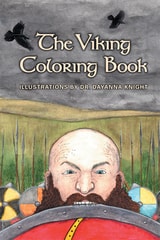
What do you think of when you think of the Vikings? Fierce warriors? Sailors of magnificent dragon-prowed ships who terrorized North-Western Europe? Do you think of darkened halls thick with smoke and song?
Like all people those researchers now consider to be Viking were much more complex than the modern world sees them as. This coloring book is meant to show that. It is designed to provide scenes of the beauty of the early medieval world the Vikings inhabited. It is in this context that Viking cultures developed. You will find artifacts and animals, plants and landscapes within these pages to explore. Species that held some use to the Vikings, such as those that provided fur in particular have been focused on. Reconstructed scenes are inspired by the diverse world experienced in the north. There are no horned helmets here. The real Vikings were much more practical than that.
The Virtual Point of Freedom
Essays on Politics, Aesthetics, and ReligionLorenzo Chiesa
Northwestern University Press, 2016
The Visible and the Invisible
Maurice Merleau-Ponty
Northwestern University Press, 1968

The Wild Region in Life-History
Laszlo Tengelyi
Northwestern University Press, 2004

The Word and the Spiritual Realities (the I and the Thou)
Ferdinand Ebner
Catholic University of America Press, 2021
The Work of Mourning
Jacques Derrida
University of Chicago Press, 2001
Gathered here are texts—letters of condolence, memorial essays, eulogies, funeral orations—written after the deaths of well-known figures: Roland Barthes, Paul de Man, Michel Foucault, Louis Althusser, Edmond Jabès, Louis Marin, Sarah Kofman, Gilles Deleuze, Emmanuel Levinas, Jean-François Lyotard, Max Loreau, Jean-Marie Benoist, Joseph Riddel, and Michel Servière.
With his words, Derrida bears witness to the singularity of a friendship and to the absolute uniqueness of each relationship. In each case, he is acutely aware of the questions of tact, taste, and ethical responsibility involved in speaking of the dead—the risks of using the occasion for one's own purposes, political calculation, personal vendetta, and the expiation of guilt. More than a collection of memorial addresses, this volume sheds light not only on Derrida's relation to some of the most prominent French thinkers of the past quarter century but also on some of the most important themes of Derrida's entire oeuvre-mourning, the "gift of death," time, memory, and friendship itself.
"In his rapt attention to his subjects' work and their influence upon him, the book also offers a hesitant and tangential retelling of Derrida's own life in French philosophical history. There are illuminating and playful anecdotes—how Lyotard led Derrida to begin using a word-processor; how Paul de Man talked knowledgeably of jazz with Derrida's son. Anyone who still thinks that Derrida is a facetious punster will find such resentful prejudice unable to survive a reading of this beautiful work."—Steven Poole, Guardian
"Strikingly simpa meditations on friendship, on shared vocations and avocations and on philosophy and history."—Publishers Weekly
The Work of Mourning
Jacques Derrida
University of Chicago Press, 2003
Gathered here are texts—letters of condolence, memorial essays, eulogies, funeral orations—written after the deaths of well-known figures: Roland Barthes, Paul de Man, Michel Foucault, Louis Althusser, Edmond Jabès, Louis Marin, Sarah Kofman, Gilles Deleuze, Emmanuel Levinas, Jean-François Lyotard, Max Loreau, Jean-Marie Benoist, Joseph Riddel, and Michel Servière.
With his words, Derrida bears witness to the singularity of a friendship and to the absolute uniqueness of each relationship. In each case, he is acutely aware of the questions of tact, taste, and ethical responsibility involved in speaking of the dead—the risks of using the occasion for one's own purposes, political calculation, personal vendetta, and the expiation of guilt. More than a collection of memorial addresses, this volume sheds light not only on Derrida's relation to some of the most prominent French thinkers of the past quarter century but also on some of the most important themes of Derrida's entire oeuvre-mourning, the "gift of death," time, memory, and friendship itself.
"In his rapt attention to his subjects' work and their influence upon him, the book also offers a hesitant and tangential retelling of Derrida's own life in French philosophical history. There are illuminating and playful anecdotes—how Lyotard led Derrida to begin using a word-processor; how Paul de Man talked knowledgeably of jazz with Derrida's son. Anyone who still thinks that Derrida is a facetious punster will find such resentful prejudice unable to survive a reading of this beautiful work."—Steven Poole, Guardian
"Strikingly simpa meditations on friendship, on shared vocations and avocations and on philosophy and history."—Publishers Weekly
The World Unclaimed
A Challenge to Heidegger’s Critique of HusserlLilian Alweiss
Ohio University Press, 2003
The World Unclaimed argues that Heidegger’s critique of modern epistemology in Being and Time is seriously flawed. Heidegger believes he has done away with epistemological problems concerning the external world by showing that the world is an existential structure of Dasein. However, the author argues that Heidegger fails to make good his claim that he has “rescued” the phenomenon of the world, which he believes the tradition of philosophy has bypassed. Heidegger fails not only to reclaim the world but also to acknowledge its loss. Alweiss thus calls into question Heidegger’s claim that ontology is more fundamental than epistemology.
The World Unclaimed develops its powerful critique of Being and Time by arguing for a return to Husserl. It draws on Husserl’s insight that it is the moving and sensing body that discloses how we are already familiar with the world. Kinaesthesia provides a key for understanding our relation to the world. The author thus suggests that thinkers in the vein of Husserl and Kant -who, for Heidegger, epitomize the tradition of modern philosophy by returning to a “worldless subject”- may provide us with the resources to reclaim the phenomenon of the world that Being and Time sets out to salvage.
Alweiss’s fresh and innovative study demonstrates that it is possible to overcome epistemological skepticism without ever losing sight of the phenomenon of the world. Moreover, Alweiss challenges us to reconsider the relation between Husserl and Heidegger by providing a forceful defense of Husserl’s critique of cognition.
The World as Abyss
The Caribbean and Critical Thought in the AnthropoceneJonathan Pugh and David Chandler
University of Westminster Press, 2023
This book is about a distinctive ‘abyssal’ approach to the crisis of modernity. In this framing, influenced by contemporary critical Black studies, another understanding of the world of modernity is foregrounded – a world violently forged through the projects of Indigenous dispossession, chattel slavery and colonial world-making. Modern and colonial world-making violently forged the ‘human’ by dividing those with ontological security from those without, and by carving out the ‘world’ in a fixed grid of space and time, delineating a linear temporality of ‘progress’ and ‘development’. The distinctiveness of abyssal thought is that it inverts the stakes of critique and brings indeterminacy into the heart of ontological assumptions of a world of entities, essences, and universal determination. This is an approach that does not focus upon tropes of rescue and salvation but upon the generative power of negation. In doing so, it highlights how Caribbean experiences and writings have been drawn upon to provide an important and distinct perspective for critical thought.
"How is it that ontology has come to be seen as the antidote for modernity? While Foucault denigrated ontology as a mistaken and parochial exercise, contemporary social theory holds out the promise that new modes of planetary knowledge will save us from our own excesses. Drawing together long traditions in Caribbean scholarship with Afro-pessimist thought, Pugh and Chandler illustrate how the search for more emancipatory ontologies - relational ontologies, indigenous ontologies, non-human ontologies, etc. – not only misunderstands the problem of modernity but (more importantly) works to veil the negative force that marks both the limit and cause of all such knowledge practices: what they term the abyss. To engage in abyssal thought – as they lay out – is to inhabit a site of refusal: a determination not to be drawn into the lure of ontological ‘correction’ and to recognise that the practice of world making cannot not bear the imprint of colonial violence. Articulated in passionate declarative prose, these authors powerfully illuminate the trap of the emancipatory instinct and the promise of a deconstructive ethic." — Mitch Rose, Senior Lecturer in Human Geography, Aberystwyth University, UK
“A much-needed intellectual effort in the non-reductionist and non-essentialising style of Pugh and Chandler's previous book. The World as Abyss gives Caribbean thought and culture the place they deserve within critical theory and materialist studies.” — Mónica Fernández Jiménez, Valladolid University, Spain
“For some time now scholars have questioned the overly general assumptions about the ‘anthropos’ of the Anthropocene, but much work needs to be done to flesh out what a decolonized Anthropocene might be. Pugh and Chandler’s The World as Abyss provides an original, intriguing and compelling counterpoint to bland Anthropocene humanism (and posthumanism). This timely work explores the poetics of the Caribbean and provides a way to think about the Anthropocene and the future beyond the managerialism of the present. This book is essential reading for those working in the environmental humanities or Anthropocene studies.” — Claire Colebrook, Professor, Penn State University, USA
“This book names an apocalypse that began long ago. Pugh and Chandler patiently follow the journey of thought as it travels from the Middle Passage to the Caribbean. This brings them face-to-face with the horror of anti-Black violence, not as just another resource to strip-mine, but as an unavoidable abyss that confines all thought. Its reminder: that we have still not yet begun to think a truly Black world.” — Andrew Culp, Professor, California Institute of the Arts, USA
"With the force of a manifesto, the intensity of a polemic, and the nuance of a treatise, thisbook sets out to disavow the disavowal of Colonial violence in the making of thecontemporary world and thought. Learning from Caribbean thinkers, writers, and poets, itsets to work unworking, desedimenting and deconstructing, the violent ontologicalfoundations by which anti-Black worlds maintain and reproduce their innocence andignorance. Replaying and reiterating, extending and multiplying, gestures of refusal –refusals of subjection, of History, of Geography, of meaning, of Being – there is the refusalof the World as it is and of the World as it could be. The World as Abyss artfully combines acritique of the historical forces which make and unmake the contemporary moment withthe suspension of horizons, of ends, of grounds. What emerges in the wake is anintensification of the generative capacity of this refusal; voids, arrhythmia, counter-times,displacements, dislocations, the abyssal. First as threat and then as promise" — PaulHarrison, Associate Professor of Human Geography, Durham University, UK
The Writings of Jean-Paul Sartre Volume 2
Selected ProseJean-Paul Sartre
Northwestern University Press, 1974
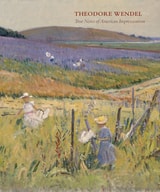
Theodore Wendel
True Notes of American ImpressionismTheodore Wendel
The Artist Book Foundation, 2019
One of the original "Duveneck boys" who studied in Munich at the Royal Academy, Theodore Wendel followed his mentor to Florence and Venice; he later went on to Paris and ultimately joined a colony of young artists at Giverny. The scenes and subject matter in the works he completed there are among the earliest by an American artist to adopt and evolve Impressionist strategies. Upon his return to America, he spent the next decades rendering scenes of the farmland and coast north of Boston that contemporary critics acclaimed as some of the best they had seen. Yet despite his talent and the significant accolades earned during his career, in the near-century following his death the recognition of his achievements has faded. The Artist Book Foundation is delighted to have the opportunity to remedy this siutation with its forthcoming monograph on the artist, Theodore Wendel: True Notes of American Impressionism.
Laurene Buckley's years of exhaustive research inform an engaging and detailed narrative of Wendel's time in Europe and his many years capturing the essence of the farms and fishing villages along the rural coast of Massachusetts. Thanks to her efforts, the book will feature many of his best works, a number of which are in private collections. An informative introduction by William H. Gerdts provides significant artistic context for Wendel and explains the artist's deft ability to draw the viewer into a scene. Concluding the monograph, an extensive chronology, exhibition history, and bibliography complete the scholarship on this long overdue tribute to a master of American Impressionism.
Theory and Practice
Jacques Derrida
University of Chicago Press, 2019
Theory and Practice is a series of nine lectures that Jacques Derrida delivered at the École Normale Supérieure in 1976 and 1977. The topic of “theory and practice” was associated above all with Marxist discourse and particularly the influential interpretation of Marx by Louis Althusser. Derrida’s many questions to Althusser and other thinkers aim at unsettling the distinction between thinking and acting.
Derrida’s investigations set out from Marx’s “Theses on Feuerbach,” in particular the eleventh thesis, which has often been taken as a mantra for the “end of philosophy,” to be brought about by Marxist practice. Derrida argues, however, that Althusser has no such end in view and that his discourse remains resolutely philosophical, even as it promotes the theory/practice pair as primary values. This seminar also draws fascinating connections between Marxist thought and Heidegger and features Derrida’s signature reconsideration of the dichotomy between doing and thinking. This text, available for the first time in English, shows that Derrida was doing important work on Marx long before Specters of Marx. As with the other volumes in this series, it gives readers an unparalleled glimpse into Derrida’s thinking at its best—spontaneous, unpredictable, and groundbreaking.

Theory of Form
Gerhard Richter and Art in the Pragmatist AgeFlorian Klinger
University of Chicago Press, 2022
In this study of the practice of contemporary painter Gerhard Richter, Florian Klinger proposes a fundamental change in the way we think about art today. In reaction to the exhaustion of the modernist-postmodernist paradigm’s negotiation of the “essence of art,” he takes Richter to pursue a pragmatist model that understands artistic form as action. Here form is no longer conceived according to what it says—as a vehicle of expression, representation, or realization of something other than itself—but strictly according to what it does.
Through its doing, Klinger argues, artistic form is not only more real but also more shared than non-artistic reality, and thus enables interaction under conditions where it would otherwise not be possible. It is a human practice aimed at testing and transforming the limits of shared reality, urgently needed in situations where such reality breaks down or turns precarious. Drawing on pragmatist thought, philosophical aesthetics, and art history, Klinger’s account of Richter’s practice offers a highly distinctive conceptual alternative for contemporary art in general.
Theory of Intuition in Husserl's Phenomenology
Second EditionEmmanuel Levinas
Northwestern University Press, 1995
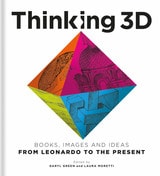
Thinking 3D
Books, Images and Ideas from Leonardo to the PresentEdited by Daryl Green and Laura Moretti
Bodleian Library Publishing, 2019
Through essays on some of the world’s greatest artists and thinkers—such as Leonardo da Vinci, Luca Pacioli, Andreas Vesalius, Johann Kepler, Galileo Galilei, William Hunter, and many more—this book tells the story of how of we learned to communicate three-dimensional forms on the two-dimensional page. It features some of Leonardo da Vinci’s ground-breaking drawings now in the Royal Collections and British Library as well as extraordinary anatomical illustrations, early paper engineering such as volvelles and flaps, beautiful architectural plans, and even views of the moon. With in-depth analysis of more than forty manuscripts and books, Thinking 3D also reveals the impact that developing techniques had on artists and draftsmen throughout time and across space, culminating in the latest innovations in computer software and 3D printing.
Thinking Out of Sight
Writings on the Arts of the VisibleJacques Derrida
University of Chicago Press, 2021
The book is divided into three sections. The first demonstrates Derrida’s preoccupation with visibility, image, and space. The second contains interviews and collaborations with artists on topics ranging from the politics of color to the components of painting. Finally, the book delves into Derrida’s writings on photography, video, cinema, and theater, ending with a text published just before his death about his complex relationship to his own image. With many texts appearing for the first time in English, Thinking out of Sight helps us better understand the critique of representation and visibility throughout Derrida’s work, and, most importantly, to assess the significance of his insights about art and its commentary.
Thinking and the I
Hegel and the Critique of KantAlfredo Ferrarin
Northwestern University Press, 2019
What is the relation between thinking and the I that thinks? And what is the relation between thought and reality? The ordinary view shared by modern philosophers from Descartes to Kant, as well as by common sense, is that there is only thought when someone thinks something, and thoughts and concepts are mental acts that refer to objects outside us.
In Thinking and the I: Hegel and the Critique of Kant, Alfredo Ferrarin shows that Hegel’s philosophy entails a radical criticism of this ordinary conception of thinking. Breaking with the habitual presuppositions of both modern philosophy and common sense, Ferrarin explains that thought, negation, truth, reflection, and dialectic for Hegel are not properties of an I and cannot be reduced to the subjective activity of a self-conscious subject. Rather, he elucidates, thought is objective for Hegel in different senses. Reality as a whole is animated by a movement of thought and an unconscious logic as a spontaneity that reifies itself in determinate forms. Ferrarin concludes the book with a comprehensive comparison of Hegel’s and Kant’s concepts of reason.
While it mainly focuses on Hegel’s Phenomenology, Science of Logic, and Encyclopaedia, this ambitious book covers all aspects of Hegel’s philosophy. Its originality and strength lie in its recovery of the original core of Hegel’s dialectic over and above its currently predominant transcendental, neopragmatist, or realist appropriations. It will be essential reading for all students of Hegel, Kant, and German idealism in general for years to come.
Thinking between Deleuze and Merleau-Ponty
Judith Wambacq
Ohio University Press, 2017
Thinking between Deleuze and Merleau-Ponty is the first book-length examination of the relation between these two major thinkers of the twentieth century. Questioning the dominant view that the two have little of substance in common, Judith Wambacq brings them into a compelling dialogue to reveal a shared, historically grounded concern with the transcendental conditions of thought. Both Merleau-Ponty and Deleuze propose an immanent ontology, differing more in style than in substance. Wambacq’s synthetic treatment is nevertheless critical; she identifies the limitations of each thinker’s approach to immanent transcendental philosophy and traces its implications—through their respective relationships with Bergson, Proust, Cézanne, and Saussure—for ontology, language, artistic expression, and the thinking of difference. Drawing on primary texts alongside current scholarship in both French and English, Thinking between Deleuze and Merleau-Ponty is comprehensive and rigorous while remaining clear, accessible, and lively. It is certain to become the standard text for future scholarly discussion of these two major influences on contemporary thought.
Thinking in the Dark
Cinema, Theory, PracticePomerance, Murray
Rutgers University Press, 2015
Thinking in the Dark introduces readers to twenty-one key theorists whose work has made a great impact on film scholarship today, including Rudolf Arnheim, Sergei Eisenstein, Michel Foucault, Siegfried Kracauer, and Judith Butler. Rather than just discussing each theorist’s ideas in the abstract, the book shows how those concepts might be applied when interpreting specific films by including an analysis of both a classic film and a contemporary one. It thus demonstrates how theory can help us better appreciate films from all eras and genres: from Hugo to Vertigo, from City Lights to Sunset Blvd., and from Young Mr. Lincoln to A.I. and Wall-E.
The volume’s contributors are all experts on their chosen theorist’s work and, furthermore, are skilled at explaining that thinker’s key ideas and terms to readers who are not yet familiar with them. Thinking in the Dark is not only a valuable resource for teachers and students of film, it’s also a fun read, one that teaches us all how to view familiar films through new eyes.
Theorists examined in this volume are: Rudolf Arnheim, Béla Balázs, Roland Barthes, André Bazin, Walter Benjamin, Judith Butler, Stanley Cavell, Michel Chion, Gilles Deleuze, Jean Douchet, Sergei Eisenstein, Jean Epstein, Michel Foucault, Siegfried Kracauer, Jacques Lacan, Vachel Lindsay, Christian Metz, Hugo Münsterberg, V. F. Perkins, Jacques Rancière, and Jean Rouch.

Thinking through Art
Aesthetic Agency and Global Modernity, Volume 25Daniel T. O’Hara and Alan Singer, eds.
Duke University Press, 0
Included in this volume are considerations of the relation between theories of art and the avant-garde; art’s relation to cognition; the aesthetic as history; the aesthetic as a unique access to modernity; and its impact on problems of identity formation, ideology, and resistances to the institutional powers inherent in dominant social formations.
Contributors. Charles Altieri, Peter Burger, David Carroll, Anthony J. Cascardi, Howard Caygill, Allen Dunn, Eric Gans, Agnes Heller, Ronald A. T. Judy, Marie-Rose Logan, Daniel T. O’Hara, Donald E. Pease, Alan Singer
Thinking through Kierkegaard
Existential Identity in a Pluralistic WorldPeter J. Mehl
University of Illinois Press, 2010
Contrary to Kierkegaard's ideal of moral personhood and orthodox Christian identity, Mehl aims to acknowledge the possibility of pluralism in existential identities. By demanding sensitivity to the deep ways social and cultural context influences human perception, interpretation and self?representation, Mehl argues that Kierkegaard is not simply discovering but also participating in a cultural construction of the human being.
Drawing on accounts of what it is to be a person by prominent philosophers outside of Kierkegaard scholarship, including Charles Taylor, Owen Flanagan, Alasdair MacIntyre, and Thomas Nagel, Mehl also works to bridge the analytic and continental traditions and reestablishes Kierkegaard as a rich resource for situating moral and spiritual identity. This reexamination of Kierkegaard is recommended for anyone interested in what it means to be a person.
Thomas Holcroft’s Revolutionary Drama
Reception and AfterlivesAmy Garnai
Bucknell University Press, 2023
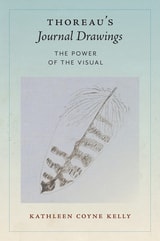
Thoreau's Journal Drawings
The Power of the VisualKathleen Coyne Kelly
University of Massachusetts Press, 2026
Examining journal drawings as an integral—and often delightful—feature of Thoreau’s work
In 1850, Henry David Thoreau began to draw in his Journal—a hedgehog’s quill, a locust’s wing, a goldenrod leaf. The sketches reflect his efforts to train his eye to observe more carefully, to look closely enough that he could see what was in front of him—with intention and attention. As Thoreau worked to combine the vivid language of a writer with the precision of a scientist, his drawings became more vital to the process. For him, writing and drawing were not separate activities; they were part of the same active, hands-on process of learning about the natural world.
Thoreau’s Journal Drawings offers a sustained examination of an understudied aspect of the Journal, emphasizing visual as well as textual analysis. It places Thoreau’s illustrated entries in the broader context of nineteenth-century scientific illustration, nature writing, and visual culture, while also offering close readings of key passages in which text and image work in tandem. The book opens up new possibilities for interpretation—both within the Journal and in the larger project of Thoreau’s thinking.
Ultimately, Thoreau’s illustrated Journal offers a case study in the complexities of representing the natural world through both language and image. His practice raises enduring questions about how we document, interpret, and mediate the more-than-human world across different forms of expression. To read the later volumes of Henry David Thoreau’s Journal without attending to his drawings is to overlook a vital dimension of his practice as both writer and observer.
Three Lectures on Leonardo
Aby Warburg
University of London Press, 2020
With an average attendance of more than 400, Warburg’s lectures were a great success, and a fourth meeting, accompanied by original Leonardo drawings and photographic prints in the Hamburg Kunsthalle, had to be repeated. Marking the fifth centenary of Leonardo’s death and the 120th anniversary of Warburg’s first public lecture series, this volume contains the full translated text of Warburg’s previously unpublished lectures. This translation, which is based on the texts as they survive in Warburg’s three manuscripts located in the Warburg Institute Archive, will bring these groundbreaking lectures to a new audience.
Time Driven
Metapsychology and the Splitting of the DriveAdrian Johnston
Northwestern University Press, 2005
Johnston draws on Jacques Lacan's oeuvre in conjunction with certain philosophical resources-elements from transcendental philosophy, structuralism, and phenomenology-to rectify the inconsistencies within the Freudian metapsychological model of drive. In doing so, he helps to answer a question haunting Freud at the end of his career: Why is humanity plagued by a perpetual margin of discontent, despite technological and cultural progress?
In Time Driven, Johnston is able to make sense of Freud's metapsychology both as a whole and in its historical development of Lacan's reinterpretation of Freud, and of the place of both Freud and Lacan in modern philosophy.
Time and Freedom
Christophe Bouton
Northwestern University Press, 2014