Results by title
4743 books match the query 'Religion' and 1168 start with t
The City of God, Books XVII–XXII
Saint Augustine
Catholic University of America Press, 1954
The Cleansing of the Heart
Reginald Lynch
Catholic University of America Press, 2017
Reginald Lynch is concerned with the cleansing of the heart—a phrase borrowed from St. Augustine and employed by Aquinas, which describes the effects that natural elements such as water or bread have on the human person when taken up by the Church as sacramental signs. Aquinas' approach to sacramental efficacy is unique for its integration of diverse theological topics such as Christology, merit, grace, creation and instrumentality. While all of these topics will be considered to some extent, the primary focus of The Cleansing of the Heart is the sacraments understood as instrumental causes of grace. This volume provides the historical context for understanding the development of sacramental causality as a theological topic in the scholastic period, emphasizing the unique features of Aquinas' response to this question. Following this, relevant texts from Aquinas' early and later work are examined, noting Aquinas' development and integration of the idea of sacramental causality in his later work. The Cleansing of the Heart concludes by contrasting alternatives to Aquinas' theory of sacramental causality that subsequently emerged. The rise of humanism introduced many changes within rhetoric and philosophy of language that had a profound effect on some theologians during the Modern period. This book provides historical context for understanding the most prominent of these theories in contrast to Aquinas, and examines some of their theological implications.
The Cloth of Many Colored Silks
Papers on History and Society Ghanaian and Islamic in Honor of Ivor WilksJohn Hunwick and Nancy Lawler
Northwestern University Press, 1997
The Coloniality of the Secular
Race, Religion, and Poetics of World-MakingAn Yountae
Duke University Press, 2024
The Colors of Violence
Cultural Identities, Religion, and ConflictSudhir Kakar
University of Chicago Press, 1996
With honesty, insight, and unsparing self-reflection, Kakar confronts the profoundly enigmatic relations that link individual egos to cultural moralities and religious violence. His innovative psychological approach offers a framework for understanding the kind of ethnic-religious conflict that has so vexed social scientists in India and throughout the world.
Through riveting case studies, Kakar explores cultural stereotypes, religious antagonisms, ethnocentric histories, and episodic violence to trace the development of both Hindu and Muslim psyches. He argues that in early childhood the social identity of every Indian is grounded in traditional religious identifications and communalism. Together these bring about deep-set psychological anxieties and animosities toward the other. For Hindus and Muslims alike, violence becomes morally acceptable when communally and religiously sanctioned. As the changing pressures of modernization and secularism in a multicultural society grate at this entrenched communalism, and as each group vies for power, ethnic-religious conflicts ignite. The Colors of Violence speaks with eloquence and urgency to anyone concerned with the postmodern clash of religious and cultural identities.
The Coming of the King James Gospels
A Collection of the Translators’ Work-in-ProgressWard S. Allen
University of Arkansas Press, 1994
The Coming of the King James Gospels is a primary publication exploring the handwritten annotations of the Oxford New Testament Company, made as members completed Matthew, Mark, Luke, and John. Their original edited pages, gathered into one binding as the Bodleian Bishops’ Bible ([1602] b.1), offer us the only known surviving record of their monumental work.
Ward Allen’s painstakingly produced collation of this Bishops’ Bible is available for the first time in acessible visual layout. It allows a reader to study simultaneously the three texts, that of the original Bishops’ Bible, the revisions suggested for the 1602 text, and the final King James version of the Gospels. Rejected readings reveal the reasoning which led to the wording of the final text. Beautifully produced, The Coming of the King James Gospels is now a prime resource for all students of the Bible and the English language.
The Comity and Grace of Method
Essays in Honor of Edmund F. PerryThomas Ryba
Northwestern University Press, 2004
The essays in the first section—"Theory and Method in the History and Study of Religion"—clarify the role of scientific, phenomenological, and comparative approaches within the history of the study of religion; collectively, they represent a multifaceted statement about recurring and subtle problems in the field. In the second section—"Theories and Methods in Application"—the authors move from overarching theoretical concerns to the application of these methods in specific religious traditions, Western and Eastern. The third section demonstrates the effectiveness of these theories and methods as guidelines for promoting global inter-religious comity.
More than a fitting tribute to a revered and highly influential scholar, this book gives even those who knew nothing of Perry and his work much to learn from and ponder about the study of religion.

The Common Legal Past of Europe, 1000–1800
Manlio Bellomo
Catholic University of America Press, 1995
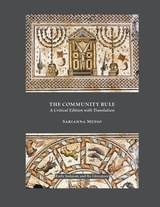
The Community Rule
A Critical Edition with TranslationSarianna Metso
SBL Press, 2019
An authoritative critical edition
The discovery and translation of the Dead Sea Scrolls transformed our understanding of the life and history of ancient Jewish communities when both rabbinic Judaism and early Christianity were emerging. As part of this rich discovery, the Community Rule serves to illuminate the religious beliefs and practices as well as the organizational rules of the group behind the Dead Sea Scrolls. However, there is no single, unified text of the Community Rule; rather, multiple manuscripts of the Community Rule show considerable variation and highlight the work of ancient Jewish scribes and their intentional literary development of the text. In this volume, Sarianna Metso brings together the surviving evidence in a new edition that presents a critically established Hebrew text with an introduction and an English translation.
Features:
- A critical apparatus and textual notes
- All the surviving evidence of the Community Rule
- A new method for presenting complex developments and transmission history of ancient texts
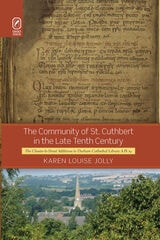
The Community of St. Cuthbert in the Late Tenth Century
The Chester-le-Street Additions to Durham Cathedral Library A.IV.19Karen Louise Jolly
The Ohio State University Press, 2012
The Community of St. Cuthbert in the Late Tenth Century: The Chester-le-Street Additions to Durham Cathedral Library A.IV.19 reveals the dynamic role a seemingly marginalized community played during a defining period for the emergence of English religious identity. Based on her new critical edition of additions made to Durham Cathedral Library A.IV.19 and by questioning the purpose of those late tenth-century additions, Karen Louise Jolly is able to uncover much about the Chester-le-Street scribes and their tumultuous time, rife as it was with various political tensions, from Vikings and local Northumbrian nobles to an increasingly dominant West Saxon monarchy.
Why, for instance, would a priest laboriously insert an Old English gloss above every Latin word in a collection of prayers intended to be performed in Latin? What motivated the same English scribe to include Irish-derived Christian materials in the manuscript, including prayers invoking the archangel Panchiel to clear birds from a field?
The Complementarity of Women and Men
Philosophy, Theology, Psychology, and ArtPaul C. Vitz
Catholic University of America Press, 2021
The Complete Sermons of Ralph Waldo Emerson, Volume 1
Ralph Waldo Emerson, Edited by Albert J. von Frank, Intro by David M. Robinson
University of Missouri Press, 1989
This inaugural volume of a four-volume set marks the beginning of the publication of all 180 of the extant sermons composed and delivered by Emerson between the start of his ministerial career in 1826 and his final retirement from the pulpit in 1838.
Edited from manuscripts in the Houghton Library, Harvard University, the sermons are presented in chronological order in a clear text approximating as nearly as possible the original version read by Emerson to his congregation. The historical introduction by David M. Robinson gives a significant appraisal of Emerson's life between 1826 and 1838 and of his absorption in and reaction against the religious culture of his time.
The Complete Sermons of Ralph Waldo Emerson, Volume 2
Ralph Waldo Emerson, Edited by Teresa Toulouse & Andrew H. Delbanco & Series Editor Albert J. von Frank
University of Missouri Press, 1990
Volume 2 includes a detailed chronology of the events in Emerson's life during the months between July 1829 and October 1830. Explanatory footnotes, textual endnotes, and a comprehensive index further add to this significant contribution to our understanding of one of America's foremost thinkers.
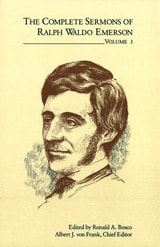
The Complete Sermons of Ralph Waldo Emerson, Volume 3
Ralph Waldo Emerson; Edited by Ronald A. Bosco; Chief Editor, Albert J. von Frank
University of Missouri Press, 1991
The forty-five sermons collected in Volume 3 were composed and first delivered between October 1830 and November 1831. During that time Emerson's first wife, Ellen Tucker Emerson, died of tuberculosis, a loss that deeply affected Emerson.
Transcribed and edited from manuscripts in Harvard's University's Houghton Library, the sermons are presented in a clear text approximating as nearly as possible the original version delivered to Emerson's congregation. As well as the detailed chronology, explanatory footnotes, and textual endnotes found in previous volumes, this one contains a comprehensive index.
The Complete Short Stories, Volume 1
Enid Dinnis
Catholic University of America Press, 2023
The Complete Writings and Selected Correspondence of John Dickinson
Volume 1Jane E. Calvert
University of Delaware Press, 2011
The Complete Writings and Selected Correspondence of John Dickinson
Volume 2Jane E. Calvert
University of Delaware Press, 2021
Dickinson’s hard work on behalf of his clients brought him success in other areas of his public life. In October 1759, he was elected to his first public position as a representative for Kent County, Del., the following year he was elevated to the position of speaker, and in 1762, he became a representative for Philadelphia County, Pa. As a legislator in two colonies, learning his craft as a global war unfolded, he contributed to bills on military and defense, Indian relations, infrastructure improvements and city management, and served on various committees. The death of George II occasioned debates over laws and judges, in which Dickinson participated. This era concludes with Dickinson playing a central role in managing the unfolding Paxton Riots, in which frontiersmen massacred peaceful Indians and threatened the Quaker leadership of Pennsylvania.
In private, Dickinson lost the two most prominent male figures in his life in 1760, his father, Samuel, and soon thereafter, his mentor, colleague, and friend, John Moland. In honor of Moland, Dickinson published a poem and became a proxy head to Moland’s large family. Though his extant correspondence during this period is small, he exchanged letters with Mary Cadwalader Dickinson, Israel Pemberton, William Allason, George Read, Thomas McKean, and others. Perhaps most significant, he wrote a lengthy, unpublished essay on the flag-of-truce trade and also maintained commonplace books as he considered his place within the British Empire, opening up the next phase in Dickinson’s life as a leader of the resistance against Britain.
Published by the University of Delaware Press. Distributed worldwide by Rutgers University Press.
The Complete Writings and Selected Correspondence of John Dickinson
Volume 3Jane E. Calvert
University of Delaware Press, 2024
The Complete Writings and Selected Correspondence of John Dickinson
Volume 4, 1767-1769John Dickinson
University of Delaware Press, 0
The Concept of <i>Ius</i> and the Nature of Law in Thomas Aquinas
Loic-Marie Le Bot, OP
Catholic University of America Press, 2025
The Concise Greek-English Lexicon of the New Testament
Frederick William Danker
University of Chicago Press, 2009
Frederick William Danker, a world-renowned scholar of New Testament Greek, is widely acclaimed for his 2000 revision of Walter Bauer’s A Greek-English Lexicon of the New Testament and Other Early Christian Literature. With more than a quarter of a million copies in print, it is considered the finest dictionary of its kind.
Danker’s Concise Greek-English Lexicon of the New Testament will prove to be similarly invaluable to ministers, seminarians, translators, and students of biblical Greek. Unlike other lexica of the Greek New Testament, which give only brief glosses for headwords, The Concise Greek-English Lexicon offers extended definitions or explanations in idiomatic English for all Greek terms.
Each entry includes basic etymological information, short renderings, information on usage, and plentiful biblical references. Greek terms that could have different English definitions, depending on context, are thoughtfully keyed to the appropriate passages. An overarching aim of The Concise Greek-English Lexicon is to assist the reader in recognizing the broad linguistic and cultural context for New Testament usage of words.
The Concise Greek-English Lexicon retains all the acclaimed features of A Greek-English Lexicon in a succinct and affordable handbook, perfect for specialists and nonspecialists alike.
The Conflagration of Community
Fiction before and after AuschwitzJ. Hillis Miller
University of Chicago Press, 2011
“After Auschwitz to write even a single poem is barbaric.” The Conflagration of Community challenges Theodor Adorno’s famous statement about aesthetic production after the Holocaust, arguing for the possibility of literature to bear witness to extreme collective and personal experiences. J. Hillis Miller masterfully considers how novels about the Holocaust relate to fictions written before and after it, and uses theories of community from Jean-Luc Nancy and Derrida to explore the dissolution of community bonds in its wake.
The Consensus of the Church and Papal Infallibility
A Study in the Background of Vatican IRichard F. Costigan, S.J.
Catholic University of America Press, 2005
The Construction of Minorities
Cases for Comparison Across Time and Around the WorldAndre Burguiere and Raymond Grew, Editors
University of Michigan Press, 2001
The Construction of Religious Boundaries
Culture, Identity, and Diversity in the Sikh TraditionHarjot Oberoi
University of Chicago Press, 1994
In the closing decades of the nineteenth century, however, the Singh Sabha, a powerful new Sikh movement, began to view the multiplicity in Sikh identity with suspicion and hostility. Aided by social and cultural forces unleashed by the British Raj, the Singh Sabha sought to recast Sikh tradition and purge it of diversity. The ethnocentric logic of a new elite dissolved alternative ideals under the highly codified culture of modern Sikhism.
A study of the process by which a pluralistic religious world view is replaced by a monolithic one, this important book calls into question basic assumptions about the efficacy of fundamentalist claims and the construction of all social and religious identities. An essential book for the field of South Asian religions, this work is also an important contribution to cultural anthropology, postcolonial studies, and the history of religion in general.
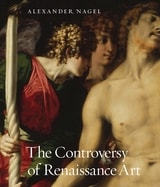
The Controversy of Renaissance Art
Alexander Nagel
University of Chicago Press, 2011
Many studies have shown that images—their presence in the daily lives of the faithful, the means used to control them, and their adaptation to secular uses—were at the heart of the Reformation crisis in northern Europe. But the question as it affects the art of Italy has been raised only in highly specialized studies.
In this book, Alexander Nagel provides the first truly synthetic study of the controversies over religious images that pervaded Italian life both before and parallel to the Reformation north of the Alps. Tracing the intertwined relationship of artistic innovation and archaism, as well as the new pressures placed on the artistic media in the midst of key developments in religious iconography, The Controversy of Renaissance Art offers an important and original history of humanist thought and artistic experimentation from one of our most acclaimed historians of art.
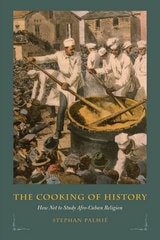
The Cooking of History
How Not to Study Afro-Cuban ReligionStephan Palmié
University of Chicago Press, 2013
The Copy Generic
How the Nonspecific Makes Our Social WorldsScott MacLochlainn
University of Chicago Press, 2022
From off-brand products to elevator music, the “generic” is discarded as the copy, the knockoff, and the old. In The Copy Generic, anthropologist Scott MacLochlainn insists that more than the waste from the culture machine, the generic is a universal social tool, allowing us to move through the world with necessary blueprints, templates, and frames of reference. It is the baseline and background, a category that orders and values different types of specificity yet remains inherently nonspecific in itself. Across arenas as diverse as city planning, social media, ethnonationalism, and religion, the generic points to spaces in which knowledge is both overproduced and desperately lacking. Moving through ethnographic and historical settings in the Philippines, Europe, and the United States, MacLochlainn reveals how the concept of the generic is crucial to understanding how things repeat, circulate, and are classified in the world.
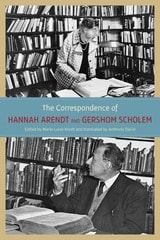
The Correspondence of Hannah Arendt and Gershom Scholem
Hannah Arendt and Gershom Scholem
University of Chicago Press, 2017
Arendt and Scholem met in 1932 in Berlin and quickly bonded over their mutual admiration for and friendship with Walter Benjamin. They began exchanging letters in 1939, and their lively correspondence continued until 1963, when Scholem’s vehement disagreement with Arendt’s Eichmann in Jerusalem led to a rupture that would last until Arendt’s death a dozen years later. The years of their friendship, however, yielded a remarkably rich bounty of letters: together, they try to come to terms with being both German and Jewish, the place and legacy of Germany before and after the Holocaust, the question of what it means to be Jewish in a post-Holocaust world, and more. Walter Benjamin is a constant presence, as his life and tragic death are emblematic of the very questions that preoccupied the pair. Like any collection of letters, however, the book also has its share of lighter moments: accounts of travels, gossipy dinner parties, and the quotidian details that make up life even in the shadow of war and loss.
In a world that continues to struggle with questions of nationalism, identity, and difference, Arendt and Scholem remain crucial thinkers. This volume offers us a way to see them, and the development of their thought, anew.
The Correspondence of John Carroll and Charles Plowden, 1779-1816
Thomas W. Jodziewicz
Catholic University of America Press, 2025
The Correspondence of Pope Julius I
Glen Thompson
Catholic University of America Press, 2015
The Correspondence of Theodoret of Cyrus
The Collectio Sirmondiana, Volume 4John F. Theodoret of Cyrus
Catholic University of America Press, 2025
The Correspondence of Theodoret of Cyrus
The Collectio Sirmondiana, Volume 5John F. Theodoret of Cyrus
Catholic University of America Press, 2025
The Council of Fifty
A Documentary HistoryJedediah S. Rogers
Signature Books, 2014
One member downplayed the significance of this secret legislative body in 1849 as “nothing but a debating School.” On the contrary, a typical meeting included decisions regarding irrigation, fencing, and adobe housing, after which the group sang a song written by Parley P. Pratt: “Come ye sons of doubt and wonder; Indian, Moslem, Greek or Jew; … Be to all a friend and brother; Peace on Earth, good will to men.” Two weeks later, the council called for “blood to flow” to enforce its laws.
As the nineteenth century waned and the LDS Church moved toward the American mainstream, ending its emphasis on the imminent End of Days, there was no longer a need for a Church-managed municipal group destined to become the millennial world government. The council became irrelevant but survives today as a historical artifact available in fragmented documentary pieces which are presented here for the first time.
The Cow in the Elevator
An Anthropology of WonderTulasi Srinivas
Duke University Press, 2018
The Craft of History and the Study of the New Testament
Beth M. Sheppard
SBL Press, 2012
The Creation of an Ethnic Identity
Being Swedish American in the Augustana Synod, 1860-1917Dag Blanck
Southern Illinois University Press, 2006
Analyzing the development of a Swedish American identity
The Creation of an Ethnic Identity: Being Swedish American in the Augustana Synod, 1860–1917 analyzes how Swedish American identity was constructed, maintained, and changed in the late nineteenth and early twentieth centuries. The Augustana Synod, the largest religious-based organization created by Swedish immigrants in the United States, played an important role in establishing what it meant to be Swedish American.
In this study, author Dag Blanck poses three fundamental questions: How did an ethnic identity develop in the Augustana Synod? What was that identity? Why was an ethnic identity formed? Based on primary sources formerly unknown or neglected, The Creation of an Ethnic Identity examines the Lutheran Augustana Synod, Augustana College, and the Augustana Book Concern to provide insights into how ethnic identity is constructed within a major religious body, a central educational institution, and a major publishing house.
Starting from the concept of ethnicity as something created or invented, Blanck goes on to explore how it was possible for a white European immigrant group like the Swedes to use its ethnicity as a tool of integration into American society. The nature of their ethnicity, says Blanck, was both determined by their cultural origins and also the values and nature of American society as they perceived it. Becoming Swedish American was also a way of becoming American.
The volume, which is augmented by illustrations, integrates the most critical scholarship on immigration and ethnicity over the past half century and provides a strong argument about how ethnicity is shaped over time within an immigrant group.
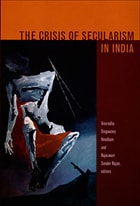
The Crisis of Secularism in India
Anuradha Dingwaney Needham and Rajeswari Sunder Rajan, eds.
Duke University Press, 2007
Scholars of history, anthropology, religion, politics, law, philosophy, and media studies take on a broad range of concerns. Some consider the history of secularism in India; others explore theoretical issues such as the relationship between secularism and democracy or the shortcomings of the categories “majority” and “minority.” Contributors examine how the debates about secularism play out in schools, the media, and the popular cinema. And they address two of the most politically charged sites of crisis: personal law and the right to practice and encourage religious conversion. Together the essays inject insightful analysis into the fraught controversy about the shortcomings and uncertain future of secularism in the world today.
Contributors. Flavia Agnes, Upendra Baxi, Shyam Benegal, Akeel Bilgrami, Partha Chatterjee, V. Geetha, Sunil Khilnani, Nivedita Menon, Ashis Nandy, Anuradha Dingwaney Needham, Gyanendra Pandey, Gyan Prakash, Arvind Rajagopal, Paula Richman, Sumit Sarkar, Dwaipayan Sen, Rajeswari Sunder Rajan, Shabnum Tejani, Romila Thapar, Ravi S. Vasudevan, Gauri Viswanathan
The Crisis of Western Education (The Works of Christopher Dawson)
Christopher Dawson
Catholic University of America Press, 2010
The Critic in the World
Essays in Honor of Fernando F. SegoviaAmy Lindeman Allen
SBL Press, 2024
A Pact of Love with Criticism, A Pact of Blood with the World
Building on the legacy of Fernando F. Segovia, the pioneering essays in this volume redefine the intersection of biblical studies and geopolitics. Through a thorough exploration of how ancient texts and modern readers influence and reflect geopolitical dynamics, each contributor reveals how biblical narratives have shaped and been shaped by historical power structures, territorial conflicts and climate changes, and cultural exchanges. Essays employ contemporary geopolitical concepts that move beyond traditional readings to offer fresh insights into the strategic and ideological forces behind scriptural texts. An annotated interview with Fernando F. Segovia traces his immigration journey as an adolescent and its indelible imprint on his scholarship as a postcolonial critic. Contributors include Efraín Agosto, Amy Lindeman Allen, Reimund Bieringer, Mark G. Brett, Ahida Calderón Pilarski, Greg Carey, Jorge E. Castillo Guerra, Jin Young Choi, Stephanie Buckhanon Crowder, Gregory L. Cuéllar, Musa W. Dube, Neil Elliott, Eleazar S. Fernandez, Bridgett A. Green, Leticia A. Guardiola-Sáenz, Jacqueline M. Hidalgo, Knut Holter, Ma. Maricel S. Ibita, Ma. Marilou S. Ibita, John F. Kutsko, Sung Uk Lim, Francisco Lozada Jr., Luis Menéndez-Antuña, Rubén Muñoz-Larrondo, Robert Myles, Wongi Park, Mitri Raheb, Elisabeth Schüssler Fiorenza, Fernando F. Segovia, Yak-hwee Tan, Ekaputra Tupamahu, Gerald O. West, Hans (J. H.) de Wit, and H. Daniel Zacharias.
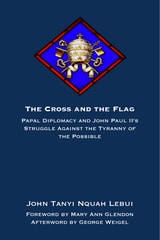
The Cross and the Flag
Papal Diplomacy and John Paul II's Struggle Against the Tyranny of the PossibleJohn Tanyi Nquah Lebui
St. Augustine's Press, 2024
What is papal diplomacy and what role does it play on the larger geopolitical stage? Why does it matter what popes say to a global audience? "As John Tanyi points out, papal diplomacy has followed a trajectory all its own over the years. In today’s globalized world, the Holy See stands out as an important communicator with a widely respected moral voice. It is often said that 'When the Pope speaks, the world listens.' What sets the diplomatic voices of the Holy Father and his envoys apart from all others is that they speak and act for the good of humanity––not just for the sovereign entity they represent, and not just for Catholics. As a former foreign minister of the Holy See, Cardinal Jean Louis Tauran, once described the mission of papal diplomats: 'Our duty is to promote and defend not only the freedom and rights of Catholic communities around the world, but also to promote certain principles without which there is no civilization.'"
The particular example of Pope John Paul II is a groundbreaking example of the critical nature of ecclesiastical diplomacy and why popes as diplomats are playing at a greater level than other statesmen. As George Weigel notes, popes must combat all the problems of the world, but also importantly what he calls the 'tyranny of the possible'––that is, in all things compromise and complacency will play a part. It is the position occupied by one man, the heir of St. Peter, to know when to defy the entirety of global politics (and sometimes what seems like common sense) to say 'yes' and 'no' definitively in light of unchanging truths.
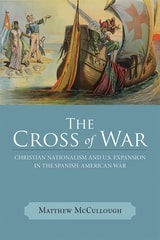
The Cross of War
Christian Nationalism and U.S. Expansion in the Spanish-American WarMatthew McCullough
University of Wisconsin Press, 2014
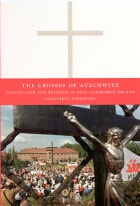
The Crosses of Auschwitz
Nationalism and Religion in Post-Communist PolandGeneviève Zubrzycki
University of Chicago Press, 2006
In the summer and fall of 1998, ultranationalist Polish Catholics erected hundreds of crosses outside Auschwitz, setting off a fierce debate that pitted Catholics and Jews against one another. While this controversy had ramifications that extended well beyond Poland’s borders, Geneviève Zubrzycki sees it as a particularly crucial moment in the development of post-Communist Poland’s statehood and its changing relationship to Catholicism.
In The Crosses of Auschwitz, Zubrzycki skillfully demonstrates how this episode crystallized latent social conflicts regarding the significance of Catholicism in defining “Polishness” and the role of anti-Semitism in the construction of a new Polish identity. Since the fall of Communism, the binding that has held Polish identity and Catholicism together has begun to erode, creating unease among ultranationalists. Within their construction of Polish identity also exists pride in the Polish people’s long history of suffering. For the ultranationalists, then, the crosses at Auschwitz were not only symbols of their ethno-Catholic vision, but also an attempt to lay claim to what they perceived was a Jewish monopoly over martyrdom.
This gripping account of the emotional and aesthetic aspects of the scene of the crosses at Auschwitz offers profound insights into what Polishness is today and what it may become.
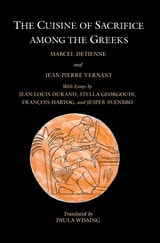
The Cuisine of Sacrifice among the Greeks
Marcel Detienne and Jean-Pierre Vernant
University of Chicago Press, 1989
The fundamental myth is that of Prometheus, who introduced sacrifice and, in the process, both joined us to and separated us from the gods—and ambiguous relation that recurs in marriage and in the growing of grain. Thus we can understand why the ascetic man refuses both women and meat, and why Greek women celebrated the festival of grain-giving Demeter with instruments of butchery.
The ambiguity coded in the consumption of meat generated a mythology of the "other"—werewolves, Scythians, Ethiopians, and other "monsters." The study of the sacrificial consumption of meat thus leads into exotic territory and to unexpected findings.
In The Cuisine of Sacrifice, the contributors—all scholars affiliated with the Center for Comparative Studies of Ancient Societies in Paris—apply methods from structural anthropology, comparative religion, and philology to a diversity of topics: the relation of political power to sacrificial practice; the Promethean myth as the foundation story of sacrificial practice; representations of sacrifice found on Greek vases; the technique and anatomy of sacrifice; the interaction of image, language, and ritual; the position of women in sacrificial custom and the female ritual of the Thesmophoria; the mythical status of wolves in Greece and their relation to the sacrifice of domesticated animals; the role and significance of food-related ritual in Homer and Hesiod; ancient Greek perceptions of Scythian sacrificial rites; and remnants of sacrificial ritual in modern Greek practices.
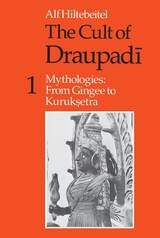
The Cult of Draupadi, Volume 1
Mythologies: From Gingee to KuruksetraAlf Hiltebeitel
University of Chicago Press, 1988
Volume 1 focuses on the Draupadī cult’s own double mythology, moving from its stories about Draupadī’s “primal temple” near the capital of the medieval South Indian Kingdom of Gingee to its version of the Mahābhārata war on the North Indian plain of Kurukṣetra. Throughout, Hiltebeitel intertwines “regional” data, gathered from both oral and written sources, with the “epic,” drawn from the cult’s own performative traditions as well as from classical versions of the Mahābhārata in both Tamil and Sanskrit. Pivotal to the overlap of these Gingee and Kurukṣetra mythologies are two folk figures unknown to classical epic traditions: Draupadī’s two guardians, Pōttu Rāja and Muttāl Rāvuttaṉ.
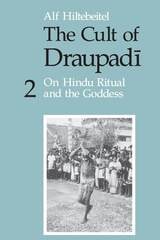
The Cult of Draupadi, Volume 2
On Hindu Ritual and the GoddessAlf Hiltebeitel
University of Chicago Press, 1991
Volume 2 looks at the cultic rituals and argues that these rituals cannot be interpreted independent of other Hindu traditions. Hiltebeitel draws upon his recent fieldwork to demonstrate the remarkable regional and local variations in the practice of the Draupadī cult rituals, from the core area around the ancient center of gingee to the thanjavur area just to the south. He brings to the forefront the differences between the complex rituals of cities, towns, and villages and discusses variations related to their proximity to the central temple in gingee and to the castes from which their customs are derived. using as its model the festival of the Tindivanam temple, Hiltebeitel’s study follows the order of the festival itself and investigates in turn the festival’s four interrelated arenas: the Draupadī temple, a drama stage, a ritual battlefield (paṭukaḷam), and a firewalking area. He explains how the Draupadī festival orchestrates movements back and forth between these arenas to produce a “ritual of battle” in which Draupadī emerges as the victorious goddess.

The Cult of the Goddess Pattini
Gananath Obeyesekere
University of Chicago Press, 1984
The Cult of the Saints
Its Rise and Function in Latin ChristianityPeter Brown
University of Chicago Press, 1982
"Brown has an international reputation for his fine style, a style he here turns on to illuminate the cult of the saints. Christianity was born without such a cult; it took rise and that rise needs chronicling. Brown has a gift for the memorable phrase and sees what the passersby have often overlooked. An eye-opener on an important but neglected phase of Western development."—The Christian Century
"Brilliantly original and highly sophisticated . . . . [The Cult of the Saints] is based on great learning in several disciplines, and the story is told with an exceptional appreciation for the broad social context. Students of many aspects of medieval culture, especially popular religion, will want to consult this work."—Bennett D. Hill, Library Journal
The Cult of the Saints
Its Rise and Function in Latin Christianity, Enlarged EditionPeter Brown
University of Chicago Press, 2014
In this groundbreaking work, Peter Brown explores how the worship of saints and their corporeal remains became central to religious life in Western Europe after the fall of the Roman Empire. During this period, earthly remnants served as a heavenly connection, and their veneration is a fascinating window into the cultural mood of a region in transition.
Brown challenges the long-held “two-tier” idea of religion that separated the religious practices of the sophisticated elites from those of the superstitious masses, instead arguing that the cult of the saints crossed boundaries and played a dynamic part in both the Christian faith and the larger world of late antiquity. He shows how men and women living in harsh and sometimes barbaric times relied upon the holy dead to obtain justice, forgiveness, and power, and how a single sainted hair could inspire great thinkers and great artists.
An essential text by one of the foremost scholars of European history, this expanded edition includes a new preface from Brown, which presents new ideas based on subsequent scholarship.
The Cultural Turn in Late Ancient Studies
Gender, Asceticism, and HistoriographyDale B. Martin and Patricia Cox Miller, eds.
Duke University Press, 2005
The contributors investigate three key concerns of late ancient studies: gender, asceticism, and historiography. They consider Macrina’s scar, Mary’s voice, and the harlot’s body as well as Augustine, Jovinian, Gregory of Nazianzus, Julian, and Ephrem the Syrian. Whether examining how animal bodies figured as a means for understanding human passion and sexuality in the monastic communities of Egypt and Palestine or meditating on the almost modern epistemological crisis faced by Theodoret in attempting to overcome the barriers between the self and the wider world, these essays highlight emerging theoretical and critical developments in the field.
Contributors. Daniel Boyarin, David Brakke, Virginia Burrus, Averil Cameron, Susanna Elm, James E. Goehring, Susan Ashbrook Harvey, David G. Hunter, Blake Leyerle, Dale B. Martin, Patricia Cox Miller, Philip Rousseau, Teresa M. Shaw, Maureen A. Tilley, Dennis E. Trout, Mark Vessey