Results by title
22279 books match the query 'Social Science' and 4007 start with t
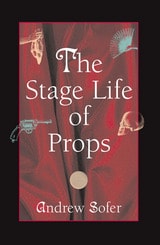
The Stage Life of Props
Andrew Sofer
University of Michigan Press, 2003
Using case studies that explore the Eucharistic wafer on the medieval stage, the bloody handkerchief on the Elizabethan stage, the skull on the Jacobean stage, the fan on the Restoration and early eighteenth-century stage, and the gun on the modern stage, Andrew Sofer reveals how stage props repeatedly thwart dramatic convention and reinvigorate theatrical practice.
While the focus is on specific objects, Sofer also gives us a sweeping history of half a millennium of stage history as seen through the device of the prop, revealing that as material ghosts, stage props are a way for playwrights to animate stage action, question theatrical practice, and revitalize dramatic form.
Andrew Sofer is Assistant Professor of English, Boston College. He was previously a stage director.
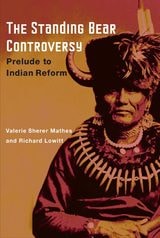
The Standing Bear Controversy
PRELUDE TO INDIAN REFORMValerie Sherer Mathes and Richard Lowitt
University of Illinois Press, 2003
In this book Valerie Sherer Mathes and Richard Lowitt examine how the national publicity surrounding the trial of Chief Standing Bear, as well as a speaking tour by the chief and others, brought the plight of his tribe, and of tribespeople across America, to the attention of the general public, serving as a catalyst for the nineteenth-century Indian reform movement.
As the authors show, the eventual ramifications of the removal, flight, and trial of Standing Bear were extensive, and included the rise of an organized humanitarian reform movement, significant changes in the administration of Indian affairs, and the passage of the General Allotment Act in 1887.
This is the first full-length study of the Standing Bear trial and its consequences, and Mathes and Lowitt draw on a vast array of manuscript, diary, and journalistic sources in order to chronicle the events of 1877, as well as the effect the trial had on broader American popular opinion, on the federal government, and finally on the Native American population as a whole.
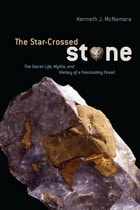
The Star-Crossed Stone
The Secret Life, Myths, and History of a Fascinating FossilKen McNamara
University of Chicago Press, 2010
Throughout the four hundred thousand years that humanity has been collecting fossils, sea urchin fossils, or echinoids, have continually been among the most prized, from the Paleolithic era, when they decorated flint axes, to today, when paleobiologists study them for clues to the earth’s history.
In The Star-Crossed Stone, Kenneth J. McNamara, an expert on fossil echinoids, takes readers on an incredible fossil hunt, with stops in history, paleontology, folklore, mythology, art, religion, and much more. Beginning with prehistoric times, when urchin fossils were used as jewelry, McNamara reveals how the fossil crept into the religious and cultural lives of societies around the world—the roots of the familiar five-pointed star, for example, can be traced to the pattern found on urchins. But McNamara’s vision is even broader than that: using our knowledge of early habits of fossil collecting, he explores the evolution of the human mind itself, drawing striking conclusions about humanity’s earliest appreciation of beauty and the first stirrings of artistic expression. Along the way, the fossil becomes a nexus through which we meet brilliant eccentrics and visionary archaeologists and develop new insights into topics as seemingly disparate as hieroglyphics, Beowulf, and even church organs.
An idiosyncratic celebration of science, nature, and human ingenuity, The Star-Crossed Stone is as charming and unforgettable as the fossil at its heart.
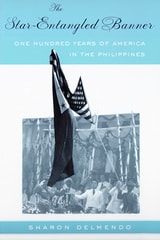
The Star-Entangled Banner
One Hundred Years of America in the PhilippinesDelmendo, Sharon
Rutgers University Press, 2004
During a ceremony held in 1996 to commemorate the fiftieth anniversary of formal Philippine independence, the U.S. flag was being lowered while the Philippine flag was being raised, and the two became entangled. In The Star-Entangled Banner, Sharon Delmendo demonstrates that this incident is indicative of the longstanding problematic relationship between the two countries. When faced with a national crisis or a compelling need to reestablish its autonomy, each nation paradoxically turns to its history with the other to define its place in the world.
Each chapter of the book deals with a separate issue in this linked history: the influence of Buffalo Bill’s show on the proto-nationalism of José Rizal, who is often described as the “First Filipino”; the portrayal of the Philippines in American children’s books; Back to Bataan, a World War II movie starring John Wayne; the post-independence fiction of F. Sionil José; and the refusal of the U..S military to return the Balangiga Bells, which were taken as war booty during the Philippine-American War. Ultimately, Delmendo demonstrates how the effects of U.S. imperialism in the Philippines continue to resonate in U.S. foreign policy in the post cold war era and the war on terrorism.
The Stars
Edgar Morin
University of Minnesota Press, 2005
The Stars Are Not Enough
Scientists--Their Passions and ProfessionsJoseph C. Hermanowicz
University of Chicago Press, 1998
These deeply personal narratives reveal dreams of fame and glory, in which scientists confess their ambitions of becoming the next Newton or Einstein. However, these scientists also discuss the meaning of success and failure. We hear their stories of aspiration and anxiety, disappointment and tragedy, hope and achievement; we are privy to their doubts and to what they consider to be their limitations and weaknesses. As the scientists age in their professions, the specter of failure often visits them, and they have to accept something less than scientific immortality or even the Nobel Prize.
Ultimately these stories give us more than an inside look at the details of careers in science, they also examine ambition by uncovering the forces that drive people in their professions and by describing how these forces persist or fade over time. Ambition for greatness often ignites a career and often sustains it. Yet, as Hermanowicz's study reveals, greatness eludes nearly all people in their heroic quests for extraordinary achievement. The Stars Are Not Enough offers a fascinating account that will appeal to anyone interested in how people's dreams blossom and evolve.
The Starting Line
Latina/o Children, Texas Schools, and National Debates on Early EducationBy Robert Crosnoe
University of Texas Press, 2020
How can we create high-quality learning environments for children from socially, politically, and economically marginalized groups? How do early childhood programs help to overcome the challenges created by poverty? Seeking to answer these questions, The Starting Line delves into the ups and downs of early education programs serving Latinas/os in Texas, using the state as a window into broader debates about academic opportunity and the changing demographics of the United States.
Immersing readers in the day-to-day activities of Texas's early childhood education programs, Robert Crosnoe illuminates how significant obstacles can stymie the best intentions. Crosnoe pays particular attention to the complex connections among classrooms, schools, families, and communities, as well as the frequently unfolding interplay of educational philosophies. The result is a story highlighting the promises of early childhood education, the perils faced in attempting to fulfill them, and the degree to which Texas stands at the forefront of some larger movements and lags behind in others.
Giving voice to bilingual educators and low-income Latina/o families, this book is a timely exploration of the strengths and needs of what will soon be the largest share of the US child population.
The State You See
How Government Visibility Creates Political Distrust and Racial InequalityAaron J. Rosenthal
University of Michigan Press, 2023
The State You See uncovers a racial gap in the way the American government appears in people’s lives. It makes it clear that public policy changes over the last fifty years have driven all Americans to distrust the government that they see in their lives, even though Americans of different races are not seeing the same kind of government.
For white people, these policy changes have involved a rising number of generous benefits submerged within America’s tax code, which taken together cost the government more than Social Security and Medicare combined. Political attention focused on this has helped make welfare and taxes more visible representations of government for white Americans. As a result, white people are left with the misperception that government does nothing for them, apart from take their tax money to spend on welfare. Distrust of government is the result. For people of color, distrust is also rampant but for different reasons. Over the last fifty years, America has witnessed increasingly overbearing policing and swelling incarceration numbers. These changes have disproportionately impacted communities of color, helping to make the criminal legal system a unique visible manifestation of government in these communities.
While distrust of government emerges in both cases, these different roots lead to different consequences. White people are mobilized into politics by their distrust, feeling that they must speak up in order to reclaim their misspent tax dollars. In contrast, people of color are pushed away from government due to a belief that engaging in American elections will yield the same kind of unresponsiveness and violence that comes from interactions with the police. The result is a perpetuation of the same kind of racial inequality that has always been present in American democracy. The State You See is essential reading for anyone interested in understanding how the American government engages in subtle forms of discrimination and how it continues to uphold racial inequality in the present day.

The State of Islam
Culture and Cold War Politics in PakistanSaadia Toor
Pluto Press, 2011
The State of Islam tells the story of Pakistan through the lens of the Cold War, and more recently the War on Terror, to shed light on the domestic and international processes behind the global rise of militant Islam.
Unlike existing scholarship on nationalism, Islam and the state in Pakistan, which tends to privilege events in a narrowly-defined ‘political’ realm, Saadia Toor highlights the significance of cultural politics in Pakistan from its origins to the contemporary period. This extra dimension allows Toor to explain how the struggle between Marxists and liberal nationalists was influenced and eventually engulfed by the agenda of the religious right.
Timely and unique, this book is a must for anyone who wants to understand the roots of modern Pakistan and the likely outcome of current power struggles in the country.
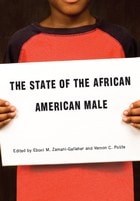
The State of the African American Male
Eboni M. Zamani-Gallaher
Michigan State University Press, 2010
The circumstances affecting many African American males in schools and society remain complex and problematic. In spite of modest gains in school achievement and graduation rates, conditions that impede the progress of African American males persist: high rates of school violence and suspensions, overrepresentation in special education classes, poor access to higher education, high incidence of crime and incarceration, gender and masculine identity issues, and HIV/AIDS and other health crises.
The essays gathered here focus on these issues as they exist for males in grades K-12 and postsecondary education in Michigan. However, the authors intend their analyses and policy recommendations to apply to African American males nationally.
Although it recognizes the current difficulties of this population overall, this is an optimistic volume, with a goal of creating policies and norms that help African American males achieve their educational and social potential. In this era of widespread change for all members of American society-regardless of race-this book is a must-read for educators and policymakers alike.
The State of the American Mind
16 Leading Critics on the New Anti-IntellectualismMark Bauerlein
Templeton Press, 2015
That was over twenty years ago. Since then, the United States has experienced unprecedented wealth, more youth enrolling in higher education than ever before, and technology advancements far beyond what many in the 1980s dreamed possible. And yet, the state of the American mind seems to have deteriorated further. Benjamin Franklin’s “self-made man” has become a man dependent on the state. Independence has turned into self-absorption. Liberty has been curtailed in the defense of multiculturalism.
In order to fully grasp the underpinnings of this shift away from the self-reliant, well-informed American, editors Mark Bauerlein and Adam Bellow have brought together a group of cultural and educational experts to discuss the root causes of the decline of the American mind. The writers of these fifteen original essays include E. D. Hirsch, Nicholas Eberstadt, and Dennis Prager, as well as Daniel Dreisbach, Gerald Graff, Richard Arum, Robert Whitaker, David T. Z. Mindich, Maggie Jackson, Jean Twenge, Jonathan Kay, Ilya Somin, Steve Wasserman, Greg Lukianoff, and R. R. Reno. Their essays are compiled into three main categories:
- States of Mind: Indicators of Intellectual and Cognitive Decline
- These essays broach specific mental deficiencies among the population, including lagging cultural IQ, low Biblical literacy, poor writing skills, and over-medication.
- Personal and Cognitive Habits/Interests
- These essays turn to specific mental behaviors and interests, including avoidance of the news, short attention spans, narcissism, and conspiracy obsessions.
- National Consequences
- These essays examine broader trends affecting populations and institutions, including rates of entitlement claims, voting habits, and a low-performing higher education system.
The State, Ethnicity, and Gender in Africa
Intellectual Legacies of Crawford YoungEdited by Scott Straus and Aili Mari Tripp
University of Wisconsin Press, 2024
Written in honor of Crawford Young, a foundational figure in the study of African politics, the essays reflect the breadth and intellectual legacy of this towering scholar and illustrate the vast impact Young had, and continues to have, on the field. The book’s themes build from his seminal publications, and the essays were written by leading scholars who were trained by Young.
The State, Popular Mobilisation and Gold Mining in Mongolia
Shaping ‘Neo-Liberal’ PoliciesDulam Bumochir
University College London, 2020

The Statue of Libertine
Luma Sims
Templeton Press, 2021
Many immigrants to the United States are reluctant to come here. That statement takes many Americans by surprise because we assume that people freely choose to come to this country to make better lives for themselves. After all, what American is unfamiliar with the romantic image of immigrants of yesteryear arriving in New York Harbor, hungry to make their way in the land of opportunity?
But the United States is not the country it was a century ago. Back then, the institutions of family and religion held together American society, establishing the norms, customs, and obligations that smoothed the gears of self-governance. For this reason, the country had a clear national identity into which immigrants could assimilate. They could adapt their cultural heritage to the American way of life and raise their children to do the same. Sadly, this is no longer the case.
The march of modernity has dissolved the institutions that supported a cohesive society, giving rise to a radical individualism that devalued the importance of meaning-making relationships. The fallout has included unprecedented rates of loneliness, historical ignorance, excessive materialism, and moral drift. Immigrants can see this in America better than Americans themselves. The advantage immigrants have is that they come from countries that cherish group belonging; they know that without it, an individual cannot live a fulfilling life.
In The Statue of Libertine, Luma Simms—herself an immigrant from Iraq—argues that we ought to listen to the immigrant perspective and use it as a tool for self-reflection. Drawing from landmark social commentators such as Alexis de Tocqueville, Simms unfolds her argument by sharing her family’s story of coming to America and struggling to make it their home. She also includes firsthand accounts of other immigrants whose experiences underscore how America’s proverbial melting pot has been shattered.
Her objective is to help us see ourselves through the eyes of the modern immigrant and grasp how far we’ve strayed from the tacit social agreements that made America so strong in the first place. With this understanding, we can begin the work of reviving the institutions that made us a beacon of hope for the rest of the world.
The Steuben Village and Mounds
A Multicomponent Late Hopewell Site in IllinoisDan F. Morse
University of Michigan Press, 1963
The Stillborn
Notebooks of a Woman from the Student-Movement Generation in EgyptArwa Salih
Seagull Books, 2017
A poignant reckoning with the Marxism of a generation and its militant postcolonial intellectuals.
Arwa Salih was a member of the political bureau of the Egyptian Communist Workers Party, founded in the wake of the Arab–Israeli War and the vibrant Egyptian student movement of the early 1970s. Written more than a decade after Salih quit the party and left political life—and published shortly after she tragically took her own life—The Stillborn offers a devastatingly honest look at the tragic failure of both the national liberation and communist projects in Egypt.
This powerful, unflinching critique speaks not only to and about Salih’s own generation of left-wing activists, but also extends its gaze outward. The Stillborn addresses the broader, still fiercely salient dilemmas of revolutionary politics that continue to echo throughout the developing world in the postcolonial era.

The Stojka Family
Spatial Mobility and Territorial Anchoredness of Lovara Vlax Roms in the Former CzechoslovakiaMarkéta Hajská
Karolinum Press, 2025
The Stojka Family features the distinctive testimony of said Romani family, allowing for a representation of “traveling gypsies” and their forced sedentarization. The book shines a light on the lesser-known Lovara community, accompanied by solid data from extensive archival research, oral history, and other ethnological methods.
The book details the story of a Vlax-Lovari Romani family, focusing on its legal, economic, and social attachment to the territory of the former Czechoslovakia from the end of the nineteenth century to the 1960s. Using extensive archival research and the accounts of Romani witnesses, the author shows the various forms of spatial mobility and anchoring of those who identified themselves as Vlax-Lovari Romani and who were simultaneously labeled by state authorities as “gypsies” or “wandering gypsies.” The distinctive testimony focuses on instruments of anti-Roma legislation over a long time, across very diverse political regimes, different regions, and changing socio-economic conditions, and traces in detail the impact of these measures on the lives of the Romani population. The book presents perhaps the most detailed treatment of the history and trajectory of a single Romani family and offers a new perspective on the so-called “Romani nomadism,” providing valuable insights in the fields of social and cultural anthropology, ethnology, sociology, and Romani studies.
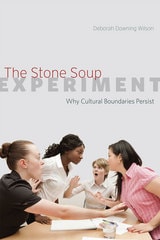
The Stone Soup Experiment
Why Cultural Boundaries PersistDeborah Downing Wilson
University of Chicago Press, 2015
The experience of the Stoners and Traders is a profound testament to human sociality. Even in the form of simulation, even as a game, the participants found themselves quickly—and with real conviction—bound to the ideologies and practices of their in-group. The Stoners enjoyed their days lounging, chatting, and making crafts, while the Traders—through a complex market of playing cards—competed for the highest bankrolls. When they came into contact, misunderstanding, competition, and even manipulation prevailed, to the point that each group became so convinced of its own superiority that even after the simulation’s end the students could not reconcile.
Throughout her riveting narrative, Downing Wilson interweaves fascinating discussions on the importance of play, emotions, and intergroup interaction in the formation and maintenance of group identities, as well as on the dynamic social processes at work when different cultural groups interact. A fascinating account of social experimentation, the book paints a vivid portrait of our deepest social tendencies and the powers they have over how we make friends and enemies alike.
The Stone and the Wireless
Mediating China, 1861–1906Shaoling Ma
Duke University Press, 2021
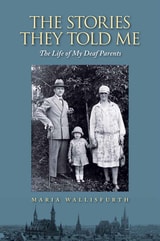
The Stories They Told Me
The Life of My Deaf ParentsMaria Wallisfurth
Gallaudet University Press, 2017
Despite their dissimilar backgrounds and the political circumstances that roiled their lives, the author’s parents showed great love for each other and their only daughter. The Stories They Told Me is a richly detailed document of time and place and a rare account of deaf lives during this era.

The Stories Whiteness Tells Itself
Racial Myths and Our American NarrativesDavid Mura
University of Minnesota Press, 2022
Uncovering the pernicious narratives white people create to justify white supremacy and sustain racist oppression
The police murders of two Black men, Philando Castile and George Floyd, frame this searing exploration of the historical and fictional narratives that white America tells itself to justify and maintain white supremacy. From the country’s founding through the summer of Black Lives Matter in 2020, David Mura unmasks how white stories about race attempt to erase the brutality of the past and underpin systemic racism in the present.
Intertwining history, literature, ethics, and the deeply personal, Mura looks back to foundational narratives of white supremacy (Jefferson’s defense of slavery, Lincoln’s frequently minimized racism, and the establishment of Jim Crow) to show how white identity is based on shared belief in the pernicious myths, false histories, and racially segregated fictions that allow whites to deny their culpability in past atrocities and current inequities. White supremacy always insists white knowledge is superior to Black knowledge, Mura argues, and this belief dismisses the truths embodied in Black narratives.
Mura turns to literature, comparing the white savior portrayal of the film Amistad to the novelization of its script by the Black novelist Alexs Pate, which focuses on its African protagonists; depictions of slavery in Faulkner and Morrison; and race’s absence in the fiction of Jonathan Franzen and its inescapable presence in works by ZZ Packer, tracing the construction of Whiteness to willfully distorted portraits of race in America. In James Baldwin’s essays, Mura finds a response to this racial distortion and a way for Blacks and other BIPOC people to heal from the wounds of racism.
Taking readers beyond apology, contrition, or sadness, Mura attends to the persistent trauma racism has exacted and lays bare how deeply we need to change our racial narratives—what white people must do—to dissolve the myth of Whiteness and fully acknowledge the stories and experiences of Black Americans.
The Story I Tell Myself
A Venture in Existentialist AutobiographyHazel E. Barnes
University of Chicago Press, 1997
The Story Within Us
Women Prisoners Reflect on ReadingEdited by Megan Sweeney
University of Illinois Press, 2012
Framing the narratives within an analytic introduction and reflective afterword, Megan Sweeney highlights the crucial intellectual work that the incarcerated women perform despite myriad restrictions on reading and education in U.S. prisons. These women use the limited reading materials available to them as sources of guidance and support and as tools for self-reflection and self-education. Through their creative engagements with books, the women learn to reframe their own life stories, situate their experiences in relation to broader social patterns, deepen their understanding of others, experiment with new ways of being, and maintain a sense of connection with their fellow citizens on both sides of the prison fence.
The Story of Act 31
How Native History Came to Wisconsin ClassroomsJ P Leary
Wisconsin Historical Society Press, 2018
Since its passage in 1989, a state law known as Act 31 requires that all students in Wisconsin learn about the history, culture, and tribal sovereignty of Wisconsin’s federally recognized tribes.
The Story of Act 31 tells the story of the law’s inception—tracing its origins to a court decision in 1983 that affirmed American Indian hunting and fishing treaty rights in Wisconsin, and to the violent public outcry that followed the court’s decision. Author J P Leary paints a picture of controversy stemming from past policy decisions that denied generations of Wisconsin students the opportunity to learn about tribal history.
The Story of Food in the Human Past
How What We Ate Made Us Who We AreRobyn E. Cutright
University of Alabama Press, 2021
Explore how food shaped humanity in this compelling archaeological journey.
The Story of Food in the Human Past: How What We Ate Made Us Who We Are uses case studies from recent archaeological research to tell the story of food in human prehistory. Beginning with the earliest members of our genus, Robyn E. Cutright investigates the role of food in shaping who we are as humans during the emergence of modern Homo sapiens and through major transitions in human prehistory such as the development of agriculture and the emergence of complex societies.
This fascinating study begins with a discussion of how food shaped humans in evolutionary terms by examining what makes human eating unique, the use of fire to cook, and the origins of cuisine as culture and adaptation through the example of Neandertals. The second part of the book describes how cuisine was reshaped when humans domesticated plants and animals and examines how food expressed ancient social structures and identities such as gender, class, and ethnicity. Cutright shows how food took on special meaning in feasts and religious rituals and also pays attention to the daily preparation and consumption of food as central to human society.
Cutright synthesizes recent paleoanthropological and archaeological research on ancient diet and cuisine and complements her research on daily diet, culinary practice, and special-purpose mortuary and celebratory meals in the Andes with comparative case studies from around the world to offer readers a holistic view of what humans ate in the past and what that reveals about who we are.

The Story of Jane
The Legendary Underground Feminist Abortion ServiceLaura Kaplan
University of Chicago Press, 1997
"The Story of Jane is a piece of women's history in step with feminist theory demanding that women tell their own stories. It serves to remind people of an important and often overlooked moment in the women's rights movement."—Seattle Weekly
"Laura Kaplan's The Story of Jane is the first book to chronicle this controversial sliver of history, and it is a fascinating, if partisan, close-up of the group."—Newsday
"[Kaplan] draws on her personal recollections and interviews with Jane members and clients and the doctors who performed the abortions to provide a well-written, detailed history of this radical group."—Publisher's Weekly
"Weaving together the voices and memories of her former co-workers, Kaplan recounts how the group initially focused on counseling women and helping them find reliable, reasonably priced doctors....Kaplan's account of this remarkable story recaptures the political idealism of the early '70s...23 years after Roe vs. Wade, the issues and memories raised by the books are close and all too relevant."—K Kaufmann, San Francisco Chronicle
"Laura Kaplan's The Story of Jane is the first book to chronicle this controversial sliver of history, and it is a fascinating, if partisan, close-up of the group....The Story of Jane succeeds on the steam of Kaplan's gripping subject and her moving belief in the power of small-scale change."—Cynthia Leive, New York Newsday
"During the four years before the Supreme Court's Roe v. Wade decision legalized abortion in 1973, the 100 members of Jane helped some 11,000 women end their pregnancies....There is more in this remarkable book that will further raise eyebrows....Kaplan's engrossing tales of the quiet courage of the women who risked their reputations and freedom to help others may remind many readers of other kinds of outlaws who have resisted tyranny throughout history."—Chicago Sun-Times

The Story of Jane
The Legendary Underground Feminist Abortion ServiceLaura Kaplan
University of Chicago Press, 1997
"The Story of Jane is a piece of women's history in step with feminist theory demanding that women tell their own stories. It serves to remind people of an important and often overlooked moment in the women's rights movement."—Seattle Weekly
"Laura Kaplan's The Story of Jane is the first book to chronicle this controversial sliver of history, and it is a fascinating, if partisan, close-up of the group."—Newsday
"[Kaplan] draws on her personal recollections and interviews with Jane members and clients and the doctors who performed the abortions to provide a well-written, detailed history of this radical group."—Publisher's Weekly
"Weaving together the voices and memories of her former co-workers, Kaplan recounts how the group initially focused on counseling women and helping them find reliable, reasonably priced doctors....Kaplan's account of this remarkable story recaptures the political idealism of the early '70s...23 years after Roe vs. Wade, the issues and memories raised by the books are close and all too relevant."—K Kaufmann, San Francisco Chronicle
"Laura Kaplan's The Story of Jane is the first book to chronicle this controversial sliver of history, and it is a fascinating, if partisan, close-up of the group....The Story of Jane succeeds on the steam of Kaplan's gripping subject and her moving belief in the power of small-scale change."—Cynthia Leive, New York Newsday
"During the four years before the Supreme Court's Roe v. Wade decision legalized abortion in 1973, the 100 members of Jane helped some 11,000 women end their pregnancies....There is more in this remarkable book that will further raise eyebrows....Kaplan's engrossing tales of the quiet courage of the women who risked their reputations and freedom to help others may remind many readers of other kinds of outlaws who have resisted tyranny throughout history."—Chicago Sun-Times
The Story of Lynx
Claude Lévi-Strauss
University of Chicago Press, 1995
So begins the Nez Percé myth that lies at the heart of The Story of Lynx, Claude Lévi-Strauss's most accessible examination of the rich mythology of American Indians. In this wide-ranging work, the master of structural anthropology considers the many variations in a story that occurs in both North and South America, but especially among the Salish-speaking peoples of the Northwest Coast. He also shows how centuries of contact with Europeans have altered the tales.
Lévi-Strauss focuses on the opposition between Wild Cat and Coyote to explore the meaning and uses of gemellarity, or twinness, in Native American culture. The concept of dual organization that these tales exemplify is one of non-equivalence: everything has an opposite or other, with which it coexists in unstable tension. In contrast, Lévi-Strauss argues, European notions of twinness—as in the myth of Castor and Pollux—stress the essential sameness of the twins. This fundamental cultural difference lay behind the fatal clash of European and Native American peoples.
The Story of Lynx addresses and clarifies all the major issues that have occupied Lévi-Strauss for decades, and is the only one of his books in which he explicitly connects history and structuralism. The result is a work that will appeal to those interested in American Indian mythology.
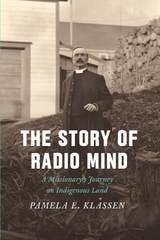
The Story of Radio Mind
A Missionary's Journey on Indigenous LandPamela E. Klassen
University of Chicago Press, 2018
Following Du Vernet’s journey westward from Toronto to Ojibwe territory and across the young nation of Canada, Pamela Klassen examines how contests over the mediation of stories—via photography, maps, printing presses, and radio—lucidly reveal the spiritual work of colonial settlement. A city builder who bargained away Indigenous land to make way for the railroad, Du Vernet knew that he lived on the territory of Ts’msyen, Nisga’a, and Haida nations who had never ceded their land to the onrush of Canadian settlers. He condemned the devastating effects on Indigenous families of the residential schools run by his church while still serving that church. Testifying to the power of radio mind with evidence from the apostle Paul and the philosopher Henri Bergson, Du Vernet found a way to explain the world that he, his church and his country made.
Expanding approaches to religion and media studies to ask how sovereignty is made through stories, Klassen shows how the spiritual invention of colonial nations takes place at the same time that Indigenous peoples—including Indigenous Christians—resist colonial dispossession through stories and spirits of their own.
The Story of What Is Broken Is Whole
An Aurora Levins Morales ReaderAurora Levins Morales
Duke University Press, 2024

The Storytellers' Journey
AN AMERICAN REVIVALJoseph Daniel Sobol
University of Illinois Press, 1999
Drawing on interviews with dozens of storytellers around the country, Sobol paints the revival as part of a larger process of cultural revitalization. He traces the growth of the preeminent revival organization, the National Association for the Preservation and Perpetuation of Storytelling (NAPPS), and details the individual passions, the organizational politics, and the economic, social, and mythic forces that have combined to transform a ragtag assemblage of enthusiasts into a national and international network of arts professionals.
A seemingly chance encounter between a restlessly ambitious high school teacher and a coonhunting tale on the car radio sets off a chain of inspirations that changes the face of a small southern town, touches lives across America, and revitalizes a homely but treasured art form.
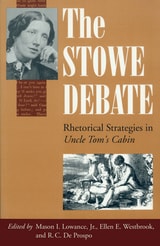
The Stowe Debate
Rhetorical Strategies in "Uncle Tom's Cabin"Mason I. Lowance
University of Massachusetts Press, 1994
The thirteen contributors to this volume enter these debates from a variety of critical perspectives. They address questions of language and ideology, the tradition of the sentimental novel, biblical influences, and the rhetoric of antislavery discourse. As much as they disagree on various points, they share a keen interest in the cultural work that texts can do and an appreciation of the enduring power of Uncle Tom's Cabin.

The Straight Line
How the Fringe Science of Ex-Gay Therapy Reoriented SexualityTom Waidzunas
University of Minnesota Press, 2015
To be taken seriously, therapies that claim to “cure” homosexuality wrap themselves in lab coats. Even though the fit is bad, and such therapies and their theorists now inhabit the scientific fringe, the science of sexuality has made some adjustments, too, Tom Waidzunas tells us in this provocative work.
Intervening in the politics of sexuality and science, The Straight Line argues that scientific definitions of sexual orientation do not merely reflect the results of investigations into human nature, but rather emerge through a process of social negotiation between opposing groups. The demedicalization of homosexuality and the discrediting of reparative therapies, ex-gay ministries, and reorientation research have, Waidzunas contends, required scientists to enforce key boundaries around scientific expertise and research methods. Drawing on extensive participant observation at conferences for ex-gays, reorientation therapists, mainstream psychologists, and survivors of ex-gay therapy, as well as interviews with experts and activists, The Straight Line traces reorientation debates in the United States from the 1950s to the present, following homosexuality therapies from the mainstream to the margins. As the ex-gay movement has become increasingly transnational in recent years, Waidzunas turns to Uganda, where ideas about the scientific nature of homosexuality influenced the passage of the Anti-Homosexuality Act of 2014.
While most studies treat the ex-gay movement as a religious phenomenon, this book looks at how the movement, in its attempts to establish legitimacy, has engaged with scientific institutions, shaping virulent anti-gay public policy.
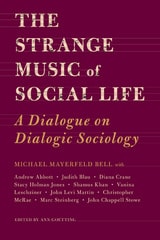
The Strange Music of Social Life
A Dialogue on Dialogic SociologyAuthored by Michael Mayerfeld Bell, edited by Ann Goetting
Temple University Press, 2011
The Strange Music of Social Life presents a dialogue on dialogic sociology, explored through the medium of music. Sociologist and composer Michael Mayerfeld Bell presents an argument that both sociology and classical music remain largely in the grip of a nineteenth-century totalizing ambition of prediction and control. He provides the refreshing approach of "strangency" to explain a sociology that tries to understand not only the regularities of social life but also the social conditions in which people do what we do not expect.
Nine important sociologists and musicians respond-often vigorously-to the conversation Bell initiates by raising pivotal questions. The Strange Music of Social Life concludes with Bell's reply to those responses and offers new insight into sociology and music sociology.
The Stranger in Medieval Society
Frank. R. P. Akehurst and Stephanie Cain Van D’Elden, Editors
University of Minnesota Press, 1998
The Stranger in Medieval Society was first published in 1998. Minnesota Archive Editions uses digital technology to make long-unavailable books once again accessible, and are published unaltered from the original University of Minnesota Press editions.
The Stranger in Medieval Society examines the presence of outsiders in medieval Europe. Whether welcome or unwelcome, voluntary or involuntary, strangers appear in every society; they leave their own communities, venture into new environments, confront differences, and often spark changes. The first collection in medieval studies to concentrate on the notion of the stranger, these essays show how outsiders influenced the culture of Europe in the Middle Ages.
Among the topics explored are Edward III and Sir Gawain and the Green Knight as historical and literary instances of chivalric skill and courage; political conflict in the late French epic Renaut de Montauban; and a group of people who were doubly strangers-some thirty thousand Jews, who after being expelled from France in 1306 returned under an experimental agreement a few years later.
Contributors: William Calin, U of Florida; Susan Crane, Rutgers; Maria Dobozy, U of Utah; Edward R. Haymes, Cleveland State U; William Chester Jordan, Princeton U; Derek Pearsall, Harvard U; William D. Phillips Jr., U of Minnesota; Kathryn L. Reyerson, U of Minnesota; and Janet L. Solberg, Kalamazoo College.
F. R. P. Akehurst is professor of French in the Department of French and Italian at the University of Minnesota. Stephanie Cain Van D'Elden is director of graduate studies for the program in Germanic philology at the University of Minnesota.
This is volume 12 in the Medieval Cultures Series
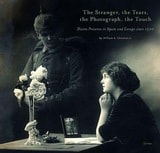
The Stranger, the Tears, the Photograph, the Touch
Divine Presence in Spain and Europe since 1500William A. Christian Jr.
Central European University Press, 2017
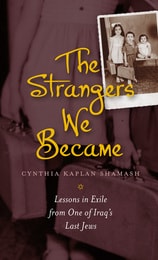
The Strangers We Became
Lessons in Exile from One of Iraq's Last JewsCynthia Kaplan Shamash
Brandeis University Press, 2015
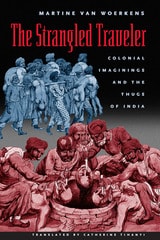
The Strangled Traveler
Colonial Imaginings and the Thugs of IndiaMartine van Woerkens
University of Chicago Press, 2002
Did the Thugs really exist, or did the British invent them as an excuse to seize tighter control of India? Drawing on historical and anthropological accounts, Indian tales and sacred texts, and detailed analyses of the secret Thug language, Martine van Woerkens reveals for the first time the real story of the Thugs. Many different groups of Thugs actually did exist over the centuries, but the monsters the British made of them had much more to do with colonial imaginings of India than with the real Thugs. Tracing these imaginings down to the present, van Woerkens reveals the ongoing roles of the Thugs in fiction and film from Frankenstein to Indiana Jones and the Temple of Doom.
The Stratigraphy and Archaeology of Ventana Cave
Emil W. Haury
University of Arizona Press, 1975
The Stratigraphy and Fauna of the Hackberry Stage of the Upper Devonian
By Carroll Lane Fenton and Mildred Adams Fenton
University of Michigan Press, 1925

The Stray Bullet
William S. Burroughs in MexicoJorge García-Robles
University of Minnesota Press, 2013
William S. Burroughs arrived in Mexico City in 1949, having slipped out of New Orleans while awaiting trial on drug and weapons charges that would almost certainly have resulted in a lengthy prison sentence. Still uncertain about being a writer, he had left behind a series of failed business ventures—including a scheme to grow marijuana in Texas and sell it in New York—and an already long history of drug use and arrests. He would remain in Mexico for three years, a period that culminated in the defining incident of his life: Burroughs shot his common-law wife, Joan Vollmer, while playing William Tell with a loaded pistol. (He would be tried and convicted of murder in absentia after fleeing Mexico.)
First published in 1995 in Mexico, where it received the Malcolm Lowry literary essay award, The Stray Bullet is an imaginative and riveting account of Burroughs’s formative experiences in Mexico, his fascination with Mexico City’s demimonde, his acquaintances and friendships there, and his contradictory attitudes toward the country and its culture. Mexico, Jorge García-Robles makes clear, was the place in which Burroughs embarked on his “fatal vocation as a writer.”
Through meticulous research and interviews with those who knew Burroughs and his circle in Mexico City, García-Robles brilliantly portrays a time in Burroughs’s life that has been overshadowed by the tragedy of Joan Vollmer’s death. He re-creates the bohemian Roma neighborhood where Burroughs resided with Joan and their children, the streets of postwar Mexico City that Burroughs explored, and such infamous figures as Lola la Chata, queen of the city’s drug trade. This compelling book also offers a contribution by Burroughs himself—an evocative sketch of his shady Mexican attorney, Bernabé Jurado.

The Street Is My Pulpit
Hip Hop and Christianity in KenyaMwenda Ntarangwi
University of Illinois Press, 2016
Mwenda Ntarangwi explores the Kenyan hip hop scene through the lens of Juliani's life and career. A born-again Christian, Juliani produces work highlighting the tensions between hip hop's forceful self-expression and a pious approach to public life, even while contesting the basic presumptions of both. In The Street Is My Pulpit, Ntarangwi forges an uncommon collaboration with his subject that offers insights into Juliani's art and goals even as Ntarangwi explores his own religious experience and subjective identity as an ethnographer. What emerges is an original contribution to the scholarship on hip hop's global impact and a passionate study of the music's role in shaping new ways of being Christian in Africa.
The Street
A Photographic Field Guide to American InequalityNaa Oyo A. Kwate
Rutgers University Press, 2021
Using MacArthur fellow Camilo José Vergara’s intimate street photographs of Camden, New Jersey as reference points, the essays in this collection analyze these images within the context of troubled histories and misguided policies that have exacerbated racial and economic inequalities. Rather than blaming Camden’s residents for the blighted urban landscape, the multidisciplinary array of scholars contributing to this guide reveal the oppressive structures and institutional failures that have led the city to this condition. Tackling topics such as race and law enforcement, gentrification, food deserts, urban aesthetics, credit markets, health care, childcare, and schooling, the contributors challenge conventional thinking about what we should observe when looking at neighborhoods.
The Streets of San Francisco
Policing and the Creation of a Cosmopolitan Liberal Politics, 1950-1972Christopher Lowen Agee
University of Chicago Press, 2014
The Streets of San Francisco uncovers the seldom reported, street-level interactions between police officers and San Francisco residents and finds that police discretion was the defining feature of mid-century law enforcement. Postwar police officers enjoyed great autonomy when dealing with North Beach beats, African American gang leaders, gay and lesbian bar owners, Haight-Ashbury hippies, artists who created sexually explicit works, Chinese American entrepreneurs, and a wide range of other San Franciscans. Unexpectedly, this police independence grew into a source of both concern and inspiration for the thousands of young professionals streaming into the city's growing financial district. These young professionals ultimately used the issue of police discretion to forge a new cosmopolitan liberal coalition that incorporated both marginalized San Franciscans and rank-and-file police officers. The success of this model in San Francisco resulted in the rise of cosmopolitan liberal coalitions throughout the country, and today, liberal cities across America ground themselves in similar understandings of democracy, emphasizing both broad diversity and strong policing.
The Strong Case Approach in Behavioral Archaeology
Edited by Michael Brian Schiffer, Charles R. Riggs, and J. Jefferson Reid
University of Utah Press, 2017
The chapters employ a wide range of data classes, demonstrating the versatility and productivity of the approach for fashioning rigorous inferences in history, historical archaeology, ethnoarchaeology, and prehistory. By illustrating the strong case approach with convincing case studies from behavioral archaeology, the editors aim to alert the archaeological community about how the process of archaeological inference can be improved.
The Strozzi of Florence
Widowhood and Family Solidarity in the RenaissanceAnn Crabb
University of Michigan Press, 2000
The Strozzi correspondence tells the story of the decline and recovery of one Florentine patrician family. Eventually, the Strozzi brothers earned the greatest fortune of their era, and, after the repeal of their exile, Filippo, the eldest, most successful, and longest lived, spent the last years of his life in Florence as one of its foremost citizens. Set in the context of other documentary evidence and of modern historical and anthropological studies, Crabb's study illuminates the role of women, kinship, solidarity, honor, and profit. These letters provide nuanced insights into values and practices that more impersonal sources cannot rival.
As well as appealing to those interested in the Renaissance, Florence, and Italy, this book will attract those wanting to read about topics in social history that cross time periods: women, family and kinship, business, and honor. It confronts issues of Renaissance Florentine historiography by presenting a more positive view of the role of women than does current orthodoxy, by providing evidence of the impact of extended kinship ties, a controversial issue, and by illuminating further the value placed on honor and profit.
Ann Crabb teaches medieval history at James Madison University.
The Structure and Sentiment
Rodney Needham
University of Chicago Press, 1984
"A theoretical and methodological essay of first importance. As such, the book should be of interest to all social scientists interested in the development of specific and general theory in social anthropology."—Southwestern Social Science Quarterly
The Struggle For Meaning
Reflections on Philosophy, Culture, and Democracy in AfricaPaulin J. Hountondji
Ohio University Press, 2002
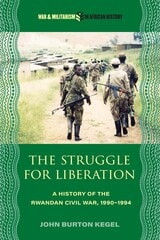
The Struggle for Liberation
A History of the Rwandan Civil War, 1990-1994John Burton Kegel
Ohio University Press, 2025
The story of the Rwandan Genocide has been told many times by scholars and journalists. Over the course of a hundred days in the spring and summer of 1994, about eight hundred thousand Tutsi and moderate Hutu were murdered by their extremist Hutu compatriots. Those hundred days were the final phase of a four-year civil war, also known as the Struggle for Liberation, which formed the immediate context of the genocide. Though scholars have researched preparations for the genocide and the international community’s role in it, none has placed the Struggle for Liberation at the heart of the narrative. However, the preparation of the genocide, the rise and fall of the moderate opposition, the degradation of the Forces armées rwandaises (FAR) from a respected fighting force to a genocidal militia, the role of the international community, the Arusha negotiations, and the execution of the genocide all took place in the context of that war. John Burton Kegel contends that the Struggle for Liberation forms the bedrock of any genuine understanding of Rwanda between 1990 and 1994, and indeed beyond. The Struggle for Liberation, which eventually led to the genocide, was fought between the FAR and the civilians and soldiers of the Rwandan Patriotic Front (RPF) and its armed wing, the Rwandan Patriotic Army (RPA). The civil war started on October 1, 1990, when the RPF entered Rwanda from Uganda, where Rwandan refugees had lived throughout the Great Lakes region since roughly 1959. This book traces the history of those refugees—and Rwanda’s deeper Hutu-Tutsi divide—from the precolonial period up to 1990. It also provides a wholly new take on how the disciplined RPF, which rules Rwanda to this day, was born and organized.
The Struggle for Maize
Campesinos, Workers, and Transgenic Corn in the Mexican CountrysideElizabeth Fitting
Duke University Press, 2011