Results by title
441 books match the query 'Women and literature' and 48 start with w

WORLDS OF MEDIEVAL WOMEN
"CREATIVITY, INFLUENCE, AND IMAGINATION"CONSTANCE H. BERMAN
West Virginia University Press, 1985
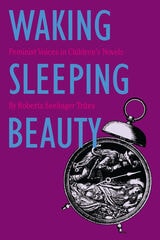
Waking Sleeping Beauty
Feminist Voices in Children's NovelsRoberta S. Trites
University of Iowa Press, 1997
The Sleeping Beauty in Roberta Seelinger Trites' intriguing text is no silent snoozer passively waiting for Prince Charming to energize her life. Instead she wakes up all by herself and sets out to redefine the meaning of “happily ever after.” Trites investigates the many ways that Sleeping Beauty's newfound voice has joined other strong female voices in feminist children's novels to generate equal potentials for all children.
Waking Sleeping Beauty explores issues of voice in a wide range of children's novels, including books by Virginia Hamilton, Patricia MacLachlan, and Cynthia Voight as well as many multicultural and international books. Far from being a limiting genre that praises females at the expense of males, the feminist children's novel seeks to communicate an inclusive vision of politics, gender, age, race, and class. By revising former stereotypes of children's literature and replacing them with more complete images of females in children's books, Trites encourages those involved with children's literature—teachers, students, writers, publishers, critics, librarian, booksellers, and parents—to be aware of the myriad possibilities of feminist expression.
Roberta Trites focuses on the positive aspects of feminism: on the ways females interact through family and community relationships, on the ways females have revised patriarchal images, and on the ways female writers use fictional constructs to transmit their ideologies to readers. She thus provides a framework that allows everyone who enters a classroom with a children's book in hand to recognize and communicate—with an optimistic, reality-based sense of “happily ever after”—the politics and the potential of that book.
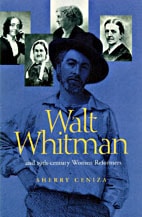
Walt Whitman and Nineteenth-Century Women Reformers
Sherry Ceniza
University of Alabama Press, 1999
WINNER OF THE ELIZABETH AGEE PRIZE IN AMERICAN LITERATURE
Examining Whitman’s poetic development through the documented influence of nineteenth‑century women reformers.
Walt Whitman and 19th-Century Women Reformers documents Whitman's friendships with women during the 1850s, the decade of Whitman's most creative period. The book reveals startling connections between the first three editions of Leaves of Grass and the texts generated by the women he knew during this period, many of whom were radical activists in the women's rights movement.
Sherry Ceniza argues that Whitman's editions of Leaves became progressively more radically 'feminist' as he followed the women's rights movement during the 1850s and that he was influenced by what he called the 'true woman of the new aggressive type . . . woman under the new dispensation.' Ceniza documents the progression of the National Woman's Rights movement through the lives and writings of three of its leaders- Abby Hills Price, Paulina Wright Davis, and Ernestine L. Rose. By juxtaposing the texts written by these women with Leaves, Ceniza shows that Whitman used many of the same arguments and rhetorical gestures as his female activist friends.
The book also discusses the influence of women engaged in women's rights outside the National Woman's Rights organization. And Ceniza's opening chapter is devoted to a fresh interpretation of the life and thought of another strong-minded woman who influenced the poet's writing-Louisa Van Velsor Whitman, Walt Whitman's mother.
Water Lilies
An Anthology of Spanish Women Writers from the Fifteenth through the Nineteenth CenturyAmy Kaminsky
University of Minnesota Press, 1995
Poetry and prose by Spanish women presented here in both English and Spanish.
A dazzling sampler, Water Lilies brings to light a rich and until now largely invisible version of Spanish literary history. These hard-to-find works, most translated for the first time, are printed on facing pages in Spanish and English and located within a critical, biographical, and historical overview.
Here are five centuries of writing by Spanish women, the unknown recovered from obscurity, the well-known seen as they rarely have been-in the context of a women’s literary history. Some of these writers, like Rosalía de Castro in “The Bluestockings” and Teresa de Cartagena in Wonder at the Work of God, question the relationship between the woman writer and the act of writing. Some, like the poet Carolina Coronado in “The Twin Geniuses: Sappho and Saint Teresa of Jesus,” overtly seek a literary tradition. Others, like Saint Teresa in her Life and Luisa Sigea in her poetry, provide touchstones for women in search of such a tradition.Legends and stories of women’s friendships, the inconstancy of men, and the love of God; Spain’s first autobiographical text; secular and religious poetry from medieval through recent times; an excerpt from one of the few chivalresque novels written by a woman; a full-length Golden Age comedia: this is the wide range of works Water Lilies comprises. Brought together for the first time, the writers articulate their resistance to, and their complicity in, a literary history that, until now, has tried to exclude them.
We Are Three Sisters
Self and Family in the Writing of the BrontësDrew Lamonica
University of Missouri Press, 2003
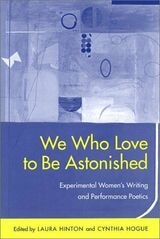
We Who Love to Be Astonished
Experimental Women's Writing and Performance PoeticsLaura Hinton
University of Alabama Press, 2001
The first critical volume devoted to the full range of women's postmodern works
We Who Love to Be Astonished collects a powerful group of previously unpublished essays to fill a gap in the critical evaluation of women's contributions to postmodern experimental writing. Contributors include Alan Golding, Aldon Nielsen, and Rachel Blau DuPlessis; discussions include analyses of the work of Kathleen Fraser, Harryette Mullen, and Kathy Acker, among others. The editors take as their title a line from the work of Lyn Hejinian, one of the most respected of innovative women poets writing today.
The volume is organized into four sections: the first two seek to identify, from two different angles, the ways women of different sociocultural backgrounds are exploring their relationships to their cultures' inherited traditions; the third section investigates the issue of visuality and the problems and challenges it creates; and the fourth section expands on the role of the body as material and performance.
The collection will breach a once irreconcilable divide between those who theorize about women's writing and those who focus on formalist practice. By embracing "astonishment" as the site of formalist-feminist investigation, the editors seek to show how form configures feminist thought, and, likewise, how feminist thought informs words and letters on a page. Students and scholars of avant-garde poetry, women's writing, and late-20th-century American literature will welcome this lively discussion.
West of the Border
The Multicultural Literature of the Western American FrontiersNoreen Groover Lape
Ohio University Press, 2000
Expanding the scope of American borderland and frontier literary scholarship, West of the Border examines the writings of nineteenth- and turn-of-the-century Native, African, Asian, and Anglo American frontier writers. This book views frontiers as “human spaces” where cultures make contact as it considers multicultural frontier writers who speak from “west of the border.”
James P. Beckwourth, a half-black fur trader; Sarah Winnemucca Hopkins, a Paiute translator; Salishan author Mourning Dove; Cherokee novelist John Rollin Ridge; Sui Sin Far, an Anglo-Chinese short story writer, and her sister, romance novelist Onoto Watanna; and Mary Austin, a white southwestern writer- each of these intercultural writers faces a rite of passage into a new social order. Their writings negotiate their various frontier ordeals: the encroachment of pioneers on the land; reservation life; assimilation; Christianity; battles over territories and resources; exclusion; miscegenation laws; and the devastation of the environment.
In West of the Border, Noreen Groover Lape raises issues inherent in American pluralism today by broaching timely concerns about American frontier politics, conceptualizing frontiers as intercultural contact zones, and expanding the boundaries of frontier literary studies by giving voice to minority writers.
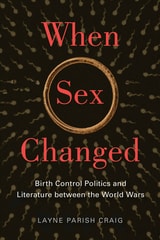
When Sex Changed
Birth Control Politics and Literature between the World WarsLayne Parish Craig
Rutgers University Press, 2013
In When Sex Changed, Layne Parish Craig analyzes the ways literary texts responded to the political, economic, sexual, and social values put forward by the birth control movements of the 1910s to the 1930s in the United States and Great Britain.
Discussion of contraception and related topics (including feminism, religion, and eugenics) changed the way that writers depicted women, marriage, and family life. Tracing this shift, Craig compares disparate responses to the birth control controversy, from early skepticism by mainstream feminists, reflected in Charlotte Perkins Gilman’s Herland, to concern about the movement’s race and class implications suggested in Nella Larsen’s Quicksand, to enthusiastic speculation about contraception’s political implications, as in Virginia Woolf’s Three Guineas.
While these texts emphasized birth control’s potential to transform marriage and family life and emancipate women from the “slavery” of constant childbearing, birth control advocates also used less-than-liberatory language that excluded the poor, the mentally ill, non-whites, and others. Ultimately, Craig argues, the debates that began in these early political and literary texts—texts that document both the birth control movement’s idealism and its exclusionary rhetoric—helped shape the complex legacy of family planning and women’s rights with which the United States and the United Kingdom still struggle.
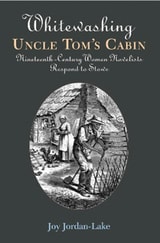
Whitewashing Uncle Tom's Cabin
Nineteenth-Century Women Novelists Respond to StoweJoy Jordan-Lake
Vanderbilt University Press, 2005
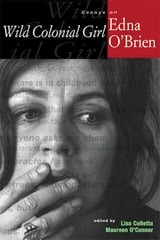
Wild Colonial Girl
Essays on Edna O'BrienEdited by Lisa Colletta and Maureen O'Connor
University of Wisconsin Press, 2006
Wild Colonial Girl situates O'Brien in Irish contexts that allow for an appraisal of her significant contribution to a specifically Irish women's literary tradition while attesting to the potency of writing against patriarchal conventions. Each chapter's clear and detailed readings of O'Brien's fiction build a convincing case for her literary, political, and cultural importance, providing an invaluable critical guide for an enriched appreciation of O'Brien and her work.

Wild Mother Dancing
Maternal Narrative in Canadian LiteratureDi Brandt
University of Manitoba Press, 1993
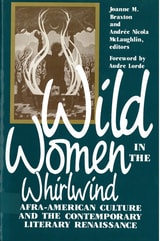
Wild Women in the Whirlwind
Afra-American Culture and the Contemporary Literary RenaissanceEdited by Joanne M. Braxton and Andree Nicola McLaughlin
Rutgers University Press, 1989
--New York Times Book Review
"The cultural and literary achievements of black American women are examined and celebrated in some 20 enjoyable, erudite essays by prominent scholars, critics, and activists."
--Publishers Weekly
This book is the first comprehensive collection of critical and theoretical essays to explore the literary and multi-cultural traditions of Black American women in many genres over a broad span of time. The essays explore cultural and literary experience in a wide context and offer a variety of critical theoretical constructs in which to view that experience. The editors have written excellent introductions providing both historical and comparative discussions of the contemporary literary renaissance. The book also includes a valuable bibliography of selected English-language works by Black women in the Americas from the 1970s to the present.
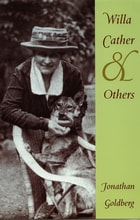
Willa Cather and Others
Jonathan Goldberg
Duke University Press, 2001
The “others” referred to in the title are women, for the most part Cather’s contemporaries, whose artistic projects allow for points of comparison with Cather. They include the Wagnerian diva Olive Fremstad, renowned for her category-defying voice; Blair Niles, an ethnographer and novelist of jazz-age Harlem and the prisons of New Guinea; Laura Gilpin, photographer of the American Southwest; and Pat Barker, whose Regeneration trilogy places World War I writers—and questions of sexuality and gender—at its center. In the process of studying these women and their work, Goldberg forms innovative new insights into a wide range of Cather’s celebrated works, from O Pioneers! and My Ántonia to her later books The Song of the Lark, One of Ours, The Professor’s House, Death Comes for the Archbishop, and Sapphira and the Slave Girl.
By applying his unique talent to the study of Cather’s literary genius, Jonathan Goldberg makes a significant and new contribution to the study of American literature and queer studies.
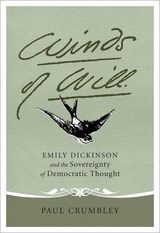
Winds of Will
Emily Dickinson and the Sovereignty of Democratic ThoughtPaul Crumbley
University of Alabama Press, 2010
A sophisticated literary analysis positioning Emily Dickinson’s poetry within the framework of democratic thought and individual sovereignty.
In this study, Paul Crumbley asserts that, contrary to popular opinion, Emily Dickinson consistently communicated political views through her poetry. Dickinson’s life of self-isolation—today her most notable personal characteristic—by no means extended into the political sphere, he argues. While she rarely addressed political issues directly and was curiously disengaged from the liberal causes and female reform movements of her time, Dickinson’s poems are deeply rooted both in matters of personal sovereignty and reader choice. The significant choices Dickinson extends to the reader underscore the democratic dimensions of reading her work, and of reading itself as a political act.
Crumbley employs close readings of Dickinson’s poems and letters, highlighting the many changing—and often contradictory—voices in her work, both throughout her oeuvre and in individual poems themselves. In Dickinson’s letters Crumbley finds just as many unique and conflicting voices; thus, both her personal correspondence and the poems make political demands by placing the burden of interpretation on the reader.
Rather than reflecting explicit political values, Dickinson’s work chronicles an ongoing decision-making process that magnifies the role of individual choice, not the advocacy of specific outcomes. In the end, Dickinson’s readers must either accept an isolated lyric subjectivity or invest that subjectivity with the substance necessary for engagement with the larger world.

Wingless Flights
Appalachian Women in FictionDanny L. Miller
University of Wisconsin Press, 1996
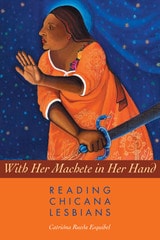
With Her Machete in Her Hand
Reading Chicana LesbiansBy Catrióna Rueda Esquibel
University of Texas Press, 2006
With the 1981 publication of the groundbreaking anthology This Bridge Called My Back: Writings by Radical Women of Color, Cherríe Moraga and Gloria Anzaldúa ushered in an era of Chicana lesbian writing. But while these two writers have achieved iconic status, observers of the Chicana/o experience have been slow to perceive the existence of a whole community—lesbian and straight, male as well as female—who write about the Chicana lesbian experience. To create a first full map of that community, this book explores a wide range of plays, novels, and short stories by Chicana/o authors that depict lesbian characters or lesbian desire.
Catrióna Rueda Esquibel starts from the premise that Chicana/o communities, theories, and feminisms cannot be fully understood without taking account of the perspectives and experiences of Chicana lesbians. To open up these perspectives, she engages in close readings of works centered around the following themes: La Llorona, the Aztec Princess, Sor Juana Inés de la Cruz, girlhood friendships, rural communities and history, and Chicana activism. Her investigation broadens the community of Chicana lesbian writers well beyond Moraga and Anzaldúa, while it also demonstrates that the histories of Chicana lesbians have had to be written in works of fiction because these women have been marginalized and excluded in canonical writings on Chicano life and experience.
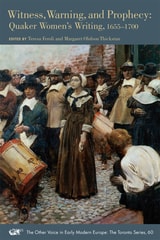
Witness, Warning, and Prophecy
Quaker Women's Writing, 1655-1700Edited by Teresa Feroli and Margaret Olofson Thickstun
Iter Press, 2018
The Other Voice in Early Modern Europe - The Toronto Series: Volume 60
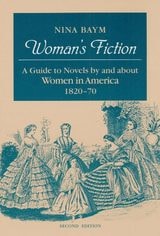
Woman's Fiction
A Guide to Novels by and about Women in America, 1820-70Nina Baym. With a New Introduction and Supplementary Bibliography
University of Illinois Press, 1993
This reissue of the pioneering and standard book on antebellum women's domestic novels contains a new introduction situating the book in the context of important recent developments in the study of women's writing. Nina Baym considers 130 novels by 48 women, focusing on the works of a dozen especially productive and successful writers.
Woman's Fiction is a major-work in nineteenth-century literature, reexamining changes in the literary canon and the meaning of sentimentalism, while responding to current critical discussions of 'the body' in literary texts.
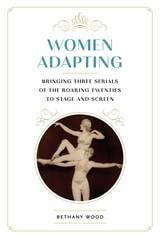
Women Adapting
Bringing Three Serials of the Roaring Twenties to Stage and ScreenBethany Wood
University of Iowa Press, 2019
Bethany Wood examines three well-known stories that debuted as women’s magazine serials—Gentlemen Prefer Blondes, Edith Wharton’s The Age of Innocence, and Edna Ferber’s Show Boat—and traces how each of these beloved narratives traveled across publishing, theatre, and film through adaptation. She documents the formation of adaptation systems and how they involved women’s voices and labor in modern entertainment in ways that have been previously underappreciated. What emerges is a picture of a unique window of time in the early decades of the twentieth century, when women in entertainment held influential positions in production and management. These days, when filmic adaptations seem endless and perhaps even unoriginal, Women Adapting challenges us to rethink the popular platitude, “The book is always better than the movie.”
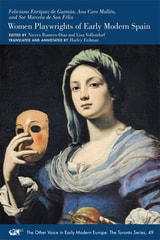
Women Playwrights of Early Modern Spain
Feliciana Enríquez de Guzmán, Ana Caro Mallén, and Sor Marcela de San Félix
Iter Press, 2016
This volume presents ten plays by three leading women playwrights of Spain’s Golden Age. Included are four bawdy and outrageous comic interludes; a full-length comedy involving sorcery, chivalry, and dramatic stage effects; and five short religious plays satirizing daily life in the convent. A critical introduction to the volume positions these women and their works in the world of seventeenth-century Spain.

Women Poets of Spain, 1860-1990
TOWARD A GYNOCENTRIC VISIONJohn C. Wilcox
University of Illinois Press, 1997
Women Poets on Mentorship
Efforts and AffectionsArielle Greenberg
University of Iowa Press, 2008
The poets in this collection describe a new kind of influence, one less hierarchical, less patriarchal, and less anxious than forms of mentorship in the past. Vivid and intelligent, these twenty-four essays explore the complicated nature of the mentoring relationship, with all its joys and difficulties, and show how this new sense of writing out of female experience and within a community of writers has fundamentally changed women’s poetry.
Includes:
Jenny Factor on Marilyn Hacker
Beth Ann Fennelly on Denise Duhamel
Miranda Field on Fanny Howe
Katie Ford on Jorie Graham
Joy Katz on Sharon Olds
Valerie Martínez on Joy Harjo
Erika Meitner on Rita Dove
Aimee Nezhukumatathil on Naomi Shihab Nye
Eleni Sikelianos on Alice Notley
Tracy K. Smith on Lucie Brock-Broido
Crystal Williams on Lucille Clifton
Rebecca Wolff on Molly Peacock

Women Reading Women Writing
Ann Louise Keating
Temple University Press, 1996
Women Times Three
Writers, Detectives, ReadersKathleen Gregory Klein
University of Wisconsin Press, 1995
The eleven essays concentrate new attention on the trio of reader, writer, and text when all three are modified by the terms “woman” and “mystery.”
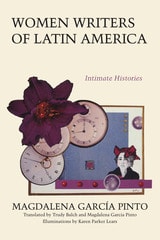
Women Writers of Latin America
Intimate HistoriesBy Magdalena García Pinto
University of Texas Press, 1991
What does it take for a woman to succeed as a writer? In these revealing interviews, first published in 1988 as Historias íntimas, ten of Latin America's most important women writers explore this question with scholar Magdalena García Pinto, discussing the personal, social, and political factors that have shaped their writing careers.
The authors interviewed are Isabel Allende, Albalucía Angel, Rosario Ferré, Margo Glantz, Sylvia Molloy, Elvira Orphée, Elena Poniatowska, Marta Traba, Luisa Valenzuela, and Ida Vitale. In intimate dialogues with each author, García Pinto draws out the formative experiences of her youth, tracing the pilgrimage that led each to a distinguished writing career.
The writers also reflect on their published writings, discussing the creative process in general and the motivating force behind individual works. They candidly discuss the problems they have faced in writing and the strategies that enabled them to reach their goals.
While obviously of interest to readers of Latin American literature, this book has important insights for students of women's literature and cultural studies, as well as for aspiring writers.
Women and Comedy
Rewriting the British Theatrical TraditionSusan Carlson
University of Michigan Press, 1991
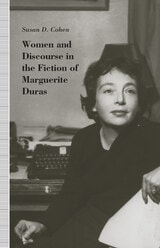
Women and Discourse in the Fiction of Marguerite Duras
Love, Legends, LanguageSusan D. Cohen
University of Massachusetts Press, 1993
One of the most famous living French writers, Marguerite Duras is renowned for her provocative and hauntingly beautiful works of fiction, drama, and cinema. This book offers the first comprehensive study of the narrative and stylistic characteristics of Duras's fiction. Susan D. Cohen examines the entire range of Duras's works, combining close textual analyses with a more general discussion of narrativity and its connections with gender, class, and race. The focus throughout is on language, representation, and difference, which Duras explores on every structural level.
Cohen shows how Duras's writings, even the controversial “erotic” works, expose and subvert the repression of women in traditional, dominant discourse and at the same time present an alternative, nonrepressive discursive model. She formulates a concept of creative “ignorance,” which she identifies as the generative principle of Duras's textual production and the approach to language it proposes. Cohen also explores the distinctive features of Duras's prose, describing how the writer achieves the ritual, legendary aura that characterizes her work.
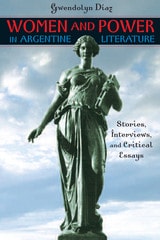
Women and Power in Argentine Literature
Stories, Interviews, and Critical EssaysBy Gwendolyn Díaz
University of Texas Press, 2007
The astonishing talent of Argentine women writers belies the struggles they have faced—not merely as overlooked authors, but as women of conviction facing oppression. The patriarchal pressures of the Perón years, the terror of the Dirty War, and, more recently, the economic collapse that gripped the nation in 2001 created such repressive conditions that some writers, such as Luisa Valenzuela, left the country for long periods. Not surprisingly, power has become an inescapable theme in Argentine women's fiction, and this collection shows how the dynamics of power capture not only the political world but also the personal one. Whether their characters are politicians and peasants, torturers and victims, parents and children, or lovers male and female, each writer explores the effects of power as it is exercised by or against women.
The fifteen writers chosen for Women and Power in Argentine Literature include famous names such as Valenzuela, as well as authors anthologized for the first time, most notably María Kodama, widow of Jorge Luis Borges. Each chapter begins with a "verbal portrait," editor Gwendolyn Díaz's personal impression of the author at ease, formed through hours of conversation and interviews. A biographical essay and critical commentary follow, with emphasis on the work included in this anthology. Díaz's interviews, translated from Spanish, and finally the stories themselves—only three of which have been previously published in English—complete the chapters. The extraordinary depth of these chapters reflects the nuanced, often controversial portrayals of power observed by Argentine women writers. Inspiring as well as insightful, Women and Power in Argentine Literature is ultimately about women who, in Díaz's words, "choose to speak their truth regardless of the consequences."
Women of Color
Mother-Daughter Relationships in 20th-Century LiteratureEdited by Elizabeth Brown-Guillory
University of Texas Press, 1996
Interest in the mother-daughter relationship has never been greater, yet there are few books specifically devoted to the relationships between daughters and mothers of color. To fill that gap, this collection of original essays explores the mother-daughter relationship as it appears in the works of African, African American, Asian American, Mexican American, Native American, Indian, and Australian Aboriginal women writers.
Prominent among the writers considered here are Toni Morrison, Alice Walker, Maxine Hong Kingston, Cherrie Moraga, Leslie Marmon Silko, and Amy Tan. Elizabeth Brown-Guillory and the other essayists examine the myths and reality surrounding the mother-daughter relationship in these writers' works. They show how women writers of color often portray the mother-daughter dyad as a love/hate relationship, in which the mother painstakingly tries to convey knowledge of how to survive in a racist, sexist, and classist world while the daughter rejects her mother's experiences as invalid in changing social times.
This book represents a further opening of the literary canon to twentieth-century women of color. Like the writings it surveys, it celebrates the joys of breaking silence and moving toward reconciliation and growth.
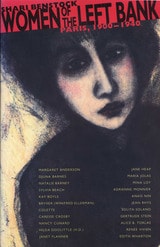
Women of the Left Bank
Paris, 1900-1940By Shari Benstock
University of Texas Press, 1986
Now available in a durable paperback edition, Shari Benstock's critically acclaimed, best-selling Women of the Left Bank is a fascinating exploration of the lives and works of some two dozen American, English, and French women whose talent shaped the Paris expatriate experience in the century's early years.
This ambitious historical, biographical, and critical study has taken its place among the foremost works of literary criticism. Maurice Beebe calls it "a distinguished contribution to modern literary history." Jane Marcus hails it as "the first serious literary history of the period and its women writers, making along the way no small contribution to our understanding of the relationships between women artists and their male counterparts, from Henry James to Hemingway, Joyce, Picasso, and Pound."
Women's Irony
Rewriting Feminist Rhetorical HistoriesTarez Samra Graban
Southern Illinois University Press, 2015
In Women’s Irony: Rewriting Feminist Rhetorical Histories, author Tarez Samra Graban synthesizes three decades of feminist scholarship in rhetoric, linguistics, and philosophy to present irony as a critical paradigm for feminist rhetorical historiography that is not linked to humor, lying, or intention. Using irony as a form of ideological disruption, this innovative approach allows scholars to challenge simplistic narratives of who harmed, and who was harmed, throughout rhetorical history.
Three case studies of women’s political discourse between 1600 and 1900—examining the work of Anne Askew, Anne Hutchinson, and Helen M. Gougar—demonstrate how reading historical texts ironically complicates the theoretical relationships between women and agency, language and history, and archival location and memory. Interwoven throughout are shorter case studies from twentieth-century performances, revealing irony’s consciousness-raising potential for the present and the future.
Ultimately, Women’s Irony suggests alternative ways to question women’s histories and consider how contemporary feminist discourse might be better historicized. Graban challenges critical methods in rhetoric, asking scholars in rhetoric and its related disciplines—composition, communication, and English studies—to rethink how they produce historical knowledge and use archives to recover women’s performances in political situations.
Women's Life-Writing
Finding Voice, Building CommunityLinda S. Coleman
University of Wisconsin Press, 1997
Women's Professional Lives in Rhetoric and Composition
Choice, Chance, and SerendipityEdited by Elizabeth A. Flynn and Tiffany Bourelle
The Ohio State University Press, 2018
This collection, edited by Elizabeth A. Flynn and Tiffany Bourelle, contributes to the valuable work of chronicling the professional and personal lives of women in academia. Through its line-up of contributors from diverse backgrounds, locations, and career paths, Women’s Professional Lives in Rhetoric and Composition showcases the voices of multiple scholars occupying a multitude of different roles in the profession: from prestigious professors emeritae and endowed chairs to assistant professors starting their careers to an independent scholar to part-time faculty.
The collection sets itself apart from other volumes not just in its diversity of perspectives but also by speaking against linear stories of success in the profession—sharing moments of shame and failure, showing how the personal and professional often intertwine and influence one another, and ultimately revealing how choice, chance, serendipity, and kairos have all played a role in the lives of its contributors. In focusing on this convergence, Women’s Professional Lives in Rhetoric and Composition offers a more nuanced picture of the professional and intellectual trajectories of women in rhetoric and composition.

Women's Words
Essay on French SingularityMona Ozouf
University of Chicago Press, 1997
Ozouf uses the woman's portrait, traditionally a male genre, to portray ten French women of letters whose lives span the period from the eve of the French Revolution to the resurgence of the feminist movement in the late twentieth century. She studies the letters and memoirs of Mme du Deffand, Mme de Charrière, Mme Roland, Mme de Staël, Mme de Rémusat, George Sand, Hubertine Auclert, Colette, Simone Weil, and Simone de Beauvoir. Rejecting the male constructions of femininity typical of this genre, Ozouf restores these women's voices in order to study their own often-conflicted attitudes toward education, marriage, motherhood, sex, and work, as well as the dilemma of writing in a literary world that did not support women's work.
Ozouf claims that a uniquely French feminism informed these women's lives, one that stems from the great egalitarian spirit of the French Revolution and is more tolerant of difference than its American counterparts. She argues that as a result, modern French culture has not isolated women from men in the same ways as American and British cultures have done.
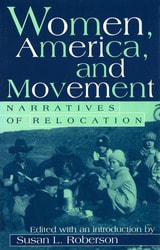
Women, America, and Movement
Narratives of RelocationEdited & Intro by Susan L. Roberson
University of Missouri Press, 1998
Since the colonial days, American women have traveled, migrated, and relocated, always faced with the challenge of reconstructing their homes for themselves and their families. Women, America, and Movement offers a journey through largely unexplored territory—the experiences of migrating American women. These narratives, both real and imagined, represent a range of personal and critical perspectives; some of the women describe their travels as expansive and freeing, while others relate the dreadful costs and sacrifices of relocating.
Despite the range of essays featured in this study, the writings all coalesce around the issues of politics, poetry, and self- identity described by Adrienne Rich as the elements of the "politics of location," treated here as the politics of relocation. The narratives featured in this book explore the impact of race, class, and sexual economics on migratory women, their self-identity, and their roles in family and social life. These issues demonstrate that in addition to geographic place, ideology is itself a space to be traversed.
By examining the writings of such women as Louise Erdrich, Zora Neale Hurston, and Gertrude Stein, the essayists included in this volume offer a variety of experiences. The book confronts such issues as racist politicking against Native Americans, African Americans, and Asian immigrants; sexist attitudes that limit women to the roles of wife, mother, and sexual object; and exploitation of migrants from Appalachia and of women newly arrived in America.
These essays also delve into the writings themselves by looking at what happens to narrative structure as authors or their characters cross geographic boundaries. The reader sees how women writers negotiate relocation in their texts and how the written word becomes a place where one finds oneself.
Women, Autobiography, Theory
A ReaderEdited by Sidonie A. Smith and Julia Watson
University of Wisconsin Press, 1998
Women, Autobiography, Theory is the first comprehensive guide to the burgeoning field of women’s autobiography, drawing into one volume the most significant theoretical discussions on women’s life writing of the last two decades.
The authoritative introduction by Sidonie Smith and Julia Watson surveys writing about women’s lives from the women’s movement of the late 1960s to the present. It also relates theoretical positions in women’s autobiography studies to postmodern, poststructuralist, postcolonial, and feminist analyses.
The essays from thirty-nine prominent critics and writers include many considered classics in this field. They explore narratives across the centuries and from around the globe, including testimonios, diaries, memoirs, letters, trauma accounts, prison narratives, coming-out stories, coming-of-age stories, and spiritual autobiographies. A list of more than two hundred women’s autobiographies and a comprehensive bibliography of critical scholarship in women’s autobiography provide invaluable information for scholars, teachers, and readers.
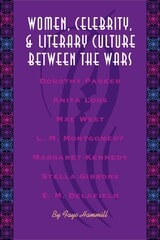
Women, Celebrity, and Literary Culture between the Wars
By Faye Hammill
University of Texas Press, 2007
As mass media burgeoned in the years between the first and second world wars, so did another phenomenon—celebrity. Beginning in Hollywood with the studio-orchestrated transformation of uncredited actors into brand-name stars, celebrity also spread to writers, whose personal appearances and private lives came to fascinate readers as much as their work. Women, Celebrity, and Literary Culture between the Wars profiles seven American, Canadian, and British women writers—Dorothy Parker, Anita Loos, Mae West, L. M. Montgomery, Margaret Kennedy, Stella Gibbons, and E. M. Delafield—who achieved literary celebrity in the 1920s and 1930s and whose work remains popular even today.
Faye Hammill investigates how the fame and commercial success of these writers—as well as their gender—affected the literary reception of their work. She explores how women writers sought to fashion their own celebrity images through various kinds of public performance and how the media appropriated these writers for particular cultural discourses. She also reassesses the relationship between celebrity culture and literary culture, demonstrating how the commercial success of these writers caused literary elites to denigrate their writing as "middlebrow," despite the fact that their work often challenged middle-class ideals of marriage, home, and family and complicated class categories and lines of social discrimination.
The first comparative study of North American and British literary celebrity, Women, Celebrity, and Literary Culture between the Wars offers a nuanced appreciation of the middlebrow in relation to modernism and popular culture.
Women, Compulsion, Modernity
The Moment of American NaturalismJennifer L. Fleissner
University of Chicago Press, 2004
Fleissner shows that this era's expanding opportunities for women were inseparable from the same modern developments—industrialization, consumerism—typically believed to constrain human freedom. With Women, Compulsion, and Modernity, Fleissner creates a new language for the strange way the writings of the time both broaden and question individual agency.
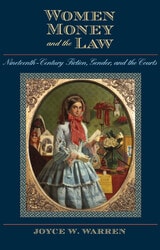
Women, Money, and the Law
Nineteenth-Century Fiction, Gender, and the CourtsJoyce W. Warren
University of Iowa Press, 2005
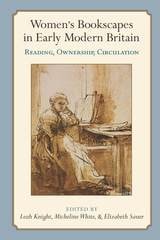
Women’s Bookscapes in Early Modern Britain
Reading, Ownership, CirculationLeah Knight, Micheline White, and Elizabeth Sauer, Editors
University of Michigan Press, 2018
Women in 16th- and 17th-century Britain read, annotated, circulated, inventoried, cherished, criticized, prescribed, and proscribed books in various historically distinctive ways. Yet, unlike that of their male counterparts, the study of women’s reading practices and book ownership has been an elusive and largely overlooked field.
In thirteen probing essays, Women’s Bookscapesin Early Modern Britain brings together the work of internationally renowned scholars investigating key questions about early modern British women’s figurative, material, and cultural relationships with books. What constitutes evidence of women’s readerly engagement? How did women use books to achieve personal, political, religious, literary, economic, social, familial, or communal goals? How does new evidence of women’s libraries and book usage challenge received ideas about gender in relation to knowledge, education, confessional affiliations, family ties, and sociability? How do digital tools offer new possibilities for the recovery of information on early modern women readers?
The volume’s three-part structure highlights case studies of individual readers and their libraries; analyses of readers and readership in the context of their interpretive communities; and new types of scholarly evidence—lists of confiscated books and convent rules, for example—as well as new methodologies and technologies for ongoing research. These essays dismantle binaries of private and public; reading and writing; female and male literary engagement and production; and ownership and authorship.
Interdisciplinary, timely, cohesive, and concise, this collection’s fresh, revisionary approaches represent substantial contributions to scholarship in early modern material culture; book history and print culture; women’s literary and cultural history; library studies; and reading and collecting practices more generally.
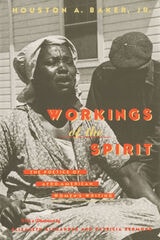
Workings of the Spirit
The Poetics of Afro-American Women's WritingHouston A. Baker Jr.
University of Chicago Press, 1990
"Brilliant, and tenderly riveted to gratitude as an indispensable facet of analysis, Houston Baker arrives, yet again, bearing the loveliest flowers of his devotion and delight: thank God he's here!"—June Jordan
Writers of Conviction
The Personal Politics of Zona Gale, Dorothy Canfield Fisher, Rose Wilder Lane, and Josephine HerbstJulia C. Ehrhardt
University of Missouri Press, 2004
Writing Like a Woman
Alicia Ostriker
University of Michigan Press, 1983

Writing Women in Central America
Gender and the Fictionalization of HistoryLaura Barbas-Rhoden
Ohio University Press, 2003
What is the relationship between history and fiction in a place with a contentious past? And of what concern is gender in the telling of stories about that past?
Writing Women in Central America explores these questions as it considers key Central American texts. This study analyzes how authors appropriate history to confront the rhetoric of the state, global economic powers, and even dissident groups within their own cultures. Laura Barbas-Rhoden winds a common thread in the literary imaginations of Claribel Alegría, Rosario Aguilar, Gioconda Belli, and Tatiana Lobo and shows how these writers offer provocative supplements to the historical record.
Writing Women in Central America considers more than a dozen narratives in which the authors craft their own interpretations of history to make room for women, indigenous peoples, and Afro-Latin Americans. Some of the texts reveal silences in the narratives of empire- and nation-building. Others reinterpret events to highlight the struggle of marginalized peoples for dignity and humanity in the face of oppression. All confront the ways in which stories have been told about the past.
Yet ultimately, Professor Barbas-Rhoden asserts, all concern the present and the future. As seen in Writing Women in Central America, though their fictions are historical, the writers direct their readers beyond the present toward a more just future for all who live in Central America.
Writing Women's Communities
The Politics and Poetics of Contemporary Multi-Genre AnthologiesCynthia G. Franklin
University of Wisconsin Press, 1997
Beginning in the 1980s, a number of popular and influential anthologies organized around themes of shared identity—Nice Jewish Girls, This Bridge Called My Back, Home Girls, and others—have brought together women’s fiction and poetry with journal entries, personal narratives, and transcribed conversations. These groundbreaking multi-genre anthologies, Cynthia G. Franklin demonstrates, have played a crucial role in shaping current literary studies, in defining cultural and political movements, and in building connections between academic and other communities.
Exploring intersections and alliances across the often competing categories of race, class, gender, and sexuality, Writing Women’s Communities contributes to current public debates about multiculturalism, feminism, identity politics, the academy as a site of political activism, and the relationship between literature and politics.

Writing in the Feminine
Feminism and Experimental Writing in QuebecKaren Gould
Southern Illinois University Press, 1990
Here is a celebration and an analysis of four Québécois feminist rebels whose self-conscious revolt against language has put them at the forefront of experimental writing in Quebec. These women—Nicole Brossard, Madeleine Gagnon, Louky Bersianik, and France Theoret—are attempting to explode male-dominated language and to construct a new language and literature of women.
In this first major study of their work in English, Karen Gould examines in depth these women’s literary visions and the new ways in which they communicate those visions. Gould broadens her book’s appeal by showing how these four women’s works, in modern forms of experimental literature, are shaped not only by Quebec feminism, politics, and culture but by American and French influences as well.
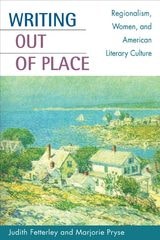
Writing out of Place
Regionalism, Women, and American Literary CultureJudith Fetterley and Marjorie Pryse
University of Illinois Press, 2002
Regionalist writers such as Alice Cary, Mary E. Wilkins Freeman, Sarah Orne Jewett, Grace King, Alice Dunbar–Nelson, Sui Sin Far, and Mary Austin present narrators who serve as cultural interpreters for persons often considered "out of place" by urban readers. Critiquing the approaches to regional subjects characteristic of local color, this book gives contemporary readers a vantage point from which to approach regions and regional people in the global economy of our own time.
Reclaiming the ground of "close" reading for texts that have been insufficiently read, Fetterley and Pryse situate textual analyses within larger questions such as the ideology of form, feminist standpoint epistemology, queer theory, intersections of race and class, and narrative empathy. In its combination of the critical and the visionary, Writing out of Place proposes regionalism as a model for narrative connection between texts and readers that has the potential to transform American literary culture. Arguing the need for other models for human development than those produced in heroic stories about men and boys, the authors offer regionalism as a source of unconventional and counterhegemonic fictions that should be passed on to future generations of readers.
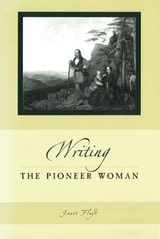
Writing the Pioneer Woman
Janet Floyd
University of Missouri Press, 2002
Focusing on a series of autobiographical texts, published and private, well known and obscure, Writing the Pioneer Woman examines the writing of domestic life on the nineteenth-century North American frontier. In an attempt to determine the meanings found in the pioneer woman's everyday writings—from records of recipes to descriptions of washing floors—Janet Floyd explores domestic details in the autobiographical writing of British and Anglo-American female emigrants.
Floyd argues that the figure of the pioneer housewife has been a significant one within general cultural debates about the home and the domestic life of women, on both sides of the Atlantic. She looks at the varied ideological work performed by this figure over the last 150 years and at what the pioneer woman signifies and has signified in national cultural debates concerning womanhood and home.
The autobiographies under discussion are not only of homemaking but also of emigration. Equally, these texts are about the enterprise of emigration, with several of them written to advise prospective emigrants. Using the insights of diaspora and migration theory, Floyd shows that these writings portray a far subtler role for the pioneer woman than is suggested by previous scholars, who often see her either as participating directly in the overall domestication of colonial space or as being strictly marginal to that process.
Written in response to the highly critical discussion of the attitudes and activities of female "civilizers" within "New" Western history and postcolonial studies, Writing the Pioneer Woman will be a valuable addition to the burgeoning discussion of the literature of domesticity.