Results by title

36 books match the query 'Christian Rituals & Practice'
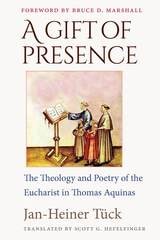
cover of A Gift of Presence: The Theology and Poetry of the Eucharist in Thomas Aquinas

A Gift of Presence

The Theology and Poetry of the Eucharist in Thomas Aquinas

Jan Heiner Tück

Catholic University of America Press, 2018
Jan-Heiner Tück presents a work that explores the sacramental theology, lived spirituality, and Eucharistic poetry of the Church’s doctor communis, St. Thomas Aquinas. Although Aquinas’ Eucharistic poetry has long occupied an important place in the Church’s liturgical prayer and her repertoire of sacred music, the depth of these poems remains hidden until one grasps the rich sacramental theology underlying it. Consequently, Tück first offers a detailed but approachable primer of Aquinas’ theology of the sacraments, before diving deeply into the Angelic Doctor’s theology and poetry of the Eucharist. The Scriptural accounts stand at the heart of the systematic framework developed by Aquinas, and thus significant attention is devoted to showing the harmony between the accounts of Christ’s passion and the detailed exposition of the Summa theologiae. Moreover, the Eucharistic controversies of the ninth and eleventh centuries provide the contrapuntal context in which Aquinas did his thinking, praying, and writing. Not surprisingly, therefore, the response he crafts to these controversies draws upon both speculative powers and contemplative prayer, brought together in the unity of Aquinas’ theology and spirituality. The net result is a twofold treasure for the Church: a careful systematic presentation of Eucharistic theology and the lived devotional expression of the same in the carefully constructed—and now much beloved—stanzas of Pange lingua gloriosi, Lauda Sion, Adoro te devote, etc. By revealing the lively interplay of the saint’s powerful speculative intellect and a heart steeped in love for the Eucharistic Lord, Tück offers a sophisticated exposition of Aquinas’ Eucharistic poetry and the roots it sinks into a wider theological framework. Finally, the contemporary significance and power of Aquinas’ work is drawn out, not only in the rarefied realm of intellectual inquiry but also in the everyday expanse of ordinary life.
[more]
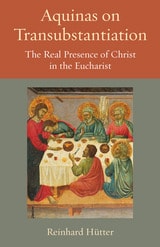
cover of Aquinas on Transubstantiation

Aquinas on Transubstantiation

Reinhard Hutter

Catholic University of America Press, 2019
Aquinas on Transubstantiation treats one of the most frequently mis-understood and mis-represented teachings of Thomas Aquinas—Eucharistic transubstantiation. The study interprets Aquinas’s teaching as an exercise of “holy teaching” (sacra doctrina) that intends to show theologically and back up philosophically the simple yet profound thesis that “transubstantiation” affirms nothing but the truth of Christ’s words at the Last Supper—“This is my body,” “This is my blood.” Yet in order to achieve a contemporary ressourcement of this simple yet profound truth, it is necessary to probe the depths of Thomas Aquinas’s philosophical interpretation of it. For Thomas Aquinas, in regarding the truth of Eucharistic conversion, it is faith that preserves the human intellect from missing or dismissing the mystery announced in Christ’s words. Faith, however, is not intellectually blind, a faith that, as is often erroneously held, is commanded by arbitrary divine dictates to which the will submits in blind obedience. Rather, Aquinas takes faith is sustained, but not constituted, by an intellectual contemplation of the proposed mystery of faith, by faith seeking understanding. Thomas Aquinas unfolds this exercise of understanding guided by faith in the medium of a metaphysical contemplation that affords a profound intellectual appreciation of this central mystery of faith—precisely as mystery. Thomas’s metaphysical contemplation of Eucharistic conversion gestures toward the blinding light of superintelligibility, experienced as the unique darkness that surrounds this sublime mystery of faith. A ressourcement in Thomas Aquinas’s doctrine of transubstantiation also affords an renewed appreciation of the Church’s affirmation of transubstantiation as the most apt term for the interpretation of the mystery of Eucharistic conversion and a greater precision of what is centrally at stake in this mystery in the ongoing ecumenical conversation of this most central Christian teaching. A doctrinally sound, ecumenically informed, and philosophically reflected contemporary Catholic theology cannot afford to ignore or dismiss Aquinas’s surpassing account of Eucharistic conversion.
[more]
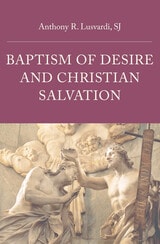
cover of Baptism of Desire and Christian Salvation

Baptism of Desire and Christian Salvation

Anthony R. Lusvardi

Catholic University of America Press, 2024
Belief in the necessity of baptism for salvation is rooted in the New Testament and was forcefully affirmed by the Church Fathers, yet today this belief is treated with unease if not ignored altogether. Over the course of centuries, Catholic theology has wrestled with a doctrine—baptism of desire—that both preserves this fundamental principle and allows for salvation in hard cases, such as catechumens dying unexpectedly. Baptism of Desire and Christian Salvation traces this doctrine’s varied history, from its genesis in a fourth century funeral oration given by Ambrose of Milan to its uneasy position in the Anonymous Christianity of Karl Rahner. More than a history, however, this book raises questions about the nature of religious ritual and the sacraments, the mission of the Church, and the essence of salvation. Arguing that theologians of the past two centuries have tended to downplay the role of the sacraments when discussing salvation, Lusvardi suggests that baptism should remain our theological starting point. Engaging with the theological tradition and at times challenging the conventional wisdom, Baptism of Desire and Christian Salvation shows how such a sacramental approach can offer credible—and sometimes surprising—responses to questions related to the salvation of non-Christians, the fate of unbaptized infants, and the relevance of the Church’s mission today.
[more]
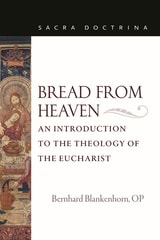
cover of Bread from Heaven: An Introduction to the Theology of the Eucharist

Bread from Heaven

An Introduction to the Theology of the Eucharist

Bernhard Blankenhorn

Catholic University of America Press, 2021
Bread from Heaven offers a contemporary theological synthesis on the Eucharist that brings together classical and critical biblical exegesis, debates on the early history of the Christian liturgy, patristic doctrine, the teachings offered by the Councils of Florence, Trent and Vatican II, and the Church’s lex orandi, all within a framework provided by the Eucharistic theology of Thomas Aquinas. The volume begins with Christ’s Bread of Life discourse in John 6, in light of the Old Testament theme of the manna, and the Synoptic accounts of the Last Supper. These biblical texts offer solid foundation for a theology of Eucharistic sacrifice, presence and Communion. It then continues with a historical and systematic study of the institution of the Eucharist by Christ, with special attention given to the emergence of the first Eucharistic prayers. Then follows a survey of key Christological and ecclesiological themes which undergird Eucharistic theology. The chapters on Eucharistic sacrifice and presence form the heart of the work. Here, the focus moves to key conciliar, patristic and Thomistic insights on these themes. Bread from Heaven clarifies misunderstandings of Eucharistic sacrifice and renders transubstantiation accessible to beginners. Blankenhorn concludes with a study of the consecration, the minister of the Eucharist and the fruits of communion. The chapter on the debate over the words of institution and the epiclesis gives a fresh perspective that integrates both eastern and western tradition. The study of the Eucharistic celebrant strikes a balance between a spirituality of the priest as acting in persona Christi and of the priest as praying in persona ecclesiae. The concluding chapter centers on the Eucharist’s unitive, mystical fruits in the Church. This textbook is ideal for an advanced undergraduate or graduate course on Eucharistic theology. It also seeks to advance the debate on several controversial historical and speculative issues in sacramental theology.
[more]
cover of Cachita's Streets: The Virgin of Charity, Race, and Revolution in Cuba

Cachita's Streets

The Virgin of Charity, Race, and Revolution in Cuba

Jalane D. Schmidt

Duke University Press, 2015
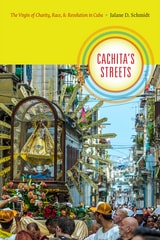
Cuba’s patron saint, the Virgin of Charity of El Cobre, also called Cachita, is a potent symbol of Cuban national identity. Jalane D. Schmidt shows how groups as diverse as Indians and African slaves, Spanish colonial officials, Cuban independence soldiers, Catholic authorities and laypeople, intellectuals, journalists and artists, practitioners of spiritism and Santería, activists, politicians, and revolutionaries each have constructed and disputed the meanings of the Virgin. Schmidt examines the occasions from 1936 to 2012 when the Virgin's beloved, original brown-skinned effigy was removed from her national shrine in the majority black- and mixed-race mountaintop village of El Cobre and brought into Cuba's cities. There, devotees venerated and followed Cachita's image through urban streets, amassing at large-scale public ceremonies in her honor that promoted competing claims about Cuban religion, race, and political ideology. Schmidt compares these religious rituals to other contemporaneous Cuban street events, including carnival, protests, and revolutionary rallies, where organizers stage performances of contested definitions of Cubanness. Schmidt provides a comprehensive treatment of Cuban religions, history, and culture, interpreted through the prism of Cachita.
[more]
cover of Eastern Catholic Theology in Action: Essays in Liturgy, Ecclesiology, and Ecumenism

Eastern Catholic Theology in Action

Essays in Liturgy, Ecclesiology, and Ecumenism

Andrew J. Summerson

Catholic University of America Press, 2024
The Second Vatican Council urged Eastern Catholics to cultivate their share of divine revelation for the benefit of the entire Catholic Church. Yet, more than 50 years later, the Eastern Catholic Churches frequently remain on the margins, both in the theological academy and in the life of the Church more broadly. In an effort to remedy this situation, at least in part, this volume offers a scholarly reflection on the unique patrimony of the Eastern Catholic Churches, divided according to the categories of Liturgy, Theology, Spirituality, Discipline, and Culture. In so doing, it both follows the categories used to define a Church sui iuris in the Code of Canon Law for the Eastern Churches, and builds on the legacy of the Rev. Peter Galadza, to whom the volume is dedicated. On one hand, the volume and its essays are intentionally introductory, revealing the worlds of Eastern Catholicism and the variety of theological approaches that take place there. Emerging in part from the experience of teaching and preaching by scholars of Eastern Christianity, who are frequently asked for a basic introduction to Eastern Catholic theology, and have little to offer in response, these essays gather an international group of scholars engaging in critical, theological reflection from an Eastern Catholic perspective. This approach is rounded out by contributions from Roman Catholic, Orthodox, and Protestant scholars, who articulate their own reception and appreciation of the Eastern Catholic theological heritage.  At the same time, however, several of the essays in this volume relate the history and current reality of Eastern Catholicism to the Orthodox and Roman Catholic Churches, yet without ignoring how frequently Eastern Catholics live, worship, and theologize without self-conscious regard for their unique ecclesial situation. Indeed, these authors show, Eastern Catholic theology can be unself-consciously grounded in the patristic tradition, and Eastern Catholics can simply “do” theology, without worrying about ecclesial politics. Readers will thus find here the best of both worlds: both an introduction to the unique and frequently ignored patrimony of the Eastern Catholic Churches, and a series of essays that avoids the all-to-common pitfall of reducing these traditions to a parody of other Churches, Eastern or Western. Instead, by engaging with the sources of the Christian tradition – as Eastern Catholics, yes, but first and foremost as Christians – the authors reveal how much their tradition can offer the Catholic Church as a whole.
[more]
cover of Faith and the Sacraments: A Commentary on The International Theological Commission's <i>The Reciprocity of Faith and Sacraments in the Sacramental Economy</i>: With Official Revised English Translation

Faith and the Sacraments

A Commentary on The International Theological Commission's <i>The Reciprocity of Faith and Sacraments in the Sacramental Economy</i>: With Official Revised English Translation

Thomas G. International Theological Comission

Catholic University of America Press, 2022
In September of 2014 thirty new members were appointed for a five-year term to the Vatican’s International Theological Commission. These theologians, clerical and lay, were chosen from twenty-six different countries and from five continents. The commission was charged with composing three documents of contemporary theological importance, one of which was that of the relationship between faith and the sacraments. This finished document was published, with the approval of the Congregation for the Doctrine of the Faith and by Pope Francis in Spanish in early 2020 under the title: La Reciprocidad entre Fe y Sacramentos en la Economía Sacramental. A subsequent English translation was published thereafter under the title The Reciprocity Between Faith and Sacraments in the Sacramental Economy. This present volume contains the text of the English translation. There follows an introduction by a member of the ITC, Thomas G. Weinandy, OFM, Cap., and subsequently followed by six explanatory and interpretive commentaries on various chapters of the document. Dr. John Yocum considers the contemporary relevance of the topic. Dr. Christopher Ruddy examines the dialogical nature of the sacramental economy of salvation. Dr. Jennifer Holmes Martin discusses the relationship between faith and the sacraments of initiation. There are two commentaries for section four concerning faith and the sacrament of marriage. Professor John Grabowski treats the strictly theological issues relating to faith and marriage. Canonist Timothy Cavanaugh takes up the canonical issues regarding faith and its relationship to enacting a valid sacramental marriage. Dr. Daniel Keating rounds off the commentaries by surveying the conclusion of the document, that is, the present need for evangelization so as to enliven the faith of the faithful, and the present relevance of the new ecclesial movements within the Church today. These commentaries are aimed at aiding priests and seminarians as they address or prepare to address the pastoral and theological concerns they encounter or will encounter on a daily basis. This volume could also be used in parish adult education groups as well, wherein the laity could better understand the relationship between faith and the sacraments.
[more]
cover of Grieving Pregnancy: Memorializing Loss in Japanese Buddhism and American Catholicism

Grieving Pregnancy

Memorializing Loss in Japanese Buddhism and American Catholicism

Maureen L. Walsh

Rutgers University Press, 2025
In Grieving Pregnancy: Memorializing Loss in Japanese Buddhism and American Catholicism, Maureen L. Walsh compares how the two religious traditions respond ritually and discursively to miscarriage, stillbirth, and abortion experiences marked by grief for the women involved. The experience of pregnancy loss has always been a part of women’s lives, yet only recently has it garnered attention from religious leaders and scholars commensurate with its prevalence. This book examines pregnancy loss as a theological problem for both Buddhism and Catholicism and analyzes the rites and memorials that have developed to address it, such as Japanese Buddhist mizuko kuyō (water children rites) and emergent American Catholic memorial practices focused on pregnancy loss. These parallel practices have emerged within distinct religious landscapes—a fact reflected in their forms and purposes—and when considered together, they raise questions of keen interest to theological and religious studies about the goals of religious practice and the imagination of human life at its earliest stages.
 
[more]
cover of Icon and Devotion: Sacred Spaces in Imperial Russia

Icon and Devotion

Sacred Spaces in Imperial Russia

Oleg Tarasov

Reaktion Books, 2002

Icon and Devotion offers the first extensive presentation in English of the making and meaning of Russian icons. The craft of icon-making is set into the context of forms of worship that emerged in the Russian Orthodox Church in the mid-seventeenth century. Oleg Tarasov shows how icons have held a special place in Russian consciousness because they represented idealized images of Holy Russia. He also looks closely at how and why icons were made. Wonder-working saints and the leaders of such religious schisms as the Old Believers appear in these pages, which are illustrated in halftones with miniature paintings, lithographs and engravings never before published in the English-speaking world.

By tracing the artistic vocabulary, techniques and working methods of icon painters, Tarasov shows how icons have been integral to the history of Russian art, influenced by folk and mainstream currents alike. As well as articulating the specifically Russian piety they invoke, he analyzes the significance of icons in the cultural life of modern Russia in the context of popular prints and poster design.
[more]
cover of In the School of the Word: Biblical Interpretation from the New to the Old Testament

In the School of the Word

Biblical Interpretation from the New to the Old Testament

Carlos Granados

Saint Paul Seminary Press, 2021
Carlos Granados and Luis Sánchez-Navarro propose reading the Bible with Christian faith, not as one approach among many, but as a disposition demanded by the New Testament for proper interpretation of both the Old and the New. Even so, the authors’ faith never leads them to dismiss history or to discard the tools of the historical-critical method. On the contrary, these sciences allow the faithful reader to take a holistic approach to biblical truth. When the reader also takes full account of the ecclesial reality in which the Bible was formed and transmitted, and in which it must be read still today, he or she encounters the word proclaimed by the text. Indeed, the words of Holy Writ ultimately proclaim the Word (Logos), Jesus Christ, in whose Spirit they were written. This book’s thirteen essays are grouped into three parts. Part I, “The Church, Living Subject of Sacred Scripture,” takes up a foundational theme of the whole book: sacred Scripture calls for a reading within the community of the People of God under the guidance of the Holy Spirit, and the same People constitute the living subject of Scripture. In Part II, “Christ, Exegete of the Fulfillment,” the authors focus on the relationship between the two biblical testaments. They argue that the Christian can both respect and venerate the Old Testament on its own terms, even as they find in Jesus, as presented in the New Testament and encountered in faith, the key for unlocking the Old Testament’s deepest meaning. The third and final part of this book, “The Teaching in Benedict XVI’s Verbum Domini,” examines Pope Benedict XVI’s 2010 post-synodal apostolic exhortation on the word of God in the life and mission of the Church. The authors’ years of shared prayer, study, conversation, and ministry have led to this coauthored book bearing witness to that ongoing unity that they live as confreres. Not surprisingly, they frequently reference the same theologians, especially Brevard Childs, Paul Beauchamp, SJ, and Pope Benedict XVI.
[more]
cover of Introduction to Sacramental Theology: Signs of Christ in the Flesh

Introduction to Sacramental Theology

Signs of Christ in the Flesh

Jose Granados

Catholic University of America Press, 2021
Introduction to Sacramental Theology presents a complete overview of sacramental theology from the viewpoint of the body. This viewpoint is supported, in the first place, by Revelation, for which the sacraments are the place where we enter into contact with the body of the risen Jesus. It is a viewpoint, secondly, which is firmly rooted in our concrete human bodily experience, thus allowing for a strong connection between faith and life, creation and redemption. From this point of view, the treatise on the sacraments occupies a strategic role. For the sacraments appear, not as the last of a series of topics (after dealing with Creation, Christ, the Church), but as the original place in which to stand in order to contemplate the entire Christian mystery. This point of view of the body, which resonates with contemporary philosophy, sheds fruitful light on classical themes, such as the relationship of the sacraments with creation, the composition of the sacramental sign, the efficacy of the sacraments, the sacramental character, the role of the minister, or the relationship of the sacrament with the Church as a sacrament. As a result of this approach, the Eucharist takes on a central role, since this is the sacrament where the body of Jesus is made present. The rest of the sacraments are seen as prolongations of the eucharistic body, so as to fill all the time and space of the faithful. This foundation of the theology of the sacraments in eucharistic theology is supported by an analysis of the patristic and medieval tradition. In order to support its conclusions, Introduction to Sacramental Theology examines the doctrine of Scripture (especially St. John and St. Paul), the main patristic and medieval authors (St. Augustine, Hugh of St. Victor, St. Bonaventure, St. Thomas Aquinas), the response of Trent to the protestant challenges, up to modern authors such as Scheeben, Rahner, Ratzinger, or Chauvet, including the teaching of Vatican II about the Church as a kind of sacrament.
[more]
cover of John Chrysostom, Theologian of the Eucharist

John Chrysostom, Theologian of the Eucharist

Kenneth J. Howell

Catholic University of America Press, 2024
Despite the fact that John Chrysostom wrote more on the Eucharist than any other Greek Church Father, there has never been a full treatment of his doctrine in English. In this book, Kenneth Howell brings together a wide array of sources from which he develops a many-sided portrait of Chrysostom’s eucharistic thought. While the Antiochene preacher assumed the real presence and the sacrificial nature of the Eucharist, he focused more on the moral and spiritual implications of communion. At the root of his theology lies the conviction that the Eucharist with its home in the liturgy is the extension of Christ’s incarnate life through space and time. All that Christ accomplished in his life, death, and resurrection is present and available to the communing Christian who stands in union with the angelic hosts in the liturgy of the church. John’s preaching at times reaches encomiastic proportions as he never tires of praising the benefits and power of the Eucharist and he deftly applies the sacrament to the struggle of virtue and vice as he explores both the invitation and the obstacles to communion. Among the moral implications of the Eucharist, John seems to distinguish well between sins arising from human weakness versus malicious dispositions freely chosen. He is especially keen to exhort his hearers to lay aside the remembrance of evil (mnesikakia) done to them in their past lives. Humility and forbearance are two essential virtues in arriving at forgiveness of past injuries. And lack of forgiveness is like greed in that both constitute a turn in on oneself. The Eucharist demands love of neighbor and active ministry to the less fortunate of the world. For John, God is interested in golden souls more than golden chalices.
[more]
cover of Kingship and Sacrifice: Ritual and Society in Ancient Hawaii

Kingship and Sacrifice

Ritual and Society in Ancient Hawaii

Valerio Valeri

University of Chicago Press, 1985
Valeri presents an overview of Hawaiian religious culture, in which hierarchies of social beings and their actions are mirrored by the cosmological hierarchy of the gods. As the sacrifice is performed, the worshipper is incorporated into the god of his class. Thus he draws on divine power to sustain the social order of which his action is a part, and in which his own place is determined by the degree of his resemblance to his god. The key to Hawaiian society—and a central focus for Valeri—is the complex and encompassing sacrificial ritual that is the responsibility of the king, for it displays in concrete actions all the concepts of pre-Western Hawaiian society. By interpreting and understanding this ritual cycle, Valeri contends, we can interpret all of Hawaiian religious culture.
[more]
cover of Liturgical Hermeneutics of Sacred Scripture

Liturgical Hermeneutics of Sacred Scripture

Marco Benini

Catholic University of America Press, 2023
The purpose of this book is to explore what a liturgical approach to the Bible looks like and what hermeneutical implications this might have: How does the liturgy celebrate, understand, and communicate Scripture? The starting point is Pope Benedict's affirmation that “a faith-filled understanding of sacred Scripture must always refer back to the liturgy” (Verbum Domini 52). The first part of the book (based on SC 24) provides significant examples to demonstrate: The liturgical order of readings intertextually combines Old Testament and New Testament readings using manifold hermeneutical principles, specifically how the psalms show the wide range of interpretations the liturgy employs. Prayers are biblically inspired and help to appropriate Scripture personally. The hymns convey Scripture in a poetic way. Signs and actions such as foot-washing or the Ephphetha rite enact Scripture. The study considers the Mass, the sacraments and the Liturgy of the Hours. In the second part, Benini systematically focuses on the various dimensions of liturgical hermeneutics of the Bible, which emerge from the first part. The study reflects the approaches the liturgy offers to Scripture and its liturgical reception. It explores theological aspects such as the unity of the two Testaments in Christ’s paschal mystery or the anamnesis as a central category in both Scripture and liturgy. The liturgy does not understand Scripture primarily as a document of the past, but celebrates it as a current and living “Word of the Lord,” as a medium of encounter with God: Scripture is sacramental. Liturgical Hermeneutics of Sacred Scripture seeks to contribute not only to the comparison of the Roman, Ambrosian, and Byzantine Rite regarding the Word of God, but most of all to the overall “liturgical approach” to Scripture. As such, it promotes an interdisciplinary dialogue of liturgical and biblical studies.
[more]
cover of Liturgical Theology in Thomas Aquinas: Sacrifice and Salvation History

Liturgical Theology in Thomas Aquinas

Sacrifice and Salvation History

Franck Quoex

Catholic University of America Press, 2023
In this volume, Fr. Franck Quoëx responds to Joseph Ratzinger’s call for a renewed appreciation of liturgical rite. A student of Pierre Gy, OP, he brings to this study of Aquinas’s liturgical theology a rare combination of expert knowledge of liturgical sources and history and the best of modern historical-critical research guided by sound theological judgment. Fr. Quoëx frames his study with an overview of the problem of rite in modern theological-anthropological discourse, before turning to Aquinas’ theory of worship in the treatise on the virtue of religion. He then explores Aquinas’ doctrine on the cultic dimensions of the Eucharist and other sacraments in his sacramental theology more broadly, finishing with a close study of the mass commentary of the Tertia Pars. Although there has been increasing attention to Thomas’s treatment of religion as a virtue, none have approached him from an anthropological angle with a focus on the nature of liturgical rite, or fully exploited the perspectives of liturgical scholarship to shed light on sacramental theology. Quoëx’s work, as the work of a Thomist, liturgist, and medievalist well versed in medieval liturgical development and in the genre of often-allegorical liturgical commentary, opens up this crucial but neglected facet of Aquinas’ theological synthesis. Few books have been published on Aquinas’s liturgical theology. Now that interest in Aquinas’s virtue theory and sacramental theology is growing rapidly, Quoëx’s studies are an invitation to further reflection on the topic of Aquinas’s liturgical theology with its manifold ramifications for and connections with other theological topics in his Summa, including his theological anthropology, his soteriology, his treatment of the Old and New Laws, and his account of the virtue of religion in connection with the other virtues.
[more]
cover of Lord I Love You! Homilies through the Liturgical Year: Volume 2: Advent, Christmas, Marian Feasts, and Saints Days

Lord I Love You! Homilies through the Liturgical Year

Volume 2: Advent, Christmas, Marian Feasts, and Saints Days

Pietro Pope Benedict XVI

Catholic University of America Press, 2025
Pope Benedict XVI was known for his brilliant mind, but he also had a heart in love with the Lord. In this careful selection from his papal homilies, read­ers can not only learn from his encyclopedic knowledge of the Christian tra­dition, but grow in their own love for God as they journey with Benedict through the seasons and feasts of the liturgical year. Lord I Love You! Volume 2 includes the joyful seasons of Advent and Christmas as well as important Marian feasts and other saints’ days throughout the year, making it an excel­lent choice for spiritual reading and a great Advent/Christmas gift idea for those who appreciate the late pope’s message of the centrality of Christ and the reliability of the Catholic tradition. Pope Benedict was not a charismatic preacher in the mold of his predecessor John Paul II, but the texts themselves are gems of Christian exhortation and reflection that are best appreciated on one’s knees in a chapel or held in one’s hands in a quiet place in one’s home—that is, in a book like this and not scrolling through a website. For scholars and students of the late pope, the collection also provides a helpful distillation of his main themes and princi­pal concerns into short, easily digestible pieces. The editor, Fr. Pietro Rossot­ti, uses the official Vatican translation with only minor spelling modifications and added footnotes with bibliographical references whenever possible.
[more]
cover of Lord, I Love You! Homilies through the Liturgical Year: Volume 1: Lent, Easter, and Solemnities of the Lord

Lord, I Love You! Homilies through the Liturgical Year

Volume 1: Lent, Easter, and Solemnities of the Lord

Pietro Pope Benedict XVI

Catholic University of America Press, 2025
Pope Benedict XVI was known for his brilliant mind, but he also had a heart in love with the Lord. In this careful selection from his papal homilies, readers can not only learn from his encyclopedic knowledge of the Christian tradition, but grow in their own love for God as they journey with Benedict through the seasons and feasts of the liturgical year. Lord I Love You! Volume 1 includes the holiest days of Lent and Easter as well as other important solemnities such as Trinity Sunday and Corpus Christi, making it an excellent choice for spiritual reading and a great Lenten gift idea for those who appreciated the late pope's message of the centrality of Christ and the reliability of the Catholic tradition. Pope Benedict was not a charismatic preacher in the mold of his predecessor John Paul II, but the texts themselves are gems of Christian exhortation and reflection that are best appreciated on one's knees in a chapel or held in one's hands in a quiet place in one's home--that is, in a book like this and not scrolling through a website. For scholars and students of the late pope, the collection also provides a helpful distillation of his main themes and principal concerns into short, easily digestible pieces. The editor, Fr. Pietro Rossotti, uses the official Vatican translation with only minor spelling modifications and added footnotes with bibliographical references whenever possible.
[more]
cover of Naming Our Sins: How Recognizing the Seven Deadly Vices can Renew the Sacrament of Reconciliation

Naming Our Sins

How Recognizing the Seven Deadly Vices can Renew the Sacrament of Reconciliation

Jana Bennett

Catholic University of America Press, 2019

What would it take to renew our ability to name our sins in a meaningful and pertinent way? Naming sins is a particularly important task for Catholic moral theology, but it is one that often falls back into a paradigm of simple violations of rules. While laws and commandments are essential, Vatican II’s universal call to holiness and the revival of virtue ethics require moving further. Yet in part because moral theologians today tend to be lay people, not priests, there has been a de-emphasis on the confession of sins. Contemporary questions like poverty, racism, and abortion are usually connected to questions about sin in some way, but they are disconnected from the idea of naming specific sins in the sacrament of penance. Lay moral theologians raise these issues in a way that makes clear their implications for a parish social justice committee (or the voting booth), but not their implications for the naming of sins in the sacrament of reconciliation. Naming Our Sins proposes to re-make that connection: the moral theologian’s task of helping people name individual sins needs to be restored, though in ways distinctive from dominant pre-Vatican II notions. In this volume, editors Jana Bennett and David Cloutier gather some of the best of the current generation of moral theologians in order to reflect on the classic tradition of the vices. It is crucial to the Christian understanding of sin that we recognize (a) we bear at least some responsibilities for injuries, and (b) God wants us to participate in the process of healing and conversion. Neither the sin itself nor the healing simply come from somewhere else; the task of naming sins enlists us as mature, growing disciples. Each chapter takes on a different classical vice, describing the vice, exploring its dimensions in contemporary experience, and moving the reader toward naming specific sins that arise from the vice. The concluding chapters from Catholic priests explore two basic dimensions of the sacrament of penance: liturgical and communal.
[more]
cover of On the Sacraments

On the Sacraments

Albert Marie St. Albert the Great

Catholic University of America Press, 2027
Albert the Great’s On the Sacraments is a scholastic treatise loosely based on Peter Lombard’s Sentences. Albert treats the full range of theological issues that will be found in his later Commentary on the Sentences, although in a much leaner manner. In this work, Albert finds himself less bound to the commentary style and sometimes more free to put forward his own conclusions. For example, Albert offers his own definition of a sacrament rather than only critiquing those of others. In most cases, Albert offers the same teaching which he will later present in his more mature Commentary on the Sentences, although there are a few points on which his teaching varies. These have often been noted in the introduction and footnotes. Albert’s sacramental theology centers intensely around the idea of inner healing. Albert’s paradigm for understanding the seven sacraments is Christ the Divine Physician who applies distinct medicines to seven different wounds. Albert roots a strong theology of sacramental signification and (dispositive) causality in the life and power of Christ. He writes, “there are two things in the Son of God, namely power and wisdom, from whom every sacrament draws power, there must be two things in a sacrament corresponding to these, namely, a cause and a sign.” It is partially his consistent application of the rubric of signification and causality to each sacrament that allows Albert to offer a breakthrough teaching on the sacrament of marriage as able to cause grace.
[more]
cover of Putting on Christ: Augustine's Early Theology of Salvation and the Sacraments

Putting on Christ

Augustine's Early Theology of Salvation and the Sacraments

Ty Paul Monroe

Catholic University of America Press, 2022
Putting on Christ aims to situate Augustine’s early soteriology and sacramental theology within the context of his personal history and intellectual development. Beginning with an extended analysis of the theology of salvation and sacramental efficacy contained within Augustine’s Confessions (ca. 400), the study then traces the maturation of his views on these matters, beginning with his earliest extant works, the Cassicacum dialogues (ca. 386). The journey entails treating Augustine’s earliest discussions of Christ’s person and his saving work, as well as the believer’s subjective experience of conversion and salvation. As Augustine’s corpus shifts from philosophical dialogues to explicitly apologetic and scriptural-exegetical works, so too does his soteriological lexicon expand to include concepts and terms that will later become his stock-in-trade, such as the virtue of humilitas. And as his roles in the North African Church come to include participation in the presbyterate and the episcopacy, so too does his engagement expand to a wider set of polemical contexts, both anti-Manichaean and anti-Donatist. Putting on Christ tracks these and many other aspects of Augustine’s maturing thought, showing where lines of both continuity and development lie and aiming to uncover their reasons. In doing so, it reveals Augustine to be a thinker and a teacher who continued to hone his understanding of salvation, the very heartbeat of Christian life and thought, as well as its relation to various other aspects of the Christian theological worldview, from Christology and anthropology to sacramental theology and ecclesiology.
[more]
cover of Re-Envisioning Past Musical Cultures: Ethnomusicology in the Study of Gregorian Chant

Re-Envisioning Past Musical Cultures

Ethnomusicology in the Study of Gregorian Chant

Peter Jeffery

University of Chicago Press, 1992

Studying Gregorian chant presents many problems to the researcher because its most important stages of development were not recorded in writing. From the sixth to the tenth century, this form of music existed only in song as medieval musicians relied on their memories and voices to pass each verse from one generation to the next.

Peter Jeffery offers an innovative new approach for understanding how these melodies were created, memorized, performed, and modified. Drawing on a variety of disciplines, including anthropology and ethnomusicology, he identifies characteristics of Gregorian chant that closely resemble other oral traditions in non-Western cultures and demonstrates ways music historians can take into account the social, cultural, and anthropological contexts of chant's development.
[more]
cover of Seeing with the Eyes of the Heart: Cultivating a Sacramental Imagination in an Age of Pornography

Seeing with the Eyes of the Heart

Cultivating a Sacramental Imagination in an Age of Pornography

Elizabeth T. Groppe

Catholic University of America Press, 2020
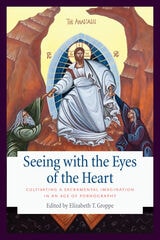
In an era in which the internet has made pornography readily accessible, Seeing with the Eyes of the Heart offers a theological critique of pornography and retrieves from the Christian tradition an alternative visual culture. This visual culture is constituted by both the character of the images we behold and the manner in which we see. Contributors include psychologists William M. Struthers and Jill Manning, who address the neurological effects of pornography and its influences on personal, familial, and social life. Their professional analysis is complemented by the testimony of a young man in recovery from pornography addiction. In an exposition of Christian visual culture, Orthodox iconographer Randi Sider-Rose describes the spiritual discipline of icon writing, Danielle M. Peters, S.T.D., surveys the iconography and art of Marian traditions, and art historian Dianne Phillips elucidates the meaning of divine desire as evident in Catholic visual culture of the late medieval and early modern periods. Catholic theologians Ann W. Astell, Nathanial Peters, Boyd Taylor Coolman, and Nicolas Ogle discuss specific practices and dimensions of the Catholic tradition that can contribute to the cultivation of sacramental vision, and David W. Fagerberg, Kimberly Hope Belcher, Jennifer Newsome Martin, and John C. Cavadini offer reflections on sacramental imagination and the healing of vision. Seeing with the Eyes of the Heart is a work of scholarship composed with pastoral care and concern, and it will be serviceable to both classroom teachers and pastoral ministers. A special feature of the book is an inset of seventy-two full-color plates featuring both classic and contemporary works of Christian iconography and art. The essays and images invite readers to behold in beauty the truth that we are created by the triune God not for sexual objectification but with a sacramental vocation to deification through Christ and the Holy Spirit of love.
[more]
cover of St. Thomas and the Rites of Man: A Historical Study of the Summa Theologiae, Tertia Pars, Question 83, Articles 4 & 5

St. Thomas and the Rites of Man

A Historical Study of the Summa Theologiae, Tertia Pars, Question 83, Articles 4 & 5

Niels Krogh Rasmussen

Catholic University of America Press, 2026
Long buried in the archives of the Dominican studium at Le Saulchoir, the lectorate dissertation of Fr. Niels Krogh Rasmussen, OP, is now made available to a wider English-speaking audience interested in Saint Thomas Aquinas’s contribution to liturgical theology. Originally written in 1966, just after the Second Vatican Council, Rasmussen’s work is a witness to the intense liturgical ferment of those years and expresses an early attempt to appropriate the then-new postconciliar mode of liturgical reflection, bolstered by attentive historical-critical work, in the spirit of Saint Thomas. Treating the saint’s reflection on the Mass rites in the Summa Theologiae, Rasmussen shows how Aquinas, while writing in the disputed question format, nevertheless presents his readers with an expositio Missae, placing him within the tradition of great medieval Mass expositors, from Amalarius of Metz and Florus of Lyon in the ninth century, Saint Albert the Great and Durandus of Mende in the thirteenth century. By isolating this distinctly liturgical content (without, however, completely eschewing its original quaestio format), Rasmussen is able to highlight the distinctiveness of Thomas’s liturgical thought against that of his predecessors and contemporaries. Even if certain insights or expressions of Rasmussen’s may sound dated to the contemporary reader—since this work was composed in that interim period between Inter Oecumenici (1964) and the promulgation of the Missal of Paul VI (1969)—such insights in fact add to the historical value of this dissertation, offering a snapshot of a time when the reform of the liturgy was very much a living process with a terminus yet to be determined. 60 years later, students of Thomism, liturgical theology, and medieval studies can continue to benefit from this work.
[more]
cover of The Book of Before and After: The Liturgy of the Hours of the Church of the East

The Book of Before and After

The Liturgy of the Hours of the Church of the East

Andrew Younan

Catholic University of America Press, 2025

The Book of Before & After is the traditional name given to the book of commonly-used portions of the liturgy of the hours of the Church of the East (the branches of which are now the Chaldean Catholic Church, the Assyrian Church of the East, the Ancient Apostolic Assyrian Church of the East, and the Malabar Catholic Church). This volume will present, for the first time, a complete English translation (from the original Aramaic/Syriac) of all the Ordinaries and Commons of the Liturgy of the Hours used by all the Churches of this Tradition. It will also include a complete translation of the Psalter as included in the liturgical books (with antiphons and prayers between sets of Psalms), the full collection of the famous “Martyr Hymns,” and extensive selections of the Propers for each week of the Liturgical Year. Finally, the volume will also include translations of the Introductions written by the various Chaldean and Assyrian Patriarchs who published editions of the Hudhra (the full liturgy of the hours) over the past two centuries, as well as a comprehensive Introductory Essay by Younan. Many of the hymns translated in this volume will be singable according to their original melody.
[more]
cover of The Book of Hours of the Armenian Church Zamagirk: English Translation, Contexts and Perspectives

The Book of Hours of the Armenian Church Zamagirk

English Translation, Contexts and Perspectives

Michael Daniel Findikyan

Catholic University of America Press, 2027
The Book of Hours of the Armenian Church (Žamagirk‘): English Translation, Contexts, and Perspectives offers the first critically grounded English rendering of one of the central liturgical books of the Armenian Christian tradition—and, as such, the first complete translation of this text into any language. Long central to the daily cycle of prayer, the Žamagirk‘ preserves a rich and layered inheritance reaching back to the formative centuries of Christian worship, even as it bears the marks of later historical development. Prepared by a leading scholar of Armenian liturgy, with broader expertise in eastern Christian liturgical traditions, the translation attends closely to the structure, language, and internal logic of the text. It is designed not only to make the Žamagirk‘ accessible to English-speaking readers, but also to reflect, as faithfully as possible, the texture and rhythm of the original, and will be of interest not only to scholars but also to those who wish to engage the text for devotional use. The translation is accompanied by an extensive analytical study that situates the work within its historical, theological, and liturgical contexts. Particular attention is given to the distinctive features of the Armenian Liturgy of the Hours: its organization of psalmody and hymnography, its unique combinations of biblical and poetic materials, and its preservation of elements that point to early Jerusalemite practice. At the same time, the study explores the ways in which the tradition has remained dynamic, incorporating new layers while retaining older forms in often surprising configurations. More than a reference work, this volume opens a window onto the spiritual world embodied in the Armenian daily office, a world marked by a striking interplay of solemnity and lyricism, scriptural depth and poetic imagination, penitential gravity and buoyant hope. It will be of interest to scholars and students of liturgy, historians of Christianity, and all readers seeking to encounter one of the great yet comparatively little-known traditions of Christian prayer.
[more]
cover of The Fullness of Divine Worship: The Sacred Liturgy and its Renewal

The Fullness of Divine Worship

The Sacred Liturgy and its Renewal

Uwe Michael Lang

Catholic University of America Press, 2018
This volume offers a selection of essays from the pages of Antiphon: A Journal for Liturgical Renewal, the official organ of the Society for Catholic Liturgy. The Society was founded in 1995 as a multidisciplinary association of Catholic scholars, teachers, pastors, and ecclesiastical professionals in the Anglophone world, with the aim of promoting the scholarly study and practical renewal of the sacred liturgy.
[more]
cover of The Holy Mass

The Holy Mass

Mike Aquilia

Catholic University of America Press, 2021
The Catholic University of America Press is proud to present the third volume in its Sayings of the Fathers of the Church series. Featuring esteemed scholars and writers compiling material from our acclaimed Fathers of the Church volumes, each title is devoted to select areas of theology. The inaugural volumes covered the Seven Deadly Sins and the Four Last Things, and now we turn to The Holy Mass. The documents of early Christianity are rich in mentions of the Mass and its component parts. Sometimes they’re detailed descriptions, sometimes quick allusions. In this volume Mike Aquilina, a popular author on early Christianity, takes readers step by step through the Mass, from the Sign of the Cross through the Dismissal, illuminating the way with the words of the Fathers. Along the way readers encounter familiar rites, words, and gestures, but also familiar complaints — about long homilies, bad singing, liturgical abuses, and distracted congregations. The Holy Mass is divided into chapters based on the parts of the Mass known to modern Catholics of the Roman Rite. The Mass did not follow this sequence through the entirety of the era of the Fathers. Gregory the Great moved the position of the Lord’s Prayer. There were geographic variants for the placement of the Sign of Peace. Some ancient liturgies lacked a specific penitential rite — though all the liturgies had a penitential dimension to their prayers. Mike Aquilina’s introduction provides historical context and describes the rich development of the liturgy through the Church’s first few centuries. A foreword by Thomas Weinandy, a member of the Vatican’s International Theological Commission, speaks of the relevance of this material for worshipers today.
[more]
cover of The Makers of the Sacred Harp

The Makers of the Sacred Harp

David Warren Steel with Richard H. Hulan

University of Illinois Press, 2010
This authoritative reference work investigates the roots of the Sacred Harp, the central collection of the deeply influential and long-lived southern tradition of shape-note singing. Where other studies of the Sacred Harp have focused on the sociology of present-day singers and their activities, David Warren Steel and Richard H. Hulan concentrate on the regional culture that produced the Sacred Harp in the nineteenth century and delve deeply into history of its authors and composers. They trace the sources of every tune and text in the Sacred Harp, from the work of B. F. White, E. J. King, and their west Georgia contemporaries who helped compile the original collection in 1844 to the contributions by various composers to the 1936 to 1991 editions.
 
The Makers of the Sacred Harp also includes analyses of the textual influences on the music--including metrical psalmody, English evangelical poets, American frontier preachers, camp meeting hymnody, and revival choruses--and essays placing the Sacred Harp as a product of the antebellum period with roots in religious revivalism. Drawing on census reports, local histories, family Bibles and other records, rich oral interviews with descendants, and Sacred Harp Publishing Company records, this volume reveals new details and insights about the history of this enduring American musical tradition.
[more]
cover of The Praise of 'Sons of Bitches': On the Worship of God by Fallen Men

The Praise of 'Sons of Bitches'

On the Worship of God by Fallen Men

James V. Schall

St. Augustine's Press, 2014
[more]
cover of The Proper of Time: Advent, Christmas, Lent, and Easter, Volume 1

The Proper of Time

Advent, Christmas, Lent, and Easter, Volume 1

Andrew Wadsworth

Catholic University of America Press, 2024
Cantate Domino is a five-volume commentary on the texts of the newly translated hymns of the Liturgy of the Hours. The hymns which recently appeared for the first time as a single corpus of English texts, will be included in the forthcoming USCCB revised edition of the Liturgy of the Hours. The hymns are drawn from among the very finest authors of the first millennium: Ambrose, Prudentius, and Gregory the Great together with later authors such as Thomas Aquinas, Leo XIII, and twentieth century authors who composed new hymns to be used in the psalter and celebration of the saints in the present Universal Calendar. The commentary concentrates on the Latin texts of the Liturgia Horarum, elucidated by the recently approved International Commission on English in the Liturgy (ICEL) translations. Commentaries have been prepared by a team of international scholars who bring both the depth of their knowledge together with the insights of those who have prepared liturgical texts in English during the sixty years of ICEL's existence. Previously unpublished material from ICEL's archives, including documents of the Consilium, which prepared the Latin texts for the liturgical books promulgated after the Second Vatican Council, will appear alongside commentaries which identify and explain biblical, classical, and liturgical allusions in the liturgical texts in a way that is of service to clergy, religious, liturgists, and students of the liturgy as well as the non-specialist reader, and all who seek to pray the Prayer of the Church with greater understanding.
[more]
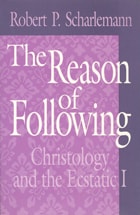
cover of The Reason of Following: Christology and the Ecstatic I

The Reason of Following

Christology and the Ecstatic I

Robert P. Scharlemann

University of Chicago Press, 1991

In the Reason of Following noted scholar Robert P. Scharlemann takes Christology in a radically new direction, suggesting that Christology itself represents a form of reason and an understanding of selfhood. For the first time, Scharlemann establishes a logical place for Christology in philosophical theology.

Scharlemann presents a christological phenomenology of the self, tracing the connections between the "I am" of the God who spoke to Moses, the "I am" of Christ, and the "I am" of autonomous self-identification. How, he asks, can the self that spontaneously responds to Jesus' "Follow me!" be compared with the everyday, autonomous self? What is the nature of "following" on the part of those who answer the summons of one whose name is "I am"? Pursuing these questions, Scharlemann develops a christological phenomenology of the self—an account in which following means not the expression of the self in action or reflection but rather self-discovery in another person.

With a deep sense of both culture and philosophy, Scharlemann distinguishes the forms of reason involved in "following" from those in ethics, aesthetics, and other modes of religious philosophic thought. His penetrating readings of nineteenth- and twentieth-century German theological and philosophical traditions provide an introduction to lesser-known thinkers such as Hermann and Picht as well as a profound critique of major figures such as Descartes, Heidegger, Fichte, and Kant.

Finally Scharlemann outlines a program for a more systematic and rounded presentation of what Christian doctrine might mean in the contemporary world. His work will be of interest to students of theology and philosophy alike.
[more]
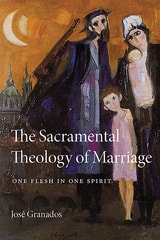
cover of The Sacramental Theology of Marriage: One Flesh in One Spirit

The Sacramental Theology of Marriage

One Flesh in One Spirit

Jose Granados

Catholic University of America Press, 2026
The Sacramental Theology of Marriage offers a comprehensive vision of the dogmatic theology of marriage. It takes into account biblical and patristic sources, the teaching of the Magisterium (with particular emphasis on the Councils of Trent and Vatican II), and the most important contemporary theological contributions. It begins with a vision of the sacrament of mar­riage as the sacrament that integrates the order of creation into the order of sacraments. This dual dimension of marriage justifies the division of the book into two parts: marriage as a sacrament of creation and marriage as a sacrament of redemption instituted by Christ. To describe the coordinates of marriage in creation, the book refers to St. Augustine (the goods of marriage), St. Thomas Aquinas (the ends of marriage), and modern personalism as re­flected in the Second Vatican Council (the gifts of marriage). The book also draws on the theology of St. Bonaventure, who emphasized the institution of marriage by God in creation. The presentation of marriage as a sacrament of the new law is rooted in the way Christ lived the various meanings of the body. Marriage’s foundation in the body and in the experience of love sheds new light on the key milestones of its sacramentality: its matter and form, its signification, the grace it transmits, its liturgy and ministers, its indissolubil­ity, its role in building up the Church, and the path of holiness it opens to the spouses. In all of this, marriage emerges as a pivotal sacrament for articulating Christianity’s relationship to the cosmos and to society. The Sacramental The­ology of Marriage includes modern philosophical and theological explorations of the language of the body and the meaning of love (including the proposal of St. John Paul II). It also outlines the main principles for the pastoral care of marriage and family.
[more]
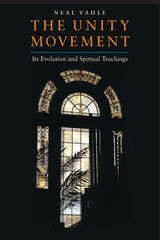
cover of The Unity Movement: Its Evolution and Spiritual Teachings

The Unity Movement

Its Evolution and Spiritual Teachings

Neal Vahle

Templeton Press, 2002

Prayer meetings held in 1889 in the Kansas City living room of Charles and Myrtle Fillmore were the beginning of what grew to be an international religious and educational movement. This book is an in-depth study of the people and beliefs that shaped it into one of the fastest growing movements of our time.

Neal Vahle documents the lives of the spiritual visionaries who created, organized, and led the Unity movement: Myrtle Fillmore, the 40-year-old wife and mother who was inspired by a Christian Science practitioner to cure herself of tuberculosis; Charles Fillmore, who had planned a business career but found, through study, prayer, meditation, and dream analysis, that he had another calling; H. Emily Cady, a New York City homeopathic physician whose book on Unity teachings, Lessons in Truth, was published in 1901, and has sold more than 1.6 million copies; Lowell Fillmore, eldest son of Charles and Myrtle, who clarified and popularized Unity teaching; and the other descendants of Myrtle and Charles, each of whom made immeasurable contributions.

He explores the key factors that led to the steady growth of the movement: the creation of the Unity School of Christianity; the development of Unity Village in Missouri; the evolution of "Silent Unity"; the publication program; the training of students; the development of centers and churches; and he presents and analyzes the controversies and debates within the organization. Vahle concludes the book with a look at the challenges facing the movement in the twenty-first century.
[more]
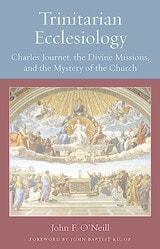
cover of Trinitarian Ecclesiology: Charles Journet, the Divine Missions, and the Mystery of the Church

Trinitarian Ecclesiology

Charles Journet, the Divine Missions, and the Mystery of the Church

John F. O'Neill

Catholic University of America Press, 2023
Venerable Fulton Sheen once famously said that “There are not one hundred people in the United States who hate the Catholic Church, but there are millions who hate what they wrongly perceive the Catholic Church to be – which is, of course, quite a different thing.” What is the true understanding of the mystery of the Church? In Lumen Gentium, the Church famously identifies herself as the sacrament of salvation, and various attempts have been made at developing an ecclesiology rooted in this idea. Another approach, nevertheless, prominent in the opening chapter of Lumen Gentium, is the relation of the Church to the Trinity in light of the divine missions, especially those of the Incarnation and Pentecost. Trinitarian Ecclesiology is an example of this approach to the mystery of the Church that places the divine missions at the head and the heart of the work. The order of Journet's work is based on the four causes of the Church. Journet situates the treatise on the hierarchy in its proper place as belonging to the efficient cause of the Church in order to treat the more central mystery of the Church in her formal and material causes, namely the sanctifying gift of fully Christic charity and its visible manifestation. While Journet’s magisterial work may already be identified as a Trinitarian Ecclesiology, recent research into the Trinitarian theology of St. Thomas Aquinas has deepened our understanding of his teaching, particularly in the way that creatures can relate to the divine persons in the divine missions. With a clearer understanding of the relation of creatures to the divine persons rooted in grace and its effects, a deeper vision of the mystery of the Church emerges, one that sees the Church as the visible mission of the Holy Spirit, inseparably joined with the visible mission of the Son in the Incarnation. The Great Mystery of Christ and the Church is the unity of the visible missions of the Son and the Spirit who have been sent into the world for our salvation.
[more]
cover of Whose Sacrifice is the Eucharist? The Offering of Christ and His Church in Catholic and Methodist Theology

Whose Sacrifice is the Eucharist? The Offering of Christ and His Church in Catholic and Methodist Theology

Stephen B. Sours

Catholic University of America Press, 2024
This book explores what Catholics and Methodists believe about eucharistic sacrifice. Eucharistic sacrifice refers to the offering that Christ and his church make in the celebration of the Lord’s Supper. It is, therefore, both a Christian doctrine and a church practice. The sacrificial dimension of the sacrament comes both from Christ’s sacrifice on the cross and from his self-offering at the Last Supper in which Christ gives himself to the Father on behalf of his people. “This is my body, which is given for you” (Luke 22:19). The eucharist is a sacrificial meal because in the bread and cup Christians are united to the body and blood of Christ that was sacrificed for them on the cross. Moreover, the resurrected Lord is really present with his people in the eucharist, and while his historic crucifixion is an event in the past, Jesus’ salvation continues and his grace is given to his people in the sacrament, “for this is my blood of the covenant, which is poured out for many for the forgiveness of sins” (Matthew 26:28). Catholics and Methodists believe that Jesus instructs his followers to repeat his words and actions from the Last Supper in their celebration of the eucharist, but a long running assumption is that Catholics and Methodists—following the historic Reformation schism—are deeply divided over eucharistic sacrifice. This book challenges that assumption by analyzing what these churches teach on eucharistic sacrifice from historical, sacramental, liturgical, and ecumenical perspectives. Key figures like Thomas Aquinas and John Wesley help define eucharistic sacrifice in each tradition. Subsequently, authoritative texts such as ecclesial statements, eucharistic prayers, and hymns further specify what Catholics and Methodists believe they are doing when they offer the eucharist to God. Sours argues that far from being divided, Catholics and Methodists have much in common regarding this controversial doctrine.
[more]
cover of Women and Communal Worship: Shaping the Early Modern Christian Liturgy

Women and Communal Worship

Shaping the Early Modern Christian Liturgy

Micheline White

University of Delaware Press, 2027

Women and Communal Worship advances our understanding of early modern women by uncovering and analyzing Christian women’s engagement with liturgical and communal worship between 1500 and 1750. The Protestant attack on the medieval liturgy was at the heart of the Reformation and Counter-Reformation, but women’s contributions to those momentous changes have been largely overlooked as scholars have focused on women’s private devotional practices and texts. This collection of essays demonstrates that communal worship was vital to women of all confessional stripes. Although they could not generally lead the liturgy, women shaped public devotion in important ways, whether at the level of the local congregation, the household chapel, the convent, the court, or the national church. Communal worship is thus a key site for examining women’s textual, literary, social, and political agency.

[more]