Results by title
36 books match the query 'Colonial History & Interaction with Nations, Tribes, Bands & Communities'
"Good News from New England" by Edward Winslow
A Scholarly EditionKelly Wisecup
University of Massachusetts Press, 2014
It was in the context of all of these roles that Winslow wrote Good News in an attempt to convince supporters in England that the colonists had established friendly relations with Native groups and, as a result, gained access to trade goods. Although clearly a work of diplomacy, masking as it did incidents of brutal violence against Indians as well as evidence of mutual mistrust, the work nevertheless offers, according to Kelly Wisecup, a more complicated and nuanced representation of the Pilgrims' first years in New England and of their relationship with Native Americans than other primary documents of the period.
In this scholarly edition, Wisecup supplements Good News with an introduction, additional primary texts, and annotations to bring to light multiple perspectives, including those of the first European travelers to the area, Native captives who traveled to London and shaped Algonquian responses to colonists, the survivors of epidemics that struck New England between 1616 and 1619, and the witnesses of the colonists' attack on the Massachusetts.
Aggression and Sufferings
Settler Violence, Native Resistance, and the Coalescence of the Old SouthF. Evan Nooe
University of Alabama Press, 2024
WINNER OF THE FRANCIS B. SIMKINS AWARD, SOUTHERN HISTORICAL ASSOCIATION
WINNER OF THE 2024 BEST FIRST BOOK AWARD FROM PHI ALPHA THETA, THE NATIONAL HISTORY HONOR SOCIETY
A bold reconceptualization of how settler expansion and narratives of victimhood, honor, and revenge drove the conquest and erasure of the Native South and fed the emergence of a distinct white southern identity.
In 1823, Tennessee historian John Haywood encapsulated a foundational sentiment among the white citizenry of Tennessee when he wrote of a “long continued course of aggression and sufferings” between whites and Native Americans. According to F. Evan Nooe, “aggression” and “sufferings” are broad categories that can be used to represent the framework of factors contributing to the coalescence of the white South.
Traditionally, the concept of coalescence is an anthropological model used to examine the transformation of Indigenous communities in the Eastern Woodlands from chieftaincies to Native tribes, confederacies, and nations in response to colonialism. Applying this concept to white southerners, Nooe argues that through the experiences and selective memory of settlers in the antebellum South, white southerners incorporated their aggression against and suffering at the hands of the Indigenous peoples of the Southeast in the coalescence of a regional identity built upon the violent dispossession of the Native South. This, in turn, formed a precursor to Confederate identity and its later iterations in the long nineteenth century.
Geographically, Aggression and Sufferings prioritizes events in South Carolina, Florida, Tennessee, Georgia, and Alabama. Nooe considers how divergent systems of violence and justice between Native Americans and white settlers (such as blood revenge and concepts of honor) functioned in the region and examines the involved societies’ conflicting standards on how to equitably resolve interpersonal violence. Finally, Nooe explores how white southerners constructed, propagated, and perpetuated harrowing tales of colonizers as both victims and heroes in the violent expulsion of the region’s Native peoples from their homelands. This constructed sense of regional history and identity continued to flower into the antebellum period, during western expansion, and well through the twentieth century.
Another Face of Empire
Bartolomé de Las Casas, Indigenous Rights, and Ecclesiastical ImperialismDaniel Castro
Duke University Press, 2007
Separating historical reality from myth, Daniel Castro provides a nuanced, revisionist assessment of the friar’s career, writings, and political activities. Castro argues that Las Casas was very much an imperialist. Intent on converting the Indians to Christianity, the religion of the colonizers, Las Casas simply offered the natives another face of empire: a paternalistic, ecclesiastical imperialism. Castro contends that while the friar was a skilled political manipulator, influential at what was arguably the world’s most powerful sixteenth-century imperial court, his advocacy on behalf of the natives had little impact on their lives. Analyzing Las Casas’s extensive writings, Castro points out that in his many years in the Americas, Las Casas spent very little time among the indigenous people he professed to love, and he made virtually no effort to learn their languages. He saw himself as an emissary from a superior culture with a divine mandate to impose a set of ideas and beliefs on the colonized. He differed from his compatriots primarily in his antipathy to violence as the means for achieving conversion.
Authentic Indians
Episodes of Encounter from the Late-Nineteenth-Century Northwest CoastPaige Raibmon
Duke University Press, 2005
Drawing on research in newspapers, magazines, agency and missionary records, memoirs, and diaries, Raibmon combines cultural and labor history. She looks at three historical episodes: the participation of a group of Kwakwaka’wakw from Vancouver in the 1893 World’s Columbian Exposition in Chicago; the work of migrant Aboriginal laborers in the hop fields of Puget Sound; and the legal efforts of Tlingit artist Rudolph Walton to have his mixed-race step-children admitted to the white public school in Sitka, Alaska. Together these episodes reveal the consequences of outsiders’ attempts to define authentic Aboriginal culture. Raibmon argues that Aboriginal culture is much more than the reproduction of rituals; it also lies in the means by which Aboriginal people generate new and meaningful ways of identifying their place in a changing modern environment.
Bartolomé de las Casas and the Defense of Amerindian Rights
A Brief History with DocumentsEdited by Lawrence A. Clayton and David M. Lantigua
University of Alabama Press, 2020
The writings of a sixteenth-century advocate who challenged empire in defense of Indigenous peoples.
With the exception of Christopher Columbus, Bartolomé de las Casas is arguably the most notable figure of the Encounter Age. He is remembered principally as the creator of the Black Legend, as well as the protector of American Indians. He was one of the pioneers of the human rights movement, and a Christian activist who invoked law and Biblical scripture to challenge European colonialism in the great age of the Encounter. He was also one of the first and most thorough chroniclers of the conquest, and a biographer who saved the diary of Columbus’s first voyage for posterity by transcribing it in his History of the Indies before the diary was lost.
Bartolomé de las Casas and the Defense of Amerindian Rights: A Brief History with Documents provides the most wide-ranging and concise anthology of Las Casas’s writings, in translation, ever made available. It contains not only excerpts from his most well-known texts, but also his largely unavailable writings on political philosophy and law, and addresses the underappreciated aspects of his thought. Fifteen of the twenty-six documents are entirely new translations of Las Casas’s writings, a number of them appearing in English for the first time.
This volume focuses on his historical, political, and legal writings that address the deeply conflicted and violent sixteenth-century encounter between Europeans and indigenous peoples of the Americas. It also presents Las Casas as a more comprehensive and systematic philosophical and legal thinker than he is typically given credit for. The introduction by Lawrence A. Clayton and David M. Lantigua places these writings into a synthetic whole, tracing his advocacy for indigenous peoples throughout his career. By considering Las Casas’s ideas, actions, and even regrets in tandem, readers will understand the historical dynamics of Spanish imperialism more acutely within the social-political context of the times.
Captive Histories
English, French, and Native Narratives of the 1704 Deerfield RaidEvan Haefeli
University of Massachusetts Press, 2006
This volume draws together an unusually rich body of original sources that tell the story of the 1704 French and Indian attack on Deerfield, Massachusetts, from different vantage points. Texts range from one of the most famous early American captivity narratives, John Williams's The Redeemed Captive, to the records of French soldiers and clerics, to little-known Abenaki and Mohawk stories of the raid that emerged out of their communities' oral traditions. Evan Haefeli and Kevin Sweeney provide a general introduction, extensive annotations, and headnotes to each text.
Although the oft-reprinted Redeemed Captive stands at the core of this collection, it is juxtaposed to less familiar accounts of captivity composed by other Deerfield residents: Quentin Stockwell, Daniel Belding, Joseph Petty, Joseph Kellogg, and the teenaged Stephen Williams. Presented in their original form, before clerical editors revised and embellished their content to highlight religious themes, these stories challenge long-standing assumptions about classic Puritan captivity narratives.
The inclusion of three Abenaki and Mohawk narratives of the Deerfield raid is equally noteworthy, offering a rare opportunity not only to compare captors' and captives' accounts of the same experiences, but to do so with reference to different Native oral traditions. Similarly, the memoirs of French military officers and an excerpt from the Jesuit Relations illuminate the motivations behind the attack and offer fresh insights into the complexities of French-Indian alliances.
Taken together, the stories collected in this volume, framed by the editors' introduction and the assessments of two Native scholars, Taiaiake Alfred and Marge Bruchac, allow readers to reconstruct the history of the Deerfield raid from multiple points of view and, in so doing, to explore the interplay of culture and memory that shapes our understanding of the past.
Captors and Captives
The 1704 French and Indian Raid on DeerfieldEvan Haefeli
University of Massachusetts Press, 2003
Haefeli and Sweeney reconstruct events from multiple points of view, through the stories of a variety of individuals involved. These stories begin in the Native, French, and English communities of the colonial Northeast, then converge in the February 29 raid, as a force of more than two hundred Frenchmen, Abenakis, Hurons, Kahnawake Mohawks, Pennacooks, and Iroquois of the Mountain overran the northwesternmost village of the New England frontier. Although the inhabitants put up more of a fight than earlier accounts of the so-called Deerfield Massacre have suggested, the attackers took 112 men, women, and children captive. The book follows the raiders and their prisoners on the harsh three-hundred-mile trek back to Canada and into French and Native communities. Along the way the authors examine how captives and captors negotiated cultural boundaries and responded to the claims of competing faiths and empires—all against a backdrop of continuing warfare.
By giving equal weight to all participants, Haefeli and Sweeney range across the fields of social, political, literary, religious, and military history, and reveal connections between cultures and histories usually seen as separate.
Conquering the American Wilderness
The Triumph of European Warfare in the Colonial NortheastGuy Chet
University of Massachusetts Press, 2003
A study of military tactics and strategy before the War of Independence, this book reexamines the conquest of the North American wilderness and its native peoples by colonial settlers. Historians have long believed that the peculiar conditions of the New World, coupled with the success of Indians tactics, forced the colonists to abandon traditional European methods of warfare and to develop a new “American” style of combat. By combining firearms with guerrilla-like native tactics, colonial commanders were able not only to subdue their Indian adversaries but eventually to prevail against more conventionally trained British forces during the American Revolution. Yet upon closer scrutiny, this common understanding of early American warfare turns out to be more myth than reality.
As Guy Chet reveals, clashes between colonial and Indian forces during the seventeenth and eighteenth centuries did not lead to a reevaluation and transformation of conventional military doctrine. On the contrary, the poor performance of the settlers during King Philip's War (1675–76) and King William's War (1689–1697) prompted colonial magistrates to address the shortcomings of their military forces through a greater reliance on British troops and imperial administrators. Thus, as the eighteenth century wore on, growing military success in the New England colonies reflected an increasing degree of British planning, administration, participation, and command. The colonies' military and political leadership, Chet argues, never rejected the time-tested principles of European warfare, and even during the American War of Independence, the republic's military leadership looked to Europe for guidance in the art of combat.
Conquistador in Chains
Cabeza de Vaca and the Indians of the AmericasDavid A. Howard
University of Alabama Press, 1996
Unlike many Spanish conquistadores who brought to the Americas a wave of disease, destruction, and oppression, Cabeza de Vaca’s stated intention was to pursue a different kind of conquest—one that would be just and humane, true to Spanish religion and law, and one that safeguarded liberty and justice for the indigenous peoples of the New World.
Bringing to South America skills and experiences earned with native peoples in North America, however, Cabeza de Vaca both failed to understand the indigenous peoples in the south and alienated many Spanish settlers in the Rio de la Plata Province, whose economic interests he threatened. Eventually the Spanish colonists formed a conspiracy to remove him from power and return him to Spain in chains.
That Cabeza de Vaca was overthrown is not surprising. His ideas and policies opposed the self-interest of most of the first Spaniards who had come to America, although he inspired the support of many even after his humiliating return to Spain. In Conquistador in Spain, historian David Howard provides a fascinating account of the rise and fall of this colonial idealist.
Creating New England, Defending the Northeast
Contested Algonquian and English Spatial Worlds, 1500–1700Nathan Braccio
University of Massachusetts Press, 2026
Between 1500 and 1700, Indigenous and English mapmakers across the North Atlantic depicted present-day New England in markedly distinct ways, highlighting how differently their communities understood the landscape. While English cartographers relied on new mathematics and other developing scientific knowledge from Europe, as well as an overhead perspective of the world, Algonquian mapmakers drew on deep knowledge of the landscape, derived from their communities’ long history upon it. Nathan Braccio refers to this phenomenon as “parallel landscapes.”
Creating New England, Defending the Northeast asserts that Algonquian knowledge of the landscape represented a powerful and persistent alternative to English surveying and mapmaking in the Northeast. When English colonists and explorers recognized the unsuitability of their techniques for understanding New England’s unfamiliar landscape, they attempted to appropriate Indigenous knowledge and maps. Algonquian sachems used this as an opportunity to control and benefit from their new English neighbors. Later, as the English became insecure in their dependence on Indigenous people, they began to remake and mark the landscape. Algonquians adapted, maintaining control of important spatial knowledge, even in a place no longer entirely of their making. This story complicates narratives of conquest and highlights the Indigenous spatial knowledge too often overlooked.
Experience Mayhew's Indian Converts
A Cultural EditionLaura Arnold Leibman
University of Massachusetts Press, 2008
First published in 1727 under the title Indian Converts, or Some account of the lives and dying speeches of a considerable number of the Christianized Indians of Martha's Vineyard, in New-England, Experience Mayhew's history of the Wampanoag Indians on Martha's Vineyard provides a rare look at the lives and culture of four generations of Native Americans in colonial America. Dividing his treatment into four sections—Indian Ministers, Good Men, Religious Women, and Pious Children—Mayhew details the books that different age groups were reading, provides insights into early New England pedagogy and childrearing practices, and describes each individual in terms of genealogy, religious practice, way of life, and place of residence.
In addition to drawing on his own firsthand knowledge of the community and transcriptions of oral testimony he and others collected, Mayhew inserts translations of Wampanoag texts that have since been lost. Although the book has been out of print since the early nineteenth century, scholars have long recognized its importance for understanding the history of New England's Native communities. In an extensive introduction to this new scholarly edition, Laura Arnold Leibman places Indian Converts in a broader cultural context and explores its significance. She shows how Mayhew's biographies illuminate the theological upheavals that rocked early eighteenth-century New England on the eve of the Great Awakening, shifts that altered not only the character of Puritanism but also the landscape of Wampanoag religious and cultural life. An accompanying online archive that includes over 600 images and documents further contextualizes Mayhew's work and provide suggestions for students' investigations of the text.
Gathered into a Church
Indigenous-English Congregationalism in Woodland New EnglandLori Rogers-Stokes
University of Massachusetts Press, 2025
Uncovering how and where Indigenous and settler communities found common ground using newly public church records
Puritans in the American colonies created Congregationalism, a Protestant denomination where power rested in each congregation rather than a larger central body. As has often been told, the official Puritan mission included outreach to Indigenous people. This may appear as nothing more than forced conversion under colonization, but church records from Massachusetts—digitized and made public for the first time—reveal the authenticity of this Indigenous religious experience, as evidenced by commonalities between the Congregational way and some aspects of local Native American cultures. The records also show how the decentralized churches stood in contrast to a growing civil government in the colonies.
Lori Rogers-Stokes focuses on the Massachusetts Bay Colony during the decades around the turn of the eighteenth century, a period bookended by King Philip’s War and the First Great Awakening. She uses as her primary source the many records kept by individual Congregational churches of the time. These records, accumulated over generations, have been missing from the historical record, allowing overly simplistic accounts of this religious community to circulate. With church records now available, Rogers-Stokes reveals a more realistic picture of diverse congregations and contrasts their internal workings—which show inherent flexibility and a focus on a shared creation of community—with a developing civil government focused on consolidating power around white landowners. The result is a story that can expand how scholars write about this period, this region, and these communities, both settler and Indigenous.
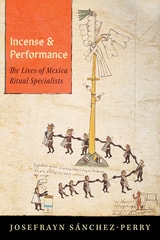
Incense and Performance
The Lives of Mexica Ritual SpecialistsSánchez-Perry, Josefrayn
University of Arizona Press, 2026
At the time of the conquest of Mexico, the anonymous authors of the Anales de Tlatelolco (1560s) recorded the deaths of two Mexica ritual specialists. During the tumultuous events of the times, Quauhnochtli (a telpochcalli specialist) and Quauhcoatl (a calmecac specialist) died protecting the temple of Huitzilopochtli and his bundled embodiement in the neighborhood of Huitznahuac.
Scholar Josefrayn Sánchez-Perry reconstructs the lives and labors of the two specialists, articulated through Nahuatl-language texts, material culture from neighborhood and temple spaces, and the academic study of religion. The book expands on known theories on Mexica ritual specialists by providing new insights about telpochcalli and calmecac duties, their interrelated educational models, and the collective practices that brought people, animals, flora, specialists, and teteo (more-than-human forces) together. The book demonstrates that telpochcalli and calmecac specialists shared the ritual responsibilities of collective and elective practices.
Giving care to teteo, giving life, and giving offerings were balanced with giving war, giving council, and giving music and dance. As Quauhnochtli and Quauhcoatl ensured the safety of the bundled Huitzilopochtli, they characterized how a Mexica ritual specialist lived and what they did.
Indian Women and French Men
Rethinking Cultural Encounter in the Western Great LakesSusan Sleeper-Smith
University of Massachusetts Press, 2001
A center of the lucrative fur trade throughout the colonial period, the Great Lakes region was an important site of cultural as well as economic exchange between native and European peoples. In this well-researched study, Susan Sleeper-Smith focuses on an often overlooked aspect of these interactions—the role played by Indian women who married French traders. Drawing on a broad range of primary and secondary sources, she shows how these women used a variety of means to negotiate a middle ground between two disparate cultures. Many were converts to Catholicism who constructed elaborate mixed-blood kinship networks that paralleled those of native society, thus facilitating the integration of Indian and French values. By the mid-eighteenth century, native women had extended these kin linkages to fur trade communities throughout the Great Lakes, not only enhancing access to the region's highly prized pelts but also ensuring safe transport for other goods.
Indian Women and French Men depicts the encounter of Old World and New as an extended process of indigenous adaptation and change rather than one of conflict and inevitable demise. By serving as brokers between those two worlds, Indian women who married French men helped connect the Great Lakes to a larger, expanding transatlantic economy while securing the survival of their own native culture. As such, Sleeper-Smith points out, their experiences illuminate those of other traditional cultures forced to adapt to market-motivated Europeans.
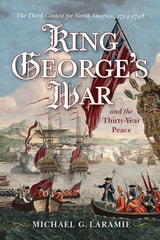
King George's War and the Thirty Year Peace
The Third Contest for North AmericaMichael G. Laramie
Westholme Publishing, 2027
King George’s War and the Thirty-Year Peace continues the contest for North America from the end of Queen Anne’s War in 1713, marking the beginning of the Thirty-Year Peace, through the start of King George’s War in 1744, to its conclusion with the signing of Treaty of Aix-la-Chapelle four years later. While there would be little fighting between the French, Spanish, and British colonies in North America during the Thirty-Year Peace—the Franco-Spanish conflict of 1719 being an exception—for the French and British internally it did not prove to be peaceful. Conflicts with former Indigenous allies erupted, including with the Three Years War, the Yamassee War, and the Natchez and Chickasaw Wars. In the south the peace was ruptured by the opening of the War of Jenkin’s Ear in 1739, which led to an attempt by South Carolina and the new colony of Georgia to seize Spanish St. Augustine, and a counter-attack by St. Augustine and Cuba aimed at the destruction of the two British colonies. While this Anglo-Spanish conflict would shift farther south into the Caribbean, to the north, news of another war between France and Britain would arrive in 1744. King George’s War, the North American component of Europe’s War of Austrian Succession, would start in Nova Scotia with French attacks on the weakly held British colony. This provocation inspired a response in the form of one of the boldest expeditions of the colonial period—Massachusetts Governor William Shirley’s successful campaign against Louisbourg on Cape Breton Island. With the French fortress in British hands and the cry of delenda est Canadaechoing through the American colonial assemblies, Shirley turned to the conquest of French Canada and convinced London to dispatch a fleet to assist in the capture of Montreal and Quebec. In Paris, news of Louisbourg’s surrender elicited an unexpected reaction in the form of one of the largest French naval expeditions ever sent to North America, with explicit orders to retake Cape Breton and expel the British from Nova Scotia. Thus, by the summer of 1746, both British and French sentries scanned the eastern horizon daily for a fleet that would determine the destiny of the conflict, but neither would be happy with what they found.
The final volume in Michael G. Laramie’s acclaimed histories of the European struggle for North America that set the stage for the French and Indian War, King George’s War and the Thirty-Year Peace: The Third Contest for North America, 1714–1748, takes the reader along with the combatants into the field and waterways, including Native American, French, Spanish, Provincial, and British. Based on a rich variety of primary sources and fully illustrated with original maps, this volume joins the author’s King William’s War and Queen Anne’s War as the modern history of these lesser-known—but enormously important—conflicts that shaped the political story of North America.
Osage Indian Customs and Myths
Louis F. Burns
University of Alabama Press, 2005
Siouan peoples who migrated from the Atlantic coastal region and settled in the central portion of the North American continent long before the arrival of Europeans are now known as Osage. Because the Osage did not possess a written language, their myths and cultural traditions were handed down orally through many generations. With time, only those elements deemed vital were preserved in the stories, and many of these became highly stylized. The resulting verbal recitations of the proper life of an Osage—from genesis myths to body decoration, from star songs to child-naming rituals, from war party strategies to medicinal herbs—constitute this comprehensive volume.
Osage myths differ greatly from the myths of Western Civilization, most obviously in the absence of individual names. Instead, “younger brother,” “the messenger,” “Little Old Men,” or a clan name may serve as the allegorical embodiment of the central player. Individual heroic feats are also missing because group life took precedence over individual experience in Osage culture.
Supplementing the work of noted ethnographer Francis La Flesche who devoted most of his professional life to recording detailed descriptions of Osage rituals, Louis Burns’s unique position as a modern Osage—aware of the white culture’s expectations but steeped in the traditions himself is able to write from an insider’s perspective.
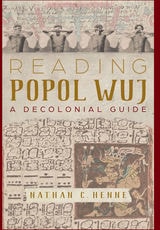
Reading Popol Wuj
A Decolonial GuideNathan C. Henne
University of Arizona Press, 2020
Popol Wujis considered one of the oldest books in the Americas. Various elements of Popol Wuj have appeared in different written forms over the last two millennia and several parts of Popol Wuj likely coalesced in hieroglyphic book form a few centuries before contact with Europeans. Popol Wuj offers a unique interpretation of the Maya world and ways of being from a Maya perspective. However, that perspective is often occluded since the extant Popol Wuj is likely a copy of a copy of a precontact Indigenous text that has been translated many times since the fifteenth century.
Reading Popol Wujoffers readers a path to look beyond Western constructions of literature to engage with this text through the philosophical foundation of Maya thought and culture. This guide deconstructs various translations to ask readers to break out of the colonial mold in approaching this seminal Maya text.
Popol Wuj, or Popol Vuh, in its modern form, can be divided thematically into three parts: cosmogony (the formation of the world), tales of the beings who inhabited the Earth before the coming of people, and chronicles of different ethnic Maya groups in the Guatemala area. Examining thirteen translations of the K’iche’ text, Henne offers a decolonial framework to read between what translations offer via specific practice exercises for reading, studying, and teaching. Each chapter provides a close reading and analysis of a different critical scene based on a comparison of several translations (English and Spanish) of a key K’iche’ word or phrase in order to uncover important philosophical elements of Maya worldviews that resist precise expression in Indo-European languages.
Charts and passages are frontloaded in each chapter so the reader engages in the comparative process before reading any leading arguments. This approach challenges traditional Western reading practices and enables scholars and students to read Popol Wuj—and other Indigenous texts—from within the worldview that created them.
Reinvention and History Making in Huarochirí
A Local Narrative of Colonialism in the Peruvian AndesCarla Hernández Garavito
University of Arizona Press, 2026
Using archaeological and historical datasets and spatial modeling, this book centers on local memory and experience throughout colonized landscapes as the thread that connects the long history of Indigenous engagement with expanding colonial empires and the emergent Peruvian nation. The author builds on Andean epistemological frameworks to argue that in the face of drastic sociopolitical changes, the people of Huarochirí turned to their own history. They created analogies and shared spaces between local and Inka landscapes and materiality and incorporated written representations and ideas of settled lives to validate their claims.
This exciting new work moves the field of Andean archaeology into conversations with decolonial and decolonizing methodologies and shows how Indigenous communities captured and made sense of their long history, reframing colonialism as a local experience.
Removing Christ from the Cross
Performing the Deposition in Nahuatl and Yucatec MayaMark Z. Christensen
University Press of Colorado, 2026
Employed on Good Friday, the texts provided mute actors with roles and props with which to reenact the removal of Christ from his cross, his placement into the arms of his grieving mother, and his burial—his Deposition. Through rare translations, vivid historical accounts, and rich cultural insight, the book uncovers how these ceremonies moved audiences to tears, shaped local Catholicisms, and still have the power to stir hearts today.
Such theatrical reenactments were common among Nahuas and Mayas during the colonial period only to become largely overlooked by the scholarly literature on religion. The texts examined here provide not only examples of performances but also insight into how translation altered their content and meaning. More than simply plays or sermons, these hybrid performances merged European tradition with Nahua and Maya storytelling, creating unforgettable moments of faith, grief, and beauty. Familiarized through local worldviews, concerns, preferences, and language, these texts provide additional and important insights into myriad issues including those of gender, agency, and how Christianity adapted its message of the Deposition to accommodate Indigenous audiences of different cultures. Christensen also mines the deep well of existing European literature on the subject to clearly distinguish the aspects derived from the Old World from those from the New.
The first book examining how the Aztec and Maya were taught about and engaged in the Deposition, Removing Christ from the Cross exposes the colonial origins of modern Latin American commemorations, showing the past clearly reflected in the present and making a significant contribution to the literature on the evangelization of New Spain. This is more than history—it is the rediscovery of performances that connected worlds.
Societies in Eclipse
Archaeology of the Eastern Woodlands Indians, A.D. 1400-1700Edited by David S. Brose, C. Wesley Cowan, and Robert C. Mainfort
University of Alabama Press, 2001
After establishing the distribution of prehistoric and historic populations from the northeastern Appalachian forests to the southern trans-Mississippian prairies, the contributors consider the archaeological and cultural record of several specific groups, including Mohawk and Onondaga, Monacan, Coosa, and Calusa. For each, they present new evidence of cultural changes prior to European contact, including populations movements triggered by the Little Ice Age (AD 1550–1770), shifting exchange and warfare networks, geological restriction of effective maize subsistence, and use of empty hunting territories as buffers between politically unstable neighbors. The contributors also trace European influences, including the devastation caused by European-introduced epidemics and the paths of European trade goods that transformed existing Native American-exchange networks.
While the profound effects of European explorers, missionaries, and traders on Eastern Woodlands tribes cannot be denied, the archaeological evidence suggests that several indigenous societies were already in the process of redefinition prior to European contact. The essays gathered here show that, whether formed in response to natural or human forces, cultural change may be traced through archaeological artifacts, which play a critical role in answering current questions regarding cultural persistence.
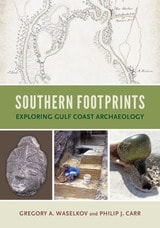
Southern Footprints
Exploring Gulf Coast ArchaeologyGregory A. Waselkov and Philip J. Carr
University of Alabama Press, 2024
Unearthing the Gulf Coast’s past—one footprint at a time.
Southern Footprints celebrates more than fifty years of archaeological research along the Gulf Coast by the University of South Alabama and the Center for Archaeological Studies. Archaeologists Gregory A. Waselkov and Philip J. Carr, the former and current directors of the center, present the “greatest hits” that have transformed knowledge of human history on the Alabama and Mississippi Gulf Coast from the Ice Age until recently. Each archaeological site, from surface collections to premiere archaeological preserves, such as Old Mobile and Holy Ground, offers clues to the past.
The chapters in this collection are arranged chronologically and survey the history and archaeology of a wide range of significant sites, including the Gulf Shores canoe canal, Bottle Creek Mounds, Old Mobile, Fort Mims, Spanish Fort, Spring Hill College, and Mobile River Bridge.
Waselkov and Carr take care to acknowledge in these stories populations who have been historically underdocumented, now recognizing the contributions of Native Americans and African Americans that have been uncovered through archaeology. The authors reveal the dire impacts of climate change, environmental disasters, development, and neglect—and convey their urgency to protect these areas of shared history—as a result of the meticulous excavation, analysis, and preservation of artifacts from these sites. Color photographs showcase the archaeology as it unfolds, often with the help of dedicated volunteers. Southern Footprints will serve as an indispensable reference on the rich Gulf Coast heritage for all to appreciate.
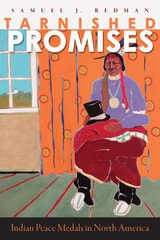
Tarnished Promises
Indian Peace Medals in North AmericaSamuel J. Redman
University Press of Colorado, 2026
Using a collection of medals held at the Denver Museum of Nature & Science, Tarnished Promises presents an updated overview of the history and story of peace medals through an examination of their legacy in the modern world. Accompanying the history and analysis are images of thirteen exemplar peace medals from the DMNS collections and their accompanying object biographies.
Peace medals paradoxically worked as tools of colonialism and also Native American agency, sovereignty, power, resistance, and change in response to growing challenges. Their widespread adoption by Native people in North America both prefigured and coincided with the many ways in which Native Americans and First Nations peoples worked to adapt to the unwelcome and undesirable changes wrought by expanding western colonialism. The unique individual histories behind the medals and the larger peace medal story suggest how material objects can hold several, sometimes contradictory, meanings and be influenced by varied strands of culture and historical memory. Tarnished Promises tells this complex story in two parts, with the first detailing the history of Indian peace medals from 1670 to the present day and the second part exploring their meaning at different points in time and to different peoples.
The first book-length treatment of peace medals using an anticolonialist perspective, Tarnished Promises is significant to scholars and the general public interested in numismatics, American history, Indigenous studies, and museum collections.
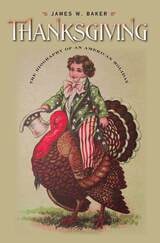
Thanksgiving
The Biography of an American HolidayJames W. Baker
University of New Hampshire Press, 2009
In this, the first in-depth study of the most American of holidays, James Baker sweeps away lingering myths and misconceptions to show how this celebration day was born and grew to be an essential part of our national spirit. Thanksgiving: The Biography of an American Holiday opens with an overview of the popular mythos of the holiday before discussing its possible religious and cultural precedents. This classic Yankee holiday is examined in historical and contemporary detail that embraces everything from proclamations, sermons, and local and regional traditions to family reunions, turkey dinners, and recipes. Thanksgiving's evolving face is illustrated with charming and often revealing period prints that chart our changing attitudes: the influence of Victorian sentiment in Thanksgiving's development, Progressive utilitarianism, intellectual “debunking,” patriotic wartime reclamation, and 1960s-era protest. Thanksgiving remains controversial up to the present day, as Mayflower descendants, Native Americans, and commercial exploiters compete for the American public's opinion of the holiday's contemporary significance and its future status. This is an intelligent and illuminating introduction to a beloved holiday and a fascinating cultural history of America and Americana.

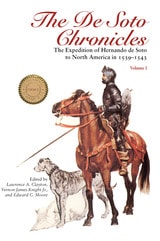
The De Soto Chronicles Vol 1
The Expedition of Hernando de Soto to North America in 1539-1543Edited by Lawrence A. Clayton, Vernon James Knight Jr., and Edward C. Moore
University of Alabama Press, 2022
1993 CHOICE OUTSTANDING ACADEMIC BOOK, SPONSORED BY CHOICE MAGAZINE
Unearthing the documents that shaped our earliest understanding of a continent.
The De Soto expedition was the first major encounter of Europeans with indigenous North Americans in the eastern half of the United States. De Soto and his army of over 600 men, including 200 cavalry, spent four years traveling through what is now Florida, Georgia, Alabama, North and South Carolina, Tennessee, Mississippi, Louisiana, Arkansas, and Texas. The De Soto Chronicles Volume 1 and Volume 2 present for the first time all four primary accounts of the De Soto expedition together in English translation.
The four primary accounts are generally referred to as Elvas, Rangel, Biedma (in Volume 1), and Garcilaso, or the Inca (in Volume 2). In this landmark 1993 publication, Clayton’s team presents the four accounts with literary and historical introductions. They further add brief essays about De Soto and the expedition, translations of De Soto documents from the Spanish Archivo General de Indias, two short biographies of De Soto, and bibliographical studies.
For anthropologists, archaeologists, and historians, The De Soto Chronicles are valued for the unique ethnological information they contain. They form the only detailed eyewitness records of the most advanced native civilization in North America—the Mississippian culture—a culture largely lost in the wake of European contact.
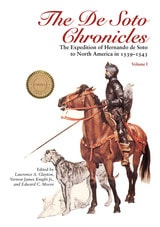
The De Soto Chronicles Vol 1
The Expedition of Hernando de Soto to North America in 1539-1543Lawrence A. Clayton
University of Alabama Press, 1993
1993 CHOICE OUTSTANDING ACADEMIC BOOK, SPONSORED BY CHOICE MAGAZINE
Unearthing the documents that shaped our earliest understanding of a continent.
The De Soto expedition was the first major encounter of Europeans with indigenous North Americans in the eastern half of the United States. De Soto and his army of over 600 men, including 200 cavalry, spent four years traveling through what is now Florida, Georgia, Alabama, North and South Carolina, Tennessee, Mississippi, Louisiana, Arkansas, and Texas. The De Soto Chronicles Volume 1 and Volume 2 present for the first time all four primary accounts of the De Soto expedition together in English translation.
The four primary accounts are generally referred to as Elvas, Rangel, Biedma (in Volume 1), and Garcilaso, or the Inca (in Volume 2). In this landmark 1993 publication, Clayton’s team presents the four accounts with literary and historical introductions. They further add brief essays about De Soto and the expedition, translations of De Soto documents from the Spanish Archivo General de Indias, two short biographies of De Soto, and bibliographical studies.
For anthropologists, archaeologists, and historians, The De Soto Chronicles are valued for the unique ethnological information they contain. They form the only detailed eyewitness records of the most advanced native civilization in North America—the Mississippian culture—a culture largely lost in the wake of European contact.
The De Soto Chronicles, 2 Volume Set
The Expedition of Hernando de Soto to North America in 1539-1543Edited by Lawrence A. Clayton, Vernon James Knight Jr., and Edward C. Moore
University of Alabama Press, 1995
1993 CHOICE OUTSTANDING ACADEMIC BOOK, SPONSORED BY CHOICE MAGAZINE
Unearthing the documents that shaped our earliest understanding of a continent.
The De Soto expedition was the first major encounter of Europeans with indigenous North Americans in the eastern half of the United States. De Soto and his army of over 600 men, including 200 cavalry, spent four years traveling through what is now Florida, Georgia, Alabama, North and South Carolina, Tennessee, Mississippi, Louisiana, Arkansas, and Texas. The De Soto Chronicles Volume 1 and Volume 2 present for the first time all four primary accounts of the De Soto expedition together in English translation.
The four primary accounts are generally referred to as Elvas, Rangel, Biedma (in Volume 1), and Garcilaso, or the Inca (in Volume 2). In this landmark 1993 publication, Clayton’s team presents the four accounts with literary and historical introductions. They further add brief essays about De Soto and the expedition, translations of De Soto documents from the Spanish Archivo General de Indias, two short biographies of De Soto, and bibliographical studies.
For anthropologists, archaeologists, and historians, The De Soto Chronicles are valued for the unique ethnological information they contain. They form the only detailed eyewitness records of the most advanced native civilization in North America—the Mississippian culture—a culture largely lost in the wake of European contact.
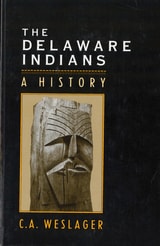
The Delaware Indians
A HistoryWeslager, C. A.
Rutgers University Press, 1990
In the seventeenth century white explorers and settlers encountered a tribe of Indians calling themselves Lenni Lenape along the Delaware River and its tributaries in New Jersey, Delaware, eastern Pennsylvania, and southeastern New York. Today communities of their descendants, known as Delawares, are found in Oklahoma, Kansas, Wisconsin, and Ontario, and individuals of Delaware ancestry are mingled with the white populations in many other states. The Delaware Indians is the first comprehensive account of what happened to the main body of the Delaware Nation over the past three centuries.
C. A. Weslager puts into perspective the important events in United States history in which the Delawares participated and he adds new information about the Delawares. He bridges the gap between history and ethnology by analyzing the reasons why the Delawares were repeatedly victimized by the white man.
The Economy of British West Florida, 1763-1783
Robin F. A. Fabel
University of Alabama Press, 1988
The untold economic story of Britain’s Gulf Coast frontier.
This is the first book-length investigation of the economy of British West Florida and the extent to which it was economically viable given that it had been an economic failure for Spain. In it, author Robin Fabel explores both the territory's economy and history but also analyzes previously neglected but key aspects of British West Florida, including the maritime life of the province, the institution of slavery, and the potentially great immigration scheme sponsored by the Company of Military Adventures.
The British divided Florida into two colonies: East Florida and West Florida. West Florida comprised the area between the Apalachicola, Chattahoochee, and Mississippi rivers, and from the Gulf of Mexico north to thirty-two degrees twenty-eight minutes north latitude, roughly the latitude of modern-day Jackson, MS and Montgomery, AL. In the geographic center of the colony were Mobile, Alabama and Pensacola, Floriday. British West Florida included parts of the states of Alabama, Florida, Louisiana, and Mississippi and existed from 1763 until 1783 at the end of the American Revolutionary War.
Fabel contrasts the founding of Georgia, where slaves were initially excluded, with West Florida, where the slave trade became important economically. The British believed that only enslaved Blacks could labor successfully in the hot climate. Fabel gives an account of how owners employed enslaved people, how rare it was for slaves to be emancipated, and the passage of slave laws for West Florida. Fabel also explores British West Florida’s trade with Native Americans and the Caribbean islands, as well as the colony's relationships with neighboring Spanish and French communities.
Fabel's work offers an engaging and accessible account of the history of an expansive region of colonial North America during a fluid period of colonial history before American independence.
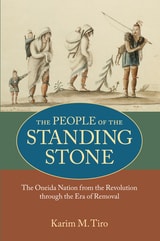
The People of the Standing Stone
The Oneida Nation from the Revolution through the Era of RemovalKarim M. Tiro
University of Massachusetts Press, 2011
The Oneidas' physical, political, and emotional division persists to this day. Even for those who stayed put, their world changed more in cultural, ecological, and demographic terms than at any time before or since. Oneidas of the post-Revolutionary decades were reluctant pioneers, undertaking more of the adaptations to colonized life than any other generation. Amid such wrenching change, maintaining continuity was itself a creative challenge. The story of that extraordinary endurance lies at the heart of this book.
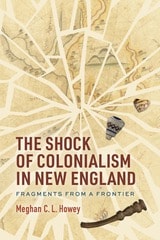
The Shock of Colonialism in New England
Fragments from a FrontierMeghan C. L. Howey
University of Alabama Press, 2025
Explores the untold impacts of colonialism in New England through diverse colonist lives, Indigenous encounters, and environmental legacies.
In The Shock of Colonialism in New England, archaeologist Meghan C. L. Howey uses excavations in the seventeenth-century colonial frontier of the Great Bay Estuary/P8bagok in today’s New Hampshire to trace the connection between European global colonialism and the planetary climate crises. Howey shows how this landscape holds forgotten stories of what it meant to live through the shock of colonialism.
These stories reveal an unexpected diversity and dynamism among English colonists, multifaceted encounters with Indigenous peoples, and lasting environmental damage from labor-intensive industries. Early Euro-American maps and stunning archaeological finds, such as a broken pickaxe embedded in a hearth, and a historical marker for the Oyster River “Massacre” of 1694 complicate our limited views of a shared past.
The reality of English colonialism in the dispossession of Indigenous lands and its wake is not commemorated. Howey’s work is a powerful corrective that traces the rise of intergenerational colonial wealth made possible by land commodified as property, the increased labor required to work newly opened land, the importation of indentured Scots and enslaved Africans to provide that labor, and the resulting degradation of the natural environment. Through Howey’s insights into the stories they tell, these fragments from a frontier can help contemporary readers better understand the past as they seek a more just and sustainable future.
The Tarahumara Rebellion of 1690
Embattled Settlers and Missionaries in Northern New SpainJoseph P. Sánchez
University of Arizona Press, 2025
Previous histories have interpreted this revolt, and other borderlands uprisings, as localized and spontaneous events aimed at rectifying specific grievances. Historian Joseph P. Sánchez argues that the revolts of the Tepehuanes and the Tarahumaras in northern New Spain, or Nueva Vizcaya, were well-planned, inspired by outside events, and drew in multiple communities and ethnicities. Drawing on a wealth of primary sources, including Jesuit accounts and archival documents, Sánchez offers a comprehensive narrative that challenges conventional interpretations of colonial Mexican uprisings.
Far from localized, the Indigenous rebellions in the northern Mexican borderlands during the colonial period were part of the overall Indigenous struggle for defense of homeland throughout the Americas. The Tarahumara Rebellion of 1690 brings together a rich history of localized events and broader historical trends and offers a compelling narrative that enriches our understanding of the colonial experience in northern New Spain.
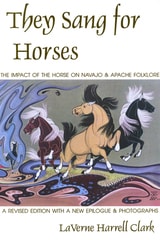
They Sang for Horses
The Impact of the Horse on Navajo and Apache FolkloreLaVerne Harrell Clark
University Press of Colorado, 2001
No Native American groups placed more emphasis on the horse in their lives than did the Navajo and Apache of the Southwest. They Sang for Horses, first published in 1966 and now considered a classic, remains the only comprehensive treatment of the profound mystical influence that the horse has exerted for more than 300 years.
In this completely redesigned and expanded edition, LaVerne Harrell Clark examines how storytellers, singers, medicine men, and painters created the animal's evolving symbolic significance by adapting existing folklore and cultural symbols. Exploring the horse's importance in ceremonies, songs, prayers, customs, and beliefs, she investigates the period of the horse's most pronounced cultural impact on the Navajo and the Apache, starting from the time of its acquisition from the Spanish in the seventeenth century and continuing to the mid-1960s, when the pickup truck began to replace it as the favored means of transportation. In addition, she presents a look at how Navajos and Apaches today continue to redefine the horse's important role in their spiritual as well as material lives.
This classic work is a must for historians, readers interested in Native American folklore and mythology, and anyone who has ever been captivated by the magic and romance of the horse.

Tiger Duff
India, Madeira and Empire in Eighteenth-Century ScotlandAlistair Mutch
Aberdeen University Press, 2017
Tohopeka
Rethinking the Creek War and the War of 1812Edited by Kathryn E. Holland Braund
University of Alabama Press, 2012
Reexamining the Creek War, the War of 1812, and the Making of the American South.
Tohopeka contains a variety of perspectives and uses a wide array of evidence and approaches, from scrutiny of cultural and religious practices to literary and linguistic analysis, to illuminate this troubled period. Almost two hundred years ago, the territory that would become Alabama was both ancient homeland and new frontier where a complex network of allegiances and agendas was playing out. The fabric of that network stretched and frayed as the Creek Civil War of 1813-14 pitted a faction of the Creek nation known as Red Sticks against those Creeks who supported the Creek National Council. The war began in July 1813, when Red Stick rebels were attacked near Burnt Corn Creek by Mississippi militia and settlers from the Tensaw area in a vain attempt to keep the Red Sticks’ ammunition from reaching the main body of disaffected warriors. A retaliatory strike against a fortified settlement owned by Samuel Mims, now called Fort Mims, was a Red Stick victory. The brutality of the assault, in which 250 people were killed, outraged the American public and “Remember Fort Mims” became a national rallying cry.
During the American-British War of 1812, Americans quickly joined the war against the Red Sticks, turning the civil war into a military campaign designed to destroy Creek power. The battles of the Red Sticks have become part of Alabama and American legend and include the famous Canoe Fight, the Battle of Holy Ground, and most significantly, the Battle of Tohopeka (also known as Horseshoe Bend)—the final great battle of the war. There, an American army crushed Creek resistance and made a national hero of Andrew Jackson.
New attention to material culture and documentary and archaeological records fills in details, adds new information, and helps disabuse the reader of outdated interpretations.
Contributors
Susan M. Abram / Kathryn E. Holland Braund/Robert P. Collins / Gregory Evans Dowd / John E. Grenier / David S. Heidler / Jeanne T. Heidler / Ted Isham / Ove Jensen / Jay Lamar / Tom Kanon / Marianne Mills / James W. Parker / Craig T. Sheldon Jr. / Robert G. Thrower / Gregory A. Waselkov
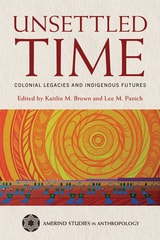
Unsettled Time
Colonial Legacies and Indigenous FuturesEdited by Kaitlin M. Brown and Lee M. Panich
University of Arizona Press, 2027
Time is at the core of how we think about colonialism in North America, with many seeing the first footfalls of newly arrived Europeans as indelibly marking the end of one era and the beginning of another. However, this understanding of time often serves to perpetuate outdated narratives about Indigenous people, normalizing colonial domination.
This volume unsettles conventional understandings of time in the study of Indigenous-colonial interactions in North America, acknowledging both the enduring nature of colonial legacies and the radical possibilities of Indigenous futures. The contributors largely approach this goal from the perspective of archaeology, with a particular concern for how we can effectively employ archaeological and related historical methods in collaboration with tribal nations and other descendant communities. The chapters engage with broader interdisciplinary questions about time, periodization, and temporality to build more nuanced and responsive understandings of Native-lived colonialism.
Contributors
Nathan Acebo
Kaitlin M. Brown
Wade Campbell
Emily Clark
Ruben Cu:k Ba’ak
Jacob Holland-Lulewicz
Nicholas V. Kessler
Nicholas C. Laluk
Koji Lau-Ozawa
Heather Law Pezzarossi
Lindsay Martel Montgomery
Lee M. Panich
Michelle M. Pigott
Robert W. Preucel
Christopher B. Rodning
Sarah Simeonoff

Up Against the Archive
Experiments in Writing British Empire History OtherwiseAntoinette Burton, editor
Duke University Press, 2027