Results by title
47 books match the query 'Man-woman relationships'
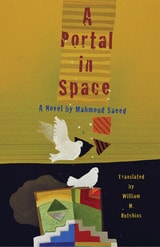
A Portal in Space
By Mahmoud Saeed, Translated by William M. Hutchins
University of Texas Press, 2015
A Portal in Space, set in Basra, Iraq, during the Iran-Iraq War (1980–1988), follows the lives of Anwar, a newly minted architect, and the other members of his affluent family as they attempt to maintain a sense of normality during the frequent bombing attacks from Iran. When Anwar joins the Iraqi army and then goes missing in action, his family struggles to cope with uncertainty over his fate. His mother falls into depression and secludes herself in the family home, while his father shifts his attention from his duties as a judge to the weekly pilgrimage to Baghdad seeking information on his son—and to Zahra, the young widow he meets there.
Emotionally engaging, A Portal in Space is a wry, wise tale of human beings striving to retain their humanity during a war that is anything but humane. Mahmoud Saeed succeeds brilliantly in bringing the sights and sounds of Iraq to life on the page—whether in a bunker on the front lines of the Iran-Iraq War or in the parlor of a fortune-teller in Baghdad. As Zahra says of the novel she is writing: “It is a normal novel that contains love, war, life, deceit, and death.”

Ambition and Accommodation
How Women View Gender RelationsRoberta S. Sigel
University of Chicago Press, 1996
By juxtaposing the voices of women and men from all walks of life, Sigel finds that women's perceptions of gender relations are complex and often contradictory. Although most women see gender discrimination pervading nearly all social interactions—private as well as public—they do not invariably feel that they personally have been its victims. They want to see discrimination ended, but believe that men do not necessarily share this goal. Women are torn, according to Sigel, between the desire to improve their positions relative to men and the desire to avoid open conflict with them. Their desire not to jeopardize their relations with men, Sigel holds, helps explain women's willingness to accommodate a less-than-egalitarian situation by, for example, taking on the second shift at home or by working harder than men on the job. Sigel concludes that, although men and women agree on the principle of gender equality, definitions as well as practice differ by gender.
This complex picture of how women, while not always content with the status quo, have chosen to accommodate to the world they must face every day is certain to provoke considerable debate.
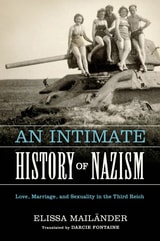
An Intimate History of Nazism
Love, Marriage, and Sexuality in the Third ReichElissa Mailänder
University of Wisconsin Press, 2027
Published to great acclaim in French and now available for the first time in English, this groundbreaking book explores how the Nazi regime used sexuality to promote political loyalty, conformity, and cohesion among “ordinary” Germans. Beginning before the collapse of the Weimar Republic and continuing through the postwar American occupation of Germany, Elissa Mailänder’s study highlights the complex and conflicted ways that sexual “liberation,” repression, and violence were used and experienced in the everyday lives of citizens of the Reich. Her analysis draws on a vast array of sources, from legal dossiers to private photographs and letters, as well as public archives, magazines, and movies. Mailänder’s findings are often uncomfortable; she demonstrates, for example, that a significant number of women who were not persecuted by the regime saw shifts in gender and sexual norms as positive developments—ones that some felt were lost under the American occupation, with its own routines of military sexual exploitation. What emerges is a portrait of a regime that was less interested in repressing sexuality than in reinventing it according to a racist, elitist, and homophobic agenda.
CUT LOOSE
(Mostly) Older Women on the End of their (Mostly) Long-Term RelationshipsBauer-Maglin, Nan
Rutgers University Press, 2006
Although breakups—whether celebrity or everyday—are a constant source of fascination, surprisingly little attention has been given to women who are cut loose in their later years. This is a book about (mostly) long-term relationships that have come apart. Each woman involved, the majority of whom are over sixty, tells of her experience through journal entries, essays, poetry, or stories. Although in many senses they have been abandoned, they have also been set free, untethered, and, for some, liberated sexually, mentally, or emotionally.
The book is divided into two major sections. The pieces in the first part are personal narratives. Among the varied voices, we hear from women in both heterosexual and same-sex relationships who have been left by their partners or who have decided to leave them. In the second section, the contributors look at being left and leaving from psychological, sociological, economic, sexual, medical, anthropological, and literary perspectives. Other essays explore the shared experiences of specific classes of women, such as single women, widows, or abandoned daughters.
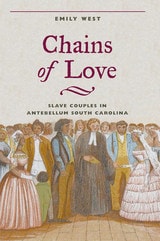
Chains of Love
Slave Couples in Antebellum South CarolinaEmily West
University of Illinois Press, 2004
Focusing on South Carolina, West deals directly with the most intimate areas of the slave experience including courtship, love and affection between spouses, the abuse of slave women by white men, and the devastating consequences of forced separations. Slaves fought these separations through cross-gender bonding and cross-plantation marriages, illustrating West's thesis about slave marriage as a fierce source of resistance to the oppression of slavery in general.
Making expert use of sources such as the Works Progress Administration narratives, slave autobiographies, slave owner records, and church records, this book-length study is the first to focus on the primacy of spousal support as a means for facing oppression. Chains of Love provides telling insights into the nature of the slave family that emerged from these tensions, celebrates its strength, and reveals new dimensions to the slaves' struggle for freedom.
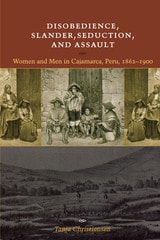
Disobedience, Slander, Seduction, and Assault
Women and Men in Cajamarca, Peru, 1862-1900By Tanja Christiansen
University of Texas Press, 2004
Though the law and courts of nineteenth-century Peru were institutions created by and for the ruling elite, women of all classes used the system to negotiate the complexities of property rights, childrearing, and marriage, and often to defend their very definitions of honor. Drawing on the trial transcripts of Cajamarca, a northern Peruvian province, from more than a century ago, this book shares eye-opening details about life among this community, in which reputation could determine a woman's chances of survival.
Exploring the processes of courtship, seduction, and familial duties revealed in these court records, historian Tanja Christiansen has unearthed a compelling panorama that includes marital strife, slander, disobedience, street brawls, and spousal abuse alongside documents that give evidence of affection and devotion. Her research also yields much new information about the protocols for conflict and cooperation among nineteenth-century Peruvian women from all social strata, and the prevalence of informal unions in an economy driven in large part by migratory male labor. Reviving a little-known aspect of Latin American history, Christiansen's book simultaneously brings to light an important microcosm of women's history during the nineteenth century.
Economies of Gender
Masculinity, "Mail Order Brides," and Women’s LaborJulia H. Meszaros
Rutgers University Press, 2026
From Single to Serious
Relationships, Gender, and Sexuality on American Evangelical CampusesMalone, Dana M.
Rutgers University Press, 2018
In From Single to Serious, Dana M. Malone shines a light on friendship, dating, and, sexuality, in both the ideals and the practical experiences of heterosexual students at U. S. evangelical colleges. She examines the struggles they have in balancing their gendered and religious presentations of self, the expectations of their campus community, and their desire to find meaningful romantic relationships.
Getting It, Having It, Keeping It Up
Straight Men’s Sexuality in Public and PrivateBeth Montemurro
Rutgers University Press, 2022

Her Husband
Luigi Pirandello
Duke University Press, 2000
Evoking in vivid detail the literary world in Rome at the turn of the century, Her Husband tells the story of Silvia Roncella, a talented young female writer, and her husband Giustino Boggiolo. The novel opens with their arrival in Rome after having left their provincial southern Italian hometown following the success of Silvia’s first novel, the rather humorously titled House of Dwarves. As his wife’s self-appointed (and self-important) promoter, protector, counselor, and manager, Giustino becomes the primary target of Pirandello’s satire. But the couple’s relationship—and their dual career—is also complicated by a lively supporting cast of characters, including literary bohemians with avant-garde pretensions and would-be aristocratic esthetes who are all too aware of the newly acquired power of journalists and the publishing establishment to make or break their careers. Having based many of the characters—including Silvia and Giustino—on actual literary acquaintances of his, Pirandello reacted to the novel’s controversial reception by not allowing it to be reprinted after the first printing sold out. Not until after his death were copies again made available in Italy.
Readers will find Her Husband eerily evocative of the present in myriad ways—not the least of which is contemporary society’s ongoing transformation wrought by the changing roles of men and women, wives and husbands.

How I Got Him Back
A NovelValerie Sayers
Northwestern University Press, 2013

In Love with Jerzy Kosinski
A NovelAgate Nesaule
University of Wisconsin Press, 2009
After fleeing Latvia as a child, Anna Duja escapes Russian confinement in displaced persons camps and eventually arrives in America. Years later, she finds herself in a different kind of captivity on isolated Cloudy Lake, Wisconsin, living with her disarming but manipulative husband, Stanley.
Inspired by the transformation of Polish-Jewish émigré Jerzy Kosinski from persecuted wartime escapee to celebrity author in America, Anna slips away from Stanley and Cloudy Lake in small steps: learning to drive, making friends, moving to Madison, falling in love, and learning to forgive. Readers will applaud the book’s power, the beauty of its prose, and its strong evocation of a woman gradually finding her way in the wake of trauma.
Winner, the Chancellor’s Regional Literary Award, University of Wisconsin-Whitewater
In Praise of Older Women
The Amorous Recollections of A. VStephen Vizinczey
University of Chicago Press, 1990
"A pleasure. Vizinczey writes of women beautifully, with sympathy, tact and delight, and he writes about sex with more lucidity and grace than most writers ever acquire."—Larry McMurtry, Houston Post
"Like James Joyce, who was as far from being a writer of erotica as Dostoevsky, Vizinczey has a refreshing message to deliver: Life is not about sex, sex is about life."—John Podhoretz, Washington Times
"The gracefully written story of a young man growing up among older women . . . although some passages may well arouse the reader, this novel brims with what the courts have termed "redeeming literary merit."—Clarence Petersen, Chicago Tribune
"A funny novel about sex, or rather (which is rarer) a novel which is funny as well as touching about sex . . . elegant, exact and melodious—has style, presence and individuality."—Isabel Quigly, Sunday Telegraph
"The delicious adventures of a young Casanova who appreciates maturity while acquiring it himself. In turn naive, sophisticated, arrogant, disarming, the narrator woos his women and his tale wins the reader."—Polly Devlin, Vogue
In the House
Lynn K. Kilpatrick
University of Alabama Press, 2010
Inequalities of Love
College-Educated Black Women and the Barriers to Romance and FamilyAveril Y. Clarke
Duke University Press, 2011
Intimate Connections
Love and Marriage in Pakistan’s High MountainsAnna-Maria Walter
Rutgers University Press, 2022

Intimate Creativity
Partners In Love And ArtIrving Sarnoff
University of Wisconsin Press, 2002
Integrating the psychology of love and creativity, this pioneering book explores both how a couple’s involvement as lovers influences their creative collaboration and how working together affects their relationship. Representing a variety of genres—painting, sculpture, photography, and installation art—the celebrated couples profiled here include, among others, Christo and Jeanne-Claude, Elizabeth Diller and Ricardo Scofidio, and Kristin Jones and Andrew Ginzel.
Intrigued by this process of "intimate creativity," psychologists Irving and Suzanne Sarnoff (themselves partners in love and work) decided to conduct in-depth interviews with partners in visual art because they defy the supremely individualistic tradition of their field. Whatever their age or sexual orientation, these artist-couples combine their talents to form a collective identity as a professional team. Passionately intense about their shared commitment, they communicate endlessly to resolve conflicts and reach consensus. Providing mutual validation and support, they increase their productivity and the quality of their work; they minimize their fear and frustration and enhance their pleasure in being together.
The authors also draw on historical and contemporary literature about similar couples, ranging from Jean Arp and Sophie Taeuber to Gilbert and George to Claes Oldenburg and Coosje van Bruggen. Stimulating and engaging, this book highlights the features of a unique collaborative process, considers the connection between creativity and sexuality, and suggests possibilities for any couple to expand their intimacy.
Last Words of the Holy Ghost
Matt Cashion
University of North Texas Press, 2015

Listening to Mozart
Charles Wyatt
University of Iowa Press, 1995
With all the drama and complexity of a symphony, Listening to Mozart traces forty years in the life of flutist James Baxter. Many of the stories in this collection—actually a novel in stories—center on or revolve around James' relationship with Anna, a potter and artist. Each story is a separate movement, yet they combine to create a deeply textured whole work. The stories chronicle James' inward journey, as well as his life and loves, with a voice repeatedly transformed through the years.
“Bach Suite” serves as a prologue and deals with the split in consciousness that often accompanies musical performance. The story imitates the musical form it describes and tunes the reader's ear to the innermost thoughts of a musician. Each succeeding story introduces another episode in James' life—his music school days in Philadelphia with his first love, Zoe, his stint in the U.S. Marine Band during the Vietnam War when he meets Anna, his adventures with his friend Franklin, his experiences with the mysterious Dalawa, a trip with Anna to Toronto to immerse themselves in the culture and music of South India. James' friendships, affairs, experiences, and occasional angst resound in each story.
In all the stories, in all his relationships, James finds himself experiencing his life in much the way he experiences music. There is a moment for which he is waiting, yet for which he is never fully prepared, a moment which passes inexorably. Sometimes, in the rare musical experience, he is able to penetrate that moment and allow time to fall away. These moments are the signposts of his life, like the movements of the Bach suite, but unbidden, and they give him his only perspective and vision.
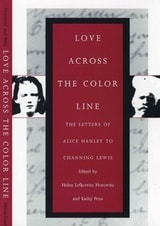
Love Across the Color Line
Helen Lefkowitz Horowitz
University of Massachusetts Press, 1996

Love After the Riots
Juan Felipe Herrera
Northwestern University Press, 1996
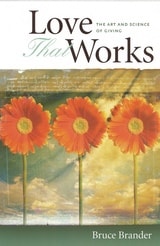
Love That Works
Art & Science Of GivingBruce Brander
Templeton Press, 2004
This original, highly readable book poses a clear distinction between our customary form of love, which almost guarantees failure, and higher, more generous ways of loving that can succeed and enrich both individuals and society as a whole. Love That Works draws on history, psychology, and the theology and science of love to offer a proposal on how to be successful in love and romance. It starts by showing why love fails to meet expectations, often ending sadly or even tragically.
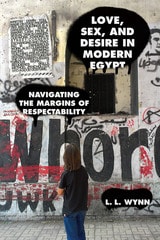
Love, Sex, and Desire in Modern Egypt
Navigating the Margins of RespectabilityBy L. L. Wynn
University of Texas Press, 2018
Cairo is a city obsessed with honor and respectability—and love affairs. Sara, a working-class woman, has an affair with a married man and becomes pregnant, only to be abandoned by him; Ayah and Zeid, a respectably engaged couple, argue over whether Ayah’s friend is a prostitute or a virgin; Malak, a European belly dancer who sometimes gets paid for sex, wants to be loved by a man who won’t treat her like a whore just because she’s a dancer; and Alia, a Christian banker who left her abusive husband, is the mistress of a wealthy Muslim man, Haroun, who encourages business by hosting risqué parties for other men and their mistresses.
Set in transnational Cairo over two decades, Love, Sex, and Desire in Modern Egypt is an ethnography that explores female respectability, male honor, and Western theories and fantasies about Arab society. L. L. Wynn uses stories of love affairs to interrogate three areas of classic anthropological theory: mimesis, kinship, and gift. She develops a broad picture of how individuals love and desire within a cultural and political system that structures the possibilities of, and penalties for, going against sexual and gender norms. Wynn demonstrates that love is at once a moral horizon, an attribute that “naturally” inheres in particular social relations, a social phenomenon strengthened through cultural concepts of gift and kinship, and an emotion deeply felt and desired by individuals.
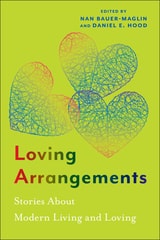
Loving Arrangements
Stories About Modern Living and LovingRutgers University Press, 2026
Love songs and Hollywood romances make it all sound so simple: You find your soul mate, move in together, get married, never stray from the path of monogamy, and live happily ever after. But real life tends to be more complicated. Many couples pursue alternative living arrangements, and some even pursue alternative loving arrangements.
The twenty-nine personal essays in this collection offer a variety of perspectives and experiences with nontraditional relationships and forms of cohabitation. The contributors include married couples who live in separate cities and single people who find companionship through communes and cohousing. These essays also present varied outlooks on the practice and ethics of having multiple partners, with some embracing large polycules while others opt for “monogamish” relationships. Everyone has a different story to tell, from close friends living together to form a chosen family to couples navigating the shifting boundaries of their relationship as one partner begins a gender transition. With contributors across generations and representing the full ethnic and cultural diversity of the United States, Loving Arrangements demonstrates the myriad ways that we live and love today.

Lyric Novella
Annemarie Schwarzenbach
Seagull Books, 2011
Schwarzenbach’s clear, psychologically acute prose makes this novella an evocative narrative, with many intriguing parallels to her own life.
Annemarie Schwarzenbach—journalist, novelist, antifascist, archaeologist, and traveler—has become a European cult figure for bohemian free spirits since the rediscovery of her works in the late 1980s. Lyric Novella is her story of a young man’s obsession with a Berlin variété actress. Despite having his future career mapped out for him in the diplomatic service, the young man begins to question all his family values under Sibylle’s spell. His family, future, and social standing become irrelevant when set against his overriding compulsion to pick her up every night from the theater so they can go for a drive. Bringing the story back to her own life, Schwarzenbach admitted after publication that her hero was in fact a young woman, not a man, leaving little doubt that Lyric Novella is a literary tale of lesbian love during socially and politically turbulent times.
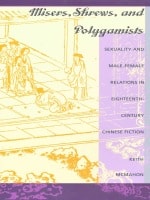
Misers, Shrews, and Polygamists
Sexuality and Male-Female Relations in Eighteenth-Century Chinese FictionKeith McMahon
Duke University Press, 1995
In many examples of rare erotic fiction, and in other works as well-known as Dream of the Red Chamber, Keith McMahon identifies a sexual economy defined by the figures of the "miser" and the "shrew"—caricatures of the retentive, self-containing man and the overflowing, male-enervating woman. Among these and other characters, the author explores the issues surrounding the practice of polygamy, the logic of its overvaluation of masculinity, and the nature of sexuality generally in Chinese society. How does the man with many wives manage and justify his sexual authority? Why and how might he escape or limit this presumed authority, sometimes to the point of portraying himself as abject before the shrewish woman? How do women accommodate or coddle the man, or else oppose, undermine, or remold him? And in what sense does the man place himself lower than the spiritually and morally superior woman?
The most extensive English-language study of Chinese literature from the eighteenth century, this examination of polygamy will interest not only students of Chinese history, culture, and literature but also all those concerned with histories of gender and sexuality.
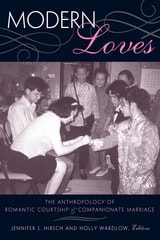
Modern Loves
The Anthropology of Romantic Courtship and Companionate MarriageJennifer S. Hirsch and Holly Wardlow, Editors
University of Michigan Press, 2006
In this first comparative ethnographic look at the global transformation toward marital ideals characterized by emotional intimacy, companionship, and mutual choice—discussed here as "companionate marriage"—Modern Loves asks how this shift is occurring and explores the factors that promote and hinder it, just who is pushing for these more companionate relationships, and what advantages men and women see in modern love. The contributors analyze the intricate negotiations surrounding love, marriage, and sex in Mexico, India, Papua New Guinea, Brazil, Pakistan, Nigeria, Singapore, and Hong Kong and among Latino youth in East Los Angeles. Modern Loves presents the new global approach to kinship studies, examining both the microlevel practices that constitute and bind relationships and the macrolevel forces that shape the landscape of love.
Jennifer S. Hirsch is Associate Professor in the Department of Sociomedical Sciences, Mailman School of Public Health, Columbia University. Holly Wardlow is Assistant Professor of Anthropology at the University of Toronto.
"What‘s love got to do with it? Hirsch and Wardlow answer this question by demonstrating the relevance—indeed, centrality—of the ideologies and practices surrounding romantic love and companionate marriage to the study of social transformation more broadly. The essays compiled in this volume explore the material, structural, and demographic underpinnings of the global shift in marital ideals while also tracing some of the sources of this marital shift in mass media, missionization, and the spread of individualism. The contributors of the chapters provide ethnographically rich examples of the ways in which people living in different societies interpret and act upon these global forces and images in sometimes overlapping and sometimes varying ways. This volume is an important and thoughtful contribution to the study of emotion, gender, kinship, and social change." —Laura M. Ahearn, Department of Anthropology, Rutgers University
"With its rich descriptions of the nuances in romantic love and its lucid analysis of the political economy of conjugal relations, this book will be widely read and loved by anthropologists as well as the concerned public."
—Yunxiang Yan, Department of Anthropology, UCLA
"Modern Loves offers an overview of current scholarship on love in the context of sexual relationships cross-culturally, and provides a view of the complexity of varied aspects of emotion, social structure, and social change in contemporary sexual relationships. It clearly makes the case for a political economic understanding of the emergence of ideologies of love, marriage, and courtship as part of expanding global economies."
—Linda-Anne Rebhun, Department of Anthropology, Yale University
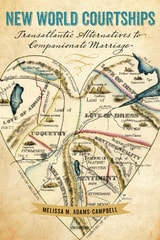
New World Courtships
Transatlantic Alternatives to Companionate MarriageMelissa M. Adams-Campbell
Dartmouth College Press, 2015

Odd Couples
Friendships at the Intersection of Gender and Sexual OrientationAnna Muraco
Duke University Press, 2012
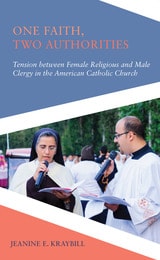
One Faith, Two Authorities
Tension between Female Religious and Male Clergy in the American Catholic ChurchJeanine E. Kraybill
Temple University Press, 2019
While female religious have grown to possess a sense of personal authority in issues impacting the laity, and have come to engage in social-issue-oriented activities, religious institutions have traditionally viewed men as the decision-makers. One Faith, Two Authorities examines the tensions of policy and authority within the gendered nature of the Catholic Church.
Jeanine Kraybilllooks at the influence of Catholic elites—specifically within the U.S. Conference of Catholic Bishops and the Leadership Conference of Women Religious—and their opinions on public policy and relevant gender dynamics with regard to healthcare, homosexuality, immigration, and other issues. She considers the female religious’ inclusive positions as well as their opposition to ACA for bills that would be rooted in institutional positions on procreation, contraception, or abortion. Kraybill also systematically examines the claims of the 2012 Doctrinal Assessment against the Leadership Conference of Women Religious.
One Faith, Two Authorities considerswhether the sisters and the male clergy are in fact in disagreement about social justice and healthcare issues and/or if women religious have influence.
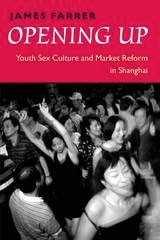
Opening Up
Youth Sex Culture and Market Reform in ShanghaiJames Farrer
University of Chicago Press, 2002
More and more men and women in China these days are having sex before marriage, creating a new youth sex culture based on romance, leisure, and free choice. The Chinese themselves describe these changes as an "opening up" in response to foreign influences and increased Westernization. Farrer explores these changes by tracing the basic elements in talk about sex and sexuality in Shanghai. He then shows how Chinese youth act out the sometimes-contradictory meanings of sex in the new market society. For Farrer, sexuality is a lens through which we can see how China imagines and understands itself in the wake of increased globalization. Through personal storytelling, neighborhood gossip, and games of seduction, young men and women in Shanghai balance pragmatism with romance, lust with love, and seriousness with play, collectively constructing and individually coping with a new culture based on market principles. With its provocative glimpse into the sex lives of young Chinese, then, Opening Up offers something even greater: a thoughtful consideration of China as it continues to develop into an economic superpower.

Reuben, Reuben
A NovelPeter De Vries
University of Chicago Press, 1964
SPOT IN THE DARK
BETH GYLYS
The Ohio State University Press, 2004
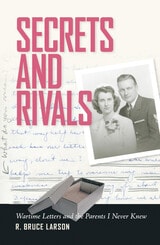
Secrets and Rivals
Wartime Letters and the Parents I Never KnewR. Bruce Larson
University of Missouri Press, 2015
Reading through the letters, he is drawn into his parents’ courtship amid the hardships of separation and war. Beyond the tumultuous romance, Larson finds that he barely recognizes his father, whom he knew only as distant and impassive. He uncovers shocking truths about his mother, Ruth, whom family lore had pigeonholed as sweetly pious.
At the time of the letters, Bob is a young Coast Guard clerk fighting off depression with thoughts of his dream girl back home. Back in Minnesota, Ruth passes the days adrift in romantic fantasies and liaisons with local admirers. Bob’s suspicions about Ruth and his obsession with her from afar threaten the young man’s fragile hold on his sanity, but he will not give her up. Decades later, their son comes to feel a tenderness for both his parents and to understand how their losses, fears, and reluctance can transform and refashion family bonds.
Taming of the Shrew
William Shakespeare
Arizona Center for Medieval and Renaissance Studies, 2022
While beloved for its sharp dialogue and witty banter, The Taming of the Shrew offers a problematic storyline that many have deemed misogynistic. The play contains insensitive gags and uneasy politics, making it difficult for modern audiences to connect with the text. Amy Freed’s new translation reactivates the original story, blowing away the dust and cobwebs. As Freed’s text reminds us, at its heart The Taming of the Shrew is a story about courage and authenticity.
This translation of The Taming of the Shrew was written as part of the Oregon Shakespeare Festival’s Play On! project, which commissioned new translations of thirty-nine Shakespeare plays. These translations present work from “The Bard” in language accessible to modern audiences while never losing the beauty of Shakespeare’s verse. Enlisting the talents of a diverse group of contemporary playwrights, screenwriters, and dramaturges from diverse backgrounds, this project reenvisions Shakespeare for the twenty-first century. These volumes make these works available for the first time in print—a new First Folio for a new era.
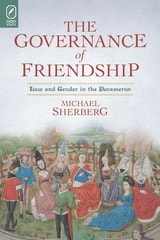
The Governance of Friendship
Law and Gender in the DecameronMichael Sherberg
The Ohio State University Press, 2011
Through a series of close readings at all three levels of the text—the author’s statements, the frame narrative, and the stories themselves—Sherberg shows how Boccaccio exposes and explores gender tensions rooted in a notion of the patriarchal household, which finds its own rationale in the natural-law postulate of the inferiority of women. Relying on the writings of the great twentieth-century legal theorist Hans Kelsen, Sherberg demonstrates how through the complex architecture of the Decameron Boccaccio dismantles the logic of natural law, exposing it instead as a rhetoric used by men to justify their control of women.
The Governance of Friendship aims well to advance our understanding of Boccaccio as an intellectual: not only steeped in the key texts of his time, but also at the forefront of critical thinking about such issues as law and gender which will play out over the coming centuries and beyond.
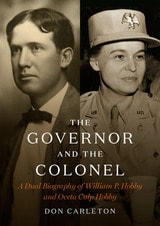
The Governor and the Colonel
A Dual Biography of William P. Hobby and Oveta Culp HobbyBy Don Carleton
University of Texas Press, 2020
William P. “Will” Hobby Sr. and Oveta Culp Hobby were one of the most influential couples in Texas history. Both were major public figures, with Will serving as governor of Texas and Oveta as the first commander of the Women’s Army Corps and later as the second woman to serve in a presidential cabinet. Together, they built a pioneering media empire centered on the Houston Post and their broadcast properties, and they played a significant role in the transformation of Houston into the fourth largest city in the United States. Don Carleton’s dual biography details their personal and professional relationship—defined by a shared dedication to public service—and the important roles they each played in local, state, and national events throughout the twentieth century.
This deeply researched book not only details this historically significant partnership, but also explores the close relationships between the Hobbys and key figures in twentieth-century history, from Texas legends such as LBJ, Sam Rayburn, and Jesse Jones, to national icons, including the Roosevelts, President Eisenhower, and the Rockefellers. Carleton's chronicle reveals the undeniable impact of the Hobbys on journalistic and political history in the United States.

The Last Layer of the Ocean
Kayaking through Love and Loss on Alaska's Wild CoastMary Emerick
Oregon State University Press, 2021
The year Emerick turned 38, the suicide of a stranger compelled her to uproot her life and strike out for Alaska, taking a chance on love and home. She learned how to travel in a small yellow kayak along the rugged coast, contending with gales, high seas, and bears. She pondered the different meanings of home from the perspectives of people who were born along Alaska’s coast, the first peoples who had been there for generations, newcomers who chose this place for themselves, and the many who would eventually, inevitably leave. When she married a man from another island, convinced that love would stick, she soon learned that marriage is just as difficult to navigate as the ocean.
Divided into sections detailing the main kayaking strokes, with each stroke serving as metaphor for the lives we all pass through and the tools needed to stay afloat, this eloquent memoir speaks to the human need for connection—connection to place and to our fellow travelers casting their bubbles of light in the depths.
The Red Sofa
Michel Lesbre
Seagull Books, 2017
In The Red Sofa, we meet Anne, a young woman setting off on the Trans-Siberian Railway in order to find her former lover, Gyl, who left twenty years before. As the train moves across post-Soviet Russia and its devastated landscapes, Anne reflects on her past with Gyl and their patriotic struggles, as well as on the neighbor she has just left behind, Clémence Barrot.
Rocked by the train’s movements Anne is moved by her memory of Clémence, who is old and whose memory is failing, but who has not lost her taste for life and adventure. Ensconced on her red sofa at home, Clémence loves to tell Anne her life story, mourning lost loved ones and celebrating the lives of brave, rebellious women who went before her. Eventually, Anne’s train trip returns her home having not found Gyl, but having found something much more meaningful—herself.
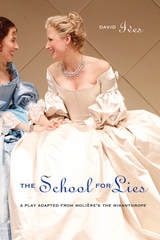
The School for Lies
A Play Adapted from Molière's The MisanthropeDavid Ives
Northwestern University Press, 2012

The Typewriter Satyr
A NovelDwight Allen
University of Wisconsin Press, 2009
Finalist, General Fiction, Midwest Book Awards

The Weather Changed, Summer Came and So On
Pedro Carmona-Alvarez
Seagull Books, 2015
The Weather Changed, Summer Came and So On is a haunting novel about love, loss, and identity that focuses on the survival of trauma. Translated beautifully from its original Norwegian by Diane Oatley, it constructs and inhabits a liminal world as the protagonists seek to stay afloat amid grief and estrangement. This is a gripping, heartbreaking story that will move readers with its timelessness and universal relevance.
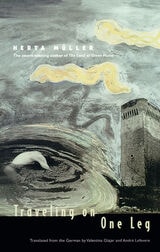
Traveling on One Leg
Herta Muller
Northwestern University Press, 2010
Winner, 2009 Nobel Prize in Literature
Irene is a fragile woman born to a German family in Romania, who has recently emigrated from her native country to West Germany. Politically and socially isolated, Irene moves within the orbit of three troubled men, while simultaneously embarking on an inner exploration of exile, homeland, and identity.
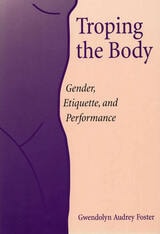
Troping the Body
Gender, Etiquette, and PerformanceGwendolyn Audrey Foster
Southern Illinois University Press, 2000
Troping the Body: Gender, Etiquette, and Performance is an interdisciplinary study of etiquette texts, conduct literature, and advice books and films. GwendolynAudrey Foster analyzes the work of such women authors as Emily Post, Christine de Pizan, Hannah Webster Foster, Emily Brontë, Frances E. W. Harper, and Martha Stewart as well as such women filmmakers as Lois Weber and Kasi Lemmons.
“Specifically,” Foster notes, “I was interested in the possibility of locating power and agency in the voices of popular etiquette writers.” Her investigation led her to analyze etiquette and conduct literature from the Middle Ages to the present. Within this wide scope, she redefines the boundaries of conduct literature through a theoretical examination of the gendered body as it is positioned in conduct books, etiquette texts, poetry, fiction, and film.
Drawing on Bakhtin, Gates, Foucault, and the new school of performative feminism to develop an interdisciplinary approach to conduct literature—and literature as conduct—Foster brings a unique perspective to the analysis of ways in which the body has been gendered, raced, and constructed in terms of class and sexuality.
Even though women writers have been actively writing conduct and etiquette texts since the medieval period, few critical examinations of such literature exist in the fields of cultural studies and literary criticism. Thus, Foster’s study fills a gap and does so uniquely in the existing literature. In examining these voices of authority over the body, Foster identifies the dialogic in the texts of this discipline that both supports and disrupts the hegemonic discourse of a gendered social order.

Twilight of Torment
II. HeritageLéonora Miano
Seagull Books, 2023
After beating his girlfriend and leaving her for dead on the street, Amok retraces his steps. Frightened by his act, which reproduces the violence of his father, he hopes to save the woman. But it is too late when he arrives at the scene; two women are already carrying the injured woman. Overwhelmed and not daring to reveal himself, he decides to find his father in order to learn how to rid himself of the dark force that he believes runs through the men of his lineage. He embarks on a journey that will be, more than anything, an inner one, forcing him to understand his story and choose a healthier way of being in the world. This second volume of Twilight of Torment is both intimate and political. Through the story of a man and his family, we discover an African bourgeoisie and its many social wanderings in a contemporary Africa whose future seems nebulous.

Twilight of Torment
MelancholyLéonora Miano
Seagull Books, 2022
Four women speak. They speak to the same man, who is not there. He is the son of the first, the great-yet-impossible love of the second, the platonic companion of the third, the older brother of the last. Speaking to him in his absence, it is to themselves that these women turn, examining their own stories to make sense of their journey, from twilight to twilight, through a mysterious stormy night in the middle of the dry season.
Together, the voices in Twilight of Torment: Melancholy, the first volume of a two-volume novel, perform a powerful and sometimes discordant jazz-inspired chorus about issues such as femininity, sexuality, self-love, and the intrusion of history into the intimate lives of people of African descent. Blackness confronts African-ness, love is sometimes discovered in the arms of another woman, the African renaissance tries to establish itself on the rubble of self-esteem damaged by history. Each of these women, with her own language and rhythm, ultimately represents a specific aspect of the tormented history of Africans in today’s world, and at the end of the night, they will each arrive at a dawn of hope.
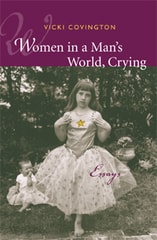
Women in a Man's World, Crying
EssaysVicki Covington
University of Alabama Press, 2002
This thoughtful, engaging collection examines resilience, identity, and inequality in the modern workplace produced by one of the nation's most observant and incisive writers.
This collection of warm, heartfelt essays from award-winning novelist Vicki Covington chronicles the multitude of "in between" moments in the writer's life. These are her stolen moments in between the writing of four novels-Gathering Home, Bird of Paradise, Night Ride Home, and The Last Hotel for Women; in between coauthoring the edgy memoir Cleaving: The Story of a Marriage with her husband Dennis Covington; in between raising two daughters; in between her husband's struggle with cancer and the author's own heart attack; in between a life full of trials and triumphs, disappointments and celebrations - moments that, as Covington demonstrates here, are always rich and revealing.
In the title essay, the author questions why all seven middle-class women who live on her street confess at a neighborhood cookout that in the past 48 hours each of them has cried. In "A Southern Thanksgiving," Covington reflects on the "family dance" that is Thanksgiving in the South: "In the North they put their crazy family members in institutions, but in the South we put them in the living room for everyone to enjoy." In "My Mother's Brain," the author recounts the onset of Alzheimer's in her mother and how, with the spread of the disease, an untapped vein of love is revealed.
Some of these essays were written as weekly newspaper columns for the Birmingham News. Others were written for specific literary occasions, such as the First Annual Eudora Welty Symposium. They are divided into six thematic sections: "Girls and Women," "Neighborhood," "Death," "The South," "Spiritual Matters," and “Writing.”
Throughout, as Covington casts her candid, attentive eye on a situation, confusion yields to comprehension, fear flourishes into faith, and anger flows into understanding. In memorializing the small moments of her life, she finds that they are far from peripheral; indeed, they are central to a life full of value and meaning.