Results by title
48 books match the query 'Progressivism (United States politics)'
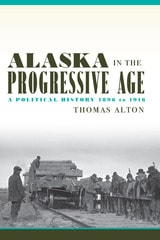
Alaska in the Progressive Age
A Political History, 1896 to 1916Thomas Alton
University of Alaska Press, 2019
Alaska in the Progressive Age looks at how this national movement affected the Alaska territory. Though the reigning view is that Alaska was neglected and even abused by the federal government, Alton argues that from 1896 to 1916 the territory benefitted richly in the age of Progressive Democracy. As the population of Alaska grew, Congress responded to the needs of the nation’s northern possession, giving the territory a delegate to Congress, a locally elected legislature, and ultimately in 1914, the federally funded Alaska Railroad.
Much has been written about the development of modern-day Alaska, especially in terms of the Gold Rush and the origins of the Alaska Railroad. But this is the first history to put this era in the context of Progressive Age American politics. This unexplored look at how Progressivism reached the furthest corners of the United States is an especially timely book as the Progressive Movement shows signs of affecting Alaska again.

Are We the 99%?
The Occupy Movement, Feminism, and IntersectionalityHeather McKee Hurwitz
Temple University Press, 2021
The protestors that comprised the Occupy Wall Street movement came from diverse backgrounds. But how were these activists—who sought radical social change through many ideologies—able to break down oppressions and obstacles within the movement? And in what ways did the movement perpetuate status-quo structures of inequality?
Are We the 99%? is the first comprehensive feminist and intersectional analysis of the Occupy movement. Heather McKee Hurwitz considers how women, people of color, and genderqueer activists struggled to be heard and understood. Despite cries of “We are the 99%,” signaling solidarity, certain groups were unwelcome or unable to participate. Moreover, problems with racism, sexism, and discrimination due to sexuality and class persisted within the movement.
Using immersive first-hand accounts of activists’ experiences, online communications, and media coverage of the movement, Hurwitz reveals lessons gleaned from the conflicts within the Occupy movement. She compares her findings to those of other contemporary protest movements—nationally and globally—so that future movements can avoid infighting and deploy an “intersectional imperative” to embrace both diversity and inclusivity.
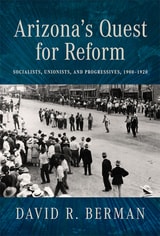
Arizona’s Quest for Reform
Socialists, Unionists, and Progressives, 1900–1920David R. Berman
University of Arizona Press, 2026
In Arizona’s Quest for Reform, David R. Berman traces the rise and fall of a dynamic coalition of socialists, labor activists, and progressive Democrats led by the influential Governor George Hunt as they pursued sweeping reforms in a rapidly changing state. From the fight for workers’ rights and women’s suffrage to the use of the initiative process and the role of radical newspapers, Berman brings to life the people and movements that shaped Arizona’s early political identity.
Drawing on extensive primary sources and organized in a clear chronological structure, Berman’s study reveals the tensions, alliances, and dramatic events that defined Arizona’s reform efforts between 1900 and 1920. The book explores the impact of powerful mining interests, railroad companies, and labor unions, while also examining the racialization of Mexican miners and their evolving role in the labor movement. Through vivid storytelling and rigorous scholarship, Berman uncovers the complexities of political change in a state straddling the transition from territory to statehood.
This landmark work will appeal to scholars of western history, labor studies, and political science, as well as general readers interested in Arizona’s unique place in the national Progressive movement. Arizona’s Quest for Reform not only deepens our understanding of the past but also offers timely insights into the enduring challenges of coalition building, grassroots activism, and political reform. It is a vital contribution to the study of Arizona and the American West.

Belle and Bob La Follette
Partners in PoliticsBob Kann
Wisconsin Historical Society Press, 2008
The most famous couple in Wisconsin politics, "Fighting Bob" La Follette and his wife, Belle Case La Follette, come to life in the pages of the newest addition to the Badger Biographies series for young readers. In an accessible format that includes historic images, a glossary of terms, and sidebars explaining political concepts, students learn about Progressive politics and reform in the early 20th century through the experiences of this pioneering couple.
The father of "Progressive politics," Bob La Follette was famous for digging in his heels when it came to reforming government corruption. He also gained a reputation for fiery speeches on the campaign trail and on the Senate floor. Belle La Follette was political in her own right. The first woman to graduate from the University of Wisconsin's Law School, she was an advocate for world peace and an agitator for the women's vote. She was also Bob's most trusted political advisor. Together, the couple raised a family and fought for the changes they believed would make the world a better place.
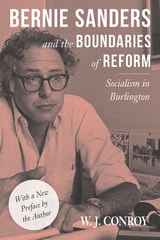
Bernie Sanders and the Boundaries of Reform
Socialism in BurlingtonW. J. Conroy
Temple University Press, 2016
In his preface to this reissue of the 1990 book, Challenging the Boundaries of Reform, W. J. Conroy reflects on the recent legacy of Sanders, his Agenda for America, and his appeal to young voters. His book then looks back to identify Sanders’ experience in Burlington by examining several case studies that unfolded amidst a conservative trend nationally, an unsympathetic state government, and a hostile city council.
Ultimately, Conroy asks what lessons can be drawn from the case of Burlington that would aid the American left in its struggle to capture both government and civil society?
Black Georgia in the Progressive Era, 1900-1920
John Dittmer
University of Illinois Press, 1977
have of black life in a southern state at the beginning of the twentieth century."
-- Howard N. Rabinowitz,
Journal of American History
"The author shows clearly and forcefully
the ways in which this [white] system abused and controlled the black lower
caste in Georgia." -- Lester C. Lamon, American Historical Review.
"Dittmer has a faculty for lucid exposition of complicated subjects. This is
especially true of the sections on segregation, racial politics, disfranchisement,
woman's suffrage and prohitibion, the neo-slavery in agriculture, and the racial
violence whose threat and reality hung like a pall over all of Georgia throughout
the period." -- Donald L. Grant, Georgia Historical Quarterly.
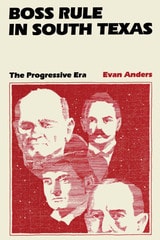
Boss Rule in South Texas
The Progressive EraBy Evan Anders
University of Texas Press, 1982
Four men played leading roles in the political drama that unfolded in South Texas during the first decades of this century:
- James B. Wells, who ruled as boss of Cameron County and served as leading conservative spokesman of the Democratic Party in Texas;
- Archer (Archie) Parr, whose ruthless tactics and misuse of public funds in Duval County established him as one of the most notoriously corrupt politicians in Texas history;
- Manuel Guerra, Mexican American rancher and merchant whose domination of Starr County mirrored the rule of his Anglo counterparts in the border region;
- John Nance Garner, who served the interests of these bosses of South Texas as he set forth on the road that would lead him to the United States vice-presidency.
Evan Anders's Boss Rule in South Texas tells the story of these men and the county rings they shaped in South Texas during the Progressive Era.
Power was the byword of the bosses of the Lower Rio Grande Valley, and Anders explores the sources of that power. These politicos did not shirk from using corrupt and even violent means to attain their goals, but Anders demonstrates that their keen sensitivity to the needs of their diverse constituency was key to their long-term success. Patronage and other political services were their lifeblood, and the allies gained by these ranged from developers and businessmen to ranchers and Mexican Americans, wealthy and poor.
Besides examining the workings of the Democratic machines of four South Texas counties, Anders explores the role of the Hispanic populace in shaping the politics of the border region, the economic development of the Lower Rio Grande Valley and its political repercussions, the emergence and nature of progressive movements at both local and state levels, and the part played by the Texas Rangers in supporting bossism in South Texas.
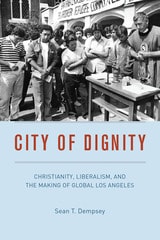
City of Dignity
Christianity, Liberalism, and the Making of Global Los AngelesSean T. Dempsey
University of Chicago Press, 2023
Contemporary Los Angeles is commonly seen as an American bulwark of progressive secular politics, a place that values immigration, equity, diversity, and human rights. But what accounts for the city’s embrace of such staunchly liberal values, which are more hotly contested in other parts of the country? The answer, Sean Dempsey reveals, lies not with those frequent targets of credit and blame—Democrats in Hollywood—but instead with liberal Protestants and other steadfast religious organizations of the postwar era.
As the Religious Right movement emerged in the 1970s, progressive religious activists quietly began promoting an ethical vision that made waves worldwide but saw the largest impact in its place of origin: metropolitan Los Angeles. At the center of this vision lay the concept of human dignity—entwining the integral importance of political and expressive freedom with the moral sanctity of the human condition—which suffused all of the political values that arose from it, whether tolerance, diversity, or equality of opportunity. The work of these religious organizations birthed such phenomena as the Sanctuary Movement—which provided safe haven for refugees fleeing conflict-torn Central America—and advocacy for the homeless, both of which became increasingly fraught issues amid the rising tides of neoliberalism and conservatism. City of Dignity explores how these interwoven spiritual and theological strands found common ground—and made common impacts—in the humanitarian ecosystem of one of America’s largest and most dynamic metro areas.

Defending the Masses
A Progressive Lawyer's Battles for Free SpeechEric B. Easton
University of Wisconsin Press, 2018
Roe was the principal trial lawyer of the Free Speech League—a precursor of the American Civil Liberties Union. His cases involved such activists as Emma Goldman, Lincoln Steffens, Margaret Sanger, Max Eastman, Upton Sinclair, John Reed, and Eugene Debs, as well as the socialist magazine The Masses and the New York City Teachers Union. A friend of Wisconsin's progressive senator Robert La Follette since their law partnership as young men, Roe defended "Fighting Bob" when the Senate tried to expel him for opposing America's entry into World War I.
In articulating and upholding Americans' fundamental right to free expression against charges of obscenity, libel, espionage, sedition, or conspiracy during turbulent times, Roe was rarely successful in the courts. But his battles illuminate the evolution of free speech doctrine and practice in an era when it was under heavy assault. His greatest victory, including the 1917 decision by Judge Learned Hand in The Masses Publishing Co. v. Patten, is still influential today.
Democracy in Print
The Best of The Progressive Magazine, 1909–2009Edited by Matthew Rothschild
University of Wisconsin Press, 2009
Readers will discover the vision of the magazine’s founder, Robert “Fighting Bob” La Follette, and his suffragist wife, Belle Case La Follette. They’ll find historic gems from the likes of Jane Addams, Carl Sandburg, Huey Long, and John Kenneth Galbraith, and profound essays by Theodore Dreiser, Barbara Ehrenreich, Noam Chomsky, Upton Sinclair, Arundhati Roy, James Baldwin, Edwidge Danticat, and Edward Said. The collection is leavened with humor from Kate Clinton, Will Durst, Michael Feldman, and Molly Ivins, and graced by poems from such writers as Mahmoud Darwish, Rita Dove, Martín Espada, Maxine Kumin, Adrienne Rich, and Sandra Cisneros. Fascinating interviews bring readers into conversations with prominent cultural figures, including Chuck D, the Dalai Lama, Allen Ginsberg, Amy Goodman, Harold Pinter, Patti Smith, Susan Sarandon, and Yevgeny Yevtushenko.
Eminently browsable, this book is for anyone concerned with American democracy, the global community, and the perils of the planet. With contributions by actors and Supreme Court justices, comedians and Nobel Prize-winners, Democracy in Print offers all readers nourishing food for thought.
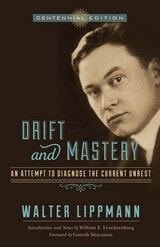
Drift and Mastery
An Attempt to Diagnose the Current UnrestWalter Lippmann, Introduction and notes by William E. Leuchtenburg, Foreword by Ganesh Sitaraman
University of Wisconsin Press, 2015
Lippman’s Drift and Mastery became one of the most important and influential documents of the Progressive Movement. It remains a valuable text for understanding the political thought of early twentieth-century America and a lucid exploration of timeless themes in American government and politics. Distinguished historian Walter Leuchtenberg’s 1986 introduction and notes are retained in this edition.
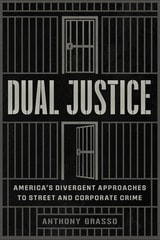
Dual Justice
America’s Divergent Approaches to Street and Corporate CrimeAnthony Grasso
University of Chicago Press, 2024
A far-reaching examination of how America came to treat street and corporate crime so differently.
While America incarcerates its most marginalized citizens at an unparalleled rate, the nation has never developed the capacity to consistently prosecute corporate wrongdoing. Dual Justice unearths the intertwined histories of these two phenomena and reveals that they constitute more than just modern hypocrisy.
By examining the carceral and regulatory states’ evolutions from 1870 through today, Anthony Grasso shows that America’s divergent approaches to street and corporate crime share common, self-reinforcing origins. During the Progressive Era, scholars and lawmakers championed naturalized theories of human difference to justify instituting punitive measures for poor offenders and regulatory controls for corporate lawbreakers. These ideas laid the foundation for dual justice systems: criminal justice institutions harshly governing street crime and regulatory institutions governing corporate misconduct.
Since then, criminal justice and regulatory institutions have developed in tandem to reinforce politically constructed understandings about who counts as a criminal. Grasso analyzes the intellectual history, policy debates, and state and federal institutional reforms that consolidated these ideas, along with their racial and class biases, into America’s legal system.
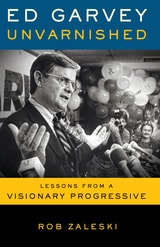
Ed Garvey Unvarnished
Lessons from a Visionary ProgressiveRob Zaleski
University of Wisconsin Press, 2019
Shortly before he died, Garvey expressed his views on everything in a series of detailed, no-holds-barred interviews with journalist Rob Zaleski. In his trademark witty, blunt, and often abrasive style, he offered his impressions of the political climate, worries about the environment, and Act 10 protests on Capitol Square. Garvey's candor during these conversations provides deeper insight into the personal highs and lows he experienced over his rich life. Diehard followers will fondly remember his energetic campaigns, but they may be surprised to learn of his long-simmering disappointment after those losses. Ever timely and meaningful, Garvey's words offer a path for how the Democratic Party, both within Wisconsin and nationally, can regain its soul.

Educated by Initiative
The Effects of Direct Democracy on Citizens and Political Organizations in the American StatesDaniel A. Smith and Caroline J. Tolbert
University of Michigan Press, 2004
--Kristina Wilfore, Executive Director, Ballot Initiative Strategy Center and Foundation
Educated by Initiative moves beyond previous evaluations of public policy to emphasize the educational importance of the initiative process itself. Since a majority of ballots ultimately fail or get overturned by the courts, Smith and Tolbert suggest that the educational consequences of initiative voting may be more important than the outcomes of the ballots themselves. The result is a fascinating and thoroughly-researched book about how direct democracy teaches citizens about politics, voting, civic engagement and the influence of special interests and political parties. Designed to be accessible to anyone interested in the future of American democracy, the book includes boxes (titled "What Matters") that succinctly summarize the authors' data into easily readable analyses.
Daniel A. Smith is Associate Professor of Political Science at the University of Florida.
Caroline J. Tolbert is Associate Professor of Political Science at Kent State University.
Eleanor Baldwin and the Woman's Point of View
New Thought Radicalism in Portland’s Progressive EraLawrence M. Lipin
Oregon State University Press, 2017
A century before the Occupy movement and the Women’s March, Baldwin spoke truth to power. Imbued with a New Thought spirituality that presumed progressive thought could directly affect material reality, she wrote to move history forward. And yet, the trajectory of history proved as hard to forecast then as now. While her personal story seems to embody a modern progressivism, blending abolition with labor reform and anti-banker activism—positions from which she never wavered—her path grew more complicated as times changed in the aftermath of World War I, when she would advocate on behalf of both the Bolsheviks and the Ku Klux Klan.
In this deeply researched and nuanced account of Eleanor Baldwin’s intellectual journey, historian Larry Lipin reveals how even the most dedicated radical can be overcome by unforeseen events. Eleanor Baldwin and the Woman’s Point of View restores a missing chapter in Portland’s Progressive Era history and rescues this passionate, intriguing, and quixotic character from undeserved obscurity.

Fair Share
Senior Activism, Tiny Publics, and the Culture of ResistanceGary Alan Fine
University of Chicago Press, 2023
If you've ever been to a protest or been involved in a movement for social change, you have likely experienced a local culture, one with slogans, jargon, and shared commitments. Though one might think of a cohort of youthful organizers when imagining protest culture, this powerful ethnography from esteemed sociologist Gary Alan Fine explores the world of senior citizens on the front lines of progressive protests. While seniors are a notoriously important—and historically conservative—political cohort, the group Fine calls “Chicago Seniors Together” is a decidedly leftist organization, inspired by the model of Saul Alinsky. The group advocates for social issues, such as affordable housing and healthcare, that affect all sectors of society but take on a particular urgency in the lives of seniors. Seniors connect and mobilize around their distinct experiences but do so in service of concerns that extend beyond themselves. Not only do these seniors experience social issues as seniors—but they use their age as a dramatic visual in advocating for political change.
In Fair Share, Fine brings readers into the vital world of an overlooked political group, describing how a “tiny public” mobilizes its demands for broad social change. In investigating this process, he shows that senior citizen activists are particularly savvy about using age to their advantage in social movements. After all, what could be more attention-grabbing than a group of passionate older people determinedly shuffling through snowy streets with canes, in wheelchairs, and holding walkers to demand healthcare equity, risking their own health in the process?

Feeling Like a State
Desire, Denial, and the Recasting of AuthorityDavina Cooper
Duke University Press, 2019
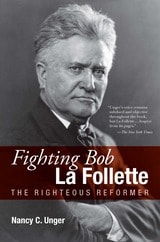
Fighting Bob La Follette
The Righteous ReformerNancy C Unger
Wisconsin Historical Society Press, 2008

Fighting Son
A Biography of Philip F. La FolletteJonathan Kasparek
Wisconsin Historical Society Press, 2006
Former Wisconsin governor Philip F. La Follette forged a political path characterized by his progressive, innovative vision. Growing up in the shadow of revered senator "Fighting Bob" La Follette made for a politically charged childhood and laid the groundwork for Phil's emergence as a powerful figure in Wisconsin politics. A gregarious and fiery politician, Phil's efforts led to the passage of the country's first unemployment compensation act, aid programs for workers and farmers, and the reorganization of state government.
This approachable, comprehensive book traces La Follette's journey through public office as well as his life after the waning of the Progressive era. Phil La Follette’s is a history of continuing progressivism, of innovative solutions to social problems, and of loyalty to a political ethos that goes far beyond love of country. Kasparek's treatment of this Fighting Son is a monument not only to La Follette but to progressive politics in Wisconsin.
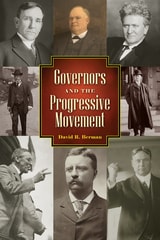
Governors and the Progressive Movement
David R. Berman
University Press of Colorado, 2019
Governors and the Progressive Movement is the first comprehensive overview of the Progressive movement’s unfolding at the state level, covering every state in existence at the time through the words and actions of state governors. It explores the personalities, ideas, and activities of this period’s governors, including lesser-known but important ones who deserve far more attention than they have previously been given.
During this time of greedy corporations, political bosses, corrupt legislators, and conflict along racial, class, labor/management, urban/rural, and state/local lines, debates raged over the role of government and issues involving corporate power, racism, voting rights, and gender equality—issues that still characterize American politics. Author David R. Berman describes the different roles each governor played in the unfolding of reform around these concerns in their states. He details their diverse leadership qualities, governing styles, and accomplishments, as well as the sharp regional differences in their outlooks and performance, and finds that while they were often disposed toward reform, governors held differing views on issues—and how to resolve them.
Governors and the Progressive Movement examines a time of major changes in US history using relatively rare and unexplored collections of letters, newspaper articles, and government records written by and for minority group members, labor activists, and those on both the far right and far left. By analyzing the governors of the era, Berman presents an interesting perspective on the birth and implementation of controversial reforms that have acted as cornerstones for many current political issues. This book will be of interest to students and scholars of US history, political science, public policy, and administration.
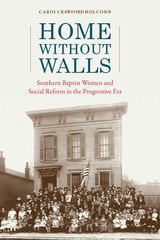
Home without Walls
Southern Baptist Women and Social Reform in the Progressive EraCarol Crawford Holcomb
University of Alabama Press, 2020
The Woman’s Missionary Union (WMU), founded in 1888, carved out a uniquely feminine space within the Southern Baptist Convention during the tumultuous years of the Progressive Era when American theologians were formulating the social gospel. These women represented the Southern Baptist elite and as such had the time to read, write, and discuss ideas with other Southern progressives. They rubbed shoulders with more progressive Methodist and Presbyterian women in clubs and ecumenical missionary meetings. Baptist women studied the missionary publications of these other denominations and adopted ideas for a Southern Baptist audience.
Home without Walls: Southern Baptist Women and Social Reform in the Progressive Era shows how the social attitudes of women were shaped at the time. By studying primary documents—including personal letters, official exchanges and memoranda, magazine publications, newsletters, and editorials—Carol Crawford Holcomb uncovers ample evidence that WMU leaders, aware of the social gospel and sympathetic to social reform, appropriated the tools of social work and social service to carry out their missionary work.
Southern Baptist women united to build a financial empire that would sustain the Southern Baptists through the Great Depression and beyond. Their social attitudes represented a kaleidoscope of contrasting opinions. By no stretch of the imagination could WMU leaders be characterized as liberal social gospel advocates. However, it would also be wrong to depict them as uniformly hostile to progressivism or ignorant of contemporary theological ideas. In the end, they were practical feminists in their determination to provide a platform for women’s views and a space for women to do meaningful work.
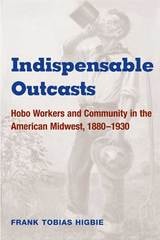
Indispensable Outcasts
Hobo Workers and Community in the American Midwest, 1880-1930Frank Tobias Higbie
University of Illinois Press, 2003
Often overlooked in labor history, the hoboes who rode the rails in search of seasonal work nevertheless secured a place in the American imagination. Frank Tobias Higbie weaves together history, anthropology, gender studies, and literary analysis to reposition these workers at the center of Progressive Era debates over class, race, manly responsibility, community, and citizenship. Combining incisive cultural criticism with labor history, Higbie illustrates how these so-called marginal figures were in fact integral to communities and to cultural conflicts over class, masculinity, and sexuality. He draws from life histories, the investigations of social reformers, and the organizing materials of the Industrial Workers of the World to present a complex portrait of hobo life, from its often violent and dangerous working conditions to its ethic of “transient mutuality” that enabled survival and resistance on the road.
Frank and compelling,Indispensable Outcasts examines hoboes within the sprawling story of American labor while meditating on writing history from the bottom up and the ways a fascination with personal narrative can color a historian's work.
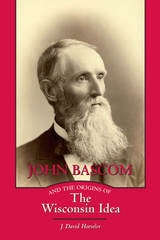
John Bascom and the Origins of the Wisconsin Idea
J. David Hoeveler Jr.
University of Wisconsin Press, 2017
During his term as governor (1901–1906), Robert La Follette routinely consulted with University of Wisconsin researchers to devise groundbreaking programs and legislation. Although the Wisconsin Idea is often attributed to a 1904 speech by Charles Van Hise, then president of the University of Wisconsin, David Hoeveler argues that it originated decades earlier, in the creative and fertile mind of John Bascom.
A philosopher, theologian, and sociologist, Bascom (1827–1922) deeply influenced a generation of students at the University of Wisconsin, including La Follette and Van Hise. Hoeveler documents how Bascom drew concepts from German idealism, liberal Protestantism, and evolutionary theory, transforming them into advocacy for social and political reform. He was a champion of temperance, women's rights, and labor, all of which brought him controversy as president of the university from 1874 to 1887. In a way unmatched by any of his peers at other institutions, Bascom outlined a social gospel that called for an expanded role for state governments and universities as agencies of moral improvement.
Hoeveler traces the intellectual history of the Wisconsin Idea from the nineteenth century to such influential Progressive Era thinkers as Richard T. Ely and John R. Commons, who believed university researchers should be a vital source of expertise for government and citizens.
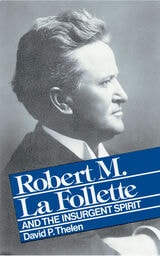
La Follette Insurgent Spirit
David P. Thelen
University of Wisconsin Press, 1986
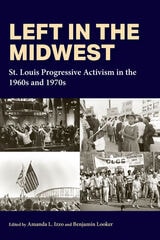
Left in the Midwest
St. Louis Progressive Activism in the 1960s and 1970sAmanda L. Izzo
University of Missouri Press, 2023
Despite St. Louis’s mid-twentieth-century reputation as a conservative and sleepy midwestern metropolis, the city and its surrounding region have long played host to dynamic forms of social-movement organizing. This was especially the case during the 1960s and 1970s, when a new generation of local activists lent their energies to the ongoing struggles for Black freedom, lesbian and gay liberation, feminist social transformations, environmental protection, an end to the Vietnam War, and more. This volume, the first of its kind, offers fifteen scholarly contributions that together bring into focus the exceptional range of progressive activist projects that took shape in a single midwestern city during these tumultuous decades.
In contrast to scholarship that seeks to interpret the era’s social-movement initiatives in a primarily national context, the works presented in this expansive collection emphasize the importance of locality, neighborhood, community institutions, and rooted social networks. Documenting wrenching forces of metropolitan change as well as grassroots resilience, Left in the Midwest shows us how place powerfully shaped agendas, worldviews, and opportunities for the disparate groups that dedicated themselves to progressive visions for their city. By revising our sense of the region’s past, this volume also expands our sense of the possibilities that the future may hold for activist movements seeking change in St. Louis and beyond.
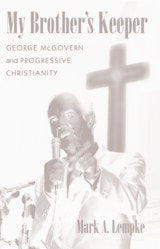
My Brother's Keeper
George McGovern and Progressive ChristianityMark A. Lempke
University of Massachusetts Press, 2017
George McGovern is chiefly remembered for his landslide loss to Richard Nixon in 1972. Yet at the time, his candidacy raised eyebrows by invoking the prophetic tradition, an element of his legacy that is little studied. In My Brother's Keeper, Mark A. Lempke explores the influence of McGovern's evangelical childhood, Social Gospel worldview, and conscientious Methodism on a campaign that brought antiwar activism into the mainstream.
McGovern's candidacy signified a passing of the torch within Christian social justice. He initially allied with the ecumenical movement and the mainline Protestant churches during a time when these institutions worked easily with liberal statesmen. But the senator also galvanized a dynamic movement of evangelicals rooted in the New Left, who would dominate subsequent progressive religious activism as the mainline entered a period of decline. My Brother's Keeper argues for the influential, and often unwitting, role McGovern played in fomenting a “Religious Left” in 1970s America, a movement that continues to this day. It joins a growing body of scholarship that complicates the dominant narrative of that era's conservative Christianity.

Nearly Neighbors
Jane Addams, Johnny Powers, and the Progressive Political ImaginationTerrence J. McDonald
University of Chicago Press, 2026
Jane Addams was full of courage and goodwill when she opened Hull House in Chicago’s Nineteenth Ward in 1889. However, she failed to understand that her immigrant neighbors had been well-organized around mostly Catholic churches and schools for decades before her arrival. Her ultimate political rival, Johnny Powers, grew up in this culture but was no ethnic hero or deep political thinker. Nearly Neighbors is the first book to provide a contextualized history of their encounter, embedding it in the social and political culture and structures of Chicago and the Nineteenth Ward in the 1890s.
Terrence J. McDonald provides a crucial analysis of two pivotal figures in Chicago’s political history, in part by providing the first detailed assessment of Powers’s life and practices, but also by demonstrating Addams’s misconception of him and her neighbors—and why it matters for understanding her Progressive work overall. In both her political work and writings, Addams saw her ethnic neighbors as bundles of economic need, rather than bearers of ethnic culture. At the same time, she was recruited by elite allies into causes that appeared to be opposed by her neighbors. These views and practices permitted Powers to win in their climactic political battle in 1898 simply by claiming to be the neighborhood defender against Addams and her “downtown” allies. Nearly Neighbors offers a new way of understanding Addams and the complicated legacy of her famous political work and writings.
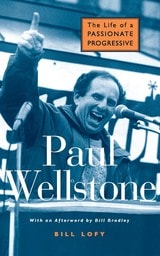
Paul Wellstone
The Life of a Passionate ProgressiveBill Lofy
University of Michigan Press, 2005
---Arianna Huffington, columnist and editor of HuffingtonPost.com
"This book captures the vibrant spirit of my friend Paul Wellstone---the fierce commitment to justice that defined his life, and that shapes his enduring legacy."
---U.S. Senator Russ Feingold
"Paul Wellstone was a great leader because he fused progressive idealism with a stubbornly pragmatic politics. Bill Lofy's book captures that dual commitment in his story of Wellstone's life, and also shows us the extraordinary human appeal that Wellstone emanated in his relationships with people in all walks of life. This book is an engaging read that also tells us a lot about the political practice to which we should aspire."
---Frances Fox Piven, author of The War at Home
"This vividly written book captures the life and personal qualities of the late Senator Paul Wellstone. In so doing it provides an illuminating gloss on Max Weber's seminal exposition of the political vocation. It is a jewel of a book."
-Fred Greenstein, Princeton University
Bill Lofy's fast-paced and readable biography tells the inspirational story of one of the most compelling figures in the history of American politics---Senator Paul Wellstone.
Yet Lofy's book is more than just the chronicle of Wellstone's life and political career; it's also an indispensable guide to what ails political life today. Readers politically inclined or not will find in its pages a handbook to the uncertain and often treacherous business of politics and a stirring example for living a courageous and honest life---whether as public servant or private individual.

Persistent Progressives
The Rocky Mountain Farmers UnionJohn F. Freeman
University Press of Colorado, 2015
Using data spanning decades, author John Freeman covers the founding of the RMFU in 1907 until the present, demonstrating how members continually sought to control the means of production and marketing by forming cooperatives, providing consumer services, and engaging in politics. Powering this evolution was a group of “practical idealists”—the Farmers Union leaders and titular persistent progressives who shaped the organization’s growth and expansion. Initiated by Jim Patton, who brought the organization out of its oppositional roots and into its cooperative advocacy, the RMFU passed to John Stencel and then David Carter, joining hands with agricultural conservationists and small organic producers along the way to carry the torch for progressive agrarianism in today’s urbanized world. Shaken but undeterred by some notable failures, its leadership remains convinced of the efficacy of cooperatives as a means to achieve justice for all.
Discussing the broader social, economic, political, and environmental issues related to farming, ranching, and urbanization, Persistent Progressives seamlessly blends regional history with ongoing issues of agricultural and economic development.

Physics Demonstrations
A Sourcebook for Teachers of PhysicsJulien Clinton Sprott
University of Wisconsin Press, 2015
Dr. Sprott shares demonstrations tested over many years in his popular public lectures on “The Wonders of Physics,” which appeal to general audiences and to students from grade school to graduate school. Science teachers at all levels will find a wealth of detail showing how to present these demonstrations to students with flair. Science professionals will find indispensable information for creating educational and entertaining public programs. Organized to teach the six major areas of classical physics—motion, heat, sound, electricity, magnetism, and light—Physics Demonstrations includes:
• a brief description of each demonstration
• materials lists, with sources for common materials
• preparation procedures
• discussions of the physics principles demonstrated
• potential safety hazards
• references for further information.

Poindexter of Washington
A Study in Progressive PoliticsHoward W Allen
Southern Illinois University Press, 1981
In this study of Miles Poindexter, Insurgent Republican turned conservative, Howard W. Allen reaches beyond the traditional bounds of biography to present a history of the United States Congress during the Progressive era and the early years after World War I.
A congressman (1909–13)and a senator (1913–23), Miles Poindexter of Washington State was an outspoken, progressive reformer before World War I. He struggled to protect “the people” from “special interests,” particularly defending the interest of his section against eastern “colonialism.” A man with a penchant for absolute positions, Poindexter became caught up in the emotionalism of the Insurgent Republican revolt. At one time or another he championed Socialists, the IWW, the striking textile workers in Lawrence, Massachusetts—all unlikely causes for a middle-class lawyer from Spokane.
Regarding foreign policy, Poindexter was an uncompromising nationalist who, with Theodore Roosevelt, declared himself a member of the Progressive party in 1912.
After 1917 Poindexter actively tried to suppress opponents of the war. Following the war his targets were “Bolshevists” and other radicals. He also developed intense hostility toward Socialists, the IWW, and organized labor, fearing radicalism and labor. Reversing his former position, he allied himself with the eastern businessmen and regular Republicans in the Senate. Campaigning for the presidency in 1920, he appealed without success to the most conservative members of the party. He was defeated b a progressive Democrat in his 1922 bid for reelection to the Senate.
Allen examines the traditional sources—archival collections, newspaper files, and congressional reports. When he combines this material with a quantitative analysis of roll-call votes throughout Senator Poindexter’s years in Congress, he creates a remarkably useful method never before attempted in political biography.
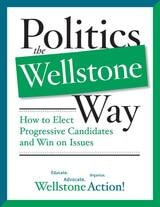
Politics the Wellstone Way
How to Elect Progressive Candidates and Win on IssuesWellstone Action Wellstone Action Wellstone Action
University of Minnesota Press, 2005
Wellstone Action is a nonprofit organization dedicated to continuing Paul and Sheila Wellstone’s fight for progressive change and economic justice by teaching effective political action skills to people across the country. Politics the Wellstone Way is a workshop in book form, providing the detailed framework needed to jump-start a new generation of activists plus plenty of helpful tools for old pros, including articulating a strong message, base building, field organizing, budgeting, fundraising, scheduling, getting out the vote, and grassroots advocacy and lobbying, illustrated by practical and inspirational examples.
From the school board all the way to the White House, Politics the Wellstone Way instructs people on becoming better organizers, candidates, campaign workers, and citizen activists, empowering them to make their voices heard.
Wellstone Action was established by the Wellstones’ two surviving sons, David and Mark. The main vehicle for this ongoing work is Camp Wellstone, a weekend training program that Wellstone Action leads regularly in locations across the country. Jeff Blodgett, Paul Wellstone’s longtime campaign manager, is the executive director of Wellstone Action. For more information visit www.wellstoneaction.org.
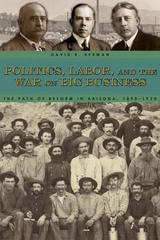
Politics, Labor, and the War on Big Business
The Path of Reform in Arizona, 1890-1920David R. Berman
University Press of Colorado, 2012
In the 1890s, once-heavily courted corporations had become, in the eyes of many, outside "money interests" or "beasts" that exploited the wealth of the sparsely settled area. Arizona's anticorporate reformers condemned the giant corporations for mistreating workers, farmers, ranchers, and small-business people and for corrupting the political system. During a thirty-year struggle, Arizona reformers called for changes to ward off corporate control of the political system, increase corporate taxation and regulation, and protect and promote the interests of working people.
Led by George W.P. Hunt and progressive Democrats, Arizona's brand of Progressivism was heavily influenced by organized labor, third parties, and Socialist activists. As highly powerful railroad and mining corporations retaliated, conflict took place on both political levels and industrial backgrounds, sometimes in violent form.
Politics, Labor and the War on Big Business places Arizona's experience in the larger historical discussion of reform activity of the period, considering issues involving the role of government in the economy and the possibility of reform, topics highly relevant to current debates.
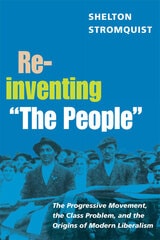
Reinventing "The People"
The Progressive Movement, the Class Problem, and the Origins of Modern LiberalismShelton Stromquist
University of Illinois Press, 2006
A comprehensive study of the Progressive movement, Reinventing "The People"contends that the persistence of class conflict in America challenged the very defining feature of Progressivism: its promise of social harmony through democratic renewal.
Shelton Stromquist profiles the movement's work in diverse arenas of social reform, politics, labor regulation and so-called race improvement. While these reformers emphasized different programs, they crafted a common language of social reconciliation in which an imagined civic community--"the People"--would transcend parochial class and political loyalties. But efforts to invent a society without enduring class lines marginalized new immigrants and African Americans by declaring them unprepared for civic responsibilities. In so doing, Progressives laid the foundation for twentieth-century liberals' inability to see their world in class terms and to conceive of social remedies that might alter the structures of class power.

Roots of Reform
Farmers, Workers, and the American State, 1877-1917Elizabeth Sanders
University of Chicago Press, 1999
Based on new evidence from legislative records and other sources, Sanders shows that this tenuous alliance of "producers versus plutocrats" shaped early regulatory legislation, remained powerful through the populist and progressive eras, and developed a characteristic method of democratic state expansion with continued relevance for subsequent reform movements.
Roots of Reform is essential reading for anyone interested in this crucial period of American political development.

Sojourner Truth's America
Margaret Washington
University of Illinois Press, 2009
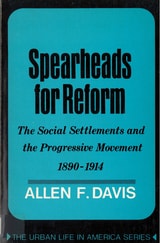
Spearheads for Reform
The Social Settlements and the Progressive Movement, 1890-1914Davis, Allen
Rutgers University Press, 1985
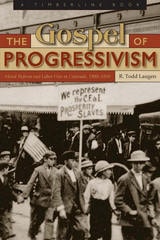
The Gospel of Progressivism
Moral Reform and Labor War in Colorado, 1900-1930R. Todd Laugen
University Press of Colorado, 2010
Sharing enemies like the party boss and corporate lobbyist who undermined honest and responsive government, Progressive leaders were determined to root out selfish political action with public exposure. Labor unions defied bosses and rallied for government protection of workers. Women's clubs appealed to other women as mothers, calling for social welfare, economic justice, and government responsiveness. Protestant church congregations formed a core of support for moral reform. Labor relations experts struggled to prevent the outbreak of violence through mediation between corporate employers and organized labor. Persevering through World War I, Colorado reformers faced their greatest challenge in the 1920s, when leaders of the Ku Klux Klan drew upon the rhetoric of Protestant Progressives and manipulated reform tools to strengthen their own political machine. Once in power, Klan legislators turned on Progressive leaders in the state government.
A story of promising alliances never fully realized, zealous crusaders who resisted compromise, and reforms with unexpected consequences, The Gospel of Progressivism will appeal to those interested in Progressive Era reform, Colorado history, labor relations, and women's activism.

The Honky Tonk on the Left
Progressive Thought in Country MusicMark Allan Jackson
University of Massachusetts Press, 2018
Bringing together a wide spectrum of cultural critics, The Honky Tonk on the Left takes on this conservative stereotype and reveals how progressive thought has permeated country music from its beginnings to the present day. The original essays in this collection analyze how diverse performers, including Fiddlin' John Carson, Webb Pierce, Loretta Lynn, Johnny Cash, O. B. McClinton, Garth Brooks, and Uncle Tupelo, have taken on such issues as government policies, gender roles, civil rights, prison reform, and labor unrest. Taking notice of the wrongs in their eras, these musicians worked to address them in song and action, often with strong support from fans.
In addition to the volume editor, this collection includes work by Gregory N. Reish, Peter La Chapelle, Stephanie Vander Wel, Charles L. Hughes, Ted Olson, Nadine Hubbs, Stephanie Shonekan, Stephen A. King, P. Renee Foster, Tressie McMillan Cottom, Travis D. Stimeling, and Jonathan Silverman.
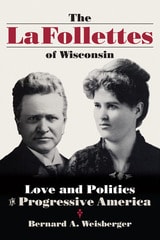
The La Follettes of Wisconsin
Love and Politics in Progressive AmericaBernard A. Weisberger
University of Wisconsin Press, 2013

The Last Gladiator
William Muldoon and the Making of American SportsScott Beekman
University of Texas Press, 2025
2026 Honorable Mention in Monographs, North American Society for Sport History (NASSH)
The incredible career of the forgotten but foundational pro wrestler who shaped American sports culture.
William Muldoon was an infamous athlete whose prowess, savvy, and chicanery across his six-decade career led him to wealth, cultural importance, and political power. Muldoon, the child of poor Irish immigrants, began wrestling in the 1870s and quickly became one of the most famous athletes of the post–Civil War era. He started acting and modeling as his popularity grew, making him one of the first sports stars to achieve crossover success. After a triumphant stint rehabilitating fallen boxing heavyweight champion John L. Sullivan in 1889, he retired from the ring and began a new career as a fitness impresario, founding an elite gymnasium and remaking himself as a health authority in the press. He became trainer to the rich, famous, and politically powerful, which led to his appointment as chair of the New York State Athletic Commission in the 1920s. From this position, Muldoon exerted his influence over the rules of boxing and wrestling and weaponized his power to maintain segregation in sport.
The Last Gladiator is a deep, insightful dive into Muldoon’s life and impact, demonstrating the significance of this often-controversial figure in the development of American sports, professional wrestling, and physical and popular culture.

The Lost Cause and the Great War
Progressive Reform and Patriotism in the American SouthRobert E. Hunt
University of Alabama Press, 2025
How Tennessee reformers reconciled Southern heritage with rising nationalism, weaving the Lost Cause into the fabric of American progress and identity.
The Lost Cause and the Great War tells the stories of central Tennessee Progressive-era reformers to illustrate the fascinating broader issue of how Southerners steeped in Lost Cause Civil War mythologies simultaneously developed patriotic American fervor. Focusing on Luke Lea, a prominent politician and American army officer who attempted to capture Kaiser Wilhelm II during World War I, the book reveals the intricate interplay between three competing ideas: attachment to the memory of the Confederacy, intense American nationalism, and advocacy for progressive reforms.
Hunt shows that Lea and his contemporaries sought either to harmonize these competing loyalties or to compartmentalize them to use when needed. Through insightful accounts of Tennessee’s 1928 presidential campaign, the American Legion’s response to cuts to veteran benefits in 1933, and the redefinition of America’s global role post–World War II, Hunt shows how these reformers achieved a balance that held until the Civil Rights movement disrupted this delicate consensus.
Hunt’s rich account reveals how Lea and others like him wove national patriotism and Southern collective memory into a cohesive narrative that supported their broader Progressive goals. The book offers much to readers interested in Southern history, the Gilded Age, Prohibition, World War I, World War II, and the beginnings of the Civil Rights movement. It provides vivid examples of how collective memory and narratives shape social and political movements. General readers will discover how white Southerners who remained devoted to vindicating the Confederacy nonetheless became fervent supporters of America's growing nationalism in the early twentieth century.
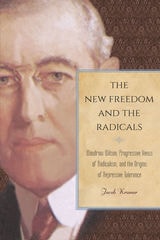
The New Freedom and the Radicals
Woodrow Wilson, Progressive Views of Radicalism, and the Origins of Repressive ToleranceJacob Kramer
Temple University Press, 2017
In The New Freedom and the Radicals, Jacob Kramer deftly examines how progressivism emerged at a time of critical transformation in American life. Using original archival sources, Kramer presents a study of Wilsonian-era politics to convey an understanding of the progressives’ views on radical America.
The New Freedom and the Radicals shows how the reactions of progressives to radicals accelerated the pace of reform in the United States, but how the movement was at times predisposed to repressing the radical elements to its left. In addition, Kramer asks to what extent progressives were responding to and influenced by those who opposed the state, capitalism, and the class structure altogether, as well as how progressives’ views of them changed in relation to events.

The Novel and the American Left
Critical Essays on Depression-Era FictionJanet Galligani Casey
University of Iowa Press, 2004
The first collection of critical essays to focus specifically on the fiction produced by American novelists of the Depression era, The Novel and the American Left contributes substantially to the newly emerging emphasis on twentieth-century American literary radicalism. Recent studies have recovered this body of work and redefined in historical and theoretical terms its vibrant contribution to American letters. Casey consolidates and expands this field of study by providing a more specific consideration of individual novels and novelists, many of which are reaching new contemporary audiences through reprints.
The Novel and the American Left focuses exclusively on left-leaning fiction of the Depression era, lending visibility and increased critical validity to these works and showing the various ways in which they contributed not only to theorizations of the Left but also to debates about the content and form of American fiction. In theoretical terms, the collection as a whole contributes to the larger reconceptualization of American modernity currently under way. More pragmatically, individual essays suggest specific authors, texts, and approaches to teachers and scholars seeking to broaden and/or complicate more traditional “American modernism” syllabi and research agendas.
The selected essays take up, among others, such “hard-core"” leftist writers as Mike Gold and Myra Page, who were associated with the Communist Party; the popular novels of James M. Cain and Kenneth Fearing, whose works were made into successful films; and critically acclaimed but nonetheless “lost” novelists such as Josephine Johnson, whose Now in November (Pulitzer Prize, 1936) anticipates and complicates the more popular agrarian mythos of Steinbeck’s The Grapes of Wrath.
This volume will be of interest not only to literary specialists but also to historians, social scientists, and those interested in American cultural studies.

The Revival of Labor Liberalism
Andrew Battista
University of Illinois Press, 2008
The Revival of Labor Liberalism is a careful analysis of the twentieth-century decline of the labor-liberal coalition and the important efforts to revive their political fortunes. Andrew Battista chronicles the efforts of several new political organizations that arose in the 1970s and 1980s with the goal of reuniting unions and liberals. Drawing from extensive documentary research and in-depth interviews with union leaders and political activists, Battista shows that the new organizations such as the Progressive Alliance, Citizen Labor Energy Coalition, and National Labor Committee made limited but real progress in reconstructing and strengthening the labor-liberal coalition. Although the labor-liberal alliance remained far weaker than the rival business-conservative alliance, Battista illuminates that it held a crucial role in labor and political history after 1968. Focuses on a fraught but evolving partnership, Battista provides a broad analysis of factional divisions among both unions and liberals and considers the future of unionism and the labor-liberal coalition in America.
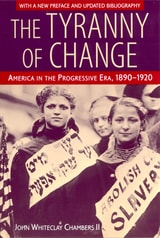
The Tyranny of Change
America in the Progressive Era, 1890-1920Chambers, John Whiteclay II
Rutgers University Press, 2000
Between 1890 and 1920, the forces accompanying industrialization sent the familiar nineteenth-century world plummeting toward extinction. The traditional countryside with its villages and family farms was eclipsed by giant corporations and sprawling cities. America appeared headed into an unknown future.
In lively, accessible prose, John Chambers incorporates the latest scholarship about the social, cultural, political, and economic changes which produced modern America. He illuminates the experiences of blacks, Asians, Latinos, as well as other working men and women in the cities and countryside as they struggled to improve their lives in a transformed economy. He explores the dimensions of the new consumer society and the new information and entertainment industries: newspapers, magazines, the movies. Striding these pages are many of the prominent individuals who shaped the attitudes and institutions of modern America: J. P. Morgan and corporate reorganization; Jane Addams and the origin of modern social work; Mary Pickford and the new star-oriented motion picture industry; and the radical labor challenge of “Big Bill” Haywood and the “Wobblies.”
While recognizing a “progressive ethos”—a mixture of idealistic vision and pragmatic reforms—which dominated the mainstream reforms that characterized the period, Chambers elaborates the role of civic volunteerism as well as the state in achieving directed social change. He also emphasizes the importance of radical and conservative political forces in shaping the so-called “Progressive Era.”
The revised edition in this classic work has an updated bibliography and a new preface, both of which incorporate particularly the new social and cultural research of the past decade.
Transcending the New Woman
Multiethnic Narratives in the Progressive EraCharlotte J. Rich
University of Missouri Press, 2009
Young Bob
A Biography of Robert M. La Follette, Jr.Patrick J. Maney
Wisconsin Historical Society Press, 2002
United States senator "Young Bob" La Follette entered politics as a young reformer in the shadow of his legendary father, "Fighting Bob" La Follette. He made his own mark as a key architect of Roosevelt’s New Deal and as a champion of labor rights and civil liberties. But in 1946 he was unexpectedly unseated by Joseph McCarthy, whose rise to Cold War notoriety foreshadowed La Follette’s despair and suicide in 1953. This new edition updates the only full scale biography of La Follette,Jr., the first to exploit his voluminous collection of personal papers. Patrick J. Maney makes clear that Young Bob’s story is as relevant today as it was when he died. His life stands as dramatic evidence of how one of the most respected politicians of his time bridged the political spectrum and was admired by both liberals like FDR and Harry Truman and conservatives like Robert Taft and Richard Nixon.