Results by title
396 books match the query 'Rome' and 38 start with a
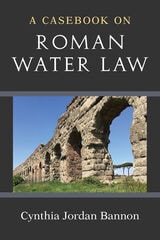
A Casebook on Roman Water Law
Cynthia Jordan Bannon
University of Michigan Press, 2020
This casebook aims to cross historical and disciplinary boundaries by making the primary evidence for Roman water rights accessible to students and researchers. Cases are presented in both original Latin and English translation. To prepare for study of the cases, each chapter opens with an overview of its topic while the introduction presents the evidence for water rights and contextualizes them within historical and conceptual frameworks.

A Coin in Nine Hands
A NovelMarguerite Yourcenar
University of Chicago Press, 1994
"A Coin in Nine Hands has . . . passages that move close to poetry and a story that belongs in both literature and history."—Doris Grumbach, Los Angeles Times Book Review
"What lingers at the end of A Coin in Nine Hands is the shadowiness and puppetlike vagueness of the Dictator, and the compelling specificity of the so-called 'common people' revolving all around him."—Anne Tyler, The New Republic
"Within a few pages we have met half the major characters in this haunting, brilliantly constructed novel. . . . The studied perfection, the structural intricacy and brevity remind one of Camus. Yet by comparison, Yourcenar's prose is lavish, emotional and imagistic."—Cynthia King, Houston Post
"Transcends its specific time and place to become a portrait of vividly delineated characters caught in the vise of a tragically familiar political situation."—Publisher's Weekly
Best known as the author of Memoirs of Hadrian and The Abyss, Marguerite Yourcenar (1903-87) achieved countless literary honors and was the first woman ever elected to the Académie Française.
A Commentary on Cicero, De Divinatione I
Celia E. Schultz
University of Michigan Press, 2014
A Commentary on Cicero, De Divinatione II
Andrew R. Dyck
University of Michigan Press, 2020
Celia Schultz’s earlier volume in this series presented the text and commentary for De Divinatione I. With Andrew Dyck’s companion volume on the second book of De Divinatione, students and teachers are well served with crucial texts from one of Rome’s most famous philosophers, as he considers important Roman practices and beliefs.
A Commentary on Cicero, De Natura Deorum II
Andrew R. Dyck
University of Michigan Press, 2025
A Commentary on Plautus' Curculio
T. H. M. Gellar-Goad
University of Michigan Press, 2024
This up-to-date, authoritative commentary on the play will prove useful to directors and actors and will readily introduce students to the joys of Roman comedy.
A Family of Gods
The Worship of the Imperial Family in the Latin WestGwynaeth McIntyre
University of Michigan Press, 2016
Roman politics and religion were inherently linked as the Romans attempted to explain the world and their place within it. As Roman territory expanded and power became consolidated into the hands of one man, people throughout the empire sought to define their relationship with the emperor by granting honors to him. This collection of practices has been labeled “emperor worship” or “ruler cult,” but this tells only half the story: imperial family members also became an important part of this construction of power and almost half of the individuals deified in Rome were wives, sisters, children, and other family members of the emperor.
In A Family of Gods, Gwynaeth McIntyre expands current “ruler cult” discussions by including other deified individuals, and by looking at how communities in the period 44 BCE to 337 CE sought to connect themselves with the imperial power structure through establishing priesthoods and cult practices. This work focuses on the priests dedicated to the worship of the imperial family in order to contextualize their role in how imperial power was perceived in the provincial communities and the ways in which communities chose to employ religious practices. Special emphasis is given to the provinces in Gaul, Spain, and North Africa.
This book draws on epigraphic evidence but incorporates literary, numismatic, and archaeological evidence where applicable. It will be of interest to scholars of Roman imperial cult as well as Roman imperialism, and religious and political history.

A History of Earliest Italy
Massimo Pallottino
University of Michigan Press, 1991
A History of the Vandals
Torsten Cumberland Jacobsen
Westholme Publishing, 2012
The First General History in English of the Germanic People Who Sacked Rome in the Fifth Century AD and Established a Kingdom in North Africa
The fifth century AD was a time of great changes in the Mediterranean world. In the early 400s, the Roman Empire ranged from the lowlands of Scotland to the Upper Nile and from Portugal to the Caucasus. It was almost at its widest extent, and although ruled by two emperors—one in the West and one in the East—it was still a single empire. One hundred years later, Roman control of Western Europe and Western North Africa had been lost. In its place, a number of Germanic kingdoms had been established in these regions, with hundreds of thousands of Germanic and other peoples settling permanently inside the former borders of the Western Roman Empire.
One of the most fascinating of these tribes of late antiquity were the Vandals, who over a period of six hundred years had migrated from the woodland regions of Scandinavia across Europe and ended in the deserts of North Africa. In A History of the Vandals, the first general account in English covering the entire story of the Vandals from their emergence to the end of their kingdom, historian Torsten Cumberland Jacobsen pieces together what we know about the Vandals, sifting fact from fiction. In the middle of the fifth century the Vandals, who professed Arianism, a form of Christianity considered heretical by the Roman emperor, created the first permanent Germanic successor state in the West and were one of the deciding factors in the downfall of the Western Roman Empire. Later Christian historians described their sack of Rome in 455 and their vehement persecution of Catholics in their kingdom, accounts that were sensationalized and gave birth to the term “vandalism.”
In the mid-sixth century, the Vandals and their North African kingdom were the first target of Byzantine Emperor Justinian’s ambitious plan to reconquer the lost territories of the fallen Western Empire. In less than four months, what had been considered one of the strongest Germanic kingdoms had been defeated by a small Roman army led by the general Belisarius. Despite later rebellions, this was the end of the Germanic presence in North Africa, and in many ways the end of the Arian heresy of Christianity. For the Romans it was the incredibly successful start of the reconquest of the lost lands of the Western Empire.
A Most Reliable Witness
Essays in Honor of Ross Shepard KraemerSusan Ashbrook Harvey
SBL Press, 2015
Celebrate a trailblazer in the areas of women and re
Celebrate a trailblazer in the areas of women and religion, Jews and Judaism, and earliest Christianity in the ancient Mediterranean
Ross Kraemer is Professor Emerita in the Department of Religious Studies at Brown University. This volume of essays, conceived and produced by students, colleagues, and friends bears witness to the breadth of her own scholarly interests. Contributors include Theodore A. Bergren, Debra Bucher, Lynn Cohick, Mary Rose D’Angelo, Nathaniel P. DesRosiers, Robert Doran, Jennifer Eyl, Paula Fredriksen, John G. Gager, Maxine Grossman, Kim Haines-Eitzen, Susan Ashbrook Harvey, Jordan Kraemer, Robert A. Kraft, Shira L. Lander, Amy-Jill Levine, Susan Marks, E. Ann Matter, Renee Levine Melammed, Susan Niditch, Elaine Pagels, Adele Reinhartz, Jordan Rosenblum, Sarah Schwarz, Karen B. Stern, Stanley K. Stowers, Daniel Ullucci, Arthur Urbano, Heidi Wendt, and Benjamin G. Wright.Features:
- Articles that examine both ancient and modern texts in cross-cultural and trans-historical perspective
- Twenty-eight original essays on ancient Judaism, Christianity, and women in the Greco-Roman world
A Symposion of Praise
Horace Returns to Lyric in Odes IVTimothy Johnson
University of Wisconsin Press, 2007
Johnson shows the Horatian panegyrist is more than a dependent poet representing only the desires of his patrons. The poet forges the panegyric agenda, setting out the character of the praise (its mode, lyric, and content both positive and negative), and calls together a community to join in the creation and adaptation of Roman identities and civic ideologies. With this insightful reading, A Symposion of Praise will be of interest to historians of the Augustan period and its literature, and to scholars interested in the dynamics between personal expression and political power.
A Taste of Ancient Rome
Ilaria Gozzini Giacosa
University of Chicago Press, 1992
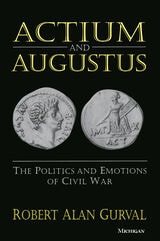
Actium and Augustus
The Politics and Emotions of Civil WarRobert Alan Gurval
University of Michigan Press, 1998
Actium and Augustus marks a turning point as well. Robert Alan Gurval's unusual approach is to examine contemporary views of the battle and its immediate political and social consequences. He starts with a consideration of the official celebration and public commemoration of the Actian victory and then moves on to other questions. What were the "Actian" monuments that Octavian erected on the battle site and later in Rome? What role did the Actian victory play in the political formation of the Principate and its public ideology? What was the response of contemporary poetry? Throughout, this volume concentrates on contemporary views of Actium and its results.
Written to include the general reader, Actium and Augustus presents a thoughtful examination of a complex period. All Greek and Latin quotations are translated, and extensive illustrations present graphic evidence about the issues Romans faced.
Robert Alan Gurval is Associate Professor of Classics, University of California, Los Angeles, and has been a recipient of the Rome Prize awarded by the American Academy in Rome.
Aesop's Human Zoo
Roman Stories about Our BodiesPhaedrus
University of Chicago Press, 2004
Providing unusual insights into the heart of Roman culture, these clever poems open up odd avenues of ancient lore and life as they explore social types and physical aspects of the body, regularly mocking the limitations of human nature and offering vulgar or promiscuous interpretations of the stuff of social life.
Featuring folksy proverbs and satirical anecdotes, filled with saucy naughtiness and awful puns, Aesop's Human Zoo will amuse you with its eccentricities and hit home with its shrewdly candid and red raw messages. The entertainment offered in this volume of impeccably accurate translations is truly a novelty—a good-hearted and knowing laugh courtesy of classical poetry. Beginning to advanced classicists and Latin scholars will appreciate the original Latin text provided in this bilingual edition. The splash of classic Thomas Bewick wood engravings to accompany the fables renders the collection complete.

Aetna and the Moon
Explaining Nature in Ancient Greece and RomeLiba Taub
Oregon State University Press, 2008
After Transformation
A Lyrical History of Christian Late AntiquityMaia Kotrosits
Duke University Press, 2025
Agrippina the Younger
PoemsDiana Arterian
Northwestern University Press, 2025
A poetic journey through the past of the Roman Empress Agrippina looks toward the future
Agrippina the Younger follows one woman’s study of another, separated by thousands of miles and two millennia but bound by a shared sense of powerlessness. Agrippina was a daughter in a golden political family, destined for greatness—but she hungered for more power than women were allowed. Exhausted by the misogyny of the present, Diana Arterian reaches into the past to try to understand the patriarchal systems of today. In lyric verse and prose poems, she traces Agrippina’s rise, interrogating a life studded with intrigue, sex, murder, and manipulation. Arterian eagerly pursues Agrippina through texts, ruins, and films, exhuming the hidden details of the ancient noblewoman’s life. These poems consider the valences of patriarchy, power, and the archive to try to answer the question: How do we recover a woman erased by history?
All in the Family
Childhood and Fictive Kinship in Roman SocietyGaia Gianni
University of Michigan Press, 2025
Amor Belli
Love and Strife in Lucan's Bellum CivileGiulio Celotto
University of Michigan Press, 2022
Compelled by the emperor Nero to commit suicide at age 25 after writing uncomplimentary poems, Latin poet Lucan nevertheless left behind a significant body of work, including the Bellum Civile (Civil War). Sometimes also called the Pharsalia, this epic describes the war between Julius Caesar and Pompey.Author Giulio Celotto provides an interpretation of this civil war based on the examination of an aspect completely neglected by previous scholarship: Lucan’s literary adaptation of the cosmological dialectic of Love and Strife.
According to a reading that has found favor over the last three decades, the poem is an unconventional epic that does not conform to Aristotelian norms: Lucan composes a poem characterized by fragmentation and disorder, lacking a conventional teleology, and whose narrative flow is constantly delayed. Celotto’s study challenges this interpretation by illustrating how Lucan invokes imagery of cosmic dissolution, but without altogether obliterating epic norms. The poem transforms them from within, condemning the establishment of the Principate and the Julio-Claudian dynasty.
An Introduction to Empire in the New Testament
Adam Winn
SBL Press, 2016
Explore how empire is a crucial foreground for reading and interpreting the New Testament
In the last three decades, significant attention has been given to the way in which New Testament texts engage and respond to the imperial world in which they were written. The purpose of the present volume is to introduce students and non-specialists to the growing subfield of New Testament studies known as empire studies. Contributors seek to make readers aware of the significant work that has already been produced, while also pointing them to new ways in which this field is moving forward. The contributors are Bruce W. Longenecker, Richard A. Horsley, Warren Carter, Adam Winn, Eric D. Barreto, Beth M. Sheppard, Neil Elliot, James R. Harrison, Harry O. Maier, Deborah Krause, Jason A.Whitlark, Matthew R. Hauge, Kelly D. Liebengood, and Davina C. Lopez.
Features:
An Introduction to Greek Epigraphy of the Hellenistic and Roman Periods from Alexander the Great down to the Reign of Constantine
B. H. McLean
University of Michigan Press, 2011
“In short, this is a reference work of the best kind. For the beginner, it is indispensable. And for those who already know something about its subject matter, the book is in many ways useful, informative, and interesting. We all owe a debt to [the author] for undertaking this significant project, and for completing it so well.”
—Michael Peachin, Classical World
“. . . provides invaluable road maps for non-epigraphers faced with passages of inscribed Greek.”
—Graham Shipley, Bryn Mawr Classical Review
Greek inscriptions form a valuable resource for the study of all aspects of the Greco-Roman world. They are primary witnesses to society's laws and institutions, religious habits, and language. This volume provides students with the tools to take advantage of the historical value of these treasures. It examines letter forms, ancient names, and ancient calendars, knowledge of which is essential in reading inscriptions of all kinds.
B. H. McLean discusses the classification of inscriptions into their various categories and analyzes particular types of inscriptions, including decrees, honorary inscriptions, dedications, funerary inscriptions, and manumissions. Finally, McLean includes special topics that bear upon the interpretation of specific features of inscriptions, such as Greek and Roman administrative titles and functions.
Anatomizing Civil War
Studies in Lucan's Epic TechniqueMartin T. Dinter
University of Michigan Press, 2013
Imperial Latin epic has seen a renaissance of scholarly interest. This book illuminates the work of the poet Lucan, a contemporary of the emperor Nero who as nephew of the imperial adviser Seneca moved in the upper echelons of Neronian society. This young and maverick poet, whom Nero commanded to commit suicide at the age of 26, left an epic poem on the civil war between Caesar and Pompey that epitomizes the exuberance and stylistic experimentation of Neronian culture. This study focuses on Lucan's epic technique and traces his influence through the Middle Ages and the Renaissance.
Martin T. Dinter's newest volume engages with Lucan's use of body imagery, sententiae, Fama (rumor), and open-endedness throughout his civil war epic. Although Lucan's Bellum Civile is frequently decried as a fragmented as well as fragmentary epic, this study demonstrates how Lucan uses devices other than teleology and cohesive narrative structure to bind together the many parts of his epic body.
Anatomizing Civil War places at center stage characteristics of Lucan's work that have so far been interpreted as excessive, or as symptoms of an overly rhetorical culture indicating a lack of substance. By demonstrating that they all contribute to Lucan's poetic technique, Martin T. Dinter shows how they play a fundamental role in shaping and connecting the many episodes of the Bellum Civile that constitute Lucan's epic body. This important volume will be of interest to students of classics and comparative literature as well as literary scholars. All Greek and Latin passages have been translated.
Ancient Bovillae
History, Art, and Archaeology of a Lost City in the Roman HinterlandEdited by Peter Hatlie
University of Michigan Press, 2025
Ancient Bovillae goes well beyond the work of any previous publication by gathering together all known evidence about the city from the ancient, medieval, and modern ages, with contributors analyzing the significance of Bovillae in art, architecture, religion, and history. Written by a distinguished team of scholars and featuring nearly one hundred images of artifacts, monuments, and technical drawings associated with Bovillae, this book boldly pieces together evidence about the history, art, and archaeology of Bovillae. It draws attention to Bovillae’s significance within the Roman world as well as its transformation and decline in the post-Roman era.
Ancient Latin Poetry Books
Materiality and ContextGabriel Nocchi Macedo
University of Michigan Press, 2021
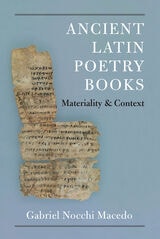
Before the invention of printing, all forms of writing were done by hand. For a literary text to circulate among readers, and to be transmitted from one period in time to another, it had to be copied by scribes. As a result, two copies of an ancient book were different from one another, and each individual book or manuscript has its own history. The oldest of these books, those that are the closest to the time in which the texts were composed, are few, usually damaged, and have been often neglected in the scholarship. Ancient Latin Poetry Books presents a detailed study of the oldest manuscripts still extant that contain texts by Latin poets, such as Virgil, Terence, and Ovid. Analyzing their physical characteristics, their script, and the historical contexts in which they were produced and used, this volume shows how manuscripts can help us gain a better understanding of the history of texts, as well as of reading habits over the centuries. Since the manuscripts originated in various places of the Latin-speaking world, Ancient Latin Poetry Books investigates the readership and reception of Latin poetry in many different contexts, such schools in the Egyptian desert, aristocratic circles in southern Italy, and the Christian élite in late antique Rome. The research also contributes to our knowledge about the use of writing and the importance of the written text in antiquity. This is an innovative approach to the study of ancient literature, one that takes the materiality of texts into consideration.
Ancient Law, Ancient Society
Dennis P. Kehoe and Thomas A. J. McGinn, editors
University of Michigan Press, 2017
Essays cover topics such as using collective sanctions to enforce legal norms; the Greek elite’s marriage strategies for amassing financial resources essential for a public career; defenses against murder charges under Athenian criminal law, particularly in cases where the victim put his own life in peril; the interplay between Roman law and provincial institutions in regulating water rights; the Severan-age Greek author Aelian’s notions of justice and their influence on late-classical Roman jurisprudence; Roman jurists’ approach to the contract of mandate in balancing the changing needs of society against respect for upper-class concepts of duty and reciprocity; whether the Roman legal authorities developed the law exclusively to serve the Roman elite’s interests or to meet the needs of the Roman Empire’s broader population as well; and an analysis of the Senatus Consultum Claudianum in the Code of Justinian demonstrating how the late Roman government adapted classical law to address marriage between free women and men classified as coloni bound to their land.
In addition to volume editors Dennis P. Kehoe and Thomas A. J. McGinn, contributors include Adriaan Lanni, Michael Leese, David Phillips, Cynthia Bannon, Lauren Caldwell, Charles Pazdernik, and Clifford Ando.
Ancient Maritime Loan Contracts
Peter Candy
University of Michigan Press, 2025
Combining a wide variety of papyrological, epigraphic, and legal evidence, Peter Candy’s framework illustrates the significance of these contracts in both their economic and legal context. By using an interdisciplinary approach, Ancient Maritime Loan Contracts addresses important questions about how maritime trade was financed in the context of the ancient economy; the response of individual legal cultures to maritime loan contracts; and the relationship between international commercial practice and legal development in the ancient world.
Ancient Obscenities
Their Nature and Use in the Ancient Greek and Roman WorldsDorota Dutsch and Ann Suter, editors
University of Michigan Press, 2015
Ancient Pathways and Hidden Pursuits
Religion, Morals, and Magic in the Ancient WorldGeorg Luck
University of Michigan Press, 2000
The present volume includes the author's thoughts on Greek and Roman religions, early Christianity, Greek and Roman psychology and morals, and magic and the occult. Luck's main findings explore generally neglected areas of ancient civilization, locating magic and philosophy with religion as vehicles for moral and psychological guidance. Throughout this study, one finds meaning in "superstitious" and conflicting patterns of behavior and learns much about the nature of the human soul. This collection will serve as a valuable reference for those interested in the driving motivations of ancient man.
"The topics of the individual articles in this volume are very central and of great humanistic appeal, and they indeed form a thematic unity concerning man and religion in Greek and Roman society." --Ludwig Koenen, Herbert C. Youtie Distinguished University Professor of Papyrology, University of Michigan
Georg Luck is Professor of Classics, emeritus, The Johns Hopkins University.
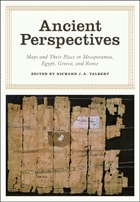
Ancient Perspectives
Maps and Their Place in Mesopotamia, Egypt, Greece, and RomeEdited by Richard J. A. Talbert
University of Chicago Press, 2012
Ancient Perspectives encompasses a vast arc of space and time—Western Asia to North Africa and Europe from the third millennium BCE to the fifth century CE—to explore mapmaking and worldviews in the ancient civilizations of Mesopotamia, Egypt, Greece, and Rome. In each society, maps served as critical economic, political, and personal tools, but there was little consistency in how and why they were made. Much like today, maps in antiquity meant very different things to different people.
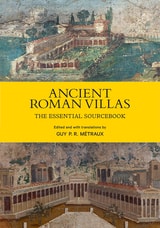
Ancient Roman Villas
The Essential SourcebookGuy P. R. Métraux
J. Paul Getty Trust, The, 2024
While the term villa is generic today, its meaning extended across the entirety of ancient Roman life: villas supplied food, oil, and wine to towns and cities and produced raw materials for craft industries and building construction. Villas were also venues for pleasure, relaxation, and the cultivation of friendships and the mind. Many were known for their spectacular sites, architecture, decoration, and furnishings. They came to be ubiquitous throughout ancient Rome's European and Mediterranean rural hegemony.
This volume compiles a wealth of newly translated Latin and ancient Greek sources—treatises, letters, poems, histories, biographies, and other works of literary art—to vividly convey the architectural, economic, social, political, and cultural significance of ancient Roman villas, from their Greek antecedents through the early Christian period. Thematic chapters reveal ancient Roman attitudes on villa architecture, agricultural operations, and the practices of buying, building, and decorating villas as well as entertaining and pursuing leisure there. References to family, gender relations, and the lives of enslaved persons aim to situate, if only indirectly, a broad range of experiences within villas. Supplemented by generous commentaries, copious annotation, a comprehensive bibliography, and a glossary, this definitive sourcebook equips scholars and students alike for further research and makes for fascinating reading.
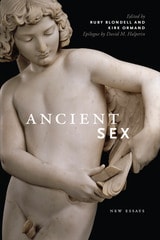
Ancient Sex
New EssaysEdited by Ruby Blondell and Kirk Ormand, epilogue by David M. Halperin
The Ohio State University Press, 2015
Rather than reopening old debates, Ancient Sex takes up Foucault’s call for discursive analysis and elucidates some of the ways that ancient Greek and Roman texts and visual arts articulate a culturally specific discourse about sexual matters. Each contributor presupposes that sexual and gendered identities are discursively produced, and teases out some of the ways that the Greeks and Romans spoke and thought about these issues. Comprising essays by emerging and established scholars, this volume emphasizes in particular: sexual discourses about women; the interaction between sexual identities and class status; gender as an unstable discursive category (even in antiquity); and the relationships between ancient and modern sexual categories.
Antony and Cleopatra
William Shakespeare
Arizona Center for Medieval and Renaissance Studies, 2023
In Antony and Cleopatra, Christopher Chen tackles the sweeping epic of love and betrayal at the center of the story of the rulers Antony of Rome and Cleopatra of Egypt. In this contemporary translation of the play, Chen brings the political intrigue and historical storytelling of Shakespeare to modern audiences while preserving the poetic foundation of the play’s language.
This translation of Antony and Cleopatra was written as part of the Oregon Shakespeare Festival’s Play On! project, which commissioned new translations of thirty-nine Shakespeare plays. These translations present the work of “The Bard” in language accessible to modern audiences while never losing the beauty of Shakespeare’s verse. Enlisting the talents of a diverse group of contemporary playwrights, screenwriters, and dramaturges from diverse backgrounds, this project reenvisions Shakespeare for the twenty-first century. These volumes make these works available for the first time in print—a new First Folio for a new era.
Aqueduct Hunting in the Seventeenth Century
Raffaele Fabretti's De aquis et aquaeductibus veteris RomaeHarry B. Evans
University of Michigan Press, 2002
Fabretti's treatise, De aquis et aquaeductibus veteris Romae dissertationes tres, is cited as a matter of course by all later scholars working in the area of Roman topography. Its findings--while updated and supplemented by more recent archaeological efforts--have never been fully superseded. Yet despite its enormous importance and impact on scholarly efforts, the De aquis has never yet been translated from the original Latin. Aqueduct Hunting in the Seventeenth Century provides a full translation of and commentary on Fabretti's writings, making them accessible to a broad audience and carefully assessing their scholarly contributions.
Harry B. Evans offers his reader an introduction to Fabretti and his scholarly world. A complete translation and a commentary that focuses primarily on the topographical problems and Fabretti's contribution to our understanding of them are also provided. Evans also assesses the contributions and corrections of later archaeologists and topographers and places the De aquis in the history of aqueduct studies.
Evans demonstrates that Fabretti's conclusions, while far from definitive, are indeed significant and merit wider attention than they have received to date. This book will appeal to classicists and classical archaeologists, ancient historians, and readers interested in the history of technology, archaeology, and Rome and Italy in the seventeenth century.
Harry B. Evans is Professor of Classics, Fordham University.
Archimedes and the Roman Imagination
Mary Jaeger
University of Michigan Press, 2013
The great mathematician Archimedes, a Sicilian Greek whose machines defended Syracuse against the Romans during the Second Punic War, was killed by a Roman after the city fell, yet it is largely Roman sources, and Greek texts aimed at Roman audiences, that preserve the stories about him. Archimedes' story, Mary Jaeger argues, thus becomes a locus where writers explore the intersection of Greek and Roman culture, and as such it plays an important role in Roman self-definition. Jaeger uses the biography of Archimedes as a hermeneutic tool, providing insight into the construction of the traditional historical narrative about the Roman conquest of the Greek world and the Greek cultural invasion of Rome.
By breaking down the narrative of Archimedes' life and examining how the various anecdotes that comprise it are embedded in their contexts, the book offers fresh readings of passages from both well-known and less-studied authors, including Polybius, Cicero, Livy, Vitruvius, Plutarch, Silius Italicus, Valerius Maximus, Johannes Tzetzes, and Petrarch.
---Helen King, Times Literary Supplement
"An absolutely wonderful book on a truly original and important topic. As Jaeger explores neglected texts that together tell an important story about the Romans' views of empire and their relationship to Greek cultural accomplishments, so she has written an important new chapter in the history of science. A genuine pleasure to read, from first page to last."
---Andrew Feldherr, Associate Professor of Classics, Princeton University
"This elegantly written and convincingly argued project analyzes Archimedes as a vehicle for reception of the Classics, as a figure for loss and recovery of cultural memory, and as a metaphorical representation of the development of Roman identity. Jaeger's fastening on the still relatively obscure figure of the greatest ancient mathematician as a way of understanding cultural liminality in the ancient world is nothing short of a stroke of genius."
---Christina S. Kraus, Professor and Chair of Classics, Yale University
"Archimedes and the Roman Imagination forms a useful addition to our understanding of Roman culture as well as of the reception of science in antiquity. It will make a genuine contribution to the discipline, not only in terms of its original interpretative claims but also as a fascinating example of how we may follow the cultural reception of historical figures."
---Reviel Netz, Professor of Classics, Stanford University
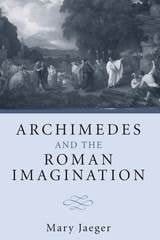
Cover art: Benjamin West. Cicero Discovering the Tomb of Archimedes. Yale University Art Gallery. John Hill Morgan, B.A. 1893, LL.B. 1898, M.A. (Hon.) 1929, Fund.
Arguments with Silence
Writing the History of Roman WomenAmy Richlin
University of Michigan Press, 2014
Women in ancient Rome challenge the historian. Widely represented in literature and art, they rarely speak for themselves. Amy Richlin, among the foremost pioneers in ancient studies, gives voice to these women through scholarship that scours sources from high art to gutter invective.
In Arguments with Silence, Richlin presents a linked selection of her essays on Roman women’s history, originally published between 1981 and 2001 as the field of “women in antiquity” took shape, and here substantially rewritten and updated. The new introduction to the volume lays out the historical methodologies these essays developed, places this process in its own historical setting, and reviews work on Roman women since 2001, along with persistent silences. Individual chapter introductions locate each piece in the social context of Second Wave feminism in Classics and the academy, explaining why each mattered as an intervention then and still does now.
Inhabiting these pages are the women whose lives were shaped by great art, dirty jokes, slavery, and the definition of adultery as a wife’s crime; Julia, Augustus’ daughter, who died, as her daughter would, exiled to a desert island; women wearing makeup, safeguarding babies with amulets, practicing their religion at home and in public ceremonies; the satirist Sulpicia, flaunting her sexuality; and the praefica, leading the lament for the dead.
Amy Richlin is one of a small handful of modern thinkers in a position to consider these questions, and this guided journey with her brings surprise, delight, and entertainment, as well as a fresh look at important questions.
Around the Roman Table
Food and Feasting in Ancient RomePatrick Faas
University of Chicago Press, 2005
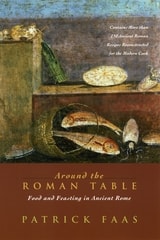
Faas guides readers through the culinary conquests of Roman invasions—as conquerors pillaged foodstuffs from faraway lands—to the decadence of Imperial Rome and its associated table manners, dining arrangements, spices, seasonings, and cooking techniques. With recipes for such appetizing dishes as chicken galantine with lambs' brains and fish relish, Around the Roman Table is ideal for food aficionados who wish to understand how the desire for power and conquest was manifested in Roman appetites.
"There are many misconceptions about the food of ancient Rome that Faas sets out to correct. The result is half cookbook, half history book and is entirely fascinating to both chef and antiquarian alike."—Washington Times
Arrian the Historian
Writing the Greek Past in the Roman EmpireBy Daniel W. Leon
University of Texas Press, 2021
During the first centuries of the Roman Empire, Greek intellectuals wrote a great many texts modeled on the dialect and literature of Classical Athens, some 500 years prior. Among the most successful of these literary figures were sophists, whose highly influential display oratory has been the prevailing focus of scholarship on Roman Greece over the past fifty years. Often overlooked are the period’s historians, who spurned sophistic oral performance in favor of written accounts. One such author is Arrian of Nicomedia.
Daniel W. Leon examines the works of Arrian to show how the era's historians responded to their sophistic peers’ claims of authority and played a crucial role in theorizing the past at a time when knowledge of history was central to defining Greek cultural identity. Best known for his history of Alexander the Great, Arrian articulated a methodical approach to the study of the past and a notion of historical progress that established a continuous line of human activity leading to his present and imparting moral and political lessons. Using Arrian as a case study in Greek historiography, Leon demonstrates how the genre functioned during the Imperial Period and what it brings to the study of the Roman world in the second century.
Artifact and Artifice
Classical Archaeology and the Ancient HistorianJonathan M. Hall
University of Chicago Press, 2013