Results by title
45 books match the query 'Selected Essays'
Between the Iceberg and the Ship
Selected EssaysAnne Stevenson
University of Michigan Press, 1998
Feminist critics will find much to invigorate and infuriate them in these essays. Stevenson believes that the "takeover" of poetry by critical theorists has, in recent years, all but brought about its demise in England and America. But she also fears that the media's doctrine of mass marketability may have a detrimental effect on the future of poetry. Her essays on Plath, Bishop, Irish poetry, and other subjects are as witty as they are challenging, upsetting many of the easy assumptions of our putatively "postmodern" era.
Anne Stevenson is the author of numerous books, including Bitter Fame: A Life of Sylvia Plath, The Other House, Four and a Half Dancing Men, and most recently, Collected Poems 1955- 1995.
Beyond Borders
The Selected Essays of Mary AustinRueben J Ellis
Southern Illinois University Press, 1996
Seventeen essays by Mary Hunter Austin (1868–1934), author of the western classic The Land of Little Rain (1903), demonstrate her wide-ranging interests and equally varied writing styles.
Although she was born in Carlinville, Illinois, and graduated from Blackburn College, Mary Austin spent most of her writing career in California, New York, and finally Sante Fe, New Mexico. A well-known, popular, and prolific writer, Austin published thirty-three books and three plays and was closely associated with many important literary figures of her time, including H. G. Wells, George Bernard Shaw, Mabel Dodge Luhan, Jack London, and Willa Cather. Still best known today for her nature writing and southwestern cultural studies, Austin has been increasingly recognized for her work on feminist themes, including the play The Arrow Maker, the nonfiction The Young Woman Citizen, and the novels A Woman of Genius and No. 26 Jayne Street. What has been perhaps an overemphasis on Austin’s nature writing has, since her death, eclipsed the fact that Austin was known during her lifetime as a colorful, eccentric, and controversial person whose direct and outspoken opinions engaged a wide variety of topics.
Beyond Borders demonstrates that variety. In addition to her monographs, Austin also published her short fiction and essays in periodicals. In fact, like many a writer earning a living from her work, Austin wrote prolifically for the magazine market, producing during her career over two hundred individual pieces published in over sixty periodicals. Although a collection of her short fiction appeared in 1987, Austin’s nonfiction periodical work has remained uncollected until now.
In support of Austin’s essays, Reuben J. Ellis provides an introduction that establishes a biographical and historical context for Austin’s work. In addition, each Austin essay is prefaced by brief introductory remarks by the editor. A selected bibliography of Austin’s essays is also included.
Comparing Impossibilities
Selected Essays of Sally Falk MooreSally Falk Moore
HAU, 2016
The essays range from studies of myths of incest and sexuality to those of economic development projects, from South America to Africa. The result is an astonishing assortment of works from one of the most respected legal anthropologists in the field, one who brought together disparate places and ideas in enriching comparisons that showcase the possibilities—and impossibilities—of anthropology.
Conditions of the Present
Selected EssaysLindon Barrett
Duke University Press, 2018
Contributors. Elizabeth Alexander, Jennifer DeVere Brody, Daphne A. Brooks, Linh U. Hua, Janet Neary, Marlon B. Ross, Robyn Wiegman

Consumer Culture
Selected EssaysEdited by Gjoko Muratovski
Intellect Books, 2016
Crime and Family
Selected Essays of Joan McCordJoan McCord, introduction by David Farrington, foreword by Geoffrey Sayre-McCord
Temple University Press, 2007

Critical Passions
Selected EssaysJean Franco
Duke University Press, 1999
A key participant in the major debates in Latin American studies—beginning with the “boom” period of the 1960s and continuing through debates on ideology and discourse, Marxism, mass culture, and postmodernism—Franco is recognized for her feminist critique of Latin American writing. While her principal books are all readily available, Franco’s several dozen articles are dispersed in a variety of periodicals in Latin America, Europe, and the United States. Although many of these essays are considered pioneering and classic, they have never before been collected in a single work. In this volume, Mary Louise Pratt and Kathleen Newman have organized the essays into four interrelated sections: feminism and the critique of authoritarianism, mass and popular culture, Latin American literature from the “boom” onward, and the cultural history of Mexico. As a group, these writings demonstrate Franco’s ability to reflect on and judge with equal seriousness all spheres of expression, whether subway graffiti, a fashion manual, or an avant-garde haiku. A bona fide fan of popular and mass media, Franco never allows her critiques to dissolve into the puritanical or reductive; instead, she finds ways to present and debate complex theoretical questions in direct and accessible language.
This volume will draw an extensive readership in Latin American, cultural, and women’s studies.
Culture, Genre, and Literary Vocation
Selected Essays on American LiteratureMichael Davitt Bell
University of Chicago Press, 2000
Throughout, Bell revisits issues of genre with an eye toward the unexpected details of authors' lives, and invites us to reconsider the hidden functions that terms such as "romanticism" and "realism" served for authors and their critics. Whether tracing the demands of the market or the expectations of readers, Bell examines the intimate relationship between literary production and culture; each essay closely links the milieu in which American writers worked with the trajectory of their storied careers.
Dancing on the Fault Lines of History
Selected EssaysSusan Manning
University of Michigan Press, 2025
Like the artists at the center of her research, Manning’s writing dances on the fault lines of history. Her introduction and annotations to the essays reflect on how and why these keywords became central to her research, revealing the autobiographical resonances of her scholarship as she confronts the cultural politics of the late twentieth and early twenty-first centuries.
Fact, Fiction, and Form
Selected EssaysRalph W. Rader
The Ohio State University Press, 2011
God and Caesar
Selected Essays on Religion, Politics, & SocietyGeorge Pell
Catholic University of America Press, 2007
Henry van de Velde
Selected Essays, 1889–1914Henry van de Velde
J. Paul Getty Trust, The, 2022
Belgian artist, architect, designer, and theorist Henry van de Velde (1863–1957) was a highly original and influential figure in Europe beginning in the 1890s. A founding member of the Art Nouveau and Jugendstil movements, he also directed the Grand-Ducal Saxon School of Arts and Crafts in Weimar, Germany, which eventually became the Bauhaus under Walter Gropius.
This selection of twenty-six essays, translated from French and German, includes van de Velde’s writings on William Morris and the English Arts and Crafts movement, Neo-Impressionist painting, and relationships between ornament, line, and abstraction in German aesthetics. The texts trace the evolution of van de Velde’s thoughts during his most productive period as a theorist in the artistic debates in France, Germany, Belgium, and the Netherlands. Katherine M. Kuenzli expertly guides readers to see how van de Velde’s writings reconcile themes of aesthetics and function, and expression and reason, throughout the artistic periods and regions represented by these texts. With introductory discussions of each essay and full annotations, this is an essential volume for a broad range of scholars and students of the history of fine and applied arts and ideas.
House of Pain
New and Selected EssaysLaurence Gonzales
University of Arkansas Press, 2013
Laurence Gonzales began his successful publishing career in 1989 with the publication of The Still Point and later The Hero’s Apprentice (1994), both with the University of Arkansas Press. From these collections of essays he went on to write for renowned magazines in addition to publishing several books, including the best selling Deep Survival. His journalism garnered two National Magazine Awards, and his latest nonfiction book, Surviving Survival, was named by Kirkus as one of the best books of 2012.
This new collection of essays shows us the sometimes hair-raising, sometimes heart-wrenching writing that Gonzales has become known for. This “compelling and trustworthy guide” (Booklist) takes us from a maximum-security prison to a cancer ward, from a mental institution to the World Trade Center. Among the essays included is “Marion Prison,” a National Magazine Award finalist, with its intimate view inside the most maximum security prison in America. “House of Pain” takes the reader into the life of a brain surgeon at Chicago’s Cook County Hospital, a grim world that few ever see. “Rites of Spring,” another National Magazine Award finalist, follows Gonzales and his wife on their journey through cancer, not once, but twice.
Other stories venture above the Arctic Circle, flying deep into the Alaskan wilderness among grizzly bears and trumpeter swans; explore aerobatics in high-performance aircraft; and eulogize Memphis and Miami as American cities that mourn their fates in uniquely different ways.

Issues in Curriculum
Selected Essays from Past NSSE YearbooksEdited by Margaret Early and Kenneth J. Rehage
University of Chicago Press, 1999
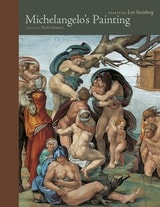
Michelangelo's Painting
Selected EssaysLeo Steinberg
University of Chicago Press, 2019
For half a century, Steinberg delved into Michelangelo’s work, revealing the symbolic structures underlying the artist’s highly charged idiom. This volume of essays and unpublished lectures elucidates many of Michelangelo’s paintings, from frescoes in the Sistine Chapel to the Conversion of St. Paul and the Crucifixion of St. Peter, the artist’s lesser-known works in the Vatican’s Pauline Chapel; also included is a study of the relationship of the Doni Madonna to Leonardo.
Steinberg’s perceptions evolved from long, hard looking. Almost everything he wrote included passages of old-fashioned formal analysis, but always put into the service of interpretation. He understood that Michelangelo’s rendering of figures, as well as their gestures and interrelations, conveys an emblematic significance masquerading under the guise of naturalism. Michelangelo pushed Renaissance naturalism into the furthest reaches of metaphor, using the language of the body to express fundamental Christian tenets once expressible only by poets and preachers.
Leo Steinberg was one of the most original art historians of the twentieth century, known for taking interpretive risks that challenged the profession by overturning reigning orthodoxies. Michelangelo’s Painting is the second volume in a series that presents Steinberg’s writings, selected and edited by his longtime associate Sheila Schwartz.
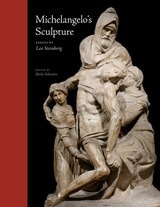
Michelangelo’s Sculpture
Selected EssaysLeo Steinberg
University of Chicago Press, 2018
For half a century, Steinberg delved into Michelangelo’s work, revealing the symbolic structures underlying the artist’s highly charged idiom. This volume of essays and unpublished lectures explicates many of Michelangelo’s most celebrated sculptures, applying principles gleaned from long, hard looking. Almost everything Steinberg wrote included passages of old-fashioned formal analysis, but here put to the service of interpretation. He understood that Michelangelo’s rendering of figures as well as their gestures and interrelations conveys an emblematic significance masquerading under the guise of naturalism. Michelangelo pushed Renaissance naturalism into the furthest reaches of metaphor, using the language of the body and its actions to express fundamental Christian tenets once expressible only by poets and preachers—or, as Steinberg put it, in Michelangelo’s art, “anatomy becomes theology.”
Michelangelo’s Sculpture is the first in a series of volumes of Steinberg’s selected writings and unpublished lectures, edited by his longtime associate Sheila Schwartz. The volume also includes a book review debunking psychoanalytic interpretation of the master’s work, a light-hearted look at Michelangelo and the medical profession and, finally, the shortest piece Steinberg ever published.
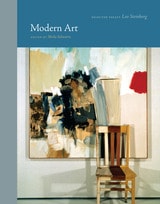
Modern Art
Selected EssaysLeo Steinberg
University of Chicago Press, 2023
Leo Steinberg was one of the most original art historians of the twentieth century, known for taking interpretive risks that challenged the profession by overturning reigning orthodoxies. In essays and lectures ranging from old masters to modern art, he combined scholarly erudition with eloquent prose that illuminated his subject and a credo that privileged the visual evidence of the image over the literature written about it. His writings, sometimes provocative and controversial, remain vital and influential reading. Steinberg’s perceptions evolved from long, hard looking at his objects of study. Almost everything he wrote included passages of formal analysis that were always put into the service of interpretation.
Following the series publication on Pablo Picasso, this volume focuses on other modern artists, including Cézanne, Monet, Matisse, Max Ernst, Jasper Johns, Robert Rauschenberg, Roy Lichtenstein, Hans Haacke, and Jeff Koons. Included are seven unpublished lectures and essays, Steinberg’s landmark essay “Encounters with Rauschenberg,” a survey of twentieth-century sculpture, and an examination of the role of authorial predilections in critical writing. The final chapter presents a collection of Steinberg’s humorous pieces, witty forays penned for his own amusement.
Modern Art is the fifth and final volume in a series that presents Steinberg’s writings, selected and edited by his longtime associate Sheila Schwartz.
Music in the World
Selected EssaysTimothy D. Taylor
University of Chicago Press, 2017
In addition to chapters on music, capitalism, and globalization, Music in the World includes previously unpublished essays on the continuing utility of the concept of culture in the study of music, a historicization of treatments of affect, and an essay on value and music. Taken together, Taylor’s essays chart the changes in different kinds of music in twentieth- and twenty-first-century music and culture from a variety of theoretical perspectives.
Mutants
Selected EssaysToby Litt
Seagull Books, 2016
Praise for Toby Litt
“A genuinely individual talent with a positive relish for dealing with the contemporary aspects of the modern world.”—Scotsman
“Toby Litt is awfully good—he gives something new every time he writes.”—Muriel Spark
“He has invented a fresh, contemporary style—it will sing in the ears of this generation.”—Malcolm Bradbury
No Evil Star
Selected Essays, Interviews, and ProseAnne Sexton
University of Michigan Press, 1985
On Economics and Society
Selected EssaysHarry G. Johnson
University of Chicago Press, 1982
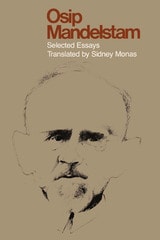
Osip Mandelstam
Selected EssaysTranslated by Sidney Monas
University of Texas Press, 1977
Osip Mandelstam, who died anonymously in a Siberian transit-camp in 1938, is now generally considered to be among the four or five greatest Russian poets of the twentieth century. The essays in this volume, presented in an exceptionally scrupulous and true translation, were selected because they represent Mandelstam's major poetic themes and his thought on literature, language and culture, and the work and place of the poet. Mandelstam's views on literature are profound and original, and they are expressed in striking and dramatic, if sometimes difficult, prose. These essays deal with such topics as the poetic process and the relationship of poetry to politics, culture, the traditions of the past, and the demands of the present.
Sidney Monas's lively introduction to the work and life of Mandelstam combines the virtues of both the critical essay and detached scholarship. Keeping biographical detail to a minimum, Monas concentrates on the pattern that runs through the essays and lends them that coherence often noted in Mandelstam's poetry.
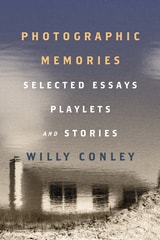
Photographic Memories
Selected Essays, Playlets, and StoriesWilly Conley
Gallaudet University Press, 2023
Original photographs taken by the author accompany his writings and invite the reader to contemplate the often-blurred lines between reality and memory.
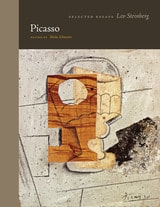
Picasso
Selected EssaysLeo Steinberg
University of Chicago Press, 2022
Leo Steinberg was one of the most original art historians of the twentieth century, known for taking interpretive risks that challenged the profession by overturning reigning orthodoxies. In essays and lectures ranging from old masters to modern art, he combined scholarly erudition with eloquent prose that illuminated his subject and a credo that privileged the visual evidence of the image over the literature written about it. His writings, sometimes provocative and controversial, remain vital and influential reading. Steinberg’s perceptions evolved from long, hard looking at his objects of study. Almost everything he wrote included passages of formal analysis but always put into the service of interpretation.
This volume brings together Steinberg’s essays on Pablo Picasso, many of which have been studied and debated for decades, such as “The Philosophical Brothel,” as well as unpublished lectures, including “The Intelligence of Picasso,” a wide-ranging look at Picasso’s enduring ambition to stretch the agenda of representation, from childhood drawings to his last self-portrait. An introduction by art historian Richard Shiff contextualizes these works and illuminates Steinberg’s lifelong dedication to refining the expository, interpretive, and rhetorical features of his writing.
Picasso is the fourth volume in a series that presents Steinberg’s writings, selected and edited by his longtime associate Sheila Schwartz.
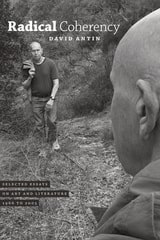
Radical Coherency
Selected Essays on Art and Literature, 1966 to 2005David Antin
University of Chicago Press, 2011
“We got to talking”—so David Antin begins the introduction to Radical Coherency, embarking on the pursuit that has marked much of his breathless, brilliantly conversational work. For the past forty years, whether spoken under the guise of performance artist or poet, cultural explorer or literary critic, Antin’s innovative observations have helped us to better understand everything from Pop to Postmodernism.
Intimately wedded to the worlds of conceptual art and poetics, Radical Coherency collects Antin’s influential critical essays and spontaneous, performed lectures (or “talk pieces”) for the very first time, capturing one of the most distinctive perspectives in contemporary literature. The essays presented here range from the first serious assessment of Andy Warhol published in a major art journal, as well as Antin’s provocative take on Clement Greenberg’s theory of Modernism, to frontline interventions in present debates on poetics and fugitive pieces from the ’60s and ’70s that still sparkle today—and represent a gold mine for art historians of the period. From John Cage to Allan Kaprow, Mark Rothko to Ludwig Wittgenstein, Antin takes the reader on an idiosyncratic, personal journey through twentieth-century culture with his trademark antiformalist panache—one thatwill be welcomed by any fan of this consummate trailblazer.
Renaissance Reflections
Selected EssaysArthur F. Kinney
University of Massachusetts Press, 2014
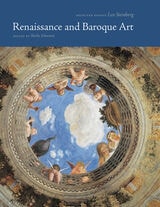
Renaissance and Baroque Art
Selected EssaysLeo Steinberg
University of Chicago Press, 2020
This volume begins and ends with thematic essays on two fundamental precepts of Steinberg’s art history: how dependence on textual authority mutes the visual truths of images and why artists routinely copy or adapt earlier artworks. In between are fourteen chapters on masterpieces of renaissance and baroque art, with bold and enlightening interpretations of works by Mantegna, Filippo Lippi, Pontormo, El Greco, Caravaggio, Steen and, finally, Velázquez. Four chapters are devoted to some of Velázquez’s best-known paintings, ending with the famously enigmatic Las Meninas.
Renaissance and Baroque Art is the third volume in a series that presents Steinberg’s writings, selected and edited by his longtime associate Sheila Schwartz.
Science, Curriculum, and Liberal Education
Selected EssaysJoseph J. Schwab
University of Chicago Press, 1982
Schwab participated in what Daniel Bell has described as the "most thoroughgoing experiment in general education in any college in the United States," the College of the University of Chicago during the thirties, forties, and fifties. He played a central role in the curriculum reform movement of the sixties, and his extraordinary command of science, the philosophy of science, and traditional and modern views of liberal education found expression in these exceptionally thoughtful essays.
Selected Essays
Oscar W. Firkins
University of Minnesota Press, 1933
Selected Essays was first published in 1933. Minnesota Archive Editions uses digital technology to make long-unavailable books once again accessible, and are published unaltered from the original University of Minnesota Press editions.
Professor Firkins' reputation as a writer whose work combines the qualities of thought and style, of penetrating criticism and epigrammatic wit, is amply upheld by these seventeen essays.
The volume opens with "Man: A Character Sketch," which Christopher Morley has described as a "brilliant essay in spiritual anthropology." Emerson and Howells, on both of whom Mr. Firkins was a recognized authority, are each the subject of an essay. Glimpses of the author's boyhood and of his remarkable mother are given in "Undepicted America," which is the development of an original theory concerning American letters. In "The Irresponsible Power of Realism" the author flays some modern tendencies in literature and in "The Sermon on the Mount" he sets forth the basic principles of his humanistic religious views.
A few of these essays are here published for the first time. Most of them, however, have been selected as representative of Mr. Firkins' best published work in the field of the critical essay.
Selected Essays and Dialogues by Gianni Celati
Adventures into the Errant FamiliarEdited and Translated by Patrick Barron
University College London, 2024
Selected Essays and Dialogues is a collection of translations of Italian essayist Gianni Celati’s theoretical and musing work from the late 1960s to the present. Its topics range from environmental perception and archaeological conceptions of historical knowledge to street theater, writing, photography, cinema, and translation. The book provides a framework of key literary, theoretical, and artistic movements of the past fifty years, as well as a guide for English-language readers to place Celati’s work in historical, cultural, and biographical contexts.
Celati’s fondness for the unexpected ordinary tempts readers to wander and become lost in the webs of his daring thoughts. Indeed, a genial adventurousness can be found within all of his writings collected here, driven by an affectionate and light-hearted engagement with the surrounding world. This collection offers a taste of his adventures of the mind and body, led by a lithe sensitivity not restricted to the so-called high arts or letters, but also very much engaged with the everyday lives, places, and tales we all constantly share.
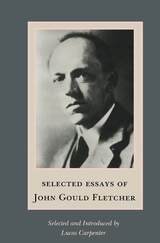
Selected Essays of John Gould Fletcher
John Fletcher
University of Arkansas Press, 1989
Selected Essays of John Gould Fletcher brings together for the first time a representative selection from Fletcher’s voluminous critical writings. Ranging in subject from Modernist poetics to Asian art, these essays reveal a keen, insightful intellect coming to grips with the central artistic problems of the most revolutionary period in modern literature, painting, music, and philosophy.
First published in Poetry, North American Review, Southern Review, and Criterion, and other leading cultural journals of their day, Fletcher’s essays are arranged in three groups: poetry and poetics; appreciation of individual writers; and essays on art and philosophy.
Significant and long overdue both in terms of the light it sheds on Fletcher and the evolution of the Modernist movement, the collection should challenge all serious students of literature and general readers alike.
Selected Essays on Rhetoric
Thomas De Quincey, Edited with a Critical Introduction by Frederick Burwick. Foreword by David Potter
Southern Illinois University Press, 1967
The five essays presented here—Rhetoric, Style, Language, Conversation, and Greek Literature—were published together for the first time in The Collected Writings of Thomas De Quincey in 1889–1890. Frederick Burwick brings the essays together again in this volume, introducing them by tracing the sources and development of a belletristic theory of rhetoric, which he says “is one of the most original, and for a few critics, the most puzzling of the nineteenth century.” Burwick makes the edition complete with a comprehensive index and a selected bibliography.
Selected Essays
Viacheslav IvanovViacheslav Ivanov
Northwestern University Press, 2003
A poet, critic, and theoretician during the Silver Age of Russian poetry, at the turn of the twentieth century, Viacheslav Ivanov was dubbed "Viacheslav the Magnificent" by his contemporaries for his erudition, sumptuous and allusive poetry, and brilliant essays. He provided Russian Symbolism with theoretical underpinnings based on classical and biblical mythology, the aesthetics of music, philosophy ranging from Plato and Kant to Schopenhauer and Nietzsche, and a profound knowledge of classical and modern European poetry.
In choosing material for this volume of essays, Robert Bird and Michael Wachtel have covered a broad range of Ivanov's interests: the aesthetics of Symbolism, theater, culturological concerns, and on such influential figures of the period as Nietzsche, Solovyov, Tolstoy, and Scriabin. Also included are extensive notes on the essays in which classical, biblical, and poetic citations and allusions are identified, the aesthetic and theoretical contexts are clarified, and certain translation problems are briefly discussed. This volume provides valuable insight into the theory of Symbolism as it developed in Russia.
State, Space, World
Selected EssaysHenri Lefebvre
University of Minnesota Press, 2009
State, Space, World collects a series of Lefebvre’s key writings on the state from this period. Making available in English for the first time the as-yet-unexplored political aspect of Lefebvre’s work, it contains essays on philosophy, political theory, state formation, spatial planning, and globalization, as well as provocative reflections on the possibilities and limits of grassroots democracy under advanced capitalism.
State, Space, World is an essential complement to The Production of Space, The Urban Revolution, and The Critique of Everyday Life. Lefebvre’s original and prescient analyses that emerge in this volume are urgently relevant to contemporary debates on globalization and neoliberal capitalism.
The Act and the Place of Poetry
Selected EssaysYves Bonnefoy
University of Chicago Press, 1989
The Author's Dimension
Selected EssaysChrista Wolf
University of Chicago Press, 1995
"An important publication, ably served by the editing of Alexander Stephan; the knowledgeable translation by Jan Van Heurck; and Grace Paley's sisterly introduction, which . . . claims at least the later Christa Wolf for a pacifist feminism."—Peter Demetz, New York Times
The Black Experience in America
Selected EssaysEdited by James C. Curtis and Lewis L. Gould
University of Texas Press, 1970
In the fall of 1968, the University of Texas at Austin sponsored a series of public lectures delivered by outstanding students of the black past in an effort to clarify the role of the African American in America’s history. This volume of essays by eight of the ten participants makes the lectures available to a broader public.
The essays demonstrate that the black experience in America has been integral throughout the nation’s history. Although each contributor deals with a different aspect of this experience, they all share a common commitment to sound historical scholarship. The essays also reflect the intensive research in the field of black history during a time of high racial tension.
Henry Allen Bullock, in an exploration of education in the slave experience, shows that, despite organized attempts to dehumanize the Negro, the black man’s position in the American social order was not static. By training and educating the Negro, the slaveowner was weakening the peculiar institution and preparing the slave for freedom. In the field of cultural anthropology, which had largely ignored blacks in the United States, William S. Willis, Jr., examines the interaction of whites, blacks, and Indians on the Southern colonial frontier. Arthur Zilversmit traces the development of abolitionist attitudes from patience to militance and points out that both those reformers who abandoned action and those who demanded radical violent change were forced into their positions by society’s failure to listen to the arguments of moderate reformers.
William S. McFeely takes a fresh look at the Reconstruction era, one of the only times in American history when white Americans have even come close to wanting for black Americans what black Americans wanted for themselves. In a discussion of protest against segregated streetcars in the South, August Meier and Elliott Rudwick show that the boycotts of the late 1950s had their counterparts in more than twenty-five Southern cities between 1900 and 1906. Thomas R. Cripps attacks the myth of the Southern box office and shows how Hollywood’s own timidity fostered racial stereotyping in American movies. Robert L. Zangrando outlines the role of the NAACP, founded in 1909, in the evolution of civil rights protests during the mid-twentieth century. He argues that the organization’s precarious position in American society prevented it from exercising strong leadership within the black community. Louis R. Harlan concludes the volume by assessing the past and looking toward the future of black history in America.
The Classical Moment
Selected Essays on Knowledge and Its PleasuresJames V. Schall
St. Augustine's Press, 2014
The essay is one of the great inventions of the human mind. It can talk about anything and everything. It can be lightsome or solemn. It can be witty or informative. Above all, it is short. It likes the passage in which Socrates told Callicles in the Gorgias to make his answers brief. Yet, we can find in essays things we need and want to know. Aquinas often managed to make the most profound arguments in two paragraphs. Samuel Johnson did the same.
The Classical Moment is, indeed, a collection of “selected essays.” Such a collection is a classical and beloved form of English letters, the literary form most preferred by Schall.
The essays in this book all touch on knowledge and its pleasures. Schall does not tarry on the effort and determination it often takes to say just what we want to say, then say it and know that we have said it. Somehow, when an essay is written, an author simply knows that it is complete, that it is what he wanted to say. He says to himself, “Yes, that is it.” An essayist may well be conscious that when he begins an essay, he really does not know what he will finally say. The writing is the saying. Our writing is our thinking, our thinking-through, our being pleased to know this is it . . . this is the point Schall, one of America’s greatest essayists, makes here.
The “classical moment” is that intense experience of seeing or hearing or encountering some vista, or song, or person that takes us out of ourselves. We are most ourselves somehow when we are most outside of ourselves, seeing what is not ourselves. We are intended to be more than ourselves in being ourselves, to know with others what is the truth, to know what is.
These essays originally appeared in regular columns done in various journals, papers, and on-line sources. One can read them in any order. The order of the author or collector does have a certain “logic,” but each essay is also a whole, something contained within itself.
The unity of an essay collection is found more in a kind enthrallment that comes to us when we deal with the things that are both important and delightful. At bottom, these essays belong together. Aristotle warned us that if we did not delight in the things that are, we would seek our highest pleasures where they are not really found.
We will always seek something to delight in. What civilization is about lies in finding what is really worthy of the capacity of delight that is given to us in our being. The “classical moment” is the perfect phrase that brings us to the threshold of this experience. We have to enter it ourselves, but once inside, we will find so much more than ourselves. And we will rejoice.
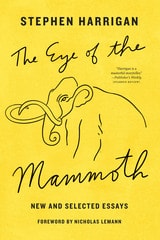
The Eye of the Mammoth
New and Selected EssaysBy Stephen Harrigan; foreword by Nicholas Lemann
University of Texas Press, 2013
History—natural history, human history, and personal history—and place are the cornerstones of The Eye of the Mammoth. Stephen Harrigan's career has taken him from the Alaska Highway to the Chihuahuan Desert, from the casinos of Monaco to his ancestors' village in the Czech Republic. And now, in this new edition, he movingly recounts in "Off Course" a quest to learn all he can about his father, who died in a plane crash six months before he was born.
Harrigan's deceptively straightforward voice belies an intense curiosity about things that, by his own admission, may be "unknowable." Certainly, we are limited in what we can know about the inner life of George Washington, the last days of Davy Crockett, the motives of a caged tiger, or a father we never met, but Harrigan's gift—a gift that has also made him an award-winning novelist—is to bring readers closer to such things, to make them less remote, just as a cave painting in the title essay eerily transmits the living stare of a long-extinct mammoth.
The Lure and the Truth of Painting
Selected Essays on ArtYves Bonnefoy
University of Chicago Press, 1995
The sixteen essays collected here show the breadth and depth of Bonnefoy's writings on art, aesthetics, and poetics. His lyrical ruminations range across centuries and cultures, from Byzantium to postwar France, from the paintings of Piero della Francesca to the sculptures of Alberto Giacometti and the photographs of Henri Cartier-Bresson, from the Italian Giorgio Morandi to the American Edward Hopper. Always fascinated in his poetry by the nature of color and light and the power of the image, Bonnefoy continues to pursue these themes in his discussion of the lure and truth of representation. He sees the painter as a poet whose language is a visual one, and seeks to find out what visual artists can teach those who work with words. More philosophical than historical and more poetic than critical, the essays express Bonnefoy's deep sympathy for the creative process and his great passion for individual works of art.
Bonnefoy's engagement with great art in The Lure and the Truth of Painting sheds light on the philosophy of presence and being that animates his poems. This book will be welcomed by lovers of Bonnefoy's poems and by everyone interested in the creation, history, and appreciation of art.
Yves Bonnefoy's numerous books include New and Selected Poems and In the Shadow's Light, both published by the University of Chicago Press. Richard Stamelman is director of the Center for Foreign Languages, Literatures, and Cultures and professor of romance languages at Williams College. He is the author of Lost beyond Telling: Representations of Death and Absence in Modern French Poetry.
"Few exponents of contemporary French letters deserve the attention of the reading public in America more than Yves Bonnefoy. . . . [His] writings . . . are an important lighthouse on the contemporary cultural coastline."—Emily Grosholz, The Hudson Review
The Mirror Diary
Selected EssaysGarrett Hongo
University of Michigan Press, 2017
The Mirror Diary tracks the emergence of an original poetic voice and a learned consciousness amid multiple and sometimes competing influences of complex literary traditions and regional and ethnic histories. Beginning with a literary inquiry into the history of Japanese Americans in Hawai`i and California, Garrett Hongo draws on his own history to consider the mosaic of American identities—personal, cultural, and poetic—in the context of a postmodern diaspora.
Hongo’s essays attest to the breadth of what he considers his cultural inheritance and literary antecedents, ranging from the poets of China’s T’ang Dynasty to American poets such as Walt Whitman and Charles Olson. He explains free-verse prosody by way of John Coltrane’s jazz; praises his contemporaries, poets David Mura, Edward Hirsch, and Mark Jarman; and acknowledges his mentors, Bert Meyers and Charles Wright. In other pieces he engages with controversies and contestations in contemporary Asian American literature, confronts the politics of race and the legacy of Japanese American internment during World War II, offers paeans to the Hawaiian landscape, and addresses immigrants newly arrived in America with a warm welcome. The Mirror Diary is the work of a poet fully engaged with contemporary politics and poetics and committed to the study and celebration of diverse traditions.
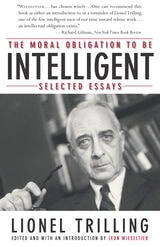
The Moral Obligation to Be Intelligent
Selected EssaysLionel Trilling
Northwestern University Press, 2009
Bringing together the thoughts of one of American literature’s sharpest cultural critics, this compendium will open the eyes of a whole new audience to the work of Lionel Trilling. Trilling was a strenuous thinker who was proud to think “too much.” As an intellectual he did not spare his own kind, and though he did not consider himself a rationalist, he was grounded in the world.
This collection features 32 of Trilling’s essays on a range of topics, from Jane Austen to George Orwell and from the Kinsey Report to Lolita. Also included are Trilling’s seminal essays “Art and Neurosis” and “Manners, Morals, and the Novel.” Many of the pieces made their initial appearances in periodicals such as The Partisan Review and Commentary; most were later reprinted in essay collections. This new gathering of his writings demonstrates again Trilling’s patient, thorough style. Considering “the problems of life”—in art, literature, culture, and intellectual life—was, to him, a vital occupation, even if he did not expect to get anything as simple or encouraging as “answers.” The intellectual journey was the true goal.
No matter the subject, Trilling’s arguments come together easily, as if constructing complicated defenses and attacks were singularly simple for his well-honed mind. The more he wrote on a subject and the more intricate his reasoning, the more clear that subject became; his elaboration is all function and no filler. Wrestling with Trilling’s challenging work still yields rewards today, his ideas speaking to issues that transcend decades and even centuries.
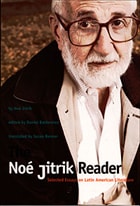
The Noé Jitrik Reader
Selected Essays on Latin American LiteratureNoé Jitrik
Duke University Press, 2005
The Noé Jitrik Reader showcases Jitrik’s reflections on marginality and the canon, exile and return, lack and excess, autobiography, Argentine nationalism, the state of literary criticism, the avant-garde, and the so-called Boom in Latin American literature. Among the writers whose work he analyzes in the essays collected here are Jorge Luis Borges, Esteban Echeverría, Domingo Faustino Sarmiento, José Martí, César Vallejo, José Bianco, Juan Carlos Onetti, José María Arguedas, Julio Cortázar, and Augusto Roa Bastos. The Noé Jitrik Reader offers English-language readers a unique opportunity to appreciate the rigor and thoughtfulness of one of Latin America’s most informed and persuasive literary critics.
Why Are You Here and Not Somewhere Else
Selected EssaysHarry L. Davis
University of Chicago Press, 2013
On the occasion of the fiftieth anniversary of Davis’s arrival at the Booth School, Why Are You Here and Not Somewhere Else offers seven essays by Davis that offer new perspectives and contribute to a more well-rounded understanding of business education. Adapted from convocation addresses given by Davis at different points during his five-decade career, the essays encapsulate the spirit of business education at the Booth School, while at the same time providing encouraging, invaluable wisdom for those about to embark on business careers or take on leadership positions. Topics addressed range from the role of the university in the business world to the crucial role of intangible values in shaping one’s career.
Davis has been a formative influence on more executives and leaders than perhaps any other business educator living today, and Why Are You Here and Not Somewhere Else provides a unique and valuable perspective on how leaders in business and elsewhere can shape and define their careers in new ways.
William Troy
Selected EssaysStanley E. Hyman
Rutgers University Press, 1999